
DAILY: BYD To Develop Cars In Europe, Mazda Retreats To Hybrids and German Automakers Still Fighting Clean Air Targets | 13 May 2026
About this episode
BYD says it will launch Europe-designed cars for European consumers within three years, while Mazda retreats from dedicated EV plans to 2029 and leans harder on mild hybrids. Opel/Vauxhall shares early details of the electric Corsa GSE, and German automakers keep pushing back against EU clean-air targets. The show also covers smarter depot charging to extend battery life, Lucid’s delayed UK rollout to 2028, and UK policy tweaks that reshape electric-van testing and boost the used EV market.
You can read all the latest news on the blog here: https://EVne.ws/blog
Subscribe for free and listen to the podcast on audio platforms:
➤ Apple: https://EVne.ws/apple
➤ YouTube Music: https://EVne.ws/youtubemusic
➤ Spotify: https://EVne.ws/spotify
➤ TuneIn: https://EVne.ws/tunein
➤ iHeart: https://EVne.ws/iheart
BYD PLANS EUROPE-BUILT CARS FOR EUROPE https://evne.ws/4dG4jMX
MAZDA DELAYS DEDICATED EV TO 2029 https://evne.ws/4u4YKNR
AUTOMAKERS SEEK NEW EU CO2 CONCESSIONS https://evne.ws/4ua4O7K
OPEL PREVIEWS 207 KW CORSA GSE https://evne.ws/4npat7D
AUSTRALIA DELAYS FEDERAL EV ROAD CHARGE https://evne.ws/4f32vPt
GERMAN OPERATORS BACK ELECTRIC TRUCKS https://evne.ws/48W6Kbz
AI CHARGING METHOD CUTS EV BATTERY WEAR https://evne.ws/4d89o0j
FIRST BUS TESTS DEPOTS AS GRID ASSETS https://evne.ws/4nrLMaA
LUCID PUTS UK LAUNCH BACK TO 2028 https://evne.ws/3RlOVfY
UK E-VAN RULES EASE FROM 2026 https://evne.ws/49r6OAg
UK USED EV SALES HIT Q1 RECORD https://evne.ws/4d99qVU
flash charging
"Over an hour spin-off show EV news China today we're talking about byd adding flash charging to even small cars like the Ato 3 that's their 1,500 kilowatts 1.5 megawatt charging technology... [37.3s] Let's get into it byd say they'll launch a series of cars designed in Europe..."
Flash charging means charging the battery very quickly. The idea is to reduce the time you spend plugged in compared with normal charging.
Flash charging is a marketing term for very fast battery charging, typically using high-power charging infrastructure. The episode ties it to BYD’s plan to bring higher-power charging to smaller cars, emphasizing speed of charging as a competitive advantage.
1.5 megawatt charging technology
"...adding flash charging to even small cars like the Ato 3 that's their 1,500 kilowatts 1.5 megawatt charging technology... [37.3s] Let's get into it byd say they'll launch a series of cars designed in Europe..."
This is a claim about charging at extremely high power—about 1,500 kilowatts. In simple terms, it’s aiming for much faster charging, but it only works if the charging station and the car are built for it.
1.5 megawatt charging technology refers to extremely high charging power (1.5 MW = 1,500 kW). Charging power at this level is meant to dramatically shorten charging times, but it also depends on the availability of compatible high-power chargers and the car’s battery and thermal systems.
plug-in hybrid
"The shift starts with the Dolphin G now is a tiny plug-in hybrid they're gonna run Violet in June... the Dolphin G is a plug-in hybrid super mini. [76.7s] It serves as the combustion engine alternative to the all electric Dolphin surf byd says it'll be the smallest plug-in hybrid on sale."
A plug-in hybrid can be charged like an EV, but it also has a gas engine. You can drive on electricity for shorter trips, then switch to gas when needed.
A plug-in hybrid (PHEV) is a hybrid car that can be charged from an external power source. It typically uses both an electric motor and a combustion engine, letting short trips be done on electricity while longer trips can rely on the engine.

BYD Dolphin G
"The shift starts with the Dolphin G now is a tiny plug-in hybrid they're gonna run Violet in June... with a whole bunch of byd stuff like densers the Dolphin G is a plug-in hybrid super mini. [76.7s] It serves as the combustion engine alternative to the all electric Dolphin surf byd says it'll be the smallest plug-in hybrid on sale."
The BYD Dolphin G is a small plug-in hybrid. That means it can run on electricity sometimes, but it also has a combustion engine for when you need it.
BYD Dolphin G is described as a tiny plug-in hybrid (PHEV) that BYD positions as a smaller alternative to a fully electric Dolphin. It’s notable here because BYD is planning a European launch strategy and is explicitly framing the Dolphin G as the “combustion engine alternative” to the all-electric Dolphin.
mild hybrid
"Mazda has pushed back their first EV by dedicated EV I should say by two years to 2029 and cut their EV investment by nearly half it shifted resources towards mild hybrids and Chinese made EVs that'll be re-badged as Mazda. [165.2s] Mazda relies on Toyota licensed gas guzzling mild hybrid technology at the moment."
A mild hybrid has a small electric assist system, but it’s not a full EV. The electric part mainly helps the gas engine work more efficiently and recovers energy when you slow down.
A mild hybrid uses a small electric motor to assist the combustion engine, but it can’t usually drive the car purely on electricity for long distances. It’s often used to improve efficiency and reduce emissions by helping with acceleration and enabling more regenerative braking.
dedicated EV
"Mazda has pushed back their first EV by dedicated EV I should say by two years to 2029 and cut their EV investment by nearly half it shifted resources towards mild hybrids... [147.8s] Mazda calls its EV strategy an intentional follower and that's OK..."
A dedicated EV is built specifically to be electric, not just modified from a gas car. That helps the battery and electric parts fit better and work more efficiently.
A dedicated EV is designed from the ground up as an electric vehicle, rather than being converted from a gas-car platform. That usually allows better packaging for the battery and electric drivetrain, and it can improve efficiency and performance.
Toyota
"Mazda relies on Toyota licensed gas guzzling mild hybrid technology at the moment. [176.7s] Their new hybrids would be a little more under Mazda's control even as it cuts back on their EV spending..."
Toyota is referenced as the company whose hybrid technology Mazda is using. Licensing means Mazda can use Toyota’s proven system instead of inventing a new one.
Toyota is mentioned as the source of “licensed” mild-hybrid technology that Mazda relies on. In practice, licensing means Mazda uses Toyota’s established hybrid system designs under agreement rather than developing everything from scratch.
clean air targets
"European automakers the likes of Volkswagen BMW and Mercedes Benz met with EU officials today in Brussels to argue for further concessions to the blocks aim to clean up lung busting pollution which puts all of our health futures at risk. [223.1s] The German car industry won big concessions only months ago and they're not happy."
Clean air targets are rules meant to reduce pollution from cars. The episode is saying automakers are trying to delay or soften those rules, while regulators want them to be stricter.
Clean air targets are regulatory goals set by governments (here, the EU) to reduce harmful pollution from vehicles. The episode frames it as a business fight: automakers want more flexibility on timelines while regulators push for tighter limits to cut health-damaging emissions.
2035 target
"They now want even more flexibility to blow past the 2035 target to who knows when with their emissions generating vehicles... [242.9s] and decades down the line when those auto execs have long since retired..."
The 2035 target is a future deadline for stricter vehicle pollution rules. Automakers are lobbying to have more time or flexibility to meet it.
The “2035 target” refers to a future regulatory deadline for reducing vehicle emissions in the EU. The episode describes automakers lobbying for more flexibility to extend or delay compliance, which directly affects how quickly they must shift to lower-emission powertrains.

Opel Corsa GSE
"Let's talk about Opel slash Vauxhall. Opel has shown the first images of the Corsa GSE. It's an all-electric hot hatch some would say mild hatch but still they're calling it a hot hatch that will sit underneath the Mocha GSE. [333.8s] Opel slash Vauxhall says it will be the fastest accelerating production car they've ever built."
The Opel Corsa GSE is an electric version of the Corsa that Opel is marketing as a sporty “hot hatch.” It’s meant to be quick off the line compared with typical small EVs.
Opel Corsa GSE is presented as an all-electric hot hatch, positioned as a performance-oriented version of the Corsa lineup. The episode highlights it because Opel claims strong acceleration for a production car, and it’s part of the brand’s shift toward EVs.
hot hatch
"Opel has shown the first images of the Corsa GSE. It's an all-electric hot hatch some would say mild hatch but still they're calling it a hot hatch... [349.4s] Probably says a lot about the kind of cars that they've been selling."
A hot hatch is a sporty small hatchback. It’s usually tuned to feel more exciting to drive than a regular version.
A hot hatch is a performance-focused hatchback, typically tuned for quicker acceleration and sharper handling than a standard family hatch. In EV terms, the label is often used to signal sporty driving feel and strong launch performance rather than just efficiency.
ECMP platform
"The shift started with the Mocha GSE leading the electric performance of Opel slash Vauxhall. The Corsa now follows on Stalantas' ECMP platform."
An “ECMP platform” is basically the shared design and engineering base a company uses for multiple electric cars. It helps them build different models more efficiently because they reuse a lot of the same underlying structure.
An ECMP platform is a shared vehicle architecture used across multiple brands for electric cars. Using a common platform helps automakers reduce development costs and standardize key components like the powertrain layout and electronics.
permanent magnet motor
"Front mounted permanent magnet motor. 207 kW upgraded the battery's thermal management."
A permanent magnet motor is an electric motor that uses magnets to help generate the force that moves the car. It’s one of the common motor designs in EVs because it can be efficient and quick to respond.
A permanent magnet motor uses magnets in the rotor to create the magnetic field that drives torque. Compared with some other motor types, it can be efficient and responsive, which matters for EV acceleration and overall energy use.
battery's thermal management
"Front mounted permanent magnet motor. 207 kW upgraded the battery's thermal management."
Thermal management is how the car keeps the battery at the right temperature. If the battery runs too hot or too cold, it can perform worse and wear out faster.
Battery thermal management is the system that controls battery temperature using cooling/heating and control logic. Keeping the pack in an optimal temperature range helps performance consistency and can reduce long-term degradation.
limited slip diff
"With some new limited slip diff, lowered sport suspension, new axle tuning, new stabilizer tuning, new shock absorbers, new steering calibration and pedal calibration and new brakes as well."
A limited-slip diff helps the car put power to the wheel that has better grip. That can make the car feel more controlled when the road is slippery or when you accelerate hard.
A limited-slip differential (limited slip diff) helps manage wheel slip when traction isn’t equal left-to-right. In EVs, it can improve grip and stability during hard acceleration or cornering by biasing torque toward the wheel with more traction.
road user charge
"The pause follows the high-course ruling that struck down Victoria's EV road charge. That decision forced Canberra to move with a little more care. A separate road user charge for New South Wales drivers is still on the cards for 2027."
A road user charge is a fee for using roads, usually based on how far you drive. The episode discusses plans to introduce or adjust these charges for EV drivers.
A road user charge is a fee based on how much you use the road, often calculated using distance traveled. In the transcript, it’s discussed as a policy tool to replace or supplement EV road charges that were struck down, and it’s tied to specific Australian states and timelines.
FBT exemption
"The budget also reshaped support for EV buyers. The government confirming that its electric car fringe benefits tax discount will be restructured. It'll now be a permanent budget measure... The full FBT exemption will narrow next April, applying only to EVs under $75,000 or below that that are purchased via innovative leases."
FBT exemption is a tax break for certain benefits, like when a company provides a car. The episode says the EV tax discount rules are changing, which could make EVs cost more (or less) depending on the deal.
FBT exemption refers to a tax benefit related to fringe benefits—commonly used for company-provided vehicles. In this episode, the hosts discuss how the EV fringe benefit tax discount is being restructured and narrowed by price and purchase method, which directly affects EV affordability for many buyers.
electric car fringe benefits tax discount
"The budget also reshaped support for EV buyers. The government confirming that its electric car fringe benefits tax discount will be restructured. It'll now be a permanent budget measure."
The electric car fringe benefits tax discount is a government incentive that reduces the tax impact of employer-provided EVs. Because it affects the total cost of an EV for many buyers, changing the discount rules can shift demand between EV models and purchase methods.
vehicle excise duty
"We want to pay our fair share, but a lot of people feel very spied on when they have to declare where and when they've gone, that kind of stuff. ... EVs for a long time were given a free pass, no road tax or vehicle excise duty as we call it."
Vehicle excise duty is a government fee that comes with owning or using a vehicle. The hosts are saying EVs used to be exempt, and now some people want them to pay more like everyone else.
Vehicle excise duty is a government charge tied to owning or using a vehicle. The episode contrasts EVs receiving a “free pass” (no road tax/vehicle excise duty) with the push to make EVs contribute more like other vehicles.
right hand drive
"And what about making right hand drive cars? Because they sell them in Europe in left hand drive. But what about here? The UK is still one of Europe's biggest EV markets."
Right-hand drive means the steering wheel is on the right side of the car. It’s needed in countries where people drive on the left, like the UK.
Right-hand drive (RHD) means the steering wheel is on the right side of the vehicle, which is required for countries that drive on the left. The episode discusses making right-hand-drive EVs for markets like the UK, where most cars are RHD.
battery electric trucks
"Okay, let's talk a little bit about a new German study by the Institute for Applied Ecology finding strong support for battery electric trucks."
Battery electric trucks are trucks that run on electricity stored in batteries. The hosts mention a study looking at how well these trucks work in real life compared to diesel.
Battery electric trucks are heavy-duty vehicles powered by rechargeable battery packs rather than diesel engines. The episode references a study of companies already operating these trucks to assess real-world satisfaction, reliability, and operating costs versus diesel.

Tesla Semi
"...d a bunch of companies that are already operating semi trucks if you want to call them those or heavy go..."
The Tesla Semi is an electric truck built for hauling goods. It’s discussed because it’s meant to replace diesel trucks for some routes, and that depends heavily on having the right charging setup.
The Tesla Semi is an all-electric heavy-duty truck designed for long-haul freight. It’s significant in EV news because it represents a major push to electrify commercial trucking, where energy use, charging infrastructure, and operating costs are central topics. The podcast mention of companies already operating “semi trucks” ties into how electric semis are being adopted alongside existing trucking fleets.
total cost of ownership
"But the main pain points were elsewhere. Not the vehicles. They said there's a higher upfront purchase price, but of course they look at total cost of ownership."
It means looking at what the vehicle really costs over time, not just what you pay upfront. For EVs, that usually includes charging costs and upkeep, not just the purchase price.
Total cost of ownership (TCO) is the full cost to buy, run, insure, and maintain a vehicle over time—not just the sticker price. For EVs, it often includes electricity costs, charging infrastructure, maintenance, and any financing or depreciation effects.
grid connection
"Really, it's about depot grid connections. Most charging happens at base... That was 1,115 kilowatt grid connection, which is nothing."
It’s the amount of electricity a charging depot can pull from the power company. If the connection is small, you can’t charge as quickly or as many vehicles at once.
A grid connection is how a charging site ties into the electric utility network and how much power it can draw. For depot charging, the available grid connection capacity can be the limiting factor for how fast and how often heavy vehicles can charge.
charging protocol
"Now largely, they will apply the same current and voltage to similar batteries regardless of age... It's still largely though a one size fits all approach."
It’s the “charging instructions” that the charger and battery follow. Different protocols can change how fast the battery charges and how much it stresses the battery.
A charging protocol is the set of rules a charger and vehicle follow—such as what current and voltage to apply over time. Standard protocols can treat batteries similarly, while smarter approaches adjust charging to the battery’s condition to reduce wear and improve longevity.
lithium plating
"Using the same charging protocol regardless of your own personal battery can speed up wear and raise the risk of lithium plating. Lithium plating happens when metallic lithium deposits on the electrode go there rather than being stored correctly."
It’s when an EV battery charges in a way that causes lithium to form deposits instead of storing energy properly. That can damage the battery and make it wear out faster.
Lithium plating is a battery failure mode where metallic lithium deposits on the electrode instead of staying in the normal storage process. It’s more likely under aggressive charging conditions (like high current, low temperature, or certain battery states), and it can increase degradation and reduce usable capacity.
digital twins
"Now the team trained their AI models in simulations using digital digital twins. Now digital twinning is a huge thing in the automotive industry."
A digital twin is a computer model that mimics a real system. Researchers can try charging strategies in the simulation first, then apply the best approach in the real world.
Digital twins are virtual replicas of real systems (like a battery pack or vehicle) used to test and optimize behavior without building everything physically first. In EV charging research, they can simulate how a specific battery responds to different charging strategies.
depot infrastructure project
"Now let's talk about first bus in the UK launching a depot infrastructure project alongside our national grid."
This is about installing charging equipment at the company’s home base (depot). It helps fleets charge their vehicles more reliably than depending only on public chargers.
A depot infrastructure project is an effort to build charging and power systems at a vehicle operator’s base (depot), rather than relying mostly on public chargers. For buses and other fleets, depot charging can be scheduled around fleet needs and grid conditions.
Lucid
"Integrate everything. I can't wait. Lucid say that they are putting back their UK launch to 2028. That makes three delays now for their British plans."
Lucid is an electric-car company. In this segment, they’re talking about Lucid’s plans for selling EVs in the UK and how they’re timing new model launches.
Lucid is an EV brand planning UK expansion and right-hand-drive models. The hosts discuss Lucid delaying its UK launch to 2028 and preparing a new midsize platform and multiple UK models.
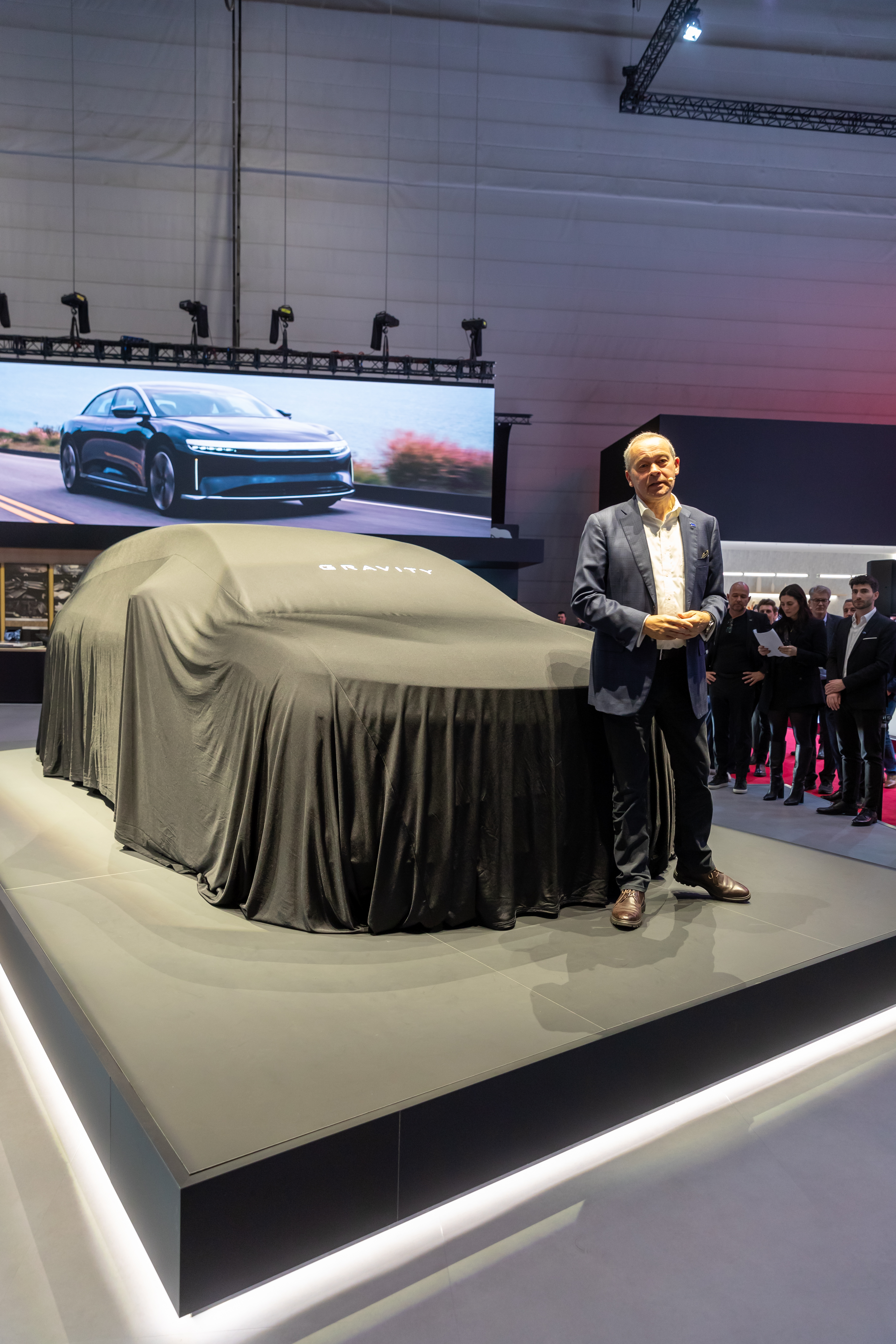
Lucid Gravity
"Of course we want right hand drive vehicles that are not going to reengineer the Lucid air their current saloon and they won't reengineer the gravity SUV either"
Lucid Gravity is Lucid’s electric SUV. They’re saying it can be adapted for the UK without completely redesigning the vehicle.
Lucid Gravity is Lucid’s electric SUV offering, positioned as a larger, family-oriented counterpart to the Air. The discussion suggests Lucid plans to adapt it for UK right-hand-drive without a full reengineering effort.

Lucid Air
"Of course we want right hand drive vehicles that are not going to reengineer the Lucid air their current saloon and they won't reengineer the gravity SUV either"
Lucid Air is Lucid’s main electric sedan. They’re saying it won’t need a major redesign just to sell in the UK with right-hand driving.
Lucid Air is Lucid’s flagship electric sedan, known for its long-range focus and efficiency-first design. The segment notes that Lucid won’t reengineer the Air for the UK’s right-hand-drive market, implying the existing platform can be adapted for steering layout.
Lucid Cosmos
"Production begins by the end of the year though on the midsize Lucid unveiling at their first investor day back in March the first UK model would be the cosmos that's a coupé style crossover"
Lucid Cosmos is a new Lucid model they’re planning to bring to the UK first. The hosts describe it as a coupe-style crossover and part of the company’s UK launch timeline.
Lucid Cosmos is described as a coupe-style crossover that would be the first UK model. The segment treats it as a key product in Lucid’s UK rollout plan, with production starting by the end of the year.
Lucid Earth
"then it'll be the earth a rugged variant third model is going to follow as well"
Lucid Earth is another upcoming Lucid model, described as a rugged version. It’s mentioned as the next step after the Cosmos for the UK lineup.
Lucid Earth is mentioned as a rugged variant that would follow the Cosmos in the UK lineup. The segment frames it as part of a multi-model rollout from Lucid’s new midsize platform.
EV vans
"The UK government is going to remove some barriers for EV vans. So this is if you buy an electric van that weighs between three and a half and four and a quarter tons."
An EV van is a delivery/work van that runs on electricity. The rules for them can depend on how heavy they are and what they’re used for.
“EV vans” are delivery or work vans powered by electricity instead of a combustion engine. In the UK, regulations can treat these differently based on vehicle weight and how they’re used.
battery electric vans
"There's been years of lobbying from fleets that argue that battery electric vans are unfairly punished because battery packs big ones anyway."
Battery electric vans run only on electricity from batteries. The episode says rules can treat them differently than diesel vans, partly because they can be heavier.
Battery electric vans are vans powered entirely by electricity stored in onboard battery packs. The segment discusses how policy can treat them differently from diesel vans, especially when weight pushes them into certain regulatory thresholds.
HGVs
"And under the new rules these new larger electric vans mean that they don't get treated has heavy goods vehicles HGVs because the HGVs here have a whole different testing regime a bit like pickup trucks in China."
HGVs are heavy commercial trucks. If a vehicle is classified as an HGV, it has different rules and tests than lighter vehicles.
HGVs means “heavy goods vehicles,” a UK/EU category for larger, heavier commercial trucks. The segment explains that certain heavier electric vans can avoid being classified as HGVs, which changes the testing and regulatory regime they fall under.
tachograph
"Electric vans in that weight band will now move into the new framework which effectively removes the mandatory tachograph use and ends restrictions on operating distance stuff like that."
A tachograph is a device that logs a driver’s driving and rest times for commercial driving. The episode says some electric vans may no longer need one under the updated rules.
A tachograph is a device used in many commercial vehicles to record driving time, speed, and rest periods. The segment claims the new framework for certain electric vans removes mandatory tachograph use, which can reduce compliance burden.
driver hours rules
"There's also on really heavy vehicles things like driver hours rules. Electric vans in that weight band will now move into the new framework which effectively removes the mandatory tachograph use and ends restrictions on operating distance stuff like that."
Driver hours rules are laws that limit driving/work time so drivers don’t get too tired. The episode suggests the new classification could change which rules electric vans have to follow.
Driver hours rules are regulations that limit how long drivers can work and drive, to reduce fatigue risk. The episode says that moving electric vans into a different regulatory framework can change how these rules apply.
used EV market
"Finally, the used EV market is exploding around the world. This should not be a surprise to anyone who's been a long term listener to this podcast because I've long talked about like what is basically obvious economics that if the new car sales have been flying..."
The used EV market is where people buy and sell electric cars that aren’t new. The episode argues it’s growing because more EVs are coming off leases and prices are dropping.
The used EV market is the resale ecosystem for previously owned electric vehicles. The episode connects its growth to new-car sales, lease returns, and changing expectations around battery degradation and pricing.
battery degradation
"Lower battery degradation than many people had assumed back in the day means that modern EVs have buyers who are more willing to consider an EV because they're obviously more reliable."
Battery degradation means the battery slowly holds less charge as it ages. The hosts say the real-world results have been better than many people expected, which helps used EV confidence.
Battery degradation is the gradual loss of a battery’s capacity and performance over time. The episode argues that lower-than-feared degradation in real-world EVs has made buyers more willing to consider used EVs.
Request an Explanation
Heard something you'd like explained? We'll add it to this episode.
Sign in to request explanations for terms you heard.
Want to learn more?
Browse our glossary for plain-English explanations of automotive terms, jargon, and concepts.
Help improve this episode
See something that's not quite right? Our annotations are AI-generated and can sometimes miss the mark. Click the flag icon on any annotation to suggest a correction.