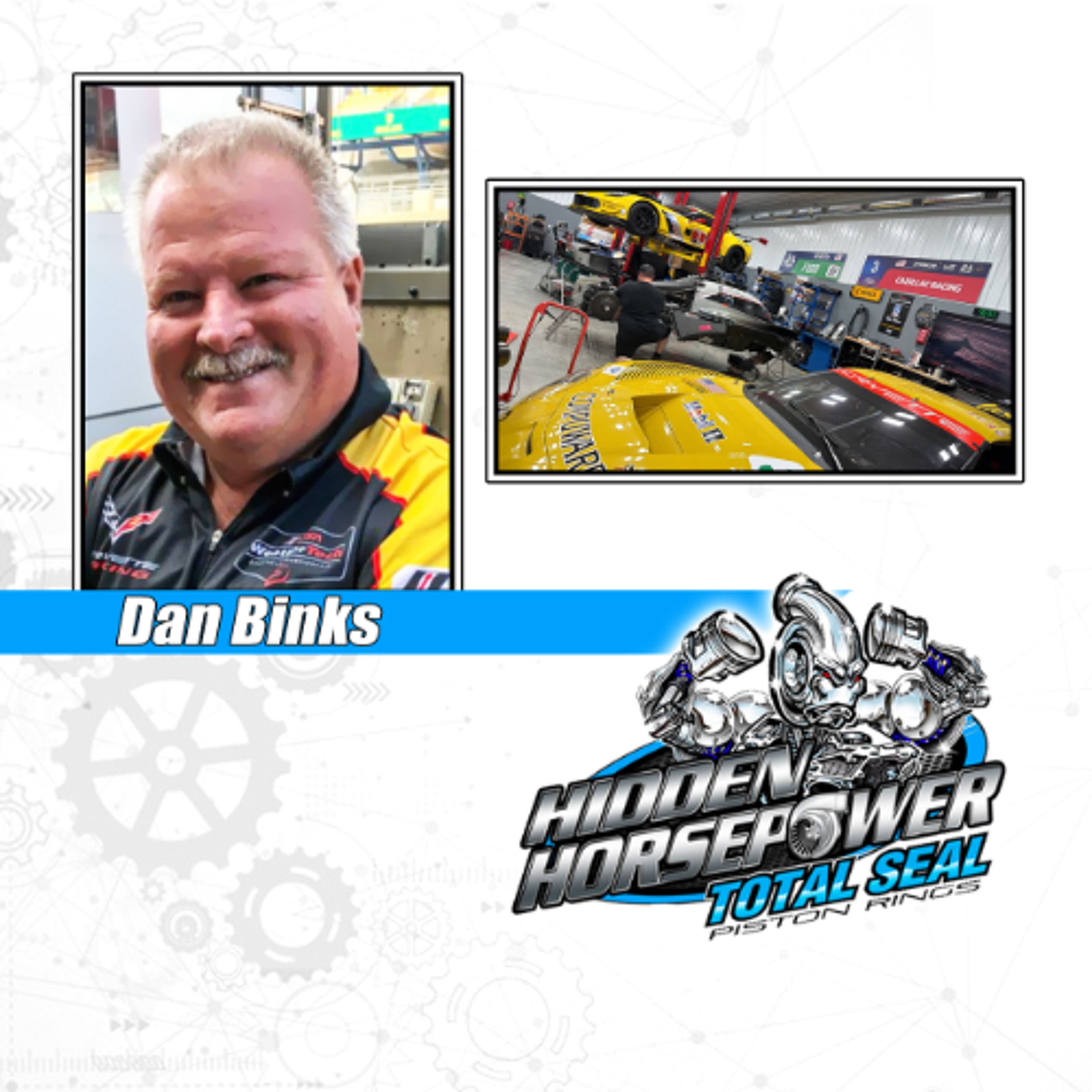
Dan Binks - 3 Cylinder Monster
About this episode
Keith and the crew kick off with a diesel drag-racing trip, then shift into Dan Binks’ one-off three-cylinder “monster” build. Dan walks through a clean-sheet design aimed at the Chili Bowl, including oil cooling with no radiator, mechanical fuel injection, and a high-RPM setup that can run near 10,000 RPM where “there is no rev limiter.” They also cover billet/CNC build speed, grounding and wiring fixes, and how compression releases help hard-to-start high-compression setups.
three cylinder engine
"And then you had pictures of my midget. I built a three cylinder midget engine. And I think that's what we're going to talk about here in a minute. [235.8s] Yes, absolutely. We are going to talk about that because I can't help but think Keith, Compleminator motor, right? Like something a three cylinder engine."
Instead of having 4 cylinders, this engine has 3. Fewer cylinders can mean less weight and packaging, which matters a lot for small race cars like midgets.
A three-cylinder engine uses three combustion chambers instead of the more common four or six. In this episode, the host is setting up a specific build: a three-cylinder midget engine designed to make power efficiently for racing.
billet
"And I did the whole thing in 24 weeks. I built three engines, all billet and start to finish. It was 24 weeks till we raced at the Chili Bowl."
Billet means the part is made by cutting it out of a solid chunk of metal. That can make it stronger and more precise for racing engines.
“Billet” refers to machining parts from a solid block of metal rather than casting or using a cheaper formed blank. In performance engines, billet components are often used to improve strength and consistency for high-stress builds.
Chili Bowl
"And I did the whole thing in 24 weeks. I built three engines, all billet and start to finish. It was 24 weeks till we raced at the Chili Bowl. [295.5s] And we set a new record. We passed 60 cars in one day at the Chili Bowl most in history."
The Chili Bowl is a famous short-track race. The hosts mention it because the rules and race style push teams toward lightweight setups.
The Chili Bowl is a well-known short-track racing event where lightweight, fast engine packages are especially valuable. The episode uses it as the benchmark for why the engine is built without a conventional cooling system.
oil cooled
"Yeah, it's pretty wild. It doesn't have any water. It's actually oil cooled and everything for the Chili Bowl is about lightweight. There's no minimum weight."
Instead of using a radiator and coolant, this engine uses oil to carry away heat. That can save weight and simplify the setup for racing.
Oil cooling uses engine oil as the primary heat-transfer medium instead of relying on a conventional liquid coolant radiator. This build is described as having no radiator and no water pump, with the oil doing the cooling work for the race environment.
no radiator, no water pump, no hoses, no cooling system
"That is wild. We've got a video, Keith, of it running and I'm struggling to get some photographs in position, but we'll get them. Don't worry. [332.9s] But the video, I think we'll chat just a little bit. So no radiator, no water pump, no hoses, no cooling system. Awesome. Absolutely awesome."
Most cars use coolant through a radiator and pump to keep the engine from overheating. This engine skips all of that to save weight, and it relies on oil to handle the heat.
A conventional cooling system uses a radiator, water pump, hoses, and coolant to control engine temperature. Removing those components reduces weight and complexity, but it requires an alternate strategy—here, oil cooling and a race-specific setup.
alcohol
"Yep, we keep it cool with fuel. It's alcohol. So basically it does have a water system, but the oil goes through the water system."
Here “alcohol” means a racing fuel that’s different from regular gasoline. It’s commonly used in motorsports and can help with how the engine runs under race conditions.
In racing, “alcohol” fuel typically refers to alcohol-based blends (often methanol or similar) that can offer strong performance characteristics. The episode ties alcohol use to the engine’s cooling and fuel system strategy for the Chili Bowl.
fuel stacking
"So I can run it on gasoline. I can put water in it. Or if I run an alcohol, I can put just the oil through it. [359.7s] And no fuel stacking problems or anything with it. You guys got it all."
Fuel stacking is when too much fuel builds up in the engine system instead of burning cleanly. That can cause rough running, and the speaker says this setup avoids that problem.
“Fuel stacking” is a racing/engine tuning issue where fuel continues to accumulate in the intake/exhaust system or combustion process, often leading to poor combustion and drivability problems. The speaker claims this engine avoids fuel-stacking problems with its setup.
mechanical fuel injection
"Yeah, it's mechanical fuel injection. You know, it's pretty simple. If it gets warm, you can add a little bit of fuel and cool it off."
Fuel injection is how an engine gets the right amount of fuel. “Mechanical” fuel injection means it’s controlled by physical parts, not a computer.
Mechanical fuel injection is a fuel-delivery system that meters fuel using mechanical components (rather than an electronic control unit). It’s often used in racing because it can respond quickly and can be tuned for specific engine setups.
exhaust valve
"Yep. So it's four and a half inch bore, 34 50 stroke, 900 intake valve, sorry, 600 intake valve, 900 exhaust valve, 800 exhaust valve saring."
The exhaust valve is the “outlet” valve that lets the spent gases leave the engine. Better exhaust flow helps the engine keep making power as RPM climbs.
An exhaust valve is the valve that opens to let burned gases leave the combustion chamber. Exhaust flow is critical for high-RPM engines because it affects how well the engine can clear gases and take in fresh charge.
intake valve
"Yep. So it's four and a half inch bore, 34 50 stroke, 900 intake valve, sorry, 600 intake valve, 900 exhaust valve, 800 exhaust valve saring."
The intake valve is the “inlet” valve that lets the mixture get into the engine. Improving it helps the engine breathe better, especially at high revs.
An intake valve is the valve that opens to let the air/fuel mixture enter the combustion chamber. Bigger or higher-flow intake valves can improve breathing, which matters a lot when you’re targeting very high RPM.
bore
"Yep. So it's four and a half inch bore, 34 50 stroke, 900 intake valve, sorry, 600 intake valve, 900 exhaust valve, 800 exhaust valve saring."
Bore means the diameter of each cylinder. A bigger bore can help the engine move more air and fuel.
Bore is the cylinder’s diameter. In engine specs, bore strongly affects how much air/fuel the cylinder can hold and how the engine breathes at high RPM.
stroke
"Yep. So it's four and a half inch bore, 34 50 stroke, 900 intake valve, sorry, 600 intake valve, 900 exhaust valve, 800 exhaust valve saring."
Stroke is how far the piston moves up and down. It’s one of the key measurements that helps define the engine’s size and behavior.
Stroke is the distance the piston travels inside the cylinder. Together with bore, stroke helps determine engine displacement and the engine’s character—especially how it performs at different RPM ranges.
rev limiter
"At the chili bowl, there is no rev limiter. So we actually revved at 9800 RPM, almost 10,000 RPM outdoors. We can only rev at 8700."
A rev limiter is a safety/engine-protection limit that stops the engine from revving too high. If it’s removed or not used, the engine can be spun much faster.
A rev limiter is an engine control feature that prevents the engine from spinning faster than a set RPM. In this build, the speaker says there’s no rev limiter at the Chili Bowl, which is why they can push to around 9,800 RPM outdoors (and only 8,700 RPM in another context).
cubic inches per hole
"And it's 55 cubic inches per hole. So it needs a lot of air and, you know, air valves and big RPM thing the way it goes."
That phrase means how much space each cylinder has. If it’s “per hole,” it’s the size of one cylinder, not the whole engine.
“Cubic inches per hole” is a way of expressing displacement per cylinder. When the speaker says it’s 55 cubic inches per hole, they’re emphasizing the huge cylinder size for a three-cylinder engine—meaning each cylinder is doing a lot of work.
high-RPM engine breathing
"And it's 55 cubic inches per hole. So it needs a lot of air and, you know, air valves and big RPM thing the way it goes."
At very high RPM, the engine has less time to pull air in and push exhaust out. So it needs big airflow paths (like valves/ports) to keep up.
The speaker links large displacement per cylinder to the need for lots of airflow and high-RPM operation. In practice, that means the engine needs valve area/port flow and timing that can move enough air fast enough at extreme revs.
clean sheet of paper
"And I finally just said clean sheet of paper. Here we go. I've been fortunate enough to, you know, where I can do pretty much what I want."
It means they didn’t tweak the old design—they started over with a brand-new plan. The goal is to avoid repeating the same problems from earlier engines.
In engineering, a “clean sheet of paper” approach means starting a design from scratch instead of modifying an existing engine. In this context, it’s about designing a new engine package and manufacturing plan rather than iterating on the previous builds that “had problems.”
modern manufacturing
"It's not about the foundry had to pump out 50 of them or you made these clean sheet of paper that shows you where we are with modern manufacturing."
They’re talking about how today’s manufacturing tools make it possible to build parts faster and more accurately than before. That’s why a full engine-related parts plan can come together on a deadline.
The segment contrasts older production constraints with modern manufacturing methods that make tight schedules feasible. The discussion ties this to CNC machining and the ability to source/produce precision engine components quickly.
CNC
"Yeah. With the CNC stuff and, you know, get crankshafts and rods and pistons and, you know, rings, you guys helped us out with the rings."
CNC is a computer-controlled machine that cuts metal very precisely. It helps manufacturers make engine parts accurately and faster than older manual methods.
CNC (computer numerical control) is machining done with computer-controlled tools that cut parts to precise dimensions. The host connects CNC to modern manufacturing capability—like getting crankshafts, rods, pistons, and rings made on a tight schedule.
crankshafts
"Yeah. With the CNC stuff and, you know, get crankshafts and rods and pistons and, you know, rings, you guys helped us out with the rings."
The crankshaft is the main rotating shaft inside the engine. Pistons push on it, and it turns that motion into the rotation that drives the car.
A crankshaft converts the pistons’ up-and-down motion into rotational motion for the drivetrain. It’s a critical precision part, and the episode highlights lead times for sourcing or machining it.
pistons
"Yeah. With the CNC stuff and, you know, get crankshafts and rods and pistons and, you know, rings, you guys helped us out with the rings. I use Molly pistons."
Pistons are the parts that move up and down in the engine’s cylinders. They help turn the energy from burning fuel into motion.
Pistons are the engine components that move inside the cylinders and transfer combustion pressure to the crankshaft. The segment also mentions “Molly pistons,” implying a specific piston material/coating choice for durability and friction control.
dry sump pumps
"You know, from billet heads, billet blocks, you know, dry sump pumps, you know, on and on."
Dry sump systems store oil in a separate tank and use pumps to keep oil moving. That helps the engine keep proper lubrication when driving aggressively or spinning fast.
A dry-sump lubrication system uses a pump to pull oil from the engine and store it in a separate reservoir. Dry sump setups help prevent oil starvation during hard cornering and high-RPM operation, and they can support more consistent oil pressure.
OE part
"And, you know, and a thousand times better than the OE part. And but and not to beat on the OE, but one of the things I, you know, I say all the time is the OE builds it for the OE."
OE parts are the factory parts that came with the vehicle. The speaker is contrasting custom-built parts against what the manufacturer originally used.
“OE” means original equipment—the parts the manufacturer designed and installed on the car when it was built. In performance builds, builders compare their custom parts to OE components to show improvements in strength, durability, or consistency.
10,000 RPM
"They don't need it to do 10,000 RPM like Dan or 6,000 foot pounds of torque like a pulling tractor."
RPM is how fast the engine spins. Higher RPM means the engine is working harder and the parts have to stay controlled and lubricated at very high speed.
RPM (revolutions per minute) is how fast the engine’s crankshaft spins. When someone says an engine needs to do 10,000 RPM, they’re talking about surviving very high rotational speeds where valve control, lubrication, and internal clearances become critical.
PSI valve springs
"Yeah, I mean, it's, you know, got oil sprayers, PSI valve springs, Excel 9 valves and retainers."
Valve springs help keep the engine’s valves opening and closing on time. When an engine spins fast, stronger springs can help prevent the valves from losing control.
Valve springs are rated by the force they provide, often expressed in pounds per square inch (PSI) or related force specs depending on context. Higher spring force helps keep the valves from floating at high RPM, maintaining proper timing and preventing valve-to-piston contact.
compression releases
"We mounted the coils on the side of the block right above the coils are compression releases from Harleys because these cars actually push start."
Compression releases make it easier to start the engine by reducing the “squeeze” while you’re cranking it. Once the engine catches, they stop interfering.
Compression releases are devices that temporarily reduce effective compression during engine cranking. They let a high-compression engine spin over more easily so it can start, then they disengage once the engine is running.
push start
"We mounted the coils on the side of the block right above the coils are compression releases from Harleys because these cars actually push start."
Push start means starting the car by rolling it and letting the drivetrain turn the engine. It can help when the engine is too hard to crank normally.
A push start (also called bump starting) starts a vehicle by rolling it and engaging the drivetrain so the engine turns over mechanically. It’s sometimes used when an engine is hard to crank—like a high-compression build—so the vehicle’s motion helps get the engine spinning.
Harleys
"We mounted the coils on the side of the block right above the coils are compression releases from Harleys because these cars actually push start."
They’re using a part originally made for Harley-Davidson motorcycles. The point is that it worked well for solving the starting problem on this engine.
The speaker is referencing Harley-Davidson parts being repurposed for this engine build. It highlights how builders sometimes borrow proven components from other platforms when they solve a specific problem—here, starting a high-compression setup.
unlimited race
"And that's what the chili bowl is really all about, like an unlimited race."
They’re talking about a race where the rules are flexible, so teams can build very different cars and engines. The point is that it’s not limited to one “type” of setup.
“Unlimited” in this context refers to a racing format where the rules allow a very broad range of engine and build approaches, so teams can push unusual designs. It’s used to describe the spirit of the event rather than a specific engine spec.
piston rings
"Moly did actually Kevin Studecker with the piston rings. I, of course, I used a 027 piston ring and when we started it, he only had nine of them."
Piston rings are thin metal bands on the piston. They help keep combustion gases from leaking and help control how much oil gets into the cylinder.
Piston rings seal the gap between the piston and cylinder wall to control compression and manage oil. In racing builds, ring choice and availability can be a major constraint because they directly affect sealing, friction, and engine durability.
027 piston ring
"I, of course, I used a 027 piston ring and when we started it, he only had nine of them."
“027” is a specific size/type of piston ring. It’s important because the ring has to match the engine’s cylinder and piston setup to seal correctly.
“027” is a ring specification (commonly referring to ring thickness or a dimensional code used by the manufacturer) that determines how the ring fits and seals in the engine. Using a specific ring spec matters because it affects sealing performance and how much margin you have if parts are scarce.
three engines, 33 cylinders
"So I had three engines, 99 cylinders, right? Three engines, 33 cylinders, and I didn't have any spares."
They built more than one engine for the project. In total, the engines add up to 33 cylinders, which is an unusual, experimental setup.
The speaker is describing a multi-engine setup where multiple engines (three) are built to collectively create a very large total cylinder count (33). This kind of packaging is typically done for specialized racing experiments where the goal is to test or extract power from an unusual configuration.
LS main bearings
"Main bearings, it uses LS main bearings."
Main bearings are the parts that let the crankshaft spin smoothly inside the engine. “LS main bearings” means the builder used bearings made to match GM’s LS engine design.
“LS main bearings” refers to the main bearings used in GM’s LS V8 engine family. Main bearings support the crankshaft in the engine block, and using LS-spec bearings is a common way builders standardize parts when adapting components.
small block Chevy rod bearings
"Main bearings, it uses LS main bearings. It uses small block Chevy rod bearings and, you know, makes 160 horsepower per hole."
Rod bearings are the parts that connect the crankshaft to the pistons through the connecting rods. Using “small block Chevy” rod bearings means they used a proven bearing design from that engine family.
“Small block Chevy rod bearings” are the connecting-rod bearings used in Chevrolet’s small-block V8 engines. Rod bearings sit on the connecting rods and support the crankshaft at each cylinder, so choosing a known bearing design matters when an engine is built to handle high load.
dyno
"So, but, you know, crankshafts were probably the biggest hold up... we bolt it all together, we get it on the dyno."
A dyno is like a treadmill for an engine. It lets you measure how much power the engine makes and helps catch problems early.
A dyno (dynamometer) is a test stand that measures engine output—typically horsepower and torque—under controlled conditions. Builders use it to verify the engine runs correctly and to diagnose issues before putting the car into real-world driving.
coils
"The electronics we had trouble with, believe it or not, the coils were grounded to the engine on one side of the engine."
Coils are the parts that generate the high-voltage spark for the spark plugs. If they don’t have a good electrical ground, the engine may misfire or run badly.
“Coils” are the ignition coils that transform battery voltage into the high voltage needed to fire the spark plugs. If coil grounding is incorrect, the coil may not energize properly, causing misfires or poor running until the wiring/grounding is fixed.
ignition
"And the electronics part of the ignition was on the other side of the block and the resistance in the block made the thing run bad."
Ignition is what creates the spark to light the fuel in the cylinders. If ignition timing or electrical connections are off, the engine can run rough.
In this context, “ignition” refers to the system that fires the spark plugs at the right time to ignite the air-fuel mixture. The transcript links ignition issues to coil grounding and electrical resistance, which can directly affect combustion stability.
resistance in the block
"the resistance in the block made the thing run bad... grounding through the block, the resistance is built into the material."
Even though the engine block is metal, it’s not a perfect electrical conductor. If it has resistance, the electrical signals can be “off,” and the ignition system may not work correctly.
The transcript describes how electrical resistance in the engine block can interfere with grounding. When current returns through a resistive path, components on opposite sides of the block can see different voltages, which can disrupt ignition electronics and cause the engine to run poorly.
grounding problems
"The biggest failures they have with this thing is simply grounding problems. They talked about, you know, trying to, like you just said, grounding through the block, the resistance is built into the material."
Grounding is the electrical “return path” that lets current flow correctly. If the ground is bad, the ignition and other electronics can act up and the engine may run poorly.
Grounding problems happen when an electrical system doesn’t have a proper low-resistance path to chassis/engine ground. In ignition systems, poor grounding can cause incorrect coil/ignition behavior, leading to misfires or unstable running—especially when the wiring is routed or grounded through the engine block.
grounding through the block
"They talked about, you know, trying to, like you just said, grounding through the block, the resistance is built into the material."
Instead of using a dedicated ground wire, the setup relies on the engine block to act like the ground. If the block isn’t a good enough conductor, the electronics can get the wrong signals.
“Grounding through the block” means using the engine block itself as part of the electrical ground path. Because the block material and interfaces have resistance, this can create voltage differences between components (like coils and the ignition electronics), which can make the engine run badly until the grounding strategy is corrected.
wiring harness
"They've created this whole wiring harness that's like, don't do it this way, use this and eliminate all the ground issues and all their problems went away."
A wiring harness is the organized set of wires that connects all the electrical parts. If the harness is designed differently—especially for grounding—it can fix electrical problems.
A wiring harness is the bundled set of wires and connectors that routes power and signals through the vehicle. In performance builds, the harness design and grounding scheme can be critical—changing how grounds are handled can eliminate ignition/ECU problems.
AI
"You went to the AI with a query and it spit out an answer and the answer turned out to be right for your application."
They’re using AI like a smart helper that answers questions based on what you type in. It can be useful for ideas, but you still have to double-check it on the car.
Here, “AI” is being used as a troubleshooting and tuning assistant: the host inputs symptoms or questions and the system returns suggestions. In practice, it can help narrow down possibilities, but it still needs verification because it’s not a substitute for proper diagnostics.
timing
"We were having one of the cars was sluggish off the corner and I asked it how much timing I thought I could have."
Timing is when the spark plug fires in the engine cycle. If you advance it a bit, the engine can feel more responsive, but going too far can be risky.
In an engine, ignition timing is when the spark happens relative to piston position. Changing timing can make the engine respond better (like being less “sluggish” off the corner) but too much can cause knock and damage.
cylinder head
"There's some cylinder head problems that they say they need to be cast cylinder head. So I'm working on that right now."
The cylinder head is the top housing of each engine cylinder where the fuel-air mixture burns and where the valves sit. If there are cylinder head problems, it can affect how well the engine runs and how long it lasts.
The cylinder head is the top part of an engine that houses key components like the combustion chamber surfaces and the valves. When the speaker mentions “cylinder head problems” and needing cast cylinder heads, they’re pointing to manufacturing/strength issues that can affect durability under high load.
Pike's Peak
"Somebody asked about running one at Pike's Peak with a turbo. It looks like with about 32 pounds of boost, it'll make 1000."
Pike’s Peak is a well-known race up a mountain. Because it’s at high altitude, the air is thinner, so engines have to work harder to make power—especially with a turbo.
Pike’s Peak is a famous hill climb in Colorado that reaches high elevation, where the air is thinner. That makes turbo boost and engine airflow management especially important for maintaining power as altitude increases.
boost
"It looks like with about 32 pounds of boost, it'll make 1000. So at Pike's Peak, you know, a 200 pound engine with the turbo, making 1000 is, you know, pretty cool."
Boost is how much extra pressure the turbo adds to push air into the engine. More boost usually means more power, but it can also be harder on the engine.
Boost is the extra air pressure a turbocharger (or supercharger) adds above normal atmospheric pressure. Higher boost generally means more potential power, but it also increases stress on the engine and requires careful tuning and cooling.
flat six
"A lot of people have ideas that we've had people ask about making a Porsche cylinder head similar to mine because, you know, three cylinders on each side of flat six, you know, and the, you know, the amount of power this thing makes per cubic inch..."
A flat-six is an engine design where cylinders are laid out flat, two sides of three. The way the cylinders are arranged can affect balance and how the engine fits in the car.
A flat-six is an engine layout where six cylinders sit horizontally in two banks of three on opposite sides of the crankshaft. The speaker’s point is that their three-cylinder-per-side concept resembles a flat-six’s packaging, which can influence balance, cooling, and how power is distributed.
power per cubic inch
"A lot of people have ideas that we've had people ask about making a Porsche cylinder head similar to mine because, you know, three cylinders on each side of flat six, you know, and the, you know, the amount of power this thing makes per cubic inch..."
“Power per cubic inch” tells you how much power an engine makes compared to how big it is. If it’s high, the engine is getting a lot of power out of its size.
“Power per cubic inch” is a specific-output metric that relates engine power to displacement (how much volume the engine displaces). Higher power per cubic inch usually means the engine is extracting more performance from each unit of size, often requiring aggressive airflow, boost, and tuning.
one less cylinder, one less piston, one less everything
"And, and, you know, it's one less cylinder, one less piston, one less everything."
Fewer cylinders means fewer moving parts inside the engine. That can make the engine smaller and sometimes easier to work on, which matters a lot in racing.
Going from a multi-cylinder engine to a three-cylinder changes the engine’s balance, packaging, and how much hardware you have to service. Fewer cylinders can reduce weight and complexity, and it can make certain maintenance tasks faster—especially in racing or prototype builds.
sleeves will slide out
"Yeah, and I made it similar to a fuel car where the sleeves will slide out so you can put, you know, you could change all three pistons and rods and, you know, an hour."
They’re talking about cylinder liners/sleeves that can be taken out and replaced. That can make engine repairs quicker if the cylinder surfaces wear out.
The speaker is describing a replaceable cylinder-sleeve design where the sleeves can be removed and replaced without replacing the whole engine block. This is often used in performance or racing engines to make repairs faster and cheaper after wear or damage.
rockers and the push rods
"I actually practiced, I adjusted all the rockers and the push rods for the spare cylinder head."
These parts help open and close the engine’s valves. Adjusting them makes sure the valves open at the right time and the engine runs correctly.
Rockers and pushrods are part of a pushrod valve-train system that transfers motion from the camshaft to the engine’s valves. Adjusting them ensures correct valve timing and lift, which affects performance and can prevent valve-train wear.
single turbo V6
"That car actually makes over a thousand horsepower, single turbo V6. And I restored that car four or five years ago."
It’s a V6 engine that uses one turbocharger to boost power. The turbo helps the engine burn more fuel and make much more horsepower than stock.
A “single turbo V6” means a V6 engine (six cylinders arranged in a V shape) using one turbocharger to force more air into the engine. With enough supporting mods and tuning, a single-turbo V6 can produce very high power—here, the host says it makes over a thousand horsepower.
weight balance
"Wow, imagine the weight balance, we'll say opportunities would be there with a 200 pound three cylinder turbo at a thousand horsepower."
Weight balance is where the car’s weight sits. If you change the engine (and therefore how heavy it is), the car can handle differently because the front and rear loads change.
Weight balance is how much of a car’s mass sits toward the front vs. the rear (and left vs. right). The host connects it to engine choice—imagining a “200 pound three cylinder turbo” making huge power—because changing engine weight and placement can strongly affect handling and traction.
pipe bombs
"And, and we're able to make them a lot better. Those cars were pipe bombs in the day right now. They're, you know, they actually run for quite a long time."
“Pipe bombs” is a colorful way of saying the cars were brutally loud and intense. The speaker’s point is that newer parts and electronics make them less chaotic and more reliable.
Calling the cars “pipe bombs” is enthusiast shorthand for engines that were extremely loud and/or aggressive, often with minimal emissions equipment and a lot of exhaust flow. The host contrasts that with modern evolution of parts and electronics that make the same kind of power more controllable and durable.
no lift shift
"The electronics on that car, no lift shift, traction control, you know, for the Cadillacs. It won't shift if the, you know, it senses that the drivers trying to shift at the wrong time."
No lift shift means you keep your foot on the gas while shifting gears. It helps the car keep pulling instead of briefly losing power during the shift.
No lift shift is a driving technique where the driver keeps the throttle open during an upshift instead of lifting off the gas. On race cars, it’s often supported by engine management so the car can maintain boost and reduce the power interruption that would otherwise slow acceleration.
traction control
"The electronics on that car, no lift shift, traction control, you know, for the Cadillacs. It won't shift if the, you know, it senses that the drivers trying to shift at the wrong time."
Traction control is a safety/handling system that helps the tires grip the road. If the wheels start slipping, it reduces power so you don’t lose acceleration.
Traction control is an electronic system that detects wheel slip and intervenes—typically by reducing engine torque—to regain grip. In a high-power race car, it helps prevent the drive wheels from spinning, especially during hard acceleration or low-grip conditions.
knock sensors
"I mean, there's so many things that that thing does, knock sensors, right, it won't let it detonate. It could take timing out if it gets hot, you know, the, the sky is the limit really."
Knock sensors listen for harmful engine knocking. If they detect it, the car’s computer changes timing or reduces power to protect the engine.
Knock sensors detect “knock,” an abnormal combustion event that can damage an engine. When knock is detected, the ECU can adjust ignition timing and other parameters to protect the engine—here, the host says it “won’t let it detonate” and can take timing out if it gets hot.
detonate
"I mean, there's so many things that that thing does, knock sensors, right, it won't let it detonate. It could take timing out if it gets hot, you know, the, the sky is the limit really."
Detonation is when the fuel-air mixture burns in an uncontrolled way inside the cylinder. It can be damaging, so the car’s computer tries to prevent it.
Detonation is uncontrolled, explosive combustion that occurs when the air-fuel mixture ignites too aggressively or at the wrong time. It’s dangerous because it can rapidly increase cylinder pressure and lead to engine damage, so performance ECUs use sensors and timing adjustments to prevent it.
Cadillac in sports car racing
"And Cadillac getting involved in sports car racing, a lot of people back then thought like, why, what are they doing? Aren't they supposed to make like big boats that you cruise down the, the avenue with?"
They’re talking about how some people were surprised Cadillac was racing. The idea is that Cadillac was known for big, comfy cars, so racing was unexpected.
This segment discusses why Cadillac’s involvement in sports car racing surprised some people. It frames the brand’s racing participation as a departure from the “big boats” stereotype.
General Motors
"I've been fortunate enough to, you know, race with General Motors for 20 years. So I have a lot of friends downtown and Pontiac there."
General Motors is a major car company that owns brands like Cadillac. The speaker is saying GM has the resources and people to compete at a high level.
General Motors (GM) is the automaker behind brands like Cadillac, and the host frames it as having a long racing and engineering footprint. Here, GM is discussed as a platform for funding and staffing the effort to compete in top-level motorsport.
Formula One engine development
"They're, they're making their own Formula One engine. They're making fast street cars. You know, fast Imsa cars, it's, it's a super cool time for, you know, GM and Cadillac."
They’re talking about Cadillac/GM building their own engine for Formula One. Formula One engines are very advanced and require a lot of specialized engineering.
The segment claims that Cadillac/GM is making its own Formula One engine. That matters because Formula One engines are highly specialized, with strict technical rules and intense development timelines.
IMSA racing
"They're making fast street cars. You know, fast Imsa cars, it's, it's a super cool time for, you know, GM and Cadillac."
IMSA is a big racing organization in North America. When they say “IMSA cars,” they mean race cars built for that kind of competition, often including long-distance events.
IMSA refers to the International Motor Sports Association, which runs major North American sports-car racing series. The host’s mention of “fast Imsa cars” connects GM/Cadillac’s development efforts to endurance-style racing demands, not just street performance.
Miami race
"I can tell you our Miami race is exceptional. I haven't been there in years. We used to run IMSA cars down there and but I haven't been down there for any of the Formula One shows."
They’re specifically praising the Miami Formula One event. The point is that the event setup makes it feel special and easy to get around.
The speaker is talking about the Miami Formula One event and why it stands out. They mention the venue setup and how the stadium location affects the race experience.
ingress and egress
"And because of the way it is, the ingress and egress is super easy."
Ingress and egress are event-planning terms for how people enter and leave a venue. In racing, easy ingress/egress matters because it reduces traffic and makes it simpler for fans to move between parking, gates, and viewing areas.
titanium nitride
"Right. [2097.0s] You know, it's a, it's, it's titanium nitride. [2099.2s] It's a very, very tough coating and it holds up extremely well."
Titanium nitride is a very tough coating that gets put on engine parts. It helps the parts last longer by resisting wear and rubbing.
Titanium nitride (TiN) is a hard ceramic coating used on engine parts to resist wear and reduce friction. In this context, it’s being discussed as a durable surface treatment that performs well even when small amounts of dirt get through.
0.7 millimeter
"[2102.8s] Yeah. [2103.0s] The 0.7 millimeter stuff is a great, you know, when it comes down to the really thin ring packs, that's, that's like my go to ring. [2109.3s] It's just, it's got enough mass."
They’re talking about how thick the coating is—0.7 millimeters. The thickness matters because engine parts have very limited space, especially around the piston rings.
The speaker is referring to a coating thickness of 0.7 millimeters, which matters because thinner coatings can be better suited to tight packaging on small engine components. Here it’s tied to “thin ring packs,” implying the coating thickness is chosen to fit the available space without compromising durability.
ring packs
"[2103.0s] The 0.7 millimeter stuff is a great, you know, when it comes down to the really thin ring packs, that's, that's like my go to ring. [2109.3s] It's just, it's got enough mass. [2111.2s] It'll handle a little bit of, you know, something silly happens."
Ring packs are the piston rings on top of the piston. They help seal the combustion gases, and their size limits what you can do with coatings.
A ring pack is the set of piston rings on an engine piston. Its thickness and design affect sealing and how much room there is for coatings or other treatments, which is why the speaker connects coating thickness to “thin ring packs.”

Corvette
"[2122.6s] It's in all the, my Cadillac pistons and it's in my Corvette pistons. [2128.5s] It's in all of them now. [2129.8s] And that's why I made it easy to, to make the choice."
They also mention the Corvette, meaning the same coated piston parts are used in Chevrolet’s performance car. The point is that it’s meant to hold up under tougher conditions.
The speaker notes the coating is also used in Corvette pistons, tying the technology to a performance-focused Chevrolet model line. That matters because Corvette engines are often tuned for higher stress, so the coating’s wear resistance is part of the pitch.
dome piston
"[2139.6s] I probably should have showed you that stuff. [2142.1s] But anyways, it's a, you know, very small dome piston. [2147.0s] "
A dome piston has a bump on top of the piston. That bump changes the shape of the space where the fuel burns, which can affect how the engine runs.
A dome piston has a raised “dome” on top of the piston crown, which changes the combustion chamber shape. That can influence compression characteristics and how the air-fuel mixture burns, which is why piston crown shape is often chosen carefully for specific engine setups.
compression ratio
"The combustion chamber is very small, not too big a compression ratio, 13 and a half to one. A lot of guys are running up to 16 with Sprint cars and things like that."
Compression ratio is how much the engine squeezes the air-fuel mixture before it’s ignited. Squeezing more can make more power, but too much can cause the fuel to ignite the wrong way and damage the engine.
Compression ratio is the ratio between the volume in the cylinder when the piston is at the bottom versus at the top. Higher compression generally improves efficiency and power, but it also increases the risk of knock/detonation if the fuel and calibration aren’t right.
oil ring
"It's like, guys, got a 22 pound oil ring. Oh, no, no, if we've got to stop and put oil in a man, you know, we can't do that."
The oil ring’s job is to keep extra oil from building up on the cylinder walls. Using thinner oil rings can reduce drag, but the ring still has to control oil reliably.
An oil ring is the piston ring specifically designed to scrape excess oil off the cylinder wall and return it to the crankcase. Thinner oil rings can reduce friction, but they must still maintain effective oil control under high loads and temperatures.
detonation
"And, and as you said, and then the engine management systems, that's really the key. The detonation and all that knock sensors, keeping that thing from hurting itself."
Detonation is when the fuel-air mixture ignites too aggressively and too early, instead of burning smoothly. It can create damaging pressure in the cylinder, so engines use safeguards to prevent it.
Detonation is uncontrolled, near-instant combustion that can occur when the end-gas in the cylinder auto-ignites under high pressure/temperature. It’s harmful because it creates extreme pressure spikes that can overheat components and damage the engine.

Subaru 360
"... And then my other car, Kyle O'Gara had one of my 360s in his pavement car and got an instant spun out a..."
The Subaru 360 is a very small older car made by Subaru. It was built to be light and efficient, but small cars can still lose traction if the tires or driving conditions aren’t right. That’s likely why it was mentioned in a story about spinning out.
The Subaru 360 is a small, early compact car from Subaru that’s often remembered for its lightweight design and simple, economical approach. In the podcast context, it’s mentioned as a “360” that was used in a pavement car and involved in a sudden spin-out, which points to how these cars can behave under real driving conditions. It’s discussed because it’s a recognizable piece of Subaru’s history and a classic example of compact-car engineering.
cast head
"So now you had mentioned, Dan, you know, working on a cast head to make it, you know, so that they don't make it illegal or anything like that."
A cylinder head is the top part of the engine where combustion happens. A “cast head” means it’s made by pouring metal into a mold, which can be important for strength and for fitting racing modifications.
A “cast head” refers to an engine cylinder head made by casting molten metal into a mold. Cylinder heads are critical because they shape the combustion chambers and house the valvetrain, so casting choices affect strength, cooling passages, and how easily the head can be modified for racing rules.
COMP Eliminator Race
"But if somebody wanted to come to you and see, you know, let's just say, I call you up, Dan, hey, Dan, how fast can I have one of these things? ... I want, I want to go COMP Eliminator Race."
“COMP Eliminator Race” sounds like a drag-racing class with rules about what you’re allowed to change. The point of the engine work is to be fast but still legal for that class.
“COMP Eliminator Race” refers to a specific drag-racing class format where cars compete under rules that constrain engine and vehicle modifications. The mention implies the engine/head work is being done to stay within those class legality requirements while maximizing speed.
drag car
"I'm going to put in my drag car."
A drag car is a car set up to race in a straight line, usually over a short distance. The focus is quick acceleration and getting the power to the ground.
A drag car is built and tuned specifically for straight-line acceleration over a short race distance. These cars often emphasize weight reduction and traction to convert engine power into rapid launches and consistent passes.
HRA
"Well, for COMP Eliminator, you could have one pretty fast because I think the cylinder head would be legal for an HRA."
HRA is the rules body for a racing series. Saying something is “legal for HRA” means it follows the allowed parts and setup rules for that competition.
HRA here refers to a drag-racing sanctioning/competition organization that sets class rules. When the host says the cylinder head would be legal for an HRA, they mean it would comply with that organization’s technical regulations.
lightweight dragster
"So someone with a lightweight dragster, guys, you got to take advantage."
A lightweight dragster is a drag race car that’s built to be as light as possible. Being lighter helps it speed up faster when you hit the throttle.
A lightweight dragster is a drag-racing car designed to minimize mass so it accelerates faster for a given amount of power. In drag racing, lower weight improves acceleration and helps the car launch and stay controllable under hard traction demands.
400 horsepower
"You know, 400 horsepower and 800 pound car, maybe?"
Horsepower is a way to describe how much power the engine makes. More horsepower usually means the car can accelerate harder—especially in drag racing.
Horsepower is a measure of engine power output, reflecting how much work the engine can do over time. In drag racing discussions, horsepower is often paired with vehicle weight to estimate how quickly a car can accelerate.
800 pound car
"You know, 400 horsepower and 800 pound car, maybe?"
Weight matters because it affects how hard it is to get the car moving. A lighter car can accelerate faster than a heavier one with the same power.
Vehicle weight is a key factor in acceleration because it determines how much mass the engine has to move. In drag racing, extremely low weight can make even moderate power feel very fast.
3-cylinder engine
"[2776.7s] What do you think about that, Keith? [2778.1s] You know, I had like three cylinder engine. [2779.8s] I know you had some insight, but this is all new to me. [2781.8s] That's wild. [2782.7s] Mine's blown."
A 3-cylinder engine is an engine with three firing cylinders. It’s often smaller and easier to fit into compact cars, but it can feel different than a 4- or 6-cylinder engine.
A 3-cylinder engine uses three combustion chambers instead of the more common four or six. With fewer cylinders, it can be smaller and lighter, which helps packaging, but it also changes how smooth the power delivery feels and how the engine is balanced.
3-cylinder monster
"I mean, imagine stuffing that in one of those little things. [2795.9s] I mean, just it's a little compact package that's lightweight, makes a mountain of power from rally car to drag car."
This is about how a small 3-cylinder engine can still feel like a “monster.” With the right technology (like a turbo), it can make a lot of power for its size.
The episode framing (“3-cylinder monster”) points to the idea that a small-displacement engine can still feel extremely powerful. With the right setup—often including turbocharging—three-cylinder engines can produce strong torque and sound lively under load.
rally car
"I mean, just it's a little compact package that's lightweight, makes a mountain of power from rally car to drag car. [2803.8s] Like you say, slap a turbo on it."
A rally car is a race car designed for rough roads and changing surfaces. It’s built to handle traction and quick acceleration in tough conditions.
A rally car is built for off-road, mixed-surface stages and is tuned for rapid throttle response and traction management. That “mountain of power” comment implies the same small-engine/turbo idea can work in demanding rally conditions.
stationary engine parts
"Working on, you know, stationary engine parts right now for, you know, big nine inch four stationary stuff. [2849.1s] It's always, every phone calls something different."
Stationary engines are engines that stay in one place, like for backup power or industrial equipment. “Stationary engine parts” means parts made for those fixed engines.
Stationary engines are engines that don’t move with the vehicle; they run in fixed locations for power generation or industrial use. “Stationary engine parts” refers to components made for those applications rather than automotive engines.
Request an Explanation
Heard something you'd like explained? We'll add it to this episode.
Sign in to request explanations for terms you heard.
Want to learn more?
Browse our glossary for plain-English explanations of automotive terms, jargon, and concepts.
Help improve this episode
See something that's not quite right? Our annotations are AI-generated and can sometimes miss the mark. Click the flag icon on any annotation to suggest a correction.