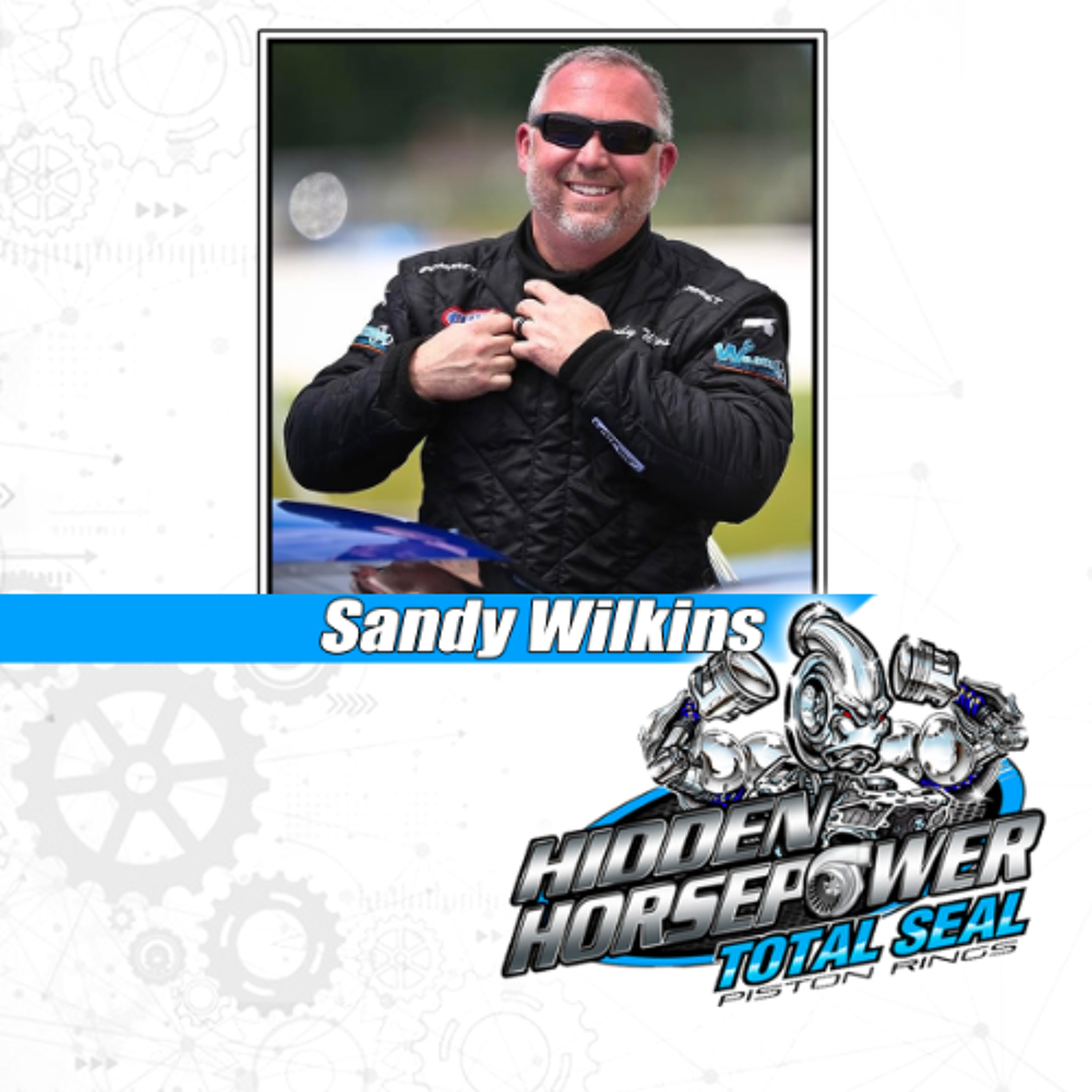
Sandy Wilkins of Wilkins Racing Engines
About this episode
Sandy Wilkins of Wilkins Racing Engines shares his path from karting and SCCA success to NHRA Top Sportsman world champion, plus how his engine-building career evolved from NASCAR late models to Roush Yates and beyond. The conversation digs into the RY45 program, twin-turbo drag tech, and why modern engine building is increasingly driven by measurement—profilometers, surface finish, and rigorous dyno validation. They also connect Total Seal ring tech to consistency and durability, then shift to Top Sportsman strategy, nitrous tuning, and the importance of documenting every build.
ring seal technology
"The following is brought to you by Total Seal Piston Rings, the leader in ring seal technology. TotalSeal.com."
Piston rings need to seal tightly against the cylinder wall. If they don’t seal well, some combustion gases escape and the engine can burn oil or lose efficiency.
“Ring seal technology” refers to design and material choices in piston rings that improve how tightly the rings seal the cylinder. When sealing is better, less combustion gas leaks past the rings (blow-by), which can improve power consistency and reduce oil usage.
Total Seal Piston Rings
"The following is brought to you by Total Seal Piston Rings, the leader in ring seal technology. TotalSeal.com."
Total Seal makes piston rings, which are small parts that sit on the piston inside the engine. Their goal is to help the rings seal better so the engine burns fuel more efficiently and uses less oil.
Total Seal Piston Rings is an aftermarket piston ring brand known for improving “ring seal,” which helps control combustion gases and oil consumption. Better ring seal can support higher cylinder pressure and more consistent engine performance, especially in racing or high-stress builds.
PRI show
"I wear mine each year to the PRI show under a jacket. It's kind of a cool deal."
The PRI show is a big event for racing and performance parts. It’s where companies show off new products and where people in the racing industry network.
The PRI show is a major annual performance racing industry trade event where companies and engine builders showcase new parts and technologies. Mentioning it helps place the piston-ring discussion in the broader aftermarket racing community.
NHRA Gator Nationals
"Hidden Horsepower, Hartford's got the decals on the side of his race car that won the 2026 Amelie Motor Oil NHRA Gator Nationals."
The NHRA Gator Nationals is a drag racing competition. The host is saying the racing car had branding tied to a win at that event.
The NHRA Gator Nationals is a drag racing event in the NHRA series. It’s relevant here because the host references a race car’s decals tied to winning that event, connecting the brand’s piston-ring focus to real racing results.
horsepower
"I'm super excited to connect with you and talk a little horsepower on Hidden Horsepower. Absolutely."
Horsepower is basically how strong an engine is. Higher horsepower usually means the car can make more power and accelerate harder, especially at higher speeds.
“Horsepower” is a measure of engine power—how much work the engine can do over time. In racing and engine-building conversations, it’s often discussed alongside torque, airflow, and how efficiently the engine turns fuel into usable power.
pro stock
"How about Hartford, though? Real quick, this guy goes out there and wins a crown jewel event in pro stock. That's one that if you win the Gator Nationals, you've had a successful year, and they got"
Pro Stock is a category of drag racing where teams build cars to compete under specific rules. It’s competitive and winning major races usually means the car and engine are working really well.
Pro Stock is a class in NHRA drag racing where cars are built to strict rules and are designed for maximum performance in short, straight-line runs. Winning major events in Pro Stock is a big deal because it reflects both engine performance and consistent race-day setup.
Pomona's
"I mean, you've got, you know, the Gators, Indy, you know, of course, Pomona's, I mean, so he's got a, he's got a couple more to swing at, but, you know, it's, that's a big one."
“Pomona’s” refers to the Pomona NHRA race, a famous stop in Southern California. It’s mentioned as part of the set of big events Pro Stock drivers aim to win.
Indy
"I mean, you've got, you know, the Gators, Indy, you know, of course, Pomona's, I mean, so he's got a, he's got a couple more to swing at, but, you know, it's, that's a big one."
“Indy” here likely refers to an NHRA event at Indianapolis, which is commonly part of the drag racing schedule. The host is listing major stops that a Pro Stock driver can target during the season.
Gainesville
"I actually went down early to Gainesville for the test. You know, the top fuel guys were there. You know, there were quite a few pro stock guys there."
Gainesville refers to the NHRA drag racing venue in Gainesville, Florida, known for hosting major testing and race activity. The host mentions going there for testing and working with teams, which highlights how engine builders and teams use track time to dial in performance.
top fuel
"I actually went down early to Gainesville for the test. You know, the top fuel guys were there. There were quite a few pro stock guys there."
Top Fuel is the fastest, most powerful class in NHRA drag racing. It’s where teams run dragsters built specifically for maximum acceleration.
Top Fuel is the premier class in NHRA drag racing, using purpose-built dragsters with extremely powerful engines. Mentioning “top fuel guys” at the same test session underscores that the event had high-level teams and serious performance development happening at once.
new rings
"We've developed some new rings for the fuel cars. You know, talked a lot about pro stock guys."
Piston rings are critical sealing components that control compression and oil consumption inside the engine. In high-stress racing applications, ring design (materials, coatings, gap, and tension) can directly influence reliability and power consistency.
fuel cars
"We've developed some new rings for the fuel cars. You know, talked a lot about pro stock guys."
In drag racing, “fuel cars” usually means race cars that use special fuels instead of regular gas. Those fuels burn differently, so the engine parts have to be built to handle it.
“Fuel cars” is a broad drag-racing term for cars that run on a specific racing fuel (often alcohol-based or other specialty fuels) rather than pump gasoline. The fuel choice affects combustion, tuning, and how components like pistons and rings are designed and cooled.
300 mile per hour run
"That's a bit of a wonder, but you saw the historic Gainesville raceway where the first ever 300 mile per hour run happened. That is, that is a big deal."
Hitting 300 mph on a drag strip is a huge milestone. It means the car is going extremely fast, and that takes a lot more than just engine power.
A “300 mile per hour run” refers to achieving 300 mph (or more) during a drag-racing pass, which is an extreme milestone. It requires not just power, but also aerodynamic stability, traction management, and careful gearing.
NHRA drag racing
"So our guest today on Hidden Horsepower, speaking of NHRA drag racing, he has been involved in all forms of motor sports."
NHRA is the organization that runs a lot of the big drag races in the U.S. Saying “NHRA drag racing” tells you the guest competes in that mainstream drag-racing world.
NHRA (National Hot Rod Association) is the major U.S. sanctioning body for drag racing. When the hosts say “NHRA drag racing,” they’re framing the guest’s background in a specific competitive environment with defined classes, rules, and championship points.
top sportsman world championship
"We're going to get into it, but he is a NHRA champion, won the top sportsman world championship in 2019, which is a big, big deal."
The “Top Sportsman World Championship” is an NHRA championship event/class that recognizes top performers in the sportsman ranks. Winning it indicates a high level of consistency and race-day execution, not just raw engine output.
Wilkins racing engines
"Sandy Wilkins, Wilkins racing engines. He worked at Roush Yates. He's done so many different things."
Wilkins racing engines is Sandy Wilkins’ engine-building business. The episode is about how engine builders develop parts and tune engines so they perform consistently in racing.
“Wilkins racing engines” refers to Sandy Wilkins’ engine-building operation, which is central to the episode’s theme of performance development. In racing, engine builders often focus on component selection and development work (like rings) to improve reliability and repeatability under extreme conditions.
restarting the engine shop
"[352.2s] I remember having a conversation. [354.2s] I think it was at the Southeastern Division two championship banquet pre COVID about just that you were thinking about doing this. [362.5s] And restarting the engine shop."
That phrase means the engine builder is getting their business going again. It usually involves getting parts and starting new engine projects.
“Restarting the engine shop” refers to bringing an engine-building business back into active production—typically involving staffing, sourcing parts, and resuming builds. For performance-focused shops, this often means getting back to cylinder heads, short blocks, and full engine assembly work.
drift car
"We have drift engines in Ireland and in Spain at this point and working on another program for a satellite team over in Europe. So and that's not drag racing stuff. That's drift car."
A drift car is set up to slide around corners on purpose. Because the tires are slipping a lot, the car needs tuning and parts that can handle that stress.
Drift cars are built and tuned for controlled oversteer, where the driver intentionally breaks traction and maintains a slide through corners. That changes engine and drivetrain priorities—response, torque delivery, and durability under sustained high-load wheel slip.
engine development
"We're going to talk about ring seal. We're going to talk about engine development and NASCAR and and whatever else you want to throw out there on the table."
Engine development is basically engine “R&D.” People test and tweak parts and settings until the engine makes the kind of power they want and lasts.
Engine development is the process of designing, testing, and refining an engine to meet goals like power, reliability, and efficiency. It often includes iterative changes to internal components, fuel/air delivery, and sealing/clearance targets based on dyno and track data.
NASCAR
"We're going to talk about ring seal. We're going to talk about engine development and NASCAR and and whatever else you want to throw out there on the table."
NASCAR is a stock-car racing series where teams build and develop engines to survive long races while maintaining consistent performance. Engine builders often tailor parts and calibration for the series’ rules, track types, and durability demands.
go-karts
"My dad was the guy that helped push me in the direction and we started at age 14 with go-karts and had a great time first year out. We finished second in our local division and then that progressed into sports car racing."
Go-karts are small race cars that are often the first step into racing. They help people learn how to drive fast and race safely before moving up.
Go-kart racing is a common entry point into motorsports because it teaches racecraft—lines, braking points, and wheel-to-wheel awareness—at a relatively low cost. Many professional drivers and engine builders start here before moving into higher-level series.
SCCA
"So my dad raced SCCA and the historic stock car group and I ended up at age 15 being the SCCA champion actually. So that was that was my start and we all kind of thought that was the direction I would go."
SCCA is a big U.S. racing organization that runs amateur and semi-pro road racing. Doing well there can be a big stepping stone in a racing career.
SCCA (Sports Car Club of America) is a major U.S. motorsports organization that runs road racing and other competition classes. Winning an SCCA championship is often a strong indicator of real driving skill and can open doors to higher-level racing.
historic stock car group
"So my dad raced SCCA and the historic stock car group and I ended up at age 15 being the SCCA champion actually. So that was that was my start and we all kind of thought that was the direction I would go."
Historic stock car racing is racing with older cars, usually from a specific era. It’s a way to keep classic race cars and their technology alive.
Historic stock car racing focuses on older stock-car machinery and period-correct competition. It often emphasizes preserving original-style components and understanding how older engines and drivetrains behave under race conditions.
crew chief
"...which took me to the drag strip and meeting some guys where I was actually a crew chief for a pro modified team in my early 20s. And that got me a job in the engine building right out of college and the rest is history."
A crew chief is the person who runs the team and makes the big calls during preparation and race day. They coordinate the car setup and help solve problems so the driver can perform.
A crew chief is the lead in charge of race-day strategy and technical coordination for a team—often including setup decisions, troubleshooting, and communicating with the engine builder and mechanics. In performance racing, the crew chief’s role can strongly influence outcomes through preparation and rapid problem-solving.
drag strip
"But during college, the racing kind of slowed down and, you know, I got more involved in street cars, which took me to the drag strip and meeting some guys where I was actually a crew chief for a pro modified team in my early 20s."
A drag strip is a straight-line race track. Cars are judged on how fast they accelerate, so the engine and drivetrain need to deliver strong power right away.
A drag strip is where cars race in a straight line over a short distance, typically emphasizing acceleration and traction. Engine builders often develop for drag use by optimizing torque curve, fueling, and durability for repeated high-load launches.
pro modified team
"...meeting some guys where I was actually a crew chief for a pro modified team in my early 20s. And that got me a job in the engine building right out of college and the rest is history."
“Pro Modified” is a drag racing category where cars are significantly changed to make more power. The goal is fast acceleration, but the car still has to survive repeated runs.
“Pro Modified” refers to a class of drag racing where cars are heavily modified for performance, often with purpose-built engines and drivetrain setups. Teams in this category focus on maximizing acceleration while managing reliability under repeated hard launches and high heat loads.
karting
"And I got to tell you, I have a whole lot of respect for those karting guys because that thing is a rocket ship and you're this far off the ground with no suspension. And I was absolutely amazed at the cornering, how fast."
Karting is racing with small go-karts. It’s a great training ground because the cars are simple and you learn how to drive fast by focusing on grip, lines, and control.
Karting is a grassroots motorsport that many professional drivers use to build core racing skills. Because karts have minimal suspension and are lightweight, drivers learn line choice, braking/throttle control, and tire management quickly.
F1
"And you see how many world champions. I mean, look at all the F1, all that that comes out of karting into SCCA into like, say turning both ways."
F1 (Formula 1) is referenced as the top tier of open-wheel racing that many drivers aspire to. The speaker is using it as an example of the career path from karting to higher-level racing.
gear ratios
"You know, karting really got me more involved in mathematics and, you know, things like gear ratios, tire sizes, all this stuff, you know, played into kind of growing your brain."
Gear ratios are how the drivetrain “multiplies” the engine’s speed. The right ratio helps the car or kart accelerate strongly instead of bogging down or spinning too fast.
Gear ratios determine how engine RPM translates into wheel speed. In racing, choosing the right ratios helps keep the engine in its power band for acceleration and top speed.
tire sizes
"You know, karting really got me more involved in mathematics and, you know, things like gear ratios, tire sizes, all this stuff, you know, played into kind of growing your brain."
Tire size changes how far the vehicle travels with each wheel rotation. That can affect acceleration and grip, which is why racers pay attention to it.
Tire size affects rolling circumference, which changes effective gearing and how quickly the vehicle accelerates. It also influences grip and how the kart or car loads the suspension and chassis during cornering.
tire softeners
"And in high school, I think my senior project was on tire softeners that took me to a win at the North Carolina Science Fair. And, you know, who knew that this DMSO, which is a bus or relaxant for horses, would have been the best tire softener, at least, you know, back when I was 18 years old."
Tire softeners are products used to make race tires grip better. They can help the tire feel “stickier,” but they can also make the tire wear out faster.
Tire softeners are additives or treatments used to change tire compound behavior, typically to increase grip. In motorsports, they can help tires reach working temperature and improve traction, but they may also reduce tire life or alter wear patterns.
DMSO
"And in high school, I think my senior project was on tire softeners that took me to a win at the North Carolina Science Fair. And, you know, who knew that this DMSO, which is a bus or relaxant for horses, would have been the best tire softener, at least, you know, back when I was 18 years old."
DMSO is a chemical that the speaker says they found could make tires act “softer” and grip better. It’s not a normal street-car product, and using chemicals on tires can be risky and rules-dependent.
DMSO (dimethyl sulfoxide) is a chemical sometimes discussed in motorsports contexts for its ability to alter tire compound behavior. The speaker connects it to tire softening, noting it was effective in their earlier work.
Craftsman truck series
"...the craftsman truck series, we built engines and trucks for that and then moved into the Bush series."
The Craftsman Truck Series is NASCAR racing, but with pickup trucks instead of cars. Teams build and tune engines to match the series rules and the way the trucks race.
The “Craftsman Truck Series” is NASCAR’s top-level stock-car racing series for pickup trucks (sponsored by Craftsman at the time). Engine builders and teams tune power and durability for the heavier vehicle and the series’ specific rules and race lengths.
Bush series
"...we built engines and trucks for that and then moved into the Bush series."
“Bush series” is NASCAR slang for a specific series name that changed with sponsorship over the years. It indicates the speaker moved into another NASCAR truck/car series after the earlier one.
“Bush series” is a NASCAR series name used during sponsorship eras (commonly referring to what is now the Xfinity Series). In this context, it signals the speaker’s engine-building work moved from one NASCAR series to another with different vehicle specs and competition levels.
drag racing program
"...bought my shop and, and moved me in to run a drag racing program."
A drag racing program is basically a team’s whole setup for racing cars in straight-line sprints. The goal is maximum acceleration, so the engine and tune have to be built to survive hard launches again and again.
A “drag racing program” means a dedicated effort to build, tune, and campaign a car for quarter-mile (or similar) sprint races where acceleration and traction matter most. Engine builders often focus on power delivery, fuel/air control, and reliability under repeated high-load launches.
top sportsman wins
"...a world champion, six second Camaro that has carried you to many, many NHRA top sportsmen wins."
“Top Sportsman” is a level of drag racing competition with its own class rules. When someone says they’ve got Top Sportsman wins, it means they’ve been successful against other cars in that same competitive bracket.
“Top Sportsman” is a drag racing class/category within NHRA-style competition, typically for cars that are faster than basic bracket classes but still not at the top professional categories. It’s a way to compare performance and results within a rules-defined tier, not just raw speed.
drag racing engines
"And, and then I had so many people that wanted drag racing engines and I had the passion for drag racing. And, and we didn't have time to do that at that agent shop."
Drag racing engines are built for short, intense bursts of power rather than long-duration consistency. That usually means careful fuel/air preparation, ignition timing strategy, and engine durability planning for repeated hard launches and high-stress runs.
signal seals and fasteners
"And, uh, you know, after a number of years of doing that, uh, and having a relationship with signal seals and fasteners, uh, Don Gray, who owns signal seals and faster, his, his neighbor worked at Rouse Shates and, and we met each other."
This sounds like a parts supplier for sealing and fastening—things that keep engine components tight and leak-free. In racing, those details matter because engines see extreme heat and stress.
“Signal seals and fasteners” appears to refer to a supplier of sealing and fastening components used in engine builds. In high-performance engines, the right seals and hardware help maintain reliability under heat cycles, vibration, and high cylinder pressures.
RY 45
"I know you were, uh, big in the development of a very famous and historic, uh, engine, the, the RY 45. Like when, when, and I, through reading learned a lot about this, but developing an engine like that."
“RY 45” is described as a “very famous and historic” engine, implying a specific, notable racing powerplant with a known development story. For listeners, the key is that engine development names like this often correspond to a particular configuration, rule-era, or performance breakthrough rather than just a generic engine type.
FR nine
"So, uh, the engineers developed the block. They took parts from the FR nine, which is the, uh, the cup engine that was debuted for Ford in 2009."
They’re talking about a specific Ford racing engine family (“FR nine”) that served as the starting point. Instead of designing everything from scratch, they used parts from that engine and adapted them for a new racing application.
“FR nine” refers to Ford’s 2009 “Coyote”/modular-family V8 concept used as a foundation for racing engine development. In this context, the speaker says they borrowed components from that engine architecture to build a new block and related parts package.
cup engine
"They took parts from the FR nine, which is the, uh, the cup engine that was debuted for Ford in 2009."
A “cup engine” means an engine designed for top-level NASCAR-style racing. It’s built to fit the rules and performance needs of that series, and here it’s being used as a starting point for another race engine.
A “cup engine” is an engine built for NASCAR Cup-style competition rules and development. The speaker is referencing the Ford cup engine introduced in 2009 as the parts donor for their new block and cylinder-head/valvetrain compatibility.
cylinder heads
"And that engine, uh, the parts like the cylinder heads, the, the rocker system, uh, all that will work on the RY 45, which is an aluminum block version of the FR nine."
Cylinder heads are the parts on top of the engine where the fuel burns and where the valves open and close. Using compatible heads is a big deal because it helps determine how well the engine breathes.
Cylinder heads are the upper engine castings that house the combustion chambers and valve gear. The speaker notes that cylinder heads from the donor engine family can be used on the new aluminum-block version, which affects airflow and combustion efficiency.
rocker system
"And that engine, uh, the parts like the cylinder heads, the, the rocker system, uh, all that will work on the RY 45, which is an aluminum block version of the FR nine."
The rocker system is how the camshaft’s motion gets turned into valve movement. In racing engines, it’s important because it affects valve timing and how long the engine can handle hard use.
The rocker system is part of the valvetrain that transfers camshaft motion to the valves. Changes in rocker geometry, ratio, and durability can strongly influence valve lift, timing, and how reliably the engine survives high-RPM racing use.
taller deck
"It has a taller deck. It has bigger mains that can build more cubic inches than the 358 that they use in NASCAR."
A “taller deck” means the engine block is built with more vertical space between key parts. That extra space can let the builder use a longer stroke to make the engine bigger (more displacement).
Deck height (the distance from the crankshaft centerline to the cylinder head surface) affects the engine’s geometry. A taller deck allows longer-stroke combinations, which can increase displacement and change piston speed and combustion chamber packaging.
bigger mains
"It has bigger mains that can build more cubic inches than the 358 that they use in NASCAR."
“Mains” refers to the main bearings that support the crankshaft. Bigger main bearing areas improve crankshaft support and strength, which helps an engine survive higher loads and increased displacement in racing applications.
cubic inches
"It has bigger mains that can build more cubic inches than the 358 that they use in NASCAR."
Cubic inches is a way to describe engine displacement—how much space the pistons move through. More displacement often means more potential power, especially in racing builds.
Cubic inches (displacement) is a measure of engine size based on the volume swept by the pistons. The speaker contrasts the new block’s potential displacement with the 358 cubic-inch engines commonly used in NASCAR.
358
"...can build more cubic inches than the 358 that they use in NASCAR."
The “358” is shorthand for a 358 cubic-inch V8 displacement class used in NASCAR. Here it’s used as a benchmark to explain how the taller-deck/aluminum-block design can build more displacement than that common racing baseline.
dyno pulls
"We dinod it. We took it over to the cup shop and we made 200 dyno pulls with it to validate the block and all the things that were new."
A dyno is a machine that tests an engine on a stand. A “dyno pull” is one test run where they measure how the engine performs under load.
A “dyno pull” is a test run on an engine dynamometer where the engine is loaded and measured across RPM. The speaker describes performing 200 dyno pulls to validate the new block and other newly introduced components.
dirt late models
"that engine was specifically designed for dirt late models. And it was in, in, to take place of what they, the D head engine or the Windsor style engine, which was currently what everybody was using."
Dirt late models are a grassroots-to-regional stock-car racing class run on dirt tracks, with engine rules that differ from asphalt series. The speaker says the engine was specifically designed for dirt late models, meaning the build targets durability and power delivery suited to traction-limited, stop-and-go racing.
Windsor style engine
"...to take place of what they, the D head engine or the Windsor style engine, which was currently what everybody was using."
“Windsor” refers to Ford’s Windsor V8 engine family (a common small-block-style architecture in racing). The speaker contrasts their new dirt-late-model engine with the existing “Windsor style” engines that were widely used at the time.
D head engine
"...to take place of what they, the D head engine or the Windsor style engine, which was currently what everybody was using."
They mention another common engine setup (“D head engine”) that racers were using before this new design. The exact details aren’t fully explained here, but it’s presented as a competitor to the new block/engine approach.
“D head engine” likely refers to a specific cylinder-head or engine variant used in dirt-late-model circles, but the transcript doesn’t provide enough detail to confirm the exact meaning. It’s mentioned as an alternative to the Windsor-style engine that the new design was intended to replace.
Scott Blumquist
"People like Scott Blumquist was one of the first guys to have one of these. And, uh, and I think he won a 50 grand or the first time out with it."
Scott Blumquist is named as one of the early dirt late model drivers to use this engine. Driver adoption is a key part of how new racing engine packages gain credibility—wins and early results validate the design.

Jeep Wrangler
"...e guy in charge there used to call me the unicorn wrangler because I worked, they always gave me the odd bal..."
The Jeep Wrangler is an off-road SUV designed to handle rough terrain. It’s popular with people who like to modify their vehicles for special setups. Calling one a “unicorn” usually means it’s an unusual or rare version compared to typical Wranglers.
The Jeep Wrangler is a rugged off-road SUV known for its simple, capable design and strong aftermarket support. The podcast reference to a “unicorn wrangler” suggests a rare or unusual Wrangler build or configuration that stood out in a racing or shop environment. It’s discussed here as a memorable vehicle tied to hands-on work and distinctive history.
Roush Yates
"The Roush Yates thing was always a big deal. ... the engines were built at Roush Yates and, and I was one of the guys in charge of that in the beginning."
Roush Yates is a racing-focused engine builder. They make high-performance engines for motorsports, and in this story they built the starting point for the engines Sandy was managing.
Roush Yates is a performance engine-building organization best known for racing engines and high-output builds. In the segment, Sandy explains that the engines for the project were built there before later modifications.
twin turbos
"eventually we converted that entire engine over to twin turbos and we brought in ... at that point. And, uh, we brought in some drag racing technology."
“Twin turbos” means the engine uses two turbochargers to make more power. More air gets forced into the engine, so it can burn more fuel and produce more horsepower—if everything is tuned and cooled correctly.
Twin turbos use two turbochargers (often one per bank or staged) to increase airflow and boost power. Converting an engine to twin turbos typically changes the whole fueling, cooling, and engine calibration strategy to handle higher boost and heat.
Switzer Dynamics
"I had Brandon Switzer from Switzer Dynamics build us a billet manifold for that, for the twin turbo."
Switzer Dynamics is a performance shop/engineering company. In this case, they helped by designing a custom turbo manifold so the twin-turbo system could work effectively.
Switzer Dynamics is an aftermarket performance company known for building high-performance turbo setups and supporting motorsport applications. Here, Brandon Switzer is credited with building a billet manifold specifically for the twin-turbo configuration.
drag racing technology
"And, uh, we brought in some drag racing technology. So I had Brandon Switzer ... build us a billet manifold for that, for the twin turbo."
Drag racing tech is the stuff engineers use to make cars accelerate hard and reliably in short bursts. It often focuses on getting power to the wheels and keeping the engine from overheating under heavy load.
Drag racing technology refers to performance approaches developed for straight-line acceleration, where power delivery, traction, and thermal management are optimized for short, intense runs. Sandy notes they brought this kind of tech into the project to make it more powerful and effective.
billet manifold
"I had Brandon Switzer from Switzer Dynamics build us a billet manifold for that, for the twin turbo."
A billet manifold is a custom-made part that routes exhaust gases to the turbo(s). Using billet (machined from solid metal) can help it handle extreme heat and stress better than cheaper alternatives.
A billet manifold is machined from a solid block of metal (billet) rather than cast. Billet manifolds are often used in high-boost applications because they can offer strength and precise fitment for demanding turbo plumbing.
Hill Climb videos
"And this is many years ago. So this is before the Hill Climb videos and, and, and all that."
Hill climb videos refer to motorsport content where cars race up steep courses, often emphasizing traction, cooling, and sustained performance. Sandy notes the timeline was “before” those videos, implying the tech and car development came earlier than the later media exposure.
all wheel drive
"it was 1400 horsepower, you know, all wheel drive, just a crazy, crazy package."
All-wheel drive means the car can send power to more than just the rear wheels. That usually helps it grip the road better, but with huge power it can also feel surprising or hard to control.
All-wheel drive (AWD) sends power to multiple axles, improving traction and allowing more of the engine’s torque to be used effectively. Sandy describes the resulting package as “crazy” because AWD plus extreme horsepower can create unpredictable, hard-to-modulate behavior.
unfun predictable
"Ken got out of it the very first time he drove and said, this thing is going to kill me. ... it was 1400 horsepower, you know, all wheel drive, just a crazy, crazy package."
“Unfun predictable” here is describing drivability: when power delivery is so aggressive and consistent that it removes the driver’s ability to modulate traction and feel. With extreme horsepower, AWD, and turbo boost, the car can become difficult to enjoy because it behaves more like an on/off surge than a progressive power curve.
Robert Yates D cylinder head
"but it was based on a 410 sprint engine effectively with, with, uh, the D, the Robert Yates D cylinder head."
The cylinder head is where the fuel/air mixture burns and where the valves live. “Robert Yates D” is a specific high-performance cylinder head design that’s meant to flow well and support big power.
A cylinder head is the top part of an engine that houses the combustion chambers and valves. The “Robert Yates D” designation points to a specific cylinder-head casting/design associated with Robert Yates, used to support high-flow, high-performance builds.
410 sprint engine
"but it was based on a 410 sprint engine effectively with, with, uh, the D, the Robert Yates D cylinder head."
A “410 sprint engine” refers to a specific high-performance engine displacement/class used in sprint car racing (commonly associated with a 410 cubic-inch category). Sandy says the build was “based on” that engine, implying the project borrowed architecture or design lineage from sprint-car powerplants.
Martinsville
"we were working with Dave Crower on a 10,500 package for Martinsville. ... we were turning 10, five at Martinsville and everybody else was, you know, 9,800 or 10,000."
Martinsville is a NASCAR race track. It’s known for being hard on cars because you brake a lot and turn a lot. That can stress the engine, so teams talk a lot about reliability for the whole race.
Martinsville Speedway is a well-known NASCAR track, and it’s often associated with heavy braking and tight corners. Those characteristics can be tough on engines and drivetrains because the car is constantly accelerating and decelerating. That’s why “package” and durability discussions matter so much there.
durability
"because, meaning if we had the durability, we could have won the race, right? ... So then that's the next thing you work on the durability, you work on the next thing that fails."
Durability is the ability for an engine to survive the entire race distance without failing. The host describes a common development loop: if the engine breaks, you focus next on making it last under the same high-stress conditions. In racing, durability is often the limiting factor that prevents winning even when performance is strong.
Roush H
"... leaving there, opening my own business and then going to Roush H, which I, you know, is, is a hundred plus people, all like-minded..."
The transcript appears to reference “Roush H,” which is likely shorthand for Roush Yates Racing, a major NASCAR engine and team organization. In this context, the host is contrasting earlier “cowboy-ish” experimentation with a more structured, large-team approach. That difference affects how parts are developed, tested, and implemented.
cowboy-ish
"... it is not the same as it was in the nineties when it was, as Keith would say, sort of cowboy-ish. If you're going to summarize your time at Roush Yates..."
“Cowboy-ish” describes a hands-on, improvisational approach to racing development—trying things quickly, discarding what doesn’t work, and iterating fast. The host contrasts that with a more formal, process-driven environment. In engine building, this can influence how aggressively teams experiment versus how systematically they validate changes.
Hendrick
"And I'm sure it's the same at other places like Hendrick and Children's, et cetera. [1371.0s] Um, and what, what I learned there is one of the things I learned was that..."
Hendrick is a major racing team. The takeaway is that big teams can connect you with specialists and parts suppliers that smaller builders might not reach.
Hendrick refers to Hendrick Motorsports, a top NASCAR team with extensive engine and engineering resources. The host uses it as an example of how big racing organizations provide access to vendors, expertise, and development opportunities.
comp cams
"vendors knocking on your door every day, you know, comp cams is coming in, totals is coming in. [1424.5s] If you all remember James... he used to come see us..."
Comp Cams makes performance engine parts, especially camshafts. The idea is that big racing shops can get in touch with companies like this to try new parts and get expert help.
Comp Cams is an aftermarket performance parts company best known for camshafts and related valvetrain components. In engine development, working with a company like Comp Cams can mean faster access to new cam profiles, engineering input, and parts designed for specific RPM and airflow targets.
big business mentality to a small business
"it just shows you, to me, what I learned is how big business works and it's totally different than small business. [1487.1s] Well, you're doing pretty good..."
They’re comparing how big companies can afford to try risky new ideas versus small shops that can’t take as many expensive chances. It’s about how development costs and failure risk change when you’re running a smaller operation.
The speaker contrasts large racing organizations’ development budgets and risk tolerance with smaller engine shops. In practice, big teams can absorb failures during R&D (more test engines, more funding), while small businesses must be more cautious because one expensive failure can threaten survival.
10,000... 10,500
"The, you know, how we talk about engines and things like you said, you know, back in the day, you know, turning 10,000, want to turn it 10,500... this is big RPM."
They’re talking about engine speed (RPM). Going from 10,000 to 10,500 RPM means the engine is being pushed harder, so the builder has to make sure the engine can survive those higher speeds.
This refers to engine RPM targets—raising the operating/redline range from 10,000 to 10,500 RPM. Higher RPM generally increases power potential but also raises stress on the valvetrain, rotating assembly, and lubrication system, which is why engine builders focus on reliability at those speeds.
24 hour endurance engine
"Well, and in our business, you know, I was also, you know, once, once we got kind of passed what we were just talking about at my tenure at Roush 8, I worked on the B6 program for the Le Mans engines, which is a 24 hour endurance engine."
Endurance racing is like a marathon for engines. Instead of just being fast for a few minutes, the engine has to keep working reliably for a long time.
An endurance engine is designed to produce power reliably for long stints, not just short bursts. The requirements include heat management, component longevity, and consistent performance over many hours.
Le Mans
"...I worked on the B6 program for the Le Mans engines, which is a 24 hour endurance engine. So that's a whole another level of things that have to work, you know, for 24 hours."
Le Mans is a famous endurance race where engines must run at high load for extended periods. The speaker references Le Mans specifically to highlight the stricter reliability demands compared with drag racing.
top sportsman top dragster bracket program
"And I think the horsepower monster might have dropped a video today on our 648 beast and that is a top sportsman top dragster bracket program."
Bracket racing and dragster classes emphasize repeatable performance and consistency, not just peak power. The speaker is positioning the “648 beast” as a build tailored for that competition format.
dry sump engine
"It is a dry sump engine that is meant to go 150 plus runs between fresh and ups."
A dry sump is a racing oil system that helps keep the engine properly lubricated when the car is being pushed hard. It uses extra pumps and a separate oil tank instead of relying only on the oil pan.
A dry sump uses an external oil reservoir and scavenge pumps to keep oil pressure stable during hard acceleration, braking, and high RPM. It’s common in racing because it reduces oil starvation risk and helps manage oil control at extreme loads.
fresh and ups
"It is a dry sump engine that is meant to go 150 plus runs between fresh and ups."
This is how racers talk about engine maintenance cycles—when the engine is built “fresh,” then how long it can go before it needs the next major step. It’s basically a way to describe rebuild intervals.
“Fresh and ups” refers to the cycle of rebuilding/refreshing an engine and then running it through subsequent “ups” (typically performance upgrades or the next rebuild stage). In racing, this frames how many runs the engine can complete between major work.
648 cubic inch engine
"...it's a 648 cubic inch engine. So that's a lot of RPM for that big engine."
Cubic inches (displacement) is a key factor in how much air/fuel an engine can move and how it makes power. A 648 cubic inch engine is a very large displacement for drag racing, supporting high torque and power at high RPM when built with the right valvetrain and fuel system.
carburetor
"...we had a customer in South Georgia last weekend run 658 at 202 in their top dragster, you know, with one carburetor."
A carburetor mixes fuel and air mechanically before it enters the engine. The speaker’s example highlights that the build can make very high performance even with one carburetor, emphasizing efficiency and tuning.
surface finish and rings
"On that total seal note, you know, we've kind of chronicled the awakening of surface finish and rings and total seal has been a leader."
The inside of the engine cylinder and the piston rings have to “mate” correctly. If the surfaces are finished the right way, the rings seal better and the engine runs more efficiently.
Surface finish refers to the microscopic texture of cylinder walls and mating parts. Ring sealing depends heavily on that finish—proper surface roughness and ring material behavior can improve compression, reduce blow-by, and support durability.
data-driven engine building (measure → adjust → validate)
"And what has changed for us, and I know Keith talks about this at his seminars at the racetrack. But what's changed for us is, you know, you used to worry about whether or not it was straight and whether or not the cylinders were round. And now you worry about, you know, well, first, you assume they're straight and round because of the equipment we have nowadays. And then, of course, the next thing is surface finish."
The segment describes a modern workflow where builders use advanced measuring tools to quantify cylinder geometry and surface finish, then iterate machining steps and validate outcomes with dyno testing. It’s an example of how racing engine development has become more scientific and repeatable over time.
cylinder wall
"Well, I'll tell you, you know, and I've told this to Keith before, but we don't buy rings from anybody else. I mean, total seal is the only place we get our rings. And what has changed for us, and I know Keith talks about this at his seminars at the racetrack. But what's changed for us is, you know, you used to worry about whether or not it was straight and whether or not the cylinders were round."
The cylinder wall is the internal surface the piston rings ride against, and its shape and surface texture strongly affect sealing. Sandy describes a shift from worrying only about basic geometry (straight/round) to also controlling surface finish so the rings contact the cylinder properly.
in-house dyno facility
"So we're constantly working on surface finish. And with the in-house dyno facility, we can say, hey, now we've got this surface finish and this ring. These are the results. And, you know, it's not happened once."
An in-house dyno facility is a test setup where engines are run on a dynamometer to measure output and validate changes. Sandy connects dyno testing with their ability to correlate cylinder wall/ring setup changes to real performance results.
profilometers
"We take it back off. We try something different with surface finish because now with the profilometers and the things that the video cameras and all the things that you have, you can really tell and really see what you're doing to the cylinder wall."
A profilometer is a measurement tool used to quantify surface roughness and texture. Here, it’s part of the workflow that lets the engine builder verify cylinder wall surface finish changes after honing, rather than relying on guesswork.
honing
"We take it back off. We try something different with surface finish because now with the profilometers and the things that the video cameras and all the things that you have, you can really tell and really see what you're doing to the cylinder wall. And Keith's product, you know, if you've got a round cylinder, you better have a ring that's round too, this, you know, contacting the cylinder everywhere."
Honing is the process of finishing the inside of the cylinder so it’s the right shape and texture for the piston rings. Better honing helps the rings seal and perform consistently.
Honing is the machining process used to shape and texture cylinder walls, typically after boring. This segment highlights a modern, data-driven approach: measure surface finish, adjust honing, and validate results with an in-house dyno.
air rings
"And that's why we use total cylinder because we don't have any issues with air rings, you know, and it has definitely stepped up our game. I mean, you know, the things with the profilometer and the diamond hones, and we have a very unique honing setup, not exactly what everybody else is doing right now, but it works really well for us."
This sounds like a problem where the piston ring doesn’t fully seal against the cylinder wall. Sandy is saying their ring-and-cylinder setup avoids that so the engine seals better.
“Air rings” likely refers to a ring type/fitment issue where the ring doesn’t maintain full contact with the cylinder wall, allowing air leakage past the ring. Sandy says Total Seal’s cylinder/ring approach prevents these issues, emphasizing the importance of matching ring roundness to cylinder geometry.
diamond hones
"I mean, you know, the things with the profilometer and the diamond hones, and we have a very unique honing setup, not exactly what everybody else is doing right now, but it works really well for us. And, of course, you know, we've got to have the total silver rings to make it all happen."
Diamond hones are abrasive honing tools used to refine and control the cylinder wall’s geometry and surface texture. Sandy ties them to their honing process and measurement-driven iteration, implying that the honing method is critical to achieving the desired ring-to-cylinder contact.
flame flunk travel across the combustion chamber
"we're looking at, you know, flame flunk travel across the combustion chamber at what speed per second?"
They’re talking about how fast the “fire” spreads through the cylinder. If you know how quickly and evenly it burns, you can tune the engine to make more power without running into problems like knock.
This refers to measuring how the flame front moves across the combustion chamber over time. Tracking flame travel speed helps explain combustion timing, efficiency, and knock tendencies, which directly affect how much boost or compression an engine can safely run.
trace boss
"And that's the same thing with, you know, the profilometer and trace boss and the cameras. You know, we're not guessing anymore."
This sounds like a measurement tool that helps you map or verify surface details. The point is that instead of guessing, teams can measure what’s really going on.
“Trace boss” appears to refer to a surface/trace measurement system used to capture and compare geometry or surface profiles. The context is about not guessing and using instrumentation to verify what’s happening in engine-related surfaces.
combustion analysis
"I remember very distinctly when combustion analysis became available for the CUP teams and it was a million dollars for the combustion analysis equipment... a guy now can spend $20,000 and get what he needs to do the same thing it used to cost a million dollars for us to have that data."
Combustion analysis is basically “watching how the fuel burns” inside the engine. Instead of guessing why power or efficiency changes, teams can measure what’s happening during combustion and tune accordingly.
Combustion analysis is measuring how the fuel burns inside an engine—things like burn rate, flame behavior, and combustion efficiency. In racing, it helps teams stop guessing and tune engines based on what the combustion process is actually doing.
CUP teams
"I remember very distinctly when combustion analysis became available for the CUP teams and it was a million dollars for the combustion analysis equipment."
“CUP teams” means the top NASCAR teams. They’re saying that advanced engine testing used to be extremely expensive, even for the best teams.
“CUP teams” refers to NASCAR Cup Series teams. The speaker is describing when combustion analysis equipment became available to top-level stock-car teams and how expensive it used to be.
nitride
"...I can make more power with that ring if it's the gapless or, you know, nitride or whatever."
“Nitride” refers to nitriding, a surface treatment that hardens and improves wear resistance on metal parts. In ring/engine applications, nitriding can help rings resist scuffing and maintain sealing under harsh conditions.
gapless
"...if I go to the Tulsa ring, it's a better ring or I can make more power with that ring if it's the gapless or, you know, nitride or whatever."
In racing engine context, “gapless” typically refers to piston ring designs where the ring ends are arranged to reduce or eliminate the gap that can allow blow-by. Reducing blow-by can improve sealing and power consistency, especially under high boost and heat.
Tulsa ring
"...if I go to the Tulsa ring, it's a better ring or I can make more power with that ring if it's the gapless or, you know, nitride or whatever."
“Tulsa ring” sounds like a particular piston ring option they’re talking about. They’re basically saying the right ring design can help you make more power.
“Tulsa ring” appears to be a specific ring product or brand/model discussed in the context of making more power. The speaker compares ring types (gapless, nitride) and implies the ring choice affects performance at the track.
gas ported pistol ring
"...one of the things we introduced... is our gas ported pistol ring. And, you know, the idea with that was for to bring that part out into applications like stockers, where you're not allowed to gas port the piston, but we could put it in the ring."
This is a special piston ring design with built-in channels/ports. The goal is to help the ring seal and manage oil better, especially when rules don’t allow modifying the piston itself.
A “gas ported” piston ring is a ring design with ports that route combustion gases in a controlled way to improve ring sealing and oil control. The speaker says they use this concept in applications where you can’t gas-port the piston directly, so the ring carries the feature instead.
Summit
"...applications where a guy's buying a kit piston, you know, from a place like Summit for his LS and he's going to turbo it."
Summit Racing is a well-known parts store for performance upgrades. They’re mentioning it as a source for kit pistons that people then turbocharge.
Summit Racing is a major U.S. retailer for performance parts and engine components. The speaker references it as a place where builders buy kit pistons for LS turbo projects.
boost
"...it's like, oh, how much boost are you going to put on?"
Boost is how much extra pressure the turbo is pushing into the engine. More boost can mean more power, but it also increases strain and can cause problems if the engine isn’t built or tuned for it.
Boost is the increased air pressure created by a turbocharger (or supercharger) compared to normal atmospheric pressure. Higher boost generally means more potential power, but it also raises stress on pistons, rings, and the combustion process, so it must be matched with supporting hardware and tuning.
gas porting
"Yeah, that's just a little you might want to consider gas porting. And we can add that ring to that non gas ported piston."
Gas porting means adding small openings/paths in the piston/ring area so combustion gases are controlled better. That can help the rings seal tighter and keep oil and pressure where they belong.
Gas porting is a modification to the piston and/or rings that creates small pathways for combustion gases to be managed more effectively. The goal is usually to improve ring sealing and reduce blow-by under load.
gas ported piston
"And we can add that ring to that non gas ported piston. But where I'm going with this is... put the gas ported ring with the gas ported piston?"
A gas ported piston has small openings that help control combustion gases. When it’s matched with the right rings, it can help the rings seal more effectively.
A gas ported piston has features (ports) that allow combustion gases to be directed or vented in a controlled way. The intent is to work with ring design so the ring can maintain better sealing over time and under higher cylinder pressures.
gas ported ring
"what do you think if I put the gas ported ring with the gas ported piston? ... So when we combine the two, wow, the ring seals even that much more."
A gas ported ring is a special piston ring with small holes/ports. Those ports help control how gases move, which can make the ring seal better against the cylinder wall.
A gas ported ring is a piston ring designed with ports (small openings) to help manage combustion gas flow. In this discussion, pairing a gas ported ring with a gas ported piston is said to improve sealing and reduce leakage past the rings.
Shavers
"Lake ran it at Shavers. We saw, you know, benefits from it."
“Shavers” sounds like a place where they tested the engine parts. It matters because the results weren’t just theory—they were tried in real conditions.
“Shavers” appears to be a track, test location, or event where a person (“Lake”) ran the setup being discussed. It’s relevant because it provides real-world validation for the gas porting/ring sealing claims.
Request an Explanation
Heard something you'd like explained? We'll add it to this episode.
Sign in to request explanations for terms you heard.
Want to learn more?
Browse our glossary for plain-English explanations of automotive terms, jargon, and concepts.
Help improve this episode
See something that's not quite right? Our annotations are AI-generated and can sometimes miss the mark. Click the flag icon on any annotation to suggest a correction.