Rob Cochrane, the incoming chair of NADA, shares his vision for 2026, emphasizing the need for a long-term strategic approach in the rapidly changing auto industry. Key discussions include the upcoming USMCA trade talks, UAW leadership drama, and CarMax's financial struggles. Cochrane highlights the importance of enhancing customer experience and leveraging artificial intelligence while addressing regulatory challenges. The episode also touches on vehicle affordability and the impact of tariffs on the market, providing insights into the current state and future direction of the automotive landscape.
Incoming National Automobile Dealers Association chair Rob Cochran discusses his priorities for 2026. U.S.-Canada trade talks are set to begin in January with high stakes for automakers. Plus, deleted texts reveal an alleged conspiracy against UAW Secretary-Treasurer Margaret Mock.
CarMax is a big company that sells used cars. They have lots of stores across the U.S., and they try to make buying a car simple by setting a fixed price for each vehicle.
CarMax is a large used‑car retailer in the United States, known for its no‑haggle pricing and nationwide network of dealerships.
"General Motors is ramping its autonomous driving technology, targeting a 2028 launch for its eyes off driving system."
This is the technology that lets a car drive by itself, using cameras and computers to see where it should go.
Autonomous driving technology refers to systems that allow a vehicle to navigate and control itself with minimal or no human input, using sensors, software, and AI.
"General Motors is ramping its autonomous driving technology, targeting a 2028 launch for its eyes off driving system."
General Motors is a big car company that makes many different cars and trucks. They have brands like Chevrolet and Cadillac.
General Motors (GM) is one of the largest automobile manufacturers in the world, headquartered in Detroit, Michigan. The company produces a wide range of vehicles under brands such as Chevrolet, Buick, GMC, and Cadillac.
"General Motors is ramping its autonomous driving technology, targeting a 2028 launch for its eyes off driving system."
It means the car can drive itself for a bit, so you don't have to keep your hands on the wheel or feet on the pedals.
An "eyes off" driving system is a type of autonomous technology that allows drivers to disengage from the steering wheel and pedals for short periods, typically in low‑traffic or highway scenarios.
"They talk about how the automaker is rolling its former cruise robotaxi unit into its super cruise team and its ambitions for self-driving tech."
It's a car that drives itself and can pick up passengers like Uber or Lyft, but without a human driver.
A robotaxi unit is a self‑driving vehicle designed for ride‑hailing services, combining autonomous technology with the convenience of a taxi or rideshare platform.
"They talk about how the automaker is rolling its former cruise robotaxi unit into its super cruise team and its ambitions for self-driving tech."
Cruise is a company that works on making cars drive themselves, especially for rides like Uber or Lyft.
Cruise is a subsidiary of General Motors that focuses on developing autonomous vehicle technology, particularly self-driving cars for ride‑hailing services.
"Cruise is bringing their expertise and just raw horsepower in embedded AI modeling."
It means the car has smart computer programs built into it that help it see and decide what to do while driving.
Embedded AI modeling refers to the use of artificial intelligence algorithms that run directly on a vehicle's hardware, enabling real‑time decision making for tasks like perception and control.
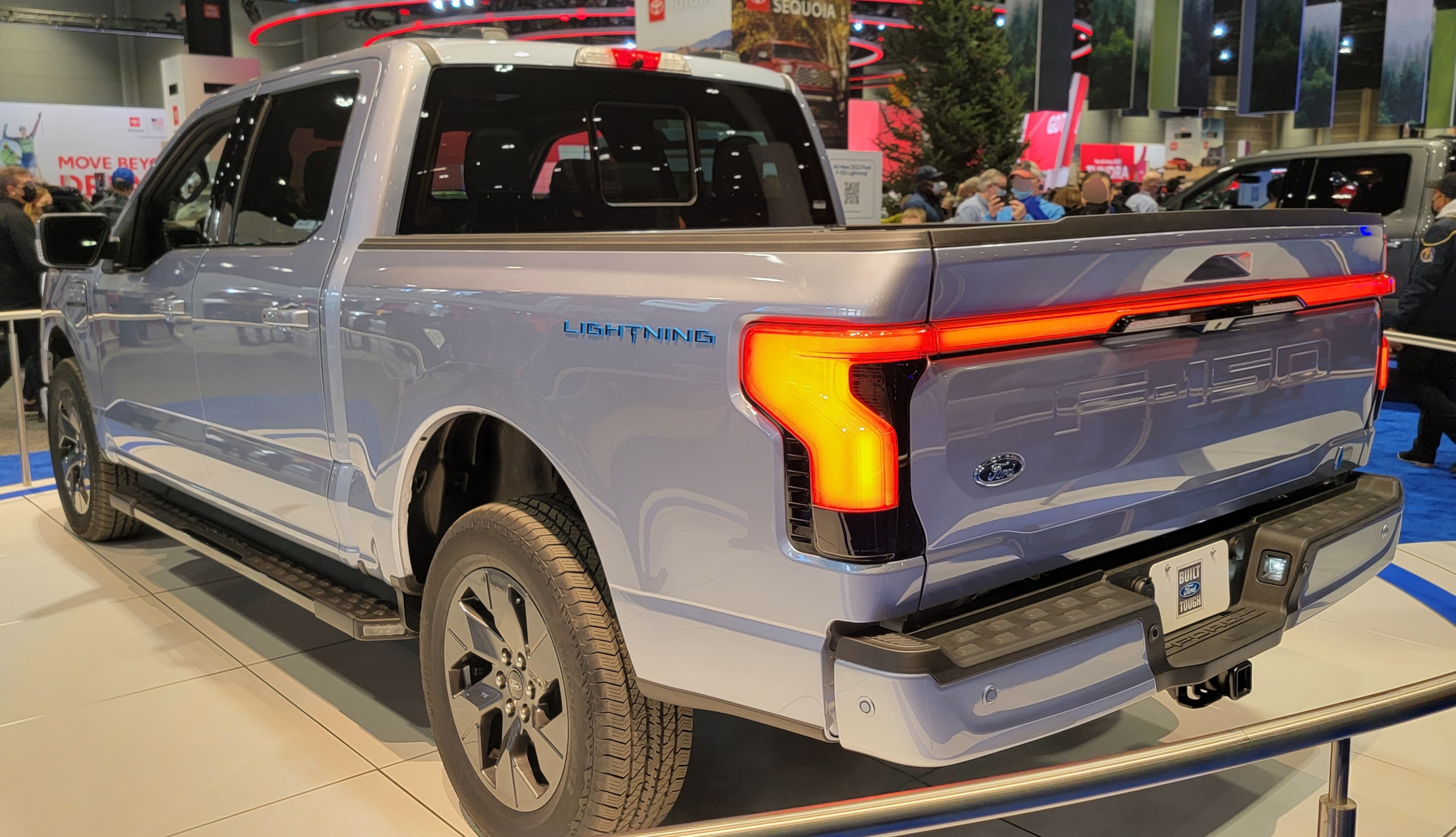
"including the EU's emissions reversal and Ford's decision to dump the F-150 Lightning. The EV buyer and the Ford F-150 buyer Van Diagram is really kind of like two circles."
The F‑150 Lightning is a fully electric pickup truck made by Ford. It can drive about 300 miles on one charge and has two electric motors for power.
The Ford F‑150 Lightning is an all‑electric version of the popular F‑150 pickup truck, featuring a dual‑motor setup and a large battery pack that delivers up to 300 miles of range. It represents Ford’s push into the electric truck market.
"The EV buyer and the Ford F-150 buyer Van Diagram is really kind of like two circles."
An F‑150 buyer is someone who buys the regular Ford pickup truck that runs on gasoline. They usually want a strong, reliable truck for work or family use.
An F‑150 buyer is a consumer who purchases the traditional gasoline-powered Ford F‑150 pickup truck. Their priorities often include towing capacity, durability, and brand loyalty.
"The EV buyer and the Ford F-150 buyer Van Diagram is really kind of like two circles."
An EV buyer is someone who buys a car that runs on electricity instead of gasoline. They usually want cheaper fuel and help the environment.
An EV buyer is a consumer who purchases an electric vehicle, often motivated by lower operating costs, environmental concerns, or access to incentives. Their buying patterns differ from traditional gasoline buyers.
Select text to request an explanation
This podcast is brought to you by Reynolds and Reynolds, the industry leader in automotive technology. Learn how Spark AI Reynolds Unified AI Data Layer can help you unlock your full potential by visiting rayray.com-spark-AI. Welcome to Daily Drive for Friday, December 19th, 2025. I'm Kellan Walker in Las Vegas.
Today on the show, USMCA talks are set to kick off in January. More UAW drama, deleted texts expose a scheme against Sean Fain's second-in-command, and CarMax slashes costs and hunts for CEO as profits are cut in half. Plus, incoming NADH Air Rob Cochrane joins the show to talk about what he hopes to accomplish in 2026.
NADH has historically been really good with issues of the day, policy issues, how we need to defend things, create grassroots, energy to either oppose something or support something. How can we balance that with a bit of more of a long-term view?
Let's run through all the news. You need to know to keep up in the auto industry.
The US and Canada will begin formal talks in January to review their free trade agreement, a critical negotiation for the auto industry.
Prime Minister Mark Carney says Canada sees major benefits in working cooperatively on key sectors like autos, steel, and aluminum.
But Washington has concerns about Canadian dairy policies, digital services, and provincial alcohol bans imposed after US tariffs at Canada.
Carney says the two countries were close to sectoral relief agreements on steel, aluminum, and energy before talks stalled in October.
Those discussions will now fold into the broader trade review.
For automakers operating across the border, the stakes are high.
Any changes to North American supply chain rules could reshape production and investment decisions.
The UAW is reinstating two top officials after deleted text messages exposed an alleged conspiracy at the top of the union.
A federal monitor says President Sean Fane colluded with his chief of staff and communications chief to make false accusations against Secretary Treasurer Margaret Mock.
Fane stripped Mock's duties in February, claiming she obstructed Union business.
But texts tell a different story.
One said, quote, everything went perfectly to plan.
The chief of staff has resigned and Mock and Vice President Rich Boyer are being reinstated.
Investigators found Fane apparently deleted 123 text messages.
This comes as Fane decides whether to run for a second term as Union President in next year's UAW leadership elections.
And CarMax is in crisis mode.
The nation's largest used vehicle retailer just reported a 50% drop in third-quarter net income to $62 million.
Sales fell 8% and revenue dropped nearly 7%.
It's a continuation of years of stagnant earnings which led to the decision to fire CEO Bill Nash in November.
Now interim leaders say they're cutting $150 million in cost and looking for a new CEO who can turn this ship around.
Here to talk more about it is Mark Homer, who covers CarMax as well as retail tech for us at Automotive News.
Mark, welcome back to Daily Drive.
Thank you. It's great to be here.
So Mark, why is CarMax in this state of crisis right now and why are the sales and profit numbers in bad shape?
There are certainly multiple factors but one of the biggest ones and that came out in this past weeks
they're quarterly earnings meaning their cars are too expensive and they've been working on reducing prices
but they haven't gone fast enough.
And what's the strategy going forward and what kind of CEO are they looking for to shepherd that strategy?
Let's talk with the strategy first.
The strategy is kind of an interim thing because the CEO is going to be the one who may want to do something
slightly different.
So in the short term, they're looking at cutting costs and lowering prices,
both of which will happen probably through the next quarter.
Some of which has already happened last month,
CarMax laid off 350 people with their one of their customer service arms and so more of that is likely to come.
Longer term, they're looking for a CEO who is experienced with e-commerce,
not necessarily with auto,
basically somebody who can think outside of the box and help bring them to the next level in terms
of efficiency, technology and how they sell cars with a really good customer experience.
They pointed out in their earnings call, it's still not as easy to buy a car online
as it is to buy pretty much anything else.
Well, let's see if CarMax figures it out.
Mark Holmer, thank you so much for joining me.
My pleasure.
And those are today's headlines.
You can find more details on all those stories at autonews.com.
Coming up, NADA's incoming chair, Rob Cochran, joins the show to talk about his priorities
in that new leadership role.
That's next on Daily Drive.
General Motors is ramping its autonomous driving technology,
targeting a 2028 launch for its eyes off driving system.
On this week's episode of the automotive news, shift podcast,
GM's Ryan Fowler and Jason Ecklement join the show.
They talk about how the automaker is rolling its former cruise robotaxi unit
into its super cruise team and its ambitions for self-driving tech.
Cruise is bringing their expertise and just raw horsepower in embedded AI modeling.
I'm Molly Boygon.
Join me and automotive news General Motors reporter Lindy Van Hully on shift,
available this Sunday wherever you get your podcasts.
When your AI tools are siloed, lost data, duplicate entries and confusion are inevitable.
Spark AI isn't another AI tool to manage.
Instead, it's a unified AI data layer changing the game by ensuring your solutions
are making life easier and working at their highest capacity.
Don't miss Spark at NADA.
Watch Ray, our new AI assistant,
bring everything together in one intuitive command center for smart,
fast decision making.
Ray answers your questions at any time,
providing instant messaging, insights, help videos or live support.
Instantly analyze your sales history and market trends or generate a sales report with one prompt.
You can even ask which cars to buy at auction today for the best return.
Schedule an appointment at our booth for everything from a short demo to a full retail
management system demonstration using our core AI products.
Visit rayray.com slash NADA.
That's R-E-Y R-E-Y.com slash NADA.
Welcome back to Daily Drive. I'm Kellyn Walker.
Rob Cochrane is stepping into the NADA chairmanship at a pivotal moment for franchise dealers.
He's the president and CEO of number one Cochrane in Western Pennsylvania.
Cochrane spoke with automotive news director of retail coverage Melissa Burden this morning.
He's a piece of their conversation.
What are your priorities for your NADA chairmanship in 2026? What do you hope to accomplish?
Well, I would say it's never about what I'm going to accomplish. It's always about
team and the NADA team, Mike Stanton, the professional team.
Hopefully, there's one thing the dealers of America will understand is how talented the team that
they have representing them and how hell dedicated that team is because it's really as you're
from a board seat and you're seeing this group work every day, they're really talented.
So that being said, it's really what I can, you know, some influences that I can bring.
I would tell you that NADA has historically been really good with issues of the day,
policy issues, how we need to defend things. You get great grassroots energy to either oppose
something or support something. How can we balance that with a bit of more of a long-term view?
A bit of a strategic view. There are so many issues the industry is changing rapidly
before we know it. We're going to be five years or seven years down the road and in a lot of
things, they're like, wait, look at all that has changed. We need to be thinking about some of those
changes now versus waiting for them to, you know, waiting for them to occur and then react to it.
So within that customer experience, artificial intelligence or probably,
or would be the two biggest things that I'm trying to influence and bringing to the table.
What are your top concerns then for US franchise dealership groups heading into 2026?
A big word concerns, right? We have to do a better job of getting prepared for the future.
What does that mean? Customer experience, the whole notion and we've gone through things,
there's certainly things going on in different states with what's happening with either
dealer practices or certain, you know, what OEMs are doing. We can continue to improve in that way.
The system can continue to improve. It is the best system out there for delivering vehicles
to customers and providing good experiences for customers, but it still can improve.
So how, you know, what can we do to, you know, we're right now we're in the midst of a study
on customer experience and independent study that is going to identify both dealer practice and OEM
practice and policy that may be, that may be negatively impacting how we're connecting and engaging
with customers. So that's a big initiative. Artificial intelligence as quickly as things are
changing. What are the three or four buckets or components of artificial intelligence and
technology that NADA should be monitoring over the coming months and the coming years
because it will be fluid. Those are keys. Certainly in the near term, there's always policy issues
continuing to push with the EPA. The president recently announced a relaxed cafe standards which
we're highly supportive of, but we have to get that across the goal line. So we'll be engaged with
that. And in the direct sales environment, we're continuing to fight direct sales throughout,
supporting various states throughout the country because we're vehemently opposed to that. So
there's always, there's always a lot to do. There's a lot to do. There'll be a lot to do in this
coming year, but I'm excited about it. And I know everybody at NADA is excited about it.
You mentioned a few of the changes that we saw regulatory wise in 2025.
How are those affected dealers? I wondered if you could tell us what you think maybe were some
of the more significant changes regulatory wise to dealers and how that might impact their
businesses going forward. Well, yeah, we had a good year. We had a very good year regulatory wise,
proud of the group, proud of all the collective efforts really with the CRAs and with the impact
on these issues that we're mandating. We're mandating EVs. Now we can let the consumer choose
what vehicle is best for them. And NADA has always supported but let the consumer make the choice.
We're moving. There's still a little bit of work to do on the cafe standards, but we've taken
big, big steps in moving to where the customer gets to choose that retailer needs to have the
products that the customer wants and it's a simple system. When the retailer works to provide
what the customer wants, the market works. So that's what we're for. We've made good progress
there this year. There's a bit more to occur with the cafe standards, but yeah, it's been a good
year from that standpoint. Is there anything in particular with cafe standards that you'd like
to work on this year or a upcoming year or that you'd like to see change? You know, as far as
specifics or particulars, I can't get into that. I would just say we want the customer to be able
to choose what it is that they want. We don't we don't want the government getting involved
with what is best for the customer. We want the customer to ultimately choose what is best for
that? What is the feeling among dealers on tariffs and how do you think tariffs will impact
vehicle prices in 2026? Yeah, that's a good question. I mean, we,
tariffs came out as you know in April and there was certainly a lot of a lot of energy around them.
I think if anything, we've been heartened that the industry has been as resilient as it's been
over these past eight months or whatever it's been. So, I think from from an ADA standpoint,
we're continuing to monitor, we're continuing to educate. We have great discussions within
within the administration and good communication within the administration. At this point,
we're just focused on continuing to communicate. If we see if we see the tariffs and feel the tariffs
are boy, this is really this is really becoming a challenge. We're going to be communicating that
and I think we've seen them continue to make progress in rationalizing and being transparent with
with all the OEMs. It's getting to be a simpler you know, it's a simpler system now with the OEMs
understanding what they're going to need to do to navigate through you know, through whatever the
the new laws are. So, we feel good about that. How did dealers do financially in 2025 and what's
you're thinking for dealers, you know, for their profitability levels in 2026? It was another good
year. I think it's OEM specific and brand specific. So, certain brands perform better than others
and that gap between the strong performers and the weaker performers probably grew in this past
year. So, as we look at next year, I think there's optimism. I think there's there's general
optimism on what's going to happen in 2026, but there's there's always some questions as far as
the economy or affordability as you as you mentioned. And the affordability is a concern. So,
I'm not sure next year would be rated at 10 out of 10 from an optimism standpoint, but I think it's
what everybody expects it to be a good year and a year where dealers can have success.
You led right into my next question. I was going to ask you about vehicle affordability.
The average price of a new vehicle is reached $50,000. It's up significantly from just five years
ago. Do you think vehicles are too expensive for the average consumer? Well, affordability is a
concern and it has been a concern. I think the affordability concerns point to maybe the
magic of the dealer system because it really puts dealers in a mode to do what we do best and that
is find solutions for customers, financing solutions, finding, being able to offer maybe use cars
to complement the new vehicles that people may be looking for. And that is our job. Our job is to
find products for our customers that are out there. Has that become a little more challenging?
The last couple of years, it has. So, we know the White House is, we know the White House is
aware and they've gone on record as it's talking about trying to slow the affordability
creep that the country has realized the last few years. So, it's a concern, but I think there's
a lot of energy around it and I think we'll manage it quite well over the next couple of years.
Is NADA doing anything specifically to help consumers or dealers with affordability of vehicles?
Well, I'm not sure that's NADA's, you know, that's what their role is. I think their role is to
just put dealers in a position to do what we do best. I certainly, NADA in their communication
with the White House and with Congress and with others will speak about the need to do a better job
in slowing the increase of pricing of vehicle pricing and I think everybody's focused on that.
Do you think that Fed cuts are needed to help with affordability for consumers and dealers?
Well, the certainly rate cuts help affordability. So, when the rates come down,
when the rates come down, when gas prices come down, that whole mix becomes easier for customers to
to absorb. So, that is the rate cuts that we've that have been offered will make it a little
bit easier this year than it was last year. You can hear more from our own Melissa Burton's
interview with incoming NADA chair, Rob Cochran, on our bonus episode of Daily Drive, available Sunday
morning. That's Daily Drive for today. I'm Kellen Walker. Thanks to automotive news, executive producer
Jake Near as well as our own Nick Bunkley and Mark Homer for their reporting for today's podcast.
You can get the latest news on retail, tariffs and trade and everything happening in the auto
industry at autonews.com. Come back over the weekend for our weekend drive episode of the show,
our own Molly Boygon and Greg Lason discuss the biggest stories from the past week,
including the EU's emissions reversal and Ford's decision to dump the F-150 Lightning.
The EV buyer and the Ford F-150 buyer Van Diagram is really kind of like two circles.
These are not really the same buyer. We'd love to hear from you. Let us know what you think
of the show on the topics we cover today. Then us an email at DailyDrive at autonews.com or leave
us a voicemail at 313-444-2774. And if you enjoyed the podcast, remember to like, leave a review
and subscribe so you never miss an episode.
Request an explanation for:
1 cars
1 cars featured
Request an Explanation
Heard something you'd like explained? We'll add it to this episode.
Sign in to request explanations for terms you heard.
Want to learn more?
Browse our glossary for plain-English explanations of automotive terms, jargon, and concepts.
See something that's not quite right? Our annotations are AI-generated and can sometimes miss the mark.
Click the flag icon on any annotation to suggest a correction.