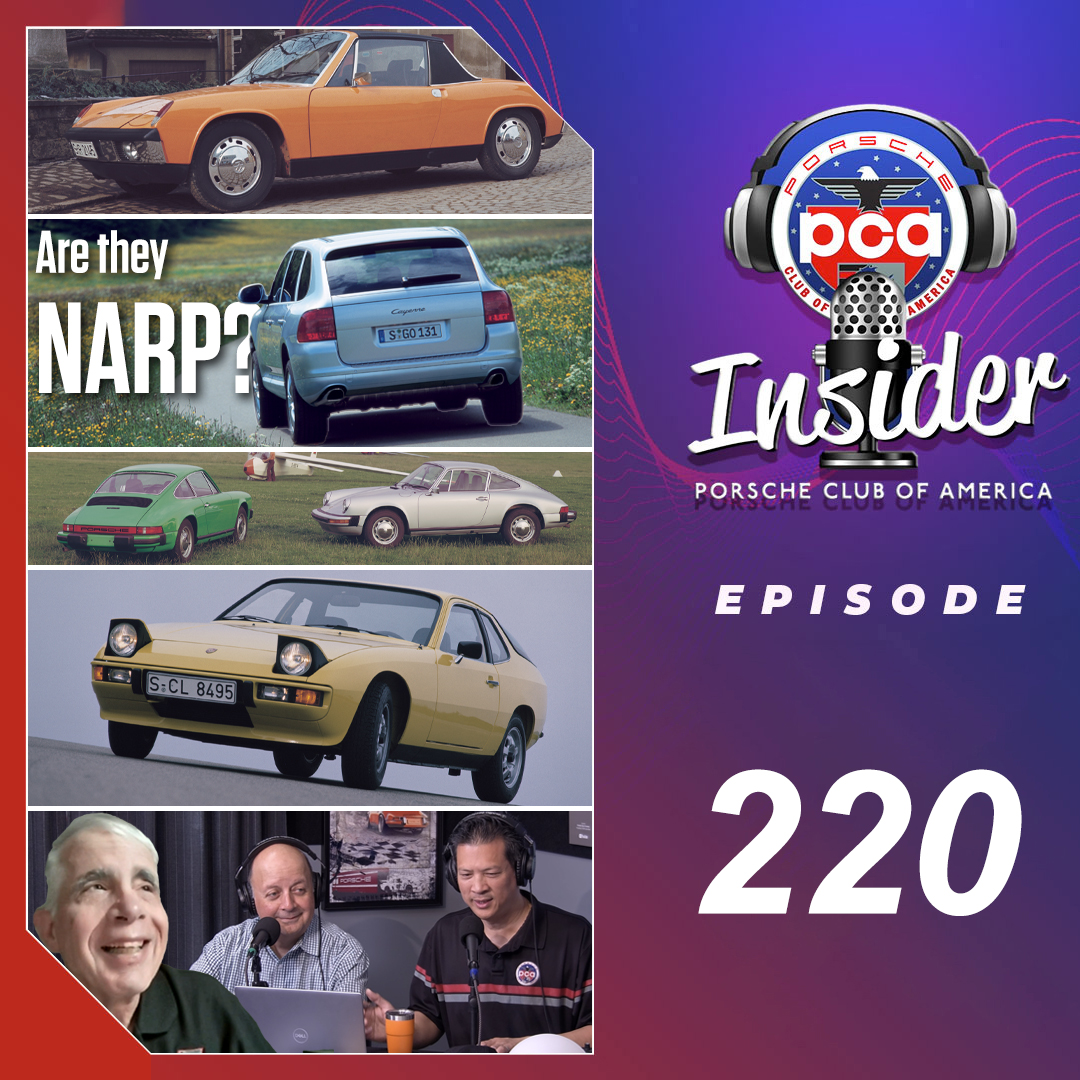
“NARP” is a nickname fans use online for a Porsche that some people argue “doesn’t really count.” It’s basically internet slang for “not a real Porsche,” and the argument is usually about which models are “true” Porsche.
The Porsche 356 was one of the first Porsches and it’s a big deal in Porsche history. The hosts are saying some 356 fans didn’t immediately like the newer 911 when it arrived because it felt very different.
The Porsche 911 is the iconic model most people think of when they think “Porsche.” In this discussion, the 911 is described as a big change from the earlier 356, which is why some fans questioned it at first.
An engine’s “cylinders” are the individual chambers where fuel is burned. Here, they’re pointing out that the earlier car used a four-cylinder design, and the later one moved to six cylinders.
More cylinders usually means the engine can run more smoothly. The hosts are using the shift to a six-cylinder engine to explain why the 911 didn’t feel like the same kind of Porsche as the older 356.
Term
bathtub-like shape
This is a nickname for the older 356’s body shape—low and rounded. The hosts are contrasting it with the 911 to show how big the visual change was.
Term
bubble-like shape
This is just a visual description of how the older 356 looked—more rounded. The point is that the 911 looked very different, which surprised long-time fans.
The 918 Spyder is a very high-end Porsche supercar. It uses a hybrid system, meaning it can run on more than one kind of power. The podcast brings it up when comparing it to other supercars.
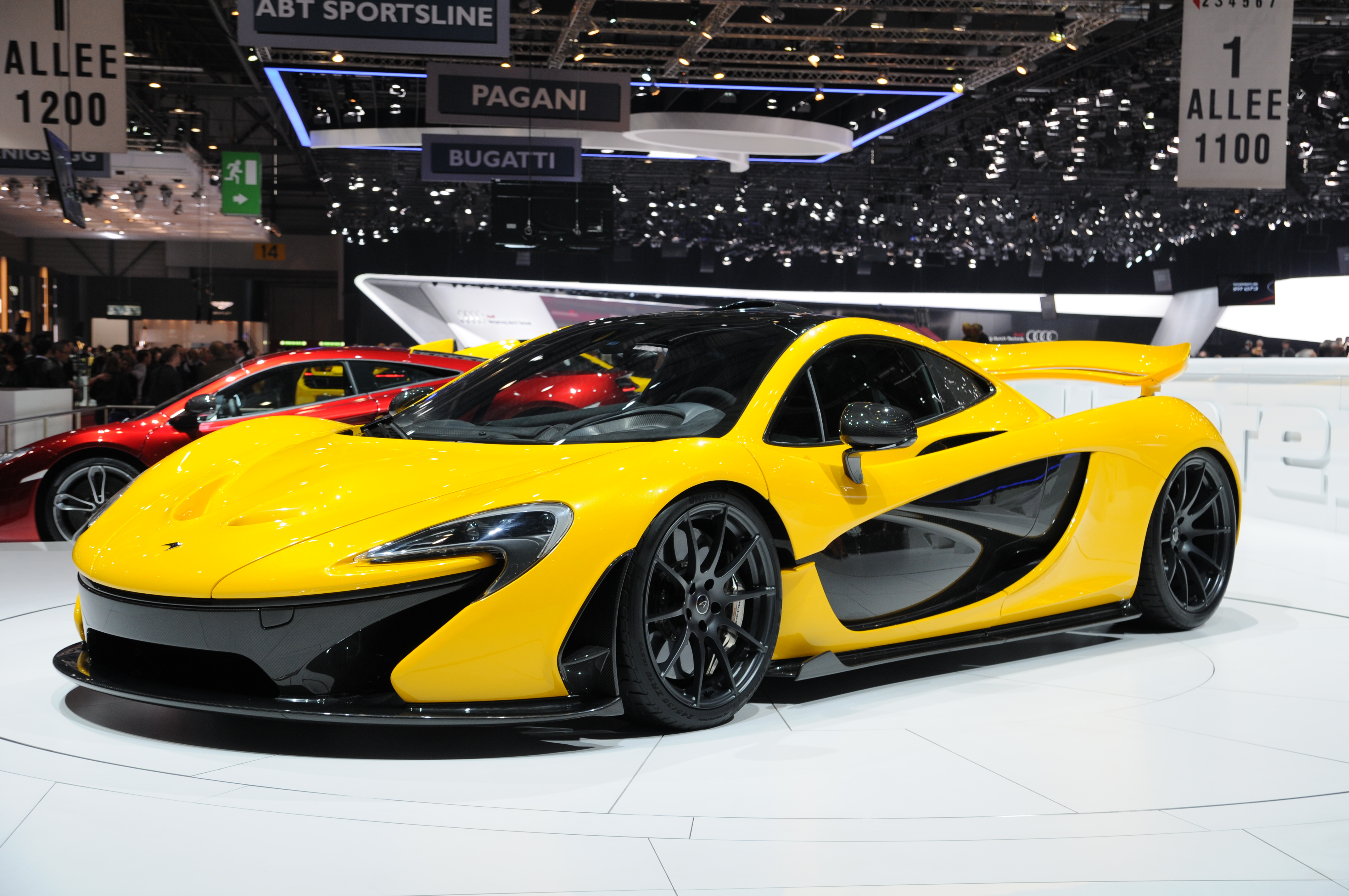
The McLaren P1 is a very high-end supercar with advanced hybrid technology. Here it’s mentioned because the hosts are comparing it to Porsche’s 918 Spider when talking about what people consider a “real” Porsche.
Volkswagen is the company that, through the Volkswagen Group, has been connected to Porsche for a long time. The point here is that Porsche isn’t isolated—it shares corporate roots and sometimes components with Volkswagen.
The Porsche 914 is an older Porsche that enthusiasts argue about. The reason is that it shared a lot with Volkswagen, so some people thought it was “not really Porsche,” which is exactly what the hosts are debating here.
Audi is part of the same big corporate group as Volkswagen. The hosts mention it to illustrate that Porsche often teams up with brands from that same family.
Toyota is brought up as a “what if” partner for Porsche. The host is basically saying Porsche usually sticks with its own corporate family, so a Toyota partnership is unlikely.
The Toyota MR2 is a small sports car that’s known for being fun and relatively affordable. The host is hoping the MR2 (or a new one) would happen without Porsche getting involved.
Kaizen is a way of running a factory where you constantly look for small improvements. The host is saying Toyota has helped with production ideas, even if it hasn’t teamed up with Porsche on cars.
Handling is how the car feels when you turn—how well it sticks to the road and how smoothly it responds. It’s a big part of why drivers judge whether a car is “fun” or “sharp.”
They’re saying that today’s Porsche buyers expect more than they used to—faster acceleration and stronger overall performance, not just a fun driving feel. So older cars can get judged differently than they did back then.
The Porsche Cayman is a Porsche sports car with its engine placed more in the middle of the car. The host uses it to show that Porsche’s “DNA” shows up across different models, not just the 911.
“Stock form” means the car is basically as the factory built it. The host is saying they’re talking about the original, unmodified versions when comparing performance and character.
EVs are electric cars that run on a battery and electric motor instead of gas. The host is saying you should drive a Porsche EV because it can still feel like a Porsche, not just a generic electric car.
Propulsion power is the amount of driving force an electric motor system can deliver to move the car. The host argues that, for Porsche identity, the sensation of driving (steering, balance, and feel) matters more than raw propulsion power numbers.
The Porsche Taycan is Porsche’s electric car. The host’s point is that even though it’s electric, it still drives like a Porsche—so it doesn’t feel like a generic EV.
The Chevrolet Corvette C8 is a newer Corvette generation where the engine sits more in the middle of the car. The host is using it as an example of a model that looks and feels like a bigger change than Porsche’s more gradual evolution.
“Mid-engine” means the engine sits closer to the middle of the car rather than at the front or the back. That can change how the car feels when turning and how it balances.
A trans-axle is a drivetrain unit that combines the gearbox and the final-drive/differential in one assembly. It helps the car fit the powertrain in a certain layout, especially on front-engine cars.
“Water-cooled” means the engine uses coolant fluid to carry heat away, usually through a radiator. The episode contrasts this with air-cooled engines that cool using airflow instead.
“Air-cooled” means the engine is cooled mainly by air flowing over it, not by coolant through a radiator. In the episode, people use this as a sign of “classic Porsche” heritage.
Term
evolutionary line of design
“Evolutionary line of design” here means the idea that Porsche’s styling and engineering should progress in a recognizable, continuous way from earlier models. The episode frames the NARP label as a reaction to cars that break that visual/engineering continuity.
The Porsche 924 is an older Porsche that was more affordable than the classic 911. The hosts discuss it because some people call it “not a real Porsche,” but it sold in big numbers and played a real role for the brand.
Car
Porsche 911S C Sunroof Coupe
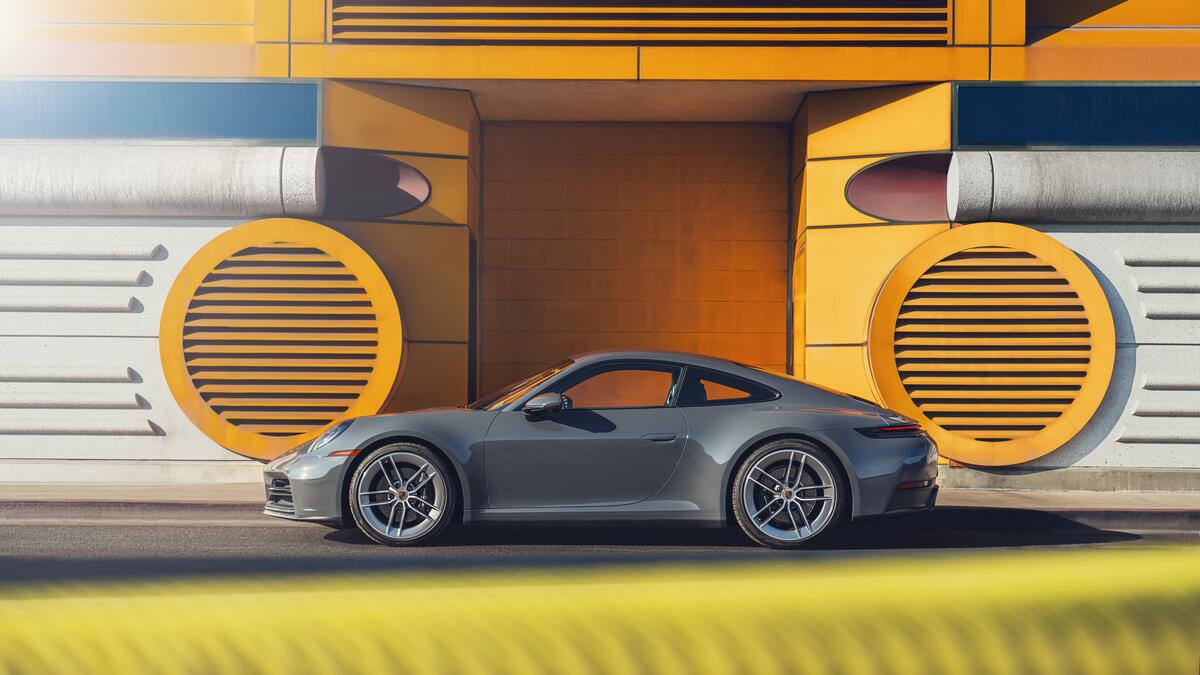
This is a 1978 Porsche 911S coupe with a sunroof. The 911 is the model most people think of as “the real Porsche,” which is why it comes up in the argument.
“Dealer installed” means the car didn’t come with that feature from the factory. The dealership added it later, which can sometimes lead to messy or non-original-looking work.
An air conditioning unit is the part that cools the car’s cabin. The speaker is saying he expected the factory-style setup, but the dealership installed a different unit instead.
Term
Vopo unit
“Vopo unit” sounds like a nickname for an aftermarket gadget someone added to the car. The host is saying it required cutting up the dash, and that kind of modification usually makes the interior look worse and can be a pain to live with.
“Air-cold” is the idea of cooling the engine using air flow, not coolant. The host is saying some Porsche fans were strongly attached to the older air-cooled way of doing things.
“Water-cold” means the engine uses liquid coolant to stay cool. The host is pointing out that the 924 used this approach, which felt like a big change to traditional Porsche fans.
Consigned means the car is being sold through a dealer, but it’s not necessarily the dealer’s car. The owner usually still has control until the car actually sells.
Company
VW repair restoration facility
They’re saying the car was sent to a shop that does repair and restoration work for Volkswagen cars. It’s basically a specialized service place, not a random dealer lot.
They’re talking about a parade event held in St. Charles, where they drove their car for a rally/campaign. It’s part of the story about what happened to the car during that event.
This means the car has special, unusual features that aren’t found on most other cars like it. Those rare details are part of what makes it exciting to show at top car shows.
A concours is a fancy car show where cars are judged on how correct, clean, and well-kept they are. They’re saying their Porsche 924 was invited because it’s special and in great shape.
HVAC vents are the air outlets for the car’s heating and air-conditioning. The hosts say the dashboard cracks start near those vents, which suggests that heat and airflow over time can damage the dashboard material there.
A retrofit means adding a newer or different part to your car so it works like you want. In this case, they’re saying they can fit a dashboard from later 924 years onto an earlier car to address cracking.
Direct sunlight can make the inside of a car get very hot. That heat can damage dashboard materials over time, so the speaker covers the dash to reduce sun exposure and keep it cooler.
Heat soak is when a car’s interior materials absorb heat and stay hot for a long time, even after you stop driving. In this segment, the hosts connect heat soak from sun exposure to dashboard deterioration, which is why they use towels/covers to limit heat buildup on the dash.
Engines can be cooled in different ways. Air-cooled engines use airflow to keep things from overheating, while water-cooled engines use coolant flowing through the engine and a radiator.
An engine can have different numbers of cylinders. More cylinders often change how smooth and how the engine sounds and feels, and the host is saying people get too focused on that when judging Porsches.
Some car fans argue that certain Porsches don’t count as “real” Porsches. The host disagrees and says the real Porsche feel comes from how the car drives—especially steering and how it rides—more than from what engine it has.
The Porsche 944 S2 is an older Porsche that’s famous for how it drives. The host’s point is that it feels like a Porsche mainly because of the steering and how the suspension behaves over bumps, not just because of the engine.
The Porsche 912E is a special Porsche variant that was sold only in the U.S. The episode calls it a “NARP” because it’s kind of a mix—built between other Porsche models. People argue about whether it feels like a “real” Porsche because of how it was put together.
The Porsche 924 Sebring is a particular Porsche model tied to the 924 family and Sebring racing history. In this segment, it’s mentioned because the hosts are planning to display it at an event. It’s basically a named, recognizable Porsche variant they’re proud to show off.
“Zinc coated” means the metal gets a protective zinc layer to slow down rust. The hosts are pointing out that this kind of protection can make a big difference in how long the car stays solid.
“Short hood” means the front hood is shorter than on the more common version. The hosts are using it to point out that this particular 912 is a rare configuration.
This means the car uses a Volkswagen flat-four engine design. The hosts are saying that engine choice is a big reason the car drives differently—often smoother and easier to manage than a classic 911.
The Porsche 912 V is described as easier to drive and smoother than the older 911s the hosts are comparing it to. In rallying, they say it lets you concentrate on the road and not constantly worry about the engine.
RPMs tell you how fast the engine is spinning. The hosts are saying the 912 V is easier because you don’t have to constantly watch and manage that engine speed while driving hard.
“Sunroof cars” just means cars that came with a factory roof opening. The hosts are talking about how few of those were made compared with the cars without a sunroof.
Steel wheels are wheels made from steel instead of lighter alloy materials. They’re usually a more basic, original-style option on older cars. In this story, it’s part of what makes this Porsche 912 V stand out as a rare configuration.
NPCA is the Porsche Club of America. It’s a group for Porsche owners that organizes events and helps people stay connected with other enthusiasts. The episode mentions it to show the car’s previous owner was deeply involved in the Porsche community.
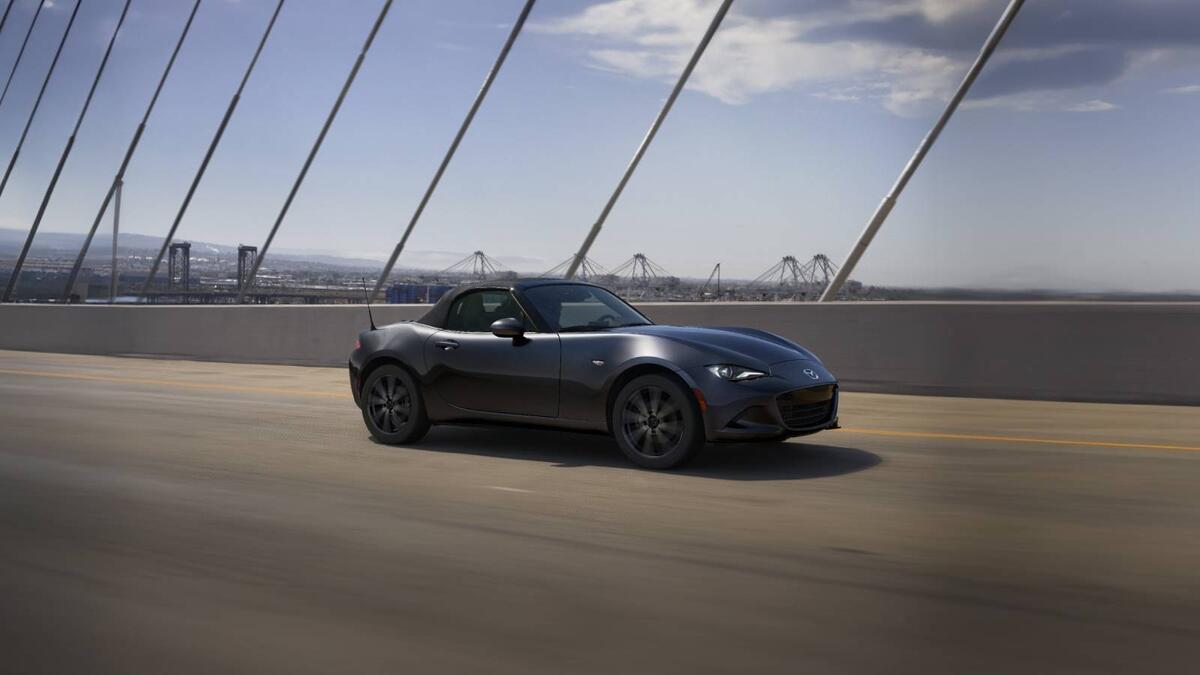
The Miata (MX-5) is a small, lightweight convertible made by Mazda. It’s known for being easy to drive and fun for everyday trips. In the podcast, it’s used as a quick visual and layout comparison.
The Porsche Boxster is a Porsche roadster with the engine placed in the middle of the car. People sometimes argue about whether it “counts” as a real Porsche, but it’s still a genuine Porsche model. In the episode, they talk about how opinions changed when stronger versions like the Boxster S arrived.
A “spider” is just a roadster—an open-top car. “Two-seat spider” means it’s designed for two people and focuses on open-air driving. The speaker uses it to describe what people were excited about when the Boxster arrived.
The speaker is saying that some early Porsche Boxster/Cayman cars used a transmission design that came from Volkswagen (VW). That matters because people argue about whether the Boxster is “really” a Porsche. The point is that some major parts were shared, even if the overall car is still Porsche-engineered.
“Six-speed” means the car has six forward gear ratios. In this segment, it’s mentioned while comparing how heavy different transmission setups are. More gears can help the car keep the engine in a better range while driving.
“Boxer” describes the engine shape. Instead of cylinders moving up and down in a straight line, the pistons move opposite directions, which helps the engine sit low in the car and can make the car feel more balanced.
“Take umbridge” just means “get offended” or “feel upset.” In this conversation, they’re saying they’re really bothered by the labels people use for certain Porsches.
Torque is the engine’s pulling force that helps the car move quickly, especially when you accelerate. The host’s point is that people who call it “not a real Porsche” should drive it and feel how the torque comes on.
Person
Carmen
The host mentions “Carmen” as the person involved in early Porsche 356 work—physically modifying bodies by welding parts together. The takeaway is that Porsche’s early cars weren’t always “perfectly traditional,” and people still argued about the results.
A “notchback” is a car body shape where the roof and trunk look like they’re clearly separated (a stepped profile). The host is saying that when Porsche made the 356 in this style, people didn’t like the new look.
A “stop-gap measure” means a temporary solution. The hosts are saying Porsche used an entry-level model as a bridge, and some fans reacted negatively to that idea.
The Porsche 944 Turbo is an older Porsche that came with a turbocharger. Enthusiasts have long used it as a budget-friendly track car, and the host is saying Boxsters are filling that same niche now.
A “flat six” is an engine where six cylinders sit in a sideways layout. The host mentions it because some people expect that classic Porsche engine shape and sound.
The Porsche 718 is a Porsche that uses a four-cylinder engine instead of the classic flat-six. The host is arguing that even with a smaller engine, it can still drive and feel like a true Porsche.
Turbocharged means the engine has a device that forces more air into the cylinders to make more power. The host is saying the car still feels quick and doesn’t feel “slow” or laggy.
The Porsche Cayenne is Porsche’s SUV. People argued it wasn’t a “real Porsche” because it was built with Volkswagen and shared a lot of the same underpinnings as the Touareg. The point here is that it’s related, but not identical—Porsche still made it feel and spec differently.
“Direct partnership” means Porsche and Volkswagen worked together closely on the SUV project. The criticism in this segment is that sharing costs and development made the Porsche feel too similar to a Volkswagen. The hosts argue it’s related, but not identical.
The Volkswagen Touareg is Volkswagen’s big SUV. In this episode it’s used as the comparison point for the Porsche Cayenne because they’re closely related under the skin. The speaker explains that even though they share a lot, the engines and how they feel can be different.
TDI is a type of diesel engine. It uses a turbo to help the engine breathe better and injects fuel directly into the engine. In this segment, it’s mentioned because the speaker owned Touareg diesels with this setup.
Here, “platform” means the shared basic structure underneath the car. If two SUVs share a platform, they can feel similar because the bones and layout are related. But the final tuning and parts can still make them different.
VR6 is a special Volkswagen engine design. It’s built to fit in a smaller engine bay than a typical wide V6, while still behaving like a V6. Here it’s mentioned because one engine option is similar between the Touareg and Cayenne.
Ferdinand Piech was an important leader at Volkswagen. The speaker brings him up to explain the “why” behind the engineering approach used on the Cayenne and Touareg—basically, that the cars were developed during a time when the company was willing to build them very thoroughly.
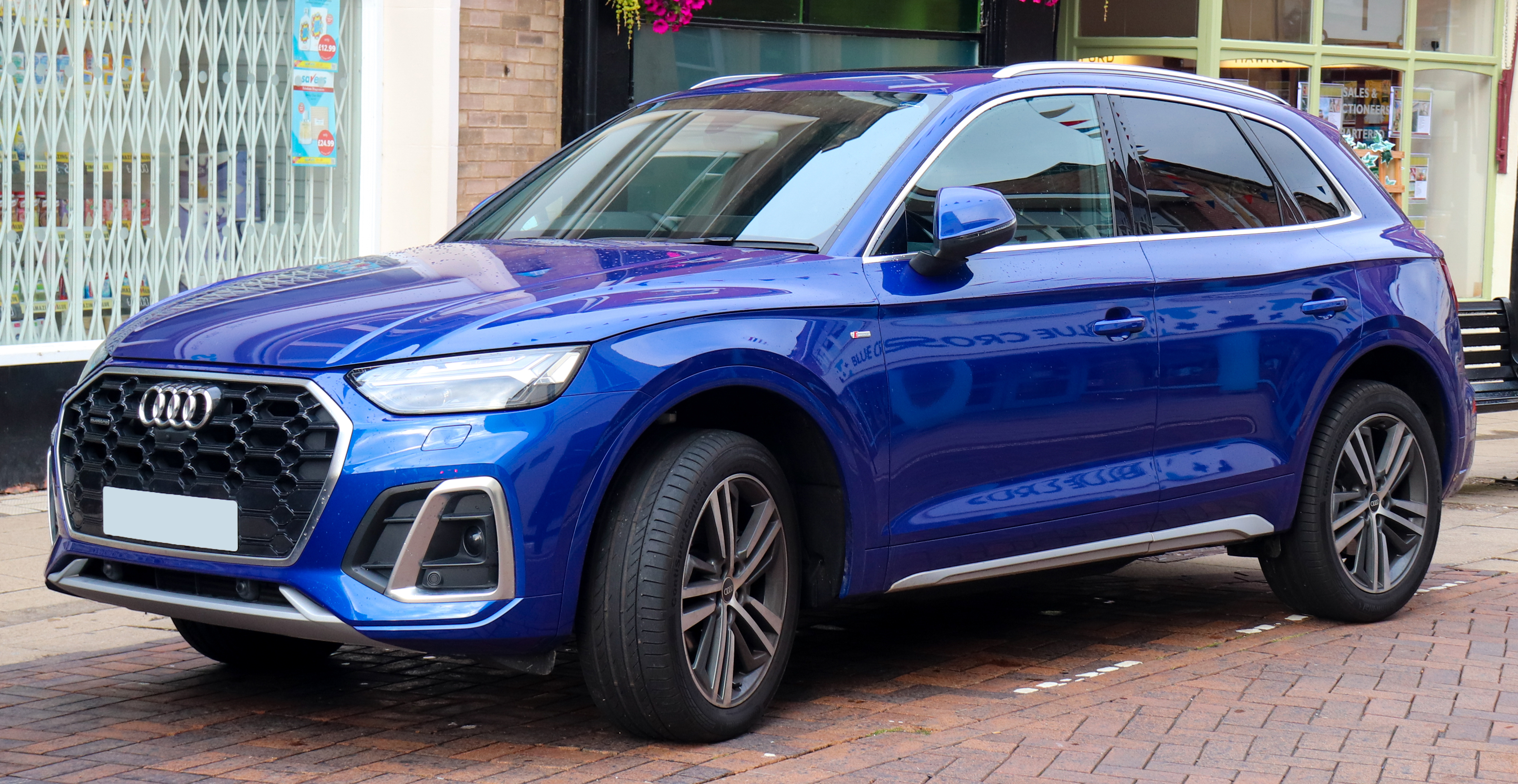
The Porsche Macan is Porsche’s smaller SUV. Here they’re talking about how Porsche tuned it to feel more like a Porsche to drive—especially by sending most of the power to the rear wheels instead of the front.
The Audi Q5 is an Audi SUV. In this discussion, they’re saying Porsche based the Macan on that general platform, but Porsche changed it enough that it should drive and feel like a Porsche, not just a rebranded Audi.
A chassis is the main “frame” of the car that everything else mounts to. They’re discussing whether Porsche should have built a new frame or just modified the existing one from the Audi platform.
This means the car sends more power to the front wheels than the back. The hosts say Porsche changed that balance so the rear wheels get more of the work, which can make the car feel more agile and “Porsche-like.”
This means the car sends most of its power to the rear wheels. They say it’s roughly 80% to the rear, which helps the car handle more like a traditional rear-driven sports car.
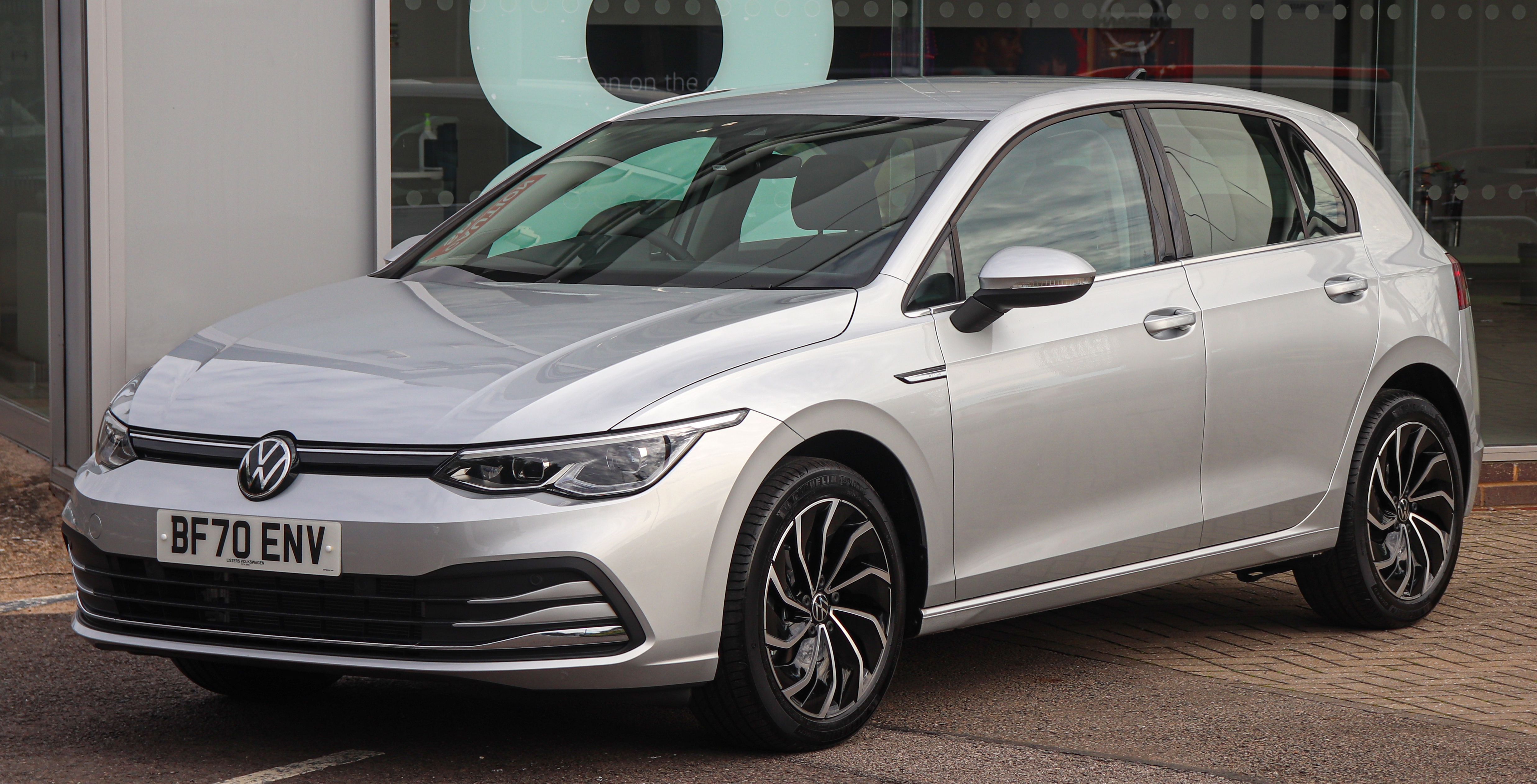
The Golf is a compact car from Volkswagen. In the podcast, people talk about it getting criticism because some versions are seen as related to the GTI and because they may feel underpowered. The point is that the car’s reputation affects how people judge it.
Suspension is the system of springs, dampers, and linkages that controls how a car rides and how its tires stay planted over bumps and during cornering. The speaker credits the Macan’s suspension (and brakes) for inspiring confidence, which is why they think the base engine isn’t the whole story.
“Base model” is the basic version of a car, usually with fewer upgrades than the higher trims. The speaker is saying you don’t automatically need the top engine to enjoy the car.
“Hot hatches” are small hatchback cars that are tuned to be quicker and more fun to drive than regular versions. The speaker is saying the base Macan feels similar—nimble and engaging.
The Panamera is Porsche’s four-door car, meaning it has room for more than just two people. It’s built to drive more like a sports car than a typical family sedan. The podcast mentions it because they had multiple Panameras available to look at or test.
A “daily driver” is the car you use most days for normal life—work, errands, and commuting. Here, the point is that the Porsche SUV can handle everyday use.
Brand
McCons
The transcript says “McCons,” but it doesn’t sound like a real car model name. The speaker is talking about a used car that’s certified pre-owned, and they mention the engine is shared across Audi and Volkswagen cars.
LIVE
Welcome to the Porsche Club Insider, your one stop for all things Porsche and PCA.
Before we get into it, I want to thank our presenting sponsor, Pirelli. Pirelli tires have to
achieve the highest levels of performance, safety, noiselessness, and grip on the road surface.
Innovative tires that can satisfy even the most specific mobility needs of the end consumer.
Thank you all for listening. If you aren't currently a PCA member in Onaporsha,
what are you waiting for? Grab that VIN, head over to PCA.org and make yourself a member.
For those of you that don't currently own a Porsche, check out our Test Drive program,
where we unlock resources so that you can find that special Porsche for your driveway and or
garage. We are back at PCA's national office around the little tiny table. I've got Manny
to my right. I've got Damon manning the controls. And back for I think either the third or fourth
time, we have retired Colonel Bob Gutierre, who is also the co-founder of Boardwalk Reunion,
the Porsche Parade gimmick rally assistant to the chair, and just all around, good guy.
Welcome back. I looked it up and I thought he was co-chairing and I realized it said
Ellen Beck chair and I'm like, oh, assistant. He's the tag along.
Yeah, I am definitely a plus one when it comes to the gimmick rally. Yep.
All right. So, Narp, I've never, is this, how did I, did you know about this, Damon?
I did not. I've never heard the term. I've heard, I've heard not a real Porsche.
I've never heard Narp. Oh, first time for me. Are people using that online?
It's in a lot of the forums. Yeah. Yeah. Well, I think between the four of us here,
we own several NARPs. So what is not a real Porsche, you know, from my 996 to my 914.
Let's see, Damon, you've got your six cylinder Cayenne. Yeah, that's technically. Your 996
doesn't qualify. What do you mean it doesn't qualify? No, just because it's at least loved 911
that it means anyone ever said it's not a Porsche. At least loved. No one ever said a 996 was not
a real. So this is, this is, I thought about this because I thought, and then nothing irks me more
than when I hear journalists say, this doesn't give you the Porsche experience or this doesn't
give you what, what a Porsche is all about. And because there's no definitive answer to what the
Porsche experience is. Every, everyone, it differs. It's the same reason everyone has their own
reason for buying a Porsche and what makes them love, love to mark. So it really irks me when,
when people, and I find this a lot in automotive journalism, while they were slam base models
or any of the entry level models has not been good enough to be called a Porsche.
Now, do you think, I think if we rewind the original 356 Porsche and when the 911 came along,
there's probably a period of time where they thought the 911 was a NARP.
Not that I've read. Yeah. No. Well, 356 people would say that. I looked in panorama and the
transition, it was a more expensive car. Yeah. Bob, what do you think? I was going to say that,
you know, I mean, I did a little bit of homework in preparation for this podcast,
so I can keep up with you guys. But I think that when the 911 was first introduced, the 356
community was really surprised by its design, because it was such a radical departure from
the 356. You went from a four-cylinder engine to a six-cylinder engine with a very much different
shape than the bubble-like shape or bathtub-like shape of a 356. And beyond that, it was much
more expensive and it handled completely different. So back in the day, I've heard where
the 356 guys would not blink after 911s. And there was a little bit of tension,
I think, at the first couple of parades based upon what I've heard from people who attended
those parades back in the day. So even a new design like the 911 received a little bit of
pushback from the Porsche community until it was obviously completely embraced. But I think that
speaks to the radical, the way the Porsche community reacts to a new design or something
different than what they're expecting and what they own. I think it's also human nature, right?
So you get used to something, anything that's new you're going to hate. But I would say the
poster child of Narp, not because I think it's true, but if you say Narp or not a real Porsche,
the car that kind of comes into mind is I would say the 914. I think that probably gets the
worst rap. I think that's where it all started. And I saw something, it was a top gear clip
and they were comparing the McLaren, I think P1 maybe against the 918 Spider.
Anyways, Jeremy Clarkson was in favor of P1 and he has Richard Hammond who was doing the
918 Spider. He goes, but who is your car? Who is Porsche owned by? And you see Richard Hammond
look down and say Volkswagen. Like it was like a mark of shame, you know? But the reality for
those who don't know or new to the brand is Volkswagen and Porsche have been in the same family
forever. It's something that when Volkswagen was buying out Porsche, it didn't worry me one bit.
If GM or Ford had bought Porsche, I would have been in panic mode. But this was just a matter of
two families moving around ownership and money and whatnot. So it doesn't bother me that.
Correct me if I'm wrong. Porsche number one, chassis number one, where did that kind of
spawn out of? The majority of it was Volkswagen parts. Exactly. So how can you hate on that?
But the 914, I think what hurt the 914 was that in Europe, it was sold in BW dealerships
and had a lot of BW markings. And so people here in North America automatically assumed,
well, it's really a BW and they're just marketing it as a Porsche.
I feel like we've kind of come full circle in a way because, you know, everybody knows what's
going on with Porsche now and, you know, the cars, the prices are, you know, through the roof.
And we often get people saying, oh, they should make an inexpensive Porsche for the,
you know, the average person that could buy. So basically what they're saying is make a modern
day 914. Yeah, so they can complain about it. So they can complain about it, not being a real
and if you notice every time they do partnerships, it's with Volkswagen or Audi or somebody
from the Volkswagen family. So I want to hear people say they should team up with Toyota.
I'm like, it's never going to happen. It's not something that they've done in the past.
They stick within their own family. Well, if we really stretch it, they have done stuff with Toyota
just not regarding their cars, right? With the Kaizen production line of things. So we can hold
out hope that MR2 will become. That's not going to happen. That's not going to happen. I was going
to say if an MR2 happens at all by itself, it'll be awesome. They don't need Porsche's help.
Here's the thing. We recently spent some time with George Hussey, Auto Atlanta, and I got a ride
in a very solid example of, I think it was a 76 914. And you want to talk about a real Porsche
experience. Maybe you all will have to define this for me, but I felt that was a very special
experience in that 914. It was solid. It was fun. It handled well. It had plenty of power for a car
of its day. I just don't understand what people think. What is the real Porsche experience?
How do you define that? Bob, you have a little answer to that one?
Well, I think it is totally dependent upon the individual. And one of the things that
I've seen over the many, many years is in the Porsche community, people are very passionate
about the mark. You could argue that Porsche owners are the most passionate owners of any
specific sports car in the world. And so they have very, very, most different opinions on
what their cars are about, what a Porsche should be, what it shouldn't be. And as a result of that,
you're going to have these individuals who are very passionate have specific ideas about what
performance should be, whether it be handling or horsepower. I think over the years, we've
departed a lot more from handling to the horsepower because Porsche is just building just killer
cars that are blowing people's doors off. So I think the expectation now in these modern times
is Porsche is going to be extremely fast, have a tremendous amount of horsepower and handle
perfectly. So when you look at that, the expectation from these new owners
is a little bit different than previously, and the performance expectations are much higher.
So over the years, this is kept up with Porsche's engineering and how well they've
improved the cars. So I think that's one of the major factors. You have to look at that passion,
you have to look at the individuals who really believe that they have the right opinion, that
they know what a Porsche should be, because they spend all this money on the car, they're passionate
about the car's attributes, and so they feel that they know best. I mean, we see this in forums all
the time, you know, on bat, on blogs and everything, where people really believe that they know what
what a Porsche should be, what its performance should be. When in reality, you know,
Porsches have always been performed well in their time and in their element, right? So it's just,
I think, more of the people looking at this, the owners, the passionate owners looking at this,
as opposed to the general public. I would also say the Porsche experience.
If you take all their cars in the stock form in which they were introduced, take it a 356,
a 911, a Cayman, and just look at pure stats. I think every Porsche punches well above its
class because of how well executed these individual things are. And what I mean is that
the combination of handling, you know, and it might not have the best high power, it might not
be the lightest, but when it's all put together, whatever that secret sauce is, it makes for a
very enjoyable drive that punches well above its class. Yeah. When we talk about EVs, and I'll
ask people, have you driven a Porsche EV? And a lot of them will say no. And I said, well, you really
owe it to yourself to drive it because what you're going to feel is you're going to say, yes, this
is a Porsche. The propulsion power isn't as important as that when you get behind the wheel
of the car. You hold a steering wheel, you look at the dashboard, and then you start rolling.
It feels like a Porsche. It handles like a Porsche. And to me, that's part of the Porsche
experience. And that goes from a 50 horsepower, 356, all the way to the 1139 turbo GT Taycan.
It gives you that feeling of a Porsche. And everything in between is your own personal
preference. And I also think it has to do with how distinct the design of a Porsche is, no matter
which model. You can see how they're all connected, right? Like from a 356 to a 911 to a Cayman,
even to a Cayenne to the modern Taycan. You can see that DNA woven through all of those models.
Other cars, as much as you might love a Honda, Toyota or whatever,
sometimes when they introduce a model, it's so shockingly different. Like there is no
connection. Like you take a C was the C8 Corvette versus like you don't see the DNA, maybe a little
bit of it, but not Porsche has evolved. And it's not a complete revolution to their original design.
I think that people, even non-car people, see a 911 or a 356, they know it's a Porsche, even
without even being a car person, because it's all so uniquely distinctive.
Well, I think, but you know, that argument, you could counter that argument by saying that
the radical nature of some of Porsche's designs has caused, so the discussion we're having today,
the NARP discussion, in that if you look at the 914, that was a complete departure from
what the 356 was and what the 911 was, right? You have a very 70s looking design
with a mid-engine package, 924, a front-engined trans-axle car, a water-cooled car,
and they were complete departures from what the traditionalists, the purists, if you will,
had embraced previously with the 356's and the 911. So you get these arguments from
these people during those years, during those times, and sadly enough, sometimes today,
that the 914 is not a real Porsche, and that the 924 is not a real Porsche because
it lacks that heritage, it's not air-cooled, or it doesn't have those lines, that evolutionary line
of design like you just mentioned. So a lot of the owners during those times were up against that.
Do you think this, and you make a very good point, I think the cars that fall into the NARP
category are the ones that go against the traditional lines of what a Porsche is,
but that's not all though. I think those non-traditional cars are also introduced maybe as
the affordable ones, and they were not well kept and became daily drivers that just end up being
junked, and they just kind of had the fate, unlike, I think if someone buys a 356 or 911,
it was always like the jewel that they polished, and it was a weekend driver, but boxers and
944s? If you go back and look at the 914, sales-wise, it was a success, volume number,
due to some handshake agreements that were null and void when Heinz-Nordolf passed away,
their profit margin per car dropped considerably, otherwise it would have been an incredible,
profitable sales success, but as far as volume went, the car was very successful for Porsche,
and bringing a whole different clientele to the showrooms, so a lot of people forget that part
of it, they just think of the Volkswagen, and funny thing, the Porsche powered 914 and 9146,
but they sell 21, not even 20, was it 2100? Examples versus over 100,000?
3200, it was about 3200.
It was mid-school compared to the amount of 4-cell owners they sold, so it was like
much of these other cars, one of their top sellers that kept the company going,
which was, to me, kind of comical that people called it a not-a-real Porsche, simply because...
I'm sorry, but I mean, that thread runs through Porsche's history, right? I mean, the 914 sold
over 115,000 examples, the 924 sold over 153,000 examples, and it's
fairly well-known and obviously documented that the 944, in its era, saved Porsche,
and then later on, when the company was in dire straits, the Boxster saved Porsche from oblivion,
so all these new models, from entry... You actually bought a 924 new,
you were at West Point, I remember you saying, and... I think that's the only car he's bought
new, right? Because he's usually a shopper for good deals. That's also true. That's the only
Porsche I ever bought new, that's very true. And so what attracted you to the 924 versus buying
a used 911 for that kind of money? Well... It hurts him in hindsight.
I wish you wouldn't have asked me that question, but I will tell the truth. I was not necessarily
attracted to the 924. I had been looking for a used 911S at the time. The year was like 1977,
and I was a first-classman senior at the Military Academy. I wanted a Porsche. Everybody got,
in those days, when you're a first-classman at the Military Academy, everybody got a new car
or a very nice used car, and we all had these loans that were ridiculously low interest rates.
So I'd been looking for a 911S, and it fell through, and I really wanted to go up to Vermont,
of all places, to see my girlfriend at the time, and I wanted to impress the hell out of her
with the 911. It didn't work out. The deal fell through, and I was so disappointed to let
him. Instead, I basically bought a... I just jettisoned that whole idea and bought a brand-new 924
from Manhattan, Porsche Audi in New York City, and then drove up to Vermont to see my girlfriend,
whereupon she just dumped me. So I drove back down, and that was the end of that.
So I wound up with... Not even a new 924 could change the fate. That became your rebound car.
It's right. It was my rebound car. So I really wanted a 911S, but I wound up with a 924.
Did she break up with you when she saw the 924? Is that what did it, or...?
No.
You say you call that a Porsche, and you lie to me.
Yeah, that's right. She said it wasn't a real Porsche. She wanted a 911. That's right.
And how long did you have that 924? And what was the reaction from... Were you in PCA? Were you
doing a lot of PCA Porsche events with that car? I didn't join PCA at the Military Academy. I was
a little bit too busy, so I joined at my first Army post at Florida, Texas, two years later,
in 1979. Did you still have that car? I did. I had that car from 77 to 80. I sold it in 1980,
and I bought a 1978 Petrol Blue 911S C Sunroof Coupe. It was a gorgeous car.
But he's written articles about how the dealer hacked up his whole interior, putting this air
conditioning in. Back then, they were dealer installed. The 924 dealer?
Well, I don't think it was in Texas. Didn't you have it done in Texas?
Yes. I drove it everywhere. It was my only car, so I drove it from West Point to my first
posting in Fort Woodchook, Arizona. In Fort Woodchook, Arizona, the heat differential one
morning from about 30 degrees to 80 degrees, it was like four-year 50 degrees, and one day,
one morning to an afternoon, cracked the dash wide open. It was just incredible.
A three-year-old car? Three-year-old car, yep. The dash had a half-inch crack right in the middle
of the binnacle in the console. What were the warranties on cars back then?
It was 12 months or 12,000 miles. That's it? Wow. That was it. So I was totally...
You got rid of the car after three years.
Yep. So I went to Texas, and I had, and obviously, if you've ever lived in Texas for any length of
time, you have to have air conditioning. So I went to the dealership, and I can tell you the
dealership because it's long since gone. Bob Miller, Porsche Audi in Austin, Texas, and I had them put
an air conditioning unit. I thought it was going to be factory air. I told them I wanted factory
air, but instead, they put in a Volkswagen Products Corporation air conditioning unit,
it's known as the Vopo unit, and they just carved up the dash, and it did not look great at all.
And that really, when I got the car back with the air conditioning in, that was really the
end of it, as far as my love for the car. And I knew I just wanted to sell it after that, which I
did. But didn't you go back later, try looking for that car? You told me? I've never looked for
that car because I don't have its VIN number, and I really believe it's probably in some junkyard,
in Central Texas or Texas somewhere, sadly deteriorating and just going the way of the dirt.
But I think that car, when the 924 came out, I think it also separated the generations where
you had the people who were diehard, air-cold people, and that's all they knew was air-cold.
And suddenly, Porsche comes out with the engine in the front, water-cold, and they were like,
this is the end of Porsche, as we know it. The new customers thought this is an incredible look to
the car, this is updated, this is what I've been waiting for, and thus the car was a pretty good
sales success. Yes, it was. I mean, for all intents and purposes, it was what Porsche intended
to be, which was an entry-level car for the market. And it was purchased by young people,
such as myself, or people who couldn't afford a 911. And that was the intent, market.
And it worked. I mean, they sold 153, that whatever it was. And unfortunately, though,
a lot of the people who bought those cars back in the day couldn't afford them. So,
as you've mentioned before, they were not well maintained, and a lot of them just fell by the
wayside, and they were never really cared for that well. So, finding a really nice 924 is very,
very hard to do. And this is another Narpeone, because Bob has a 79, 924 now.
I do. You seebring one, right?
Correct. Correct. Yeah, the seabring we bought in 2008. It was on the side of the road in
Charlottesville, Virginia. And we've done just a minor refresh on that car. I mean, the paint,
the interior were very nice. I was just stunned to actually see a 924 seabring, which is an
extremely limited edition 924. I think they made like 1292 examples, whatever it is,
on the side of the road to Charlottesville, Virginia. And it was cheap.
To be clear, it wasn't broken down on the side of the road. It was at a dealership.
No, it wasn't. It was for sale. It was consigned, right? It was consigned to a VW repair restoration
facility. And it was actually owned by a German national. So, we actually bought the car from
a German national, and we've done some minor refreshing on it. But it's been, for whatever
reason, you know, Ellen and I, my wife Ellen and I are more associated with that car than we are with
some of the other cars we own. Is that the car that you drove without reverse or something like
that? Yes. I don't remember that. Who needs reverse? It's a great deal. We don't need reverse.
The first time we campaigned that car to parade was the 2010 parade at St. Charles. And we lost
first gear, and we lost reverse at that parade. And Ellen was pushing me around at the rally,
and she will never let me forget that one. Never leave that woman. Wow.
When you say push around, she was pushing the car around.
She was, yeah. I mean, we were on the rally, and we didn't want to accumulate miles, of course.
The only way we could actually turn the car around was if someone pushed it. So, she had to get
But you know, we've really developed, unlike the 77 car, I've really, really embraced this car. It's
a very cool car, very unique with one-off option features that make it really distinctive. So
much so that we've been invited to several national concours to show the car, which is a great honor
to have that little 924 in some of the national concours, like the Ison Design Concours in Detroit
in 2019. And this year, we've been invited to the Greenwich Concours, the sport in Greenwich,
Connecticut, over the weekend of 2930 May. So, we're really honored to be invited to these concours
and show this little car. It's just wonderful. Yeah, because to Bruce's point, no one took care
of them like a 911. So, when you see one in such good shape like yours, at a cars and coffee,
you automatically gravitate towards, because yeah, there's a ton of nice 911s, but finding a 924
that's still in great shape is very rare. And I bet you get this all the time where people,
yours is such a wonderful specimen. It's also very retro look, but I bet you get a lot of people
that go, I used to have one of those, or my dad or my uncle used to have one of those. And they
haven't seen one in years, right? And to see a nice one that just throws them back into a time
period of their life when they were growing up. Now, is the dash uncracked on yours?
The dash is starting to just go a little bit. The cracks in the dash start forming
in the HVAC vents right in front by the windshield. And so, we're getting minor cracks,
but nothing major like the black 77 car I had. So, it's just something that happens with 924s
over time. But fortunately, Porsche is really issuing that dash. So, I already have one ready
to go once the dash goes fully. Do you think they made any improvements to prevent the cracking,
or are we dealing with the same dash from 1976? No, the new dash that I have is from the 87,
88, 924. So, it is a retrofit. You can retrofit that dash. I'm sure someone that's online on this
podcast is probably going to say you can't, but I'm pretty sure I've done my homework and you can
retrofit it for Porsche. And they do crack. Because I had 87, 924s, so it's the same kind of cracks
I had on my E1. They do crack. Yep, they do crack a little bit. Not as bad as the 77 version.
But I think yours, your car now, lives such a posh life. It's not going to be abused and left
out in the sun, and I'm sure you put something over it every time you park. He covers it like
it's a religious thing to expose the dashboard. Every time I see it, it's covered in towels.
So, while you're talking... One of the crazy things I do now,
and I think most 924 owners can appreciate it, have a nice car, is you have to protect the dash
all the time, particularly from just direct sunlight and from heat. I mean, heat and direct
sunlight just destroy that dash. So, whenever I take it anywhere for like a concor, if I drive it,
I typically will drive it with white towels on the dash. And then when I'm driving, and then the
glare from the towel, you have to wear sunglasses all the time. So, even in cloudy days, you're driving
the damn car with these white towels covering the dash to protect the heat. I use a black towel.
Why don't you use a black towel? Then you don't have the glare. That absorbs the heat.
Because black absorbs heat. But it's not that much. I mean, let's see. Cover the dash with a
black towel so that you can see or put a white towel and you can't see and you bury the car into
another car. I just think of Ellen who went from pushing a car to riding around with the blind guy.
No, but I actually drove up to Northern New Jersey region for their classic concor. It's a great
concor sponsored by Paul Miller Porsche. And I drove up and drove back with the white towels
and the dash wearing a hat and sunglasses just to be able to see the road. That's how insane
we are about these 924s. So, I have an observation actually about Porsche. Porsche is not a Porsche
in Arps, I guess. And the through line is, and we've sort of touched on this, is that when there's
four cylinders to six cylinder, air cool to water cool, you're always going to hear that.
It seems like we're internal combustion to electric. That's when the people always come out
and start saying or traditional enthusiasts that it's not a real Porsche. It's not what I want
or anything like that. But I would argue that it's not the powertrain or the shifter or anything
like that that imparts the true Porsche feeling through, in my opinion, I've driven a lot of
Portias now. Every one of their cars has this feeling. It's through the seat of your pants and
the steering. It's not the engine. cooling type. It's that feeling you get
usually when you close the door. But really, once you turn the car on and start driving,
the steering has a certain feel to it, the way it goes over bumps, the way it handles.
And I'll be the first one to say that my 944 S2, when I drove it, I loved it and it had
amazing steering compared to the car that I drove through high school, the way the suspension
handled turns or went over bumps. And I was like, this is what a Porsche feels like.
When I drove a 911, I was impressed by the engine. That engine is way different. And frankly,
in my opinion, it feels a little bit nicer to rev. But what those cars share is,
they feel the same behind the wheel. If you tune out the engine, what it sounds like,
all the other inputs are very similar, if not the same. That's what they share, I think.
Yeah. And I also remember my dad, when we got into German cars, not just Portias,
you talk about that feel, Damon, how solid a Porsche is.
Yeah, the solidity. The one pieceness of it. Yeah, regardless of the drivetrain or how it's
powered and such, it's how you feel when you grab that steering wheel, as you said,
that steering wheel, when you close the door, that clunk, how you sit relatively in the car,
like it's all very familiar. And I think that's the Porsche experience.
Well, that brings up the next car, which right now, this is one of the reasons why
S-Bob to come on the show, because he's owned many of these cars.
I was just thinking, he's the king of Narp.
So far, I'm two for two, but I don't have this, I never owned this third car,
which is the US only 912E, one year only. And this was a car that was like a bridge between
the 914 and the 924. And this was called not a real Porsche, because Porsche had the audacity to put
a 914 engine into a 911. Is this flaky? Flaky? Yeah, I kind of call this car flaky. Every time I
see it. Well, I don't think it's flaky. I think funky is a better word.
I think your specific car I called flaky. Not anymore. R912E has been in the paint shop since
March 25th of last year. And it should be making a reappearance here and should be done
by the end of this month. As a matter of fact, since you mentioned it, I just got pictures
back today. And the only thing it lacks now to be complete will be putting in the glass and
finishing up the sunroof. And other than that, it's going to be ready to go back on the road
here, hopefully before the end of the month. Wow. So we're really excited about that.
Are you taking it to parade? We are not. We've been asked to bring the 924. Sebring to parade.
So the Sebring will be in the historic display. We're very honored to be one of 15 cars in that
display. So I'd like to give a shout out to Alex Lorenz for that. And so we, and it's also the
50th, as you guys know, it's the 50th, the 50th anniversary of the transaxle as well. So I think
that will be one of the transaxle cars in the historic display. I don't know if it's the only
one, but it'll be one of them anyway. So the 912E, we thought we're going to take to parade. We're
not going to be able to take to parade this year. So 912E, once again, just available in the US.
I thought, well, we saw one in Europe when we went over one time, somebody had imported it,
and he thought it was the greatest thing in the world because he had the one car that no one
else had and didn't know exactly what it was. But when I first heard of the car, I thought it was
like the perfect Porsche because you had the ease of working on a 914 engine and the relative
reliability of this little flat floor four and a complete 911 body. Now, 911, the suspension,
transmission, it was zinc coated, so much less rust. It seemed like the perfect scenario,
but it got a lot of... And this is the only 912 that was a short hood 912.
Correct. Not a long hood. This is a G-body 911 with a type 4 VW engine in it.
The experience, since we're talking about the experience, it's just marvelous in that car.
It's so smooth and so tractable. The engine only has 86 horsepower, but it is just a wonderful
handling car. It's a great rally car. You sit a little bit higher. The G-body 911s,
hopefully I won't offend any owners there. I mean, I own a G-body, but the 911s of the
era are a little bit of a nervous car. I mean, you really have to keep your head in the game
when you're driving a 911 in that era. A 912 V is much more forgiving and a very smooth car.
Ellen and I have done very well in rallying with that car because you can focus on the rally.
You're not necessarily focused on the engine and worrying about RPMs and that sort of thing.
It's a very nice running car. It's a great little Porsche. It really is.
So it has the 914-2 liter in it?
Well, yes, but it's detuned. What I always thought was interesting was, and I still say this,
in the books, it tells you that they only made 500 sunroof cars and the rest were non-sunroof.
I have only in all my years seen one non-sunroof car.
Really?
I think that our car is now in panorama because I happened to notice that it works for Union
and I walked up to Rob's ass and I'm like, I've seen one of the rarest cars I'll ever see. He
goes, what's that? I'm like, there's a 912 V without a sunroof. For a car that's the sunroof
so rare, everybody in his brother has a sunroof car, but this car not only had no sunroof,
it had steel wheels. I guess he must have told one of the writers and it ended up in this coming
pano. It's a very unique car. I've driven them and like Bob said, they're very smooth running.
It's not as fast as the 911, but that's all relative by now with the horsepower numbers and
whatnot, but it's so easy to work on. Everything's easy to get to on that car and much like the
912s from 65 to 69, if you've ever seen a 912 and the reason why a lot of people say it's one
of the best handling 911s is because the engine has moved forward towards the driver instead of
hanging out the rear. So if you look at an old 912 or a 912 V, you have this big gap where the
six-cylinder would have finished up the gap. That's just empty because the engines move
towards the driver and that helps in your handling. It's also a little bit lighter too,
which is a good thing too. Unfortunately, people have discovered what they are and they're no
longer inexpensive. They used to be really, really affordable cars because once again,
all the buyer guys that stay away from them by a 911, you'll never be happy with the 912
horsepower and whatnot, but then people started discovering what they were.
I got to give props to Bob. I think somehow he's like the king of narps and what's great is he has
like fantastic examples of each and eventually the world caught up and appreciate what you've
been appreciating all along. And I know you have other cars that are obvious that people
appreciate, but you didn't just focus on those. You bought some cars that people probably questioned
you when you bought them, but now here you have the last laugh. Well, we were very lucky though.
I mean, for the 79924, we found it on the side of the road. For the 912 V, that was a Chesapeake
region car all of its life. And the previous owner, Sherry Vieth, was a very active NPCA
back in the day. And she more or less tapped us on the shoulders and basically said, I'd like you
to take stewardship of my car. And we really were honored to have her come to us and say,
I want you to be the next owners. And we of course really wanted to take ownership of that car.
I had been admiring that car for many years, so we were really lucky that way too. But I didn't
hesitate. And I managed to convince Alan not to hesitate too, because I knew what the 912
E was, and I knew it was going to appreciate as well. So it's all luck in many cases like that.
So when's the last time we had this discussion with Nathan? When's the last time you sold a Porsche?
Oh, the last.
I know you're taking all these orphans in.
The hits keep coming. I had to tell you the girlfriend story, and I have to tell you the
Alan story. So the last time we sold a Porsche. That's not even your car though.
Well, I mean, technically not. He sold it like it was his car.
Yeah, that's why I'm still in trouble for that.
So Alan had been a Porsche owner of her adult life too. And she had a 944 S2 that she brought
into our marriage. And we were using that car to track. And admittedly, it was a car she was
frustrated with, because as Porsche performance improved over the many years, she was a DE
instructor. She was pointing her finger out the window more often than not. And I finally said,
well, why don't we just sell the 944? I mean, it's tired. I know you love it. But I mean,
you're frustrated with it. And she did look at it. I think a good reason to get rid of you.
I was going to say, you're tired. She's frustrated with you. You're next.
So I convinced her, I think she was somewhat reluctant about that, but I convinced her to
sell it. We did sell the car. And we bought for a track car a 996 anniversary edition. But
to this day, she is not necessarily happy with that decision that I thought we had made together.
So that's the 944 S2 Alan story. Now, the next car that I think is probably in line to being
the official Narp car. You mentioned it earlier. This is a car I think that saved Porsche in dire
times. And that has to be the Boxster. And unfortunately, I think Boxster also got this
whole like secretary hairdressers. I don't know where that came from, just because it was like
on an engine. Kind of looks like a Miata ish. I mean, it's a convertible. I mean, that's,
I never understood it. I thought when I was around, obviously, when this car came out,
I think I might have been vice president or, I don't know, just speak something. Anyway,
I just remember organizing a meeting where the general manager from the local Porsche dealership
said, Hey, I can bring the Boxster over and you guys can all take it for a test drive at the meeting.
I said, That is awesome. And no one said it's a Narp or it's a secretary's car. Everyone's just
thrilled about this new two seat spider type of car. And, you know, you drove it and you said,
Yeah, I wish I had a little bit more horsepower, but it was something that was a lot of fun and
everything. And just by was it like first three years, there were like waiting lists
to get these cars. I wouldn't even consider the Boxers ever have been not a Porsche or
reviewed that way. Is that what you're getting? Oh, yeah. Oh, yeah. Right. I mean,
people say that. Sure. You check any Boxer for them and they'll wait for them to tell you.
So there's nothing there that isn't Porsche in that car. So I've always viewed it, you know,
personally is, you know, maybe when it was new, I thought, Oh, looks like, you know, kind of a
Miata and that was negative back then. Nowadays, I love Miata's. I love Boxers. Well, the thing was
not a Porsche. When the Boxer S came out, you heard a lot of people say now it's a proper Porsche.
Now it's something that this is what they should have come out with within the first place.
And then even with the RS that people are saying now, now the RS is a real Porsche.
But it's something that's still you still just has any active Boxer owner and they'll tell you
that people have come up and said, I think it's not a real Porsche. And David's point,
it is 100% Porsche. Yeah. And everything about that car is designed by Porsche,
engine, transmission, it's unique to that car. And yet, because some writers wrote that it's
not a Porsche of standards, I will say the transmission in those early cars and including
in my Cayman is a VW transmission. But I will say it's what a good 50 pounds lighter than the six
speed. So there's that. Well, I would say it's, it's aged very well. Like I, we were just doing
a comparison video with Nathan Merz at TPC on some different budget cars. And we took out
Jim's 986. And of course, I think you guys all know I, I, Loan's 986 as well, is such an enjoyable
drive. Again, if you'd look at the car on paper, in terms of just its horsepower, weight and stuff
like that, like it's not that impressive. But as far as fun factor, when you're driving it,
it is definitely the Porsche. Now, Bob, why did you never buy a Boxer?
He did, but he got a very special one. We did. Oh, well, that's a spider. Yeah.
Yeah. He's very good at picking these cars. So we, we did buy a Boxer spider. And that is
Ellen's favorite car. And she told me to tell you guys that the Boxer spider is every bit of Porsche
and a Boxer is every bit of Porsche. Like, like many, like, I think a lot of, a lot of women,
and hopefully a lot of men take Umbridge with this whole secretary car, secretary's car thing.
And I am, I am guilty of this as well. I mean, when the, when the thing first came out, and
there were so many women buying the car, and there were, I mean, it opened up another market for
Porsche. I had the temerity and the arrogance at the time I've since learned to call it a
chick car in a zone one. How dare you? I remember that. I remember those days.
They were calling EC up to have him expelled from PCA.
But, but the point, but the point is though, is I think that I had this, you know,
arrogance about myself too, like, okay, that's a Boxer women are buying it. It's, it's not
necessary. It doesn't have necessarily the power or the man manliness of a 911, you know,
because a lot, a lot of people attribute a 911 as a man's car, which is ridiculous.
And to attribute a Boxer as a woman's car or secretary's car is also ridiculous. I mean,
I think we're getting on to the same point here in that it's the experience of the car.
And the people who cast stones at these cars, calling them not a real Porsche, a Narpe, or
a car that is below the Porsche standard, really, I think that that comes from up,
from their own perspective. And I think that perspective is one of arrogance and elitism,
quite frankly. I really, really take Umbridge. And I was guilty of that when it first came out
too. I mean, I had that arrogance about me. But you learn over the years that, you know,
what Porsche is making here is, is the experience. It's, it's a visceral experience and all their cars
and their vehicles have that visceral experience that people, people aspire to. I really believe
that. Let's move forward to a model or actually more, more about the engine. That's a Narpe. And
that is in the Boxer and or Cayman, when the 718 Turbo 4 was introduced, I think people considered
that a Narpe, which was completely silly. Yeah. Yeah. That was also once again, a flat four designed
by Porsche, not put in any other vehicle except the Porsche. And yet people said it sound like a
Subaru. It sounds like a Porsche. It's not a real Porsche. And you know, I drove me nuts.
And here's the people, people, people that were saying all this stuff. I would ask them,
have you driven one? Have you felt the torque of this? Most of them were just
never rehashing what a journalist wrote. So, but this, this has been going on for decades,
right? I mean, the new designs or the changes in engine configurations. I mean, you always see
this pushback. You always see these comments from, from the purists or from these passionate people
who think that they know best as to what a Porsche is or what a Porsche experience is. And I'm going
to draw Mani into this and I'm going to put this a little bit of shame on Mani. Oh, come on, bring
it on. So, if you look, if you go back to the days of the early 60s, Porsche made a 356 called a
time, really pushed back on that design, calling it ugly. The fact that Carmen was basically welding
for the 61 model year was welding hard tops on the cabriolet bodies and putting together a car,
almost like a Frankenstein car, wherein they, the notchbacks were made and were like,
considered a partspin car back in the day and they were considered ugly during the day. And
because the design was different and the car was new in a different shape as opposed to the pure
shape of the classic 356, a lot of people pushed back on that car. So, this is nothing new.
And even just a couple of weeks ago, Mani called the car ugly, incredibly enough.
No, no, I said, if you're blind, you really love this car.
You're telling me, did you buy a notchback? Are you trying to raise the prices? Is this what's
going on? So, truth be told, a Gooyear has bought a notchback. It ain't me. It's my son, Joshua,
has been looking for a notchback for a couple of years, or has been looking for a 356. And the
notchbacks, because they still have the stigma that Mani continues to perpetuate. Because I'm the
one who was only going to call them ugly. You're the one who's causing the market. So,
notchbacks are a little bit less in value. Price point in classic 356 is because the stigma carries
through today, even though they only made like 2100, 2200 of these cars over two years. So,
Josh was finally able to find a really nice notchback at a price point he could afford,
and the owner was very, very generous. Did he fall in love with notchback? Was he looking
for a cheap 356? Is he having more family members now? He needs to put in the backseat.
So, he was looking for a 356, but he gravitated to notchbacks because of this whole stigma that
they carry, continue to carry as far as some 356 enthusiasts don't necessarily embrace the
notchback as well as they do other 356. But no one ever called that car not a real Porsche.
No, no, no, not at all. But my point is, though, is that the changes in design,
the changes on how Porsche manufacturers always get pushed back. So, even though a
notchback, of course, has always been considered a real Porsche, back in the day,
a lot of people call it ugly. A lot of people push back on that new design. And that's not
atypical for Porsche over the many years. I think where Porsche is really hit hard is when they do
a new design so radical and so different, along with the stop-gap measure, an entry-level car,
so to speak, or a 912V, that's when people start really pointing fingers and saying,
that's not a real Porsche. That's when that happens.
So, what's interesting is when the Boxster came out, like I said, it was initially
really well received, I remember. But the ones that suffered was the 996, 911 owners.
Because it shared so many parts of the Boxster, and the Boxster came out first,
that a lot of people would refer to the 996 as a Boxster 911. And I can't tell you how many times
on track, and this is very, I guess, a car prejudice for me, I would see a car coming
up behind me on the track and I wouldn't give it to passing them because I'm like,
there's no way this 201 horsepower Boxster is passing me. Something must have happened,
but there's no way he's about to pass me, and I would wait two or three turns and finally,
I'm like, I can't shake this guy, I'm going to let him go. And as he went by, I realized,
oh my god, it's not a Boxster, it's the 996. But the front end looked the same.
But you know, the other thing about Boxsters too is, I mean, I think Boxsters are now the new 944,
944 Turbo for GEs and track events, right? A lot of people are using them and modifying them
for track. And they're a great car for that because of the handling and the balance,
the platform is perfect for that. So I think you're seeing a revival of a lot of the older
Boxsters on the track for GE events and maybe some club racing.
Early Boxers also, because of their price point, who bought them and lack of maintenance and such,
and a lot of them have been sort of stripped for spec Boxster and such. Now to find a clean
example early Boxster, it's kind of hard, but they're still very affordable. They're still
fine. That's a cool car to drive, easy to work on, fairly inexpensive, but still has that Porsche
DNA, like the Boxster is still... But when Damon and I went over to Porsche Owings Mills to do a
buyers guide on the 718, I remember going there and I was telling Damon, I'm like,
yeah, I did a lot of research on this model. And unless I'm wrong, there's not a whole lot
that goes wrong with these cars. I couldn't find anything. And so we got there and the guys there
were like, yeah, we thought maybe a Panamero, that could be like a three-hour show, but there's
not a whole lot to go wrong with these cars. And the more we learned about the cars, I was like,
the hate is so unjustified because the car is pure Porsche. Just the original Boxster,
the 718, yes, it had a four-cylinder, but it was turbocharged. And when... Long time ago when we did
the one-mile review, we drove a 718 base four-cylinder and I think Damon did a review and I got to
drive it later on and I was like blown away. I'm like, was it like 300 horsepower, Damon?
Yeah, it's 300 on the dot. And we also talked about this last week with Nathan when he was
visiting. And I was looking at that video, it's like 115,000 views that actually might be our most
watched model review, like a review with driving. Yeah, but because some people, especially in the
media, labeled it as not a real Porsche because there's a four-cylinder and it doesn't sound like
a Porsche and blah, blah, blah, blah. People, their first thoughts are like, I want a flat six,
I don't want a four-cylinder. And I still remember the first time I drove a 718.
A Porsche didn't tell me anything about it. It was at Mosport and I was with somebody
Porsche in the right seat and I'm driving and he goes, what do you think? And I'm like,
awesome, feels great and everything. Third lap, he says, hard to believe this is a four-cylinder.
I had no idea. First of all, it was turbocharged because I didn't probably felt any lag and it
certainly with the top down, I didn't hear the turbo whine at all. Not the point being,
it felt 100% like a Porsche should. So I was very impressed. So I don't think it suffers from
NARP as much as some of the other models, but the fact that people look down on it because
it's a four-cylinder to me is just so unjustified. We've been talking about NARPs that are two doors,
but probably the roughest introduction was a NARP that's a four-door and Manny has told me
the story before and we can blame journalists for some of it, but we have to take the blame
for some of our own people for this introduction and it has to do with the Cayenne.
I'm sure Bob was there at that parade banquet when Francois announced the Cayenne. They didn't
need but a Cayenne. He's just announced that they were building an SUV and the whole room
booed quite loudly. Hans Peter Porsche put his hands over top of his face and I remember
Fritz Wabi was the CEO of Porsche Car North America was getting more and more frustrating.
You people don't understand what this car is going to do for a portion of why it's necessary and
people are just not ready to hear an SUV was coming to Porsche. And he was right.
At that parade, they actually had t-shirts made that said to hell with Le Mans, we're building
SUVs. Not Porsche. That was a private member. Porsche was not amused by those shirts. No,
they were not. And a lot of people wearing those t-shirts and PC&A representatives were
definitely not amused by those shirts because they did admit that they were canceling the Le Mans
program so they could focus all their resources on the Cayenne. Porsche was not anywhere near
the size they were today. But part of the reason that a lot of people said it wasn't a real Porsche
was because once again, they were doing this in direct partnership with Volkswagen to share the
cost. And a lot of people said screw the Cayenne. I'm buying a Touareg. I'll save the money. It's
the same car. And of course, it wasn't the same car, but word gets out and suddenly people are
like, it's not a, you're just paying for the Porsche name, not anything else.
Let me ask Bob this one because he was or is a Touareg owner. How did that car feel? Because
you've driven and been in E1 Cayennes. Was the Touareg the same? What was different about the
Touareg compared to a Cayenne? Other than their money. So we've owned two Touareg diesels, the TDI
diesels. The first one was a Sport. The second one was a Luxe. The Sport was close to Cayenne
admittedly. Really well performing car, great performing vehicle. The same thing with the Luxe.
I think the Cayenne and I've driven both diesel Cayennes and I've driven
normal gasoline Cayennes as well. I think the Cayennes are better appointed. I think that
they have a little bit more of a performance advantage over the Touaregs. But the Touareg is a,
I mean, it's the same platform. So in many respects, the handling is same. The feel is
not completely the same. To me, the Cayenne is a better car than the Touareg, but not by much.
No, the engines are actually different as well, except for the VR6 and the base Cayenne. The
V8 and the Touareg is different from the V8 and the Cayenne S and etc. I'll also point out here
that the Cayenne and Touareg were both developed during Ferdinand Pieck's reign, for lack of a
better word, at VW. And Pieck and VW and Porsche at that time were not known for under-engineering
anything. And so when Volkswagen got the Touareg, they were really getting the Cayenne to make
into a Volkswagen rather than a Volkswagen to make into a Cayenne. It was a really overbuilt.
I mean, think about how much engineering and how complicated a Cayenne is and that the Touareg
gets most of that stuff. Man, Volkswagen, they don't build cars like that anymore because the
average person who's looking for a Volkswagen doesn't need and probably can't afford
They stopped building the Cayenne like that too because they suddenly realized our competitor
is not Land Rover. Exactly. It's more like Mercedes and BMW. We don't need to build a car that can
go all the way to Greenland by itself. It's not something our customers are doing. Yeah, but
that's what I love about the E1 generation Cayenne is they do feel, they're heavy gas gullards,
but they feel like granite. They're so solid and I know most people don't need it,
but if you have a well taken care of E1, there's a satisfaction of how solid that car is.
Ellen and I drove a, I think it was, oh my gosh, like a 2022 or 2023 Cayenne for the Porsche
Parade. We did it on Touareg. We rented a Cayenne. It was a great experience. It was an eight cylinder
and tremendous vehicle. Tremendous vehicle. It had that same vault feeling and the difference
between an eight cylinder Cayenne and a six cylinder turbocharged diesel is quite a bit,
I mean, from a performance standpoint. So it was a very, very impressive car.
All right. Well, let's talk about the last Narp, which is the best selling Porsche ever and
how dare you? No, no, they're still selling it.
They're still selling it. I think Amon's right. It'll lose that crown very soon.
Yeah. But you know, it's enabled for Porsche to do a lot of things because you sell a lot of these
and have enough money to have these side projects and that has to be the Makon.
Yeah. We saw the, you know, Porsche sent someone over to talk to us about the new Makon when it
we should have developed our own chassis because we changed the Q5 so much
that it would have just been less of a headache. It would just develop our own,
making the point that this wasn't an Audi that just put a badge on. This was a car that they
had to transform into a car that felt like a Porsche. And I think that's key with almost
all their models. They had to give the driver a feeling that they are in a Porsche. And one of
the things they did immediately was the Audi was front-wheel drive biased,
but they needed to make it rear-wheel drive biased so they reversed everything. And if anyone owns
a Makon and you see the little gauge you see, that thing is 80% goes to the rear wheels and it
gives you more of that true Porsche feeling when you're driving it. Then you had the engine options
and the four-cylinder got a lot of hate because it's straight from the VW GTI.
And a lot of people say it's underpowered. I argue that my wife, who is normally the most
conservative, serene driver when she gets behind her Makon, I have to keep on reminding her what
her speed is because she hits for that left lane and goes to town because the Makon inspires so
much confidence with the suspension and the brakes. If you ask her, it's 100% Porsche. She
loves the car and she always says we would have gotten an S. I would probably be in jail now.
I would agree with you. The base model Makon I think is reminiscent of the hot hatches of the
GTIs of back in the day. I had one as a loner and I just hopped in it. I didn't even think of it as an
S or not and I drove it and it immediately felt more nimble. It was definitely quicker than my V8
E1 and then I got to my house. I'm like, what am I driving? It was the four-cylinder Makon.
I was like, what? It's faster than my V8 handles better. It's more than enough engine.
Doesn't have the space of a Cayenne. It doesn't have the space of a Cayenne. I was so impressed
with it. I recommended my mom to buy a Makon T. I thought the Makon T package was a nice cool
package. My mom, unfortunately, she went in and she saw this chalk one and she was more in love
with chalk and it was an S and so she test drove the S and then when she went back to the T, she
was like, oh yeah, I like the power of the S. If you're going to try them out, I would say focus
on, if you're going in for a base model, just drive that one because if you drive an S or you drive
a GTS, you're going to fall in love with those two for a proper reason. But the base model, the T's,
they are plenty of power for tooling around and I'm not just saying that from an economy side.
It's a fun drive. It's lightweight. It's balanced. Plenty of power.
Much like any other base model, you could form your own subgroup in PCA because the base Makon
owners, whenever I talk to them, they'll say, what's the base model? And I'll say, well,
I have a base model too. And they're like, oh really? And I started telling them how much we
love it. And it's almost like they can come at it or shell and say how much they love their base
model as well. We should have a base model registry. Well, you understand. Well, you know,
I told them, I said, you know, I said, at one point, I think we had every model Panamera here at
the office that Porsche has sent for some reason. And I said, and we drove them all and the consensus
was we loved the base Panamera the most. Yes. I said, it was like $100,000 cheaper than the
Turbo, but it was such a blessed drive because it was a rear-wheel drive only. It was much later
than the other models. We said, if we had to live with something every day, this would be the one
to have. Because it was so much fun to toss around. There's a reason. I mean, that's one of the
reasons why it's such a bestseller. I mean, it's got a good price point. It drives well. It handles
well. And it's utilitarian too. I mean, just driving, we left Lake Placid this morning to
come to New Hampshire. So it's about a four-hour drive and just driving along the back roads of
Vermont to get to New Hampshire. I mean, I saw any number of McCons parked outside of people's
houses. I mean, this is clearly a Porsche that is not only embraced by enthusiasts,
but also by people who are looking for a very solid, well-performing, utilitarian SUV. And this
is one of the reasons why it's so popular. I mean, I couldn't believe going through, you know,
these backcountry roads of Vermont, like there's a McCon parked right outside. And these people are
using it on a daily basis. A daily driver in sovereignty, giving them good performance and
good value. I also wonder how much of the hate, if you will, is because it appeals to women.
You see a lot of women driving. And when we were buying ours, they sold four other ones and they
were all sold to women. And I was like, boy, talk about finding the right niche of this Porsche
always talks about that we want to bring more women into the showroom. And this car suddenly,
you had the other gender that wasn't afraid or wasn't intimidated by the car and
fit them perfectly. I gave my wife the choice and said, would you want the Cayenne or the
McCon? She drove them both and she just fell in love with the McCon. I like the Cayenne because
of the space, but she would just love the McCon and she still does. And here's the thing, if you
don't realize how wonderful McCon is, it's also a fantastic deal right now because you can find,
I think, three year, four year old McCons with, you know, if they say 30, 40,000 miles, CPO'd
for like 35 to 40. Incredible deal, 35 to 40. That is less than a civic, a new civic.
And then once the CPO warranty is gone, or if it doesn't have one, also remember,
the engine in the McCon is also shared with plenty of Audi's and VW's, including the GTI.
That engine can make a lot more power, not too hard. If you want to go that route, you know,
it's easy as installing a chip or new software. Now, it'll void your warranty,
but yeah, you can get a little bit more speed and that engine is definitely very sporty.
Well, if you didn't know before, that is what we call Narps. But with Bob and Ellen,
they're synonymous with two events and we'd give you a few minutes here to promote one that's going
to happen at Parade and Lake Placid and the other one is Ocean City, New Jersey. So go.
I'll ask you, is the gimmick rally sold out?
Yes, it is. Actually, we actually had a waiting list and we took the people off the waiting list
and Ellen is so generous that she took the people off the waiting list last night. So anybody
who registered for the gimmick rally is going to go into the gimmick rally. So as of last night,
we have approximately 260 plus cars coming into the gimmick rally. It is the largest
competitive event. When I say competitive, it's not the classic four traditional competitive events,
but from a trophy standpoint, it is the largest competitive event at the parade this year.
And it's going to be celebrating the 70th anniversary of parades. So as we all know,
last year was the 70th anniversary of PCA. This year is the 70th anniversary of parades
because of the one off year due to COVID. But our event is celebrating that. Ellen is on a great
job of doing a great rally. I don't want to give away all of the fun of that rally, but suffice
it to say that we're going to be sending out cars two at a time and they're going to be going in two
different directions for this rally. And part of the rally. So you have two different sets of
instructions and no, I didn't say that. No. And we, I can't talk, I can't talk about the gimmick
completely. I can't give away the gimmick because it's, it's top secret. Ellen is already yelling
at me across. I was about to say, I think I heard Alan say something. He was in the army,
military intelligence, keep a secret. I can't, I can't divorce that, but suffice it to say that
you will learn more about parades on this, on this rally than you will ever have learned in,
in any parade you previously attended based upon locations, logos, that sort of thing.
It's going to be a lot of fun and we're going to various attractions. The two key ones that people
will enjoy in this rally more than any others is going to be scaling the summit of white,
of white faced mountain where there's a bonafide castle on top of it at the summit. And then
you say scaling, do you mean driving or you talk about actually walking? Driving, yes,
driving all the way up. Yes. It's a, it's about a 65 or six mile drive from the toll gate
along the veterans memorial highway all the way up to white faced mountains. Fantastic views,
fantastic restaurant, fantastic castle that you can actually hike up to. So bring your,
bring your walking shoes for that one. And the other, the other location that's going to be
interesting, I think that people will enjoy will be the high falls gorge, which is just a little
bit north of Lake Placid. It's definitely something to see and definitely worth the admission fee.
So this rally will, will, will combine a tremendous route, a lot of interesting sites that you'll see,
attractions that you'll see along the way, and the gimmick is going to teach you about parades.
So you, you can't do any better than that. And if you're smart enough to order a limited edition
grill badge, that's available too. So I look forward to seeing you. Do you have checkpoints
to this rally? We have stops along the rally. They're not checkpoints, but they are stops.
It's just like a year, a year's prior where you're sending them to some store to look for a certain
item. Uh, you are going to be stopping and picking up an item. So, so for those listening,
you may be wondering, what in the world is a gimmick rally? So PCA has a time to be distance
rally, which that's the one that's in a rule book and there's a ton of rules and you got to be
fairly good at math to do well. And you're basically, you're estimating how long it takes
to get from point A to point B. The problem is you don't know where point B is. So you got to
follow your instruction to the letter, meaning you got to maintain an average speed. Anyways,
it drives me nuts to the point where I just would volunteer to work checkpoints and not even try
to rally because I just did terrible at it. The gimmick rally on the hand, which I think
you guys started, was it Hershey with the first gimmick rally? We start the first gimmick rally
and operated Hershey. So that was more fun. So it's not subject to the rules book. It's not one
of the official competitive events in parade, but it is without a doubt like Bob just articulated,
one of the most popular primarily because you are not limited to two people like you are in
time to be distance. You can have your whole family, which doesn't necessarily give you an
advantage. You think it would with more eyes looking for clues. It can be complete pandemonium.
I found that when we took our three kids in Utah. But they do it different classes,
depending on the amount of people and people really look forward to this. You must have the
biggest repeat entry of any event. Yes. Typically the TSD, a lot of people are one and done on the
TSD. But for the gimmick rally, Ellen has various really strong competitive classes. So
that you have the two car class where you drive our navigator to the two plus class,
which includes families or whatever. But then you also have the juniors class too for kids. So
there's three classes and each one of the classes, there are competitors that return every year
to try to beat one another and to solve the mystery of the gimmick rally. So it's always fun
to see the repeat repeat up competitors come back year after year and their stories every year.
That's part of the fun of the gimmick rally. There's always something happening. Just
find the gimmick rally is they try to solve this thing. Just find out where they are when they
come in to hand in the sheets and just hang around that area, which I happen to be sitting next to
Bob when they were coming in, bringing the sheets and you had those who took it very seriously and
had lots of complaints and other ones that were just completely lost, but very had a great time.
So but the other thing too is I don't want to throw shade on Peter Snyder. Peter Snyder is the
new TSD rally chair for the parade and he does a great job and he has 162 cars for the parade this
year. So he's got his hands full as well on Tuesday. Our event is on Thursday the 18th and
Peter's is on the Tuesday the 16th and we're both starting from the Lake Placid North Elba Historical Society
train station and so right in downtown Lake Placid. So definitely something to see if you're not
on the rallies as well, but the gimmick rally should be a lot of fun this year and I think
Peter's going to have a great time with the TSD rally as well. Well the other event that my
way of likes that you do is Boardwalk Reunion. Yes. That's one of our favorite events as well as
a lot of other people. What's the date for that this year? So the date for that this year is the
17th of October down at Ocean City, New Jersey. The height of the fall season at the Jersey
Shore is just a lovely calm of year there and every year third Saturday in October we put about
400 cars on the boards and people have made a weekend out of it. It's become a thing.
It is the only event that I'm aware of that is a dual dual zone event. So both zone one
which is the northeast part of the United States and zone two which is largely the middle middle
Atlantic part of the states hosts this event. We have volunteers coming from both zone one and
zone two and then we have a lot of other repeat volunteers coming from all over PCA to run this
thing and typically we have cars coming as far from as far away as the Midwest and far south as
Florida and far north as New Hampshire and Maine. So it's become a big event that is very very popular
with enthusiasts because there's absolutely no competition unlike the parade which has so many
competitive events like the gimmick rally and the TSD rally. There's absolutely no competition here.
This is a laid back cars and coffee on the boardwalk at a beautiful time of the year on the
Jersey Shore and invariably we have a lot of people come out for that both new and repeat
participants and at the same time that you're on the board you can do anything you want chopping,
walking the beach which is right next to the cars on the boardwalk or going to tech sessions like
last year you guys were kind enough to do a podcast from there and hopefully you'll come back again
and run another live podcast which was a lot of fun and in front of a quasi live audience. So
it's a great event. People really look forward to it just for the laid back nature of it and the
social aspect of it. It's a wonderful weekend. And what is registration open? Registration opens
on 1 August for the boardwalk reunion. All right. All right. Want to remind everyone to be sure to
head over to PCA.org to sign up for PCA's newsletters, performance news, e-brake news and
mart fresh all free. Let's see. We do want to remind you that we have events coming up. We have
of course works for union Monterey, August 14th registration. We'll have open by time. You see this
registration open May 13th. We have Treffen at sea the 2026 Pacific wine cruise September 19th
through 25th. Check out PCA's homepage for registration details there. We did have a bit
of news and those of you that have followed along the podcast and know that there are a few
Porsche bike. Yes, bicycles. Porsche bicycle enthusiasts here at PCA headquarters were a bit
sad. But we understand Porsche has to focus. This was published out of cyclingelectric.com
and they're sort of closing their e-bike. I bought a interest in, I'm not sure if I pronounced
this, but then I pronounce it German bike electric bike company. And everyone's really excited when
they bought an interest in it. But as with any business, when you're doing not so well, you
got to cut costs. And this means more Porsche employees are losing their jobs and they're
diversifying themselves away from electric bikes, which is I believe the only kind of bike they
were they building. So I guess they're getting out of the bike game for now.
Yeah, they were going to get into like bike trans the transmission part,
the motor, the electric hub, not hub, but crank assist motors. And it was a cool place to go
in terms of performance for e-bikes. But like I said, it's totally understandable that they
need to focus on their core business. So that is what it is. Videos, we dropped a deep dive on
Porsche's T hybrid technology that was taken at Tech Tactics.
Let's see, for those of you that are looking to do some sim racing with fellow PCAers,
check out PCASimRacing.com, a lot of races, as well as EHPDEs, where you can just learn to drive.
Sim racing, not necessarily compete, but they have different levels. Just check it out and they'll
get you set up. PCA Insider swag available at the PCA Web Store. We have bottles, mugs, t-shirts.
But of course, if you're looking to just show your support of PCA Insider, we'll send you some
decals if you send us your physical address information to podcast at PCA.org. We'd be
more than happy to do that. You're at parade on that Wednesday of Tech Tactics. We're recording an
early morning podcast. I think it's eight to nine. More than welcome to come in, sit in, no charge,
obviously, and see us record a podcast live. Bob, always great to see you and looking forward to
seeing you at parade. And until then, folks, thank you for listening. Be sure to like, comment,
subscribe, and consider sharing our show with fellow Porsche enthusiasts. Until next time,
stay safe, and we'll catch you down the road. Thanks, guys. We'll see you.
About this episode
“NARP” (“not a real Porsche”) sparks a wide-ranging debate on Porsche Club Insider, starting with model gatekeeping and the models people argue about—like the 996, 914, 924, 912E, and Boxster. Hosts connect the label to historical purism (air-cooled heritage, 356-to-911 change, and even 718 four-cylinder backlash) and to Porsche’s Volkswagen-family ties. They push back with driving feel, handling, and real-world ownership stories, then wrap with Porsche Club event talk and rally formats.
Ever owned a Porsche accused of being a "NARP" (Not A Real Porsche)? In this episode, Boardwalk Reunion co-founder Bob Gutjahr joins us to sort through the targeted models and debate if the title is justified. Bob shares firsthand stories of how he was treated at events when driving his own "NARPs." Tune in for a light-hearted discussion you will easily relate to.