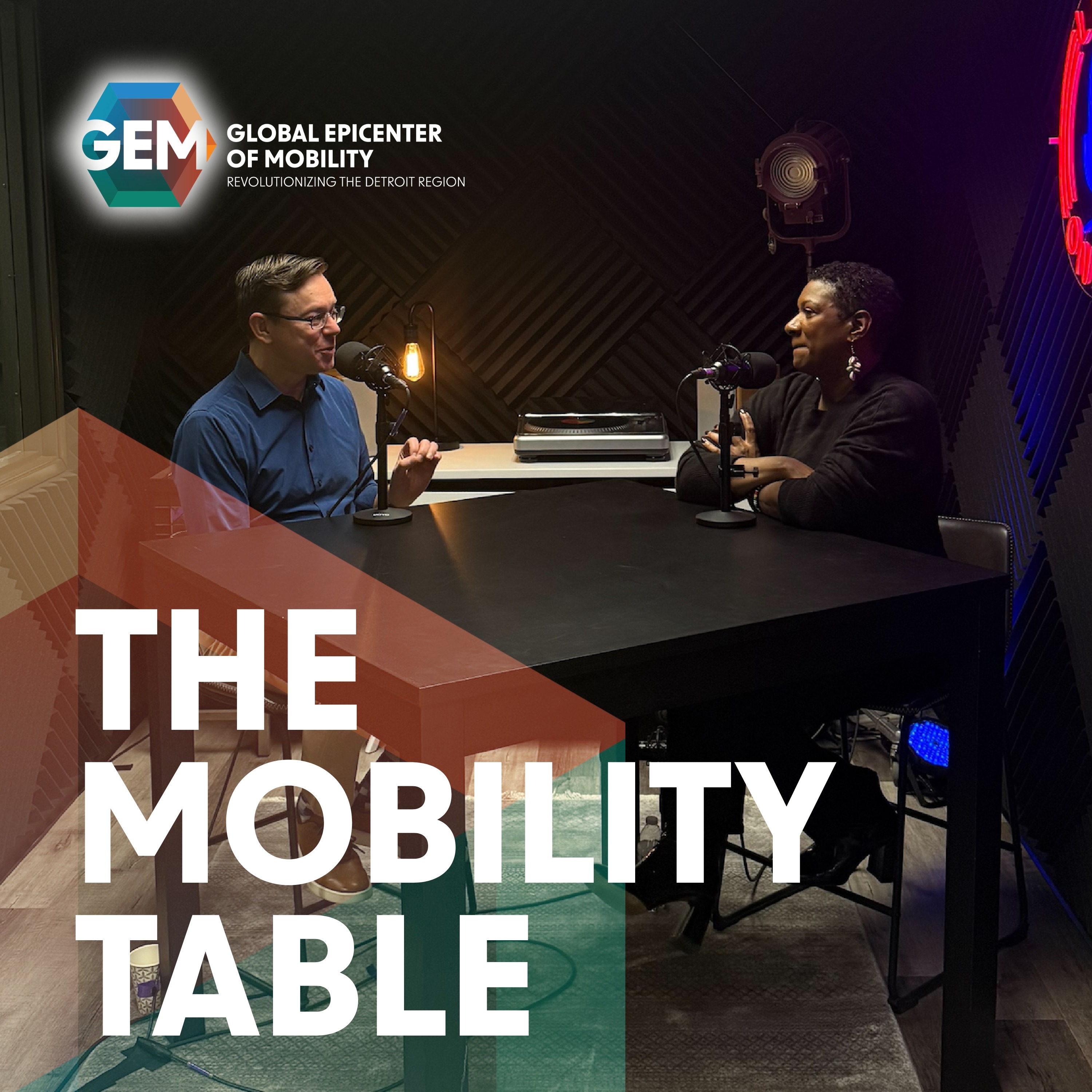
Detroit’s Mobility Success Isn’t Happening in a Vacuum with John McElroy, President of Blue Sky Productions and Host of Autoline
About this episode
Detroit’s mobility future is framed as bigger than the auto industry, with John McElroy arguing that electrification, automation, drones, and other new modes are creating a fresh sector. The conversation contrasts legacy automakers with startups, urges Detroit to study China’s pace and methods, and points to the region’s deep manufacturing base as a major advantage. It also stresses that real momentum will come from entrepreneurs, private capital, and a clearer regional strategy.
John McElroy sat down with Jeannine and Bernard at The Mobility Table to discuss the ways the Detroit region mobility ecosystem can overcome global competition. The conversation explores the resources, capabilities and knowledge that sets the Detroit region apart and will drive innovation in the future.
John is an influential journalist, lecturer, commentator and entrepreneur, having created Autoline an outlet dedicated to the reporting, discussion and dissection of the automotive industry and its products. He is an automotive expert, sharing his insights through radio segments, blogs and appearances on major outlets across the country.
GEM
"I am your host Bernard Swicky, VP of Mobility and Research at GEM. And I am Janine Gantt, the Mobility Engagement Officer for the Global EpiCenter of Mobility and we are really happy to have you here today."
GEM is the organization the host works for, and it’s mentioned as part of the broader effort around mobility in the Detroit region.
GEM is referenced as the organization where the host works (“VP of Mobility and Research at GEM”). In the context of the episode, it’s part of the Detroit-area mobility ecosystem being discussed.
Global EpiCenter of Mobility
"And I am Janine Gantt, the Mobility Engagement Officer for the Global EpiCenter of Mobility and we are really happy to have you here today."
The “Global EpiCenter of Mobility” is an organization involved in promoting and coordinating mobility efforts. The hosts are saying it’s part of the network working on future transportation in Detroit.
The “Global EpiCenter of Mobility” is presented as an organization or initiative focused on mobility engagement. It’s positioned as a key stakeholder in the Detroit region’s advanced-mobility ecosystem.
advanced mobility
"This new emerging ecosystem related to advanced mobility is critically important for the Detroit region and I think we've had a lot of really good guests that have come in and talked about a variety of different kind of topics as it relates to advanced mobility."
“Advanced mobility” just means the next wave of transportation beyond today’s cars—like electric vehicles and smarter, more connected tech. The hosts are talking about how Detroit is preparing for that future.
“Advanced mobility” is a broad umbrella term for next-generation transportation—often including electrification, connected vehicles, and automated driving. In this episode, it’s used to describe the Detroit region’s ecosystem and programs aimed at future transportation systems.
electrified, automated automotive
"Now, when we talk of mobility, which is electrified, automated automotive, but it's also things that fly, float, aerospace, you name it, right?"
They’re talking about cars that use electricity instead of gas, and cars that can drive with less help from the human driver. That can range from advanced safety features to full self-driving.
“Electrified” means replacing or supplementing gasoline power with electric power (typically battery-electric or plug-in hybrids). “Automated automotive” refers to driver-assistance and self-driving capabilities that reduce or remove the need for human input.
mobility sectors
"My grand vision is, can we be to all those mobility sectors what we historically have been to automotive, right?"
They mean different kinds of transportation businesses, not just regular cars. The idea is Detroit should lead across many vehicle types.
“Mobility sectors” is a catch-all for different transportation categories—like cars, aerospace, and other vehicles—rather than just traditional passenger cars. The speaker is arguing Detroit should apply its historical automotive leadership across multiple mobility industries.
headwinds vs tailwinds
"people are talking a lot about these headwinds that we're receiving. And an innovator doesn't see them as headwinds, they see them as tailwinds."
They’re using a metaphor: “headwinds” are things that slow you down, and “tailwinds” are things that push you forward. The point is to treat problems as something you can work on.
In business and tech, “headwinds” are forces that make progress harder, while “tailwinds” are forces that help you move forward. The speaker reframes challenges as opportunities to solve problems.
SAE Society of Automotive Engineers
"You know, I remember the old SAE Society of Automotive Engineers tagline used to be freedom through mobility."
SAE is a well-known engineering organization for the auto industry. Mentioning its tagline is a way of pointing to the long-running idea that engineering can improve how people get around.
SAE (Society of Automotive Engineers) is a major professional organization in the automotive and mobility engineering world. Referencing its tagline frames the episode’s theme around engineering-led progress in transportation.
electrification
"Because now that we're in the midst of this electrification, automation, everything happening simultaneously, competition from China, we're spreading automotive technology into other mobility sectors."
Electrification means cars are moving away from gasoline engines and toward electric motors. That also changes charging needs and how the whole system around driving works.
Electrification is the shift from internal-combustion engines to electric powertrains (like battery-electric vehicles and plug-in hybrids). In mobility terms, it changes how vehicles are powered, how energy is delivered, and what supporting infrastructure is needed.
automation
"Because now that we're in the midst of this electrification, automation, everything happening simultaneously, competition from China, we're spreading automotive technology into other mobility sectors."
Automation is when a car can help drive itself using sensors and computers. Depending on the level, it can steer, brake, and accelerate with less driver input.
Automation refers to driver-assistance and self-driving capabilities that use sensors, cameras, radar, and software to control the vehicle. It’s a major part of modern “mobility” because it changes the role of the driver and can affect safety, traffic flow, and vehicle utilization.
overhead camshafts
"I remember getting excited about rolled fillets on crankshafts and engines and overhead camshafts and things like that."
An overhead camshaft is part of an engine that controls when the valves open and close. Putting it up in the cylinder head can help the engine time things more accurately.
Overhead camshafts (OHC) are camshafts located in the cylinder head that operate the engine’s valves. Compared with older designs, OHC layouts can improve valve timing precision and packaging for performance-oriented engines.
crankshafts
"I remember getting excited about rolled fillets on crankshafts and engines and overhead camshafts and things like that."
The crankshaft is the main rotating part inside a gas engine. It turns the up-and-down motion of the pistons into the spinning motion that powers the car.
A crankshaft is the rotating shaft in an internal-combustion engine that converts piston motion into rotational motion for the drivetrain. It’s a key component because its shape and surface finish influence durability and friction.
drones
"I'm sure you will probably get into it, drones and things like that. But I mean, that didn't exist back then."
Drones are flying devices that can be controlled remotely or fly on their own. Here, they’re mentioned as part of the broader future of transportation beyond cars.
Drones are unmanned aerial vehicles controlled remotely or autonomously. In a mobility context, they represent a different delivery and transportation channel that can share enabling technologies with automotive systems (navigation, sensors, autonomy software).
Toyota production system
"There was a great book that came out at MIT called The Machine that Changed the World. [726.8s] Everybody studied the Toyota production system. And what happened by the early 90s? Certainly the mid 90s."
Toyota developed a manufacturing method that tries to make factories more efficient. The big idea is to reduce waste and keep improving the process so cars get built faster and with fewer problems.
The Toyota production system (often called TPS) is Toyota’s approach to manufacturing that emphasizes continuous improvement and eliminating waste. It’s closely associated with lean manufacturing ideas like producing only what’s needed and improving processes over time.
lean manufacturing
"Everybody studied the Toyota production system. And what happened by the early 90s? Certainly the mid 90s. Detroit had totally caught up in terms of productivity."
Lean manufacturing is about running a factory more efficiently. Instead of doing things “just in case,” it tries to cut out wasted time and materials so the work flows smoothly.
Lean manufacturing is a production philosophy focused on reducing waste—like excess inventory, waiting time, and unnecessary motion—while improving quality and flow. It’s often discussed alongside the Toyota production system because many of the same principles are used to streamline operations.
Fisher Body
"So here's another World War Two analogy. Back in the Second World War, Fisher body, [798.5s] which was one of the big divisions of General Motors at the time, adopted the slogan, when the strong arm fails, think your way to victory."
Fisher Body was a GM-related company that built car bodies. The host brings it up to highlight a World War II-era mindset: when brute force isn’t enough, improve how you think and work.
Fisher Body was a major coachbuilding and body-manufacturing division associated with General Motors. The segment references Fisher Body adopting a wartime slogan to emphasize that manufacturing challenges can be solved through thinking and process improvement.
critical mass
"They still have not reached a critical mass. And I could not tell you which of those are going to be the ones that emerge…"
It means a tipping point—when enough people and resources join in that the idea starts growing on its own.
“Critical mass” is the point where a new technology or industry grows enough—customers, suppliers, and investment—to sustain itself and accelerate. Here, it’s used to describe mobility startups that are leaders but haven’t yet scaled to widespread influence.
GM
"...even the legacies like GM and Ford recognize this. Ford created Skunkworks out in California... General Motors has set up its software and product development..."
GM is a major car company. In this episode, they’re described as trying to modernize how they build cars and software by working more independently from their usual old processes.
GM is discussed as a legacy automaker that’s trying to change how it develops products and software. The host mentions General Motors setting up development work away from the “mothership” to get faster, newer thinking.
Skunkworks
"Ford created Skunkworks out in California to come up with a radically different way of manufacturing cars to slash the cost of making an EV."
“Skunkworks” means a special, fast team inside a company that tries new ideas with fewer rules. Here it’s described as helping Ford find cheaper ways to build EVs.
“Skunkworks” refers to an internal, semi-independent R&D setup designed to move quickly and take bigger risks than normal corporate processes. In this context, it’s used to develop a radically different manufacturing approach to reduce EV production costs.
VTOL
"Well, the whole VTOL thing. I call them drones. Don't talk to the VTOL manufacturers and call them drones. They hate that. They call them vertical takeoff or landing."
VTOL means a vehicle can take off and land vertically, like a helicopter. The host thinks this kind of air mobility could be a big change soon.
VTOL stands for “vertical takeoff and landing,” meaning an aircraft (or air vehicle) can lift off and land without needing a runway. The host frames VTOL vehicles as a near-term mobility shift, similar to how drones are used for short-range tasks.
last mile delivery
"We've seen things like last mile delivery kind of approaches, whether it's electric scooters."
“Last mile delivery” is the final part of shipping—getting a package from a local hub to your house or business. The episode suggests new delivery methods are being tried for that last step.
“Last mile delivery” is the final step of getting goods from a distribution point to the customer’s location. The host connects it to new mobility approaches, implying that electrification and alternative delivery methods are being tested for this short, high-frequency leg.
electric scooters
"...last mile delivery kind of approaches, whether it's electric scooters. I think there's even going to be a lot of more interest in pedal vehicles, electric assist..."
Electric scooters are battery-powered scooters for short trips. They’re often used as a practical way to get around for quick errands or commuting gaps.
Electric scooters are small, battery-powered micromobility vehicles used for short trips. In mobility discussions, they’re often cited as a low-cost, low-emissions way to move people over “first/last mile” distances.
electric assist
"...I think there's even going to be a lot of more interest in pedal vehicles, electric assist, you know, e-bikes are all over the place."
Electric assist means a bike helps you when you pedal, usually with a small motor. It makes riding easier—especially on hills or longer rides—without turning it into a full motorcycle.
Electric assist refers to pedal bicycles (or other pedal vehicles) that use a motor to help the rider while still requiring pedaling. It’s a common micromobility technology because it can reduce effort on hills and for longer commutes without fully switching to a throttle-only vehicle.
e-bikes
"...electric assist, you know, e-bikes are all over the place."
E-bikes are regular bikes with a motor that helps you pedal. The host mentions them as increasingly popular for everyday transportation.
E-bikes are bicycles with an electric motor that assists pedaling (and sometimes provides limited throttle support depending on the model and local rules). They’re highlighted as a growing part of “new mobility” because they can replace short car trips for many riders.
autonomy
"Exactly. And autonomy. We're going to have all kinds of autonomous little, you know, we have already seen that in Ann Arbor."
Autonomy here means self-driving capability—systems that can handle driving tasks without a person constantly doing everything.
In automotive and mobility contexts, autonomy refers to a vehicle’s ability to operate without continuous human control. The discussion frames autonomy as part of a broader “new mobility” shift that changes how people and goods move.
autonomous little cars
"Domino's was experimenting. I think it was Domino's. I hope I got that right. I hope I got the right piece of company there. But it was delivering with little autonomous cars that would drive up and down the sidewalk."
They mean self-driving vehicles. These are small cars or robots that can navigate and move around without a human driver, often using cameras and sensors to understand where they are.
The hosts are talking about autonomous vehicles—cars or small shuttles that can drive themselves using sensors and onboard computing. In this case, they’re described as operating on sidewalks for delivery and local errands, which is a specific use case for autonomy beyond typical road driving.
Domino's
"You know, Domino's was experimenting. I think it was Domino's. I hope I got that right."
Domino's is a well-known pizza company, and the host says it tried using self-driving vehicles for deliveries.
Domino's is referenced as experimenting with delivery using autonomous vehicles. The point is less about pizza and more about how major consumer brands can pilot autonomy in real-world logistics.
new mobility
"But the new mobility is going to change that. Here's one thing I want to add though. We need a strategy."
“New mobility” means transportation is evolving—how people get around and how deliveries happen is changing, not just with cars but with new technologies and services.
“New mobility” is a broad idea covering how transportation is changing—often including electrification, autonomous driving, and new ways to move people and goods. In the segment, it’s framed as freeing people from routine tasks and enabling more productive work.
EV
"So not just EV and automotive, but what other opportunities and things can be manufactured, frankly, with the assets that we have, and the research and development folks that we have here."
EV means electric vehicle—cars that run on electricity from a battery instead of gas.
EV stands for electric vehicle, meaning a car powered primarily by electricity stored in a battery rather than gasoline. The host contrasts EV-focused change with other mobility types the Detroit region could lead in.
Blue Sky Productions
"We have everything here to be able to be a leader of a broader industry. Totally agree. And you hit on it, the manufacturing capability. ... I love the fact that you guys are involved in it. That's the future of this region. I don't think GM, Ford or Stellantis are going away."
Blue Sky Productions is the company John McElroy is with. In this conversation, it’s mentioned as part of the broader effort to support new technology and startups in the region.
Blue Sky Productions is the company associated with John McElroy in this episode. The hosts mention it in the context of regional innovation efforts, including work connected to New Lab.
innovation to enter the vehicle itself
"So that sounds like a domino that needs to fall, if we're going to truly live up to this vision of finding easier pathways for this innovation to enter the vehicle itself, right? We keep talking about, hey, we have to get GM and Ford and Stellantis, you know,"
This is about getting new technology from inventors into real cars. It’s not just inventing something—it’s also getting it approved and built into vehicles.
The phrase refers to the process of moving new technology from startups or research into actual production vehicles. In automotive terms, it implies overcoming the integration and approval hurdles required for new tech to become part of a car’s systems.
Stellantis
"We keep talking about, hey, we have to get GM and Ford and Stellantis, you know, more agile and more cutting edge and all that. I don't think we should rely on them to be the leaders."
Stellantis is a big automaker group mentioned in the discussion. The point is that even though companies like this matter, the real innovation push may come from startups and entrepreneurs.
Stellantis is referenced as one of the large automakers that would need to be more agile and innovative. The episode frames the automaker role as important but not the primary source of future technology leadership.
Ford
"We keep talking about, hey, we have to get GM and Ford and Stellantis, you know, more agile and more cutting edge and all that. I don't think we should rely on them to be the leaders."
Ford is another major car manufacturer mentioned in the conversation. The host is saying the future innovation might come more from entrepreneurs than from big automakers acting alone.
Ford is named alongside other automakers as an example of a company expected to become more agile and innovative. The speaker’s point is that relying on automakers alone may not be the best path for new technology to reach vehicles.

Ford Edge
"...tellantis, you know, more agile and more cutting edge and all that. I don't think we should rely on the..."
The Ford Edge is a mid-size SUV made for regular driving, like commuting and family trips. It’s designed to give you extra space and a higher driving position than a typical sedan. People talk about it when discussing what to look for in a practical SUV.
The Ford Edge is a mid-size crossover SUV built for everyday driving with a comfortable ride and practical space. It’s often discussed in the context of how manufacturers position their SUVs—balancing comfort, technology, and drivability—when comparing what different brands offer. In a podcast, it may come up as an example of a mainstream, family-oriented SUV rather than a niche performance vehicle.
New Lab
"...I think I come back to the true entrepreneurs, those who are putting business plans together, going out and scraping up the money, whether they're in New Lab or other places to do these things, that's where the future is. And so I love the fact that you brought up New Lab. I love the fact that you guys are involved in it."
New Lab is mentioned as a hub for startups and entrepreneurs. The idea is that it helps people build plans, find funding, and turn new ideas into something that can actually be used.
New Lab is referenced as a place where entrepreneurs and startups develop business plans and raise funding to bring new technology into real-world use. In the episode, it’s positioned as a key part of the region’s innovation pipeline.
AI
"...why are all these automotive companies investing in AI? ...You're not an AI expert..."
AI means “smart” computer software that can learn patterns and make decisions. The discussion is about whether car companies should build that expertise themselves or rely on specialists.
AI (artificial intelligence) refers to computer systems that can perform tasks like prediction, optimization, and pattern recognition. The segment frames AI as a capability that automakers may not need to build entirely in-house, instead partnering with or buying from specialized startups.
computer-aided design
"...when computer-aided design, computer-aided manufacturing came out, General Motors was heavily involved in developing that."
Computer-aided design (CAD) is software engineers use to draw and design parts on a computer. It helps them plan a car’s components before building them.
Computer-aided design (CAD) is software used to create and modify product designs digitally. In automotive, it helps engineers model parts and systems before anything is built, speeding up development and reducing physical prototyping.
computer-aided manufacturing
"...computer-aided design, computer-aided manufacturing came out, General Motors was heavily involved in developing that."
Computer-aided manufacturing (CAM) is software that helps factories build parts more accurately. It turns design plans into instructions for machines.
Computer-aided manufacturing (CAM) uses software to control and optimize manufacturing processes. For cars, it can translate designs into machine instructions for stamping, machining, and assembly, improving consistency and throughput.
General Motors
"...computer-aided design, computer-aided manufacturing came out, General Motors was heavily involved in developing that. Well, maybe that made sense 40 years ago..."
General Motors is a big old-line car company. The hosts are using it as an example of how a major automaker used to lead big technology shifts, like computer-aided design.
General Motors (GM) is a legacy automaker that has historically invested in manufacturing and engineering technologies. In this segment, it’s used as an example of how a traditional automaker got heavily involved in earlier tech waves like computer-aided design and manufacturing.
powertrain
"...okay, I can buy seats and dashboards and wheels and suspension parts, but the core thing is the powertrain, right? ...especially the engine."
The powertrain is what makes the car move—basically the engine/motor and the parts that send power to the wheels. The point here is that car companies used to focus most on owning that part.
The powertrain is the set of components that generate and deliver motion—typically the engine (or motor), transmission, and related drivetrain parts. The hosts argue that historically automakers’ “core” identity centered on controlling the powertrain, especially the engine.
transmission
"...go ask anybody, hey, how many gears are in that transmission of yours? They'd have no clue."
The transmission is the gearbox that helps the engine work well at different speeds. The point being made is that many people don’t know details like how many gears their car has.
A transmission is the gearbox system that changes gear ratios so the engine can operate efficiently across different speeds and driving conditions. The hosts mention it to illustrate that many buyers don’t even know basic details like how many gears their car has.
automaker
"So what you've really got to concentrate on is what's really core for an automaker. I would argue there's only three things."
An automaker is the company that makes cars and sells them under its brand. The discussion is about which parts of the process they should do themselves.
An automaker is the company that designs and produces vehicles for sale under its own brand. In this segment, the speaker breaks down what automakers should keep in-house versus what can be outsourced.
buyer experience
"...You have to design the vehicle inside and out. You have to market and sell the brand and you have to control the buyer experience. You can pretty much outsource everything else."
Buyer experience means what it’s like to shop for the car and deal with the brand afterward. The point here is that the automaker should manage that part closely.
Buyer experience is the end-to-end process of how customers interact with a brand—everything from shopping and financing to delivery and after-purchase support. The speaker argues automakers should control this directly rather than leaving it entirely to outside partners.
OEMs
"...As these OEMs and the legacy look to outsource, right? To do things differently, to do things in a more agile way than they have in the past."
OEMs are the main car companies that make the vehicles in the first place. The idea here is that they can hire other companies to do some tasks, but they still manage the big-picture parts of the car business.
OEMs are Original Equipment Manufacturers—the companies that design and build vehicles (and often major systems) that are then sold under their own brand. In this segment, the host is talking about automakers outsourcing work to other suppliers while keeping core control in-house.
outsourcing
"...As these OEMs and the legacy look to outsource, right? To do things differently, to do things in a more agile way than they have in the past."
Outsourcing means a car company pays other companies to do some jobs for them. Here, they’re saying that helps automakers move quicker and adapt more easily.
Outsourcing is when an automaker hires outside companies to handle parts of the work—like engineering, manufacturing, or specific components—instead of doing everything internally. The point in this discussion is that automakers want to move faster and be more flexible by using specialized partners.
agile way
"...To do things differently, to do things in a more agile way than they have in the past."
“Agile” is a way of building and improving things faster by making changes in smaller steps. In cars, it usually means the company can adjust sooner as technology and customer needs evolve.
“Agile” refers to an approach to product development and operations that emphasizes faster iteration, frequent feedback, and the ability to change direction quickly. In automotive, that often means shortening development cycles and making it easier to incorporate new technology or customer needs.
software defined batteries
"an example where my studio is just down the road from it is this startup company that's working on sdvs, you know, software defined batteries. So you can do all and it's it's cutting edge stuff."
It means the battery’s behavior is controlled by software. Instead of one fixed way of charging and using the battery, the system can adjust to what the vehicle or grid needs.
“Software defined batteries” refers to battery systems whose behavior is controlled and optimized by software rather than fixed hardware settings. That can enable smarter charging, better safety management, and more efficient energy use as conditions change.
carbon capture for locomotives
"There is another company that's just a couple of miles from my studio that's working on carbon capture for locomotives. Who knows about this stuff? Nobody knows about this stuff."
It’s technology meant to grab carbon dioxide from a train’s exhaust. The goal is to keep that CO₂ from going into the air.
“Carbon capture for locomotives” means capturing carbon dioxide emissions from locomotive operations and preventing that CO₂ from being released to the atmosphere. In practice, this can involve capture systems integrated with the exhaust stream and then handling the captured CO₂.
Request an Explanation
Heard something you'd like explained? We'll add it to this episode.
Sign in to request explanations for terms you heard.
Want to learn more?
Browse our glossary for plain-English explanations of automotive terms, jargon, and concepts.
Help improve this episode
See something that's not quite right? Our annotations are AI-generated and can sometimes miss the mark. Click the flag icon on any annotation to suggest a correction.