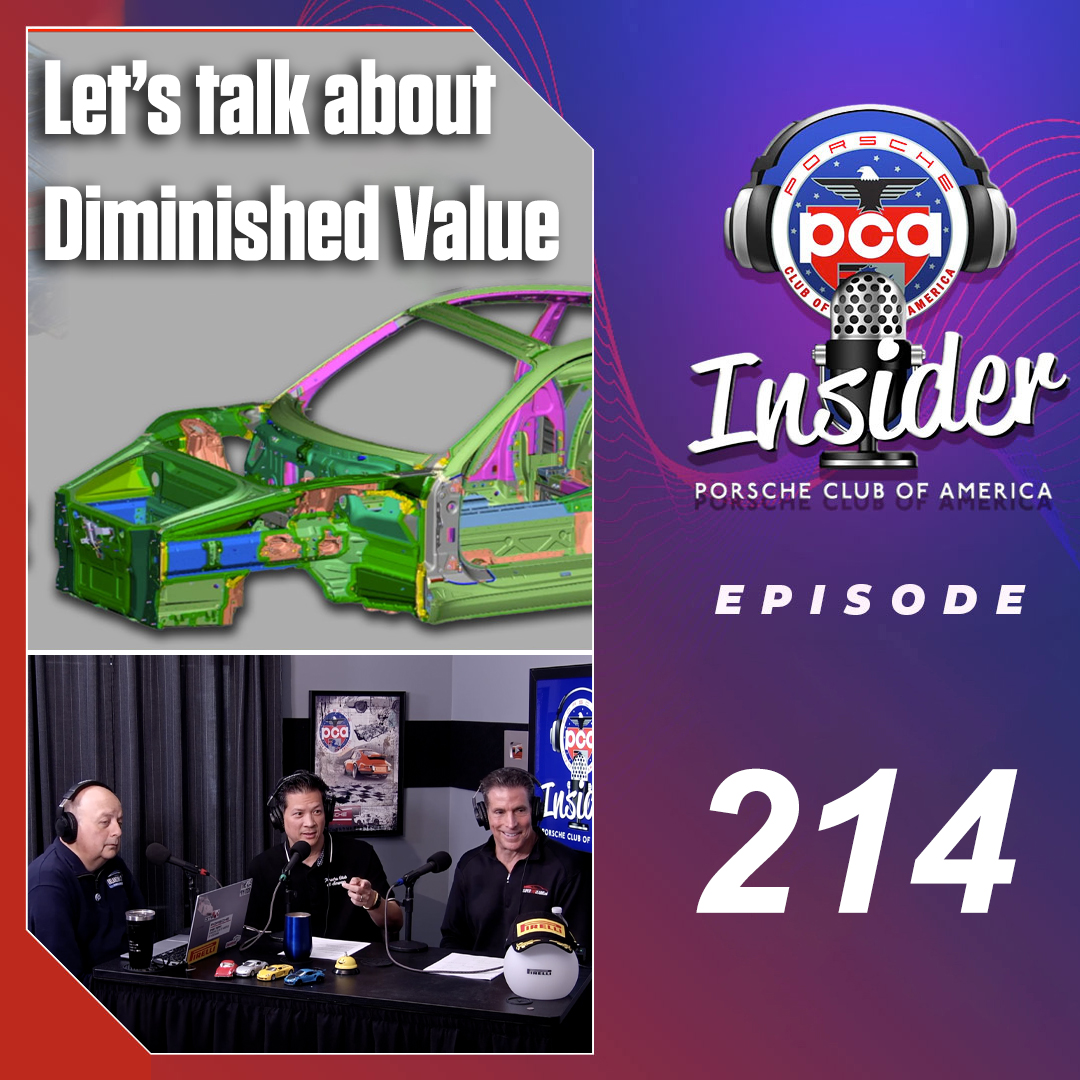
Even if your Porsche gets fixed after an accident, it can still be worth less than a similar car with no accident history. “Diminished value” is the amount of that extra loss in resale value.
VIN stands for Vehicle Identification Number, a unique 17-character code used to identify a specific car. In insurance and vehicle history contexts, the VIN is commonly used to pull accurate records and ensure the correct vehicle is being evaluated.
Topic
Supercar Claims
“Supercar Claims” sounds like a specialized way of handling claims for very expensive cars. The hosts mention it right before they talk about diminished value, so it’s likely part of the episode’s main explanation.
PCA typically refers to Porsche Club of America, a large Porsche enthusiast organization with regional chapters and events. In this segment, the guest’s PCA membership and regional involvement provide context for their ownership perspective and community network.
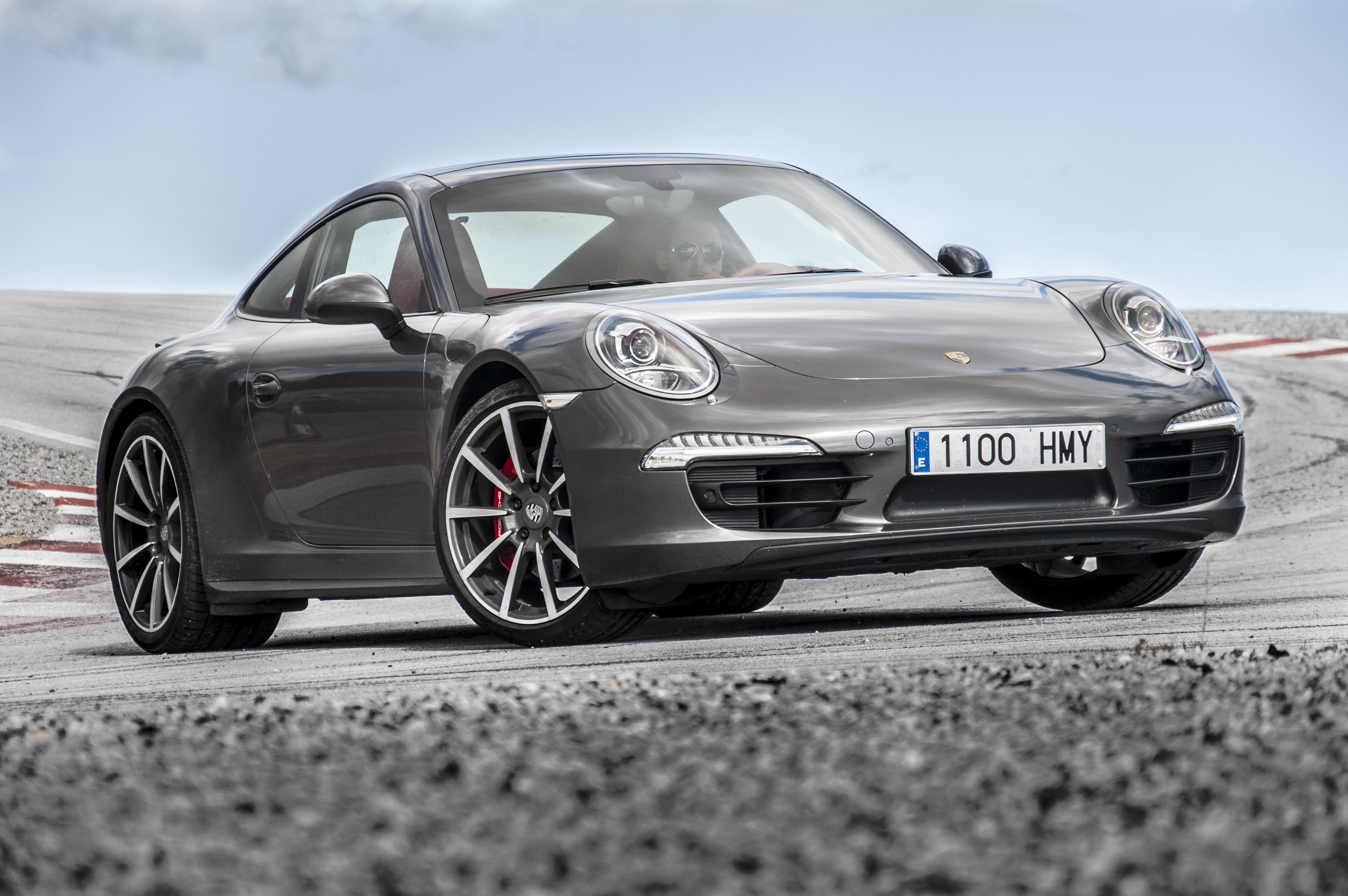
Porsche uses generation codes for the 911. The “991” is one specific era of the 911, and it’s the one the guest moved into before later switching again.
A “stick shift” is a manual gear lever you move yourself to change gears. Here, the guest is describing how the shifter position and feel matched what they wanted.
Term
loss of use
Loss of use is about what it costs you when your car is in the shop and you can’t drive it. Sometimes that means paying for a rental, or it can mean a daily amount for the time you’re without your car. It’s separate from the repair bill.
The clutch pedal is what you press to change gears in a manual car. If it feels “right,” it usually means the pedal response and engagement are smooth and predictable. Here it’s being used to describe how good the car feels to drive.
The Ford Bronco is a type of SUV made to handle rough roads and off-road trails. People bring it up because it’s a well-known vehicle, especially if they’ve owned one in the past. It’s often used as an example of an older, more basic driving experience.
Concept
insurance claims for accident damage
Sometimes insurance pays to fix the car, but it doesn’t make up for the fact that the car is worth less afterward. Even if the repairs are good, buyers may still pay less. This is the situation Steve is talking about.
An “original paint” car is one whose exterior finish has not been repainted since it left the factory. In collector-car contexts, original paint is often a major value driver, so repainting or bodywork after an accident can create a larger diminished-value argument.
The quarter panel is part of the car’s outer body on the rear corner. If it gets replaced after an accident, buyers may assume the car was damaged, which can reduce resale value.
OEM parts are the same type of parts the car maker would install at the factory. Using them can help ensure the repair matches the original quality and can support your case when dealing with insurance.
The idea is that even if your car is fixed, it may still be worth less when you sell it later. Cars that people collect or really care about can lose value more than you’d expect.
OEM paint means the original factory paint system used when the car was built. If repairs use non-OEM paint or don’t match perfectly, it can be a visible and measurable deviation that hurts buyer confidence and resale value.
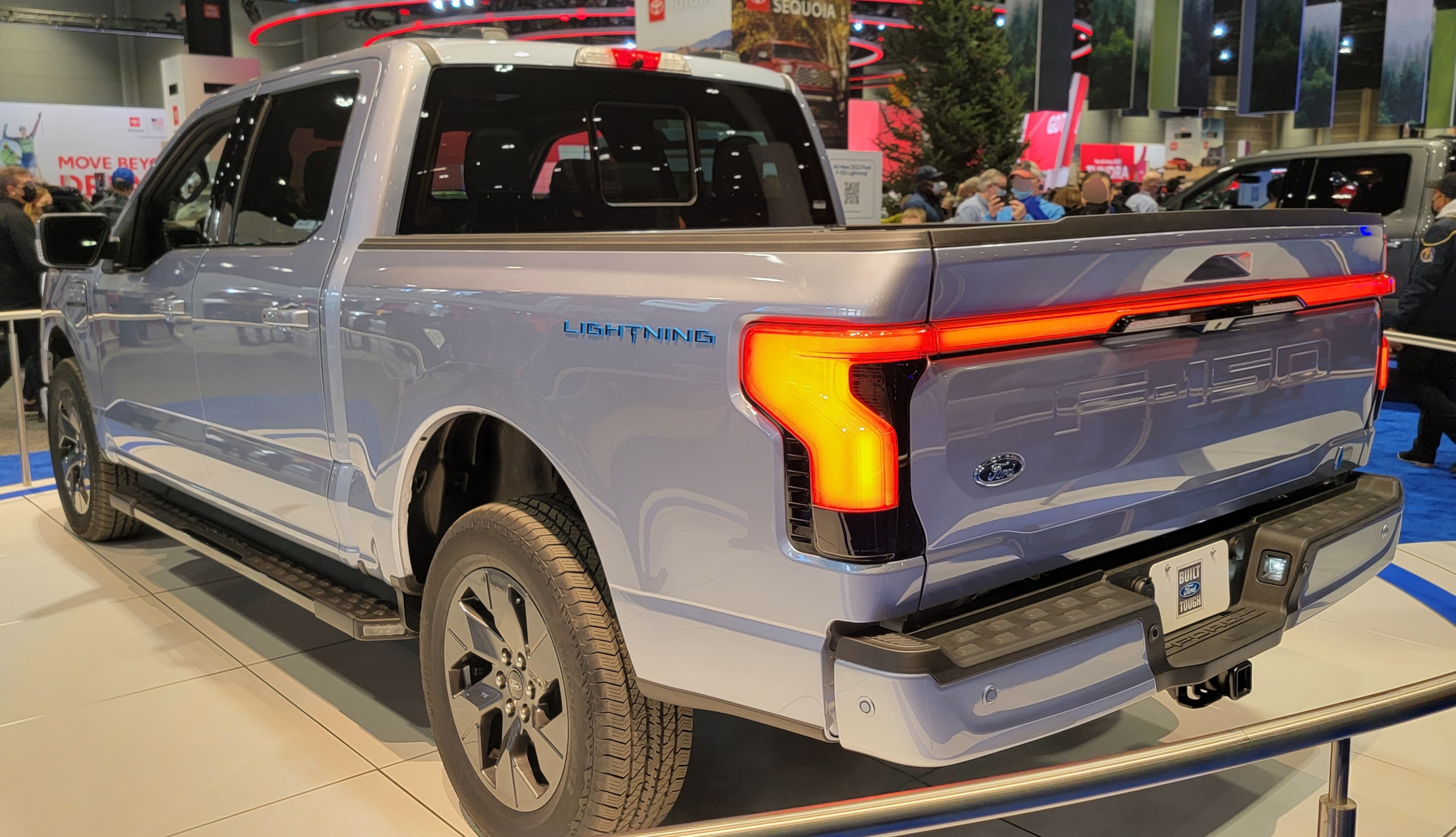
They mention the Ford F-150 to show a difference in buyer expectations. Trucks like the F-150 are often used hard, so some damage history is more acceptable than it would be for a Porsche.
Crash history means the car has been in an accident before. Even if it’s repaired, many buyers see that record and assume it’s not as desirable, so the price drops.
“Clean Carfax” refers to a vehicle history report showing no reported accidents or damage events. In practice, buyers use it as a quick proxy for risk and resale value—cars without accident records tend to command higher prices.
A “dirty” Carfax usually means the report shows an accident or damage. That can make people offer less money because they assume the car may have hidden issues or repairs.
Third-party coverage is the insurance of the driver who hit you. If they caused the crash, their insurance is often the one that should pay for the damage.
Your first-party carrier is your own insurance company. They’re the ones paying your claim and then sometimes trying to recover money from the other driver’s insurance.
Concept
made-whole doctor
This is a rule-of-thumb idea: you should be fully paid for your losses before the insurance company tries to take money back from the other side. The speaker is saying the injured owner should get diminished value and loss of use first.
A specialty policy is a special kind of insurance plan, often for collector cars. It can include extra coverage that regular auto insurance might not offer, like diminished value.
UMPD is insurance that helps pay for damage to your car if the other driver can’t. It’s especially important for property damage, like repairs to your Porsche after a crash.
Uninsured motorist coverage helps you when the other driver doesn’t have insurance. The hosts are saying many people focus on injuries, but you should also make sure your car’s damage is covered.
A frame machine is a tool body shops use to straighten the car’s structure after a crash. If your car needed that kind of work, buyers may assume it was more seriously damaged.
“Fish eye” is a paint defect where the finish forms small craters or circular imperfections, usually caused by contamination or improper surface preparation. It’s a sign the repair process may not have been done correctly, which can reduce resale value.
This means the repair shop is approved by Porsche and is supposed to meet Porsche’s repair standards. But even if the work looks right, the car can still be worth less because buyers know it was repaired after a crash.
When an accident happens, insurance has rules for deciding whether to repair or total the car. They look at the repair work needed and compare it to the car’s value to decide what costs less.
Concept
repair cost vs vehicle value ratio
Insurance often uses a simple comparison: what it costs to repair the car versus what the car was worth before the accident. That comparison helps them decide whether to total it.
Insurance companies compare the repair cost to what the car was worth before the accident. If the repairs are too expensive relative to the car’s value, they may declare it a total loss.
Before insurance decides what to do, they may take the car apart to find any hidden damage. If they find more damage than expected, the repair cost can go up.
Laws usually set a time limit for when you can file a claim. This time limit depends on where you live, so the window for bringing a diminished value claim can be shorter or longer.
Subrogation is basically your insurance company trying to get reimbursed by the person who caused the crash. If they already took money from the other side, the question becomes whether they can undo that step. That can change how your claim is handled and what you can recover.
Property damage coverage is the part of insurance that pays to fix damage to cars or other property. If the at-fault driver only has a limited amount, there’s a cap on how much can be paid out. That’s why the speaker keeps coming back to how much property damage coverage is available.
Bodily injury coverage is what insurance uses to pay for injuries to people after a crash. It’s different from the coverage used to fix damage to your car. So if you’re talking about car value or repair-related losses, you usually have to look at the property damage side.
“Comp and collision” are two parts of auto insurance that help pay for damage to your own car. Comprehensive is usually for non-crash events, and collision is for crash damage. The speaker is saying these are separate from the third-party injury coverage rules.
These are two parts of car insurance that help pay to repair your car. Collision is for crash damage, and comprehensive is for things like theft or storm damage—so if something covered happens, your policy can pay for repairs.
Concept
mitigate our losses
This phrase means “try to reduce the damage financially.” In insurance terms, it’s about recovering money or limiting what the insurer has to lose.
Subrogation is when the insurance company tries to get its money back from the person who caused the crash. They pay first, then go after the other side to recover what they spent.
Instead of going through your own insurance, you deal directly with the driver who caused the crash to get your car fixed. That can sometimes reduce the back-and-forth with insurers.
Liability is basically “who caused it.” Insurance companies usually have to decide that before they’ll pay, so if nobody agrees yet, you can end up waiting.
“Incapacitated” just means the car can’t be used because it’s not in a drivable/safe condition. If insurance takes a while to approve the claim, you may be stuck without the car longer.
Premiums are what you pay for insurance. Some people worry that filing a claim (or involving their insurer) could make their future insurance more expensive.
“Prejudiced” basically means “hurt” or “put at a disadvantage.” The insurer is claiming that because you waited, they couldn’t properly check what happened.
Insurance companies often require you to report a claim quickly. If you wait too long, they may say they couldn’t investigate properly and refuse to pay.
They’re talking about an outside company that helps with the claim. Instead of everything happening directly through your insurer, you may have to contact this other company, and it can take a long time to get paid.
Concept
database where all of this gets reported
They’re talking about systems that keep track of accident and claim history. Insurers can look it up later, which is why renewal forms ask about crashes.
Insurance policies often require you to report a claim quickly. If you wait too long, the insurer may deny or reduce coverage because they couldn’t check the damage properly at the time.
The Chevrolet Cruze is a common compact car. They’re using it as an example to show that these insurance issues can happen to regular, non-luxury vehicles as well.
“Recovery” just means the final payout you receive from the insurance claim. The speaker is saying they want the client to keep as much of that payout as possible.
They’re talking about a Porsche GT—basically a Porsche that’s meant to be more performance/track-oriented. The question is: if you wreck your own Porsche because you were at fault, do you still try to claim diminished value?
Your insurance policy is the document that spells out what your insurer will pay for. If you’re dealing with damage to a car, the policy language can decide whether you’re covered.
Brake calipers are the parts that squeeze the brake pads. Some people paint them for looks, and if they get damaged or need repainting, it can complicate an insurance claim.
Jack stands are safety supports used to hold a car in the air while work is performed underneath. They’re critical for preventing falls, but accidents can still happen if a vehicle is knocked or improperly positioned.
The undercarriage is the bottom of the car—where things like the exhaust and suspension parts live. If it gets hit, it can cause problems that aren’t always visible from the outside.
Concept
paint sample car
A paint sample car is basically a car used to show or test paint colors. If it gets hit, it can still need repairs and can affect what the owner can claim.
Paint detailing is the process of cleaning and restoring a car’s finish—often including washing, polishing, and applying protective products. Damage during detailing can affect the finish and may require additional correction work beyond basic repair.
A paint meter is a tool that checks how thick the paint is on different parts of the car. If the numbers don’t match what factory paint usually looks like, it can mean the car was repainted, which can hurt resale value.
If someone steals your wheels, you often have to replace them with something else. Replacement wheels may not match the original ones, and that can make the car harder to sell for the same price.
“Numbers matching” here means the wheels are the original-style ones with the right identifying markings. If those wheels are gone and replaced, the car may not feel as “original,” which can reduce what people are willing to pay.
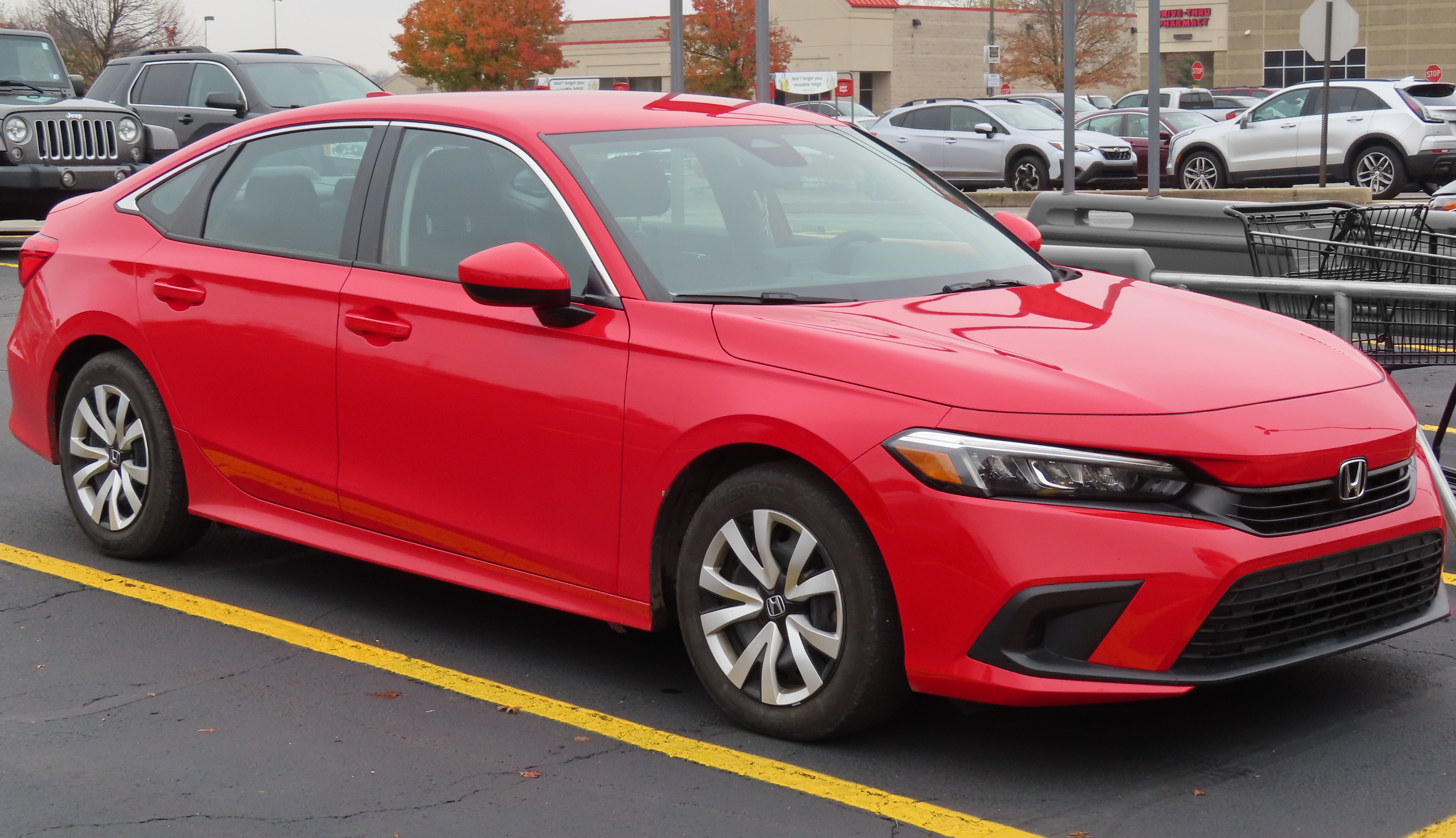
They’re talking about a Honda Civic as an example. The point is that if you lose original parts (like matching wheels), it can make the car harder to value or harder to sell for top money.
PPF is a clear film you put on your car’s paint to help protect it from scratches and rock chips. It’s one of the ways people try to keep the car looking new.
A ceramic coating is a protective layer on top of the paint. It helps repel water and dirt, so the car stays cleaner and the finish is easier to maintain.
Car prices don’t just depend on condition—they also depend on how many are available and how many people want them. If a car becomes more popular, it can be worth more, so damage can hurt the resale price more.
A “rear-ended” crash is when someone hits you from behind. Even if the damage is fixed, the accident can still reduce what the car is worth when you sell it.
“Appreciated” means the car got more valuable over time. If the market is pushing prices up, it can change how much damage affects what the car is worth.
An appraisal is a written estimate from a qualified person that supports your claim. Here, it’s used to show how much value the car lost after the damage, not just what it cost to repair.
Term
touring paint sample
This sounds like a description of the car’s paint—possibly a special or higher-end finish. When a car gets repainted after an accident, buyers may value it less, even if the work looks good.
Damage history is basically proof that the car was in an accident and got repaired. Many buyers treat that as a negative, so the car sells for less.
Concept
demand (insurance/claim settlement demand)
A demand is the amount someone asks for to settle a dispute. If the other side’s offer doesn’t match the evidence (like appraisals), the demand can be withdrawn or adjusted.
Appraisers are people who figure out what a car is worth. In accident cases, they may also estimate how much value the car lost because of the damage and repairs.
If a car can’t be repaired quickly because parts are missing, it can sit in the shop for a long time. That long delay can make it easier to argue that the owner lost the ability to use the car.
“PTS” is Porsche’s personalization option for things like paint. “PTS Blue” means the car was ordered with a special custom blue color, not just a basic factory color.
They’re saying their Porsche 911 GT3 Touring isn’t available to drive, even though they still have to keep paying for it. The point is that you may still owe insurance and loan payments while the car is tied up, so there should be compensation for that lost ability to use the vehicle.
Garnishing wages means money gets taken directly out of your paycheck by court order. The question here is whether someone could end up owing money beyond what insurance pays.
Bring a Trailer is a website where car enthusiasts buy and sell cars. The host is using those auction results to show that a bad vehicle history report can lower what people are willing to pay.
“No stories” basically means the car has a clean past with no accidents or insurance claims. Buyers like that because it makes the car feel safer and easier to trust.
OEM parts are the same brand/spec parts the car was originally built with. The big question for insurance is whether your policy promises OEM parts or allows cheaper replacement parts.
Term
aftermarket used but newly in part
Aftermarket parts aren’t made by the same company that built your car. If your insurance allows aftermarket or non-new parts, the repair may not match what you expected.
They’re talking about their Porsche Cayman. It’s the car they’re using as an example for how insurance and damage claims can be affected by what’s been changed on the car.
“Monoblock Brembo” is a type of brake caliper. It’s a higher-end brake part than the factory one, and changing brakes can affect how an insurance claim is handled.
The speaker asks how modifications—both aftermarket and other changes—interact with insurance and diminished value claims. This matters because insurers may treat modified parts differently when assessing coverage, repair costs, and whether the vehicle’s value was impacted.
A third-party claim is when you’re dealing with the other driver’s insurance. The way they handle the claim can affect whether you can recover money for things like diminished value.
Your insurance carrier is your insurance company. If you’ve changed your car, you usually need to tell them so they know what they’re covering and how repairs should be handled.
Term
four-liter motor
A “four-liter motor” means the engine is about 4.0 liters in size. That can matter because different engines use different parts and repairs can cost different amounts.
Carbon ceramic brakes are special brakes with very hard, heat-resistant rotors. They usually cost a lot more than regular brakes, so insurance and repair decisions can get complicated after an accident.
Concept
deer on notice
“On notice” means you tell your insurance company what’s different about your car. If you don’t, they may say they can’t pay for certain damage because they weren’t told ahead of time.
LIVE
Welcome to the Porsche Club Insider, your one stop for all things Porsche and PCA.
Here's your host, Vue Gwynn and the Insider crew.
Welcome everyone, with recent values of most Porsches going through the roof, we often
talk about having proper insurance for your Porsche.
But we don't talk about a key term that we're going to talk about today, obviously if you
read the title, it's diminish value and we have an expert in-house that's going to break
it down for us.
Welcome to episode 213, to my right I have Manny Alvin, to my left Damon Launey at the controls
and special guest Stephen Calamusa, PCA member, Supercar Claims founder as well.
Thank you for joining us.
All right, thank you for having me.
Well, I want to thank our sponsor, presenting sponsor, Pirelli.
Pirelli tires have to achieve the highest levels of performance, safety, noiselessness and
grip on the road surface.
Innovative tires that can satisfy even the most specific mobility needs of the in-consumer.
Thank you all for listening.
If you aren't currently a PCA member and own a Porsche, grab that VIN, head over
to PCA.org and make yourself a member and join the ranks of over 170,000
PCA members in the US and Canada.
And if you're looking for a special Porsche, we have a program called Test Drive and you
can join that as well where we'll unlock resources so that you can find that special
Porsche for your driveway.
So Manny, do you know what diminished value is?
I thought I did until I started looking at Steve's slides, when I took Texas live
and I realized that there's a lot more than what I thought it was.
So before we dig deep into Supercar Claims and diminished value, let's learn a little
bit about you and how long have you been a PCA member and what do you drive?
Okay.
I've been a PCA member since 2019 when my son was born.
I had attended PCA events prior to that with a friend of mine and his son and I thought
it was like an amazing bonding experience with him and his son going to car shows, going
to dinners.
And then when my son was born, I said, you know what, I'm going to do that as
well.
And that's when I joined in 2019.
And I joined the Gold Coast region at the time.
Superactive region?
No, it was phenomenal.
Steve and Dottie there do a phenomenal job.
They're great.
And then the Gulf Stream region spun off from the Gold Coast and I became a founding
member of Gulf Stream and I'm the charity chairperson.
So what car did you join the club and is it still the same car or did you get something
different?
Most, most of the times that we end up accumulating are changing up.
That's what happened.
That's what happened.
I ventured into the 991 generation out of Turbo S and then I'd champion do some work
to it and I was racing my car and then I got a 997 Turbo and when I sat in my car and
I put my hand on the stick shift, I said, oh my God, this is exactly where the shifter
is supposed to be.
This clutch pedal is supposed to be and the car just felt right.
So I now have some, a couple of 997, I have a 997 GT2.
Wow.
Yeah.
But I bought them before everything went crazy.
Smart man.
Smart man.
It's a good place to park your money.
Yes.
And it's just, I drive it and it's an amazing car and when I think about that car coming.
Amazing.
Everybody says amazing.
All right.
We like that word.
We like that word.
It's just, it's a phenomenal car, it really is.
So how does one get into this world of insurance, diminished value?
How did you get into saying this is the niche that I want to play in?
Okay.
I've been a lawyer for, it's hard to believe, almost over 30 years and I did a
lot of products liability claims, was doing a lot of sophisticated litigation and I
came from driving like an old ruster Bronco to having nicer cars and my friends also started
having nicer cars and along the way, my friends would come to me and say, hey Steve, somebody
smashed into my car and the company will pay to fix it but my car's worth less because
it's been crashed and they won't pay me anything for the loss in value of my car
and I said, you got to be kidding.
And I had friends that had a friend of mine who had a 993 turbo that was smashed and
it was an original paint car and then another friend of mine had a 991 turbo that
was smashed where they replaced a quarter panel and they didn't want to pay diminished
value.
They denied the claim.
So I said, send me the letters, let me see what the denials that you're getting and as
I looked closer, I noticed that this was happening more routinely and I searched online
and I didn't see that there was a lot of law firms that were doing this type of work.
There's a lot of appraisers out there but there weren't a lot of law firms and
I thought the area was underserved and as a car person, I went to my partners
and I said, I want to help fellow car people.
This seems like an area of law that really we should engage in because of the fact that
they're routinely denying these claims.
So that's how it started.
It started about five, six years ago.
I think most of us, of course, have the fear of our car ever being in any sort
of incident but unfortunately it does happen and when it does happen, you're usually
chasing down and making sure that the insurance company will use OEM parts, having it be
repaired properly and that is a big part of it and then those of us that have cars that
are somewhat collectible and some of us even think it's almost irreplaceable, you
don't even think about possibly the loss of potential value if you go to resell
it because you're not reselling it until later.
But many of us that are shopping for cars, when you see a car has accident
damage, you just automatically go to, well, that car should be X number of
dollars less because it's not perfect, the paint's not OEM, it's got history.
And correct me if I'm wrong, but that's sort of what we're trying to
recover at the time or close to the time of the incident.
You're exactly right.
You're exactly right.
Most people that buy these types of cars are very critical,
particular.
They want a specific car.
They don't want a car with stories and it's different than if you have an F-150
and not that there's anything wrong with the F-150s, but if an F-150 has
damage to it and someone's using it to trailer their vehicles with, they'll
accept some repair damage to their vehicle, but on a Porsche, most people
when they're shopping for a Porsche, it's not a car that's necessary.
This is a car that they want for pleasure and they don't want a car
with a short story, so they'll overlook a car that has a damage history.
So you're exactly right, the difference in value is what does the market
think of this car now that it has a crash history because people will seek
out the car that doesn't and so the value of this car has dropped
dramatically as a result of the fact that it's had a crash history.
They get asked all the time, I watch these little shorts on the
Instagram, I've gotten into the rotation where I'm getting a whole
bunch of them, but a lot of these used car places will film the interactions
with the customers and when the customers are trading in, the first thing
they ask, does it have a clean car fax? Because the guy says, well it's been
involved in an accident, you can see the look on the dealer's face and like
you can see dollars just floating out of the car because now it doesn't
have a clean car fax.
Right, most dealers, in fact, most dealers will not retail a car with
a dirty car fax, they'll send them to a wholesale auction and when you
trade that car in, you're going to take a hit on it if the car fax is dirty
without a doubt, especially on high-end vehicles, Porsche, Ferrari, Lamborghini,
it's the scarlet letter.
So can I ask why, I guess why don't, let's say your insurance company
that is representing you, the one that you've chosen and you get
into an accident, how come, or maybe they do and I don't know it, but how
come they don't sort of go after this? And it seems as though your service
came about because people were seeking the service, but you would think
someone that's protecting your asset would also understand that this is
something that they should be chasing after to provide proper service
to the customer.
Okay, so I'm just going to define things. First-party coverage
is your coverage, third-party coverage is the person that hit you, hit you
with that coverage. And that's a great question that you asked and I want to
try to explain it first-party versus third-party. So first-party coverage,
you insure your car and you think, hey, well I've got full coverage, most
people say I've got full coverage, but what does that actually mean?
So what happens when your car is in a crash and someone damages your
car, your insurance company will go after the third-party coverage,
the outfall party for subrogation, meaning if they pay to fix your car,
your insurance company wants to get paid back that money, so they will go
after the third-party to get that money back. What they won't do is they
won't go after that third-party and collect your diminished value.
They don't do that. As a matter of fact, and what generally happens is
this is that that money that the first-party insurance guy or your
insurance company is going after the third-party to get to pay to
fix your car, that's money that you could have used for diminished
value and sometimes they grab it before you have the opportunity to and
that money is gone. So when we get involved, we tell the first-party
carrier, time out, don't subrogate just yet because my client's
entitled to diminished value and before you grab that money, he goes
first because it's called the made-whole doctor and our clients get
to go first and take the money for diminished value and loss of use.
So we stop the subrogation process and what we hope is that the
person who's a third-party has enough coverage to pay to fix the car,
pay for diminished value and pay for loss of use, but that doesn't
always happen.
I guess the next question is what happens if they don't, would
your own insurance company be able to pay diminished value?
Yes. Here's the occasion when that occurs. If you have a
specialty policy with some of the bigger companies that ensure
collector cars such as this, you can get a diminished value part
of your policy. That's one. In addition to that, if you have what's
called UMPD, Uninsured Motors, Property Damage Coverage. If
anybody has that available to them in their state, they should
get that coverage because that protects you in the event that
the person who hits you doesn't have enough coverage and it
happens quite a bit.
Was that UMPD?
UMPD.
Uninsured Motors I've heard but then Property Damage is the key part.
Yeah, most people have uninsured motorists for bodily
injury coverage. So if someone hits you, you get injured, they
don't have enough coverage, you protect yourself. A lot of people
don't have UMPD and it's an insignificant amount of money. It's
not that expensive, so you need to get it.
I think that's something I'm not. I know I have uninsured
motors, but I can't say for 100% that I have the PD part of
it. So take a look.
I guess I have some homework where we have a good
insurance agent. Yeah.
He's going to tell you what Steve just told you.
Oh.
He said what you should get.
And the thing is it's not costly. It's pretty inexpensive and
the extra coverage that you get is pretty substantial.
Okay. Now, are there different levels or types of diminished
value claims?
Yeah. Well, there's two types. Well, two main types of
diminished value. You have diminished value, which is
like inherent diminished value, which is associated with
your car's damage. It's fixed. It looks perfect,
but because of the history, it's inherent that this car
is now worth less. You could look at it side by side.
You wouldn't see the difference, but you know, there's
a crash history. You've seen the final repair invoice
from the body shop. You know, it's been on a frame
machine. So there's a lot of work that's been done to
this car and it's now got a dirty car fax or, you
know, all the other history databases that they have
out there that has created a situation where that
car is worth less. That's inherent. The second part
is like repair related diminished value where the
repair is done shoddy. Say for example, if the body
panels don't align or, you know, you see fish eye in
the paint or orange peel in the paint, things you,
you know, overspray on places or just, I mean, I've
seen some horrible work done. That's another
element of diminished value. Most of the claims
that come to us are people that have inherent
diminished value where they've taken into a
Porsche certified body shop. The car has been
fixed properly. It looks great, but on the
market, it's going to, the market recognizes
that there's a problem with that car's value.
Does the potential diminished value claim
play into the part of whether or not the car
will be fixed and or is totaled?
Um, so the insurance companies look at, from a
total loss perspective, they look at it from
the perspective generally of their statutes,
statutes, and they also have internal
guidelines regarding the value of the vehicle.
What percentage of the value of the vehicle
is the, what percentage is the repair compared
to the value, the total value of the vehicle?
Once it reaches a threshold, when the car's
being torn down and they're taking a look at
as far as the repairs that need to be done,
then then they make a decision. What's in our
best interest to total this car is going to
be more costly to fix it or more costly
to total it. And that's generally how that
decision is made. They, a lot of times
they're not taken into consideration the
diminished value associated with it,
because a lot of times they don't think
that that claim is coming.
Ah, okay. Gotcha. Gotcha. Yeah, because um, you know,
because it could be a significant amount of money
and if they're like right on the border
and you add on, if they were to add on the
diminished claim, possibly would possibly
take more time, but you're saying that's
later in the process so they don't take
that into consideration?
Usually, because what happens is people
are coming to us after the fact and
you know there's a statute of limitations
that where you can bring a claim,
depending upon what state you're in,
there's a number of years that you can
bring a claim. Oh, okay. Yeah, so some claims,
some states you can go back three, four
years, you know, some states I think it's
up to six years, but most of the states
is two to four years. So if somebody had a
crash, even if they've sold their car,
they still may have a diminished value
claim if it's within that statute of
limitation period. Oh, I know that.
The reason being is because when they
sold their car they likely took a
hit when they sold it, so as a
result, yeah, that claim can still be
made. Oh, and I guess would you go
to your your state DMV site or where do
you, where do you find out or just call
you? Yeah, no, if someone's been in a
crash and they recognize that their car
was worth less when they, when they
sold it, they could just contact me,
I mean, send the police report, we take
a look at it and we'd find out if
it's within the statute of limitations
and you know advise them if we can
help them with something. So where
along the process would you advise
let's say something happens to this
GT3RS? GT3RS right there and you know
you're all you're all upset about the
accident and such and you want to get
it repaired, you always think about
wanting to keep the car, right, but you
want it done right and so on and so
forth. When, when does, when should we
think about hey we need to give
someone like you all a call to make
sure that we're... I think I would
say as early as possible. The reason
being is that it becomes a battle
if your insurance company has already
subrogated and taken the money from the
third party, so first party your
cover, your insurance, if they've
already gone and they've taken the
money from the third party for the
repairs, we then ask them to reverse
subrogation. Depending upon if there's
not enough coverage on, I'll give you
an example, say for example the GT3RS
that you mentioned that's on the desk
there, it gets re-rended. The person
that re-rends you has $50,000 in
property damage coverage because
that's the part of the policy that
applies. Not your bodily injury
coverage that doesn't apply,
comp and collision on your policy, that's
a whole different thing, we'll talk
about that but
the person that behind you it's the
property damage coverage that covers
your car, so they have $50,000 in
property damage. Not a lot. Not a lot.
So I have a quick question before we
get too far and this is more for
viewers who haven't watched Tech Tactics
live yet, but what is, what is
subrogation? Okay, good, that's
great, that's great. Subrogation
is when your insurance company
pays out on a claim and then they decide
they want to go against the third party
which was the person who caused the
damage and collect the money
to reimburse them for the damage that
they paid for. It's an interesting
concept because
you've paid premiums to your insurance
company for them
to pay this claim, meaning if you're
if you have comp and collision on your
car, comprehensive
coverage and collision on your car,
your collision element of your
policy pays to repair your vehicle.
Okay, so you've paid premiums, they
understood the risk that they were
taking by taking your premiums that
this might happen.
Okay, in spite of that, when the
damage occurs and they use your
collision coverage that you've paid
for to fix your car, they say, well,
you know what, we want to go get the
money back from, we want to
mitigate our losses and we want to
get the money back that we paid
from the person that hit you
and then they go and they
subrogate against the insurance
company, meaning they attempt to get
paid back for those losses.
In that situation, if you have not
received diminished value and loss of
use yet, that money that they took to
subrogate may be money that you're
entitled to, but you don't get the
letter saying, generally, that you
should get that money first.
So just to back up along with what
Damon was saying, so I have a
better understanding, I'm thinking
about my daughter's accident a few
years ago.
So there's two choices, I think.
If you get into an accident that to
get your car repaired, you can
either go to your insurance company
and say, I guess it's gotten to an
accident, I want my car fixed ASAP,
I have coverage with you and they'll
pay for it and then they go and they
chase after the third party, or
you don't say anything, even though
it's not your fault, or especially
because it's not your fault, you
don't say anything to your
insurance company and then you just
work directly with the person that
hit you and try to get your car
fixed through their system, so that
way your insurance doesn't have to
chase after it, whoever is
covering the person that hit you,
they're working with you and working
with, which I think takes a lot more
work because they're covering your
car that they, you're not even their
customer.
Usually what winds up happening is this,
is that there's a delay in paying
your claim when you're going through
the third party, generally, because
they have to make a liability
decision, so they don't make the
decision, like on the fly, like that.
So you're waiting, your car's
incapacitated and you're waiting, so
usually a lot of people just go
through their, you know, through their,
use their policy and then
eventually, you know, their insurance
company subrogates through the third
party.
But here's what I would say is this,
because a lot of people say I don't
want to put my insurance company on
notice, I don't want to raise my
premiums.
I understand, but the problem that
you encounter is this, is that if
you don't tell them and
they're not put on notice and then
they have, they didn't have the,
sorry, they didn't have the
opportunity to investigate the
claim, and they may say we're
prejudiced now and we're not going to
provide coverage to you, because under
our policy, you were supposed to
notify us within X amount of days.
And so therefore, the person that hit
you, if they don't have sufficient
coverage and you try to go back to
your car and say, hey, I want to put
you on notice now, they may say,
well listen, you had an obligation
of the policy to put us on notice
and you didn't.
Ooh, okay.
So just a thought, just a thought.
And I will say, maybe I got a mix
of the worst of both worlds,
because I did, for my daughter's car,
I did go to my insurance company,
and they took care of the repairs,
but then I had like this deductible
that I had to pay, and they're like,
oh no, you have to wait and reach
out to the third party company
and they'll pay you.
It took like two years for me
to get like 500 bucks.
Give me a call next time.
Not I know, not I know.
We're Honda Civic, because I'm not
sure that it's Civic.
It wasn't even her Civic, it was
the cruise.
But it was, it was the perfect
cruise, and it was manual,
and anyways.
So yeah, so it's one of those things
where you kind of know about it,
but then when it happens,
you're so distressed and having
you here talking about it now,
and hopefully for those of you
that are listening, you can make
better decisions.
Like I've just learned a number
of things here just now about
how to handle this, if you find
yourself in this situation.
That's why you need to go,
like Damon said, need to go
watch Tech Tactics Live.
Yeah.
About this, because it's a full
hour of the whole process.
We go much deeper than
what we've gone into here.
The process, details, all that
stuff, like the how-to.
Yeah.
Stuff that, yeah, I didn't know
that about insurance either.
I thought someone's a person
who hit me, you know, I was
like, why should I kind of
take my insurance company?
You're the insurance company
who's going to pay for this.
And ultimately, I mean,
in the best case scenario,
we want the third party to
pay for it.
We don't want to use your
coverage, but there's a
database where all of this
gets reported anyway.
So your insurance company is
going to find out that
there's a claim anyhow.
Oh, okay.
So this is all reported.
So when you're renewing
your policy, they'll ask you,
have you been in a crash?
It's known.
So the only point of it is
is that, as I said, we want
to use the outfall party's
insurance company.
And that's really where we,
that's the main place
where we go.
But we're notified that
our clients that it's
important that if the
possibility exists that
they don't have enough
coverage, you want to put
your carry on notice
and you don't want to
violate your policy language
because that's your contract
with them.
And they can say,
we're not covering it
because the fact you didn't
timely notify us
and we've been prejudiced
because we didn't get to
inspect the car when it was
damaged and there's a variety
of things that we needed to
know that we don't know now
and we can't because the
car's already been fixed.
Now, do you have
or can you share with our
listeners?
Is there like a threshold
of a car?
Like you talked about an F-150
or maybe my daughter's
Chevy Cruze.
Is there time and energy
that's worthwhile?
At what level
should I make that call
to someone like you?
Usually what we're doing is
we have about 15 to 20 people
working in this department
alone.
We have about 100 employees
at the firm and 15 to 20 people
working in this department
alone, several lawyers
and paralegals and appraisers.
When it comes to PCA members,
I got to be honest,
I said let's see what they
have and let's see what we
can do to help them
regardless of what the
threshold is.
So I've been very flexible
with PCA members.
And what we generally do
is this is that usually a
threshold is $50,000 on the car.
And if it's below $50,000,
what I'll do is I generally
get on the phone with people
and I'll give people my
cell phone number all the
time.
I talk to a lot of PCA
members all the time
and I'm happy to give
my cell phone number to
anybody.
And what we generally do is
this is that I talk to them,
when I talk to them about
the claim, I speak to them
about their car and I say,
why don't you try this?
And I give them advice
regarding getting it
without us getting involved
because I want them to
have the full amount of
money without us taking
a percentage of the recovery
on it.
So I'll generally give them
guidance so that way on a
smaller claim they can get
all of the money themselves.
That's generally what we do.
Can I ask a silly question?
But I feel like I have to ask
it.
But what if you were at fault?
Like what if you took your
career GT and spun it
and hit a rock wall
or something?
Must bang a cars and cars.
Hey, hey, hey, hey, hey, hey.
Don't get too personal.
That happens.
Do you go chase after
diminished value for your own
fault?
Or generally it's
if you're there's no third
party at that point
because you just got to go
stare in the mirror
and be like, I'm the guy that
did it or gal that did it.
Generally you just have to
look at your policy
and see what your policy
says about damage.
And there's, you know,
there may be language in
there.
If you have a specialty
policy that covers damage
like that, there may be
some language in there
that may help you.
But generally that's not the
claims.
But we've had some interesting
stuff where, you know,
cars were taken to dealerships
where they were having their
calipers painted, for example.
And they put the car on
jack stands and somebody
backed into it while it was
on jack stands in the park
and knocked it onto the
ground and damaged the
undercarriage.
And so we've had people
where the cars were parked
in their garage and a home
inspector came in and pulled
the attic ladder out
and hit the roof of a
paint sample car.
So it's not just...
Keep coming with these
examples.
That's very interesting.
It's not just your, you know,
car A hits car B.
There's a variety of things
that happen.
We had a car that was at a
shop getting repairs where
they were, you know,
they were detailing the paint
on the car.
And a windstorm came
through and ripped a piece
of siding off of the building
and, you know, ran down
the side of the vehicle
damaging the paint.
And as we all know,
original paint is really
important on these cars.
Absolutely.
Yeah, original paint is really...
Wow, yeah.
I was just thinking car to car
or, you know,
a situation like that,
but just random accidents.
And storage facilities,
when vehicles are
being transported.
So there's so many events
that can occur
that damage the car
and that still affects...
That will be on the car facts,
generally.
There'll be a claim.
And if somebody goes
around the car with the
paint meter
and the car was an
original paint car,
it's now it's been,
you know, affected.
Sure.
Yeah.
So I have an example.
I guess I don't have
a third party,
so it doesn't matter.
But thankfully my car was...
My wife's car wasn't damaged,
but, you know,
our wheels were stolen,
but I don't have anybody
to chase down
to try to get to
manage value
because I don't have...
I don't have the numbers
matching wheels
to our Civic anymore.
Right.
Should be comprehensive, though.
Yeah, I just went
and bought a new set of wheels.
I should also ask there,
you know,
with the Civic
or, you know,
like my Cayman,
they're not expensive cars.
I think my Cayman special,
but it doesn't seem,
you know,
from what I've heard,
wouldn't make sense to go
chasing after diminished value
on a 15,
$20,000 Cayman,
you know,
or a $25,000 Civic
or whatever it might be.
Well, it's money
and you're entitled to it.
I mean,
what I would say is this,
is that
for most people,
money doesn't grow on trees
and it's a loss
they're going to experience
when they sell the car.
And in addition
to the diminished value component
of it,
you know,
it's going to be a couple thousand
dollars on that car.
It's going to be meaningful
to somebody.
And then,
part B of that
is if while your car
was in the shop,
you may be entitled
to loss of use,
which is another element
of what we recover
for people
and sometimes that's
equal or greater
than the diminished value.
And the thing is,
I'm not asking
for any more
than what people
are entitled to.
So it's just
what I'm a car person.
I know how I would feel
if my car was damaged.
And I'm a PCA member
and I know how PCA
members feel
about their cars being damaged.
You know,
everybody protects their cars,
the PPF,
the ceramic coatings,
everybody wants their cars perfect.
So when something bad happens,
not only is it a gut punch
to most people
that are car people,
but it's also,
it's going to affect them
when they go to trade the car in.
But here's,
I'll throw a back at you, Damon.
You got,
you know how much you paid
for your car, right?
Now,
because of supply and demand
and, you know,
you know,
Caymans and Calclean,
they're falling into favor
and your car starts appreciating.
Let's say it doubles in value
in 10 years.
Like,
you got to think about
if you had to sell it,
then your car is going to take
at least a five grand hit
because someone damaged the back
when they rear-ended you, right?
Yeah.
And we sort of talked about this
a little bit
before the podcast today.
I think we were using
like a 997 Turbo
as an example
where there was a point where,
you know,
maybe there wasn't as big
of a diminished value case
in the value of the car
because it was depreciated.
But since then,
they've appreciated.
Exactly.
So,
yeah, maybe,
but it sounds like as well,
you know,
for my Cayman,
there's maybe more of a loss
of use sort of case
than a diminished value,
but 10 years from now,
maybe not.
It's worth a,
it's worth a letter.
I mean,
honestly,
and I think if most people
ask the insurance companies
for it,
they're not going to,
they're not going to get the,
probably the number that we would
get for it.
Yeah.
In fact,
if you want me to give you
a quick example
of a situation that happened,
it would be a good time.
So,
the situation happened
where a vehicle was damaged
to paint a sample
GT3 touring.
And the person who owned the
vehicle
decided to hire an appraiser
and then submit an appraisal
to the insurance company
for the diminished value.
The insurance company took the
appraisal and said,
oh, we're not paying that.
And we're going to offer you
this.
And what they offered was
$10,000 for a diminished value
on the vehicle.
This was a $300,000 touring
paint sample.
Wow.
10 grand is nothing.
Right.
With $60,000 worth of property
damage, it was fixed.
Okay.
$60,000.
$60,000.
$60,000.
Wow.
So they,
and the appraisal that they
sent to them was for $30,000
in diminished value,
which I thought
that's very low
because no person who's
going to buy a GT3 touring
that's paint a sample
and spend 300 grand
is going to accept that car
for a 10% discount,
which was $30,000,
with all of that
damage history.
Yeah.
There's no way.
So we got involved
and I immediately withdrew
the $30,000
demand and said,
that's off the table.
And we had our appraisers
work up the numbers.
And what they didn't take
into consideration
and what the original
appraiser didn't take
into consideration that the
client had hired
was that the vehicle was
in the shop for months
waiting for parts.
And they didn't have the use
of their GT3 touring,
which is an element
of their damages.
And we settled that case for
multiples.
Before you say the number,
do you guys want to guess first?
I don't think everybody's
seen the numbers.
Yeah.
And we're going to pull it
up on screen in a second.
So the letter
and the person
that they contracted
submitted for a $30,000.
Just diminished value.
Just diminished value.
But you're saying months of,
months of not having access
to the car.
It's a 2019 GT3 touring
and PTS Blue,
I think you said.
75, 80,000?
Okay.
Okay.
With diminished value
and loss of use,
it was over 200,000.
Yeah.
And here's 200.
And if you're watching
YouTube now,
I'm just putting it
on the screen
so you guys can see
the car
and all that good stuff.
That's not the exact car
that's an exemplar car
because we protect the innocent.
Yeah.
But so that's probably
a good idea to protect the innocent.
Right, right.
And that's a 992, I think.
But anyway,
the reality of it is this,
is that
you,
the way it works
is that your car
is not available to you.
You're paying insurance
on your GT3 touring.
You're,
if you have a loan
on it,
you're paying your loan
on your GT3 touring
and that car is not
in your driveway
for you to drive.
And the law is
that you're entitled
to recover
the loss of use
of your vehicle.
This is an,
that's an extreme situation
most of them
are not like that,
but that's,
that's an extreme situation.
So does that mean
that the person's
insurance
that covered that 200 grand,
like they had
that much coverage
for the car
or?
They did.
Wow.
They did.
They had good insurance.
Yeah, they had good insurance.
Had.
I don't know,
I'm just kidding.
You know what I'm doing?
You know what I'm talking about.
It was,
it was more like
a professional
commercial policy.
A commercial policy.
Yeah.
And it was,
it was a kind of
a bizarre circumstance.
Wow.
Well, I'm sure
that was an extreme one,
but the whole idea is,
if you're not sure,
ask.
Right.
And now,
now that you're armed
with the information
of what diminished value
isn't as many
mentioned later today
and later today
as,
as of the recording.
But by the time you're
watching this,
the,
the tech tactics live,
which we go into
much further detail.
That's the one
that you're going to
want to watch
for more examples
and more tips
on how to stay protected.
And make sure that
you have good insurance
as well.
Right.
Because if you're at fault,
you don't want to be in a
position where,
you don't have enough
insurance because
they may come after you
somehow to get the money.
Yeah.
So let's flip the script
there just so that
that's a,
that's a great point,
Manny.
So let's say
it was at 200.
Unfortunately,
you hit that
GT three.
And then what's,
what's the typical
coverage for a person
and would they,
would their policy
be able to cover
that $200,000?
And if they can't,
does that mean
they're garnishing wages
or how does that work?
Generally,
the way it works is this,
is that we're not
going after people
and taking their assets
from them
if they don't have
sufficient coverage.
You know,
what we're doing
is we're looking
for what the coverage is.
We advise the clients
with what coverage
is available.
Again,
I'm not overreaching.
I wanted to pass
a straight face test
if I have to go in front
of, you know, a judge.
I wanted to be where
the story makes sense.
And regarding that GT three,
which sounds like an
extreme situation,
and I'll get,
you know,
to answer your question also,
is that
that's what the market is on it.
And I'll,
the reason why I say that
this is,
there's an example of cars
that were on bring,
bring a trailer.
There's two GT twos,
nine, nine, seven GT twos
that sold within
like a month and a half
of each other.
One had a dirty carfax.
One didn't.
Both had the same mileage.
The car that had
the dirty carfax
didn't even have
any paintwork on it.
I think the mirror,
someone broke a window
on it and the mirror
got knocked off
and somebody made a claim
and it showed up on
carfax.
There was a difference of
$100,000 in value
of that car
as far as what they sold.
Wow.
Yes.
Yeah.
So that's what the market,
this is the market speaking.
Sure.
And that's because people
don't want,
if someone's going to buy a GT
two and spend,
you know,
300, 400,
$500,000,
they want a car
with no stories.
No stories.
Yeah.
So getting back to your
point,
like what is adequate
coverage,
what should people be
getting?
I would say you got to
look at your assets
and,
you know,
determine like,
do you need to have a big policy?
You know,
God forbid,
you know,
something happens.
More than that,
and these are kind of
extreme claims
and there's a lot less,
you know,
high value vehicles
than there are other cars
on the road.
So the likelihood
of that
that happening is
less than you hitting,
you know,
a car of lesser value.
But I'm not here
to tell people what to do,
but I know how I,
what I do
is that I make sure
that I have adequate
coverage that makes
me feel good
when I put my head
on the pillow at night
that I'm covered,
should I do something
that I regret doing?
Yeah,
I mean,
that's,
that's also something
that I share with my kids
as they've,
they've been driving
that there was,
they're representing
the family
and,
and you don't want to say
specifically,
don't hit an expensive car,
but
you,
you teach them that
they are an extension
of the responsibility
for this household
and to make sure
that you have
the proper
coverage because,
and pay attention
because you're,
you could affect
our lives.
Right.
And that's a big
responsibility.
And don't go for
cheapest insurance,
most people do when they,
Right.
When you ask them
what's your,
what insurance
you recommend,
they'll always,
first thing they mention
is how little they pay.
Yeah.
And of course,
I'm a big proponent
to find a good agent
who is going to
advise you
and hopefully
fight for you
and tell you
here's the,
for $8 a month or more,
you can have this coverage.
Yeah.
I know my
homeowner's association,
he mentioned something
about clean water,
flooding.
And our regular
homeowner's insurance
didn't cover it.
And we had a sump pump go up
or something happened
a pipe.
But anyways,
also it's short,
we got covered.
And it was $8 a year.
$8?
But we would have never
have known about it
if the insurance agent
hadn't said,
hey, for $8 a year,
this is like a no-brainer
should I add this to the policy.
And it would have been
like a $5,000 claim
with all the damage you did.
Wow.
All the people that
belong to PCA,
whether it's their porches
or the other cars that they own,
they should walk through
their policies
with their agent
to make sure that they know
what covers they have
and what happens the event of,
so that way that they're
fully informed
and there's no surprises
because the worst thing
is that when I'm talking
to somebody
and they're surprised
that they don't have covers
and they're mad at their agent.
They thought they had it.
They thought they did.
They thought they,
their policy meant
all OEM new parts.
And then they find out that
no, it's either
after marketer used
but newly in part
it's not going to be on your car.
That's true.
So that was one of my questions.
I found out about this
when I hit a deer in my golf.
I actually have had
my Cayman's stock breaks on it.
So, you know,
the monoblock brembo
as I put on the car.
So the insurance company,
let me go get those breaks
after they asked me
or confirmed that I hadn't
had modifications
or whatever on my policy.
Can you talk about modifications,
you know,
not just after market
but modifications and insurance
and does it even work
in diminished value at all?
Usually,
well, when you're making
a third party claim,
say for example,
like if you're ensuring your car
and you have modifications
done to your car,
you need to communicate
to your insurance carrier
that you have those modifications
so that way they know
what they're ensuring.
Okay.
When it comes to the third party,
when the at fault party
damages your car,
they take it
as you had it.
So with all of your modifications,
they're responsible for fixing
the damage to your car.
So because you didn't get
to communicate with them before,
hey, before you hit me,
I just want to let you know
I've got a four-liter motor
in the car,
you know,
and I've done XYZ
and I've got,
you know,
carbon ceramic brakes
and so just be careful.
You don't get to have
that communication with them.
So they're responsible
for what they damage
on your car,
modified or not.
Whereas with your carrier,
you have to put them
on notice of your modifications
if you want to get paid
for them generally.
Yeah, I tried to put
the deer on notice,
but it didn't.
But that's, I guess,
that's the main thing.
You're lucky to be alive
hitting a deer seriously.
That's why the insurance
companies always ask,
you know,
please update your records
and any changes to your car.
Since you're the expert
and let us know whether or not
it affects when it comes
to diminished value claims,
but oftentimes people are confused
with agreed value,
stated value,
how does that play into all of this?
That's usually
when your car is totaled.
So when your car is totaled,
you want to have a number
that you're not chasing
at some later point.
So again,
this is part of reviewing
your policy
with your insurance agent.
And generally,
when your car is totaled,
there's going to,
if you haven't agreed value
and the language is clear,
because you also have to look
at how it's worded
when it comes to agreed value
because sometimes it says
the lesser of.
And make sure you read
your policy carefully.
So it's very good.
You know,
it's very important
to look at your policy
with your agent
and make sure, say,
my car is totaled.
What am I getting paid?
And you know specifically
what you're getting paid
on actual cash value.
They're looking at
what is the market?
You know,
what does the market look like?
And I can tell you this.
We recently had a claim come in
where a gentleman's car
was damaged.
Not a 997 turbo.
And you guys know values here.
997 turbo,
six speed manual cab.
Just had $20,000
with the service.
Coolant lines pinned
and a variety of other things.
Preventative maintenance.
It gets totaled.
And they offer him $58,000
for the car.
Wow.
Okay.
Well, it's easily $80,000 to $90,000.
Or if not more.
If not more.
Yeah.
So what do you do then?
So you have a conversation
with the insurance company
regarding how they're wrong.
You have an appraisal done.
You show them the market comps
and you get that number changed.
But if the person
was not represented,
that person,
and if they didn't know any better,
they're taking about a $60,000 hit
on their car.
And that's what the insurance company
hopes is that you'll say,
okay.
And take it.
Because they're in a business
and they're hoping that you're
not educated
and you'll just accept their first offer.
Right.
They're playing the odds.
And listen,
it's a business like any other business.
I'm not here to,
I'm not going to talk negatively
about insurance companies.
But what I would say is this is that
people that have these cars
and people in general
should be armed with knowledge
when they have a claim occur
to make sure that they,
their rights are represented.
Well, if you want to be armed
with more knowledge,
again, I want to recommend
that you watch Tech Tactics Live
where we go into more details
with Steven.
And I want to remind everyone
to be sure to head over to PCA.org
and sign up for PCA's newsletters,
performance news, e-brake news,
and Mark Fresh.
It's all free to do so.
In the news,
Manny has queued up a couple items.
First on the block
is possibly a new 9-11 variant.
The headline of this auto block story
is a 2027 portion element
to car prototype
so it's a long way to go.
But it is testing in Sweden.
That's why there's big yellow lights
which are not going to be part of the car,
but are required
evidently by Swedish law.
That's why it's on there.
It looks like it's basic,
say, on the on the GTS.
I think it'll get any other portion.
It'll be an evolution of the previous car
which was very successful.
They made 2500 and they sold all of them.
So I think this is just another continuation
for either people that want to upgrade
to a newer car
or ones who missed out on the first run
and want to get an off-roader.
Do you still think the obsession with
off-road overlanding
still is strong?
Or is this just another niche car
that they'll produce?
What do you think?
Without any data,
I would say to me just looking,
it looks like it's waning down.
It's not as popular.
I think it works this year.
We didn't see the whole 7, 8, 10
overlander cayans.
Yeah, maybe it is.
So the question is what's next?
What's the next big thing?
What's the next big thing?
I don't know.
But it's not,
but I think that the cars,
it's a factory effort.
Yeah, people.
I do think it's cool though.
I think the mindset of people
that buy those cars,
it's the one car
that you probably are more proud of it,
the dirtier it is.
And that's kind of cool.
You don't have to worry about your car
being spotless.
You're not going to take your regular 911
to Aspen in the wintertime
when your vacation
you got to bring up the car.
Exactly.
You have a proper tool for the job.
Let's see, next item
we're talking about the group
that makes special wishes happen.
It's Thunderwunch.
I always wanted to do Thunderwunch, folks.
Whenever you do a car
is trying to get a media blitz
attention,
part of the buyer's experience.
But this is based off a 911 ST.
Which, so you look at the Thunderwunch car
it has all those design graphics.
Yeah.
I don't think the race car had that.
It's very hot wheels looking.
Yeah, I first thought it was flames.
Yeah.
But then I realized it wasn't flames.
It's based on the sport classic you said or?
Well, ST is based on the original ST.
Gotcha.
I don't know.
What do you think?
You know, I like the color combination
of the original car
carried over to the new car.
The splashy graphics.
For a street car that would be tough for me.
And the funny thing is you go through a gallery.
The original race car didn't have those graphics.
So it's something that they added on?
Yeah.
Yeah.
Which I kind of wonder.
I'm like...
Yeah.
Well, it all depends on what...
Maybe that's something that the owner had asked
to do some kind of special graphics for it.
I guess if you're getting Thunderwunch, you want to...
Yeah, be a little different.
You're not shy.
I do like the rear wheel disc.
How funny it's like...
That's the one thing.
The multi-wheels.
Yeah, exactly.
I think that's a cool part of the build.
All right.
Let's talk about PCA events.
Man, Porsche Parade, if you haven't heard,
it is insane how many people
are going to be there in Lake Placid.
Right now, we're cresting over 2,600 people
that will be there June 14th through 20th.
Phase two is about to open.
It'll open April 15th.
That's where if you are currently registered
for Porsche Parade,
this phase two is where you actually
sort of choose your classes
and choose your program
that you want to participate in.
We'll have a podcast.
Give you some tips and tricks
of making sure you choose the right things.
The biggest thing is just know what you want early on.
And then when phase two opens,
I go in and get what you want
and check out as soon as possible.
It's kind of like registering for class and college.
Phase two is nothing like phase one
as far as the time wise.
Phase two is going to be much longer
because unless you're not doing anything,
then you can just click a note all the events
and go straight to checkout.
But most people are doing things
and there they will ask you,
especially if you get a t-shirt,
if you get lunch,
all these questions they have to ask
and make sure your experience is what you expected.
So, yeah, it takes time.
Yeah, and unfortunately many of the events
have limited capacities.
So, guess what?
You and 2600 other people
are going to try to get into the same stuff.
So, don't get discouraged.
Don't get discouraged.
They're trying to open as much capacity as possible.
But a lot of people are signing up right now,
months before parade,
and plans change.
So, you may be 20th on the wait list
since they'll never get in,
but you'd be surprised how many people
canceled or changed your mind.
Or even at parade once it starts,
a lot of people,
it's like their first trip to Las Vegas.
They try to do everything on the first day
and by the second day they're exhausted.
Parade can be like that as well
where people are trying to do every single event
and come Wednesday they are exhausted
and they don't want to do that tour.
So, they'll sell the tickets to that tour
on the Bolton Board in Hospitality.
You can usually get some pretty good deals.
Yeah, don't get discouraged
if you don't get into everything.
Try to get into most things
and you'll find yourself plenty,
play of things to do.
So, don't get distressed.
If you're not doing anything,
September 19th,
want to head on a cruise with us.
We're at Treffenet Sea,
going out of Vancouver,
down to San Francisco,
down to Santa Barbara,
and finally ending up in Los Angeles.
This is the PCA Treffenet Sea wine cruise.
So, if you're partaking in wine
or even if you don't,
you just want to hang out
with fellow PCA members.
We have some great guests
that will be joining us,
putting on multiple seminars
and it's a lot of fun.
PCA Videos,
you want to talk about
the 1,000th video, David?
Sure, yeah.
And I'm going to put this up
while I talk.
But basically,
I was able to drive a 997.2 GT3 RS,
3.8 liter,
and a Ferrari 458 Italia
at the same time.
And if you were paying attention
back in 2010
when these cars were new,
they were competitors.
They do very similar things.
The result is similar,
very fast, sounds great,
fun to drive,
but they get there very differently.
So, I had always wondered
if what I read in the magazines
still holds true today.
And I think it does.
The Ferrari,
much different beasts
in the GT3 RS,
both equally good
at what they do best,
the GT3 RS being a track car.
But if you've ever wondered
what these two cars are like
and how they're different,
this is a kind of a fun video,
I think.
Yeah, honestly,
I don't think you can make
a bad choice between the two.
It's more of what
fits your use case, right?
Yeah, exactly.
And I will say,
full disclosure here,
and if you've watched the video,
you know this,
I absolutely love driving that Ferrari.
Yeah.
I get why people love the 458.
It's an amazing car.
But so is the GT3 RS.
Yeah, so the one thing
that the Ferrari doesn't have,
and I'm proud to say it.
And they do have somewhat of a club,
right?
There's the Ferrari club,
but what we do in PCA
and what that GT3
or a Porsche gains you access
and connects you to a community
such as PCA,
that's a big factor for me.
So I think the Porta Lamborghini guys,
they have nothing for me.
Dana, you did a great job in the video.
I really enjoyed it.
Thank you, I appreciate it.
Yeah, I somehow pulled it off pretty well.
It was a lot of work.
I saw him how much time and energy he put in there.
Yeah, exactly.
And I should say,
before we move off of videos,
it's worth mentioning here that
we had tech tactics
at Eastern Pennsylvania
and one of our more recent videos.
If you are into tire tech
or want to know what
Pirelli Tire is up to,
Davide Conti gave a presentation.
It's about all sorts of stuff
from data to new technologies.
Really how they develop a tire
is pretty interesting.
All the research they do
with manufacturers
in developing a tire
with using data and whatnot.
It's much more complicated than I thought.
Yeah.
And for me,
what I find interesting is
you think of a tire
as a certain number of ingredients,
right?
And you can make different tread patterns.
And I've always thought you kind of,
if you wanted more dry weather grip,
you give up wet weather grip.
If you want more wet weather or snow,
then you give up dry.
But with the technology
and the compounds
and where they can place certain
textures and compounds of the tires
in the profile of the tire,
you can actually develop a new tire
and it does everything better.
That's pretty cool.
Yeah.
When I watched the video,
what I found interesting
was the designation on the tire,
whether it's Porsche or BMW,
is meaningful.
Yeah, absolutely.
And they were talking about how the tire
is different for the rear engine,
Porsche versus other vehicles,
even though it's the same size.
So it enlightened me
as to the tire technology.
So it was a great video.
Yeah, that's exactly right.
We were just talking about a GT3
and a 458.
You could have the same size tire,
but if it was built for the Ferrari
or if it was built for the Porsche,
you can't swap them.
I mean, you can,
but then know that doing that,
you're giving up performs
because that specific tire
was designed for a Porsche.
The tires are physically different
from the compound
to even the tread pattern
can be different between like an N-spec,
Porsche tire and a StarSpec BMW tire.
For example.
In the video,
each shows a cross-section of the tire
and you get to see inside
how it differs.
On the outside,
naked eye, they may look all the same,
but how many of you are surprised,
especially at cars and coffee,
and you come across,
let's say a GTS.
I won't even go crazy with a GT3.
Like a GTS,
which is still a super high-performance vehicle,
and they just have mediocre
non-N-spec tires on it.
What goes through your mind?
That's my car.
Guy knows how to find a deal.
It's hilarious because that's...
Not every one of us has
the inside link to Pirelli.
I know.
But at the same time though,
they probably spent two grand
on that special exhaust for their car,
which performance is probably questionable
of whether or not they...
They definitely increase the sound,
but whether or not
it actually performs better.
But then the one thing
that is actually attaching the car to the ground,
they went cheap on.
Right.
So I will say,
I mean, I bought PS4Ss
for my Cayman that are not N-spec.
I don't know if they make N-spec for 987,
but I'm pretty sure you can get N-spec
for 981s and all that.
And they're great.
So don't think that...
Yeah, I'm not saying...
They're not bad tires.
Yeah, I'm not saying...
They're just not tailored
to your car specifically.
Yeah, and I wouldn't hate on the person
that spent on a quality brand.
It's when it's like some cheap,
you know, gas station brand or...
Mucho Macho on a GT3 or whatever.
Mucho Macho.
You know, I've been in sales
for a long time,
and part of sales is qualifying the customer.
I always tell people,
what are you doing with your car?
What are the majority of your driving is?
If it's going to cars and coffee,
I mean, you know,
you really need a Sport Cup 2
to go to cars and coffee.
That's true.
That's true.
Are you doing tours of your region?
That's one thing.
But if you're just driving
the cars and coffee and back,
you could probably run those Ling Longs.
Ling Longs.
Except for the shame of having Ling Longs in your Porsche.
900 treadwear.
Unless you have a very entertaining ride
to cars and coffee.
Mine's all interstate, so...
Well, even with your 964
that primarily goes to cars and coffee,
I see how you drive.
No, not my friend.
I do tours.
Oh, you do tours.
Which I don't think you own these tours,
but I do tours.
So, you do need, yeah.
So, see, that's why people have to make sure
that they have the proper tires
on the car to perform, right?
So, anyways, if you're looking to race folks,
if you're not on tours,
but you want to race folks in PCA,
you can check out PCA Sim Racing,
PCASimRacing.com.
If you'd like some insider swag,
head to the PCA Web Store.
It's PCAWebStore.org.
We have bottles, mugs, t-shirts
available for sale.
If you'd like to get some decals
for PCA Insider decals,
send your address,
your physical address information
to podcast at PCA.org.
And we'll send you a set.
Again, Steven, thank you so much
for coming out to the National Headquarters
to be on the podcast today.
I'm looking forward to recording
TechTactics live,
and hopefully those that watched it live
will have some great questions
for us to answer,
and should be a lot of fun.
Thank you very much for the invite.
I really appreciate it.
Thank you all for listening.
Be sure to like, comment, and subscribe,
and consider sharing our show
with fellow Porsche enthusiasts.
Until next time,
stay safe,
and we'll catch you down the road.
All right.
["Dance of the Sugar Plum Fairy"]
About this episode
Steve Calamusa, founder of Supercar Claims, breaks down diminished value and loss of use for Porsche owners facing accidents—especially when repairs look perfect but the market still punishes “crash history.” He explains why insurers typically don’t pursue diminished value, how subrogation can swallow money meant for you, and the two main types of diminished value (inherent vs repair-related). The discussion includes timing/statute-of-limitations, coverage options like collector/specialty policies and umpd, and real examples where claims ballooned once loss of use was included. The rest of the show covers PCA events and tire/GT3 vs 458 video chatter.
We’re joined in the studio by Steve Calamusa, the founder of SuperCarClaims.com, to demystify the complex world of diminished value and loss of use claims. A passionate PCA member, Steve launched a specialized department within his law firm dedicated specifically to these issues. Whether you’re looking for representation or just want to be better prepared, Steve shares essential insights to help you navigate the claims process and protect your investment.