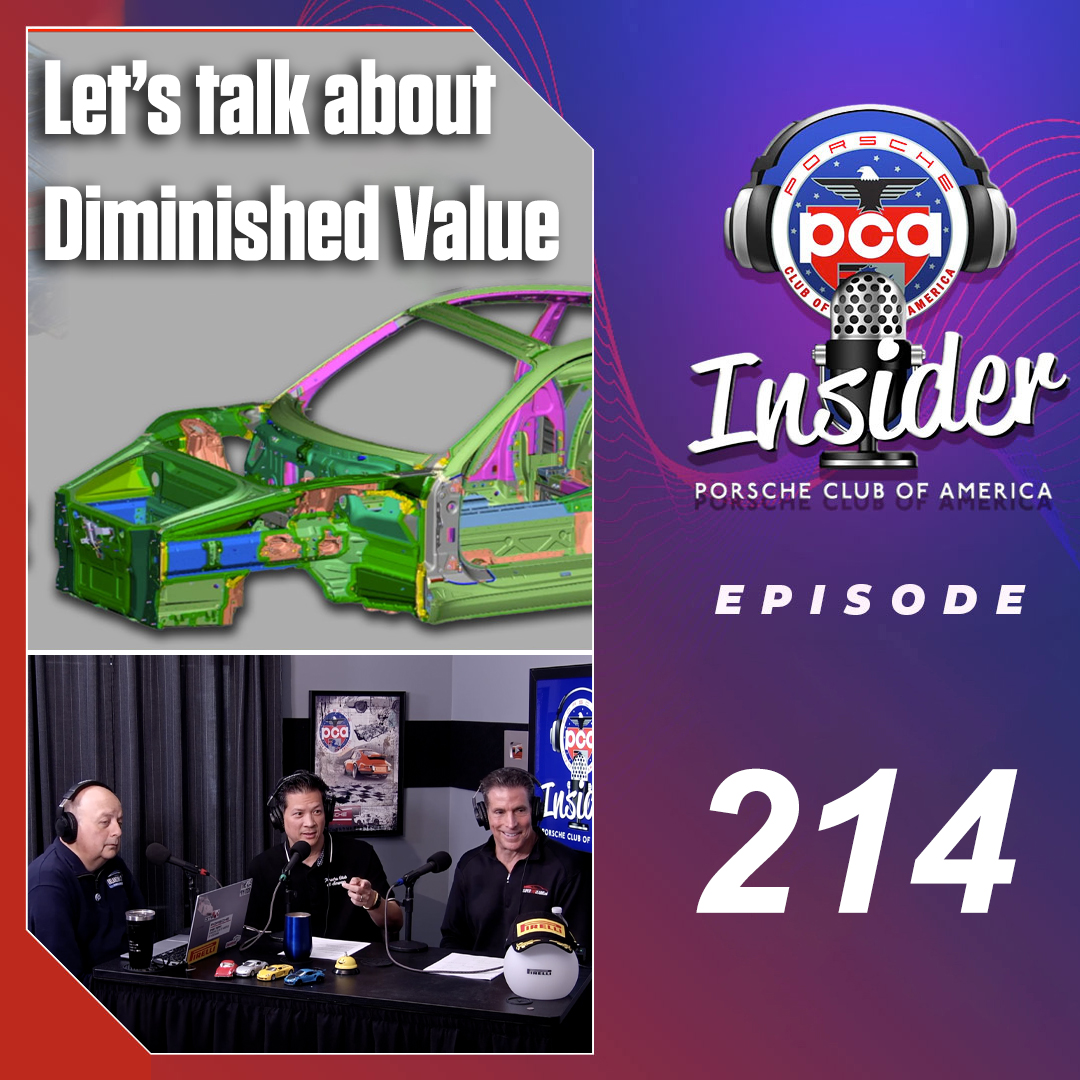
Diminished Value & Loss of Use: Protecting Your Investment with Steve Calamusa
About this episode
Steve Calamusa, founder of Supercar Claims, breaks down diminished value and loss of use for Porsche owners facing accidents—especially when repairs look perfect but the market still punishes “crash history.” He explains why insurers typically don’t pursue diminished value, how subrogation can swallow money meant for you, and the two main types of diminished value (inherent vs repair-related). The discussion includes timing/statute-of-limitations, coverage options like collector/specialty policies and umpd, and real examples where claims ballooned once loss of use was included. The rest of the show covers PCA events and tire/GT3 vs 458 video chatter.
We’re joined in the studio by Steve Calamusa, the founder of SuperCarClaims.com, to demystify the complex world of diminished value and loss of use claims. A passionate PCA member, Steve launched a specialized department within his law firm dedicated specifically to these issues. Whether you’re looking for representation or just want to be better prepared, Steve shares essential insights to help you navigate the claims process and protect your investment.
proper insurance
"Welcome everyone, with recent values of most Porsches going through the roof, we often talk about having proper insurance for your Porsche. But we don't talk about a key term that we're going to talk about today..."
Insurance isn’t just about paying to fix the car. The episode is saying the right coverage can also help protect what your Porsche is worth afterward.
“Proper insurance” in this context means having coverage that addresses not only repair costs, but also potential financial impacts like diminished value after an accident. The episode frames insurance as a key part of protecting a Porsche investment.
diminished value
"But we don't talk about a key term that we're going to talk about today, obviously if you read the title, it's diminish value and we have an expert in-house that's going to break it down for us."
Even if your Porsche gets fixed after an accident, it can still be worth less than a similar car with no accident history. “Diminished value” is the amount of that extra loss in resale value.
Diminished value is the reduction in a vehicle’s market price after it has been damaged or repaired, even if it’s restored to a drivable condition. Insurers and claims professionals often evaluate how much value is lost based on factors like the type of damage, repair quality, and whether the car’s history shows an accident.
VIN
"If you aren't currently a PCA member and own a Porsche, grab that VIN, head over to PCA.org and make yourself a member and join the ranks of over 170,000 PCA members in the US and Canada."
VIN stands for Vehicle Identification Number, a unique 17-character code used to identify a specific car. In insurance and vehicle history contexts, the VIN is commonly used to pull accurate records and ensure the correct vehicle is being evaluated.
Supercar Claims
"So before we dig deep into Supercar Claims and diminished value, let's learn a little bit about you..."
“Supercar Claims” sounds like a specialized way of handling claims for very expensive cars. The hosts mention it right before they talk about diminished value, so it’s likely part of the episode’s main explanation.
“Supercar Claims” appears to be a specific claims category or discussion topic tied to high-value vehicles and how diminished value is handled. It’s mentioned as a lead-in to the episode’s main subject, so listeners may want context on what makes these claims different.
PCA
"...how long have you been a PCA member and what do you drive? ...I've been a PCA member since 2019..."
PCA typically refers to Porsche Club of America, a large Porsche enthusiast organization with regional chapters and events. In this segment, the guest’s PCA membership and regional involvement provide context for their ownership perspective and community network.
Gold Coast region
"...I joined the Gold Coast region at the time. [140.4s] Superactive region?"
This refers to a local Porsche club chapter area. The guest is explaining which part of the Porsche Club of America they joined first.
The “Gold Coast region” is a PCA chapter region mentioned to explain the guest’s club involvement. It’s a structural detail about where the guest participates within the Porsche Club of America network.
Gulf Stream region
"...the Gulf Stream region spun off from the Gold Coast and I became a founding member of Gulf Stream and I'm the charity chairperson."
This is another local Porsche club chapter within PCA. The guest says they helped start it and now lead a charity role.
The “Gulf Stream region” is another PCA regional chapter the guest helped found. This is relevant mainly as background on their involvement and leadership within the club community.

Porsche 911 (991)
"I ventured into the 991 generation out of Turbo S and then I'd champion do some work to it and I was racing my car..."
Porsche uses generation codes for the 911. The “991” is one specific era of the 911, and it’s the one the guest moved into before later switching again.
“991 generation” refers to the Porsche 911 generation code 991 (roughly 2012–2019). This is the guest’s next step after their Turbo S, and they mention doing work and racing the car, which ties directly into how ownership choices affect value and claims.
stick shift
"...and then I got a 997 Turbo and when I sat in my car and I put my hand on the stick shift, I said, oh my God, this is exactly where the shifter"
A “stick shift” is a manual gear lever you move yourself to change gears. Here, the guest is describing how the shifter position and feel matched what they wanted.
“Stick shift” refers to a manual transmission with a gear lever you move by hand. In the context of this episode, the guest’s reaction suggests the shifter feel and placement are part of what makes the car “right,” which can influence how owners perceive changes after repairs or incidents.
loss of use
"is supposed to be. This clutch pedal is supposed to be and the car just felt right. ... So how does one get into this world of insurance, diminished value?"
Loss of use is about what it costs you when your car is in the shop and you can’t drive it. Sometimes that means paying for a rental, or it can mean a daily amount for the time you’re without your car. It’s separate from the repair bill.
Loss of use refers to the cost or inconvenience of not having your vehicle while it’s being repaired after an accident. Depending on the claim and jurisdiction, insurers may compensate for rental expenses or a daily value for the time you’re without the car. The episode title suggests this is part of the broader “diminished value” protection discussion.
clutch pedal
"This clutch pedal is supposed to be and the car just felt right. So I now have some, a couple of 997, I have a 997 GT2."
The clutch pedal is what you press to change gears in a manual car. If it feels “right,” it usually means the pedal response and engagement are smooth and predictable. Here it’s being used to describe how good the car feels to drive.
A clutch pedal is part of a manual-transmission setup, used to disengage the engine from the gearbox so you can shift gears smoothly. When someone says the clutch pedal “is supposed to be” and the car “felt right,” they’re describing how the pedal feel and engagement match what they expect from that car’s design. In this segment it’s more about subjective driving feel than a technical repair.

Ford Bronco
"...gation and I came from driving like an old ruster Bronco to having nicer cars and my friends also started ..."
The Ford Bronco is a type of SUV made to handle rough roads and off-road trails. People bring it up because it’s a well-known vehicle, especially if they’ve owned one in the past. It’s often used as an example of an older, more basic driving experience.
The Ford Bronco is a rugged SUV known for off-road capability and a long-running reputation as a go-anywhere vehicle. It often comes up in conversations about how people transition from older, simpler vehicles to more modern cars. In a podcast context, it’s a recognizable reference point for driving history and lifestyle.
insurance claims for accident damage
"along the way, my friends would come to me and say, hey Steve, somebody smashed into my car and the company will pay to fix it but my car's worth less because"
Sometimes insurance pays to fix the car, but it doesn’t make up for the fact that the car is worth less afterward. Even if the repairs are good, buyers may still pay less. This is the situation Steve is talking about.
This segment describes a common insurance scenario: the insurer pays to repair the car, but the owner still suffers a financial hit because the vehicle’s resale value drops. That’s the core tension between “repair cost” and “market value” after an accident. The discussion ties Steve’s legal background to helping owners quantify and argue that gap.
original paint car
"[270.0s] And I had friends that had a friend of mine who had a 993 turbo that was smashed and [273.4s] it was an original paint car and then another friend of mine had a 991 turbo that"
An “original paint” car is one whose exterior finish has not been repainted since it left the factory. In collector-car contexts, original paint is often a major value driver, so repainting or bodywork after an accident can create a larger diminished-value argument.
quarter panel
"[277.6s] was smashed where they replaced a quarter panel and they didn't want to pay diminished [280.6s] value."
The quarter panel is part of the car’s outer body on the rear corner. If it gets replaced after an accident, buyers may assume the car was damaged, which can reduce resale value.
A quarter panel is a body panel on the rear side of the car, typically replaced or repaired after side or rear impacts. Even when the work is done correctly, insurers may argue the replacement eliminates diminished value—while owners may argue the replacement still affects resale value.
OEM parts
"[329.4s] chasing down and making sure that the insurance company will use OEM parts, having it be [336.7s] repaired properly and that is a big part of it"
OEM parts are the same type of parts the car maker would install at the factory. Using them can help ensure the repair matches the original quality and can support your case when dealing with insurance.
OEM parts are original equipment manufacturer components made to the same specifications as what the car came with from the factory. The host emphasizes that using OEM parts and repairing the vehicle properly can matter for both safety and the owner’s ability to argue for value protection after an accident.
loss of potential value if you go to resell it
"[345.3s] are somewhat collectible and some of us even think it's almost irreplaceable, you [351.4s] don't even think about possibly the loss of potential value if you go to resell [356.8s] it because you're not reselling it until later."
The idea is that even if your car is fixed, it may still be worth less when you sell it later. Cars that people collect or really care about can lose value more than you’d expect.
This is the practical owner-side framing of diminished value: the loss shows up later when you sell or trade the car, not necessarily immediately after repairs. The episode highlights that collectible or enthusiast cars may be especially sensitive to accident history in the resale market.
OEM paint
"well, that car should be X number of dollars less because it's not perfect, the paint's not OEM, it's got history."
OEM paint means the original factory paint system used when the car was built. If repairs use non-OEM paint or don’t match perfectly, it can be a visible and measurable deviation that hurts buyer confidence and resale value.
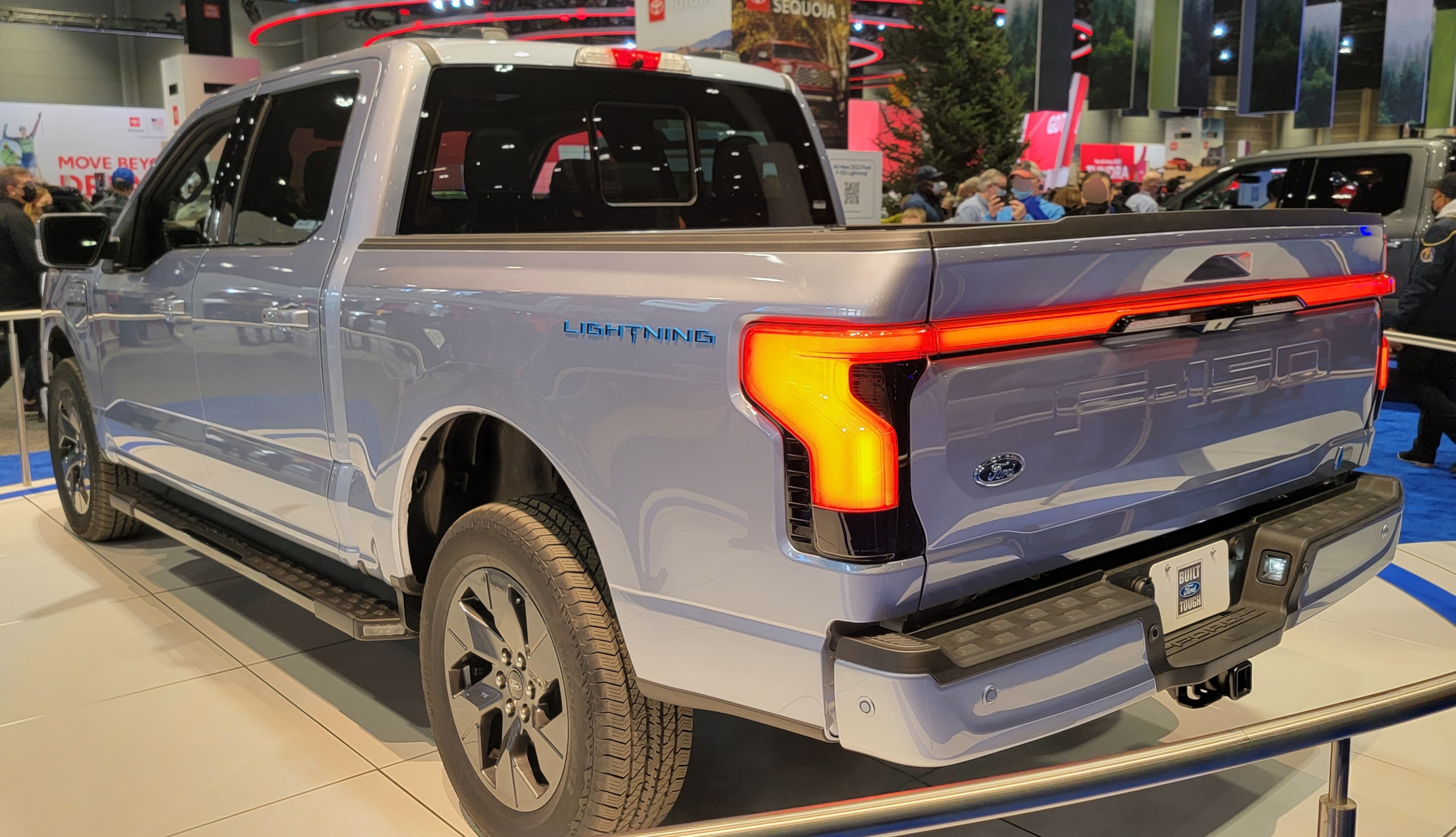
Ford F150
"they don't want a car with stories and it's different than if you have an F-150 and not that there's anything wrong with the F-150s, but if an F-150 has damage to it... they'll accept some repair damage"
They mention the Ford F-150 to show a difference in buyer expectations. Trucks like the F-150 are often used hard, so some damage history is more acceptable than it would be for a Porsche.
The Ford F-150 is used here as a contrast to a Porsche. The point is that many F-150 buyers may accept some repair damage because the truck is often treated as a utilitarian work vehicle, while Porsche buyers are more focused on pristine, pleasure-oriented condition.
crash history
"So you're exactly right, the difference in value is what does the market think of this car now that it has a crash history because people will seek out the car that doesn't"
Crash history means the car has been in an accident before. Even if it’s repaired, many buyers see that record and assume it’s not as desirable, so the price drops.
A crash history is the record (often from insurance claims and vehicle history reports) that a car has been damaged and repaired after an incident. In the Porsche market described here, buyers treat crash history as a major negative because it changes how the car is valued and perceived.
clean car fax
"but a lot of these used car places will film the interactions with the customers and when the customers are trading in, the first thing they ask, does it have a clean car fax? Because the guy says, well it's been"
“Clean Carfax” refers to a vehicle history report showing no reported accidents or damage events. In practice, buyers use it as a quick proxy for risk and resale value—cars without accident records tend to command higher prices.
dirty car fax
"most dealers will not retail a car with a dirty car fax, they'll send them to a wholesale auction and when you trade that car in, you're going to take a hit on it if the car fax is dirty without a doubt, especially on high-end vehicles"
A “dirty” Carfax usually means the report shows an accident or damage. That can make people offer less money because they assume the car may have hidden issues or repairs.
A “dirty Carfax” indicates the vehicle history report includes an accident or damage event. That typically reduces resale value because buyers and dealers treat the car as higher risk, especially for high-end brands.
Ferrari
"especially on high-end vehicles, Porsche, Ferrari, Lamborghini, it's the scarlet letter."
They’re using Ferrari as an example of a luxury brand where an accident record can make the car worth less.
Ferrari is mentioned as an example of a high-end brand where a reported accident can significantly reduce value. The “scarlet letter” framing highlights how strongly buyers react to vehicle history reports.
Lamborghini
"especially on high-end vehicles, Porsche, Ferrari, Lamborghini, it's the scarlet letter."
They’re saying that for cars like Lamborghini, an accident history can hurt resale value a lot.
Lamborghini is included in the discussion as another high-end brand affected by accident-history stigma. The point is that a “dirty” vehicle history report can reduce what dealers will pay and what buyers will accept.
first-party coverage
"Okay, so I'm just going to define things. First-party coverage is your coverage, third-party coverage is the person that hit you"
First-party coverage means the insurance policy you purchased for your own car. It’s the coverage that gets used when your car is damaged in a crash.
First-party coverage is the insurance you buy for your own vehicle. It’s the policy that responds when your car is damaged, and it often triggers the insurer’s later actions like subrogation.
third-party coverage
"First-party coverage is your coverage, third-party coverage is the person that hit you, hit you with that coverage."
Third-party coverage is the insurance of the driver who hit you. If they caused the crash, their insurance is often the one that should pay for the damage.
Third-party coverage refers to the insurance held by the person who caused the accident. In many claims, your insurer will pursue the at-fault party’s coverage to pay for repairs and losses.
first-party carrier
"this is that that money that the first-party insurance guy or your insurance company is going after the third-party to get to pay to fix your car, that's money that you could have used for diminished value"
Your first-party carrier is your own insurance company. They’re the ones paying your claim and then sometimes trying to recover money from the other driver’s insurance.
A first-party carrier is your own insurance company handling your claim under your policy. In the segment, the speaker contrasts it with the third-party insurer (the at-fault driver) and explains why the first-party should pause certain recovery actions.
made-whole doctor
"he goes first because it's called the made-whole doctor and our clients get to go first and take the money for diminished value and loss of use."
This is a rule-of-thumb idea: you should be fully paid for your losses before the insurance company tries to take money back from the other side. The speaker is saying the injured owner should get diminished value and loss of use first.
“Made-whole” is a legal principle meaning the injured party should be fully compensated before an insurer recovers its payments through subrogation. The speaker uses “made-whole doctor” as a shorthand for that priority rule in diminished value and loss-of-use claims.
specialty policy
"If you have a specialty policy with some of the bigger companies that ensure collector cars such as this, you can get a diminished value part of your policy."
A specialty policy is a special kind of insurance plan, often for collector cars. It can include extra coverage that regular auto insurance might not offer, like diminished value.
A specialty policy is a tailored insurance arrangement—often for collector cars—that can include coverage for items like diminished value. The speaker notes that some larger insurers offer this as part of collector-car protection.
UMPD
"[656.4s] Was that UMPD? [658.0s] UMPD. [658.4s] Uninsured Motors I've heard but then Property Damage is the key part."
UMPD is insurance that helps pay for damage to your car if the other driver can’t. It’s especially important for property damage, like repairs to your Porsche after a crash.
UMPD stands for Uninsured Motorist Property Damage. It covers damage to your vehicle when the at-fault driver doesn’t have enough insurance (or is uninsured) to pay for repairs.
uninsured motorists
"[661.7s] Yeah, most people have uninsured motorists for bodily [664.4s] injury coverage. So if someone hits you, you get injured, they [668.1s] don't have enough coverage, you protect yourself. A lot of people [671.8s] don't have UMPD and it's an insignificant amount of money."
Uninsured motorist coverage helps you when the other driver doesn’t have insurance. The hosts are saying many people focus on injuries, but you should also make sure your car’s damage is covered.
Uninsured motorist coverage protects you when the other driver doesn’t have insurance. The episode distinguishes that most people buy it for bodily injury, but property damage protection (like UMPD) is often overlooked.
frame machine
"You know, it's been on a frame machine. So there's a lot of work that's been done to this car and it's now got a dirty car fax..."
A frame machine is a tool body shops use to straighten the car’s structure after a crash. If your car needed that kind of work, buyers may assume it was more seriously damaged.
A frame machine is the equipment used to pull and align a damaged vehicle’s structure back to specification. If a car was on a frame machine, it indicates structural realignment work occurred, which can affect market value even after cosmetic repairs.
fish eye in the paint
"...you see fish eye in the paint or orange peel in the paint, things you... overspray on places..."
“Fish eye” is a paint defect where the finish forms small craters or circular imperfections, usually caused by contamination or improper surface preparation. It’s a sign the repair process may not have been done correctly, which can reduce resale value.
orange peel in the paint
"...fish eye in the paint or orange peel in the paint, things you... overspray on places..."
Orange peel means the paint dries with a bumpy, uneven texture. It’s usually a sign the painting wasn’t done with the right conditions or technique.
Orange peel is a texture defect where the paint surface looks bumpy, similar to the skin of an orange. It typically results from spray technique, viscosity, or curing issues, and it can be used as evidence of subpar bodywork.
overspray
"...orange peel in the paint, things you, you know, overspray on places or just, I mean, I've seen some horrible work done."
Overspray is when paint gets on parts that should have been protected. If you can see it, it suggests the repair job wasn’t done carefully.
Overspray is paint that lands on areas that weren’t meant to be painted, often visible around trim, edges, or seams. It’s a common indicator of sloppy masking or finishing work, which can contribute to repair-related diminished value.
Porsche certified body shop
"Most of the claims that come to us are people that have inherent diminished value where they've taken into a Porsche certified body shop. The car has been fixed properly."
This means the repair shop is approved by Porsche and is supposed to meet Porsche’s repair standards. But even if the work looks right, the car can still be worth less because buyers know it was repaired after a crash.
A Porsche certified body shop is an approved repair facility intended to follow manufacturer standards for repairs and refinishing. The episode’s point is that even when a Porsche-certified shop fixes the car properly, the market may still apply diminished value due to the prior damage history.
insurance total loss decision
"Um, so the insurance companies look at, from a total loss perspective, they look at it from the perspective generally of their statutes... and they also have internal guidelines... then then they make a decision."
When an accident happens, insurance has rules for deciding whether to repair or total the car. They look at the repair work needed and compare it to the car’s value to decide what costs less.
The “total loss” decision is driven by insurer statutes and internal guidelines, not just the physical condition of the car. They evaluate repair scope during teardown and compare it to the vehicle’s value to determine whether fixing or totaling is more cost-effective.
repair cost vs vehicle value ratio
"What percentage of the value of the vehicle is the, what percentage is the repair compared to the value, the total value of the vehicle?"
Insurance often uses a simple comparison: what it costs to repair the car versus what the car was worth before the accident. That comparison helps them decide whether to total it.
The repair-to-value ratio is a key metric insurers use to decide whether a vehicle is totaled. It’s essentially: how much it costs to fix the car compared to what the car is worth before the damage.
total loss threshold
"What percentage of the value of the vehicle is the, what percentage is the repair compared to the value, the total value of the vehicle? Once it reaches a threshold... then they make a decision."
Insurance companies compare the repair cost to what the car was worth before the accident. If the repairs are too expensive relative to the car’s value, they may declare it a total loss.
Insurers use a “total loss” threshold based on how expensive repairs are compared with the car’s pre-loss value. Once repairs exceed that threshold, the insurer typically decides it’s financially better to total the vehicle rather than repair it.
car being torn down
"Once it reaches a threshold, when the car's being torn down and they're taking a look at as far as the repairs that need to be done..."
Before insurance decides what to do, they may take the car apart to find any hidden damage. If they find more damage than expected, the repair cost can go up.
“Torn down” refers to the insurer’s process of disassembling the vehicle to assess hidden damage and the full repair scope. This can change the estimated repair cost and therefore affect whether the car crosses the total loss threshold.
statute of limitations
"there's a statute of limitations... depending upon what state you're in, there's a number of years that you can bring a claim... some states you can go back three, four years... some states... up to six years... most... two to four years."
Laws usually set a time limit for when you can file a claim. This time limit depends on where you live, so the window for bringing a diminished value claim can be shorter or longer.
The statute of limitations is the legal deadline for filing a claim. In this segment, the hosts note it varies by state, which determines how far back a diminished value claim can be brought after an accident.
DMV
"...would you go to your your state DMV site or where do you find out or just call you?"
DMV is your state’s vehicle office. It’s where you can often find official information or links related to vehicle records and requirements.
DMV is the state Department of Motor Vehicles, which maintains records related to vehicle ownership and registration. The segment mentions using a state DMV site as one possible place to find information during the process after a crash.
subrogation
"if your insurance company has already subrogated and taken the money from the third party... we then ask them to reverse subrogation."
Subrogation is basically your insurance company trying to get reimbursed by the person who caused the crash. If they already took money from the other side, the question becomes whether they can undo that step. That can change how your claim is handled and what you can recover.
Subrogation is when an insurance company that paid a claim tries to recover that money from the at-fault third party. In a diminished value/loss of use context, the discussion focuses on whether the insurer can (or should) reverse that process if the claim handling or coverage allocation was wrong. This matters because it affects who ultimately pays and how the claim is documented.
property damage coverage
"The person that re-rends you has $50,000 in property damage coverage... Not your bodily injury coverage... comp and collision on your policy, that's a whole different thing."
Property damage coverage is the part of insurance that pays to fix damage to cars or other property. If the at-fault driver only has a limited amount, there’s a cap on how much can be paid out. That’s why the speaker keeps coming back to how much property damage coverage is available.
Property damage coverage is the portion of an insurance policy that pays to repair or replace damage to vehicles and other property. In the example, the at-fault driver has a limited amount (e.g., $50,000), which constrains how much can be paid toward repairs and related costs tied to the vehicle. This is distinct from coverage for injuries.
bodily injury coverage
"Not your bodily injury coverage that doesn't apply, comp and collision on your policy, that's a whole different thing."
Bodily injury coverage is what insurance uses to pay for injuries to people after a crash. It’s different from the coverage used to fix damage to your car. So if you’re talking about car value or repair-related losses, you usually have to look at the property damage side.
Bodily injury coverage is the part of an insurance policy that pays for injuries to people (medical bills, sometimes related costs) after an accident. The transcript contrasts it with property damage coverage to emphasize that vehicle-related losses are not paid from the injury bucket. This distinction is crucial when discussing diminished value or other vehicle-focused claims.
comp and collision
"Not your bodily injury coverage that doesn't apply, comp and collision on your policy, that's a whole different thing, we'll talk about that but..."
“Comp and collision” are two parts of auto insurance that help pay for damage to your own car. Comprehensive is usually for non-crash events, and collision is for crash damage. The speaker is saying these are separate from the third-party injury coverage rules.
“Comp and collision” refers to common auto insurance coverages: comprehensive (comp) and collision. These typically apply to damage to your own vehicle under different circumstances, rather than to third-party injury claims. The speaker is using this to separate how your insurer might pay for your car versus how third-party coverage applies.
comprehensive and collision coverage
"“if you have comp and collision on your car, comprehensive coverage and collision on your car, your collision element of your policy pays to repair your vehicle.”"
These are two parts of car insurance that help pay to repair your car. Collision is for crash damage, and comprehensive is for things like theft or storm damage—so if something covered happens, your policy can pay for repairs.
Comprehensive and collision are two common auto insurance coverages that apply to different types of damage. Collision generally covers damage from crashes, while comprehensive covers non-crash events like theft, vandalism, or weather-related damage; together they determine what repairs your insurer will pay for after a claim.
mitigate our losses
"...we want to mitigate our losses and we want to get the money back that we paid from the person that hit you..."
This phrase means “try to reduce the damage financially.” In insurance terms, it’s about recovering money or limiting what the insurer has to lose.
“Mitigate our losses” is the idea that the party paying (or seeking reimbursement) will take steps to reduce or recover financial harm after an incident. In insurance disputes, it often comes up alongside subrogation and reimbursement efforts.
subrogate
"...they go and they subrogate against the insurance company, meaning they attempt to get paid back for those losses."
Subrogation is when the insurance company tries to get its money back from the person who caused the crash. They pay first, then go after the other side to recover what they spent.
Subrogation (often misspoken as “subrogate”) is when an insurer (or sometimes another party) seeks reimbursement from the at-fault party’s insurer after paying for a claim. The goal is to shift the financial responsibility to the party responsible for the accident.
insurance company
"...you can either go to your insurance company and say... they'll pay for it and then they go and they chase after the third party..."
Your insurance company is the insurer that pays for covered repairs. They may also try to get their money back from the other driver’s insurance.
In an accident claim, your insurance company can pay for repairs under your coverage and then pursue reimbursement from the at-fault party’s insurer. The process is often called subrogation, and it can affect how quickly you get repairs.
direct settlement with the at-fault party
"...you don't say anything to your insurance company and then you just work directly with the person that hit you and try to get your car fixed through their system..."
Instead of going through your own insurance, you deal directly with the driver who caused the crash to get your car fixed. That can sometimes reduce the back-and-forth with insurers.
Direct settlement means you (or your representative) work with the person who hit you to get repairs handled through their process, rather than having your insurer lead the claim. This can change how your insurer participates and may affect how claims for diminished value or other losses are handled.
liability decision
"because they have to make a liability decision, so they don't make the decision, like on the fly, like that."
Liability is basically “who caused it.” Insurance companies usually have to decide that before they’ll pay, so if nobody agrees yet, you can end up waiting.
A liability decision is the insurer’s determination of who is responsible for the crash or damage. Until that responsibility is agreed upon, insurers often delay claim payment, which can leave the vehicle undrivable while paperwork and negotiations play out.
car's incapacitated
"So you're waiting, your car's incapacitated and you're waiting, so usually a lot of people just go through their, you know, through their, use their policy and then eventually, you know, their insurance company subrogates through the third party."
“Incapacitated” just means the car can’t be used because it’s not in a drivable/safe condition. If insurance takes a while to approve the claim, you may be stuck without the car longer.
When a car is “incapacitated,” it can’t be driven normally due to damage or safety issues. In insurance disputes, that matters because it can trigger additional costs and delays—especially when payment depends on liability being resolved.
raise my premiums
"because a lot of people say I don't want to put my insurance company on notice, I don't want to raise my premiums."
Premiums are what you pay for insurance. Some people worry that filing a claim (or involving their insurer) could make their future insurance more expensive.
“Raising premiums” refers to an increase in your insurance cost after a claim or when your insurer becomes involved. People often try to avoid notifying their insurer to prevent rate increases, but that can complicate how claims are handled and who has to be involved.
prejudiced
"...they may say we're prejudiced now and we're not going to provide coverage to you..."
“Prejudiced” basically means “hurt” or “put at a disadvantage.” The insurer is claiming that because you waited, they couldn’t properly check what happened.
“Prejudiced” is an insurance/legal argument that a delay harmed the insurer’s ability to investigate or defend the claim. In practice, it’s used to justify denying coverage when notice wasn’t given promptly.
notify us within X amount of days
"...because under our policy, you were supposed to notify us within X amount of days..."
Insurance companies often require you to report a claim quickly. If you wait too long, they may say they couldn’t investigate properly and refuse to pay.
Many insurance policies require prompt notice of a claim—often within a set number of days. If the insured doesn’t notify the insurer in time, the insurer may deny coverage or argue it was “prejudiced” by the delay.
deductible
"...I did go to my insurance company, and they took care of the repairs, but then I had like this deductible that I had to pay..."
A deductible is the part of the repair bill you pay first. After that, insurance pays the remaining cost.
A deductible is the amount the policyholder pays out of pocket before the insurer covers the rest of a claim. In accident repairs, the deductible is why owners may still have to pay even when the insurance company approves the repair.
third party company
"[1217.6s] out to the third party company [1219.7s] and they'll pay you. [1220.3s] It took like two years for me [1222.1s] to get like 500 bucks."
They’re talking about an outside company that helps with the claim. Instead of everything happening directly through your insurer, you may have to contact this other company, and it can take a long time to get paid.
A “third party company” in this context is an outside provider that handles part of the diminished-value or loss-of-use claim process rather than the insurer directly. These companies may evaluate the claim and coordinate payment, which can introduce delays. The segment notes a long wait time before receiving compensation.
database where all of this gets reported
"there's a database where all of this gets reported anyway. So your insurance company is going to find out that there's a claim anyhow."
They’re talking about systems that keep track of accident and claim history. Insurers can look it up later, which is why renewal forms ask about crashes.
The “database” reference points to industry claim-history reporting systems that insurers use to track accidents and claims. These records can affect underwriting decisions like renewal questions and premium changes.
renewing your policy
"So when you're renewing your policy, they'll ask you, have you been in a crash? It's known."
When you renew your insurance, they check your past claims and accidents. That history can change your price and what coverage you can get.
When you renew an auto insurance policy, the insurer typically re-evaluates your risk using your claims and crash history. Prior claims can influence premiums and eligibility for certain coverages.
timely notify us
"...we're not covering it because the fact you didn't timely notify us and we've been prejudiced because we didn't get to inspect the car when it was damaged..."
Insurance policies often require you to report a claim quickly. If you wait too long, the insurer may deny or reduce coverage because they couldn’t check the damage properly at the time.
“Timely notify” refers to an insurance requirement to report a claim promptly. If you delay, the insurer may argue it was “prejudiced” because it couldn’t inspect the vehicle while the damage was fresh and fully documented.

Chevrolet Cruze
"...Like you talked about an F-150 or maybe my daughter's Chevy Cruze."
The Chevrolet Cruze is a common compact car. They’re using it as an example to show that these insurance issues can happen to regular, non-luxury vehicles as well.
The Chevrolet Cruze is a compact sedan that’s widely owned, making it a relatable example for insurance and valuation conversations. The point is that diminished value and loss-of-use can apply to everyday cars too—not just expensive sports cars.
recovery
"...getting it without us getting involved because I want them to have the full amount of money without us taking a percentage of the recovery"
“Recovery” just means the final payout you receive from the insurance claim. The speaker is saying they want the client to keep as much of that payout as possible.
In insurance claims, “recovery” is the amount of money you ultimately get back from the insurer or through a settlement. The speaker is describing how their involvement affects how much of that recovered amount the client keeps.

Porsche Career Gt
"But what if you were at fault? Like what if you took your career GT and spun it and hit a rock wall or something?"
They’re talking about a Porsche GT—basically a Porsche that’s meant to be more performance/track-oriented. The question is: if you wreck your own Porsche because you were at fault, do you still try to claim diminished value?
The speaker references a “Porsche GT,” meaning a Porsche GT model (often used to describe Porsche’s track-focused GT cars). The key point in the conversation is how diminished value works when the owner is at fault and damages their own car.
insurance policy
"Generally you just have to look at your policy and see what your policy says about damage. And there's, you know, there may be language in there."
Your insurance policy is the document that spells out what your insurer will pay for. If you’re dealing with damage to a car, the policy language can decide whether you’re covered.
An insurance policy is the contract that defines what kinds of damage are covered, what exclusions apply, and how claims are handled. In diminished value situations, the exact wording about “damage,” “specialty coverage,” or related benefits can determine whether something is reimbursable.
calipers painted
"We've had some interesting stuff where, you know, cars were taken to dealerships where they were having their calipers painted, for example."
Brake calipers are the parts that squeeze the brake pads. Some people paint them for looks, and if they get damaged or need repainting, it can complicate an insurance claim.
Painting brake calipers is a cosmetic modification that can be affected by minor damage or repair work. Because it’s a visible, often custom detail, insurers may dispute whether repainting is purely cosmetic or tied to covered damage, which can matter for claims.
jack stands
"on jack stands in the park and knocked it onto the ground and damaged the undercarriage."
Jack stands are safety supports used to hold a car in the air while work is performed underneath. They’re critical for preventing falls, but accidents can still happen if a vehicle is knocked or improperly positioned.
undercarriage
"and knocked it onto the ground and damaged the undercarriage. And so we've had people where the cars were parked in their garage and a home inspector came in..."
The undercarriage is the bottom of the car—where things like the exhaust and suspension parts live. If it gets hit, it can cause problems that aren’t always visible from the outside.
The undercarriage is the portion of the vehicle beneath the body, including components like the exhaust, suspension links, and protective shields. Damage here can be more than cosmetic, potentially affecting drivability and requiring more involved repairs.
paint sample car
"and pulled the attic ladder out and hit the roof of a paint sample car. So it's not just..."
A paint sample car is basically a car used to show or test paint colors. If it gets hit, it can still need repairs and can affect what the owner can claim.
A “paint sample car” is a vehicle used to test or display paint colors and finishes, often in a controlled shop setting. Collisions with these cars can still create real damage and lead to claims about repair costs and vehicle value impacts.
detailing the paint
"We had a car that was at a shop getting repairs where they were, you know, they were detailing the paint on the car. And a windstorm came"
Paint detailing is the process of cleaning and restoring a car’s finish—often including washing, polishing, and applying protective products. Damage during detailing can affect the finish and may require additional correction work beyond basic repair.
paint meter
"And if somebody goes around the car with the paint meter and the car was an original paint car, it's now it's been, you know, affected."
A paint meter is a tool that checks how thick the paint is on different parts of the car. If the numbers don’t match what factory paint usually looks like, it can mean the car was repainted, which can hurt resale value.
A paint meter (often a handheld thickness gauge) measures the thickness of paint/clearcoat on a panel. If readings differ from what’s expected for factory paint, it can suggest repainting or refinishing, which can affect a car’s value after an accident or repair.
wheels were stolen
"...but thankfully my car was... My wife's car wasn't damaged, but, you know, our wheels were stolen, but I don't have anybody to chase down..."
If someone steals your wheels, you often have to replace them with something else. Replacement wheels may not match the original ones, and that can make the car harder to sell for the same price.
Wheel theft can complicate diminished-value or documentation claims because it removes original components and may require replacement wheels that don’t match the car’s original specifications. Even if the replacement is similar, the lack of original parts can affect buyer perception and valuation.
numbers matching wheels
"...because I don't have the numbers matching wheels to our Civic anymore."
“Numbers matching” here means the wheels are the original-style ones with the right identifying markings. If those wheels are gone and replaced, the car may not feel as “original,” which can reduce what people are willing to pay.
“Numbers matching” usually means the vehicle’s components are the original ones identified by specific codes/markings (often tied to the car’s build or option package). With wheels, matching codes can help demonstrate originality and can support higher resale value because buyers prefer parts that haven’t been swapped.
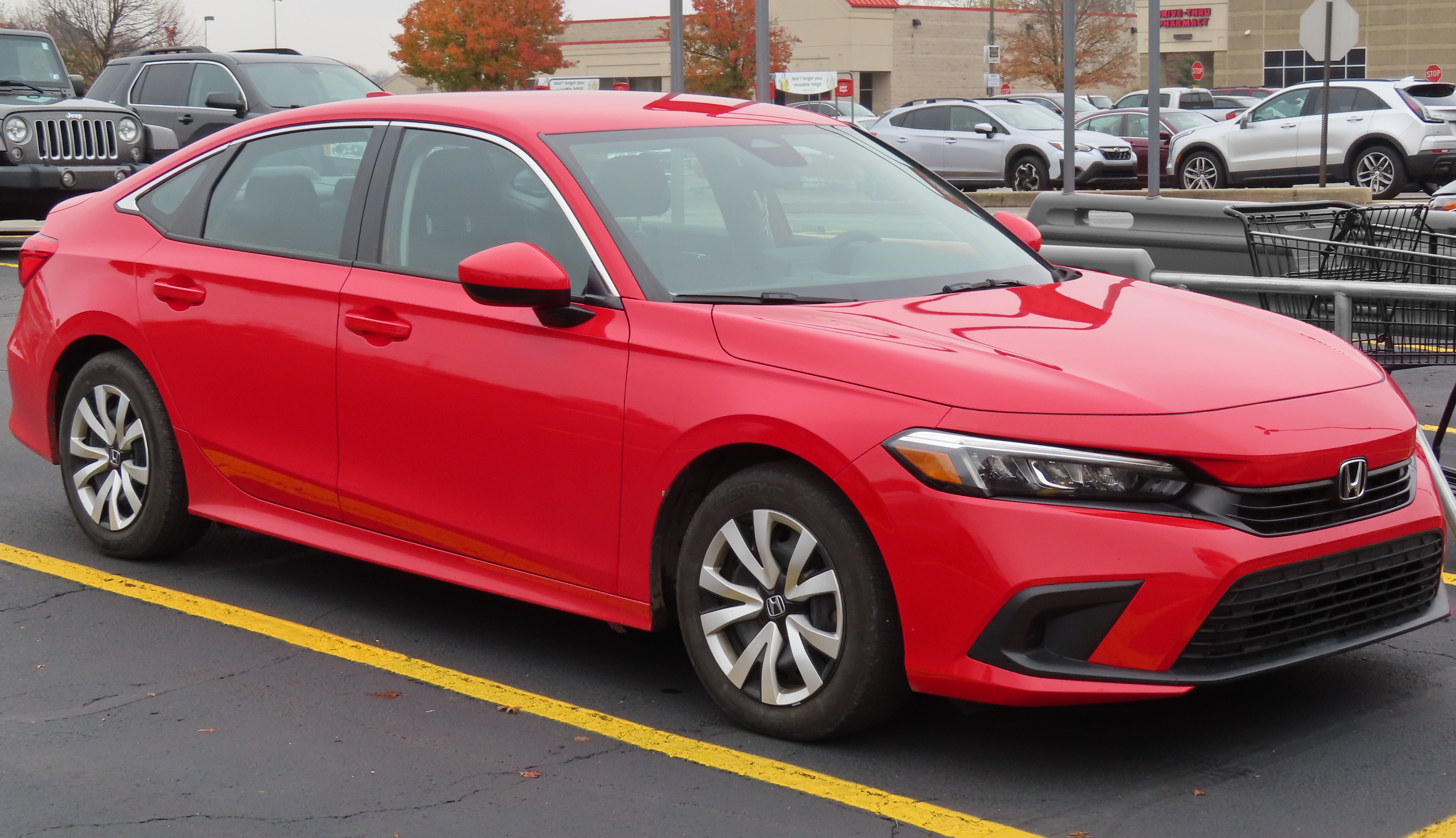
Civic
"...because I don't have the numbers matching wheels to our Civic anymore."
They’re talking about a Honda Civic as an example. The point is that if you lose original parts (like matching wheels), it can make the car harder to value or harder to sell for top money.
The Honda Civic is being used as an example of a vehicle where certain value-related details (like matching wheels) are no longer available. In diminished-value discussions, having original or matching components can matter because it helps preserve the car’s “as-delivered” condition and buyer confidence.
PPF
"everybody protects their cars, the PPF, the ceramic coatings, everybody wants their cars perfect."
PPF is a clear film you put on your car’s paint to help protect it from scratches and rock chips. It’s one of the ways people try to keep the car looking new.
PPF usually means paint protection film, a clear protective layer applied to vulnerable areas of a car’s paint. It’s meant to reduce damage from road debris and minor impacts, helping preserve appearance and potentially resale value.
ceramic coatings
"the PPF, the ceramic coatings, everybody wants their cars perfect. So when something bad happens,"
A ceramic coating is a protective layer on top of the paint. It helps repel water and dirt, so the car stays cleaner and the finish is easier to maintain.
Ceramic coatings are liquid polymer coatings that bond to paint to create a hydrophobic, more stain-resistant surface. They’re popular for reducing contamination and making the car easier to wash, which supports long-term appearance and protection.
Supply and demand (used to explain car appreciation)
"[1669.7s] Now, [1671.7s] because of supply and demand [1672.6s] you know, [1673.4s] Caymans and Calclean,"
Car prices don’t just depend on condition—they also depend on how many are available and how many people want them. If a car becomes more popular, it can be worth more, so damage can hurt the resale price more.
The hosts attribute price changes to supply and demand—when fewer cars are available or more buyers want them, prices can rise. That matters for diminished value because a higher baseline value means an accident can cause a larger dollar loss.
rear-ended
"[1683.6s] then your car is going to take [1685.5s] at least a five grand hit [1686.9s] because someone damaged the back [1688.9s] when they rear-ended you, right?"
A “rear-ended” crash is when someone hits you from behind. Even if the damage is fixed, the accident can still reduce what the car is worth when you sell it.
“Rear-ended” means the car was struck from behind, which can damage the rear bumper, trunk area, and alignment-related components. Even with proper repairs, a rear-end accident can still lead to diminished value because buyers may assume hidden damage or future issues.
appreciated
"But since then, they've appreciated. Exactly."
“Appreciated” means the car got more valuable over time. If the market is pushing prices up, it can change how much damage affects what the car is worth.
Appreciated means the car’s market value increased over time rather than decreased. This matters in diminished-value discussions because a vehicle that’s rising in value may show different (or reduced) measurable resale-value impact after repairs.
appraisal
"And the person who owned the vehicle decided to hire an appraiser and then submit an appraisal to the insurance company"
An appraisal is a written estimate from a qualified person that supports your claim. Here, it’s used to show how much value the car lost after the damage, not just what it cost to repair.
An appraisal is a formal estimate—often from an independent appraiser—used to support a claim for losses like diminished value. In these cases, the appraiser typically documents the vehicle’s condition, the damage history, and the expected market impact after repairs.
touring paint sample
"This was a $300,000 touring paint sample. Wow. 10 grand is nothing."
This sounds like a description of the car’s paint—possibly a special or higher-end finish. When a car gets repainted after an accident, buyers may value it less, even if the work looks good.
“Touring paint sample” sounds like a specific paint/finish option or a custom paint-related reference used to describe the vehicle’s value and repair context. In diminished-value discussions, paint quality and originality can matter because repainting or refinishing may affect resale perception.
damage history
"...accept that car for a 10% discount... with all of that damage history. Yeah. There's no way."
Damage history is basically proof that the car was in an accident and got repaired. Many buyers treat that as a negative, so the car sells for less.
A car’s damage history is the record (and sometimes the reputation) that it was involved in an accident or sustained significant repairs. Even when repairs are high quality, damage history can reduce buyer confidence and therefore resale value.
demand (insurance/claim settlement demand)
"So we got involved and I immediately withdrew the $30,000 demand and said, that's off the table."
A demand is the amount someone asks for to settle a dispute. If the other side’s offer doesn’t match the evidence (like appraisals), the demand can be withdrawn or adjusted.
A demand is a requested settlement amount—often used in insurance disputes or legal negotiations—based on the claimed loss. With diminished value, the demand typically reflects the estimated value reduction plus related considerations, and can be withdrawn if the evidence or appraisal support changes.
appraisers
"So we got involved and I immediately withdrew the $30,000 demand and said, that's off the table. And we had our appraisers work up the numbers. And what they didn't take into consideration..."
Appraisers are people who figure out what a car is worth. In accident cases, they may also estimate how much value the car lost because of the damage and repairs.
Appraisers are specialists who estimate a vehicle’s value and, in diminished-value cases, how much value was lost due to the damage and repair history. Different appraisers can reach different conclusions depending on methodology, assumptions, and what factors they include.
vehicle in the shop for months waiting for parts
"was that the vehicle was in the shop for months waiting for parts."
If a car can’t be repaired quickly because parts are missing, it can sit in the shop for a long time. That long delay can make it easier to argue that the owner lost the ability to use the car.
Extended repair downtime due to parts shortages can directly increase damages exposure, especially for loss of use claims. When a vehicle sits for months, the owner’s inability to access the car becomes a more significant and documentable impact.
PTS Blue
"and PTS Blue, I think you said. 75, 80,000?"
“PTS” is Porsche’s personalization option for things like paint. “PTS Blue” means the car was ordered with a special custom blue color, not just a basic factory color.
“PTS” stands for Porsche Tequipment, Porsche’s personalization program. “PTS Blue” indicates a specific custom paint color chosen through that program, which can affect resale value and insurance/claims discussions because it’s more individualized than standard paint.
Porsche 911 GT3 Touring
"You're paying insurance on your GT3 touring. You're, if you have a loan on it, you're paying your loan on your GT3 touring and that car is not in your driveway for you to drive."
They’re saying their Porsche 911 GT3 Touring isn’t available to drive, even though they still have to keep paying for it. The point is that you may still owe insurance and loan payments while the car is tied up, so there should be compensation for that lost ability to use the vehicle.
The speaker is talking about a Porsche 911 GT3 Touring being unavailable after a claim, so they can’t use the car while it’s out of service. In this context, the “GT3 Touring” is the specific 911 variant they’re referencing, and it matters because the insurance and loan payments continue even though the car isn’t usable.
garnishing wages
"And if they can't, does that mean they're garnishing wages or how does that work? Generally, the way it works is this"
Garnishing wages means money gets taken directly out of your paycheck by court order. The question here is whether someone could end up owing money beyond what insurance pays.
Wage garnishment is a legal process where money is taken from someone’s paycheck to satisfy a debt or judgment. In the insurance context, the question is whether an underinsured claim could lead to legal collection actions if the owner is responsible for amounts not paid by insurance.
Bring a Trailer
"there's an example of cars that were on bring, bring a trailer."
Bring a Trailer is a website where car enthusiasts buy and sell cars. The host is using those auction results to show that a bad vehicle history report can lower what people are willing to pay.
Bring a Trailer (BaT) is an online auction site known for enthusiast cars, where vehicle history and condition details can strongly influence bidding. The host uses BaT sales to illustrate how a Carfax event can affect prices even when cars are otherwise similar.
no stories
"And that's because people don't want, if someone's going to buy a GT ... they want a car with no stories. No stories."
“No stories” basically means the car has a clean past with no accidents or insurance claims. Buyers like that because it makes the car feel safer and easier to trust.
“No stories” is collector shorthand for a car with a clean history—no accidents, claims, or major repairs that could affect buyer confidence. In valuation discussions, it’s a proxy for how much risk a buyer perceives and how easily the car can be sold.
OEM new parts
"They thought their policy meant all OEM new parts. And then they find out that no, it's either after marketer used ..."
OEM parts are the same brand/spec parts the car was originally built with. The big question for insurance is whether your policy promises OEM parts or allows cheaper replacement parts.
OEM parts are made by (or to the specifications of) the original equipment manufacturer, and “new” implies they’re not recycled. In insurance disputes, the key issue is whether the policy guarantees OEM parts or allows aftermarket parts for repairs.
aftermarket used but newly in part
"And then they find out that no, it's either after marketer used but newly in part ... it's not going to be on your car."
Aftermarket parts aren’t made by the same company that built your car. If your insurance allows aftermarket or non-new parts, the repair may not match what you expected.
Aftermarket parts are made by companies other than the original manufacturer, and “used” vs “new” affects cost and perceived quality. The transcript suggests the policy may allow non-OEM sourcing or non-new components, which can impact repair quality and resale value.

Porsche Cayman
"I actually have had my Cayman's stock breaks on it. So, you know, the monoblock brembo as I put on the car."
They’re talking about their Porsche Cayman. It’s the car they’re using as an example for how insurance and damage claims can be affected by what’s been changed on the car.
The speaker says they had a Porsche Cayman and installed stock brakes on it after a deer incident. In this context, the Cayman is the specific Porsche platform they’re talking about for insurance and diminished value.
monoblock brembo
"So, you know, the monoblock brembo as I put on the car. So the insurance company, let me go get those breaks after they asked me…"
“Monoblock Brembo” is a type of brake caliper. It’s a higher-end brake part than the factory one, and changing brakes can affect how an insurance claim is handled.
“Monoblock Brembo” refers to Brembo brake calipers made from a single piece of metal (monoblock construction). This is a performance-oriented brake upgrade that can matter in insurance discussions because it may be considered a modification.
modifications
"Can you talk about modifications, you know, not just after market but modifications and insurance and does it even work in diminished value at all?"
The speaker asks how modifications—both aftermarket and other changes—interact with insurance and diminished value claims. This matters because insurers may treat modified parts differently when assessing coverage, repair costs, and whether the vehicle’s value was impacted.
third party claim
"Usually, well, when you're making a third party claim, say for example, like if you're ensuring your car…"
A third-party claim is when you’re dealing with the other driver’s insurance. The way they handle the claim can affect whether you can recover money for things like diminished value.
A third-party claim is an insurance claim made against another party’s insurer (as opposed to filing with your own policy). The speaker frames diminished value in the context of how these claims are handled and what documentation/conditions insurers may require.
insurance carrier
"you need to communicate to your insurance carrier that you have those modifications so that way they know what they're ensuring."
Your insurance carrier is your insurance company. If you’ve changed your car, you usually need to tell them so they know what they’re covering and how repairs should be handled.
An insurance carrier is the company that underwrites your policy and processes claims. In modification-related claims, you typically must notify the carrier so they understand what’s on the car and how it should be valued and repaired.
four-liter motor
"hey, before you hit me, I just want to let you know I've got a four-liter motor in the car, you know, and I've done XYZ and I've got,"
A “four-liter motor” means the engine is about 4.0 liters in size. That can matter because different engines use different parts and repairs can cost different amounts.
“Four-liter motor” refers to engine displacement—4.0 liters—which is a common way to describe engine size. Engine size can matter for insurance and repair discussions because it can correlate with specific parts, labor, and the correct replacement components.
carbon ceramic brakes
"[2299.7s] you know, [2300.0s] carbon ceramic brakes [2301.1s] and so just be careful."
Carbon ceramic brakes are special brakes with very hard, heat-resistant rotors. They usually cost a lot more than regular brakes, so insurance and repair decisions can get complicated after an accident.
Carbon ceramic brakes are a high-performance brake system that uses carbon-ceramic composite rotors. They can be expensive to replace and may have specific rules around repair, communication, and coverage after damage.
deer on notice
"[2314.5s] Yeah, I tried to put [2315.5s] the deer on notice, [2316.3s] but it didn't. [2317.8s] But that's, I guess,"
“On notice” means you tell your insurance company what’s different about your car. If you don’t, they may say they can’t pay for certain damage because they weren’t told ahead of time.
“On notice” refers to informing the insurance carrier about relevant facts—here, modifications—so the insurer can properly evaluate and potentially cover related losses. If you don’t document and communicate changes, coverage for damage tied to those modifications can be disputed.
Request an Explanation
Heard something you'd like explained? We'll add it to this episode.
Sign in to request explanations for terms you heard.
Want to learn more?
Browse our glossary for plain-English explanations of automotive terms, jargon, and concepts.
Help improve this episode
See something that's not quite right? Our annotations are AI-generated and can sometimes miss the mark. Click the flag icon on any annotation to suggest a correction.