“Matching numbers” is a collector term that means the car’s important ID numbers (like the engine and chassis/VIN) match what the car had when it was built. People care because it suggests the car is more original and less likely to have had major parts swapped.
“Card X” is an older Porsche paperwork record used for early cars. It helped document things like the engine and transmission numbers so they could be verified.
A “technical certificate” is an official document Porsche provides after checking the car’s information. The key point here is that they verify it before issuing the copy.
They’re checking the big drivetrain parts—especially the engine and transmission—to see if they match the car’s documented history. That’s what people mean when they talk about “matching numbers.”
“Cardax” is Porsche’s old filing system for historical records. It’s basically a card catalog that helps identify and look up information about older cars.
A certificate of authenticity is an official paper from Porsche that says the car matches their records. It’s meant to help prove what the car is and how it was built.
If an engine failed while the car was still covered by warranty, Porsche might replace it. The replacement parts weren’t always stamped the same way, which could make it easier to alter the numbers later.
An un-stamped block is an engine block that doesn’t have the identification number stamped into it. If someone later stamps it to match the “correct” number, it can be used to fake originality.
“Re-stamp” means changing the stamped ID marks on a part, like the engine number. In this context it’s being described as a way to fake a matching-numbers Porsche.
Term
grind down the numbers
This means someone removes the original stamped engine number by grinding it down, then stamps a new number on top. It’s a technique used to hide the original ID and fake authenticity.
The “certificate process” here refers to how Porsche (and Porsche Classic) documents a car’s authenticity using records and owner-submitted information. The host describes multiple iterations: an early approach that could print “matching numbers,” a period where Porsche required owners to provide numbers, and later changes that reduced or removed drivetrain-number disclosure. The concept is important because it affects how much you can trust a certificate for “matching numbers” verification.
Engine and transmission numbers are the unique IDs for the car’s engine and gearbox. Porsche can use them to check whether the parts are the original ones for that car. The discussion here is about how Porsche’s certificate rules changed regarding whether those IDs were included.
“Porsche production specifications” is a cheaper certificate option. According to the host, it doesn’t include the specific identifying numbers that people use for “matching numbers.” That means it’s less useful if you’re trying to prove originality down to engine/transmission IDs.
A parade competition is a car show where cars are judged using specific rules. This segment suggests that having the right paperwork can matter for competing.
Concord is the place where this Porsche Club event is happening. The host is saying that where you live can affect how easy it is to get the paperwork needed to compete.
A COA is a certificate that says your car is authentic and documents how it was built. For Porsche collectors, it’s used to prove details about the car’s original configuration.
In the context of classic-car judging, “preservation” means keeping the car in a historically accurate, original, or period-correct state rather than modifying it for performance or modern upgrades. The host implies that without documentation, it can be harder to prove the car meets preservation criteria.
Term
Venn decoders
“Venn decoders” is a nickname for tools that help decode a Porsche’s option/build information. People use them to figure out what the car was originally ordered with, even when the factory won’t send official letters.
Term
heritage interior
A “heritage interior” is a Porsche interior option/package aimed at a classic, period-correct look, typically with specific materials, colors, and trim choices. It’s the kind of factory option enthusiasts try to verify when assessing originality and build correctness.
The Porsche 356 is an early classic Porsche that many enthusiasts collect. The host is using it as an example of how, years ago, owners sometimes replaced an engine and later swapped in a similar one—so it may not “match” the original numbers anymore.
Concept
engine provenance
“Engine provenance” here refers to the documented history of an engine’s identity—where it came from and whether it’s the original unit for the car. In classic Porsche markets, provenance can influence how buyers value originality versus functional condition.
“Numbers matching” means the important parts in the car still have the original factory numbers. Collectors like it because it proves the car hasn’t been changed much, which can make it worth more.
Weber is a performance parts brand. Here, it’s being used to point out that the car has aftermarket fueling/induction parts, which can reduce how “original” it is.
A throttle body controls how much air the engine can take in. A “big throat” version is larger inside, which can let the engine breathe more, but it usually means the car isn’t stock.
Term
phone vent repair
This sounds like a specific repair job on the car, but the wording in the transcript doesn’t match a common car-tech term. It likely means they fixed a particular ventilation-related issue on that Porsche.
A 1957 Porsche Carrera Speedster is a very rare classic. For cars like this, collectors care a lot more about whether the original parts are still there, because it affects how authentic and valuable the car is.
“Cars and coffee” is a casual car meetup where people show up, hang out, and often drive their cars there. In that setting, the car doesn’t have to be perfectly original to be appreciated.
Serial numbers are the unique IDs stamped on parts or recorded for the car. Collectors use them to check whether the parts are the original ones that belonged to that specific Porsche.
A production number is a factory tracking ID for the car’s build. The key point here is that it doesn’t automatically tell you which engine is in the car.
“Original feel” means how the car drives when it’s set up the way it was from the factory. The host is saying that keeping that feel can matter more than making the car look “correct” on paper.
“OE style shocks” are aftermarket shock absorbers built to resemble original equipment (OE) parts in shape and intended function. They’re often cheaper than true OE parts, but the ride feel can differ depending on valving and tuning, which is why the host frames it as a tradeoff between cost and preserving the original driving character.
“Bigger brakes” means upgrading the braking system so the car can slow down better and handle harder driving. It’s part of the same idea of changing the car from its original setup.
Here “originality” means keeping the Porsche in its factory-like condition, instead of changing lots of parts or fixing it in ways that don’t match how it was built. The claim is that a more original car tends to drive more like it’s supposed to.
Autocross is a timed driving event where you go through a course made of cones. It’s less about top speed and more about how quickly and smoothly the car turns and grips the ground.
“100% stock” means the car is exactly as it came from the factory, with no upgrades or changes. They’re saying it can feel really satisfying to be able to say that.
“Cayman S” is a stronger version of the Porsche Cayman. They’re saying people often assume the car is the more powerful Cayman S, but it’s actually the base model—so the performance expectations are different.
“3.8 liter” is how big the engine is, based on how much space the cylinders move through. Bigger displacement usually means more potential power, but it can also change how the car drives.
An air-cooled engine uses air passing over the engine to keep it from overheating, instead of circulating coolant through a radiator. The speaker is saying that air-cooled engines have constraints that affect how big you can build them.
“Longhood 911” is a nickname for the early 911’s longer-looking hood shape. The speaker is talking about pairing that early look/feel with an engine that may not match the car’s intended character.
MFI means mechanical fuel injection, which delivers fuel using mechanical parts instead of modern electronic control. The speaker is saying certain MFI engine setups feel more “right” for an early Porsche.
“Short stroke” describes the engine’s internal geometry. It often makes the engine rev more freely, which can feel quicker and more lively in the way it responds.
Term
revy
“Revy” is slang for an engine that likes to rev—meaning it feels quick to spin up and responsive. They’re saying the smaller builds feel more lively than the big 3.8 swap.
“Air-cooled” means the engine is cooled mainly by air flowing over it, not by coolant running through a radiator. This matters here because the conversation is about older Porsche air-cooled cars and how original parts get changed over time.
“Short wheelbase” just means the car’s distance between the front and rear wheels is shorter. In this discussion, it’s part of the list of older 911 types that are more likely to have had their original engine replaced.
“Long wheelbase” means the car’s front-to-rear wheel spacing is longer. Here it’s mentioned as one of the older 911 categories that often doesn’t retain its original engine.
“Mid-engine” means the engine is positioned closer to the middle of the car. In this segment it’s used to describe certain older Porsche layouts that, according to the host, frequently have had engine swaps.
“Machine work” is the precision shop labor used to rebuild an engine—like grinding or boring parts so everything fits correctly again. The point here is that it was often cheaper to swap in a used engine than pay for that rebuild labor.
“Webbers” are a type of carburetor (fuel system) made by Weber. The speaker is saying the replacement engine had those carburetors, and that made the car run a bit better.
The Porsche 993 is a specific generation of the 911, and it’s often considered one of the more dependable air-cooled ones. The host is saying many 993s still have their original engine because it usually didn’t need to be replaced.
A “respray” means repainting the car. The host is saying that a high-quality repaint can still keep a car’s originality story intact, depending on the rest of the car.
Here, “original engine” means the engine that the car started life with. Collectors care because it helps prove the car is authentic and not heavily rebuilt with different parts.
A “registry” is like a car database where owners log details about their cars. In this case, it helps people find others looking for the same engine number.
The “engine pad” is a flat spot on the engine where the factory stamps the engine’s ID numbers. If someone tries to fake the numbers, the stamping often looks different from the factory work.
“Metallurgical analysis” means testing the metal in a lab to look for signs it was worked on before. Here, it could show that old engine numbers were ground down and replaced.
Term
1720
“1720” here means they rebuilt the engine to a 1.7-liter size. That can make more power, but it also means the car may no longer match the original factory setup.
“Motronic 32” is the car’s engine computer system that controls things like fuel delivery and ignition timing. If your Porsche has a different Motronic than what it originally had, some collectors see that as less “original.”
“Case halves” are the two big halves of the engine’s main housing. They’re part of the engine structure, and in this story the speaker is debating paying money to keep the original engine’s crankcase parts.
“Period correct improvements” means making upgrades that fit the time period the car is from. The goal is to get better performance while keeping the car looking like it belongs in that era.
An “irreversible change” is a modification you can’t easily undo later. They’re saying they’ll stop if the upgrade would permanently change the car’s original look or parts.
“Pistons and cylinders” are the main parts inside the engine where combustion happens. Changing them can increase engine size and power, even if the engine still looks stock from the outside.
They’re comparing different power levels—here, aiming for about 210 horsepower instead of something lower. The point is that you can sometimes get more power without changing how the engine looks.
The “engine block” is the big metal core of the engine where the cylinders are. It’s a major part of the engine, so collectors care a lot about keeping the original one intact.
A “transmission number” is the stamped identification code on the transmission case used to verify whether the transmission is original (or at least consistent with the car’s build records). In this segment, it’s important because the stamping location can be damaged on early 911s.
An odometer is the instrument that tracks total vehicle mileage. Here, the host emphasizes that older Porsche odometers can fail or be unreliable, so you shouldn’t treat the reading as proof of how the car has actually been used.
The Porsche 944 is a classic Porsche model. Here, the host brings up owning one to explain that older cars’ odometers and mileage claims may not be trustworthy, so you should verify condition another way.
The Porsche 914 is a classic Porsche with the engine placed near the middle of the car. In this discussion, it’s mentioned to back up the idea that you can’t always trust the odometer reading on older Porsches.
Pedals are the parts you press while driving. This episode points out that pedal wear can reveal whether a car’s mileage claim makes sense, because worn pedals usually mean the car was used more than the odometer suggests.
A “bellwether” is a clue that helps you judge what’s going on. In this case, the host is saying mileage can be a clue to how the car has been used, but it’s not always trustworthy.
Scottsdale is a well-known place in Arizona for classic car auctions. The host is using a Scottsdale auction story as an example of why you should verify mileage claims by checking the car itself.
The heel pad is the rubber part near the pedal where your heel often rests. If it’s worn through, it’s a strong sign the car has been driven a lot more than the low-mile claim.
“Ownership history” means the record of who owned the car over time and what was done to it. If that record is complete, it can make claims about mileage and originality more believable. In this segment, they say mileage only really matters when the ownership history is strong enough to prove it.
“Service” means maintenance work done on the car, like inspections and repairs, usually recorded in paperwork. The host’s point is that if you have a continuous set of service records, you can trust the car’s history more. That’s why mileage can matter only when the service trail is complete.
The Porsche Boxster is Porsche’s mid-engine convertible roadster. In this segment, they’re talking about whether it matters if the engine isn’t the original one. Their takeaway is that for the Boxster, a non-original engine often isn’t a deal-breaker—especially if it’s newer or has fewer miles.
They’re describing a 2005 Porsche Boxster S where the engine is from a different year. The host says that can actually be better, because the engine may have less wear than the rest of the car. So the “original engine” issue isn’t always as important as people think.
Here, “dealer” means an official Porsche dealership did the engine replacement. The host thinks that’s a good sign because it’s more likely to be done correctly and with records. So it can reduce worries about a non-original engine.
Term
C of A
C of A is a Porsche document that’s meant to show how the car was originally built. The point here is that people can misinterpret it or rely on it too blindly, especially for older cars.
They’re talking about how car records used to be kept. In the past, the information could be handwritten and entered differently depending on the shift, so mistakes were more likely.
Option codes are standardized identifiers used by Porsche to represent factory-installed equipment (like wheels, trims, and other choices). The host explains that Porsche reused the same option codes across different models, which can lead to incorrect assumptions when decoding a car’s build information.
A “supply chain network” is the system of companies and shipping routes that get parts to the factory. Changing it is meant to make deliveries more dependable.
“Geopolitical changes” means world politics and government decisions that can affect trade. For car companies, that can make it harder or more expensive to get parts from overseas.
This is Porsche’s electric version of the Cayenne SUV. The big question is whether an EV Cayenne can still feel like a “real Porsche,” not just an electric car wearing the name.
The GT2 RS is one of Porsche’s most extreme 911s, built for serious performance. Here, the big question is whether the next one will be hybrid, which would change how it makes power and how it feels.
Hybrid integration means the car uses both a gas engine and an electric system together. That can affect how quickly it accelerates and how power is delivered when you drive hard.
The Saturn Vue is a small SUV. The “Vue” name is part of why people might tease or make jokes about it. It’s a regular family-style vehicle, not a sports car.
A hybrid platform means the car is built to support a hybrid system from the beginning, not added later. That can affect how well the car fits the battery and how the whole drivetrain works together.
“Turbo” means the engine uses a turbocharger to make more power. They’re saying the current GT2 is extremely powerful (around 700 horsepower), and that’s why people are thinking about what happens when a hybrid version arrives.
Hydraulic steering uses fluid pressure to help you turn the wheel. If a car moves away from that, the steering help is usually controlled electronically instead, and the steering can feel different.
Your car’s performance envelope is basically the “zone” where it feels strongest and you can push it hard. Exploiting it means driving right up to the point where the tires and handling start to run out of grip.
This phrase is about tire grip—how well the tires can hold the road. When people say the “fastest car wins,” they usually mean the car that can use the most grip without losing control.
The 996 GT2 is a Porsche 911 GT2 from the 996 generation. The host is basically saying that even older GT2s haven’t gotten “cheap” the way some people expect.
Telemetry data is information your car collects while you drive, using sensors. It can show what the car is doing and how your inputs line up with that. Drivers use it to figure out what to change to go faster.
LIVE
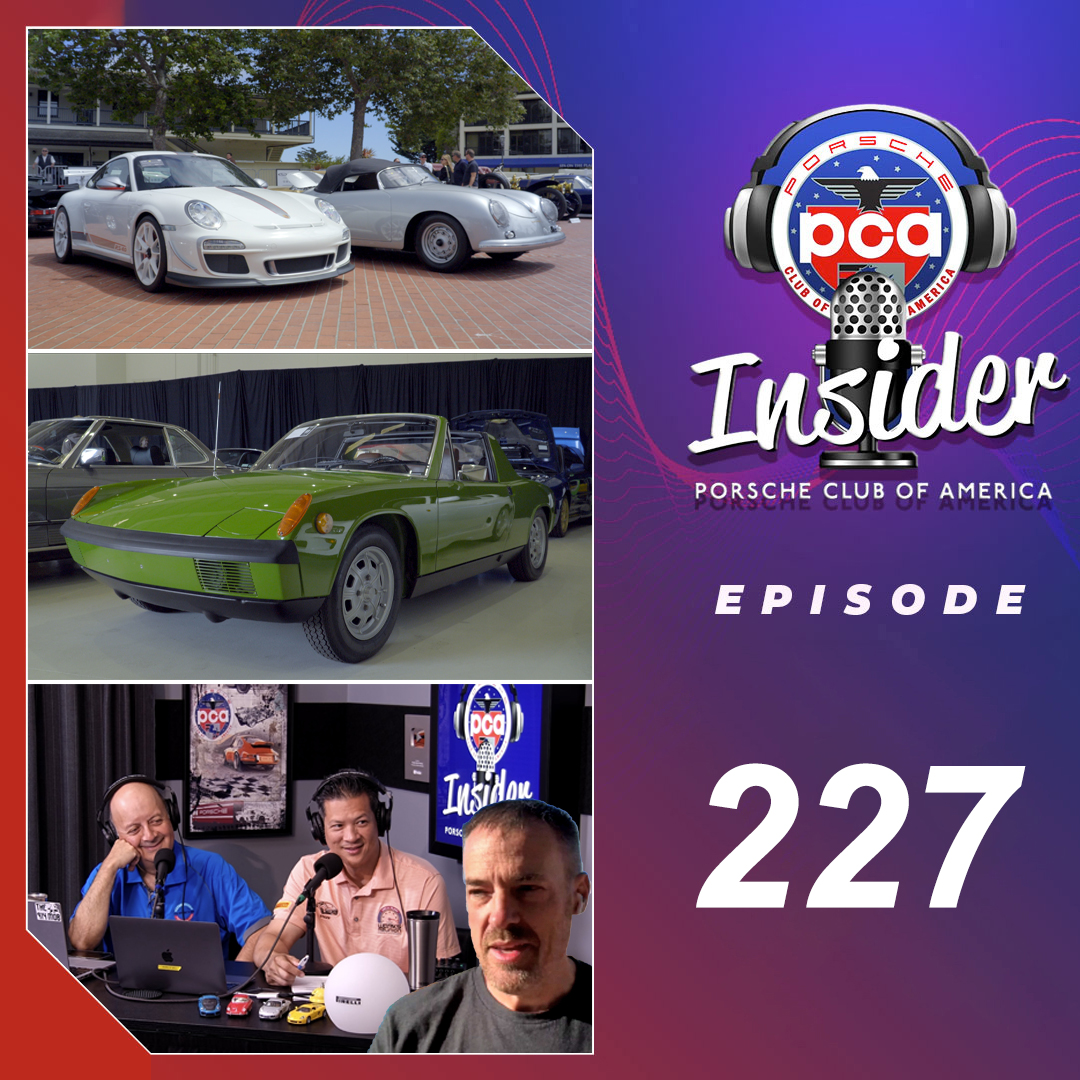
Welcome to the Porsche Club Insider, your one stop for all things Porsche and PCA.
Here's your host, Vu Gwin, and the Insider crew.
Hello everyone.
Today we're talking about matching numbers.
What does that actually mean?
Does it matter with the Porsche?
Before we go into it, I want to welcome everyone here to PCA's national office.
We have Manny Albin to my right, Damon Launey at the controls, and our fun-loving, he might
even be a little extra spicy on this topic, our PCA valuation expert, owner of Columbia
Valley luxury cars, Mr. Nathan Merz.
Welcome Nathan.
Good morning, and a happy post forth to my friends.
Before we get into it, I want to thank our presenting sponsor, Pirelli.
Pirelli tires have to achieve the highest levels of performance, safety, noiselessness,
and grip on the road surface.
Innovative tires that can satisfy even the most specific mobility needs of the end consumer.
I want to thank you all for listening.
If you aren't currently a PCA member and own a Porsche, what are you waiting for?
Be sure to grab that VIN, head over to PCA.org and make yourself a member.
For those of you that don't currently own a Porsche, check out our test drive program.
Again, you can join the test drive program at PCA.org.
See, I never think about what my shirt says when I wear it.
I do.
I see I.
I do.
I wear a Michelin shirt.
I do.
I know exactly when you say today is a podcast day, I wear the correct shirt.
I had a Michelin shirt on going to the Pirelli Walkham party, and then I told my wife,
I'm like, oh, crap, I got a better change because it's the Pirelli Walkham party.
I try to match up the sponsors with what the event is.
Speaking of the fourth year, happy belated fourth since we're recording this
to the Monday after July 4th.
You've got the flag flying behind you.
It's a real background.
It's not AI generated or it is.
I'm just sitting on my back patio and it's beautiful morning here.
Of course, I had to get up early to do this.
This is seven a.m. my time, but you're you're up at five in the morning.
I'm thinking you've run 25 miles already, at least.
You know, I didn't because you guys wrecked my run because I thought, well,
gosh, if I get up at five, stretch, go run, get showered.
I can't make it in time for this call.
So I'll blame you guys for my poor fitness.
How was your fourth, Manny?
Well, if I get up at five, it's to the bathroom and then back to bed again.
It was it was fun.
It was Damon and I went to a friend of ours who's a PCA member and has a house on
the water and we got to see fireworks and some good food and good friends.
Did you fireworks I've ever seen? Oh, wow.
Awesome. Did you guys get hit with that torrential rain at like seven o'clock or so?
Like it was going.
It was like like plastic all over the house.
He has like a wrap around porch.
So I went out front to watch the rain and when it started coming in sideways,
I came back and asked what I missed was behind the house where they had all the
chairs set up facing the water.
They had two easy ups.
And evidently, Damon was doing his best impression to hold these.
Oh, these easy ups down.
We had these easy ups and they were anchored down or anchored down and everything.
We took everything, the umbrellas, you know, other people took them down.
We left the tents up.
We thought, well, it's kind of going to miss us, you know, sort of maybe.
And it came through and it got really intense for about five minutes.
And it was enough to take flight or no.
Oh, yeah, they took flight and then they came back down and they all banter.
The easy ups are both broken.
Oh, they look like pretzels when I give it up to the party gods.
Yeah. Well, let's talk about matching numbers.
You know, when you're when you're buying a car, it seems like this is one
of the questions someone's already always asked, especially if it's an older car.
But where do we start with this?
What's the definition of matching numbers, first of all?
OK, it's a great question.
And so, of course, people in the Porsche world, I'd like to say that we aren't
particular, but we are.
And so people really like to get, you know, center a lot around originality.
So matching numbers, essentially, is this notion that the vehicle has its
originally installed engine and transmission as it left the factory.
So Porsche has always stamped both the engine and transmission
with a production number, if you will.
And generally, they recorded that so they could document, OK, this is the engine
that was built for this car.
This is the transmission that was built for this car.
And so the car that's numbers matching quite simply would have
its original engine and transmission installed in the car.
So early Porsches would have had these matching or these numbers identified
on what was called the card X, right? The the little it's almost like a card
catalog size file that the museum has.
And somehow you would get the ability to have it verified or get a copy
center, something like that.
But now today's they don't really do that anymore.
I don't think the Porsche or they call it the technical certificate.
They don't do that unless you take they don't just send it to you.
They have to verify it before they give you a copy.
Well, they have two different types of documentation they sell to you.
Now, everyone refers to a certificate of authenticity,
which they did for a long time, but they no longer do.
That's when that's when you used to be able to just like send your
then number and then they send you back this sheet of paper.
Yeah, first, if we get a no longer no longer available.
Yeah, because some people were saying, well, actually, my car had this option,
this option, this option.
And PCNA being PCNA said, OK, well, I had that on there.
And suddenly they had a document that said the car had all these options
that didn't come with originally.
So Porsche, the two things they'll verify
the VIN number, the color, I think maybe the production.
Have you seen? Have you seen that?
It's not called certificate of compliance.
It's I had on the screen.
The technical it's the less expensive option.
All you do is you mail the information out and they will send it back to you.
The other one is where the classical
the Porsche classic technical certificate is.
I think that's the one where they take your car and it has to be
at a Porsche classic dealer, not someone who sells classic parts,
because that's any dealer.
But for us, our closest one is Paul Miller, New Jersey.
So no one in Maryland is a class to be a classic as it be a classic dealer.
It's a separate dealership from the regular sale dealership.
And there they will inspect the car, put up on a lift, check
serial numbers, check what Nathan was just articulating, the engine transmission.
I think even now body parts are matching sometimes, right, Nathan? Yes.
Yes and no, it depends.
Can we can we back up to the very beginning and talk about the nemesis
or basically the start of how all this happened?
Sure, go ahead. We talk about that.
OK, back in the day when Porsche was a smaller company,
you actually could, you know, phone or usually send a letter to the factory
and you could say, you know, hey, I've got this, you know, 1961,
three to six B coupe, I love it.
And what can you tell me about it?
And oftentimes some very nice woman from Germany
would send you an actual letter back and just give you the information
because they like that you love the cars.
They did that program all the way through probably the 80s.
You could just, you know, email and email, gosh, send an actual letter
and they would respond back and that was great.
And that was pulled originally by like you talked about from the Cardax.
If you have the opportunity to go to the museum or the archive,
they actually it looks like you're back in your elementary school library
from the 1980s, if you're old enough to remember that.
And it just looks like an old card catalog with all the small little wood
drawers for the three by five cards.
And to this day, they still have all those three by five cards in those drawers
and you can pull them out and find the Cardax for your car if it's old enough.
The Cardax is stopped in about 1970, 1971.
But back then they used to give the information for free.
And then like Manny talked about, I don't know the exact date,
but it was sometime in the 80s, they came out with a certificate of authenticity.
And originally they didn't even charge for those.
That was just sort of, oh, we'll make it look a little nicer.
And then they charged a nominal amount for them.
And those really lasted all the way through the early 2000s.
And then I think one of the things that happened is that as the cars values went up,
there was more value in having a matching numbers car.
And so I think for the first time we started seeing some potential fraud
on more valuable cars, like an RS as an example,
because they used to give you the numbers.
And so essentially you created two problems.
One, if someone wanted to fake a matching numbers car,
now they knew what the numbers were supposed to be.
So they might be able to re-stamp as an example their engine case.
Because what you could do back in the day, there was a couple of possibilities.
One, if you ever had an engine replacement under warranty,
oftentimes you had an un-stamped block.
So someone could go and re-stamp a block because now they knew the number.
Or oftentimes you'll see them actually grind down the numbers
and re-stamp over the original numbers in the engine.
So at some point Porsche realized, hey, there's some liability for two reasons.
One, we've provided them the information.
And two, if you look at the original certificate of authenticity,
there could be some challenge where someone said, hey,
you know, Porsche says this car is authentic, but Porsche never saw the car.
They just mailed you a certificate.
So later on there was an interim step where they said, OK,
we won't necessarily provide the numbers unless you provide the numbers.
So like let's say Manny would send in for his car.
He would say, here's the numbers I have.
Porsche would compare that to their information.
And this was the craziest period.
If what Manny sent them was correct,
they would actually print on the certificate matching numbers.
And that only lasted for a very short period of time.
So someone pointed out, OK, this is really bad because now
you could tell some of the cars matching numbers when it wasn't even matching numbers.
It just happened to be Manny knew what his original number was.
So then that stopped.
And then for a while, they just stopped providing engine and transmission numbers.
And then the final iteration is what we have today, which is the both the
I think they call it the Porsche production production specifications.
That's the one you get for less money and it does not contain the numbers.
And then the Porsche Classic technical certificate.
You pay a boatload more money for you have to bring the car
to an actual Porsche Classic center and then they charge you money
and they provide that information if Porsche has it in the system.
So that's a little bit of the background of how we got to this place.
And it's a little bit of a dance of trying to satiate the customer
demand for having information about essentially how their car was born,
but also maybe protect the company from liability or concern about fraud.
So it's kind of a dance, if you will.
So it's an interesting situation.
It's also interesting because I was looking at the parade competition
rules for Concord, just as I was getting ready to judge this year.
And the weird one is we might have a situation where
like if someone doesn't have a historical COA
and they don't live anywhere near a classic dealer,
they may not have the information they need to compete in preservation
that might make things a little bit challenging.
So I think all of this really because we get calls all the time, right?
Many people are saying, so I have this car.
I want to check this, that and the other, especially they want to know
if it's like one of one or and such.
And the pure volume, like you said, back in the day,
they felt good, wanted to please the customer and was happy to do it for free.
And I'm sure writing letters was, you know, there was this hurdle.
You had to get over to actually ask for it.
So the volume probably wasn't that large now with, you know, the Internet
and sending emails, they probably get inundated with all these requests.
And frankly, they don't have that many resources to send someone into the archives
and then pull it all out.
And by the way, write everything down correctly.
Because as you said, it could be used for selling a car,
being putting the car into an auction.
And now what they wrote is that gospel and is their liability.
That's that's tough.
So members now don't call in to ask, what did my car come with originally?
Because there's so many Venn decoders and there's so much information
for the newer cars to find it out.
We get calls about is how many et in the blue
with a heritage interior with this option, this option did Porsche built.
We that's where we have to say the standard response is that
Porsche had that information, but they won't release it.
And we certainly don't have that information.
So, yeah, you may have a one on one car, but Porsche
won't isn't going to give you a letter.
Yeah, unless you know someone on the inside,
that might be willing to do that.
But I would doubt that they would put their job at risk.
But like the matching numbers.
I thought it was funny.
I thought it'd be a good topic to discuss was because
whenever someone doesn't have matching numbers,
it's almost like a scarlet letter and they would let you know
as soon as they see you that their car is not matching numbers.
So we'll be looking at an early 9-11 at 56
and the first thing they'll say is, well, it's not
that's not the original engine is not matching numbers.
It's a different replacement engine that we put in
and never even entered my mind.
You know, we're just enjoying looking at this this example they have.
And I thought, who who who actually checks this said it?
Yes, according to other than at the concor, you know, the cars and coffee
or show is anyone actually checking that it's
or really care that is matching numbers?
Well, I guess it's like a proud point for some people.
And if they don't have it, then they feel like they have to disclose it.
You're right, it's kind of funny, like, especially with my 59,
you know, they like the car, they don't like the car or whatever.
But they usually do.
Someone does ask, you know, is this the original engine?
Is it modified or whatever?
So then I go into the full story of about it.
But like older cars, it's not uncommon back in the day,
like a 60s, 356 had a motor for a couple of years,
and then it went, you know, bye bye and they replaced it with an equivalent engine.
So I guess like at what point does the matching engine
value and as far as enjoyment as as many will say, it doesn't matter.
Like you've got a good running engine, you got a good running engine.
But then I guess in the market, having the original case or let me ask you,
is it the case?
Is it all the parts of the engine?
Is like, like, what's the what's the varying degrees?
Like you can say, oh, yeah, it's got the numbers matching,
but you've got Weber, you know, big throat,
throttle bodies and all that kind of stuff.
So what's are you talking about?
Hundred percent original and when does it matter, Nathan?
It's a really good question.
I actually think this is a good topic, too, because it's changing
because the guard is changing.
So in a really 10,000 foot view, essentially the older the Porsche,
the more important or more of a talking point of view on the marketplace,
matching numbers are and generally the more valuable the car.
So I'll give you an example.
So is matching numbers valuable in a 100,000 mile 986 that we just did phone vent repair?
No, not valuable whatsoever.
You have a 57 Carrera Speedster.
That's all original matching numbers, highly, highly important.
So essentially the older and the more valuable, the more important it is.
But I think again, I think that's changing.
I mean, I think, you know, as the average buyer for some of the older Porsches turning over,
you know, does that 34 year old guy care that much about matching numbers on a 59A coupe that he has?
I don't think he cares as much.
So I think that's a little bit of that.
And again, it also depends on the car.
I mean, it's kind of like it reminds me years ago, we have a member who's no longer with us
anymore in the NPNWR.
And I always sort of got a chuckle because he'd always bring his 911 SC to an event
and he always had a handwritten cardboard sign that looked like a windshield banner
that he would stick up in the windshield.
And they always wrote in like huge black font, like all original paint.
Now mind you, when he walked up the car, being polite, I would call the car a 50 footer.
I mean, it had more chip than paint.
Well, there's some point at which, okay, it's original, but it's past the point of being,
you know, valuable to most people.
Same thing with original matching numbers.
Like you said, if, okay, if I have one case half that has the matching number on it,
but it's been completely modified into oblivion.
Well, I don't, I think you've now lost the plot.
Yeah.
So some of it really also depends on what, what you're trying to present the car as.
So if the car is, you know, go into an event and Monterey or it's going to parade and you're
want to show the car in restoration or preservation, it probably matters.
If you're going to take the car to your local cars and coffee, you're going to take it on
a drive, it's going to be modified.
It probably doesn't matter.
Now, I know we have the, what's the little red book that we produce that has, so.
All the serial numbers.
All the serial numbers.
So, and there's lots of decoders, as you said, online too.
You can, you can get within a range.
You can get, like I remember when I picked up my motor off of Craigslist and I ran the motor
number, I could tell that it was from that list, a motor from 1960.
So if that motor happened to be in a 1960, 356, like at least you would know the motors
of the right era, right?
Like that's easy and kind of free, but it's when you need to know, did that motor come
with that car?
That's when it's tougher.
You have to ask.
Yeah, I mean, a lot of people make some assumption that it's aligned with the VIN number.
There's, there's no correlation between VIN number, production number and engine number.
Those things are all independent of each other.
But to your point, let's say I have a 74, I don't know, U.S. Carrera.
I can go in there and I can decode, okay, I know what that engine number is going to
start with.
Then there'll be a type number and then the last four digits of that engine number are
just a sequential build number of the engines.
So I might not, for example, be able to say, oh, that's the original engine that came in
the 74 U.S. Carrera, but I could determine, hey, it is a correct 74 U.S. Carrera engine.
And then generally there is some loose correlation.
So if the VIN number on my car is, you know, 528 and the engine number is sequentially
413 or 622, it's, there's a probably better chance than not it's the original engine,
but I won't necessarily know.
So kind of on the matching numbers front, if I, you know, kind of your best cases,
you do have the matching numbers.
Your second best would be you have the correct type and model engine.
You know what's funny as we're talking about this?
I'm just, you were talking about younger folks and I'm looking over at Damon and his
eyes are literally glazing over.
Because do you even care about this, Damon?
I've got to admit, I'm like thinking about some texts and emails that I got a little bit.
I know you were.
I know you were.
I could tell from your look.
You're just like, oh, what are they talking about?
My mouth is open.
I'm the older I get, the more I do care.
I appreciate originality more because I've screwed enough cars up now to know that
like it's not just having matching numbers car.
It's about having that original feeling when you're behind the wheel more than,
you know, the matching numbers aspect.
And, and if I've learned anything, it's like you can buy, you know, OE style shocks,
let's say, for example, and buy them cheap or you can buy the OE shocks.
Yeah.
Yeah, one's better.
And that's, that's the tough balance, right?
Like there's so much technology and equipment that you can buy today to quote unquote,
modernize your car.
But then as Manny says, sometimes why are you doing that?
Like you lose, you lose the original feel of the car.
Like he could, he could change his two liter 914 to some crazy motor and go faster and
put bigger brakes and stuff like that.
But then he, and now I now appreciate it.
Like he appreciates the charm of how a two liter 73 should drive,
should shift, should brake, should lean over in turns.
Like that's what he doesn't want to give up.
And I think that's part of this original engine.
Yeah, it's preserving some of that, right?
Yeah.
I mean, the thing that's interesting, I mean, I, in full disclosure, people probably know this.
I'm kind of a fanatic about originality.
And, but not so much because I want to be the guy that blow hard at cars and coffee,
who tells everyone how great I am.
That ship has sailed.
You know, but the reason I like originality is in my experience, and I've driven
literally thousands of Porsches, there is a certain quality or an essence to how a Porsche
drives when it is the way it left the factory.
And the less it's kind of been manhandled and changed and improperly repaired and all that
over the years, generally it drives truer to its original vision.
And so I just like, like I would love driving Manny's car because my assumption is it drives
like it's 1973 all over again.
Like if I'm going to drive it, particularly a classic Porsche,
I don't need it to drive like 2026.
If I'm driving a 73, I want it to drive like 1973.
Otherwise, why am I driving it?
You want it to be, I always say, I want it to be like my time machine.
Like my older cars, I feel like I want it to drive from the era that the car is from.
But then you get behind the wheel of Damon's Cayman at an autocross and you're like,
Oh, you know, I get why people modify their cars.
Damon's just great at doing that.
But that's a modern car.
That's a modern car.
Even that, when you modify your car, you're expected to be able to perform at a certain
level, right? Because you modify the car versus if the best thing on the track
was when you got in a car and somebody walked up to you and say,
what have you done to your engine?
And you can look up straight in the face and go, it's 100% stock.
That's very satisfying.
Best feeling, you know.
I do have to say most people, I will say, think that I drive a Cayman S.
And whenever I tell them, oh, it's a base 2.7, their eyes sort of widen and like, oh, okay.
So anyway, modified cars for you.
Yeah. I mean, on the modification topic, I always want to be careful because I don't
want people to get the impression I don't like modifications.
One, I always tell people, make the car what you want.
And I actually love modifications on certain cars, but I also want them to be in character
with the car.
I'll give you an example like early cars.
Everyone knows I really, really like early 911s.
Really 70 to 73 is kind of a sweet spot for me.
And I have some original early cars.
I have some modified early cars, but I've had to learn actually through trial and error,
for example, years ago, I bought a 964 engine back when they were cheap
and had it rebuilt to a 3.8 and I shoved it into a 72.
And I literally thought the most epic Porsche on the planet would be an early 911
with a 3.8 liter, because of course that's about the limit of what you can put in an
air-cooled engine.
And I thought, why this possible car, biggest possible engine, that of course would be great.
And what I will tell you after having owned that car for a period of time is what I discovered
is, which feels so not okay to say, but it actually wasn't great.
It felt disjointed.
It was not cohesive.
And I couldn't figure out initially, I wasn't mature enough maybe to understand what I didn't
like about it, because the car went like hell.
I mean, it was like epically fast and wicked fun and crazy to drive sideways.
But something about it just felt off.
I couldn't put my finger on it at the time.
Yeah, I was like, it felt like it was two different types of cars.
It was Longhood 911 married to, I don't know, like an ill performing 993, like a bad mash-up
of the two.
And what I've later learned is the best early cars, if you want a hot rod or more like a
2.5 short stroke or a 2.8 MFI, something that's really levy.
Revy feels very light on its feet.
That feels, at least to my character, more what I want to drive for an early car.
Whereas, yeah, a 3.8 liter in a 993 or a 964 is great, but it kind of fits the car better.
I don't know how to explain that well.
Sure, because what you described is like a 2.8.
That's what the factory was putting in, right into the RSRs.
And so I always tend to look to see what did the factory do to make these cars faster.
And to your point, I remember when the 3.6 engines got really cheap and you saw what you did,
a lot of track guys did, and it was amazing to look on their face when their lap times
didn't improve that much.
Because once again, you think this monster engine, it's going to be wicked lap times,
but it wasn't because now that balance that had done so well with the 2.4 S they were running
was blown out because they didn't have the same balance with the 3.6 or 3.8.
Nathan, for the earlier cars, let's say pre-
let's just talk about air-cooled cars.
Of the air-cooled market, what would you say roughly is cars that do have matching numbers
versus cars out there that are not matching?
If you were a buyer, and second part of that question is,
how much determination should you have towards finding a car that has matching numbers versus
a deal that doesn't have it?
Yeah, so essentially from 1964 until 1998, that encompasses the whole array of air-cooled 9.11,
and essentially, you can basically assume the older the 9.11, the lower the likelihood that it
has its original engine, because the earlier engines both had two things. One, they didn't
have the same longevity. Porsche hadn't been building as long and hadn't kind of perfected them.
And there also were in a period of time where the cars were inexpensive enough and hobbyist
owned that it wasn't considered a big deal to kind of throw the original engine in the
dumpster and go something else. And so short wheelbase, long wheelbase, and mid-engine or
mid-year cars, so 64 to 77, very, very high percentage of those cars do not have their
original engines. Oftentimes, because they wanted to upgrade or the original engine failed,
and at that time it was cheaper to just buy a new used engine than it was to do the machine work
and rebuild. The other thing was, they were someone's everyday car. And so if you had your
68, 9.11, and I don't know, you dropped a valve or something, well, you needed the car to get to
work. You didn't have 12 weeks or someone to rebuild the engine. So oftentimes the shop owner
was like, oh, yeah, yeah, yeah, we had a wreck at the track. And there was this 72 that went off
track. He's got a 22 in it with Webbers. We'll just shove that in. Oh, sounds great. And they
shoved that engine in. The guy was like, oh, now I have a 22 with Webbers. It's a little bit faster.
Cool. I'm happy. He's happy. And then they literally, maybe they saved the block, but oftentimes
I remember there was a good friend of my name, Squire Tamasi. We ran a shop here in Seattle
for many, many years. And I remember going to his shop and I, this is a safe space, right? I can
admit this. I remember helping him lift 27 Now, of course, people hated two sevens in
period, literally taking entire two sevens with CIS and everything still attached and throwing
them in the dumpster because nobody wanted them because the cost to rebuild the engine exceeded
the value of the car. And so it's like, you just get tired of it sitting in the corner of the shop.
And it's like, well, we'll just throw it in the dumpster. So, you know, and then by time you get to
really the SC era, the motors become a lot more robust. And so the percentage of cars that have
the original engines gets higher, 32 even higher. And then 964 and in particular
993 I can't remember the last time I found a 993 that didn't have its
original engine. Because one, what were you going to upgrade it to? There was no factory upgrade.
And then there was generally no catastrophic failure mode for the 993 engine.
So, yeah, it's sort of an interesting one. Although I will say I think there might be an
uptick in 993 non matching numbers because I shouldn't say this out loud, but
there's an arbitrage play in the market right now where you can buy a 993 cabriolet
oftentimes for less than the value of the engine and transmission.
Oh, yeah. I believe it. Yeah. So I'm seeing guys literally by running and driving nine,
93 cabriolets and parting them out because the engine transmission is worth more
than they paid for the whole car, which is really sad. That's crazy. What kind of premiums would
people expect for those early cars if they do find a matching numbers vehicle?
Again, just like we talk about age, the biggest driver is how good is the rest of the car?
So for example, if you have a car that's really, really good, it's got original paint or a very,
very high quality respray and it's fully documented and the rest of the car is original,
then matching numbers makes a pretty big difference. But if the rest of the car has
got age and patina and use, which is just fine, then having the original engine doesn't really
move the needle a whole lot. And it matters more on how special the original car was.
So for example, if you have a true 901, the first couple hundred cars produced,
having its original engine is massive, massive. If you have a, you know, 68, 911L that's a color
change and had flares added to it, I don't think it really matters a whole lot.
Do you have people that reach out to you that they have a car that is non-matching
engine and transmission and they seek out to find, who do we know that actually found their
engine like on eBay or something like that? Like they, they, was it Bob Goodyear? Yeah. Yeah.
Yeah. Like that's got to be rare, but I'm sure there's people out there that has,
that know their engine number and probably Google it all the time.
Oh yeah. And they do searches and on the registry, they're constantly,
you'll see people looking for their matching engine. Yeah. And on essentially on both 356
registry and the early 911S registry, there is kind of these ongoing sticky threads where you
can put what your engine number is. And then oftentimes you say, Hey, I'm looking for engine
number XYZ. And it just sits there. And the good news is, you know, Google is basically,
you know, is that, you know, that's going to come up. And so maybe at some point,
someone has an engine case sitting there and they plug it in. And all of a sudden this,
you know, lifting you made in 2011 says, Oh, who's looking for the original engine for his 59
and somebody has it. So I would say it's unusual, but not crazy. With that said, I think on some
of these rare cars, I'm just going to call it like a, I think there's also some BS in the market.
There's a couple of well-known cars that magically found their original engines.
Seems a little convenient to me. How hard is it for someone to tell that that's
that's been doctored. It's not a match. It's the correct engine, but it's not the
correct number. You know, it depends on how good someone may work to make a fake.
Like I've seen some really awful fakes from like, yeah, that wouldn't convince anybody.
And then there are some that are so good that
your best case scenario would be, I mean, not that I'm encouraging and do not make a fake,
please, but your easiest case scenario would be if you had a factory blank case that was a correct
model for the car. Well, then you have a blank engine pad and those original numbers that were
stamped in the case were hand stamped in there. So they weren't stamped with a machine. I mean,
someone actually used a punch and punched those numbers in. So in fact, if anything, one of the
telltales of a fake is that the numbers are too perfect. So if you ever look at an original stamped
engine, it's not every number has the exact same depth or not perfectly straight because some
guy in the production line just put the numbers in with a stamp. So, but I've seen also where
people basically grind down that pad and then they have new numbers in. In those cases, if you
actually almost did like a like a metallurgical analysis, you could actually start seeing behind,
you know, what the old numbers were. So there's been some well known legal cases about this.
And again, this only matters on cars that are like high six-figure, seven-figure type cars.
No one's re-stamping the engine case review engine. I mean, maybe they are, but I doubt it.
So speaking of my Craigslist motor, did I do a disservice? Because I've never registered
my Craigslist motor on the 356 registry and perhaps someone is looking for that motor,
but I turned it into a 1720. Like, did I just mess it up for somebody? I didn't even think about that.
No, I mean, the odds that the car that that originally belonged into is still out there
and still alone by someone who's searching for it is, you know, one in a million.
You're afraid that they're going to come back in that one?
No, because if I ever did find or if someone ever did come to me say that is the motor for
my car, like I would give it up. Like I feel like it should belong with the original car,
but then because it was an extra motor for me, I didn't think about it that way. And I'm like,
when we had it rebuilt, I turned it into a 1720 for a little bit more power and blah,
blah, blah, blah, but it's not really original original, which may have mattered to the person
that has the car that it goes to. Yeah. Well, I mean, a case in point, like my 7911T,
the one I feature in my, my driving early 9-11 video where I compared three different power
types. And that car is, you know, I built the car to be what I wanted it to be. And so it's
got a later Motronic 32 because it's a driver. Well, funny enough, I actually know where my
original engine is. It's still sitting at the shop who did the original, some of the original
mechanical work on the car 25 years ago, and the shop owners are a friend of mine. And he says,
do you want your original engine? And I said, well, maybe, well, he wants, and I don't, I don't
beef him about this. He wants $2,500 for the case. It's just the, basically the case halves.
And I'm thinking, well, for $2,500, then I got to store something in my basement
that I'll never, ever put back in the car. And the car has been modified enough in other areas that,
okay, it might be interesting. So if you wanted to give me the engine, fine, I'll take it. But
to pay $2,500 to put it in the box to say to someone 20 years down the road when I'm damn near
dead, I think I'm going to call you out on this one for $2,500. I'm going to call you out on this
for $2,500 for you to have the original case in your, in your basement or whatever. I think you'd
do it. I haven't done it. I've been offered it. So in fact, if you're so good, I'm going to call
your bluff here. My, my Venmo, Nathan, a period mirrors at gmail.com. I think you know, it's not
going anywhere and it's being stored for free as of this moment. That's why you're fine with it
just sitting there. But the moment that he might move or that motor might go somewhere, I have a
feeling you'd stuff it in your basement. I'm just saying basically you're saying if I was Nathan,
I would already have that engine in my house. A hundred percent. All right.
Let me, let me ask you this. Let me throw it. So, so the, my original 59 motor that I took out,
right? Honestly, I don't know if it's original, original or not, but let's say it is. Let's say
it is still a 1600 s motor. I want to rebuild it and put it on the shelf for a future. Should I
restore it to 1600 s as is or should I go to 1720 like I did in my current motor?
So what I think is if I'm going to rebuild an engine, I generally will make any period correct
improvements that could be made without having to make any external visual modifications. So for
example, in the case of that engine, I can make it a 1720 and dress it like it's all original.
So I'm going to pick up a little bit of power. It doesn't cost me any more money.
So why would I not? Now, if I have to make it an irreversible change to do that or I have to
modify the car so it doesn't appear externally correct, then that's generally where I'll stop.
So that's an example. If I have a 73 s and I'm rebuilding the engine and I get it by new pistons
and cylinders, why would I not buy 2.7 liter RS pistons and cylinders? They're the same cost.
Why would I not do that? Why not make it a 210 horsepower motor versus a 180 or a 190 for the
same cost and no one can tell? I mean, not everyone would agree with that perspective,
but that's how I view it. What do you think, Manny? Would you leave 100% stock or would you?
I would go 100% stock mainly because you already have a 1776 engine. So why? I wouldn't understand
why you would want two 1776 when you have one. Just because that's what he said is to rebuild it
into a 1720. Yeah, but it's going to sit there because you have another one you just rebuild.
I know. I know. So when you sell the car, you can say this is 100% original stock.
That's kind of what I was leaning towards is keeping it like if it is still stock, because
honestly, I don't even know if my motor was rebuilt bigger or not because right now driving the two
back to back, I haven't seen that much of a power difference. So I'm suspecting that my original
engine was maybe bumped up at some point. I don't know that for sure until we take it apart.
But yeah, I was thinking because this motor will probably sit on the shelf and be for the next owner,
like just leave it as stock as possible. And then if they want to upgrade it later,
technology will be different 20 years from now. Or maybe not. It might be the same.
But all I know is the nice thing about having this other motor in my car is like,
I'm not going to mess up their original block. Like I can't grenade it, right?
So at least I'm doing my part in preserving that part of the engine.
Yeah. Real quick, let's talk because everyone talks engine, but the other part of matching
numbers is transmission. Transmission, yes. Now I find this to be a bigger question because
or at least I get this question more often because oftentimes someone will say, oh,
it's matching numbers. And then a client or whoever I'm talking to will say, oh, well,
how about the transmission? Transmissions are interesting because particularly on the earliest
9-11s, Porsche put the transmission number on the very bottom of the case, which is actually
the very lowest point on the car. So if that car has ever run aground, the very first place that
gets scrubbed is the bottom of the transmission. So I actually run into a decent number of cars
where the transmission number is actually completely ground off or partially illegible.
And that's kind of a tricky one. The other thing is, I always tell people
that matching numbers engine is the gold standard. The transmission is kind of like the cherry on
top, but people are still happy if it's matching numbers engine. The transmission,
you know, maybe it makes a slight difference, but it's way less valuable than a matching numbers
engine. So sort of an interesting one. Can I go off on a tangent because I know
we're talking about matching numbers, but especially with the early cars,
what about mileage? Like how much mileage on like, how do you verify like my 59 shows 22,000
miles? And I don't know if that's 122, 222, 322, nor do I really care, but I think somebody that's
buying an investment car, like how do you, I guess you just have to have records.
You must not watch Nathan Merz's presentations like I do because I know what Nathan says about this.
Okay. What do I say, man? Be me. Be about looking me.
These odometers fail constantly. Yeah.
Unless they have records, don't take the mileage on the odometer as as factual and look at the car
itself. Look at the indicators that would tell you whether this is a 20,000 mile car or 200,000
mile car. And as someone who's owned 944s, 914s, 911s, those odometers back then were crap.
Yeah. When they got old, yeah. And you know, one of the main things that you check for that,
and it's, this is also learned from one of Nathan Merz's videos back in the day,
is you look at the pedals. Isn't that right, Nathan? The war, the wearing of the paddles is a very
good. Yeah. I mean, the way I always look at mileage is the word I use is bellwether. So the
condition of the car should be a, the mileage would be a bellwether for that. So sometimes
you'll run into someone and say, oh, you know, my 326 has, you know, 42,000 original miles.
And you look at the car and it looks like hell. It's like, well, okay. But the reason most people
prize a little mileage is there's some assumption that the quality of the car matches said odometer.
And so if it's disconnected, even if that 42 were true, which it likely isn't,
then it really is immaterial. So, but yeah, I always like to look at both the pedals and the
early 911s had a rubber format as did the 356. So I don't want to call anyone out, but there was
a well-known person who rhymes with Bain Spamini, who was selling an early 911.
And this early 911 was at an auction sale in Scottsdale, probably 10 years ago.
And it was a purported 5,000 mile. I think it was an early 911T. And two things that caught my
attention. One, it was a complete respray. I'm like, why would it need a respray at 5,000 miles?
And then if you looked at the rubber format underneath the gas pedal,
it was completely worn completely through the rubber pad, the heel pad.
Can't do that in 5,000. I'm like, maybe someone wore stilettos. It was,
you know, she was an entertainer or something. I have no idea. But I was laughing because the
story that was told was the car was repainted because the original owner was very particular.
And when his daughter was a teenager, he was out of town and she let her boyfriend drive the car
and the car got scratched. And so she had to get it repainted before he got home, so he wouldn't know.
At the finest paint shop, I'm sure. Yeah. I'm like, yeah, that's stories.
It sounds like a good bar top story when you've had about six drinks, but otherwise it doesn't
hold water. So yeah, early cars, one of the things I love about 356 and early 911 is that I would
make the argument that mileage is absolutely immaterial on 98% of the cars. The only exception
to that would be if you have an early car where you can definitively prove the mileage. Like,
as in it's a very low ownership history and you have everything from its very first oil change
all the way through current service, unbroken through time. Okay, fine. 98% of the cars, that's
not true. And so to your car, if it shows 22, it doesn't matter. It doesn't matter. I don't care.
All people are going to judge the car on is, how is the car today?
There's a meat standard today. I'm happy with it. Many judges, my car on many other things.
Yeah, it's still the stuff you do to it, not because of the car itself. The car is innocent.
Yeah, the car is innocent. Well, thank you so much like that. You know, magic numbers we talk
about a lot, but I don't think we've ever had an in-depth discussion on it.
Before we switch to the news, I think it is interesting on the other end of the spectrum,
after like the Boxster came in 996, non-original engines didn't seem to matter at all. In fact,
when people ask me what your box you have, I always say it's an 05 Boxer S with the 06 engine.
Yeah, right. Because the 06 had the bigger, so instead of like being a Scarlett letter,
it's the opposite exactly that you're saying, Hey, this has a little bit better bearing on it. So
that engine is going to last longer. And I don't, I don't, I've never had a member call up to say,
they've said, if the engine is being rebuilt, should I worry? Yeah. And I go with 130,000 miles,
no. I said, something could have happened. I said, you're getting a fresh engine. Well,
I would, or they say, well, the engine was replaced by a dealer, a certain part of them,
like that's even better. That means you're getting a, the chassis may have this many miles,
but your engine only had this many miles. So, you know, where that's also another example of that
is what year GT3, where they had like the pin? That's a 14. Yeah. The 2014 and 15 GT3. Yeah. So
people, people talk, people talk up like, Oh yeah, I've got the engine that was replaced and it's
got warranty. And so it's a pro as opposed to a con. Speaking of that, before we run out of time,
because we're going to run out of time, we do need to do another segment on engine rebuilds.
Oh gosh. Let's do a topic on that. Oh man. Yeah. And what does that mean? Yeah.
What does it mean and how it can go terribly wrong? Yeah. And then the other thing I want to
talk about is one about, we touched on it real beefy, but the C of A, at the 10,000 foot view,
but this could be a whole other topic would be the inaccuracies of the C of A and all the urban
legends around stuff. Cause I get people all the time, oh, my car came equipped with this or that.
And I'm like, no, it says it on the C of A or Oh, I used a Vindicoder. That makes it true. No,
it doesn't. Yeah. And people forget that, you know, the whole topic about that in the 50s,
60s and 70s data management was not as precise as it is today. And things were handwritten and
things were written in the middle of the day or in the evenings. And depending on the shift,
it was not as accurate. Well, my nine 14, like to Nathan's point earlier when he was saying that
you would have to get Porsche information and then they would type it up in this nice little
birth certificate called the C of A. I was really, really hoping that they would call mine the nine
14 S because they were calling it that the dealers were calling it that Porsche wasn't,
but I have the original sales sheet when the owner put it in and it was listed as a nine
14 S. Oh, he even bought match from the dealer, custom match that said nine 14 S on it.
It's almost thinking somebody at PCNA, hopefully it's not an enthusiast,
and it will simply type in nine 14 S. Nine 14 S certificate, but no, they did not.
Yeah. Well, that's actually one of the common problems because one of the things Porsche did
over the years too is they, they use the same option codes on many different models. And so
sometimes, for example, someone will come to me and say, Oh my God, my nine and three was delivered
with 19 inch wheels. No, no, no, no. That's simply because they use the same option code for the
upgraded wheels on the nine and three as they did, for example, on the nine and seven and
someone in Atlanta base goes, Oh, I remember I did one last week and that's what this
code means. And then I wrote that on there. No, wrong. It was just a typo. So that could be a
tie right there. You may not want me. So you weren't, you weren't that spicy today. I was
expecting to more spiciness. You were actually pretty calm day. I was being, I was being polite.
It's so nice out. I was going to say, it's a surrounding. It's a surrounding.
The calming effect of that water, just, you know, going side to side. So yeah.
I have to get them to call in from the Bronx or Queens or something and then they'll be all busy.
All right. Well, I remind everyone to head over to PCA.org to sign up for our newsletters,
performance news, e-brake news and mart fresh, of course, all free. We have two Porsche news items.
The first one is not so happy news. It has to deal with low sales, decreased profit,
and specifically in China. The closing dealers, obviously, that's not
a, they're going to go, I think, from 116 to 80 dealers. So they're closing four right away.
I would be surprised to go below 80 as well. Yeah. You know, they're simply not selling
the product that they thought they were going to sell. And that headline is a little misleading.
It says closing dealers and it kind of almost suggests that they're closing all dealers, but
they're working towards, I think, it looks like 80 dealers in China. They're leaning up.
Yeah. And I think that has to do with the second news item is what's the strategy and
what's the plan and leaner and future proof. They're redoing their supply chain network,
which I applaud them. And I hopefully, you would have thought they would have learned during COVID
that relying on Chinese suppliers can be tempting because of the amount of money you say,
but also it's got to be a nightmare scenario when the supply chain fails you. And I think Porsche,
at least though, the new CEO has realized that that's not a long-term feasible thing they can do.
So they're looking at moving out of the Chinese market, 100% reliant on a lot of it and having
vendors outside that are going to be a little bit more reliable and, you know, geopolitical changes
happen. They're not stuck like they were during the pandemic.
Yeah. And amidst all of this, deciding what their future lineup is going to be,
they've got the Cayenne EV that's coming out that you talked about at Parade.
You know, that's incredible car, but will the market love it? What's going to be the
Boxters and Caymans and what's the next 9-11? Oh, and by the way, we're kind of
in the cycle of, shouldn't we be seeing the GT2 RS here shortly? And will that come out?
Like, do they have time to do that? Like, I have so many questions.
You would hope so. I mean, they haven't really come out with any two doors.
And around the world, they've had some special edition models, but nothing that
the average consumer can put. Like, are we on the cycle now? Like, it should be
some serious hardware should be coming out. Like I said, the GT2 RS people have been waiting
because they want to find out what the platform will it be. Will it be simply bigger turbos and
minor tweaks? Or would there be a hybrid integration into it? A lot of people are wondering.
If it doesn't have hybrid, I would be blown away. Yeah. And then the question that,
so Peter Chen, my friend, right? Who, he came over this weekend and he goes,
Vue, you know, people make fun of me because you make fun of me on the insider so much.
And I said, Peter, it's all in good faith. He's like, it's not my fault.
If I go, oh my God, there really is a Peter Chen. There really is a Peter Chen,
but his question is, I think relevant to what we're just talking about is,
Nathan, what do you think? If the GT2 RS comes out as a hybrid platform, what will happen to
the latest iteration that Peter Chen has, the GT2, that's the turbo 700 horsepower monster
that is not hybrid? Like, in my mind, I think, man, that just means his car is going to continue
to go up and he'll have to continue to pay more for insurance. Yeah. I mean, I think ultimately,
you know, the GT2 RS is the technological flagship for performance anyway. So,
I think the hybrid platform ultimately is proven to be an absolute game changer for
performance. So, to Manny's point, I'd be shocked if they don't come out with it.
Because you'd be seeding a huge potential performance advantage and improvement if you
don't go that direction. And what people want to make a lot of noise, it kind of reminds me
on a more minor level. Remember back when they did away with hydraulic steering and everyone's
like, oh my God, it's the end of the world. Oh, it's like driving a Cadillac from the 80s. I'm
like, shut your piehole. That's not true. Porsche has done an epic job. And so, yes, there'll be
these enthusiasts, but we always are this way. Oh, this is the last car with the what? This is the
last car. At the end of the day, time marches on, things get more technologically advanced. Now,
each person can decide where in the curve they want to live and exist and drive. That's fine.
I'm a curmudgeon. I'm stuck in the past. But I also appreciate the march of performance and
technology over time. And so, I think it'll be hybrid based. I think it'll do just fine because
the other thing is the person who's buying the GT2, let's be honest, there's only two buyers
for that car. One, the guy who wants the bragging right that he's got the newest,
latest, greatest, fastest, hardest to get car. Okay. There's that person. And then there's the
person who will, in some capacity, wants to fully exploit the performance envelope of this car.
That's my favorite buyer for the car. And they'll look at and go, at the end of the day,
where rubber meets the road, the fastest car with the best performance wins. And so, I think it
succeeds on that level. And all the noise will come from people that frankly aren't buying the car
anyway. Right. I'm not buying the car. So, what's the market care if I complain about it? Nothing.
Nothing. And is there any cheap GT2s out there? I mean, you think about the lineup? Nope. I'm
still waiting for the 996 GT2 to come down in price, but it has never come down.
Well, actually, they were pretty inexpensive for a long time. I mean, in a relative scheme,
it used to be at the bottom, you could buy a 996 GT2 for about 100 grand.
Oh, 100. Yeah. I mean, for one that'd been kind of attractive. So, I can see your face.
That's not cheap. 100 grand. I mean, not that 100 is cheap, but it was cheap,
relative to what the car offered, I think. So, of course, they're no longer there.
All right. Let me remind you of a few events that are coming up. Of course, we will be
at Monterey Car Week, August 14th, Workshare Union Monterey. Judge's area has been sold,
or Judge's area has been sold. We still have Corral Spots open. We have a lot of folks coming out
exhibitors and sponsors. It's going to be a full packed house. We have some really cool displays.
I can't really say from whom, but it'll be very Instagram-worthy. So, make sure you head out
to Workshare Union Monterey. Unstock, we've mentioned before, very unique setting. We're
going to be on the Huntington Beach Pier, never before a slew of cars that will be on the pier.
Only VW buses have been on the pier in the past. So, we're looking forward to that.
That event is November 8th, registration opens September 2nd. Traffinette C, 2026,
the Pacific Wine Country Cruise will be sailing out September 19th through 25th. Nathan and I
will be on board as well as a host of other speakers. No Manny? Donald Osborne. No, I won't
be on that cruise. Yeah. I'm not going that. If Manny's not going, it's happening. I know.
It's not that he doesn't want to go, but he's got some things to take care of, and he doesn't want
to roll the dice. We'll cut him some slack. We'll cut him some slack. We will certainly miss him,
but yeah. Wish you were coming. Open House, September 12th, registration will open.
PCA Open House here in Maryland, July 29th through 26th. We have been promised a,
was it? What kind? Oktoberfest theme, but... I'll miss Oktoberfest. But no alcohol. We won't be
serving alcohol, but it'll be fun. Should be fun. So, hopefully you come out and register for that.
Videos. Damon. Yes, so videos. We got some good stuff coming up, but also just released. So,
if you are watching on YouTube, I'll take down this here. We have a Nathan Merz video, and this
one is from the Tech Tactics East presentation. And what you're seeing here is what the whole video
is about. Cars with smoke billowing out of the back. No, that was actually just the intro,
but Nathan goes through setting your expectations to avoid getting ripped off in a nutshell. That's
what this presentation is about. We also have something, another presentation from Tech Tactics
East that was just released. And this one is by Vance Fenson, who is the PCA Club Racing
Marketing Manager. And if you are a nut about driving faster, whether on a racetrack or an
autocross like me, you owe it to yourself to watch this video. And he explores all sorts of
techniques to utilize telemetry data from your car, which I'll go a little bit
further in this presentation, but to utilize telemetry to see what your car is doing and what
your input are doing and to make yourself go faster. So, it's pretty cheap nowadays to get a GPS
with accelerometers and hook it up to, usually it's an Android based operating system on a
pad or a phone and you can get your own data. You don't have to have a super expensive setup.
So, those are the two most recent ones. I'm hard at work today for the rest of the day to finish,
start and finish the 914 guide. So, we'll see if it actually comes out tomorrow.
Oh my God. Hopefully it's straightforward, but it might be one of those late nights for me.
But take a look out on that as well. All right. I want to remind you if you want to go
SimRacing with other PCA folks, check out PCASimRacing.com. If you want some insider swag
at the PCAwebstore.org, you can get bottles, mugs and t-shirts. If you're looking for a PCA Insider
decal, just send us your physical address information to podcast at PCA.org and we'll send you a set.
And we are at the top of the hour, just like that. Anything else, John?
It was a great time. I enjoyed and I, and I say not too punchy. So next time.
Not too punchy. I was expecting a punchy or anything, but you know, you, you seemed relaxed
today, but we will come up with another topic and perhaps you will get to shine in a more punchy
or fashion. Okay. Sounds good. All right, folks. Well, thank you for listening. Be sure to like,
comment and subscribe. Consider sharing our show with fellow Porsche enthusiasts.
Until next time, stay safe and we'll catch you down the road. Thanks, Nathan. Thanks, Nathan.
Thanks.
About this episode
Matching numbers come up constantly in Porsche buying and judging, but the episode digs into what they actually mean: the car leaving the factory with its originally installed engine and transmission, and how Porsche verifies details via VIN/build records and inspections. They also cover why documentation can be incomplete or inaccurate, how matching numbers can affect value and disclosure, and why mileage claims often need records. Practical guidance ties it together—when originality matters, and when it doesn’t.
Porsche expert Nathan Merz returns to the podcast to break down the complexities of matching numbers, factory documentation, and how mileage impacts your car's market worth. We also dive into the latest Porsche news, PCA videos, and upcoming events!