Elevation just means the track goes up and down. That changes how the car feels in corners—especially braking and grip—because gravity is helping or fighting you depending on whether you’re going uphill or downhill.
“Spa” is a famous Formula 1 track in Belgium. People love it because the road rises and falls a lot, which makes the corners feel different and more exciting.
A street circuit is a race track made from normal city streets. It usually has tighter turns and lots of walls close to the track, so it can feel more cramped and less flowing than a dedicated race track.
The pit lane is the special lane where cars go to change tires and make adjustments during a race. It has rules and speed limits, and where it connects back to the track can change how much time you lose.
A chicane is a section where the track forces you to make quick, tight turns back and forth to slow the car down. If the pit lane exit is near one, it can be hard to merge back safely and quickly.
A 90-degree corner is a very sharp turn, like turning a corner at a right angle. Cars usually need to slow down a lot for it, so it can affect how quickly you can get back up to speed after the pit lane.
A “speed profile” is just the plan for how fast you go at each point of a corner. It matters because different speeds change how hard the tires work and how stable the car feels.
“Dirty air” means the air behind another car is messy instead of smooth. That can make the following car feel less planted to the road, so it’s harder to drive close behind.
Person
Carlos
The host mentions “Carlos” as the source of an idea about getting cleaner air. The segment doesn’t say which Carlos, so it’s unclear exactly who it is.
A “braking zone” is the part of the track where you slow down for a turn. How you use it can change how stable the car feels and whether you can pass or just set up the next corner.
“Clean air” is air that isn’t messed up by the car in front. When you have clean air, the front of your car grips better, which helps you follow the best line and set up the next corner.
The front wing is the big wing at the front of the F1 car. It helps push the car down onto the track so the tires can grip better when turning.
Term
super clipping corner
A “super clipping corner” is a corner where you have to be extremely precise to get through efficiently. If you can’t carry speed, it can turn what should be a fast section into something slower and more difficult.
“Flat out” means you’re going as fast as possible through the corner, with the throttle wide open. In qualifying, doing that can save a lot of time—if the car has enough grip.
“S’s” refers to a sequence of alternating left-right (or right-left) corners that form an S-shaped pattern. These corner sequences test how well the car can stay balanced while changing direction repeatedly, which matters for tire usage and for where you can deploy hybrid power.
In F1, the “battery” is part of the hybrid system that stores extra energy. Drivers and teams decide when to use it for acceleration and when to save it, because it changes how strong the car feels in different corners.
“Harvest” means the car recovers energy instead of wasting it. For example, when you slow down, the hybrid system can put some of that energy back into the battery for later.
G forces are how hard the car is accelerating or turning, measured compared to gravity. In fast corners, the driver feels a lot of sideways force, and the tires have to handle it too.
A megajoule is a unit for energy. When they talk about “eight megajoules,” they mean there’s a limited amount of energy available in that part of the lap, which influences how the drivers manage power.
An “energy rich” track is one where the car can use its available energy in a lot of places. That can make power management and energy recovery matter more for speed and strategy.
“Overtakes” just means passing another car. Where and how often it happens depends on the track layout—especially braking and where you can get close enough to attack.
Place
La Monumentale
La Monumentale is a specific named part of the Monza track. Saying “coming down from La Monumentale” means the cars are leaving one key section and then approaching the next important braking/turning area.
A crest is the top of a hill on the race track. As the car goes over it and starts down, the car’s grip and balance can change because the suspension is moving differently.
Term
inclination of the asphalt
This means how steep the track is at that spot. If the road slopes up or down, the car’s weight shifts and the tires can grip differently.
Topic
Rouge
“Rouge” is the name of a famous corner known for being dramatic. The key point is that the track’s up-and-down shape makes the cars’ movement really visible, so it’s more exciting to watch.
Topic
Radeon
“Radeon” sounds like it might be a mis-heard corner name. The important part is that the host is comparing two named corners and talking about what makes them iconic to watch.
Compression means the suspension is being pushed down. When that happens, the tires can grip differently and the car can feel more stable or less stable depending on the situation.
The racing line is the path the driver chooses through a corner. “At the top” means near the highest point of the track feature, where the car’s balance can be tricky, so getting it slightly wrong shows up quickly.
Term
second or third gear corner
That phrase means the corner is driven at a speed where the car stays in lower gears. Lower gears can make the car harder to manage if you don’t get the braking and throttle timing exactly right.
Curbs are the raised strips of pavement at the edge of the track. Racers sometimes drive over them to take a tighter line, but if the curbs are rough or too aggressive, it can make the car harder to control and force you to slow down.
A car’s gear affects how fast it can go and how much it slows down for a turn. If a driver can stay in something like fourth or fifth gear, it usually means the corner can be taken quickly without dropping to much lower gears.
“Grip” is how much traction the tires have on the track, and it strongly changes braking, cornering, and how confidently drivers can use curbs. A real circuit’s grip can differ from what a simulator or game predicts, so the same line can be dramatically faster or slower in reality.
A simulator is a high-tech training setup that lets drivers practice a track virtually. It helps them understand how the car will behave before they drive it for real.
These are races run on city streets instead of a dedicated race track. Because the track is tighter and surrounded by walls, it can be harder to pass and easier to make a costly mistake.
Overtaking opportunities are the places on a race track where drivers can realistically pass. Good tracks give you more chances to make a move instead of just following the car ahead.
“Spectacular corners” are turns that look and feel exciting—often because they’re fast, tricky, or have big changes in the track. They’re the kind of corners that make good TV and test driver ability.
A blind apex is a turn where you can’t really see the exact “turning point” until you’re already committed. That makes it harder because you have to guess the corner’s shape and where to aim.
Singapore is referenced as an example of a track that can feel more like normal roads than like the most dramatic racing layouts. The speaker is contrasting it with circuits that have more challenging, exciting corner features.
Sochi is brought up as an example of a track that doesn’t necessarily have the most exciting corner mix. The speaker is using it to make a point about what makes a circuit feel special.
Valencia is mentioned as an example of a track that doesn’t always deliver the most exciting corner characteristics. The point is more about how the track layout affects racing than about the city itself.
Monaco is mentioned as the special case among city street tracks. Even though it’s hard to pass there, it still has very famous corners that make the race feel unique.
In F1, “strategy” is the team’s plan for things like when to pit and when to change tyres. The goal is to get the best track position while managing tyre wear.
In F1, teams pick which type of tyre to run and when to change them. Softer tyres usually grip more but wear out faster, so the timing affects speed and race strategy.
The “asphalt surface” is the actual condition of the track pavement. It affects how much grip the tyres get and how consistent the car feels, which can change race strategy and excitement.
Concept
place of zero overtaking
A “place of zero overtaking” means a track where it’s basically impossible to pass. The speaker is saying this circuit shouldn’t be like that.
LIVE
The Athletic
The race is on, and with the renamed Barcelona Catalina race in the rearview mirror, we're
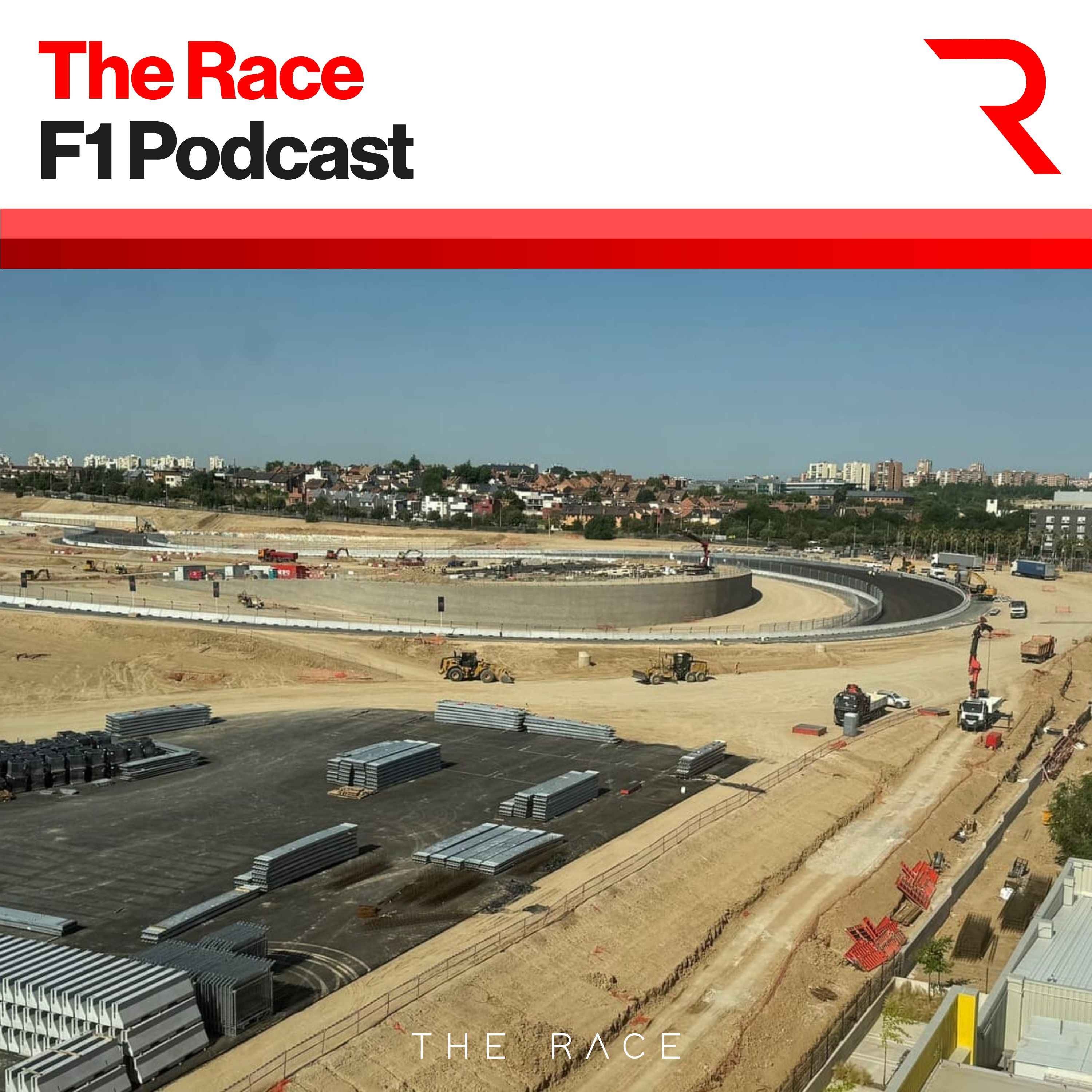
visiting F1's newest track, the Madring, which takes over the Spanish Grand Prix in September.
But is the circuit any good?
And is the Banquem monumental corner going to be great?
Or just a gimmick?
I'm Ed Struer and joining me on location are John Noble and Diego Mejia.
Well, Diego, welcome back.
We haven't done a podcast for too long, but you were loitering around the area and you
seemed ideal because unlike us who didn't see this track for the first time until yesterday,
you've seen it quite regularly.
You've seen it evolve.
Yeah, thanks for the invite, Ed and John.
It's great to be with you guys again.
As you will say, I live in Madrid, I've been based here for a few years, so I came for
the first time to Ifema, this place, this expo place when they brought the F1 X position
that's going around the world.
That's the first thing that they did here way before there was serious talk about having
a Grand Prix here.
And it's been like 74 weeks, like less than 600 days since the first stone was placed
until now, I mean, until the Grand Prix day, basically, so it's a very short time frame.
It has gone by very quickly.
They've had many challenges, especially the weather.
There's been a lot of rainfall in the early part of the year, at the end of last year
as well, and that has put back a lot of the work, especially on the racetrack.
And as you could see, there's still plenty of work to be done around the track, but it
looks now like a racetrack.
Yeah, lots to be done, John, but it's pretty impressive, isn't it?
It's always good to come to a track like this, and the reason we've come straight after the
Spanish, the Barcelona, the Catalina, Barcelona Grand Prix, Barcelona, Catalina, terrible
name.
Anyway, it's all about the Spanish Grand Prix, but it makes sense for us to come because
we're three months out.
So it's a good chance to see F1's newest circuit and get a real taste of the place.
Yeah, I think it's very, very difficult to get a proper judgment of a circuit, just looking
at the track map and watching some computer simulations.
The first one was awful.
Even the driver was awful.
So you can't really understand the dynamics of the corners, what's it going to look like.
I think one of the core elements, I think, of a good racetrack has always been elevation.
Some of the greatest circuits, some of the greatest corners have all got elevation.
It just adds a dynamic to a race circuit.
You can't see from a track map, and I was surprised here, actually, how much elevation
there is when you, the first section, when you climb to the top of the hill, up to turn
eight and turn nine, it's going to be a spectacular corner for it, drops down into the back section.
It's very high, beautiful way of looking into the distance, and it's the kind of view
that somewhere like Spa, you go, wow, that's amazing, all this big elevation.
So yeah, I mean, it's not every corner is fantastic.
There are some elements, especially around here, that are much more modern street circuit,
90 degree corners, concrete barriers and straight lines, but the bits they've been able to kind
of do themselves and have some design ideas into it are pretty interesting.
Yeah, the part of the track we're in now, it's the south part.
This is the ephemeral exhibition centre and everything.
And perhaps, Diego, you can give us a bit of a sense of what this place is, because the
north ends all the new parts of the track, the bespoke part, the fan part, this is the
existing infrastructure.
So what is Ephema?
Yeah, it's like the expo place where Formula E races in London, basically, it's the same
kind of place.
It has been having its expositions and all its usual events while the circuit has been
constructed and that has been one of the main challenges for them to be building everything
for the track and still having the normal activity, because this is state-owned, so it
has to keep going and yeah, it's been a challenge to get all the work to the exact deadlines
having all these events around for the whole year.
So I think I first heard about Ephema, I've been living in Madrid for nine years and I
first heard of it because there was some talk about a Formula E race way long time ago here.
It never happened, but I think there has been talk about this Grand Prix here since 2019,
the first few conversations that took place were around that time.
Ten year deal, of course, for the race.
And John, obviously, whenever we have a race like this, a new track, pretty much universally
there's a lot of, oh, will it be ready stories?
I remember every new circuit we've had over the past 15, 20 years, Valencia, India, Korea,
Sochi, there's always this, oh, will it be ready?
I think probably Korea was the one that cut it the most fine, but they always are ready,
aren't they?
And even though, particularly if you go to the sort of fan zone end of the circuit up
by the banked corner that we'll talk about in a bit, it's still very much a building
site with a lot of work to be done, but it's going to be ready, isn't it?
There's no question mark about that.
Yeah, I mean, it's not finished yet.
And even at this year's race, I don't think you'll get the full vision of what the Madrid
Grand Prix organises, think the Madrid Grand Prix should be in terms of, you know, everything
around the circuit, the fan zones, the grandstands, the hospitality.
But the primary bit, the track, I mean, it's surfaced already.
Obviously, there's a lot of tidying up to do and more work to be done, but we're still
a long way out.
I don't think there's any doubt it's going to be ready for September.
There's almost no way it couldn't be ready in time.
If we'd turned up here and the track wasn't laid down and the pits weren't being built
and there wasn't tons of frantic activity, you'd think, well, what's going on here?
But this is a very advanced project that's pushing on.
Is it going to be, you know, the final vision in September?
No, but it's a step and it's going to evolve.
And even we spoke to the organisers here.
This is a venue that is going to evolve and change and look different year on year on
year.
Yeah, there's even the possibility of the track will evolve because Colette Simon, as
the Chief Operations Officer, was going to get the job titles right, mentioned that this
possibility could go into the exhibition halls at some stage, kind of Excel, formulary style.
So, yeah, interesting from that perspective.
And Diego, seeing the way they've laid it all out, obviously, there is the existing
infrastructure here.
They've got the paddock area, the kind of garage area, which is split by this.
It's down there in that direction for us.
There's the big kind of entrance building in the middle of it.
So it's a two-part pit lane because the pit lane is quite long.
It rejoins after the first few corners.
I was trying to estimate what a pit stop time loss will be.
I think it'll be on the, I'm going around the 22 second mark.
But I think it's more than that.
We were told yesterday it's quite a long pit lane loss here.
So maybe in excess of 25 seconds.
Oh, that'll be big.
Yeah, yeah, well, that's not ideal strategically.
But it does cut back in at the, because the entry is before the last corner,
isn't it?
And the exit is after you go left, right.
So it's after the sort of first chicane.
So, yeah, it's very difficult.
So I've done that based on basically looking and guessing how long it is.
And if it's 80 kilometers, well, be one thing, looks wide enough to be so.
But let's see what the FIA says when, because we don't have yet the whole, the full lines.
I mean, the entry, it's going to be a quick 90 degree corner.
Same as the one on the outside, but it's going to be a quick corner.
And then, then we'll see.
But yeah, it should be, should be nice.
There's not a lot of distance between the start, finish line and the first corner
from what they said yesterday is going to be a less than 300 meters, which isn't a lot.
But it reminds me somehow of Yeda turns one and two, but inverted to the other.
I mean, Yeda has left, right.
This is, sorry.
This is left.
Oh, yeah, it's the same.
It's actually the same.
Yeah, the same layer.
Yeah, I was confused, but yeah, exactly the same.
But, but after that, there's a very long stretch of, of full throttle,
which would probably see a lot of overtaking.
Yeah. Yeah, I think you hear it.
It'll be a bit of a two part start, won't it?
You'll have that first corner, but the start phase will go on further
around the lap before it really, really settles into, into line.
But the facilities here, clearly for teams are great.
They're having the trucks will be kind of inside the exhibition hall.
So they'll have an air conditioned environment and all of that kind of thing.
There was John, wasn't there?
A desire to get rid of the, the motor homes, but I don't think the
teams like that idea, did they?
No, teams love their engineering hubs and motor homes and corporate guests
and all those sort of elements.
They've had to split things around and there isn't enough space just behind
here to fit in a fan, fan area, the garages, media, corporate hospitality.
So it's a bit split, maybe similar to Zanvo, where you split the motor
homes from the trucks and the pits.
So it would be a very different feel to the Grand Prix.
It's not going to be a normal European race where it's garages, trucks,
hospitality units, but it'll have a bit of character.
It probably reminds me of Valencia, which had a, you, you didn't have
the motor homes exactly behind the, the garages.
So they're in the fish market.
Yeah.
Well, the trucks are in the fish market.
But it's a, yeah, it's a, it's going to be, you're going to have to learn
your way around, especially it seems like the first garages, the ones further
from the paddock are going to be the top teams.
I'm not sure they're going to like that, but yeah, there's going to be a lot
of distance for the top teams to go to the, to the garages, but they, they
will have their, the engineering places right behind the garages.
Yeah.
And very much the, the circuits conceived in two halves, I say conceived
in two halves.
It's basically because there's a massive highway in the middle of it.
So there's a tunnel either side, this area of the south, it's, this is kind
of the kind of administration and teams area and it's the, the north end,
which is where all the fans will be.
So if anyone's going to this race, get your bearings and know what station
you're coming into.
It's the main train line you want to go into for the, for the fan area.
And that's the area that's still, still being built, but well, in
particular in terms of the fan zone, et cetera.
But yeah, it's looking, looking very, very interesting.
And after this, we'll get into a bit more detail.
I'm Paul Tenorio.
I cover soccer for the athletic and I'm Amy Lawrence.
I cover football for the athletic, whatever you call it, the biggest
competition in the sport is happening right now.
And the athletics World Cup coverage has everything you need to follow the tournament.
We've got more than 70 obsessive reporters on the ground.
If you're eager to know more about the teams, the matches, all the stories
on and off the pitch, we've got you sorted throughout the tournament.
You have free access to all the coverage in our app.
Download the athletic app and see you there.
Well, now we're going to talk a little bit about the, the trademark of the circuit.
We'll come to you first, Diego, because you'll have the best accent for
pronouncing it, but it's, it's the bank corner.
La monumental.
How's that?
Very good.
Yeah, you got the accent right there.
Yeah, it's a very different corner to anything we've seen.
I mean, obviously, we have the two bank corners in, in a sandbox, but this
is way longer.
And especially when we went yesterday to watch from, from turn eight, you
could see that, that it actually goes up or uphill, you know, like the entry
is at a lower level and then it goes uphill.
And then when you step there, you see it's a completely blind exit and it
looks now way narrower than before because they have put the barriers on the,
on the right side, they have put temporary barriers on the left side, but you
could, you can get a little bit of a better idea of what it's going to be like.
When Carlos did his lab that was on social media, there were no barriers, but
now you get more of a feel of how wide or how not very wide the track will be.
But yeah, the corner is quite special.
They claim there could be like three different lines for it.
Probably the drivers will sort out the best one and everybody will follow.
But yeah, I've heard, I've heard different versions about the, the
speeds that they are going to get there.
Because Carlos was saying today that it could be flat out before that.
I mean, a few weeks before he wasn't saying that when he did the lap in the,
in this Mustang, he wasn't saying he was going to be flooding.
He obviously had to lift and he was recording.
You had to do all the same.
But, but yeah, it's, I'm interested to find out how quick it's going to be.
Yeah, that's going to be the thing we're really looking at, isn't it?
John, on Friday, when practice starts, because even though they'll, they'll
build up their simulations, the track will have been scanned.
So it'd be pretty accurate and they'll have measured the track surface.
It's only really for a new track when real cars get onto it, that some of those
little, the little tricks, the techniques, I always remember watching at
Zanvort the first year that we went back with particularly turn three with a
very, very steep banking and different approaches from everybody.
So it's a different kind of corner to that because this one's just massively
longer, over 500 meters.
So they're going to be in it for a very long time, but that's going to be
what we're looking for, isn't it?
Where is, where are people putting their cars and do we see an evolution as
drivers think about what they're doing and see how it behaves?
Yeah, there'll be a lot of experimentation because I'm sure there will be kind
of various pros and cons of being higher up at a, at a bigger angle.
Probably a lot depends on the speed profile.
Is it easily flat?
Are you on the limit through there?
Do you want to avoid having dirty air from the car in the front?
As Carlos suggested, so you try and get in some clean air because that'll be
better for the car.
So there's a lot of uncertainties, but what I'm most looking for, just seeing
a Formula One cars through there, because it's a proper banked corner.
We went around in a bus and they were quite worried about the bus tipping over
as we were going around.
Yeah, you feel it, don't you?
So it is, it is steep.
And as Diego said about the elevation, our great orange experiment, if you
seen our video of us rolling the orange down the bank, a French journalist was
quite jealous that we'd bought an orange with us and asked if he could borrow it.
And he rolled it down, but didn't have Ed catching it at the bottom.
And it went underneath a little gap in the concrete barriers to a, to an
access road, which confused him, but then he saw it.
But then the orange then rolled down the road, a couple of hundred metres
just because of the elevation of the corner.
So it was a perfect example of how there's this, the corners not completely
flat like the Final Cut at Zandvoort, for example, very stationary.
In Zandvoort, primarily just an extension of a straight, this is a corner.
It's going to be great to see F1 cars through there.
Yeah, I think that's the thing, isn't it, Diego, that I'm not quite clear
in my mind how much of a corner it is, because I did.
The ideal would be that he wanted to be just on the edge.
Maybe it's when you can just take flat out, if you're confident you've
got the grip and you've got the car.
But it's such a fine line between that and easy flat, isn't it?
And we don't really know.
Carlos Sainz, as you said, we had a press conference with him and say he seems
fairly confident, but we'll keep an eye out for the first person to take it flat
out, especially when it's when it's quite dirty and needs cleaning up on Friday.
Especially with this rule set, we may, in the end, have a situation where
it's not ideal to go flat out through there.
And it could be a place to set up overtakes in the next corner.
That's also something that Carlos mentioned, because it's a it's a hard
braking zone, so probably you want to follow and get you running for
the next braking zone, not necessarily overtaking there.
And what John mentioned also is very, very kind of a noble technique of
just edging out of the guy ahead to get some clean air and get some air on
your front wing so that you can follow the right line and set up the pass for
for the next corner.
But yeah, when he was first published Carlos's lab, there was a lot of talk
about, oh, it's going to be a super clipping corner.
We may see some of that, but but yeah, it would be great to see in
qualifying that they're able to take it flat out.
I think one of the good things, having looked at the the layout now and
understanding these Formula One cars is you realize that how what a corner is
now depends almost on what the corners are before it.
So you can have a fantastic corner sequence, let's say like Suzuki, for
example, through the S's, which should in theory be fantastic.
But because there's a high speed corner coming in, they've burned the
battery all the way down the start finish straight.
So basically becomes a super clipping place.
So it wasn't fantastic at all.
What you want the high speed corners to be after really tight sections
where the batteries are full of power.
They know they can harvest a bit more on the way out as well.
So they're they're full on it.
And looking at the layout, you've got the hill section nice and twisty.
And the other good news is we spoke to the COO.
Carlos Jimenez, who said the original idea was to come from the hill
and you'd go straight into the the banking.
So it would be completely flat out.
But FI went, well, we think this might be a bit on the edge in terms of speeds,
forces pushed on the car, forces on the tyres, even G forces on the drivers
would have been too much.
So they put a medium speed chicane in there, which is also a good news for
this, these 26 cars, because it's another place to harvest.
So the battery should be nice and fully pumped for that corner.
And because it's so long, you're going to need to try to get up as much speed as
possible. Yeah, it's going to be a relatively energy rich track, isn't it?
From memory, I think it's an eight megajoule one.
Should have checked that before I said it, but that's what I recall this is.
So it works well in that regard.
And the real question is, I guess, do we think that banked corner?
The monumental Diego is going to be towards the great end
of the spectrum, or is it more gimmick?
I'd like to think that it's going to be unique, maybe more so in qualifying
that in the race, but it could be, as I said before, a place to set up
overtakes later on the lap, because there's there's quite a few places
where the cars are supposed to hit over 300 K's and coming down from
La Monumentale is probably going to be one of them.
So it's going to be interesting.
And the fact that it's so long, it's and I'm curious to see whether the cars
will somehow become light when they hit the crest and start going down
because you see and it's it's quite marked on on the inclination of the asphalt there.
In terms of the gimmick, you could probably hold podcast on it is about
what are the fundamentals of a great corner, because it's not necessarily
an easy flat corner can actually be quite boring, because if it's easy flat
for everybody, it doesn't mean much.
And then you think of a Rouge, for example, now that one of the iconic
Formula One corners up to Radeon, but all generation of cars was easy flat.
Drivers didn't see it as much for challenge, but from a from a fans
perspective, media perspective, it's always fantastic seeing cars going
through a Rouge, the elevation change, the compression, the lines at the top,
just getting it slightly wrong.
So even if money, monumental is not a massive challenge, even if it is flat,
I think the very fact you could see Formula One cars looking fantastic
through a bank corner, looking spectacular, shooting past you, I think
will more than make up for it.
It doesn't have necessarily have to be a complex corner and there's probably
I'm sure if you spoke to drivers and asked what is the most challenging
complex technical corner in Formula One, probably it ended up in a consensus
of a strange second or third gear corner somewhere that nobody ever goes to watch
at. And I also think that there's a lot of talk and there's a lot of interest
about La Monumental, but I think there are other great corners around the track,
especially after La Monumental, you get a quick section of corners left and right
that Carlos mentioned that he liked a lot when he tested on the touring car.
So I think there's more than La Monumental to this track that will enhance the spectacle.
Yeah, well, we'll certainly get into a few of the other bits of the track
in the final part of the podcast.
In fact, for members of the Race Members Club, so hit the link in the
episode description if you want to find out more about the Race Members Club.
I had to Patreon and search for the race.
Diego gave us a track guide with the help of a big track map on the wall,
which was very, very useful.
And me and John had a chat and we've done various bits and pieces
that will be appearing in the Race Members Club.
So we've definitely made the most of it in terms of being here.
And that's what we do with the Race Members Club.
We do extra and we take you on to the scene a little bit more.
Thriving community.
We do our in car insights podcast.
So check out the link to find out more about that.
Let's talk about a few other parts of the track.
I must admit, one I quite liked.
Diego was the I think I want to say it's in turn eight.
It's one of the sort of fast chicanes before you get to the Monumentale,
where it's got the uphill approach.
So you're kind of committing to the braking and the entry before you can
see the corner. That one looks like quite a it'll take a little bit of time
for drivers to get in tune with that and really carry the speed in and throw it.
Yeah, probably.
And I think Carlos Sainz also mentioned that it's a blind place as well.
Like the exit of La Monumentale, it's completely blind.
And it's going to be where he where his fans are going to be,
because that's where the place he chose from the whole track,
where the grandstand for Carlos Sainz's fans will be.
It's got the best view of the whole infield section.
If we can call it like that, it's where the fan zone is going to be.
So it's the highest elevation place, I think, of the whole track.
And yeah, it's I think it goes up like at eight percent
from from the roundabout all the way up to turn eight.
And then it goes down at five percent, which is not a lot,
but it gets a feeling and it continues to go down after that before it starts
going uphill again at La Monumentale.
So yeah, that's also a nice place.
And I'm curious to see how the sort of chickens on the roundabouts are going
to be set up, because that's going to dictate a lot of how strong the breaking
will be for those corners and how much of an opportunity to overtake will will
debut, although we don't need exactly very hard overtaking places
with this generation of cars to have overtaking.
Yeah, that's interesting.
If you look online, there's various on board laps, aren't there,
John, from various people as there's models for various games.
And they're all quite different because exactly how quick some of those
she came to, particularly the first part of the lap,
depends where the track limits are, what the curbs are like.
So that there's still very much that how the tracks going to evolve
to see just how quick those are and how much speed you can carry through.
Because if you have curbs that are quite aggressive,
you can make it a much slower corner than if you leave it a little bit more open
and really let let the drivers run the curbs because they'll get away with it.
Yeah, absolutely. I saw some on board.
We were sent by our social team as an on board of one of the chicanes.
Was it towards the back end of the I think it was early in the lap,
the one where it's really been cut.
Yeah, and it seemed that an impossibly quick fourth or fifth gear
straight lined the whole thing would have been
if you could do that in real life, you think this is just makes a mockery of the corner.
I'm sure when the curbs are put down,
when you've got a real track surface with the actual grip,
all those elements, it will be completely different to how it looks on the on the computer game
because the FI aren't going to put super low curbs in and have have people
can't strike across them because drivers chase every single bit of track
that they can legitimately use and they don't want drivers running flat out
through what should be slow sequences of corners.
I think we should hear from Carlos Sainz. He held a press conference.
So, John, you certainly spoke to him in that press conference.
There are a few English questions.
So let's hear what Carlos Sainz had to say about the track with the caveat.
He is, of course, an ambassador for the circuit.
So he is part of the whole the whole organization
and very excited about the race being in Madrid.
But I think he's got some some honest and interesting comments on the track.
Carlos, can you talk a little bit about what you expect,
the experience of La Monumental to be like, how it's different to,
fans know there's an awful banking, how's it going to be different?
What makes it unique?
And what's it going to be like of a speed and g-force is now blind exit?
Probably, I mean, the simulator will give you exact feelings and details
of how it will feel.
But I can already tell you, it looks impressive because
we're going to be entering that corner at a very high speed already.
Around, I think, 180 to 200 kph.
My feeling is the corner that is going to be flat out the whole way.
And it's going to create an opportunity in the next time that
the banking will allow you to maybe position the car higher up or lower down
if you want to get cleaner to follow.
But if it sees it flat, then it will also be a corner where
if you stay hot in the slipstream, you will produce quite a bit of slipstream
in these kind of corners like you see in Sanborn.
So something interesting to add to the drive, especially that that sector
too loose, not only in Monumenta, the whole sector too loose,
but quite flowing, quite high speed, which I think is great
for having a more, I guess, free drive.
John, one of the things that does get criticism with Formula One today
is the proliferation of these these street tracks, these urban tracks,
whatever you want to call it.
And it is a challenge, isn't it, to come up with a circuit that really ticks
all of the boxes that gets around whatever the local geography is,
that creates overtaking opportunities, spectacular corners, etc.
Et cetera. How well has this balance been struck here?
Do you think those people listening to us and watching us
are thinking, oh, another one of these tracks now, I don't want this.
Is there a counter argument or is it just more of the same in that regard?
I think this is a kind of a dual identity circuit.
So obviously the motorway runs bang through the middle of it.
And actually for the first year, spectators won't be able to get
from the north section to the south section on foot.
So they're going to have to get shuttle buses and come around
if they want to come and see the pits or go and watch out the back section.
And this section, if we call this the street section, for example,
normally street circuits, you're quite hemmed in by streets,
which are invariably boring, don't have high speed corners,
don't have blind apexes and elevation changes.
So you end up with places like Valencia, like Sochi, for example,
even Singapore, fairly standard roads.
Quite, you don't generally get great formula on corners on street circuits.
Maybe Monaco is an exception.
Then Monaco is too small and you can't overtake.
But Monaco has got some iconic corners.
But modern cities don't normally have these.
But the north section, when it comes over Turn 8 out to La Monumentale,
they've not been hemmed in by the roads.
They've been able to do their own thing pretty much.
And I think it's a very different identity and it's picked out quite well.
Yes, it's windy, but that could well help with energy harvesting
with these 26 cars.
And it could be cars swooping around, coming down the hill
through the banking.
I think it looked great.
So, yes, there's some sections that look quite boring,
like the start, finish straight, the Jedder style opening corner.
But once you start heading out, out to Turn 3, for example,
and you're climbing out, I was in a taxi last night
and you start climbing up the hill under the first tunnel.
I think, well, this is a formula on track.
This is quite cool.
And then pops over the hill and you get that expanse out.
So I think it's a good mixture.
I'm not pretending it's a perfect track at every corner is fantastic.
But I think it's enough good corners and at least one iconic corner
to think this has got quite a good chance of having a being a good place
of Formula One.
Yeah, I don't think this is going to be anyone's least favourite track,
which I know no way near.
So I always I always view memorable tracks
are good tracks that if you can walk around the circuit
and, you know, exactly where you are and what you're seeing
and what this corner is, then that's really important.
Whereas you walk around Sochi, for example, every corner looked identical.
There's nothing there.
Even Valencia, apart from the bridge section,
which was often open anyway, so you couldn't get across it.
But it's also quite identical in a lot of places.
So it didn't really stand out.
Valencia was Valencia was so disappointing, lovely city Valencia.
I thought that race was going to be great.
But I think pretty much everyone's forgotten about it.
Whereas here, even on a lap, we did on a bus.
You got some character, some of the character of the track.
It looked fantastic.
I've got more of an idea in my head of what it's like.
Interested to see what F1 cars like.
So the fact that I can now got an idea of the circuit, I'm not confused.
Was this turn five or turn six or what section was this?
So I understand it already.
I've now watched a lap that rewatched Carlos Sainz did from outside.
And I know what section he's in now.
So I think that says quite a lot.
Yeah, I guess some people might think, OK, here we go.
Another street track after Miami, after Vegas.
But this is nowhere near that is a completely different concept.
I think Carlos has described it as a as a hybrid track.
And it is effectively because of what John has mentioned.
But yeah, you probably one hat.
You have one or two corners dictated by the neighborhood.
Val de Vevas, which is the neighborhood right beside the EFEMA.
But yeah, there are 22 corners, 90 degrees that are inside EFEMA.
And then you have turns one and two, which is yeah, chicane.
But the rest it's been created with some freedom
towards trying to make a a different track, an interesting track.
And one that provides overtaking opportunities
and different challenges for the drivers.
I think that point about it being very different to say of Vegas,
because Vegas, the track is secondary, isn't it?
It's it's all about the backdrop.
And basically, it's some straights with a few corners to connect the straights together.
It's it's not a great track for driving.
Can be quite good for racing, actually.
And often there is this strange inverse proportionality, isn't there?
That a great driving track might not be a great racing track necessarily,
because it's difficult to overtake.
But this one feels better than better than Vegas in that regard,
better than Miami, probably that strikes me.
But we won't know until it really runs.
But I mean, just to know what you think, Diego,
in terms of how big a deal this is for Madrid as a city,
because they had the the the speeches for the opening of the track,
the very exciting flag raising, various local dignitaries, etc.,
doing all the usual kind of diplomatic, political stuff.
But obviously, they talked up how important it was for Madrid.
Madrid's a huge city.
You know, this is not a city that does not have events that nobody's heard of.
But how big a deal is it for this city to have a Grand Prix?
Is this going to be a huge event that takes over the city
or is Madrid just a little bit too big really for that?
No, I think, I mean, many races, you go to, you arrive at the airport,
you get a feel of the city and some places you don't feel like
everyone is happening.
Some places maybe used to be like that, but with the years they've grown
and everyone is just part of the offer for people visiting the city.
I think, at least at the beginning, it's a huge deal.
It's it's the local government is heavily invested
into this Grand Prix taking place.
And yeah, it's it's something very, very important.
And there's this rivalry from many years in Spain between Barcelona and Madrid.
In Barcelona, for many years, I mean, 10 or 20 years ago,
people would say it's the best city in Spain.
But I think Madrid has evolved in such a way that I mean,
it is a bigger city and more than 3000000 people live in the in the,
let's say, inside the city, the main urban area.
And it grows around nearly to 7000000
So it's a it's a big, big city.
And yeah, there could be plenty of offering for entertainment, for sports.
But everyone at the level it is now with the popularity it has.
OK, it's not the best year for Spanish drivers with all the
disappointment about Alonso and Aston Martin not having an opportunity
to chime this year with Carlos with Williams taking a step back from last year.
But slowly recovering and being there knocking on the door of points every weekend.
I think, yeah, with time, this is going to be even bigger.
But this first year is is a huge deal for for Madrid and and for the local authorities.
It was no coincidence that they were all there and they wanted to give their own species
because it's it's quite a big deal for Madrid.
So as the final question, John, we're going to be here in a few months.
Sunday evening, what's everyone going to be saying about the race?
Do you think this track is one that lends itself to a really, really
good, interesting, exciting, intrigue filled Grand Prix?
Or do you think it's a little bit in the in the lap of the gods in that regard?
I think it's in the lap of the gods in terms of I think it's really difficult
these days to predict what Grand Prix are going to be like.
Because you can have great tracks that if the tyres are in the wrong compounds
or energies in the wrong place can deliver terrible racing.
And you can have tracks that historically have been terrible.
Think of Barcelona, for example, how many really boring races have we had at Barcelona?
And then in a generation of cars where
suppose the energy can be really difficult,
tyres have delivered us boring one stop as most of the race.
Suddenly we had an absolute barnstormer of a Barcelona Grand Prix.
You know, fantastic race, very close dynamics
in terms of strategies, tyre choices, that battle at the front.
You know, brilliant, brilliant Grand Prix.
So I think there are there are too many external elements to say that,
yes, this can be fantastic or no, it's going to be a disaster.
I don't think you can tell which way it's going to be round.
And for the other other problem also always is that you could have a Grand Prix
on a on a circuit with four 90 degree corners, for example.
With the right energy levels and the right tyre strategies
and the right asphalt surface could deliver a great race.
So I don't think you can say, yes, it's going to be brilliant.
But I think what this what we do know is is not going to be a place of zero overtaking.
We know it's not going to be a place where the drivers aren't challenged
and it's really boring and it's got no identity.
We are going to see cars running very fast, very spectacular,
elevation changes, challenging corners and I think it's all those elements
that make things spectacular, that can push things on the edge.
And if there's a chance of making a good race, they've got the chance here.
Yeah, and I think it's important as well to remember not to judge a race
on its first year because the classic ones back, isn't it?
Remember the first year?
Everyone say, oh, this is terrible.
But now, of course, back, who's one that people think, oh, this is great.
They'll be overtaking.
It can be a chaos race. Stuff happens there.
So you always have to bear bear that in mind.
But I think the main thing is efforts have been made to make this an interesting track.
Now, whether some of the philosophies and ideas are underpinned that are correct.
That will be tested by what what's happened.
But this isn't just sort of squeeze a track in any which way.
Yeah. And I think that I mean, you mentioned Carlos being an ambassador
and he obviously talking up the race.
But I think to some extent he has to be honest and genuine.
And the fact that he wanted to be part of this, I think it's a guarantee that
I mean, he he does really want this to be a nice track and that it delivers a proper race.
He feels like the local guy, the host, bringing his peers to race at his city.
And he doesn't want to disappoint everyone either.
So he has been really involved in it.
He's not just getting, you know, being the image of the race for for the world and for Madrid.
But he really wants to be and he has really been part of it.
So I think the fact that he was involved was was a very good asset for for the organizers.
And certainly, I think this track, I'm more optimistic about it having been here.
But I guess the real question is what it looks like on television.
Obviously, everybody watching and listening to us here will have the chance to judge the track.
Most of you won't be here.
So that's always the asset test, not only the driving when we see it on Friday and Saturday,
but also what it looks like on television, the spectacle both from the outside cameras and the on boards.
But now, yeah, I'm very, very much looking forward to it.
So thanks very much, Diego and John and stay with us for everything you need to know from the world of Formula One.
The Athletic.
About this episode
Madrid’s new F1 circuit is being sold on elevation, speed and a signature banked corner rather than just city spectacle. The hosts highlight how the first hill climb feeds a “spectacular” sequence into turns 8 and 9, then drops into the back section. La Monumentale’s uphill entry, blind exit and long banking—made safer with a medium-speed chicane—should create drama, including potential slipstream passing. Built in under 600 days despite weather delays, the track is expected to be ready for September.
Spain plays host to two grands prix in 2026, with Madrid's brand-new Madring track joining the Circuit de Barcelona-Catalunya on the calendar. And on this episode of The Race F1 Podcast, Edd Straw, Jon Noble and special guest Diego Meija share their thoughts on F1's newest track after a special tour of the facility, three months before the first race.
Equipped with a 10-metre high, 550-metre long, steeply banked corner, Madrid has a corner that on paper could become one of F1's best - but will this latest Spanish venue prove a hit or go down as another missed opportunity, like the now-abandoned Valencia track?
Edd, Jon and Diego discuss that corner, assess what the circuit has in store for the drivers, and explain why they're optimistic about the racing it should provide. Plus we also hear from home hero Carlos Sainz, who has been heavily involved in the project.