The Dodge Hornet is a car model name that the podcast talks about as if it’s being confused with other Dodge models. The point is that the host thinks the name doesn’t fit the situation they’re describing. So it’s mainly about identifying the right car name.
Twin-turbo means the engine uses two turbochargers to push extra air into the cylinders. That extra air helps the engine make more power and pull harder.
An inline-six is an engine with six cylinders lined up in a row. It’s known for running smoothly, and here it’s the engine type behind the Charger’s performance.
The Jeep Grand Wagoneer is a big SUV that’s meant to feel more luxurious than a typical Jeep. It’s designed for comfort and higher-end features. The podcast mentions it because the same engine is available in this SUV.
A straight six is an engine with six cylinders lined up in a row. It tends to run smoothly and can sound different from engines with eight cylinders or V-shaped layouts.
Turbocharged means the engine uses a device (a turbo) to push extra air into it. More air usually means more power, and it can also affect how the engine sounds and feels when you accelerate.
Weight distribution is how the car’s weight is spread between the front and rear tires. If more weight is in the front, the front tires usually do more work, which changes how the car turns and stops.
The Cadillac CTS-V is a performance Cadillac. They bring it up because their CTS-V is lighter than the Charger they’re discussing, which helps underline the Charger’s weight.
Launch control is an electronic driving mode that helps a car accelerate from a stop with maximum traction and repeatability. It coordinates throttle, transmission behavior, and traction systems so you don’t have to manually manage engine speed and slip as much as with older “manual” launch techniques.
That tire size is a way of describing how wide the tire is and how tall the sidewall is. Wider tires with a shorter sidewall usually grip the road better, which helps with hard acceleration.
The Dodge Charger is a famous American muscle-car model. In this episode, they’re talking about a newer Charger lineup that comes in different versions—some electric and some gas—depending on the trim.
A drivetrain is the set of parts that send power from the engine to the wheels. They’re saying the car can be very similar mechanically even if you pick a different body style.
Concept
Wrangler philosophy
The host is comparing the ordering experience to the Jeep Wrangler, which is known for being easy to configure. The idea is that you can pick what you want without a confusing set of packages.
The Jeep Wrangler is an SUV made for off-road driving. It’s designed to handle rough roads and trails better than a typical car. The podcast uses it as an example of the kind of capability people want.
“Hellcat” is Dodge’s name for a very powerful V8 engine. Saying they’d “put a Hellcat in everything” means they’d use that same big, high-performance engine in lots of different cars.
The Challenger is a Dodge performance car name. The podcast mentions it in connection with very powerful versions of the car. They bring it up to clarify which model they mean.
A V8 is a type of engine with eight cylinders. It’s usually associated with strong power and a classic muscle-car feel, and they’re debating whether this car will end up using one.
They’re talking about whether there are enough people who would actually want to buy this car. If the audience doesn’t exist, the car can have trouble selling.
Concept
non luxury coups
They mean the kind of two-door cars that used to be more affordable and not considered “luxury.” Their argument is that those cars are harder to find now, so it’s tougher to sell a new one.
Term
four door or two door
Two doors usually means a sportier look but less rear-seat access, while four doors are more practical for passengers. They’re saying this car could be offered in either format.
Wheelbase is the length of the car measured from the front wheels to the rear wheels. If it’s longer, the car tends to feel roomier and can change how the cabin and seating positions line up.
The Ford Mustang is a sports car made by Ford. It’s known for being sporty and for having different engine choices depending on the version. The podcast mentions it to compare measurements like wheelbase to another car.
The Dodge Polara was a big, older American car. It’s mentioned here because Dodge (like other brands) made large cars with powerful V8 engines during the muscle-car era.
The Mercury Marauder is an older car name from the Mercury brand. The podcast brings it up because someone is trying to remember a similar model with a different name. It’s mainly a naming reference.
Muscle cars are older American performance cars known for strong engines and quick acceleration. The host is comparing them to bigger luxury cars that were trying to compete for buyers’ attention.
“Personal luxury” means cars that were sold as stylish and comfortable, more about the experience than racing. The host is saying this type of car was popular for decades, then SUVs took over the role for many buyers.
The BMW 6 Series is a BMW model line known for upscale, two-door (and later grand-touring) styling and a “personal luxury” vibe. In the transcript, it’s cited as an example of the kind of car that fit that 1980s personal-luxury formula.
The BMW 8 Series is BMW’s more upscale, grand-touring-style luxury car line. Here it’s mentioned as the next step up from the 6 Series in that personal-luxury direction.
An eight-speed automatic is a car transmission that automatically shifts through eight different gear ratios. Even with more gears, the way it shifts can feel smooth or can feel jerky—especially when you’re creeping around in traffic.
ZF is a company that makes car parts, including transmissions. Here, the host is saying the Charger’s automatic transmission is probably made by ZF, and they’re criticizing how it shifts in this specific car.
“Jerky at low speeds” means the car doesn’t move smoothly when you’re going slowly, like in traffic. It can feel like the car lurches or shudders when it’s trying to shift or apply power.
Concept
Alex platform
A platform is the underlying “bones” of a car that affects how it drives and what parts it uses. The host is comparing this car’s feel to another older platform, saying you can tell the design and technology are from an earlier era.
The Chrysler 300 is a large sedan made to feel more upscale and comfortable. It’s designed for people who want a big, traditional car rather than a small sporty one. The podcast mentions it as an example of a luxury-style approach.
The Dodge Challenger is another popular American muscle car. The host is talking about how many people bought Challengers, and how that affects what body styles and trims automakers choose to keep selling.
V6 means the engine has six cylinders arranged in a V shape. The host is saying that the V6 was the most common choice, so it strongly influences what “base” versions should cost.
“Power tree” just means the different engine options a car comes with. The host is saying most people picked the V6 option for the Charger and Challenger.
Pentastar is a name Chrysler uses for a V6 engine. The host is saying that even if the car got that V6, it probably still wouldn’t become cheap enough to match the older base-price versions.
An EV platform means the car’s “underbody design” was built specifically for electric power and batteries. That usually makes it easier to fit the battery pack efficiently and keep the car balanced.
The battery pack is the big battery system that powers an EV. Designers try to place it low and near the middle of the car so the vehicle feels more stable.
It’s the “base design” a company builds so it can make electric cars. Instead of redesigning everything from scratch for each model, they reuse the same basic electric-car layout.
This is the big car company behind brands like Dodge and Jeep (Stellantis). The point here is that the speaker thinks their North American team hasn’t done electric cars as well as other parts of the company.
Tavares is a top executive at Stellantis. The speaker is saying that the company’s electric-car plans are being approved or guided under his leadership.
The Mitsubishi Outlander is a crossover SUV. Some versions are plug-in hybrids, which means you can charge it using electricity. The podcast is pointing out that the plug-in version is different from other Outlander models.
The Nissan Rogue is a compact SUV meant for everyday driving. Different versions of the Rogue can feel different depending on features and equipment. The podcast mentions it while talking about which Rogue is the best choice.
The Mitsubishi Eclipse is a model name that has been used on different cars. The podcast says the newer Eclipse is essentially the same idea as another vehicle, just with the Eclipse badge. So it’s not necessarily a totally unique car from scratch.
All-season tires are made to be decent in hot, cold, and rainy weather. They’re a compromise—good enough for most people without switching tires season to season.
The Subaru Outback is a family car that’s meant to handle bad weather pretty well. They’re using a 2015 model as the car to test the tires, so the results are more like what most people would experience.
Wet weather performance is how safe and grippy the car feels when the road is wet. It’s mainly about stopping and turning without slipping on rainy pavement.
Hydroplaning is when your tires start to “float” on top of water instead of gripping the road. When that happens, the car can feel less responsive to steering and braking. Heavy rain and puddles make it more likely.
Water channeling is how a tire’s tread pattern and grooves move water out from under the contact patch. Good channeling helps maintain tire-to-road contact in wet conditions, reducing the risk of hydroplaning. The host is crediting the tire’s wet-weather design for staying stable in heavy rain.
Ventus S1 is a specific line of tires made by Hankook. The hosts are testing how well these tires grip, especially in rain, compared with regular all-season tires. They’re using real-world driving to judge the difference.
An all-season tire is meant to work in a mix of weather—hot and cold, and wet and dry—without being specialized for just one season. The host is saying their Ventus S1 tires feel grippier than a typical all-season tire. That suggests they’re tuned more for traction than for broad weather coverage.
Summer tires are designed to grip best when it’s warm. They usually aren’t meant for cold weather or snow. The hosts plan to test them in summer so the results match what the tires are optimized for.
Grip is how well the tires can “hold on” to the road. If grip is higher, the car feels more controlled—less sliding when you turn, brake, or accelerate. The host is saying these tires feel stickier than a typical all-season.
It means putting on tires that grip the road too well for the rest of the car. Then the car’s other parts can get overloaded, causing problems like extra noise or even damage.
The driveline is the power-transfer system that sends engine power to the wheels. If the tires hook up too hard, it can put extra stress on those parts and cause them to fail.
Bushings are soft mounts in the suspension that help parts move smoothly and reduce vibration. If they wear out, you may hear noises and the ride/handling can feel off.
Hankook Ventus is a brand/model line of performance tires. The point here is that these tires grip really well, and that can make other parts of the car start acting up.
That’s the tire size. It tells you the tire’s width, how tall the sidewall is, and that it fits a 16-inch wheel. The issue here is that this exact size is difficult to find.
The Mazda MX-5, also called the Miata, is a small two-seat sports car. It’s designed to feel nimble and fun to drive. The podcast mentions it because many owners still drive them often, including on weekends.
The date code is a number on the tire that tells you when it was made. It’s important because tires can age while they sit in storage. Checking it helps you make sure you’re not installing very old tires.
A tire batch refers to tires produced during the same manufacturing run/time period. The host suggests checking the date code on every tire because they may not all come from the same batch, even if they’re purchased together. That matters because different production dates can mean different levels of rubber aging.
Tires can wear out with age, not just miles. Even if the tread looks okay, the rubber can get worse over time. That’s why the host is warning against very old tires.
“18 inch” refers to the wheel diameter (and typically the tire size family) used on the car. Wheel size matters because it influences tire sidewall height, ride feel, and how the tire responds to impacts and grip changes.
Tire compounds are the special rubber recipes inside the tread. They affect how sticky the tire is and how it wears, and they can change as the tire ages—even if the tread still looks okay.
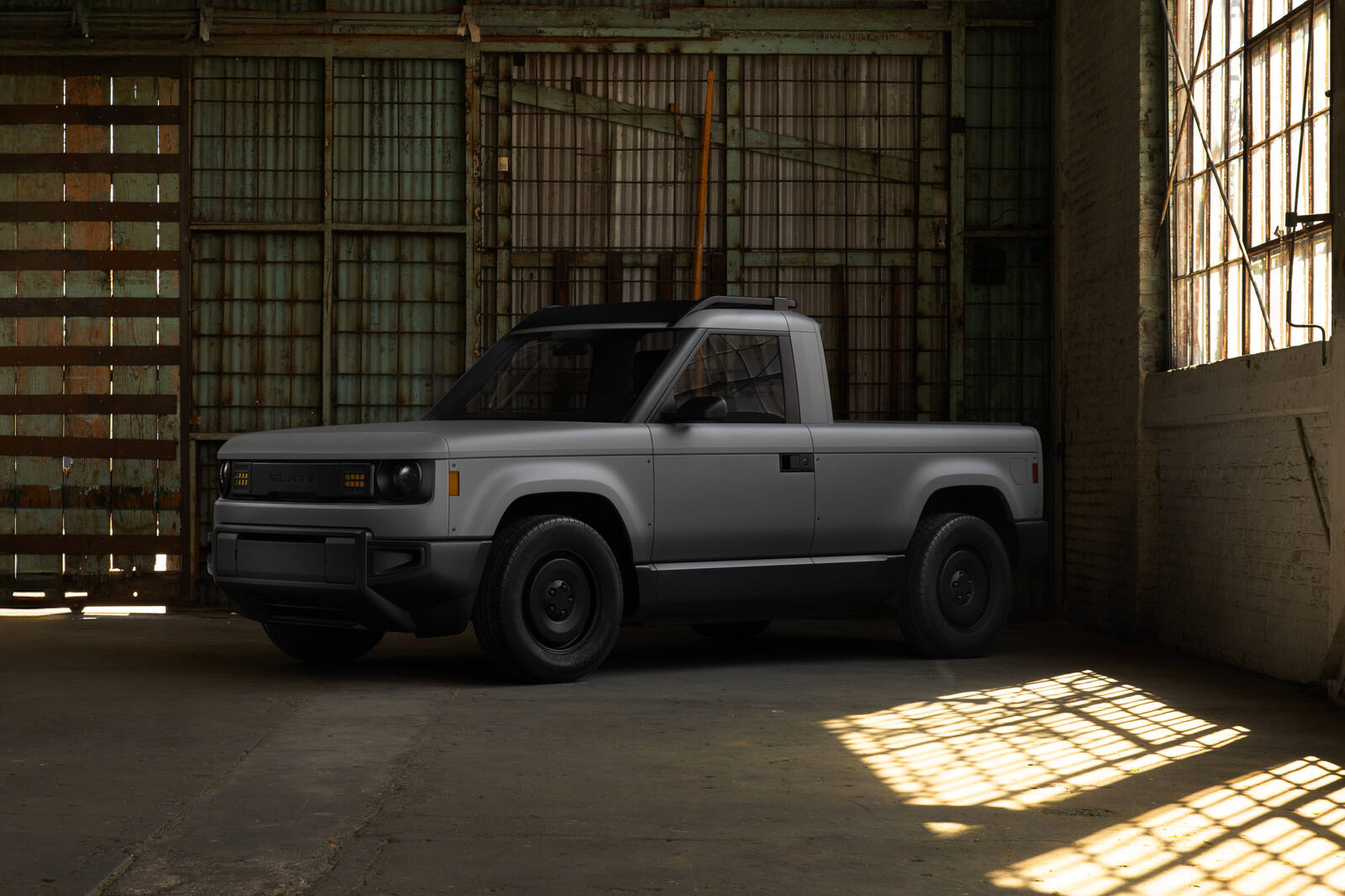
The podcast mentions a “Truck” and says they saw official pricing for it. The model name is described as “blank slate,” but the exact truck brand and model aren’t specified in the excerpt. So this part is mainly about the price and the name.
They’re saying the truck is built with trade-offs to keep the price down. That usually means you don’t get every feature or capability you’d get on a more expensive truck.
They mention a 2011 Ford Ranger to help you picture the kind of small pickup they mean. It’s basically a practical truck you might use for occasional trips and errands.
It’s the official EV range number from a U.S. government test. It helps you compare different electric cars, but your real range may be different depending on how you drive and the weather.
This means what kind of battery materials the car uses inside. That choice affects things like how much range you get, how expensive it is, and how safe it is.
They’re talking about government money that can reduce the cost of buying an EV. The rules can depend on where the battery materials come from, which can influence what battery type the company chooses.
NMC is a type of lithium-ion battery material mix used in EVs. It can help the battery store more energy, but it can also be influenced by supply and government incentive requirements.
LFP is a common EV battery type that’s generally considered safer and often cheaper. It may not store as much energy per pound as some other battery types, so range can depend on battery size.
Energy density is basically how much “battery power” fits into a certain size or weight. More energy density usually means more range without making the battery bigger/heavier.
A resistive heater is an EV’s way of making heat by using electricity directly. In cold weather it usually uses more energy than a more efficient system, so you lose more range.
A heat pump is a more efficient way to warm the cabin/battery. Instead of “making heat” from electricity alone, it moves heat around—so you usually lose less driving range in the cold.
“EPA cycle” is the official test method used to estimate an EV’s range. Your real range can be different because real driving isn’t exactly the same as the test.
Term
aerodynamic box
A “boxy” shape usually isn’t as slippery through the air. More air resistance means the EV has to work harder, especially on the highway, which can reduce range.
Electric windows are windows that move with a button instead of a hand crank. Here, they’re saying the add-on option for that feature didn’t end up happening.
A wrap is a sticker-like film that gets put over the car’s paint. It can change the color or protect the paint, and here they’re saying you may have to pay for a wrap because you can’t order the car painted.
DIYing a wrap means you put the vinyl film on the car yourself. The host is warning that if you’ve never done it before, it’s easy to mess up the fit and finish.
Hyundai Ioniq is a name Hyundai uses for a group of vehicles that can include electric and hybrid versions. The podcast is talking about how you can choose different setups, like battery size and whether it drives the front or rear wheels. The exact details depend on which Ioniq model you pick.
A “small battery” means the EV has a smaller battery than the higher-end versions. Smaller batteries often cost less, but they usually provide less driving range.
Rear-wheel drive (RWD) means the engine’s power is sent to the rear wheels. In an electric vehicle like the Ioniq 5, choosing RWD can affect traction, handling feel, and sometimes efficiency compared with all-wheel drive.
It means taking a big upfront cost and spreading it out over lots of sales. So each car effectively “pays” only a small part of that original cost.
LIVE
Hello, and welcome to the unnamed automotive podcast.
My name is Sammy Hadgesad,
and with me as always is my good friend
and fellow automotive journalist, Benjamin Hunting.
Say hi to the people, Ben.
Greetings, human listeners.
Greetings to everyone,
and I'd like to extend a special greeting
to our guest this week,
another automotive journalist
who goes by the name of Chad Kirchner.
Welcome back to the show, Chad.
A special geeking?
Is that what you were about to say?
I was about to say that, yeah.
Because we are geeking out before that.
What your listeners should find interesting though
is we obviously talk a little pre-show
to make sure microphones and stuff work,
but Sammy suddenly sounded a lot better
when he did his intro,
like he got up real close to his mic or something.
Well, he goes into broadcast mode, which he is.
He's got a really good broadcast voice.
He would be good for AM radio.
Do you really think that I have
a totally different speaking voice
than a conversation voice, a pre-amble voice?
Your intro there was definitely different.
You're kind of back in the normal Sammy mode now,
but there was a moment there
I felt like I was talking to a real radio professional.
Call in and be the fifth caller.
Yes, here on WK9 too, boo, boo, boo.
I just wanna say, anyone out there, any listeners,
do you remember Radio Collins shows?
And did you ever call in?
I don't necessarily mean for a chat show,
but yeah, to win a prize or to do,
give us this thing in Montreal.
I have, for sure, all the time I've done it.
When I was younger in Montreal,
there was a show called The Trivia Show
on Sunday mornings, and this is like pre-Google,
so they would ask a bunch of trivia questions.
You would call in and they would ask you
a series of trivia questions,
and if you got a certain number in sequence,
you would win a certain prize.
And we would listen to it all the time,
and I've called a couple of times when I was a kid,
but that's completely gone now.
Like, I don't think that exists in any format.
I listen to a-
It's called podcasting?
That's true too.
But like why?
There's no real nice call in on a podcast,
but I do listen to FM radio,
and my wife is also always telling me
that these people on the radio
don't know what they're talking about,
and the trivia in particular,
she's like, I can do that.
I don't think she understands
the performance anxiety that occurs when-
Yeah, your wife is a medical professional.
She does not have performance anxiety.
You don't know that.
Like, your wife could do that show
while someone is bleeding out in front of her.
Well, and she should be able to.
That should be like,
that's why she makes the big bucks, right?
Sure, yeah.
Well, this week though, yes, yes, yes.
No, I was just gonna say,
I want a pilot who,
when I'm commercial flying somewhere,
I like pilots that used to be in the Air Force,
because they've prepared for her
when stuff doesn't work.
Yeah, their worst day is nowhere near your worst day.
Right, yeah, so like,
and not to say anything bad about other pilots, but like-
They've clearly not burnt their mouth on a Pop-Dart,
is what you're saying?
Right.
That's like my worst day.
Your worst day is burning your mouth on a Pop-Dart?
Pop-Dart? No, more like the-
Sam, he doesn't wait for them to come out of the toaster.
That's the problem.
You can't wait.
They smell so good.
I actually put my mouth over the toaster.
He tries to catch them like a dolphin.
Like a dolphin.
Yeah, okay.
Your toaster must be pretty spring-loaded.
Favorite Pop-Dart flavor, go.
S'mores.
So in Canada, we only have five.
I don't know if you're aware of that.
We have like strawberry, chocolate.
There's a maple one.
Of course there is.
I don't think we have a vanilla one anymore.
I think that's gone.
There's a un-icing, there's one with no icing,
which I've never tried, tried.
Those are like OG ones.
Yeah, those are like the ones they invented,
back in pioneer times when they were
alongside shredded wheat.
Like if you didn't die of dysentery,
you could have a non-frosting Pop-Dart.
Your treat was an unflavored grain square.
I think that my favorite ones, though,
it's really hard to say.
I like that there were some vanilla milkshake ones
that were pretty good.
Yeah.
The chocolate one is always pretty good.
I don't know.
It's really tough.
I think that depends on the day.
I like Sammy S'mores, absolutely for sure.
But, you know, the brown...
There was no hesitation, S'mores, bam.
But yeah, no, that was quick.
That was what I was hoping for.
The brown, the frosted brown sugar cinnamon one
is my favorite.
That's too much for me.
I think that trips all of my sugar sensors
and I explode.
Make sure teeth itch.
Kyle Patrick.
That's my guy.
Yeah, what about him?
We're just saying names now.
No, no, no, no, because I know two Kiles
were very similar last names.
So I was like, what are you thinking?
Like, I hope I got it because I'm really bad at names.
But I was on a program recently with Kyle.
And we had a drink fully sweetened soda
instead of the artificial sweetened, no calorie stuff.
You're saying with sugar?
Yeah, yeah, yeah.
And he's like...
Cane sugar?
I like how you were saying you were forced to do this.
Like...
No, we were because there was no other option.
Like, the drinks had already been all picked through.
It was very weird.
So anyways, he's like, he's like,
oh, does this make your teeth itch?
And I'm like, excuse me, what?
He's like, oh, yeah, like when he's like,
that's how I describe the taste of drinking
like pure sugar soft drinks.
He's like, like, makes your teeth itch.
Yeah, I can get behind that.
A full bag of sour patch kids would do that to me.
Oh, yeah, we're on that kick lately.
There's someone in my house who has cravings
and we have to have those sour keys or whatever.
Good thing you have a medical professional
available to you at all times.
Sammy, you shouldn't be talking about
how you have cravings all the time.
I want to talk about how I can't,
I am so excited to have you on the show this week.
Yes, super true.
Because we've got some pretty cool EV talk to get to.
But before we do that, I also want you,
a part of the conversation that we're gonna have with Ben
because Ben has been driving a very,
I'm gonna say interesting and I really,
sometimes I use interesting as a filler word
for things when I don't know what I'm talking about.
But this is actually an interesting car to be in this week.
Ben, can you prime this up?
It's a 2026.
This is a Dodge, I'm certain of it.
Okay, so there is a down to two possible vehicles, right?
Yes.
Because the Hornet doesn't exist.
Or Challenger.
There's no, there haven't been Challengers in two years.
So it's not a Challenger, Sammy.
So it's a four door charger.
No, it's a two door charger.
It's a two door charger.
You need to get with the program
because everything you knew about the charger
is out the window.
The Alex platform is gone
and in its place is a platform whose name I don't know,
but it has produced an electric charger,
a four door gas.
A stellar large, I believe.
I think I knew stellar large.
So that's what I order at the bar.
So essentially I'm driving a two door charger.
It is the scat pack version of the car
and it comes equipped with a turbo charge,
twin turbo charge.
I believe it's three liter inline six cylinder engine.
It has 550 horsepower and 531 pound feet of torque.
The scat pack trim is currently the only one
you can buy as far as I know.
There's going to be an RT later on
that will have the same motor,
but there's two tunes for this motor,
which we've talked about in the past.
And you have the high output.
Yeah, because this engine's available
in the Grand Wagoneer.
It's available in the Ram.
And I think that's it for now.
Does it rock you like a hurricane?
It is a really, really good motor.
The base motor.
I do get a set of the way,
just to get out of the way,
the base motor is 420 horsepower
and 460 pound feet of torque.
So I just wanted to make a rocky, like a hurricane joke
because it's the hurricane engine.
Essentially the, and also speaking of hurricanes,
my favorite hockey team, Carolina Hurricanes
won the Stanley Cup recently.
I don't know if I mentioned that on the podcast.
No, you haven't yet,
but I've been waiting 20 years for that.
I, they want to say everything that's happened
in America in his entire life.
That's not true.
But the, the, it's just a big deal for me.
I'm very happy.
Anyone else out there is a Hurricanes fan.
It'd be awesome to hear from you
because there are not a lot of them in Quebec.
As you might imagine.
So that end of hurricane talk.
This engine is fantastic.
I really love it.
It's, I love it in everything I've driven it in.
I think it's one of the best engines on the market
for a large vehicle.
It's whether you're driving an SUV or a pickup
or a, in this case, car that's so big,
there's no market for it at all.
It performs very well.
The charger is very quick in a straight line,
even though it is enormous and heavy.
It, it feels fast.
It sounds good too.
I've actually had some friends complain
that they don't like how it sounds.
I don't know how Chad or, or Sammy,
how you guys feel about this.
Is it just like the usual people who complain
that a six isn't an eight and therefore it sounds worse?
Well, it's, I think it's the fact that it's like a six
that's in a car that's used to have an eight
and it sounds European than it should.
I don't feel that way, but I think it sounds nice.
I think straight six, I mean, straight six is in turbocharged
straight six can still sound good.
I feel like I've heard every possible exhaust
equipped to a BMW in my neighborhood and they sound fine.
That's a big Hamilton thing.
But if you are, but if you are what we would consider
a stereotypical Dodge fan,
at least on my side of the border,
you probably don't think of a six cylinder engine
when you think of a Scat Pack.
And unless you're Australian.
Right, which, which, which you're way farther south
of the border than, than, than where I am.
And the only coming all wheel drive is that.
I believe so. Currently they are all wheel drive.
There's some crazy stats about this car.
Remember when I said it was heavy?
It weighs 4,876 pounds.
Oh, come on. This is the electric car now.
You're talking about. No, no, no, no, no.
And 55% of that weight is over the front wheels.
No. Yes.
Okay. Hold on. I need you to break this down.
We have not talked about this car.
This makes 500 pounds more than my Grand Wagoneer.
Just want to put that out there.
And a thousand pounds, a thousand pounds more than my CTSV.
That's what the, that's within a hundred pounds
of the M five wagon with the full plug in hybrid.
Yeah. But it's just heavier, which is heavier
than the all electric five series.
And it is, is however lighter than an RS six, I believe.
So at least it's got that going for it.
It's got lighter than the death star.
So I just, I, I led with the weight
because it does 60 in four seconds, which is nuts.
And it does the quarter mile in 12, three.
That's really good. Yeah.
Like for a car this size. I mean, come on.
But I, I, I, these numbers don't make sense anymore.
We're at a stage where Griff is so.
Well, yeah, you have all wheel drive.
So you're going to be able to launch, I mean, as long as the software is right,
you're going to be able to launch consistently.
Yeah, I tried the launch control on this and it is, but, you know, suitably bananas.
It's actually very simple, much simpler than past launch controls that I've used.
Like instead of having to set an RPM that you manually want to use yourself,
you just do the whole brake thing and then floor it and then let go.
And everything else is automatically calculated for you.
But, you know, getting back to the idea of grip,
it also has 305 35 series tires.
Oh, yeah, that's great. Man, holy.
So are I tire budget when winter comes around?
That's true.
It's all we'll drive.
We just drive on the summers. It's fine.
I wanted to talk a little bit about the, I'm sorry, Ben,
I want to talk a little bit about the whole concept of this charger
because it first arrived as an EV.
We saw it as an EV first and then they were like, oh, no,
now it's also a six cylinder, a gas powered version.
Is the EV still around? Is that still available?
Yeah, you can still order it on the website.
So the the the RT that I don't think you can get yet,
even though you can build it online, starts at 50 grand.
The scat pack that I drove starts at 55.
Then there's a scat pack plus for 60.
And then past that point, it's all electric.
So for the same money as the scat pack plus,
you can get a Daytona scat pack.
So Daytona is the signifier that it's electric.
And then there's a Daytona scat pack plus for 65.
That's those are all US numbers.
In Canada, I'm not exactly sure on the pricing.
I want to say it's considerably more expensive.
Yeah, I had. OK, here we go.
It starts at 775
That's a lot of output scat pack.
I don't have a price on the RT,
but the model that I drove had a lot of options.
I think it was around 90.
OK, so the RT that's coming out starts at 60,
which is actually very competitive with the US.
That is OK. Yeah.
But the six pack is considerably more expensive.
Four door four door models in a strange twist of events in Canada,
I believe are 3000 dollars more across the board.
So you can get these same like drive train
and features with two extra doors.
Usually the two doors are more expensive.
That's right.
And when it comes to performance cars,
I believe that's the same in the US as well.
I don't know what the exact price difference is.
It's 2000 dollars, I think.
So two and four doors.
But basically, if you want the extra doors,
you have a pay farm, but like it's it's not part of a weird bundle
or a weird patch, like it's probably this is a very
damning them with faint praise.
But like that's probably the smartest thing about this car is
adopting kind of a Wrangler philosophy where you can get, you know,
well, making it simple like to to order,
which, you know, they they could have fallen into a trap.
But I mean, I don't want to go off editorializing
about the whole Dodge strategy right now.
But I don't dodge strategy or two words that are very confusing to me.
Because because there isn't one.
Well, there is. It's put a hellcat in everything because it's 2016 again.
But that's right. I was trying to lead us today.
Yeah, but like so I like the hurricane.
I completely agree with Ben that that is a fantastic power dream.
And I think it makes a lot of sense to use in a high performance car,
which is what this is.
But but good old Timmy K. Mr.
Caniscus has has applied pretty heavily that a V8 will fit and that a V8 is coming.
Does I think that's definitely a downgrade in this vehicle.
But I'm also going to I have the opinion that it's not going to matter.
I think this vehicle.
This vehicle does not have a customer.
OK, I think that there is no equivalent car on the market
anywhere near its price point.
That is a problem for a car.
Come on. And I want to qualify cars to people who will buy them.
I want to qualify that because there are no large non luxury coups anymore.
And when I say large to give you an idea of this,
we're talking about how this car can be either a four door or two door.
And you know, there's there's the four series and the three series.
And we're all used to that kind of like one sausage, many different lengths thing.
But it's not like that with the charger.
It's one sausage, one length, different doors.
Yeah, this two door has a wheelbase of 100 and 21 inches.
I when I open the door to this car, my seat is so far forward.
It looks like it looks like I'm four feet tall
because of how close it is to the steering wheel and how much room there is behind it.
It is crazy. And to give you some perspective, I believe,
Sammy, didn't we do the calculations and it's almost two feet more
wheelbase compared to a Mustang? Two feet.
Was it something like 18 inches or something like that?
It's six inches longer overall than a Mustang.
It's wider than a Mustang.
And the wheelbase is insanely bigger.
When you're in this car, the only thing that comes close to it dimensionally
are like an eight series coupe, I think would be kind of the same feel.
Or maybe like, is there an S class coupe anymore?
No, I don't think so.
Like that's the that's the closest, I think,
size match for the charger.
And I think that's a huge problem for Dodge, because this car is essentially
personal luxury. It is not a muscle car.
It doesn't feel like one because it is way too big.
It is just way too like at the end of the sixties,
there were actually it's the early seventies, but in the sixties,
there were there was a trend where car companies like Ford, Mercury,
I think Dodge did it a little bit with the Polara.
They made full size cars with big block v8s.
Like Ford had the XL and there was a Mercury.
It wasn't it was like a Marauder, but it was it had a different name.
Had an X in it as well.
Everything had an X in that period.
And these were like gigantic, like luxury cars, two doors.
And I say gigantic, like we're talking like swimming pool size cars.
Right. And they had the attitude and kind of market position
that, hey, we're going up against muscle cars, which are almost exclusively
intermediates in terms of size and midsize vehicles, but they weren't.
They were like something else.
And personal luxury, it stayed a thing from like the seventies, the eighties
and the nineties, and then it was killed in the nineties.
Like SUVs took over from personal luxury for people who wanted to spend money
on a car, but not necessarily by a luxury car.
So you could have like a high in luxury car, I should say.
So the cars like the Lincoln market, you know, cars like the Cadillac,
ETC, the El Dorado equivalent that they had in that era.
You had the BMW six series in this in the eighties, which was very much that.
And then the eight series, which took it up a much higher level.
You had the, you know, Dodge even tried to do it.
The vehicles like the Marata and the there was a two door.
What's that company imperial in the eighties as well.
And these vehicles don't exist anymore.
It's a concept that we've moved.
Yeah, for a reason, right? Like it just wasn't popular.
And now to bring it back with this car and be the only car on the market doing
this, I don't get it.
And I think putting a V8 in this car will not change it because the dynamics
of this car are not sporty.
There's nothing engaging about the car.
It's a cruiser.
And even that, as much as I like the engine, it has an eight speed automatic.
Usually I believe it's a ZF box.
I mean, it has to be right.
That's what Chrysler uses almost exclusively.
I normally love this transmission.
It is not well tuned in this car.
It was surprisingly jerky at low speeds.
I've never encountered that in a Dodge product before.
It doesn't feel refined.
It feels like this car feels old.
It feels like something that should have come out like 89 years ago.
Wow.
And it's not charming in the way that the Alex platform was
where you knew you were in an older car.
You knew the technologies were like dating from a different era.
And that was kind of part of the appeal.
But now it's like, here's this brand new car.
I'm inside of it.
The interior is very normal.
The stitching doesn't really line up on the dashboard and the door cards.
The infotainment is fine.
Everything about it is fine, but it doesn't feel special.
And it looks enormous and it's just an odd experience.
And like it has some really positive aspects and it has a bunch of very puzzling aspects.
And it was just a strange experience overall.
So basically, you're telling me that this car is this bizarre blend
of like a European large grand tour, but without the refinement
that usually arrives with those.
I say it's the size of a European grand tour.
And I mean, it sounds like the performance characteristic of an inline
of a turbo inline six like that might be along those lines as well.
I guess there's also the driving experience is radically different.
There's nothing connected about this car that you're floating above the road.
And then the size is like it's basically what it's like an SUV.
Like it's just that big.
It's huge. It feels that big.
Does it feel like you're really you mentioned like you're floating.
Are you familiar?
Are you familiar with a Gerald R four class aircraft carrier?
I feel like the Mustang, the Mustang already feels big.
And this is like way bigger than a Mustang.
OK, I think if I can throw in something else here, too.
When I drove the electric, it also felt like this really kind of mismatch.
I think that if that car, if they would have designed that platform
and made that car a Chrysler, not saying that's a great idea.
But if it would have came out as like a Chrysler 300 or something
that's designed to be a luxury, a more luxury focused cruiser,
I think it would make more sense because my one takeaway from driving
that vehicle is the EV wasn't any more refined,
but it was super quiet on the highway.
Like they they they paid they paid to double double glaze,
you know, double paying glass all around.
It has that it has the only noise that I heard in the cabin really
outside of like powertrain noises was because of the rear hatch.
It's hard to kind of it's kind of hard to delete all this down.
Yeah, shut up to a hatch.
I mean, that's something that's useful.
But like it could.
But but it's trying to it doesn't know what it is.
It's it's like a no one knows what it is.
It's like a team going through, you know, going through adolescence
and trying to figure yourself out like it's a pre college car.
I think as a customer, you would have trouble knowing what it is to.
Yeah, like it's hard to identify who the market is for this vehicle.
I think even as a Chrysler, there's the idea of a gigantic two door coupe.
Right. Does it fly?
Yeah, I but I think that I mean, I'm sure the take rate on the two door
is going to be super low.
Yeah, but I make it like it's puzzling.
Yeah, sure.
Well, I mean, maybe they wanted, maybe they felt there were enough
Challenger sales that they couldn't get rid of the two door.
I could see that Challenger was a was like affordable, right?
And much smaller, which is crazy to say.
Because the car was huge.
Yeah.
But I'm going to pull up the Christ, the Challenger dimensions here.
I think affordability was a huge aspect of the previous
Charger and Challenger and 300 C or S or whatever you're going to call it.
And that you could have it at this really entry level, like price point
all the way up to that, like nearly a 100000 dollar
red eye or whatever, demon. Right.
And to me, where this thing starts seems to be a little bit on the high end
almost twice as much as well.
There's no I kind of expected.
There is no base like GT V6.
Yeah, I guess that's that's you know, because the six cylinder
the six cylinder by far was the most popular power tree on both Charger and Challenger.
But even if they could introduce a naturally like, yeah,
let's say they throw a Pentastar in this. Yeah.
It wouldn't drop the price by like 15000 dollars, right?
Like no, there's probably they're probably trying to.
I mean, it's a new platform and they got paid for that platform.
And Stella Large, I think the interesting thing about the wheel base
with Stella Large is because it was designed to be an EV power in EV platform.
EVs tend to have those really wide wheel bases.
So in some ways, like you're getting this
benefit of all this interior space, which is interesting when you talk about
the four door version, because it's not a different sized car.
Like it is just two doors added.
They cut out that second row of doors.
That's what's so important about it.
And like it's just there's dimensionally, there is nothing different.
And even between like a three series and a four series,
like there's some things that are different.
This is not that it is just popping the doors in.
It's wild.
So the the vehicle is four percent longer than a Charger.
So that a Challenger, it's wider, longer and taller.
And looking at the wheel base now and the wheel base is
looks like five inches longer than a Challenger, which is already a big car.
Everything about this car screams like priority was being able to stuff
as much battery pack as possible.
Right. Like that's what you get with a massive wheel base.
You you're able to put as many batteries as you can between the axles, I guess.
And yeah, because that keeps the center of gravity lower.
Yeah. And to me, it just seems like there are consequences of trying to do this.
And there's consequences of trying to do this for a for a car platform, too.
But other automakers have been able to make, I think, car EV.
What is an EV car that I can think of?
No, we're skipping over.
We're skipping over the fact that we all know they could have done this differently.
Yeah. It's not like it's not like they were forced to make
a 5000 pound two door coupe the size of a pickup truck.
Like they they chose to do this because it cost less money to do it this way.
That's the bottom line here.
It was like they did not have the money to properly develop
a challenger replacement and a charger replacement.
So they tried to do both at the same time.
Right. And we're looking at what that looks like, right?
And it doesn't look like something that I think maybe for the charger,
it's fine for the four door, it's fine.
But for this coupe and specifically talking about the two door,
it just seems like a vehicle without without a customer.
I don't understand how they're going to market it.
Well, and we're also I'm sorry, but we're also
talking about an electrification platform that the North American
Stalantis doesn't have any experience really doing electrified anything successfully.
So you have the Stela platforms approved under a Tavares
and you have all of these European brands of Stalantis,
you know, focusing their engineering talent and resources on that.
Yeah. And it's very obvious after Tavares left and Kinesis
came back out of retirement, he made it very clear.
He didn't like anything that Tavares did.
And I think that some of the decisions that he's making
as head of North American product is is it like reactionary?
Yeah. Yeah. And it's not and it's not figuring out how to work with Stela Large.
It's not figuring out how to make this platform kind of work.
It's very much like, well, we've we've got this, we have to use it.
You know, let's figure out how to put a V8 in it.
And speaking of experience with electrified platforms,
I mean, how problematic are the the plug-in hybrids that they're selling?
They're catching fire. Are they are they selling them?
They don't have any. No, they're not.
I think they're still on.
I mean, I don't know if they're still on the stop sale, but like
they've killed all of their plug in hybrids, the new ones.
Instead of fixing them.
Yeah, basically, because I mean, they're still like,
they could possibly catch fire and things like that.
And they just didn't want to fix them.
They didn't they want to engineer.
They didn't want to spend that.
And again, I think a lot of this good and bad
will fall a lot onto the head of North American product.
And I think that above him.
What's his name?
What can you remember his name right now?
The new head of slantist global?
Antonio Filosa.
I think he's a smart guy.
He said some really smart things the first time I talked to him
that that really like genuinely impressed with.
OK, but I don't just I think that this car
is a symptom of an overall problem at Stellantis, North America
that they still haven't solved.
I mean, I that it feels like they're constantly in transition.
Yeah. Yeah.
And like and like right now.
And they can't transition away from our car.
Our cars will all have V8s and will be right.
This old American style thing.
And and can they can they transition from that?
Like, I think this is more of an existential question.
But like, OK, can you have a dodge?
Can you have a dodge that isn't, you know, miracle V8?
Like, can you can you make an EV?
Can you do this hurricane powertrain
potentially as the as the top end powertrain?
I mean, I can go one further.
Can you have a dodge?
Yeah, like fair, fair question.
We keep forgetting about the recent addition to the Dodge lineup,
which was the Hornet that we forget about all the time.
Oh, yeah, it exists.
We don't need to talk about it. Right.
I mean, I drove it.
I remember driving it, but I've never seen any like.
So this is a good segue.
We're talking about a company
that's having an internal strife, trying to find leadership.
Yeah, recently, Sammi and I were reading about a Nissan board.
A recent Nissan board meeting where I'm on team GONE.
I'm sorry, I'm on team GONE.
Yeah, so things got a little out of control.
Let's say for our listeners, Nissan is Nissan is in a in a lot of
in a heap of trouble, like this is a problem.
They are struggling with new product.
They're they're bloated around the world.
They don't know what their the sales are really all over the place.
So they had an annual shareholders meeting against that background.
And their CEO, Ivan Espinosa, basically had to fend off
multiple floor motions to remove him as the chairman of the meeting.
Then he had to fend off a no confidence vote.
And then he had to shut down a proposal
to appoint former chairman Carlos GONE to the board.
If you remember, GONE is someone who is currently living, I believe, in Beirut.
Yeah, because he can't leave Lebanon or he'll be arrested.
He can't leave Lebanon.
He's there so he can't be extradited.
Right. So they want they want international criminal Carlos GONE,
who famously was smuggled out of Japan in a Yamaha,
in a Yamaha music cello case.
I thought it was a coffin.
No, no, because Yamaha had to put out a press release saying
that you should not travel in one of their.
You got to drill a hole and air hole.
Well, the important one here is that if you watch Game of Thrones,
you have to also have a poop hole, too.
So this was crazy.
Before the meeting even was called to order.
There was a no confidence vote.
Yes. In Espinosa.
So if you think your job is not going well.
Right. Yeah. Well, so can I?
I'd like to say one.
I almost wonder if that Carlos GONE motion was a plant,
because of course Carlos GONE, who's very full of himself,
managed to very quickly say, oh, yeah, no, I would totally do it.
Of course, they should have. Of course, they really is there.
Yeah. Yeah. He's commented today or some type of immunity.
I mean, I mean, most of the meetings can probably be zooms.
Anyways, right? Like this is the ultimate.
That's a totally reasonable way to run your business.
So so if you if you look at Nissan over the past few years,
Carlos GONE did one thing extremely well, two things extremely well,
smuggling himself, escape, escape and
cutting cost and improving profitability.
Like the Nissan's were bad under his reign
because he was cost focused to to to too extensive of of a limit,
like to a limit that didn't make sense.
I would argue that the product today, a lot of the product today
is way better and in some cases, good
than one than one GONE was leading it.
But you do bring up a really good point.
I'm thinking back on Carlos GONE era.
The key is he conglomerated everything he made every year.
Right. He cut everything that wasn't necessary.
He made everything the same around the world, improved profitability,
saved the company from completely going on.
Probably. Yeah.
But and people bought the cars.
People bought Nissan because they couldn't get a loan for anything else.
Right. The is not the way it worked here.
Well, and now the thing is, what people don't really realize is
there's some reasonably good, if not, like genuinely good Nissan's out there.
I like the Versa and now that's gone.
But yeah. And of course, you would say that.
The new leaf is good.
The new leaf is fine.
I've driven. I've driven E-Power, the new third gen E-Power
that will debut on the new Rogue later this year.
OK. It's. But isn't that just a good outlander?
No, that's the plug in.
It's the extra. No, it's something that's not the plug in.
It's going to be a different.
It's a serial. They're getting a new Rogue.
It's their serial hybrid. Yeah. Yeah.
No, the current Rogue plug in is just the outlander.
I mean, if God was smart, which is good, which is surprisingly good.
Yeah. Yeah. No, it's the outlander.
The outlander P have is the best Nissan Rogue you can buy.
I think that by far, I think that if God was smart,
he would campaign to become chairman of Mitsubishi
because Mitsubishi is slowly eating Nissan alive from the inside.
So so the new Mitsubishi Eclipse, the new Eclipse is just that badge engineered.
They're doing the same badge engineering that they did in Rivers
for the outlander or whatever.
No, but OK, so like so like Goan made some mistakes.
Before you even talk in what you mean,
the money and the fraud and the. Yeah. Yeah.
But but keep in mind that everybody's doing it, but there's only really
a couple of months difference between Goan and
Jose Munoz, who who was also tied up pretty close into that,
but got out at the right time and look at him now.
He's running one of the he's running HMG like a key is to always have
a Yamaha cello case nearby. Yeah. Yeah. Absolutely. No.
So you don't have to wait a couple of months custom ordering one to your size
and you can escape when the escaping is good.
What the problem, the problem is culturally with with Nissan now is
they refuse to see anything, any of the positives that Goan did.
Like so he's he's persona non grata.
You can't talk about like a cross cab, you know,
not that they should bring the cross cab back.
They shouldn't, but it will never happen because it was a pet project of.
I mean, that's one of the reasons. Yeah. Well, I mean, I knew one might be better,
but but and nobody there.
I mean, I know a lot of people that work there.
Nobody there likes a Spinoza.
They don't. I think that's pretty clear.
There's no confidence.
There's no, but I mean, internally within within rank and file,
there is there's no confidence there.
So that that was that was my segue.
That was my segue to my tire talk.
I just thought that that was funny and wanted to bring that up.
I mean, funny for us. That's a funny. No, it's it's hilarious.
Like I saw the news and I'm like, I have a shutter stock image from
when one Gown was still there, where he's in his behind the wheel of
a Navarra, I think, in the in the desert in Morocco.
And he's just got a Nissan, a white Nissan Polo on a white Nissan hat
with a red Nissan written on it.
And he's given a thumbs up, a smile, a thumbs up to the camera in the middle
of the desert. Yeah, kind of out in the middle.
Yeah, like it is scouting out potential non non deportation countries.
It's just so good.
Like, like, and honestly, I think they could do worse than Carlos Gown.
Like, yeah, for sure.
I mean, he was a man with a plan.
He was prepared. He got out.
Yeah, I was tired. Sorry.
Yeah. So I've been testing as that event is S1 all seasons.
They are on our 2015 outback.
And I talked about them, I guess, last month, maybe like two or three weeks ago.
We've had a chance to put some more miles on them.
This isn't going to be an in depth update, but two things I wanted to talk about.
One noise.
I'm trying to figure out if the noise is louder than the set that we took off
because I'm starting to notice some noise on them now that I didn't notice
when we were first driving them.
Second, wet weather performance has been really good.
So my wife drives the car as well, and she notices she she doesn't like
when the vehicle hydroplanes is something that she talks about
and notices when she's driving.
And we've we've had some insane rain here.
We got something like 105 millimeters of rain in a 24 hour period
or a two day period, something like that.
It was pretty crazy.
There was a lot of flooding, but that's like a mile of rain, right?
Yeah, it was like it was 33 bushels of rain.
And it got pretty bad and we were driving the car around
and we had no problems at all with water channeling.
It did a really good job with that.
Something that she's been impressed with while driving the vehicle.
So those are my two Ventus S1 all season updates.
This is kind of how we're going to be talking about it over the course
of the summer because they are summer tires.
So we're going to run them between between two other segments.
Yeah, well, between we'll do some more deep dives
because it's really only been a few weeks that we've had it on the car.
So it's hard to really talk too much about how they've been feeling.
But we have some longer drives planned for the car in next month.
And once those are done, we'll have a better feel for them.
But I can say that they do appear to have a lot more grip
than a standard all season tire, which makes sense
because they're a performance tire to the point where we're starting
to notice weaknesses in the suspension system
that we didn't have with the other tire, which is an interesting thing
that I think people don't always consider.
You can overtire a vehicle to the point where you have too much traction
and you'll break driveline components.
But by the same token, you can also start to have too much grip.
And you'll notice that maybe your springs are noisy,
your spring pads are too noisy, or you're having some bushing issues,
that kind of thing.
So we're starting to notice that a little bit with the car,
which speaks to how sticky these Ventus tires are.
And I keep saying Ventus, Hankook Ventus, is Ventus is like the sub-brand of them.
Yeah. So I had to try.
I had to try to find a set of because Michigan killed another one of my tires
recently. I'm trying to find replacements for it.
I have a 195 50 R 16.
Yeah, that's tough.
Nobody makes them anymore.
No, you could go to Coker and pay too much money.
Well, I want to like so it's just it's an annoying.
It's an annoying problem because one, it affects me personally.
So of course, it's got to be annoying, but two, but two.
I mean, that is the American thing to say, right?
But but two, more importantly is the average age of what a car on the road
right now is what, 14 years, 13 years around there.
Like people are keeping cars longer for whatever reason.
We're going to talk about affordability here, but it anyways with a vehicle.
But like, you're going to have to be able to buy tires for these things.
Like and I understand, oh, well, there's fewer, fewer cars in those sizes.
So, you know, it doesn't make sense for us to make them.
I reached out to Michelin directly because I've got a bunch of contacts there
and they're like, well, are you in a Royal?
We got some stuff in our Royal brand.
But like, yeah, Michigan, you know, you start to get pushed into like very
narrow niches of tires where you you don't have selection.
You just have two different brands.
The only thing that Costco had available for me were two summer performance
tires. It's like, yeah.
And a lot of that is because the reason you see smaller diameter
performance tires is because Miata's are, I think, yeah.
And they there are tons of people who are still driving Miata's every weekend
on a racetrack.
And so 15, 16 inch tires are still being served by those four of those customers.
But they're exclusively like ultra high performance summer or or track tires,
you know, and they're not appropriate necessarily for daily driving.
And in my last set of tires that I bought, I had to buy four just because it was
time along with the the road hazard stuff.
A tire rack gives you two years of road hazard.
Well, it's been two and a half years.
So, um, but, but Costco gives you five years.
And I'm like, OK, well, I'm going to buy a set of tires from there.
I don't care.
Um, yeah, yeah, but I can't.
So, you know, so I ended up actually having to go, um, to the dealer.
And I'm not super thrilled about that.
But the pricing was, was competitive.
The tire rack for what I was able to get.
So take a look at the date code on those tires at the dealership before you put
them on your car. That's a good idea.
Yeah. Yeah.
Because you know, well, they had to order them in.
So we'll see.
But like if you can, I mean, and when I say date code, look at every tire
because the chances are they're not from the same batch.
Sure.
You don't want a seven year old tire on your car.
Oh, no, absolutely.
I absolutely don't.
That's what I worry about.
Even with performance tires, like I, I sometimes end up getting
tires that are two years old, you know, and it's like, I know I'm going
to run those out before they age out, but I recently had tires.
I don't drive my Cadillac as much as I would like.
And I had a set of, um, can't remember what was on them beforehand.
And in any case, I had a set of tires age out on the car.
Like they were eight or nine years old and they just weren't safe anymore.
They didn't feel great in terms of grip.
Right.
And, uh, I had to end up, I was able to get a decent deal.
They're 18 inch.
Yeah.
But, um, I was able to get a decent deal on a set of replacements, but
it sucked because, you know, I had good tread on them and whatnot.
It's just that we don't think about like tire rubber and compounds.
Oh yeah.
We don't, we don't at all.
Um, especially when you start looking at like auctions on like bring
a trailer and cars and bids and you're like, man, the date codes in these
tires like are terrible and people are like, Oh, well, the tread's fine.
Yeah.
I don't trust that.
Thanks.
Yeah.
They're fine until it delaminates on the highway, you know, like
right, right.
Destroys your fender.
But, you know, speaking of like car affordability, we have the solution.
Ben, Sammy.
Really?
We do.
It's going to solve all of our problems.
I saw it on the internet.
So tell me, um, this week, we finally were able to see official
pricing on the slate auto, I guess blank slate is the official model name.
I don't know the truck from slate.
It's here sort of.
So let's give our listeners a recap of what this slate auto is.
There it is a new American electric vehicle startup that is promising to
sell in an affordable electric truck or trucklet that has many, I guess,
like sacrifices in order.
I would call them compromises.
It's a compact two door short bed pick.
Have you driven a 2011 Ford Ranger or older?
Like that you have a friend who keeps a ranger in the backyard for
bi-yearly trips to the dump.
That's yes.
Um, that's what you guys are getting from this.
Yeah, they were promised.
Well, okay.
So we're going to obviously we'll get into more details, but yeah, that's
how I kind of described it.
I did an interview with a ABC News this week about it.
And, um, that's kind of like, I kind of gravitated to that Ford
Ranger kind of thing, an S 10 from the late nineties, early 2000s famously
on the podcast, we like smaller trucks.
Yeah, yeah, same.
Modern full size trucks are too big.
I think mid-sized trucks are a good form factor, but you can't get a
long box with a mid-sized truck these days.
It's almost impossible.
And so we're in this weird world where practicality from a task
perspective is hard to find.
It's all focused on daily driving and passenger comfort.
Yeah.
So this is not a solution for that necessarily, but it's almost the anti
solution, but so, but Slate promised us a 25, a mid-twentieth thousand
dollar electric pickup truck, and they delivered a $25,000 electric pickup truck
with a whole bunch of asterisks with a whole bunch of asterisks.
And what I would like to say before we get into any of this, because I don't
know how long we'll talk about it, but, um, what I would like to say is I've
been covering this business for what, 11, 12 years now, Ben.
I've known you for at least 10 of that.
Um, I, I have an MBA.
I consider myself like an expert in this business.
And I consider myself an expert in electrification.
I'm sorry if that makes me sound very, um, conceded.
Why would we have you on the show otherwise?
No, but I don't like talking about myself, but like, but like, I genuinely
believe I know what I'm talking about and slate is fascinating.
I'm not saying that slate will succeed, but there are so
many like weird variables because I will argue to, I'm blue in the face
that this is the perfect timing to introduce this a $25,000 pickup truck.
I don't think the timing could be any better than what it is right now.
I think it's better than when the tax credit existed.
I think that this is the perfect time for slate to do this.
Now, um, if you look up the definition of luck, it's, it's, you know,
preparation meets opportunity.
And I think that the opportunity is here.
Slate has fallen down hard on the preparation on the preparation.
And that's, and that's where obviously we're going to get into that there.
But like,
so what are these asterisks, Chad?
What are the biggest asterisks for this truck?
Because, because they are, I want to get something out of the way first.
I think that we're entering into a societal prism where if you want
something to be inexpensive, you're also told that it has to be less good.
Yeah, you're not allowed to be giving up fact, like really, like, yeah,
you're required to make sacrifices in order to have something you
could actually afford.
Um, they didn't used to be this way.
It used to be that you could get a cheap car that did all the stuff
you needed it to do.
And if you wanted to make it a little nicer, you could buy a little
bit nicer version of that car.
Sure.
And I'm talking about like features or fuel economy or whatever.
Um, yeah, the slate truck is, I think the embodiment of a world where
you pay less and you get less and you'll like it.
And you have to, and you have to do it.
I'm not going to, I don't want to take quite as I don't want to call you
cynical, but I don't want to take quite as a cynical definition on it only
because hear, hear me out here.
I'm going to make, make the most pro kind of case I can
firstly, but there's still a lot of assresses that I'm also like feel like
I like, like at the end of the day, I'm not sure if this company makes sense.
I don't know if this company succeeds.
I have a real hard time seeing a total addressable market, a TAM.
I'm sorry.
It's the only time I'll use business talk, but like, I don't see the TAM
big enough for this to be successful.
Um, so what are the, what are the flaws with this track?
Like, what are you getting for $25,000?
So like, let's like, so for, okay, let's talk about that first.
For your $25,000, you get a regular cab pickup with a 45 foot
bed.
I don't know exactly what it is.
It's rear wheel drive, right?
It's rear wheel drive.
Um, it contains, you can only get it in one battery size.
It's an LFP battery, uh, rated at 65 kilowatt hours.
It's good for roughly 200 ish horsepower, zero to 68 seconds.
Not that that matters in a pickup truck, but it'll feel quicker than that
just because electrics always feel a little quicker.
Um, and it's, it's has a, they're hoping for an EPA rated range.
So it hasn't done EPA validation yet, um, of 205 miles.
Now, anybody that has, has looked at Slate before, they were promising
two different battery chemistry or two different battery sizes, 150 mile
one for 35 or 25 grand, and then an unknown price for the upgraded battery.
Because the tax credit went away, it no longer was important for Slate to
use the NMC, uh, battery technology because they needed to do NMC because
LFP batteries were only coming from China.
Like nobody's making them domestically right now, or they weren't for until
real, real recently.
So, um, part of the full $7,500 tax incentive was where the batteries
were sourced, the, the, the materials for the battery.
So they couldn't use LFP, which is traditionally a cheaper technology,
less dense, but also less expensive and safer too.
But, um, because they didn't have to hit that tax credit anymore, they could, or
because they didn't have to worry about that anymore.
They could source an LFP battery, which bumps the standard range up by 55
miles over what they were initially planning.
So in some ways, so in some ways that's good, that's an upgrade.
That's positive.
Yeah.
Um, and LFP batteries, if you puncture an LFP battery pack, it might
spark and then that's it.
Like there's no, there, it is a much safer battery chemistry than, and you
can charge all the way to a hundred percent on the regular as well.
So you're not necessarily losing that top 10% of range because you should
only charge the 90% you can go to a hundred percent.
You have to go to a hundred percent on them for, for them to, so you, so you
have, so you have this, this $25,000, 2,000 pound towing capacity, 1500
pound payload capacity, 205 mile pickup truck.
Now, is that range enough objectively?
Yes, but people don't buy cars objectively.
They don't, they don't, in my country, that's for sure.
And before I know you, when I know you're going to talk about range
dropping, no, I'm not going to talk about range dropping.
I'm going to talk about all the other, the flaws of this truck.
Yeah.
No, no, no, we'll, we'll totally get, I totally plan on getting there.
Um, but that 205 miles of range, they're using a resistive heater and
not a heat pump.
So when the temperature gets cold, you're going to lose a lot more range.
Yeah.
Probably up to 40, up to 40.
Um, and that 205 miles range is also EPA cycle.
It tends to be a 55% highway, 40% city, 45% city.
So, and this being a box and not a real engineered aerodynamic box, you
start hitting at least non Ontario, provisional police speeds.
Um, like in the US, um, you're going to start losing range pretty quick.
So, um, so, but objectively, if you look at just that, if you just look
at those things, um, this seems like a great idea.
You also have, um, but some things you need to keep in mind and Ben, you're
going to talk about a lot of negatives, but because, because the whole idea
of like this truck is these stats are neither here nor there.
It's the package that it comes in.
That's the problem for me.
Well, the, before you talk about that, I will mention that most of, um, I'm
sorry, um, most of the price of that car is in the battery pack.
Yeah.
So if they would, so if, if, if realistically 15 to $17,000 of slates
cost is in the battery, then they have to design, design an engineer a full
vehicle with only potentially five or five or $7,000 to work with.
Yeah.
Well, we can see that they didn't do much on the design part.
Yes.
And then that's, and Ben, that's what you're going to get into.
But I mean, even just looking at it, there are some other stats though
that I think that we should hit just kind of at some point.
I'll let you talk about the negatives now, but there are some things
that I want to come back to that like really makes slate a challenge, but also
the, the question I have isn't, isn't, Hey, does any of this make sense or
whatever?
I don't understand why they're doing it.
Um, and, and, and let's go ahead and talk with the negatives.
And I'll come back to that when we're here.
So here's some negatives.
The, it comes with roll up windows only with crank windows.
They were going to offer the ability to add electric windows as an add on
feature.
They decided not to do that.
Um, it doesn't come painted.
If you want anything other than like a weird gray on any of the
panels, you're going to have to pay to get a wrap.
You can't get it painted from slate.
They will give you a wrap and expect you to install it yourself.
I believe it's like $1,700 to get a half decent price of all of the
accessories, um, that they offer, including the wraps, um, they will install
for you for a fee, but they haven't said what any of those installation
prices are, that's where they're making their money idea.
DIYing a wrap is not an easy thing to do.
It is.
If it's your first time doing it, you're going to mess it up.
Yep.
That's just how it is.
You, you need to have experience to do this.
It's going to take you a little while to get the hang of it.
So there's that.
Uh, it doesn't have a radio.
Um, no, the, there's, there's no entertainment options at all from what,
from what I'm aware of.
You have to bring your own.
So, okay.
Good luck with that.
Um, the other thing is it looks like utter garbage inside.
It looks like the kind of vehicle you would rent by the hour at Home Depot to
just drop something off at the dump.
Like I was mentioning earlier, it is not super.
Uh, it looks the, the plastic, the plastics on the inside have the fit and
finish of a porta potty.
Like from every image I have seen, it is just horrendous.
And the reason I'm going hard on this is because for this, you can actually
right now in the real world, buy an actual car made by a company that cares
about you as a passenger and a human being and doesn't hold you hostage with
all sorts of weird things they're not putting in the vehicle.
Cause you can go buy an Ioniq five with a small battery and rear wheel drive and
it is $350 less than a slate, including delivery fees.
And it comes with a stereo and it comes with paint.
Like that is crazy to me.
That slate is coming out and saying, here's our $25,000 truck.
You're welcome when they are not at all competitive.
Like if they're, if their goal is to be basic transportation, they have
failed at that.
If their goal is to be the only compact electric pickup, then it's a success.
So what are they doing?
Right?
Because that's a great balancing act.
They've got to make there.
Yeah.
Well, if you're succeeding by ultra narrow criteria, you better be sure
there's a customer there who wants that.
And I don't think there is because not many people buy that base Ioniq.
Like it's not a popular trim.
So if people already aren't going for a base vehicle that has all the features
the slate truck doesn't have and costs less and is objectively better
in every single way, except for the open cargo bed.
It's very hard to understand why anyone would ever want this truck.
Well, I mean, I'll push back a teeny tiny bit on what versions of the
Hyundai Ioniq 5 sell.
We got to remember that it's whatever the dealers stock to like, there's a lot
of, there's a lot of control.
I'm not saying that vehicle actually exists.
No, right.
Right.
Right.
Okay.
Yeah.
As long as we're clear, like that car, maybe
it doesn't exist.
Um, if you're patient, you can probably get it.
You can conjure it up.
If you were patient, I think that if slate, it's a paper launch like that car.
I think, yeah, yeah.
I think if slate, if this idea of this truck came from an automaker that can
amortize the costs over a whole fleet like Hyundai, like the fact that Ioniq
5 pricing is as cheap as it is, it's only because Hyundai is so vertically
integrated and it's such a large scale automaker that controls the process
all the way from pulling the raw material out of the earth, all the way
into the cargo containers that they're put onto to ship to the dealer because
they control all of that.
They can be very aggressive with pricing.
And that's not an excuse for slate.
That's not at all because you're right.
Why wouldn't you go to an automaker that like, but I also also like a real
automaker that has dealerships dealers.
Yeah.
Yeah.
And a service network and stuff like that.
I don't think that slate is trying to say, this is it deal with it.
This is what they have to do.
And again, this is not an excuse for any of them, but I will, I will say that
in the year of our Lord 2026, it is you are not, you cannot start a car
company with a gas powered car.
It has to be an EV, not even a hybrid.
It has to be an EV because you're not going to find any investment money.
And you also have a very artificial short life.
As we know, you're a seven engine specifications, like remissions and stuff.
Like, so you, so you would limit yourself to, because it's not like, it's not
like Scout that has a pole from Volkswagen.
Yeah.
Um, like this is, they'd have to license an engine from somebody.
Um, odds are it wouldn't be Euro seven compliant because that would be more
expensive so they could never sell in Europe.
The only thing stopping slate from selling Europe right now is E-call functionality,
which is easy enough to add, um, which is easy.
And I mean, it's, it would add cost, but it's easy enough to add.
Um, also, you know, you're just not going to find investors who wants to
invest right now in a gas powered and car startup.
There, there, there'd be no money.
Now you could argue why start the company at all completely agree.
I think this is my, I don't know that because you don't have the
quantity as a scale of production.
So you have to buy all of your, your parts and probably not a discounted rate.
Um, so you have to cheap out.
You have to go super duper cheap.
Then why even bother?
Like if you're right, no, no, no, that's fair.
I'm, I'm with you.
I'm with you.
I don't understand that at all.
Like, let's say, let's say you wanted to just do a fleet play, just do a fleet play.
Yeah.
Like instead they've done the whole give us deposits and we have a hype cycle and
all of this stuff and it feels like they're not delivering on the hype cycle.
Yeah.
Because because they're, they're bringing things down.
They've, they've basically done like, uh, yeah.
Like a lowered expectations kind of thing.
Well, and you guys haven't even talked about even the bigger problem.
Um, I'm going to quote us numbers.
I know you guys are Canadian.
I'm sorry.
Um, I don't think this is even available in Canada.
So don't worry about it.
Okay.
Um, so like of, of licensed sort of drivers in the US, um, some 65
percent live in our own, their own home.
Um, so they have the ability to the rest live in the homes of other secret
and crawl spaces.
Correct.
Correct.
Um, so that's the lowest kind of hanging fruit.
Like if you, if you own your own home, it's easier for you to install home charging.
Um, if you are somebody who can't charge at home or charge at work, you're going
to have a very bad time with EV ownership.
And the only EVs owners that I know that have switched back to gas or to a hybrid
have been folks who couldn't charge a warm worker at home.
They'd have to go to chargers all the time and they just didn't like that experience.
If you're that person, a hybrid's a much better, a much better choice for you.
Now, um, the problem is, is that if you are somebody who's looking at a $25,000
vehicle for the affordability aspect, you probably don't own your own home, which
means you aren't going to be able to charge it at home, which means maybe like,
what if it's a second or a third vehicle?
Yeah, in that case, in that the case, but that's not how they're pushing this.
They're not pushing this as your second or third car.
This is just a solution to the affordability problem.
Um, and if that's the, the line they're going to take, then potentially
they, they want somebody to have this to be their only vehicle.
And if that's the case, they're not going to be able to charge at home.
And unless they have workplace charging, they're going to have a problem
where they're going to charge this.
And I mean, if you're saying, this is interesting, what you're saying about,
they want this to be your only vehicle.
Well, I'm not saying they're specifically saying that, but all the messaging
has been, has been, we are solving the car affordability problem.
Okay.
But if that's, if that's the case, then they have another issue with a buyer
base, because if you have a family, you can't have this vehicle.
No.
Well, you spend the extra four or five green and you get the second row with the,
with the, but then you're no longer having a truck, right?
You're having like the.
No, I, the weird Bronco style thing, the weird Bronco thing that maybe you
can take the roof and stuff back off again.
But that doesn't even get into the, even the bigger problem, which is something
like only like 20 or 25% of all car sales in the US are new car sales.
So like you have, so, so if you're going to the bottom of the market in
terms of affordability offering a vehicle that doesn't make a ton of sense to
somebody, that's before you even talk about interior quality and whether,
whether this thing is that when you just look at the numbers on paper and you
realize this doesn't make any sense.
And then you factor in that you are in the cheapest of cheap seats when you
could go for, um, maybe find a versus still hanging around or, or any tracks,
you know, or like a venue or in Vista, in Vista, all these vehicles that are
way nicer than the slate, right?
And granted, the slate could be cheaper if they didn't use the EV, but back
to my point, you can't start a car company that way.
You know how it could be cheaper if they replaced the seats with just like a
chain, like a chain that you hang from.
Yeah.
And the steering wheel is also like two chains.
And they get a, they get two chains to do a marketing thing with them.
It's like a corporate synergy.
Like we're in 2013 again.
And see, and this isn't, and this isn't how you, and this is also isn't how
you fight the Chinese either because one, you're using LFP chemistry, which
means you're probably licensing a CATL battery, which is Chinese.
You know, the GM approach at least is a little bit, you know, more thought out.
Um, and two, like, again, China's a completely different discussion, but
like this isn't, this, this is a knit dog.
Like there is going to be a small group of people of regular retail buyers who
find this appealing.
I have a, I have a colleague that both of you guys know who's super excited
about this product, but I don't understand outside of some magical fleet play
that may or may not happen.
I don't know how there's enough customers out there.
Now, I also don't think that they could have started this company any other way.
So we go back to Ben to your point.
Well, why do it at all?
And that's, I think the fair is the fair question because if you, if yes, you
want to, because in a lot of ways, in a lot of ways, this car is a culmination
of what internet commenters say they want.
Yeah.
And the problem is, is I said this to Ben yesterday was like the meme stock of cars.
Yeah, absolutely.
Yeah.
And the problem is internet commenters will never buy anything.
They don't.
Well, it's not commenters might not even be real.
You know what I mean?
That might be the same person with a million accounts.
So you're saying that like it's possible that a bought farm created enough hype
to create the slate.
I probably do.
I personally.
And obviously, and obviously, I really do think that.
And obviously the smartest, most intelligent people listen to this podcast.
So I don't mean any offense to them, but a lot of folks that say, oh, I want this
back to basics vehicle, don't turn around and buy the back to basics.
But I mean, I want them.
It doesn't, sorry to interrupt, but back to basics doesn't mean crappy.
No, no, no, I don't think that's the problem that I have with the slate truck
where they're like, hey, back to basics means plastics.
You'll cut yourself on and no radio.
Well, that's why I like, well, that's why I like the Versa and the, and the
new Sentra.
Like you don't feel like you're, you're not being penalized for being poor.
Yes.
Maybe buying a Nissan isn't the same as buying a BMW, but you don't, you're
not reminded constantly that you're poor.
And I think that like, if you drive the slate, I think you will be.
And that's not a good feeling.
That's not a good, like you should be allowed to have nice-ish things.
Like there shouldn't be.
So I don't know how you solve, I don't know how you force other automakers
to get into the affordability market.
We had affordable.
We talk about the, the, the Chevy Bolt all the time.
Yeah, yeah, it was affordable.
It was, maybe it wasn't 26,000.
It was a million times more hospitable than the slate.
But it was, yeah, exactly drivable.
And it wasn't a truck.
Okay.
Let's be clear.
Even, even the leaf is a thousand times more affordable, more hospitable.
And I don't even mean the current leaf.
I mean the previous generation leaf.
Right, right.
And the big, so like you have all of that.
Imeave?
Are we going to go as far as Imeave?
This is the, might as well be an Imeave pickup.
Yeah.
With range.
Come on, the Imeave didn't have range.
Yeah, this will charge a little bit better.
Mitsubishi's eating everyone, I tell you.
And then the big elephant in the room, the big, the big,
hundred and 1600 and seventeen year old,
hundred and eighteen year old elephant in the room is, again,
I'm not putting faith in Ford to be able to do much of anything.
However, they are promising a 30000 dollar EV truck here
by the end of the year.
And yes, 5000 dollars more expensive is a lot of money
when you're looking at a 25000 dollar vehicle.
That's what 15, 20 percent more expensive.
Yeah, like that's that's not an insignificant amount of money.
So I don't want to, to trivialize that price difference.
But at 30000 dollars pre-delivery,
which we don't want the delivery charges on the slate.
If if we're talking about 5000 dollar difference between trucks,
you're going to get up to possibly a hundred miles more of range,
which is almost worth it right there.
Um, and a real company that's not going on for two years, hold that to the end.
That's going to be the most dramatic ending.
Um, you're going to have, you know, you're going to have a bit more range.
You're going to have two rows and 44 doors by default.
So you're going to know it's probably not going to have as much
second row room in the slate, because they can make a little bit more space out of that.
You're also still going to get the pickup truck bed.
So you're going to get the ability to carry five plus the pickup truck bed.
Plus you're going to have a radio.
It'll probably be something that supports Android Auto and Apple CarPlay.
Um, you'll have paints and you'll have, you'll have glorious paint paints.
Probably all the paint options won't be free.
Some will probably be 500 or a thousand dollars, but you'll have paint.
And then Ben, to your point, you'll have a dealer network, um, a repair
network, um, and the backing of a hundred and eighteen year old company.
Yeah.
So I mean, going back to your MBA, I'm sure that you were taught that when
you're entering a new market, you need to make sure there isn't an existing
company that will clobber you.
Yeah, there is.
There is clobbering one on one.
It should, it should show up.
Yes, clob, it's clobbering time.
No, no, you're absolutely right.
It's called, it should show up in the, in the T section of the SWAT analysis.
It's just the other thing though, too, is I don't trust Ford's pricing shenanigans.
So I don't, I don't either.
Like, like, like here, I like, I have to give Ford a lot of leeway here
because the Maverick, the Maverick hybrid is 40% more expensive today
than it was when it came out.
When they refresh, 40% when they refresh, when they, yeah, yeah.
Well, they made it worse.
All of these most recent Ford refreshes, like Ranger too, all have cheaper
materials that have been in the cars for more money, like the original 20.
That's a Honda move.
The original Honda did with the beginning of the pilot.
They're like, we're just going to make all of our cars.
And remember how, like, everyone was freaking out when Ford was like,
yeah, you can 3D print a cup holder for your Maverick.
And now we're like, Slate is like, you can 3D print a seat.
I mean, I can.
I like, again, I like the idea of a back to basics vehicle.
I like the idea of really trying to address the affordability problem.
I don't, I'm not seeing how Slate does it.
I'm not.
I'm just, I'm just not.
And, and I, I, I won't buy into this whole idea.
And I've seen a lot of people on the internet, especially some of our
colleagues feel like, you know, the Chinese would never do this or that.
Like, here's the thing, I think they would do things significantly
better than this.
Unfortunately, yeah.
But hear me out.
Like, you know, some, a lot of people talk about, well, the cheapest EV in
China is, you know, what, the equivalent of what?
Like that 18,000.
Do you feel, for example, it's like, in China, where they don't
have to ship it across the ocean and pay tariffs.
Like, yeah.
Racing is like.
But, but also, but also the, I did the math on this the other day, whatever
that car is, it's the, it's priced at like 9,000 US dollars in China.
And it's like, okay, well, why can't we have this for this?
Well, in China, it takes a year, almost a year and a half of complete, of your wages.
So like, if all of your wages, the median wage in China, which China
publishes in English, surprisingly, is like 9,000.
So for like the $15,000 vehicle, like you have to work, you know, a year and a half.
It would be the same thing.
If you look at US median income, it would be the same thing as that car
costing $70,000 in the US.
Okay, we're ahead of the curve, we're ahead of the curve on that.
Cars aren't cheap in Chinese cars aren't cheap in China.
There's a billion, you know, over a billion people.
So there's a lot more people above that median income range that could afford
these vehicles, but these are by no means cheap.
And that doesn't mean that China's competition and stuff won't help make
our cars better.
I'm not saying that, but this, there's so much discussion out there
about how cheap these cars are.
It's like another thing you learn in grad school, especially, is it doesn't,
you can't just compare, like even before you talk about shipping and everything
else, you just got to look at cost of living and things like that.
Like, you know, now should, now should somebody, now should if manufacturing
moves to a country where the daily wage is $5 and you start paying them, you
know, U.S. wages, like that creates a socio economic issue in that area.
You're arguing maybe shouldn't move production there and things like that.
That's a different story, but like you have to look at the market, you're
entering and I'll tell you what, like compared to that base BYD, I don't
have the BMW M3, you know, it's $70,000, $75,000, right?
So we have, great, our cars aren't affordable, like we do have an affordability
problem, I completely think that.
But this isn't the solution.
This isn't the solution.
And neither is just throwing a BYD seal on the street either.
Um, that's what Canada is going to do.
It is, it is.
I have lots of questions.
I'm going to be paying very close attention because up until recently,
your guys' exposure to Chinese EVs has been Tesla.
And we also had, I mean, here in Quebec, we have BYD taxis, but there's not many of them.
Yeah.
Um, you know, like Tesla's really been like your big thing.
Um, not you guys, it's personally a big thing, but like that's your, that's your
exposure to most Chinese built vehicles, other than you have probably the same,
um, Lincoln and, uh, Buick that we have.
Yeah.
We had a Buick in vision, I think, for a while, with not any V, but I, I, are
of police stores or, I mean, I guess there's a whole conversation we need to
be having about Polestar later.
And, and, and we will, but yeah, but, but I'm paying very, but speaking of China,
and we will talk about it there with that.
I am paying very close attention to, um, because your market is the closest
to ours, some people will be like, Oh, well, you know, Mexico is this, this,
this, this and this and, and, and yes, but also there's a lot of differences in
terms of economic, just in economics in general.
Um, you know, the, the reason why I think we can, we can so easily become
best friends, um, is we'll want, cause we're, we're all awesome, but to like,
we, the, the trade barriers and our economic growth is, is, is tied very
closely together.
Um, and I, yes, you're a smaller market, but I think you're going to be the
real like, Hey, what does this continent think about Chinese EVs and how well,
and also what practices are the Chinese EV makers going to do to sell those?
Are we going to see potentially dumping?
Are we going to see artificially low prices?
How, how will the government sort of respond if that's the case?
Like, and, and, and obviously there's a lot of limitations already put into
place, um, to allow them in at all.
But, but that's also up to pay attention to you because those are all legitimate
concerns that can affect economically, you know, a lot of things.
Now, whether I agree with all of those or not, it's an entirely different story.
We don't talk about that here, but, um, you're, you're kind of the litmus test.
Canada's for me, the litmus, the litmus test on this.
And yeah, the slate isn't, the slate, it's not, it's not.
I hope Ford can deliver the truck at $30,000.
And I hope that they don't dramatically raise a part of this, right?
Like if competition is what spurs them to doing, to, to pushing it this far, yeah,
that's one thing.
But Ford is probably looking at this and saying, and probably laughing because
they've got so much more in their core than this, right?
And they might not even need, now they're looking at that.
Like this is what a wholly dedicated approach to an affordable.
They need to be paid.
They need to be paying attention though.
They can't just write it off, but you're right.
I think they don't have a lot to be concerned with here.
But I would like to see GM try something different too.
Like I would like, you know, I think the first real kind of.
You mean like a bolt that isn't already dead, like, like have an obituary written for it?
GM, I'm working on a story with them right now.
And, and it is so madness because they are doing some things incredibly smart.
Like very intelligent things that I'm really bullish about, not only for the
future of like their company, but also the nationals are national security.
Our country is, you know, ability to make things.
It's like really positive on that and some some innovations that they have coming.
But then they can't get out of their own way.
GM is always going to GM.
And it's it's so frustrating because you take the bolt.
Oh, it's popular.
Let's kill it. Oh, well, now let's bring it back.
Let's kill it before it's even on sale.
You know, plug-in hybrids.
They were doing, you know, the serial plug-in hybrid stuff with the volts
long before we were talking about this and the ELR.
Don't forget the ELR.
I see a few occasionally.
I saw two in one day last month and it blew my mind.
By a lottery ticket.
Isn't there a CT6 plug-in at one point as well?
I don't recall.
Oh, that might have been a fever dream, Sammy, like a fantasy that you had.
I'm going to find it.
But like, we should be seeing getting close to a second gen
Altium. It's been out long enough now.
We're going to see we're next gen EGMP very soon.
Yeah. So next gen Altium is going to be two aircraft carrier sized batteries
stacked up on top of each other.
Yeah. And you won't be able to cross certain bridges.
Yeah. Just too heavy.
Oh, well, you already can't take the Hummer into mean that.
And technically it's but the
you know, it's just it's what it is, right?
So but speaking of China,
we've got a couple of minutes left, I think.
Paul Starr is no longer being sold in the US, but.
Are you surprised?
This is something I don't know.
Will we miss it? Like, like, will we miss it?
I guess the question is I'll just give a real quick real quick kind of a review.
There is there is legislation that was enacted by the Biden administration
regarding cars that have connectivity
that are running Chinese software.
Not just software. It's also a hardware concern.
Yeah.
That's part of the whole legislation.
You're you're seeing it at home consumer routers.
You're seeing it in other aspects.
But basically, for vehicles that are built in China,
they've basically been banned in the US.
Unless you get an exemption.
Geely was able to get that exemption for Volvo.
Geely was not able to get that exemption for Paul Starr
for whatever that reason may be.
So we learned today that that exemption isn't going to happen
and that Geely isn't going to put up a fight.
They're going to sell through their 25 and 26 model year stuff
and they're turning the lights off in the United States.
And they're pulling up shop and coming to Canada.
And they're pulling up shop and coming to Canada.
Personally, they built some poll stars in in the United States now.
Doesn't matter.
I'm not a big poll star fan, but I think any time the market
shrinks and consumers lose choice, that's bad.
I think I made a kind of a Highlander joke earlier,
like you can only have one.
So in order for Slate to appear,
somebody has to go away and that's Paul Starr.
I thought it would be I thought it would be Scout Scout.
Oh, well, that's that's a different, you know, whatever.
You don't have to exist for them to go away.
Yeah, I will say, I think it's odd that they were able
to get the exemption for Volvo, not Polestar.
You look at you have a theory about that.
Do I I do this a little tin foil hat, but like
Polestar sales in the U.S. haven't been haven't been great.
They're doing way better in Europe.
You know, it's it's really hard to go out of business
as a car maker in the United States because you have all these dealer
agreements and stuff you just ask Henry Fisker.
He's like seven times he's done it a hundred.
He's done it a thousand times.
He just can't quit going out of business.
Yeah, like just so good at it.
And and the point and the thing is, like this kind of gives
implausible deniability, like they can be like, look,
the committee forced their hand a little bit.
Maybe it made them think it.
But they're like, look, I mean, I think they want it out
because they were able because Julie knows how to make it work
because they made it work.
They want to get out there, but not in Canada.
That's the only problem with they probably sell more cars
proportionally here. Yeah, that's probably easy.
And their prices are way higher here.
Yeah. So they probably have more profitability and lower tariffs in Canada.
Yeah, and lower tariffs.
And, you know, maybe they're still not selling as great, but they don't have this out.
Like this out gives them an out.
Maybe if suddenly the Carney administration suddenly said,
we're following the Americans on this, then maybe they would also do the same there.
But Volvo obviously has more name recognition.
We can argue till we're blue in the face and whether it was a good idea
to split Polestar off.
I don't think it was. Some people think it was.
But long story short, they're in the United States, they're gone.
And there's a lot of discussion stuff out there.
I feel like you should, if you want to know more about that, do that.
I'm sure you guys will talk about this a little more, maybe next week,
because I know we are short on time.
Because yeah, because we didn't get carried away.
Well, we also met a podcast before we podcasted.
That's right. We got carried away.
But Chad, can you please give our listeners a really quick
plug to where they can find your latest work and how do they can get in touch
with you and all that jazz? Oh, my goodness.
I have a Star Trek podcast that Benjamin has been on, at least two of,
that he should check out called temporal investigations.
But can't wait to be on the third one.
I mean, yeah, soon we're doing some stuff.
But I have temporal investigations in case people.
Yes. Yes.
And you can find a link for that.
And the stuff that I've been doing stuff with ours.
Technica, I've been doing some stuff with Jalotnik.
I mean, you can more or less Google search my name.
But I'll have I'll have either Sam here,
Ben put a link to just my home page at ChadKershaw.com in there.
And then I'll have everything there.
I'm really active on Blue Sky.
If somebody wants to say hi and say, hey, I heard you on here
and thought you were terrible or thought you weren't terrible.
I'd love to hear some feedback too.
Yeah, Blue Sky is fun.
Everyone should be on Blue Sky, except people who shouldn't be on Blue Sky.
Except for people who shouldn't be there. Yeah.
You can find our work at the unnamed automotive sorry,
unnamed automotive podcast dot com.
While you're at that website, you can see all of our previous episodes.
You can get in touch with us using a contact form there.
You just fill it out and it lands in our inbox.
If you don't want to go through all that rigmarole,
you can just email us the old fashioned way.
It's Benjamin at Benjamin hunting dot com.
Or you can reach out to us on social media.
You'll find me on Instagram.
I'm at Sammy underscore.
Hi, like you're laughing.
And Ben, as he mentioned, is on Blue Sky.
He's at Hunting Benjamin there.
Ben, what are we talking about next week?
So I'm going to be doing some towing with a massive Ram HD pickup.
And I'm probably going to be talking about that.
I'm going to see you with that truck.
I hope so.
I'll be driving to hang out with you with a Subaru trail seeker.
So I can't just call it the outback.
I'm sorry. Outback as we're both outback owners.
So we can't, you know, we got to stick with the company line.
You know, start rebranding everything out back.
Thank you so much, Chad, for coming on and talking to us.
Not just about Slate and Chinese cars and EVs and all that jazz,
but even during the charge of discussion as well.
We really love having you on.
It's an open door policy.
You let us know when you're available and you want to talk cars.
Well, I will look at the podcast stats after I'm on here.
When they drop, they're always they drop terrible.
No, podcast line always goes on.
No, but yeah, sorry, your listeners for this one running long.
Just we have a lot that we have a lot to talk about.
So I'm really, I'm really glad to be here.
I enjoy talking to both of you.
I don't get to see my Canadian friends as often as I'd like
because Canada is another country.
Turns out.
Thank you, everyone. We'll talk to you next week. Bye. Bye.
About this episode
Guest Chad Kirchner joins the hosts, and the conversation quickly turns into a deep dive on the 2026 Dodge Charger Six Pack Scat Pack—its twin-turbo inline-six output, surprising straight-line quickness, and the “six in a car used to have an eight” sound debate. The hosts then broaden out to EV economics and real-world constraints using Slate’s $25k electric trucklet, tire testing updates (Hankook Ventus S1), and market shifts like Polestar leaving the U.S., plus corporate and safety talk across automakers.
Welcome guest Chad Kirchner on this week's episode which is loaded with all kinds of interesting car discussion. The show starts off with Benjamin's review of the 2026 Dodge Charger Scat Pack, which boasts a 550 horsepower inline six cylinder engine. However, Ben notes some important details about the size of this new muscle-y car, and suggests that it's stuck in a sort of limbo with few actual customers and rivals.
Then Chad reports on the newly detailed Slate Auto's EV pickup truck. Now with an official price, and list of features (or features missing), our round table can really begin. How influential will this startup be, when it lacks a paint job, radio, and power windows? Are other automakers checking their rear view mirrors about the Slate truck? Chad shares his thoughts and more! Thanks for listening!