
Episode 568: Tesla CEO Teases Upcoming FSD Improvements
About this episode
Elon Musk’s FSD tease kicks things off, with hosts zeroing in on parking—why “Destination parking is by far the biggest reason people now intervene with FSD” and how improved destination parking could reduce driver takeovers. The conversation then pivots to Apple CarPlay rumors, including why it was delayed and when it might arrive in a holiday software update. Later, the show broadens to Tesla’s Cyber Cab details from EPA documents, plus autonomy and EV news from Rivian, BMW, and Porsche.
Tesla CEO Elon Musk teased a couple of different quality-of-life improvements for FSD Supervised that he says are on the way soon. Plus: some Cybercab specs have been revealed, BMW reveals a concept for its upcoming quad motor M3 EV, and more!
Also, don't forget to leave a message on the Ride the Lightning hotline anytime with a question, comment, or discussion topic for next week's show! The toll-free number to call is 1-888-989-8752.
If you enjoy the podcast and would like to support my efforts, please check out my Patreon at https://www.patreon.com/teslapodcast and consider a monthly or (10% discounted!) annual pledge. Every little bit helps, and you can support for just $5 per month. And there are stacking bonuses in it for you at each pledge level, like early access to each episode at the $5 tier and the weekly Lightning Round bonus mini-episode (AND the early access!) at the $10 tier! And NO ADS at any Patreon tier!
WIN AN EV WHILE GIVING TO A GREAT CAUSE: For your chance to win your dream EV (or $50k cash!) in the 2026 ChesedChicago raffle, head to https://ccraffle.com/?utm_source=ridethelightning&utm_medium=podcast&utm_campaign=06.14.26 -- Hurry, tickets are limited and only 9,999 tickets will be sold, get your tickets today and use code RTL for $25 off 2 tickets or $500 off 15 tickets. Whether you win or not, you're helping a great organization help families in need.
NEW: Level up your business with NetSuite by Oracle! Get your free business guide, Demystifying AI, at https://www.netsuite.com/lightning
INTERESTED IN A FLEXIBLE EXTENDED WARRANTY FOR YOUR TESLA? Be a part of the future of transportation with XCare, the first extended warranty designed & built exclusively for EV owners, by EV owners. Use the code Lightning to get $100 off their "One-time Payment" option! Go to www.xcelerateauto.com/xcare to find the extended warranty policy that's right for you and your Tesla.
P.S. Get 15% off your first order of awesome aftermarket Tesla accessories at AbstractOcean.com by using the code RTLpodcast at checkout. Grab the SnapPlate front license plate bracket for any Tesla at https://everyamp.com/RTL/ (don't forget the coupon code RTL too!). Enhance your car with cool carbon-fiber upgrades from RPMTesla.com. And make your garage door foolproof with the Infinity Shield – get yours at https://www.infinity-shield.com and use the promo code RTL at checkout for a $25 discount.
carplay
"A new report claims that Apple is in the process of developing what would be the missing [99.5s] link for Tesla to get carplay. Apple and Tesla have been reportedly working together for some time [117.6s] to give Tesla owners the opportunity to utilize carplay within their vehicles."
CarPlay is Apple’s way of showing your iPhone apps on a car screen. It lets you use things like maps and music through the car’s interface.
CarPlay is Apple’s in-car system that lets you use an iPhone’s apps and controls through the vehicle’s display. For Tesla owners, the key point is whether Apple’s interface can be integrated into Tesla’s infotainment experience.
route sharing
"With the addition [150.4s] of a feature known as route sharing, which gives a navigation app the ability to share"
Route sharing is a navigation feature that lets a navigation app share a route with another device or app, so the destination and guidance can be coordinated. In this context, it’s described as part of a CarPlay-related “bridge” between Tesla and Apple.
destination parking
"Destination parking is by far the biggest reason people now intervene with FSD. Critical safety interventions are extremely rare."
Destination parking means telling the car where you want to park—like a specific spot at home or work—so it can handle the approach and parking steps. The host says this is where people most often have to take over.
Destination parking is the idea that the car can use saved preferences and navigation context to park at a specific location (like your home garage or a particular spot) rather than just “parking somewhere.” The host argues it’s the most common reason drivers have to step in when using Tesla’s FSD.
parking preferences
"The person posted, parking preferences so that the car goes to the right location at your home, office, school drop off, etc... meaning if you want to back into your garage because of your charge ports on one side"
Parking preferences are choices you set so the car parks the way you want. In this case, it includes things like backing into the garage so your charging setup works out.
Parking preferences are user-defined settings that tell the system how you like the car to park in a given location. Here, the host describes preferences such as backing into a garage, which matters for things like where the charge ports are positioned on the car.
disengage FSD
"That in fact, the most common reason to disengage FSD is for parking purposes. One of the buttons that's on the annoying pop-up when you disengage that you can't get rid of until you touch something or say something is in fact parking."
Disengage FSD means you stop the car’s automated driving/parking and take control yourself. In this story, the host says they do it mostly for parking situations.
To disengage FSD means turning off or interrupting the automated driving/parking behavior so the driver can take over control. The host notes that the most common reason to disengage is parking-related, and describes a specific “parking” button used when stopping FSD for garage entry.
AI team
"his statement is based on factual data from the Tesla AI team. That in fact, the most common reason to disengage FSD is for parking purposes."
The AI team is the group at Tesla that builds and trains the software that helps the car drive itself. The host is saying their data supports what Musk is teasing.
The “AI team” refers to Tesla’s internal group working on the machine-learning systems that power features like FSD. The host claims Elon Musk’s statement is based on data from this team, implying the improvements are driven by observed behavior and testing.
charge ports
"meaning if you want to back into your garage because of your charge ports on one side, that soon it's going to be able to do that"
Charge ports are where you plug the EV in to charge it. The host says where the port is located can affect how you want the car to park.
Charge ports are the physical connectors on an EV where you plug in to recharge. The host ties parking behavior to charge-port placement—if the port is on one side, backing into the garage can make plugging in easier.
San Francisco
"FSD can now drive all over the very strange streets of San Francisco pretty darn well... it's definitely probably in the upper quadrant of difficult cities to drive a car in, let alone self-drive a car in"
San Francisco is presented as a tough place to drive because the streets and traffic can be complicated. The speaker uses it to show how well the self-driving system handles real-world chaos.
San Francisco is used here as a stress-test city for self-driving because it combines dense traffic, complex street layouts, and frequent unpredictable interactions. The speaker frames it as a relatively difficult environment for both human drivers and autonomous systems.
version 12
"up until, really I would say version 12 is when it started to actually get good enough to navigate around San Francisco"
“Version 12” is a particular update of Tesla’s self-driving software. The speaker says this is when it started feeling truly capable in real city driving.
“Version 12” is a specific software release of Tesla’s FSD stack. Here it’s treated as a turning point where the system became good enough to reliably navigate around San Francisco.
version 14.3.4
"and now with version 14.3.4 in fact, that's the one I got that this week, I think a lot of us got that one this week. It is just, it is buttery smooth throughout San Francisco"
“Version 14.3.4” is a specific Tesla FSD software update. The speaker says it feels smoother and handles San Francisco better than earlier versions.
“Version 14.3.4” is a more recent FSD software build that the speaker says they received that week. They describe it as smoother and better at navigating San Francisco, implying meaningful improvements over earlier releases.
Waymo
"It's probably why Waymo started here, right? Because if you can make Waymo work in San Francisco, it's going to be a lot easier in a lot of other cities"
Waymo is a company that builds self-driving technology. The speaker is saying San Francisco is so challenging that it’s a good test—if it can handle that, it should do better elsewhere.
Waymo is an autonomous-driving company that has historically focused on deploying self-driving technology in complex urban areas. The speaker suggests San Francisco was a proving ground: if it works there, it should generalize better to other cities.
X
"he responded to another FSD-related post on X, and this one was from a woman named Kristen Hendricks"
X is a social media site. The speaker is referencing posts there as the place where the FSD teaser came from.
X is the social platform where the speaker says Elon responded to an FSD-related post. In this context it’s being used as the source of the teased updates.
grok
"Tesla FSD is magic. Need to be able to converse with grok like we can with an Uber driver. For instance, hey grok, turn right here."
“Grok” here means an AI assistant. The idea is that you could talk to it like a person and give simple instructions, and it would help coordinate what the car does next.
“Grok” is referenced as an AI assistant that could understand and carry out spoken requests. The example is conversational command-and-response for driving-related actions (e.g., “turn right,” “drop us off,” then parking behavior).
Uber
"Need to be able to converse with grok like we can with an Uber driver. For instance, hey grok, turn right here."
Uber is a rideshare service. The comparison is saying the car should understand you and respond to requests the way you’d talk to a driver during a ride.
Uber is used as a comparison point for conversational interaction with a driver. The speaker’s point is about natural dialogue for ride/parking coordination rather than any specific Uber driving technology.
version 15
"Now, whether that means it's going to be part of [702.8s] version 15, or maybe just another major point release of version 14, whether that's 14.4, [710.8s] maybe a 14.5, remains to be seen."
Version 15 is the next big software update number for the car. The host is wondering whether the new feature will show up in that big update or in a smaller update first.
“Version 15” refers to a major Tesla software release number for the vehicle’s driver-assistance and related features. The speaker is debating whether the teased capability will land in version 15 specifically or as a smaller update within the version-14 family.
banish feature
"But part of what she's describing and what Elon is acknowledging there is the banish feature, [774.2s] which has been discussed before. That is where your car drops you off at the entrance to your [781.3s] destination, like say, if you're going to the movies, drops you off at the, at the front entrance,"
The “banish feature” is when your Tesla drops you off near where you’re going, then drives away to park by itself. When you’re done, you can call it back to pick you up.
The “banish feature” is a Tesla behavior where the car drops the passenger off at the destination entrance, then drives itself to a parking spot and waits. In the transcript, it’s described as parking in the lot and remaining there until the driver is ready to summon it again.
smart summon
"until you're ready to be picked up by the car again, until you summon it, until you actually [800.3s] smart summon it again when you're, when you're done with your movies. So if that's really coming [806.8s] in three months or, you know, even six,"
Smart summon is a Tesla feature that helps the car drive itself to where you want to be picked up. It’s more advanced than basic summon, and it’s mentioned here as the way you get the car back after it parks.
“Smart summon” is Tesla’s more capable version of remote vehicle movement, intended to guide the car to a pickup point using sensors and software. In the transcript, it’s described as the next step after the car banishes itself to parking.
full self-driving
"Now, before I move on from this topic, speaking of full self-driving, it is [834.7s] June 19th as I record this, so I must ask, as the calendar says June 19th as I'm recording this,"
Full self-driving is Tesla’s software that tries to do more of the driving for you. It gets improved through updates, but you usually still have to pay attention and be ready to take over.
“Full self-driving” (FSD) is Tesla’s driver-assistance software package that aims to automate more of the driving task than basic autopilot features. It’s delivered via software updates and is designed to handle more complex scenarios over time, though it still depends on the driver to supervise in many regions.
version 14 light
"are those of us with hardware three cars going to be getting version 14 light by the time I record [852.7s] next week's podcast, or maybe at worst two podcasts from now?"
“Version 14 light” sounds like a smaller or limited version of the Version 14 software update. The host is checking whether certain cars will receive that update by a specific date.
“Version 14 light” appears to be a lighter or partial rollout of Tesla’s version 14 software—likely a subset of features or a staged deployment. In the transcript, it’s contrasted with whether HW3 cars will get it by the next podcast recording.
earnings call
"So I wonder if the Tesla AI team is still tracking towards that. History says not to hold your breath... I think there's a good chance we'll get it by July 22nd if it doesn't land by the end of this month. And the reason that I say July 22nd specifically is because that is when the Q2 earnings call should be happening."
An earnings call is when a company talks to investors about how it did this quarter. Tesla sometimes uses it to announce updates, including software progress.
An earnings call is a scheduled event where a company discusses quarterly results and guidance with investors. In Tesla’s case, these calls often include product/software announcements that can move expectations for features like FSD.

Tesla's cyber cab
"Next up in Tesla news this week, we have new information about Tesla's cyber cab. It's been revealed in publicly filed EPA documents... The battery capacity is approximately 48 kilowatt hours, which would make it the smallest"
The Tesla Cyber Cab is Tesla’s planned small EV, likely aimed at ride-hailing. In this segment, they mention it would use front-wheel drive and have a relatively small battery (around 48 kWh), which suggests it’s built for efficiency and city use.
The Tesla Cyber Cab is Tesla’s upcoming small, ride-hailing-focused EV concept, and the segment highlights key specs from EPA documents. The mention of front-wheel drive and an estimated ~48 kWh battery capacity points to a compact, efficiency-first design rather than a long-range flagship.
front wheel drive
"And here's what we learned from EPA documents about the cyber cab. It is a front wheel drive car, more on that in a minute."
Front-wheel drive means the front wheels do the work of both steering and moving the car. That can make the car feel different in turns, especially when the road is wet or icy.
Front-wheel drive (FWD) means the engine’s power is sent to the front wheels, which handle both steering and propulsion. Compared with rear-wheel drive, it often changes traction and how the car feels in cornering, especially on slippery roads.
battery capacity
"The battery capacity is approximately 48 kilowatt hours, which would make it the smallest"
Battery capacity tells you how much energy the EV can store. More capacity usually means you can drive farther before needing to recharge, but it’s not the only factor.
Battery capacity is how much electrical energy the EV’s battery can store, usually measured in kilowatt-hours (kWh). A smaller battery capacity generally means a shorter potential driving range, though real-world range also depends on efficiency and vehicle weight.
kilowatt hours
"The battery capacity is approximately 48 kilowatt hours, which would make it the smallest"
Kilowatt-hours (kWh) is the unit used to describe how much energy is in an EV battery. Think of it like the size of the battery’s “fuel tank” for electricity.
Kilowatt-hours (kWh) are the standard unit for EV battery energy storage. It’s a measure of energy, not power—so it relates more directly to how far the car can go than to how quickly it can accelerate.
curb weight
"The horsepower, 219 horsepower. The curb weight, 3113 pounds. The motor power, capable of outputting"
Curb weight is basically how heavy the car is when it’s ready to drive, without people or extra stuff in it. A heavier car usually uses more energy, which can reduce range.
Curb weight is the weight of a vehicle as it sits ready to drive, including standard fluids and a full set of operating items, but without passengers or cargo. It matters because heavier vehicles generally need more energy to accelerate and maintain speed, which affects range and efficiency.
horsepower
"The horsepower, 219 horsepower. The curb weight, 3113 pounds. The motor power, capable of outputting"
Horsepower is a way to describe how much power the motor can produce. More horsepower generally means the car can accelerate more strongly, though weight and efficiency also matter.
Horsepower is a measure of engine/motor power—how quickly the vehicle can do work. In EV discussions, it’s often used alongside other power units (like kilowatts) to describe the motor’s output capability.
kilowatts
"the motor power, capable of outputting 163 kilowatts and the voltage 326 volts."
Kilowatts are another way to measure motor power, commonly used for electric cars. It’s basically the “power rating” of the electric motor.
Kilowatts (kW) are a unit of electrical and mechanical power commonly used for EV motor output. The host converts the motor’s capability into kilowatts (163 kW here) to quantify how much power the drivetrain can deliver.
voltage
"the motor power, capable of outputting 163 kilowatts and the voltage 326 volts."
Voltage is the electrical “pressure” in the car’s battery system. It influences how the car moves energy around to run the motor.
Voltage in an EV context refers to the electrical system’s operating voltage, which affects how the battery and power electronics deliver energy to the motor. Higher system voltage can reduce current for a given power level, which can help with efficiency and component sizing.
equivalent all electric range
"The equivalent all electric range, Sawyer notes, is listed at 418 miles. Hang on, don't get too excited."
This is a standardized way of talking about how far the vehicle can go using electricity. The host then points out that the official EPA number is usually lower than the optimistic equivalent figure.
Equivalent all-electric range is a way to express how far a vehicle can go on electricity alone, often used when comparing vehicles with different powertrain setups or charging assumptions. Here, it’s used as a range figure (418 miles) before the host cautions that EPA range will be lower.
EPA range
"With 375 miles of highway range, but as Sawyer kindly notes, the final EPA range is usually a good bit lower than that."
EPA range is the official, standardized estimate of how many miles an EV can go on one charge. Your real highway range can be lower because conditions like speed and weather change how efficiently the car uses energy.
EPA range is the estimated distance an electric vehicle can travel on a full charge as measured under standardized U.S. Environmental Protection Agency test procedures. Real-world highway driving often differs due to speed, weather, elevation, and driving style, so the host warns not to get “too excited” about higher headline numbers.

DeLorean
"the original Roadster clocks in at about 2700 pounds, which, funny enough, from my own personal history, that's about the same weight as my old DeLorean was."
The host compares the Roadster’s weight to their old DeLorean. They’re using it to explain that the DeLorean’s stainless-steel look doesn’t necessarily mean it’s heavier than people assume.
The DeLorean is brought up as a personal reference point for weight: the host says the original Tesla Roadster’s ~2700 lb curb weight is about the same as their old DeLorean. It’s used to address a common question at car shows—whether the DeLorean’s stainless-steel body makes it “heavy.”
Tesla Cybercab
"...r weighed about the same as the DeLorean, and the Cybercab is beefier than both of them, even though it's a ..."
The Tesla Cybercab is a Tesla vehicle concept that’s being talked about as something new. In the podcast, the speaker compares its weight to other cars to describe how big or heavy it might be. It’s mentioned as part of Tesla’s future plans.
The Tesla Cybercab is discussed as a future Tesla vehicle concept, with the episode comparing its weight to other well-known cars mentioned earlier. The conversation suggests it’s “beefier” than those references while still being part of Tesla’s broader EV and autonomy roadmap. It’s brought up because it represents Tesla’s move beyond current car categories into new vehicle types.

Tesla Roadster
"the original Roadster weighed about the same as the DeLorean... Most of the weight was... coming from the battery pack itself... in the original Roadster, the pack is mounted directly behind the passenger compartment, effectively making the original Roadster like a mid-engined sports car."
The original Tesla Roadster is an early Tesla EV. They’re pointing out that its battery sits behind the seats, which helps the car feel more like a mid-engine sports car in how it balances weight.
The original Tesla Roadster is highlighted for its weight and, more importantly, its battery packaging: the battery pack is mounted directly behind the passenger compartment. That layout makes it feel closer to a mid-engined sports car in terms of weight distribution, even though it’s an EV.
kilowatt hour battery pack
"But yeah, 48 kilowatt hour battery pack. So even still, with all that taken into account, 400 pounds or so heavier than the original Roadster was."
A kilowatt-hour (kWh) battery pack is how much energy the battery can store. Bigger kWh usually means more potential range, but it also tends to add weight.
A kilowatt-hour (kWh) battery pack is the battery’s energy capacity—how much electrical energy it can store. In EV discussions, kWh is a key spec because it strongly relates to potential range and also affects vehicle mass, since larger packs weigh more.

Tesla Model S
"...adster wasn't a skateboard. That didn't come till Model S, and now every Tesla since has been a skateboard,..."
The Tesla Model S is a Tesla electric car in the sedan category. The podcast mentions it because it introduced a design where the battery and key components are laid out in a way that makes the car’s interior and structure efficient. That approach then influenced later Teslas.
The Tesla Model S is Tesla’s flagship electric sedan, widely associated with the brand’s “skateboard” platform idea—an EV architecture that places batteries and motors in a flat layout. The episode references it as the point where that platform concept became central to “every Tesla since.” It’s mentioned because platform design strongly affects space, performance, and how future models are built.
0-60 time
"If you are curious how the 219 horsepower compares to other cars, I would be curious what the 0-60 time is on the Cybercab... what's the 0-60 time? But anyway, my guess would be like 6-7"
0-60 time is how long it takes the car to go from 0 to 60 miles per hour. Lower numbers mean faster acceleration, and it depends on power and traction.
0-60 time is the elapsed time for a vehicle to accelerate from 0 mph to 60 mph. It’s a simple, widely used performance metric that depends on power, traction, gearing, and—on EVs—how quickly the battery and motor can deliver torque.
steer by wire
"I suppose the Tesla engineers who are out driving them around now, via the Cybertruck, steer by wire squircles that are hooked up to those engineering Cybercabs, they could test it out."
Steer-by-wire means the steering wheel doesn’t directly connect to the wheels with rods or cables. Instead, sensors and computers control the steering, which can make it easier to tune how the car drives.
Steer-by-wire replaces the traditional mechanical linkage between the steering wheel and the wheels with electronic controls. That allows software to coordinate steering with stability systems and can enable more precise testing of vehicle behavior without relying on a fixed mechanical steering ratio.
robotaxi fleet
"once it's out and about giving rides in the robotaxi fleet. We're never going to get to see one accelerate as hard as it possibly can."
A robotaxi fleet is a bunch of self-driving cars used for ride-hailing. The point here is that public rides may be more conservative than what engineers can test in private.
A robotaxi fleet is a group of autonomous vehicles operating as ride-hailing units. The segment implies that once the Cybercab is released to the public for robotaxi service, the public experience may be limited compared with what engineers can do during controlled testing.
Lars Moravy
"If I had to guess, and if I ever have the privilege of having Lars Moravy, the chief engineer at Tesla, back on the show, I'm going to have to ask him this."
Lars Moravy is a top Tesla engineer. The host wants to ask him what the Cybercab’s 0-60 time is, since he’s involved with the engineering and testing.
Lars Moravy is Tesla’s chief engineer mentioned as the person the host would like to ask about the Cybercab’s expected 0-60 performance. His role matters because chief engineers typically oversee vehicle systems integration and validation testing.
unsupervised rides
"...unsupervised rides to the public as of yet, so that's where I would lean towards no..."
“Unsupervised rides” means the car is driving itself and no human is watching it like a backup driver. The host says that’s the point where it should count as actually launched.
“Unsupervised rides” means passengers can use a vehicle without a human driver monitoring the system or being ready to take over. In the segment, the host argues that this is the practical milestone that determines whether the Cybercab is truly “launched.”
autonomous push
"Tesla is meeting resistance to their autonomous push in my birthstate of New Jersey..."
An “autonomous push” just means a big push to get self-driving cars on the road. The host is saying Tesla is running into legal/political obstacles in New Jersey.
An “autonomous push” is a company’s effort to deploy self-driving technology at scale—typically involving software updates, vehicle readiness, and regulatory approval. Here it’s specifically about Tesla facing resistance to that deployment in New Jersey.
New Jersey
"Tesla is meeting resistance to their autonomous push in my birthstate of New Jersey... propose legislation moving through Trenton right now would impose restrictions so severe that true driverless deployment would remain illegal."
New Jersey is the U.S. state where Tesla’s self-driving plans are running into trouble. The host says proposed state rules could make fully driverless rides illegal.
New Jersey is the U.S. state where the host says Tesla is encountering resistance to autonomous-vehicle deployment. The segment centers on proposed legislation that could restrict “true driverless deployment,” affecting how and whether self-driving services can operate there.
Trenton
"propose legislation moving through Trenton right now would impose restrictions so severe that true driverless deployment would remain illegal."
Trenton is where New Jersey’s state government operates. The host is saying lawmakers there are considering rules that could restrict self-driving cars.
Trenton is the capital city of New Jersey, and it’s referenced here as the place where state legislation is moving forward. The host is using it to pinpoint where the regulatory fight over autonomous vehicles is happening.
superchargers
"remember, a couple years ago, New Jersey made Tesla rip out superchargers along the Garden State Parkway because they'd signed a deal with a third party charging company..."
Superchargers are Tesla’s fast public EV chargers. They’re meant to get you back on the road quickly, especially for longer trips.
Tesla Superchargers are Tesla’s fast-charging network designed for high-power EV charging on trips. The episode notes New Jersey required Tesla to remove some Superchargers along the Garden State Parkway due to a deal with another charging provider.
Garden State Parkway
"remember, a couple years ago, New Jersey made Tesla rip out superchargers along the Garden State Parkway because they'd signed a deal with a third party charging company..."
The Garden State Parkway is a major highway in New Jersey. The transcript uses it as the specific corridor where Tesla was required to remove some Superchargers, highlighting how state policy can affect charging access on key travel routes.
NACS, the North American Charging Standard
"So anyway, the point here is if you're in New Jersey, you probably already got the email from Tesla... Tesla was already there on the Parkway and NACS, the North American Charging Standard, was already the standard when the New Jersey state government made that move."
NACS is the plug/charging standard Tesla uses for fast charging. If your car and the charger both use NACS, you can plug in without adapters and charge more easily.
NACS (North American Charging Standard) is Tesla’s charging connector and the broader standard that many other automakers have been adopting for EV fast charging. It matters because it determines which plug you can use at public chargers and how easily you can switch between charging networks.
robotaxi network
"but they're talking specifically about unsupervised full self-driving, meaning the robotaxi network once it were ready to deploy in New Jersey..."
A robotaxi network is a bunch of self-driving cars that you can summon like a taxi. The key idea is that there isn’t a human driver in the car.
A robotaxi network is a fleet of autonomous vehicles operating as ride-hailing taxis without a human driver. The transcript ties it to Tesla’s “unsupervised full self-driving” timeline for deployment in New Jersey.
traffic aware cruise control
"...bottom of the line, base model gas powered car, that would maybe have traffic aware cruise control at the most."
Traffic-aware cruise control is cruise control that can slow down and speed back up based on cars in front of you. It’s more limited than FSD because it doesn’t really handle the whole driving task.
Traffic-aware cruise control is an adaptive cruise system that adjusts your speed to match slower vehicles ahead. The host contrasts it with FSD, implying that basic cruise control only manages speed and spacing, not full driving around complex roads.

Lucid Air
"...new Model Y performance, a Model 3 performance, a Lucid Air, maybe a Cadillac Lyric. How about 50 grand in ca..."
The Lucid Air is an electric car in the luxury sedan category. The podcast brings it up as one of the EVs people might compare when shopping. It’s included because it’s designed to feel upscale and drive well.
The Lucid Air is an electric luxury sedan known for efficiency and performance-focused engineering. In the episode, it’s mentioned alongside other EVs as part of a discussion about what buyers might consider. It’s relevant because it represents a more premium approach within the EV market.
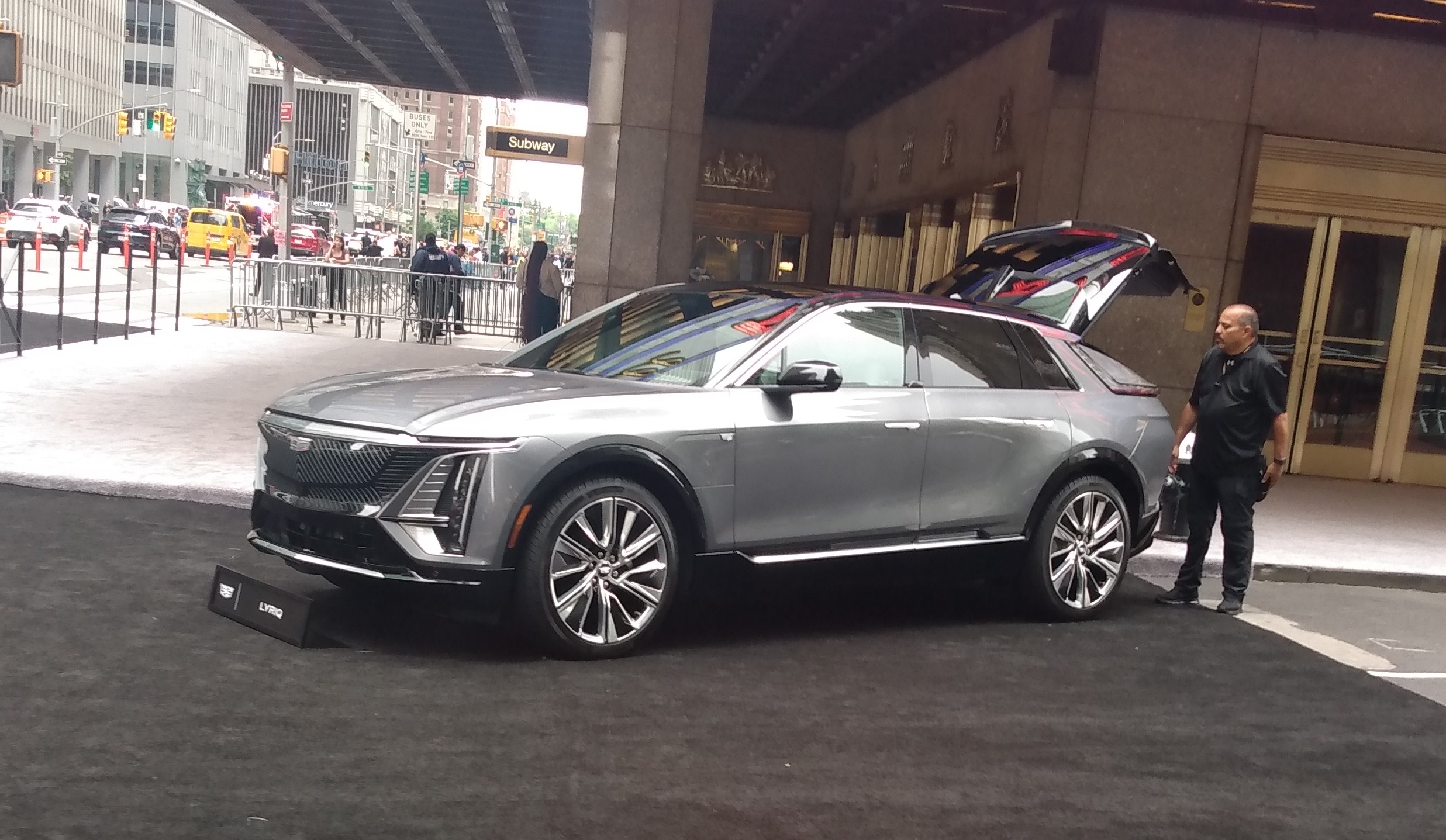
Cadillac Lyric
"...odel 3 performance, a Lucid Air, maybe a Cadillac Lyric. How about 50 grand in cash if that even sounds p..."
The Cadillac Lyriq is an electric SUV from Cadillac. The podcast mentions it as one of several electric cars people might compare when deciding what to buy. It’s included because it’s aimed at the luxury side of the EV market.
The Cadillac Lyriq is an electric luxury SUV, positioned as a premium alternative for buyers moving from gas vehicles. In the episode, it’s mentioned in a list of EVs people might consider, alongside other performance and luxury electric models. It’s relevant because it represents the luxury EV segment and how pricing and options factor into shopping decisions.
NetSuite by Oracle
"This week's episode of Ride the Lightning is brought to you in part by NetSuite by Oracle."
NetSuite by Oracle is a cloud software service businesses use to manage things like finances and operations. It’s mentioned here as the sponsor, not as something related to EVs directly.
NetSuite by Oracle is a cloud-based business management suite. In this segment it’s used as an example sponsor, not as an automotive technology, but it frames the episode’s broader theme of AI-driven tools.
battery technology
"Before buying an EV, these folks research charging, battery technology, software, range, road trips, ownership costs, they plan ahead."
Battery technology is what kind of battery an EV uses and how it’s built and controlled. It matters because it affects how far the car can go, how fast it charges, and how well the battery holds up as the years pass.
Battery technology refers to the design and chemistry of the EV’s battery pack and how it’s managed. Differences in cell type, pack design, and thermal management can affect charging speed, usable range, and how the battery ages over time.
software
"Before buying an EV, these folks research charging, battery technology, software, range, road trips, ownership costs, they plan ahead."
For EVs, software is the car’s computer programs that control things like battery charging and driving features. Updates can improve the experience over time, not just the hardware.
In EV context, software usually means the car’s operating systems and control logic—things like battery management, navigation/charging integration, and driver-assistance behavior. Updates can change how the car drives, how efficiently it uses energy, and how well it plans trips.
X-Care
"And that's exactly why so many Tesla and Rivian owners take a look at X-Care before they ever need it. Not because something's wrong, but because preparation is part of smart ownership."
X-Care is a service product for EV owners. The idea is to help you stay prepared and covered so you can enjoy your EV for years.
X-Care is presented here as an EV-focused coverage/assistance product aimed at Tesla and Rivian owners. The pitch emphasizes preparation and long-term ownership rather than reacting after something goes wrong.

Tesla Cybertruck
"Whether you're driving a Model Y, Cybertruck, R1-T, R1-S, or something else entirely, X-Care was built specifically for EV owners who plan to enjoy their vehicles for years to come."
The Tesla Cybertruck is Tesla’s electric pickup truck. It’s famous for its unusual look and for being an EV, so owners often talk about charging and range planning.
The Tesla Cybertruck is Tesla’s angular, stainless-steel-bodied electric pickup. It’s notable because it’s a distinctive EV platform in the truck segment, and it tends to drive lots of discussion about real-world ownership—charging, range planning, and costs.

R1-T
"Whether you're driving a Model Y, Cybertruck, R1-T, R1-S, or something else entirely, X-Care was built specifically for EV owners who plan to enjoy their vehicles for years to come."
R1-T is Rivian’s electric pickup truck. Like other EVs, it’s usually discussed in terms of charging and how far you can go on a trip.
R1-T refers to Rivian’s electric pickup truck. It’s part of Rivian’s lineup focused on adventure-oriented EV ownership, which often includes planning around charging and road-trip range.

R1-S
"Whether you're driving a Model Y, Cybertruck, R1-T, R1-S, or something else entirely, X-Care was built specifically for EV owners who plan to enjoy their vehicles for years to come."
R1-S is Rivian’s electric SUV. People who own it usually think about how to charge it and how far it can go on trips.
R1-S is Rivian’s electric SUV. It’s positioned as an EV for everyday use and road trips, so ownership discussions often revolve around charging behavior, range planning, and long-term running costs.

BMW Neue Classe M3
"In other EV news this week, BMW revealed the concept for its new Neue Classe M3, which will interestingly come in both an EV and a gas-powered version, no hybrid."
BMW is showing a concept for a future “M3” that will exist as both an electric car and a gas car. The big point is that BMW M is trying to make the electric version feel like a real performance car, not just a slower alternative.
BMW is previewing a new “Neue Klasse” platform concept tied to an “M3” performance model, and it’s described as coming in both an EV and a gas-powered version. The key enthusiast angle is that BMW is positioning this as a next-generation electric BMW M direction, not just a standard EV variant.

Bmw M
"...'s own website and on their blog, they wrote, the BMW M concept Neue Classe debuts the new design languag..."
The BMW M Coupe (E36) is a sporty BMW coupe from the E36 generation. The podcast mentions it as part of a discussion that connects BMW’s past performance cars to what’s coming next. It’s basically a reference to an older BMW model with an M performance focus.
The BMW M Coupe (E36) refers to a performance-oriented BMW coupe based on the E36 generation, typically associated with the M-badged lineup of that era. In the episode, it’s mentioned in the context of BMW’s broader design and model discussion, tying back to BMW’s performance heritage. It’s relevant because it helps ground the conversation in BMW’s past when talking about future design directions.
Neue Class Neue
"we are presenting the most expressive interpretation of Neue Classe design. Said Oliver Heilmer, head of design at BMW Compact class, Neue Classe NBMWM, he continues saying genuine aerodynamics and functional design that is even more than aesthetics,"
Neue Klasse is BMW’s plan for what their next generation of cars will be like. The podcast says it will focus on design and better airflow (aerodynamics), which can help efficiency. It’s mentioned because it’s a roadmap for future BMW vehicles.
Neue Klasse is BMW’s next-generation design and platform direction for future vehicles, described in the episode as an “expressive interpretation” with a focus on genuine aerodynamics. It’s discussed because it signals how BMW plans to shape both the look and efficiency of upcoming cars. The name matters in a podcast like this because it connects design philosophy to real-world EV performance goals.

3 Bmw Compact
"...se design. Said Oliver Heilmer, head of design at BMW Compact class, Neue Classe NBMWM, he continues saying gen..."
The “3 Series Compact” refers to a smaller version of BMW’s 3 Series lineup. In the podcast, it’s mentioned as part of BMW’s Neue Klasse plan, meaning the same new design ideas would apply to that smaller car. It’s basically about what BMW might build next in the compact segment.
The “3 Series Compact” is referenced as part of BMW’s Neue Klasse discussion, implying a smaller or more compact interpretation within the 3 Series family. It’s mentioned because the design and engineering goals of Neue Klasse—like aerodynamics—would be applied to that segment. That makes it relevant to how BMW intends to evolve its mainstream lineup for the EV era.
electric M3
"As for the battery-powered version, well, BMW says it'll be a hoot. Quote, with the electric M3, we move to the next level of vehicle dynamics."
They’re talking about an electric version of an M3 and saying it should be a better track car than the gas one. The episode is basically teasing what BMW is promising, even though the full specs aren’t out yet.
The segment frames an “electric M3” as a next-level performance direction, with BMW claiming it will be quicker around a track than the gas version. This is the core claim listeners are meant to evaluate as the EV M3 concept details remain limited.
vehicle dynamics
"We actually started development with the vehicle dynamics as our main target, so the EV won't just be the quicker car in a straight line, it'll be faster around a track too."
Vehicle dynamics is basically how the car drives and handles—how it grips, turns, and stays stable when you push it. Here, BMW is saying they tuned the electric car to be fun and capable on a track, not only fast in a straight line.
Vehicle dynamics is the study of how a car behaves as it moves—how it accelerates, brakes, turns, and stays stable. In the transcript, BMW claims the EV’s “vehicle dynamics” are the main development target, meaning the car is meant to be track-capable, not just quick in a straight line.
torque split
"The technology provided to us by Neue Classe means we can have the range, power, and torque split to create something quite extreme."
Torque split is how the car decides how much pulling force to send to different wheels. By changing that distribution, the car can improve traction and handling—especially when cornering or accelerating hard.
Torque split is how an EV distributes twisting force to its drive wheels (often between front and rear, or side-to-side). The transcript claims the Neue Classe tech enables a “range, power, and torque split” setup intended to create “something quite extreme,” which is a performance-handling lever.
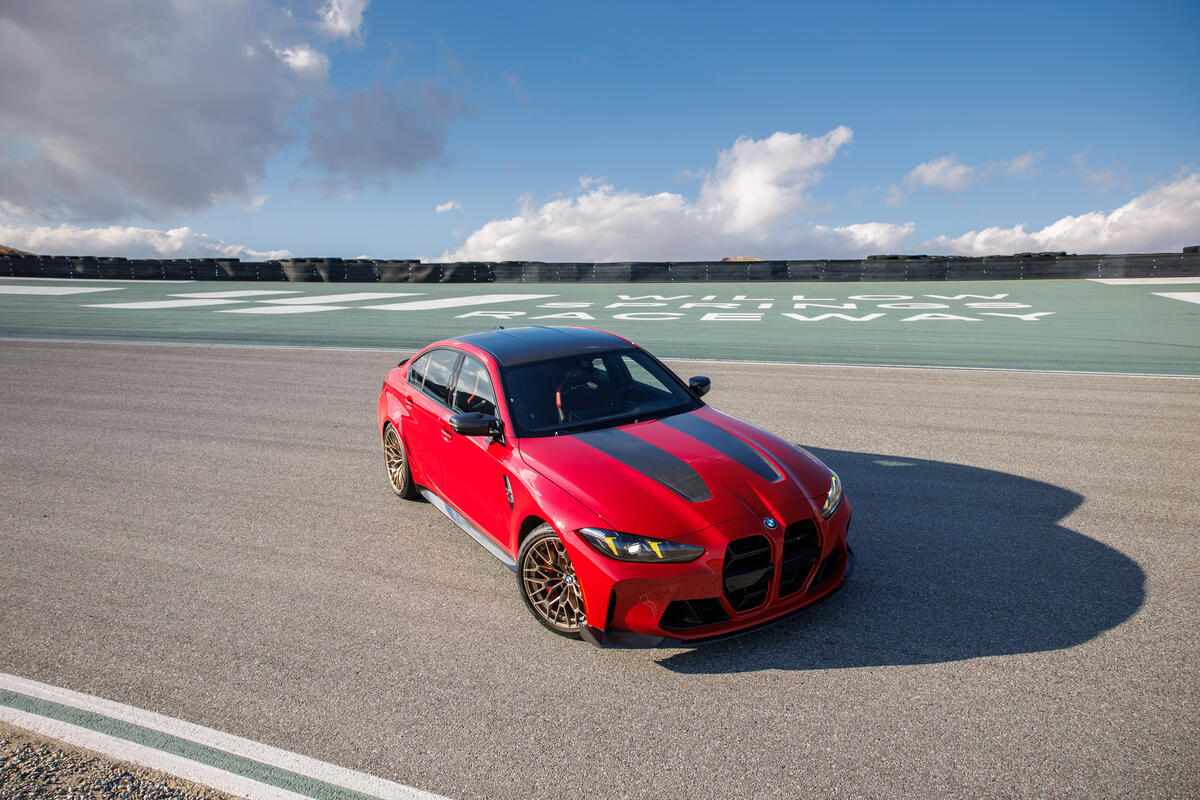
BMW M3 concept
"wondering, wait a minute, they absolutely called it an M3, it's an M3 concept. And this isn't necessarily the thing that's going into production, but anyway, BMW blog continues saying,"
BMW’s M3 is a high-performance BMW. In this episode they’re talking about an M3 concept, which is like a preview car that may not be exactly what you’ll be able to buy.
The BMW M3 is BMW’s performance “M” model line, and this segment is specifically about an M3 concept car. A concept is a preview of design and tech that may change before production, so the details discussed here aren’t guaranteed to match the final vehicle.
four electric motors
"the concept uses four electric motors powered by an M-specific battery pack with more than 100 kilowatt hours of usable energy."
Instead of one electric motor doing all the work, this concept uses four. More motors can help the car control grip and power more precisely, especially when accelerating or cornering.
Using four electric motors usually means each axle (or even each wheel) can be driven independently, which can improve traction and allow more precise torque control. That kind of motor layout is common in high-end EV performance concepts because it helps with acceleration and stability tuning.
concept car
"Well, I watched a couple of videos on this car, or at least the concept car, and I read up on it, and I have personally, I'll say, I've not been a fan of BMW's recent design language."
A concept car is basically a preview vehicle. It can show what a company is thinking, but the final production car may look or work differently.
A concept car is a showpiece that previews styling, technology, and sometimes powertrain ideas, but it’s not necessarily what will be built. The segment emphasizes that concept details often don’t match the production car closely, even if the concept is meant to hint at the future direction.

Tesla S
"You take any of the concept or prototype Tesla's from the S to the X, the three, the three was almost exactly the same car."
The Tesla Model S is one of Tesla’s main EVs. The host brings it up to say Tesla tends to build cars that are very similar to what they show in prototypes.
Tesla’s Model S is an early, long-running EV platform that helped establish the company’s reputation for turning prototypes into production cars. In this segment, it’s used as an example of Tesla prototypes being close to what customers actually get.

Tesla X
"You take any of the concept or prototype Tesla's from the S to the X, the three, the three was almost exactly the same car."
The Tesla Model X is an electric SUV. They mention it to argue that Tesla usually makes the production car look and feel like the one they show first.
The Tesla Model X is an EV SUV platform, and it’s referenced here as part of the “prototype-to-production” comparison. The point is that Tesla’s unveiled cars have historically been close to the final customer cars.
alphas
"Cybertruck, Cybertabs, I mean, Cybertab, we didn't even really get a concept. We got a whole fleet of alphas at the unveil for that."
Here, “alphas” means early test versions of the vehicle. They’re not the final product you’d buy, but they help the company validate the design and technology.
In this context, “alphas” refers to early development vehicles used to test ideas before a final production design. It’s analogous to early software “alpha” builds—vehicles that may be rough, incomplete, or different from what eventually ships to customers.
kidney grille
"They fixed the whole front end, like weird giant kidney grille thing that they were doing. Or I should say, they weren't even kidneys anymore. They were lungs on the front of the BMWs in recent years."
BMW is known for its distinctive front grille shape, often called the “kidney grille.” The host thinks BMW has been making it too big or too weird-looking on newer cars.
BMW’s “kidney grille” is the brand’s signature front grille shape, named for its kidney-like openings. The host argues that recent BMW designs have made the grille look overly large or stylized, comparing it to “lungs” instead of kidneys.
Neue Klasse
"By the way, I remember enough of my high school German, Neue Klasse does mean new class. So it's like, save by the bell, Neue Klasse. That is the new class. That is the literal translation of that one."
“Neue Klasse” literally means “new class.” In this context, it’s BMW’s label for a new direction for future cars—like a new generation of how they’re designed and built.
“Neue Klasse” is German for “new class,” and in BMW’s context it refers to a new generation of vehicle platform thinking. In other words, it’s not just a slogan—it’s BMW’s label for a foundational shift in how future cars are built and positioned.

Pontiac Firebird
"...ge of BMW. Mike Suttick saying, looks like my 80s firebird. And you know what, Mike, now that you say it, I ..."
The Pontiac Firebird is an older American sports car known for a muscle-car style. The podcast mentions it because someone thinks a vehicle looks like an 1980s Firebird. It’s mainly a visual comparison.
The Pontiac Firebird is a classic American muscle car that’s known for its performance heritage and 1960s–1980s era styling. In the episode, it’s mentioned as a comparison when someone recognizes a look that resembles an “80s Firebird.” It’s relevant because the conversation is using familiar design cues to describe how a vehicle looks.
eyes off
"introduce hands free driving by the end of the year followed by an eyes off autonomous driving ... However, Scarridge now says Rivian's point to point driving system similar to Tesla's FSD will arrive later this year while eyes off capability is now expected in 2027."
“Eyes off” means the car can do more of the driving without the driver having to keep their eyes on the road all the time. It’s usually considered a bigger leap than just taking your hands off the wheel.
“Eyes off” refers to an autonomy capability where the driver is no longer required to keep their eyes on the road constantly. It’s a step beyond “hands-free,” and it typically implies a higher level of system confidence and different driver-monitoring expectations.
hands free driving
"introduce hands free driving by the end of the year followed by an eyes off autonomous driving system this year, 2026."
“Hands free driving” means you don’t have to keep your hands on the wheel because the car is steering for you. You still usually have to pay attention and be ready to take over.
“Hands free driving” means the vehicle can steer and manage driving tasks without the driver holding the steering wheel. Even when steering is automated, many systems still require driver supervision and may use driver-monitoring to ensure the person is attentive.
point to point driving
"Scarridge now says Rivian's point to point driving system similar to Tesla's FSD will arrive later this year ... The system is expected to handle complete trips while still requiring driver supervision similar to how Tesla's FSD operates today."
Point-to-point driving means you set where you want to go, and the car tries to drive you there. The “supervised” part means it still expects the driver to watch and take over if something goes wrong.
Point-to-point driving is an autonomy mode where the car is tasked with completing a trip from a defined start to a defined destination. In this segment it’s described as “supervised” and “complete trips,” implying the system handles most driving while the human remains responsible for monitoring and intervention if needed.
robot taxi services
"Scarridge also discussed Rivian's longer term ambitions for fully driverless vehicles and robot taxi services."
Robot taxi services are like ride-hailing, but the car drives itself. The episode links it to the goal of having no driver inside the car.
Robot taxi services are ride-hailing operations where the vehicle drives itself without a human driver. The segment connects this idea directly to achieving fully driverless operation, because that’s what would make autonomous taxis commercially practical.
Rivian R1T
"That will roll out to all of our Gen 2 vehicles and of course R2. ... Rivian plans to deploy the capability to its Gen 2 R1T and R1S vehicles and the new R2 leaving Gen 1 R1T and R1S owners out in the cold."
The Rivian R1T is Rivian’s electric pickup. In this episode, they’re talking about which R1T versions will get the newer self-driving features, and that the Gen 2 cars are the ones targeted first.
Rivian R1T is the company’s electric pickup truck, and this segment discusses how Rivian’s autonomy rollout will affect it. The speaker says the new supervised point-to-point capability is planned for Gen 2 vehicles, while Gen 1 R1T owners may be left out.
Rivian R1S
"Rivian plans to deploy the capability to its Gen 2 R1T and R1S vehicles and the new R2 leaving Gen 1 R1T and R1S owners out in the cold."
The Rivian R1S is Rivian’s electric SUV. The episode is explaining which generation of R1S gets the newer self-driving features first.
Rivian R1S is the company’s electric SUV, and it’s mentioned as part of Rivian’s autonomy hardware/software rollout. The segment says Gen 2 R1S vehicles are targeted for supervised point-to-point driving, while Gen 1 owners may not receive it.
fully driverless operation
"While Rivian's immediate focus is on consumer vehicles, Scarridge made it clear that the company is ultimately working toward fully driverless operation."
“Fully driverless” means the car can drive by itself with no person inside. The big reason people care is that it could enable services like robot taxis.
“Fully driverless operation” means the vehicle can drive without a human in the car, not just without hands or eyes. The segment frames it as a longer-term goal that would enable new services like robot taxis.
first movers
"Maybe get there faster without having to navigate through the figurative minefield that Tesla's had to tiptoe through since Tesla, of course, has been the first movers in this space, at least certainly with regard to consumer vehicles."
“First movers” means the early companies that try a new technology before everyone else. The host is saying Tesla went first in consumer EV autonomy, so others may be able to learn from that and move faster.
“First movers” refers to companies that enter a new technology space early, gaining experience and learning from real deployments. In this segment, it’s used to describe Tesla’s early push in consumer autonomy and how that experience might help other automakers like Rivian “skip a couple steps.”
controlled experiment
"I'm not completely ignoring Waymo, but Waymo is, you could consider Waymo like a, a very controlled experiment by comparison to what Tesla's doing with FSD and what Rivian wants to do with its autonomy plus package."
The host is using “controlled experiment” to mean a self-driving program that’s run in a more controlled, limited way. That makes it easier to judge how well it works compared with self-driving software in everyday consumer cars.
“Controlled experiment” here means deploying autonomy in a tightly managed environment where variables like routes, operations, and system behavior are more constrained than in consumer driving. The host uses it to argue that Waymo’s results are easier to evaluate than Tesla’s and Rivian’s broader, real-world consumer use cases.
autonomy plus package
"getting back to Rivian, because Rivian hasn't really delivered anything as of yet, I wonder if I would pay $2,500 for that lifetime autonomy plus package if I were buying an R1 today or an R2 once they get the lidar pre-installed in them. I mean, I obviously, you all know that I bought FSD outright on both of our Teslas"
Rivian’s “autonomy plus package” is an add-on you pay for that’s meant to enable more advanced self-driving features later. The host is basically saying it’s a gamble because Rivian hasn’t proven the results yet.
“Autonomy plus package” is Rivian’s paid software/hardware bundle intended to unlock higher levels of automated driving capability over time. The host frames it as a buyer decision: since Rivian “hasn’t really delivered anything yet,” they’re unsure whether paying $2,500 for lifetime access is a sure bet.
Rivian R1
"getting back to Rivian, because Rivian hasn't really delivered anything as of yet, I wonder if I would pay $2,500 for that lifetime autonomy plus package if I were buying an R1 today or an R2 once they get the lidar pre-installed in them."
Rivian R1 is one of Rivian’s main electric vehicles. Here, the hosts are talking about whether it’s worth paying extra for Rivian’s future self-driving features on that vehicle.
Rivian R1 is the company’s flagship electric SUV/pickup platform line that’s positioned as a premium EV alternative to Tesla. In this segment, it’s used as the baseline example for Rivian’s “autonomy plus package” and how buyers might value future self-driving capability.
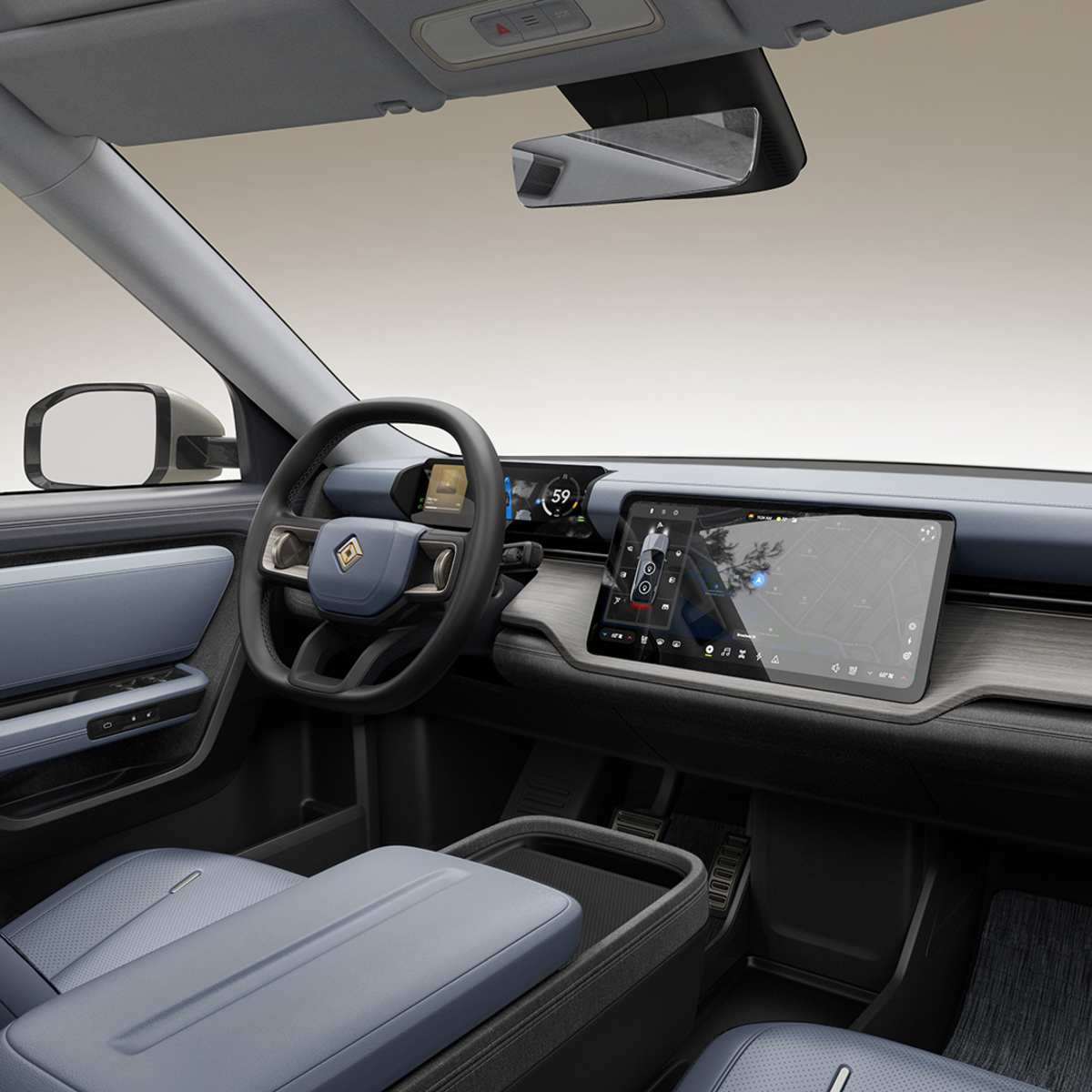
Rivian R2
"I wonder if I would pay $2,500 for that lifetime autonomy plus package if I were buying an R1 today or an R2 once they get the lidar pre-installed in them."
Rivian R2 is Rivian’s next EV the host is considering. They’re specifically talking about paying for self-driving features and how having lidar installed could make that package more valuable.
Rivian R2 is Rivian’s upcoming/next electric vehicle that the host references as a future purchase option. The key point here is that the host expects it to have lidar pre-installed, which they connect to Rivian’s autonomy strategy and the value of paying for a lifetime autonomy package.
lidar
"I wonder if I would pay $2,500 for that lifetime autonomy plus package if I were buying an R1 today or an R2 once they get the lidar pre-installed in them."
Lidar is a sensor that uses lasers to “see” the world in 3D by measuring how far away things are. The host is saying that if Rivian puts lidar in the car from the start, it could make the self-driving features more credible and worth paying for.
Lidar is a sensing technology that uses laser pulses to measure distances and build a detailed 3D map of the surroundings. Here, the host specifically ties lidar being “pre-installed” in the Rivian R2 to Rivian’s autonomy approach and the perceived value of paying for a lifetime autonomy package.
version 13
"either version 12 was already in or for sure version 12 and maybe even version 13 had come out right about the same time, but anyway, what I'm saying here is I'm not sure that I would necessarily recommend to other people that they buy the $2,500 autonomy plus package on their Rivian"
“Version 13” is another software update label from Tesla. The host is using it to show that FSD capability depends on which software generation your car is running.
“Version 13” is another Tesla autonomy/software release number mentioned as potentially having come out around the same time as the host’s FSD purchase. It’s part of the broader point that autonomy capability is tied to software versions and vehicle hardware readiness.
point-to-point supervised FSD
"Like, I'm eager to see what their system can do once they deploy that point-to-point supervised FSD later this year, and then once they do that, obviously I don't have a Rivian"
This is an advanced driving feature that can guide the car along a route from start to finish. It still needs the driver to stay alert and take over if the system can’t handle something.
“Point-to-point” supervised FSD describes a driver-assistance/automation mode that is designed to handle a specific route from one location to another, while still being supervised by the driver. “Supervised” implies the system is not fully autonomous in all conditions and expects driver monitoring and intervention.

Porsche Taycan
"And finally this week, the last bit of news, it's from Porsche and they are giving the Taycan, one of its most significant updates yet for the 2027 model year"
The Porsche Taycan is Porsche’s electric sports car. Here, they’re talking about big updates for the 2027 model year to make it more appealing—like a bigger battery, better charging, and improved software.
The Porsche Taycan is Porsche’s electric sports car, known for its performance-oriented EV architecture and strong driving dynamics. In this segment, the hosts focus on major 2027 updates aimed at boosting sales, including battery, charging, and software/UX changes.
infotainment
"The updates include a larger battery across the entire lineup, improved charging capabilities, a revamped infotainment system, and fake gear shifts."
Infotainment is the car’s main screen and software for things like music and navigation. A “revamp” usually means the interface and features are being updated or redesigned.
Infotainment is the car’s integrated system for media and information—typically the touchscreen, navigation, audio controls, and related software. When Porsche says it’s “revamped,” they mean the user interface and underlying software experience are being redesigned.
eShift
"The feature is called eShift, an optional system across the Taycan lineup and standard on the Taycan Turbo GT that attempts to simulate gear changes"
eShift is a Taycan feature that tries to make the car feel like it’s shifting gears, even though it’s electric. It adds simulated shift moments, sounds, and engine-speed changes to make driving feel more exciting.
eShift is an optional Porsche feature for the Taycan that simulates the sensation of gear changes you’d get in a gas car. It does this with virtual engine-speed cues, shift timing, and audio/UX effects to make acceleration feel more “mechanical” and engaging.
Taycan Turbo GT
"The feature is called eShift, an optional system across the Taycan lineup and standard on the Taycan Turbo GT that attempts to simulate gear changes"
The Taycan Turbo GT is the more extreme, performance-focused version of the Taycan. Here, Porsche notes that eShift (the simulated gear-change feature) comes standard on this model.
The Taycan Turbo GT is the high-performance variant of Porsche’s electric Taycan lineup. In this segment, it’s specifically called out because eShift is standard on it, tying the feature to Porsche’s top-tier EV performance model.
simulated gears
"paddles mounted behind the steering wheel allow shifts through eight simulated gears. Porsche says the system recreates characteristics"
Because EVs don’t shift like gas cars, Porsche uses software to imitate the feeling of shifting. It’s meant to make the driving experience feel more familiar, even though the car is still electric.
On the Taycan, “simulated gears” are a software feature that mimics the feel of shifting in a traditional car. Even though an EV doesn’t need gears to move, the system can create staged changes in response so the driver gets familiar cues like shift timing and engine-braking-like behavior.
virtual rev limiter
"Porsche says the system recreates characteristics such as engine braking effects, a virtual rev limiter, shift lights, and noticeable shift sensations."
A rev limiter is what stops an engine from spinning too fast. Here, it’s “virtual,” meaning the EV uses software to mimic that behavior for the fake engine feel.
A “virtual rev limiter” is an EV software limit that imitates the engine’s RPM cutoff you’d feel in a gas car. It helps shape the sensation of acceleration and lift-off by preventing the simulated engine behavior from continuing past a set point.
DC fast charging
"increases maximum DC fast charging capability to 320 kW when connected to compatible 800 volt chargers."
DC fast charging is the “quick charge” method for EVs. It uses high-power direct current so you can add a lot of range in less time than normal home charging.
DC fast charging is a method of charging an EV using direct current at high power, allowing much quicker top-ups than standard AC charging. The segment highlights that the Taycan’s updated battery and charging system increase maximum DC fast-charging capability when paired with compatible chargers.
800 volt chargers
"increases maximum DC fast charging capability to 320 kW when connected to compatible 800 volt chargers."
800-volt chargers are a faster-charging type of EV charger. They use higher voltage so the car can accept more power, which can mean quicker charging—if the car supports it.
“800 volt chargers” refer to high-voltage EV charging hardware that can deliver more power with lower current for the same power level. Higher-voltage architectures can reduce charging time and stress on components, which is why the Taycan’s peak charging rate is tied to charger compatibility.
AI-powered voice assistant
"and a more advanced AI-powered voice assistant capable of handling follow-up questions without repeatedly saying, hey Porsche,"
This is the car’s voice system, but powered by AI so it can understand you better. The improvement mentioned is that you can ask a follow-up question without having to keep saying the wake word.
An AI-powered voice assistant uses machine learning to understand and respond to spoken commands more naturally than basic voice control. The segment specifically calls out follow-up questions without repeatedly prompting for activation, which is a usability improvement for in-car interaction.
paddles and fake gear shifts
"But I'll bet that a sizable chunk of those new 2027 model year Taycan buyers will have stopped using the paddles and fake gear shifts at some point in their first year of ownership."
Some electric cars let you use steering-wheel paddles to imitate shifting gears, even though there’s no real gearbox. The host thinks owners will eventually stop using that and just drive normally.
Many EVs offer paddle controls and “fake” gear-shift behavior to mimic the familiar feel of a manual or automatic transmission. The host is predicting that Taycan owners will stop using those controls after living with the car, because they’ll prefer the EV’s natural acceleration and regen behavior.
embracing electrification
"I very much applaud Porsche for staying in the EV game when many of their legacy automaker counterparts are bailing out. Porsche is on my short list of legacy automakers who, who get a gold star for embracing electrification."
The host is talking about which car companies are really committing to making electric cars. They’re saying Porsche is doing it more seriously than some other traditional brands.
“Embracing electrification” is the idea that a legacy automaker commits to electric vehicles as a core strategy rather than treating EVs as a side project. Here, the host contrasts Porsche’s EV push with other legacy automakers “bailing out,” and frames it as a reason enthusiasts should respect Porsche.

Porsche Cayenne EV
"Then they, they just released the new Cayenne EV, which is a beast, and they've got a McCann EV as well."
The Porsche Cayenne EV refers to Porsche’s electric version of the Cayenne, the brand’s high-volume SUV line. The host calls it a “beast,” positioning it as part of Porsche’s broader push into electrification alongside the Taycan.
FSD improvements via parking-to-door workflow
"it was starting to rain and I thought wouldn't it be great if the FSD would just take me to the door and then go park itself... Now, the good news... smart summon recently got a very noticeable upgrade that's"
The discussion is about a new idea for Tesla’s self-driving features: have the car take you right to the entrance, then park itself. The host says a related feature already exists and that Summon recently got improved.
The caller proposes an FSD workflow that drives to the door and then automatically parks itself, explicitly framing it as the reverse of Summon. The host responds that a similar feature (“banish”) already exists and mentions a recent upgrade to Summon.
silent satellite view
"And it gives you a silent satellite view of where your car is and what cars are around it. So if a car is coming down the lane you can see it."
This phrase refers to the app showing your car from above (like a map/satellite view). The goal is to help you see what’s around the car while it’s moving, especially if cars are nearby.
“Silent satellite view” describes the app’s camera/map-style visualization used during Tesla assisted parking or repositioning. It’s meant to help the driver monitor the car’s surroundings—like nearby lanes and approaching vehicles—while the car moves.
inactive development
"We heard from Elon it's apparently coming in about three months. So again, whether that's three months or maybe a little longer, but it is inactive development and it is on our way to our cars soon."
“Inactive development” here implies the software feature is in a paused or limited state of active work, but still progressing toward release. The host frames it as something Tesla is working on that should reach cars soon, with a timeline of roughly a few months.
hydroplaning
"I've never really had a rain or weather related accident, but I am paranoid about hydroplaning. I have a 2022 Tesla Model Y performance that I use FSD almost exclusively in..."
Hydroplaning is when your tires hit a wet patch and can’t grip the road well, so the car starts to slide. In heavy rain, it can make steering and braking less effective.
Hydroplaning is when tires lose contact with the road and ride on top of a layer of water, reducing traction and steering/braking effectiveness. It’s a major risk in heavy rain because the car can feel like it’s “slipping” even if you’re driving carefully.
hardware three
"I have a 2022 Tesla Model Y performance that I use FSD almost exclusively in. Of course, it's got the hardware three computer and cameras, but as good as FSD is, I am really hesitant to let it be in control during heavy rain."
“Hardware three” is the Tesla computer and sensor setup the car uses for its driver-assistance features. In this call, the key point is that heavy rain can interfere with the cameras, so the driver has to take over.
“Hardware three” refers to Tesla’s third-generation onboard computer and sensor suite used for advanced driver-assistance and FSD features. The caller notes it includes cameras, and that in heavy rain the cameras can be impaired, forcing a takeover.
speed profiles
"I know that I can change the speed profiles. I typically stay in hurry. I can change it to standard or even chill, and I normally do that..."
“Speed profiles” are different driving behavior settings. They change how the car speeds up and slows down, and the caller uses them to make FSD feel less aggressive in bad weather.
In Tesla’s FSD/driver-assistance context, “speed profiles” are selectable behavior modes that change how aggressively the car accelerates, decelerates, and follows traffic. The caller uses profiles like “standard” and “chill” to make the system feel more comfortable in rain.
atmospheric rivers
"We get these atmospheric rivers on occasion. Now, what's funny is the first thing that I was going to bring up"
Atmospheric rivers are weather systems that bring a lot of moisture and can cause very heavy rain. The host is using them to explain the extreme conditions where tires and driving speed become especially important.
Atmospheric rivers are long, narrow bands of moisture in the atmosphere that can deliver intense rainfall to a region. The host uses them to describe the kind of extreme downpour where tire grip and conservative automated driving behavior matter most.
rain channeling tire
"suggesting that he consider like the best rain channeling tire available for the for the Model Y."
A rain channeling tire is designed with tread patterns (like grooves and sipes) that help route water away from the contact patch. That reduces the risk of hydroplaning and helps maintain grip when roads are wet or flooded.
OEM tires
"it turns out that the OEM tires that you probably already have on your Model Y performance are the best ones in the rain."
OEM tires are the tires that come on the car from the factory. The host is saying those stock tires are already very good in rain, so you might not need to replace them just for wet-weather driving.
OEM tires are the tires installed by the vehicle manufacturer at the factory. The host’s argument is that the Model Y’s factory tire choice is already optimized for wet traction, so switching tires may not be necessary for rain-focused safety.

2018 Model 3 performance
"my experience is that our 2018 Model 3 performance with hardware three on FSD, it has done quite well in the past in those big downpours"
This is a 2018 Tesla Model 3 Performance. The host is describing how their car’s driver-assist system handled big rainstorms, and they emphasize going slower than usual when visibility and traction are worse.
A 2018 Tesla Model 3 Performance is a performance-focused EV variant, and here it’s used as the host’s real-world example for how Tesla’s FSD behaves in severe rain. The key point is that the host pairs FSD with conservative speed choices during heavy downpours to maintain safety.

Tesla Model Y
"I am loving the full self driving. But as we move towards total autonomy, there's something that I struggle with on a daily basis and that's parking at work."
The Tesla Model Y is an electric SUV from Tesla. This caller has one, and they’re using Tesla’s self-driving features day to day—especially for parking.
The Tesla Model Y is Tesla’s compact crossover EV, and it’s one of the brand’s most common platforms for Full Self-Driving discussions. In this segment, the caller specifically ties their daily experience with parking and autonomy features to their Model Y.
drop a pin
"if there's not a feature or if there isn't, there should be where you can just drop a pin for your location."
“Drop a pin” means you tap a specific location on the map to mark it. The caller wants the car to use that exact marked spot for parking.
“Drop a pin” is a navigation workflow where you mark a specific spot on a map. Here, the caller wants to set a precise parking location (not just a general address) so the car can navigate and park at that exact point.
nav point
"but then if you hard press the place either you want, the parking spot that you want, just choose that as a nav point and have your car navigate to it."
A “nav point” is a marked destination your car can follow to. The host says you can select your parking spot on the map and set it as the destination so the car drives there.
A “nav point” is a navigation target that your car’s system can route to, similar to a waypoint. In this segment, the host explains that you can hard-press a map location, select it as the nav point, and then the car will navigate there and attempt to park.
HD2D
"But anyway, HD2D is basically, it's like taking Super Nintendo graphics, 16-bit graphics, and adding modern lighting and modern effects like depth of field to it."
HD2D is a visual style for games. It keeps the old-school pixel look, but adds modern lighting and camera effects so it looks both nostalgic and sharper.
HD2D is a game-art style that blends retro, pixel-art aesthetics with modern rendering effects. The speaker describes it as taking “Super Nintendo” era 16-bit graphics and enhancing them with modern lighting and effects like depth of field.
depth of field
"and adding modern lighting and modern effects like depth of field to it."
Depth of field is the “camera blur” effect. Things at one distance look sharp, while things closer or farther away get blurry.
Depth of field is a visual effect where only part of the scene is sharply focused while the foreground and/or background blur. In the context of HD2D, it’s used to make retro-style graphics look more modern and cinematic.
premium connectivity
"Mike from Samanich, Washington. This week, I call it, I had a question about Grock and his Tesla limiting his usage. After using it for a while and asked, well, why should this be? I have premium connectivity."
Tesla can connect to the internet through the car. “Premium connectivity” usually means you pay for a higher tier, which gives you more data/usage than the free option.
In Tesla terms, “premium connectivity” refers to a paid tier of the car’s built-in internet service. It’s used for features like streaming, live traffic, and third-party integrations, and it typically comes with higher usage allowances than the free tier.
LLM
"Grock is an LLM like any other LLM does have paid subscription levels and a free level."
An LLM is a kind of AI that can understand and write text—basically a chatbot brain trained on huge amounts of data. In this case, it’s the AI behind the Grock service, and access can be limited by your plan.
LLM stands for “large language model,” a type of AI trained on lots of text to generate responses. The speaker is explaining that Grock is an LLM, and that its in-car usage can be limited by subscription tiers and peak-time throttling.
throttle free users significantly
"The free levels always have usage limits, especially during peak times and will throttle free users significantly."
“Throttle” means the service intentionally limits you. Here, the free option gets restricted more—especially when lots of people are using it—so it may work slower or stop sooner.
“Throttle” means the system intentionally slows down or limits how much data/usage a service allows. In this context, the free connectivity tier is restricted more during peak times, which can make an in-car AI/chat service feel less responsive or cap usage.
SpaceX
"As for why it's limited for premium connectivity subscriber, do remember SpaceX owns and Grock, not Tesla. Via the purchase of XAI, which happens to include X, PKA Twitter."
SpaceX is a company associated with Elon Musk. In this segment, it’s mentioned because the speaker says SpaceX owns Grock, which influences how the app works inside a Tesla.
SpaceX is referenced here as the parent owner of Grock, which affects how the service is integrated and who controls the subscription/usage rules. The speaker claims Grock is owned via a purchase of XAI.
XAI
"Via the purchase of XAI, which happens to include X, PKA Twitter."
XAI is mentioned as a company involved in the ownership behind Grock. The point is that Grock’s limits are controlled by the Grock/AI side, not by Tesla’s connectivity plan.
XAI is mentioned as the company whose purchase is said to include Grock’s ownership chain. In this context, it’s part of the explanation for why Tesla connectivity doesn’t automatically remove usage limits for Grock.
Apple music
"just like you don't get free usage to Apple music in your Tesla because you have paid connectivity or serious or other services like MyQ."
Apple Music is used as an example. The speaker is saying that even if you pay for a music service, Tesla may still limit how much data or usage you get through the car’s connectivity.
Apple Music is used as an analogy for how paid services don’t necessarily remove usage limits inside a Tesla. The speaker’s point is that Tesla’s connectivity tier doesn’t automatically grant “free usage” for every third-party service.
MyQ
"just like you don't get free usage to Apple music in your Tesla because you have paid connectivity or serious or other services like MyQ."
MyQ is a connected-service brand (commonly used for garage access). The speaker is using it as an example that Tesla’s paid internet plan doesn’t necessarily mean unlimited use for every app.
MyQ is referenced as another third-party service that may still be subject to Tesla connectivity rules and usage limits. The speaker uses it to argue that paid Tesla connectivity doesn’t automatically eliminate limits for every connected service.
center console LED ambient light strip
"they've got fun stuff like a full-color animated center console LED ambient light strip, which is actually in the little gift they provide, looks really sweet."
This is a strip of LED lights inside the car that makes the cabin look nicer with soft colored lighting. It’s mounted along the center console area.
An LED ambient light strip is an interior lighting accessory that adds indirect, colored illumination along trim surfaces. In this case, it’s installed in the Model 3’s center console area to create a more “ambient” cabin look.
LED premium puddle lights
"They've got the mega-bright LED premium puddle lights that say Tesla, T-E-S-L-A in the logo, the correct font, the word mark there, etc. etc."
Puddle lights are lights that shine on the ground near your feet when you open the door. This version projects the Tesla logo.
Puddle lights are small LEDs that project a logo or pattern onto the ground when you open the door. The host calls out “premium” LED puddle lights for Tesla, including the correct “word mark” styling.
snap plate plus
"The snap plate and the newer, stronger snap plate plus available for basically every modern EV at this point. They've redesigned it for the Teslas in order to accommodate the lower front bumper camera..."
This is a front license-plate holder that mounts on the car securely. It’s designed to avoid drilling and to work around the camera on the front bumper.
A “snap plate plus” is an aftermarket front license-plate mounting bracket designed to attach securely without drilling or leaving permanent damage. The host also notes it’s redesigned for Tesla cars to accommodate the lower front bumper camera.
lower front bumper camera
"They've redesigned it for the Teslas in order to accommodate the lower front bumper camera. This is a great product if you are legally required to have a front license plate..."
This is a small camera mounted low on the front bumper. It helps the car “see” the road, and the license-plate mount needs to be shaped so it doesn’t block or interfere with that camera.
The lower front bumper camera is a Tesla sensor mounted low in the front fascia, used for driver-assistance and vehicle perception. Because it sits near the license-plate area, the host says the license-plate bracket must be redesigned to avoid interfering with it.
automotive tape
"Don't do that. Use the snap plate which does mount to the front end of your car very safely and securely but it leaves no permanent damage. If you want to take it off,"
Automotive tape refers to adhesive tape products used on cars for temporary or semi-permanent mounting. The host warns against using Tesla’s tape-based plate attachment because it can be harder to remove cleanly and may leave residue or damage.
Request an Explanation
Heard something you'd like explained? We'll add it to this episode.
Sign in to request explanations for terms you heard.
Want to learn more?
Browse our glossary for plain-English explanations of automotive terms, jargon, and concepts.
Help improve this episode
See something that's not quite right? Our annotations are AI-generated and can sometimes miss the mark. Click the flag icon on any annotation to suggest a correction.
1 community members have helped improve this episode.