This means they’re actually out there competing, not just talking about racing or getting ready. It’s a sports way of saying they’ve made it onto the track.
They’re talking about how an F1 team plans improvements to the car over several races. Instead of changing everything at once, teams bring new parts in stages and try to make them work together.
Instead of adding one new part at a time, the team can bring several improvements together. That helps them test the changes as a group and can save time.
They’re a brand-new F1 team, so they don’t have years of race data yet. That makes it harder to compare themselves with teams that have been around forever.
This means how long people on the team have worked in Formula 1. In racing, having lots of experienced people can help a team make better decisions and avoid mistakes.
Cadillac is the luxury car brand from General Motors. They’re talking about Cadillac’s new Formula 1 team and how it went from an idea to actually racing.
They’re talking about setting up big work sites in two different parts of the world. That means the team is serious about having a large operation, not just a small racing outfit.
A manufacturer is a company that makes cars. In racing, having a manufacturer involved usually means the team has a lot of money, engineering support, and resources.
'On track' means the car is actually being driven on a race circuit. The idea is that teams learn fastest when they can test the car in real conditions.
They’re talking about what happens when F1 teams get a break between races. More time can help them fix problems, but it can also slow down the rhythm they had built up.
This means all the companies and deliveries that get parts to the race team. If something is delayed, the team may not have the pieces it needs for the car.
This is about how well the team does its job behind the scenes. It’s not just about the car being fast, but about the people and systems working smoothly.
A race finish just means the car made it to the end of the race. In Formula One, that matters a lot because cars often break or crash before the finish.
A pit stop is when the car pulls into the pit lane so the team can change tires or fix things quickly. In F1, these stops are super fast and can decide races.
This is about how a racing team moves all its stuff around the world. They have to decide what goes on a plane, a boat, or a truck so everything arrives on time.
These are the races that are far away from the team’s base, so they can’t just drive the equipment there. The team has to ship or fly everything instead.
This means a complete batch of team equipment that gets shipped by boat. Teams keep several copies so one can be used while another is already traveling.
Topic
sea freight vs air freight
This is about how F1 teams move all their stuff around the world. Big heavy items go by ship, and important or expensive items go by plane so the team can race on time.
They’re talking about a scene in the F1 movie where the race team gets help from people not physically at the track. The question is basically: who are those people, and what do they do?
This means using computers or a simulator to practice and test ideas before the real race. It helps the team make better decisions without driving the actual car.
They’re talking about how a racing team can work from different places instead of all being at the track. Even if people are far apart, they still act like they’re in the same race control room.
A super license is basically the special racing license you need to drive in Formula 1. It shows the driver has enough experience and success to be allowed to race at that level.
A rookie driver is a newcomer or very inexperienced driver in Formula 1. Teams have to give these drivers some practice time so they can gain experience.
Long ago, race cars were painted in colors that represented their country. It was a way to show where the car came from before teams used their own branding.
F1 Academy is a racing series for women drivers. It helps young racers get experience and move up the motorsport ladder.
LIVE
Group chat getting quiet?
Drop a TikTok clip.
Trends, memes, hot topics, instant reactions, endless replies.
Keep the vibe alive.
Download TikTok now.
This podcast is brought to you by Avocado Mattress.
And if healthy, comfortable sleep matters to you,
this is one organic brand worth knowing.
That's because what you sleep on actually matters.
Most mattresses rely on synthetic foams and chemical materials
that trap heat, break down over time, or off gas.
Avocado does it differently.
Their mattresses are handcrafted with natural materials,
organic latex, organic wool, and organic cotton,
designed to be naturally cooling,
incredibly supportive, and long-lasting.
They're certified organic by GOTS
and meet multiple non-toxic and safety certifications,
made for people who care about their health
and the environment without sacrificing comfort.
I love that Avocado proves you don't have to choose
between comfortable, supportive sleep and your values.
And now, during our Earth Month sale,
you can get up to 15% off Avocado Mattresses.
Just go to AvocadoGreenMattress.com.
Get up to 15% off at AvocadoGreenMattress.com.
AvocadoGreenMattress.com.
The newest team at F1 is just three racers old.
Cadillac have outdone some far more established teams so far.
Their brand new car seems to be reliable.
Now, they need to make it faster.
And they have the opportunity to do just that.
A few weeks away from the track to do their homework,
study their performance so far,
work on upgrades, and to answer your questions.
Right here on F1 Explains.
Hello, everyone. Welcome to the official F1 podcast,
where I, Christian Hugill, put your questions
to the best people in the sport.
F1 Explains at F1.com is the place
to send your F1 wonderings, curiosities, and queries.
Emails are very welcome, so are voice notes.
Usually, we and the rest of the F1 world are at the racetrack,
but today, I'm at home.
And the teams are, too.
Well, I say at home, they're at their factories.
And Cadillac team principal, Graham Loudon,
joins us from the team's UK base at Silverstone.
Graham, welcome to F1 Explains.
How is it being back at the factory at the moment?
It's great, although it's quite funny
that a number of people have asked already
what I'm going to do with the long holiday
between Suzuka and Miami.
And of course, it's far from holiday for us
and any of the teams.
There's a huge amount of work going on.
We're certainly making use of the time.
The drivers are as well.
The engineers are mechanics, even.
But like anything, we're just itching
to get to Miami and go racing again.
We'll dig into that in a moment, actually, Graham.
But just before we look at the break,
let's look at the season so far.
Listen, the car seems to be solid.
You've suffered fewer reliability problems
than many other established teams.
How pleased are you with your first three racers
in this Formula One adventure?
Yeah, I think we have to be pleased in motor racing.
You're never satisfied.
You always want more.
But I think we do have to be pleased.
We've had five out of six car finishes
in the three Grand Prix so far.
And I think the fans can see as well
that when there is a big regulation change,
it does take a little while for everything
to settle in.
And it reflects just how difficult this game is.
Formula One is the pinnacle of world motorsport.
It's the greatest team game in the world.
And it's also one of the most difficult sports you can do.
I think people that we've put together
have done an exceptional job in a really short space of time,
simply to be on the field of play, if you like.
But that was never our target.
Just turning up was never the objective.
We want to be competitive.
And I think we've demonstrated already
that the team's performance is improving
Grand Prix to Grand Prix.
We've gone quicker in Shanghai than we did in Melbourne.
And we went quicker in Suzuka than we did in Shanghai.
And so that's really the focus now for us as a team,
is just continue improvement in every area that we can.
Well, congratulations on all you've achieved so far, Graham.
It's been really brilliant following your progress so far.
And we look forward to doing so across the rest of the season.
Now, last week on this podcast, Graham,
we had our resident strategist, Bernie Collins on,
and we asked her this question.
But we're going to start this week's episode
by asking it again, basically,
because we thought it would be a good opportunity
to get an answer from someone who runs a team
with the greatest of respect to the brilliant Bernie Collins.
So this is an email from one of our listeners, Chantel.
Chantel asks, with Bahrain and Saudi
not happening in April, will the FIA and F1
let teams work more on the car
to allow for changes and improvements?
So as we mentioned, Graham, Bernie answered the question
last week in that, yes, of course,
you are allowed to make changes.
You know, what is it you've been doing in this break?
What is it you're going to do for the rest of the break
in terms of analysis, upgrades?
How are you utilizing this time?
Actually, all of the team,
I'm pretty sure all the teams would be the same as us,
which is you already have quite a far-reaching plan
for upgrades over multiple Grand Prix
and multiple parts of the season, actually.
And so that side of things
probably hasn't changed that much.
What we will have been able to do
is optimize how we combine some of those upgrades, you know.
So certainly we had some plans already for Bahrain.
We had some other plans for Saudi.
We had some plans for Miami,
and it's given us a chance to combine
a number of those upgrades.
I think the other thing for us as a new team as well
is it's given us a chance to analyze the first three races.
It sometimes strikes me.
I don't know how many races, for example,
Ferrari have done in their history.
Someone will calculate it, but it's a lot.
We've done three.
And so it's important that we use, I think,
this time to look back at those three
and immediately say, what can we do to improve?
What's within our control?
We can't control what's happening at other teams,
but we can control what's in within our sphere.
And so it's really important for us to look back
at those analyze things and just maximize what we can.
And everything that we're doing
is just about constant improvement
in every single area of the team.
We've got a lot of experience in the team.
We counted up a little while back
that we had something like two and a half thousand years
of Formula One experience
in the more senior managers within the team.
Not in all in one person, obviously.
But less than 12 months of working together.
So the break has given us a chance to review,
but also we want to keep momentum as well.
We felt a real progress, Grand Prix to Grand Prix.
And it's really important for us to maintain that.
And I think that's another reason why
we're just very, very keen to get to Miami.
And it's a home race for the team as well.
To answer your question on Ferrari, Graham,
I had a quick Google.
Producer Chris had a quick Google.
We've both come up with at least 1,100 race starts
for Ferrari.
So they are narrowly edging you there with your three.
You are right with your assumption.
They've got a narrow advantage on the race starts front.
Yeah, yeah.
And in terms of obviously Ferrari are a good partner
of ours at the moment.
And it's great to have that experience on board as well.
And it's been fantastic for me to witness
the Cadillac Formula One team go from being an idea
on a sheet of paper to team competing
in the highest level of motorsport in the world.
And that's been a real honour and a privilege
for me to be able to do that.
Have there been moments where you've stood there,
I don't know, for example in the paddock in Australia
and had those little moments
because as you say, you have been with this project
right from when it was just being talked about
as a hypothetical.
Have you had those moments where you sat on the pit
and we're like, yeah, we did it.
We're here.
I have, yeah.
And I consciously made a decision to do that
because I didn't really do it the last time
brought a new team into Formula One who was much more,
well, we just didn't think of it actually.
Hello, to be honest, we did maybe 2010 Monaco on the grid.
That was a bit of a sort of, we're okay, we're here.
So this time, I've made a conscious decision to do it.
And I've talked to everyone in the team about it as well
about doing the same, you know,
because that was a learning for me from the previous time.
And it only takes 30 seconds.
You know, you don't have to dwell on it or anything,
but just capture the moment.
What we're doing doesn't happen very often.
In fact, it never happened.
In reality, it never happened.
You never get a chance to bring a huge automotive
manufacturer in, start a brand new team,
build factories on both sides of the Atlantic,
hire some fantastic people, you know,
give them the resources and the opportunities
to show the world what they can do.
It just never happens.
So I've encouraged everyone in the team
to take that little 30 seconds,
no more because we need a lot of time
to focus on their job in hand.
But, you know, just take that 30 seconds
and just have a lad.
You know, I personally think what the team has done
up to this point is exceptional, you know, really is.
And it's a testament to getting a lot of clever people
into one place and giving them the resource that they need.
We've always said we want this to be the team
that everyone wants to join.
Everyone's proud to be in and nobody wants to leave.
And, you know, I think we're well on our way to doing that.
Absolutely. And we'll just say
for those newer to Formula One,
Graham, you have, as you say, got experience
with bringing a new team into Formula One.
Graham ran the Manor team in F1
through its various guises from its entry as Virgin in 2010
and until 2015.
So Graham's got that experience with bringing, you know,
a new entity into Formula One.
Graham, just finally on the break,
I'm really interested in the sort of parallel
between you so often hearing Formula One,
it said the best way of learning is on track.
Now, obviously we've lost out on those two races
of on track stuff,
but have you been able to find an advantage
in having time away from the track?
And where is that parallel between time on track
and actually a bit of extra homework time back at the factory?
It genuinely is a kind of two-edge sword
because it does help in certain areas.
You can catch up in certain areas.
You know, there's always things in every team
where in the supply chain, you know,
you need a little bit of extra time
maybe to get some components
that were going to be pretty tight caught up or, you know,
there's always something like that.
But the flip side is we were into a really good momentum
in that we saw huge progress
in the way we were operating in the first three Grand Prix.
And so the challenge for us is when we go to Miami,
we don't want it to feel like Grand Prix number one again,
you know, in our massive history of three Grand Prix.
We, you know, we want to build upon it.
So, you know, there are some challenges
when you have the gap,
but the main thing is that as soon as it was clear,
you know, from Formula One and from FIA,
that there was going to be this change to the calendar.
The main thing was that we put in place
a really clear plan,
what we're going to do in the time available
and maximize everything
because we won't get this pause again.
So maximize everything that we possibly can
and go to Miami, you know,
in the best condition that we can as a team
and try and continue that progression,
both operationally and performance-wise.
Of course, the tricky thing is we sit here and say,
well, it's great, you've got this opportunity
to go back to the factory,
to learn from those first three races,
to try and improve the car,
to try and keep that reliability up,
to try and bring in more pace.
But the tricky thing is in Formula One,
your 10 rivals have all got exactly the same.
It's not like you've got this extra time
and everybody else doesn't.
Yes, that is the pesky thing about this sport,
is there's a whole load of other people
who are very good at it as well.
You know, we've said before,
we have huge respect for the other teams
and know them very well.
And I think it is important to respect your competitors
otherwise, you know, if you don't have respect for the...
You know, we have huge respect for the championship.
That's the starting point.
Personally, I always have a thing for me.
The one is super special.
It's really special.
It's such a hard game, this and it's such a hard industry
that if you don't have respect for, you know,
for what you're competing in,
then I genuinely don't know why people would do it.
The downside with it being so competitive
is as you say, everyone has the same,
everyone has that same advantage at the minute.
They've all got a bit of a chance to regroup
or sort some issues out or whatever.
But it's also one of the fundamental attractions
of Formula One is just the competitive level is just insane.
It's difficult to see other sports that have that level
where you have all those teams,
because for me, it's the ultimate team game.
It's the greatest team game in the world,
but all the teams are on the pitch at the same time
and you've got a thousand players in every team
and you've got to get the best thousand players
in the right place at the right time
with the right resources.
And that's what breeds this just absolutely intense competition.
But it's also part of the magic recipe
that makes Formula One so attractive to watch.
But you talk about having respect for your fellow teams
and respect for the series.
It certainly has felt to me in the paddock
so far that you've earned that respect
from your competitors as well.
And we talked about your start to the season here
out of six potential race finishes
with your two drivers.
You've got five, Valtteri has finished as high as 13th.
It seems like a really solid start way.
It seems to me that you've earned that respect.
Do you feel that?
I do.
It was our first day at Adobe Jectivist
and the respect of the competition.
And we've certainly had a lot of...
I personally had a lot of very supportive messages
from people in other teams, very senior levels.
And that's nice.
I've spoken quite a bit about how competitive
Formula One is.
And it is brutally competitive.
But also there is a real respect between competitors.
And rightly so, we're all in the same sport together.
And I value that relationship.
And it's good when you get those messages.
So, and it's two-way thing as well.
We show respect to the competition.
I'm super lucky because a lot of the good comments
that we've had are delivered to me as a team principal.
And so I've spent quite a bit of time talking to everybody
and now a team to pass on those messages as well.
Because the reality is, I don't do this.
It's all of the people in our team who do this.
They're the ones who've designed the car
and built the car and do the pit stops
and go racing and do all the late nights and all nights.
And it's great for me
because everyone tells me how good the team's doing.
So I kind of get all the upside.
And I made a real effort to pass that message on
because I genuinely think that the job
that our small band of people have done is really exceptional.
Absolutely.
We are going to put some of your questions
to Graham Loudon in just a second on F1 Explains.
From Taco Night in Tulum to Sushi in Tokyo,
everybody's rewarding and pulse-worthy
with MX Gold's four times membership rewards points
at restaurants worldwide.
Wherever you dine, points are piling up.
So bring your friends along for your next course
because it's not all about the posts.
It's about the company and the memories.
How can gold from MX sweeten your next food moment?
Learn more at americanexpress.com slash explore dash gold.
Terms and points cap apply.
Quality proteins aren't just for special occasions.
With Omaha Steaks, you get unbeatable flavor
and value delivered right to your door.
They have an unmatched selection
of perfectly portioned proteins,
including USDA certified tender,
steaks, burgers, chicken, pork, seafood, and more,
all flash frozen at their moment of peak quality.
Then quickly deliver to your door in a dependable cooler.
So a great dinner is just minutes away
from Taco Tuesday to a weekend feast.
Omaha Steaks practically invented meat delivery
and they've been perfecting the art of premium proteins
for over 100 years.
With their 100% satisfaction guarantee,
you can order with complete confidence.
Taste the Omaha Steaks difference.
A better, more convenient way to buy proteins.
Start getting flavorful proteins delivered today.
Visit OmahaSteaks.com and get $35 off
with promo code audio at checkout.
That's OmahaSteaks.com code A-U-D-I-O.
Terms apply, see site for details.
Welcome back to F1 Explains.
I'm Christian Hugill.
We are with the Cadillac team principal, Graham Loudon.
And Graham, are you up for some of our listeners' questions
that they have put to you?
Sure. Yeah, I can't wait.
Erika in Phoenix, Arizona,
Andrew and Ryan and Matthew from Connecticut.
All want to know about logistics,
especially interesting given
that we're now not racing until Miami.
They say moving all of the stuff for a race
seems to be a huge undertaking.
How do the teams decide which bit of their gear
has to be sent by plane, boat or truck?
As we say, Graham, a particularly interesting one,
given we're now going from Japan to Miami now.
Yes. I think the logistics in Formula One is fascinating.
It's beyond the signs.
It becomes a bit of an art form.
And there are different modes of transport,
as the question is of rightly identified.
So a lot of stuff goes by truck and sea.
So a lot of stuff goes by truck and sea and also air.
So the truck side of thing is fairly easy to define
because that's primarily the European races.
Those are races that are easier to access
from most of the logistics bases for the team.
And we are an American team,
but we have a logistics establishment in Silverstone,
so within Europe.
So the European ones are truck based
when it comes to all of the non-European races
or flyaway races, as we usually refer to them,
then we use a mixture of air freight and sea freight.
And what you see on the TV in terms of a lot of the
infrastructure in the garages and everything,
although it looks the same at every race,
it's actually not.
Most teams will have six or seven sets of sea freight
which leapfrog around the world.
So a set that goes to Melbourne may then go off
to Miami or somewhere like that.
In general, the rule is if it's heavy and low cost,
it'll go by sea.
If it's light or expensive, it'll go by air.
And when I say expensive, I mean things like the race cars.
They'll be shipped by air, but heavier things
like back of house garage boards
and all of the paraphernalia that make up
the equipment that's needed for a team to operate.
That's heavy.
We'll buy multiple sets.
So in our instance, we have six sets of sea freight
and they're constantly just on ships leapfrogging
around the world, ensuring that when we turn up
with the air freight, which is like the icing on the cake,
if you like, the team is there
with all of the facilities it needs.
And it looks to the standard that everyone's come
to expect in Formula One.
And it's fascinating that everyone just
never stops moving.
Our next question is from Chris in Brisbane
in Australia.
Chris says, my questions are related to the support members
who aren't at the track during a race weekend.
What prompted me for this question
was I was watching the F1 movie
and there was a few scenes where the pit crew
on the grid would radio to an off-site crew
who were providing support, data
and recommendations for strategy.
How many people are usually completing this support?
What are their roles?
Where are they likely based?
How do they communicate this to the on-site team?
And we particularly wanted to put this question
to you, Gray, and because as you've just mentioned,
Cadillac do have team members at the racetrack, of course,
but you've also got a base at Silverstone in the UK,
in Indianapolis, in Indiana,
and in Charlotte, North Carolina.
So you have got a truly global operation in Cadillac,
haven't you?
We have, and we've tried to design the team
so that it kind of doesn't matter where you are
in the world if you're in the Cadillac Formula One team
and then you can contribute to where we're racing.
So at present, we operate with the facility
that the question relates to is kind of what most teams
refer to as a remote garage.
So we operate with two at the moment.
One is at the GM Technical Center in Charlotte
and the other is at Silverstone.
Typically, we'll have maybe 25 or so,
25 to 30 people at the facility in Silverstone
and then 10 to 15 or so
at the GM Technical Center in Charlotte.
When we do a schedule for the team,
we have the time zone of all of these different facilities
and then of course you're racing in a third time zone as well.
So it could be Melbourne or Singapore or wherever.
I think everyone's body clock gets really messed about
quite a bit because whatever time it is in Silverstone,
it'll be a completely different time in the GM Tech Center.
So while one group are having lunch,
the other group are having breakfast and all sorts.
But to answer the question of what do these people do,
typically it's additional engineering support
on, you know, so they're monitoring things like brake,
suspension, reliability, all sorts of other things.
And then also simulation.
So we have, at present,
we have our driver and the loop simulator
again based at the GM Tech Center in Charlotte
and North Carolina.
And so the group there will also be working out
what kind of program would be run overnight,
I should say overnight, wherever the Grand Prix is,
could be the middle of the day in Charlotte.
But they'll be working out what should we simulate
between, for example, FP2 and FP3
or between Quali and the race
or whatever on a normal non-sprint weekend.
And we operate with all the same protocols
as if somebody was at a race,
you know, the same headsets,
they have the same intercom system.
And it's really interesting for me
because I sit on the pit wall during a race
and I'm talking to people and I know them,
I know their voice, I have no idea where they're sat.
Could be in the US, could be at Silverstone,
there could be 20 yards away in the garage.
But I love just hearing that symphony of everything,
everybody working together as a team.
That's why I said it's a great steam game in the world.
The pitch is very spread out.
You know, hearing little things like that
just really underline why I love this sport.
It's amazing, isn't it?
You're sat there on the pit wall
at the Canadian Grand Prix, for example,
and you've got people talking to you from all over the world.
You don't know where they're coming from,
but they might as well be next year.
It's absolutely fascinating.
Hannah is in Germany.
Hannah's emailed at f1explains at f1.com.
Hi, Hannah, thanks for your question.
Hannah says, I would love to learn more
about the differences between reserve drivers,
development drivers or test drivers.
Are there any rules around those roles?
Now, obviously, with Cadillac, Graham,
you guys have got the IndyCar race winner,
Colton Herter, as your test driver.
He's also racing in Formula Two,
where he scored points in his first F2 weekend in Australia.
So, well done to him.
And you've got Gio Grandu as your reserve driver,
who's previously raced in F1 with the Salbertine,
the Alfa Romeo team.
Graham, differences in their roles?
Yeah, so there are differences to answer Hannah's question.
And there's a number of differences to do with the task
that each driver has.
There are also regulatory differences as well.
So if we start with raced drivers,
because that's kind of the most obvious,
the raced drivers have to have a full super license.
The reserve driver also has to have a full super license
because they need to be in a position
where they can step in for one of the two raced drivers
in the unfortunate circumstance
that one of those drivers isn't able to drive,
so perhaps they're ill for some reason or something like that.
But the reserve driver has to satisfy the requirements
of a full super license to be able to do that.
Test driver doesn't have to have a full super license.
They can play a role in developing the car,
so they could be heavily involved in the simulator program
and other elements of contributing to the engineering side.
In the Formula One regulations,
each team needs to give the opportunity
to a rookie driver to do free practice,
one session for a number of occasions,
so this here would be four occasions.
And so typically, if you look at our team,
obviously the raced drivers are not rookies
and neither is our reserve driver either.
But our test driver would qualify as a rookie,
so we would have the opportunity
to give Colton some Formula One experience,
which in turn would add to the valuable feedback
that he can contribute on the engineering side.
And then just to extend Hannah's question even further,
we then have a roster of simulator drivers as well.
Now, obviously the raced drivers, reserve drivers
and test drivers also drive on our simulator,
but we have additional drivers.
We have Pietro Fittipaldi and Simon Pancino
who provide some really essential work
on the simulator as well.
So you can see there's a real range of roles
and locations and they all contribute
to the overall objective of the team,
but they do so in different ways.
Absolutely, and Graham, I know you're a very busy man,
so we've got you for just a couple more minutes.
Wanted to ask this one final one from Jen Insuri.
Jen says, love the podcast.
It's fascinating to learn more
about this crazy and complex sport.
I'm new to F1, so I greatly appreciate the insights
you share and it's so well explained.
So that's very nice of you, Jen.
Thank you.
Jen says, my question is,
how are the team's colours decided?
So in this case, why did Cadillac decide
on their black and white colour scheme
I love a livery question, Graham.
I really do.
Well, I'd love to say it
is because I'm a Newcastle United fan.
I'm not sure I could get away with that.
The colour scheme developed over some time
and what we wanted to really show
was a real aspirational side
to how we treat the brand actually.
And we really liked this dark combination
of the black and the white in it.
It kind of reflects this combination of things
that we need, you know, we need this true grit
of the job that we've got in hand is a lot to do.
We also want it to reflect the aspirations
of the team going forward.
And also we have in that palette,
we also have silver as well.
We don't use it very much,
but we do use it to show that slight elevated approach,
but without being kind of flashy
to show off or anything like that.
But Cadillac is a premium brand.
So there is a lot of thought.
It's a great question from Jen, by the way.
And it does reflect the fact
that there's a huge amount of thought
behind everything that we do,
including the colours.
And actually we have a brand book
which has got pages and pages on why the black,
why the white, why the silver,
and then there's some accent colours as well.
But I won't bore you with the pages and pages.
But it's very much to reflect
the core values that we have in the team.
We have build ambition.
It is all one team.
We like to keep things simple,
but with a real elevated approach.
Yeah, and teams want to give themselves
a sense of identity, don't they?
I remember Zach Brown saying,
when he came into McLaren,
he felt like that was missing
and he really pushed forward
the bold, papaya colour scheme.
Obviously Ferrari have always had the bold red
that you associate with it.
Teams just want to give themselves an identity,
don't they?
And decide how best to fit in with that.
They do.
And for the, Jen's new to Formula One,
for the fans who've been around a long, long time,
Grand Prix racing used to be done in national colours.
Red actually used to be the national colour of the US.
And then it got kind of switched to Italy
and the US adopted white.
And that was another reason for us having white in.
I love that.
In our palette as well.
So there's a bunch of history,
it reflects Cadillacs 120 odd years
of history and innovation.
So there's a lot goes on behind
what looks very simple choice of colours,
but there's a lot behind it.
But as a Newcastle United fan grain,
you couldn't have possibly have gone with the red
if for the red and white of Sunderland,
that would have just not worked at all.
I was secretly smiling to myself
and somewhat delighted when I saw the final colour palette,
but it's definitely been driven by solid marketing reasons
and not just my choice of football team.
And for our American listeners,
Newcastle United's big rivals
are Sunderland who play in red and whites,
just to, we're going to have people all over the world
baffle that are getting slightly niche football chat, Graeme,
which is something I guilty of.
Yeah, I should clarify that football means soccer as well.
The regular listeners to this podcast
are used to my references on that by now, Graeme.
Graeme, this has been an utter joy.
And listen, I'm a Formula One fan first and foremost.
So for me as a fan of the sport,
seeing the team come in has just been fantastic.
So following your progress
has been such an enjoyable part of 2026 so far.
Look forward to that continuing.
And congratulations on all you've achieved so far, Graeme.
It's been great to watch
and we really appreciate you taking the time
to come on the podcast.
Well, thanks, Christian.
It's kind of you to say, you know, I'm a Formula One fan as well.
And, you know, we've said right from the start,
as a new team, we want to contribute
and give something more to the fans.
All the best for your home race in Miami, Graeme,
that first home race.
And we look forward to catching up soon.
Thanks, Christian. Thanks.
Huge thanks to Graeme and the team at Cadillac
for taking the time to talk to us.
Of course, they've got a few weeks away from the track,
but it's always busy in Formula One,
so we really, really appreciate it.
And I really emphasise, I just think Cadillac
have done such an impressive job so far this season.
It's one of F1 2026's most fascinating storylines
to see how they continue to develop
as they move through the season.
And of course, future seasons.
It's a long-term challenge.
We'll keep sending us questions.
And don't be down heartened, by the way,
if we haven't answered yours yet.
We've got loads to get through.
We appreciate and read every single one.
And we're working on finding the best guests to answer them.
A few shout-outs to some recent e-mailers
who are waiting to have their questions answered.
Brandon from California.
Bazma from London.
Liz from Chicago.
Bart from Tennessee.
Sean from London.
Debra from Adelaide.
And Tommy from Maryland.
Thank you so much for all the questions.
But just because we've got loads,
it doesn't mean we want you to stop sending them.
We're going to be right here all the way
until the end of the season.
So join them.
In our inbox, F1explains at F1.com.
Bonus points if you send a voice note.
I'm not entirely sure what you could
cash those bonus points in for,
but we've got time to work on it.
Also, just a reminder, F1 Beyond the Grid
has had some great guests recently,
including Cadillac CEO Dan Tarris,
plus F1 Academy Champion Dorian Pan,
and the 1997 Formula One World Champion,
Jacques Villeneuve.
Check that out wherever you listen to your podcasts.
Plus, the latest episodes of F1 Nation are on this feed too.
We're back with new episodes on F1 Explains every Friday.
So until then, thanks so much for listening.
Bye-bye.
About this episode
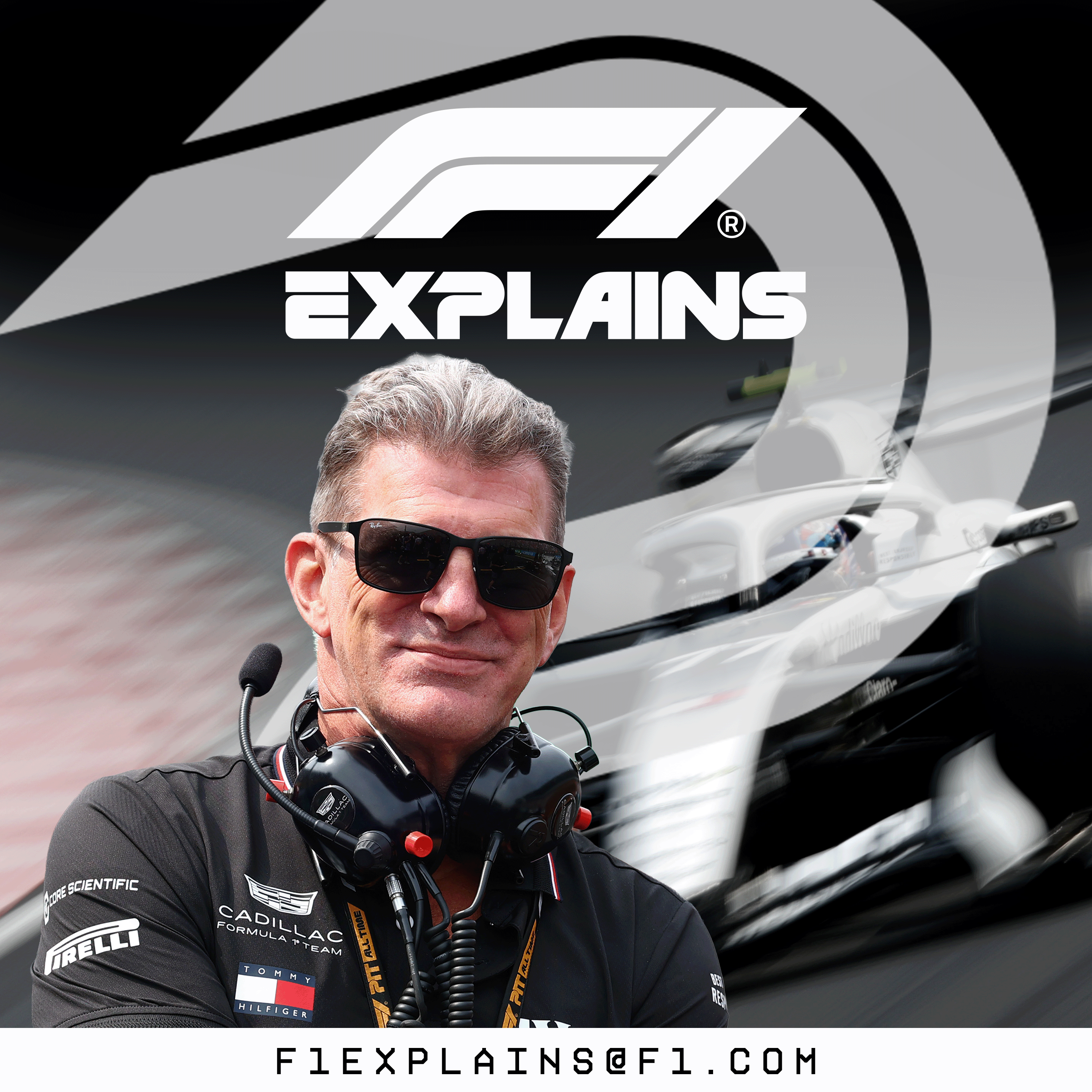
Cadillac team principal Graeme Lowdon joins to unpack the brand-new team’s first three races, where reliability has been a pleasant surprise but outright pace still needs work. He explains how the unexpected break between races has been used to combine upgrade plans, study early data, and keep momentum without losing the progress made so far. The conversation also touches on the rare experience of launching a new F1 team, the emotional milestones along the way, and how Cadillac is balancing factory homework with the pressure to keep improving.
How do Formula 1 teams get all their kit to Grands Prix? What’s the difference between Reserve, Test and Development drivers? And how do team members working back at base during a race weekend help the team at the track?
Cadillac Team Principal Graeme Lowdon joins Christian Hewgill on F1 Explains to answer your questions about the sport.
Graeme also gives his assessment of Cadillac’s first three races as an F1 team and tells Christian what the team are working on during the April break.