CPO programs are for used cars that have been checked and approved by the dealer or manufacturer. They usually come with extra warranties to help buyers feel safe about their purchase.
Subaru is a car company from Japan that makes vehicles known for being safe and reliable, especially in bad weather. They are popular for their all-wheel-drive systems, which help with traction on slippery roads.
BMW is a well-known car brand from Germany that makes luxury vehicles. They are famous for their sporty performance and high-quality interiors, often seen as a status symbol.
The Tesla Model 3 is a fully electric car that is known for being fast and having a long battery life. It's important because it shows how electric cars can be practical and fun to drive, making them a popular choice for many people.
The Audi e-tron is a fancy electric SUV that offers a smooth and quiet ride without using gas. Some early models had problems that made people question how reliable they are, which is something to think about if you're considering buying one.
Chrysler is a car brand from the United States that makes different types of vehicles, including minivans. They have had some issues with reliability recently.
The Saturn Outlook is a big family car that can fit a lot of people and their stuff. It's designed to be comfortable and useful for families, which is why it was popular when it was made.
CAFE rules are laws that set fuel economy standards for cars and trucks. They help ensure that vehicles are more fuel-efficient, which can save drivers money on gas and reduce pollution.
Fuel economy is how far a car can go on a certain amount of fuel, usually measured in miles per gallon. Higher fuel economy means you spend less money on gas.
Hybrid EVs are cars that use both a gas engine and an electric motor. They are designed to save fuel and reduce pollution, but they can be more complicated to fix than regular cars.
Advanced driver assistance systems are features in cars that help drivers avoid accidents and make driving easier. They can do things like help you stay in your lane or stop the car automatically if there's an obstacle.
The Volkswagen Lupo is a small car that's perfect for driving around the city. It's easy to park and uses less gas, making it a good choice for people who want a simple and efficient vehicle.
OEM means the original company that made the car parts. If you buy an OEM part, it's made by the same company that built your car, ensuring it fits and works properly.
A warranty is like a guarantee from the car maker that they'll fix problems for a certain time after you buy the car. If something goes wrong during that time, they usually pay for the repairs.
The TVR Griffith is a sporty car from the UK that is built for speed and fun driving. It's getting a lot of attention because it's coming back after being out of production for a while, and people are excited to see what it can do.
An oil change plan is a service you can buy that pays for your car's oil changes for a certain time or number of visits.
LIVE
Thanks for choosing to be here on this Friday, December 5th.
And on this day, CDG Circles are live.
Many of you saw the Cardiola Ships guys post to LinkedIn last night talking about the number,
the quality, the quantity, and the first question from CDG himself came out today.
How was November?
Groups are interacting on that question.
Some of the feedback is fascinating, interesting, and certainly a help to all of us in the
industry.
Before we talk fixed-ops today as Fixed-Ops Friday, let's cover today's industry news.
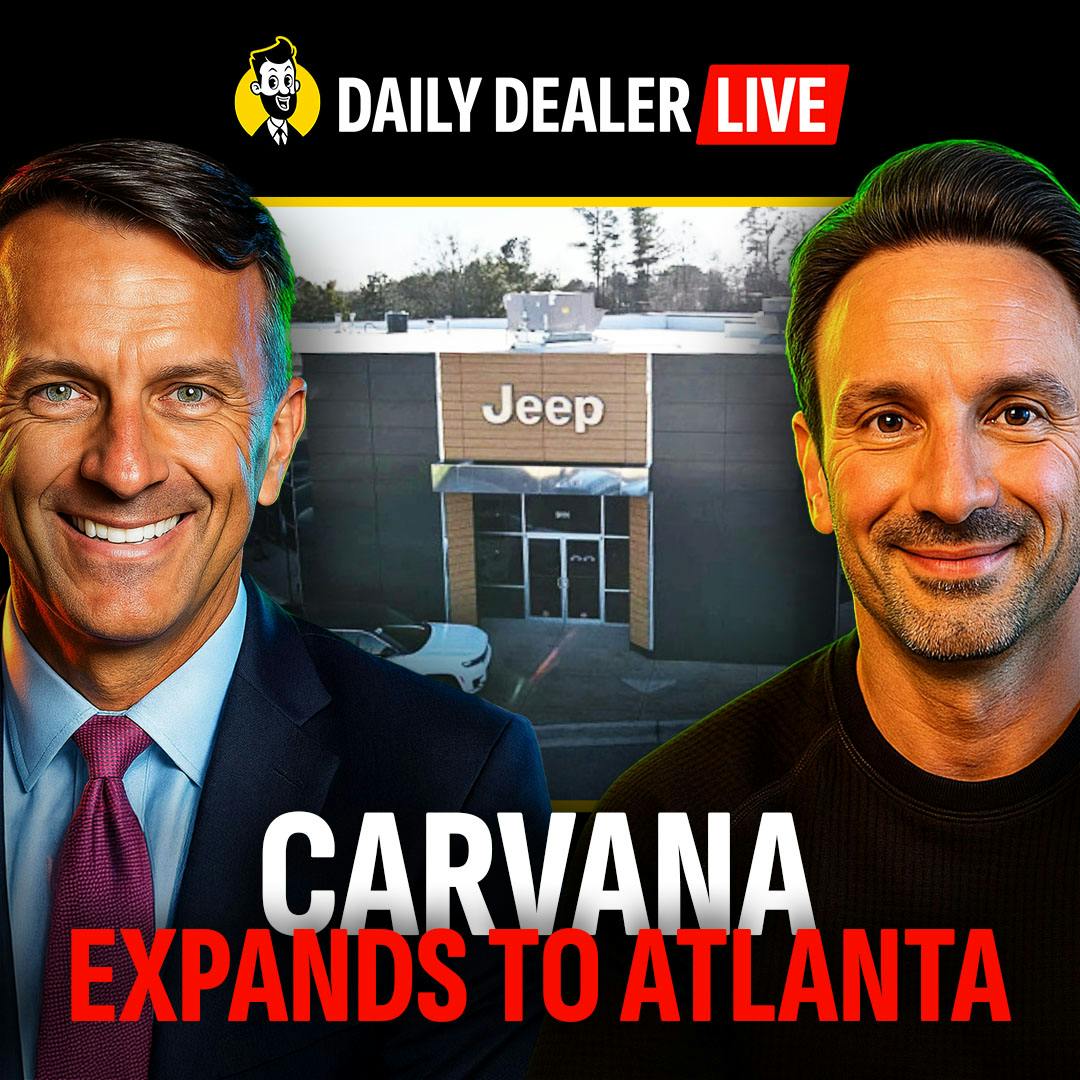
First up today, Carvana has purchased its fourth Chrysler Dodge Jeep Ram franchise of the year
from an unnamed seller in Metro Atlanta that's continuing a buying streak that started in
Arizona then moved to Dallas and Southern California.
For context, the Southeast is one of the hottest dealership M&A regions in the country
with strong population growth, business-friendly policy, and a huge base of consumers who
rely on personal vehicles.
But between the lines, Stellanus has been quietly offloading underperforming stores for a while
now and Carvana likely keeps stepping in because each CDGR rooftop comes with other value behind
the scenes like closed-lane auction access, CPO programs, wholesale parts, and more.
And remember, Atlanta was the first market Carvana launched its online car buying
back in 2013.
More recently, the company has expanded its wholesale infrastructure there, so dropping
a CDGR franchise into that footprint seems to fit the broader strategy.
What's next?
Auto industry will wait to see.
Next up today, Subaru has landed the top spot on Consumer Reports' latest auto brand ranking
for reliability, satisfaction, and safety.
For the second year in a row, Subaru beat out BMW, number two which claimed the top
luxury ranking.
Huge props to Subaru, Ziggler.
We have four Subaru franchises, very proud of them, in Indiana, Wisconsin, and it is
a growing winning brand.
The rest of the top 10 is a mix of some familiar names and big improvements.
Porsche, Honda, Toyota, Lexus, Lincoln, Hyundai, Acura, and Tesla, which jumped eight spots
thanks to Model Y and Model 3 improvements that finally moved past earlier quality issues.
Lincoln made the biggest jump up 17 positions.
As its older lineup has become more predictable and reliable over time, on the flip side, Audi
slid 10 spots to number 16 after the Q4 e-tron showed up early reliability problems and
the consistently strong A4 left the lineup.
Chrysler struggled again with all three minivan models scoring below average reliability, Dodge
GMC and Land Rover, and Jeep branded out the bottom.
What's the big picture here?
Well, as consumers stretch ownership longer, reliability is carrying more weight at the
point of sale.
Dealers with brands that consistently perform well have an easier close while stores
carrying lower scoring name plates might lean harder on service plans and warranty
coverage from the very first conversation and that lengthening ownership cycle plays
into today's topic as part of Fixed Ops Friday, so I'm sure we'll have a fascinating conversation
as part of that.
Next up today, the latest Cox Automotive dealer sentiment report shows a clear shift.
Dealers, especially independents, say the market feels slower, shoppers feel more
hesitant and grosses are getting harder to hold.
Franchise stores are still more optimistic but even they're feeling softer demand than
they did over the summer.
Traffic is one of the biggest issues dealers flagged.
Stores reported fewer people walking in, fewer serious online shoppers and more buyers
browsing than buying.
And profitability expectations are cooling too.
Dealers say buyers are more price sensitive, trades are tougher and used car activity
is losing steam.
All signals that customers are watching their budgets a little more closely.
Confidence in the broader economy has softened as has the outlook for EV demand which continues
to reset after the tax credit changes.
What's the one bright spot?
Well, new car inventory appears to be stabilizing.
Many franchise dealers say they're stocking at levels they can actually work with
but the used market remains tight and very competitive.
Earlier this week in the Oval Office, President Trump announced that his administration will
unwind Biden-era CAFE rules calling them quote, ridiculously burdensome meaning instead of
ramping fuel economy toward roughly 50 miles per gallon by 2031, the new plan would
land closer to 34.5 miles per gallon, essentially freezing standards near the old 22 baseline.
The move gives automakers short term breathing room, lower targets mean fewer compliance
costs and more flexibility to keep building profitable trucks and SUVs but it also risks
slowing momentum on more efficient and electric models already in the pipeline.
And reactions across the industry are quickly split, Ford's Jim Farley and Stellanus's
Antonia Filoso are in the room supporting the rollback.
While GM issued formal praise shortly after, analysts meanwhile say consumers shouldn't
expect immediate price relief.
Auto tech cycles take years to adjust and future administrations could reverse course again.
What's the bottom line here?
For dealers, looser standards could extend the runway for selling bigger, less efficient
vehicles but it also means the regulatory landscape will likely stay very choppy.
And finally up today, a new survey from Topdown US has revealed that even seasoned
certified auto techs are hitting real limits with late model diagnostics.
At this, 73% of respondents say their biggest hurdle is lack of access to OEM data, not lack
of skill.
And modern vehicle networks aren't helping either, two thirds of techs say communication
systems are the hardest to diagnose and hybrid EVs add another layer of complexity.
High voltage systems and advanced drive assistance are also causing trouble spots too.
To keep up, techs say they need better tools, more in-depth OEM level diagnostics,
wiring diagrams, guided repairs, and faster scan speeds, all of which we'll talk about
today as we wrap today's industry news because guess what?
Today's Fixed Ops Friday.
Julie, welcome.
What's up?
Dude, today's, hey, I pumped to have you back today's Fixed Ops Friday and Julie
as you know, today we're diving deep into retention.
We'll talk technician staffing pipelines, mobile service, AI in the service lane, customer
transparency.
There's a ton of topics on TopTap for today.
So everybody welcome to Fixed Ops Friday and not to get too far ahead into the week,
but do you know who my list is of people that would be great to have on this show?
There's three people and I'm going to add one.
So Trump just came out with the reduced CAFE standards.
We want President Trump on this show.
By the way, this morning he posted out there that he just approved mini cars.
Mini cars, yeah.
Yeah.
I don't know how the president of the United States approves a mini car, but he's saying
he's approved mini car.
I want Trump on here.
It would be awesome to have him.
Nick Saban would love to talk to Nick Saban as he expands his empire in the Midwest,
particularly with luxury brands like Mercedes Benz.
Guess who the third is?
I want Jay Leno on this show.
He has been such an automotive aficionado and I feel like on Fixed Ops Friday it's great
to put that out in the world.
That's a good call.
And this Monday, just as a teaser, I'll be broadcasting live.
You'll obviously will both be on the show, but I'll be live in New York City from
Chase Bank's brand new facility.
They're a preferred lender at Ziggler Auto Group.
So I'm out there for a dealer summit they've got going on.
And there's a small chance Jay Leno might be in that room.
So I, there's probably no way he'll agree to come on the show.
But this is the one place in all of automotive.
We'd love to hear from him.
So to our loyal listening audience, if you have a connection to Jay Leno, tell him we'll
be nearby and we would love to have him on the show.
I, I don't know if I dare ask Monday or not, but either Monday or a future show.
You miss 100% of the shots you don't take.
So I'm taking that shot.
I'm taking that shot.
So in a reminder, sitting audience, post your comments to the social media streams.
We're streaming across all social media.
We've got some great comments already.
Yoga car say says make a DDL live from Jay's garage.
I would love that.
That would be so much fun.
Eager K says key key cars would be great in the U.S.
If they meet EPA standards for North American market.
So many, many cars, you know, I think about Europe and all the super small cars they
have there.
I spent some time in Russia, Ukraine and whatnot and I couldn't fit in those
mini cars.
So I don't know what Trump is thinking.
That's why we need them on the show to tell us what he's thinking.
I don't want to part too small.
I live by the water and they have them now because they're historic name plates.
They have all these little trucks.
They use them around like the marinas and stuff.
Okay.
Any pickup trucks that they just load up these old bit zoos and Toyotas.
They're cool.
I mean, I see a market for it.
Not everyone, but it makes sense.
But you know, in a world where you see like one person driving this enormous
suburban or a great grand, like we love big cars.
Like there is an American fascination and commitment to big cars and
Well, we've had the room for them.
So yeah.
Yeah.
Well.
And so yoga car says, Sam, do you fit in the Ugo?
And so I would answer.
And yet, I do not, I do not fit in a Ugo and I've actually been in some
of those little very small little Russian cars and I don't fit in those
either.
Well, I guess you can fit in anything, but whether you want to spend time
in it is another.
Right.
All right.
Enough of that.
It's fixed ops Friday.
Richard Lupo, fixed ops director at Apple Tree Honda Acura.
Welcome to the show, Richard.
Well, thank you, gentlemen.
It's good to be here and thanks for having me.
We're pumped to have you.
Thanks for being here to contribute to content today on this fixed ops
Friday.
All right.
First up.
How's biz?
And as part of that, tell us a little bit about yourself.
Business is great.
We came off a good, not the stellar November, but a really good
solid performance and we're off and running in December.
So it's generally very, very good.
Business is great.
Awesome.
My name is Richard Lupo.
I'm the fixed ops director for Apple Tree Automotive.
We have a Honda and an Acura store in Western North Carolina.
We have a vicinity of Asheville and also have a third rooftop that
is a used car superstore and I take care of those rooftops.
So you're in a super competitive marketplace and you recently thinking
about closing 25 strong and starting 26 strong identified your need to level
up your mobile service strategy.
Tell us about your strategy there, how you did that and what you're working on.
So we've had several partners in doing prep work in 25 to get ready for 26.
We have a partnership with Spiffy, Troy Blackwell and a gang there doing
the upfitting and the software logistics for mobile service.
We also started a partnership with Blink AI who overhauled our website
and our web scheduling with some AI technology.
And then we also have some OEM tools that are provided to us in one
including a company called Urban Science has a piece of their technology
called Service View.
And so as I was putting the mobile service plan together, we started to
I used all of these tools together and so we put Spiffy and Blink
and Urban Science all together, got them all together and started talking.
And what we're working on is automating the scheduling and targeting of
our mobile service, make it intelligent about who we're offering it to,
when we're offering it to them and how we're offering the services
and it through logistics software that Spiffy does, the AI scheduling
that Blink does and the geographic information that Urban Science has.
Mash all of those two, all three of those together, leverage them
and you get really smart and really targeted about your mobile service.
So it's interesting.
I think in today's world, Richard, that's the future.
Getting companies to come together to help us solve problems
rather than us buying pre box solutions.
Brian Benstock shared his strategy a couple of weeks ago or last week
at use car acquisition in the service lane.
How has how has that collaboration gone getting those companies to work
together and really lean into serving you and helping build this tool and solution?
Well, we've chose great partners and I can't tell you that they were just
excited to work with each other to look at the possibilities as they were
to work with us and it's it's it's been fantastic.
I can't I can't tell you that without let me let me say that they have
had a great start.
We've got a great start and the technology and the leveraging of their
technologies together is going to make it even better as we go into 2026.
They've worked together and worked with us and fantastic.
So for another dealer group that's considering doing similar
to what you're doing in the mobile service world.
So you this is a new strategy, but you've got mobile
service currently in operation right in your stores.
Correct.
What are what are three practical steps that a dealer could take to get
mobile service off the ground and and get it to scale and profitable as
quickly as they possibly could just really have to commit to it.
That's if you're if your fixed ops people are not committed to it.
If your organization is not committed to it.
If they don't think it's a great idea, then you don't then everything
downstream of there is just not going to work.
So that the biggest thing is committing to it.
That's the first thing.
And then, you know, maintaining, pushing forward and constantly
being a part of monitoring the KPIs, finding solutions, you know, fill
those gaps and keep the keep the vans profitable.
So it's so it's interesting.
You've got Honda and Acura.
You don't have Ford, some of the OEMs, Ford and others give
money to help supplement mobile service.
I don't think Honda Acura does.
That's correct.
What what opportunity did you see in in mobile service?
What's the market need that convince you to invest without any
outside, I guess, monetary assistance?
You're bootstrapping this on your own.
And we are.
We're going on alone as far as having OEM support, but that's OK.
So.
Life cycles are way, way up.
You know, I mean, we've got the average car is over 70,000
miles in our in our store right now.
Yeah.
And so when you're with the customers are keeping the cars longer,
you know, there's this historical drop off after the warranty goes out, you
know, and you don't see that customer ever at all, except for
warranties or, you know, recalls, things like that.
And so when you extend that life to where that customer is not
coming in and buying a car every three or four years, now you're
extending out four or five, six, seven years.
There's a chance.
There's a huge chance for brand defection at that point.
And so creating a condition where we can go meet that customer
that is maybe geographically isolated very far from the store 20,
you know, 20, 30 miles from our store and create.
Close that loop in the in the life cycle and continue to service.
The dealer continue to service that car.
We'll drive brand loyalty and repurchase from that dealer.
And so that's really the biggest opportunity.
Of course, we're going to make money at it and we're going to sell much
more cars going to retain those customers.
Retention is going to be up and that is that's really where we are.
It's a life cycle completion exercise for us in, you know, retaining the customers.
So you're putting a lot of focus on retention right now,
which is a similar theme.
You leave.
We hear that a lot from Tully from the needle auto group
and a lot of other fixed ops directors.
As you're focused on that retention and you're doing it using these remote
or mobile service, how has the way you've engaged your service advisors
and maybe your BDC changed?
Are you repurposing them somehow to think differently about retention
and keeping the customers?
You did.
We've done a bunch of work to set this stage.
You know, we changed our marketing partners with a tentative and the
the graphing out of how effective that has been communicating.
Our customers has been fantastic.
Link is going through our data.
Sending out proactive messages, you know, with the AI.
So it's it's taken a lot of load off of the BDC doing calls
because of the different ways that we've learned to communicate
with our customers that they actually prefer.
So it has freed up our BDC to take care of, you know, more complex
and company calls.
So it definitely has changed a lot for us in the way that we communicate
and the way that we go to market and bring our bring awareness
to the customers of what we're doing.
So I want you to come in because he's got a question.
But as we do that, I just want to have you decou...
Implementing these different AI solutions and technologies
and like increasing the way you connect and communicate
with customers, have you decreased the size of your BDC
or have you decreased the number of service advisors
or have you just repurposed them?
Because one theory you and I have is that AI and some of this
technology is just going to increase expectation from customers
which doesn't necessarily decrease our headcount in all cases.
It just it just levels up how we develop it
or how we deliver and connect with our customers.
It has not reduced headcount.
We didn't go into it expecting a reduction in headcount
and enhancing our customer's experience when they interact
with us is main goal or the service department.
You know, there are some other goals that the front end
of the store has with it.
But really if you can get a very simple, you know,
oil change appointment scheduled without talking to a human
then that frees up our BDC because we do have an in-house
BDC to talk to that customer and spend the time with that customer
that has that more complex issue that needs that human touch.
So there's not the pressure of the next call,
the next call, the next call because we're scheduling,
you know, 700 plus 800 plus online web appointments
on a monthly basis.
That's 800 calls that are not coming in for schedule
and oil change appointments.
Yeah, Richard, I have a question for you.
I just want to take a step back.
As Sam mentioned, you know, you're dealing with OEMs
that are not providing an immediate monetary incentive,
obviously, aside from the obvious that you're going to capture
from the customer themselves.
For a general manager or service director
or service manager that's looking to implement this,
you said step one is to be intentional.
Walk us through someone who is like clueless about this.
How do you have to set this up as a separate entity
under, you know, your fixed up rooftop?
You know, how are you looking at hiring?
How are you looking at, you know,
the hierarchy and the structure?
How are you attacking this if you had no starting point
whatsoever?
Well, using the very first step was to see if it was viable.
OK, and so we looked at, we used some of the tools
with the urban science tool and looked at how many,
you know, units in operation, how many lapsed,
how many were active, how many bought here
and didn't service, you know,
all those kinds of things like that.
And amazing amount of numbers of cars that are,
you know, were purchased here and not servicing
or, you know, were transient to the market
and, you know, never purchased, never serviced here.
So we identified this huge number of vehicles
that are native to Honda and Acura, to the brands.
And from there, we said, OK, what does it take
to reach those customers?
You know, mobile was the solution that we sought
and are pursuing.
Then you cost it how many vans, you know, cost it out.
And Smithy provided us some financial calculation tools
to help us with that and found them very accurate
for forecasting.
And so we defined the opportunity, then business
planned for it.
And there's a lot of help.
And obviously, if anybody needs any guidance on that,
they can always reach out to me because it's been a year
and a half process to get to here.
So Richard, a couple of really good comments online.
I want to bring these in and get your perspective.
So Lauren Klein, she's a long time listener,
love it, says this.
Let's see if you agree.
You can't have an AI call a customer over a decline service.
True or false?
So in North Carolina, that is correct.
OK.
But.
Wait, why is that correct?
Well, the way that you it'd be like a spam call.
So you cannot have outgoing.
Now, you can contact a customer through AI
or a federally mandated repair that costs no money.
So a recall, a recall.
Yeah, yeah, actually, that's been set, I think,
by the Supreme Court.
And you may have to trust me to check me if I'm wrong.
Yeah.
Well, if it's not costing them any money,
if you're not soliciting business from them
and it's a safety recall update to the car,
you can be proactive and reach out to them there.
So even if they're your customer
and the vehicle is in the service
and you're going back and reviewing decline service,
if you use AI to do that in some states,
that could be considered spam and is not permissible.
For decline services, an actual phone call,
I don't know how that's applicable to our state law.
We don't do that, but we do send out text messages.
So there's some technology behind how we do it,
but we do reach out to the customer via text.
That's fascinating.
Brando says liking the truth bombs here.
So very cool, bringing in some industry perspectives.
So I want to bring you to something you've said.
I think you may have said in the green room or the intake.
You made a pretty bold statement.
You've said dealer loyalty beats brand loyalty
for future sustainability.
So as you're thinking about building these tech stacks
and bringing customers back in,
why do so many stores get the dealer loyalty
versus brand loyalty wrong?
And how can a GM fish shift their organization
towards dealer first loyalty, your perspective?
Well, I can tell you that Apple Tree
is the people that sign my paycheck.
And being associated with Honda and Acura
are fantastic brands, historically great brands.
Some of the best brands, yeah.
But the family that owns Apple Tree
are the ones that sign my paycheck.
So we've got to do what we got to do
to be relevant as a local business
and take care of this business in order
to make sure it stays viable and relevant going into the future.
So making sure that we are part of the community,
that we're doing right things,
taking care of our customers,
making them friends and repeat customers,
doing those things,
that is what keeps you relevant and sustainable.
Yeah.
All right, as we approach kind of the end of our time
together, if you were sitting down
with the dealer principle, right,
and you work across a group,
what three levers would you say
will drive the most fixed stops gross
between now and into 2026?
If I'm looking to supercharge fixed stops,
what are the biggest three levers?
Effective communication.
Yeah.
Customers.
Process, process, process in your shop and your drive.
And take care of the people that are on the front line,
taking care of your customers.
Yeah.
So do you guys use video MPIs?
Do you do video MPIs as part of your technology stack?
We do.
What do you use for that?
We use Service Snap,
which is a Reynolds and Reynolds product,
and we use Service Flex.
Okay.
We have a very long relationship with Reynolds
and we use it on other products.
For integration purposes,
they integrate with each other
and so we use Service Snap and Service Flex
with Reynolds for those two technologies.
So I wanna see if you're willing to get in on this with us.
Last show, we had a dealer principle on
and he talked to us about, look,
we're doing a contest within our group for best video,
like video communication is a way
to connect with customers, right?
And so we're gonna do a contest in January,
we're working on all the background on it,
where we have salespeople, service riders,
service managers, communicating with customers via video,
and we're gonna do a big nationwide contest.
We'll have the best of the best here on the show,
so that advisor, that technician, whatever.
And it's interesting, video seems to us,
when you talk about leveling up
on communicating with customers,
it's one of the toughest things
to consistently get employees to do,
and yet it's one of the highest-return
people activities we can do.
It is.
Yeah, one of the success stories of our video
is that we inadvertently, we had a technician
that was doing an extensive overhaul of an engine,
and the video was being sent directly to the customer.
Yeah.
He thought he was sending the videos to the advisor,
but he kept taking all of these videos of,
here's the next step, here's the next step,
and we were not...
It was too much.
Well, the customer came in and absolutely loved the videos,
and it showed the power of what it was
to communicate with our customers.
But we do the video, MPIs,
but we also take a lot of pictures, too.
Yeah.
It's much easier for people to flip through their phones,
especially real quick,
instead of watching videos sometimes.
So for the very quick and common items like air filters,
we do pictures,
and then supplement video as needed.
Well, Richard Lupo, Fixed Operations Director
at Apple Tree Hunt and Acura.
Thanks for sharing your perspectives
on all things Fixed Ops,
including mobile service, your tech stack,
and what you're doing to better communicate
with customers going into 2026.
Thanks for being here.
Thank you for having me,
and thank you guys.
It's been an awesome experience.
I hope to talk to you soon again.
Thank you.
I don't know.
The video competition sounds like fun.
I don't know if I want to see
an entire engine overhaul or not,
but to his point, the customer was excited.
What you got to make sure of
is people don't say something wrong.
We had a Hyundai corporate trainer
in one of our Hyundai stores yesterday,
and he's like, yeah, this is a great process.
We talked Metaglasses and how you can put Metaglasses
on and do the video MPI using the Metaglasses.
But to Richard's point,
like you've got to train on that, right?
The service manager I was sitting with,
he's like, I don't understand the tech.
I don't understand how it works.
It's not working very well.
Service managers everywhere, best practice,
learn it, understand it, embrace it.
So you can do it just as well as your service techs
and writers can do it, and you'll have success.
Let's talk cars.com real quick
because we're transitioning you in.
Then we'll come back.
This episode's brought to you by cars.com
because we're super behind.
The producers are getting a little excited with us.
Today's episode is brought to you by cars.com,
the number one most recognized marketplace brand
helping your dealerships show up
and stand out to the most valuable car shopping audience.
Click the QR code there.
Go to the show notes.
We appreciate cars.com for sponsoring today's content,
including that fascinating conversation
on remote service and communicating better
with your technicians, communicating with customers.
So thanks cars.com.
Eager Superfan says,
Happy birthday to Hyundai today.
It's their 80th birthday.
So props to Hyundai.
Again, I sat with a Hyundai trainer yesterday.
He didn't say that.
And then Lauren Klein says older techs are just stubborn.
The newer techs are now being onboarded,
doing video MPIs.
Lauren, I agree, but I think younger, older,
everybody is a little reticent to go on and create video
unless it's us and then we do this three times a week.
But you also got to make sure that the radios are off
when they're recording the video.
Some techs are just blasting music.
And then two, you got to make sure your shop's clean.
The posters up can't have a lot of other stuff up,
which should be the standard anyway today.
All right, let's transition.
Next up, Alex Griff, a CEO of Overfuel,
Jamie Kent, Chief Strategy Officer of Overfuel.
Welcome to the show.
Hey, guys.
Hey, thank you.
Thanks for being here.
All right, first question up we'll ask is, how's Biz?
And as part of that, tell us a little bit about yourself.
Let's start with Alex.
Tell us what your Biz is too.
Sure, sure.
So I'm Alex Griff, the CEO of Overfuel.
We're a Lightning Fast, mobile-first website platform
that really focuses on speed, great user experience,
and passing core web vitals.
For those unfamiliar, we got a lot of insight and data
that we could share with folks to unpack that a little bit,
but excited to be here, a long time listener
for some color.
Awesome.
And Biz is great.
This is great.
Yeah, Biz is going great.
We're quick, Jamie Kent, Chief Strategy Officer.
I came to Overfuel with about 20 years of experience
in automotive software and digital marketing.
And kind of back to the early days of Google,
pay-per-click advertising was a new thing
when I got started and everything.
So I've kind of been all over the map a little bit
in the automotive software side of things.
Most recently, I was running one of the largest
OEM certified digital programs.
So I got to kind of experience.
Which ones?
Can you say?
I was running for it.
Okay, very good.
Yeah, that's great.
And so it was one of the largest programs,
had about 80 or so certified providers across web,
search, trade-in tools, you name it, service schedulers.
And so-
All right, so-
Oh, go ahead.
Yeah, go ahead.
No, go ahead, sorry.
Oh, I'll just say, when it came time for me
to get back onto the vendor or partner side of things,
I was really looking for the most innovative,
kind of disruptive technology that I could find.
And I felt like the website space was kind of ripe
for a new player to come along
and really modernize the space.
And that's what led me to Alex and the Oakfield team.
So couldn't be happier to be with that team.
All right, so what do you say to the dealer that says,
look, I've got a website.
We slapped the template on.
It's factory approved, right?
So I get my factory money.
That's all I need to be thinking about.
What's wrong with that thought process?
I mean, first and foremost,
there was even money on the table, right?
Like we've ran data studies in back-to-back years
that show 99% of automotive websites specifically
are failing basic performance standards.
And from an analytic standpoint, when we look at it,
that is the difference of 20 to 30% in traffic
or leads virtually overnight, right?
So we see it shift in either direction
depending on if they're passing or failing.
But yeah, I mean, I think the important thing
to recognize here is that 99% of them are failing
and they're paying the slow tax for it, right?
Organic, traffic, paid ads, cost per click.
I mean, everything just goes through the roof
when performance isn't a priority.
All right, so if I'm a dealer
and what are the top three things
that most of them fail at, the websites that are failing?
And how can I check for that on my own website today?
So anybody can run their website through page speed
or GT metrics.
And it tends to tell a pretty clear story.
The first and most obvious is that dealerships
change marketing agencies, right?
New agencies come in, put in their own tags
and before you know it, you've got this gremlin
of a website with 20 Google tags on it
and for every Google tag, you're talking
a tenth to a quarter of a second of low time.
So that's number one.
And then-
And not to go back, but what's the website
you go to to check that?
If I'm a dealer sitting here watching the show right now,
I can go to that site.
Just look up page speed.
Okay.
It's pretty good.
Yep.
Okay.
And what's the next issue you see typically?
I would say that the next issue,
a lot of times we encounter,
obviously it's the platform itself
and what is being done on the platform
and can't go too far into the weeds
with the technology behind it,
but how components are loaded
and how the site is designed to really ensure
that there's not the layout shift
and all the different things that happened
to the consumer experience that slows the sites down
or makes it kind of bounce around.
So that's definitely another thing that comes up a lot
is just understanding,
how does your platform perform
when it comes to that perspective?
Okay.
Okay.
And then the last piece then this gets brought up a lot
are all the third party tools.
We live in a space where at some point
the website platform almost became thought of
as like a commodity that is just there
to start plugging in all the other things
that you want to plug into it.
And the challenge that arises there
is if those third party plugins
that you're wanting to use on the site,
chat tool, a pop-up for a coupon, a trade-in, whatever,
if those are creating disruptions
that'll also have your site fail core web buys.
And so that's another big area to work on
and what we've done is we actually have gone through
and started working with third party tools
and started almost like a green, yellow, red of this,
we know this tool passes it.
We consult and advise with our dealers.
You're looking to add a chat tool.
Well, here are the chat tools that work with us the best
and that are gonna help you pass.
Here are the ones that are maybe more of a challenge.
And one of the cool things that Alex has done
is he's actually gone to had our engineers
go to engineers within those third party tools
and say, hey, you're causing us
to fail these core web vitals.
If you make these changes for us
we think it'll start passing.
And the great thing about that is that
we'll hear from these third party tools
that nobody's ever even asked us to do this before.
And they get kind of excited
because they're now unlocking something
that will help them in the future as well.
So it's interesting.
We've been talking about on this show a lot
how like dealers that ask companies
to work better together when ultimately
and those companies that wanna stay in their own silo don't.
That's a great example of it, right?
How has the reception been
as you've reached out to these connectors
or these other companies
that work with dealership websites?
Have you had any that have said,
hey, I don't wanna participate in this process.
I'm not interested.
And then others that have greeted it with open arms
and what's advice you give to dealers
in selecting companies that work better together
to produce a better result for the customer?
Man, that's a tough one.
I mean, I think we have to go back
to what is the incentive, right?
Obviously the dealership's incentive
is to sell more cars.
It comes with third party plugins.
Their incentive is to capture a lead at all costs, right?
They're trying to prove their value
by being as disruptive as possible
to the consumer on the website.
So, the advice that we often give is,
hey, less is often more,
but if you have to have the chat tool
and you have to have all these things,
just show the chat icon, right?
Consumers are smart.
If they wanna chat, they know where to find the icon.
And when you look at the heat map analytics
on the vehicle pages,
the close button on the live chat
is the number one most collectable.
So, the consumers are telling us,
and it's like we're not listening, you know?
So, I would just say minimalism,
like just install the chat.
You don't need all the fancy greetings, pop-ups,
and there's all kinds of accessibility issues
around those things too.
Just keep it simple.
Like we just have to keep it simple.
Yeah, and Sam, one of the things that you mentioned
was like the companies that work together,
internally with us, we talk a lot about partnership.
And so ultimately at the end of the day,
that entire deep digital ecosystem
that the dealer is kind of cobbling together,
it's really about serving the dealer
and the partnership that's involved there.
So that's something that we focus on a lot
and we look for those partners that are open to that.
So that's, if I'm a dealer,
that's what I would be pursuing as well.
It's like, where can I find the best partners
if you're not open to being a good partner
with my website provider or my digital retailing tool
or my agency, then that's where the problems
are gonna start to arise.
So that's the path to pursue, would be partnership.
Yeah, and it is interesting as you talk about
what's everybody's self-interest.
Some it's to collect leads,
some it's to provide that experience on the site.
For everyone, it should be helping the dealer
to best deliver that experience
and sell that customer, right?
And so maybe it's a little bit of a paradigm shift.
Maybe it's a little bit of a paradigm shift.
The website is such an important part.
It is the first showroom that the customer hits.
And it's your number one sales rep.
Is there, aside from checking those things
that you just talked about,
are there any other tips when you're thinking
about your website that you should be paying attention to
on a day-to-day basis?
And I guess the other question too is,
how much, you know, you have these OEM certifications
for certain website providers.
So you can do some sites, you can't do others.
Do those certifications help or hurt a dealer
in trying to put their best foot forward
on website development?
So I'll jump in here.
That's a loaded question.
It is a loaded question.
It is a loaded question.
The reality is that those programs
do provide a tremendous amount of benefits.
And a lot of times, you know,
if you're looking just at the front
and you don't necessarily see the benefits
that are happening on the back end
with all of the different data feeds
for in transit vehicles or incentives,
or all of the things that the OEM is focused on
to ensure that the dealer has the most up-to-date data
and content that the consumer is getting
the most consistent experience across the board.
So there's a lot of good that comes out
of those programs.
The challenge that does arise is that, you know,
when a company like Overfuel,
that I believe, you know,
exceeds those standards for an OEM program
and can really be a great partner,
not only for the dealers,
but a partner for the OEMs as well.
You know, the focus there for the OEM program,
it's how do you get that attention?
How do you get on the radar to be able to pilot?
How do you get an OEM to say,
hey, we don't really need any more website provides?
How do you get them to kind of change that thinking
beyond this category is already solved for?
It's already settled science, right?
It's not settled.
There are up-and-coming providers that are disrupting
and how do you get the OEM to say,
yeah, we need to test and pilot
and really continue to evolve instead of just saying,
yep, these are our five or six certified providers
and we're just done.
Yeah, and I think that, so how do you do that?
How do you get the OEMs to think more broadly about it?
And you say five to six, really in a lot of ways,
you might look at it and say there's two, right?
Or two or three.
And everybody does kind of copy-paste
and ultimately the consumer fails.
I'll give you one area that we think a lot about.
So generative AI and being able to search a page
and engage and interact with a page on generative AI.
Talk to us a little bit about what your thought
is on the value and importance of that
and how maybe some websites today
are failing in that generative AI search
providing that experience.
So I haven't seen a whole lot on the search side.
I often think that search is one of the most overlooked
features on a website.
And our data shows that the free form search box
accounts for about 25% of clicks
when somebody comes to the website.
So I feel like a search experience
is heavily underinvested in right now
and it's an area that we're really focused on.
Whether it's like fuzzy matching, detecting typos,
letting people search for cars with specific features
like maintenance or carplay.
Like nobody's really made a whole lot of advancement there.
I think a lot of the AI focus has been around
obviously chat and scheduling and things like that.
But we haven't really seen it make its way
into the website experience yet.
And so that's a narrative that we're pretty excited about.
What, I actually saw a news article
that talks about how quickly Google search,
what's Google's tool called?
Gemini.
How quickly it's surpassing even chat GT.
And we've talked a lot about how you put in,
hey, find me a good car for me.
It uses the generative AI to match everything
it knows about you to find the right match
for an auto dealer.
That's gonna be important coming up, right?
Creating a website that best matches to the consumer
based on the kind of dealership that you are.
And maybe other site providers
aren't quite catching on to that.
All right, last question up.
What's the single highest ROI modernization move
that dealers can make heading into 2526
as it comes to their website?
What would you say?
Oh, man, well, dealers obviously spend
tens of thousands a month on whether it's people
or advertising.
And I fundamentally think that the digital foundation
is the weakest link, right?
So the slow outdated websites,
that 99% failure rate,
that's a silent lead killer, right?
And so fortunately, this conversation
has really picked up steam
and a lot of people are more aware of it.
And so I think going in the next year,
again, we gotta get back to keeping it simple,
doing more with less.
And really assessing if the website
is a good experience or not.
And I think dealers need to start
by going to their own website
and saying, well, I use this to shop, right?
Because the odds are the answer is no.
And so to your point, it's a bit of a paradigm shift,
but we're not the only ones talking about it anymore, right?
Shift digital in their pulse report
said that for every $100 spent
on driving traffic to the website,
$30 of that is paying for poor performance.
So I think we're gonna see a shift
towards speed and performance
because ultimately that's what
the modern car shoppers are looking for now.
Yeah, yeah.
So let's pretend, I wanna do this one last question
because it's a good one.
Let's pretend both of you were dropped into a store
as an internet director.
Your entire task is to optimize that website.
Traditional dealership wherever.
What are three changes you'd make today?
You already said, you know, you'd simplify, right?
You'd get rid of some of the,
and you know, that's fascinating
because I see a lot of these like financing tools
by different lenders and whatnot.
Some dealers have, you know, three versions of ICO and whatnot
with the website messiness just can be there.
But what are the first three big changes you'd make
as an internet director walking into a store today?
Yeah, I mean, for starters,
I'd go through an audit of every single tool
and everything I'm paying for, right?
And whether it's how much am I spending on marketing
and where is that driving that traffic to
what is the experience like and try to get
a visualization of what's everything that's happening.
Because every, to Alex's point earlier,
every single tool, website, digital retail, whatever,
they're all trying to just go in
and justify their existence.
And as an internet director, you've got to take a step back
and look at the net effect of all of those things.
So if a trade-in tool gets you X number of leads,
but if you didn't have that trade-in tool,
you'd still get the same number of leads.
They would just fill out the trade-in form on the website
or something along those lines.
Then your net effect is not, you're not gaining anything.
You've really got to understand the net impact
across the board instead of just looking
at individual tools and say,
well, I get 40 leads over here, 50 leads over there.
What's the net effect of having all those tools
on your site?
Yeah, interesting, that's fun.
Well, definitely a big lift for anybody
looking at their websites, Alex Griffiths,
CEO of Overfuel and Jamie Kent, Chief Strategy Officer
of Overfuel.
Appreciate you being on the show,
sharing your perspectives on upping your game
on your dealership website.
Thanks for being on.
Appreciate it.
Thanks guys.
You know, it's interesting,
like the website is the new brick and mortar, right?
And it's been for a long time,
but their point is valid.
Like a lot of people haven't evolved beyond just thinking
about the website as a template you slap down
and just build on.
It's a heck of a lot more.
I'm banging the search bar drum for like over a decade.
The search bars on dealer websites are not good.
They're nothing like what customers are used to,
you know, going on Google or just typing in
whatever you want and then getting the results
and being able to, you know, sift through them.
The search bars on dealer sites are not good.
And with AI now, there's no reason for them
that they shouldn't go from bad to okay,
they should go from bad to amazing.
Elite, exact, as we heard.
So great comments online.
Igor says, Paul Salisman, most OEMs are comfortable
with their own, whatever.
Their only concern is to shove allocations
down the dealer's throats.
Skin, he says, comfortable in their own skin.
Yeah, yoga car says it's a zero sum game.
Paul says OEMs of all people
should understand technology evolves.
Forcing these sites,
site providers are really dumb.
OEMs should provide APIs and design frameworks
for consistent experiences.
We preach the free market and competition
evolving all of these things along.
There's no reason to close that off to other players.
Yeah, but I love what they said,
because they're right.
You've got to look what everybody's self-interest is
as they come to that game.
And so Yossi posted, CDG,
Cardiola ship guy, he posted something recently
and he said he thinks a majority of tech vendors
are going to disappear over the next few years.
I don't have it in front of me, but.
I believe it.
And I actually think that could be true,
because there's so many different fragmented systems
trying to play in the same area.
And to the point of over fuel,
like everybody has their own separate self-interest.
And what we need to do is we need to have everybody
working together in the interest of the customer
ultimately, but to the dealer first and foremost.
And we're just not there yet.
There's so many fragmented systems.
All right, let's keep it going.
Manny Gonzalez, Fixed Operations Director at Ramsey Mazda.
Welcome to the show, Manny.
Hello, thank you for having me, Tom, today.
Manny, thanks for coming on.
You're a Fixed Operations Manager at Ramsey Mazda.
We're going to ask you the signature question.
How's biz?
And as you answer that,
tell us a little bit about what you do
and quantify what you guys are doing there.
Yes, business is good, especially on the Fixed Ops side.
What I do is I am the Fixed Operations Manager
for Ramsey Mazda in Irvindale, Iowa.
It is part of the Lithia Automotive Group,
pretty large group here.
And my specialty is on the service department
and currently working out of the Mazda office.
Gotcha.
Now, I know in your intake form, you had said
your biggest move was intentional people development.
What does that actually look like
on the day-to-day in your service department?
So one thing that a lot of people
or a lot of stores have is procedures, processes.
So there's always procedures and processes.
The biggest thing is developing people to follow the processes.
So intentionally just working to hire the right people
or retain employees and just figure out
what they wanna do, if they wanna grow,
if they wanna get to a different role
within the dealership, just being intentional
on getting everybody to their full potential
or where they wanna end up at.
So focus a lot on that.
Sam and I love that word intentional.
I'm sure a lot of our listeners do.
I mean, it's the only way to be successful in this day and age
but walk us through that.
You're investing heavily in coaching advisors and techs.
What's that look like on a day-to-day specifically?
What are you doing with your team to be intentional?
Yeah, so that's one thing I spend most of my day.
For example, service advisors in the morning
will have like a huddle where we will pull up
like surveys from customers
and we work through each of those.
And a lot of times it's just going through good surveys.
It's like, you know, nice job on this.
These are little things we can do
for a better customer experience.
So we do that in the mornings
and then once for service advisors
because they touch so many customers,
we do that once a week, each individual.
So a lot of times stores can't have an advisor
step away because they're busy.
So a lot of times that doesn't happen
and I do focus to try to get them away
and just essentially see what they're feeling.
Also, see what they just kind of go over.
Their performance, see what they want to do.
Some of them want to do really well
with customer surveys.
Some want to increase our per hour.
They're just different things for each advisor.
So staying on that vein
and having these one-on-ones with these customers,
what are some of the things that you guys do really well
or that your team is doing really well?
So customer experience, we do really well.
I have a good store where advisors,
as soon as you pull in your vehicle and a service drive,
they're already out there greeting the customers.
They do a lot of prep.
One thing a lot of customers like is hearing their name,
just knowing their name when they're coming in.
That's been kind of a big thing.
Just getting to know your customer,
building the relationship.
So they do a good job of greeting customers,
getting them checked in
and just really prepping for that customer to come in.
What kind of technology are you using
to ensure that that happens?
Or is it just a process that you guys have developed
to make sure no one gets forgotten about?
It's been a lot of hard work.
So we use currently a couple of different systems.
We're using My Carma and CDK.
My Carma, we do a lot of communication,
but we also use them to check in customer vehicles.
So we got a tablet system.
So we can go out into the drive
and check in the customer or do the walk around.
And then it integrates into CDK to create repair orders.
So then they can go back to their desk
and have that repair order.
And so prepping ahead of time
is we have like appointments,
ledgers going out ahead of time
so they can see who's coming in.
I think a lot of our team members touch it
or parts advisors also see that
because one other thing is they're looking ahead of time
to make sure we have the parts in stock.
Advisors are seeing, making sure
that we have the loaner reserved ahead of time.
So we all work together.
It's been, it's just a lot of different steps.
You mentioned loaners.
I know they're a pain point for a lot of stores.
How have you tightened that process?
So it feels like a benefit to the customer
and not a chore.
So we've worked a lot.
I actually got to be on a pilot program
with TSD, XI, My Carmela
to be able to come up with a really good system
because a lot of times it's a lot of prep work
to get loaners.
I found that when customers are coming in
and we're not prepped,
it could take like half an hour
to get a customer in a loaner car.
So we came up with a process
where we can send a text, email ahead of time
so the customer can put all their information ahead of time.
And so that's already set
and we're just having time and going over
just any restrictions or anything like that.
But we have went as far as
when someone schedules the day before,
we'll send a reminder like, hey, fill this out.
But then we go ahead and find the loaner,
match it up to what they're driving.
We'll even write,
there's like a card inside with their name on it.
This has reserved and the customer name
and it's ready to go clean up gas.
And so when the customer comes in,
they pull in, they see their name on the loaner
and they're just really excited.
It's really good customer experience on that.
So into the loaner piece,
transitioning over to retention on vehicles
over two years old.
So we talked a lot about the importance
as ownership extends out longer
to retain those customers back to the dealership.
I think you said you've got your retention
for two plus year old vehicles at 55%,
which is elite, right?
What practice have you put in place
to get that retention increase to that point?
That's stellar.
Yeah, there's two things that I,
or my team has implemented on that.
So the first thing is just kind of
what we're talking about, customer experience.
So once they're here and they go through
or check and process or communication
or service advisors having a good time
and communicating well,
that right there is what really does it for us.
Second thing is I worked with,
so before Mazda, I worked for Toyota and one thing
they had was ToyotaCare and this ToyotaCare Plus.
So Mazda, it's kind of similar
and have kind of same products.
And I brought over the selling the service contracts
from the drive.
So a lot of the older customers come in
and we were able to sign them up for like a five year,
five oil change plan in the drive,
less than it would if you paid for five oil changes
and saving up 40 to 50% upfront.
Dude, have you had success with service riders
and others in the drive offering that?
And what's your process on that?
I've found that to be a process where,
riders have so much on their plate already.
It can be a tough thing for them
to try to add on, on top of it all.
Yeah, at first, the vision was there
and everybody's just kind of not wanting to do that,
but just kind of getting everybody together
and showing what that can do.
It, I got pretty successful presenting it
and just having the, like the numbers in front,
just showing like, hey, this is saving your customer
X amount of dollars.
After a few, like, wow, this is actually working
and then we've been doing it for three years now.
Year two, they love it.
They just, it's like they're signing up
a customer for five years.
And then last question up,
and we've had such great content today,
your perspective has been awesome.
We talk a lot about these video inspections, video MPIs.
I think you said you're at 87%,
which is a pretty stellar rate.
How'd you get there, maybe in 30, 45 seconds?
Yeah, so that's the view rate.
One thing, we position our service advisors
right in front of the waiting room.
So we can kind of see what we send the videos
and like we ask customer, hey, please watch this.
The one's going out, they're not sitting.
We have, as soon as the customer checks in,
we have kind of step-by-step,
like, hey, you'll receive a text message from us,
save your contact information
and then you'll receive a video
and then an estimate from the customer,
or from us.
Mandy Gonzalez, fixed operations director,
manager, or Amzi Honda.
Thank you so much for being on the show,
sharing your perspectives and very cool
the different processes you have in place
to better serve customer and dealer groups.
So thanks for being on today.
Thanks, Mandy.
Good show today, good Fixed Offs Friday.
My gosh, it always goes so fast.
It went fast today too.
We'll get more in full out about our up and coming.
We hope to do this video karaoke video competition,
creating video and automotive is what's coming.
And then I look forward to broadcasting live
from Chase on Monday.
Anybody who knows Jay Leno, get it to him.
We'd love to have him on either Monday
or at some point in the future.
So it'll be fun to report out on their new building
and all the stuff going on there at Chase.
So, Julie, good show.
Love it, great show.
All right, let's do it again on Monday.
Let's do it again Monday, 1 p.m. Eastern.
Thanks for watching Daily Deal Live.
We break down the biggest moves in the car business
as they happen.
Don't forget we're here live as we said every Monday,
Wednesday, Friday, 1 p.m. Eastern.
So if this is your world,
hit like, hit subscribe, turn on those notifications,
so you never ever miss a beat.
And we'll see you next episode, everybody.
Thanks.
Thanks guys.
About this episode
The episode dives into the latest trends and challenges in the automotive industry, focusing on Fixed Ops. Key discussions include Carvana's acquisition strategy, Subaru's top reliability ranking, and the impact of changing CAFE standards on vehicle sales. Guests Richard Lupo and Manny Gonzalez share insights on enhancing customer retention through mobile service strategies and effective communication. The episode also highlights the importance of using technology for better service operations and customer engagement, emphasizing the need for dealerships to adapt to evolving consumer expectations.
Today's show features:
Manny Gonzalez — Fixed Operations Manager, Ramsey Mazda
Jamie Kent — Chief Strategy Officer, Overfuel
Alex Griffis — President, Overfuel
Richard Lupo — Fixed Operations Director, Apple Tree Honda & Acura
This episode is brought to you by:
Cars.com – the #1 most recognized automotive marketplace and the place shoppers turn for trusted expertise and a better way to compare vehicles. Unlike marketplaces that reduce everything to price, Cars.com automatically merchandises your inventory’s most compelling features and accolades to highlight true value and help shoppers make confident buying decisions. Cars.com is the flagship offering from Cars Commerce, an audience-driven technology company simplifying everything about buying and selling cars. Learn more at https://www.carscommerce.inc/marketplace.
Overfuel – Dealers: You’re torching $30 of every $100 in marketing spend when your site flunks Google’s basic performance test. Why keep using outdated website technology that's killing your profits? Overfuel is the new technical standard in automotive websites, proven to grow sales by 30%+. Whether you need more revenue or better support, they’ve got you covered. Go to overfuel.com and use code CDG500 in the comment box for $500 OFF.
CDG Circles – A modern peer group for auto dealers. Private dealer chats. Real insights — confidential, compliant, no travel required. Visit https://cdgcircles.com/ to learn more.
Car Dealership Guy is back with our second annual NADA Party—happening in Las Vegas on Thursday, February 5th. It’s the hottest ticket at NADA 2026. Spots are limited and unfortunately we can't invite everyone —so RSVP today at https://carguymedia.com/cdglive and we hope to see you in Vegas!
—
Check out Car Dealership Guy’s stuff:
CDG News ➤ https://news.dealershipguy.com/
CDG Jobs ➤ https://jobs.dealershipguy.com/
CDG Recruiting ➤ https://www.cdgrecruiting.com/
My Socials:
X ➤ https://www.twitter.com/GuyDealership
Instagram ➤ https://www.instagram.com/cardealershipguy/
TikTok ➤ https://www.tiktok.com/@guydealership
LinkedIn ➤ https://www.linkedin.com/company/cardealershipguy/
Threads ➤ https://www.threads.net/@cardealershipguy
Facebook ➤ https://www.facebook.com/profile.php?id=100077402857683
Everything else ➤ dealershipguy.com