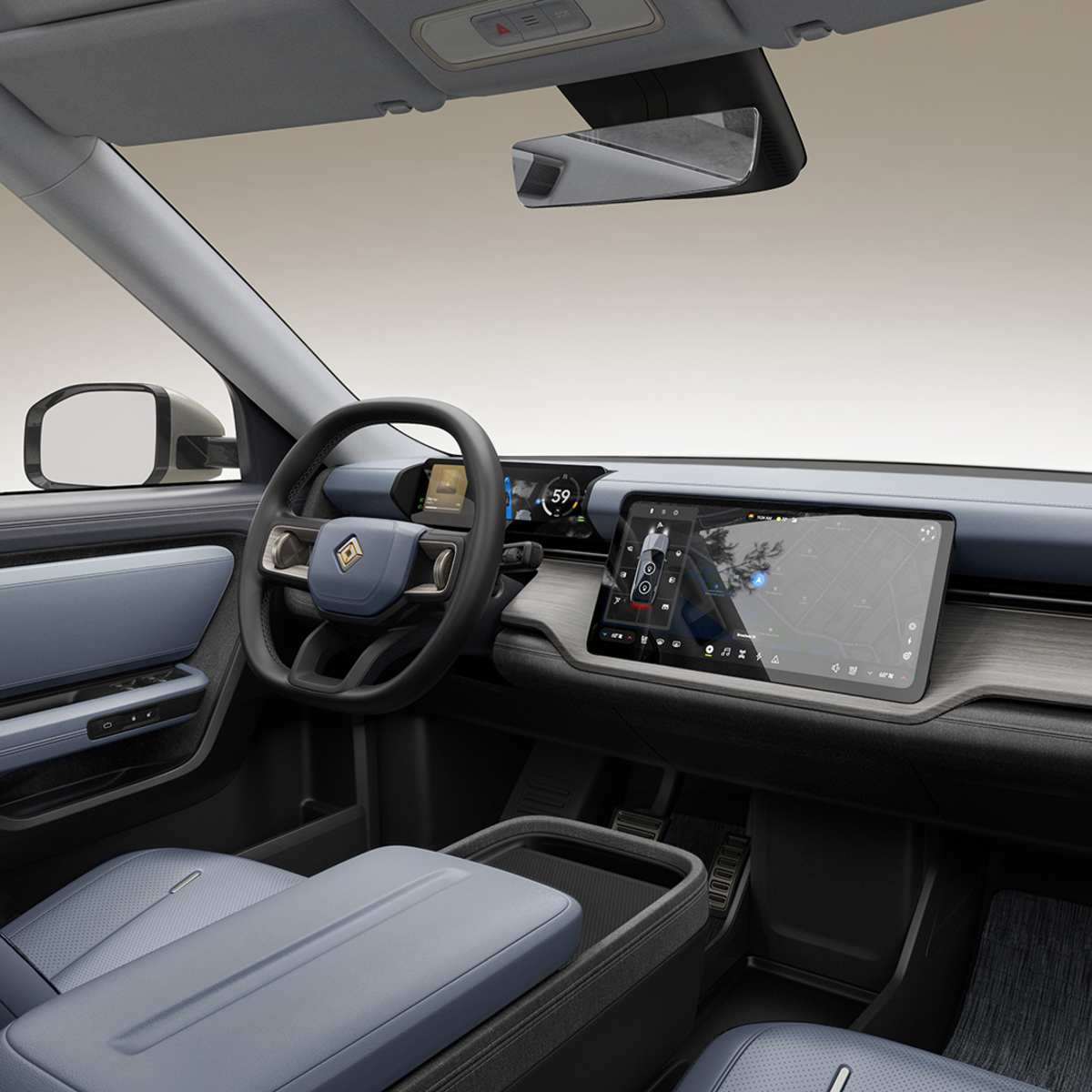
The Rivian R2 is an all-electric SUV from Rivian. This segment is talking about its launch day—when deliveries start and people can finally see and buy it.
“Digital services” means the software and online features that come with a car. Instead of just selling the vehicle, companies also sell ongoing features through apps or subscriptions.
EV market share is how much of the car market is electric cars. If it goes up, it means more buyers are choosing EVs from that brand compared with other brands.
OnStar is GM’s service that connects your car to help and features through a cellular connection. “Subscribers” means people paying for those services over time.
Super Cruise is GM’s system that can help you drive more automatically on certain roads. It can let you take your hands off the wheel and, in supported situations, look away from the road.
The Cadillac Escalade IQ is an upcoming Cadillac electric version of the Escalade. GM says it will be one of the first vehicles to get a more advanced “eyes-off, hands-off” driving tech feature.
“Eyes-off, hands-off” refers to a higher level of automated driving where the system can handle steering and driving tasks while the driver is not actively watching the road and is not holding the wheel. It’s typically limited to specific conditions and may require driver monitoring and mapped road support.
A subscription service means you pay ongoing money to keep using a feature. In this case, it’s the car’s autonomous-driving feature after the free trial ends.
Cadillac IQ is GM’s plan/label for new driver-assist or self-driving features in future Cadillac cars. The host is basically saying we’ll see if it really works as well as GM claims.
“ICE” here means gas engines. “Ice-free autonomous driving” is basically the idea that the same self-driving tech should work whether the car is gas or electric.
A digital environment is a computer simulation of driving conditions. It lets engineers test self-driving software without putting cars on the road for every scenario.
Stress-testing means they try to “break” or challenge the system with tough situations to see if it still works. In this case, they do it in a computer simulation before real-world testing.
“Supervised on-road testing” means they test the self-driving tech on real roads, but someone is watching and ready to take over if needed. It’s safer than letting the system run completely on its own.
Term
AI
AI means computer systems that can learn patterns and help make decisions. In this segment, GM says AI is being used to help write a big portion of the code for their self-driving work.
Zevo is an electric-vehicle company mentioned in the podcast. The discussion focuses on supplier contracts, which are the agreements for getting the parts needed to build EVs. Those contracts can affect whether vehicles can be produced on time and at the expected cost.
A prepaid subscription is when customers pay upfront for a set period before the service becomes a recurring subscription. GM references “prepaid for a three-year period” for Super Cruise, then discusses what happens after that term ends (including deferred revenue and later subscription renewals).
“Attachment rate” here means how many people actually sign up for the service. GM is saying that about 40% of the vehicles that were part of the initial plan end up continuing the subscription after that prepaid time ends.
ARPU means “average revenue per user.” It’s a way to measure how much money the company makes from each customer who uses a paid digital feature or service.
Amortize is an accounting way of spreading a cost or revenue over time. Instead of counting it all immediately, the company recognizes it step-by-step as the service period progresses.
P&L is the company’s profit-and-loss report. It’s where revenue and expenses get counted for a given time period, so the timing of subscription revenue recognition changes what the P&L shows.
Autonomy means the car can handle more of the driving tasks on its own. The speaker is saying GM expects software and driver-assistance progress to eventually translate into bigger business impact.
Mercedes is mentioned as an example of a luxury brand that has tried charging subscriptions to turn on features. In the story, the feature hardware is already in the car, but you pay to activate it.
BMW is mentioned as another example of a luxury brand that has tried subscription activation for features. The concern raised is that it can feel unfair if the hardware is already in the car.
FSD means “Full Self-Driving.” It’s a Tesla software add-on that tries to automate more of the driving. Whether it’s worth the price depends on what computer (hardware) is inside your Tesla.
“Hardware 3” is the generation of the computer inside a Tesla. If your car has older computer hardware, some advanced features may not work as well or at all compared with newer cars.
“Hardware 4” is a newer generation of the computer inside a Tesla. Newer computers can enable more advanced features, so the same subscription can feel more “worth it.”
Android Auto lets you use your Android phone in the car—like maps and music—on the car’s screen. The speaker is saying GM removed support for it, which could change how easy it is to use your phone in the car.
Apple CarPlay connects your iPhone to the car so you can use certain apps on the car’s screen. The speaker is saying GM removing it could make the car less convenient for some buyers.
SDV 2.0 is about making the car more “software-updatable,” so features can be improved or added over time. The key issue is that older cars may not have the right computer hardware to run the new software.
Deferred revenue is basically “money collected now for something you’ll deliver later.” So it can be a clue that customers have paid for future features or services that aren’t active yet.
The Equinox is one of GM’s more affordable, high-volume crossover models. GM is basically saying the newest expensive tech will likely debut on pricier cars first, not on the mass-market ones.
GM is the automaker being talked about. The idea is that they want to test new driving-assist tech with real customers, not just prototypes, so they can see how it works in normal driving.
Tesla is referenced as the benchmark for how an automaker can roll out driver-assistance features to customers. The speaker contrasts Tesla’s approach with GM’s and other companies’ philosophies, implying different strategies for deployment and responsibility.
Brand
G Rivian
Rivian is another electric-vehicle company mentioned in the comparison. The host is saying Rivian’s approach to advanced driving features may be different from Tesla’s and GM’s.
“Level 3” means the car can do a lot of the driving by itself, but you still have to be ready to take over if it asks. It usually only works reliably in certain conditions, not everywhere and not in every weather situation.
Capital allocation strategy is basically how a company chooses to spend and invest its money. It’s about deciding what projects get funded and when.
LIVE
Good morning and welcome to the General Motor Company first quarter 2026 earnings conference
call.
During the opening remarks, all participants will be in listen-ally mode.
After the opening remarks, we will conduct a question and answer session.
As a reminder, this call is being recorded on Tuesday, April 28, 2026.
I would now turn the call over to Ashish Kohli, GM's Vice President of Investor Relations.
Thanks Denise and good morning everyone.
We appreciate you joining us as we review GM's financial results for the first quarter
of 2026.
Our conference call materials were issued this morning and are available on GM's Investor
Relations website.
We are also broadcasting this call via webcast.
Joining us today are Mary Bara, GM's Chair and CEO, along with Paul Jacobson, GM's Executive
Vice President and CFO.
Susan Sheffield, President and CEO of GM Financial, will also be joining us for the
Q&A portion.
On today's call, management will make forward-looking statements about our expectations.
These statements are subject to risks and uncertainties that could cause our actual results to differ
materially.
These risks and uncertainties include the factors identified in our filings with the SEC.
Please review the safe harbor statement on the first page of our presentation as the
content of our call will be governed by this language.
Hello everyone and welcome to Kilowata Podcasts about Electric Vehicles, Renewable Energy,
Autonomous Driving and much, much more.
My name is Bode and I am your host and on today's episode we have GM's Q1 2026 earnings
call.
In addition to that, it's June 9th, which is Rivian's R2 day.
They're delivering Rivian R2s today.
Today's the launch day.
I think that's what I meant to say.
Today's the launch day for the Rivian R2.
So yeah, that's exciting.
I haven't been outside today other than just around my neighborhood to go for a run.
So I'm looking forward to seeing if there's any R2s floating around in the Tempe Phoenix
area.
I'll let you know when I spot one.
But I think that's it.
Let's go ahead and dive into Mary Barra's opening remarks.
Just like every earnings call that I talk about, I edit it for this show.
There may be things that are put together that sound like, she said it all at one time,
but they could happen in very different places in the earnings call.
So if you want the full earnings call, I'll put a link in the show notes.
But I do my best to represent it in the way that it was meant to be.
I don't try to edit it in a way that sounds worse or better than it is.
This is really more, does this information make sense for this show?
Is it informative for folks who listen to this show?
And then I can present it to you in a way that doesn't have all of the added stuff of
actual earnings calls, which sometimes are very interesting and sometimes could be a
little mind-numbing.
So let's go ahead and jump into Mary's opening remarks.
We're also building tremendous momentum in digital services.
They are playing an increasingly important role in our success and they will drive even
stronger results in the future.
If you look deeper at our results, especially in North America, you can see how the depth
and breadth of our vehicle portfolio is driving the business.
Even with tight inventory, we continued to lead the industry in the US and Canada and
were number two in Mexico.
We also continue to lead in full-size pickup sales and share with 42% of the US market.
In addition, we were number one in fleet, including commercial deliveries, and we were
number two in EVs.
As we exited the quarter, our EV market share in the US was 13%, up from about 10% in December
2025, which underscores the appeal of our portfolio as the segment stabilizes.
Okay, so this is really the most that GM is going to say about their electric vehicles.
They're going to talk a lot about services.
They're going to talk a lot about GM or supercruise, not GM crews, but supercruise.
When I say a lot, a lot more than they did about EVs, but it was a lot of the questions
this earnings call were about things like their new pickup truck platform that they're
working on, which has nothing to do with EVs.
There's just people who are curious about it.
So, I decided to focus mostly for this particular earnings call on the services and supercruise,
although there is some where it made sense some EV stuff peppered in there, but honestly,
not a lot of breath was wasted on EVs.
I'll just put it that way.
All right, let's move on to our next clip, which will be about, surprisingly enough,
digital services.
All of these winning vehicles are laying the groundwork for higher company-level profitability
around the world through durable, reoccurring digital revenue streams.
We are on pace to add more than 1 million on-star subscribers in 2026, with about 30% of our
existing customers choosing a premium plan.
Outside of the US and Canada, we have more than 20 revenue-generating markets and regions,
including Mexico, Brazil, China, South Korea, and the Middle East.
Within the on-star platform, supercruise is also scaling quickly.
Our customers have now driven 1 billion hands-free miles and our subscription performance is
on pace to exceed 850,000 subscribers by the end of the year, with strong renewal trends
in the 30-40% range.
You will find that our attach rates, subscription renewals, and revenue generation compare favorably
to others in the industry.
The continued growth of this ecosystem, including the customer base, Miles traveled, and the
insights we're gaining to train our AI models will help pave the way for our eyes-off hands-off
technology launching in 2028 on the Cadillac Escalade IQ.
Okay, so it doesn't sound like every GM car comes with supercruise.
It sounds like when you order your car or when the car gets built, it's built with all
of the components needed for supercruise.
I could be wrong on that, but I'm sure that I feel confident that they said this later
in the earnings column, we'll go back and listen to it because I listened to this and
then I cut it all up and then now I'm actually doing the show, so I'll have to go back and
make sure that that's correct, but when we get to that part, I'll let you know.
But that's different than, say, Rivian or Tesla because they have every car they built
has the capability, well, I mean, Rivian, every new car that they build has this capability
or potential capability of autonomous driving, wherever it lands on the spectrum of autonomous
driving, but it doesn't sound like that's how GM is doing business.
However, when you buy a GM car and it comes equipped with all the hardware and you get,
I think, three years of autonomous driving for free and then after that you have to pay
for it and as we'll hear later in the call, a fair number of people are finding enough
value in it that they are continuing to pay for the subscription service.
Now, when the Cadillac IQ comes out, whenever in 2027, 2028, whatever Mary said it was,
then we'll really see if GM could actually produce on their claims of, you know, hands-free,
ice-free autonomous driving, we'll see.
I am skeptical of that, but let's go ahead and learn a little bit more about the autonomous
driving in this next clip.
The Escalade IQ is just the start.
We are doing something unique in the autonomous space, which is developing a system for personal
vehicles that we can deploy on both ice vehicles and EVs and scale across multiple brands and
price points.
We're stress-testing it in the digital environment capable of simulating roughly 100 years of
human driving every single day.
We recently took the next step and began supervised on-road testing in California and Michigan.
The way we're building this technology is a reflection of how seriously we're embracing
AI across the enterprise.
Today, nearly 90% of the code written by our autonomy team is generated by AI.
More than I would normally expect to hear about AI in a GM earnings call.
I'm just not, you know, not that important.
Everybody's kind of talking about it.
But yeah, we'll kind of keep an eye on this and see where it goes.
I fully expect to be doing this podcast in 2028, so I will be interested to see if they're
actually able to achieve the full level three autonomy like they're saying they can.
I don't think they're doing anything different than other companies,
but I just thought it was interesting.
All right, let's move on.
Paul, which Paul, I'm blanking on his last name, he is the CFO for GM.
And we are going to move to some of his opening remarks.
So let's go ahead and dive in and hear what he has to say.
Let's turn next to an update on our EV charges.
Last year, as you know, we reassessed our EV capacity and manufacturing footprint to
better align with softer demand and elimination of US tax incentives.
As previously indicated, we are transitioning or an assembly from EV to ice production
and resolving associated supplier contracts.
With the exception of the bright drop EV van, we have not recorded impairments
to our current EV portfolio.
Our focus remains on improving EV profitability and scaling our business as market adoption
grows, albeit at a slower expected pace than we had previously seen.
In the second half of 2025, GM recorded a total of $7.6 billion in EV related charges.
This breaks down into $4.6 billion of estimated cash charges and $3 billion in non-cash impairments.
In the first quarter, we took an additional $1.1 billion in EV charges,
driven mainly by contract cancellations and supplier commercial claims.
We expect about $1 billion of this will have a future cash impact.
We're moving quickly to finalize claims.
To date, we've already recorded around 90% of the expected total supplier commercial claim
costs and we anticipate reaching agreements in principle on most of the remainder during the
second quarter.
Separately, we continue to work expeditiously through right sizing our battery supply chain
with our joint venture partners.
Of the total $5.6 billion in EV related cash charges recorded since the second half of 2025,
$2.6 billion has been paid as of March 31.
In April, we've already paid an additional $600 million and we continue to expect most
of the remaining cash flows to occur in 2026.
We remain steadfast in our desire to get these claims resolved quickly and fairly for our business
partners and our shareholders.
For EVs, we expect volumes to be lower as the market shows early signs of stabilizing
around 6% of US industry sales.
We continue to expect a benefit of $1-1.5 billion for the calendar year as we right
size our EV capacity and run at substantially lower EV wholesale volumes.
The production pause at Altium cells means lower benefits from production tax credits
flowing through material costs, but this is largely offset by positive inventory
adjustments from lower cell inventory levels.
On regulatory costs, we continue to expect a $500-750 million tailwind year over year.
The endangerment finding repeal in February was already assumed in our plan.
All right.
I don't have much to add on this other than, you know, they decided to pivot away
from EVs a little bit because of, you know, all the reasons that they said,
and that has a cost associated with it because they have contracts with suppliers and such.
So, yeah, I mean, I don't know.
In my heart, it's a little disappointing, but in reality, it's just probably business as usual.
All right, let's move on to our next clip.
Oh, by the way, we're done with opening remarks and we're now on to analyst questions.
All right, let's go ahead and listen in.
Thank you.
The next question comes from Emanuel Rosser with Wolf Research.
Your line is open.
Great.
Thank you so much.
Good morning.
So quite an uncertain environment as you certainly indicated.
I was curious in terms of the factors you're monitoring, you indicated, you know,
a little bit more clarity on some of those before making any additional changes to the outlook.
In terms of things that could move the needle for this year that you're monitoring,
is it more on the demand side, vehicle mix, input cost?
I'm curious which are the ones that, you know, can still, you know,
move up or down, you know, the most and impact you.
Well, Emanuel, I think the number one thing that we're watching is, you know,
what happens from with the Iranian conflict.
Because obviously, you know, with oil prices affect a lot more, you know,
that we're seeing from not only logistics, but also other commodity costs.
So if the conflict ends in a shorter period of time,
I think we'll see a return back to normal levels.
If it stays on longer, tell me how high oil prices go
before we'll start talking about what demand is.
But I also want to remind you that we're,
although we have an incredibly strong truck franchise,
and I'm very excited about the new truck that we have coming out at the end of the year,
we also have a very strong mid-sized crossover portfolio
and small crossover portfolio as well as a strong mid-sized truck.
So I think we're well prepared with, you know, a portfolio I'd stand against anyone
when we look at how consumer behavior might ship,
depending on how long the war lasts.
But we just don't know.
So I think those are the primary things that we're watching.
And as Paul said, we looked at the year seeing that uncertainty,
especially as the conflict began,
and that's why we started to really work on cost management.
There's other areas that we're working on to continue to do that.
But I think the biggest variable that we're looking at is,
how long does the conflict last and what does it cause from a cost perspective
across logistics, supply chain, and if it ends up having anything,
any impact on a shift in mix.
But to date, we really haven't seen that.
So I want to remind everybody that this was recorded,
like I think on August 28th or April 28th or something like that.
So it was a few weeks ago, the conflict with the United States, Iran, and Israel
really hadn't been going on for as long as it's currently going on for sure.
So when we listened to that clip, we should remember back to the late April
and what was going on then, because there was still a lot of unknowns.
I'm sure Mary's answer would have been very different
had it been answered or had the question been asked yesterday, right?
So I want to make sure that's very clear.
But the second thing is, notice she didn't say anything about EVs in that answer.
She did say they have crossovers and things like that to help
whether the higher gas prices and things like that.
But she didn't say anything about, hey, we have a whole bunch of EVs,
especially on the Cadillac side that people could buy.
Didn't no mention of EVs in that answer.
Let's go ahead and move on to our next question, which is about supercruise.
Thanks for that, Paul.
My other question was on supercruise and the digital services for the strong growth
that GM has been seeing in supercruise and the willingness for consumers
to subscribe after the prepaid subscriptions last.
Can you speak a bit more on the breadth of that consumer demand and is it
concentrated in the higher end parts of the portfolio like Cadillac
or is GM seeing consumer demand for those solutions more broadly?
So what I would say, Mark, we're continuing to trend at about that 40% attachment
after the subscription period.
And we do it differently.
Other competitors that put the hardware on every vehicle and they're bearing that cost for us,
it's consumers who have purchased supercruise, they prepaid for a three-year period.
And we see that in terms of the hardware costs.
So we have the deferred revenue that comes with the vehicle,
and then we have the subscription afterwards.
So we're starting to see escalation in terms of the number of vehicles
that are coming off of that three-year prepaid period.
And we're still holding attachment rates in that 40% rate.
So we're very optimistic about what that means.
And I think that's what I was adhering to in the earlier question of when you look at the ARPU,
you've got to really take into account the scale advantage that we have,
especially as we start growing into SDV 2.0 and expanding that across the portfolio.
But supercruise is a really strong leading indicator,
and we're continuing to invest in delivering more value to customers
that we think are going to make that even more attractive in the future.
40% attachment rate seems good, right?
It is worth noting that supercruise after the three-year period either costs $40 a month,
or you get a little break if you pay it for a year, which is $400,
which is cheaper than what Rivian's charging.
I think Rivian says $50 a month, or $2,500 a year,
or $2,500 if you want to buy it outright.
And Tesla's obviously $100 a month, so I don't think their pricing is unreasonable,
and that probably goes to the higher take rate of 40%.
Is that out of this world crazy numbers?
No, but GM's a big company. It's not crazy for one customer,
but when you have as many customers as GM does, it's probably pretty decent money for them.
All right, yet another question here about digital services in our next clip,
so let's listen in on that.
Just going back to the digital services, I think you said that you expect margins to be
in line with other software companies. When will we see those types of margins?
I don't know if they're there yet now or not, or if their upfront costs you take.
How does that cost-last revenue curve look out over the next two to three years?
Yeah, so Mike, this gets a little bit technical. I'll try to summarize as best I can,
but when we sell a vehicle with supercruise, all the hardware gets
expensed right away, and then the revenue associated with that gets deferred over the
three-year trial period. That's coming on at a very, very sizable margin,
because we've already recognized the costs in that going forward. Then when you look at the
other digital services and on-star, there are some hardware costs, etc., that are
expensed with the vehicle. There's some service costs that go in, so the margins aren't quite
as robust as if you expense everything, because there are service costs associated with it,
but they're still pretty sizable. As we ramp up that deferred revenue base, and it starts to
amortize into the P&L at increasing rates, that's where you start to see the impact.
What we talked about, if you go back to Investor Day several years ago, we talked about that having
an impact and growing to a point where it has an impact on the overall margins of the company,
and we're starting to see that take hold. We've got a lot of excitement about the potential of
one SDV 2.0 and the future improvements to Supercruise, and ultimately, autonomy can do
for us when you look at it across scale.
First thing, I misunderstood this clip when I first heard it. I thought he was saying that
only certain cars were sold with the Supercruise hardware installed,
and that's not what he's saying at all. When I said that earlier in the podcast,
this is me correcting that, because that is incorrect.
Having said that, I think car companies that sell very expensive vehicles,
and you can argue that a $30,000 vehicle is affordable, but it's also a pretty expensive
vehicle, and then to sell subscription services on top of that, I think that's a very fine line
to dance. We know about, I think it was Mercedes or BMW that was selling the heated seats,
which already came with the car, like the hardware for heated seats is in the car,
and they were charging a subscription for the heated seats to activate it.
That kind of thing can go poorly very quickly, but I think GM has managed this pretty well.
I think Tesla does a good job of it too, although I'd still argue that $99 for FSD,
especially if you have a hardware 3 vehicle, is too much money because you are not getting
the same value out of your hardware 3 vehicle that you are out of a hardware 4 vehicle,
for instance, or AI4, AI3, whatever. But I do think that GM, Tesla, Rivian,
and other companies as well, are offering subscriptions that are not
pickpocketing people for features that they should already have in the car anyway.
So, I know GM has taken a lot of lumps when it comes to their software package that they built
with Google Auto. No, not Google Auto, excuse me, Google built in. I know that GM has taken a lot
of grief for getting rid of Android Auto, there we go, and Apple CarPlay, and you can argue that's
going to hurt them in the long run. It doesn't seem to hurt them very much honestly, but if they were
to get a little bit more aggressive with their subscriptions, I think that would hurt them.
But right now, I think GM is doing a really good job of walking that tightrope.
All right, we have yet another question on digital services, so let's listen in.
Thank you. The next question comes from Andrew Percoco with Morgan Stanley. Your line is open.
Great. Good morning, guys. Thanks so much for taking the question. I want to start on the
digital services. I appreciate the added disclosure you guys have started to give here.
But if I look at the 13 million or so subscribers that you're targeting by your end,
you've also got, I think, 45 to 50 million vehicles on roads. I'm just curious, how do you tap into that
35 to 40 million other vehicles that currently have any subscriptions to these digital services?
Is there a hardware limitation? I know there might be some limitations around supervision, but
outside of supervision, what's the opportunity to get some of those customers into some of these
digital services? Yeah, thanks, Andrew. I appreciate that. I think when we talk about the car park
that's out there in the universe of GM vehicles, that really is meant to signal the opportunity
that exists going forward. So as we continue to put SDV 2.0 and other capabilities, many of the
vehicles that are out there today don't have the hardware capabilities to be able to deliver that.
So we're looking at that as growth potential and really sizing the box for the future as we
continue to expand that. So we do have, like I said before in response to the other question,
with supercruise, it really is a case where the hardware is on there for people that buy it.
As we continue to get the cost down, we can look to potentially approach the market differently
on that. But we see a ton of potential here because we're already driving approximately
$7.5 billion of deferred revenue by the end of this year with what we have. So
really speaks to the opportunity that's ahead of us. Got it. That makes sense and that's super
helpful. And I guess there's a follow-up question to that. I think supercruise is available on,
I think, 750,000 miles of roads in the US. What's some of the gating factors in expanding that?
Is it regulatory? Is it your own kind of risk appetite? Just help us think through what some
of the kind of gating factors are there. Thank you. It really is, as the company looks, it's
both from, in many cases, we have light our map with the current system. And it's also,
we've really focused on highway and major roads. And so it's a focus that we continue to look at
how we expand. And as you've seen, from when we first launched supercruise and it started on a
certain amount of roads, we continue to expand that over time. So we are now on additional roads,
not just highways. And we'll continue to look at the opportunities to do that and making sure we
do the technology correctly because one of the things we're most proud of from a supercruise
perspective is it's viewed as extremely safe. And the customers, we're building a lot of trust
with supercruise as we do that, which I think will also play well as we launch our next generation
with the Escalade IQ with the eyes off, hands off. Again, you know, the Escalade IQ is coming in
2028. A lot of the IQ is going to be expensive. It's not going to be a cheap car that most people
can afford. I'm sure, not I'm sure that the technology for the that comes in the IQ first
will trickle down to all the other models eventually who knows if it will actually be in 2028
or if it's just going to be a few vehicles in, you know, in the IQ. When I say a few,
like again, it's going to be expensive cars. It's not going to sell as many as like the Equinox,
for instance. So I think that's a that's an easy way, I guess, for GM to kind of test this kind of
technology in the similar way that Tesla is doing it,
by saying that I mean with customers paying for it. And then, you know, it's one of those things
where this is obviously a different philosophy from what Tesla is saying. And I'm sure it's
probably a little different than what G Rivian is doing. So we'll just kind of have to pay attention,
pay closer attention to these companies as they roll this stuff out. You know,
eyes off hands off in 2028. Again, I am skeptical that that's going to be a thing.
It could be not saying it won't be. It's just
that seems too close seems too soon to get to get that. But it could be eyes off hands off
for this stretch of road that's largely straight, you know, that in Arizona, for instance, it gets,
you know, 90 some percent of the days of the year are sunny. Sure, maybe that that that will
work in that situation. But for a place like northern Michigan, or, you know, in the northeast,
eastern part of the United States, where they get more inclement weather than what we see here,
or an island for that matter, or the UK, that part of the world, we don't we don't really see
that much rain here in Arizona compared to other states like that. So, you know, I don't know.
I'm just skeptical. So we'll just we'll see how it goes. I'm hopeful for sure. But
yeah, I'm sure there'll be lots of caveats for that eyes off hands off level three driving.
All right, so that is all of the questions. Next, we're just going to hear Mary Barra's closing
remarks. And then that's going to end the show. So I let Mary have the last word. If you want to
support the show, you can do so, you can go to support kilowatt dot com. And you can choose from
either Supercast, I was trying to say Supercast, but in my brain, it was Supercruise. You can
choose from Supercast or Patreon, whichever one you like the best. And you can support the show
for as little as a dollar, I try to make it very affordable for everybody to support the show,
you get an ad free experience and all the money that you spend supporting the show goes back into
the show. None of that money goes into my pocket. So you are truly supporting the show by doing that.
You can also email me if you're wanting to respond to this or needs call and be like,
what the heck? There's hardly any EV stuff. I do want to remind you autonomous driving is in the
intro. You can do so it's Bodi B O D I E at 918 digital.com. And if you want to follow me on
LinkedIn, you can do so. Oh, man, this is so the car stuff podcast with Tom Appel and Jill
Seminello, they had on somebody from Scout and I have not had a chance to listen to the episode
yet. But they had on, let's see. Sorry. Let me look this up here. This is not me being very
professional. They had on Ryan Decker from Scout Motors. And they talk about Scout's launch and
what to expect and all that other stuff. So I would highly encourage you to go to car stuff
podcast. I'll put a link in the show notes as well. I love their podcast. They talk about
more than just the EVs, but it is a great podcast. So I highly encourage you to go check it out.
Jill's been on the show before and hopefully someday soon we'll have Tom on as well.
All right, everybody. Let's go ahead and let Mary Barra close us out.
Thank you. I'd now like to turn the call over to Mary Barra for her closing comments.
Well, thank you and thanks to everybody for your questions. I hope you see that we're
clearly operating in a very dynamic environment, but that's not unusual for the industry. And
that's why we have a multi-year focus to ensure we have the right products, the right team,
and a strong balance sheet supported by healthy cash flows to achieve our long-term goals
and execute on our capital allocation strategy, regardless of the short-term volatility or
longer-term cyclicality. To sum it up, we're executing well against our plan and we've shown
quarter after quarter that we have durable earnings, we're growing our software revenue,
we're disciplined with our capital allocation, and we have multiple paths to profitable growth.
We have strong momentum in the core business thanks to our broad and deep portfolio vehicles.
We remain focused on delivering 8% to 10% North American margins this year. Our on-star digital
business, which includes supercruise, is contributing to high margin revenue growth. And I'll remind
everyone that is not cyclical and we're advancing automated driving technology in a way that separates
GM from other companies. Finally, we're addressing the near-term impacts of higher costs and we're
prepared to respond quickly and strategically as the market continues to develop. So once again,
thank you for joining us and I hope everyone has a good day.
That concludes a conference call for today. Thank you for joining.
If you liked the show, please take a moment to rate, review, and subscribe.
It really does help the show to grow. Thank you for listening.
About this episode
GM’s Q1 2026 earnings call is framed with recording details, speaker introductions, and a safe-harbor note before the host pivots to what matters most. The discussion centers on connected “digital services” like OnStar and Super Cruise—usage milestones, attachment rates, pricing, and how deferred revenue and hardware expensing affect margins. GM also addresses EV market-share trends, EV-related charges, and macro uncertainty tied to the Iranian conflict. Autonomy gets a roadmap angle, with AI-heavy development and “eyes-off, hands-off” plans tied to the Cadillac Escalade IQ in 2028.
Here's the link to the Car Stuff Podcast https://bleav.com/shows/car-stuff-podcast/
Here's the link for the Car Stuff Podcast Scout Motors Episode: https://bleav.com/shows/car-stuff-podcast/episodes/compact-crossover-comparo-scout-deep-dive-discontinued-car-quiz/
Here's the link for GMs Q1 2026 Earnings Call: https://investor.gm.com/events/event-details/general-motors-company-q1-2026-earnings-conference-call
Kilowatt Show Notes Generator
Custom Gem
In this episode, we dive deep into General Motors’ first quarter 2026 earnings call to unpack the automaker’s latest financial performance, changing market position, and strategic outlook. We dissect GM's robust sales performance in North America and track its growing EV market share alongside the complex capacity adjustments being made to handle shifting consumer demand. Listen in as we break down the critical analyst questions surrounding production costs, structural margins, and the evolving roadmap for software-based revenue. We also explore the massive expansion of GM's digital ecosystem—highlighting key updates to OnStar and Super Cruise—as well as their implementation of AI in software engineering and upcoming supervised autonomy testing for personal vehicles. Finally, the episode looks honestly at how GM is navigating lower EV volumes and the financial sting from the loss of federal U.S. tax incentives.