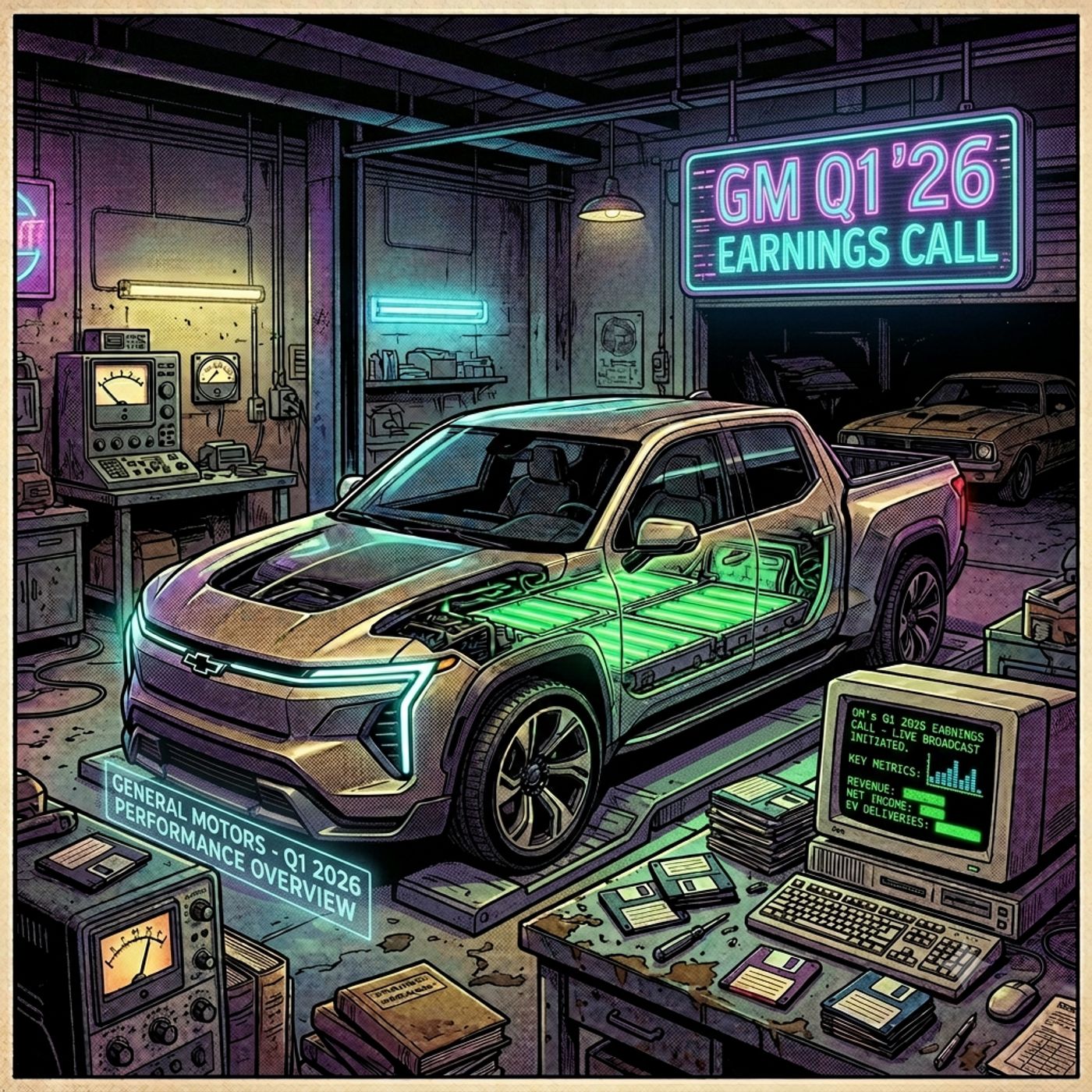
GM's Q1 2026 Earnings Call
About this episode
GM’s Q1 2026 earnings call is framed with recording details, speaker introductions, and a safe-harbor note before the host pivots to what matters most. The discussion centers on connected “digital services” like OnStar and Super Cruise—usage milestones, attachment rates, pricing, and how deferred revenue and hardware expensing affect margins. GM also addresses EV market-share trends, EV-related charges, and macro uncertainty tied to the Iranian conflict. Autonomy gets a roadmap angle, with AI-heavy development and “eyes-off, hands-off” plans tied to the Cadillac Escalade IQ in 2028.
Here's the link to the Car Stuff Podcast https://bleav.com/shows/car-stuff-podcast/
Here's the link for the Car Stuff Podcast Scout Motors Episode: https://bleav.com/shows/car-stuff-podcast/episodes/compact-crossover-comparo-scout-deep-dive-discontinued-car-quiz/
Here's the link for GMs Q1 2026 Earnings Call: https://investor.gm.com/events/event-details/general-motors-company-q1-2026-earnings-conference-call
Kilowatt Show Notes Generator
Custom Gem
In this episode, we dive deep into General Motors’ first quarter 2026 earnings call to unpack the automaker’s latest financial performance, changing market position, and strategic outlook. We dissect GM's robust sales performance in North America and track its growing EV market share alongside the complex capacity adjustments being made to handle shifting consumer demand. Listen in as we break down the critical analyst questions surrounding production costs, structural margins, and the evolving roadmap for software-based revenue. We also explore the massive expansion of GM's digital ecosystem—highlighting key updates to OnStar and Super Cruise—as well as their implementation of AI in software engineering and upcoming supervised autonomy testing for personal vehicles. Finally, the episode looks honestly at how GM is navigating lower EV volumes and the financial sting from the loss of federal U.S. tax incentives.
Support the Show https://www.supportkilowatt.com/
Other Podcasts:
News Links:
- Car Stuff Podcast
- Car Stuff Podcast: Compact Crossover Comparo & Scout Deep Dive
- General Motors Company Q1 2026 Earnings Conference Call
*Show Art Created By Gemini
Hosted by Simplecast, an AdsWizz company. See pcm.adswizz.com for information about our collection and use of personal data for advertising.
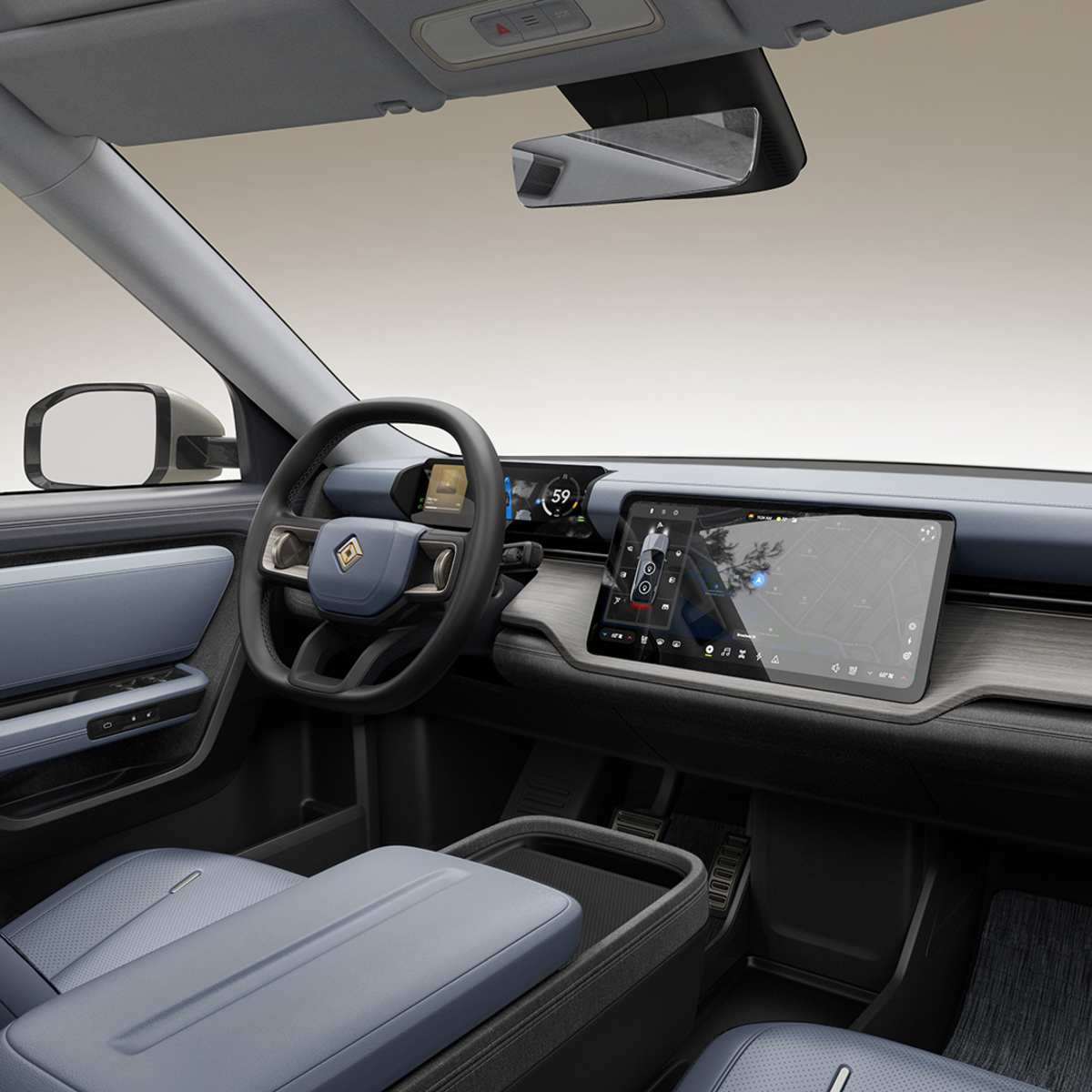
Rivian R2
"In addition to that, it's June 9th, which is Rivian's R2 day. They're delivering Rivian R2s today. Today's the launch day."
The Rivian R2 is an all-electric SUV from Rivian. This segment is talking about its launch day—when deliveries start and people can finally see and buy it.
Rivian R2 is Rivian’s upcoming electric SUV, positioned as a smaller, more affordable step in the brand’s lineup compared with the larger R1 models. The “launch day” framing here is about the start of deliveries and public availability, which is a big moment for any new EV platform.
digital services
"We're also building tremendous momentum in digital services. [215.8s] They are playing an increasingly important role in our success and they will drive even [220.4s] stronger results in the future."
“Digital services” means the software and online features that come with a car. Instead of just selling the vehicle, companies also sell ongoing features through apps or subscriptions.
In an automotive context, “digital services” refers to software-based offerings tied to the vehicle—like connected features, apps, and subscription-based functionality. Automakers increasingly treat these as a growth area because they can improve customer experience and create recurring revenue beyond the car sale.
EV market share
"As we exited the quarter, our EV market share in the US was 13%, up from about 10% in December [255.9s] 2025, which underscores the appeal of our portfolio as the segment stabilizes."
EV market share is how much of the car market is electric cars. If it goes up, it means more buyers are choosing EVs from that brand compared with other brands.
EV market share is the percentage of all vehicle sales in a region that are electric vehicles. When a company says its EV market share rose (e.g., from about 10% to 13%), it’s claiming it sold a larger slice of the EV market as the overall segment changes.
on-star subscribers
"We are on pace to add more than 1 million on-star subscribers in 2026, with about 30% of our [335.5s] existing customers choosing a premium plan. [338.4s] Outside of the US and Canada, we have more than 20 revenue-generating markets and regions,"
OnStar is GM’s service that connects your car to help and features through a cellular connection. “Subscribers” means people paying for those services over time.
OnStar is GM’s connected-services platform, and “subscribers” refers to customers paying for ongoing features delivered through the vehicle’s telematics connection. In earnings calls, subscriber growth is often used as a proxy for recurring revenue.
Super Cruise
"Within the on-star platform, supercruise is also scaling quickly. [351.9s] Our customers have now driven 1 billion hands-free miles and our subscription performance is [356.6s] on pace to exceed 850,000 subscribers by the end of the year, with strong renewal trends"
Super Cruise is GM’s system that can help you drive more automatically on certain roads. It can let you take your hands off the wheel and, in supported situations, look away from the road.
Super Cruise is General Motors’ hands-free driver-assistance system that can steer and manage driving tasks on compatible roads. It’s designed for “eyes-off, hands-off” operation when conditions and mapping support are met.

Cadillac Escalade IQ
"The continued growth of this ecosystem, including the customer base, Miles traveled, and the [377.1s] insights we're gaining to train our AI models will help pave the way for our eyes-off hands-off [381.6s] technology launching in 2028 on the Cadillac Escalade IQ."
The Cadillac Escalade IQ is an upcoming Cadillac electric version of the Escalade. GM says it will be one of the first vehicles to get a more advanced “eyes-off, hands-off” driving tech feature.
The Cadillac Escalade IQ is a Cadillac electric SUV platform that GM is positioning as a flagship for advanced driver-assistance. In this call, GM ties its “eyes-off, hands-off” technology launch to the Escalade IQ in 2028.
eyes-off hands-off
"The continued growth of this ecosystem, including the customer base, Miles traveled, and the [377.1s] insights we're gaining to train our AI models will help pave the way for our eyes-off hands-off [381.6s] technology launching in 2028 on the Cadillac Escalade IQ."
“Eyes-off, hands-off” refers to a higher level of automated driving where the system can handle steering and driving tasks while the driver is not actively watching the road and is not holding the wheel. It’s typically limited to specific conditions and may require driver monitoring and mapped road support.
subscription service
"...and as we'll hear later in the call, a fair number of people are finding enough value in it that they are continuing to pay for the subscription service."
A subscription service means you pay ongoing money to keep using a feature. In this case, it’s the car’s autonomous-driving feature after the free trial ends.
A subscription service is a recurring payment model for software features after an initial trial period. Here, the host says many GM customers keep paying for the autonomous-driving capability rather than dropping it after the free years.

Cadillac IQ
"However, when you buy a GM car and it comes equipped with all the hardware and you get, I think, three years of autonomous driving for free... Now, when the Cadillac IQ comes out, whenever in 2027, 2028, whatever Mary said it was, then we'll really see if GM could actually produce on their claims of, you know, hands-free, ice-free autonomous driving..."
Cadillac IQ is GM’s plan/label for new driver-assist or self-driving features in future Cadillac cars. The host is basically saying we’ll see if it really works as well as GM claims.
Cadillac IQ is GM’s branding for an upcoming autonomous-driving-focused technology platform tied to Cadillac vehicles. In this segment, the host frames it as a near-term test of whether GM can deliver on “hands-free” autonomous driving claims.
hands-free
"then we'll really see if GM could actually produce on their claims of, you know, hands-free, ice-free autonomous driving, we'll see."
“Hands-free” means the car is supposed to drive without you holding the wheel. The host is questioning whether GM can truly deliver that in practice.
“Hands-free” describes a level of driver assistance where the system can operate without the driver physically holding the steering wheel. The host uses it as a benchmark for GM’s claims, implying the real-world capability is uncertain.
ice-free autonomous driving
"then we'll really see if GM could actually produce on their claims of, you know, hands-free, ice-free autonomous driving, we'll see."
“ICE” here means gas engines. “Ice-free autonomous driving” is basically the idea that the same self-driving tech should work whether the car is gas or electric.
In this context, “ice” is shorthand for internal combustion engine, and “ice-free” means the autonomous system is intended to work across both gas cars and EVs. The host is highlighting GM’s goal of deploying one autonomy approach across different powertrains.
digital environment
"We're stress-testing it in the digital environment capable of simulating roughly 100 years of human driving every single day."
A digital environment is a computer simulation of driving conditions. It lets engineers test self-driving software without putting cars on the road for every scenario.
A digital environment is a simulation or virtual test world used to evaluate autonomous-driving behavior without risking real vehicles. The segment claims GM can simulate an enormous amount of driving experience daily to accelerate development.
stress-testing
"We're stress-testing it in the digital environment capable of simulating roughly 100 years of human driving every single day."
Stress-testing means they try to “break” or challenge the system with tough situations to see if it still works. In this case, they do it in a computer simulation before real-world testing.
Stress-testing is a validation method where software is pushed through difficult scenarios to see how it behaves under challenging conditions. Here, GM is said to be stress-testing autonomy in a digital environment via large-scale driving simulation.
supervised on-road testing
"We recently took the next step and began supervised on-road testing in California and Michigan."
“Supervised on-road testing” means they test the self-driving tech on real roads, but someone is watching and ready to take over if needed. It’s safer than letting the system run completely on its own.
Supervised on-road testing means the autonomy system is tested on public roads while a safety driver or operator monitors it. This is a step beyond simulation, used to validate real-world behavior before wider deployment.
AI
"The way we're building this technology is a reflection of how seriously we're embracing AI across the enterprise. Today, nearly 90% of the code written by our autonomy team is generated by AI."
AI means computer systems that can learn patterns and help make decisions. In this segment, GM says AI is being used to help write a big portion of the code for their self-driving work.
AI (artificial intelligence) is being used here to generate code for GM’s autonomy team. The host highlights that this is a notable amount of AI-assisted software development for an earnings call, implying it’s central to GM’s autonomy strategy.

Zevo Bright Drop
"...ted supplier contracts. With the exception of the bright drop EV van, we have not recorded impairments to our c..."
Zevo is an electric-vehicle company mentioned in the podcast. The discussion focuses on supplier contracts, which are the agreements for getting the parts needed to build EVs. Those contracts can affect whether vehicles can be produced on time and at the expected cost.
Zevo is an electric-vehicle brand mentioned in the podcast in the context of supplier contracts and financial reporting. That kind of discussion usually matters because EV production depends heavily on parts and manufacturing partners, and supplier issues can affect timelines and costs. The podcast’s reference suggests Zevo is part of a broader conversation about how EV companies manage production and supply-chain risk.
prepaid subscriptions
"My other question was on supercruise and the digital services for the strong growth that GM has been seeing in supercruise and the willingness for consumers to subscribe after the prepaid subscriptions last. ..."
A prepaid subscription is when customers pay upfront for a set period before the service becomes a recurring subscription. GM references “prepaid for a three-year period” for Super Cruise, then discusses what happens after that term ends (including deferred revenue and later subscription renewals).
attachment
"So what I would say, Mark, we're continuing to trend at about that 40% attachment after the subscription period. And we do it differently."
“Attachment rate” here means how many people actually sign up for the service. GM is saying that about 40% of the vehicles that were part of the initial plan end up continuing the subscription after that prepaid time ends.
In software and connected-car business models, “attachment rate” is the percentage of eligible vehicles or customers that end up subscribing or using a feature. GM says it’s “trending at about that 40% attachment after the subscription period,” meaning a sizable share of Super Cruise buyers continue paying after the initial prepaid term.
ARPU
"And I think that's what I was adhering to in the earlier question of when you look at the ARPU, you've got to really take into account the scale advantage that we have,"
ARPU means “average revenue per user.” It’s a way to measure how much money the company makes from each customer who uses a paid digital feature or service.
ARPU stands for Average Revenue Per User. In an automotive context, it’s commonly used to estimate how much money a company makes per connected-customer account (often from subscriptions like driver-assist features or infotainment services).
take rate
"and that probably goes to the higher take rate of 40%."
Take rate is the percentage of people who choose to buy the option. It’s basically a conversion rate for subscriptions like Super Cruise.
Take rate is the percentage of eligible customers who actually choose to buy or subscribe to a product. In subscription-feature discussions, it’s often treated as the same idea as attachment rate, just framed around the conversion from availability to purchase.
cost-last revenue curve
"How does that cost-last revenue curve look out over the next two to three years?"
This phrase is about timing: do you pay costs first, and then earn revenue later? They’re asking how the money timeline looks over the next few years.
“Cost-last revenue curve” describes how revenue ramps relative to when costs are incurred—i.e., whether spending happens first and revenue comes later. In software/business terms, it’s used to discuss timing: upfront investment versus when subscription or service revenue starts to show up.
amortize
"As we ramp up that deferred revenue base, and it starts to [1244.4s] amortize into the P&L at increasing rates, that's where you start to see the impact."
Amortize is an accounting way of spreading a cost or revenue over time. Instead of counting it all immediately, the company recognizes it step-by-step as the service period progresses.
Amortize is the accounting process of gradually expensing or recognizing the cost/revenue of an intangible item over a set period. Here, the speaker says deferred revenue base “amortize[s] into the P&L,” meaning the subscription revenue is recognized over time rather than all at once.
P&L
"...and it starts to [1244.4s] amortize into the P&L at increasing rates, that's where you start to see the impact."
P&L is the company’s profit-and-loss report. It’s where revenue and expenses get counted for a given time period, so the timing of subscription revenue recognition changes what the P&L shows.
P&L stands for “profit and loss” statement, the financial report that shows revenue, expenses, and resulting profit for a period. The call is emphasizing that how GM recognizes deferred subscription revenue affects margins shown on the P&L.
autonomy
"...and ultimately, autonomy can do [1274.2s] for us when you look at it across scale."
Autonomy means the car can handle more of the driving tasks on its own. The speaker is saying GM expects software and driver-assistance progress to eventually translate into bigger business impact.
Autonomy here means higher levels of automated driving—systems that can perform more driving tasks without continuous human input. The speaker frames it as a future benefit of GM’s software-defined vehicle strategy and Super Cruise evolution.
Mercedes
"We know about, I think it was Mercedes or BMW that was selling the heated seats, [1340.1s] which already came with the car, like the hardware for heated seats is in the car,"
Mercedes is mentioned as an example of a luxury brand that has tried charging subscriptions to turn on features. In the story, the feature hardware is already in the car, but you pay to activate it.
Mercedes is referenced as an example of a premium automaker that has used subscription-style monetization for features. The speaker specifically mentions heated seats being hardware-present but activated via subscription, which can be controversial with customers.
BMW
"We know about, I think it was Mercedes or BMW that was selling the heated seats, [1340.1s] which already came with the car, like the hardware for heated seats is in the car,"
BMW is mentioned as another example of a luxury brand that has tried subscription activation for features. The concern raised is that it can feel unfair if the hardware is already in the car.
BMW is referenced alongside Mercedes as an example of a premium automaker monetizing features via subscriptions. The speaker’s point is that charging to activate already-installed hardware (like heated seats) can go wrong with customers.
FSD
"I think Tesla does a good job of it too, although I'd still argue that $99 for FSD, especially if you have a hardware 3 vehicle, is too much money..."
FSD means “Full Self-Driving.” It’s a Tesla software add-on that tries to automate more of the driving. Whether it’s worth the price depends on what computer (hardware) is inside your Tesla.
FSD stands for Full Self-Driving, Tesla’s software package aimed at automating more driving tasks. It’s typically sold as a subscription or one-time purchase, and the value depends on what hardware generation is installed in the car.
hardware 3
"...especially if you have a hardware 3 vehicle, is too much money because you are not getting the same value out of your hardware 3 vehicle that you are out of a hardware 4 vehicle..."
“Hardware 3” is the generation of the computer inside a Tesla. If your car has older computer hardware, some advanced features may not work as well or at all compared with newer cars.
“Hardware 3” refers to Tesla’s third-generation onboard computing platform used for driver-assistance and autonomy features. The speaker argues that cars with older hardware can’t deliver the same capabilities as newer hardware, so subscription pricing may not match the real feature value.
hardware 4
"...because you are not getting the same value out of your hardware 3 vehicle that you are out of a hardware 4 vehicle, for instance..."
“Hardware 4” is a newer generation of the computer inside a Tesla. Newer computers can enable more advanced features, so the same subscription can feel more “worth it.”
“Hardware 4” is Tesla’s newer onboard computing platform generation compared with Hardware 3. The speaker’s point is that newer hardware can unlock more software features, so a subscription’s value can be higher on Hardware 4 cars.
Android Auto
"I know that GM has taken a lot of grief for getting rid of Android Auto, there we go, and Apple CarPlay..."
Android Auto lets you use your Android phone in the car—like maps and music—on the car’s screen. The speaker is saying GM removed support for it, which could change how easy it is to use your phone in the car.
Android Auto is Google’s in-car software that mirrors a phone’s compatible apps onto the vehicle’s infotainment screen. The speaker mentions GM “getting rid of Android Auto,” framing it as a software/platform decision that could affect customer experience.
Apple CarPlay
"...and Apple CarPlay, and you can argue that's going to hurt them in the long run."
Apple CarPlay connects your iPhone to the car so you can use certain apps on the car’s screen. The speaker is saying GM removing it could make the car less convenient for some buyers.
Apple CarPlay is Apple’s in-car system that brings selected iPhone apps (like navigation and music) to the vehicle’s infotainment display. The speaker pairs it with Android Auto to argue that removing popular phone-integration features can have long-term downsides.
SDV 2.0
"So as we continue to put SDV 2.0 and other capabilities, many of the vehicles that are out there today don't have the hardware capabilities to be able to deliver that."
SDV 2.0 is about making the car more “software-updatable,” so features can be improved or added over time. The key issue is that older cars may not have the right computer hardware to run the new software.
SDV 2.0 refers to a “software-defined vehicle” roadmap, where more vehicle functions are controlled by software and updated over time. The speaker says GM plans to roll out SDV 2.0 and that many existing vehicles lack the hardware needed to support those future capabilities.
deferred revenue
"we're already driving approximately $7.5 billion of deferred revenue by the end of this year with what we have."
Deferred revenue is basically “money collected now for something you’ll deliver later.” So it can be a clue that customers have paid for future features or services that aren’t active yet.
Deferred revenue is money GM has received (or is entitled to) for a product or service that hasn’t been delivered yet. In this context, it’s being used as a measure of demand/commitments for upcoming features or subscriptions tied to the company’s plans.

Equinox
"When I say a few, like again, it's going to be expensive cars. It's not going to sell as many as like the Equinox,"
The Equinox is one of GM’s more affordable, high-volume crossover models. GM is basically saying the newest expensive tech will likely debut on pricier cars first, not on the mass-market ones.
The Chevrolet Equinox is GM’s mainstream compact crossover, used here as a sales-volume benchmark. GM is contrasting it with the more expensive IQ-branded vehicles, implying the advanced tech may start in low-volume, high-price models before spreading out.
GM
"for instance. So I think that's a that's an easy way, I guess, for GM to kind of test this kind of technology in the similar way that Tesla is doing it,"
GM is the automaker being talked about. The idea is that they want to test new driving-assist tech with real customers, not just prototypes, so they can see how it works in normal driving.
GM (General Motors) is being discussed here as a company that wants to test advanced driver-assistance technology with real customers paying for it. That implies a commercialization approach—deploying the tech beyond internal testing to gather data and validate behavior in everyday use.
Tesla
"technology in the similar way that Tesla is doing it, by saying that I mean with customers paying for it."
Tesla is referenced as the benchmark for how an automaker can roll out driver-assistance features to customers. The speaker contrasts Tesla’s approach with GM’s and other companies’ philosophies, implying different strategies for deployment and responsibility.
G Rivian
"And I'm sure it's probably a little different than what G Rivian is doing. So we'll just kind of have to pay attention,"
Rivian is another electric-vehicle company mentioned in the comparison. The host is saying Rivian’s approach to advanced driving features may be different from Tesla’s and GM’s.
Rivian is being referenced as another automaker with a different philosophy for rolling out advanced driving technology. The transcript appears to say “G Rivian,” but the context strongly suggests the speaker means Rivian.
level three driving
"I'm hopeful for sure. But yeah, I'm sure there'll be lots of caveats for that eyes off hands off level three driving."
“Level 3” means the car can do a lot of the driving by itself, but you still have to be ready to take over if it asks. It usually only works reliably in certain conditions, not everywhere and not in every weather situation.
“Level 3 driving” refers to SAE automation levels, where the car can handle most of the driving task under specific conditions, but the driver must be ready to take over when the system requests it. It’s not full autonomy—especially in bad weather or complex scenarios—so the system’s limits matter a lot.
capital allocation strategy
"and a strong balance sheet supported by healthy cash flows to achieve our long-term goals and execute on our capital allocation strategy, regardless of the short-term volatility or"
Capital allocation strategy is basically how a company chooses to spend and invest its money. It’s about deciding what projects get funded and when.
A capital allocation strategy is how a company decides where to put its money—such as investing in new products, software, manufacturing, or returning cash to shareholders. In earnings calls, it’s often used to signal discipline and priorities over time.
Request an Explanation
Heard something you'd like explained? We'll add it to this episode.
Sign in to request explanations for terms you heard.
Want to learn more?
Browse our glossary for plain-English explanations of automotive terms, jargon, and concepts.
Help improve this episode
See something that's not quite right? Our annotations are AI-generated and can sometimes miss the mark. Click the flag icon on any annotation to suggest a correction.