Spark plugs can get “fouled” when something coats them so they can’t ignite the fuel-air mixture properly. Here, the host says oil is getting onto the plugs (and possibly into the engine’s burning chamber).
The combustion chamber is the part of the engine where the fuel is burned. If oil gets in there, it can cause dirty buildup and make the spark plugs work poorly.
A compression test checks how well each cylinder seals and builds pressure. If pressure is low, it can mean worn rings or valves that aren’t sealing, which can lead to oil getting into the combustion area.
A four-stroke engine completes its cycle in four piston movements: intake, compression, power (ignition), and exhaust. The compression phase is when the mixture is squeezed to the right pressure before ignition.
A leak down test puts air pressure into a cylinder and watches how much leaks out. Where the air escapes tells you whether the problem is rings, valves, or something like a gasket.
Valve seals are little rubber/plastic seals that sit around the valve stems. They stop oil from sneaking into the cylinder, where it would otherwise get burned and make the engine use oil.
Crankshaft bearings are the parts that let the crankshaft spin smoothly inside the engine. If metal debris gets into the oil, it can grind up or destroy those bearings.
The Chevrolet Silverado is a popular full-size pickup. The host mentions it as an example of a newer truck that could still have an engine problem caused by manufacturing debris.
The head gasket is a seal inside the engine that keeps coolant and oil where they belong. If it fails, coolant can get into the cylinders, and you may see white smoke and the engine can overheat.
The temperature gauge tells you if the engine is running too hot. If it climbs along with smoke, that’s a warning sign that something inside the engine isn’t sealing correctly.
An oil usage problem means your engine is burning or leaking oil faster than normal. You might see blue smoke, find low oil on the dipstick, or get an oil warning light.
Low oil pressure means the engine isn’t getting enough oil flow. If the oil warning light is on, you should check the oil level right away to avoid damage.
Blue smoke can be a sign that your engine is burning oil. If you see it, it usually means something inside the engine isn’t sealing or working properly.
Oil level tells you how much engine oil is in the engine. Checking it often helps you catch low oil early, before it can cause serious engine problems.
The oil pan is the part at the bottom of the engine that stores the oil. When the engine sits and cools down, the oil flows back down there, so the dipstick check is more accurate.
A dipstick is a simple stick you pull out to see how much oil is in the engine. You wipe it, put it back in, pull it out again, and check whether the oil level is in the safe range.
Overfilling means you put in more oil than the engine can safely hold. Too much oil can cause problems inside the engine, so you should add it slowly and recheck the level.
Apple CarPlay is a way to connect your iPhone to your car. It shows compatible apps on the car’s screen so you can use navigation, calls, and music more easily.
Disc and drum brakes are two different ways cars slow down. Disc brakes use pads that clamp onto a spinning disc, while drum brakes use shoes that press outward inside a drum. The type matters because they can wear and feel a bit differently.
Brake pads are the parts that press against the brake rotor to help your car stop. Over time they wear out, and when they do you might hear noise or feel that braking isn’t as strong. It’s important to know the signs so you can get them replaced.
Transmission fluid is the fluid that helps your transmission work smoothly. When it’s dirty or not right, the car can shift poorly and wear out faster.
OEM filters are the “right” oil filters made for your exact car model. They’re usually designed to fit perfectly and filter the oil the way the manufacturer intended.
The Honda Accord is a popular Honda family car. Here it’s just used as an example of a car the speaker wouldn’t buy if they planned to use cheaper oil filters.
The Subaru Forester is a popular Subaru SUV/crossover. The host mentions it as an example of a car they wouldn’t buy if they were going to use cheap oil filters.
A multi-point inspection is a checklist where a shop looks over several parts of your car. It helps find problems early and gives you documentation of what was checked.
A warranty is the manufacturer’s agreement to pay for certain repairs for a limited time. The host is saying that if you keep getting service done at the dealer, it can help if you need help paying for a repair later.
LIVE
Hey folks, Leonard B. Lawson here, the car guru.
I thought your name was Lenny.
Well, it is Lenny.
It's my nickname.
How do you spell it?
L-E-N-N-I-E.
So whenever I say my email address is Lenny Lawson 2020 at gmail.com, because
you want to ask a complicated automotive question, then make sure you put the IE
in there and not why.
Why did my mother spell my nickname that way?
And why didn't they just call me Leonard?
I probably because my grandfather, her father was Leonard.
And that could have been confusing.
So they called me Lenny.
My brother is Max Wendell Lawson, Jr.
Nope, didn't call him Max because my dad was Max, so they called him Wendell.
So there's Wendell and Lenny.
I bet there's no other family in existence that has two boys that are named Wendell
and Lenny.
That is a unique thing.
I'll tell you what else is unique.
This program is somewhat unique because, well, it's a radio program.
Started on WJCW many years ago.
Guy named Paul Overby used to run the show or sell staff up there.
And he said, Hey, Lenny, why don't you come do a show?
You know, he was doing these little segments with veterinarians and lawyers
and real estate people.
And they wanted a car dealer.
I think Chris Lee at Gatton was doing a little segment every now and then.
I love Chris Lee, but he was boring.
No, I'm just kidding.
He's good.
And so I said, I don't really want to do that.
I would rather do like a half hour or something like that.
He said, well, maybe we can work something out.
Well, two or three months later, he calls me.
So, okay, we got it worked out.
You can do a half hour on Saturdays.
I said, I'm not doing it on Saturday.
Okay, well, let me check on something else.
So he got it worked out where I could do it on Thursdays, half hour on Thursdays.
So I started doing it.
I never forget my first, well, the guy that runs the controls.
I did all the talking.
Occasionally somebody else would ask the questions, but there was this talk show
host and let's see, what was his name?
John John Quaintance.
That was his name.
See, this is a problem.
Now that I'm a geez, I cannot remember names.
I can remember faces, but I cannot remember names.
Well, let's just say this, he was doing the show.
He's sitting there in the seat.
He's working the controls.
He's looking at me, asked questions every now and then.
And I'm sitting there talking a little bit nervous.
I normally broke out in a minor sweat and all of a sudden he gets up.
I'm talking and he walks over and starts messing around with some things.
I'm still talking.
Then he walks out of the studio, door closes behind him.
And I'm sitting there in total shock and a high degree of panic.
And I know it had to sound weird on the radio because it was live.
He abandoned me, but then five minutes later, here he comes.
He just sits down, gets all comfortable and then asked me another question.
And I'm dumbfounded.
I wanted to punch him out, but I didn't.
I didn't think that would go over well on the radio.
So I just waited until it was over and I said, what were you thinking?
Why did you leave me?
He said, well, I didn't think it mattered.
I mean, you're sitting there talking and I figured you could handle yourself.
Yeah, maybe I could, but this was, I was young.
I mean, this was like, I don't know, 25 years ago.
I wasn't the confident person that I am now.
So that's how it got started.
And then about three years ago, this podcast thing really caught my attention.
I said, you know, I'm going to take this radio show and I'm going to make it a
worldwide phenomenon.
And so that's what I did.
I found this company called Buzzsprout and they are a podcast host.
And so I just started recording the show, sending it to them.
And then they send it all over the world.
Let me just tell you where this thing goes.
It's amazing.
Uh, right now, let's see, let me scroll back here.
All episodes, let's see.
I am in 135 different countries, 2,440 different cities around the world.
And quite frankly, there are, you know, some pretty small numbers in different areas,
just like in Australia, Melbourne, Australia.
I have 53 listeners, Clinton, Tennessee, 54, Austin, Texas, 55, Prague, Czech Republic,
59, London, England, 61.
And, oh, I just saw an interesting one, Ho Chi Minh City.
Isn't that in Vietnam?
Wasn't that called Saigon?
78.
I mean, that just freaks me out.
To think that I actually speak a universal car language, apparently people must face
similar issues wherever they live, where there's an automobile, where people obtain
service, where they buy cars, sell cars.
A lot of these things apply as long as they can understand my East Tennessee English.
I'll be back in just one minute.
All right, speaking of issues, let's talk about some car stuff.
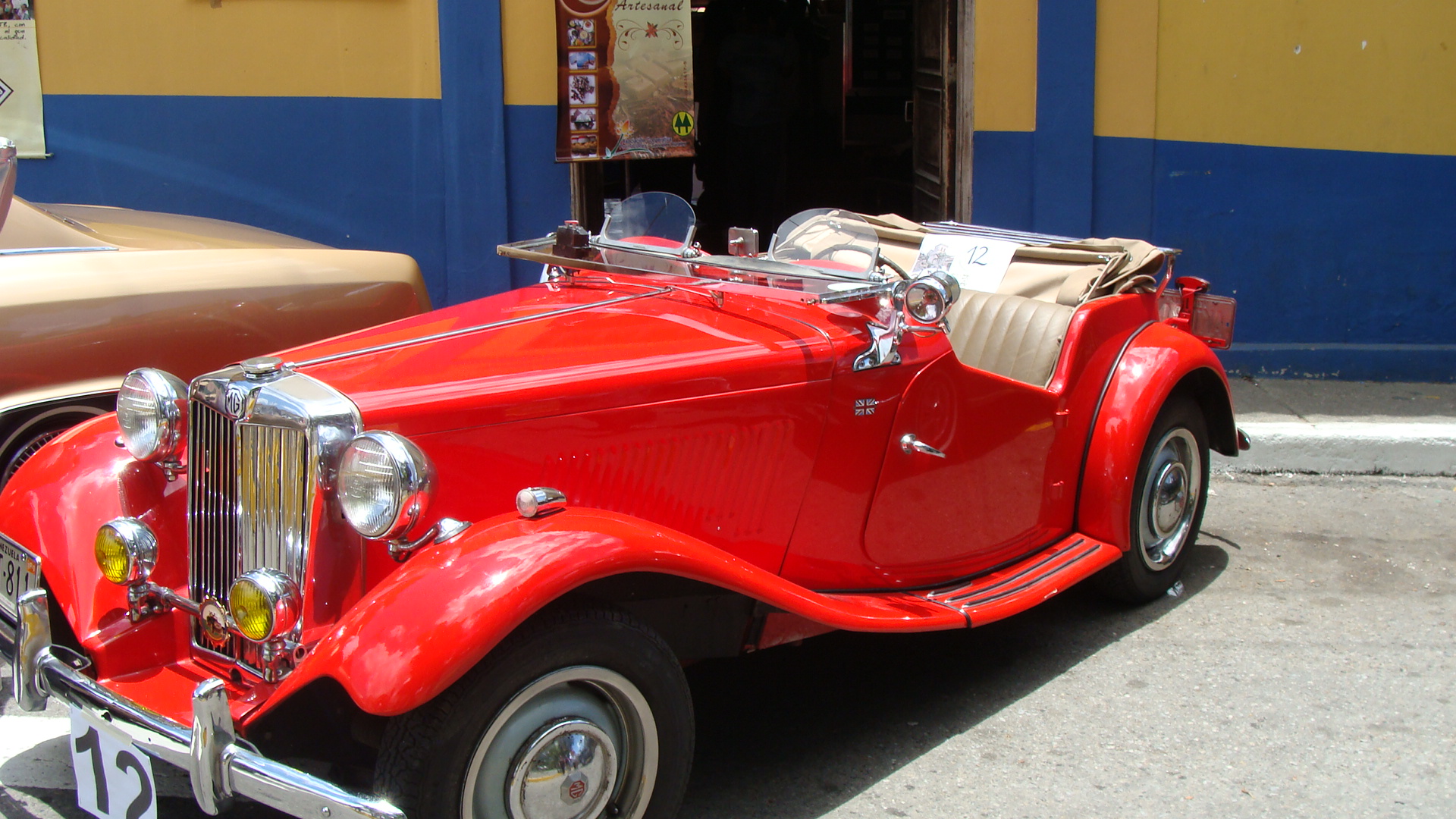
So I've got a 1950 MGTD.
This car was actually designed in the 30s.
And when you look at one of these cars, if you Google it, you'll see what I'm talking about.
It has the separate headlights in the front, the vertical grille.
Looks like a, the front of it looks like a Model A Ford or something like that.
Definitely a car from the 30s, but this was a 1950 model.
And a sweet lady called me from Johnson City and said, her dad had had this vehicle
since 1957, bought it for 700 and some odd dollars.
She said, will you sell it for me?
I said, yes, I will.
I drove to Johnson City, saw the car, immediately loved it.
Yellow with green leather interior.
I know it sounds weird, but great if you're a Green Bay Packers fan, which I'm not.
But I do love the car.
And I just said, you know, I think I'm just going to buy the car.
And she was thrilled.
Well, here's the problem.
It keeps fouling the spark plugs.
What does that mean?
Well, that means that the spark plugs are getting coated with oil.
Could be coated with carbon.
There's a lot of different things that get fouled the spark plugs, but these are
being coated with oil that's falling somehow or getting somehow into the combustion chamber.
Now there's only two places basically that oil can come from and get into the combustion chamber
where it's not supposed to be.
It can come from below the pistons in the crank case and get somehow get past the piston rings
and then to the combustion chamber.
This is a very common thing.
And the other way is that it somehow comes to the top of the engine through the valves
because the valves are in the top of the engine.
You have an intake valve and you have an exhaust valve.
The intake valve opens up, let's air into the combustion chamber.
Fuel is squirted into the combustion chamber and that mixture is compressed by the piston
and then a spark ignites and causes an explosion and pushes that piston back down.
Now you have an exhaust valve that opens up and lets the exhaust out, goes through the tailpipe.
Well, those valves are bathed, well, the mechanisms that make the valves go up and down
and the valve stems are lubricated.
They have oil on them.
So there's oil in the top of the engine and there's oil in the bottom.
Well, how do we figure out where this oil is coming from?
Well, we do something called a compression test first.
We want to make sure that the combustion chamber when the piston is going up in the compression phase
of the four-stroke engine that it is holding the right amount of pressure
because if it's not, there's a problem.
The rings are not sealing the combustion chamber and therefore oil is getting into there.
That could foul the spark plug, but that wasn't the problem.
We checked that.
We did another test called a leak down test, which is another way of verifying
or determining if we have a problem with the piston rings.
But here's the problem.
It's the valves.
The valves are probably fine, but there are these little things called valve seals.
And it's kind of like a gasket.
It's just a little plastic ring that goes around the valve stem.
And it's supposed to keep oil in the top of the engine, not let it leak down past the valve into the cylinder.
Well, that ain't working too good.
That's where my problem is.
So does that mean, Lenny, you need a new engine?
No, thank goodness.
I just need to pull the head off the engine where the valves reside, where they live,
where they go up and down and send that off to a engine shop that can redo the head.
And that should solve my problem.
Oil usage is a big issue on usually on older engines.
Sometimes it can happen with a brand new vehicle.
They're having a problem with a lot of different makers.
Hyundai, General Motors, a few Ford vehicles where the machining process,
when they're making an engine block, they're doing all that grinding and there's metal shavings all over the place that,
well, some of those metal shavings aren't getting cleaned out and they're working their way down into the crankcase.
And those shavings are destroying the crankshaft bearings.
And this could be a brand new Chevy Silverado or a Hyundai Sonata.
Yeah, and this has been a problem.
So yeah, it can happen on new cars, but on old cars, normally in the excess of 100,000 miles,
most people will never know that their engine is using oil unless there's a whole lot of blue smoke coming out of the tailpipe.
Not white smoke.
What's white smoke mean, Lenny?
It means that you probably have a blown head gasket, but not oil usage.
Now, white smoke in the morning is really just water vapors.
It's not really smoke, but it concerns a lot of people.
My vehicle is smoking like crazy in the morning.
Well, it's it's just cold or it's there's a lot of moisture in the air.
You don't have a problem, but if that white smoke continues and you'll typically notice your temperature gauge going up,
you have got coolant getting into the combustion chamber.
What causes that?
You remember, I was talking about the head having to come off my MG.
Well, the head where the where the valves are attaches to the block where there's a gasket between the block and the head is called a head gasket.
What a perfect name.
And that is the culprit, usually when you have coolant leaking into the combustion chamber.
A blown head gasket can render your engine dead, DOA, if it goes unnoticed for some period of time.
It can strand you on the side of the road.
So white smoke or blue smoke, not good.
So but if you have blue smoke, you know you have an oil usage problem.
Another way you know you have an oil usage problem.
You have an oil light come on.
Now that could be caused by low oil pressure as well.
But it could be say, hey, you need to check your oil, find your dipstick, pull the dipstick out, wipe it off when the vehicle is cold.
That is stick it back in, pull it back out again and look at it.
Maybe you are showing no oil on your dipstick.
You have an oil usage problem.
What's normal oil usage on a modern vehicle?
I would say normal vehicle should not use any more than half a quart of oil in about three to 4000 miles.
If it's used more than that, I think it's a problem, but the manufacturers don't always agree with me.
I have heard from various manufacturers that I have represented over the years, which includes Chevrolet, Toyota, Mitsubishi, Mazda, Chrysler, Dodge, Jeep, several others.
Ford, Nissan, did I say Mazda?
Probably did.
That if a vehicle is using a quart of oil in a thousand miles, that's normal.
I would be very upset if my car used a quart of oil in a thousand miles, especially if it was new.
If it's 20 years old or 10 years old with an excess of 100,000 miles, okay, I can forgive it for using a little bit of oil.
But it's going somewhere.
And, you know, if it's bad enough, you're going to see the blue smoke, but you just need to monitor your oil levels pretty often.
Like every other gas fill up, raise the hood and check your oil.
Now, you know, if you pull into a gas station to get gas, your engine's hot.
That's not the best place to do it.
You need to do it like first thing in the morning or in the evening after the engine is cooled down and the oil has had time to flow back down to the oil pan.
And then you raise the hood, pull the dipstick, wipe it off, stick it back in, pull it back out again, look at it.
And if it's down, you don't really do anything.
As long as it's within the range, you don't have to add any, okay?
But if it gets down below the add mark, then you need to add oil and you need to know how to do it.
You shouldn't have to drive to a gas station or to a car dealership to add oil.
You have an extra quarter to around your house or in your garage, maybe not in your living room, but in your garage.
And if you need to add some, you add some, but please, now listen very carefully, do not overfill your oil, do it a little bit at a time, and then recheck it.
If you overfill it, you can damage your engine.
If you way overfill it, you can ruin your engine.
So don't do that.
Use a funnel.
You should have one.
Know where your oil filler cap is.
And that's where you put it.
It's not hard, but you might need to get somebody to show you where it is.
You know, when you go in for service the next time, just ask the service advisor, will you show me exactly where my dipstick is and pull it out.
Let's look at where the marks are.
So I know where the full mark is and the low mark.
And then also where the oil goes if I need to add some before I come back for my next oil change, they'll be happy to do that for you.
And then while you're there, buy a quart of oil, the same brand that they're putting in your vehicle during the oil change and just have it there.
And like I say, you should check your oil, maybe every other gas fill up if you have concerns about oil usage, or maybe once a month.
It's just something that people don't do anymore.
I don't know.
Do they not want to get their hands dirty?
What's the problem?
Do you just think that it's, everything's going to be fine?
You're just hoping, you know, you go to the Jiffy Lou place.
They take care of it.
I don't have to do anything.
Yeah, those are the folks that end up on the side of the road.
Those are the folks that need to come to Gateway Ford for a tutorial with me, maybe.
I don't know.
You know, when I sell car to somebody, I make sure that they know where some of these checks are underneath their hood.
Most car dealerships, you buy a new car, they'll never raise the hood.
They used to be a big thing back in the seventies, eighties, nineties.
People wanted to see the engine.
They wanted to know how to check their oil and add oil and where their battery was and where's the spare tire and stuff like that.
I never have anybody ask about that stuff anymore.
They just want to know how to program their iPhone so they can get Apple CarPlay.
And, you know, how do you work this and how do you work that?
They never raise the hood.
They never ask questions about that anymore.
I guess it's because they believe that it doesn't matter until it does.
And then it gets expensive.
I think it's a big mistake, especially for young people that are,
new drivers, they need to have an orientation of some kind by their parents,
by an uncle that knows a lot about cars.
You know, if somebody gives them a car to drive,
then somebody needs to raise that hood and show them how things work
and make sure that it has a spare tire and that the spare tire has air in it and that they have
tools to change a flat tire and that they know how to do that.
That's one of the reasons I did the teen driver experience at my dealership is to
invite young people in to show them how this stuff works so that they have the knowledge.
They may never need it.
You know, they may never have to jumpstart a car or to change a flat
or, you know, check the oil for that matter.
But I think it's important for them to know how to do that kind of stuff and know the difference
between disc and drum brakes and how a braking system works and,
you know, how to tell if your brake pads are worn out.
What are the signs that you need to listen for and feel for when you're driving a car that
could indicate that it has a problem?
Because normally if you feel something, if you sense something
early enough, it won't be expensive.
If you wait, that's when it gets expensive.
The car dealership or the repair shop starts ringing the cash register.
I'll be back in just one minute.
I've always liked this saying, if you think an education is expensive, try ignorance.
And ignorance about how your car works and should work can be a big problem.
It can be a budget buster.
So most of your car, well, as far as the life of it is concerned,
the longevity of it depends upon fluids.
If you maintain the fluids at a high quality, they don't get too dirty like your engine oil,
transmission fluid, coolant, brake fluid, what other, power steering fluid.
All of these things are essential for your car to operate properly.
If the fluids stay clean, your car is going to last longer.
If you know how to check them, which is pretty simple, you don't have to
rely on another human being to do that for you.
You can do it.
But you need to have a little tutorial, either with your owner's manual or with a mechanic.
I'm not a fan of the quick loop places because I don't think they check enough
and they use the cheapest filters that they can find.
And they use generic oil, which is, to me, is not as good as what the manufacturer recommends.
I'm going to use mobile one in a lot of my vehicles.
It's a synthetic oil.
Or I'm going to use a synthetic blend, what the manufacturer recommends,
not what the high school dropout at the quick loop place recommends.
I'm going to use OEM filters, original equipment manufacturer filters.
I am not going to buy a new Honda Accord or a Subaru Forester.
Regardless what it is, I'm not going to buy it and then cheap out on the oil filters,
just because it's three dollars less.
No, and I'm also not going to go to the fast loop place.
I'm going to the dealer that sells that brand of vehicle and get a
multi-point inspection done every single time.
And another reason I do that is when my vehicle runs out of warranty and something
bad happens, if something bad happens, I'll be able to go to that dealership and say,
now listen, I've had all of my service work done here.
You need to go to bat for me to get this covered or at least get me some help from
the manufacturer.
And guess what?
They will and the manufacturer will help.
They help loyal customers because they want to retain you
and they'll either pay for the parts or the labor or they'll pay a large percentage of
a major repair bill.
Even if you're 25 or 30,000 miles out of warranty, they will step up but only under one circumstance
if you had all of your service work done there.
Now, if you miss one and you defect because you're on vacation or something and you can't
find an open dealership and you go to Walmart to get your oil change, that's fine one time.
But you need to go back to the dealership and ask for forgiveness.
No, you really don't.
Just get that off-brand filter off of there as quickly as possible.
Put a good one on there.
Put a factory filter on there from Honda or Toyota or Chevrolet or Ford.
And you'll be a lot better off in the long run.
Well, thanks for listening to this edition of My Car Guru if you have any questions.
You can send me an email to LennyLawson2020 at gmail.com and I'll do my best to answer it.
I'll see you next time.
About this episode
The My Car Guru Podcast blends a behind-the-scenes origin story with practical advice for building a global audience and becoming “famous” through your own show. The host ties podcast growth to a “universal car language” idea—people everywhere face similar car issues. Then the episode shifts into fluids and engine health: oil fouling spark plugs, diagnosing oil entry with compression/leak-down tests, and using smoke color to spot head gasket vs oil consumption. It closes with guidance on checking oil, choosing fluids, and using OEM filters.