A trade-in is when you give your old car to the dealership to help pay for a new one. They will give you money off the price of the new car based on how much your old car is worth.
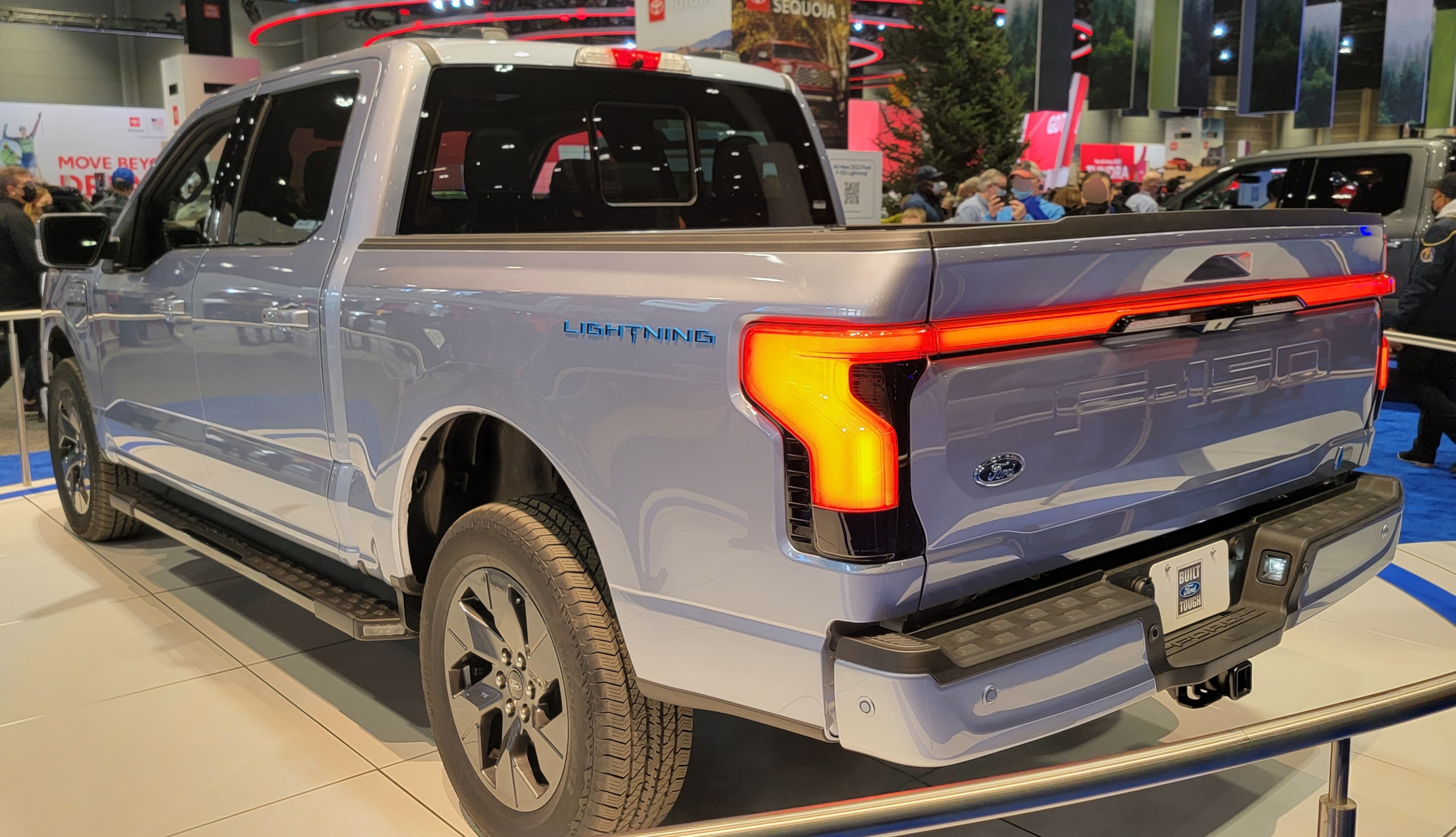
The Ford F-150 is a popular truck that can be used for work or personal use. It has different versions, like the Platinum and King Ranch, which are fancier and have more features.
Dealer markup is when a car dealer adds extra money to the price of a car above what the manufacturer suggests. This can happen if they think the car is in high demand.
A deal sheet is a paper that shows the details of the car deal, like how much you will pay and any extra costs. It helps both the buyer and seller keep track of what was agreed upon.
Negotiating means talking with the seller to try to lower the price or get better terms when buying a car. It's a way to make sure you don't pay more than you need to.
The terms of the loan are the details about how you will pay back the money you borrow to buy a car, like how long you have to pay it back and what interest you will pay.
The interest rate is how much extra money you pay back to the bank or credit union when you borrow money to buy a car. It's usually shown as a percentage of the total loan amount.
Aftermarket products are car parts or accessories that are made by other companies, not the car maker. They can be added to your car to improve performance or change its look.
An extended warranty is like extra insurance for your car that you can buy to cover repairs after the regular warranty runs out. It can save you money if something goes wrong, but you should check if it's a good deal.
The Ford Fusion is a car made by Ford that is designed for everyday use. It's known for being comfortable and efficient, making it a popular choice for families.
The check engine light is a light on your dashboard that tells you something might be wrong with your car. It could be a small issue or something more serious.
Overheating happens when your car's engine gets too hot, which can be dangerous and cause damage. It can happen for several reasons, like not having enough coolant.
A major service is a big maintenance check for your car that includes a lot of important tasks to keep it running well. It's usually based on how long you've had the car and how many miles you've driven.
Flushes are services where old fluids in your car are cleaned out and replaced with new ones. This helps keep your car's systems running smoothly and prevents problems.
A brake fluid flush is when mechanics take out the old brake fluid and put in new fluid. This is important for keeping your brakes working well and preventing problems.
A transmission flush is when all the old fluid in your car's transmission is removed and replaced with new fluid. If your car has a lot of miles, this can sometimes cause problems instead of fixing them.
The timing belt is a rubber belt in your car's engine that helps keep everything working together. If it breaks, it can cause big problems and may ruin your engine, so it's important to replace it regularly.
A cooling system flush is when you clean out the liquid that cools your engine. It's important to do this to keep your engine from getting too hot and to help it run better.
Coolant is a liquid that helps keep your car's engine from getting too hot. It moves around the engine and radiator to keep everything at the right temperature.
LIVE
Okay, so sometimes you have to do some role playing in order to be able to get your point
across.
Hey, this is Lenny Lawson, The Car Guru, and today we're going to do some role playing.
I know I've got it all in the My Car Guru guidebook, which is totally free and a great
Christmas gift or Thanksgiving gift even.
But sometimes people say, okay, they can read it, but they don't know how to execute it.
They don't know how it should sound, for example, coming out of their mouth.
So that's what I'm going to do.
Today, I'm going to role play with you.
I'm going to be me, and I'm going to be you, and I'm going to be the salesperson that's
waiting on you.
Or the service advisor.
We're going to do both.
These are where, well, okay, let's say you trade cars every four or five years.
That's going to be your limited experience with the salesperson, right, but you don't
want to blow it because this is where huge dollars are wasted.
I mean, you can waste huge dollars in the service department as well, but more than
likely those people aren't paid on an aggressive commission scale, and they are less likely
to lie to you.
So, and customer retention is important to those people at the average salesperson.
It's going to be there that long anyway.
So I mean, there are many exceptions.
I would say maybe 10% of the salespeople will last about five years at the same store, and
then 90% of them are going to either go back into whatever they did before because they
realize they can't cut it, or they're going to jump from dealership to dealership to dealership.
This is what they do.
So let's just start with the salesperson, okay?
So you walk into the, you get out of your car, and you're walking towards the dealership
and the salesperson approaches, hey, how can I help you?
Well, I am interested in looking at some different vehicle options for my wife.
Okay, what kind of monthly payment you're looking for?
Okay, so folks, that was the sound of breaks stopping you from going any further, because
wrong kind of salesperson.
If those words come out of their mouth anywhere in the first five minutes, you are at a four
square negotiating dealership that probably packs payments, which means they put all kinds
of stuff in the monthly payment to where you don't know what you're paying for the car.
They train their salespeople to get the customer to commit to a monthly payment.
So what do you say to that guy?
Here's what you say, sir, whatever my monthly payment budget is, is really not of your concern
at this point.
I want to pick out the right vehicle and then we'll talk about a sales price on that vehicle.
Are you going to trade anything?
Eee, those are the sounds of breaks, because how you respond next is as important as how
you responded to the payment question.
You don't have a trade in.
That's the answer.
What are you going to do with your car?
I don't know.
I might sell it, might give it to my sister-in-law.
I really don't know.
But I just want to pick out a car.
See you're restating that.
I want to pick out a car and I want to get a price on that car, what you sell that car
for.
And so if they don't go with you and willingly start showing you different things or asking
you questions about what you're interested in, what type of vehicle, SUV or passenger
car, truck, whatever it happens to be, then you're not dealing with somebody who's going
to help you buy something.
You're just dealing with somebody who's desperate to sell you something for a commission.
Yes, all of them need their compensation.
That's fair.
You expect them to sell you a car and either get paid a salary, which most dealerships don't
do, or they're going to get paid a commission for selling you the vehicle.
It could be based on the sale of a particular unit.
Maybe they get $250 a car or $300 a car on some sliding scale, or they could get paid
a commission based on how much money is made on the transaction.
So, a real salesperson, a good salesperson, is going to do everything he can to win your
trust and to build value in the product.
He's going to do his darndest to sell you him and his enthusiasm and his attitude and
to where you like him and trust him, and then he's going to help you select the right vehicle.
That's all you're asking for at this point.
You're not trying to get a price yet.
Pick the right vehicle first.
Understand that price is important.
I mean, you don't need to be buying a $60,000 car if your budget is $40,000.
So, if they land you on a Platinum F-150 and really your budget allows for an XLT, then
don't go test driving a Platinum or a King Ranch F-150 because you'll want it.
And many salespeople will push you towards the more expensive option because, why?
Because they make more money if you buy the more expensive option, okay?
So you test drive the car, you come back into the dealership, you're ready to get a price.
Now, at this point, at a lot of high pressure dealerships, they'll turn you over to a manager
at this point because he wants to really pull the information that the salesperson was unable
to pull from you.
And that is what kind of monthly payment you're looking for.
And well, he may even ask, what kind of credit do you have, you know, as if that was any
of his business at this point either.
And then, same question.
What about a trade?
Aren't you going to trade your car?
You are going to trade your car, aren't you?
Really?
Really?
Come on.
You know, that's what they're going to do.
And your answer is, well, I may trade my car.
I don't know.
I may sell my car to my sister-in-law, like I said, but right now I just want to get a
price on the car that he showed me.
I like the car.
It's great.
I need your best price on the car.
Well, if we give you a really good price, will you buy the car today?
Do I have to buy the car today?
Well, no.
Well, then probably not.
I'm going to study my options, but I just want your best price because I'm leaving after
you give me the price.
Well, I'm not going to give you a price.
If you're just going to go shop it, you know, I've even heard salespeople say that.
I mean, I've had people come from Johnson City and different places.
They've been shopping around and tell me these stories of what salespeople say, what managers
say, to try to get them to act, to buy now.
And that's not what you want to do.
You want to think about it.
That's the best option.
See, at this point, you're still in control, totally.
Now, if they give you a, let's say that they give you a price and it's not discounted very
much, negotiate it, say, well, you know, I just, that's way too much.
I'm not interested in paying that much for the car.
You're only knocking off $300 and that was off of the MSRP.
And by the way, what's that extra sticker you have beside the sticker that says an additional
$4,000 or $5,000?
What's that for?
Boy, I just love to watch salespeople squirm when you ask them that question.
Like there's this competitor of mine that adds like $4,000 or $5,000 on top of the sticker
of every car.
And the salesperson will actually go up to the customer and say, we're not knocking
off $300, we're knocking off $5,300.
I love that because I will swap that one out of the ballpark.
Now, you're not knocking off $5,300.
I was born at night, but I wasn't born last night.
That's a good one to say.
You know, I should probably leave because you have that added on there.
But no, I'm not paying for any of that.
We got to pay for the, the, you seal it, pack it.
No, I don't.
No, that's just vapor.
I'm not paying for that.
I want to know what my discount is going to be off of MSRP.
And if that's the best you can do, then put it in writing, sign, sign me a little deal
sheet or whatever you call it.
And I'll go home and think about it.
How's that?
Well, how is that, Mr. Carbire, Mrs. Carbire?
Is that hard?
I mean, it was straightforward.
You don't have to be mean.
You just tell them like it is.
We're not, I'm not doing it your way, Mr. Salesperson.
We're doing this my way.
I'm the buyer and I have the power.
You don't have to say that, but he realizes it really quickly.
If you handle the transaction that way, okay, I'll take my first break.
I'll be back here in just a minute.
So we talk about the four targets hitting the four targets in any car deal will save
you thousands of dollars and probably put you in a position where you can trade cars
again in three or four years and not be so far upside down, meaning that you owe a lot
more on the car than, than what it's worth and you'll be able to trade.
If you let them lead you around and you answer all those questions, like especially the one
about the payment, then you're going to be upside down.
You're going to owe more on your cards than it's worth because you paid too much for it.
It's that simple.
So reminding you what the four targets are.
The selling price of the vehicle is negotiated by itself.
The trade in is negotiated next by itself.
The trade value is not related to the selling price of the car.
A lot of dealers try to do that.
I've even heard some dealers or some salespeople tell customers say, well, if you trade for
that car over there, we'll give you $10,000 for your car, but if you trade for that car
over there, we'll give you $15,000 for your car.
Well, did your car all of a sudden go up in value?
No.
Why can they do that?
Because that one over there, they need to really get rid of it and it's overpriced.
It's got too much markup in it.
That's why you have to negotiate these things independently and separately.
And then the next target are the terms of the loan.
What's the length of the loan?
What's the interest rate on the loan?
What are the details as far as between you and the bank of the credit union, you know,
how this vehicle is being financed?
And then finally, the aftermarket products that are sold in the finance office because
you can get a great deal on the front end, great deal on the car.
They pay you what you want for your trade.
You get a good interest rate, but then they sell you an extended warranty and charge you
$5,000 for it when you should be able to buy it anywhere for $2,500.
So you have to hit all the four targets and look at each one as a different negotiation.
And just stay calm.
Now on the next episode, we're going to keep digging down this role-playing thing in the
sales department, but we're going to jump over to the service department real quickly.
Because that's where you probably go, what, three, four times a year?
If you put a lot of miles on your vehicle, you may go more frequently than that.
But when you go into the service department, or let's say this, before you go into the
service department, if it is for a mechanical issue, a problem, a check engine light, you
know, your brakes are making noise, you're smelling antifreeze when you get out of your
car, you've got some kind of vibration going on, your engine seems to be missing, your
fuel economy has gone down.
All of those types of problems need to be well documented.
And what I mean by that is if you can like do a video of your vehicle acting up, or you
know, if you can give specific temperatures outside that it seems to act up more often,
you know, it may be some kind of a battery issue or a tire issue, but just whenever
it's really cold, this is when this thing does it.
Or when it's warmed up, this is when it does it.
Or when I drive it a long way, I had a guy the other day driving a Ford Fusion.
I think it was a 2016 Ford Fusion.
If he drove somewhere between 45 and 60 miles, the check engine light would come on, and
the car would get hot, it would start to overheat.
He could drive around town, you know, just go 10 or 15 miles and nothing would happen.
But when he drove kind of that distance, then it started acting up.
That's important because that's part of the diagnosis process.
So you go in there with some information that will benefit, that will help the service
advisor and the technician figure out what's going on with your vehicle.
So today in most service departments, you're going to pull into a service drive.
I mean, the ones that are really behind the times, you still have to get out of your car,
walk inside, and talk to a service advisor.
But most of them have drive-throughs that make it more convenient.
So you will typically be greeted at your car by somebody who's going to get the basic
information, the VIN number, the miles.
If you have an appointment, of course, they want your name so that they can verify that.
And then you're going to talk to the service advisor, and they're going to ask you why
you're there unless you already provided that information to them.
And then they're going to start selling because they're going to look at the time that it's
been that you've owned the vehicle or since the last service and the miles that have elapsed,
or the miles that are on the vehicle to begin with to see if it's due for some type of major
service.
What major services should be done to your vehicle, the ones that are listed in the owner's
manual?
You know, a lot of service advisors, a lot of dealerships now charge for flushes, all
different kinds of flushes.
I've heard of brake fluid flushes.
What they mean is that they're going to use some type of a pressure or a chemical to push
out all the existing fluid that's in that component.
And then they're going to fill it back up with new fluid.
I talked to a guy that works at a Porsche dealership in Knoxville, and I said, why do
they, why do you guys recommend doing a brake fluid flush?
He said, Lenny, I have no idea.
That's the biggest bunch of malarkey I've ever seen.
You know, if you've had a car sitting for a lot of years and maybe it's been in a damp
garage or something, I understand that condensation can form and brake lines and different
components of your vehicle, but a flush on a relatively new car, maybe with 30,000 miles
that you've driven every day, no, thank you.
You know, and then they'll sell a power steering flush.
Are you kidding me?
A transmission flush.
You know, if you flush a transmission, it's never been done before and you drain all the
fluid out and you flush it and you put new fluid in it.
It's very possible, almost likely, that if it has over 100,000 miles on it, that transmission
will never shift the same.
You have damaged it because I don't know the scientific reasons, but it's just a fact
that older transmission should not be flushed and it's because it jars things loose.
You know, that transmission, all those clutches and gears and stuff, they've gotten used to
those circumstances and they're doing pretty good.
And if a component like that is doing fine, there's no reason to mess with it.
Now there's certain things that should be done.
Let's say you're not, you weren't aware that you needed to change your timing belt at 60,000
miles or 80,000 miles.
That's one of those things that you better do because if you don't, you could easily
destroy your engine if that belt breaks.
That's important, but a cooling system flush, you know, a cooling system flush, I guess
it's the only one that really makes sense to me because I don't know, if you've seen
a lot of the coolant that comes out of people's cars after it's been in there for four or
five years and 60,000, 70,000 miles, it looks like, I don't know, it looks like the University
of Texas orange and that's not really good.
I'm sure the long horns like it, but you know, for that to be in your radiator or your
coolant overflow tank, it's not good.
So that would be a reason to maybe flush your cooling system.
I can go along with that, but when should you do it?
Well, if your coolant looks fine, it looks like about the same color.
As long as you have the right level of protection, there's no reason to pay to have it flushed.
I've actually seen cooling systems get flushed and then they start leaking.
And what's the customer do?
They blame the dealership for doing that.
Something broke loose, something was filling a hole somewhere, you know, a little piece
of metal or whatever, and then all of a sudden it starts seeping out of that hole.
Yeah, I mean, if there's a hole there, it needs to be fixed, but typically it's the
dealership that gets blamed for that, but yeah, that's the only flush that I would recommend.
Power steering, brakes, transmissions.
No, don't let the service advisor talk you into that.
Ma'am, your vehicle calls for a transmission flush.
Sir, could you show me where in my owner's manual it says I need a transmission flush?
Well, it's not in your owner's manual, it's something that we recommend.
Okay, well, if it's not in my owner's manual, I'm not doing it.
Oh, and one more thing, if they give you a price for something, and I've mentioned this
before, magic words, is that the best you can do?
Because that seems like a lot of money.
And you know, sometimes they'll get that deer in the headlights look on their eyes.
They've not heard that one, it's been a long time, I don't know, let me go check with my
manager.
Now, if you get that answer, then you might get a discount.
They might say, well, what did you have in mind?
Say, well, you know, $20, $30 off, 10%, 15%, give me something.
If you ask them, they might give it to you.
If you don't ask them, you'll never get anything.
So ask them.
It's pretty simple.
Okay, I'll take my last break, I'll be back in just a minute.
Okay, I am back.
You know, sometimes we do role-playing with our service advisors and our salespeople because
there are going to be circumstances that come up and they don't know what to say.
It's just like when you go to a restaurant and you bite into that hamburger and it's
awful.
So, you tell the waiter and they don't know what to say.
Well, I have to get my manager.
You know, there is no apology, there's no effort to really do anything at that point,
and so they just disappear and while everybody else is eating and enjoying themselves and
finishing their meals, you're sitting there with, you know, just looking at everybody
and eating bread.
Businesses are responsible for educating their workforce on what to do when things go wrong
or not as planned and it's just so many new car salespeople, they get so little training
and there's such a large turnover as far as the workers and how long they stay on the
job.
I mean, it's just, you know, people don't go to school, go to college and say, you know,
I just want to be a car salesman the rest of my life and because it's not what you would
call an honored profession, but you know what?
I know a salesperson, well, I've known several salespeople, but one in the tri-cities where
I live that he never waited on customers that just appeared on the lot.
Not every bit of his business was repeating referral and he sold between 30 and 40 cars
a month and him he probably made more than anybody else in the dealership except for
the guy that owned the dealership.
And then I know another salesperson in Knoxville, Tennessee, the same kind of thing.
He's been offered every single job in the dealership in there for going on 35 years
and they've offered him the general manager's job.
They've offered him all the sales manager's position finding.
He said, why would I want to do that?
I set my own schedule.
I don't wait on any lot traffic.
I don't have to meet any strangers.
My customers come to me and call me when they're ready for a new car.
Does that sound like a pretty good profession to you?
It does to me.
But the problem is that most individuals don't have the patience and the work ethic to wait
until they get to that point and they become self-sufficient.
And that's the guy that you want waiting on you.
Go to the receptionist at the dealership, find out who their best salesperson has been there
the longest.
I guarantee he didn't come out of his office and say, well, you want your monthly payment
to be, you know, it just, he doesn't operate that way.
Because he understands the buyer.
He understands what people want and he gives it to him.
And that's all that matters.
Well, folks, thanks for listening to this edition of My Car Guru.
If you have any questions, you can call me on my personal cell phone, 423-552-2020.
Send me a text and send me your email address and I'll forward you a copy of the My Car
Guru guidebook that explains all of this stuff in detail.
Well, thanks again and I'll see you next time.
About this episode
Lenny Lawson dives into the intricacies of the car buying and servicing experience through engaging role-playing scenarios. He emphasizes the importance of understanding the sales process, recognizing red flags with salespeople, and negotiating effectively. Lenny shares insights on how to maintain control during the buying process, the significance of independent negotiations for pricing and trade-ins, and the pitfalls of unnecessary service recommendations. This episode is packed with practical advice for anyone looking to navigate the often confusing world of car dealerships with confidence.