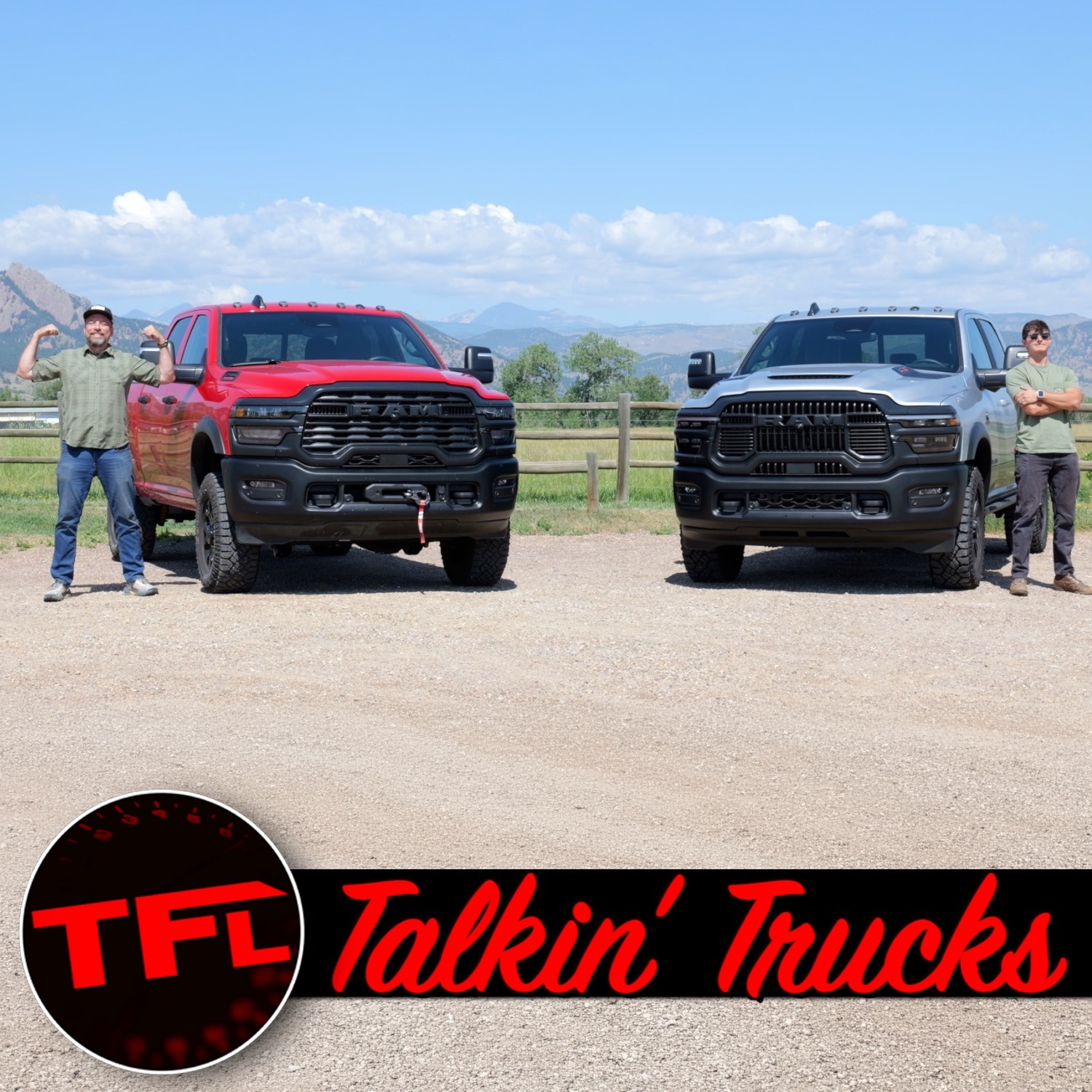
Is The New Cummins Power Wagon Worth It? | Ep. 340
About this episode
The hosts break down whether the new Cummins Power Wagon is worth the jump from a Hemi-powered Power Wagon. They compare price ($103,000 vs about $67,000), power and torque (430 hp/1,075 lb-ft vs 405 hp/429 lb-ft), and real-world capability like payload and towing. Off-road hardware gets a lot of attention—lockers, sway bar disconnect, articulation, and winch/camera differences—plus practical notes on interior controls, visibility, and fuel economy. They also flag warranty and discount realities, then preview upcoming testing.
( https://www.alltfl.com/ ) Check out our new spot to find ALL our content, from news to videos and our podcasts!
The crew hits the field for an outdoors, hands-on comparison between two massive heavy-duty off-road rigs: the brand-new 2027 Cummins-powered Ram Power Wagon and a traditional gas-powered Hemi Tradesman Power Wagon. With nearly a $36,000 price difference separating the $67,000 work-ready Hemi from the fully loaded $103,000 Cummins, the guys break down where that extra money actually goes. While the Hemi offers maximum budget-friendly trail capability on 17-inch wheels with a factory Warn winch, the new Cummins diesel brings massive upgrades in utility—boosting payload and towing capacity immensely. Between inspecting the solid axles, front and rear selectable lockers, and sway bar disconnects, the team evaluates whether the heavy-duty diesel engine, upgraded load ratings, and tech-heavy interior are worth the steep jump in price.
The guys also cover the latest news sweeping the truck world. They discuss Ram’s controversial new warranty policy targeting short-term TRX buyers and flippers, GMC’s 25th-anniversary Hummer EV Icon edition, and updates on high-performance luxury SUVs like the delayed high-horsepower Infiniti QX80. The team also highlights fresh developments in the compact EV space, including TELLO’s progress toward its affordable electric pickup, before taking a deep dive into the cabin features of both Power Wagons—contrasting analog gauges and cloth seats with 14.5-inch vertical screens and dual wireless chargers.
( http://www.patreon.com/tflcar ) Visit our Patreon page to support the TFL team!
Advertising Inquiries: https://redcircle.com/brands
Privacy & Opt-Out: https://redcircle.com/privacy
Hemi
"And we've got the traditional, the old-school, hemi-powered power wagon right next to it. There's a big price difference between these two trucks."
“Hemi” is a nickname for an engine design with a combustion chamber shaped like a half-sphere. It’s used here to mean the older gas engine version of the Power Wagon.
“Hemi” refers to Chrysler’s hemispherical combustion-chamber engine design, which helps shape airflow and can support strong power output. In this episode, the hosts use “hemi-powered power wagon” to distinguish the older gas Power Wagon from the newer diesel Cummins-powered one.
6.4 liter
"Yeah. [89.3s] It's a big 6.4 liter, and it's got a new transmission in 2019. [95.1s] They added the ZF 8-speed automatic, which this still has, and it's kind of stealth, right?"
“6.4 liter” tells you how big the engine is. Bigger displacement often means more potential for pulling power, and the hosts are comparing this engine’s strength to another setup.
“6.4 liter” is the engine displacement, meaning the total volume of all cylinders in the engine. In this context it’s paired with the Power Wagon discussion, where the hosts compare how the engine’s output feels in a heavy truck.
ZF 8-speed automatics
"[95.1s] They added the ZF 8-speed automatic, which this still has, and it's kind of stealth, right? [101.5s] You won't find any power wagon stickers or decals or nothing like that. [106.7s] Yeah."
This is an automatic transmission with eight forward gears, made by ZF. Having more gears can help the truck stay in the right engine speed for smoother driving and stronger pulling.
A “ZF 8-speed automatic” is an eight-gear automatic transmission made by ZF. More gears can help keep the engine in a better efficiency or power band, which matters for towing and payload work.
powertrain
"[116.7s] So the powertrain in this truck, to your point, is tried and true. [121.3s] It's a known quantity, which is great, but we've been asking for a Cummins power wagon [126.8s] for such a long time, because the name is power wagon, and the 6.4 hemi has always felt"
“Powertrain” means the main parts that work together to move the truck, like the engine and transmission. They’re saying the truck’s setup is proven and dependable.
“Powertrain” is the combined set of components that make the vehicle move—typically the engine, transmission, driveshaft, and differential. Here, the hosts use it to frame how the truck’s drivetrain is “tried and true” and what that means for capability.
torque
"So 430 horsepower and 1,075 pound-feet of torque versus 405 horsepower, which is not actually [152.6s] that far below it, but 429 pound-feet of torque. [155.7s] Not so many torques, I would say."
Torque is the engine’s pulling force. For towing and hauling, torque often matters more than horsepower because it helps the truck move heavy loads.
Torque is the twisting force an engine produces, and it strongly affects how easily a truck can get moving and how well it pulls under load. The segment contrasts torque numbers (including pound-feet) to argue the Cummins setup provides more real towing grunt.
horsepower
"So 430 horsepower and 1,075 pound-feet of torque versus 405 horsepower, which is not actually [152.6s] that far below it, but 429 pound-feet of torque."
Horsepower is a number that describes how strong the engine is. Higher horsepower usually means the engine can produce more power for acceleration and pulling.
Horsepower is a measure of engine power—how quickly the engine can do work. The hosts compare horsepower figures between two truck setups to show how the new Cummins version changes the performance balance.
towing
"but also the new Cummins power wagon has more capability as far as payload and towing. [177.8s] So we need to talk about all those features and show actually how they're different, because"
Towing is how well the truck can pull a trailer. The hosts are saying the newer Cummins version is better suited for that job than the older setup.
“Towing” refers to the truck’s ability to pull a trailer, which is limited by factors like engine torque, transmission gearing, cooling capacity, and drivetrain strength. In this segment, towing is part of the reason they say the Cummins Power Wagon is more capable.

Ford Maverick
"$36,000, you could buy a brand new Ford Maverick for that much money."
The Ford Maverick is a smaller, cheaper pickup truck. Here, they’re comparing its price to the Power Wagon to show how much more expensive the Power Wagon is.
The Ford Maverick is a compact pickup that’s known for being one of the more affordable ways to get into a truck. In this segment, it’s used as a price benchmark against the much more expensive Power Wagon variants.
articulation
"This truck will actually do the work. Right? Yes, and for the people that are listening. The Cummins power wagon will stay on the highway by itself, and it will never get muddy, and the Hemi-powered, affordable power wagon with, look at how much clearance this wheel has. I mean, it has a lot of articulation, clearance."
Articulation is how well the suspension can “flex” when the road gets bumpy. More articulation usually means the tires stay on the ground better off-road.
Articulation is how much a vehicle’s suspension can move up and down independently as the wheels travel over uneven ground. More articulation helps maintain tire contact and traction when climbing, descending, or crossing ruts and rocks.
wheel gap
"I mean, it has a lot of articulation, clearance. It's got a lot of wheel gap. A lot of wheel gap."
Wheel gap is the space between the tire and the fender. People look at it because it can hint at how much clearance and suspension movement the truck has for off-roading.
Wheel gap is the visible space between the tire and the wheel opening in the fender. It’s often used as a quick visual cue for ride height and suspension travel, which can matter for off-road clearance.
285 70R17
"The Hemi power wagon, which is a more basic truck, has a 17-inch wheel, and this tire is a 285 70R17, which measures out in inches to about 32.7. Since we all like to round up, we'll call that a 33."
That number is the tire’s size. It tells you the tire width, how tall the sidewall is, and that it’s made to fit a 17-inch wheel.
“285/70R17” is a tire size code. It means the tire is 285 mm wide, has a sidewall height that’s 70% of the width, and it fits on a 17-inch wheel.
285 60R20
"So we'll also call the tire on the Cummins power wagon a 34. This is a 285 60R20, which measures to about 33.5, but it is on a 20-inch wheel, which is not especially conducive to going off-road because especially the design of this wheel,"
That’s the tire size. It tells you how wide the tire is, how tall the sidewall is, and that it’s meant for a 20-inch wheel.
“285/60R20” is a tire size code. It indicates a 285 mm width, a sidewall height that’s 60% of the width, and compatibility with a 20-inch wheel.
off-road
"This is a 285 60R20, which measures to about 33.5, but it is on a 20-inch wheel, which is not especially conducive to going off-road because especially the design of this wheel,"
Off-road means driving on rough or unpaved ground. They’re saying the wheel and tire design they’re using may not be as good for that kind of driving.
“Off-road” refers to driving on unpaved or rough surfaces where traction, tire sidewall compliance, and wheel protection matter more than on-road comfort. In this segment, they’re implying that the 20-inch wheel/tire setup is less ideal for off-road conditions.

Cummins power wagon
"But here's what I learned from the Ram folks, right, looking at the Cummins power wagon, [376.8s] because people have been asking for it."
This is a Ram truck called the Power Wagon, and it uses a Cummins diesel engine. The hosts are talking about how Ram tries to make it carry and tow more by changing parts on the truck.
The Ram Cummins Power Wagon is a heavy-duty off-road pickup built around a Cummins diesel engine and the Power Wagon package. In this segment, the hosts focus on how Ram changes the truck’s capability—especially payload and towing—by updating components like tires.
load rating
"So this tire is actually different load rating, right? [393.1s] So it enables them to actually load it up with up to 2,700 pounds of payload,"
Load rating is how much weight a tire is designed to safely carry. If the tire has a higher load rating, the truck can carry more cargo without overloading the tires.
Load rating is a tire’s maximum weight capacity, typically tied to its tire size and construction. A higher load rating lets the truck carry more payload safely, which is why the hosts call out that this tire is different for the Power Wagon.

Lotus Excel
"...s Cummins power wagon as a basis for a prospector excel would be insane. Yes, but there is a lower range ..."
The Lotus Excel is a sports car made by Lotus. In the podcast, it’s mentioned as part of a wild “what if” idea—turning it into something much more extreme by using a heavy-duty engine concept. It’s not described as a normal factory setup, more like a crazy custom possibility.
The Lotus Excel is a sports car model known for being a more practical, fast grand-touring-style Lotus rather than a pure track-only machine. In the podcast, it’s brought up as a hypothetical project—using a Cummins power wagon setup as a basis for an extreme “Prospector Excel” idea. That’s why it’s mentioned: it’s an unusual mashup that highlights how wild a concept build could be.
lower range E-tire
"Yes, but there is a lower range E-tire versus a lighter load tire. [428.2s] So this is what enables them to bring it out."
An E-tire is a heavier-duty tire meant for carrying more weight. The hosts are saying this setup uses a tire in a heavier load category, while a lighter-load tire would reduce how much the truck can safely carry.
An E-tire refers to a tire load category (often associated with “E-range” tires) that’s built to carry heavier loads than standard passenger/light-duty tires. The hosts contrast a “lower range E-tire” with a “lighter load tire,” explaining how tire choice affects the truck’s ability to meet payload goals.

Dodge Ram
"So this is what enables them to bring it out. But Ram, if you're listening, if they're making an update..."
Ram is the name used for Dodge’s full-size pickup trucks. The podcast mentions Ram because the speaker is talking about possible future changes or updates to the truck. It’s essentially a “what are they going to do next?” conversation.
The Dodge Ram (often referred to as the Ram pickup line) is a full-size truck brand known for frequent updates and different powertrain and trim options. In the podcast, “Ram” is mentioned in a forward-looking way—suggesting the speaker expects or hopes for an upcoming update. That’s why it’s brought up: it’s tied to what changes may be coming next.
front locker
"Obviously with the front locker. [462.6s] So no winch as stock on the front of the truck, [466.7s] but of course you could turn to the aftermarket."
A front locker locks the front wheels together so they both spin at the same time. It helps when the ground is slippery and one wheel would spin uselessly.
A front locker is a differential lock for the front axle that forces both front wheels to rotate together. That improves traction when one wheel would otherwise spin, which is why it’s relevant for off-road recovery and low-grip situations.
aftermarket
"but of course you could turn to the aftermarket. [468.3s] You could get a winch pretty easily."
Aftermarket refers to parts and accessories made by companies other than the vehicle’s original manufacturer. In truck terms, it often means you can add upgrades like a winch even if the truck didn’t come with one from the factory.
camera system
"This truck is pretty well equipped. [471.9s] So you've got a nice camera system. [475.6s] You can see the front camera right underneath the A in the Ram logo."
A camera system is built-in cameras that help you see around the truck. It’s especially useful when you’re creeping forward or trying to line up in tight spots.
A camera system on a truck is a set of factory cameras (often front, rear, and/or side) used to improve visibility at low speeds and during tight maneuvers. Here it’s specifically called out as a front camera mounted near the grille area.
Ram radar technology
"But look, I still have Ram radar technology [500.5s] because every new heavy duty Ram also gets adaptive cruise control, right?"
Radar technology uses sensors to “see” what’s in front of you. It helps features like adaptive cruise control keep a safe distance from the vehicle ahead.
“Radar technology” here refers to the vehicle’s radar sensor system used for driver-assistance features. In this case, it’s tied to adaptive cruise control, which uses radar to maintain a set following distance from the car ahead.
factory installed
"But look at this, a factory installed winch. [511.2s] It's a worn winch, 12,000 pounds, synthetic line."
A factory installed winch is a recovery winch that comes mounted from the factory. That usually means it’s wired and fitted more cleanly than a random add-on.
A factory installed winch is an off-road recovery winch mounted and integrated by the vehicle manufacturer. Compared with adding one later, factory installation usually means better packaging, wiring integration, and fitment for the truck’s bumper and electrical system.
10,000 pounds
"It's a worn winch, 12,000 pounds, synthetic line. [515.4s] So it's a good piece of kit."
“12,000 pounds” is how much pulling power the winch is rated for. A bigger number generally means it can recover heavier vehicles more effectively.
“12,000 pounds” is the winch’s rated pulling capacity, indicating how much force it’s designed to generate during recovery. Higher-rated winches can pull heavier vehicles or handle tougher recovery situations, though real-world results also depend on line type, angles, and vehicle weight.
synthetic line
"It's a worn winch, 12,000 pounds, synthetic line. [515.4s] So it's a good piece of kit."
Synthetic line is the rope on the winch made from strong fibers instead of steel cable. It’s usually lighter and easier to manage, and it behaves more safely if it ever fails.
A synthetic winch line is made from man-made fibers (instead of steel cable) and is commonly used on modern off-road trucks. Synthetic rope is typically lighter and easier to handle, and it can be safer in a snap scenario because it doesn’t whip like steel cable.
recovery points
"Both trucks have pretty sizable recovery points on the front bumpers. The Cummins power wagon does have a nicer headlight."
Recovery points are strong, purpose-built attachment locations on a vehicle—typically on the front bumper—for towing or winching when the truck is stuck. They’re designed to handle the high loads involved in pulling a vehicle out of mud, sand, or snow.
front bumpers
"Both trucks have pretty sizable recovery points on the front bumpers. The Cummins power wagon does have a nicer headlight."
The front bumper is the part at the front of the truck. On off-road trucks, it often includes strong hook-up points so you can tow or winch the truck if it gets stuck.
Front bumpers on off-road trucks often integrate hardware like recovery points and tow hooks. Their placement and strength matter because they’re the typical attachment location for pulling the vehicle out.

Lucid Air
"... massive. It's not like it's jacked way up in the air and it's a silver exterior color. So nothing else..."
The Lucid Air is an electric car that’s made to feel like a luxury sedan. Instead of using gasoline, it runs on electricity. The podcast mentions it while talking about the car’s size and appearance.
The Lucid Air is an electric luxury sedan known for its emphasis on efficiency and performance rather than traditional engine power. The podcast references it in a way that sounds like they’re discussing its physical presence and design details. It’s brought up because it represents a different direction from trucks and off-road vehicles—an EV luxury alternative.

power wagon
"But I guess the power wagon here, it identifies itself with the decals, right? ... So that helps differentiate it a little bit more."
The Power Wagon is a Dodge truck made for serious off-roading. It’s meant to be recognizable and it comes with special off-road drivetrain parts, including a locking front differential you can engage when you need extra traction.
The Power Wagon is a Dodge heavy-duty off-road truck line known for factory off-road hardware. In this segment, they’re focusing on its visual identification (decals) and, more importantly, its off-road drivetrain feature: a front selectable locking differential.
front selectable locking differential
"But we should say that this is the only heavy duty truck on the market with a front selectable locking differential."
This is a switchable off-road traction feature for the front wheels. When it’s locked, both front wheels work together so if one starts slipping, the other can still keep you moving.
A front selectable locking differential is a drivetrain feature that lets you lock the front axle’s left and right wheels together. When locked, both wheels turn at the same speed, which helps maintain traction when one wheel would otherwise spin.

F-250 Tremor
"So you can get obviously an F-250 Tremor. ... And the Tremor has got a rear locker, it's got bigger tires."
The F-250 Tremor is a Ford truck setup meant for off-roading. Here they’re saying it has an off-road rear locking feature and bigger tires, but it’s not the same as the Power Wagon’s front locking differential.
The Ford F-250 Tremor is a factory off-road package for the F-250 that’s aimed at trail use. In this segment, they compare it to the Power Wagon by noting the Tremor’s rear locker and larger tires.
rear locker
"And the Tremor has got a rear locker, it's got bigger tires."
A rear locker is an off-road traction feature for the back wheels. It helps when one wheel is slipping by making both rear wheels work together.
A rear locker is a locking differential feature for the rear axle. It forces the left and right rear wheels to rotate together, improving traction when one rear wheel loses grip.
factory winch
"You can get it with a factory winch, which is nice."
A factory winch is a rope-pulling tool that comes installed from the factory. It’s for off-road recovery—like pulling the truck out if it gets stuck.
A factory winch is a winching device installed by the vehicle manufacturer rather than added later. It’s used to pull the truck (or recover something) during off-road situations like getting stuck.
35s
"And you can also get it with 35s. Which is a bigger tire."
“35s” means tires that are about 35 inches tall. Bigger tires can help off-road by giving more clearance, but they can also change how the truck drives.
“35s” is shorthand for 35-inch tires, a common way enthusiasts talk about tire size. Bigger tires generally improve ground clearance and off-road capability, though they can affect ride, gearing, and fuel economy.
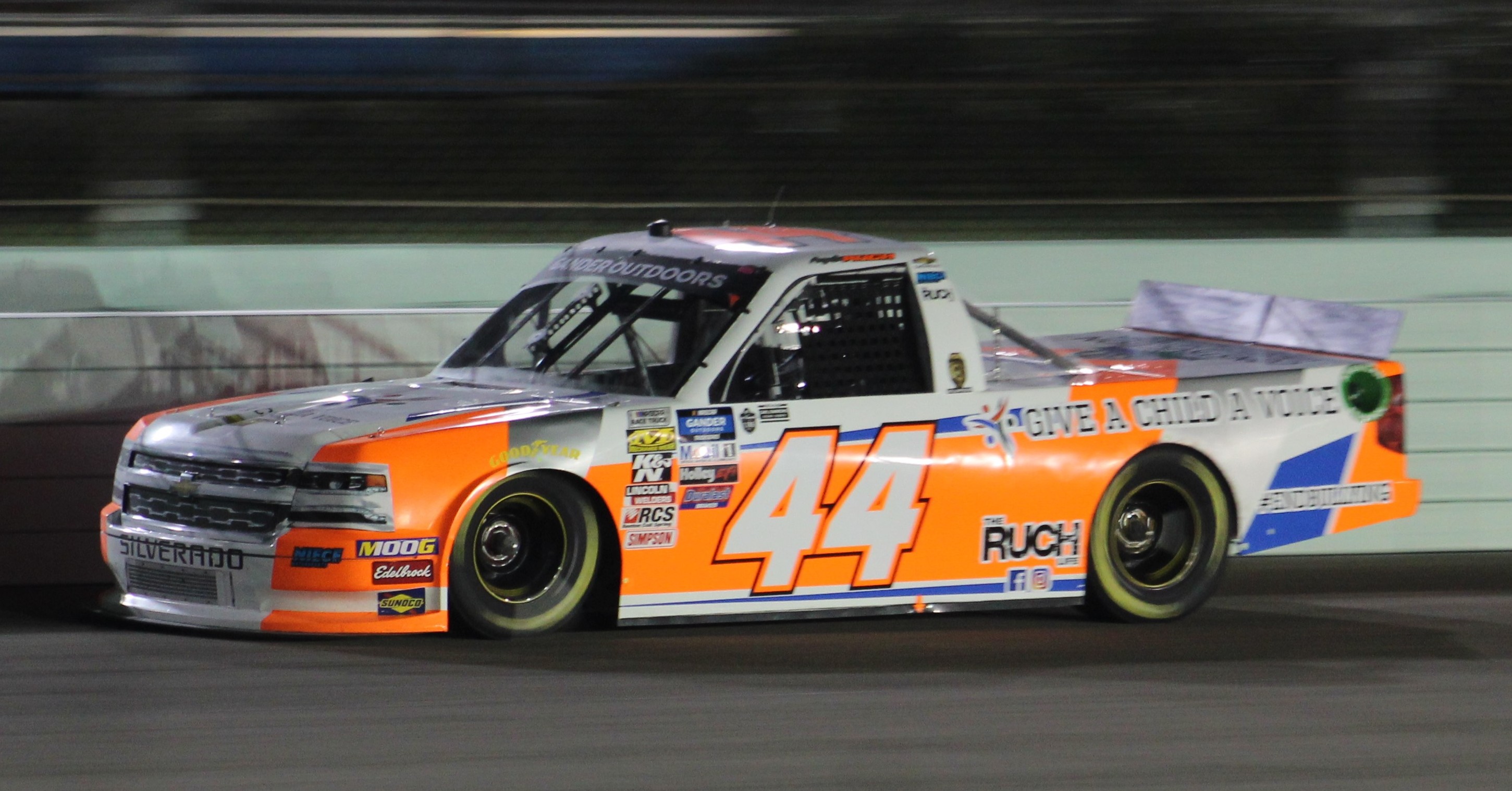
Chevrolet Silverado
"...vels, at least two, right? And also you can get a Silverado, I was going to say Super Tremor. No, the Tremor ..."
The Chevrolet Silverado is a large pickup truck made for hauling and towing, but it can also be used like a normal daily vehicle. People talk about it a lot because there are many versions, including ones meant for rough roads. In the podcast, it’s brought up when comparing different truck setups and off-road packages.
The Chevrolet Silverado is a full-size pickup truck known for being widely available in many trims and configurations. It often comes up in truck discussions because it’s a mainstream benchmark for capability, towing, and everyday usability. In this episode, it’s mentioned alongside other off-road-leaning or performance-focused options, including talk of specific off-road packages.

Ford F350
"No, the Tremor in like F-350 as well as F-250. ... So there's a couple of different ways you can get them."
The F-350 is Ford’s bigger heavy-duty truck. They’re saying you can also get the Tremor off-road package on an F-350, not just the smaller F-250.
The Ford F-350 is a heavy-duty pickup platform that can be ordered with the Tremor off-road package. In this segment, they mention that Tremor availability extends to the F-350 as another way to get similar off-road equipment.
Silverado ZR2
"You could get a Silverado ZR2. And you can even get them kitted out with AEV parts."
The Chevrolet Silverado ZR2 is an off-road-focused trim of the Silverado built for tougher trails. It’s brought up here as a competitor to the Cummins Power Wagon, especially in the context of factory off-road options.
AEV parts
"And you can even get them kitted out with AEV parts. By some parts."
AEV makes aftermarket parts for off-road trucks. The point here is that you can add upgrades from AEV to make the truck better for trails.
AEV (American Expedition Vehicles) is an aftermarket brand known for off-road truck upgrades. Mentioning “AEV parts” signals that you can buy additional hardware to enhance capability beyond what the base truck offers.
solid axle
"And I like the fact that this truck is on solid axles like the Ford, unlike the GM trucks."
Solid axles connect the left and right wheels together as one sturdy unit. They’re common on off-road trucks because they can handle rough terrain and let the wheels move a lot.
“Solid axles” are a suspension setup where the axle housing is rigid, so both wheels on that axle are linked. This design typically offers strong durability and good off-road wheel travel, which is why many serious 4x4 trucks use it.

Ram TRX
"So we were just talking to the folks over at Ram... specifically buyers of the new TRX. If you get a new TRX."
The Ram TRX is Ram’s “big, fast, and tough” performance truck. Here they’re talking about what happens to the warranty if you buy one and sell it again within a year.
The Ram TRX is Ram’s high-performance, supercharged pickup built for extreme power and off-road capability. In this segment, the hosts focus on how Ram’s warranty policy changes if you buy a TRX and resell it quickly.
warranty impact of flipping a new TRX
"And you try and buy it and flip it, resell it for more money, that will actually have an impact on your warranty... Because Ram announced that they will basically cancel basic and powertrain warranty if the truck is resold within the first 12 months of ownership."
They’re basically warning that if you buy a new TRX just to sell it quickly, the warranty might not protect you. That matters for anyone thinking about flipping or paying extra.
The hosts discuss how buying a new Ram TRX with the intent to flip it for profit can affect warranty coverage. This frames the episode’s buyer-focused question: is it worth paying markup or flipping quickly given the warranty risk?
basic warranty
"Because Ram announced that they will basically cancel basic and powertrain warranty if the truck is resold within the first 12 months of ownership."
A basic warranty is the standard warranty coverage for the truck’s problems. The hosts say Ram may cancel it too if the truck is resold within the first year.
A basic warranty is the general coverage portion of a vehicle warranty, usually covering a wide range of defects beyond just the drivetrain. Here, Ram is described as canceling both the basic and powertrain warranty if the truck is flipped within 12 months.
resold within the first 12 months of ownership
"Because Ram announced that they will basically cancel basic and powertrain warranty if the truck is resold within the first 12 months of ownership."
Ram is using a “first year” rule. If you sell the truck within 12 months, the warranty coverage can be canceled.
This is a time-based warranty condition: Ram is tying warranty validity to whether the truck remains with the original owner for at least 12 months. It’s meant to discourage quick flips and speculators.
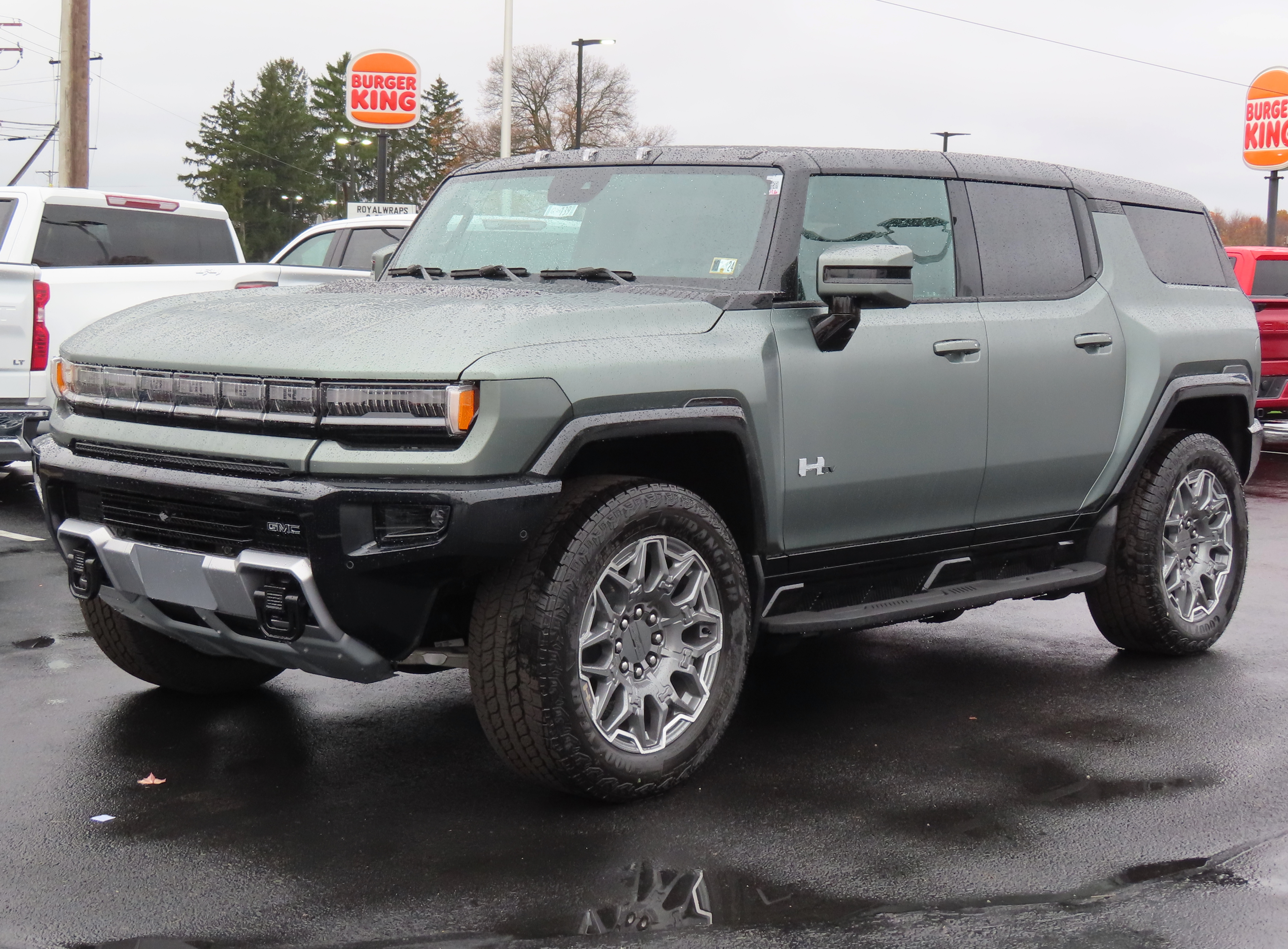
Hummer EV
"But they're doing a special edition of the Hummer EV in both truck and SUV form. They're calling it the Hummer EV icon because ...So they've made this bright yellow version of the Hummer EV."
The Hummer EV is GM’s electric Hummer—an electric truck/SUV meant to look tough and drive off-road. Here they’re talking about a special bright-yellow version and what makes it different from a regular one.
The Hummer EV is General Motors’ electric off-road truck/SUV line, known for its big, aggressive styling and electric torque. In this segment, they’re discussing a special edition with a distinctive bright yellow paint scheme and limited-edition details.
GM
"They're calling it the Hummer EV icon because [878.5s] the brand for GM has been around now for 25 years."
GM is General Motors, the company that makes these vehicles. They’re mentioning GM’s long history with Hummer to explain why this special edition is named the way it is.
GM refers to General Motors, the automaker behind the Hummer brand. In this segment, they mention GM’s Hummer brand history to explain the naming and styling choices for the special edition.
special plaque
"They have a special plaque that are limited edition. And then also there's like a black skid plate, right?"
A special plaque is a badge on the vehicle that marks it as part of a limited edition. It’s basically how the manufacturer shows it’s not one of many identical builds.
A special plaque is a physical badge used to mark a vehicle as part of a limited run. It’s typically used to signal exclusivity and sometimes includes numbering or edition branding.
limited edition
"They have a special plaque that are limited edition. And then also there's like a black skid plate, right?"
A limited edition means the manufacturer is only making a smaller number than usual. It usually comes with extra unique details so it feels more exclusive.
A limited edition is a production run with a restricted quantity or special content compared to the standard model. It’s often used to justify unique styling, badges, or exclusive packages.
black skid plate
"And then also there's like a black skid plate, right? Yeah, I think that's about it."
A skid plate is a protective plate underneath the truck/SUV. It helps protect the bottom of the vehicle when you drive over rough ground.
A skid plate is an underbody protective panel designed to shield vulnerable components from rocks, debris, and impacts during off-road driving. The “black skid plate” here is an edition-specific appearance/feature tied to the special Hummer EV.

Hummer H2
"[972.3s] I knew we used to own an H2. [975.3s] It was an 03."
The Hummer H2 is a big SUV made by Hummer. It’s the kind of vehicle people associate with the brand’s early 2000s “big and tough” look, and the hosts are talking about when it first came out and a memorable color.
The Hummer H2 is a large, truck-based SUV from the Hummer brand, known for its bold styling and off-road-capable stance. In this segment, the hosts reference owning an H2 and its early-2000s launch timing and color.

Infiniti QX80
"...r and a half. And Infinity had some news that the QX80, their truck-based SUV, there's a luxury machine,..."
The Infiniti QX80 is a large luxury SUV. It’s built on a truck-style foundation, which helps it feel sturdy and capable. In the podcast, it’s mentioned as a big, luxury-focused option.
The Infiniti QX80 is a luxury SUV built on a truck-based platform, which is part of why it’s often discussed as a big, capable family hauler. The podcast describes it as a “truck-based SUV” and frames it as a luxury machine, likely because of its size and intended comfort. It comes up as a notable alternative in the broader conversation about large vehicles.
truck-based SUV
"[1010.9s] And Infinity had some news that the QX80, their truck-based SUV, there's a luxury machine,"
A “truck-based SUV” is built more like a pickup truck than like a normal car. That usually means it’s sturdier for towing and rough use.
A truck-based SUV uses a body-on-frame construction, similar to pickup trucks, rather than a unibody car-like structure. This typically helps with durability and towing/off-road capability, which is why the hosts describe the QX80 that way.

Cadillac Escalade
"But also, I think Infinity is also like trying to fight up against like the Escalade V, [1059.8s] you know, that's a very desirable hike."
The Cadillac Escalade is a big luxury SUV. “V” usually means a sportier, higher-performance version. The host is comparing other vehicles to the Escalade V because it’s the kind of thing people really want.
The Cadillac Escalade V is the performance-oriented variant of the Escalade, Cadillac’s large luxury SUV. “V” typically indicates a higher-output, more performance-focused version than the standard trim. The host mentions it as a benchmark for what’s “desirable” in the luxury truck/SUV space.
fast charging speed
"They teased us with a fast charging speed, like a couple of weeks back. [1091.6s] And then they talked about towing, it will tow about 6,600 pounds."
Fast charging speed is how quickly an EV can recharge when it’s plugged in. It depends on both the charger and the vehicle’s battery/charging system. The host is saying the company teased that their truck can charge pretty quickly.
Fast charging speed describes how quickly an electric vehicle can add energy while plugged into a compatible charger. In EV discussions, it’s usually tied to the charger’s power output (often measured in kW) and the vehicle’s ability to accept that power. The host notes the company teased this capability, implying a focus on quicker charging for their trucks.

Jeep Wrangler
"Because at the end of the day, if you're buying a power wagon instead of a Jeep Wrangler, for example, presumably you're making that decision because you want something that can also function as a pickup truck."
The Jeep Wrangler is a popular off-road SUV. Here it’s mentioned as the alternative to a pickup like the Power Wagon—basically, the Wrangler is great for trails, but the Power Wagon is chosen when you also need real truck hauling and towing.
The Jeep Wrangler is a compact off-road SUV known for its trail-focused design and removable roof/doors on many trims. In this comparison, it’s used as the alternative to a Ram Power Wagon—suggesting the Wrangler is more about off-road capability than being a dedicated pickup for hauling and towing.
payload
"If we walk over to the payload sticker on this truck, it would be pleasantly, at least I'm pleasantly, surprised to see 2700 pounds of payload."
Payload is how much weight the truck can carry. It’s the truck’s “carrying limit,” like how heavy your stuff can be in the bed without exceeding the vehicle’s ratings.
Payload is the maximum weight the truck can carry in the bed and/or cargo area, including passengers and gear. It’s limited by the truck’s suspension, brakes, and overall vehicle rating, so higher payload means more usable hauling capacity.
fifth wheel hitch
"By the way, this has a fifth wheel hitch. [1328.3s] It does. [1329.3s] And I don't think I've ever seen it on a power wagon ever."
A fifth wheel hitch is a special trailer connection that sits in the bed of the truck. It hooks to a trailer’s front “pin,” helping the trailer tow more smoothly—especially for big, heavy trailers.
A fifth wheel hitch is a trailer-coupling system that mounts in the truck bed and connects to a kingpin on a fifth-wheel trailer. Because it sits low and pivots in a controlled way, it’s commonly used for heavy towing and can handle long-distance hauling more stably than a basic ball mount.
goose neck
"But you can put a giant gooseneck on this, right? [1358.7s] And you could haul many different toys behind you, right?"
A gooseneck is a type of trailer hitch where the trailer’s front “neck” sticks up and connects to a ball in the truck bed. It’s often used for heavier trailers because it can be a stable way to tow.
A gooseneck trailer uses a hitch where the trailer’s front section rises up and connects to a ball mounted in the truck bed. Compared with some other trailer setups, it can provide good stability for towing and is popular for hauling equipment and livestock because it allows a relatively compact, strong connection point.
four wheel drive
"Because for a lot of people, a heavy-duty truck, maybe depending on where you live, doesn't even need to be four-wheel drive. [1382.7s] It's a towing machine exclusively."
Four-wheel drive means power can go to all four wheels. That helps you get traction on rough roads, dirt, snow, or mud—when two-wheel drive might struggle.
Four-wheel drive (4WD) is a drivetrain setup that can send power to all four wheels, improving traction on loose, uneven, or slippery surfaces. It’s especially useful for off-road access and for getting a loaded truck and trailer moving when grip is limited.
sway bar disconnect
"This truck gives you that flexibility to have the rugged side of things with a sway bar disconnect with lockers."
It’s a feature that can loosen the truck’s anti-sway bar when you’re off-road. That helps the wheels move more independently over bumps and uneven ground, without making the truck feel too tippy.
A sway bar disconnect lets the truck temporarily “uncouple” the anti-roll (sway) bar. That reduces body roll and can improve wheel articulation off-road, while still allowing the sway bar to be connected for better on-road stability.
traction aids
"You've got a lot of traction aids and ways to keep this truck and your trailer that you're hauling from getting stuck while simultaneously giving you that ability to still."
Traction aids are the truck’s helpers that keep the wheels from spinning uselessly. They make it easier to drive on slippery surfaces like mud, gravel, or snow.
Traction aids are systems designed to prevent wheel slip and help the vehicle move in low-grip conditions. They can include things like traction control, differential behavior, and other off-road driving aids that manage torque to the wheels.

Ford Bronco
"...s-shopping this vehicle with a Jeep Wrangler or a Bronco, even though this is designed to be an off-road c..."
The Ford Bronco is an SUV designed for off-road driving. It’s built to go on rough roads and trails, not just highways. The podcast mentions it because it’s a common alternative people consider when looking for an off-road SUV.
The Ford Bronco is an off-road SUV designed to compete in the trail-capable segment. It’s often compared directly with other off-road icons because it’s built with off-road hardware and driving modes in mind. In this episode, it’s mentioned as another vehicle people might cross-shop, even though the discussion is about a different off-road-oriented model.
2400 watts of power
"Speaking of tools in the toolbox that you have available, this truck does have 2400 watts of power accessible here in the bed."
That’s how much electricity the truck can provide from the bed. More watts usually means you can run more gear out on the trail without bringing a separate generator.
This refers to the truck’s onboard electrical output available in the bed, measured in watts. Higher wattage means you can run more power-hungry accessories (like tools or certain camping gear) without needing a separate generator.

Ford F150
"Yeah, and also has right there. That's a really great thing because Ford kind of broke the mold a little bit with their F-150 hybrid offering high power export features."
The Ford F-150 is a large pickup truck that many people consider a standard for this type of vehicle. In the podcast, it’s mentioned because Ford has offered a hybrid version and added features aimed at higher performance. That makes it a big topic when talking about what modern trucks can do.
The Ford F-150 is a full-size pickup truck that’s especially significant because it’s one of the most influential trucks in the market. The podcast highlights Ford’s hybrid offering and the idea of high-power features, suggesting it’s a notable shift in how the F-150 is configured. That’s why it comes up in discussions about modern truck tech and performance expectations.
power tailgate
"So it does have, well, basically there is no, it's not a power tailgate, right? [1580.2s] So it just kind of falls. [1581.6s] It does have a step."
A power tailgate opens and closes automatically with a motor. If it’s not a power tailgate, you usually have to operate it yourself (or it uses a simpler mechanism).
A power tailgate is a tailgate that opens and closes automatically using an electric motor. If it’s not a power tailgate, you typically have to manually operate it or it may use a simpler mechanical latch and assist.
bed rails
"They are in the bed rails or shoulder height. [1591.8s] So getting anything in the back of the truck, not necessarily easy. [1595.6s] We use this Hemipower wagon to go bring a couple of small motorcycles out to Moab"
Bed rails are the sides of the truck bed that stick up. They help define the bed’s height, which matters when you’re trying to load something heavy or awkward.
Bed rails are the raised side edges of a pickup’s cargo bed. When the speaker says the trucks are “in the bed rails or shoulder height,” they’re describing how tall the truck sits and how that affects loading and access.
ramps
"It's a bit of a challenge because the angle on your ramp getting the motorcycle up into the back of it [1609.5s] is pretty steep and it's still doable. [1612.7s] But the taller a truck is for that especially because motorcycles are heavy, even small ones."
A ramp is the sloped board or platform you use to roll a bike or other items up into the truck. A steeper ramp is harder to get up, especially if the load is heavy.
A ramp is the sloped surface used to drive or roll something up into the truck bed. The “angle on your ramp” is critical because a steeper angle makes it harder to climb, especially with heavy loads like motorcycles.
control arms
"But this Cummins Power Wagon has a different step. [1641.6s] It does. [1654.8s] Oh and look, it has speed holes in the control arms."
Control arms are parts of the suspension that hold the wheel in place and help it move smoothly over bumps. If there are “speed holes” in them, it means there are cutouts in those arms, usually to save weight.
Control arms are suspension links that connect the wheel to the vehicle’s chassis and help control wheel motion. “Speed holes in the control arms” suggests cutouts/lightening holes, which can reduce unsprung weight and/or improve packaging while keeping strength.
speed holes
"Oh and look, it has speed holes in the control arms. "
“Speed holes” are holes cut into a part to remove extra material. In this case, they’re in the suspension arms, usually to save weight.
“Speed holes” are cutouts in suspension components (here, the control arms) that reduce material and can lower weight. They’re often used as a lightweighting feature, though the exact benefit depends on the design and how it’s engineered.
tradesman
"Let's jump into this tradesman. Here you go, Cole."
“Tradesman” is a truck trim level—basically a specific version of the interior and features. In this segment, they’re showing the more affordable Tradesman setup.
“Tradesman” is a trim level name used on Ram trucks, typically positioned as a more work-focused, value-oriented interior/exterior package. The hosts say they’re starting with the Tradesman interior.
six person config
"So this is a six person config."
“Six person config” means the truck is set up to seat six people. They’re pointing it out as part of the interior layout.
“Six person config” refers to a seating arrangement that accommodates six occupants, usually via a specific bench/seat layout. The hosts mention it while discussing how tall the truck is and how you get into the Tradesman interior.
transmission tunnel
"I mean, the transmission tunnel is really huge. Yeah, it's not going to be the most comfortable place to sit,"
It’s the raised hump in the floor where the truck’s drivetrain parts run underneath. Because it sticks up, it can make the seat area feel tighter and less comfortable, especially for long drives.
The transmission tunnel is the raised channel in the cabin floor that covers and protects drivetrain components like the driveshaft and transmission. In trucks and SUVs, it can take up legroom and make the front seating area feel less spacious.
center screen
"And even though this is a more basic truck, you still get a pretty sizable center screen. But one thing that I like is this truck gives you physical controls"
The center screen is the main display in the middle of the dash. It’s where you can control things like navigation and media, and sometimes vehicle settings too.
A center screen is the main infotainment display mounted in the middle of the dashboard. In modern trucks, it often controls media, navigation, and some vehicle settings, though this truck is described as having key towing controls physically instead of only through the screen.
trailer brake controller
"But one thing that I like is this truck gives you physical controls for the plus and minus on your trailer brake controller for your gain."
When you tow, the trailer needs its own brakes. A trailer brake controller lets you control how strongly those trailer brakes work when you press the brake pedal.
A trailer brake controller is the device that manages how much braking force the trailer brakes apply when you slow down. Physical controls for it let the driver fine-tune trailer braking for different loads and conditions.
tow haul mode
"You also get a physical control for your tow haul mode, for your parking sensors, for traction control."
Tow/haul mode is a towing setting that helps the truck manage gears and engine braking better when you’re pulling a trailer. It’s meant to make towing feel more controlled, especially on grades.
Tow/haul mode is a drivetrain setting that changes how the transmission and engine braking behave while towing. It typically helps keep the engine in a better power band and can reduce gear hunting on hills.
traction control
"You also get a physical control for your tow haul mode, for your parking sensors, for traction control. So it's not all integrated in the screen."
Traction control helps prevent the tires from spinning when the road is slippery. It automatically reduces power and can brake a wheel to help the truck move more smoothly.
Traction control is an electronic system that reduces wheel slip by cutting engine power and/or applying brake force to a spinning wheel. It helps maintain grip on slippery surfaces like rain, snow, or loose gravel.
parking sensors
"You also get a physical control for your tow haul mode, for your parking sensors, for traction control."
Parking sensors are little detectors that warn you when something is close to the truck while you’re parking. They help you avoid bumping curbs, poles, or other cars.
Parking sensors are proximity sensors that detect nearby objects at low speeds and alert the driver, usually with beeps or a display. They’re especially useful for tight maneuvering when towing or parking large trucks.
physical gauges
"And then you actually have quite a few physical gauges in front of you. [1842.8s] I do physical tachometer and of course my coolant and several actually different needles."
“Physical gauges” are the normal-looking dials with needles you can read quickly. Instead of everything being on a screen, key info shows up as real dials behind the steering wheel.
“Physical gauges” are traditional analog-style instrument dials (like tachometer and temperature/fuel/boost needles) instead of a fully digital instrument cluster. They’re common on work-focused trucks because they’re easy to read at a glance while driving or towing.
tachometer
"I do physical tachometer and of course my coolant and several actually different needles."
A tachometer tells you how fast the engine is spinning, usually in RPM. When you’re towing or working the truck, it helps you understand how hard the engine is working.
A tachometer measures engine speed in RPM (revolutions per minute). On trucks—especially when towing or off-road—watching RPM helps you keep the engine in the right operating range for power and efficiency.
miles per gallon
"And a tiny, tiny screen with information. [1852.7s] By the way, the information I'm looking at now is my MPG, which is a sad sight."
MPG means miles per gallon—how far you can drive before you need more gas. If you tow or drive off-road, MPG usually drops because the engine works harder.
MPG (miles per gallon) is a fuel-economy measure that tells you how far the truck can go on one gallon of fuel. Lower MPG is especially noticeable when the truck is towing or driven off-road, because those conditions increase fuel consumption.
18 gallon tank
"This does have like a 31 gallon tank, but obviously I don't want to run it completely dry. [1894.5s] So like every 25 gallons, I have to go back, which is about 300 miles."
A “31 gallon tank” refers to the fuel capacity of the truck’s gas/diesel reservoir. Larger tanks can reduce how often you stop for fuel, but real-world range still depends heavily on driving conditions like towing and off-road use.
Moab
"You mentioned going to Moab. We've done some off-roading red cone trail, for example, here."
Moab is a famous off-roading area in Utah with tough trails. People go there to test how well their trucks handle rocks, ruts, and steep terrain.
Moab is an off-road destination in Utah known for technical trails and challenging rock crawling. It’s a common proving ground for trucks because traction, articulation, and low-speed control are tested constantly.
locker engagement
"They're a little finicky how to lock engagement or for low selection or sway bar disconnect engagement. This truck seems to be kind of on point."
Locker engagement is when the truck switches from normal open-differential behavior to a locked state. It’s important because you want the traction help to happen right when you ask for it.
Locker engagement is the moment the system actually locks the differential(s) so both wheels on an axle rotate together. How quickly and smoothly it engages matters off-road because it affects traction when you need it most.
low selection
"They're a little finicky how to lock engagement or for low selection or sway bar disconnect engagement. This truck seems to be kind of on point."
Low selection refers to choosing a low-range gearing mode (typically in the transfer case) for crawling. Lower gearing multiplies torque so the truck can move slowly over obstacles with better control.
line choice
"The size of a truck like this is always going to be a factor when you're off-roading. Because it's so heavy, because it's so wide, long, you're limited on line choice, everything like that."
Line choice is the route you pick through a trail obstacle. Picking the right path helps you avoid getting stuck and keeps the tires gripping.
Line choice is the path a driver selects through an obstacle or trail section. On tight or difficult terrain, the “best line” can mean the difference between keeping traction and getting hung up or stuck.
reverse camera
"[2000.6s] It's a reverse camera. [2002.1s] Very basic camera. [2003.5s] Yeah."
A reverse camera shows you what’s behind the truck on a screen when you go into reverse. It makes backing up safer and easier because you can see things you might miss with just mirrors.
A reverse camera is a rear-facing camera that displays what’s behind the vehicle when you shift into reverse. It helps reduce blind spots when backing up, especially around trailers or tight parking spaces.
surround view
"[2010.3s] So that's of course mandated, right? [2012.2s] You have to have a rear camera, but you don't have to have surround view. [2017.4s] Do you see a bug just fly by?"
Surround view uses multiple cameras to show a near top-down view around the truck. It helps you see where you’re going when parking or maneuvering in tight spots.
Surround view is a multi-camera system that stitches together images around the vehicle to create a bird’s-eye or “360-degree” view. It’s more helpful than a single rear camera for tight maneuvers because it shows obstacles from multiple angles.
adaptive cruise control
"[2024.2s] Anyways, so this is kind of what you get. [2026.4s] But by the way, adaptive cruise control is here. [2028.9s] I was showing that radar in the front."
Adaptive cruise control is like regular cruise control, but it also watches the car in front of you. If that car slows down, your truck slows down too to keep a safe gap.
Adaptive cruise control automatically adjusts your speed to maintain a set following distance from the vehicle ahead. It typically uses a radar sensor to detect traffic and can slow down or speed back up within certain limits.
gear selector
"[2034.6s] And my gear selector is a little bit weird. [2037.2s] It's this little button here. [2038.9s] I would have liked to see a little bit of maybe like a paddle shifter or something."
The gear selector is how you tell the truck which gear to use, like Park or Drive. Some trucks use buttons or a small control instead of a big stick.
A gear selector is the control you use to choose the transmission mode (like Park, Reverse, Neutral, or Drive). In some modern trucks, it’s implemented as buttons or a small shift control rather than a traditional lever.
paddle shifter
"[2037.2s] It's this little button here. [2038.9s] I would have liked to see a little bit of maybe like a paddle shifter or something. [2043.7s] And there's also no volume knob buttons on the back of the steering wheel."
A paddle shifter is a lever you pull with your hands, usually behind the steering wheel. It lets you tell the transmission to shift up or down yourself.
A paddle shifter is a set of controls (usually behind the steering wheel) that lets the driver manually request upshifts or downshifts. It’s often used to give more control over gear selection than a basic automatic-only setup.
passenger screen
"And you've got a passenger screen as well. [2223.3s] Yeah, so this is probably not necessary. [2227.1s] What would you rather have? [2228.0s] A cubby or a passenger screen? [2229.2s] A cubby."
A “passenger screen” is a screen in the truck that the front passenger can use. It’s usually for entertainment or information, and here they’re debating whether it’s better than having extra storage space.
A “passenger screen” is an in-cabin display mounted for the front passenger, typically used for media, navigation, or vehicle settings. In this segment, it’s discussed as a feature that may not be worth the tradeoff versus simpler storage.
110 volt outlet
"And on that Hemi-Traitman power wagon, there was a 115 volt outlet right here. [2242.7s] So he was actually sitting here with a laptop plugged in editing a video while we were moving"
A “115 volt outlet” is like a regular wall plug inside the truck. It lets you power things like a laptop or small electronics while you’re parked or working.
A “115 volt outlet” is a standard household-style power plug in the truck, allowing you to run devices that normally use AC wall power. On trucks, it’s commonly used for laptops, tools, or jobsite equipment without needing an external inverter.

Chevrolet Volt
"...n that Hemi-Traitman power wagon, there was a 115 volt outlet right here. So he was actually sitting her..."
The Chevrolet Volt is a car that can run on electricity, and it can also use gas when the battery needs help. The podcast talks about it having a normal household-style power outlet (115 volts). That means you can plug in certain devices directly from the car.
The Chevrolet Volt is a plug-in hybrid electric vehicle that can run on electricity and also use a gasoline engine when needed. The podcast specifically mentions a 115-volt outlet, highlighting how it can power devices while you’re using the vehicle. That kind of feature is often discussed because it adds practical utility beyond just commuting.
hood bump
"especially because the Cummins power wagon does have this hood [2358.7s] that has a hood bump and a fake vent."
A hood bump is a raised bulge on the hood. It’s usually there to make room for something under the hood, but it can also make it harder to see the road directly in front of the truck.
A “hood bump” is a raised section on the hood that creates extra clearance for components under the hood. On trucks, it can also affect driver visibility by changing the hood’s shape and the sightline over the front edge.
fake vent
"that has a hood bump and a fake vent. [2362.7s] Yeah, that's not necessary."
A fake vent is a vent-looking opening that’s mainly for styling, not for moving air. In this case, the host says it still changes the hood shape and blocks some of what you can see.
A “fake vent” is a decorative vent opening on the hood or body that doesn’t actually function for airflow. It’s mentioned here because it contributes to the hood’s shape and can reduce forward visibility even if it doesn’t provide real cooling benefits.
14 and a half inch vertical display
"It is true. [2380.3s] But this 14 and a half inch vertical display, [2383.7s] I think the odd part about it is that the camera view"
That’s a big screen—about 14.5 inches tall—mounted in a vertical layout. They’re saying the camera image only uses part of the screen, so it doesn’t fully solve the visibility problem.
A “14 and a half inch vertical display” refers to a large, portrait-oriented screen used for the truck’s camera/infotainment interface. The host is pointing out how the screen size and layout affect what camera view you actually get while driving.
full digital instrument cluster
"This does also use a fully digital instrument cluster. [2414.2s] So that is in place of the analog gauges on the Hemipower wagon,"
Instead of regular dial gauges, the truck uses screens for the speed/engine info. Screens can be customized, so you can choose what you want to see depending on how you’re driving.
A fully digital instrument cluster replaces traditional analog gauges (speedometer/tachometer dials) with screens. The benefit is that the display can be configured for different driving modes and driver preferences, which can be useful in off-road situations.
heavier duty springs
"But this heavier truck, because it is heavier, [2462.6s] it has heavier springs. [2464.8s] It doesn't have the articulating connectors."
Heavier springs are stiffer suspension springs. They help support a heavier truck, but they can also make the suspension feel less “soft” over bumps.
Heavier springs are stiffer coil springs (or spring rates) that resist compression more strongly. A higher spring rate can help support extra weight, but it can also change suspension travel and how the truck articulates over obstacles.
articulating connectors
"it has heavier springs. [2464.8s] It doesn't have the articulating connectors."
These are parts that let something move as the suspension flexes. If the truck doesn’t have them, some components may limit how far the suspension can travel.
Articulating connectors are flexible or jointed connections used to allow components to move with suspension travel. If a truck lacks these, it may have reduced articulation because certain linkages or hoses/wiring can’t accommodate as much movement.
RTI score
"So I don't know the exact angle or RTI score difference, but we'll test that today. We're going to go into the mountains and we're going to test it out."
RTI score is a way to estimate how well a truck can flex its suspension when driving over rocks and ruts. Higher usually means the tires stay in contact with the ground better.
RTI score (often discussed as “Ramp Travel Index”) is a measurement used to estimate how well a vehicle can articulate its suspension while climbing over uneven terrain. A higher RTI score generally indicates more suspension travel and better wheel contact on obstacles.
wheelbase
"Well, they have the same wheel base, right? They're very similar in many ways."
Wheelbase is the distance between the front and rear wheels. A longer or shorter wheelbase can change how stable and how “planted” a truck feels, and they’re saying these two are the same.
Wheelbase is the distance between the front and rear axles. It affects stability and ride behavior, and the hosts note both trucks share the same wheelbase, which helps explain why they’re similar in many ways.
Request an Explanation
Heard something you'd like explained? We'll add it to this episode.
Sign in to request explanations for terms you heard.
Want to learn more?
Browse our glossary for plain-English explanations of automotive terms, jargon, and concepts.
Help improve this episode
See something that's not quite right? Our annotations are AI-generated and can sometimes miss the mark. Click the flag icon on any annotation to suggest a correction.