This is the podcast network that hosts and produces the show you’re listening to. It helps set the context for the kind of automotive repair content they focus on.
Wrenchway is the organization running the technician survey they talk about. It’s meant to capture what mechanics are actually seeing and dealing with day to day.
This is a yearly survey that asks technicians for their real opinions and experiences. The goal is to help shops figure out what’s going wrong and how to improve.
A shop management system is the computer software repair shops use to keep track of cars and paperwork. It helps them quote jobs, write repair orders, and communicate with customers.
They’re talking about how much personal time technicians want outside of work. It affects scheduling—like how many hours per day or how many days per week the shop stays open.
Service advisors are the customer-facing role that coordinates service requests, communicates with technicians, and helps manage the shop’s workflow. The host notes they wish there were more service-advisor responses because the role is critical to shop performance.
They’re comparing results from car dealerships to independent repair shops. Dealership service departments can work differently, so the survey may show different priorities.
They’re using survey answers from mechanics and students to understand what jobs and shops should be doing better. The point is to compare what people say they want with what’s actually happening in real shops.
“No weekends” is a scheduling benefit that can significantly affect technician work-life balance and job satisfaction. The speaker lists it among the perks that dealerships advertise to technicians.
Flat rate means mechanics get paid a fixed amount for a repair, based on how long the job is supposed to take. If the car is harder than usual and takes longer, the tech may not earn as much.
“Gold certified” is like a higher approval level for an auto shop. The idea is that meeting certain standards helps the shop earn more trust and more customers.
Instead of doing inspections only on paper, the shop documents what they find digitally. That can make it easier for customers to see issues and understand recommendations.
Napa Tracks is software for auto shops to manage jobs and business operations. The claim here is that it helps shops run more efficiently and make more money.
ASE is a well-known organization that certifies auto mechanics in the U.S. If a shop or technician is ASE-certified, it usually means they’ve passed tests for specific skills.
An advisory committee is a group that helps a school stay connected to the real world. For auto programs, it helps make sure students learn the skills shops are hiring for.
A tech school (technical or vocational school) focuses on hands-on training for specific careers, often including automotive repair. The discussion frames it as a place where industry support matters because programs can be expensive to run.
Retention just means keeping your employees instead of having them quit and go somewhere else. When people stay, the shop runs smoother and you don’t have to keep replacing staff.
Net Promoter Score is a way to measure how happy people are. They answer whether they’d recommend something to a friend, and the results are turned into a single number based on who would recommend it and who wouldn’t.
They mention Chris Craig as someone in the industry who talks to technicians online. His post is being used to show how many mechanics feel the same way.
Workflow is the “process” of how work moves through the shop. If it’s organized well, cars spend less time waiting around and the shop can handle more work.
LIVE
This is the Automotive Repair Podcast Network.
Hey, everybody, Carm Capriotto.
Good to have you here.
Remarkable results radio coming up to our 11th year.
We're so happy you're here.
You know, if it wasn't for you, we wouldn't keep doing this thing.
And I will tell you this right now.
You have tuned in to a very, very important episode that just you need to hear about.
I have Jay Gannon, founder and president of Wrenchway, who does this annual Wrenchway
annual Voice of the Technician survey.
He just recently did a great webinar on it.
I hung out for about a half hour.
Surprisingly, interesting information that if you're a shop owner, you need to hear.
And if you're a technician that I like to call a specialist in our industry,
then you also like to need to hear that too.
And oh, by the way, listen, our app, it's going strong.
We're having so much fun.
It took us about a year to build it.
You've got to get it for your phone, the Automotive Repair Podcast Network.com
forward slash app, everything in one place, playlists.
You can set favorites, create your own categories, download for later listening.
A lot of great links.
You can read all the show notes there and we just love having it for you.
So thanks for being here.
Let's give great homage if we couldn't do this without our sponsors.
Hey, take your Napa AutoCare Center to the next level with the Napa AutoCare
Gold Certified Program, increase car count, build trust with customers and
stand out as one of the best.
Talk to your local Napa representative today.
Hey, for over 30 years, Napa Trax has made selecting the right shop
management system easy by offering the best, most comprehensive SMS in the industry.
We'll prove to you that Trax is the single best shop management system in the business.
Find Napa Trax on the web at NAPATRACS.com.
Let me introduce to you Jay Ganinen, co-founder and president of RENCHWAY.
Hey, Jay.
Hi, Karm.
How are you?
11 years.
Congratulations.
I know.
Is it amazing?
Sometime in March of this year, I don't quite remember.
But yeah, I never would have thought and I just don't know where all the time went.
Jay, I just don't because I guess I loved everything I've ever done in my entire life.
OK, from owning the shop and the bulk oil plant and the automotive distribution
and all the stores in corporate America and down this incredible chain of.
I would have to say success that I've had.
I've enjoyed this the most.
And you're pretty darn good at it.
I always enjoy listening, always enjoy when I'm scrolling through Facebook
and you having a panel out there talking.
It's always so educational.
I think you've got a gift for being able to bring kind of the best and brightest
together to talk about a lot of the industry's real, I think, pressing issues
and best practices and just everything.
I've learned so much over the years and it's giving you a lot of credit for it.
Thank you for that.
Like you, the best and the brightest coming on the show.
And we're talking stuff here.
Yeah, we are.
So first of all, let's just set this up front.
How can anyone get this survey?
Yeah, so they can go to Wrenchway.
There's a resources tab and then the report is there for download or free for anybody.
So anybody that wants to go out, check out the report.
It's all out there.
I would do exactly what calm did there, which is printed out
because there is so much in it to be able to dive into.
I see you've got your sticky notes in there as well.
And there's a lot in there.
There is so much in there.
I have to tell you, it makes you stop and think very deeply about what's going on
from a technician's perspective and point of view.
The research that you've done is off the charts.
The depth of what you know about the people that took the test
and where they work, the needs, the wants, the education, the benefits, it's all there.
So if you're one of the top people in the industry, super successful
because you worked at it to get yourself there, you got to read the report
because it could confirm a lot of the moves that you made and continue
to let you think through tomorrow.
And if you're struggling, you may want to look at this thing and say,
pick one or two out and say, I got to do this stuff.
Yeah, you know, it's funny.
I give our team so much credit.
My co-founder, Mark Wilson, our VP of marketing, Sarah Wilson,
and then just our marketing team, Val, everybody on our team that contributed to this,
they really put their heart and soul into it.
And it was for that reason, right?
And I talk a lot about how if the report makes you have a conversation internally
with your team, I think we've done our job, right?
Because that's the intent.
We want to uncover blind spots.
We want to be able to allow people to use it for productive good,
even though there's things in the report that aren't necessarily positive, right?
There are a lot of things that I think we need to take seriously as an industry
and try to change our luck with some of this stuff.
And a lot of it isn't rocket science.
Like a lot of it is stuff that we can do in our shops
to improve the livelihood of our technicians and really
hopefully understand them a little bit better.
You just gave me a great idea.
I always cling on to every word my guests say and then my mind kind of processes
and it goes off on its own, Jay. Did it ever happen?
Your mind goes off on its own?
No, all the time, ask my wife.
So it just went off on its own.
And I thought of having a bringing a panel together, Jay,
and looking at a couple of these critically important,
you can't ignore this stuff and then ask the panel,
how are we going to overcome that?
I love that and I'm guessing there's a lot of shops
that are probably doing some of this really, really well.
But in a lot of cases, some of this that we detail or that we talk about,
I feel like the ones that do it really, really well are in the minority.
And if I'm a shop that's out there,
what I would say is that's a big opportunity for me, right?
Because if I'm doing it better than others
or I have the ability to do it better than others,
that gives you an advantage. Everybody's looking for talent.
If you're doing some of these things really, really well,
you become a magnet for that talent.
And if it's kind of talked about with your team
and it becomes common knowledge amongst other technicians,
you'll have people that want to come work for you.
It's just finding those things that you can do really, really well
that others can't, that will make you stand out.
Great stuff. I just had another crazy thought.
The subtitle of this report could be The Unicorn Speaks.
Oh, yeah. If you think about it, it really is in a lot of cases,
the unicorn that everybody's looking for.
And I think if we open our eyes and open our ears a little bit
and are open to changing, I know if we've been in that shop for a long time,
and this is something that we just kind of,
you go in each day and kind of check the box of working, right?
You go in, you put out the fires, and at the end of the day,
you close up shop and you're out of breath,
and you just need to go home and chill out.
You're not doing it right, right?
Like, so I think if you view this, and not just this report,
but if you listen to Commerce Podcast,
if you listen to Matt's podcast, if you listen to anybody's podcast,
and you get ideas in ways that you can implement
and make your operation better,
you're going to have more fun doing like being in business,
and I think you'll have better relationships.
Thanks for bringing that up way back when I started doing this, Jay.
I come up with a slogan called, Listen to Learn Just One Thing.
And what hit me a couple of years ago was that I needed to add
another couple of words to that slogan and implement it.
Because we can listen to things and write them down,
and I'm a perpetual writer.
I have to do lists and ideas lists that would, you know,
they're so big, I don't even know what to do with them, right?
And every once in a while, I go through them and say,
oh, I did that, I did that, I did that, right?
When I think about being able to implement something,
is I think, seriously, one of the most critical things you could do
with any really great idea that you end up owning and buying it.
Oh my God, I got to do that.
You know, finally, I got to push over the edge that made me buy in.
I finally heard one thing from someone that really, now, don't let that go to waste.
Use that as motivation.
And when you look at this, and I mentioned earlier,
the importance of having a conversation with your team,
I think that's where some of those bings can come from, right?
Because if you're talking with your team, and maybe your team disagrees
with something in the survey, and they're like, well, that might be important
to what they're talking about, but for me, that doesn't really matter.
At least having an understanding of what's important to your team,
and even if it's different than a lot of the stuff that we've got in the survey,
I will say, I think a lot of it, from what I've had conversations with technicians about,
I think it's very on point with a lot of it.
I'm sure there's some variances and some differences of opinion
if you're talking to your own team, but if nothing else,
it drives the conversation, so you're listening.
And then maybe something comes up to where you do get that idea,
and I do think that's the power of podcasts and reading and everything is that.
A lot of times, maybe you won't even use it at that exact moment,
but maybe you're having that conversation with your team, and you're talking about the survey,
and they say, well, this kind of stinks.
This isn't how I would want this at our shop.
Well, then you have something to refer back to, an idea to go back to on how to fix something,
or if you can take that and do research online and try to figure out ways that people are doing,
whatever it is that your technicians want, there's shops that are doing it better than
you find those things, and then hold yourself accountable to getting them done.
So as you're talking through what you would add to that slogan,
I think that spot on the execution side, holding yourself accountable and allowing your team to
hold you accountable to making changes that are best for business and best for the people
is only going to put you in a better position.
Get the report, wrenchway.com, get it, read it, look at it, take your pen,
take your highlighter, go over it, and in one of your weekly huddles,
and maybe it's the big Friday morning workflow thing, say, hey, listen,
there's a survey that came out. Look at this stuff, guys. I printed it.
I want you to take a look at it. Are we in this? How bad are we?
How good are we to what this survey is saying? You want to learn?
Now, they may not tell you directly, but the thing that I love about having a survey and
putting it in front of people, it's already been answered. It's public.
There's no shame in trying to say, I want to, yeah, I agree with that number one position,
or we could do better there. I always think instead of asking
clearly an unknown question to people if they saw a survey in front of them and saying,
how are we with this? They may be more forthcoming, Jay.
Well, at times, if you can brainstorm with your team and talk through things, one thing that
I think came through clearly in the survey was that there is more of a desire for work-life
balance. It was surprising to me to see that it was ranked higher to have four,
10-hour workdays than it was to have five, eight-hour days. As you're talking through
these things with your team, maybe it's not so much of, this is just the way we do businesses,
the way it's going to be. It's, okay, if you guys really wanted four, 10-hour days,
maybe we still have to stay open five days a week. Maybe that opens opportunities for the
just stuff like that where you can brainstorm with your team and say,
that's a cool idea. Let's talk about it. Is that realistic or is that not something that's going
to work with us? Great. Hey, let's jump in. Look, number one is the job role technician,
which I like to call a specialist, came out at 59%. So 59 or 60% of all the answers in here.
The other people that replied were instructors or educators. I like to call them management or
owner students and service advisors. I just almost wish there were more service advisors,
because I think that is becoming the single, it's as critical a role as our specialists in the
back. Year's experience in the industry, while between 16 and 21 years, 71%. So you got some very
solid, if you will, loyalists that are inside of our industry. I love that. And I'm just highlighting
this so that we can get into some of the other, the shop styles. One of the things that I was
really surprised about was how many from dealerships replied. It's 51.8% versus independence 27.7.
We got to work on that. I agree. We need more help from the independent side. But I do think
as you look into the numbers, there are some things that spoke highly of the independent side
versus the dealer side, right? And there's some really fascinating stuff in there to really,
I guess, for the independent side to pat yourself on the back for. But then also,
things that maybe we can improve, because then you're going to be automotive to diesel. And diesel
seems much happier than the automotive world for whatever reason. So yeah, a lot to dive into there,
too. I know. And if you're looking and reading the stats, you realize it's tainted like 51 to 27%.
That's got to open your eyes to what they're saying they want, they need, they have. So that's
really critical. And I just did a blog. I just want to do a podcast on this. It was this big ad
from a dealership talking directly to the mechanics technicians in the industry.
And they listed everything that they have for them. They says, we do this, we have equipment,
we have laptops, we have the state of the art, we have paid training, we have PTO time off,
we have retirement, we have blah, blah, blah. And I'm sitting there saying, oh, that's going to hurt.
You know, at a sports game in the city of Buffalo, they're just going for the main artery. And
that, in my mind, that's a wake up. ASC certifications, 74%. I love that.
Yeah, I did too. It's funny when we first launched the survey a few years back,
I was deathly afraid it was just all going to be students. Like we put it out there and I'm like,
this is all going to be entry level folks that respond to it. And the data won't be what we
want it to be. It was quite the opposite. And I think our friend Tanner Brandt had pointed this
out to me at one point when that first came back that it was very reflective of what he saw when
he walks into a shop as a diagnostician, where he is walking into shops of all shapes and sizes.
And he says, in most cases, you're walking in and you're seeing a lot of very experienced
technicians in the shop, you're seeing a lot of entry level texts, and you're not seeing a lot
in the middle, right? Like there's almost like a gap where we're missing that 10-year technician
in a lot of shops. And so something that I thought was interesting in our stats when they first came
out versus what somebody like Tanner, who's in shops every day, saw and reflected on. And
I think it's a worry at some level, but it's also great to get insight from people that have been
doing it for a long time. Totally agree. What technicians and students look for in employers.
Here's the top, I think, six proper equipment in the shop, which is it just makes me worry.
I'm on page eight. Maybe they have it and they just don't want to lose it or there's a weakness
in the industry, but then paid vacations, retirement funds, paid training, no weekends.
No weekends. Yeah. I mean, God, no weekends. And anyway, that is this outrageously open
discussion that we can have inside the industry about four, five, six, seven days.
But really good stuff. I'm moving over Jay to page 11. And I know we've got some specific
talking points, but I just want to go through my yellow tabs here. Please do. I'd rather. Yeah.
Thank you. A preferred pay structure, page 11, by the type of shop. It was interesting. Hourly
salary with bonus was tied between dealerships and independence. I thought that was interesting.
And so it looks to me, tell me I'm right or wrong, that the flat rate is flat rate and
loved by all of our senior people and the hourly salary bonus coming up from our younger people.
What do you see? I don't think so. I've heard a lot of A level, you know,
diagnostician level technicians that hate flat rate, because if they get stuck on the tougher
jobs, if they're always getting pushed, the hard diet jobs, it's hard to make money that way on
flat rate versus if you're that undercard tech that can just plow through work and you can make
a really good living on flat rate. I do think that's where just general awareness from a shop,
if you're one of those shops that's paying on flat rate, having some general awareness around,
you know, how are you treating your best people? Because not only is it important that you retain
your best people, and a lot of times those are the ones that are getting pushed the tougher jobs,
but that also shows that young person coming into the industry how they're going to be treated
someday. And if you're not treating your best technician, your best specialist with the ultimate
respect, and really taking care of them, what does that look like to that person just coming
into the shop? If you're showing an example of how they're treated and it's not very good,
which I don't think is the case anymore. I really, really think most good shops, if they have good
people, they're taking care of them and they're bending over backwards to try and take care of
them. So I do think that shows a shining example of how the rest of that technician's career is going
to go. And we need to be really, really mindful of that. Are you a Napa Auto Care Center ready to
elevate your shop? Then it's time to step into the Premier Tier Napa Auto Care Gold Certified
Program. Gold certified centers are recognized as the best of the best, delivering a consistent
trusted customer experience nationwide. Now that consistency means more repeat business,
more referrals, and more opportunities to grow your car count. Now when you're Gold certified,
you unlock advanced resources, maximizing technology, boosting your local marketing presence,
and keeping your team fully trained on the latest trends and tools. In short,
Gold certified status separates you from the rest. So what does it take to be Gold? To qualify,
your shop must be a Napa Auto Care Center for at least one year, have been open for two years or
more, employ an ASE master technician or hold ASE blue seal status, co-brand with the pro image
program, maintain a four star rating or hire on Google Yelp or Napa CSI, use digital vehicle
inspections, offer Napa consumer financing, purchase $7,500 or more in Napa parts monthly,
and participate in a Napa business development group. It's a true partnership. And in return,
Napa rewards Gold certified shops with premium benefits like free priority placement on the
Napa online dot com locator, annual marketing funds, enhanced warranties, rebates, training
opportunities, and a whole lot more. Are you ready to take your shop to the Gold level?
Well contact your local Napa sales representative today to see if you qualify and start your journey
to Gold certified. Increase car count, build trust with customers and stand out as one of the best.
Talk to your local Napa representative today. Let's face it, your shop management system is the
single most important tool in your shop, period. Napa Tracks was built from the ground up to make
your business more profitable and efficient. We provide an extensive set of tools to increase
and track profitability in real time. Napa Tracks offers the industry's best post sale support
hands down and we train your people on site. Yep on site and we offer remote refresher training
10 times a week and customer support is open six days a week. Give us a call, visit the website,
or join our Facebook community today to learn more. We'll prove to you that Tracks is the
single best shop management system in the business. Napa Tracks is always customized and tailored for
you whether you're a one-man shop or a large multi-bay or multi-location company. After all,
it's your shop, so it's your choice. Visit us on the web at Napa Tracks, that's N-A-P-A-T-R-A-C-S dot com.
I'm doing a masterminded vision this year and the people that are attending, they got a survey
for me on the top dozen hot topics in the industry and I just looked at the the results
so far this morning and one of the number one categories is communication front back of shop
and what you just said, what we have just been talking about is if you're flat rate,
don't bother me, I got to get this thing done because I'm trying to beat the clock. If you want
a client experience that solves problems and deals with all the pressures of the DVI, the
presentation, the pricing, the yeses and the noes, the communication between front and back is critical
and if you take an individual off of their game and I'm not saying that this is good or bad because
there could be systems designed around making it work but when a top A technology specialist
or mechanical specialist needs to stop for a moment, maybe lose their their rhythm and work
with a service advisor or customer service advocate in some capacity to discuss, you wrote
this up in your DVI blah blah blah, it's a problem in the shops but it also could be a problem on
that pay program if that pay program didn't say you got to knock that that two hour job out in
an hour so that you can make coin and so we can be productive and I get the productivity side,
I get that maybe there's something there. I'm seeing more and more shops adapt their pay plans
based on what their technicians want and so if they do have that technician that's been in the
shop for 35 years has a wealth of knowledge and is just slowing down with their body that maybe
they need to look at something different, you know, you and I have talked about that before
where I'm such a fan of your specialist system and what you've talked about in the need for
specialists. When you go the specialist route, I think that opens opportunities for somebody
that's a senior level technician that has all the smarts but their body's starting to break down
a little bit and then maybe you look at it in a little different lens and find a fit for them to
where maybe they're training that next generation of technicians, maybe they're, you know, doing
running mentorship, maybe they're helping with workflow in the shop as a whole, you know, there's
so many different things that you can do that I think takes care of your people and really
it's not even paying it forward because they're still providing a great level of value if you
put them in the right position. So I just think it's really, really smart. Thank you, man. Hey,
you're working with David Johnson with ASE on some stuff. Talk to me. Yeah. On top of everything
we're doing here, this is actually co-branded with ASE that the survey, we had just released a
program called ASE Connects and that's more of how do we attack this whole shortage situation at
its core? How do we try to fix some things that are lasting instead of trying to duct tape everything
together? So we teamed up with ASE, it's ASE's program that we're running for them. It introduces
pieces of our school system that we've got, just a really, really cool program and looking at it
foundationally. We kind of broke it down into five pillars, but the first thing is we did not
have a good grasp of the amount of schools in the nation. So when we talk about that, we're talking
through, you know, it started with a conversation around how many ASE accredited schools are there,
we know that, but how many could be accredited that aren't. And so trying to understand that
number, well, then we started digging into more and more school numbers as a whole.
And you started to see that there was not a lot of really good data out there, even at the state
level. And so we wanted to build a directory of every school in the nation. So every high school,
every tech school, and then try to figure out if they have a program, if they don't, what do they
have? Maybe they just have a general woodworking shop, if it's in a small town, or maybe they've
got a consumer automotive class, you know, just understanding what they have for programs and
then who a contact at those programs are. And so we're really working hard at that piece,
trying to get an understanding of the automotive climate as a whole, what we can do to help,
try to streamline that communication so that when a school needs help, we get there before
they're closing their doors, right? I think a lot of times we come in too late as an industry,
so we're trying to get out in front of that, trying to build data around it, right? So we know
what enrollment is in all these classes and try to get an understanding if there's a school
struggling with enrollment. That's a lot of times the number one factor of why a school is
going to close, right? If they don't have interest in the program, if they don't have a teacher,
that falls off. We need to put our arms around that school as an industry and really try to
attack it. So a lot of school facing things that I think are core to our industry, and we've got
another data component that's coming where we'll be able to get really, really granular, not only
with the school side, but some of the industry pay information, some really cool stuff coming
with AAC Connects. Congrats for this. I'll give you every high five that I possibly can. I'm on
an advisory panel for our local college. One of the things that I've noticed, Jay, just as a quick
now, we went from having an AAS degree, Science, English, and Math to an AOS, that they didn't
have to have that. And we have added to our enrollment like never before because our students
weren't ready to go out and do English, Science, and Math. Shame on us for not giving them those
kinds of skills, which I think are important, but some of the competing colleges in the state
of New York up here were AOS degrees in automotive. And so we made that change and it really had a
very positive effect on graduation rates because that was important. And I got to give kudos to
our chairman of this curriculum. Very passionate. Former instructor continues to be, works inside
the community, visits shops all the time. That is a key component to drive the improved curriculum,
the ASE relationship, the new equipment, getting the money. And so programs like that don't have to
go away. There's a whole lot of secrets on how to make them work.
Well, in our job as an industry, I've talked a lot about this, but we've got to figure out,
how do we focus on the one program more than just the one student? And I think a lot of shops will
focus on getting that one student out of a program and then figure they're done with that relationship
for a while until they need to school again. And what happens when we do that is a lot of times
these instructors will suffer in silence. I just had one on our Beyond the Wrench podcast today that
talked about how he feels like he's inconveniencing industry when he's asking for things. And so many
of us in industry want to help these schools out. And so that's really what we're trying to get to
is we want to make that instructor feel comfortable to start an advisory committee. We want them to
ask for things so that we can get out in front of it. And really, we don't want them living on an
island because when they do, that's when they go away. When they don't have support from the industry,
it's an expensive program to run regardless of what program you're running in a high school or a tech
school. A lot of times, it's not just us bringing donations. It's actually being involved with the
program so that there's visibility. So if that administrator walks in and the dean of a tech
school walks in and sees that you've got all of these shops in there that are supporting this
program, it makes it a lot easier for that administrator when they're looking for extra
funds. Hey, we've got a lot of support for this program. We need more money in the budget. We need
more support from the school as a whole. And so there's so many benefits to it. And sometimes,
it can become very, very secondary when you're trying to put fires out in your shop every day.
It becomes back of mind, but we really, really need to focus on this because if we want this to
change, I've said forever that I want our industry to be in better shape when I leave it than when
I got into it. And so it's just going to take a lot of effort. Thanks for your passion on this.
I so appreciate this. You could think back, and I could go back when they had more cars I know
what to do with because they got all these clunkers sent to them. And then there was this period of
times, say in the last maybe eight years, the cars weren't coming in. Why? They're so expensive.
Right. But it's happening. We're starting to get vehicles. And the suppliers, we haven't stopped
asking. But I think the tide started to change, Jay, of just recent, the last, say, year and a
half where the vehicles are starting to show because we need them to look at, to play with,
to fix, to show new tech. And the suppliers are starting to give tool cabinets and all kinds of
stuff. So don't stop asking. The whole reason that we're having this little mini chat about
education and what you're doing with ASC Connect is that I always want people to listen to this and
say, I'm going to get off my ass and do this. I'm going to go to the college and I'm going to knock
on the door and find out how I can help. If an individual is bashful inside the college to ask,
then you need to not be bashful and go out and say, how can I help? Internships, all kinds of
stuff. Come in and be a guest lecturer. If we don't fix the educational piece, we got this great
shortage. We're going to work ourselves out of jobs, especially when you see, like I told you,
those ads being put out by a dealership saying that they've got everything.
Yeah. I think this is where what we're doing through ASC Connect is so impactful. And just
our partnership with ASC in general is that the survey is really meant to make you aware of where
you can become a better employer because we want you to retain your people. We want you to be able
to treat your people so well that they don't need to go look somewhere else. And then we can really
focus on that school side of bringing more people into the industry. For the longest time, it felt
like we were in a leaky boat. We just kept adding people and then the water kept coming on and we're
losing people and it's just very chaotic. And so the purpose of the retention side is that we have
to do a better job retaining our people. And then when we do that, you start to get more net
positives, right? Where you're starting to add on to your team and you're starting, it's not just
that you're trying to plug holes all the time. You're actually building a culture because you're
finding the people that fit who you are. And it's not just because they have technical skill. You're
really identifying those people that fit your culture instead of just technical skill. And
I just think it makes for such a happier life in a more productive shop.
Totally agree. By the way, the secret to retention, Jay, is sitting inside this survey.
There's a lot of it in there. Yes. It's in here. You just got to get it and you got to read it and
you got to say, is that me or not me? Let's go to page 18, Jay. Satisfaction with current employer
by shop type. Wow. This one's tough. I know. Talk to me. What do you see here? First and foremost,
if you really look at the dealership versus independent, there's only one thing that dealerships
ranked higher on it and that was that they provided adequate paid trainings. Dealerships were at 65%
independent shops were at 44%. It's so easy to do. It is. And it's one of those things where
we look at it like I'm pointing out the one negative thing here out of the independent side,
right? But then as I go through it, just because we rank better than dealers does not necessarily
mean we're in a good position. One that always drives me crazy is that, one, shop management
communicates well. 44% for independent shops, which is good compared to the 28% of dealerships.
But that's still over half of technicians telling us that their management doesn't communicate well,
right? The other thing is, and this one I think is the most telling stat on here,
I would recommend the shop to a friend. Only 36% of dealership technicians said that they would
recommend their shop to a friend. The opposite of that, literally 63% say of independent shop
technicians would refer their shop to a friend. So that's a good sign. Still shows a lot of need
for improvement and a lot of things we can work on. So just in general, while it's not great still,
there are some positives to point out here. And even the one that might have surprised me the most
was the shop provides good benefits. Independent techs responded at a 51% rate, dealerships 42%.
So what they're telling us is that the independent sides are actually offering better
benefits, which kind of blows my mind. And that commercial that I saw. Yes. And that blog that
I wrote saying, open your eyes if you do it all this thing, great. And so here's the point, Jay.
You mentioned it earlier, the top shops, you know, I continue to talk to so many people in
the industry that says, you know, there's 20% that are really good operators. And there may be that
top top five out of that 20. And then there's that 50 in the middle and 30 at the bottom. And so
we have to stop and think if the people that are answering the survey error in the top 20%
shops, maybe we're not surprised because they're doing so many things right. And I want that middle,
you see, you got that 50% that's, you know, the bottom 30 may just go away. Maybe they're
acting as hobbyists. But I look at the top section of that middle 50, my listeners have heard this
over and over again. This is my audience. This is who I want to drive these changes,
these implementing these great ideas to get off their butt, look in the mirror and say, you know,
maybe I'm the problem, or sit down with your team and says, let's fix this place. Listen,
we're going to come up with some brand new great idea each and every week. By the time we're done
with this, we got 52 ideas, we're going to work this stuff, you got to be with me processes,
systems, protocols, we got to do all this stuff. We got to be a top shop because we got opportunities.
We got opportunities like never before in fixing all these older vehicles and people just don't
have the money to buy new. And even at our family shop, we hear that over and over again.
Feels like every day now where people are kind of weighing, am I going to pay this $3,000 repair
or and keep this vehicle or am I going to trade it in? And so many times now, they're like,
$70,000 car makes this $3,000 bill look pretty cheap. So they go forward with repair and
keep driving their old car. Do you remember 60 month payments? No longer.
I do. Right. Oh my goodness.
Seven years.
It'll be like a house.
Seven years to pay for a vehicle. Can you imagine having a three to $400 payment for seven years
on a thing that continues to depreciate and needs service?
Well, and I think three or $400 is underestimating it now. I think the average payments like six
or 700 now it's crazy. I'm sorry. I may be right. That is, if you want to go and buy the $85,000
of 150. It's so much fun talking to you, man. Let's go to page 20. Recommending the technician
profession, the net promoter score. Recommending. Wow. This one's got some headlines. This one is
something that I think is the, it's the easiest to point to and say we've got some concerns,
right? Because this is something that, and I'll explain that promoter score for those of you that
don't understand it or aren't all that familiar with it. But basically you take the people,
you say, would you recommend this industry to a friend or family member? You take the
nines and tens. Those are promoters. You take the, what is it seven and eights that are the kind of
middle ground? I'm sorry. Yeah. Seven and eights. And then six or lower that are the detractors
and subtract the detractors from the promoters and you end up with a score. And this year,
2026, our score as an industry was negative 60, meaning we've got a lot of detractors versus
promoters. 2024 is negative 24. 2025 is negative 52. 2026, negative 60. We're trending downward,
which is very concerning. And to your point earlier, Karm, I think the frustrating part is
you see so many shops that have adapted and so many great shops out there that are treating
their people well. But you also see the ones that either think they are treating people well,
but really aren't. And then maybe some that just don't care, right? Like there's still shops out
there that just could care less. They just want to make money. They'll turn their staff over and
over and over again. And it just, to me, it's frustrating because there are so many people
in this industry and it's a beautiful, great industry that are working hard to try and change
this. And to see this come back is a little frustrating. Thank you for explaining that.
And it is very worrisome to you and me and so many other people in the industry. But if you're in
people, if you're looking to build your bench, then some of the people that are in that negative
60 score range, if you will, that aren't happy, they may be great new people who want, they just
don't know how to get off top dead center and want to come and look for you. They may not go on.
Indeed, they may not be on social media to see what's going on. But I think there's a lot of
talent out there that's wasted. I do too. And I look at it from the sense of they don't go to a
shop that treats them well. I think they're deflecting the industry completely. There's a
good industry friend of mine by the name of Chris Craig, who has a gigantic social media
following. And he had actually gone out and made a post about the fact that I forget what it is,
77% of technicians, something like that, like don't believe our industries headed in the right
direction. They don't think that there's that light at the end of the tunnel. They, you know,
we're not painting the picture of hope here, right? The technicians aren't feeling like we're
moving in the right direction. He put a post out, I think it's got nearly 3000 likes on the post,
but the comments, it probably has more comments than that. It's just an insane amount of comments.
And it is heartbreaking to read all of the comments technician after technician that says,
I wouldn't recommend this industry. And how many of these comments come through and say,
I'm a technician that's spent my entire life in this industry. I've been in it for 30 years,
and I tell every single young person that comes in not to like, go be an electrician,
go be a plumber, go do something different. And so there's so much heartache in our industry
right now. And it's across the board that it's hard to ignore, right? Like when I read these
comments, it's one of those things where I think we've not only got to keep driving that conversation,
but there has to be some execution from the shop side. There has to be some understanding of
what is making these people so uncomfortable working at your places of work. And we have to
be realistic enough to know that nobody's going to be perfect, but there's a genuine anger that
you can sense in the comments as they're going through Chris's post. And as you're going through
some of the comments that we see when we're, you know, a lot of press coverage on this,
it's one of those things that I just hope someday we open our eyes and say, guys, we got to do this
better. We got to treat our people better. We got to figure out some way to treat them better.
You're laying right in my lap here because, respected, it goes back to the language shift,
the paper that I wrote on changing this language in our industry. And it's just not
the word specialist to bring it. Think about engineers. There's civil engineers and there's
bioengineers and all these people that do kind of the same thing that our people inside of our
shops do, but they have this really cool title that's been respected forever. I was on a cruise
ship. This whole thing started by me realizing that chefs were so well respected and had to work
their ass off to get the title of chef and how many different kinds of chefs that exist in a
kitchen and how hard you have to work in the education that you have to have them traveling
through the cruise ship, big chef hat with a thermometer coming out of his pocket with a
beautiful white chef jacket on. And I said, hi, chef, thank you. The food's been great and the
person stopped and thanked me. Can you imagine walking down, you're going into a restaurant
and saying to a mechanical or technology specialist, thanks for working on my car.
Thank you for all that you do. But I'm just a mechanic and I'm dirty and I'm dark and I wear
dark blue shoes with... And so this whole thing has been... Okay, I'll stop rambling. Remarkable
results.biz forward slash downloads or go to my downloads page on my and get and download
the declaration of the rise of the specialist and read it and say to yourself, do I need to get
part of this? We just created a brand new poster. We're ready to post so that we can put it in front
of not only the clients, but in the back of the shop. So our people realize as we've made this
language shift, what's the creed? What's the values of why we did it? And if we could lift
a little bit, what we call each other and how the client, our customer base looks in at us,
we may have more people say, I can recommend our industry.
Karm, you and I had a conversation at Apex and it changed my views. I had read through all of this
and the specialist thing really stuck out to me. And in our own family shop, you'll be happy to hear
this. I just hired a service operation specialist for our shop to help us with workflow, to help us
with a number of different things. And it was a new position that we created, but a lot of that stemmed
from our conversation. And he's a wonderful, wonderful person. And I'm really, really excited
to see what he can do. But I wrote the job advertisement as that, right? I wrote a job ad
for a service operation specialist. And to be honest, I wrote it in a way we weren't desperate
for it. We didn't need a tech. This was a new position that we were creating. It wasn't desperate.
I sat, I wrote what I consider a really good job advertisement using service operation specialist
as the title. And I was able to draw like just what I would call a unicorn, right? Just checked
every box. And I did not, even me that's been in staffing for the last nine years, did not think
that I would find this person. And we just had the most wonderful person I was moving back to
Wisconsin, come and apply and we hired him. And I think he's going to be great.
Wonderful. Glad to hear it. Thank you. I really do believe that Karm, it's just a title change.
No, there's a new believability in the value that I bring to the business and how the outside world
looks at us that we're especially save lives in the medical field, engineers, they're classified
as brainiacs, and that they really make things happen. Well, so do we. And we can call ourselves
mechanics or take the lazy language of tech versus technician. But there's technicians everywhere
now. We've got beer technicians, we have nail technicians, we have roofing technicians. But
okay, so we have mechanic technicians, auto repair. No, we have auto repair specialists.
And you know what, when we go to that school, and we have that paid training, and we're doing 80
hours a year, we've got the right equipment that I can do my job in a very big and good way. And
I've got all the data points and computers that I need. I'm a damn specialist, man.
Anyway, thank you for letting me get up and you up on your box. I appreciate it. Listen,
so get the survey so that you can kind of, there's probably another 25 pages we haven't even covered.
It's crazy. And I would do exactly what Carm did, right, which is to print out the report. It's
going to cost you some ink, right? That's about all it's going to cost you. Print it out. I've
gone through this report so many times. I've so many notes, so many different things that I've
pointed out. Every time I read through it, I learned something new. And it's our company that
did this, right? It's just one of those things where there is so much to be had there. And
hopefully it opens your mind to things. Hopefully it makes you think about something a little
differently. And again, if it just drives a conversation between you and your team,
I think that does such, it delivers so much value for everybody.
It can allow you to do a deep dive evaluation of your business based on the survey results too.
Jay, thank you so much for doing this, for coming on the show. And wow, keep up the great work
at Wrenchway. Co-founder, president of Wrenchway. You've got the family business,
you've got the podcast. A lot of good stuff going on with you, bud.
Thank you, my friend. You've always been an inspiration for me and everything that we're
doing. So I just really, really appreciate everything. Likewise, man. Thanks.
Thanks for being on board to listen and learn from the Premier Automotive Repair Business
podcast, Remarkable Results Radio. Get your episodic education on the ARPN
listing app at automotiverepairpodcastnetwork.com. Also, enjoy the podcast on our Carm Capriato
YouTube channel. Carm is all for advancing the professional automotive service industry.
Until next time.
About this episode
Wrenchway founder Jay Gannon shares findings from the annual Voice of the Technician survey, arguing that shop owners may be the “problem” when it comes to retention, communication, and pay culture. The discussion highlights technician preferences like work-life balance, proper equipment, paid training, and benefits—plus concerns around flat-rate pay, weak front-to-back communication, and declining industry sentiment (net promoter score trending negative). Dealership vs independent comparisons, the “unicorn” specialist talent idea, and ASE Connects education initiatives round out the hard truths and actionable next steps.
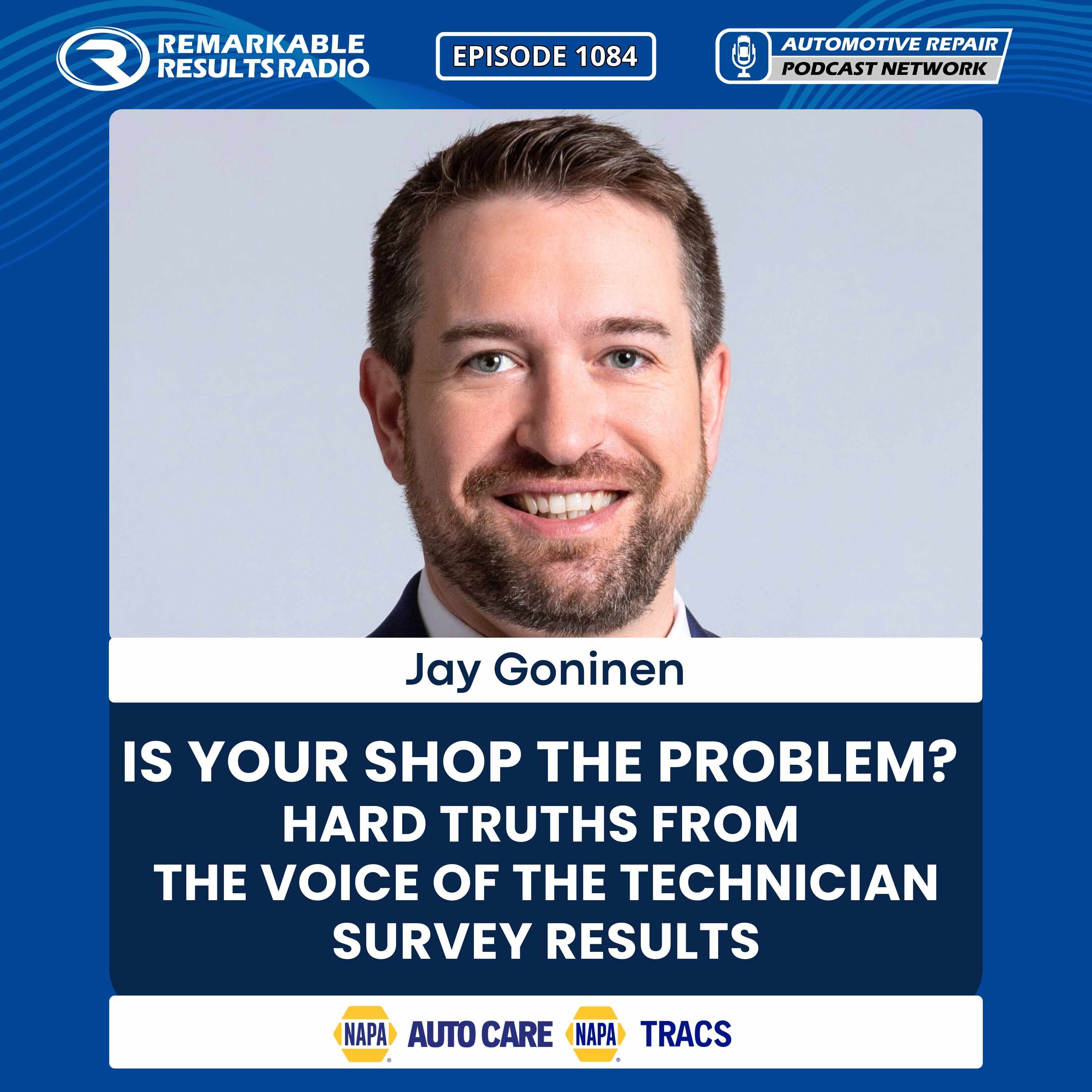
Host Carm Capriotto speaks with Jay Goninen, co-founder and president of WrenchWay, about insights from the 2026 Voice of the Technician Survey and what it reveals about the state of the automotive workforce.
Jay encourages shop owners to download the free report to uncover blind spots and start meaningful conversations with their teams. The data show that technicians strongly prefer a four-day, 10-hour workweek with no weekends, along with proper equipment, paid vacation, retirement benefits, and paid training.
While dealership technicians made up a larger share of respondents, independents stood out in workplace culture. 63% of independent technicians would recommend their shop to a friend, compared to 36% at dealerships, though dealerships scored higher in providing paid training. Across both groups, technicians favor an hourly wage plus bonus structure, which many feel better supports diagnosticians than traditional flat-rate systems.
The discussion also highlights a troubling trend: the industry’s Net Promoter Score dropped to -60 in 2026, signaling that many technicians would not recommend the profession to others.
To strengthen the talent pipeline, Jay discusses ASE Connects, a new initiative aimed at connecting shops with high school and technical school automotive programs to support them through mentorship, advisory roles, and community engagement.
Carm also advocates elevating the profession by shifting the language from “mechanic” or “technician” to “specialist,” emphasizing the expertise required to work on today’s vehicles.
Overall, the episode serves as a wake-up call for shop owners to use the survey insights to evaluate their culture, communication, and work environments, and to become employers technicians are proud to recommend.