Formula 5000 was a kind of race series with very powerful open-wheel cars. The cars were built to be light and fast, but they didn’t protect the driver much in a crash. That’s why people talk about it as a dangerous era.
The speaker is describing how older race cars often had very little protective structure around the driver. If the car hit something, the outer parts could fail quickly. And because the driver sat very low in a tub, there was less “buffer” between them and the crash.
Term
LOL
“LOL” here is a nickname drivers used for Formula 5000 cars. It suggests that after a crash, the car might not be able to keep going like a normal race car. It’s basically a joke that points to how rough and unforgiving the cars were.
“Limp” here means the car isn’t running or handling the way it should, so you can’t drive it confidently. It’s like the car is “holding you back,” and you want to avoid that.
Handicap racing tries to make races more even by giving some drivers a head start or other advantages. That can make the race feel riskier because you may have to fight through traffic.
A rear wing is an aerodynamic device that generates downforce to improve grip and stability, especially in corners. If a wing stay isn’t properly bolted, the wing can twist or fail, drastically changing aero balance and increasing the chance of a severe crash.
They mention “Grand Prix Day,” meaning a big race-meeting day. The important part is that there are lots of events happening and the schedule can cause waiting and delays.
A “tote” is the betting system/board used at racecourses to display odds and manage wagers. It’s part of the on-site race-day experience and helps explain why they’re parked nearby while the event is running.
A transistor radio is a small portable radio, and here it’s used to follow race timing while waiting for delays. This highlights how people tracked live event updates before modern smartphones and live streaming.
Qualifying is the session where drivers set their fastest laps to determine starting positions. If qualifying is interrupted or delayed, drivers may have to make quick adjustments and still perform under time pressure.
“Pole” means you earned the best starting spot for the race. It usually comes from qualifying fastest, so you line up first and have an advantage right at the start.
Topic
Manfield Racing
Manfield Racing is the race track where this story happened. Different tracks behave differently, so what’s going on with the track can change when practice/qualifying happens.
Term
bourbons
The transcript uses “bourbons” as a humorous detail about having a few drinks before getting back in the car. While not a technical racing term, it’s a notable personal anecdote that contrasts with the seriousness of performance under pressure.
When officials stop a practice session due to a track problem, it changes the rhythm of preparation and can compress the time drivers have to learn conditions. It can also create a “restart” situation where drivers must quickly find pace and confidence.
The Singapore Grand Prix is a big Formula 1 race in Singapore. Because it’s run on city streets, it’s harder to drive than a normal track.
Concept
collision damage before the next race
The segment describes a collision that damaged the car, followed by only about a week before the next race. That timing matters because it affects what can realistically be repaired (and how thoroughly), which can influence reliability and performance.
This was a race event in Malaysia (Selangor). The speaker brings it up because they won it as part of a successful stretch of racing.
Concept
race paddock/workshop storage security
They’re describing where the race car was kept when not being driven, and how they worried about it being tampered with. The story shows they relied on the workshop person’s presence and strict rules to keep it safe.
A “rally Jag” means the Jaguar was treated like a rally car, not just a normal road car. Usually that means it was set up to handle rougher driving and be more reliable when pushed.
Bathurst is a famous long-distance race in Australia. Winning at Bathurst usually means the team did a lot right—car reliability, good strategy, and strong driving over many hours.
An angina pill is medicine for chest pain related to heart blood flow. The story is basically saying the driver had a heart-related issue but still kept racing.
Formula Atlantic is a type of open-wheel race series. It’s the kind of racing where drivers often build their skills before moving up to bigger categories.
If you start near the back, you have more cars to pass. The plan is usually to drive carefully at first, then make your way through the field as the race settles.
An engine problem means something in the engine isn’t working right. If it happens before the race, it can ruin your starting position or end your race early.
Tipping upside down means the car rolled over. That’s a serious crash because it can damage the car’s structure and make it harder for the driver to stay safe.
An Armco fence is a heavy-duty metal barrier at the edge of the track. It’s designed to absorb crashes and keep cars from going into areas they shouldn’t.
The camshaft is like the engine’s timing controller for the valves. If it’s damaged or missing, the engine can’t breathe and run correctly, and it can cause major damage.
Term
grazers
“Grazers” here sounds like the scuffing/scraping damage from a crash. It usually means the car slid or rubbed along something hard.
Sometimes in a crash, one car can ride up onto another. When that happens, the other car can get lifted and thrown, which is why these collisions look so violent.
Sometimes a race gets delayed for safety reasons. When that happens, teams have to adjust how they warm up the car and manage everything before the restart.
Concept
dummy grid
A “dummy grid” is basically a practice lineup. Teams park the cars in a grid-like setup so they can do start and setup checks before the real race begins.
Term
tape
Tape can be used as a temporary fix on a race car. If something is loose or damaged, teams may tape it up just to get through the next session safely.
Car dealing is basically a business where you buy cars and sell them for profit. Kenny’s point is that this business helped fund their racing.
Concept
carponing
“Carponing” sounds like car flipping—buying cars and selling them again for more money. Kenny is saying that was how they made the early cash for racing.
Motor racing is competitive driving events. Kenny is describing how expensive and time-consuming it is, so they kept working and only took time off when racing required it.
Self-funded just means they paid for racing themselves, using money they earned from their own work. That usually means working a lot and saving up until sponsorship or outside help arrives.
Sponsorship is when companies help pay for racing. Instead of the team paying everything themselves, sponsors chip in—often in exchange for branding and visibility.
LIVE
A Listener Production
Look at everybody, Rusty here all set for part two of my feature episode with Kenny Smith.
Now, you all know that I usually bang on at this point.
If you've arrived here and not listened to part one, you need to jump back to the library and give that a listen first and so on.
Well, I mean that even more than normal with this one.
And that is because Kenny's story is incredible.
A life that has just been about horsepower and racing and he is still deeply committed to it.
In part one, you'll learn about how it all got started in the late 1950s.
His friendship in those early years with Jimmy Richards.
Waking up after a big night out with his feet painted silver.
Holding up an event or being a little late back to the track because he was putting a bet on a horse race somewhere.
The absolute superstars of the 60s from Europe that he raced against here and hung out with afterwards.
As we get into part two, just a little reminder that Kenny's career is so massive.
He has so many trophies, stories, memorable moments that we are not aiming to cover all of them.
Apologies if I don't get to one that perhaps you wanted to hear a bit more about.
I'm endeavouring to provide a summary of sorts that hopefully appeals for lots of different reasons.
I loved this conversation. We filmed it too, so if you'd like to watch the chat at some stage later,
you can do that by heading to our YouTube channel at Rusty's Garage Pod.
Let's get back to the chat now.
You lit up today just before we started recording when I began mentioning about Formula 5000s.
You enjoyed that era, didn't you?
Oh, 5000 is something special. The dangerous car, there's no doubt about that.
I mean, when you look at them, they've got plenty of bodywork around them,
but when you hit anything, that bodywork's gone and you're sitting in less than six inches height from your hips when you're sitting in a tub.
And I'll tell you what, they fold up. That's why they used to call LOL the limp to them when guys used to crash.
And being small, our pedals were back 40 inches from the front, so we didn't get LOL the limp.
Now, that's a car. I mean, the Atlantic car is the most fantastic car I've ever driven,
but I still have to say the 5000 was the cream of anything.
Is that right?
And after we got, I sold the car in Australia after the end of 1977
because New Zealand decided to go for Atlantic and drop them and Aussie kept the 5000s.
And the car's still over there now.
So that's why I went to the States to buy this other one later when we started running 5000s back in Ukraine.
And had it up until about five years ago.
Did a good 10 or 12 years in it.
And then I decided I wouldn't run again here because they started wanting to do handicap racing.
And I just didn't fancy starting off a back of a grid with two or three sharp guys with you
and you've got 15 or so cars in front of you and some of them were five and six seconds of lap off the base.
And it's just, you know, it's too dangerous.
I mean, those cars, I had to be hit it, put the car in one of them on a V8 supercar.
I remember vividly, yeah.
A rear wing, the guy forgot to bolt the one stay up on the rear wing and just twisted the wing
and she went in hard over another car.
So you sort of don't, you push your luck a bit and I've been very lucky.
I've got away without a few crashes but nothing super major and haven't done too much damage.
Can I have a bit of fun with you now?
They tell me you don't like swimming and you're not a fan of water.
Is this true and why?
You know, I've never been a water lover.
I can't swim.
No, I'm hopeless swimming and you wouldn't get me in any deep water.
So I mean, that's crazy.
The only time I use water is when you wash.
And I thought that's what it was made of.
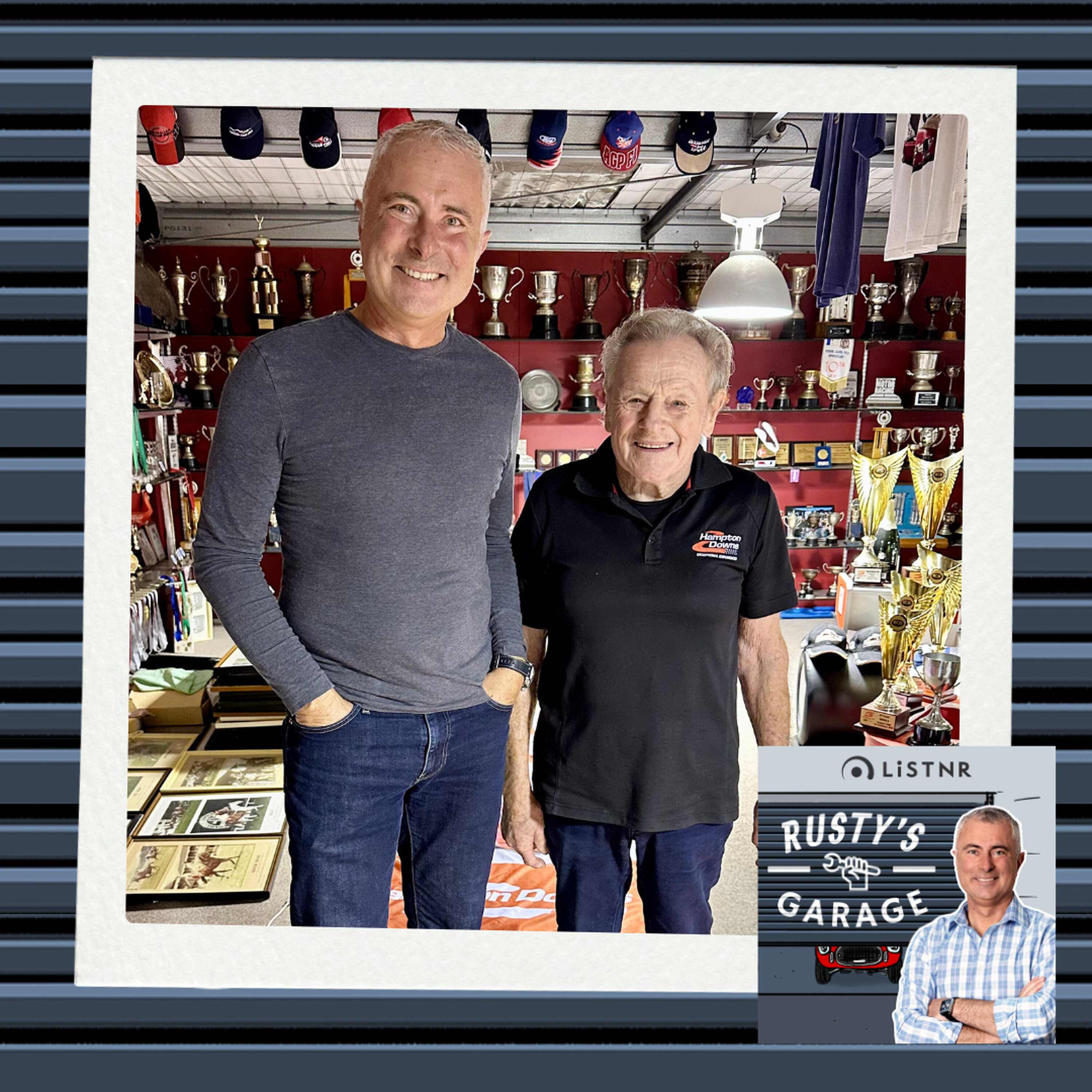
Behind us here among some unreal motor racing memorabilia
is a little nod to the fact that you like another kind of horsepower too, don't you?
And have done for quite some time.
Where does the fondness I guess for horse races and maybe a flutter come from?
Well, my father and I bought a racehorse and I had a friend train it in Cambridge
and then we ended up with a dozen horses in the finish.
But every horse we had was placed or won races.
And one of the cream horses we had was a horse called Elma.
She won 17 races and three in Australia for us.
And she was running at Pukakawi in a very big race and it was Grand Prix Day.
And we're parked on the other side of the Grand Prix track by the tote
and Eric Mallard was running the Grand Prix association.
He's yelling, all drivers got to be out of here now.
We're ready to line up for the Grand Prix.
And I had the transistor radio because the horse was running.
And they said there'd be a three-minute delay at Alice Lee.
And I thought, oh, here we go.
So I had to bolt out before they shut the gate.
So I took the transistor with me and we drove around the track
and we stopped for about five minutes on the track before they let us go.
And I've got the radio and it says there'll be a further three-minute delay at Alice Lee.
So they're telling everybody to get off the grid.
So I had to throw the radio to the crew.
About four laps later I come around and the board comes out
because those days there were two boards.
And it had $7.45 and $2.45, which meant she won.
And then I could get me, I wouldn't start getting going.
That's excellent.
And we did the same at Bay Park.
She was running at Alice Lee and we were at Bay Park
and Peter Hanna was a promoter there.
And I said to him, Peter, there's clashing.
We've got a half hour qualifying.
And I said, as soon as we start the qualifying, I've got this horse I've got to see.
So he teed it up for a guy over from the start line in the house.
He said, I've teed it up there.
Now when you're ready, pull in past the start line and get off the track.
Get out the car and I'll tell you when you can bolt across the track.
So that's how he did.
And I got over there and the old boy said to me, what are you here for?
And I said, I'm here to look at a horse.
And he said, what's this nun?
I said, oh, mate, she won't win.
He said, so he was an old horse nut.
Well, she won by three lengths.
So I bolted out, thanked him, went back and got across the track
and then jumped in the car and got belted in again and away we went.
I don't know if this is the same race meeting.
Is this the one when you got bolted back in again?
This might have been qualifying.
I can't remember.
But there was a moment there in the juggle of all of that and what have you
that when you got back in, you still managed to pip David Oxton for pole.
Is this true?
That's actually a different story.
Yeah.
That we were at Manfield Racing and it was, we had a horse running at Arwood Pune.
So the father and I went and watched that.
And I said, I'm not coming back for qualifying.
I'll start off a bit tomorrow.
So we were there and we had lunch.
The horse got up and won and I had about three bourbons and for lunch and all that.
Then when I get back, they said, look, the practice only just started
and they stopped it because it's a problem in the track.
Throw your gear on and get in.
And I said, no, no, no, forget about it.
They punished me hard.
I threw the gear on and got in with the bourbons.
And in about four laps, I got it on pole.
And David said to me, what the hell did you, how did you do that?
And I said, you need to come to the races with me.
I had Roberto Moreno come on last year on a really, really good chat with him.
And he talked about, he was here last year in a kind of coaching capacity
and helping Kiwi Motorsport and so on.
But he talked about when he came out here and raced himself.
And I'm paraphrasing here, but it was along the lines of
they had enough money to do the first race.
But he couldn't necessarily stay for the rest of the campaign.
And you got hold of him and said, I know about a horse,
might have been one of your own horses, I don't know.
You both put some money on it.
And that got to the point where I think he won enough money
to continue with the rest of the New Zealand series.
He did. He was funny.
He did because a Greek settlement of Australian, he was managing and looking after him.
And so we got him and fused into horses, but he didn't make enough money to keep going here.
And we backed a few over that time he was here, so he was happy.
And he always throws that back even now when I saw him last year.
And he came here a few years ago and signed the wall and that sort of stuff.
Love it. Love it.
Great guy.
You mentioned about, you know, racing a bit overseas as well.
I mean, I can immediately see a picture of Phillip Island where you've been there.
But you had some success, Kenny, in Asia too, in Malaysia and all sorts of places.
Yeah, in 1970 we went and did the Singapore Grand Prix.
And we had a crash with another driver, a Japanese guy, who, when he got a flag,
he put his finger out there to go that way.
But what he meant in Japan, I go that way, you go the other way.
So we collided and the car got damaged and it was only a week apart.
So we had to work pretty frantically to get it going and going.
And we went and did the Panang Grand Prix, further up, and won that.
And ended up winning that three times a year later and again in 1979.
And the Singapore one looted me. I led it for a while and then had a mechanical issue.
And Jack Bramble was doing the starting up there in those days.
Those days, yeah.
Yeah, and then we won the Selangor Grand Prix and the Malaysian Grand Prix,
which Jackie Stewart was part of that year.
So we've had a lot of fun.
Did you enjoy racing up there? It was quite different back then to now, wasn't it?
They laid the red carpet for you.
Our unbelievable people there.
They made sure everything was what you wanted.
And I remember, I used to be fussy, we were apart in my car.
So in Panang we parked the car and the guy said he can bring it in his workshop.
And I said, do you lock this at night time?
And he said, no, I'm here most of the time.
And I said, well, I'm a bit worried about the car.
And he went, no, and touch it.
And he went, whoof, and he brought up a gun.
And he said, I kill him if I touch the car.
Safe as houses.
Safe as houses.
Yeah, no, it was quite funny.
It was good, but we've had some good fun up there and the people were nice.
And, you know, we've done quite a lot of racing off and on in Australia
and different parts there.
So that's been good.
I enjoyed it.
Has there been a race that you haven't done
or an event that you would like to have done?
Well, it'd be nice to have got to Europe maybe and done something over there,
but it didn't matter.
We'd been and done America and Australia and Asia and here and that's good.
Did you almost get close to stitching something together for Europe?
No, back in those early days, look,
they were looking for F1 drivers in the early days.
We're nowadays, they're not, you know, there's that many of them there.
And I know if I'd have gone over there maybe back when I was, say, 2021
with the help of Bruce McClown, I'm sure I could have got a deal going.
But I didn't.
It was one of those things, I just didn't go.
I choose to stay home and so that was it.
You mentioned him, but we didn't talk so much about him there before.
What was Bruce like and did you have a good relationship with him?
Oh, yeah, he was a fantastic guy.
He was a prefect at Sid and Tech
and I even quoted in the book all right,
he should never have been a prefect.
He was too nice to everybody.
Really?
Yeah, he wouldn't harm anybody.
That's the sort of guy.
And he used to bring his little officers to school
and well as he'd street and park it outside the school at times.
And I always looked at that car and thought,
God, I'd love to own that car one day, which was good and fortunate
because I did get it.
And I remember when he went to Coopers with Jack,
he came out in 1960 and bought a 3.8 Jaguar out for his father,
a rally Jag.
It was a beautiful car and he was cleaning it up in his workshop
in Upland Road where his father at the garage
and I rolled up in the Austin
and he fell down when he saw it again.
Did he?
He said, can I go for a ride in it?
So he jumped in it, we both got in.
We drove up through a road flat sticking back down again
and that's, you know, what a sort of guy he was.
Rusty speaks with people from all around
the motoring and motorsport world on this spot
with a decent focus on both sides of the Tasman.
He's a little nugget from his awesome feature episode
with Ross Stone and the Stone Brothers
breakthrough Bathurst win.
Family's in the car and you turned around
and you said, we're going to make it.
We're going to make it.
Yeah, yeah, well, it was hard because, um,
there was a hundred grand a few in Bathurst, you know,
and that, that was massive to us.
From how it all got started in New Zealand
to conquering supercars championships
with Marcos Ambrose and Russell Ingle.
Search for it in the garage library later.
Now back to another Kiwi racing legend, Kenny Smith.
You're 84 now, as I talked to you,
but your memory, Kenny, is as sharp as,
particularly around cars and moments of your racing career, isn't it?
Well, I always think that my memory is not as good.
Well, obviously you can't when you get older,
but I forget people's names more than anything,
but it's like, if I had to go through and do this,
it's hard, but you ask me a question,
then all of a sudden things start coming back.
Yeah, and I probably could go for hours talking rubbish.
Please, please, keep going.
I mean, for whatever reason, if we, you know,
spark a memory of some kind, go with that.
Your health around your racing
has fundamentally been really good, right?
But there is one story around your heart,
and you might have taped an angina pill
that you had to the side of the Formula Atlantic,
and on the day in question,
was it the last pill that you had at the time?
What happened? It turned to powder or something?
I remember Graham Watson, the road dealer over there,
he called me over and he said he was trying to win the championship,
and it was three rounds ago,
and he wanted me to come over and drive his 86-roll,
and just sort of interfere with the other guy
so that he could get the job done.
So we get to the last meeting, which...
Where are you here?
I think it was Amaru Park.
Amaru Park, okay.
Yeah, and so we had an engine failure in the car,
and he didn't have another engine,
then he remembered a customer's engine in the back of his truck,
so I don't know what it's like, we'll put it in,
and it was actually quicker than his engine.
It was a good engine, but anyway,
we got out that morning and I said,
you know, look, don't worry about this guy
that you're competing with,
and I had to start off the back
because I didn't qualify for the engine problem,
and I said, I'll work my way through this pack,
and I said, leave me to do it if we have to.
I know it's a pretty greasy way
of telling you to get a guy's championship,
but off the start line,
Graham and this guy came together,
and Graham's car tipped upside down
and went along an Armco fence,
and I'll never forget that,
he had grazers on his crash at,
and he also had no camshaft left
in one side of the engine and the BDO engine.
It had toured out on the Armco,
that's how close it was, rick the car,
and the other car of the guy,
it climbed up over his car
and shot him away in the air,
and ended up in a car park beside the track,
upside down, and it killed a lady
at the top of her, which was a sad day,
and of course, the race was postponed
for four or five hours
because the police came and everything,
and so they say right,
we're gonna start this race,
and I remember going out on the dummy grid,
and the mechanic that was working on it
was one of Graham's mechanics,
Les Laidlaw, and I said,
don't touch that, what's on there,
until I need that tomorrow.
The Pil, the Anjana Pil, yeah, yeah.
And he said, I know what it is,
and he said, you're crazy,
and so what I did, I got the Pil,
and I'd lick my finger
and pull the tape back together,
and I thought, holy shit, this is powder,
so I've got a problem here,
because I was getting bad angina pains,
and so I've been here,
I'm picking it away, and I'm putting it under my tongue,
and I looked up, and there's a big guy looking at me,
he looked like he was about seven foot tall,
and he went, my God, good luck, and walked away.
Now to this day, he probably said I was on dope.
But it was later on that I had to go
and get the bypass done, because it was,
we only had one artery was closed,
one was 10% open, the other one was 5% open,
and I was suffering bad,
and even like at Pococoa, when you're coming down
the front straight and taking turn one,
you're trying to get in there as late as you can,
and every time I went into there,
the massive angina would come,
and it would release itself down the back straight,
it's just because you're tensing yourself.
But hey, look, we never looked back,
we had that done, and then
we did have a little issue originally about
getting a license,
because motor sports in those days,
you can't renew your license anymore.
So I hung up, and like I was devastated,
and a week later,
I rang them up, and I said,
I want to run in there, and you can't run,
they said, and I said alright, I said well,
you've got your international drivers coming out
to run in a month, and they said yeah,
and I said well, they won't be running.
Why is that? I said I've got the best lawyer
you'll ever see in this country,
and he's putting a courting junction on you
so you can't do it, run it.
They said you won't do that,
and I said well, you watch me, and I said
you go and talk to your lawyers and see
if I've got any right to say what I'm saying,
and within a week I had a license.
And now, all around the world, anybody
that's had heart trouble, that can prove a cardiologist
that you've had, you know, your arteries are open
and all that, they can run a car.
And as I said to them on the phone,
I said, have you got any trouble with your heart?
And they said no, and I said well, you might drop dead
in a minute with that phone, that talking to me.
Because I said oh mine are open, yours might be closed.
Closed, yeah. So I stood a lot of crap
in those days.
How did you stitch it together along
the way, Kenny, you talked about, you know,
the kind of car dealership and things like that
before, were you doing other
jobs as you were progressing through
or has it just been
your life? You talked before
about some of the money required in America
back in the day, and so on, it's an expensive game,
isn't it? Oh it is an expensive game, but in
those early days, like we first started
my father and I, we were carponing for a number of
years, and then decided we'd go car
dealing, and that business was
good, and
we just, you know, we worked seven days a week
to go motor racing.
And you know, it was never time off, and you just
take a day off when you were going motor racing,
and then back to work again.
And my father would eat, work until midnight
at night time, and we'd do long hours
doing carponing and all that to get going.
And so it was self-funded
until later on when we got some
sponsorship to help some different companies.
Rusty's Garage
is written and presented by
me, Greg Rust.
Series editor and producer
is Joel Harrison. Audio production
by Link Kelly.
If you've got a guest suggestion
get in touch with me on social
media. The Garage.
It's where a journey begins
with a tank full of passion-fueled
stories.
Thank you.
About this episode
Kenny Smith reflects on Formula 5000, calling it the cream of the cars he drove and describing just how dangerous they were. He shares stories about racing while following horse results, including backing horses with Roberto Moreno, and talks through success in Singapore, Penang and Malaysia. The conversation also covers his friendship with Bruce McClown, a heart scare that led to bypass surgery, and how he funded racing through years of hard work in car painting and car dealing.
Awarded a Member of the Order of the British Empire in the Queen’s Birthday Honours in 1987 for services to Motorsport Ken Smith wasn’t about to let that be a book end to his career. There was still so much more he wanted to do. His eye for talent and the significant help he gave in the background to sure up the future of some modern day stars. Working with Indycar great Scott Dixon, World Sportscar and Le Mans 24 hour winner Brendon Hartley, 4-time Bathurst winner Greg Murphy (in his early days) as well as Shane van Gisbergen and Liam Lawson. Trading blows with Craig Baird and Paul Radisich as they climbed the ladder. Reflections on the lovely constant for so much of his racing, his late Mother Dorothy. And we’ll talk about the cool cars that surround us in the 5-time Gold Star winner’s workshop.
Plus the odd saloon car drive and much more. The numbers seem hard to comprehend, 50 starts in the New Zealand Grand Prix, almost 70 years of continuous racing, success overseas in Asia as well as countless wins at home. We don’t get to every podium or memories of every high or low but this is a well rounded summary of an incredible career so far and Ken Smith has no plans to hang up the helmet just yet. Head to Rusty's Facebook, Twitter or Instagram and give us your feedback and let us know who you want to hear from on Rusty's Garage