A turbo is a device that helps an engine make more power by pushing extra air into it. More air usually means more fuel can be burned for more performance.
Horsepower is a way to describe how strong a car’s engine is. When people chase “more horsepower,” they’re trying to make the car faster or more responsive.
“Fox Sports” is a TV network that broadcasts sports. If someone worked there for years covering racing, they were probably a regular commentator or host.
“Motorcycle racing” is racing motorcycles against other riders on a track or course. It’s a specific kind of motorsport with its own rules and classes.
Briggs and Stratton makes small engines that power things like lawn equipment. In this story, someone took one of those engines and used it to build a minibike.
A Honda dealer is a store that sells Honda vehicles and usually helps with service and parts. It’s the “official” place to buy a Honda instead of building something yourself.
Motocross is off-road motorcycle riding and racing on tracks with bumps and jumps. It’s a common way riders build skills before moving to other forms of racing.
A clutch is a lever that lets you control when the engine’s power goes to the wheels. On dirt bikes, it helps you manage traction when you’re starting, turning, or hitting uneven ground.
Car
Honda DAX
The Honda DAX is a small, easy mini bike. The speaker is saying the XR75 was more serious and better suited to dirt riding.
Dirt track is racing on a dirt surface, usually on a track with corners that you slide and grip through. The speaker is saying they didn’t have that kind of track close by.
Car
RM125
The Suzuki RM125 is a 125cc dirt bike made for motocross racing. It’s the kind of bike riders use when they’re learning race pace and technique.
A two-stroke engine makes power differently than a four-stroke. It usually feels more aggressive and easier to rev, which is why it was popular in dirt bikes.
Sprockets are the gears the chain wraps around. If they’re worn or the wrong ones are installed, the bike can feel like it has the wrong “gears” for the track.
Over geared means the bike is geared for higher speed instead of quick acceleration. On a motocross track, that can make it harder to get the power you need when you’re trying to accelerate out of corners.
The rev limiter is like a safety cutoff that stops the engine from revving too high. If you hit it on a straight, the bike can feel like it’s “stuck” and not accelerating.
Ducati is a famous Italian motorcycle brand that makes performance bikes. Here they’re talking about taking a ride on one of Bob Brown’s Ducati motorcycles.
A warm-up lap is a brief circuit at the start of a session or race to bring tires and brakes up to operating temperature. It helps riders get traction and confidence before pushing hard.
Front forks are the suspension parts at the front of the bike. If they’re the wrong length, the bike can sit differently and handle differently in corners.
The key idea is that the race lasts six hours, so you plan for the whole time. That means steady driving and fewer mistakes.
LIVE
MUSIC
A Listener production.
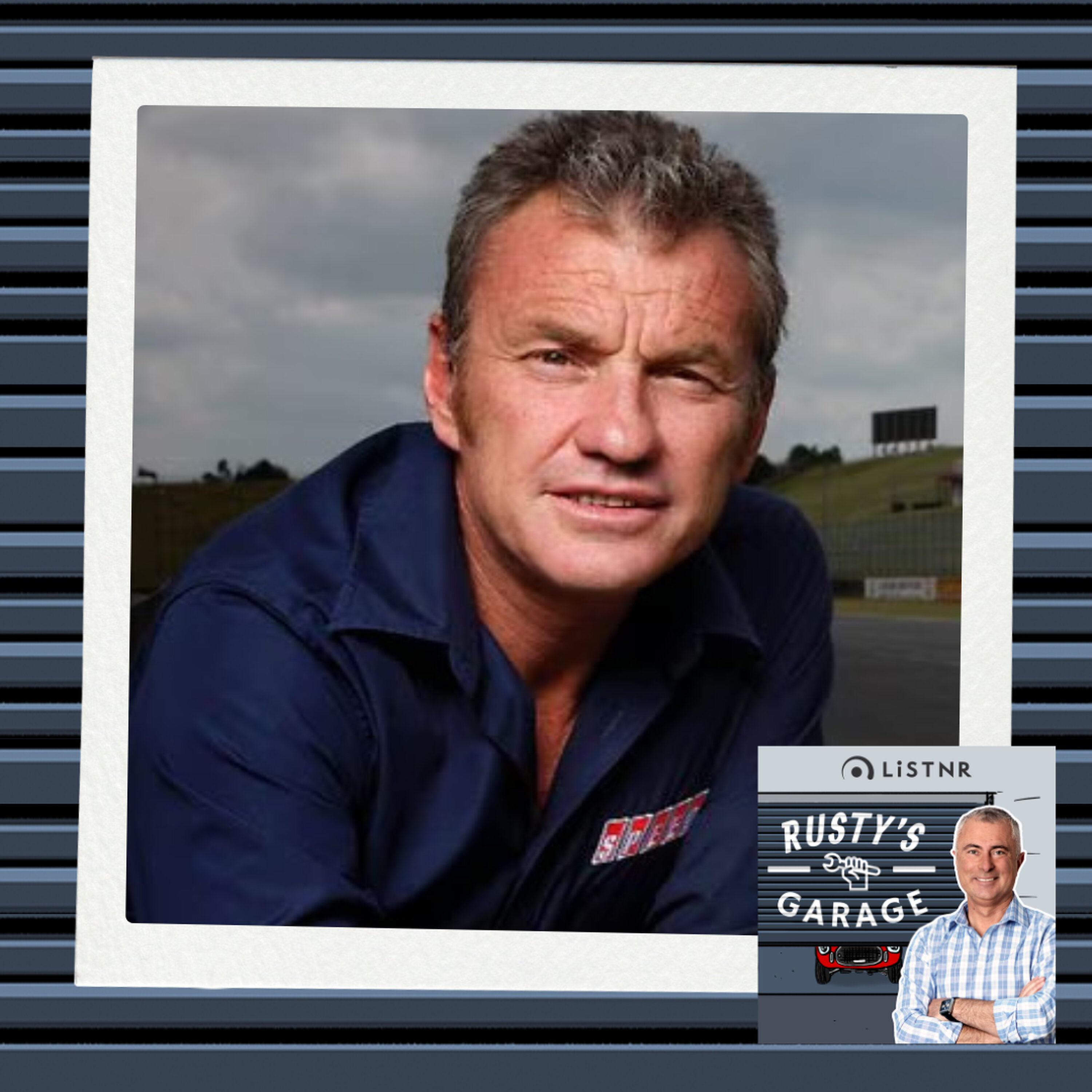
I'm Automotive Commentator and journalist Greg Rust,
and this is Rusty's Garage.
For this episode, I'm at home and my guest is dialing in
from Horsham, about 300km, or 3.5 hours drive
north-west of Melbourne.
As you'll hear, it's truly home for Kevin McGee.
As he climbed the motorcycle racing ladder,
he earned the nickname the Horsham Hurricane
and later became known simply as Magoo,
a subtle tune on his surname
that lent into the cartoon character Mr. Magoo.
Kev is in his early 60s now,
and I've had the opportunity to work alongside him
several times over the years, covering domestic bike racing.
We also cross paths with some fun four-wheel stuff, too,
from road rallies to being at Oren Park
when he sampled Rod Salmon's AU Falcon Supercar back in 2002.
I seem to recall walking into a kitchen at his place once,
and he was rebuilding a turbo from a Subaru.
He loves that stuff and has this knack of crazy ideas
that might generate more performance or beloved horsepower.
This chat is one that I probably should have done some time ago,
and it will tend to zero in on his bike racing.
We'll get to his Grand Prix career, of course, winning in Spain
and a couple of crashes that had a profound effect on him, I sense,
including one that led to an Aussie news outlet
making the horrible mistake of reporting his passing
as a result of the accident.
As you'll hear, Magoo talks in incredible detail at times,
from remembering specific bikes to sprocket choices and a whole lot more.
We'll also talk about a big stint that he had with Fox Sports
covering motorcycle racing that lasted nearly three decades,
and the remarkable part that he played
shadowing a vision-impaired rider,
guiding him to a world record on Lake Gatner.
Kev's got a cuppa, which you'll hear him use
to sue the vocal chords as we talk, mostly him, for nearly 90 minutes.
One of us also left our phone on the desk, too,
so when the odd text comes through, it might sound, in the distance,
like a game show buzzer, and its timing is uncanny.
If you're anything like me, it'll probably make you laugh,
because it's like we got the answer wrong at the time.
I'm a huge believer in keeping the chats, as you know, in their own words,
and this one steadfastly sticks to that principle.
Here we go now.
Hello, Kevin McGee.
How you going, Rusty?
Hey, it has been too long, my friend.
It's great to get you on the podcast.
I would love to know, life has come full circle for you.
You're back in Horsham where you grew up,
and tell me about early life,
and when you first got your hands on a motorcycle.
Well, life started out at Dewan behind the motocross track,
on a sheep and wheat farm, mainly.
Had a few cows and, you know, chucks and geese and all the rest of it,
but that was it.
And then we moved into town in 68,
just after I started school.
I only went on the school bus a couple of times.
And then my middle brother, Damian,
he was a bit of a rebel and sort of an industrial,
if you know what I mean, industrialist,
if that's the right word.
He ended up making a minibike, because he wanted a minibike,
so he made one old 2.5 horsepower Briggs and Stratton stationery motor,
bent up some frame down at the local garage where he was made with his kid at school,
and cut a wheelbarrow tyres and, you know,
it was a V-belt drive which wasn't very successful.
It was idling at about 15 mile an hour.
And Dad felt sorry for us one Sunday afternoon,
so he jumped in the car and went around the corner to the Honda dealer.
This is on a Sunday afternoon when, you know, the whole world's dead
and regional Victoria, especially back then.
And I come on with a blue Honda 70, the old ST70 Honda Dax as our famously known.
And that was it.
Amazing. And were you like a duck to water?
Yeah. Tim's four years older than me, the next oldest brother and Damian,
who built that first minibike, he's another two years older.
So I was 10 at the time, so they were 14 and 16 respectively.
And they were pretty fair, but, you know, sometimes you get the short end of the stick.
Were you just trying to keep up with them, mate, or were you sort of off and running?
Yeah, that was always a case.
Damian, I remember they were building up the ground near the Wimmer River
down South Town for more housing.
And there was a sort of like a four, five, four, six foot varying areas of like a ramp.
And, you know, you're trying to do that, and so Damian was telling me how to do it.
And I was pretty scared of jumps, but, you know, got used to it after a while.
So yeah, it was good.
We used to spend like Sunday afternoon down there at barbecues and all that stuff
and just riding. There was other kids riding as well.
So it was good little social sort of start to motorcycle.
Awesome. So we tend to think of you from your career in circuit racing
and, you know, super bikes and Grand Prix and so on, mate.
But was there sort of an early push in towards either dirt track or motocross
or something along those lines? What transpires next?
Never did do dirt track, basically dodged trees for a lot of years.
And then from the DAX got a YZ80C and that was like a proper bike with a clutch.
And that before that, Tim had moved to South Australia over to the uncle
and his at Naracourt. He left this XR75 home for me for a while.
And compared to a Honda DAX, it was a real bike.
It had five gears and a clutch and spoke wheels and stuff like that.
You could dump the clutch and look out the back and watch the dirt fly
and those sort of things that just are so important when you're a kid.
And we went over to Edenope.
I would just, you know, your bush sort of scrambles as they were called in the day.
Didn't even use a front brake because back in the early days,
they said, I don't touch front brake, you know, you'll fall off.
I won the first one, I think, and then got third and a fourth as the horse
motorcycle club. We basically were was originally a bunch of road riders.
And then it sort of turned into, like all us dirt riders and minibike kids.
And dirt track, we didn't have one anywhere near here that I know of or knew of.
And in the early days, I was better at right handers and left handers.
I probably would have been no good at dirt track anyway.
So what transpires next, mate, in the, you know, the story of your career?
Clearly you're good from a scrambles point of your you had the feel for the motorcycle
and so on. Did someone coach and give you a bit of tuition?
Were you just a natural? What transpires next?
One of the schoolmates, Russell Jagger, he had a CR125M1 and I was at 88 and
doing mum took me out and a little three, two, three in the tiny trailer and
dropped me off and come back and get me later.
And Jags gave me a ride on his CR and I just killed it.
And yeah, there was guys there that had full racing gear and stuff that race
motocross and basically all the beacons straight away.
So there was a few different tipping points.
That's one and then dad died in the meantime there at the end of 78.
That was the end of form four and then I was working at a servo with the other
mates from Czech school and you'd save every penny and scream for motorbike
stuff. And that's what it was all about.
First thing I bought was a pushbike to ride was 12 Ks to school and 8 Ks to the
servo. So I was pretty fit little ranger and you know, working around the place,
cutting wood, doing not so much lawns, but grass with just a push mower and
things, all the stuff you had to do, whether it's fixing a pressure pump or
what, you know, you never really like much of a spare time.
And I begged mum or $1,100 loan to buy an RM125M when they were coming out.
And what happened before that?
I did work experience at one of the motorcycle dealers and I had a $50
deposit on an RM370.
I think we had a work and be.
So the dealer took it out.
I went out with him and we do the work and be in that and have a ride on the
RM370 and it's like ding, ding, ding, ding.
You know, to go faster when you let it off than it did when it went on.
And one of the other schoolmates from the servo, Colonel Kim Grosser, he had
brand new YZ125F and to give me a ride and bolshe the dealer just had the
brand new KX250 with the gold rims and it was a very good motocrosser.
And I caught him and passed him on on the makes YZ125.
So we're driving back into town.
I can still remember about 500 metres up the road after we left the motocross
track of doing Phil Bolshe was Bolshe goes, Kevin, I got this trip to Japan
and RM Suzuki bringing out this new RM125 in 12 inches of suspension.
The first one and all that sort of thing.
So that's how that story started.
So I beg mum, she, she came good.
I ended up paying a back after saving the bucks from pumping fuel after
school and on the weekends and that, and that was the same weekend I met.
This is one of the key factors besides Bob Brown is Phil Neyman.
He was there and he was a local road racer.
He had some TAs and he was a very good two stroke mechanic.
He'd come on up his RD350s and they'd probably, you know, run alongside,
probably sometimes drag off on the fours and quack a nine.
So it was a good two stroke junior.
And that was mainly because I think it was in the model aeroplanes too
and chainsaws and stuff like that.
And when I met him, he saw me riding and pass Bolshe on the 125 and Bolshe was
on the 250 and he said that it was going to Mac Park over at
Mount Gambia, the closest road racetrack in a couple of weeks or whatever.
So one of the weekends, not far in front of that, I went motocrossing
with the wrong gearing because the sprockets were worn out when I prepped
it for the motocross meeting.
So one of the mates, Greg Arnott, we got the rear sprocket, which was 520
not 428 gauge chain.
Then we got a front sprocket on the Saturday morning, went to the motocross
at Meribara and it was really over geared for motocross.
But then we lined up, Phil put a trials universal on the 21 inch front
on the RM and just an old 18 inch road tire on the back with the same gearing
from the Meribara motocross meeting.
And coming on to the straight at Mac Park, it was hitting the rev limiter.
So you just nurse it down the straight and loved it because it got home
and the bike wasn't dirty, the brakes weren't worn out, the chain wasn't
stuck from the mud and all that sort of stuff.
So it was just clean and easy and a lot of fun on the on the tarmac.
And it's fun day.
So we didn't technically race, but you always want to beat the other guys.
And there was a guy that I was racing with on an MTR 125, the 125
Honda Road Racer, and I kept trying to peg him back and I'd pass him sooner
and sooner and sooner.
So I raced and got second last, not last.
I was I was just before 17 and nine months at that stage, which was when
you got your learners for a motorcycle in Victoria.
And I was just after the 250cc limit come in.
So that I'd been riding quacker nines and 750 commandos,
three cylinders, 750, McBork, Kawasaki's,
Mc3, Kawasaki's, all that stuff, mainly on dirt.
And I was I was slammed with this 250 limit, which sort of was very disappointing.
But born an R-E 250 off of who was that, Robert Black,
and went road racing for the first time.
I think when my first race got something like fourth, I was like,
how does this and then you get on your gears, not trash dirty.
And like I said, the brakes worn out and the chain sprockets half hanging off it
because O-ring chains were sort of only really just hitting the scene back then.
So everything used to wear out quickly, quick and road racing was just a good clean front.
So what transpires from here?
Because I would imagine you are immersed in it, Kev.
I mean, it's very different in the way that you perhaps ride the motorcycle
or lines and things like that.
Did you start to soak up a whole heap of stuff in relation to circuit racing?
What did you do to improve?
The way it fancied was because Tim and I used to race the four years older brother, Tim.
Before he left, we used to race the CB125 with road tires on around down the creek.
And we had to watch where the second hand on it and we used to time each other.
So you're always up for beating, especially bigger brothers.
I think the little brothers can generally be the tire in the sense
that they always want to be bigger brother.
And I was always told being the youngest of five boys that you're too small to do that.
And it really give you the sheets.
So it motivated you.
Yeah. So then when you're out there with makes and even blokes,
you don't know, you're just competitive versus air.
You just want to beat them.
So how does it go from that to some level of professional circuit racing?
If you if you like, who provides an opportunity?
How does a door open that makes it a bit more of a significant step?
That year with the RM125,
I got an ex a couple of years later during my apprenticeship.
I had a HR station wagon.
Actually, race mode across at Broadford,
when the least he was high flying on the Jeff Leeks.
Oh, wow. I think it was about eighty three, eighty two or eighty three.
And yeah.
So I think I did like forty two or forty five race meetings
in a year between the motocross and Enduros and road racing.
Wow. You know, apprentice mechanics, wage, what nuts?
So things were pretty tight.
I had to make a decision.
So it was like to get the dirt bikes and use the road bikes.
OK, you've tipped me off to something there just around, you know,
post school life and stuff.
So you're a qualified mechanic.
And I know like if I know you,
probably on the kitchen table there at home is a turbo being worked on
or something along those lines.
You you enjoy that side of it, mate, don't you?
Oh, yeah, because when I was growing up, you had to fix things.
And that and I were down cutting wood beyond the sawmill down the roadie.
And I was 13 and sharpened on the chain, you know,
mid afternoon and dad dropped that no vice or anything.
Just sitting on the trailer, mud garden that slipped off
and it was still changed all with fuel cap in the in the left hand side.
And it popped the fuel cap in.
It was like the Baker light sort of slash what is it?
Magnesium crankcases and were struggling for a dollar.
And I remember dad ordered the new crankcases from Doug Miller machine
where it was called, where I bought me was with mom and dad bought me the
was at 80. They were $166, which was a bit of a deal back in about 75.
And there was an A grade mechanic about and he come out and saw what I was doing.
Was no workbench.
I just swept off part of the concrete floor in the shed,
pulled the chainsaw apart bit by bit and just laid it out
in order, bit, hands on and Gretelite.
And down in Cole Thomas' shed down the back,
he was a pig farmer who I was help out.
He taught me well and all that when we're making up pig gates
and had no proof that you can lose another motor.
So pinched the water pump pulley off the spare motor
because I managed to fashion that up with bolts and washers to pull
the crankcases apart because our interference fit on the bearings.
I just want you didn't just undo the blocks and pull them apart.
Gotcha.
Then this A grade mechanic said, Jack, that'll never go again.
This is the chainsaw.
Got to go on and use for the next five years.
Like I said, the guy died in the loon time a couple of years later
and then I use for the next couple of years and then traded it in
when I first started my apprenticeship on a bigger second hand trade.
And then that's it.
That still goes.
Amazing.
What did you was it tough losing your dad at such a young age, but yeah,
just starting to get to know him rusty.
And you know, on that man and young man level,
not the man and sort of boy level.
Yep.
Yeah, the kick in the guts.
But life can do that to you.
Some bomb.
Yeah, exactly.
He would love to have seen what you went on to achieve.
So basically you've got a youth some bikes.
You're are you in between your Monday to Friday work?
Are you getting a little bit of time off from your boss at the time
so you can go and pursue the racing?
Is this what's happening at this stage of your career?
No, I started my apprenticeship at all in motors.
That was everything a farmer needs from your harvest start to your
like whippersnipper and your plows.
She is and your rotary hoe, your three wheeler back in the day,
your four wheeler, your motorbikes had the Suzuki four wheel drive
and car agency as well, the Honda bike and car agencies.
So pretty much you could work on anything outboards a lot.
And no, it was really full.
And the other bike shop, which was Centipoint Motorcycles, the Bolshe had.
That was where all the cool stuff was.
You know, you weren't working on rusted.
There used to be a lot of dairies around this area,
and now it's pretty much all broadacre cropping.
So three and four wheelers and, you know, your CT 125s and 185s
that have been spent their life in water
and you've got to get the back wheel out.
Everything's just locked up.
You know, you're just working on this crap and it's just hard work.
And old Johnny Rupp, the smart guy down the back in the tractor sheet,
he taught me a lot of tricks to get things apart
that have locked themselves together.
Anyway, God rest old rookie sol2 is a really good bloke.
Very, very clever.
And I was two and a half years into me, four year apprenticeship.
And I wanted to go and work at the other dealer
because it was just full on bikes and the bus wouldn't give me the sack.
And I got down to five chargeable hours a week
because I said to the foreman, I'll just keep working on the tradings
and stuff, give me everything to fix that don't have to do a job card on.
I got called up to the office and he told me and then I worked a little bit more
and then I'll slack it off again and call me up to the office
and he was giving me the boots.
I went up and seen Ivan Washington.
So I jumped on my push bike and rode up to the horse from tech school
and saw Ivan Washington and he said,
But what do you want to do now?
I said, Well, I can go and start work at San Pymotus office.
It all off the go.
So I finished one before lunch and the next one after lunch.
And then there comes another key moment at the end of that year, Bob Brown.
I'd borrowed it was the end of 82 because I borrowed Wayne von Einem's
350 LC, Yamaha RD 350 LC
because the year before on the 250 LC, I won the Victorian
millage Yamaha day with the importers back in the day before the Yamaha Motor Australia.
Anyway, millage RDLC series for just this one bike.
But so I won that on the stocker
and then bought filming once TZ 350
borrowed Wayne von Einem, little von.
He passed away a few years ago, another great bloke and great inspiration.
He was trying to win the South Australian series on the bike
that I was hopefully going to win the two Victorian series on.
And then we could sort of between the two of us, we could brag about that.
And that was kind of funny.
So I'd borrowed Russell Jagger's FC Holden, Phil Neewan's bike trailer.
I was on a borrowed RD 350 LC, took my first day off Worth,
bolted down the bench seat on a Thursday night after getting there,
slept in the FC and being a mechanic, you don't want people looking over your shoulder.
And this bloke come up looking at me, changing the tyre on a tyre,
you know, to keep it out of the gravel in the pits at Wynton.
So I give him a sort of go away body language.
He went away, come back and introduced himself.
It's Bob Brown and goes, do you want to have a ride on my Ducati?
I'm up here testing a few riders because Jeff Finey's normal rider
was getting married on the weekend of sand down this international swan series
that we used to have through the 70s and 80s.
Yep. I said, all right, oh.
And then he rang Irwin's on, I think it was a Tuesday and he goes,
do you want to come down the sand down at the end of the month,
which was the end of November?
So it would have been a few weeks before.
And I said, oh, yeah.
Kevin, fill in the blank here.
This is a Ducati Superbike you're talking about, aren't you?
It's a Ducati 500 panda that Bob bought, crashed probably at the auctions.
Gotcha. Bob Martin straight in the frame.
And Bob just put some slicks on it.
And he didn't tell me for probably six or eight months later
that I was two and a half seconds of that faster around Wynton
than any of the other riders he tested.
That's why he rang me up to ride a swan series.
But we go down there.
It breaks a shim when I'm riding across the tarps in the Desmo gear
and pushed it back.
And he said, oh, well, I'll see you Sunday morning.
And I'm like, I've ridden it like half way across the pitch.
And I'm supposed to go out.
So we do the warm up lap Sunday morning and won both races
against fairly stiff opposition, which was Peter Muir on the old Ducati drama.
They used to call him the Dharma from Gaon Lock Engineering in Sydney.
But it nearly ticked me off.
You'd remove the old sand down rusty where at the first corner,
the arm car was right there.
Like if you run off, you run to your bone, the arm coat.
So off the start, I got down into the first corner first,
flicked it on its left side.
Next minute, the back wheels off the ground, it's come around.
It's nearly flung me into the arm coat, managed to stay on it.
And like, see, one that one and one the next one, wary
that I couldn't lean it over much to the left, which is a bit of a problem
around sand down.
Anyway, Bob brings me up and said the front forks were three inches too short
because they were out of a different model.
And by the way, won both races.
Good one. Go to Orem Park.
So back to the Sunday night, coming home after the presentation,
I give the check and the trophy and the whatever else back to Bob Brown.
He said, no, but you always you wrote it.
I said, yeah, but your ties or engine, you paid the entries.
Like I come and I'd been paying me on entries, ties, everything, obviously.
So I think I got five hundred and seven bucks and was thinking,
this is not a bad compared to an apprentice mechanic.
Does this sort of accelerate you into the Australian
Superbike Championship? What happens next?
Got stuck on Bob Brown's Duke Cattail.
I promised a few rides for nothing of any consequence ever eventuated.
Then I have in the 500 K Nippon Denso 500 at
Winton in 1985, and that was the same year.
Yamaha had the one make series for the RZ 350s.
They had the state championships and then they had the national championship.
Bob Brown off the boys at Component Yamaha at Essendon.
He bought and paid for an RZ 350 for me to race in this state championship,
thinking that I could win that and then get to go in the national one,
which you won the trip to Holland to compete at the World Cup.
So Bob paid for the bike and we put all the prize money in in the kitty.
And if you don't lack or read at the end of the year,
we'll go halves in the profit or the loss.
So I won that.
And I think when I won the first couple of races,
Graham Lang from Milly,
Yamaha back in the day rang me and asked me that I want to ride with Mike Dowsing.
It was a very good from Western Australia back in those days.
Very good 250 Grand Prix rider and
you know, I could ride anything else as well, especially production bikes
on the new Yamaha FZ 750.
So all right, I'll do that.
Can I get one to ride?
Yep. So jumping by then I had XB Falcon U
and drive down to
well, Dave Mulgrave and pick it up in Melbourne
and come back and rode around and then rode it over to the race.
And Mike Dowsing had the hour race on the two fifties in the morning.
We had a real dogfight with Russell Howard from Tasmania.
Because he was supposed to start the 500 K race.
I was just going to fill in the middle bit in the Ducati Leathers.
And then he was going to finish it.
And that worked with fuel loads.
And
Dowsing came up to me about 20 minutes before the start of it.
He said, I'm too tired.
I don't think I'm going to do the two sessions.
You're going to have to start it.
And I'm like crapping myself because
I'd been on the Ducatis and and that not raced against the
landing wheelings, malcambles, all those sort of guys on that sort of bike,
on the production bikes.
Yeah. Yeah.
Got a way at the start.
But I knew from being a mechanic, don't punish it early.
So you ride the wheels off it early
and then use sort of red line later on when you're a bit.
Worn out yourself.
Got you. I let him.
I remember at the start of that, let him get away to about sort of
I started to panic when I was four and a half seconds behind Rob Phyllis
on the brand new GSX 750
and then just wear him down and just keep him inside, keep him manageable.
Dowsing got on, he did his stint in the middle.
And I got back on, had a good lead.
And Lenny Wheeling on the Jeep Z900 was catching me.
I think it was about 10 laps to go.
So I just put my head down and ended up winning it.
That's a very cool memory, mate.
Was Warren Wheeling a part of all of that at that stage, too?
No, not yet.
He'd been down there at some stage with Lenny.
That was a reverse direction meeting.
I think the Tom Phyllis Memorial.
And I remember, Warren said to me some time after I met him, he said,
I remember seeing you on that Ducati reverse direction
when the start line was up the top of the hill.
So down into the S's, he said, the wheels are bouncing off the ground.
How'd you get around the corner?
And I said, well, we didn't know anything about suspension.
I used the chatter at its head off, so you just throw it at the corner.
And the centrifugal force had stopped the chattering.
And that was it.
Get on the gas after that.
Awesome. That was how it worked.
Back in November 2018, Rusty Chatterb with another Aussie motorcycle
racing hero, Mick Doan, and not just about his success in MotoGP.
But the tools that took me to those world titles or that took me through sport,
I've tried to apply to life after sport.
And, you know, the same commitment, the same dedication and persistence
of the things that that I still use and also try and continually
work with trusted people.
Channeling the skills learned through his career has helped Mick enjoy
wins of a different kind and ultimately lead to board positions
with the Australian Grand Prix, for example, recorded in a restaurant at Crown.
Mick is candid and shoots straight from the hip.
Search for it later.
Now back to Rusty and Migu.
Did you win?
I think you were talking before about was it a trip to the Netherlands?
Did that eventuate?
Yeah, in the meantime, Mick only took me to the Suzuka.
This is the middle of 85 with Rob Fillers on the Moriwaki CBX 750 engine.
What is Kevin McGee from Horsham thinking?
You know, this must have been one of your first big overseas trips.
Was it? Yeah, went to New Zealand at the end of 84,
race at Wonganui and Gracefield on the Dukati.
Getting to Japan like the culture is one thing.
But the amount of people at Suzuka circuit at the eight hour,
six point, whatever kilometers long and almost completely surrounded.
And then the pit area where it goes under the road and Suzuka circuit
hotels just have the other side of the road, but you can get all under that.
The people, it's just wall to wall.
And to see that many people over 200,000 people at the race meeting
was just mind blowing and just acre after acre of bikes parked around the joint.
Did you and Michael Dowson get a second there on a Formula One bike or something
or other? Was that the meeting that you've gone to?
No, that was a year after.
So this is 85, I'll get more, because 85 was a lot of rides and a lot of things.
Trevor Flood, the late great motor crosser from Melbourne.
Yep. He gave me a ride on his FZ 750, a quarter.
And Mel Campbell and Rob Fillers beat me on their thousands.
Then I rode Trevor Flood's TZ 750 in the 85 Swan series at the end of the year.
What was that like, mate?
Because that series was iconic back then, wasn't it?
Yeah, the bike wasn't that good.
Gardener that year was on the three cylinder, I think him and Mel Campbell.
No, it was on the four cylinder.
That first V4 when Honda went from the V3 Grand Prix 500 to the V4 500.
It was a pretty angry beast.
And Dave Didis in the South African, he was doing the Grand Prix
on the three cylinder, 500 Honda.
So good roll up.
You're going to some great tracks, too, aren't you?
Yeah, well, you imagine winting to surface paradise for the first time.
Awesome.
What happened from 85, eight hour ride and flood is FZ, you know,
the phone started to sort of get a little bit busy with can you come and ride this?
And then there was the Castro six hour ride on part with Mike Douse
and off the back of the Nippon Denso 500 win.
And that was the one that was really wet.
If you remember, it just absolutely poured with rain.
And unfortunately, Mike had a crash on his Ible Atman.
And then my next stint, this is how I recall it.
Anyway, the the left footpeg come off a turn two
on the start of the second lap of like an hour and a half stint.
How'd you cope with that?
Well, there was a little bit of a sort of a plate above
where the muffler comes up around the chain.
I could just sort of lift my whole leg and put my heel on that.
But when you had to change gears, you had to hold your whole leg up.
You had no ankle pivot or anything.
So anyway, I got through that.
And then it was pretty interesting in the end,
where I think we're two and two and a half or two and two and three
quarter laps down and in the wet near the end, like it was I mean,
poor and rusty, like off the end of the straight.
I'm like half lock on the front.
Aquoplane and then you just pick up.
I just had a damn pat.
Were you always comfortable in the wet mode?
Was an advantage because my bikes were usually slow.
And if it was wet, I look forward to it
because I've got more chance of doing better or wind.
Gotcha. And from skating on road tires in the early days,
Tim, sorry for me when he was in Naracot and I was here.
He bought me a crashed CB 360 for 125 bucks and give it to me.
So I was rolling around with makes on DT 250 MRs and CR 250s
on a 360 twin cylinder road bike with road tires, mud, gravel,
grass, whatever.
So you learned to hang on pretty well.
Awesome. So from there, mate, I mean, there are races
at Bathurst and all sorts.
I mean, are you no longer working as a mechanic?
Are you just purely chasing the motorcycle racing dream?
No, I'm still full time mechanic.
Wow. Assembling bikes after work and working
into half past one the next morning back at work at six.
So take me to some of the success that's starting to emerge
beyond Australian shores here, like the eight hour, for example.
I mean, that is you talked about the crowd there before and so on.
I mean, that must hold a special place in your memory, mate.
Oh, definitely. That impressed me that much.
So that's that was the middle of eighty five.
And that's when I'm getting a few rides
and I'm sort of jumping from one thing to the other to the other,
like Bob Brown's Ducati, the RZ 350 series.
The FZ 750 are called up.
The CBX 750 at the eight hour, which was a TT formula one chassis,
all aluminium super tricks, super light, Trevor floods, TZ 750.
FZ 750 Prody bike, the FZ 750 Superbike that was.
So it was sort of the case that I could ride on
treaded tyres or slick tyres, whatever bike.
It sort of didn't matter.
And Dowson and I got third in that six hour.
I got us back onto the lead lap in my last thing.
It was my last session.
And we lost it by seven seconds.
We came third.
Because I wonder it took me years.
I just could not get a ride in the Castrol six hour from like nine and eighty two.
And so we're talking eighty five.
And I finally got in it and I wanted to win the first one.
And just missed out.
But Gaston and I did win the next two on FZ 750 and the FZ 1000.
Yummy. So that was good to win those, mate, was a was a massive tick.
And it had, you know, some great names in the field traditionally
and often a bit of international interest.
They sort of kept an eye on it, didn't they?
Yeah, well, it was the spring when.
The manufacturers had released all their new models.
So it was the first acid test for the Almond robot.
Gotcha.
So the international press used to keep an eye on the Castrol six hours.
Did the manufacturers and all that.
But to win it was bloody hard because it could be 40 degrees or 14
and wet as a shag sort of thing.
You can't win it first hour of the second hour.
It's called the Castrol six hour because you've got to get past six hours.
Then they pull the flag out.
Gotcha.
You know, there's a lot of corners, a lot of gear changes, a lot of breaking
errors, either of the two riders can make a mistake.
And you say to your teammate and those ones just say, look, if you're going to
prank it, just do it in the first session.
Do you and Dawson, it seemed as though you formed a pretty decent combo,
mate, what was it about each other that complimented the other rider?
I think he was he was fast and sort of reliable, more classical road racer.
I was just I'll go anywhere I've got to to pass you.
And they used to call me ride, ride around the outside.
That was because I used to be timid, scared to go out the inside of people
because I knew if I lost the front, I'd take him out.
Gotcha. So I'd go around the outside.
And plus when I got my shit starts, they're all going for the inside apex
at the first corner. Yeah.
And I had good flow speed from the motocross days.
I didn't sort of stock and turn the motocross or I used to rail the berms.
So I like that high speed, high lean angle feel.
Yeah, I used to tend to go around the outside and pick up a lot of positions
rather than get stuck in log jam.
Everybody gone for the same bit of racetrack in the first corner.
And that was the difference.
I think Dawson was classical. I was uncouth.
That's the end of part one of my podcast with 500cc Grand Prix
winner, Kevin McGee.
He loves a chat in case you hadn't gathered.
So that means there is a part two all loaded up and ready for you
to enjoy right now in our library.
From that win at Harama to a couple of headline making crashes
that really took their toll and the incredible record breaking effort
where McGee coaches a vision impaired rider, the pair getting well above
300ks an hour on the way to the Guinness Book.
All that and a whole lot more as we twist the wrist on another feature
episode of Rusty's Garage.
About this episode
Kevin “Magoo” McGee’s Horsham roots kick off the story: growing up on a farm, learning on a Honda Dax and minibikes, then moving into scrambles and road racing after his father’s death. The episode tracks how worn sprockets, borrowed bikes, and mentors like Phil Neyman and Bob Brown shaped his early rise—plus his knack for mechanical tinkering. Key highlights include winning on a Ducati 500 at Sandown, stepping into Yamaha RZ 350 and endurance rides, and the wet, crowd-thick Castrol Six Hour experience—setting up bigger international and crash-driven chapters for part two.
We’re joined by former Fox Motorsport bike racing expert Kevin Magee for this fascinating two-parter. Growing up in country Victoria and showing fearless talent on a bike to learning what made machines really fire and how to get the best out of them. Early racing opportunities and juggling his passion with work including the story of finishing one job at lunch and starting another that afternoon! You’ll be blown away by the detail of his memory around some aspects of his racing career and the bikes he competed on. Getting his circuit racing break and just how good he was straight away. Little wonder ‘Magoo’ became known as the ‘Horsham Hurricane’ as climbed the ladder taking aim at the Swan Series, the 6-hour and ultimately racing on the world stage.
Head to Rusty's Facebook, Twitter or Instagram and give us your feedback and let us know who you want to hear from on Rusty's Garage