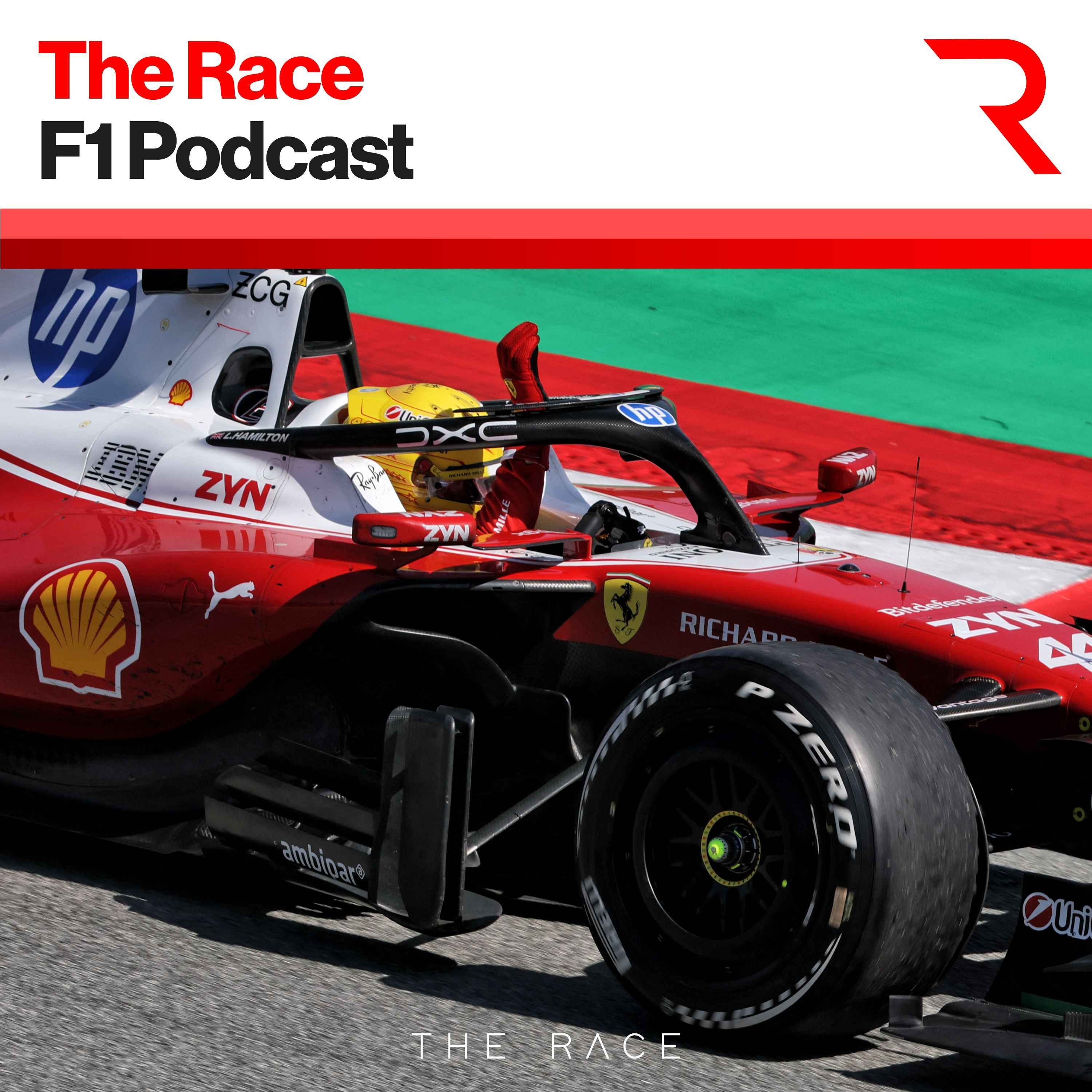
Lewis Hamilton is one of the most successful Formula 1 drivers ever. This episode segment is about how he went from a rough patch to getting back on top after joining Ferrari.
Qualifying is the session that decides where drivers start for the race. The hosts mention Hungary qualifying as one of the low points in Hamilton’s tough season.
“Lack of confidence” means the driver doesn’t feel fully sure the car will do what they expect. When that happens, they often drive more cautiously, even if they know they’re capable of more. In F1, that can quickly affect lap times and race decisions.
“Ground effect” means the car is designed to push itself down to the track using airflow under the floor. In modern F1, that downforce is a big deal, so the car can feel very different depending on how you drive it. If your driving habits don’t match the car, it can feel unstable or unpredictable.
“Muscle memory” here means the driver’s body has learned a set of habits for how to steer and apply the pedals. If the car behaves differently than before, those habits can make the car do the wrong thing. That can make the driver feel less confident until they adapt.
Engine braking is when you take your foot off the gas and the engine helps slow the car down. It can change how the car feels when you’re setting up for a turn. If a driver doesn’t like that feel, they’ll have a harder time driving the car the way they want.
“Rotation” is how the car turns into a corner—how quickly it pivots and points where you want. It depends on how the car is set up and how you brake and lift off the gas. If the driver and car aren’t working together, the turn-in feel can be off.
A “compliant car” is one that soaks up bumps and doesn’t get upset as easily. That makes it more forgiving when you brake hard or drive aggressively into a corner. If the car is more forgiving, the driver can push harder with less risk.
In F1, “regulation changes” are rule updates that can force teams to redesign the car. Those redesigns can make the car easier or harder to drive. If the new car is more forgiving, a driver who struggled before may suddenly feel more confident.
Term
very hard braking style
“Very hard braking” means braking as late and as strongly as possible. That can change how the car behaves as you turn in. If the car isn’t set up to handle that style, the driver may struggle to get the same results.
Person
Freddie Versailles
Freddie Versailles is mentioned as the person who made sure the requested updates actually happened. In F1, that usually means engineering changes based on what the driver says the car needs. The transcript doesn’t spell out his job title in this segment.
Daniel Ricciardo is a well-known Formula 1 race driver. Here, the hosts talk about him looking back on leaving F1 and being honest that he felt he’d lost some of his sharpness.
Fernando Alonso is another top Formula 1 driver. The hosts mention him alongside Hamilton to highlight how both can stay driven and keep improving even after many years in the sport.
In F1, “carbon” brakes are made from carbon-fiber material instead of steel. They can stop the car very hard, but they work best when they’re heated up properly, so track layout matters.
Corner entry is the moment you go from slowing down to actually turning into the corner. In racing, getting this right changes how stable the car feels and how well it turns.
This is when a driver starts slowing down before the turn and still brakes as they begin turning. It can help the car feel more balanced as it turns in.
Brembo is a well-known maker of high-performance brake systems. Here, they’re talking about how different brake setups can feel different to the driver and affect braking and corner entry.
This means how strongly the brakes can slow the car right away. Here, they’re saying one driver benefits from very forceful late braking rather than a more gradual brake feel.
This is about keeping the back of the car from getting loose or unpredictable when you brake hard. The right braking behavior helps the car stay stable instead of sliding around.
In F1, the tyres are what actually touch the track. Their grip and how they heat up determine how well the car can brake and turn, and they can change a lot from weekend to weekend.
“Braking demands” means how much the track makes the car slow down—how hard and how frequently it has to brake. More braking usually means more heat and stress on the brakes and front tyres.
The front axle is the part of the car that connects and supports the front wheels. When you brake, the car’s weight shifts forward, so the front wheels and brakes do a lot of the work.
Cooling capacity is how well the car can get rid of heat—here, mainly heat from the brakes. If the brakes can’t cool enough, they can start working less effectively.
“26 tires” means the tyre rules/spec for the 2026 F1 season. The key point is Leclerc felt they can feel like they’re either gripping well or not gripping at all, with less gradual change.
Here “digital” means the tyres feel like they switch between two states. Instead of gradually getting better or worse, grip can suddenly appear—or suddenly disappear.
Pirelli makes the tires used in Formula 1. Different tire characteristics can change how easily the car turns and how much traction you get in corners.
The ground effect era is when F1 cars get most of their downforce from the space under the car. Because that downforce depends on how close the car is to the track, the car can feel very different—and sometimes harder to drive—if the setup isn’t right.
Monaco is a Formula 1 race known for tight streets and slow corners. That kind of track makes tire grip and braking feel very different than on faster circuits.
Barcelona is another Formula 1 track used in the season. Comparing it to Monaco helps explain whether a driver’s problems are track-specific or more general.
“Brake later” means delaying braking until closer to the corner. In F1, that often indicates stronger braking confidence and/or better tire grip and thermal performance, allowing the car to carry more speed into the turn.
Shock absorbers are parts that help the car stay stable when the road gets bumpy. In racing, teams can change them to help the tires keep better contact with the track.
Radio calls are the live communications between the driver and the pit wall during a race. They’re used to relay information like tire wear, track conditions, and strategy changes, and they can strongly influence how quickly a team reacts.
In F1, strategy is the plan for how to manage the race—especially decisions like when to pit, which tires to use, and how to respond to changing conditions. The host’s point is that some drivers are more proactive about forcing or shaping those decisions.
A race engineer is the person on the team who talks to the driver during the race and helps decide what to do. They use information from the car to guide strategy and setup changes.
Charles Leclerc is one of Ferrari’s Formula 1 drivers. In this segment, the hosts are arguing about whether he’s good enough to consistently win a world championship, and they mention that he sometimes makes mistakes.
Term
Q3
Q3 is the last part of F1 qualifying. It’s where the quickest drivers set their final times to decide the very top of the starting grid.
George Russell is another Formula 1 driver mentioned as a comparison point. The hosts are basically saying: we want to see drivers proven in the hardest, world-championship-level situations.
Tire management is how you make your tires last and keep them working well during a race. If you push too hard too early, the tires wear out and the car gets slower.
It means pushing the car as hard as it can go without losing control. When the car isn’t perfect, that’s riskier—one small mistake can cause a spin or crash.
“Switch modes” means changing how you drive depending on the situation. Sometimes you drive to go as fast as possible, and other times you drive more carefully to protect tires and avoid mistakes.
“Fom” refers to the business side that helps run Formula 1. Here, they’re mentioned as the group that might be doing a computer-based calculation to rank drivers.
Term
fastest qualifier
A “fastest qualifier” is the driver who sets the quickest time in qualifying. Qualifying is the session that decides the starting order for the race.
Term
AI calculation
They’re talking about using computer intelligence (AI) to crunch racing stats. The idea is to turn opinions about “best driver” into a number.
Stewart refers to Jackie Stewart, a famous F1 champion who won the world title multiple times. The hosts mention him to illustrate how a driver’s success can span different teams.
Fangio was a legendary early Formula 1 driver who won multiple world titles. People bring him up because his success happened with more than one team, which makes him useful for comparing “driver vs team” arguments.
The World Championship is the official season title in F1. Drivers and teams earn points across races, and the totals decide who wins the championship.
A non-championship race is a race that follows F1-style rules, but it doesn’t count toward the official season title. Drivers can still win and gain prestige, but it won’t change the championship points.
Clark refers to Jim Clark, a legendary early F1 driver who won world championships. Here, he’s mentioned because of his connection to Lotus and the kind of races being discussed.
They’re talking about the “best ever” debate—whether you prefer someone who stays with one team and builds a legacy there, or someone who wins with multiple teams. It’s an analogy for how people judge F1 careers.
LIVE
The
Race is on!
And with a revitalised Lewis Hamilton still basking in the glory of his first Ferrari
Grand Prix win, how did he turn it all around so spectacularly after last year's struggles?
And what does it mean for his future, a nut of teammate, Charles Leclerc?
I'm Ed Straw, and joining me to explain how it all happened are Mark Hughes and Scott Mitchell Mow.
Well, Scott, the dust has settled on that Hamilton win, which was a huge story.
So let's get straight into it.
How do you see this new chapter in the Hamilton and Ferrari story playing out?
Has he conclusively proved the doubters wrong?
He's certainly proven himself wrong.
And I suspect quite a few doubters with it because Lewis has been quite honest
along the way, to be fair to him, that he has had plenty of doubts.
That goes back to his Mercedes struggles before the switch to Ferrari.
The kind of mounting sense of concern and a bit of misery as that
first Ferrari season went on.
I don't think he was lower than after Hungary qualifying last year.
Was that what he called himself absolutely useless?
Basically, yeah.
And so basically he said the team needs to consider replacing him.
Or words, words to that effect.
But he came close to reaching that basement a few times through the year
in terms of how he talks about himself.
And he admitted after Barcelona, didn't he, that there were moments,
he said in the press conference where he was thinking, or sheesh,
that they say that you, you know, everybody loses it eventually.
But like maybe he had that was his feeling.
And we know that Hamilton lives, lives very, very closely to his emotions.
So when it's good, it's great.
And when it's bad, it's a disaster.
And his career is, you know, circling the drain.
So it was probably never quite as bad as he made out.
And therefore, a lot of doubters wanted to make out as well.
Likewise, he's had a run of races now that are clearly the most convincing he
has had since joining Ferrari, arguably since losing the 2021 title to.
But the big question mark will always be, what kind of car will he have
between now and the end of the season?
What kind of emotional wave will he be riding?
Will it be a good one or a bad one?
Because I think that will dictate a lot of not only his own performances,
but his mindset and kind of how he goes about things.
And those two things are very, very closely linked for someone like Lewis.
Yeah, I think there's two components to that lack of confidence he was feeling
last year.
He was the fact that a, that generation of car that we've had since 2022,
the the the ground effect cars we had until the end of last year,
he just were unsuitable for the way he drives.
And there was no getting around that.
And his muscle memory was clearly not able to overcome to overcome that.
So that there was that.
But then as he transitioned to Ferrari, he found that they developed a car
which had systems that he absolutely hated.
So he's actually in a worse situation that he'd been in some ways than at Mercedes
because they developed a car around a lot of engine braking to get the rotation
in the car and he doesn't drive it like that.
He has he hates engine braking.
And so there was two components to it.
So, yeah, of course, he was under delivering in that situation.
He got to two fundamental pieces of the equation weren't there for him.
But then that will create doubts when when you're not doing the lap time,
you'll think, well, how much is that and how much is me?
And I think he's had.
A fortuitous change of regulation to a more compliant car
that's much more tolerant of his sort of very hard braking style
and is pushed for changes.
He was pushing for changes all through last year and Freddie Versailles delivered them.
And I think those things have come together and you just saw his confidence
sort of progressively increasing until I think it's probably Montreal
where it was really visible where, you know, between the walls.
And he thought, well, yeah, this this looks like something like Hamilton used to look.
And then it's followed up and then, you know, the Barcelona win was from the top draw.
So, yeah, I think it's I think there's every reason to believe
now he has those things in place that he can continue at this level.
Yeah, I don't think there was anything fundamentally wrong
with there being doubts over Hamilton and the Hamilton Ferrari thing.
I think the mistake was to have those doubts and mistake that for a conclusion,
which I think some people leapt towards.
And we know how complicated it is for anyone when they move teams.
You it's not the first year is a free hit, but you have to bear in mind
how dramatically different a car can be from one team to another
and how much you've got to get on top of and get in tune with.
The question for me was did have Hamilton still have the the determination
and the flexibility and all of those things to do all of that.
And he's answered those questions conclusively with what we've seen
because it's not just Barcelona.
It's been a really just impressive and more together
Hamilton across the board as he's got things the way he wants them.
Yeah, there's absolutely no doubt that this is a much better version of Hamilton
that we've seen pretty much at any point in the ground effect era.
There were moments and those those moments were were enough.
I think not necessarily in isolation, but in combination with the move to Ferrari
that just made you think the peak still there or if not, you know,
the let's say the 2020 peak or whatever,
a really, really, really high peak is still there.
But can it is that representative of what he can still be?
Or is that represent more represented, more representative?
Sorry, of what he was and can occasionally get to
but just kind of the the window is just a bit too narrow now.
So he kind of falls off either side of that of that narrow peak.
This is much this is a much broader peak now.
So we can we can say with a reasonable degree of confidence.
This is the level that Hamilton is performing out in 2026
rather than a perfect storm of factors.
One thing that I really liked about Barcelona,
and I wrote this after qualifying in particular,
is to come away from Canada and Monaco back to back,
second place finishes, strong drives there.
OK, circumstances may have helped the final result, whatever.
The main asterisk there, if there was one, is there's still outlier circuits.
There's still places where Hamilton has a really good record,
where certain things do kind of a line that can make a difference
in your your end result and how it looks.
There wasn't to take anything away from him.
It's just that thing of like you want the biggest sample set possible.
But after qualifying at Barcelona, when he's whatever it was,
what half attempt from from Paul on a circuit that tests not only the car,
but the job the driver does.
At that point, I was like, this is just his level.
This is just where he's at now, because this would have exposed it.
And obviously, we didn't see exactly what Charles Leclerc would have done in in Q3.
And if Leclerc had been on pole by a tenth and a half
and Hamilton's third two attempts to drift, you go, that's good,
but it's not great and it's not, you know, the Hamilton of old.
But it just it now means that moving forward for the rest of the season.
Oh, certainly for the next few races up to the summer break.
That's the standard that Hamilton will benchmark himself against
that Ferrari will expect and that we will expect to rather than just looking at it
and go, oh, isn't it nice to see Hamilton have a nice result from from time to time?
It's like, no, this is this is what he needs to be doing.
This is what he should be doing.
This is what he's capable of doing still.
Yeah, this is no Richard Petty kind of consolation, landmark win years
after he's he's been relevant, is it that this is contemporary reference?
Ed, exactly.
Look enough for those who aren't on board with NASCAR many decades ago.
But the thing I liked is that Barcelona drive
it had echoes of some of the Barcelona drives at the past, the 2020 victory there
when he was just driving so well.
And that's the thing that's good.
You could see a Hamilton that's kind of in that proper flow state in terms of just
the driving's coming naturally to him.
He can just put together this immaculate race performance.
It was the race performance that was particularly impressive, I would say, in Barcelona.
And that, to me, is what you mean when you say drivers at one with things
in good form, etc., etc.
There's no reason why that can't continue to be repeated,
especially given what we've seen overall this season.
So that's the most convincing element.
And that's the thing he needed to get back into that they were legitimate
questions about whether he did.
Now, we've had loads of questions from the race members club about the
Hamilton Ferrari Leclerc situation.
So in this episode, we're going to pick through a few of those as well.
And so I've got a portmanteau question from several people here,
which picks up on something you've already mentioned, which is the changes
Hamilton has made.
So Dory Nicholl says how much of Lewis Hamilton's uptick in performance
is is attributable to the structural and cultural changes
he's been pushing for within the team over the past year and a half.
Joe McKinnis asks what insight we have into the changes made that
Hamilton has been pushing and Kid Culture says, I've had many reports
that Ferrari has been resisting Hamilton's internal changes.
Are these true?
And if so, is it time they start embracing them?
So there's lots to unpick in that group of questions.
Where do you want to start?
I think rather than seeing it as it's sometimes portrayed as
Lewis Hamilton coming in with this superior knowledge of from superior teams
and saying, what a mess, right?
This needs sorting, this needs sorting, and this needs sorting.
I think it's more he's coming in, he's tried to car.
He says, I cannot drive this. This just this is hopeless.
I can't drive it in this way.
You've developed a car completely different from anything that I need to drive.
And the impact of on that and all the throughout the department,
throughout the whole company and all the different departments
and all the different engineering groups will be, you know,
if we're going to give him a car like he says that he needs that behaves
the way that we it's a completely different philosophy, everything,
the whole car, the aerodynamics of the car have been developed
around our previous philosophy.
We've got to buy in.
If we if we're going to take notice of Lewis, we've got to buy in
and it's a complete radical rethink on on everything.
And that's what Freddie Versailles has essentially done.
And he is pushed, you know, against against the grain quite in quite a few cases.
And you can imagine there would be resistance
because you've got engineers there who are saying,
why we take a notice of the slower driver, the faster drivers, this is good.
So, yeah, there'd be a natural reluctance there
that it would be Fred's job to galvanise everybody around what it is
that he's trying to do to give Lewis what it is he's asking for.
I don't think it's Lewis saying this is how you do it.
I think it's Lewis saying this is what I need.
And you're paying me all this money if you employed me
and you're putting one hand behind my back.
What's the point of that?
If you want to get full value from me and I and I'm going to get anything
from this partnership, this is what I need.
And it's your job to give me it.
And that's taken a no, it's taken a year to do that.
So, yeah, he's very definitely being part, a very important part of
giving them the car that we're there right now.
But, yeah, I don't think it's like this.
All seeing them super wise, sort of wizard guru
that it is sometimes portrayed as just pretty simple, really.
It's just saying this is I can deliver you much more lap time
if you give me what I need, but you haven't got it at the moment.
If it was as simple as basically mega intelligent, switched on driver,
comes to Ferrari with knowledge of a title winning championship.
Sebastian Vestal's sin at Ferrari would have gone a lot better than it did.
It's an institution and an organization that is inherently resistant
to change for starters, but also it's just more complicated than,
well, can we just replicate everything we were doing over there?
Like, I don't think really that's what the intelligent top drivers do for one thing.
But it is, as Mark says, it's about, you know, we're getting the best out of them.
And in a way, with what Ferrari's done with Hamilton eventually,
it's kind of the inverse of the usual phrase.
They've kind of, they've put their mouth where their money is.
Like they were, it's one thing to shell out all of the cash
because, you know, Ferrari can afford it.
Their partners would have facilitated it.
They've got all of these marketing benefits from having Lewis Hamilton on board the team.
Actually, paying someone an absolutely metric F ton of money
to come and drive for your F one team is the easy part of it.
But then actually doing the stuff that they want to do,
going out on a limb for that driver, especially when, as Mark pointed out,
it's not been the fastest driver.
So you're taking a punt, a sort of calculated punt on,
well, let's give him the benefit of the doubt
because we're already giving him the benefit of tens of millions.
But let's actually do some stuff differently.
Because that's really, really hard to do.
That's hard for any team to do, let alone a team that is steeped in certain ways of working.
And I appreciate that speaking in a generality.
And it might sound a bit stereotypical of, you know,
Ferrari slightly shambolic doesn't work the right way.
But it hasn't won in a meaningful way, i.e. a championship,
in a really, really long time for a reason.
So to finally start doing things a bit differently
and run the car differently, change configurations,
go away from long term partners, even if it's only a part move away.
That's that's a massive sort of it's a show of confidence in Hamilton.
But it's also it's also just a kind of a what's the best way of putting it,
aligning the sand almost of, well, we're going to,
we're going to do absolutely everything we can.
No excuses here.
Let's do it.
Let's just change what he says we need to change for him.
It doesn't necessarily mean that Ferrari is completely reinventing the wheel
with how it's operating as an F1 team.
But it's just doing that little bit more
that it would naturally be a bit resistant to do.
It's also a good element to feed into the whole Hamilton legacy element.
Because I think this has been overstated.
But people who want to kind of run down with us and say,
oh, we came into a McLaren that was very good,
and he went to a Mercedes that had already been built up
and gone through the difficult times and won.
So what's he doing in terms of team building, et cetera?
And it's fair to say that, for example, when he moved to Mercedes,
he didn't make the best impression on everyone initially.
It took him a little bit of time to understand how to interact
in the best way with the whole team, which he learned really, really well.
And then he was hugely effective.
But I think, Mark, to me, the fact Hamilton's been able to take a situation
where he was so down on himself and everything,
where there were definitely times where he would have just thought,
this is just not working.
What have I done? This is a mistake.
It would have been so easy to either just give up
and just bank another year or two, pay check, take the money,
say you've got a Ferrari driver where the cap isn't that nice.
But his willingness not to do that and having the ability
to articulate what he needed and make sure that the team knows what he wants
and took him seriously and implemented it, I think speaks very, very well of
qualities we knew were there, but that sometimes get,
I think, run down a little bit by people.
Yeah, that toughness, that mental toughness of the determination
was always there at the core, even when the confidence wasn't.
But I think he was thinking, I've got to, because of that drive and determination,
he was thinking, despite the lack of confidence,
I've got to give myself a chance here.
I've got to maximize my opportunity and then see where I'm at,
because where he was at in 25, it was so compromised by the car
and the era of regulation that it wasn't,
he knew that that wasn't a fair representation
and that he could do much better than that.
But how much better, that's where the confidence gap would be.
And I think he just, that determination to not just throw the towel in,
and because, I mean, he'd been there before,
he'd considered throwing the towel in at the end of 21,
after what happened in Abu Dhabi, but he still came back.
It's just that drive to keep on delivering and keep on challenging himself
that made him hang on really and made him,
that drove him to get those changes made in the team,
to see then where he was.
If he'd got all those changes and the regulation changes and everything like that,
and he was still three tenths off Charlotte Claire, two and a half tenths,
then I don't think you would have seen him hanging around for very long.
But this is different, this has given him that spark that was missing.
It must have come down to just wanting to make sure
that ultimately nothing was left on the table.
And then at the end of that, you go, no, I have lost it a little bit.
There's a podcast clip, I think, that I saw doing the rounds of Daniel Ricciardo,
basically reflecting on his own F1 exit and basically going,
actually, Rebel did me a favor, I lost it.
I didn't think I had, I really wanted to hang on and prove that I hadn't,
but I'd lost a bit.
I'd lost something, and he's comfortably admitting that now.
He's like, I can't do, Ricciardo is a really interesting one,
because I remember speaking to him about this in Singapore a few years ago.
He has a really interesting perspective on Hamilton,
which I need to dig those quotes out in full at some point,
and basically explains just why he's so impressed by a Hamilton and a Fernando Alonso,
just in terms of that not only ability to just keep grinding at that age and point in your career,
but just keep finding new motivations and finding ways to drive yourself on.
Now, that is something that has characterized the second half of Hamilton's career massively,
just this work ethic, this ability to just keep finding ways to come back and dominate,
even when Mercedes were winning.
He always found a way to move the bar enough to keep getting just that little bit better.
And then, yeah, there was a bit of a question mark when things weren't working out so well
after 2021, but you would still imagine that there's an underlying motivation there.
It's just how much of a knock did that take?
And I would love to know in his heart of hearts what percentage of confidence he actually had
that if he got what he needed to sort of paraphrase what Mark was saying,
he could do a better job because I don't think he was completely convinced by it.
And there were times last year where if he didn't say this verbatim, he basically admitted it.
He admitted that it was sort of as much hope rather than expectation that the change of
regs would fix things because he wasn't sure.
He kept having these little moments where he thought things were getting better in the
ground effect here and then it turns out they weren't.
And things just were so inconsistent that I truly believe there were points where he
doubted. I don't think it's lip service.
I think he did doubt whether he had lost it to some degree.
Even if it's not on my best day, I'm as good as I ever was.
It's just all those best days aren't coming around as much as they used to,
which is just the passage of time.
I wonder if as this season goes on, maybe if he renews and stays on for another year,
especially if, you know, let's say wins the world championship and you get one of those
really long champions interviews with him where Lewis is in full flow and opens up more.
I wonder if we'll find out exactly how close he was to calling time early and at what point,
at what percentage he was sort of thinking, no, 26, it'll be my year and how much of it was
I really hope that this works.
Yeah. And the opportunity and the option was there for him just to accept that it wasn't there.
So I like the fact that he's been willing to do that.
We should stress he's got one win and he's had a decent run of races at the start of the season.
There's still a long way to go before this is confirmed or Hamilton back to his best, etc.
But what we can definitely say is recently he has been certainly at least near his best,
which is very, very encouraging.
And let's see how it plays out over the balance of the season.
Hi, I'm Juliette from New York Times Games and I'm here talking to fans about our games.
So you play New York Times games?
Yes.
Do you have a favorite?
Connections.
It just scratches an itch in my brain.
It's really out of the box thinking of that game.
I play with my husband every night.
I refuse to let him play it without me.
I love that it's like a real life connection while you guys play connections.
Yes.
Very sweet.
I promise I didn't play that.
New York Times game subscribers get full access to all our games and features.
Subscribe now at nytimes.com slash games for a special offer.
Right, we're going to start talking a little bit more broadly about what's going on at Ferrari
now.
Mark, we'll start off with a question that comes from the Race Members Club from the Pinsky Duck,
who says, where is Lewis Hamilton finding this performance level over Charles Leclerc?
I think, first of all, we need to be a little bit careful about that he has got an ongoing
performance advantage over Charles Leclerc.
What's happened is that Charles had two races, Canada and Monaco, where he couldn't get the
brakes up to temperature.
Canada is very cold.
Monaco is very low energy and almost has a knee jerk reaction to that.
He said, right, okay, let's try Lewis's brakes and try carbon industry brakes,
which probably he didn't need to for Barcelona because it's a very high energy circuit.
It's not somewhere where you probably were going to have trouble getting the brakes up
to temperature.
So I think they have a very different approach to corner entry in the way that they get the
rotation on the car.
And I suspect that the Brembo's are probably more suitable for Charles in the way that he
overlaps cornering with earlier braking.
And you get that, that's where he's getting the rotation in the car.
Whereas Lewis is much straight line for longer, later and harder on the brakes.
And he feels he doesn't need that very graded feedback that you get from the Brembo's.
He doesn't need that.
He just needs the raw stopping power because he's breaking later and he gets the rotation
at that moment with that combination of the steering as he's coming off the brakes very,
very quickly.
And so all he needs is that the car does that brakes really hard and the rear doesn't become
unstable by the extreme sudden input.
So for him, the carbon industry is more suitable.
Now, what we haven't seen yet is both drivers happy with their setup and going at it to
see which is quicker.
And I suspect if we get that, we'll see the advantage swinging from one to the other
through the season.
It's being built into a narrative, but I think it's a false one.
But the way that we've seen that kind of swing so far does make me wonder if the circumstances
of, let's say 2026 as a whole, the way the cars work, the engines work, the tyres work,
the braking demands, especially the front axle, how much is actually kind of being put
through those brakes, how hard they're being worked.
What design choices may or may not have been made on the Ferrari side if they've been
conservative with their brake choices, which means that they're not wanting to make sure
there's been a bit more cooling capacity than is actually needed because the brakes are
being used less, whatever.
A Hamilton revival, a Leclerc struggle, whatever it ends up being specifically.
These little swings that we're seeing, I do wonder if there's a little bit of a chance
that basically what works for Hamilton and what works for Leclerc in terms of at their best,
they're just different enough.
And there's enough of these, like all these tiny variables or some of them, maybe not so
tiny sort of adding up that means one weekend, it will just sort of naturally kind of play
just a little bit more to one versus the other.
I'm struggling to see with the way that they've both been talking about how things have worked
or not worked the last few weekends.
I'm struggling to, in my mind's eye, imagine the set of circumstances that works for both
of them.
Like what's the sweet spot in terms of circuit layout, track temperatures, braking demands
or whatever, because when, especially because with one thing that Leclerc said to me, and
I'm going to go back to, I think we talked about this a little bit on the Monaco Post
Race podcast, but one thing that really stood out to me there was Leclerc in the middle of
that weekend had referred to the 26 tires as being digital.
They just sort of have grip or they don't, it's on or off.
And then in a completely separate answer on a different topic, not talking about Leclerc,
Andrea Stellar at McLaren talked about the way these tires just don't seem to transfer
grip from basically straight line to steering lock being applied into and then through the
corner.
There's something about these smaller Pirelli tires, maybe the way that they're being worked,
the load that's been put through them is lower as well because there's less downforce, just
means that there seems to be a little bit of trickiness in terms of getting that little
bit of grip out of the tire.
And I wonder there, if Leclerc needs, with the way that he drives, with that little bit
of overlap, the way that he works the car to rotate it, does he need a certain set of
circumstances to basically feel what he needs to feel through the front axle at low speed
in cooler conditions, like whatever it ends up being, because that's a danger of oversimplifying
this, that's not necessarily like a properly fundamental clash with these rules in the way
that we saw Hamilton or others struggle with the ground effect era, for example, but it's
specific enough, it's nuanced enough that it makes me think that if that's a trait or
an issue that he's dealing with, then depending on how much progress he can make within his
own style, how much does that just repeat through the year when you have those specific
circumstances?
And so a test of adaptability for Leclerc, but also to come back to the point Mark made
right at the start, I actually don't think Leclerc's underlying pace is a huge problem
in that Monaco, he could have been on pole in Monaco, even with those consistency problems
and the temperature problems of the brakes.
He was quick in Barcelona, he clearly was rattled by the fact that Hamilton was able
to brake later and carry more speed into turn four, made the mistake that we see drivers
sometimes do before of trying to match that rather than just doing what he could do.
So I don't think that Leclerc doesn't feel lost in the way that Hamilton did at times
last year.
Let's put it that way.
And of course, he isn't in the circumstances where he should be because he's been at Ferrari
for a long time.
So there's all sorts of other factors last year.
So I don't think it'd be wise to underestimate Leclerc, but Scott, there's a question from
G. Carroll, who says his Ferrari now Lewis Hamilton's team more so than Charlotte Clarke's.
Alex McLeady's asked if Hamilton has won the battle to become Ferrari's team leader,
and Manuel Adolfo Diaz-Veer asks if the Ferrari development path is slipping away from Leclerc's
hands.
I don't think so.
I mean, the fact that he's done another Ferrari contract that runs through to like 2045 or
whatever he's committed to this time.
And the fact that he's so loved by Viser, but also kind of just Ferrari in general.
I feel like it's just more, it's more that Ferrari's kind of, especially Viser, because
I have to give him a bit of credit for this specifically.
He's worked really hard to try and make sure that both drivers have what they want.
And like, whether it's sometimes I don't know whether Leclerc's got more loyalty and
faith in thread thread or more loyalty and faith in Ferrari.
But there's definitely an element.
I am so convinced that Leclerc either wouldn't be at Ferrari now if Viser wasn't the team
boss or would be on his way out soon-ish if Fred wasn't the team boss.
I mean, look at, I don't really, I still don't really know exactly what played out there,
but like that relationship clearly barely survived Matteo Bernotto being in charge because Bernotto
seemed to gravitate more towards like a Carlos Sainz type and the way that he worked and
sort of what he brought to the table.
Viser's just, and he's always been credited for this.
And I think it's something that is very easily underestimated because it's a damn hard thing
to do, much less visualise if you haven't experienced it.
Viser's clearly really good at making both drivers feel the love and feel the faith in
the project and like the project has faith in them too.
So I just don't, I don't, I don't see why Ferrari would move away because even if there
is any belief that in the short term, and I'm not disparaging Hamilton when I say this,
but just if there is any belief in the short term that Hamilton's the best bet, you remember
when Bernotto would refer to Sebastian Vettel as Ferrari's North Star for the championship
when Leclerc first joined there.
If they think that that's Hamilton for now, they're not going to sign Leclerc on a long
term deal and then do a bunch of damage in the next 12, 15 months to make sure that Hamilton's
got everything he needs and take it away from Leclerc.
I mean, where it will be a test of Ferrari's capacity is can it kind of navigate this kind
of really tight path between what both want, whether that's technically, operationally,
whatever.
So that's why I say like, if it'd be interesting to see if they can get both on a relatively
even kill through a weekend and through a run of weekends, rather than have these sort
of like little or medium swings where one driver just has the edge here and there.
It does present an interesting challenge for Leclerc, though, I think it's fair to say
in terms of his ability to, to impose himself in the way that he wants to.
You can hear him sometimes in race.
He tries to do it, doesn't he, in the radio communications and that kind of thing.
But you get him pushing on improving radio communications, and it never seems to change.
You compare that with what you see with Hamilton, with Carlos Santy, who's his basically his
temporary race engineer officially, but that seems increasingly likely to to endure.
That's the thing that you have to wonder about with Leclerc.
You know, he's not an idiot or anything.
He's not technically illiterate and all those kind of things.
But there's a, there's a question mark, a question being posed to him now about, right,
well, Hamilton's done this.
What exactly do you want?
Is it, you don't just want to go, oh, well, he's using those brakes.
I want to jump and try and use them.
OK, that's fine.
But actually, what do you want?
What do you need?
And can you lean on the likes of a certain make sure that you've got that?
Yeah, there's a danger that he's seen as too passive.
When, you know, off the back of Hamilton, having succeeded in making all these changes,
which have helped him.
I think Charles, you can't be, you can't be who you're not.
And I think it's really down to Freddie to understand, and I think he does think he
understands both personalities very well, to understand what it is that
Charles needs and then to make sure he gets it at the moment.
They have a that the focus has been on making this a quick car.
It's the that it's got the nice little uptick at the end of that for Hamilton in
that it's it's also a car that can be balanced in the way he likes to drive it.
So those few little refinements on top of a basically quick car
and increasingly quick car, it seems, or what Leclerc needs.
And so I think there's a danger that the the narrative is that
Hamilton pushing for these changes is what's made this car quick.
It's not this car would have been quick, regardless.
It's it's the type of car that they've created that is competitive.
And on Lewis's side of the garage, he's had he's had the changes made
that enable them to fully exploit it.
Leclerc needs to just dig down into his own strengths.
And there there are things that he can do with a car that Lewis can't and vice versa.
And so it's just a case of really not not being phased by the little blip
in the in the way that these the stories unfolded and not let that affect his confidence.
But I think Freddie can play a part in that as well.
I think there'll be an element with Leclerc of just getting to a point where he
just just gets on top of things just by sheer pace, just beat Hamilton by having a level
of pace that Hamilton just generally over a long enough run of races just can't quite match
because Leclerc is just, you know, he's he's so fast.
And when I say that, you know, it's not just a one lap thing.
You know, he's such a strong Grand Prix driver.
But I do just think and I don't say this critically because it could be misconstrued.
I just think he may be a bit just too straightforward.
He I do feel that there's an element they're like, I can't I do not see how Leclerc
can really bring himself to be like a political operator.
I don't really see him be I'm not not to say that he's, you know, completely lax behind
the scenes or anything like that.
But, you know, Hamilton described himself.
Didn't he when he was talking about, you know, what how the headache he gave Fred last year
where he came in, I just thought he said he's so like Hamilton's so intense and repetitive and
just in just incessant and relentless in the way that he goes about things.
He's an irritant.
Max Verstappen is an irritant in terms of the way that he want, you know, he just pushes pushes
and he won't say there's a story from like Verstappen with like the GT3 stuff where I
don't know if this is true, but I I'm just going to say it because I can just well believe it.
It fits the Verstappen psychology so much where apparently he sourced different shock absorbers
or something and just turned up to a test and said I want to try these because I think they'll
make it better.
I think I say that story because I can 100% believe Verstappen doing something like that,
just going that like extra little bit to try and sort of force something through.
And the way Ed, you described like what Leclerc does with the radio calls and things like this,
we've seen it in a different form, haven't we, with the way that he ends up being,
I think Mark used the word passive as well, but like passive in race in terms of like,
you know, when there's a decision to be made about changing conditions or strategy or something
like this, how many times did we talk in his time as a teammate to Carlos Sainz that Sainz
would basically race engineer himself during Grand Prix because he just go no, no, I know
what we need to do here. Let's do this. He won at Silverstone basically by doing that,
didn't he Sainz in a race that easily could have been a Leclerc win if the situation had
been different. It feels a little bit like that this is probably going to sound a bit too harsh,
but it feels like Leclerc is happy, I'm not sure, but happy to kind of like, there's a certain
amount of stuff here that I just want and need to trust the team to do. And I don't know if he
has quite worked out really how to impose himself enough to sort of just force through changes or
whatever it ends up being, which just means when there are moments where the narrative is,
or Hamilton's doing this, Hamilton's doing that, Hamilton's changed this, maybe Leclerc can go
along for the ride like a little bit, but that doesn't change the fact that if he gets what he
needs and Ferrari's capable of doing that and Leclerc is capable of working stuff out because
he's a fantastically adaptable driver as well, he will just, because this is what he's done up
until now, he will just often rely on ability because the level of ability is ridiculously high
and that will overcome most of, maybe even all of what I was just talking about.
So question now from Zach Duran, I'll take asking, is it time to start questioning if
Leclerc is a top driver? Too many excuses get thrown out for him over the years and years of
throwing away potential results. For years, he was commended for out driving the Ferrari
and now he overdrives at every possible opportunity. I think that's slightly reductive.
Leclerc does have a mistake in him. The Spain era, there was no excuse for that and obviously made
the era at the end of Q3 in Monaco, so he was over driving a little bit, but we're only in
quite a small one of races. So the first three events this year, he was pretty strong, was he?
He didn't start the season badly and he's done 160 odd Grand Prix weekends for Ferrari,
for Ferrari and the vast majority of them have been very good. So I think there's a question mark
in terms of whether, if you mean top driver in terms of can he win a world championship,
our multiple world championships, get into that absolute gold standard. He still hasn't
proven that and you want to see, you always want to see drivers tested in that scenario. That's
what we're seeing with George Russell. Now, but Leclerc has been very, very good. They've been
the occasional spell. Remember that spell in the middle of 2024? I think it was 24 when Sainte's
got on top of him for about three or four weekends. And then suddenly he says, oh, and then Leclerc
comes back and that's what we see all the time. And you must always be wary about looking at
too narrow a window. There's certainly questions being asked. He does have a mistake in him probably
more than any of the other top guys in F1 at the moment. But he's not chucked it at the scenery
20 times in the last 40 events, has he? That's not what's happening. Questions to answer, but
he is arguably the fastest driver over a single lap in Formula One. He produces very quick race
stints. His tire management has evolved very, very well. He does a lot of things exceedingly,
exceedingly well. And he's been consistently in our sort of top 34 in the top tens we do
at the end of the season. I think he was third last year in our collective top 10. So he's
properly good. It's just a question of that last little fraction of a percent that he hasn't had
a chance to fully answer yet. I think also when you have a history of trying to make up the deficit
of a car that's not quite the best car and you can sometimes drag results out of it that it
doesn't deserve, you are by definition driving more on the edge. So by definition, you will have
more errors. And I think it's absolutely nonsense to say that that's a trait that, you know, that
he's, there's an error prone driver. He's not, he's a driver that has spent years pulling results
out of a car that's not, that didn't quite deserve. And that ability to drive it on the edge is what's
enable them to do that, but that will sometimes bite you. And I think that's, I don't think that's
deserve criticism. It's just an approach. But it is a question in so far as can he switch modes
when the opportunity presents itself? Let's say that the Ferrari now is there for the duration
this year, which that's doing a lot of heavy lifting, but just hypothetically, let's say the
Ferrari is always going to be there about for the rest of the season. And you don't need to go there
in order to drag something out of it. Can Leclerc switch that mode and relentlessly deliver? I think
he probably can. But I think that's where there is a legitimate question mark. But yeah, circumstances
play a big part in it and what you're trying to achieve. And he's carried Ferrari on his back
for half a decade. I mean, the thing that always follows him around is that spin and crash in
France in 22, which was when that championship situation was already slipping away from him.
And there was no title fight to be had that season. You know, hindsight proves that, but
it was already in that moment, going away from him. But that's the thing that always I see it a
lot on social media. Like that's the thing that sort of like, you know, that this, you know,
this is the driver they say should, you know, would would be amazing if he gets a championship
fight. This is the driver they say is unfair has never had a chance to look what he did the last
time he was in the championship battle. And remember that France case? Yes, he was leading
by a big margin, but Verstappen had already stopped. So Leclerc wasn't leading. It was a mistake he
shouldn't have made. Certainly he was overreaching. So yeah, criticised the mistake, but it's been
almost recast as he was cruising into the distance and he shunted no, he was on deep into a stint
trying to win that race. And yeah, made the mistake. He overstepped them up, but wasn't that the season
like a race later or two races later Verstappen spun, got away with it, but lost the lead in
Hungary. It was Budapest wasn't it coming out the penultimate quarter did a 360 he spun and won
because he ended up winning anyway. But he looked like that that has to happen. That's a mistake.
He spun in a Grand Prix from and that situation he was it was he was in a comfortable position
and in control. It happened in a sit in a place where he got away with it. And Verstappen did
once tell me actually in Hungary, ironically, about four years before that, that the best drivers
do spin better than the worst drivers, like they do fight, just control it slightly
better. So you could argue that maybe Leclerc is just not quite as good as crashing at crashing as
Verstappen as well. He was going a lot quicker when he made his mistake before a car there,
wasn't he? Yeah, no, but that's what I mean. But like, that it's still a mistake is a mistake.
Like Verstappen could have done that in one of the high speed corners in Hungary. Like,
he could have made a mistake. It's just this notion that you can just check
when a driver does so much and has such a massive catalog of races and opportunities and
highs and lows, you can cherry pick any moment from their career and say this stands for this,
which is just silly. The main thing for Leclerc is I think in every single Ferrari season,
he's got more podiums in that season than his Ferrari teammate, which means if you just take
it on just the most really basic metric like that, an argument I would make is over the course
of a season, Leclerc will bring you more highs driving his way than others will bring him.
He's got like a one in three podium rate for Ferrari. And I think the only driver on the
grid who comes close to that is like Max has got like some ludicrous like one in two rate
partly helped by those Red Bull seasons where he basically had a 100% podium record. But that's
just an absurdly high standard. Leclerc's main problem. And this goes above any criticism of
him as a driver of which there are legitimate areas where you can say, is this good enough,
does this need to be better? Leclerc's main limitation is he's had a car for the vast majority
of his career that's good enough to snipe for seconds and thirds, not win consistently.
Yeah, and I think if to get the crystal ball out, we get to the end of the season, I suspect when
we look back on what's happens at Ferrari, we will say, yeah, Leclerc did have that wobbly spell
where he made some mistakes, but look where he then got back to. And that's what I'd expect to
happen. If he doesn't do that, then that tells us something about him. So there's still a few
questions to be answered. But I don't think that what we've seen over three or four weekends
makes us question what we've seen over 150 previous weekends or anything. So yeah, let's
see how this plays out over a bigger sample set. A quick reminder, the questions that we're tackling
in this podcast and other podcasts do come from the Race Members Club. If you're interested in
finding out more about that, hit the link in the episode description or head to Patreon
and search for the race. Loads of extra content we do. You can ask questions or thrive in community,
book club podcasts, we do ad free videos, all sorts of things, lots going on there. So check
that out if that sounds of interest to you. Let's move on now to looking slightly more broadly
at the Ferrari situation mark because although we've mentioned him a few times in this podcast,
there hasn't been so much wider discussion about what this win means for the whole Fred
Versailles project. Remember last year, those rumors about him being potentially ousted and
Ferrari disappointment, where's it going, et cetera, et cetera. And we saw this interesting
trajectory this season that initially it was like, well, they haven't completely tanked it,
so they got something to work from. And then you start thinking, oh, they're going backwards a bit,
are they going to vanish? Then bang, race winning again. So it's been a roller coaster for Versailles.
But where do you think we are now with that whole project and what he's trying to do with the team?
Well, it's a notoriously politically volatile place, isn't it? And the team principal is always under
enormous and ridiculous pressure, really. And it's something fundamentally flawed about the
structure at the top of the team that the team principal is always under this amount of pressure.
And it was quite feasible, say a year ago, that Versailles wouldn't be retained. And we're hearing
rumors that it might have been the WEC team boss Colletta. Certainly Christian Horner was
approached. So it wasn't that they've stuck by him and been had 100% faith in him. It's almost
like there was no ready-made solution that wanted to come. So he was given an extension,
a period of grace, and that's enabled him to do what he's just done. And the whole
given Hamilton what he needs was very, very much part of that campaign of his to give
what he thinks the team needs. And so he's cleared that hurdle and he's just proved a point.
But I don't think that structurally, the lesson will have been learned. I think
upper management will still be applying ridiculous pressure on him. And even though he's
just achieved what he has so far.
Yeah, well, he's still going to be the team boss of Ferrari, isn't he? He can't escape that
reality. I do wonder, this is sort of an open question to each of you. How much jerk in his
fate is intrinsically tied to the drivers and sort of what they do and the choices they make?
Because last year, I think the massive, massive pressure that Ferrari would have felt to some
degree is that, yes, the Hamilton move wasn't quite working out. And in the first half of the
year, it was already starting to have, you know, his iffy moments. But Hamilton had just joined
and made it really clear that one of the reasons he joined was Fred, basically. So if that ousted
him, you know, you're immediately at loggerheads with your new star signing. Fast forward 12 months,
Hamilton is now performing very well. That has to reflect well on Fred. But also LeClaire has
just done this new contract. And as I said earlier, I do question whether or not LeClaire's
faith is in Ferrari or whether it's in Fred. And that did feel a little bit like
this gets Fred on slightly sort of firmer ground. Like what, how much like,
it's a slightly different manifestation of driver power potentially. Normally,
his drivers forcing team bosses out. But I do wonder, I don't know if you agree,
whether or not there's an element there of the drivers helping keep Fred in his job.
Yeah, I think there might be something in that, but not just through friendship,
through, through faith, through faith in his ability and his faith, their faith in what he,
what he brings. I'm not just for selfish reasons, but for what he brings to the team that's going
to give them a competitive car. Yeah, I think there's definitely something in that in both
Hamilton and LeClaire's case. Every time, if you read between the lines of what both LeClaire
and Hamilton say about Fred Versailles, particularly when there were the rumors about him being
replaced last year, has basically said, well, if you get rid of him, we're off.
So that's a really strong triumph for it to have. And they've got faith in him for a reason. It's not
because he is just completely driver focused and lets them do whatever they want. It's because they
know he is the person of, you asked, you asked a little clerk, for example, about what Versailles
brought to the team. And he says he's brought a great clarity of what they're trying to achieve,
good, clear direction. And that's the first thing you need because it's so easy for politics and
to rise up that kind of thing. If the leadership doesn't give clear direction on what they're
trying to do, clear decision making, and imposes that proper culture. So that's what they also
see Versailles doing. And I think I am more confident that Ferrari will get somewhere with
Versailles there. And look at what we've seen in terms of the big upgrade package they had in
Spain. That's worked really well. That's been a pretty significant downforce game. There's been
coverage about what they've done with the wheel rims as well in terms of the tire temperature
management. So pushing in all areas, Versailles talked about the desire to make the team a bit
more innovative and not make, because there's always been this thing with Ferrari or at times
there's been this thing that they're almost afraid to do right for fear of doing wrong,
in that it's easy to go conservative. So at least if you're underachieving,
you've not done anything spectacularly wrong. But if you shoot for the stars, which you have to do
in Formula One, and it goes wrong, and you say, well, why have you done that mad thing? That's
gone wrong. Idiot. If you've got to let people get it wrong, because you can only get it right
to the absolute nth degree if you take an element of calculated risk. So that's what
Versailles I think is important for. To get that win will just ease some of that pressure.
There's still lots of pressure there, but it's a really important settling,
calming moment. Right, a few more questions that are in this general Ferrari area. Scott,
one from George. If Lewis Hamilton pushes the Mercedes this year, or even wins the championship,
can we close the book on the goat debate? The goat debate is great. It's a good name for a
band, isn't it? That debate will never end, and rightly so, because debate and who
prefers whom and what different people put above something else in terms of how they rank
sports people in whatever field is, I think, just one of the best things about sport. It is
amazing. The way I'll answer this question is, I don't think that needs to happen in this case,
because the way that I view this debate is actually, I remember seeing it in an American
context several years ago, it was an NBA tier list, and the way that their argument was that
rather than it be like a numbered list, we will rank the F1 drivers from best to worst,
and you're like, who's number one, and is Lewis number one, or where is he in that list?
This pyramid ranking almost effectively just tears it. Obviously, you can get very generous and try
and put 20 drivers in your top tier if you wanted to be a massive cop out, but I just think you
can have a cluster, because I think it's also, it's not just difficult. For me, the way that I
view it, it's impossible to compare across eras, so I don't really care about doing that. It's more
about judgment within that space, and Hamilton's in that top tier. He is one of the 56
probably best drivers ever, regardless of what metric, and I do think the Ferrari move has only
enhanced his legacy. It can't be considered a failure now, because he has ended on, at the very
least, as strong a footing as his final Mercedes chapter, because he's now won a race, but this
is a way more satisfying end to his career than the Mercedes one. It's an uptick. It means that
there's a great post script, effectively, to what looked like the end of his career. It got a great
final chapter regardless of what happens from here. Yeah, there's a distinction which should be made
between the greatest career and the greatest driver. They're not the same things, and I think
that's where the debate diverges, because let's say you had this super driver, there's a mixture of
all the best talents that have ever been, a mixture of Hamilton, Verstappen, Senna, Fangio, Jim
Clarke, and he arrives, and he gets to Formula 1, and he takes mediocre cars and sets pole positions
and wins every single race. It's no question he's the greatest driver there's ever been,
and then he retires, but he's only got one world championship. So he's not the greatest driver,
because this guy's got seven, or this guy's got five. It's just nonsense. It's about
what level do they reach, and yes, Hamilton is definitely in a contention in the conversation
for who is the greatest driver that there's been, but he's definitely the driver with the greatest
career. There's no question about that, but that's not the same thing as easy greatest driver, so
no, I don't think that conversation is ever going to be answered. Well, you can't answer it objectively,
not through bias or anything, but just there is no objective measure for that. There is a statistical
measure. I sometimes refer to Hamilton as statistically the greatest driver, and I always get
abused for it. So you're just trying to minimize it. It's like, well, no, I'm just trying to take
the one thing you can say that is factual. This is quantifiable. It's quantifiable. He's got the
most wins, the most poles, and the equal most championship. So statistically, that is the
greatest world championship Formula 1 driver. You want to call it that? The mistake you've made
there, unfortunately, Ed, is you have now tempted Fom into getting yet another partner on board to
do some kind of AI calculation that will, a bit like when we had that infamous fastest qualifier
one. And who was it? Was it like Covaliner and ended up like really high? Yeah, because Covaliner
did outqualified truly at catering and truly it outqualified like lots of other people beforehand,
just absolute nonsense. And there was another one before that that put Mark Sewer above Stirling
Moss, you know, so just forget it. Did Ed do that ranking? He can't do it. The whole point of the
the greatest debates is it's not the end, not the outcome, but it's actually the process because it
is interesting. I mean, you said you can't compare drivers across areas. And you are right in one
way. But I also think it's interesting to do it because you can look at it in the context of how
they perform against peers, what the prevailing environment they're in. And an important thing
for me is also how they drive on the game, how they raise the bar for what's possible and all
these things. So that's the kind of purpose of the goat arguments. I think the one thing you
can say with Hamilton is he certainly right up there, whether he's first or sixth or eighth or
whatever, that will vary from person to person. And to be honest, if I did an F1 top 10 drivers
every day for the next month, that it would move pretty much every single day, because that's just
the nature of the thing. You're trying to compare like the tiny percentage you have absolutely
defined what's Grand Prix racing is. But certainly, it is correct to say that getting the win at Ferrari
has had an impact on how he'll be seeing. This isn't just a failure epilogue, which there was a
risk last year of it looking like. Right, Mark, question from Adam Barton. Lewis Hamilton has
now won with three different teams. By my count, only Fernando Alonso, three, and Sergio Perez,
two have also won races with multiple teams of the active drivers. Is this something F1 should
be concerned about? I don't think so. I think that's just the way that the Formula 1 has always
been structured, and I don't think there's anything wrong with that. You have to, as a driver,
make yourself attractive enough by performance to get into one of the top seats, and then you get
into the top seats, and you compete against the other drivers in the top seats, and you go at it.
By definition, the competitive cycles are so long that if you get into one of those top seats
and you perform, there's no particular reason to leave after a couple of years, so you will tend
to spend, once you get into a top seat, you will tend to spend most of your career in that team.
So I don't think there's anything particularly wrong with that. It's just how the sport has
evolved, really. But yeah, I mean, Fangio won it with four teams, didn't he? Stewart with three.
Oh, there's a kind of worms there. I'd argue Stewart won it with won the World Championship,
and won his races with one team, but he won World Championships with, he won races with
three constructors. Yes, that's what I'm saying, races, that's what the questions are defined.
Races with four constructors, in fact. Yeah, yeah, yeah.
They are him as well, but the point being that Tyrell, Matra, March, all the same thing, but
anyway. Yeah, you won a non-championship race with the work lotus as well, of course.
Yeah, in place of Clark. Was that the Rand Grand Prix?
Yes. So, you know, yeah, I don't think there's anything particularly wrong with that. I don't
think it's a concern, and I don't think it should be a concern.
Yeah, and it's, I think you'd ideally want more teams in a position to win, but I do think F1
is kind of working on that with Costcap and all these things. But I've always said that will
take a very long time to play out. But yeah, I don't think it really matters, it doesn't matter
that Ayrton Center only won championships for one team, does it? Or Jim Clarke.
That's just the way it is. I think... It also enhances things. Because it forges these unions
in your mind between driver and team. That's part of it as well. You see, in other sports that
involve team participation, lots of people often will have a similar kind of debate to this in
football, won't they? Would you rather be a one club player who breaks loads and loads of records
for the club, but maybe doesn't have the kind of personal glory or ultimate career trophy success
that you'd like to have, because ultimately you were limited by that specific team's fortunes?
Or do you want to be more of a journeyman, goes around multiple clubs, has loads and loads of
success in different places, but you're kind of attached to lots and lots of successful
projects and you don't really carve out that special place in any one location.
It's a little bit like what we were saying with the goat debate, that that's part of the conversation,
isn't it? It's like, what do you prefer? What do you want from your, in your mind's eye, when you
imagine your mega driver? Are they attached to a team or is it solely the driver? Iconic
partnerships are part of the fabric of F1. I love that side of it. And a question now from
Superhands, who says, is having victories 19 years apart, one of the all-time great
achievements in F1 for Lewis Hamilton, what other sporting achievements related to longevity
compare? Well, I think you definitely say it's a remarkable one in terms of Formula One, isn't it?
That's tremendous longevity and he's been a top driver throughout that span.
It's obviously difficult to compare because there's different types of sports, aren't there?
There are people who've gone on longer, but there's different physicalities involved, aren't there?
So I think you definitely say that when he won with Ferrari, it did feel like a kind of longevity
milestone in so far as it had felt like almost those days might have gone and then they come
back. So one that leapt to mind was when Tiger Woods won the Masters, which is what in 2019,
wasn't it? And he'd not won a major for a long time and suddenly there he was and then he won
tournaments over slightly more than 19 years as well. And you've got people like Martin and
Avratl over who was winning Grand Slam titles, if you include doubles over not far off 30 years.
You've got Snooker, the famous class of 92, Ronnie O'Sullivan, Mark Williams and John Higgins over
three decades, George Foreman, Nick Skelton. So many people in sports, but I think it is
remarkable longevity in what you might call a kind of outright physical sport. That's perhaps not
the outright physical sport, isn't quite the way to put it. But you know what I mean? Well,
you've got other, he's got contemporaries. The one that I, when I saw this question was on
your running order, like the person that came jumped to mind of me was LeBron James,
who I think it's now 23 consecutive seasons at the top of the NBA. I think it's every season,
he's averaged more than 10 points a season. And I think there's like this one specific statistic
within it. I'm probably going to get this wrong. Someone can correct me, but I think it's like
of his 23 seasons or whatever he's done, he's got like, he's averaged more than 20 points a game
in 20 of them or something, which is basically more, there's only like 10 other players who have
had like half that number or something like that. Do you know what I mean? So like the back end of
his career basically is he's put in numbers up that he was doing when he was a phenomenon at the
start of his career. And the Williams sisters in tennis is a fascinating story as well,
especially when there's a comeback element to it. And Hamilton obviously hasn't gone away
in comeback, but in terms of that kind of, is he right at the absolute apex of everything in terms
of his preparation, quality and what has he gone through the ringer? Yes, he has. And he's come
back from that, that you know, there is that, you know, there's, there's something's been overcome
as well, which feeds into it. I think you shout out a course to Mario Andretti, which if you
compare his indie car career and you look at his indie car career in his F1 career,
all is one thing. He was winning races and championships in the old certainly races in the
60s, 70s, 80s and 90s. So, you know, I think that's pretty extraordinary as well. Yeah,
definitely, definitely. And these stories are always remarkable. And they're very often the
longevity, that longevity compared combined with excellence is remarkable, isn't it? And you get
it in cricket with people like Sachin Tendulkar, for example, who went on for 2021 odd years.
Jimmy Anderson, the England bowler who's got the most test tickets, Ringland,
you know, a remarkable performer. So the it's one of the reasons why the Hamilton win was,
was so celebrated, I think in many ways, because it is a longevity achievement. And
just to kind of come back to saying to be able to operate at that level for so long,
not only in terms of the fact you've got to compete with so many different people in so many
different circumstances and probably no sport fluctuates in terms of its prevailing conditions
more than more than motorsport in terms of the cars and that kind of thing. And obviously,
technology moves so quickly, technology moves in all sports, but to be able to operate at that
high level for so long. And actually, just the sheer determination needed to do it,
particularly for those, you know, Hamilton doesn't need to be racing in Formula One,
does he? He's earned all the money he needs to, he's got all sorts of other things going on.
You've still got to have that drive and determination, not just to turn around a
situation like Ferrari, but to put the training in every day, which gets old very,
very quickly. And obviously, the older you get, sometimes the more you have to do in order to
do that. So all of those things, and regardless of who's done what in what sports, just anyone
who's at the upper end in terms of excellence at the high level, it takes so much to do that. So
yeah, it tells you some of the names we've mentioned there tells you the kind of
strata that Lewis Hamilton is operating in. And this is kind of a reminder of his global
megastar status, which never never vanished during his Ferrari days. But it's always more,
it's always good for that to be backed up by results as well, isn't it? Results
in the now. So yeah, doubtless, there's going to be more of those for Lewis Hamilton this year.
He certainly doesn't want it to be his only Ferrari win. Right, to finish off, Scott, have
you got anything to say? Yeah, just to let any listeners or members know who may notice my
absence in the next few months, that I won't be appearing on the F1 podcast over the summer or
doing videos or web content as I'm going on an extended period of paternity leave,
just over the next couple of months, I'll be back in September. It's just my turn to spend a bit
of time at home looking after my kids, my daughter was born last September. So we've got two under
three at the moment. And it's my wife's turn to put work first, put herself first and sort of get
back at it. So yeah, I will I will be back is not the end for me. It's just it's a it's a little bit
of a break for lack of a better word because I'm not underestimating what it'll be like with the
two of them. But looking forward to that, I can't claim to have Lewis Hamilton's longevity and
commitment to the cause, but I will be back. I may pop up in a couple of bits of members club
content in the interim, that will just be stuff that we've recorded either before now or just
between now and me leaving in the next couple of days as I sit here and record this, because
they're timeless. And we've got a couple of plans in mind for like the summer break, for example,
some fun things we want to do for the members club. So if I if I appear there, I haven't
suddenly returned, it's just me having recorded it previously, but I will be back properly in
September. I'm not going anywhere in the long term. You see, now you just left yourself open to
constant requests now if we've got podcasts and we can't quite get everyone aligned at the same
time, which is always a challenge. But certainly enjoy what you're doing, Scott. And we look forward
to having you back on a podcast a few months down the line. But thanks for today, Mark and Scott.
Stay with us for everything you need to know from the world of Formula One.
The Athletic
About this episode
Lewis Hamilton’s turnaround is framed as a chain reaction: early struggles at Mercedes and a difficult Ferrari start gave way to a revitalised peak, helped by regulation and car changes that better tolerated his very hard braking style. The hosts argue it’s not just driver talent—team-wide engineering philosophy, communication, and persistence mattered, with Ferrari’s organization and upgrades playing a role. Barcelona is used as a benchmark, where Hamilton looked like he was in a natural flow state.
With a revitalised Lewis Hamilton still basking in the glory of his first Ferrari grand prix win, we explain how the Briton has been able to turn his fortunes around so spectacularly after last year’s struggles.
Edd Straw is joined by Mark Hughes and Scott Mitchell-Malm for an in-depth look at the seven-time world champion, and the changes that have been made off-track and on to enable him to re-find his form.
Edd, Mark and Scott also speculate what the recent success means for Hamilton's future, and look at the reasons why the 41-year-old's revitalised form has coincided with a slight dip for his team-mate Charles Leclerc.
Get bonus F1 podcasts, extra content and ad-free listening, sign-up to The Race Members' Club on Patreon today.