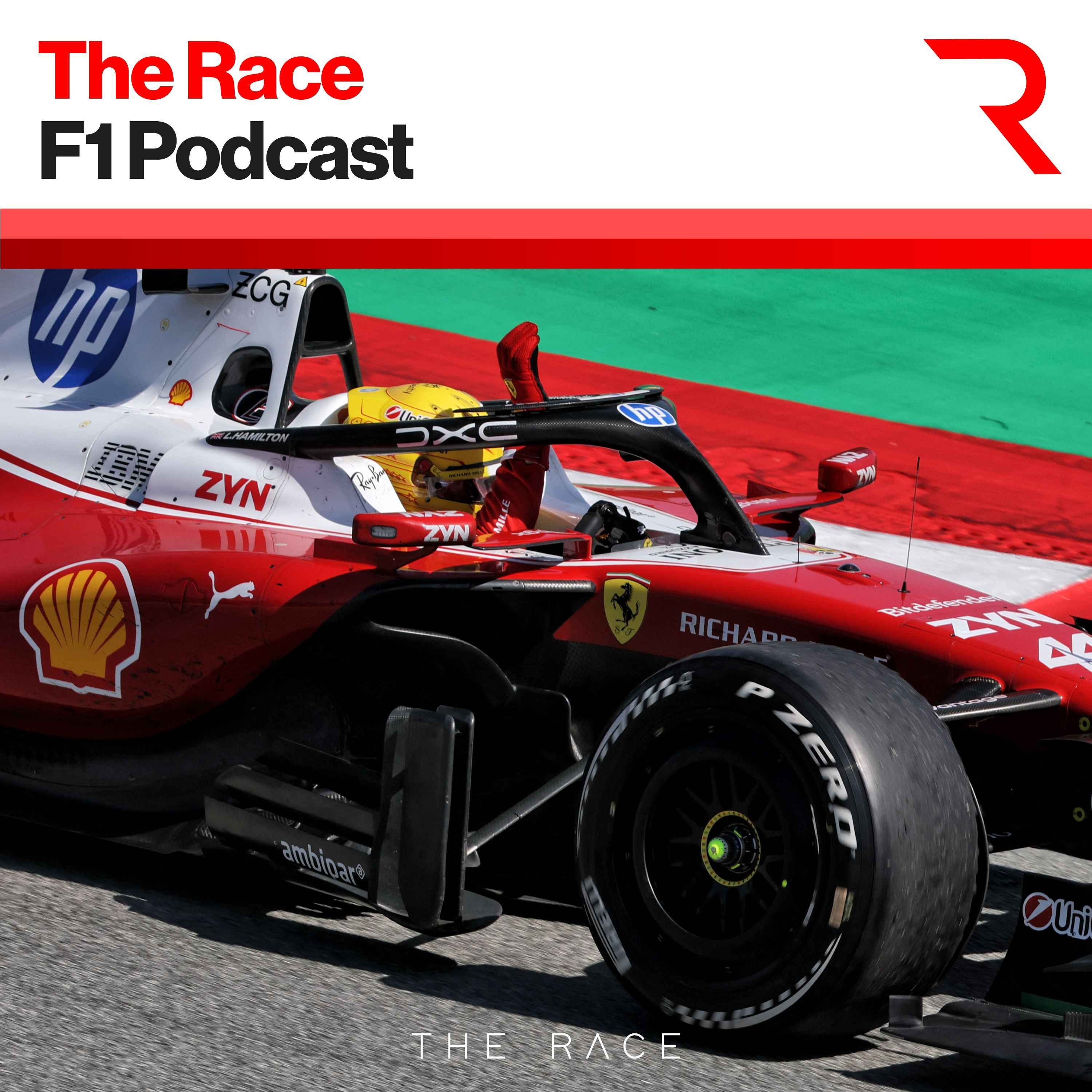
Lewis Hamilton's extraordinary F1 turnaround explained
About this episode
Lewis Hamilton’s turnaround is framed as a chain reaction: early struggles at Mercedes and a difficult Ferrari start gave way to a revitalised peak, helped by regulation and car changes that better tolerated his very hard braking style. The hosts argue it’s not just driver talent—team-wide engineering philosophy, communication, and persistence mattered, with Ferrari’s organization and upgrades playing a role. Barcelona is used as a benchmark, where Hamilton looked like he was in a natural flow state.
With a revitalised Lewis Hamilton still basking in the glory of his first Ferrari grand prix win, we explain how the Briton has been able to turn his fortunes around so spectacularly after last year’s struggles.
Edd Straw is joined by Mark Hughes and Scott Mitchell-Malm for an in-depth look at the seven-time world champion, and the changes that have been made off-track and on to enable him to re-find his form.
Edd, Mark and Scott also speculate what the recent success means for Hamilton's future, and look at the reasons why the 41-year-old's revitalised form has coincided with a slight dip for his team-mate Charles Leclerc.
Get bonus F1 podcasts, extra content and ad-free listening, sign-up to The Race Members' Club on Patreon today.
Hosted on Acast. See acast.com/privacy for more information.
Lewis Hamilton
"And with a revitalised Lewis Hamilton still basking in the glory of his first Ferrari Grand Prix win, how did he turn it all around so spectacularly after last year's struggles?"
Lewis Hamilton is one of the most successful Formula 1 drivers ever. This episode segment is about how he went from a rough patch to getting back on top after joining Ferrari.
Lewis Hamilton is a seven-time Formula 1 World Champion whose career includes multiple championship-winning stints with Mercedes and a later, highly public turnaround with Ferrari. In this segment, the hosts frame his “turnaround” as shifting from a difficult Mercedes period into a stronger Ferrari era, culminating in a first Ferrari Grand Prix win.
Ferrari
"And with a revitalised Lewis Hamilton still basking in the glory of his first Ferrari Grand Prix win, how did he turn it all around so spectacularly after last year's struggles?"
Ferrari is a famous Formula 1 racing team. The hosts are talking about Hamilton’s move to Ferrari and how things improved for him there.
Ferrari is the storied Italian Formula 1 team and constructor that Hamilton joined after struggling with Mercedes. In this segment, Ferrari is central because the hosts discuss Hamilton’s first Ferrari Grand Prix win and how his confidence and results improved during his first Ferrari season.
Mercedes
"That goes back to his Mercedes struggles before the switch to Ferrari."
Mercedes is another top Formula 1 team Hamilton drove for. The hosts say his time there was difficult before he moved to Ferrari.
Mercedes refers to the Mercedes-AMG Formula 1 team and its car program, which Hamilton struggled with before switching to Ferrari. The segment uses “Mercedes struggles” as the starting point for the turnaround narrative.
Hungary qualifying
"I don't think he was lower than after Hungary qualifying last year. Was that what he called himself absolutely useless?"
Qualifying is the session that decides where drivers start for the race. The hosts mention Hungary qualifying as one of the low points in Hamilton’s tough season.
“Hungary qualifying” refers to the qualifying session at the Hungarian Grand Prix, where drivers set their starting positions for the race. The hosts connect Hamilton’s worst self-assessment to his performance in qualifying there.
lack of confidence
"Yeah, I think there's two components to that lack of confidence he was feeling last year."
“Lack of confidence” means the driver doesn’t feel fully sure the car will do what they expect. When that happens, they often drive more cautiously, even if they know they’re capable of more. In F1, that can quickly affect lap times and race decisions.
“Lack of confidence” in F1 is a performance state where a driver doubts the car’s behavior or their own ability to extract grip. That can change how aggressively they push—especially at the limit—affecting braking points, corner entry, and throttle application. The episode frames it as closely tied to how the driver’s mindset and technique interact with the car.
ground effect cars
"He was the fact that a, that generation of car that we've had since 2022, the the the ground effect cars we had until the end of last year, he just were unsuitable for the way he drives."
“Ground effect” means the car is designed to push itself down to the track using airflow under the floor. In modern F1, that downforce is a big deal, so the car can feel very different depending on how you drive it. If your driving habits don’t match the car, it can feel unstable or unpredictable.
“Ground effect” cars use the aerodynamic underbody to generate downforce by creating low pressure under the car. Since the 2022 F1 rule changes, this has been a defining feature of the modern cars, making setup and driving style especially sensitive. If a driver’s technique doesn’t match how the car produces grip, confidence can drop quickly.
muscle memory
"And there was no getting around that. And his muscle memory was clearly not able to overcome to overcome that."
“Muscle memory” here means the driver’s body has learned a set of habits for how to steer and apply the pedals. If the car behaves differently than before, those habits can make the car do the wrong thing. That can make the driver feel less confident until they adapt.
In motorsport, “muscle memory” refers to the driver’s learned, repeatable control inputs—how they brake, turn in, and manage throttle—built over many laps. When a new car generation changes how grip and balance work, those automatic reactions may no longer produce the expected results. That mismatch can feel like a sudden loss of confidence.
engine braking
"because they developed a car around a lot of engine braking to get the rotation in the car and he doesn't drive it like that. He has he hates engine braking."
Engine braking is when you take your foot off the gas and the engine helps slow the car down. It can change how the car feels when you’re setting up for a turn. If a driver doesn’t like that feel, they’ll have a harder time driving the car the way they want.
Engine braking is the deceleration you get when you lift off the throttle and the engine resists the car’s motion through the drivetrain. In F1, teams can tune how much the car slows on lift-off, which affects rotation and how the car behaves into corners. If a driver dislikes it, they may struggle to hit the same braking/turn-in feel lap after lap.
rotation
"because they developed a car around a lot of engine braking to get the rotation in the car and he doesn't drive it like that."
“Rotation” is how the car turns into a corner—how quickly it pivots and points where you want. It depends on how the car is set up and how you brake and lift off the gas. If the driver and car aren’t working together, the turn-in feel can be off.
In racing driving, “rotation” describes how quickly and how much the car pivots into a corner as weight transfers and the tires generate lateral grip. It’s closely tied to braking balance, throttle lift behavior, and the car’s setup. If a car is designed to rotate using engine braking but the driver doesn’t use it the same way, the car may feel inconsistent or under-deliver.
compliant car
"A fortuitous change of regulation to a more compliant car that's much more tolerant of his sort of very hard braking style"
A “compliant car” is one that soaks up bumps and doesn’t get upset as easily. That makes it more forgiving when you brake hard or drive aggressively into a corner. If the car is more forgiving, the driver can push harder with less risk.
A “compliant car” refers to a chassis and suspension/aero platform that absorbs bumps and driver inputs more smoothly, keeping tire contact and stability. In F1 discussions, compliance is often about how tolerant the car is under aggressive braking and corner entry. A more compliant setup can reduce the punishment for a driver’s preferred style, improving consistency and confidence.
change of regulation
"A fortuitous change of regulation to a more compliant car that's much more tolerant of his sort of very hard braking style"
In F1, “regulation changes” are rule updates that can force teams to redesign the car. Those redesigns can make the car easier or harder to drive. If the new car is more forgiving, a driver who struggled before may suddenly feel more confident.
A “change of regulation” in F1 can force major technical and aerodynamic redesigns, which can dramatically alter how a car behaves. Here, the host links it to a “more compliant car,” meaning the car’s behavior became easier for the driver to manage. Regulation shifts can therefore be a turning point for a driver’s confidence and performance.
very hard braking style
"that's much more tolerant of his sort of very hard braking style and is pushed for changes."
“Very hard braking” means braking as late and as strongly as possible. That can change how the car behaves as you turn in. If the car isn’t set up to handle that style, the driver may struggle to get the same results.
A driver’s “braking style” describes how they brake—how late they brake, how hard they apply the brakes, and how that interacts with the car’s balance. “Very hard braking” can stress tires and suspension and can also change how the car rotates into the corner. If the car is tuned for a different braking/rotation behavior, the driver may under-deliver until the setup and regulations align.
Freddie Versailles
"He was pushing for changes all through last year and Freddie Versailles delivered them."
Freddie Versailles is mentioned as the person who made sure the requested updates actually happened. In F1, that usually means engineering changes based on what the driver says the car needs. The transcript doesn’t spell out his job title in this segment.
Freddie Versailles is referenced as the person who “delivered” the requested changes, implying he played a key role in getting the team to update the car to better suit the driver. In F1, such delivery typically means translating driver feedback into engineering changes. (The transcript doesn’t specify his exact role here.)
Daniel Ricciardo
"There's a podcast clip, I think, that I saw doing the rounds of Daniel Ricciardo, [1069.4s] basically reflecting on his own F1 exit and basically going, [1072.9s] actually, Rebel did me a favor, I lost it."
Daniel Ricciardo is a well-known Formula 1 race driver. Here, the hosts talk about him looking back on leaving F1 and being honest that he felt he’d lost some of his sharpness.
Daniel Ricciardo is an F1 driver known for his ability to adapt his driving style and stay competitive across multiple teams. In this segment, he’s discussed in the context of reflecting on his F1 exit and admitting he lost some of his edge.
Fernando Alonso
"and basically explains just why he's so impressed by a Hamilton and a Fernando Alonso, [1103.2s] just in terms of that not only ability to just keep grinding at that age and point in your career..."
Fernando Alonso is another top Formula 1 driver. The hosts mention him alongside Hamilton to highlight how both can stay driven and keep improving even after many years in the sport.
Fernando Alonso is an F1 driver used here as a comparison point to Hamilton for longevity and continued competitiveness. The segment emphasizes their shared ability to keep finding motivation and new ways to drive effectively as their careers advanced.
carbon industry brakes
"He said, right, okay, let's try Lewis's brakes and try carbon industry brakes, which probably he didn't need to for Barcelona because it's a very high energy circuit."
In F1, “carbon” brakes are made from carbon-fiber material instead of steel. They can stop the car very hard, but they work best when they’re heated up properly, so track layout matters.
“Carbon industry brakes” refers to carbon-fiber brake components (carbon brakes) used in Formula 1. Carbon brakes can deliver strong stopping power and are especially effective when you’re managing heat and braking zones, but they’re sensitive to how quickly you bring them up to operating temperature.
brakes up to temperature
"It's not somewhere where you probably were going to have trouble getting the brakes up to temperature."
This means heating the brakes so they work at their best. If the track doesn’t let the brakes warm up enough, they can feel weaker or less consistent.
Brakes up to temperature means bringing the brake system to its optimal operating heat range so it can produce consistent stopping force. In F1, track characteristics (like Monaco being low energy) can make it harder to heat brakes, which changes braking feel and performance.
corner entry
"So I think they have a very different approach to corner entry in the way that they get the rotation on the car."
Corner entry is the moment you go from slowing down to actually turning into the corner. In racing, getting this right changes how stable the car feels and how well it turns.
Corner entry is the phase of driving where you transition from braking/approach into turning-in for a corner. In F1, how you set up corner entry—especially the timing of braking—strongly affects grip, balance, and how much the car rotates.
overlaps cornering with earlier braking
"And I suspect that the Brembo's are probably more suitable for Charles in the way that he overlaps cornering with earlier braking."
This is when a driver starts slowing down before the turn and still brakes as they begin turning. It can help the car feel more balanced as it turns in.
“Overlaps cornering with earlier braking” describes a driving technique where the driver starts braking before turning in and continues braking into the early part of the corner. That can help manage balance and rotation, but it changes the brake load and how the car transitions from straight-line deceleration to turning.
Brembo's
"And I suspect that the Brembo's are probably more suitable for Charles in the way that he overlaps cornering with earlier braking."
Brembo is a well-known maker of high-performance brake systems. Here, they’re talking about how different brake setups can feel different to the driver and affect braking and corner entry.
Brembo is a major performance-brake brand, and in F1 discussions it often refers to the brake hardware and feel a driver gets. The hosts are comparing how Brembo brakes versus carbon brakes suit different driving styles for corner entry and braking overlap.
raw stopping power
"He just needs the raw stopping power because he's breaking later and he gets the rotation at that moment..."
This means how strongly the brakes can slow the car right away. Here, they’re saying one driver benefits from very forceful late braking rather than a more gradual brake feel.
“Raw stopping power” is the immediate, maximum deceleration a brake system can generate when you apply it. The hosts imply Lewis’s style relies more on strong late braking and less on the more gradual, feedback-heavy feel associated with other brake setups.
rear doesn't become unstable
"And so all he needs is that the car does that brakes really hard and the rear doesn't become unstable by the extreme sudden input."
This is about keeping the back of the car from getting loose or unpredictable when you brake hard. The right braking behavior helps the car stay stable instead of sliding around.
When the rear “doesn’t become unstable,” it means the car maintains traction and balance instead of snapping or sliding unpredictably during heavy braking and rapid steering changes. In F1, sudden brake input can upset the car’s balance, so drivers need the right brake characteristics to keep the rear composed.
tyres
"of, let's say 2026 as a whole, the way the cars work, the engines work, the tyres work, [1435.2s] the braking demands, especially the front axle, how much is actually kind of being put"
In F1, the tyres are what actually touch the track. Their grip and how they heat up determine how well the car can brake and turn, and they can change a lot from weekend to weekend.
In Formula 1, tyres are the only contact patch between the car and the track, so they largely determine grip and how the car behaves under braking, cornering, and acceleration. When the host talks about “tyres work,” they’re referring to how the compound and operating temperature affect traction and wear over a stint.
braking demands
"[1435.2s] the braking demands, especially the front axle, how much is actually kind of being put [1439.4s] through those brakes, how hard they're being worked."
“Braking demands” means how much the track makes the car slow down—how hard and how frequently it has to brake. More braking usually means more heat and stress on the brakes and front tyres.
“Braking demands” describes how hard and how often a circuit forces the car to slow down, which directly loads the brakes and front axle. Higher braking demands typically mean more brake heat, more tyre load transfer, and greater sensitivity to brake cooling and brake balance.
front axle
"[1435.2s] the braking demands, especially the front axle, how much is actually kind of being put [1439.4s] through those brakes, how hard they're being worked."
The front axle is the part of the car that connects and supports the front wheels. When you brake, the car’s weight shifts forward, so the front wheels and brakes do a lot of the work.
The front axle is the front end of the car that carries the front wheels and their suspension/brake loads. In braking, weight shifts forward, so the front axle usually takes a big share of the braking force and heat generation, making it a key area for setup and cooling decisions.
cooling capacity
"which means that they're not wanting to make sure [1450.4s] there's been a bit more cooling capacity than is actually needed because the brakes are [1453.7s] being used less, whatever."
Cooling capacity is how well the car can get rid of heat—here, mainly heat from the brakes. If the brakes can’t cool enough, they can start working less effectively.
Cooling capacity is how much heat the car’s brake cooling system (and related airflow management) can remove under race conditions. If a team doesn’t have enough cooling capacity for the braking workload, brake temperatures rise, which can reduce braking performance and consistency.
26 tires
"but one thing that really stood out to me there was Leclerc in the middle of [1511.2s] that weekend had referred to the 26 tires as being digital. [1516.3s] They just sort of have grip or they don't, it's on or off."
“26 tires” means the tyre rules/spec for the 2026 F1 season. The key point is Leclerc felt they can feel like they’re either gripping well or not gripping at all, with less gradual change.
“26 tires” refers to the tyre specification used in the 2026 Formula 1 regulations era. The host is highlighting that Leclerc described them as behaving in a very binary way—either they have grip or they don’t—suggesting a narrow operating window where performance changes quickly.
digital
"[1511.2s] that weekend had referred to the 26 tires as being digital. [1516.3s] They just sort of have grip or they don't, it's on or off. [1519.3s] And then in a completely separate answer"
Here “digital” means the tyres feel like they switch between two states. Instead of gradually getting better or worse, grip can suddenly appear—or suddenly disappear.
In this context, “digital” is a metaphor for tyre grip that changes abruptly rather than smoothly. If tyres are “on or off,” small changes in temperature, load, or surface conditions can cause sudden transitions between strong grip and loss of grip.
grip
"Andrea Stellar at McLaren talked about the way these tires just don't seem to transfer [1531.7s] grip from basically straight line to steering lock being applied into and then through the [1537.0s] corner."
Grip is how well the tires can “hold” the road. More grip means the car can turn and slow down more confidently without sliding.
In racing, grip is how much traction the tires can generate between the car and the track surface. It determines how confidently the driver can accelerate, brake, and turn without losing control.
Pirelli
"There's something about these smaller Pirelli tires, maybe the way that they're being worked, [1541.0s] the load that's been put through them is lower as well because there's less downforce, just [1544.6s] means that there seems to be a little bit of trickiness in terms of getting that little [1548.3s] bit of grip out of the tire."
Pirelli makes the tires used in Formula 1. Different tire characteristics can change how easily the car turns and how much traction you get in corners.
Pirelli is the tire supplier in Formula 1, and the specific tire construction and compound strongly affect how the car behaves. In this segment, the discussion is about how Pirelli tires may be harder to get working as the car transitions from straight-line running into cornering.
downforce
"There's something about these smaller Pirelli tires, maybe the way that they're being worked, [1541.0s] the load that's been put through them is lower as well because there's less downforce, just [1544.6s] means that there seems to be a little bit of trickiness in terms of getting that little [1548.3s] bit of grip out of the tire."
Downforce is the “suction” effect that presses the car onto the road. More downforce usually means the tires can grip better, especially in corners.
Downforce is the downward aerodynamic force that pushes the car toward the track, increasing tire grip. In F1, changes in downforce can come from aerodynamic design (including ground-effect concepts), and it directly affects braking, cornering, and tire loading.
ground effect era
"And I wonder there, if Leclerc needs, with the way that he drives, with that little bit of [1554.4s] overlap, the way that he works the car to rotate it, does he need a certain set of [1559.8s] circumstances to basically feel what he needs to feel through the front axle at low speed [1565.2s] in cooler conditions, like whatever it ends up being, because that's a danger of oversimplifying [1573.5s] this, that's not necessarily like a properly fundamental clash with these rules in the way [1578.3s] that we saw Hamilton or others struggle with the ground effect era, for example, but it's [1582.5s] specific enough, it's nuanced enough that it makes me think that if that's a trait or [1589.9s] an issue that he's dealing with, then depending on how much progress he can make within his [1596.6s] own style, how much does that just repeat through the year when you have those specific [1601.6s] circumstances?"
The ground effect era is when F1 cars get most of their downforce from the space under the car. Because that downforce depends on how close the car is to the track, the car can feel very different—and sometimes harder to drive—if the setup isn’t right.
The ground effect era refers to the period in F1 when cars use underbody aerodynamics (like venturi tunnels) to generate significant downforce close to the track. It changed how cars produce grip and how sensitive they are to ride height and setup, which can make certain drivers struggle if the car’s behavior doesn’t match their style.
Monaco
"And so a test of adaptability for Leclerc, but also to come back to the point Mark made [1608.3s] right at the start, I actually don't think Leclerc's underlying pace is a huge problem [1613.8s] in that Monaco, he could have been on pole in Monaco, even with those consistency problems [1618.5s] and the temperature problems of the brakes."
Monaco is a Formula 1 race known for tight streets and slow corners. That kind of track makes tire grip and braking feel very different than on faster circuits.
This segment references Monaco as a specific race context for discussing driver pace and tire/brake temperature issues. Monaco’s tight, slow corners make traction and braking behavior especially important.
temperature problems of the brakes
"even with those consistency problems [1618.5s] and the temperature problems of the brakes."
If the brakes run too hot or too cool, they don’t work as consistently. That can make it harder to brake at the same point every lap.
Brake temperature problems mean the brakes aren’t operating in the ideal temperature range, which can hurt braking consistency and stopping power. In F1, brake temps are affected by driving style, track layout, and how much energy the brakes must absorb lap after lap.
Barcelona
"in that Monaco, he could have been on pole in Monaco, even with those consistency problems [1618.5s] and the temperature problems of the brakes. [1620.5s] He was quick in Barcelona, he clearly was rattled by the fact that Hamilton was able [1626.9s] to brake later and carry more speed into turn four, made the mistake that we see drivers [1632.1s] sometimes do before of trying to match that rather than just doing what he could do."
Barcelona is another Formula 1 track used in the season. Comparing it to Monaco helps explain whether a driver’s problems are track-specific or more general.
The host contrasts Monaco with Barcelona to argue that Leclerc’s pace wasn’t the main issue. Barcelona’s higher-speed sections can highlight different strengths and weaknesses in braking and tire behavior.
brake later
"He was quick in Barcelona, he clearly was rattled by the fact that Hamilton was able [1626.9s] to brake later and carry more speed into turn four, made the mistake that we see drivers [1632.1s] sometimes do before of trying to match that rather than just doing what he could do."
“Brake later” means delaying braking until closer to the corner. In F1, that often indicates stronger braking confidence and/or better tire grip and thermal performance, allowing the car to carry more speed into the turn.
shock absorbers
"It fits the Verstappen psychology so much where apparently he sourced different shock absorbers or something and just turned up to a test and said I want to try these because I think they'll make it better."
Shock absorbers are parts that help the car stay stable when the road gets bumpy. In racing, teams can change them to help the tires keep better contact with the track.
Shock absorbers (dampers) control how quickly a car’s suspension moves after hitting bumps. In racing, changing shock absorber setup can affect grip, tire behavior, and how stable the car feels over kerbs and uneven track surfaces.
radio calls
"And the way Ed, you described like what Leclerc does with the radio calls and things like this, we've seen it in a different form, haven't we, with the way that he ends up being,"
Radio calls are the live communications between the driver and the pit wall during a race. They’re used to relay information like tire wear, track conditions, and strategy changes, and they can strongly influence how quickly a team reacts.
strategy
"passive in race in terms of like, you know, when there's a decision to be made about changing conditions or strategy or something like this, how many times did we talk..."
In F1, strategy is the plan for how to manage the race—especially decisions like when to pit, which tires to use, and how to respond to changing conditions. The host’s point is that some drivers are more proactive about forcing or shaping those decisions.
race engineer
"how many times did we talk in his time as a teammate to Carlos Sainz that Sainz would basically race engineer himself during Grand Prix because he just go no, no, I know what we need to do here."
A race engineer is the person on the team who talks to the driver during the race and helps decide what to do. They use information from the car to guide strategy and setup changes.
A race engineer is the team member in charge of communicating strategy and car setup guidance to the driver during a Grand Prix. They interpret data, manage pit/strategy decisions, and coordinate changes—so when the host says Sainz “race engineer himself,” it implies unusually direct driver-led decision-making.
Grand Prix
"would basically race engineer himself during Grand Prix because he just go no, no, I know what we need to do here."
A Grand Prix is just the name for an F1 race. It’s the main event where the driver and team make decisions in real time.
A Grand Prix is the name for an F1 race event. In this context, “during Grand Prix” means across the duration of a Formula 1 race weekend’s main race, where real-time decisions and driver-team communication matter.
Charles Leclerc
"or Hamilton's doing this, Hamilton's doing that, Hamilton's changed this, maybe Leclerc can go [2164.0s] along for the ride like a little bit, but that doesn't change the fact that if he gets what he ... [2194.9s] Leclerc is a top driver? Too many excuses get thrown out for him over the years"
Charles Leclerc is one of Ferrari’s Formula 1 drivers. In this segment, the hosts are arguing about whether he’s good enough to consistently win a world championship, and they mention that he sometimes makes mistakes.
Charles Leclerc is a Ferrari driver whose performance is being debated here in the context of whether he’s a “top driver” capable of winning a world championship. The hosts discuss his adaptability, but also point to periods where mistakes or overdriving have hurt results.
Q3
"I think that's slightly reductive. [2210.5s] Leclerc does have a mistake in him. The Spain era, there was no excuse for that and obviously made [2215.2s] the era at the end of Q3 in Monaco, so he was over driving a little bit, but we're only in [2222.5s] quite a small one of races."
Q3 is the last part of F1 qualifying. It’s where the quickest drivers set their final times to decide the very top of the starting grid.
Q3 refers to the final segment of Formula 1 qualifying, where the fastest cars fight for the top grid positions. The host mentions “the era at the end of Q3 in Monaco,” implying a specific qualifying moment where Leclerc’s performance (or mistake) affected results.
George Russell
"He still hasn't [2249.9s] proven that and you want to see, you always want to see drivers tested in that scenario. That's [2255.5s] what we're seeing with George Russell."
George Russell is another Formula 1 driver mentioned as a comparison point. The hosts are basically saying: we want to see drivers proven in the hardest, world-championship-level situations.
George Russell is an F1 driver being used as a benchmark for “absolute gold standard” world-championship capability. The discussion frames him as someone whose performances are currently testing whether a driver can consistently deliver at the very top level.
tire management
"stints. His tire management has evolved very, very well. He does a lot of things exceedingly, exceedingly well."
Tire management is how you make your tires last and keep them working well during a race. If you push too hard too early, the tires wear out and the car gets slower.
In Formula One, tire management is how a driver and team control tire wear and temperature over a stint. It affects grip, lap time consistency, and how long the tires stay in their optimal operating window.
stints
"He produces very quick race stints. His tire management has evolved very, very well."
A stint is just a chunk of the race where you use the same set of tires. Teams plan stints so the tires last and the car stays quick.
A stint in Formula One is the period a car runs on a specific set of tires before switching to a new set. Strategy and tire management revolve around how long each stint can be while staying fast.
driving more on the edge
"you are by definition driving more on the edge. So by definition, you will have more errors."
It means pushing the car as hard as it can go without losing control. When the car isn’t perfect, that’s riskier—one small mistake can cause a spin or crash.
“Driving more on the edge” means operating the car at the limit of traction and control. When the car isn’t ideal, that increases the chance of mistakes because small errors can trigger loss of grip or instability.
switch modes
"But that will sometimes bite you. And I think that's, I don't think that's deserve criticism. It's just an approach. But it is a question in so far as can he switch modes when the opportunity presents itself?"
“Switch modes” means changing how you drive depending on the situation. Sometimes you drive to go as fast as possible, and other times you drive more carefully to protect tires and avoid mistakes.
In F1 discussion, “switch modes” refers to changing driving approach depending on what the car and race situation require—such as switching between maximizing performance and managing risk/tires. The key question is whether a driver can adapt their style reliably when circumstances change.
spin and crash
"And the thing that always follows him around is that spin and crash in France in 22, which was when that championship situation was already slipping away from him."
A spin is when the car starts rotating and you lose direction. A crash is what happens if the car can’t get back under control safely.
A “spin” is a loss of rotational control that turns the car around, often due to exceeding grip limits. A “crash” follows when the car can’t recover safely, and in F1 it can dramatically affect championship momentum through lost points and damage.
pole positions
"and he arrives, and he gets to Formula 1, and he takes mediocre cars and sets pole positions and wins every single race."
Pole position is the best starting spot in a Formula 1 race. It’s awarded to the driver who sets the fastest time in qualifying.
Pole position is the starting spot on the grid for the fastest qualifier in a race weekend. Winning pole generally means the car was quickest over one lap in qualifying, giving an advantage at the start.
Fom
"The mistake you've made there, unfortunately, Ed, is you have now tempted Fom into getting yet another partner on board to do some kind of AI calculation that will, a bit like when we had that infamous fastest qualifier"
“Fom” refers to the business side that helps run Formula 1. Here, they’re mentioned as the group that might be doing a computer-based calculation to rank drivers.
“Fom” is a reference to Formula One Management, the organization that runs commercial operations for Formula 1. In this context, they’re being teased for using an AI-style calculation for driver comparisons.
fastest qualifier
"do some kind of AI calculation that will, a bit like when we had that infamous fastest qualifier one."
A “fastest qualifier” is the driver who sets the quickest time in qualifying. Qualifying is the session that decides the starting order for the race.
“Fastest qualifier” refers to a metric or award tied to qualifying pace—who sets the quickest time in qualifying. The hosts compare it to an “AI calculation,” implying a data-driven ranking based on qualifying performance.
AI calculation
"do some kind of AI calculation that will, a bit like when we had that infamous fastest qualifier one."
They’re talking about using computer intelligence (AI) to crunch racing stats. The idea is to turn opinions about “best driver” into a number.
An “AI calculation” here means using artificial intelligence to process racing data and produce a ranking or comparison. The discussion frames it as an attempt to quantify “greatest driver” using statistics rather than subjective debate.
Stewart
"Fangio won it with four teams, didn't he? Stewart with three. Oh, there's a kind of worms there."
Stewart refers to Jackie Stewart, a famous F1 champion who won the world title multiple times. The hosts mention him to illustrate how a driver’s success can span different teams.
Jackie Stewart was a three-time Formula 1 World Champion (in the 1960s/early 1970s) and a key figure in modern F1’s rise in professionalism. In this discussion, he’s used as an example of a driver who won championships with more than one constructor.
Fangio
"But yeah, I mean, Fangio won it with four teams, didn't he? Stewart with three."
Fangio was a legendary early Formula 1 driver who won multiple world titles. People bring him up because his success happened with more than one team, which makes him useful for comparing “driver vs team” arguments.
Juan Manuel Fangio was one of F1’s dominant early champions, known for winning multiple World Championships across different teams. His record is often used in debates about how much driver greatness vs. team strength matters.
World Championship
"Stewart with three. Oh, there's a kind of worms there. I'd argue Stewart won it with won the World Championship, and won his races with one team, but he won World Championships with, he won races with three constructors."
The World Championship is the official season title in F1. Drivers and teams earn points across races, and the totals decide who wins the championship.
In Formula 1, the World Championship refers to the season-long title decided by points. Drivers compete for the Drivers’ Championship, while teams compete for the Constructors’ Championship.
constructors
"and won World Championships with, he won races with three constructors. Yes, that's what I'm saying, races, that's what the questions are defined."
In F1, “constructors” basically means the teams. The Constructors’ Championship is won by the team based on points scored by its cars over the season.
“Constructors” in F1 means the teams competing for the Constructors’ Championship. A driver can win races for multiple teams, but the Constructors’ title is awarded to the teams based on their cars’ combined points.
non-championship race
"But yeah, you won a non-championship race with the work lotus as well, of course."
A non-championship race is a race that follows F1-style rules, but it doesn’t count toward the official season title. Drivers can still win and gain prestige, but it won’t change the championship points.
A non-championship race is an F1 event that doesn’t count toward the official World Championship standings. Historically, F1 calendars included races that used F1 rules and cars, but the results didn’t affect the season’s championship points.
Clark
"Yeah, in place of Clark. Was that the Rand Grand Prix?"
Clark refers to Jim Clark, a legendary early F1 driver who won world championships. Here, he’s mentioned because of his connection to Lotus and the kind of races being discussed.
Jim Clark was a highly successful early F1 World Champion for Lotus, remembered for speed and racecraft. The transcript references him in the context of Lotus and a specific non-championship event, highlighting how drivers moved between teams and eras.
goat debate
"It's a little bit like what we were saying with the goat debate, that that's part of the conversation, isn't it?"
They’re talking about the “best ever” debate—whether you prefer someone who stays with one team and builds a legacy there, or someone who wins with multiple teams. It’s an analogy for how people judge F1 careers.
This segment references the “GOAT debate,” comparing what fans value most in a career: loyalty to one team vs. success across multiple teams. It’s used as an analogy for how F1 fans weigh driver greatness against team context.
Request an Explanation
Heard something you'd like explained? We'll add it to this episode.
Sign in to request explanations for terms you heard.
Want to learn more?
Browse our glossary for plain-English explanations of automotive terms, jargon, and concepts.
Help improve this episode
See something that's not quite right? Our annotations are AI-generated and can sometimes miss the mark. Click the flag icon on any annotation to suggest a correction.