An off-roader is a vehicle meant for rough roads—like dirt, gravel, and trails. The hosts are wondering if this new, sleeker Range Rover will still be good at that, or if it’ll be more of a street-focused car.
“Trail Rated” is a label Jeep uses to say a vehicle is meant for real off-road trails. It usually means it has the right off-road features to handle rough terrain.
Car
Jeep
Jeep is a car brand that’s famous for off-road vehicles. In this segment, the host is saying some Jeep models aren’t built or certified for the toughest trails.
A “flexible architecture” is a vehicle design that can be built in different versions. In this case, it means the same basic platform can be used for electric and hybrid versions.
A “multi-fuel strategy” means the automaker plans for more than one kind of power source. Here, it’s basically electric first, with a possible hybrid option later.
Term
marketing speak
“Marketing speak” is a phrase for polished, non-technical language used to describe products in a way that sounds appealing but may be vague. The host uses it to critique how PR frames the “multi-fuel strategy” idea.
The Acura RDX is a compact luxury SUV/crossover from Acura. It’s the kind of car people buy for daily driving, but with a more “fun to drive” vibe than many basic SUVs. The hosts are saying Acura is pausing it for a while, which can change how well Acura sells in that category.
EV architecture is the “design blueprint” for an electric car. It covers how the battery and electric parts are built into the vehicle from the ground up. The point here is that Honda spent money planning that blueprint and then stopped, which affects what they can fund next.
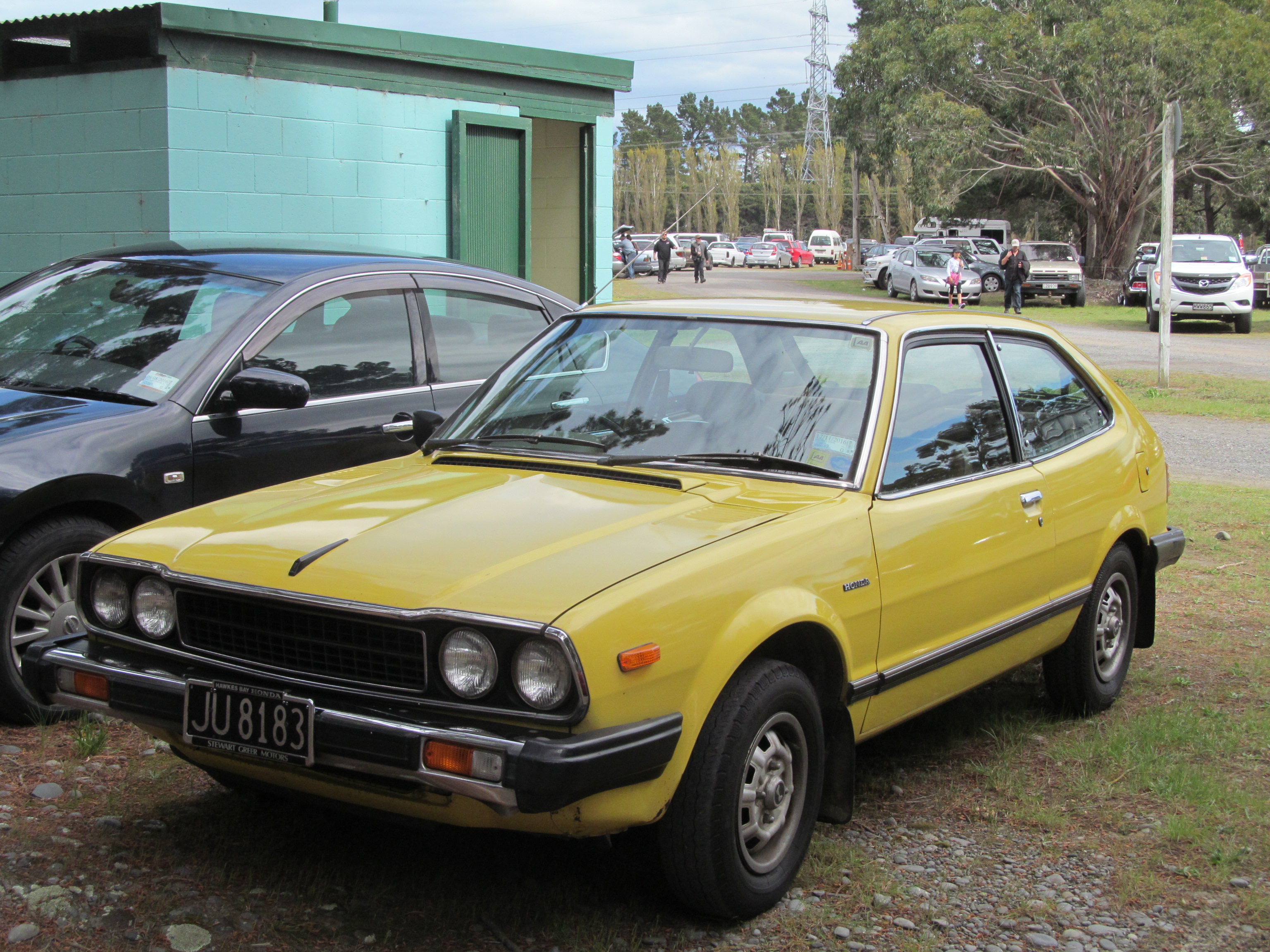
The Honda Accord is a very common Honda model in the U.S. It’s a regular family car that lots of people buy. Here, they’re using it as an example of a Honda that sells well.
The Honda Pilot is a family SUV with three rows of seats. In this segment, they say it’s the only Honda model that doesn’t sell as strongly as the others in the U.S.
The Honda Prelude was a sporty Honda coupe that never had the same mass-market popularity as models like the Civic. The host is basically saying it’s a niche car and they’re not sure how it’s doing.
This is a type of engine: six cylinders arranged in a V shape, with a total size of 3.5 liters. The host is saying it sounds good and revs freely, but it needs updating.
A hybrid uses both a gas engine and an electric motor. The idea is that the car can use electricity sometimes and recover energy, which can help fuel economy.
The Honda Ridgeline is Honda’s midsize truck. They’re pointing out that it’s built more like a car (unit body), not like traditional trucks with a separate heavy frame, so it’s not aimed at the biggest towing numbers.
Body-on-frame is how many traditional trucks are built: a separate heavy frame supports the body. The host is saying the Ridgeline doesn’t use that approach, so it’s not designed for the same kind of heavy-duty towing feel.
Towing numbers are how much weight a vehicle is rated to pull. They’re saying the Ridgeline isn’t built to tow the biggest amounts compared with more traditional trucks.
The Toyota Corolla Cross Hybrid is a small SUV that uses a gas engine plus an electric motor. The host says it’s surprisingly efficient and feels quick off the line because the electric part helps right away.
MPG (miles per gallon) is a fuel-economy measure that tells you how far the car can travel on one gallon of fuel. The host is using it to report real-world efficiency while driving around town.
Electric boost is when the electric motor adds extra push right when you pull away. That makes the car feel quicker without waiting for the gas engine to spin up.
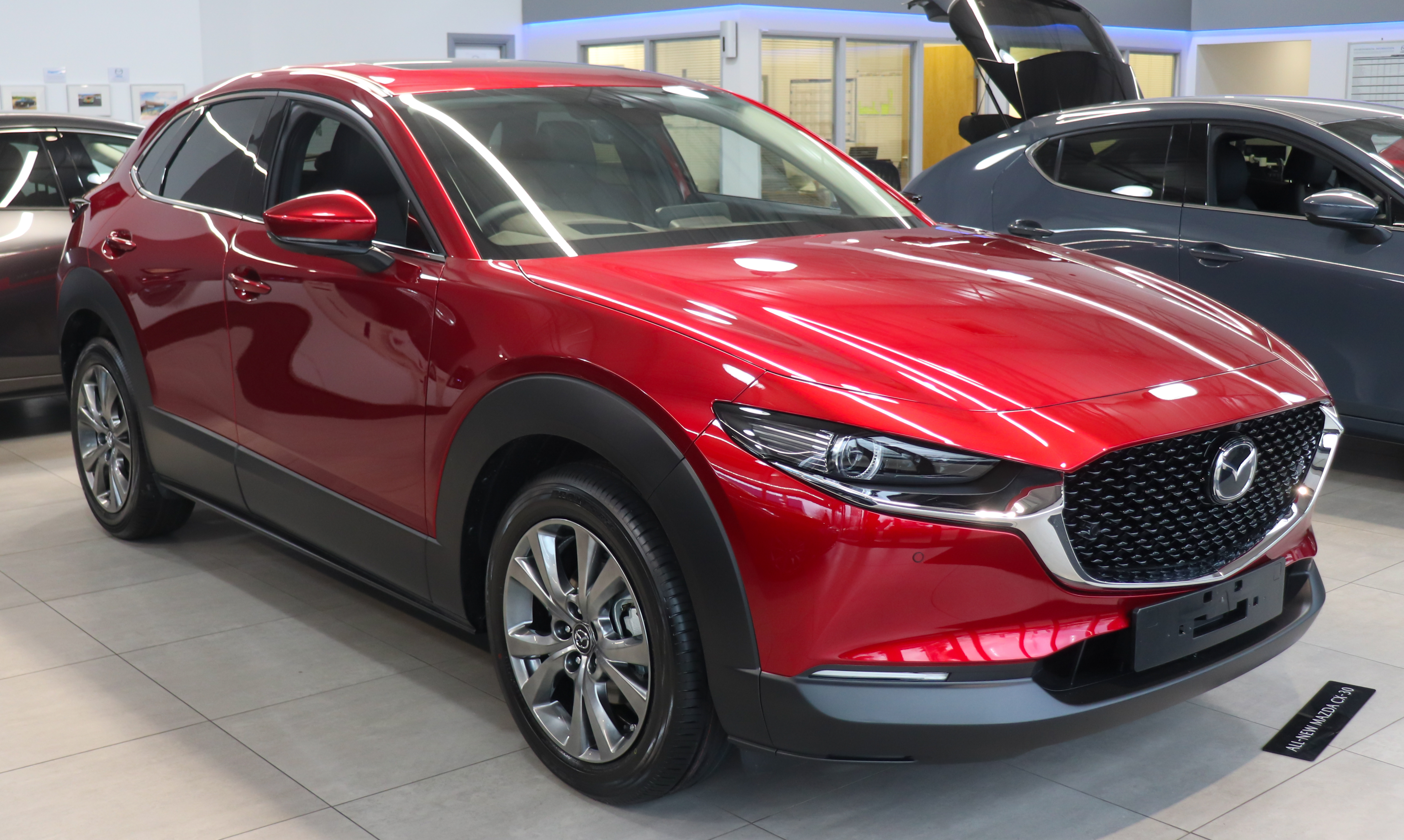
The Mazda CX-30 is a small crossover SUV. The host is saying it can be cheaper than what someone might expect if they’re looking for a sporty, nicer-feeling interior.
Lucid Air is Lucid’s main electric sedan. It’s the kind of car people compare to Tesla’s Model S, and the host is pointing out that Lucid has offered it for years with a big spread in price depending on the version.
The Tesla Model Y is an electric SUV that runs on batteries instead of gasoline. Its price can vary a lot based on the specific version and when it was made. That’s why it often shows up in conversations about EV costs.
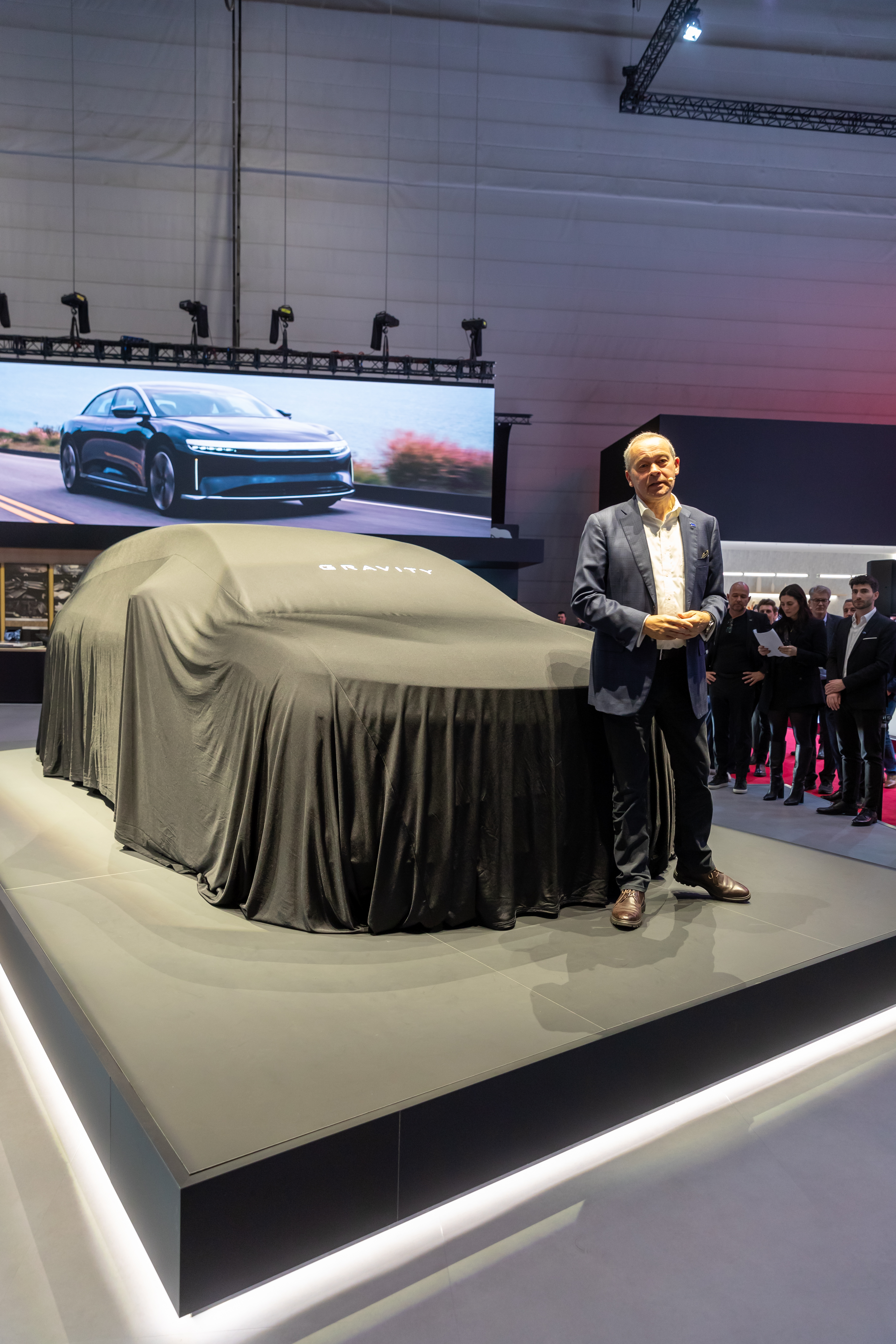
The Lucid Gravity is Lucid’s electric SUV. The discussion here is about early software problems—things like the radio not working and needing a reset to get the car back to normal.
A hard restart means forcing the car to reboot when something is stuck or not responding. It’s like restarting a phone or computer to get everything working again.
Term
control, delete, like hard reset
They’re describing a forced reset procedure they used to fix a software problem. It’s basically the driver’s way of saying, “I had to reboot the car to make it work.”
A midsize crossover is a family-sized SUV-style car. It usually has a higher driving position and more room than a regular sedan, but it’s not as big as the largest SUVs.
A touchscreen is the big screen you tap to control the car’s features. If the controls are in menus, it can be annoying when you just want to do something quickly.
The glove box is the compartment inside the dashboard used to store documents and small items. In many cars it has a physical latch or button, so difficulty opening it can be a sign the vehicle uses a more digital/centralized control approach.
Throttle response is how fast the car starts to move when you press the gas pedal. If something’s wrong, you press the pedal but the car doesn’t react the way it should.
“Hood open” is a warning light that tells you the car thinks the hood isn’t properly closed. Even if you didn’t open it, a sensor or latch problem can cause that message.
Term
turning it off and turning it back on
This is like rebooting the car—turning it off and back on. On modern cars, that can fix temporary computer glitches.
Throttle input is basically what your foot is telling the car to do when you press the gas pedal. If you “lose throttle input,” the car may not accelerate even though you’re asking it to.
The front trunk (often called a frunk) is the storage space in the front of an electric car. Since there’s no engine sitting there like in a gas car, manufacturers can use that area for bags and gear.
Concept
dire financial situation
“Dire financial situation” means the company is in serious financial trouble. For a car company, that can make it harder to keep building cars and improving the product over time.
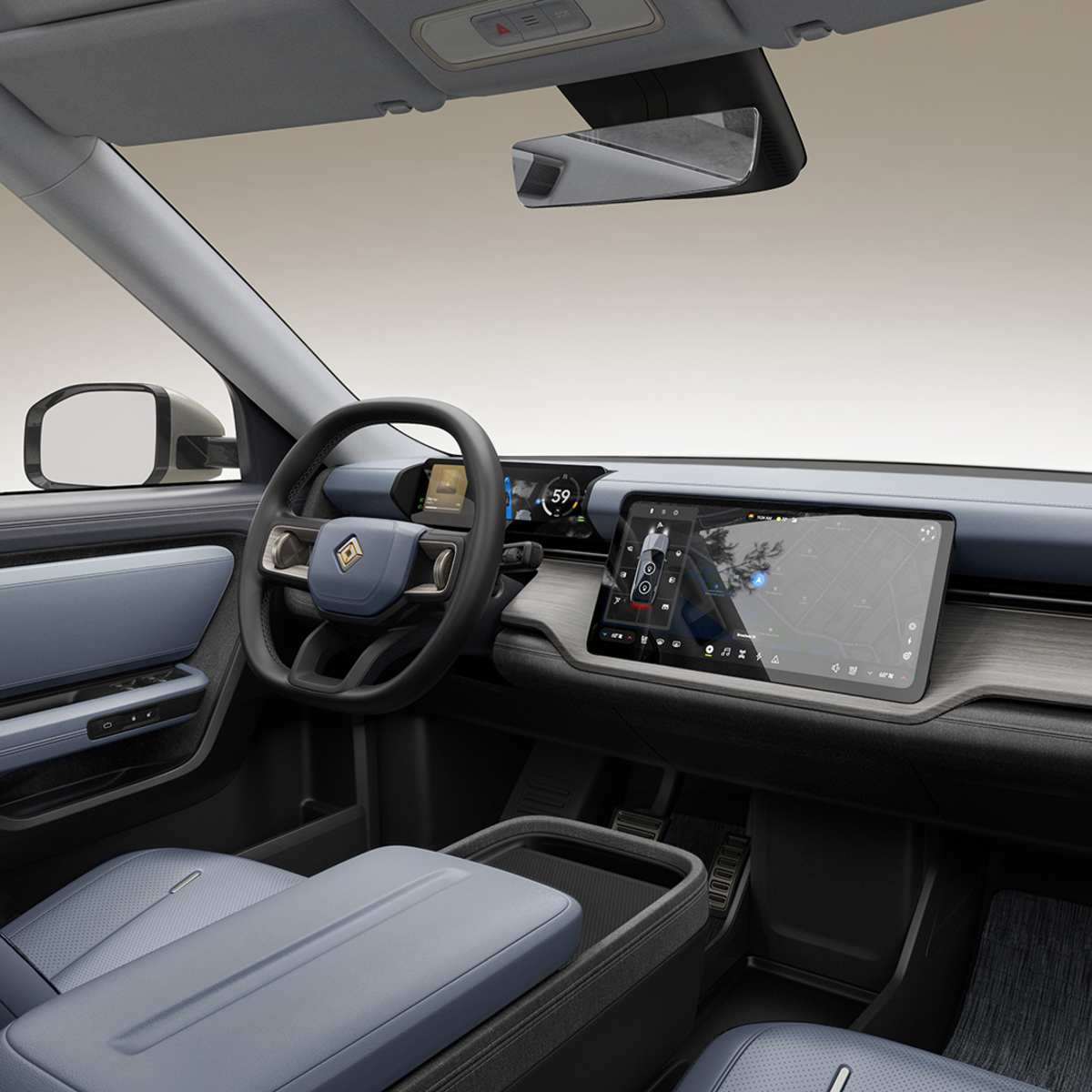
The Rivian R2 is an electric vehicle Rivian is working on. It’s intended to be a smaller EV than some of Rivian’s earlier offerings. The podcast mentions it because it’s moving from concept toward real-world testing.
The Ford Bronco Sport is a smaller SUV from Ford with an off-road style. It’s designed to be easier to drive and park than a bigger off-road SUV, while still feeling capable. That’s why people describe it as a good size for the Bronco name.
A glass roof is a roof section made of glass so more light gets into the cabin. The host is saying this one goes unusually far up, which makes the interior feel more modern and bright.
A contiguous windshield means the windshield area looks like it flows continuously into the rest of the glass around it. In this case, it helps create that big, modern glass look from the roof down to the front.
The A-pillar is the vertical metal/structural post at the front of the car, near the windshield. Most cars mount sun visors near that area, but this design puts them on the roof glass instead.
An electric SUV is a bigger family-style vehicle that runs on electricity instead of gas. You charge it like a phone or laptop—plug it in—so range and charging convenience matter a lot.
An optional third row seat is an extra row of seating that turns a two-row SUV into a three-row layout. The trade-off is usually reduced comfort and/or less cargo space, especially for adults in the back row.
Cargo space is how much room you have to put bags and stuff in the back of the SUV. More cargo space usually means easier road trips and more flexibility for daily life.
The Ford F-150 is a large pickup truck made by Ford. It’s sold in many different versions, from work-focused to more comfortable options. It’s often mentioned because truck prices have changed a lot over the years.
Here, “incentives” means government help that makes EVs cheaper or easier to sell. The hosts are saying those incentives can affect when EV companies start making real profits.
“Break even” means you’ve reached the point where you’re no longer losing money and your sales cover your costs. The hosts are using it to explain why EV companies may take a while before they’re truly profitable.
GM is short for General Motors, a major car company. They’re talking about how GM is trying to make money while the industry is moving toward electric cars.
Market share is the portion of total sales in a market that a company (or brand) captures. The hosts mention gaining market share as part of the strategy for selling gas-powered Cadillacs while the EV transition continues.
Ford Orion refers to a Ford vehicle assembly plant called Orion. It’s a factory where cars are built, and it’s located north of Detroit. The podcast mentions it to talk about production and where vehicles come from.
Home charging means plugging your electric car in at your house. It usually makes EV ownership easier and can be cheaper than charging only at public stations.
A lithium-ion battery is the rechargeable battery inside most electric cars. The exact type can affect things like how far the car can go and how quickly it can charge.
“Lithium iron batteries” usually means a type of EV battery called LFP. They’re often cheaper and can last a long time, but they may not pack as much energy as other battery types, so range and charging behavior can differ.
Excess capacity means a factory has more production ability than there’s demand to use it. If cars aren’t selling enough, companies can’t justify running the plant at full output.
Renault is a car company. In this segment, it’s brought up as another partner Ford couldn’t get to use a plant more because the market is already too full.
CATL is a company that makes EV batteries. The idea here is that partnering with them could help a carmaker learn how to make batteries better and compete.
BYD is a big Chinese company that makes electric cars and batteries. The hosts are saying that learning what BYD does could help someone compete better.
Here, manufacturing means how you actually build the cars and batteries in a way that’s efficient and consistent. It’s not just the design—it’s the real-world production process.
Geely is a Chinese car company. The hosts are saying Geely doesn’t necessarily need more factory capacity, so the plant deal might be about strategy and access instead.
UAW is a union that represents many auto workers in the United States. In this segment, it’s used to show labor’s position on where cars should be built.
The Jeep Cherokee is a compact SUV made by Jeep. It’s designed for everyday driving but with a Jeep identity that often appeals to people who want some capability. The podcast mentions it because they’re going to talk about repair or maintenance work related to it.
The Nissan Kicks is a small SUV/crossover. Here they’re comparing it to another small SUV and focusing on whether it can be driven with all-wheel drive (better traction in bad weather) versus just front-wheel drive.
The Chevrolet Trax is a small SUV/crossover. In this discussion, they say it’s front-wheel drive only, meaning it sends power to the front wheels rather than all four.
A base trim level is the most basic version of a car model. It usually has fewer features, and in this segment they connect the “base” version to front-wheel drive.
All-wheel drive means the car can send power to all four wheels. That can help with traction on wet or slippery roads compared with front-wheel drive only.
Unibody construction means the truck’s body and frame are built as one piece. That often makes the ride feel smoother and more car-like than trucks that use a separate heavy frame.
The Honda Passport is a mid-size SUV from Honda. It’s related to the Honda Pilot, so some of the main design parts are similar. That’s why it can feel more like a bigger, more rugged SUV than smaller crossovers.
A shared platform is when different vehicles are built on the same basic “bones.” That can help automakers keep costs down because they don’t have to design everything from scratch for each model.
The Toyota Grand Highlander is a bigger Toyota SUV with three rows of seats. The host is saying it’s easier to live with day to day because it has more room for stuff and a more usable third row, plus it comes with more safety features by default.
The Chevrolet Traverse is a family SUV with three rows of seats. The host is comparing it to the Grand Highlander and saying the Traverse can be cheaper, partly because some safety/driver-assist features are offered in option packages rather than on every base model.
Advanced driver assistance systems are the car’s safety tech that can help you drive—things like keeping in the lane or warning you to avoid crashes. The host is saying some of these features are bundled together, so a cheaper base car may not include them unless you buy the right package.
ADAS is short for the car’s driver-assist safety features. In this case, the host is saying they’re often offered as a bundle, so you might not get them on the cheapest version.
Genesis is Hyundai’s luxury car brand. The host is saying that Genesis used to be a great deal, but the prices have gotten less “bargain” compared with other options.
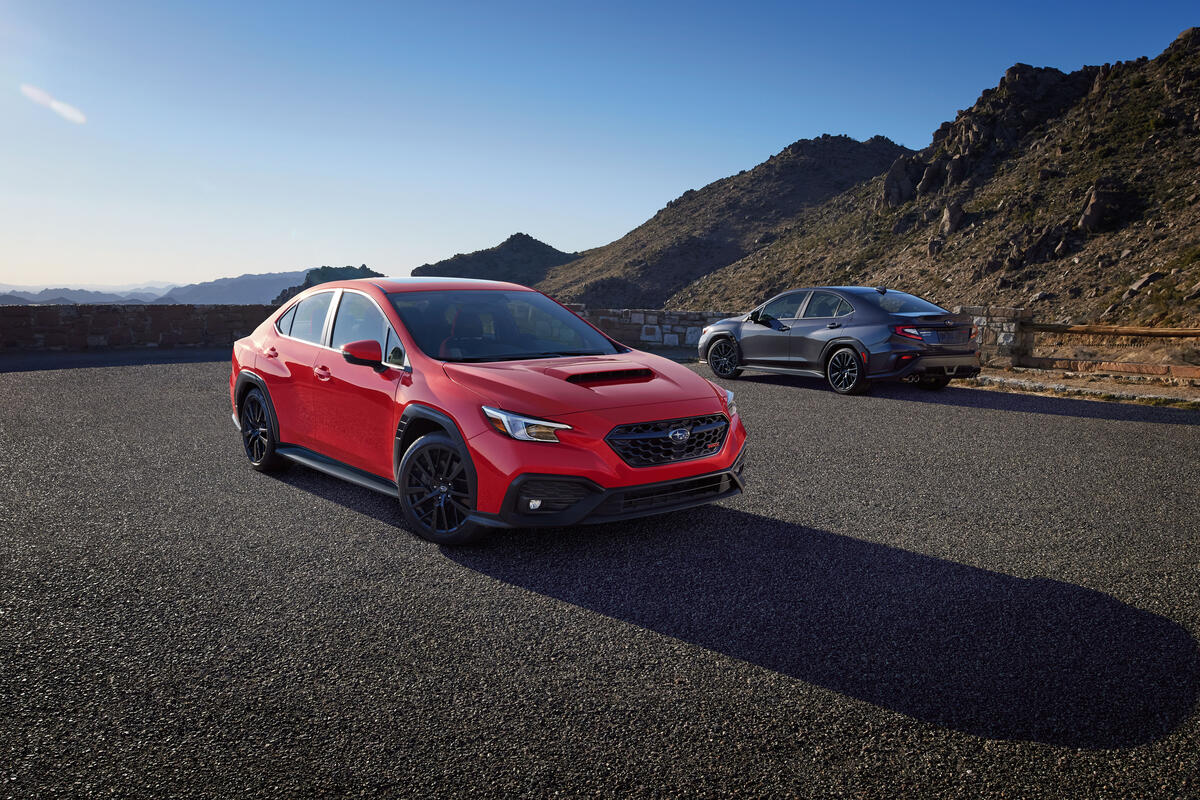
The Subaru WRX is a sporty Subaru that’s famous for being quick and for having all-wheel drive. Here they’re talking about a new simpler “base” version that can be had with a manual gearbox.
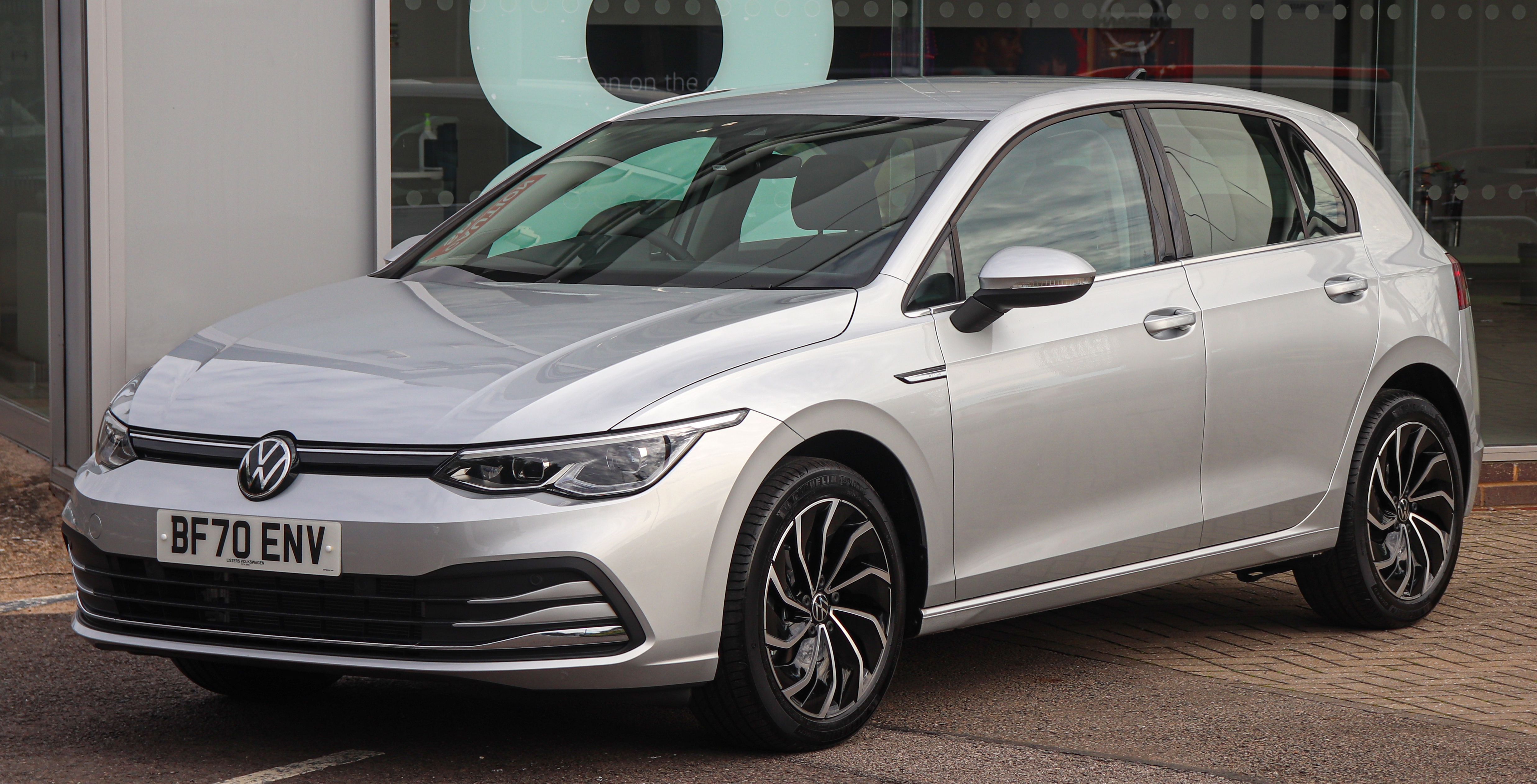
The Volkswagen Golf is a compact car made by Volkswagen. The podcast is talking about sporty versions like the GTI, which are meant to feel more exciting to drive than a regular model. They’re likely discussing a recent launch or update for these cars.
A manual transmission is the kind of car where you change gears yourself using a clutch pedal and a stick. Some drivers prefer it because it feels more connected to the car.
A trim level is the “version” of a car you buy, based on what features it includes. Here they’re trying to figure out what the simplest WRX version is called.
LIVE
Every team, every topic, everywhere. This is Belize.
All right, this is the Consumer Guide Car Stuff podcast, and I am Tom Appel, publisher of Consumer Guide Automotive.
Thank you so much for joining us today. When you have a chance, do check us out at consumerguide.com.
While you're there, you can check out our 2026 Best Bypix, and you can check out back episodes of the podcast right there on our homepage, though you should subscribe.
Online with us today, Jill Simanillo. She is contributing editor here at consumerguide.com, North American Car of the Year juror, and a freelancer. Jill, how are you?
I'm doing pretty well. How are you?
I'm doing good. I'm doing pretty good. It got hot today, and now I've closed my office door, so I will be getting cranky over the next hour.
Aren't you normally just cranky? So you're getting crankier?
Yes, I will be getting crankier.
Got it.
Go ahead.
As you say, did you get caught in the rain at all this morning, the downpour, the deluge?
Yeah, I had two cars to swap, so some rain was involved.
Yes.
Also, we're going to be talking a little bit later about the lucid gravity. I did something bad, and I didn't know I did it.
Oh.
But I left the keys in the vehicle in my driveway.
Uh-huh.
It locked itself.
Yup.
The lucid gravity locked itself.
With the keys in the car?
What kind of does that?
That's a known problem on the lucid, air and the gravity. So did you download the app?
I don't know what happened.
But did you download the app?
No.
So by the way, I had app access when I had the gravity, and I was able to unlock the doors with the app.
Hmm. All right, we're going to talk about the lucid gravity a little bit later on.
We have birthday greetings. Steve King, WGN radio of Steve and Johnny Fang shares a birthday, the exact birthday with Mick Jagger.
Okay.
So happy birthday, Steve King.
Later in the show, Jamie Butters, who goes by veteran auto journalist with that wildly oversimplifies his resume, I think.
Uh, just started a new show, a new program called, uh, what's it called?
Autotown.
Autotown, yeah.
Autotown with Jamie Butters.
We'll be talking about that and getting his take on the crazy stuff that's going on in the industry.
And there's a lot of crazy stuff going on.
There is.
But apparently the Gordy Howe Bridge is open.
I've heard a rumor.
I've seen pictures.
I know if you don't live in Detroit or Windsor, this is not a big deal to you, but it actually is.
This affects everything.
There's so much stuff that crosses that border in a day and in a month.
We'll talk a little bit about that later.
Okay.
Interesting future car thing and not that far in the future.
Apparently Rolls Royce is, I'm not Rolls Royce.
I'm sorry.
It says RR here.
Range Rover working on something called the GT.
Have you seen this?
I have.
I have seen, I have seen photos.
Um, so without describing it, like, does this look like a sedan to you?
No.
No.
No.
No.
It looks like a sedan to me.
It makes me think of the Range Rover Evoke.
I guess this is much bigger and much more expensive than that vehicle.
But I guess, I mean, Range Rovers have been really good looking vehicles for a number of years now.
And this would be a lower sleeker version of the Range Rover, though it comes in a little cheaper.
If the estimates are correct, starting around 90 grand,
which is only, that's only a lot of money as opposed to a huge amount of money.
So, so much cheaper as opposed to the vehicle you and I drove recently that was $155,000.
Well, exactly.
This is actually cheaper than that.
So my question is, if this thing indeed is lower, it looks a little bit like a sedan costs less money.
Is it still going to be a good off-roader?
I can't imagine having a Land Rover that is at least not competent.
You know, I mean, even the Evoke, little though it is, is a competent off-roader.
I mean, it can't do some of the big heavy lifting that the Range Rover and Discovery and Defender can do,
but it can still do some hard things.
So, you know, maybe it'll be more along the lines of the Evoke.
I mean, even Jeep has some Jeeps that are not trail rated.
So maybe it'll be like an off-road capable but not trail rated vehicle.
Maybe, maybe.
I've often lamented the fact that Jeep builds things that aren't especially good off-road.
That seems to be the brand.
Yeah.
You know, and they were building things like the Compass that were never really that interesting.
Though the current Compass was available and I think it's still available in trail-hawk form.
And that's actually, I've driven that off-road.
It's surprisingly good.
You pay for it.
Yeah.
So anyway, that Range Rover is due maybe as a 2028 model.
It looks really good.
We don't know a lot about it.
It will be electric first and then maybe a gas hybrid later.
So it's one of these flexible architectures that everyone talks about.
Multi-fuel strategy.
Members of the media like to call it, or not the media, I'm sorry, the PR folk.
Yeah.
The marketing speak.
So Honda Acura going through a weird time, right?
We know the Acura RDX is going to disappear for a little while.
Yep.
And now Acura's volume car and that's their compact crossover.
It was getting a little dated but it was a heck of a nice car.
Yeah.
And they're going to miss it in their sales numbers.
It's coming back.
But now we learn, and this is not nearly so popular vehicle sales-wise, but still,
I think it's important to their lineup, the Ridgeline will disappear for a couple of years.
What's going on there?
You know, I don't know that we have too many details about what's going on there,
but I think the crux of the situation at Honda is they spent a lot of money building up an EV
architecture, infrastructure, not infrastructure, but putting a lot of money into EVs and then
canceled it at the last minute, at the ninth hour.
They canceled it.
And so, or I guess I say the 11th hour, they canceled it.
And so now they have all this money that they had invested someplace else that they can't spend
on the current infrastructure of vehicles that they have already got.
So I think this is a cross-cutting savings, kind of a lifeline for them where they're cutting back
on the Ridgeline, cutting back on the RDX so that they can pour money into other things.
And they're a little bit cash-strapped at the moment.
That's what I think.
I don't have any sources to back that up, but that's what I think is what's going on.
It is interesting to me that delaying the launch of a product by 18 or 24 months or whatever results in money savings.
And I guess you're saving launch money and marketing money and retooling costs for a little while,
but you're also not generating revenue.
I mean, fair.
But you're also not, you know, they're spending that money on building the Accord, the Civic,
which are, I mean, I don't know if they're more popular than the RDX.
You are more into sales figures than I am.
But, you know, also really well-selling vehicles.
And so it's kind of like you've robbed Peter to pay Paul, so Peter needs to go on a hiatus.
Well, you know, you hit an interesting point.
Every single Honda product sells well in the U.S. except for the pilot.
And I don't know how the prelude is doing right now, but that's such a special interest thing.
It doesn't matter.
And this vehicle is scheduled to come back.
One of the problems, too, is that they have not done development work on the engine.
This 3.5-liter V6 has been around forever, and it's a honey.
It's a sporty, wonderful sounding engine with a lot of willing revviness.
But ultimately, they needed to update that, and they didn't.
So they've got to get that set up, and they're going to bring it back as a hybrid, according to rumors.
So this was built in Alabama.
And to your point, Jill, they will be making more pilots and passports in that factory while the Ridgeline is out of production.
And for people who don't know, I don't know if we covered this.
The Ridgeline is Honda's midsize pickup truck.
It's about the size of an Nissan Frontier or a Ford Ranger, maybe a little bit bigger than a Frontier.
But it is a unit body construction vehicle.
It is not batting on frame.
It doesn't generate the really big towing numbers or payload numbers, though most people don't need them.
So a very interesting vehicle.
Actually, it's a light to drive.
I always thought it was the small pickup I would pick.
So, all right, we got that out of the way.
Real quick, we're going to talk about the Lucid Air.
I'm sorry, the Lucid Gravity in a moment, but I just got out of a car I wanted to talk about for just a second.
And we'll cover it in greater detail, probably, especially if you get it.
And that is the Corolla Cross Hybrid.
So this is Toyota's smallest crossover available in the U.S.
It's available with a hybrid drivetrain.
And I've had some issues with this vehicle.
One of them is price.
I think that relative to other small crossovers, it's a little expensive.
But I did just spend a week in this vehicle and hard not to be impressed by the build quality, the ride in handling,
and my freaking fuel economy.
I kept resetting it just to see what was going on.
I saw as high as 55, as low as 49 MPG, just driving around town.
That's insane.
That's wonderful.
Regular gas, 55 MPG, and the power is really good.
For people who don't know, the way Toyota does its hybrids is the correct way,
where there's electric boost right away from when you pull away from a light,
and it just feels like you're driving something with a bigger engine.
The only problem is that engine makes snorty noises that aren't well insulated out in the Corolla Cross.
But nice vehicle gets expensive.
The one I drove started at 35.
It gets very close to 40 with stuff, which is a lot of money for a small crossover.
But on the other hand, your resale value is likely to be very high,
and you're going to save money on gas.
Trade-offs.
What's that?
I said trade-offs.
Trade-offs.
Yeah.
I want to talk more about this vehicle.
I think when my daughter was looking for a car, we didn't look at it largely because she wanted something that was very sporty.
And something that was reasonably affordable.
And somehow the Mazda CX-30 comes in cheaper, which maybe it shouldn't.
I don't know, because it's such a good car with such a great nice luxury interior.
But anyway, let's talk some Lucid.
Are you ready?
I am ready to talk some Lucid.
So Lucid has been selling one car now for years.
Wait, I have notes.
I found them.
Since 2021, Lucid has been selling the air.
A large sedan that was very similar, I think, conceptually to the Tesla Model S.
And it had a very, very broad price range that it was covering.
And at the moment, prices started $72,000 and go to $251,000.
It's crazy talk.
And that's a lot of work for one car to cover.
Yes.
Can you really make the interior that much nicer?
I know they upped the horsepower a bunch, but anyway, they needed another product.
And that product is the gravity.
And you just drove that?
I just drove that?
Well, I drove it this winter.
So it's been a couple of months since I drove it.
But I liked it.
I mean, I will say I did have a couple of early production software glitches that I don't think
current owners will have, but well, except for locking your keys in the car.
But no, no, I was on the phone with you.
We'll talk about this in a second.
I had a glitch.
Yeah, you did have.
I had to do a hard restart on the vehicle.
When I first got it, I had no sound.
So like the radio sound wasn't working.
Like you turn on your blinkers and you couldn't hear the blinkers.
I tried to call my husband and I couldn't hear him.
I think he could hear me, but I couldn't hear him.
And then, you know, it was just so I contacted Lucid and I was like, I don't know what's going on here, but I don't know what to do.
What do I do?
And so like I had to perform like a control, delete, like hard reset on the vehicle.
And then as soon as I did that, everything was fine.
Yeah, I ran into two situations.
We should describe this vehicle first.
This is a midsize crossover.
That's a little bit more focused in terms of its market segment target starts at 81,000 550 goes to 141,000 550, which is still a huge range, right?
That's 60 grand of spread, but you do get more power and more range as you climb that.
But it's a midsize crossover with an extremely generous cabin.
That is a roomy cabin.
It is a good looking vehicle, really nice interior.
Fantastic ride and handling.
Very quick lot here to like and just some quirkiness about it.
Trying to do something like adjust the outside mirrors made me suicidal because I forgot how I did that.
I forgot how I did that in the Lucid air, but you don't do it via a switch on the door or the door handle.
You have to go into the touchscreen and find this and then activate something and then use controls on the steering wheel.
Now, you don't do this often.
I understand that, but it's irritating.
Yeah, yeah.
Well, you know, and so funny, funny story, true confession time.
I was a passenger in a vehicle not so, you know, not too long ago and we were driving through a town and the speed limit dropped and a cop was waiting for us and we got pulled over.
And so I'm in the passenger seat and my friend who is driving and it was a press car and this person was also a journalist.
She had her purse in the back and so the cop comes up and she's like, can I get my purse out of the back?
And he said, yes.
And he's like license and registration.
And so I'm trying to open the glove box and I cannot freaking figure out how to open the glove box, which I think is also through that central display.
And there's no button.
And so I'm like going through all of these menu screens and I'm like, sir, I really, I really apologize, but I cannot figure out how to open the glove box and he looks at me and he's like, what?
And I'm like, the registration is in the glove box and I cannot figure out how to open the glove box.
And he's like looking at the screen.
I'm looking at the screen.
I'm pressing all these buttons.
I'm like, there is no actual button to open this.
And he was like, you know what?
I'm going to give you a warning this time.
So we got out of a ticket because we couldn't figure out how to open the glove box.
I don't think that will work ever again for anybody ever.
But yeah, I was just like, okay, thank you for the warning, sir.
Wow, I'm writing that down.
Yeah, so I got boxes.
I was talking to you on the phone.
We were leaving Superdog Chicago's legendary hot dog stands Superdog on the extreme northwest side of the city, which we'll talk about later.
We should talk about Superdog.
Yes.
But as I was leaving there, I lost throttle response.
Right.
The car stopped responding to inputs from my right foot and like what is going on.
And then a light came on and on the left side of the dashboard, the entire front of the car as represented in an animation is glowing red.
And the message reads hood open.
Well, I didn't do anything with the hood.
Why would the hood open as I was crossing Davon?
It was very weird.
So I pulled over and I had to get out and slam on the hood.
Like I tried turning it off and turning it back on.
So I don't know what happened.
It didn't feel like it was open.
It didn't look like it was open.
Pretty sure I didn't do anything accidentally with the key.
And then later on, I had the exact same thing happen for no reason where I lost throttle input and very frustrating.
And then I stopped the car and started then it reset.
Well, because I know that the front trunk is opened with a button on the screen on the left side.
So I don't know if like something could have accidentally tapped that.
I don't know.
But outside of our glitchiness, what did you think of the vehicle?
It's fantastic.
It's exactly what they need, except what they really need is something more affordable.
We've talked about Lucid and its dire financial situation and they're losing a lot of money.
And even the Saudis that have invested in this company, not super interesting and dump it more money into this company.
So we don't know where Lucid is going.
And what they need is a vehicle they can sell in volume and make money on.
And I know they went higher than I think they expected to price wise on this car just to generate cash.
But it's not selling in huge volume.
It's doing about 50% the volume of the air.
So that's good, but it's not great.
And last year they sold 16,000 cars.
That was up 600 from the year, 6,000 before the year before that, which is about 20% more than the year before that.
So sales are growing, but slowly.
So it's time to just sort of wonder about what's next for them.
Now they've got a couple of cars coming.
We know that Rivian is doing something called the R2, which I think is on the road, at least in prototype forms or test vehicles, which is a compact crossover.
And that's really what Lucid needs here.
Lucid's got a product called the Cosmos that's coming soon.
And then they've got something called the Earth, which I've reading different things about what the Earth is, but I think it's like a Broncos sport, which is a good size for them.
And if they can get that to market around 50 grand, that might work for them too.
But I like the vehicle a lot.
It presents well.
It looks really well put together.
Really nice materials.
Oh, oh, and the crazy ass glass roof.
Yeah.
The glass goes really far up the roof in the vehicle.
So you have this contiguous windshield and your sun visors are actually mounted to glass in the roof, not to, you know, fabric or anywhere near an A-pillar or, you know, a frame or anything.
So that's a really cool look.
My wife was impressed by how modern that looked.
I think that's something that you're either really going to like or really going to hate.
My husband hated it.
He hated it.
Yeah.
Interesting.
Yeah.
But I mean, I had that car, you know, a few months ago, took a road trip to Indianapolis in it with my parents in law in the back, and they loved it.
And, you know, I will have to send you my video review to link to this because I actually have my parents in law on camera with some of their driving impressions.
But, you know, I thought it was really great for a long drive, you know, because of the, you know, extra range, we didn't have to stop and charge.
It did really well on the highway.
I just, I thoroughly enjoyed my test time in that other than, you know, the control out delete situation.
Yeah.
We didn't talk about the range, but the range currently ranges from 337 to 450 miles, depending on how you equip the vehicle.
Right.
450 miles.
Dang.
It's nice.
That's nice.
Yeah.
I didn't have to think about it all week.
No.
All right.
Your final thoughts on the gravity?
I think that it's a really great electric SUV.
I think that it is a little bit higher priced, but you get a lot of luxury features for that price tag.
It's comfortable in the front.
It's comfortable in the back.
If you equipped it with, you know, the optional third row seat, that's not so comfortable, but doable in a pinch.
And you have plenty of cargo space.
And with the extra range, I really think that it is a viable EV for longer drives.
You also kind of get a vibe of this being an exotic vehicle, just a little bit, which is kind of cool.
It's kind of nice.
All right.
We're going to take a break.
When we come back, we talk to Jamie Butters.
He's the host of Autotown.
Stick around.
Questions or comments?
Drop us a line at carstuffatconsumerguide.com.
That's carstuffatconsumerguide.com.
Welcome back to the Car Stuff podcast.
And we're back.
This is the Consumer Guide Car Stuff podcast.
I'm Tom Appel.
She is Jill Simonillo.
Jill.
Hello.
Jill, one of my favorite guests has joined us today.
I think this is his second or third visit on the show.
And I have good news.
Okay.
I like your good news.
Jamie Butters, who used to host the
Daily Drive.
Thank you.
He's back on the air.
Yes.
So this is all very good.
Anyway, Jamie, welcome to the show.
Thank you.
So glad to be back.
You have had a very active career the last few months, the last couple of years.
But it's really cool to hear that you've got a new show.
So before we do anything else, tell us about your new project.
Dude, it's always fun.
My new show.
Okay.
So I left automotive news about a year ago.
Went to the Wall Street Journal.
It didn't go great.
I was on my own trying to figure out what to do.
Started bootstrapping some stuff to support this concept for my own show called
Autotown.
And it's always fun in Autotown.
But today is an exceptionally good day in Autotown because we have merch.
Oh, we don't even have merch.
No, we don't have merch.
Actually, I have a one off t-shirt.
My daughter made me.
That's pretty cool.
Yeah.
Yeah.
But that's not real much.
So that's on the merch.
Thank you.
Super exciting.
So much fun.
But no, it's it's I've seen on Saturday mornings on WJR.
Great voice of the Great Lakes.
50,000 watt Detroit station.
760 AM Saturday mornings at 7 AM.
Then I also do a midweek podcast that's on all the regular, you know,
podcast places and the, I mean, the WJR show as soon as we air it.
I post the show to all the platforms.
So all the audios out there.
I was fortunate enough, Tom, to have Jill on as a guest.
Oh, wow.
Wow.
Back.
And that was a hoot.
And we got to collab as they say on the socials and good times.
Well, cool.
So tell us about the show a little bit.
Now you've got the broadcast show on the radio, the midweek show.
Is that also called auto town?
It's also called auto town.
So there's auto town radio and auto town podcast.
It's all on my little brand.
And so the concept of the show, right?
It's auto town.
We want everyone, everyone to be represented.
All the constituencies to be reflected.
First block we do.
I call the drive around the block and guest co-host and I talk about the news.
We stop at the coffee shop.
That's the interview segment.
So, you know, you sit down in your little auto town coffee shop.
Then we go browse the dealership lot.
That's where that's where we usually talk about product.
But sometimes we talk about the retail world.
What's going on with dealers and what's going on with customers, right?
And what they need to know, what they need to be thinking about.
And then the last block is the town hall and where we try to get audience engagement.
I do a poll online each week and ask people a question.
This week we're talking about, oh my gosh, Jill, you could go off on this for a while.
We're talking about interior, you know, infotainment controls, you know, all screen,
all buttons and knobs, a combination.
What's the right, what do you want as a consumer?
That's kind of, that's this week's question.
And people can answer that right now, right?
That's right.
It's on all the socials.
I finally convinced Metta that I'm not a bot.
So I can actually put polls on Facebook and Instagram that will stay up for more than 24 hours.
So that's fun.
And no, it's great.
People can vote.
They can leave a comment.
I've been known to read some of the comments and comment on the comments.
Good times.
Never commit to reading the comments.
I'm not saying I always will.
I appreciate the input.
I always commit to reading the comments.
Yeah.
So I stepped into the middle between the crossfire between the two of you.
I get it.
There's constant crossfire.
That's okay.
So talking about product seems like a thing that we do less and less unfortunately, right?
The big topic now is affordability.
How long car loans are getting interest rates are super high.
And now the big conversation last few weeks has been about how much, how far underwater customers are.
And I sort of miss talking about actual product.
But where are we in your opinion on this affordability issue?
Because it looks like we've eliminated.
Let me just, let me just yammer for another moment.
A million vehicles.
Yeah, that's my question.
I mean, that's the rough number, right?
We've lost about a million new vehicle sales.
The data in the industry, and I would say throughout the economy, has been so chaotic over the last decade or certainly from COVID times on.
So even less than a decade, but it's just been so bizarre.
So the current thing, the thought leadership position right in these days is to argue that affordability is not such a big problem in autos.
Yeah.
And then they were 10 years ago and probably you could make the same case on a F-150 or something like that.
But the problem is, okay, compared to everything else, car prices have only gone up about the same.
Maybe they went up extra more during COVID and then kind of flattened out for a while.
But the cost of insurance has gone way up.
The cost of maintenance or repairs has gone way up.
And of course, the cost of everything else has gone way up.
So consumers are really strapped and that new higher car payment may be in line with inflation, but inflation that ran away from us for a while.
That still makes it really expensive and it's priced a million people out of the market each year, which has put more pressure on the used market, which is driving up prices there.
Yeah.
So two questions for you.
One, having to do with affordability and technology.
So consumers have access to greater technology than they've ever gotten before, but it's more or less being forced on them.
The suite of safety systems that comes with cars now that's mostly standard, raise the price of cars a lot.
And I'm not 100% convinced most shoppers see the value in all of that.
So it becomes an affordability issue simply because I think they believe they're being sold something they don't actually want to purchase.
And then part two, which is completely unrelated, no hybrids, higher prices.
General Motors is kicking ass profitability wise.
How is that happening?
It's trucks, right?
It's trucks and they're losing less money on EVs because they're not making them now.
At the same rate, they don't have the encouragement to keep investing in that.
They were on a path to break even, which is the way to get to profitability is first through break even with all those incentives behind.
Remember, it took Tesla a long time to become a break even company.
And even then people disputed it or would try to back out the money they got from the government.
But hey, they got that money.
So that counts.
But it's a tough game.
GM seemed to be close to cracking it.
Now the game's shifted.
They've shifted with it.
We joked last time.
Actually, it was last time I was on with you guys.
We don't usually think of GM as nimble.
But here they are coming right back with three new gasoline powered Cadillacs because that's going to be the law of the land for at least some of the next several years.
They know how to do that stuff.
They can turn those around.
They can get them out in the market, gain some market share, make some money and then figure out whatever they might have to do to help the world deal with climate change or maybe changing consumer taste and competition.
GM sells a bunch of different EVs from different brands.
Can they sustain the relatively low volumes that they're doing now?
I haven't crunched the numbers enough to give you a definitive answer.
But it does seem like it would be challenging.
You look at Cadillac.
If you look on Cadillac.com, like I said, they're just adding three more gas powered Cadillacs, but they list eight EV models on Cadillac.com.
And so, you know, obviously the Celestic at its elite level is never supposed to be a big volume.
You've got these and you've got a but, you know, that's a that's a lot of names.
That's a lot of variability to carry on what's still going to be relatively small volume.
And if you think, you know, GM overall, they're going to have nice volume with the bolt, but that's only for a little while.
You know, the equinox then becomes the entry level and we'll see how many of those they continue to supply if they don't feel like they're making money on them.
Jamie, reminder listeners, why is the bolt a short timer?
Oh, now you caught me on that one.
They only have a little bit of time.
They have basically a year and a half at that factory before they're bringing in something else.
Is it the new equinox, the next next gen gasoline equinox or something that they're going to make?
They have a product that's assigned to that plant.
They kind of had a window to bring it back.
But the big Orion plant up in, you know, north of Detroit was going to be all EVs.
It was the original home of the bolt.
That's going that's going to pickups.
It's going to be full size pickups.
And that's where GM thinks they can make money now.
And the workers there want to make products that are going to make money for GM because that's their job security.
I'm digging the bolt commercials about how they teched up the vehicle.
And they simplified the lineup, right?
There's no longer like a crossover that didn't really look like a crossover version.
But is it $28,995?
Is that the advertised price?
That sounds right.
It seems like a screaming good deal.
Yeah.
I mean, that of course doesn't include destination, you know, fees and handling, shipping and handling, such like that.
But yeah, it's a great deal if you can find one.
And if and if you've got home charging, you know, I mean, and I'm not saying, I mean, look, the bolt has decent range.
If you have charging at work that you can even get to once or twice a week, probably going to be fine.
But I always say, I mean, really, EVs are best for, you know, families with a garage and a, you know, two to four vehicles.
And they can easily work in one or two EVs that they can charge at home and can come out via really beneficial economic play for them.
If they're in the comfortable situation to be to accommodate it.
Yeah.
All right.
So out of curiosity, I just like, I haven't seen the bolt since it's been back.
Did they change it much?
Or is it essentially the same vehicle that left the market and then they just brought it back?
I haven't gotten a lot of time with it either.
But the point was they were going to bring it.
There's the comes there's some complicated branding involved.
But when they said they were bringing it back, it was that they were going to bring it back on the Altium platform.
And then they D branded Altium.
Right.
So that's no longer really a thing for them, partly because that was, I think, ultimately comes down to the fact that that was a joint venture with LG.
And now they're not just working with LG.
So that got a little mucked up.
And then, but it is still it's a lithium ion battery.
I mean, they didn't go to, you know, like, like Ford is planning to go with lithium iron batteries that are, you know, the cheaper, not as fast charging, but more durable, you know, there's trade offs with all the
chemistries. We know there's a lot of progress trying to be made as companies try to figure out how to do this business profitably.
And look, we talk all the time about China.
I don't know much you do.
We hear in Detroit, people talk about China all the time.
Yeah, China is a huge competitive threat, but almost none of those companies make money.
You know, they have a really grossly overcapacitized market.
And they need to dump those vehicles on other markets and cause trouble for Europe and other places.
But, you know, these are not healthy companies, fundamentally.
So it's, it's messy.
Yeah, we don't talk about that enough.
We don't talk about the debt that these Chinese companies are servicing the amount of aid.
They got to be where they are from not only the federal government over there, but from prefectures and states and even cities.
So they kind of cheated along the way.
And, and they're, they're at a place where maybe they can't sustain this stuff, selling these vehicles as cheaply as they do.
It's, it's complicated, like we said, you know, it is, I think there's, from a Western perspective, it is like a systemic cheating.
And you do wonder, are they cheating themselves?
You know, you know, with these, with the prefectures and the cities funding, providing capital to companies that can't really compete, that aren't really making money, but they provide jobs in the region.
And, you know, and that's important for maintaining the peace.
You know, I don't think we really want to see China collapse into chaos either.
For the sake of the world or the global economy or the auto industry.
So, you know, it's, it's complicated.
But yeah, they need to find a way to let their industry, you know, get reconciled into something more economical, or else they have to just destroy the rest of the global auto industry.
So big news, speaking of China last week, or was it the week before?
And that said, Ford is going to share its Valencia Spain production facility with Geely, which some people are, there's a lot of, this guy is falling talk here about this.
This is a Trojan horse for China to get into Europe, but China seems to be getting into Europe just fine anyway.
What do you make of this deal?
Yeah, it's, it's curious. And I would love to have been a fly on the wall of Ford's internal meetings about it.
I think, I mean, I don't think you can, it's strange to say that this really lets China into Europe, because they were already getting in a lot through imports.
And the last thing they need is more capacity.
But obviously Ford had excess capacity, they weren't able to utilize this plant.
I think, you know, they couldn't really get their partners like VW or Renault to use it more because they're overcapacitized facing, you know, an influx of Chinese competition.
And maybe it's an act of desperation.
I would love to think sort of like with the battery plant they're doing with CATL is you can sort of do a jujitsu, a reverse power play against like what China did to the West of saying, hey, we'll work with you, but we've got to be the majority partner.
And we need to see all your technology and we need to figure out what you're doing and be able to gather.
Say steel, but learn from that and then turn around and compete with it.
Right. I mean, if that's what you need to do to learn the battery chemistry, you know, that is fundamentally comparable to BYD.
If that's what you need to learn to do the manufacturing that's competitive with a Geely or a BYD, the best, not the state owned enterprises, but the best independent, more capitalist minded Chinese automakers, you know, maybe that's the way to do it.
But also with Ford, they already did their universal electric vehicle.
They're, they're still project is like they've already kind of planned to make the leap forward.
I mean, now you're going to second guess yourself, but I don't know.
Maybe they think they can still learn something from that as they obviously they're going to learn on the process with the UVV as well.
So, you know, you have to hope they're not, you know, doing.
We saw some hot rhetoric, right, that they were helping the Chinese, you know, to kill the global economy, global industry.
The thing is, Geely doesn't need more capacity.
You know, they're almost doing this as a favor for Ford.
Maybe, you know, maybe they'll end up trying to take over that plant and that'll give them a foothold that makes it harder to keep to restrict Chinese vehicles.
But again, sort of like we heard here today, you know, President Trump's here in Michigan and a UAW member who's long been a fan of the president.
You know, got up there and said, you know, as long as they make it here, you know, if they want to sell here, they got to make it here.
And I think there are a lot of companies that don't feel that even if the Chinese made it here, that that would make it fair.
But that is a simple way to build the process to label it.
And if they start making it there, if they start making it in Europe, it makes it harder for Europe to kick out the Chinese.
Yeah, interesting.
Jamie, we've run out of time, but tell us more about your show.
Oh, my gosh.
We're just having so much fun.
We've had, like I said, we have these guests we were about two months in.
I've done, we've done 10 episodes on the radio now.
The 10th podcast episode is set to go live this week.
And this week's show, I've got Keith Naughton from Bloomberg, my old Ford reporter.
He's about to retire and I need to catch him before he rides off into the sunset.
He just ran his first Boston marathon, Jill.
I don't know if you knew that had been a bucket list thing for him.
He got to do with his son, who's an amazing runner.
Keith's going to be my guest co-host riding shotgun this week.
We're going to be talking about the Jeep Cherokee.
And we've got a labor expert on to talk about, you know, the Ford Unifor deal.
And of course, the rest of the Unifor negotiations and what's to come with the UAW.
So check me out on all the platforms, AutoTown or AutoTown with Jamie Butters.
And I appreciate you guys spreading the word and look forward to having you back on AutoTown.
Delighted to have you join us.
I've really enjoyed listening to your podcast.
I like your format a lot. It's very fast-paced.
And, you know, there's not a lot of room to, like, get bored.
You're always, like, on to the next thing and you've got a lot of great guests.
So including me.
Including you, of course.
You've had a lot of great guests.
And so I really, like, if you were looking for another automotive podcast,
and I put the Royal U out there, I think the AutoTown is, like, a great, a great addition.
Thanks, Phil. Appreciate it.
Jamie, thank you so much for your time today.
Thanks, Tom. Appreciate you having me on, buddy.
Oh, my pleasure. That was Jamie Butters with AutoTown.
We're going to take a break and when we come back...
Quiz time.
Quiz time.
Questions or comments?
Drop us a line at carstuffatconsumerguide.com.
That's carstuffatconsumerguide.com.
Welcome back to the Car Stuff Podcast.
And we're back.
This is the Consumer Guide Car Stuff Podcast.
I'm Tom.
She is Jill.
Jill, good to talk to Jamie again.
Yeah, yeah.
As you said, he is one of our favorite guests.
He is just so fun to talk to and really knowledgeable.
Well, he's one of those guys, like Sam.
Mm-hmm.
They just have so much institutional knowledge
and they've been following this industry because they love it.
Yeah.
That it's just so easy to hear them talk about it.
And whatever it is they're sharing and their opinions,
they're like totally worth knowing.
Yes.
So yeah, cool to talk to Jamie.
Good luck with AutoTown. People should check that out.
After they listen to our podcast,
then listen to Jamie's podcast.
Yes, yes, of course.
All right.
Social media, you do that.
I do.
I do do that social media thing.
Yeah, you can find me on all the socials.
I post new video every day to YouTube and TikTok.
And I am on Instagram fairly prolifically as well, Facebook.
What is it?
X Twitter and threads and blue sky.
You can find me at Jill Siminello and I use the hashtag
Cartageur.
So if there's a social medium that I'm not on,
that I should be on, I would like to know about it.
So reach out to me and let me know.
I just posted my monthly mystery show on Facebook,
which is something we discussed on Nick DeGilio show.
And I'll be on Nick DeGilio show next Tuesday.
Special thanks to Tori Ryder at WCPT.
People who don't remember our show used to be live on W, not live,
but broadcast on WCPT.
But Tori had me on to talk a little bit about Tesla this weekend.
And we talked about Tesla finances.
Okay.
So the topics I have to keep on top of.
All the things.
All the things.
I am Car Guy Tom on Twitter and X if you want to follow me there.
Some pretty good car spotter finds this week.
All right.
It is quiz time.
Okay.
All right.
Today's topic is the easiest one ever.
Which means I'm going to get zero out of six.
Well, it's conceptually easy.
The topic is 2026 cheapest car exclamation point.
Okay.
I'm simply going to give you two vehicles.
And you have to tell me one has the cheapest, most affordable base price.
Okay.
So the entry point for that car.
Are you ready?
I was ready as I'm going to be.
All right.
Nissan kicks.
These are all 2026 Nissan kicks are Chevrolet tracks.
Which one starts the lowest?
That's, that's tough.
Also, I learned doing this that base trim level names suck.
Yeah.
Well, you know, I think a lot of trim level names suck.
So let's see.
So there isn't a single good one on this list.
No.
Man, I really like both the kicks and the tracks.
Yep.
Excellent.
The tracks is front wheel drive only the kicks offers all wheel drive.
But I believe, you know, base is front wheel drive.
You know, I think I'm going to go with tracks simply because it's a simplified platform
because it doesn't offer all wheel drive.
So I'm going to go with tracks.
It is.
And by a fair amount of money, it's 23495.
Okay.
So 235 kicks is 24275.
And I think that if you're shopping in this price range, 750 bucks matters to you.
Yeah.
I think you're correct on that.
Yeah.
And the tracks, they're both great vehicles.
The tracks offers, I would argue, better ride in handling and more cabin space.
The kicks has the much nicer interior and more standard equipment for the money.
And more available features.
I feel like on that vehicle, including all wheel drive.
I can't remember the brand of audio system, but it's very good.
If you order a top trim level.
All right.
You're on the board.
You have one.
Number two.
By the way, I think it is.
Thank you.
I don't know.
Honda Ridgeline.
We discussed it earlier.
Honda Ridgeline or Nissan Frontier, which one starts more affordably.
Oh, well, the Honda Ridgeline is certainly the simplified platform with unibody construction.
Hmm.
But I don't know if, well, the Frontier has really good base option.
And I mean, I will say, I feel like the Ridgeline, even though it's unibody construction has more bougie features.
And it definitely has a better, like overall ride to it.
Doesn't have that truck light feeling.
Shared platform with passport and pilot.
Yep.
I think would help reduce costs.
Gonna need an answer.
I know, I know.
You're going full Colombo here.
I'm trying to get you to give something away here.
You know what?
I'm going to go with Ridgeline.
No, and not even close.
The Ridgeline just starts well equipped.
The Ridgeline starts at $42,290.
The Frontier has a model that starts at $33,895.
Wow.
Yeah.
Wow.
Part of the reason the Frontier is a consumer guide best buy for 2026 is you can get into a pickup for around $35,000.
If you could find one equipped like that.
Right.
You might not order it.
All right.
You have one point.
Number three.
Okay.
This is a good one.
The Grand Highlander.
That's Toyota's big three row crossover.
Or the Chevrolet Traverse.
General Motors' big three row crossover.
Ooh.
I just had the Grand Highlander, but it was like the top tier bougie limited trim.
That stole all the Highlander sales.
Yeah.
It didn't cost more.
I mean, about a thousand bucks more, but so much more useful.
I feel like the Grand Highlander has more usable cargo space and a better third row.
It also has a lot more standard safety features.
I feel like Chevrolet is still on that.
Everything's an option kick.
You know, your base vehicle doesn't get the up-level features, which would help it cost less.
I just reviewed the Traverse and I cannot remember if they did that or not, but it's common on GM products,
especially Chevrolet products, to lump a lot of valuable ADAS, advanced driver assistance systems into a package.
Yeah.
And dealers can decide whether or not to stock those.
Yeah.
I'm going to go with Traverse being less expensive.
It is $42,795 versus $43,895.
So about a grand.
Okay.
There we go.
I like the Traverse, but the drivetrain wasn't great and interior wasn't great.
Yeah.
Interior material quality.
I didn't love the engine on the Traverse.
No, it needs a little magic.
Yeah.
Something.
Someone needs to dump some motor honey into that thing.
All right.
You've got two out of three.
You're doing fine.
The Honda CR-V or Hyundai Tucson.
Ooh.
Because Hyundai has gone a little bit upmarket lately.
Mm-hmm.
Neither of these are hybrids.
Okay.
These are just base models.
Hmm.
I mean, because, I mean, you always used to go to Hyundai as the value leader.
And in many instances, I think it is still the value leader just with all of the things
that you get included for the price.
But that doesn't necessarily mean that they are contented the same.
Um.
The Hyundai, the Hyundai Genesis value play maybe played out.
Yeah.
Yeah.
They're still, they're still, the pricing is still compelling, but they're not bargains
anymore.
No.
No, no, no.
They're definitely not bargains anymore.
I mean, just.
They're great.
Yeah.
Um.
CR-V or Tucson?
Good.
I need an answer.
You keep telling me that.
I'm going to, to go with Tucson.
As the cheaper.
Yes.
Yeah.
By a fair amount of money, 31050 versus 32370 for the CR-V.
So the CR-V is a solid 1200 bucks more.
All right.
So you have one, you have your three.
We didn't really go through the rules, five questions plus the bonus question three for
a victory.
We play with the bonus question even if you don't need it.
Yes.
Also the bonus question always related to the topic of the day.
Always.
All right.
I've got a good one here for you.
The golf GTI or Subaru WRX.
Oh, um, you know, they just launched a new base model of the WRX with a manual transmission.
I don't think they did that as a 26.
So I wouldn't know.
I don't think it's for sale yet, but, um, but I was very excited to see that.
Um, I saw some posts on LinkedIn over the weekend and I was like doing a little happy
dance.
Do you know what the base WRX is called, what the trim level is called?
Probably something stupid.
Is it just base?
It's base.
The GTI with the exciting S designation, S and base.
Um, okay.
So WRX versus GTI.
I feel like they just moved the production of the WRX away from America to back to Japan.
So that could have some tariff ramifications, but you know, the, the golf isn't the GTI is
not built here.
Um, because I would have formally said WRX is probably less expensive, but I don't know
if that's the case anymore.
Um, I, you know what?
I'm going to go with it.
I'm going to say WRX is cheaper.
Yes.
It is 33, 690 versus 35, 865.
And part of that value, if you want to call it that comes from the fact that the WRX is
also all wheel drive.
Yeah.
Yeah.
So you're getting, you're getting more power from the WRX and you're getting all wheel
drive.
Uh, all right.
You got four out of five.
Nice job.
Bonus question.
You're a big music fan.
You and I have a lot in common when we talk about music, so much in common.
How well do you know the monkeys?
Okay.
Ironically, um, when I was a kid, um, the reruns of Hey, Hey, they're the monkeys used
to be on Nickelodeon and I used to, I used to watch that on Nickelodeon.
So I don't know if I remember any of it, but I do know who the monkeys are.
Yeah.
The monkey show used to wear my patients thin, but I watched it for a while, but they were
accidentally a good band.
They were thrown together for the purposes of the show, uh, sort of a weird response to
the Beatles and a weird kind of half-assed response to the Beatles.
But yet the band worked out.
I mean, they, they recorded some great music and they've been entertaining people for years.
Uh, last train to Clarksville, stepping stone, little bit me, little bit you, big hits for
these guys.
And they turned out to be pretty cool.
I need you to tell me which of the following is not a member, which person is not a member
of the monkeys.
Are you ready?
Yeah, this I'm probably not going to know, but let's, let's go for it.
All right.
Davey Jones, Mickey Dolan's, Peter Tork or Michael Belanduk.
I know Davey Jones is that is the one I know for sure.
All right.
He was cute.
Adorbs.
Yeah.
My, my like 10 year old self, I'm sure had a crush on him.
Um, okay.
So who are the other three?
Mickey Dolan's, Peter Tork, Michael Belanduk.
The last two names don't sound familiar to me at all, but Mickey Dolan sounds familiar.
So I'm going to make a guess that maybe he was also a band member.
All right.
Um, okay.
So what were the last two again?
Peter Tork, Michael Belanduk.
Would they have both a Mickey and a Michael?
Um, I'm going to go with Michael as the fake, as the not Michael Belanduk.
Yeah.
Yeah.
He was the mayor of Chicago before Jane Byrne.
The actual fourth member was Michael Nismith.
Nice job.
If you were here, I would autograph this and hand it to you.
So they would have had a Michael and a Mickey.
Interesting.
Just not that Michael.
They would have.
So nice job on the quiz.
So, uh, Friday, Friday, you and I and, and producer Margaret and her husband went to
Superdog.
We did.
And years and years ago, we had the folks from Superdog on the show, but we
haven't talked to them in a long time.
But it was just nice to go there and still have this place be what it is.
And, and for people who don't know, Superdog was established in 1948.
It was a hot dog car to hot dog stand.
And then eventually a full blown drive-in restaurant.
And it just oozes charm and the food is good and it smells fantastic.
And it's just, there's a lot there to love.
And we didn't eat in the car, which is probably fine because it was so nice outside.
Right.
It was a nice evening.
But you do the traditional thing is to go there and eat in the car.
And one of the things that happened was that, um, COVID kind of ruined that
experience because they don't do the trays anymore, which was fun.
Yeah.
But I mean, the idea is you pull up into a parking space.
There's a speaker outside the window and, um, then you, um, place your order and
then they bring your food out to your car.
And, uh, you know, it's funny because I pulled in and I saw, like, I'd never
been to Superdog before and I pulled in and I like saw.
How is that possible?
I don't know.
I don't know.
Um, but I saw all the parking spots with, um, the, the things that I didn't
want to pull into a parking spot because I saw you guys sitting at the picnic bench.
So I like drove straight through the parking lot and I was like, I, I don't,
I don't know what to do here.
And so like literally had to circle around the block and I parked on the street.
And they were like, no, you could have actually parked in one of those spots.
And I'm like, but I didn't want to take up a space for somebody.
So, ow.
Yeah, it was still kind of hopping because we met at seven 30, I think.
Yeah.
Yeah.
And they were still doing some business, but that place has been around forever.
And it's wonderful place to just hang out and it smells great.
And, and then they opened a new one, which is gigantic, just further down Milwaukee
Avenue, uh, in Wheeling, Illinois.
A lot further down.
Yeah.
And that's kind of, I think between 15 and 20 years now, and it struggled at first.
I remember we were talking to the owner and I don't know if we did this on the
podcast or I interviewed him or something, but kids don't cruise anymore.
Right.
They don't go out in their cars and hang out and then end up at Superdog,
which they really should do.
So the nature of the audience out in the Wheeling, the suburban location is really
more family.
Yeah.
You know, kind of a destination thing, but that was good.
So how was your food?
You know what?
I really enjoyed it.
I had a Superdog with mustard and onions, no ketchup in Chicago.
And, um, you gave me one of your like pickled Tomotillo things and that was
lovely, um, you know, the, the French fries were nice and crispy.
And then we had, um, you know, to share on the table, we ordered a couple of, um,
like the fried bites or, uh, like the onion rings and the veggie bites or
whatever.
And those were also quite lovely.
Super veggies and then onion chips.
And here's the thing about the super veggie and you got one.
They call them super veggie, but there's like little wads of cornpone in
there that are, that are magic.
And if you go there, to Superdog with my daughter, those will disappear.
They will magically just disappear from the box.
So, Hey Margaret, can you check in?
You, you had said something interesting.
Uh, you, you had a hot dog, a Superdog.
They correct you if you say hot dog, but you said you didn't like the burgers there.
I'm not a fan.
No, if you want burgers, go elsewhere.
Um, their strength is super is, uh, are the hot dogs.
Yeah.
And they are fantastic.
And for people who don't know, presentation is everything.
The dog comes in a box with a wonderful presentation of crinkle cut fries.
And those are some darn good fries.
Yes.
Um, and then that is a picture of my, of my hot dog with the French fries.
I think I took a picture of it in the box.
Oh, shoot that to me.
Cause I've got my picture of my grilled cheese.
For people who don't know, I'm a vegetarian, but they do a grilled cheese.
That can be significantly customized.
So I did the grilled cheese on dark bread with grilled onions.
Okay.
Smokles.
That's good.
That's good eating.
I'm a regular customer.
I've been going there for several years.
Yeah.
And yeah, it's, it's just, it's fun.
It's, it's, it's great.
Also, it used to seem expensive, but after the COVID inflation wave, they
don't seem more expensive than any place else anymore.
But it's filling.
Yeah.
Also, that is not a Chicago hot dog.
I just want to get that out in the air too.
They don't, they don't do the celery salt.
They do a, a sine 48 kosher dog.
There's a lot of stuff there that isn't Chicago dog, but that's okay.
Cause it's fantastic.
As I remember, I haven't actually had one that was real meat for 30 years, but
they're my favorite hot dogs.
They're a hundred percent beef and they're bigger and the fries are perfect.
And it's warm when you get it.
Lots of people go there and we were regular customers during COVID because
that was the only place you could go and drive and eat in your car.
I, I did that.
I actually met people there, including my friend, Sarah, who lives in Oak Park.
We just met there to hang out, yelling from window to window.
Cause that was the nature of COVID.
All right.
So does that mean that we're going to take another trip there?
We have to.
Yes.
I, I, I a hundred percent will go back and I will, I will bring my husband this
time and you need to bring your wife, Tom.
Yeah, I got to do that.
Oh, and for people who don't know too, that's the extreme northwest side of
Chicago, like that is the edge of Chicago.
Yeah.
Put an opinion in it.
That's where Chicago ends.
And is that Niles that starts there?
Park Ridge is nearby.
Park Ridge.
Okay.
Yeah.
Good stuff.
But Margaret, this was your idea and it was a great idea.
I'm glad we did that.
Me too.
All right.
Well, Jill, guess what we did?
Um, we had another great show.
Yeah.
It was good to talk to Jamie.
It was good to talk about super dog.
Yes.
It was good for me to vent about the Corolla cross.
Um, I liked the vehicle.
It just, uh, little things, little things, all right.
Big thanks to Jamie butters of auto town.
Thank you, Jill.
Uh, thank you to producer Margaret.
Let's talk more about cars.
Let's talk more about cars next week.
Next week.
There you go.
Remember to check us out at consumer guide.com.
The car stuff podcast is produced by J turn media to advertise on the show.
Please drop us a line at car stuff at consumer guide.com.
If you liked the show, please take a moment to rate, review and subscribe.
It really does help the show to grow.
Thank you for listening.
About this episode
Lucid Gravity gets a reality-check: early software glitches included “no sound” and even a drivability moment where “I lost throttle input,” plus a lockout where “The lucid gravity locked itself.” The hosts also compare tech and value across the market—Toyota Corolla Cross Hybrid town MPG hit “as high as 55, as low as 49 MPG,” while affordability debates turn to insurance, repairs, and EV economics. Between rumors (Range Rover GT, Ford/Geely in Spain) and a Chicago drive-in detour, the episode blends car reviews with industry and everyday practicality.
Jill and Tom open the show by wishing Chicago radio friend and legend Steve King a happy birthday. Steve shares his birthday with none other than Mick Jager.
Tom shares details--what few there are--regarding a new Range Rover model due in U.S. showrooms within the next 36 months. The Range Rover GT is a sedan-like midsize/large crossover that will debut as an EV, and be made available later as a gasoline/hybrid model. Given its low profile, Tom questions the extent to which the GT will be a true off-road performer, like other Range Rover models.
The hosts talk about the planned hiatus of the Honda Ridgeline midsize pickup truck. The truck is schedule to disappear from Honda showrooms after the 2026 model year, reappearing for the 2028 or 2029 model year. The new Ridgeline will be completely redesigned, and is said to feature a hybrid V6 powertrain.
Still in the first segment, Jill and Tom review the new Lucid Gravity electric midsize crossover. The high-design EV mostly impresses, but a few software glitches left the hosts scratching their heads.
In the second segment Jill and Tom welcome industry analyst Jamie Butters to the program. Jamie shares news regarding his new radio show, and walks the hosts through a number of big stories that broke this past week, including Ford opening a factory in Spain to Chinese-car production.
In the last segment, Jill is subjected to Tom's "Which is Cheaper?" quiz, and the duo chat with producer Margaret about the team's group visit to Chicago's legendary Superdawg Drive-in. Listen in to hear what Tom, a vegetarian, orders at the Midwest's most-popular Drive-in.
Hosted by Simplecast, an AdsWizz company. See pcm.adswizz.com for information about our collection and use of personal data for advertising.