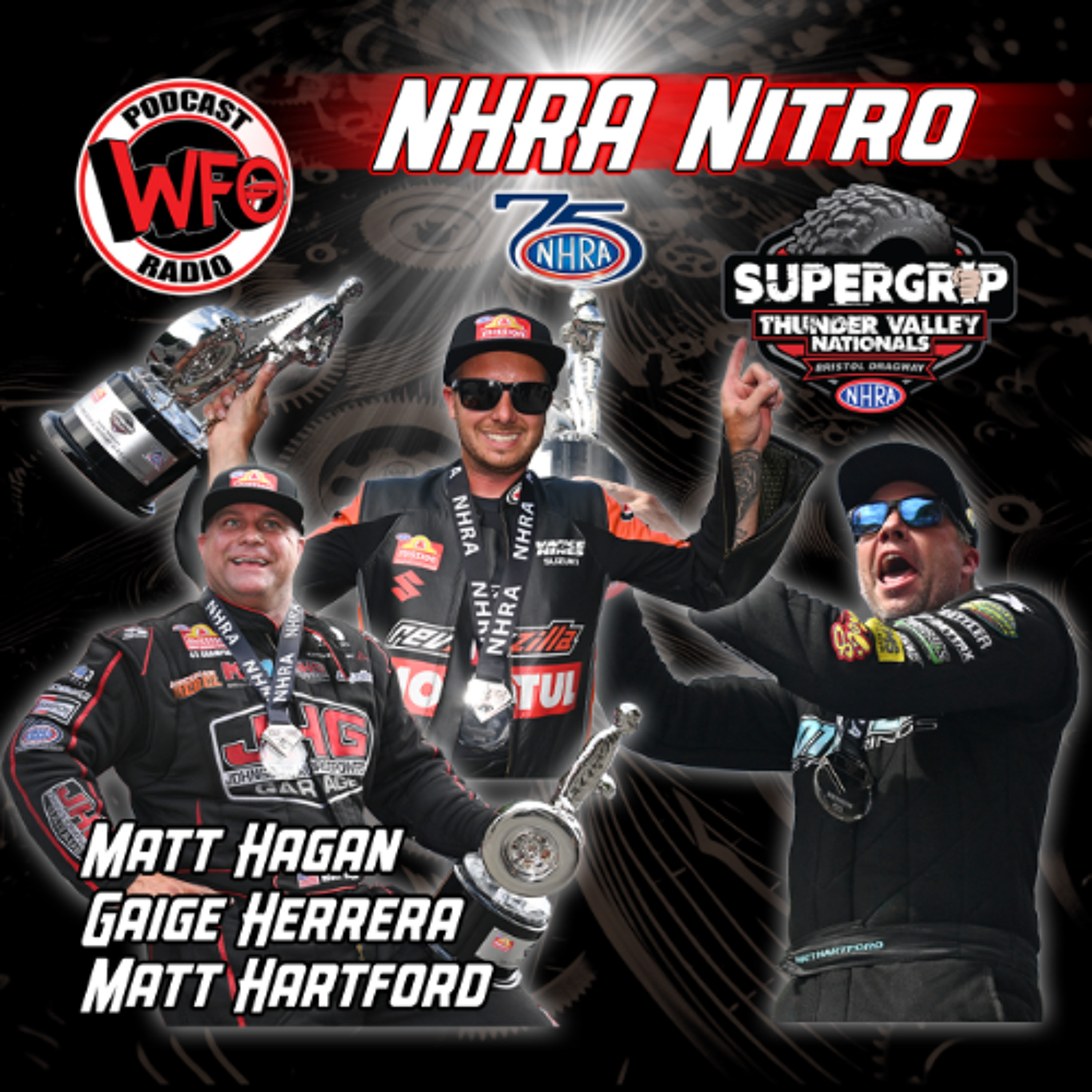
Matt Hagan, Matt Hartford, and Gaige Herrera join WFO after winning NHRA Thunder Valley Nationals
About this episode
NHRA Thunder Valley Nationals winners Matt Hagan, Matt Hartford, and Gaige Herrera join WFO Radio after a grueling East Coast stretch. Hagan celebrates his recent success, talks through the physical and mental toll of Funny Car racing, and gives behind-the-scenes perspective on the “circus” of producing the broadcast and supporting fans. He reflects on Bristol as a near-home track, the challenge of a hot, tricky new surface, and the grind of qualifying and racing John “Caps” in round one. The show also includes sponsor shoutouts and light banter about post-race relaxation.
diesel particulate filter
"Looking to replace your OEM diesel particulate filter or diesel oxidation catalyst?"
A diesel particulate filter is a device that catches the smoky soot from a diesel engine. Over time it cleans itself by burning the soot off so the exhaust stays cleaner.
A diesel particulate filter (DPF) traps soot (particulate matter) produced by a diesel engine. It periodically burns that soot off through a regeneration process to keep exhaust emissions under control.
diesel oxidation catalyst
"Looking to replace your OEM diesel particulate filter or diesel oxidation catalyst? ...complete line of aftermarket diesel particulate filters and diesel oxidation catalyst designed as an exact fit OEM replacement..."
A diesel oxidation catalyst is a part in the exhaust that helps clean up the gases coming out of a diesel engine. It works with other emissions parts to reduce pollution.
A diesel oxidation catalyst (DOC) is an exhaust aftertreatment component that helps convert harmful gases in diesel exhaust, improving emissions. It’s often used alongside a DPF and can support regeneration by helping raise exhaust temperatures.
OEM replacement
" ...aftermarket diesel particulate filters and diesel oxidation catalyst designed as an exact fit OEM replacement..."
“OEM replacement” means the aftermarket part is made to fit like the original factory part. The goal is that you can install it without major modifications.
OEM replacement means the aftermarket part is designed to match the original equipment manufacturer’s fitment and function. In practice, that usually means it’s intended to bolt in or connect the same way as the factory part.
reverse OEM lookup tool
" ...be sure to check out our comprehensive reverse OEM lookup tool, always new, never remanufactured."
This is a website tool that helps you find the right emissions part for your specific truck. Instead of guessing, it uses your vehicle details to match the correct replacement.
A reverse OEM lookup tool helps identify the correct emissions component by using vehicle-specific information (like make/model/engine details or part numbers) to find the matching OEM-equivalent part. It’s meant to reduce the chance of ordering the wrong DPF or catalyst.
remanufactured
" ...reverse OEM lookup tool, always new, never remanufactured."
Remanufactured means a part is rebuilt from an old used version. The ad is saying they sell new parts instead of rebuilt ones.
Remanufactured parts are rebuilt using used cores that are disassembled, cleaned, and reworked to meet specified performance. The sponsor contrasts this with “always new,” implying they sell brand-new emissions components rather than rebuilt ones.
NHRA Nitro is back
"Everybody, WFO Radio, NHRA Nitro is back."
They’re talking about NHRA Nitro, which is NHRA drag racing coverage. It’s basically a “drag racing is back” moment tied to recent race weekends.
This segment is framing the return of NHRA Nitro, which is NHRA’s drag racing brand/coverage for its top fuel and funny car classes. It signals the show is about recent NHRA racing results and the drivers’ performances.
Thunder Valley Nationals
" ...from Maryland and New England to Bristol, the Thunder Valley Nationals, just awesome..."
Thunder Valley Nationals is a drag racing event in the NHRA schedule. The hosts are saying they just had a great weekend there.
The Thunder Valley Nationals is an NHRA drag racing event. In this context, it’s the race weekend where the guests (Matt Hagan, Matt Hartford, and Gaige Herrera) achieved their recent win.
Gaige Herrera
"On this show, we got the Triple H, we got Hagan, we got Hartford, we got Herrera. We might have Herrera."
Gaige Herrera is one of the NHRA-related guests they’re trying to get on the show. The host says he’s busy but they’ll try to include him.
Gaige Herrera is named as another guest associated with the recent NHRA Thunder Valley Nationals win. The host also notes he may be unavailable because he’s working.
Matt Hagan
"If it doesn't work out, but Matt Hagan is just seconds from now."
Matt Hagan is a drag racer in NHRA. The show is bringing him on because he and his team just had a big winning stretch.
Matt Hagan is an NHRA funny car driver. The host is introducing him as a key guest and highlighting that he and the team have been winning recently.
Tony Stewart
"So if you're a fan of funny cars, if you're a fan of Tony Stewart Nitro, if you're a fan of Matt Hagan..."
Tony Stewart is a famous race car driver. He’s also connected to drag racing, and the host is mentioning him to describe the kind of fans listening.
Tony Stewart is a well-known American motorsports driver and team owner who has also competed in NHRA Nitro racing. Here, he’s referenced as part of the audience’s “funny car” interest.
composite gaskets
"HustyPerformance.net, not just copper gaskets anymore, they do composite gaskets for race cars, race engines."
A gasket is a seal between engine parts. Composite gaskets use special materials to hold tight better when the engine is running super hot and under a lot of pressure.
Composite gaskets are sealing layers made from engineered composite materials instead of just metal. In race engines, they’re used to help maintain cylinder sealing under high heat and pressure, where conventional gaskets can struggle.
ring seal technology
"Total seal piston rings, the leader in ring seal technology, Matt Hartford going to be on."
Piston rings are supposed to seal tightly inside the engine. “Ring seal technology” means the rings are designed to seal better, so less pressure and gases leak where they shouldn’t.
Ring seal technology refers to design features of piston rings that improve how well they seal the cylinder. Better sealing reduces combustion gases escaping into the crankcase, which can improve efficiency, throttle response, and durability in high-stress racing use.
Total seal piston rings
"Total seal piston rings, the leader in ring seal technology, Matt Hartford going to be on."
Total Seal makes piston rings. Piston rings help seal the combustion chamber, and better sealing can mean the engine makes power more consistently.
Total Seal is a brand known for piston rings designed to improve ring seal. In racing engines, better ring seal can help reduce blow-by (combustion gases leaking past the rings) and improve power consistency.
torque converters
"FTI performance transmissions and torque converters, FTIPerformance.com, you got to get them if you want to win races."
A torque converter helps the engine and drivetrain work together when you launch. It lets the engine keep making power while the car gets moving, which is crucial for quick starts in drag racing.
A torque converter is a fluid coupling in an automatic-style drivetrain that multiplies torque and allows the engine to stay in its power band during launch. In drag racing, the converter’s stall speed and characteristics are tuned to match the engine so the car accelerates hard off the line.
transmissions
"FTI performance transmissions and torque converters, FTIPerformance.com, you got to get them if you want to win races."
A transmission sends power from the engine to the wheels. In drag racing, it’s built to handle big launches and repeated hard runs.
In this context, “transmissions” refers to the race-built gearbox used to deliver engine torque to the wheels. Drag racing transmissions are typically built and calibrated for hard launches and repeated high-load shifts.
engine spray
"I think Matt knows Marvin and of course Fogget, Gary Stennett's engine spray that works on everything."
An engine spray is a product you apply to an engine to help it run better or protect it. In racing, people use them to try to improve how the engine behaves under extreme conditions.
“Engine spray” here is a branded chemical spray used on engines for performance and/or protection. In drag racing, these products are often applied to reduce friction, manage temperatures, or improve sealing/combustion behavior depending on the formulation.
hot
"And it's funny to see grown men fight over kids for, for a piston or hot and different things."
Here, “hot” is being used like slang for performance stuff—things related to making the car fast. Fans sometimes get really excited about getting those parts signed.
In this context, “hot” appears to be shorthand for a hot rod–style or performance-related item fans want signed. The key idea is that race teams and drivers often bring collectible performance parts for fans, not just car badges.
number one qualifier
"Number one qualifier, right? It was a challenge."
In drag racing, qualifying is like a timed practice where everyone tries to set their best run. “Number one qualifier” means you were the fastest in qualifying, so you start the event with the best position.
In NHRA drag racing, the “number one qualifier” is the driver who posts the fastest time during qualifying sessions. That top qualifying position determines lane/round advantages and is a strong indicator of race-day potential.
track surface
"This new track surface and that Friday session, me and Daryl going in the booth."
The track surface is basically how grippy the racing surface is. If it’s different (new or hotter), the car may hook up differently, so teams have to adjust to get the best launch.
The “track surface” refers to the condition and grip level of the drag strip, which directly affects traction and how consistently a car can launch. Changes in surface can force teams to adjust tire choice, tire pressure, and tune to maintain performance.
140 degree racetrack
"it goes to show you like, you know, 140 degree racetrack. Um, it's just tricky and challenging for, for everyone."
A “140 degree” track is extremely hot, and that affects both tire grip and how hard the engine has to work. Teams usually need to change their setup when the track is that hot.
A “140 degree racetrack” indicates extreme track temperatures, which can drastically change tire grip and engine cooling/thermal load. Hot conditions often force teams to adjust strategy and tuning to keep the car consistent.
crew chiefs
"Um, and I don't care how talented these crew chiefs are. I think a lot of people forget like, you know, when it gets hot, you have to pull the motor back..."
In drag racing, the crew chief is the team’s main decision-maker. They decide how to set up the car and what changes to make for each run so it performs well that day.
A “crew chief” is the lead strategist for a drag racing team who calls the setup and tuning decisions for each run. They manage adjustments for conditions like heat and track grip, coordinating the team to keep the car in its optimal operating window.
pull the motor back
"when it gets hot, you have to pull the motor back, but these motors like to really be lugged on."
“Pull the motor back” means reducing how hard the engine is being worked—typically by dialing back power/boost or limiting load—when conditions are hot. In drag racing, that helps prevent overheating and keeps the engine from making unstable power under high thermal stress.
lugged
"but these motors like to really be lugged on. They like to be pulled on..."
“Lugged” here means the engine is being run more gently—at lower speed or load. Teams sometimes do this to manage heat, but they still have to keep the engine running the way it likes.
In this context, “lugged” means running the engine at a lower speed/load than it would prefer, which can change combustion behavior and how the car responds. The speaker is contrasting that with the need to manage heat by reducing load, while still keeping the engine in a workable operating range.
put cylinders out
"if you don't pull on these motors and you don't have a load on them, when you free them up, they want to put cylinders out."
“Put cylinders out” means some cylinders stop working as effectively, so the engine doesn’t make smooth power. That can make the car behave unpredictably and lose grip.
“Put cylinders out” describes losing effective combustion in some cylinders—often due to unstable fueling/ignition or operating outside the engine’s ideal conditions. When that happens, power delivery becomes uneven, which can upset traction and vehicle stability.
looping the tire
"Well, when you put cylinders out, then you start looping the tire. Um, you know, start moving the car around."
“Looping the tire” means the tire spins too much and doesn’t hook up. When that happens, the car can start sliding or rotating instead of going straight.
“Looping the tire” refers to the tire spinning and losing traction in a way that can cause the car to rotate or move around under power. In drag racing, that’s usually a sign of insufficient traction or an engine/power delivery issue that upsets the launch.
under power
"to the other end, um, under power and under on eight cylinders."
“Under power” means the engine is actively pushing the car forward, not coasting. It’s the part of the run where the car is working the hardest.
“Under power” means the car is making engine torque and is actively accelerating rather than coasting. In drag racing, it’s often used to describe how the engine is loaded during the run—when the drivetrain and tires are working hardest.
eight cylinders
"to the other end, um, under power and under on eight cylinders. So when you're doing that, when it's 140 degrees and you can run on eight cylinders…"
An “eight-cylinder” engine has eight cylinders that work together to make power. More cylinders firing usually means smoother and stronger power delivery when the engine is loaded.
“Eight cylinders” refers to an engine with eight working cylinders firing in sequence. The speaker is emphasizing that the engine can be run on all eight cylinders in the conditions they’re describing, which matters for how much power the engine can deliver and how stable it is under load.
140 degrees
"So when you're doing that, when it's 140 degrees and you can run on eight cylinders, you've truly done something…"
“140 degrees” is a heat number that can change how the car runs. When it’s hot, the engine and air behave differently, so the team has to adjust to keep performance consistent.
“140 degrees” is a temperature reference that affects how the engine and/or intake system behaves during a pass. In racing, higher temperatures can change air density, combustion behavior, and how consistently the car can make power—so teams must adapt their setup and driving strategy.
buy run
"Uh, but we got through, you got around, John, you earned the buy run. That gives you an opportunity to set the track, to test prepare for a semi-final round…"
A “buy run” is basically a free pass in a drag-racing bracket where you don’t have to race in that round. Teams use it to make a run and get the car dialed in for the next race.
In NHRA drag racing, a “buy run” is the run you get when your car is advanced past a round because of the bracket setup (often due to an odd number of entries or a bye). It gives the team a chance to make a pass and gather data so the car is better prepared for the next elimination round.
semi-final round
"That gives you an opportunity to set the track, to test prepare for a semi-final round against Austin proc…"
The semi-final round is the race right before the final. If you win here, you move on to the last race of the event.
A “semi-final round” is the elimination stage just before the final race in a drag-racing event. Teams typically use the preceding round(s) to fine-tune tune-up decisions—like tire pressure, clutch/launch settings, and fuel/air adjustments—so the car is consistent under pressure.
lopsided numbers
"test prepare for a semi-final round against Austin proc, which a lot has been made about the lopsided numbers."
“Lopsided numbers” means one racer/team has been way faster than the other based on past results. It can make the matchup feel like a mismatch going in.
“Lopsided numbers” refers to a significant performance gap suggested by qualifying or prior results—like one side having much faster elapsed times or better speed. In matchups, it can create pressure because the underdog has to overcome expectations with setup and execution.
horse power garage
"Speaking of Johnson's horse power garage saw Jason and Nikki at Bristol hotel..."
“Horsepower Garage” is a drag-racing media/garage brand that shows up around events and interviews people in the scene.
“Horsepower Garage” is a motorsports media/garage brand associated with drag racing coverage and events. In this segment, it’s referenced as a group that had team members at Bristol.
starting line
"They brought out, you know, ... The starting line was full, man."
In drag racing, the starting line is where the cars line up to launch. Getting off the line cleanly and consistently is a huge part of winning.
In drag racing, the starting line is the launch area where the cars stage and begin the run. Reaction time and launch consistency are critical because small differences can translate into big changes in elapsed time and who advances.
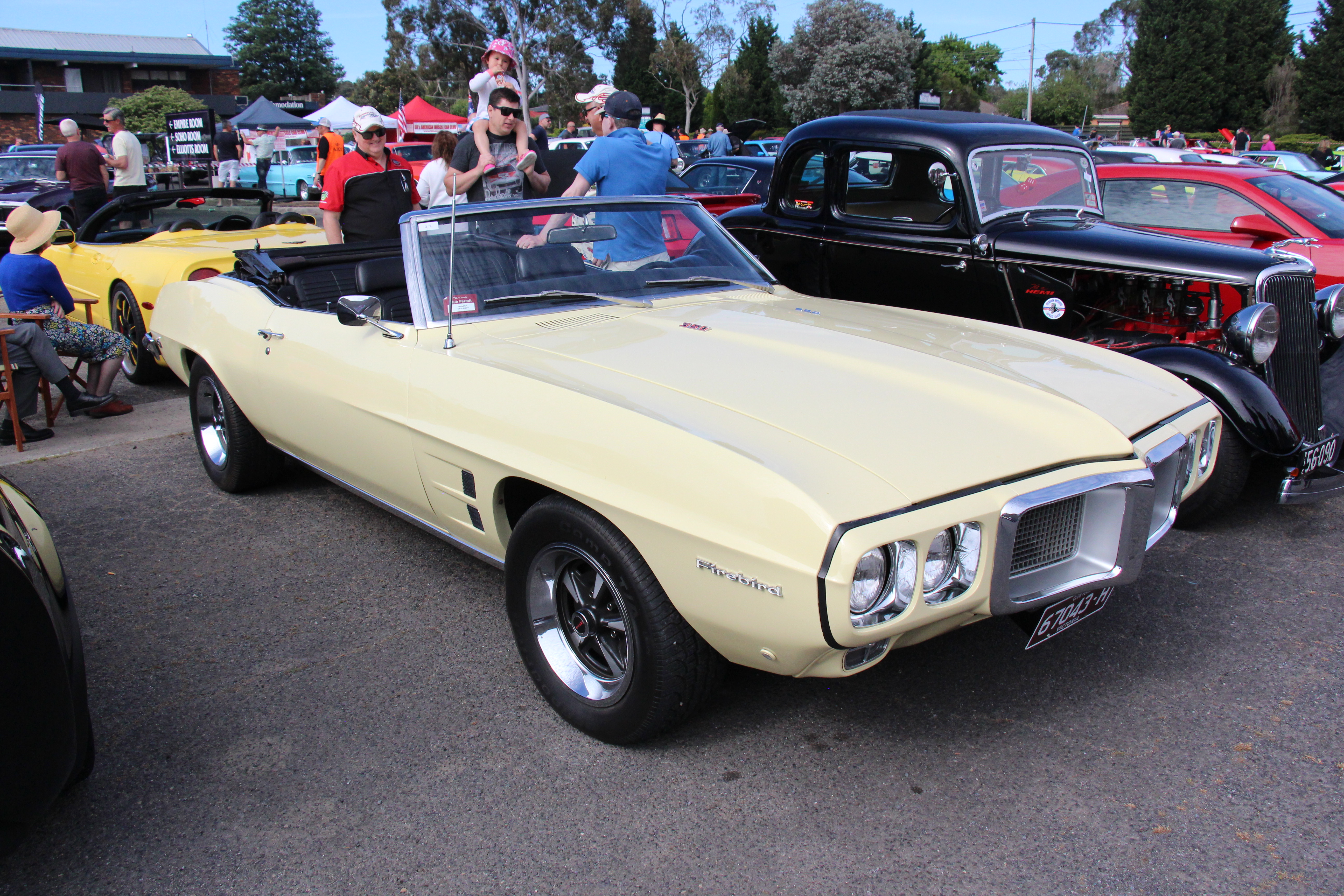
1978 Trans-Am
"Like, I'll just go get another 1978 Trans-Am and it'll be great. No, can't do that."
The 1978 Trans-Am is a classic Pontiac performance car from the late 1970s. The host brings it up to explain that he can’t just replace the car easily, so he wants insurance that covers it properly.
The 1978 Trans-Am is a classic Pontiac Trans Am from the late 1970s, known as a muscle-car era performance model. In this segment it’s mentioned as the kind of replacement race/enthusiast car the host can’t just swap in easily, which is why he needs proper insurance.
staging lanes
"…including the race car at the house, at the track, when I'm in the staging lanes, when I'm on the return road…"
Staging lanes are the controlled area at an NHRA-style drag strip where cars line up and prepare for a run. The host is saying the policy covers the race car not just at the track, but also while it’s in that pre-run staging area.
race fuel
"Like, do you have race fuel in your race trailer? Well, we can't cover you then because, you know, that's hazardous."
Race fuel is a special kind of fuel used for racing. Regular insurance policies may not want to cover it because it’s considered hazardous, so the host is emphasizing that his motorsports insurer will cover it.
Race fuel is specialized fuel used for motorsport, typically formulated for higher performance and different combustion characteristics than pump gasoline. Many standard insurance policies treat it as hazardous, which can lead to exclusions if it’s stored or transported in a trailer.
friction
"The number one source of friction in your engine is not what you think."
In engine terms, friction is the resistance to motion between moving parts (like piston rings and cylinder walls). Higher friction increases heat, which can raise wear rates and reduce effective power output—especially important in high-stress drag racing.
cylinder walls
"Piston rings rubbing against the cylinder walls generate more friction than any other part of the engine."
Cylinder walls are the inside surfaces of the engine where the piston slides. If the surface is worn or rough, the piston rings can rub more, which increases friction and can hurt performance over time.
Cylinder walls are the inner surfaces of the engine block where the pistons move up and down. Their surface finish and wear condition strongly affect friction and how well piston rings seal, which in turn impacts power and engine longevity.
swapping some engines
"Like, so you, you had kind of a tough weekend in that you were, you know, swapping some engines and word on the street is that poor Michael Heiner"
Engine swapping is when a team pulls out one race engine and puts in another. In racing, they do it fast so the car can keep competing even if something went wrong.
In drag racing, “engine swapping” means replacing the race engine between rounds or events to get the car back on track. It’s often done after damage, reliability issues, or to change setups quickly for performance.
bolted in our frame rails
"I mean, that's not speculation. 67 is bolted in our frame rails. I asked Adam to go ahead and just weld the motor plates"
“Frame rails” are the main longitudinal structural members of a vehicle’s chassis. Saying the engine is “bolted in” there describes how the engine mounts to the drag car’s frame for strength and alignment under hard acceleration and vibration.
weld the motor plates
"I hear 67 is their engine and that I was told by someone. I won't say who that 67 is their engine and that they got a call from you saying you're not getting 67 back. 67 is being held hostage. I guess that's a fact. I mean, that's not speculation. 67 is bolted in our frame rails. I asked Adam to go ahead and just weld the motor plates to our, to our frame"
“Motor plates” are mounting brackets/plates used to attach the engine to the chassis. Welding them is a structural change that prevents movement and can improve repeatability of engine position—important in drag racing where small alignment differences can affect performance and reliability.
dyno
"They got a guy that is consulting on the engines doing the dyno, as I understand, who's pretty good."
A dyno is a testing machine for an engine. It lets teams measure how much power the engine makes so they can tune it for better performance.
A dyno (dynamometer) is a machine used to measure engine output like horsepower and torque under controlled conditions. In racing, teams use it to tune engines and verify changes before or during a season.
top speed
"they set top speed at one of the events, you know, running well deep into the field at in many of the qualifying sessions."
Top speed is the fastest the car gets during a run. In drag racing, it helps show whether the car has enough power and gearing to go all the way down the track.
Top speed is the maximum velocity a car reaches during a run, typically limited by aerodynamics, gearing, and engine power. In drag racing, it’s often used as a performance indicator for how well the car accelerates and how effectively it reaches the end of the track.
qualifying sessions
"running well deep into the field at in many of the qualifying sessions."
Qualifying sessions are the runs where drivers try to post the best times. Those times decide the bracket positions for the elimination rounds.
Qualifying sessions are the timed runs that determine starting positions in a drag-racing bracket. Better qualifying typically means a higher seed, which can affect matchups and how hard the early rounds are.
first round
"I lost first round. It might have been 19 lost first round to Shane and Gainesville... So, we were concerned rolling up there against him."
In drag racing, the competition is set up as a bracket. The first round is the first head-to-head race—lose it and you’re out.
In NHRA-style elimination racing, the first round is the earliest bracket matchup and can end a team’s run if they lose. The hosts are emphasizing that even strong teams can get knocked out early, so they approached this event expecting a tough opponent.
motocross track
"You know, before we used to go there and think you were racing on a motocross track"
They’re basically saying the track used to feel rough and uneven, like a motocross course. For drag racing, a smoother surface helps the tires grip better and makes launches more consistent.
The speaker contrasts drag racing traction with a motocross-style surface, implying the earlier Bristol setup felt rough or inconsistent. In drag racing, surface smoothness affects tire grip and how predictably the car accelerates.
glass
"and now it went out there as per, I mean, it's basically like glass."
“Like glass” is a racing way of saying the track is super smooth and grips well. That usually helps cars get off the line more consistently.
When racers say the track is “like glass,” they mean it’s extremely smooth and provides very consistent traction. That kind of surface typically improves repeatability for launches and early acceleration.
Bristol Dragway
"It was definitely a big improvement and a huge shout out to Bristol Dragway for that."
Bristol Dragway is a drag racing track in Tennessee where NHRA events are held. When they improve the track surface, it can make the cars hook up and run more consistently.
Bristol Dragway is the NHRA venue at Bristol, Tennessee, known for hosting major drag racing events like the Thunder Valley Nationals. Track prep quality there can noticeably change traction and consistency from one year to the next.
660 feet
"It was, it was not the same track and they did offend whoever, whoever handled the first 660 feet of redoing all the concrete did a phenomenal job."
In drag racing, the track is measured in sections. “660 feet” is an important early part of the run where the car is still getting up to speed, so the track surface there can make a big difference.
In NHRA drag racing, the “660 feet” mark is a key early segment of the run where cars/dragsters are still building speed and traction. Changes to the track surface in this zone can strongly affect acceleration and how consistently the car hooks up.
pro stock
"Gage, you got any questions for Hartford? 31 pro stock, you know, like anything that is on your mind about the factory hot rods?"
Pro Stock is a category in NHRA drag racing where cars are based on production models but heavily modified under strict rules. The goal is to make the car launch and accelerate consistently.
Pro Stock is an NHRA drag racing class for production-based cars with strict rules on engine and chassis configuration. Teams focus heavily on repeatable launches and tuning because small changes in traction and setup can swing performance.
lane choice
"and that being in the final and my thought was we had lane choice. [2530.6s] We were going into the lane that we preferred. [2533.8s] However, a lot of the teams were preferring the left lane."
In drag racing, you race in one of two lanes. Even though they look identical, one lane can grip the tires better than the other, so choosing the right lane can help you launch harder and run faster.
In NHRA drag racing, lane choice matters because the two lanes can have slightly different traction and surface conditions. Teams often try to pick the lane that they expect will give better grip and consistency for their car’s launch and acceleration.
burnout
"Hit your marks in the burnout, you know, try to make sure you get all the [2561.1s] rosin just, you know, it's extremely important."
A burnout in drag racing heats and conditions the tires so they can generate maximum traction at launch. In top-level racing, the timing and execution of the burnout can strongly affect how consistently the car hooks and how repeatable the launch is.
rosin
"Hit your marks in the burnout, you know, try to make sure you get all the [2561.1s] rosin just, you know, it's extremely important."
Rosin is a tacky substance used to help the tires grip. Drivers and teams use it so the car can launch with more traction instead of spinning the tires.
Rosin is a sticky traction compound used on the track surface (and/or applied during the burnout process) to help tires bite. In drag racing, getting the right amount and timing of rosin application can improve how the car transfers power during launch.
pre-stage beam
"it felt like Greg started his burnout and he got back quick and he was, you [2573.2s] know, he was up into the pre-stage beam really quick and I rolled into the [2576.7s] pre-stage beam"
The pre-stage beam is an early signal in the starting system. When you roll into it, it tells you you’re in position, so you can be ready for the actual start signal.
The pre-stage beam is the first of the drag-race starting lights that a car triggers when it rolls into position. Drivers use it to stage correctly and prepare for the final “go” signal so they can launch at the right moment.
both bulbs
"it wasn't dead on both bulbs at the same time, but it was click, [2591.4s] And when that happens, I think it throws both drivers off a little bit."
The bulbs are the starting lights. If both cars trigger the lights at the same time (instead of one clearly leading), it can mess with timing because each driver is trying to react to the other car’s exact start sequence.
In NHRA drag racing, the “bulbs” refer to the staged starting lights that indicate when the race is ready to begin. If both drivers’ bulbs come on at the same time (or not in the expected sequence), it can throw off timing and reaction because each driver is anticipating the other’s exact staging behavior.
mechanical power unit
"So when we get an engine from them, that is 100% their mechanical power unit, they own it, they build it, they develop it, you know, but when it comes over to us, what we do with that engine is 100% on Matt Hartford racing."
They’re talking about the engine package that actually makes the car go. The supplier builds and owns it, and then the racing team uses it in their own race car setup.
In drag racing, a “mechanical power unit” usually means the engine package that makes the car move—built and owned by the supplier. It’s not just a generic engine; it’s the complete powerplant hardware that the team receives and then installs/uses within their own race setup.
Matt Hartford
"So when we get an engine from them, that is 100% their mechanical power unit... but when it comes over to us, what we do with that engine is 100% on Matt Hartford racing."
Matt Hartford is the person they credit for what they do with the engine after it’s delivered. Basically, he’s part of the team that turns the engine into a race-winning setup.
Matt Hartford is named as the person responsible for what happens to the supplied engine once it arrives—specifically the team’s race setup and how they apply the power package. In this context, he represents the tuning/engineering side of turning an engine into a winning drag-racing car.
KB Titan
"We're out here to win to have a team like Greg Anderson and everybody at KB Titan to be willing to provide a customer like us with power that can go to number one, can win the mission, race, outrun their own cars."
KB Titan is the company they’re talking about that provides the engine/power for their race car. The team then does its own tuning and setup to race their way.
KB Titan is referenced as the supplier/organization providing power to the racing team. The speaker emphasizes that KB Titan supplies the engine/power package, while the team handles the race-specific setup and tuning decisions.
transmission ratio
"I don't know what tire they had on their car. I don't know what transmission ratio they had in their car. I have no idea what's in their clutch."
It’s the “gearing” that determines how the engine’s RPM translates into wheel speed. The right ratio helps the car accelerate harder and keep the engine in its best power range.
A transmission ratio is the gear multiplication between the transmission and the driveshaft. In racing, changing the ratio changes how quickly the car accelerates and what engine RPM it lands on during the run.
clutch
"I don't know what transmission ratio they had in their car. I have no idea what's in their clutch. I don't know what air pressure was in their tires on how much timing they had."
The clutch is what lets the engine power get sent to the drivetrain. In drag racing, how it’s set up affects how the car launches and hooks up.
A clutch is the driveline component that connects and disconnects engine power from the transmission. In drag racing, it’s critical for launch control—how smoothly or aggressively the car transfers power off the line.
air pressure
"I don't know what's in their clutch. I don't know what air pressure was in their tires on how much timing they had."
It’s how much air is in the tires. The right pressure helps the tire grip the track better and launch consistently.
Tire air pressure is the amount of pressure inside the tire, which strongly affects contact patch shape and how the tire grips under acceleration. In drag racing, small pressure changes can alter traction, rollout behavior, and how consistently the car performs run to run.
timing
"I don't know what air pressure was in their tires on how much timing they had. I don't know what their fuel curve looked like."
In engine tuning, “timing” refers to ignition timing—when the spark occurs relative to the piston’s position. More/less timing changes combustion pressure and can make the engine faster, but too much can cause knock or other damage.
fuel curve
"I don't know what air pressure was in their tires on how much timing they had. I don't know what their fuel curve looked like. I don't know what shock they had and they don't know any of that about our team as well."
A “fuel curve” is the relationship between engine operating conditions (like RPM and throttle position) and how much fuel the engine is commanded to inject. In racing, tuning the fuel curve is essential to control mixture for power and to prevent detonation or bogging.
shock
"I don't know what their fuel curve looked like. I don't know what shock they had and they don't know any of that about our team as well."
“Shock” here refers to the suspension shock absorbers (dampers). In drag racing, shock settings affect weight transfer, tire loading, and how the car launches and stays stable under acceleration.
tree
"He got me a little on the tree, but I studied the video after our run"
The “tree” is the set of starting lights at the drag strip. Drivers try to launch right when the lights tell them to so they don’t lose time—or start too early.
In drag racing, the “tree” is the starting light system that signals when the cars can launch. Drivers time their reaction to the tree to minimize delay while avoiding a red-light (an early start).
diamond Wally
"But what about this diamond Wally? This happens to be Matt Hagan's... It's very cool... That's my second one."
A “Wally” is the NHRA trophy awarded to event winners, named after Wally Parks. A “diamond Wally” is a special/variant trophy presentation that’s typically associated with winning a particular marquee event or achieving a specific distinction.
Fogget
"And also our friends at Fogget F O G G I T. This is Gary Stinnett."
Fogget is a rust-prevention product. In this segment, they use it to protect metal and to keep an engine from rusting while it’s stored.
Fogget is a branded product used for corrosion protection, described here as being applied to stop rust and to protect engine internals during storage. The hosts frame it as especially useful for high-performance racing engines.
Summit Racing Equipment
"It's available at Summit Racing Equipment. We're headed to the Summit Racing Equipment NHRA Nationals."
Summit Racing Equipment is a parts store that sells performance and racing supplies. They’re mentioned here as the place where you can buy the product and where the NHRA-related trip is going.
Summit Racing Equipment is a major retailer of performance parts and accessories, especially for motorsports and DIY builders. The hosts mention it as the place to buy Fogget and to attend the NHRA event.
surface rust
"Somewhere that I want to just hinder the rust surface rust hit it with a shot of Fogget and it sticks and it stays."
Surface rust is the early stage of rust that shows up as a reddish film on metal. It happens when metal is exposed to moisture, and it can get worse if you don’t protect it.
Surface rust is corrosion that forms on the outer layer of metal, typically as a reddish-brown film. In a racing context, it can appear quickly when parts sit exposed to moisture, so people use protective products to stop it from spreading.
fogged down
"But of course, when Project Pontiac goes away for any period longer than 23 hours, it gets fogged down to protect the inside of that racing engine."
“Fogged down” means spraying a protective coating inside the engine so it doesn’t rust while it’s sitting. It’s a storage step to protect internal parts from moisture.
“Fogged down” refers to fogging an engine with a protective product so it coats internal surfaces. The goal is to prevent corrosion while the engine sits, especially during storage between runs.
Project Pontiac
"But of course, when Project Pontiac goes away for any period longer than 23 hours, it gets fogged down to protect the inside of that racing engine."
“Project Pontiac” sounds like the team’s nickname for a specific Pontiac they’re working on. They’re saying they protect the engine from rust when it’s going to sit for more than a day.
“Project Pontiac” appears to be a named project/car being prepared for racing and storage. The key idea here is that the team uses fogging as a routine preservation step when the car/engine will sit for more than a short window.
drag strip
"Pastime was a great show because it's exactly what every person at the drag strip does. You look at a car and you say, I wonder what that thing runs."
A drag strip is a track built for straight-line racing. People go there to see which vehicle accelerates the quickest and runs the fastest.
A drag strip is a straight-line racing venue where cars or bikes compete over a short distance, typically focusing on acceleration and top speed. The hosts mention it because “every person at the drag strip” is watching cars and trying to predict how fast they’ll run.
fog it
"Appreciate you fog it. The official lube on my bike for the kids. When this guy race guitar goes and does his ride for children's cancer, you know, what's he spray the chain down with fog it."
“Fog it” means spraying a mist of lubricant onto the chain. The idea is to coat the parts so they move smoothly.
“Fog it” here refers to spraying a lubricant onto a bike’s chain as part of a routine to keep it running smoothly. It’s a colloquial way of describing a misted application rather than a one-time wipe-on.
WD 40
"You know, there's I'm going to use WD 40 as an example. Imagine all the things you use WD 44 except something that is a far superior product."
WD-40 is a spray you can use on metal parts to reduce friction and help keep water out. The point here is that some sprays don’t last—they can wash or run off quickly—so a better product can stay on longer.
WD-40 is a widely used spray lubricant/water-displacing product. In this segment, the hosts use it as an everyday example of a chain/metal lubricant that can “run off” rather than stay put, versus a more durable alternative.
centerline
"Don't cross the centerline and don't tag the wall in racing conditions. But on the burnout, those things are not active."
The centerline is the line down the middle of the track. In many race situations you’re not supposed to cross it because it can mean you’re cutting across the track or driving in a way that could affect other racers.
In racing, the centerline is the dividing line between the two sides of the track. Rules often restrict crossing it during normal driving, because it can imply cutting across the racing surface or interfering with other cars.
tag the wall
"Don't cross the centerline and don't tag the wall in racing conditions."
“Tag the wall” means you hit the track barrier. In most racing situations that’s a big deal because it can damage the car and be dangerous for everyone.
To “tag the wall” means to make contact with the track barrier. It’s generally treated as a serious safety violation during normal racing because it can damage the car and create debris or hazards.
330 block
"remember Derek Kramer hit the 330 block on the burnout and he could run like people."
A “block” is the main part of the engine. “330 block” sounds like a shorthand for a particular engine setup the team was using, and it’s mentioned here as part of what happened during the burnout.
“330 block” appears to refer to a specific engine block or engine configuration used in the burnout/launch context. In drag racing, teams often identify engine parts and setups by shorthand, and the “block” is the engine’s main structural casting.
race control
"But being in race control, watching it all happen. No, they were this example and where people can cross or touch the centerline on the burnout."
Race control is the officiating/operations group that monitors the event and enforces rules in real time. They decide whether cars can proceed, issue warnings, and manage safety and compliance during on-track incidents and specific phases like burnouts.
Summit Motorsports Park
"NHRA Nationals at Summit Motorsports Park. It's a four day event."
Summit Motorsports Park is a drag strip where NHRA races are held. The track can be tricky, so teams have to dial in their car setup to get good traction.
Summit Motorsports Park is a drag racing venue used on the NHRA schedule. It’s known for being a “track-tuning” environment where traction and setup choices can strongly affect results.
NHRA Nationals
"Next race, summit racing equipment, NHRA Nationals at Summit Motorsports Park."
NHRA Nationals is a big drag racing event run by the NHRA. Teams race through qualifying and then elimination rounds over the weekend.
NHRA Nationals refers to an NHRA drag racing event weekend. These events typically include multiple rounds of qualifying and eliminations across different classes.
Bill Bader Jr.
"One of the best tracks on the tour. Bill Bader Jr. They do a great job."
Bill Bader Jr. is a person connected to running the event/venue. The host is praising how smoothly things are handled.
Bill Bader Jr. is associated with the Summit Motorsports Park organization and is referenced as someone who “does a great job.” The mention is about event operations and how well the venue is run.
Antron Brown
"It's great. Antron Brown. Didn't really talk a lot of top fuel"
Antron Brown is a professional drag racer. The host is saying they’ll talk about him more later.
Antron Brown is a top fuel drag racer and one of the sport’s most successful modern drivers. The host mentions him in the context of top fuel discussion and future plans to interview him.
Brian Karate
"That is a big deal. Antron and Brian Karate getting down the race track, tricky track,"
Brian Karate is a professional drag racer. The host is mentioning him as part of the group dealing with launch/setup challenges.
Brian Karate is a drag racing driver referenced alongside Antron Brown during a discussion of launching and setup. The host ties his name to the team’s work on clutch and track conditions.
Request an Explanation
Heard something you'd like explained? We'll add it to this episode.
Sign in to request explanations for terms you heard.
Want to learn more?
Browse our glossary for plain-English explanations of automotive terms, jargon, and concepts.
Help improve this episode
See something that's not quite right? Our annotations are AI-generated and can sometimes miss the mark. Click the flag icon on any annotation to suggest a correction.