General Motors is a major car company. In this segment, they’re talking about GM changing plans for a factory and focusing more on gas trucks and SUVs.
Federal EV incentives are government money-saving programs for electric cars. They can make EVs cheaper to buy, and the episode suggests restarting them to help the U.S. compete.
A recall is when a manufacturer notifies owners and fixes a safety-related defect or noncompliance issue in a vehicle. Here, the recall is tied to a rear seat defect, which can directly disrupt sales and customer confidence.
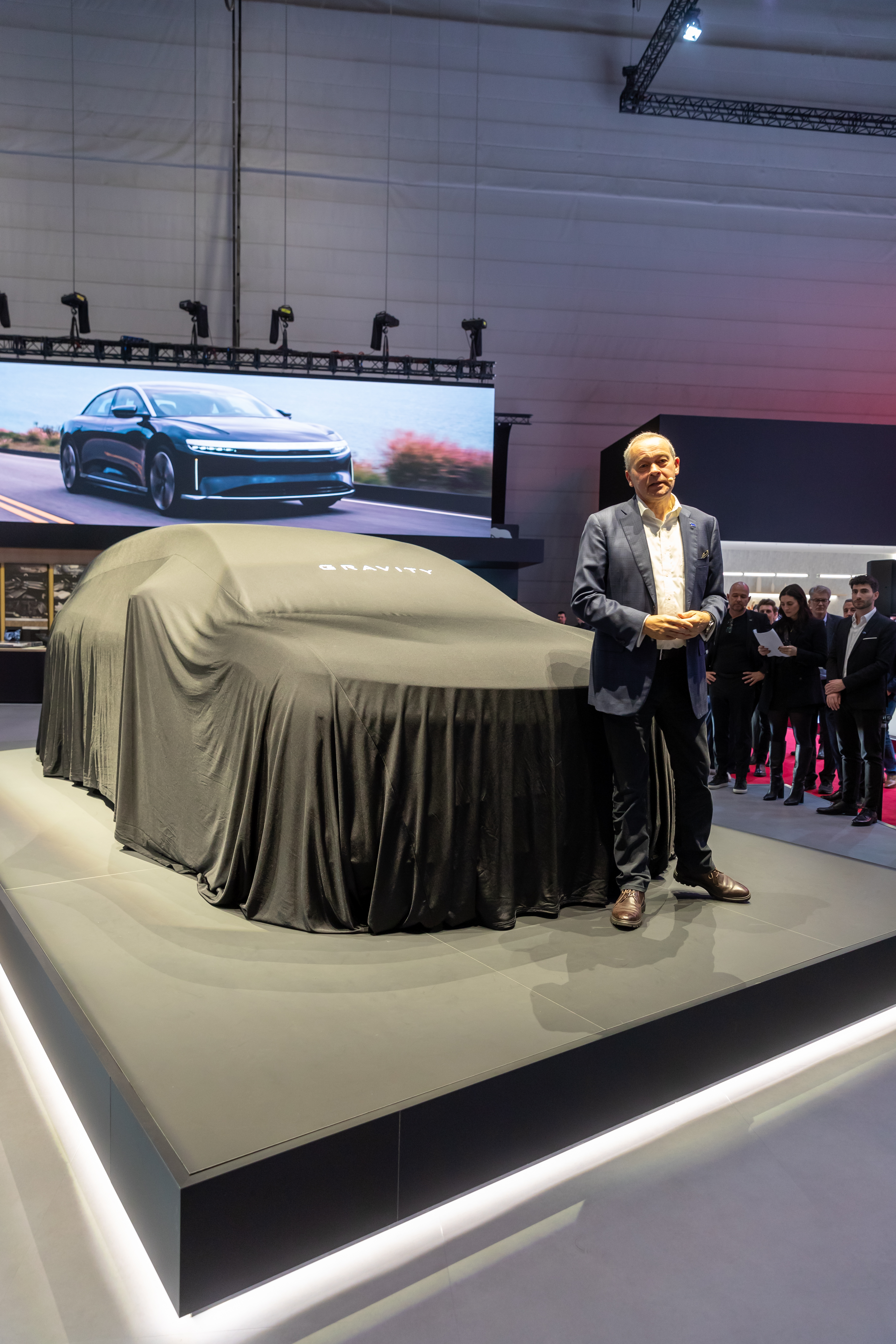
The Lucid Gravity is an all-electric SUV made by Lucid. It uses electricity instead of gasoline, and it’s built for everyday driving with more space than a typical sedan. The podcast mentions it because some owners were affected by a recall, which can slow sales.
Emissions rules are government limits on how much pollution cars are allowed to produce. The episode says those rules were loosened, which affected EV plans.
“Burning through cash” means the company is spending its money faster than it’s earning it. If that continues, the company eventually needs more funding.
Gross margin is a way to see whether a company makes money on the product itself. If it’s negative, it means they’re spending more to make each car than they earn from selling it.
Digital retailing means buying a car more through websites and apps instead of mostly in a dealership. It can change how you see prices, negotiate, and finalize the sale.
Asset protection is a set of dealer-focused products meant to reduce financial risk. The goal is to help protect the money tied up in vehicles and sales.
FNI solutions are the extra money/insurance add-ons dealers sell with a car. Think coverage plans and related products that sit next to the vehicle sale.
Industrial policy means the government tries to help certain industries grow. Here, it’s being discussed as a strategy to help the U.S. auto industry compete against China.
The idea is that China is trying to sell more cars to the rest of the world than anyone else. They’re using government support to help their automakers grow and export.
Term
combustion engine technology
Combustion engine technology is the traditional engine that runs on gasoline or diesel. The point here is that gas stations are already everywhere, which makes gas cars feel convenient.
The Morgan Plus 4 is a small sports car made by Morgan. It’s designed for fun driving and has a classic, traditional appearance. The podcast brings it up because when gas prices rise, people may change what kinds of cars they’re willing to buy.
EV adoption just means more people are switching to electric cars. The hosts are saying that when gas gets expensive, EVs tend to look more attractive.
An EV tax credit is money the government gives you (through your taxes) to help lower the price of an electric car. The idea here is to make EVs cheaper enough that more people will choose them.
They’re saying cars are getting too expensive for many buyers. The episode points to higher insurance, higher repair/maintenance costs, and higher average car prices.
GM is mentioned as another automaker that still sells electric vehicles and continues EV research. It’s brought up to show that not every company has stopped investing.
Charging infrastructure just means the places and equipment that let you charge an EV—like public fast chargers and home charging. If there are enough chargers and they work well, EVs are easier to live with.
The grid is the big electrical system that delivers power to your house. If lots of EVs start charging, the system may need upgrades so charging stays reliable.
EV transition means the move from gas cars to electric cars across society and the auto industry. It’s not just the cars—it also involves charging and power systems.
This is the idea that an EV is run more by software and electronics than by traditional engine-based hardware. That can make the car easier to update and potentially reduce some types of maintenance.
Brake by wire means your brake pedal sends an electronic signal instead of directly pushing fluid through a traditional system. The car’s electronics then control the braking for you.
Steer by wire means the steering wheel doesn’t mechanically connect to the wheels the old way. Instead, it sends signals to electronics that move the steering for you.
Electric braking calipers use an electric mechanism to squeeze the brake pads instead of using hydraulic pressure. It’s part of the broader idea of controlling braking electronically.
Cost of ownership is what it really costs to keep a car running over time—not just the purchase price. The claim here is that EVs may be cheaper to maintain.
This refers to the in-car electronic systems that run vehicle functions via software and connect to networks (for example, cellular connectivity for updates and data). The speaker frames this as a national-security concern because software integrity and communications reliability matter for safety and resilience.
EV credits are government money incentives that make electric cars cheaper to buy (or easier for companies to build). When they exist, more people are likely to buy EVs because the price feels lower.
“Miles per charge” tells you how far an electric car can go before you need to plug it in again. More miles per charge usually means less worry about running out of battery.
BYD is a big Chinese car company that makes electric cars. The point here is that if BYD sells a relatively cheap EV with decent range, it could quickly win customers.
Stellantis is a big car company that operates in multiple countries. The speaker is saying Chinese EV makers could partner with a company like Stellantis to sell in the US sooner.
Crane’s Detroit Business is another Detroit-area business publication mentioned as a reporting source for this episode. It’s cited to show the broader newsroom coverage behind the EV policy and industry updates.
LIVE
Dealers, could there be untapped revenue on your lot?
Protective Asset Protection works with dealers to unlock new revenue streams
through reliable protection products across most vehicle types.
Visit protectiveassetprotection.com slash automotivenews to learn more.
Welcome to Daily Drive. For Wednesday, May 6,
2026, I'm Kellyn Walker in Las Vegas. Today on the show,
Lucid reports a billion-dollar loss and suspends production guidance.
GM gears up for gasoline trucks at its Orient plant, and hybrid demand surges as fuel prices
climb. Plus, automotivenews managing editor Jerry Hirsch makes the case that the U.S. needs its own
EV industrial policy to counter China, which includes bringing back the federal EV incentives.
In a perfect world, the government should not be in the business of picking the moves and losers,
but it already is.
Let's run through all the news you need to know to keep up in the auto industry.
Lucid's first quarter numbers tell a rough story. The EV maker reported a $1 billion net loss,
more than double the $366 million it lost a year ago. Revenue did go up 20%,
but it still missed Wall Street's expectations by a lot. Analysts were looking for $440 million,
far more than the actual result of $282 million.
Part of the problem? Lucid built 5,500 vehicles, but only delivered about 3,100.
Gravity crossover sales took a hit after a recall over a rear seat defect.
We'll have more on this story in a minute with our own Lawrence Eyelift.
General Motors is gearing up for a second quarter launch next year at its Orient assembly plant,
and the plans are pretty ambitious. GM's telling suppliers it wants to scale production to 190,000
gasoline-powered trucks and SUVs a year. That's about two-thirds of the plant's capacity.
The factory was supposed to be all-electric, but GM switched back to traditional gas engines amid
tariffs, rolled-back emissions rules, and cooling EV demand. The automaker is also eyeing hybrid
powertrains, but hasn't pulled the trigger on that yet.
And new vehicle inventories fell to about $2.8 million at the start of May, down 2.7% from
the beginning of April. That's according to data firm Catalyst IQ. Hybrids are flying off
dealership lots faster than anything else. They're spending just 59 days in inventory,
compared with 75 days for gas-powered vehicles and 114 days for EVs. The reason?
Elevated fuel prices are driving demand for hybrids and electric vehicles to record levels.
And those are today's headlines. You can find more details on all those stories at autonews.com.
Joining me now to talk more about Lucid's grim earnings report is Lawrence Eyelift,
who covers Lucid and other EV makers for automotive news. Lonnie, welcome back to Daily Drive.
It's great to be here. All right, Lonnie. Billion-dollar question
is Lucid in real trouble? You know, I was looking at some of the analyst reports today,
and I think some people do think they're in real trouble because they keep burning through cash.
This is, you know, a billion-dollar net loss, negative 110% gross margin. They're losing about
$100,000 a car on a gross basis. And they're down to about, I think they said, $4.7 billion,
if you include money they raised recently. And they say that will take them to mid-2027,
right? So that's, you know, four quarters, five quarters. And then they have to make their third
vehicle, scale it up in a new factory in Saudi Arabia. And, you know, it's just, it's a heavy lift.
They went through their original CEO, and he left about a year ago. Peter Rollinsen, kind of the
founder CEO, the Elon Musk of, you know, Lucid. And then they had an interim CEO for a little
over a year. And now, just last month, they have a new CEO who comes from Schindler, the elevator
maker. So there are some people sounding the alarm on Wall Street for sure.
Now, Lonnie, the company still has over $3 billion in liquidity, but how long can Lucid keep burning
through cash at this rate? Right. So that was at the end of the first quarter, and they raised some
more money. So now they think they have $4.7 billion in liquidity. And basically, they're
saying kind of an optimistic way, right? That will take us through the launch of our next vehicle,
our third vehicle, the mid-sized Cosmos, which is priced at like $50,000 rather than their
like average selling price now of, you know, $90,000 or $100,000. And that will get us to the next
level, next phase. That's our next booster rocket. So they say that they have enough money to get
there, right? And then we'll have to see how that car sells, you know, whether they can produce it
efficiently in Saudi Arabia because they're building a plant there, even if they can get it out on
time, because they suspended, you know, their guidance on how many cars they would make this
year. It was like $25,000 to $27,000. They said, well, we don't know about that. We want to recalibrate
in a quarter, you know, at the end of the second quarter, we'll tell you. And they also might push
back that factory a little bit. They kind of hinted at that, that don't be focused on like a
late 2026 start of production, be more focused on 2027.
Perfect. Very insightful. Lonnie, thank you for joining me.
Thank you.
Coming up next, automotive news managing editor Jerry Hirsch argues for bringing back federal EV
tax credits to counter China. That's next on Daily Drive.
Dealerships today face tighter margins, shifting consumer expectations and affordability pressures
tied to broader economic uncertainty. At the same time, consolidation and digital retailing
are changing how products are sold and supported. That's why many dealers are reexamining how asset
protection fits into long-term profitability and business goals. For more than 60 years,
protective asset protection has worked alongside dealerships across the country,
delivering trusted FNI solutions like vehicle protection plans, maintenance programs,
Welcome back to Daily Drive. I'm Kellan Walker. China subsidizes its auto industry in dozens of
ways. From cheap credit to favorable trade policies, all part of a strategic effort to become the
world's biggest auto exporter. Automotive news managing editor Jerry Hirsch argues in his new
column that the U.S. needs its own industrial policy to counter that threat, including bringing
back a $5,000 tax credit for EVs under $50,000. Jerry spoke with our own Jake Nier about why he
thinks the U.S. can't afford to be complacent. Jerry Hirsch, welcome back to Daily Drive.
Glad to be joining the podcast again. All right, so let's set the stage right off the bat. Remind
listeners how much China subsidizes automaking and what that actually looks like. I don't have a
dollar figure, but they do it in a lot of ways. First, really cheap credit to a bunch of automakers
incentives for purchases, labor standards that are far lower than ours and that some would judge
to be exploitive, favorable trade policies to enhance exports. There's just dozens of ways
because this is a strategic move for them to essentially be the major auto exporter globally.
You write that the U.S. auto industry faces a choice here when it comes to China. What is that
choice? Well, we have this problem in the United States and we have this incredible,
wonderful infrastructure based on combustion engine technology with a gas station every quarter
and it screams convenience and ease. Even now with the Iran war, wow, gas prices are $4 plus
a gallon in many parts of the country, a little bit higher in some areas. But compared to what's
going on in the rest of the world, we have just not felt the brunt of it. We have this huge oil
supply that's continuously replenished, but that's not where technology is headed. In fact, the Iran
war is only going to push electric vehicle adoption in the rest of the world because
they don't have the luxury of much lower gas prices. Yet electricity can be made from so many
different sources. Yes, China is a big coal burner, but they also have tremendous wind
and solar power energy generation and it's only increasing year by year, month by month, week by
week. So they're moving in a direction of energy independence from fossil fuels. They're providing
huge incentives to their auto industry and they have this strategy essentially to take over
the global auto world. So we have to recognize that we just can't sit still and say, oh, yeah,
we have this wonderful system that's really convenient and great. Let's continue. We have to
move in the same direction, which is why we need some sort of strategy and industrial policy
to counter what China's doing. People will say, well, it's not fair. Yeah, it's not how a market-based
economy works, but we're in a global economy. We have to be realists and pragmatic.
So you actually make a pretty specific proposal here that the government should reinstate at
least a $5,000 tax credit for EVs under $50,000. Talk about why that amount and why you think
that's important, even though we've gotten away from the government subsidizing these vehicles.
Well, we have to recognize that all things being equal, consumers are going to gravitate probably
to hybrid vehicles because that's a step and it saves them money at the pump, but we still need
some sort of pull for them. And we have this huge affordability crisis in autos in the United States.
Insurance is incredibly high. Maintenance and repairs have gone up. All the stuff's gone up
at faster than the rate of inflation, which has already gone up pretty much. And the average
vehicle price now, the transaction price is around $50,000. So the previous credit, federal credit,
was $7,500. I understand we can't be printing money. We have huge budget deficit that grows and
grows and grows, but we do still have to think strategically. So I propose the $5,000 because
one, it's less. It's a 10% of the average transaction price of a vehicle. If people
can get 10% off the price of a car right away, perhaps then that'll be a pull toward EVs.
And it also creates a market for our automakers here in the United States to push forward with
investment plans and development, which they've practically abandoned in most cases.
There are some exceptions. Yes, Ford is doing this project in Long Beach to build a low-cost
EV compact truck. I'm sure GM still has EVs in the market. I'm sure they're still doing research.
But we need to create a friendly environment for that to be successful. And so that's why I picked
this number. I also suggest that it's sunsets in six years. So we're not disrupting the market
in one direction forever. I think over that time, our charging infrastructure will be really good.
We will have made improvements to the grid, not because of EVs, but because of data centers. But
the EV transition can piggyback on that. And we'll be in a much better situation where
an EV will have the convenience of a gasoline car. There's another reason for this,
is that EVs lend themselves to this electric software-defined architecture. You take out
the combustion chambers, the pistons, the hydraulics. You could have brake by wire,
steer by wire, electric braking calipers. Some of the developers are saying they'll
last 150,000 miles. Clearly, the next generation EVs are going to have far less maintenance
than a combustion engine vehicle. So again, we're helping our consumers by lowering their cost of
ownership. You've already brought up the argument against what you're talking about here. So
playing devil's advocate, I'd like to pull this a little bit more. Many manufacturers and dealers
will say and have said that we need to sell what US customers want to buy. Why should the government
be in the business of picking winners and losers?
Okay. In a perfect world, the government should not be in the business of picking winners and
losers. But it already is. Look, we have this deal where we own a slice of Intel. We're getting
money for the chips that Nvidia sells to China. We get a commission on that. We have industrial
policy in 50 different directions of this country. So if it was a level playing field and we didn't
picking winners and losers, boy, this argument would make a lot of sense. But when we're seeing
another country pick winners and losers in an effort to take over the global auto industry,
the Trump administration instituted all these tariffs, including on cars and the materials
that goes in the cars for national security reasons. Okay. Well, wouldn't there be a national
security reason to have our vehicles lead the electric vehicle transition so that we know
there's security in the software and the communications devices embedded in these vehicles?
I mean, you can make this argument in six different ways, but at some point, again,
you've got to be pragmatic and look at the reality of global industry and the global markets.
I also think, though, about what we're seeing in places like the EU, other markets where they've
tried a lot of these things more aggressively, even than the US was before. I'm curious how you
sort of view how you think this would play out here versus, you know, in Europe or other
markets where we see China has already very much come into those markets and is challenging
the local automakers in really existential ways.
Well, if BYD could get in here with a $35,000 EV that can go 300 miles per charge,
game over, all of the budget market's going to gravitate to that and people walk with their
pocketbooks. And if they think something's going to save them a ton of money, they're going to do
that. So the thing that I'm suggesting is kind of a half step. Let's foster and nurture this
market a bit so that we're not siloed. So we're not a global island of combustion engine technology
when the rest of the world is transitioned to EV technology and has better cars that they're
selling for lower transaction prices. All right. So before we go here, you know,
we heard at NADA this year in Las Vegas predictions that Chinese automakers could
find their way into the US market as soon as this year. Do you think there's still time to
implement real industrial policy to counter China? Yes, I don't think they're going to enter this
market in any substantial volume this year. The only way they can enter this market at this point
is people buying them and bringing them across the border. There's some loopholes and things
from Canada, which is just going to start selling Chinese EVs in Mexico,
which already has them. And we're already seeing some of these EVs in the border areas.
So I think we have time that we have these huge restrictions on Chinese imports.
Really, the only way that they can enter the market soon would be in partnership
with a legacy automaker, essentially for GM or the American unit of Stellantis,
or to buy a plant, buy access capacity and launch a plant here. And at that point,
they lose a portion of their cost advantage, not its entirety, because they'll have to pay for
US labor rates and create a supply chain and they'll be investment capital that they would
have to put into it. But they could still probably undercut our prices and come out with some really
good budget EVs for those who can't afford to buy a new vehicle at this point.
Jerry Hirsch is managing editor of Automotive News. His new column is US needs its own EV
industrial policy to counter China. Jerry, always great having you on. Thanks so much.
Thank you, Jay.
That's Daily Drive for today. I'm Kellan Walker. Thanks to our own Lawrence Ilyph and Larry
Velikwet for their reporting for today's podcast. We also have reporting from Curt
Nagel of our sibling publication, Crane's Detroit Business. You can get the latest news on EV
policy, lucid struggles and everything happening in the auto industry at AutoNews.com. We'd love
to hear from you. Let us know what you think of the show and the topics we covered today.
Send us an email at dailydrive at autonews.com or leave us a voicemail at 313-444-2774.
And if you enjoyed the podcast, remember to like,
leave a review and subscribe so you never miss an episode.
About this episode
Lucid’s latest numbers show a company still burning cash, with losses, weak deliveries, and guidance pulled back as it leans on fresh liquidity and a future Saudi plant. The conversation then widens into a policy argument: Jerry Hirsch says the U.S. needs industrial policy to counter China’s auto subsidies, and he makes the case for a temporary $5,000 EV credit aimed at today’s roughly $50,000 average transaction price. He also warns that a low-cost Chinese EV could quickly reshape the budget market.