
May 6, 2026 | The case for bringing back EV credits to counter China; Lucid's billion-dollar loss
About this episode
Lucid’s latest numbers show a company still burning cash, with losses, weak deliveries, and guidance pulled back as it leans on fresh liquidity and a future Saudi plant. The conversation then widens into a policy argument: Jerry Hirsch says the U.S. needs industrial policy to counter China’s auto subsidies, and he makes the case for a temporary $5,000 EV credit aimed at today’s roughly $50,000 average transaction price. He also warns that a low-cost Chinese EV could quickly reshape the budget market.
Automotive News Managing Editor Jerry Hirsch argues in a new column that the U.S. needs its own electric vehicle industrial policy to counter China’s strategic push to dominate global auto exports. Lucid suspends 2026 production guidance after reporting a $1 billion first-quarter net loss. Plus, hybrid demand surges as fuel prices climb.
Lucid
"Today on the show, [24.9s] Lucid reports a billion-dollar loss and suspends production guidance. ... [86.3s] Part of the problem? Lucid built 5,500 vehicles, but only delivered about 3,100."
Lucid is a company that makes electric cars. In this episode, they talk about Lucid losing a lot of money and not delivering as many cars as planned.
Lucid is an EV brand known for building premium electric vehicles like the Lucid Gravity crossover. In this segment, Lucid’s financial results and production guidance are discussed, including a large net loss and delivery shortfalls.
General Motors
"[29.7s] GM gears up for gasoline trucks at its Orient plant... [101.8s] General Motors is gearing up for a second quarter launch next year at its Orient assembly plant..."
General Motors is a major car company. In this segment, they’re talking about GM changing plans for a factory and focusing more on gas trucks and SUVs.
General Motors (GM) is the automaker making major production and powertrain decisions discussed here. The segment says GM is preparing a new launch at its Orient assembly plant and is scaling up gasoline trucks and SUVs after switching away from an all-electric plan.
hybrid demand
"[36.2s] and hybrid demand surges as fuel prices [36.2s] climb. ... [127.3s] The automaker is also eyeing hybrid"
Hybrid demand means people are buying more hybrid cars. The episode connects that to higher gas prices.
Hybrid demand refers to consumer and market interest in hybrid vehicles, which combine an internal-combustion engine with an electric motor/battery. The segment links rising fuel prices to increased hybrid interest.
federal EV incentives
"...the U.S. needs its own EV industrial policy to counter China, which includes bringing back the [42.6s] federal EV incentives."
Federal EV incentives are government money-saving programs for electric cars. They can make EVs cheaper to buy, and the episode suggests restarting them to help the U.S. compete.
Federal EV incentives are government financial benefits (commonly tax credits or rebates) that reduce the effective cost of buying or producing electric vehicles. The segment frames bringing them back as part of a broader strategy to strengthen U.S. EV adoption and manufacturing.
recall
"[92.6s] Gravity crossover sales took a hit after a recall over a rear seat defect."
A recall is when a manufacturer notifies owners and fixes a safety-related defect or noncompliance issue in a vehicle. Here, the recall is tied to a rear seat defect, which can directly disrupt sales and customer confidence.
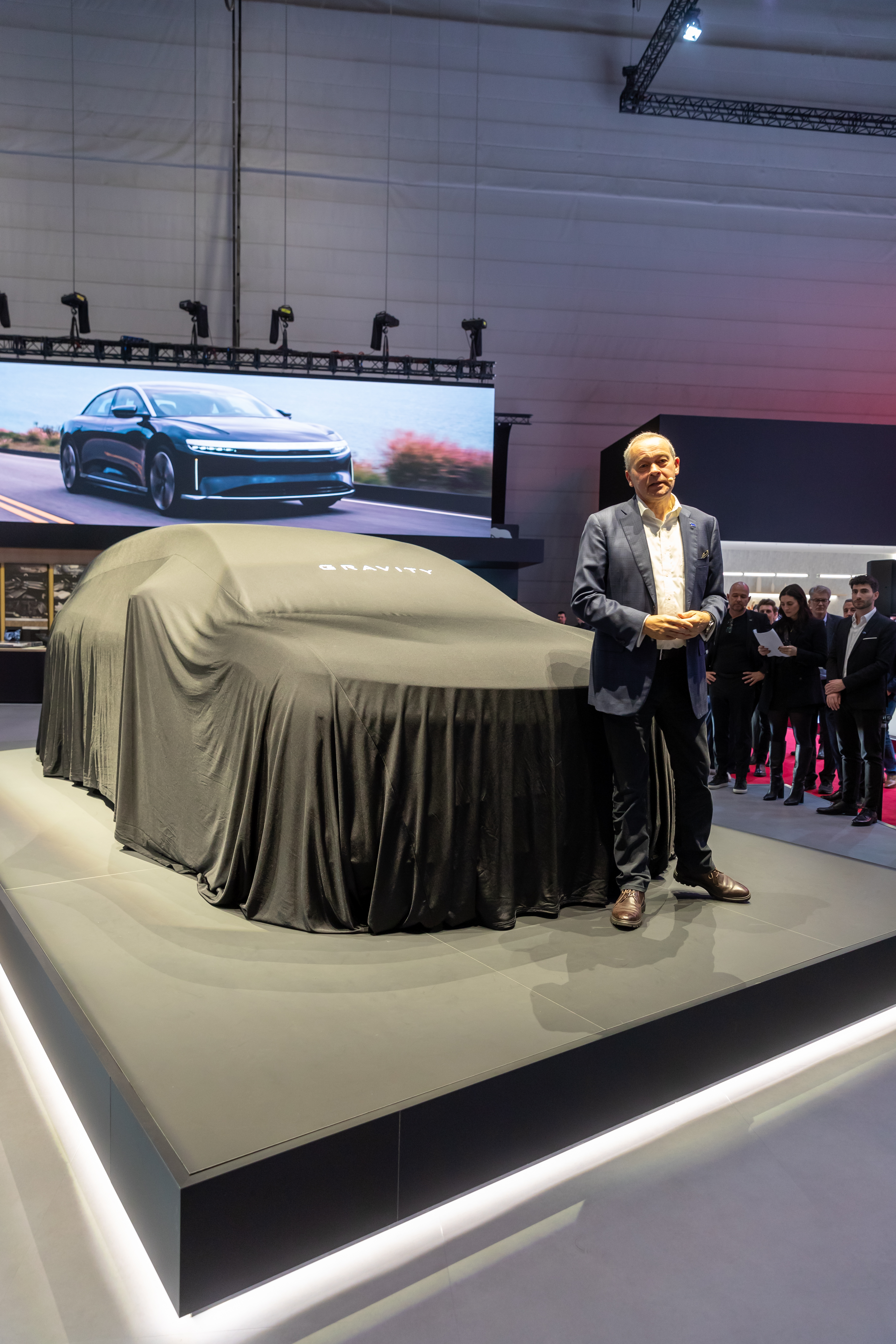
Lucid Gravity
"... 5,500 vehicles, but only delivered about 3,100. Gravity crossover sales took a hit after a recall over a ..."
The Lucid Gravity is an all-electric SUV made by Lucid. It uses electricity instead of gasoline, and it’s built for everyday driving with more space than a typical sedan. The podcast mentions it because some owners were affected by a recall, which can slow sales.
The Lucid Gravity is a fully electric crossover SUV from Lucid Motors, designed to bring the brand’s EV technology to a more family-friendly, higher-riding vehicle. It’s been discussed in sales and delivery updates because reported deliveries lagged behind expectations, and a recall affected Gravity sales momentum. That combination of delivery performance and recall activity makes it a notable topic in an automotive news roundup.
tariffs
"The factory was supposed to be all-electric, but GM switched back to traditional gas engines amid [121.9s] tariffs, rolled-back emissions rules, and cooling EV demand."
Tariffs are extra taxes on imported products. The episode suggests tariffs made EV-related plans harder or more expensive.
Tariffs are taxes a government places on imported goods. In the segment, tariffs are cited as one reason GM moved away from an all-electric plan toward traditional gas engines.
emissions rules
"...GM switched back to traditional gas engines amid tariffs, [121.9s] rolled-back emissions rules, and cooling EV demand."
Emissions rules are government limits on how much pollution cars are allowed to produce. The episode says those rules were loosened, which affected EV plans.
Emissions rules are regulations that limit how much pollution vehicles can produce, typically measured through exhaust and fuel-economy standards. The segment notes “rolled-back emissions rules” as part of the rationale for GM’s shift back to gas engines.
powertrains
"powertrains, but hasn't pulled the trigger on that yet."
A powertrain is what makes the car move—like the engine or electric motor and the parts that connect them to the wheels.
A powertrain is the set of components that generate and deliver power to move a vehicle, such as engines, electric motors, transmissions, and related control systems. The segment uses the term to discuss different vehicle types (hybrids, gas, and EVs) and how they’re performing in the market.
hybrids
"Hybrids are flying off dealership lots faster than anything else... 59 days in inventory, compared with 75 days for gas-powered vehicles and 114 days for EVs."
Hybrids use two types of power: a gasoline engine and an electric motor. In this segment, they’re selling faster than other types of cars.
Hybrids use both an internal-combustion engine and an electric motor/battery. The segment notes that hybrids are moving through dealership inventory faster than gas vehicles and EVs, suggesting demand is being pulled by fuel prices.
EVs
"...75 days for gas-powered vehicles and 114 days for EVs. The reason? Elevated fuel prices are driving demand for hybrids and electric vehicles..."
EVs are cars that run on electricity stored in a battery. The segment compares how quickly EVs are selling versus other car types.
EVs (electric vehicles) are cars powered primarily by one or more electric motors drawing energy from a battery. Here, the hosts compare EV inventory days to hybrids and gas vehicles to explain relative demand.
burning through cash
"...some people do think they're in real trouble because they keep burning through cash... how long can Lucid keep burning through cash at this rate?"
“Burning through cash” means the company is spending its money faster than it’s earning it. If that continues, the company eventually needs more funding.
“Burning through cash” means spending cash faster than the company is bringing in revenue. For EV makers, this often reflects high development and manufacturing costs before sales scale up.
gross margin
"...a billion-dollar net loss, negative 110% gross margin. They're losing about $100,000 a car on a gross basis."
Gross margin is a way to see whether a company makes money on the product itself. If it’s negative, it means they’re spending more to make each car than they earn from selling it.
Gross margin is a profitability metric that measures how much money a company keeps after covering the direct costs of producing its products. A “negative gross margin” means the company is losing money on each unit it sells at the gross level.
liquidity
"Now, Lonnie, the company still has over $3 billion in liquidity, but how long can Lucid keep burning through cash at this rate?"
Liquidity is how much cash a company has on hand. The hosts use it to judge how long Lucid can keep operating before it runs out of money.
Liquidity refers to how much cash and cash-like resources a company has available to pay bills and keep operating. In this segment, Lucid’s liquidity is used to estimate its “runway” before it needs additional funding.
digital retailing
"At the same time, consolidation and digital retailing are changing how products are sold and supported."
Digital retailing means buying a car more through websites and apps instead of mostly in a dealership. It can change how you see prices, negotiate, and finalize the sale.
Digital retailing is the shift from traditional in-person car sales to online shopping and remote purchasing. In practice, it changes how dealers present inventory, handle pricing, and complete transactions.
asset protection
"That's why many dealers are reexamining how asset protection fits into long-term profitability and business goals."
Asset protection is a set of dealer-focused products meant to reduce financial risk. The goal is to help protect the money tied up in vehicles and sales.
Asset protection refers to financial products and dealer programs designed to reduce risk and stabilize revenue. In dealership contexts, it often ties to protecting the value of vehicles and managing exposure over time.
vehicle protection plans
"For more than 60 years, protective asset protection has worked alongside dealerships across the country, delivering trusted FNI solutions like vehicle protection plans, maintenance programs,"
A vehicle protection plan is extra coverage you can buy for your car. It’s meant to help with repair costs or other vehicle expenses.
Vehicle protection plans are aftermarket coverage products sold through dealerships to help pay for certain repairs or vehicle-related costs. They’re typically positioned as an add-on to improve customer confidence and create additional dealer revenue.
limited warranties
"delivering trusted FNI solutions like vehicle protection plans, maintenance programs, limited warranties, guaranteed asset protection and more, helping dealerships generate revenue"
A limited warranty is a promise from the seller/producer to cover certain repairs, but only under specific rules. It usually doesn’t cover everything.
Limited warranties are coverage agreements that specify what parts or repairs are covered and under what conditions. Compared with broader warranties, they usually come with exclusions, limits, and defined time/mileage terms.
FNI solutions
"delivering trusted FNI solutions like vehicle protection plans, maintenance programs, limited warranties, guaranteed asset protection and more, helping dealerships generate revenue"
FNI solutions are the extra money/insurance add-ons dealers sell with a car. Think coverage plans and related products that sit next to the vehicle sale.
FNI solutions refers to finance and insurance offerings sold alongside the vehicle purchase. These can include protection products, maintenance plans, and warranty-like coverages that generate dealer profit.
industrial policy
"Automotive news managing editor Jerry Hirsch argues in his new column that the U.S. needs its own industrial policy to counter that threat, including bringing back a $5,000 tax credit for EVs under $50,000."
Industrial policy means the government tries to help certain industries grow. Here, it’s being discussed as a strategy to help the U.S. auto industry compete against China.
Industrial policy is government action designed to shape which industries grow and how they compete, often using incentives, regulations, or trade measures. In this segment, it’s framed as a way for the U.S. to counter China’s support for its auto industry.
strategic effort to become the major auto exporter globally
"There's just dozens of ways because this is a strategic move for them to essentially be the major auto exporter globally."
The idea is that China is trying to sell more cars to the rest of the world than anyone else. They’re using government support to help their automakers grow and export.
The segment describes China’s approach as a coordinated strategy to dominate global auto exports, using subsidies and trade policies to scale production and competitiveness. It frames this as a threat that the U.S. needs to respond to with its own industrial policy.
combustion engine technology
"Well, we have this problem in the United States and we have this incredible, wonderful infrastructure based on combustion engine technology with a gas station every quarter..."
Combustion engine technology is the traditional engine that runs on gasoline or diesel. The point here is that gas stations are already everywhere, which makes gas cars feel convenient.
Combustion engine technology is the conventional internal-combustion system that burns fuel to make power, typically using gasoline or diesel. The segment contrasts this with EV infrastructure and notes the existing convenience of gas stations.

Morgan 4 Plus
"... Even now with the Iran war, wow, gas prices are $4 plus a gallon in many parts of the country, a little ..."
The Morgan Plus 4 is a small sports car made by Morgan. It’s designed for fun driving and has a classic, traditional appearance. The podcast brings it up because when gas prices rise, people may change what kinds of cars they’re willing to buy.
The Morgan Plus 4 is a traditional-style sports car from Morgan, known for its classic look and lightweight, driver-focused design. It often comes up in discussions about pricing and market conditions because it’s a niche model and its sales can be sensitive to factors like fuel prices and consumer spending. In a daily drive context, it’s mentioned as part of how buyers react when everyday costs change.
gas prices
"Even now with the Iran war, wow, gas prices are $4 plus a gallon in many parts of the country..."
Gas prices are how much it costs to buy gasoline. When gas is expensive, electric cars can start to look like a better deal.
Gas prices are the retail cost of gasoline, which can strongly influence consumer decisions between fuel types. The segment uses current and global gas price differences to argue why EVs may gain traction where gasoline is less affordable.
EV adoption
"In fact, the Iran war is only going to push electric vehicle adoption in the rest of the world because they don't have the luxury of much lower gas prices."
EV adoption just means more people are switching to electric cars. The hosts are saying that when gas gets expensive, EVs tend to look more attractive.
EV adoption refers to how quickly electric vehicles are being purchased and used by consumers and businesses. The segment argues that higher fuel costs and limited access to cheap gasoline outside the U.S. can accelerate EV adoption.
EV tax credit
"So you actually make a pretty specific proposal here that the government should reinstate at least a $5,000 tax credit for EVs under $50,000. Talk about why that amount and why you think that's important..."
An EV tax credit is money the government gives you (through your taxes) to help lower the price of an electric car. The idea here is to make EVs cheaper enough that more people will choose them.
An EV tax credit is a government incentive that reduces the cost of buying an electric vehicle. In this segment, the proposal is to reinstate a credit specifically for EVs under a price cap, aiming to make EVs more affordable and increase adoption.
affordability crisis in autos
"...we still need some sort of pull for them. And we have this huge affordability crisis in autos in the United States. Insurance is incredibly high. Maintenance and repairs have gone up..."
They’re saying cars are getting too expensive for many buyers. The episode points to higher insurance, higher repair/maintenance costs, and higher average car prices.
The affordability crisis in autos refers to the idea that buying and owning cars has become harder for many people due to rising costs. This segment ties it to high insurance, and higher maintenance and repair costs, plus higher average transaction prices.
GM
"Yes, Ford is doing this project in Long Beach to build a low-cost EV compact truck. I'm sure GM still has EVs in the market. I'm sure they're still doing research."
GM is mentioned as another automaker that still sells electric vehicles and continues EV research. It’s brought up to show that not every company has stopped investing.
GM (General Motors) is mentioned as still having EVs in the market and doing ongoing research. It’s included as part of the broader point that some automakers are continuing EV work even if investment has slowed for others.
charging infrastructure
"I think over that time, our charging infrastructure will be really good. We will have made improvements to the grid, not because of EVs, but because of data centers."
Charging infrastructure just means the places and equipment that let you charge an EV—like public fast chargers and home charging. If there are enough chargers and they work well, EVs are easier to live with.
Charging infrastructure is the network of places and equipment that supply electricity to plug-in vehicles, like public fast chargers and home charging setups. Its availability and reliability strongly affect how practical EV ownership is, especially for road trips and apartment dwellers.
grid
"We will have made improvements to the grid, not because of EVs, but because of data centers. But the EV transition can piggyback on that."
The grid is the big electrical system that delivers power to your house. If lots of EVs start charging, the system may need upgrades so charging stays reliable.
The grid is the electric power network that generates, transmits, and distributes electricity to homes and businesses. EV charging adds new demand, so grid upgrades and capacity planning can matter for avoiding overloads and keeping charging fast and reliable.
EV transition
"But the EV transition can piggyback on that. And we'll be in a much better situation where an EV will have the convenience of a gasoline car."
EV transition means the move from gas cars to electric cars across society and the auto industry. It’s not just the cars—it also involves charging and power systems.
The EV transition refers to the broader shift from internal-combustion vehicles to electric vehicles across the market. It includes changes in vehicle technology, charging availability, and supporting infrastructure like the power grid.
electric software-defined architecture
"is that EVs lend themselves to this electric software-defined architecture. You take out the combustion chambers, the pistons, the hydraulics."
This is the idea that an EV is run more by software and electronics than by traditional engine-based hardware. That can make the car easier to update and potentially reduce some types of maintenance.
An electric software-defined architecture means the vehicle’s key functions are controlled heavily by software and electronics rather than by traditional mechanical systems. In EVs, that enables features like software updates and centralized control of systems, because there’s no combustion engine driving many of the old mechanical components.
brake by wire
"You could have brake by wire, steer by wire, electric braking calipers."
Brake by wire means your brake pedal sends an electronic signal instead of directly pushing fluid through a traditional system. The car’s electronics then control the braking for you.
Brake by wire replaces the traditional mechanical/hydraulic link between the brake pedal and the brakes with an electronic control system. Sensors interpret pedal input, and actuators apply braking force, which can enable advanced stability control and easier integration with software.
steer by wire
"You could have brake by wire, steer by wire, electric braking calipers."
Steer by wire means the steering wheel doesn’t mechanically connect to the wheels the old way. Instead, it sends signals to electronics that move the steering for you.
Steer by wire replaces the mechanical connection between the steering wheel and the steering mechanism with electronic signaling and actuators. This can allow more flexible steering calibration (like different steering ratios by speed) and can simplify packaging, but it depends on robust sensors and redundancy.
electric braking calipers
"You could have brake by wire, steer by wire, electric braking calipers."
Electric braking calipers use an electric mechanism to squeeze the brake pads instead of using hydraulic pressure. It’s part of the broader idea of controlling braking electronically.
Electric braking calipers use electric motors/actuators to apply braking force instead of relying on hydraulic pressure. This pairs naturally with brake-by-wire systems and can improve how precisely braking is controlled by software.
cost of ownership
"Clearly, the next generation EVs are going to have far less maintenance than a combustion engine vehicle. So again, we're helping our consumers by lowering their cost of ownership."
Cost of ownership is what it really costs to keep a car running over time—not just the purchase price. The claim here is that EVs may be cheaper to maintain.
Cost of ownership is the total amount of money to run and maintain a vehicle over time, including things like maintenance, repairs, energy costs, and sometimes insurance. The speaker argues EVs can lower this because they may require less routine maintenance than combustion-engine cars.
software and the communications devices embedded in these vehicles
"wouldn't there be a national security reason to have our vehicles lead the electric vehicle transition so that we know there's security in the software and the communications devices embedded in these vehicles?"
This refers to the in-car electronic systems that run vehicle functions via software and connect to networks (for example, cellular connectivity for updates and data). The speaker frames this as a national-security concern because software integrity and communications reliability matter for safety and resilience.
EV credits
"The case for bringing back EV credits to counter China; Lucid's billion-dollar loss ... I mean, you can make this argument in six different ways, but at some point, again, you've got to be pragmatic and look at the reality of global industry and the global markets."
EV credits are government money incentives that make electric cars cheaper to buy (or easier for companies to build). When they exist, more people are likely to buy EVs because the price feels lower.
“EV credits” are government incentives that reduce the effective cost of buying or producing electric vehicles. They’re often structured as tax credits, rebates, or production credits, and they can shift consumer demand and automaker investment.
EV range (miles per charge)
"Well, if BYD could get in here with a $35,000 EV that can go 300 miles per charge, game over, all of the budget market's going to gravitate to that..."
“Miles per charge” tells you how far an electric car can go before you need to plug it in again. More miles per charge usually means less worry about running out of battery.
“Miles per charge” is a shorthand for how far an EV can travel on a single battery charge, typically based on standardized testing. It’s a key buying factor because it affects whether drivers feel the car can handle daily commutes and longer trips.
BYD
"Well, if BYD could get in here with a $35,000 EV that can go 300 miles per charge, game over, all of the budget market's going to gravitate to that..."
BYD is a big Chinese car company that makes electric cars. The point here is that if BYD sells a relatively cheap EV with decent range, it could quickly win customers.
BYD is a major Chinese automaker known for producing both EVs and batteries at large scale. The speaker uses BYD as an example of how a low-priced, long-range EV could rapidly pull demand away from higher-priced options.
Stellantis
"...essentially for GM or the American unit of Stellantis, or to buy a plant, buy access capacity and launch a plant here."
Stellantis is a big car company that operates in multiple countries. The speaker is saying Chinese EV makers could partner with a company like Stellantis to sell in the US sooner.
Stellantis is a large multinational automaker formed from a merger of FCA and PSA. The speaker mentions its American unit as another potential legacy partner for Chinese EV companies seeking faster market entry.
supply chain
"US labor rates and create a supply chain and they'll be investment capital that they would have to put into it. But they could still probably undercut our prices and come out with some really good budget EVs for those who can't afford to buy a new vehicle at this point."
A supply chain is the whole process of getting materials and parts to build a product. For EVs, building that network can cost money and take time.
A supply chain is the network of companies and steps involved in making a product, from raw materials to parts to final assembly. In EVs, supply-chain buildout can be expensive and time-consuming, affecting cost competitiveness.
Automotive News
"Jerry Hirsch is managing editor of Automotive News. His new column is US needs its own EV industrial policy to counter China. Jerry, always great having you on. Thanks so much."
Automotive News is a car-industry news outlet. In this segment, the hosts mention its editor and reporters as the people behind the story.
Automotive News is a trade publication covering the auto industry, and it’s referenced here through its managing editor and reporting team. The hosts are using it as the source context for the discussion.
Crane's Detroit Business
"We also have reporting from Curt Nagel of our sibling publication, Crane's Detroit Business. You can get the latest news on EV policy, lucid struggles and everything happening in the auto industry at AutoNews.com."
Crane’s Detroit Business is another Detroit-area business publication mentioned as a reporting source for this episode. It’s cited to show the broader newsroom coverage behind the EV policy and industry updates.
Request an Explanation
Heard something you'd like explained? We'll add it to this episode.
Sign in to request explanations for terms you heard.
Want to learn more?
Browse our glossary for plain-English explanations of automotive terms, jargon, and concepts.
Help improve this episode
See something that's not quite right? Our annotations are AI-generated and can sometimes miss the mark. Click the flag icon on any annotation to suggest a correction.