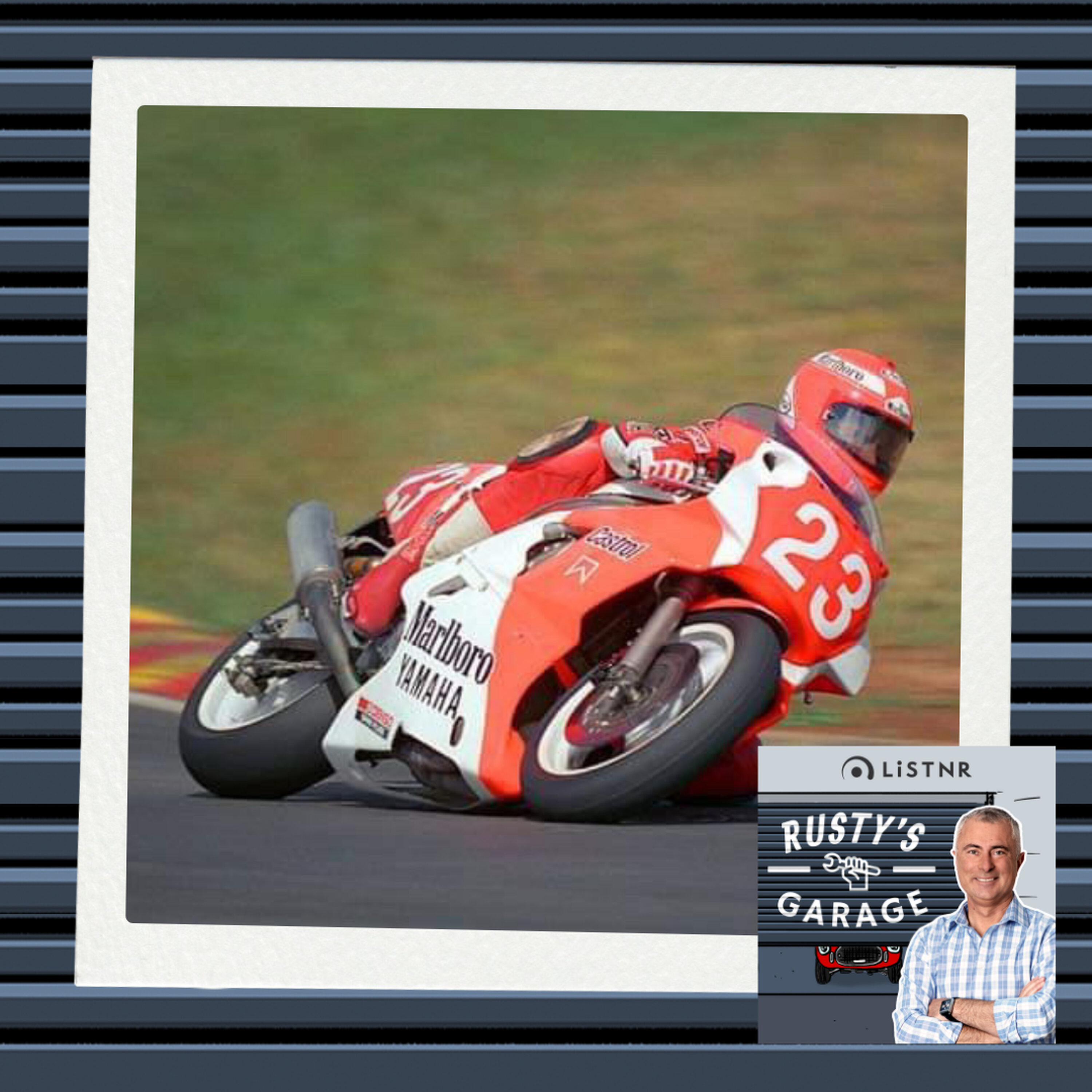
A TZ750 is a Yamaha race bike with a 750cc engine that uses a two-stroke design. Two-strokes typically rev hard and feel very aggressive compared with most modern engines.
A wheelie is when the front wheel comes up off the ground while you’re riding. It usually happens when you apply enough power (or the bike is set up that way) that the front end loses contact. Here, it’s part of what makes the hill section tricky.
It means you let off the gas pedal. Doing that changes how much pulling force the engine is making, which can help the bike stay balanced over a tricky part of the track. The host is saying that easing off the throttle is what keeps the bike from flipping.
A “barber scrub” is a riding trick where you sort of slide/scrub the tires as you go over a hill or jump. The goal is to keep the bike stable and under control rather than letting it bounce or tip. The host is using it as an analogy for how Hansford was handling the crest.
Car
KR750 factory three cylinder water cooled GP bike
The KR750 is a Kawasaki race bike. It has a three-cylinder engine and it’s water-cooled, and it was the machine Hansford was riding when he used that special technique to stay stable. The point is that this wasn’t just any bike—it was a purpose-built GP racer.
Greg Hansford is a famous motorcycle rider. In this segment, the hosts say he was the only one they can remember doing a particular stunt (“barber scrub”) in that era.
Wanneroo is a well-known race track in Australia. The speaker is basically saying: if you’ve raced bikes there, you’ll understand how hard that stunt is.
The Toyota Corolla is a regular passenger car that’s made for everyday driving. People often choose it because it’s practical and easy to live with. In the podcast, it’s mentioned as a newer car she got later in life.
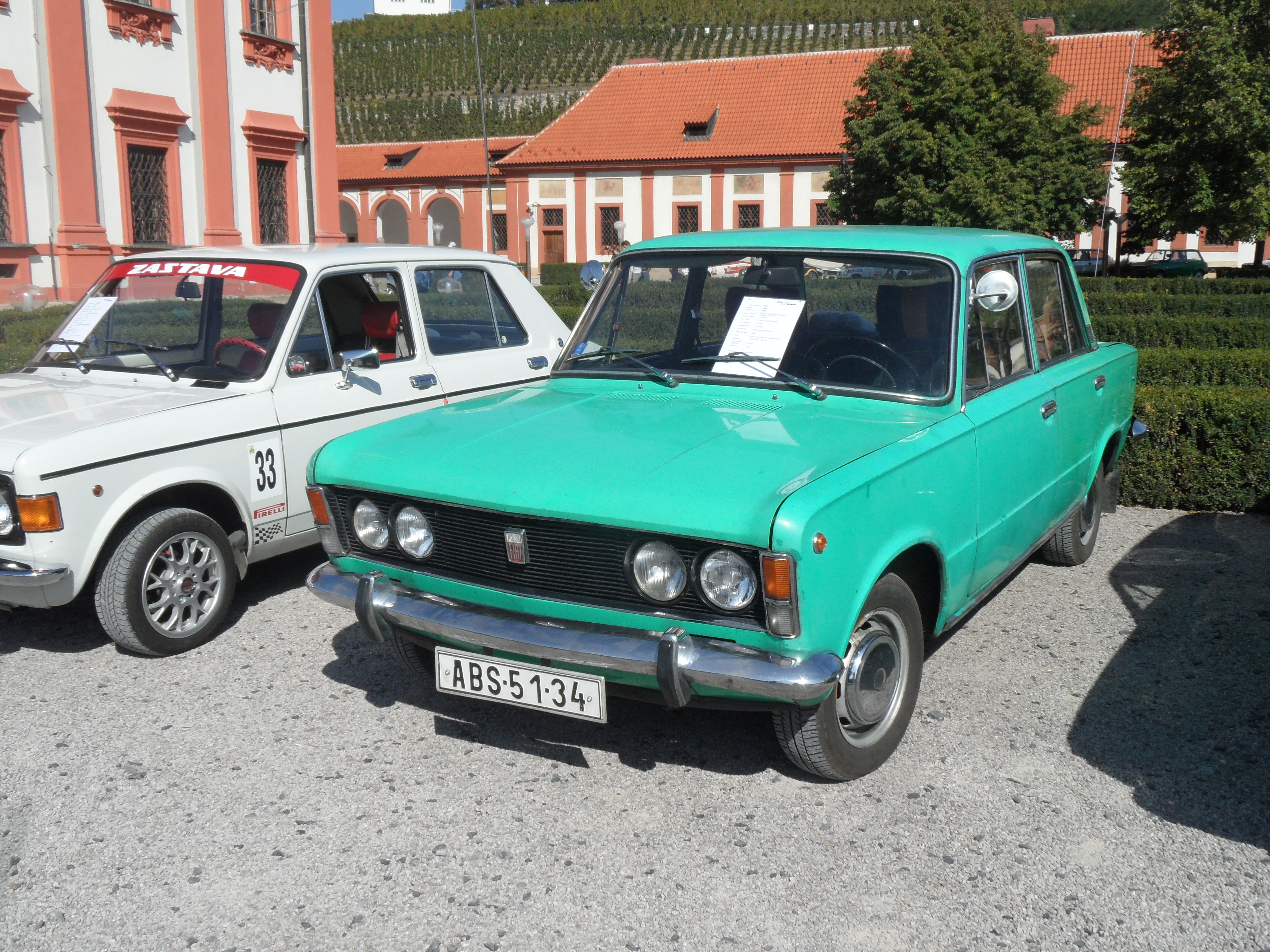
The FSO 125 is an older compact car made by FSO in Poland. It’s the kind of vehicle people talk about when discussing classic or historical cars. In the podcast, it’s mentioned as part of the speaker’s background with vehicles.
Yamaha is a well-known motorcycle company from Japan. Here, it’s mentioned because the speaker’s contact was Yamaha’s distributor in Queensland. That connection helped them get a chance to ride a race bike.
Antonin Thompson is mentioned as the Yamaha distributor in Queensland. In this story, that distribution connection is what helped the speaker get access to a race bike. It shows how local business links can open doors in racing.
Rob Assink is a person the speaker worked with in the racing and motorcycle distribution network. The speaker credits him with helping set up the chance to ride the RC500. It’s part of the story of how they got access to the bike.
Car
RC500
The Yamaha RC500 is a race bike Yamaha made for long-distance racing. Here, they’re talking about using it in a big endurance event called the Hub 300. The speaker says they were early riders of that specific bike model.
This means racing machines that are closely related to what people could buy, but they’re tested in long races. The focus is lasting the whole event reliably. Here, they’re saying this was an early phase of that style of racing in Australia.
This is a race track in Brisbane. The speaker says it was their home track at the time, meaning they knew it well. That familiarity can help riders perform better because they understand the turns and lines.
ADR compliance means the vehicle has to meet Australian rules for things like emissions and safety equipment. If there are “compliance issues,” it means the bike didn’t fully meet those rules as it came from the factory.
Oil injection is a system that automatically adds oil to the fuel/air so the engine stays lubricated. Instead of mixing oil into the gas yourself, the bike does it for you.
On many two-stroke engines, the piston itself controls the openings (ports) that let gases in and out. “Piston port” means the piston is what uncovers those openings to time the engine’s breathing.
Term
read valve engines
“Read valve engines” appears to be a transcription of “reed valve engines.” Reed valves are one-way valves (usually in the intake tract) that open to let the fuel-air mixture in, then close to help prevent backflow—improving two-stroke scavenging and throttle response.
Car
VFR 1000 Hondas
The Honda VFR 1000 is a Honda motorcycle with a V4 engine. Here it’s brought up because the rider says they were racing against those bikes.
Car
GPZ 900 Kawasaki
The Kawasaki GPZ 900 is a well-known older Kawasaki sport bike. It’s mentioned because the rider was racing against those motorcycles.
“Road circuits” are race courses that use roads (or road-like layouts) instead of a dedicated race track. They can feel more dangerous because the track space is tighter and there’s less room for mistakes.
Car
TZ 350
A TZ 350 is a Yamaha race bike. It’s known for being built for speed and racing, and the speaker is saying they were riding one in 1980.
“Your line” is the route you plan to take on the track—like the exact path through a turn. The idea is to focus on that path so you don’t get thrown off by distractions.
Term
armcodes
This word sounds like it’s meant to be a racing term for something you might see out of the corner of your eye. The point is that the rider shouldn’t stare at distractions—focus on the track instead.
Term
top riders
“Top riders” means the best motorcycle racers. The speaker is saying they look far ahead on the track so they can react sooner and ride more smoothly.
Conrod Strait is a well-known fast section of the Bathurst track. People use it like a landmark to describe where you’re going very quickly and what the ride feels like there.
Car
TZ 750
The Yamaha TZ 750 is a race motorcycle built for speed and track use. Here, the guest says it was his first “big bike,” and that it needed upgrades to work well at Bathurst.
Suspension is what helps the bike handle bumps and stay stable. In racing, good suspension helps the tires keep grip when the road gets rough or the rider is going hard.
Geometry is how the bike’s steering and suspension are positioned relative to each other. It changes how the motorcycle turns and feels—especially when you’re riding fast.
Crankcases are the engine’s main lower housing where the crankshaft sits. Saying they were “brand new” suggests the engine internals were fresh and built to run hard.
The Conrod crank assembly is the engine’s internal rotating parts—basically the crankshaft and the rods that connect to the pistons. “Brand new” here means the engine’s core moving parts were fresh.
Here, “brakes” means the moment you slow down hard for the next part of the track. At Bathurst, that’s especially important because the track changes elevation quickly.
A wheel stand is when the front wheel lifts up off the ground. It can happen when the bike accelerates hard or goes over a bump, and the rider has to control it so it lands safely.
The front tyres are the tires that control where the bike points. If they “smoke,” it usually means they’re losing traction, so the rider has to keep the bike straight and under control.
The clutch is the control that lets you smoothly connect or disconnect the engine’s power. In this situation, they’re using it to adjust engine speed while riding.
“Revs” means how fast the engine is spinning. Nine and a half thousand revs is very high, and racers watch it because it affects how the engine performs and how hard it’s working.
RPM is how fast the engine is spinning. They’re saying they could have gotten the engine speed down by about 500 RPM sooner, which would have saved time in their run.
Term
PA
“PA” is the loudspeaker system at the track. It’s how officials and crew announcements get broadcast, and they couldn’t hear it while in the pits.
Gearing is how the transmission multiplies the engine’s power. If the car isn’t strong enough to pull at the speed you want, changing the gearing can help it accelerate better and stay in the engine’s useful range.
“750cc” is the engine size, measured in cubic centimeters. Bigger numbers usually mean a bigger engine, which affects how fast the bike can go and how much fuel it uses.
Bathurst is a famous race track in Australia. They’re discussing how the track’s speed and layout make fuel range and riding technique decide who wins.
Fuel range means how far you can go on a tank of fuel. In a race, whoever can travel farther before needing fuel can often win because they can plan pit stops better.
Fuel tanks hold the gasoline for the bike. In long races, bigger tanks let you ride longer before you have to stop for fuel.
Place
Oren Park
Oren Park is a race track they tested at. They’re saying it’s slower than Bathurst, so the bike feels different in terms of speed and how hard you’re working through corners.
G-force is how hard the bike is accelerating or turning, measured in “g’s.” More G-force usually means the rider feels more pull and the bike is working harder through the track.
Term
top of the mountain
“Top of the mountain” is a notable section of the Bathurst track. They’re describing what it feels like there—fast enough that gearing and shifting become critical.
Overrevving means the engine is spinning faster than it’s meant to. It can be risky because it can stress the engine, especially if it happens for more than a moment.
The shifter is what you use to change gears on the bike. If it’s damaged or stuck, you can’t shift when you need to, which can make the engine run too fast.
A shift pattern is just how the gears are arranged and which direction you move the shifter to get the next gear. They changed the setup so it was easier to shift while the bike was leaned over on a fast, dangerous track.
LIVE
MUSIC
A Listener production.
I'm automotive commentator and journalist Greg Rust,
and this is Rusty's Garage.
For this episode, I'm on the road in Western Australia.
A number of you have messaged and asked me to put Michael Dowson
on our guest wish list, so I thought it was time to get him on,
and it's great that we are finally making this one happen.
I'm about an hour or 90 minutes north of Perth
on a huge farm that belongs to a friend of his.
Ordinarily, you'd find him and his lovely wife, Joe,
down south around Bunbury, where he spent the early part of his life.
This pod will broadly tell the story
of his bike racing career, but also his foray into touring cars.
Let's just say he was very good there, too.
In a 2018 story in the old bike archives,
they described him as stylish, swift and safe,
one of Australia's most gifted and successful motorcycle races,
up there with the very best.
He's tied with Ken Blake for the record for most Castrol six-hour wins.
Took 11 victories at Bathurst on two wheels,
including a double the first time that he went there in 1980.
Those of you who love your bikes will fondly remember him
in Yamaha Leathers with various blue-chip sponsors
and a stint with Kawasaki, too.
His racing wasn't just limited to our part of the world.
Mike had success in Asia,
and he shares stories around the famed Suzuka Eight Hour.
There are all sorts of names that he went wheel to wheel with
and had fun in the paddock with.
Kevin McGee and Robbie Phyllis, who you can find,
both of them in our garage library,
as well as Malcolm Campbell,
who I'll track down in the coming months
and a swag of international stars of the day.
Keep an ear out for a great yarn on Mick Dewan.
Dawson respectfully talks about realising Mick's talent
when they raced against each other and were teammates.
He then quietly helped open some doors
before Dewan's career hit top gear internationally with Honda
in what we now know as MotoGP.
As the conversation flows, I'm kicking myself a little
because we didn't talk in detail about Dawson's 1988
Swan Series win, that famed series.
After five years of trying and two runner-up finishes,
he beat Dewan and Campbell to the prestigious crown,
which came down to the final race at Phillip Island.
Now, Dawson has since reminded me by text
that Mick actually had a clutch problem in the decider.
For mine, though, it's the series,
not just one race and a huge overall achievement
worth shining a light on.
He worked with some guns, like the late Warren Willing,
Mal Pittman, and more.
We'll talk about them along the way.
A quick thank you to a few people who help with backstories,
like my great-mate Darrell Beatty,
who actually bought a TZ350 off Dawson.
It was Dawson's first GP bike,
and Michael threw in some Toshiba Leathers, too.
I've chatted with Mick Dewan, who was back home briefly.
All these years on, he has immense respect for Dawson as a rider,
and he's quick to acknowledge what he's done for him in those early years.
There are more who assisted me with Intel here,
including Motorcycling Australia CEO Peter Doyle
and my broadcast colleague John Smales.
J.S. recalls Dawson's brilliance and selfless nature,
but also how he seriously impressed at Toyota
in a star search competition,
which opened the door to touring cars,
all while he was still doing great things in bike circles.
Like me, this Convo might make you wonder what could have been
on the four-wheel side with Toyota,
the pros and cons of Dawson's move from Yamaha to Kawasaki,
and I sense there are plenty who feel that he could have had a stellar career
in the World Motorcycle Championship,
had timing and opportunities been right.
But Michael doesn't strike me as a shoulda, woulda, coulda type.
This is a great chat filled with straight talk,
some laughs and wonderful recollections.
Enjoy.
Magoo called me Smokey.
I think that was Dawson.
That was one of them.
He'd give me that one. I don't know how far that went.
Was the doorman because you were pretty handy
to close the door on people, or was that what they insinuated the door?
I reckon there was a bunch of guys
way better out of the me,
closing the door and sticking me in the bush,
so names will remain anonymous.
Yeah, so there was different things.
I think at one stage in the malware era,
they had quite a few broaches they'd produce with the malware staff
and then have me and Kevin or Mick or Peter Goddard,
and they'd take our photos, and at some stage,
I decided on a moustache, and I think that's where it started.
Everyone had to crack up at my little moustache,
and they called me the Colonel.
The Colonel.
I think so. I'm not really...
There's a photo here.
Joe, your lovely wife is telling me there's a photo here.
I have to look at this later.
What are we talking like, full 80s spec?
You know, what prompted that?
I don't know what it was.
At this stage, my younger brother Anthony was a machinist in the RAF,
and he was at Wagga Wagga for a long time,
and I get to see him.
He was at the Air Force Base in part near out west of Brisbane,
so I caught up with him a fair bit out there,
and I think going out of the Air Force and seeing all the fly boys,
and I was always a keen pilot,
so I kind of figured that, well, I'm not going to go flying an F-111,
I might as well just have a moustache,
make it look like a full pilot or something.
I really didn't know why I did it, but come off after a while,
because I was just copping the...
Can't take and getting the piss taken out of your thing.
Were you a genuine pilot?
Like, you actually...
You went into, like, fixed wing or something, or what were you doing?
Yeah, I got my private pilot license some time ago,
but it was a funny story.
I finished up racing and thought,
well, I'm going to get a fixed wing license, which I had started to do,
and got to the point where navigation was on,
so it was a bit of flying, you know, get up to 10,000 feet
and head off to a spot and watch the GPS, blah, blah, blah.
And I remember I did one with my training pilot,
and he said, well, are we going to go out and do some stuff?
I said, oh, I've got an uncle that's a copper out at Muckin' Budden,
and he's got to go home, so how about we'll...
Take him out.
...back to that out.
So it rang Nick, and I said,
are you sure you want to get in with a boat and a plane with me,
because he didn't like getting in a boat with me.
Okay.
And he said, oh, yeah, well, that's the best way I get in home,
because I really hadn't thought about how I was going to get back to the police station,
so anyway, I said, well, I can do that.
So did the old flight out to Muckin' Budden, landed,
took back off after dropping Nick off,
got back to boundary and said,
that was the most boring thing I've ever done and stopped.
Really?
Yeah, it was boring as a batch of it,
because up until when you start training,
you're doing these emergency landings and stuff.
And I was out over a swamp called the Bell,
I can't remember the name of it now,
out near Bronzewick,
and there's a big, just a big old dam, basically,
and you do touch and goes,
and you can do emergency landings sort of stuff,
and I had a ball, I just loved it.
But this thing about sitting up at 10,000 feet...
And just being a taxi?
Yeah, and I come back to the airport and said,
no, that's me, and that was it.
So many people in racing do gravitate to that stuff.
I mean, Daz quite enjoys flying, so does Mick and so on,
and we'll come to some of those boys and their correlation to your story as we go here.
I'm really glad that you brought up your brother there a moment ago,
because that naturally takes us to early life for you.
You were both into bikes from a young age,
we're recording this to the north of Perth,
but early life around bikes and stuff was that at Wontagge,
at the island, or was it down Bunbury Way?
Where did it start for you?
No, so I was born in Victoria at Wontagge,
and then I had a chronicle asthma as a kid.
So Mum and Dad decided to do an Australian trip, do a lap,
and got to Adelaide, Caravan, five kids, Mum and Dad,
and got to Adelaide, Dad decided to work for a bike shop.
Didn't actually work for Pittman's, but worked for somebody,
and we were all going to school, obviously,
and Mum found that my lungs were starting to clear up.
So we come across to Perth, still on the lap thing,
and we were here for about six months, I think,
and my lungs cleared up completely.
Wow.
But I don't believe for a minute that I'm the reason we're still here in Western Australia,
but that's pretty much, I think, what happened initially.
My lungs probably, if I'd gone back to Victoria,
would have been in a hole if I stayed in those cold areas
with my lung issues as a kid, so.
Joe's found a wonderful photo here with the Moe.
You're in jocks.
Don't explain it.
You're in jocks.
You're in the back of it.
Yeah.
Well, thank God you haven't got cameras and stuff.
I'm good at descriptions.
I'm good at descriptions.
You are quite the male model there, mate, aren't you?
Take me to early life then.
Your dad, you talked about working at a bike shop and so on,
and from what I can gather for both you boys at a young age,
put a bit of a makeshift bike together as one of your first, is that right?
Yeah, so the first bike we had was a JT-1,
which was a production trail bike for kids,
probably the first junior bike.
That was pretty good.
So our first motor bikes were brand new bikes in those days.
It was pretty amazing.
But mum and dad worked for Ken George Yamaha.
So Ken George was the distributor of Yamaha in Western Australia in those days.
So mum and dad worked for Ken in Perth,
and then Ken liked what he saw with dad.
So he said, well, how about I want to start a new shop in the Southwest,
on a retail shop in the Southwest.
So set mum and dad up to go to Bumbry,
and so we've been there since the early 70s and still there.
What age were you and how vivid are the memories of that bike shop
and was it a powerful?
Oh, it was a gold mine.
It was just, you know, Anthony and I just loved it.
Just, I think we tried to get out of school
to get back to the bike shop type thing.
I remember putting egg bikes together for dad after school,
and the egg bikes would be boxed up in two.
You'd pull them out of the box,
and they'd all be sitting there on the forks on the front end,
and the back wheel is already attached.
So we'd set them all up.
One day we set them all up in line.
We had about 30 lined up on their forks on the front end,
and Anthony and I were getting between them,
putting the stands on them so we could put the front wheels in.
Anyway, I reckon Anthony, not me,
but one of us knocked one of the bikes with our back,
and the old pendulum effect of about 30 bikes fell over.
Like a scene out of a movie.
Yeah, I still remember dad's face,
but we were still allowed to go back down.
I don't think we got too much damage, but we did it.
I just remember all these bikes going down,
and I think, oh my God, we're gone.
But anyway.
That feeling of riding a bike for the first time,
was it sort of, you know, love at first sight,
whatever you want to call it.
Yeah, so we started off as motocross,
and my dad being a mechanic and a very good one.
He always said to us, right, motocross is on,
he built bikes for us,
and that's how we started motocrossing,
and it was like turn trail bikes into motocross bikes.
In those days, kits could be purchased for trail bikes,
and then you do that, and then they become a motocross bike.
So that's what happened for me and Anthony initially,
and Anthony was the one that was more interested in road racing.
I wasn't so much.
I was pretty keen on motocross,
but eventually dad produced a motocross bike
and turned it into a road racing bike.
For those who remember, the really, really old people,
AS Free Yamaha was a little road bike.
He took the engine out, two cylinder air cooled motor out,
and put a YZ125C single cylinder in that chassis,
and that become our road race bike,
but the only road race circuit in Western Australia
was what was now as Barbe Gallo or whatever they call now.
Yeah, Wannaroo.
So the Wannaroo racetrack.
So I was 16 first, he had to be 16 to ride.
So dad had produced this bike initially for Anthony,
but because I was the oldest and he had 17 months to go
before he could ever ride,
I think dad was more keen than anyone to get it up to Wannaroo.
So then I get to Wannaroo, and I did a full day of riding.
And the other thing that really got me was,
with our dirt bikes, dad said,
right, I'll make your motor bikes, you clean them,
then I'll work on them and get them ready for the next weekend.
So our job was to get them cleaned first.
Had to be cleaned, if he wasn't happy,
they'd be cleaned again.
Right.
And that was the deal.
And the road race bike, I rode it all day,
and at the end of the day when he put it back in the trailer,
it was as clean as the start of the day.
So that was me.
I said, that's it, that's me now.
I can see myself doing road racing
because I was sick of cleaning bikes already.
I reckon you've missed a tiny element to the story here,
and I'd love your thoughts on it if you can.
I think there's a yarn that I've read
about you being a young fella going to Wannaroo there,
and then maybe wandering down to the bowl
and watching the likes of maybe the sails
and Hansford in particular, wasn't it?
Tell me about that.
So Wannaroo in the day, the pit lane section
was down in the bowl.
So it was in the middle of the circuit,
and there was an underground pass to get in.
And so we'd always be there for the Australian championship
before I rode.
Dad had friends that were road race champions
of the day for the national side,
sorry, state side.
And all these guys were always there.
So we would go along and we'd watch
and we'd go to the Australian rounds.
We'd watch Hansford, all those guys,
Rosenfall, Willing, the Perrys,
all those guys, the sails.
And they'd all be there with factory machinery.
It was a mind-blowing period because I had these...
Because of what they were doing or because of the cool bikes?
I think it was a bit of both,
but it was a matter of what they were doing.
I think I only really understood and could see
what they were doing of the day, what they were doing.
When I... About 1985, I got to ride a TZ750,
which was what Will Hagen called as the Old Man's Axe.
So it was an old 750cc two-stroke,
but in the day of when the Hansfords and those boys were around,
they'd come across to one room and those things were like
a motor GP bike yesterday.
That's the level.
And the tyres they had in those days were pretty much just road tyres,
nothing like what they got now with radials or whatever.
And I think probably the point you're getting to is,
I remember standing in the pits,
mind-boggling about what's going on with these machinery in the pits
and then talking to the guys.
Not so much talking to them, but looking at them and thinking,
oh my God.
And then going to the back straight so you could walk across the pits,
all secure, that's no problem.
Stand inside the fence and watch the boys exiting the bowl
and coming over the hill on the back straight.
And I just remember the guys in the 750s,
they'd come out with so much power and aerodynamics weren't that good.
And you'd get a headwind over the top
and they'd have to roll the throttle off to keep them from flipping.
And that's what you'd be watching.
You'd be watching these guys.
There's a bit of a kick on the top of the hill,
at the top of the hill on the back straight.
So halfway up the back straight, that's where the hill is.
Peak of the hill and you go down a hill.
So the boys would come up and wheel spinning out of the bowl
and then sort of manhandling these things up to the top of the hill
and then when they get to the bridge to the top of the hill,
rolling the throttle off or working out
how they can stop these things from flipping.
Mostly meant they had to roll the throttle off.
And you know, you're chasing times.
You know, back then's no different to now.
Everyone was chasing times.
So it's all a matter of how you could,
who holds the throttle open the longest
is going to be the guy that's going to win mostly.
So here's a section of the track where you've got to roll off
or you'll flip.
So Hansford was the only guy that did this at the top of the hill.
You see how they do in motocross they call it the barber scrub
where they roll the bike on the side
and just about put the handlebar into the mud as they go over the hill.
Yep.
Hansford was doing that on a KR750 factory three cylinder
water cooled GP bike.
That's like a photographic memory for you, isn't it?
It's just stuck in my head because I just,
I walked away from thinking and watching the rest of the day
thinking, well, no one else is doing it.
Just Greg.
So to be doing a barber scrub in the early,
mid 70s, mid to late 70s.
And you know, everyone thinks, oh, a barber scrub,
what they were doing in motocross.
They all do it now.
But here's a legend of our sport,
Greg Hansford doing it on a KR750 rocket with shit tires
and doing a scrub across the top of the hill at,
everyone that races bikes and has been to Wanneroo
and knows what I'm talking about.
I don't know anyone that's done a scrub,
except Greg Hansford.
And I don't know how many people can actually say,
yeah, I remember seeing that.
And appreciating what that was, the significance of that.
Mind blowing.
But I remember he did it.
Too bad he's not here to tell us how he did it.
Absolutely.
I'd love to have had him on the podcast.
In the very early phase of my career
around broadcasting for super touring and so on,
that was the tail end of his time.
Very sad.
Very sad.
Guy, absolute legend.
Absolutely lovely guy.
I had a bit to do with him at the end of his life, obviously,
but in the period because him and Warren were very good friends.
So that gave us an opportunity to meet him and talk to him,
which was pretty cool.
And yeah, that's what I remember.
And you know what?
I never spoke to him about it, which I did.
Yeah, absolutely.
What transpires next for you?
I mean, the record book show, you know,
a variety of state titles,
but does it click straight away the road racing stuff
or you immediately sort of almost podium material?
Or are there some tough moments in learning?
Where are you at in the first phase of that road racing journey?
I just loved the technical side.
Understanding what your suspension did, your geometry.
Dad's teaching you that to yourself.
100%.
Yeah, dad was all over it.
The biggest problem I had with my father was he was always saying to me,
look, okay, the Australian Championships coming over,
you're allowed to ride in it,
but just don't get your hopes up.
These guys have got way better machining than we are.
Just let them go.
Your age, what year?
What age do you reckon you are?
Of 17, 18.
Okay.
And you know what I was thinking.
What?
Are you kidding me, man?
I can do this.
I reckon I can take them on.
If you're telling me to slow down, I reckon I can run with them.
Okay.
But I never said it to him.
I would never have said it to him,
but maybe that was the differences.
I remember it echoing in my ears,
driving from Bumbry to Wanneroo,
which was in those days, a three-hour trip.
Yep.
Just don't overcook it.
Your mother will kill me if you hurt yourself.
These guys got better gear,
way better stuff than what you got.
Just let them go.
Okay.
I reckon in an article I read that the one I reflected on before,
you gave them a quote,
and it was something along the lines of,
I had a dad helping me with the prep on the bike kind of thing
and mum praying, so I had it all covered type.
Was she a warrior?
Was she a?
What was that like?
An avid Catholic and devouted Christian
and the best person to have on your side.
Okay.
Lovely.
She wasn't a nervous person about you and your brother racing, riding,
stuff like that.
Well, she was.
She always said,
God will protect us.
I've got a funny story about mum.
So later in life,
she got a brand new Corolla like what you can see around.
Yeah.
So brand new Corolla,
and I'm driving around Bumbry with her,
and she got to go over an intersection,
a dual carriageway.
And we're talking about different stuff,
and I'm looking left.
She's looking right.
Anyway, I said,
I don't know.
You shouldn't go now.
And she went.
And I'm like,
she goes,
no, it's okay.
God will protect us.
And he did.
We never crashed.
Can't have a dent in it,
but yeah,
God will protect us.
Joe's amazing.
What we've been going here,
she is flipping through some of the things
that you've printed out along the way,
which help assist in the storytelling.
So firstly, there's some black and whites here.
Just talk me through and describe what we're seeing.
I mean, there's an early sash that you've got here.
Is that right from a wind by the looks of it?
So the other couple of years in Western Australia,
that I was having a really good time
and greeting the checkered flag first,
which was pretty cool.
This photo here is of my dad
with a real fueling device for it
to our race on a production bike.
Like an early churn, so to speak, basically, isn't it?
Like early 80s,
so it was just like a 20-litre container,
BP container with a welded tube,
a tapered section on the bottom like a funnel,
a ball valve,
and that was the fueling device.
Fast refueling.
But the dude here is my uncle Nick,
the policeman I was saying that I flew out years later.
He's become a cop.
He was a carpenter then.
But I remember he being a policeman later in life.
He was working at Muck and Budden,
and that's the guy that I took out the plane.
That's cool.
He's the guy that helped end my career
in flying airplanes.
Yes.
But so much to talk about in your career
on two wheels first,
and we'll get to the car racing,
some of the car racing stuff a little bit later.
There are multiple championships here in WA
before the family makes a big decision to go east.
Just tell me about some of the memories
from those state titles,
and you did it in multiple classes too, didn't you?
Yes.
So again, having an amazing father
that was just devoted to mechanical stuff
and was a genius.
I can't ever really having a failure
in my racing career prior to going with Warren.
So I went basically with my mum and dad all the way through
until when I got a ride with Warren willing in 86
on the Marlboro team.
So in that period before,
I just can't remember having a failure
through my dad's abilities
of having a machine put together properly.
So, yeah.
So basically, he was the guy that made it all happen.
What's the trigger point for the big move
for the family to go east?
You clearly have ability.
Is there a moment in the west here
where you pick yourself against someone
or race against someone
and you realize, okay, maybe it's time.
I can have a crack at this on a national level.
Well, yes, there was.
And it was probably this two hour production race.
So that was a national race
that was held in Monoroo.
And guys like Andrew Johnson were coming across and riding.
Because Shannon Johnson's father, I think,
Correct, yes.
So Andrew was a bit of a rat bag,
but extremely professional racer
and extremely good racer,
a very hard racer.
And he and I rode 250 production bikes in this race.
And I think I must have beat him.
I can't remember if second or first to him.
Anyway, after this meeting,
we started to get to know over the period before that,
riding 125s and 250s
and starting to know some of the guys from the east coast.
Andrew was a really friendly guy
and he would be very helpful.
And he was giving me advice about riding and stuff.
And I remember Mum and Dad,
after I think this race said,
what do you think he's talking about me?
They said, what do you think about Michael?
Do you think he's got some capacity?
His capabilities, yeah.
And he said, this kid would go good on the east.
So after that, Mum and Dad started thinking about going east.
That's amazing.
Yeah, so I didn't go east by myself.
Mum and Dad come with us.
So, yeah, the whole family went.
And basically, yeah, went to Queensland
and didn't know if it was going to work or not.
Just to fill in a little bit of the blanks here.
Firstly, you've completed school at this stage.
Are you a apprentice mechanic or something?
What are you doing?
Yeah, so in that period,
a couple of things have happened in that period.
We started racing the Australian Championships
while doing the state stuff, so state and national.
Yep.
So we were doing six trips across Australia from Perth,
a high-ace van with a box trailer and...
Over the Nulliball and wherever else.
Yeah, Mum and Dad, me and an Eski and a bunch of bikes.
We go across and do the Australian rounds.
And we got a funny one.
We'd done the trip from Perth, from Bumbry,
gone to Amory Park.
So Amory Park Australian Championship coming up.
And this was in about 1980, I think.
And I had to get back to work
because one of the employees that I had at the time
was getting a bit annoyed.
With the time off.
Yeah, he's never here.
So I was a friend of my dad who was in the band.
My old man was a euphonium player in the local band.
That was a musician as well.
I don't know how he got all the time to do what he did.
But he was a musician in one of the bands in Bumbry
and the main guy had a car shop
and some of our dad got me in there
and I did me apprenticeship for a bloke called Terry Wallace.
And Terry eventually at some stage said to Mum and Dad
that he's away too much.
This can't go on.
So the Toyota people in Bumbry, the crickies,
you heard the crickies.
Yes, absolutely.
So Peter, Ron, Johnny, all those boys,
all mad, keen petrolheads.
And they said, mate, no worries.
You come and work with us and come and go to need.
So I did me apprenticeship between,
pretty much finalised my apprenticeship
when I left Bumbry Toyota.
And from there we'd moved to the east.
Okay.
Were you any good at school?
Were you, I mean, you're talking about?
Horrible.
Were you?
I was more happy to be out of school at the bike shop.
So that's a pretty big sacrifice from Mum and Dad right
to move to the east.
Yeah, there was five of us.
And pretty much Anthony was the academic.
He went to the RAF in the machining side with the RAF.
He initially wanted to be a pilot, but he was too tall.
Okay.
So we had to give up those aspirations
and went for the engineering.
Did he end up, well, you were talking before,
but did he end up at the base there,
not all that far from the Eapswitch track out
towards the back of Brisbane?
Is it?
Is Ambly? Ambly?
Yeah, yeah, yeah.
So he was there a lot.
So we were living in Brisbane
and he was in Ambly for a long time.
You can find lots of great Aussie writers in the garage library.
Many of them are lovable.
Larry can too put it all on the line in their careers,
like Robbie Phyllis.
So I took the Kawasaki deal.
And then a week later, Raymond rings me
and I should have just told Kawasaki,
no, I don't want to do the deal now.
But my word is my word, you know?
Is that always been the way we do this?
It's always been the way.
You don't need to sign anything, you know?
And so they took Fogarty.
One element I haven't come to
and I hope you don't mind if we do talk about it.
I am a good mate of young Chad Nailon
who's doing some great things in broadcasting nowadays
around supercars and so on.
And his dad and you had a bit of a friendship
where you knew each other.
And Chad said to me in the lead up to this
that when he was a really young boy, his dad took him out.
You're still a really young boy.
Yeah, you're still a really young boy.
You're right.
His dad took him out to Wannaroo.
I think you came and greeted them on a quad bike
and showed him around and he was absolutely kind of mesmerized.
And you were the first kind of proper
big-name motor racing person.
It's all your fault.
It's all your fault.
It's very sad that we've lost his dad, obviously,
but I love the impact of some of these key moments.
His late dad loved bikes,
meeting you obviously played a big part in it as well, mate.
Yeah, so I don't know Chad to talk to
in his current life, obviously.
But yeah, so his parents and my parents
were friends in Montague.
Okay.
And my parents and his parents...
Both ended up here in the West.
Ended up in the West.
So yeah, that's how it was.
So John and I stayed close for many, many years
and in the last bunch of years, I remember before his passing,
I'd be teasing him and saying,
hey, go on, Chad's dad.
So yeah, so Chad become the guy and he's done a great job.
He sure has.
John was extremely proud of me.
He should be.
A number of occasions that he was just tickled pink
to have his boy doing what he's doing.
He'd be thrilled to see what he's doing now too.
Absolutely, absolutely.
First, national win.
Australian 350 Grand Prix,
national championship early 80s.
Take me there.
Yeah, again, coming and going from the East...
from Western Australia to the East Coast
to be able to be anywhere near the points
to finish and win any of that stuff,
you had to be there.
And that was meaning, you know,
five to six trips a year from Perth.
And in those days, it wasn't all that easy,
but that's what you had to do.
And I got two parents that were probably more keen
than I was to do it, which was huge.
The more I look back at what happened
and how it went down,
the things Mum and Dad had to go without
to allow this to happen is just mind-blowing.
Remarkable.
So in Brisbane, does your dad get a job at a bike shop?
You're now beyond high school, obviously.
Are you hell-bent on racing
or are you juggling it with the job?
Yeah, so Mum and Dad had organised.
They were managers, operators, they did the mechanics,
they did everything.
I was just a loose-head hanging around riding a motorbike.
So Mum and Dad did all the legwork for all that stuff.
Dad opened up doors with a guy called Rob Assink
up at Gaythorne Yamaha in those days.
And Rob had a racing background.
He had professional race teams going.
Look at the Gaythorne Yamaha gear.
Here we are.
Yeah, so there we go.
So Robby was just instrumental.
He employed Dad.
So Dad was working there as one of his mechanics
as well as developing my racing career.
So Rob and Frank Assink,
they had Honda and Yamaha all in the same building.
And they worked together that way
and supported us in those days,
which was, without them, we wouldn't have got it anywhere.
Basically, when we got up with Gaythorne Yamaha,
it was probably 84.
And Yamaha released an RC500,
which was a road bike of the 500 Grand Prix bike.
Yep.
And no one thought too much of it.
Anyway, they had a couple from,
so the Antonin Thompson was the Queensland distributor
of Yamaha at the time.
Yep.
And they had a good relationship with Rob Assink.
And he said, well, look, we've got one of these RC500s
for the Hub 300, which is a big endurance race,
a start of the endurance production racing in Australia.
Mm-hmm.
And it was at Lakeside in Brisbane,
which was my home circuit at that time.
Yep.
And they give me the opportunity
to ride this RC500 through Antonin Thompson,
through Rob Assink at Gaythorne Yamaha.
And we won it.
So we were the first people in the world to ride
and race this RC500.
And that really, I think, put me on the map.
Tell me about that machine.
Like, how much influence have you had on it?
How much influence, perhaps, from other areas?
I don't know.
Maybe there's even sort of factory element.
What was that thing like to ride?
Yeah, it was a bucket of bolts to be truthful.
Was it? Was it?
Yeah.
So it was just, it wasn't a fight.
Like, I'd ridden a TZ250, 350, 500, 750s.
I'd already ridden, you know, proper bikes.
And this was a road bike with ADR compliance issues,
oil injection.
The engine was a mix of piston port parts
and read valve engines.
And if you know what you're talking about with engines,
that was a bit of a weird mix.
So it was basically the factory was building a bike
for a mulligation to be sold around the world,
you know, to be able to work in certain environments.
So we got this thing that was, to me,
I really didn't think too much of it.
I didn't think it was very powerful.
But funnily enough, we ended up getting the checkered flag first,
which was a bit of a surprise to me.
I didn't think the bike was anything really spectacular.
And we were riding against VFR 1000 Hondas.
We were riding against GPZ 900 Kawasaki.
So are you making, you know, the difference on the day here?
How did that come together?
And what is the reaction?
You said it puts you on the map.
What is the reaction from this win?
Yeah, I think that the factory, the Japanese factory,
at that stage, there was Japanese running Yamaha Australia
in Sydney.
And I think that is helpful.
If you just had people like Anna and Thompson who were locals
and just being a contact to the factory,
but because the Yamaha boys were Japanese in Sydney,
and I think that was our direct link to the factory.
So that, I think, if we just had, I can't remember,
Mr. McCulloch or someone was the Australian distributor of Yamaha
early in the piece before the Japanese took over,
that would probably just left us being nationally, you know,
having some kind of profile.
Yeah, we would have probably got as far as that.
But having the Japanese, I think, indoors,
within Yamaha's management system in New South Wales,
and then being able to, I think back in those days,
they were sending a, what was it called, a fax?
Fax, probably a fax.
Oh, just one big race in Australia.
We are winners.
Oh, who's a lighter?
Oh, Dawson's son.
Oh, well, there you go.
I don't know, but that's how I believe it.
So I all of a sudden started getting ride, so that was 84.
We ended up, Mum and Dad and I,
ended up getting the Toshiba Yamaha racing money
to go racing nationally in Australia from Yamaha in Sydney.
So no longer we were still working with Robbie
because they had all the experience, the workshops
and all that sort of stuff.
So the Toshiba Yamaha thing was happening from Gaith on Yamaha
with assistance from Adam and Thompson,
but it was money coming from Australia,
Sydney, from the Japanese.
So that really started helping me
to have my name up front with Yamaha.
And then in 86, the Maori Yamaha thing happened.
Can I come back to one or two little things
if you don't mind here and joining some dots?
Firstly, going to Bathurst
and riding Bathurst for the first time.
What? We're talking pre-the-chase and all of those things.
What described that? What was that like?
Yeah, Bathurst was just...
That was the circuit.
I started racing in Western Australia
on TZs and stuff, on road circuits.
So that's me and Bumbry.
Check the road circuit.
That's a TZ 350 in 1980.
How the world has changed, right?
Yeah, so there's people sort of just lying
on the side of the road, only feet from where you're roaring past.
So I was going to go on road circuits.
I'd raced Amaru. I'd raced Oran Park.
So I knew that racing with things...
My dad always said,
dad was never a racer,
but he always had a good plan about how to stay alive.
He said, don't look at anything.
Look at where you need to be.
Don't look at these balls. Don't look at those armcodes.
Just your line, are you?
That's why I was never scared of armcodes and stuff,
because I never looked at them.
What were you focusing on then? Your eyes up, down the road?
That's correct. I think probably the best way
and top riders now, we all know it now.
When you look at photos of the top guys,
they're looking so far down the road.
And probably the example for kids is,
if you can speed-read, that's exactly the same.
The further ahead you can read
and then verbally let that out of your mouth,
the further down the more fluent you become.
And racing's the same.
The further down the road you can see,
that's going to assist you to go faster.
I'll tell a little yarn here.
I'm digressing for one quick second.
I reckon I've had a similar conversation with Dourabidi about this.
And some of the interswilk and glomerate guys
who you know as well, I think...
I won't mention names here,
but I think they were spectating off the back of Corporate Hill
at Eastern Creek one particular year.
And in practice, Dourabidi has come around Corporate Hill
and he's looking like right down the road
to what is, I guess, Turn 9 or something along those lines.
But at the corner of his eye, he glimpses on Corporate Hill.
I think some of those boys had their kid off as he was coming.
And he was like, oh, no.
But he knew straight away who the cheeky ones were there.
Me with my limited capacity would never have taken my eye off
what I was doing, but Beatty and Dourabidi,
they could probably do all that shit,
but I just could never do that.
I had to be focused, looking straight ahead.
As soon as I looked up in the crowd, I would have been in the bush.
We will talk about that almost rarefied air,
but you describe it better than me.
We'll talk about that as we go in this conversation.
Can I bring you back to Bathurst?
You do reminisce about a couple of the races there.
You had some great results at the mountain.
When you were roaring down, what was just a flat Conrod Strait,
a sequence of hums?
What, I mean, 300 probably K's an hour nearly at the final one.
What was that like?
Okay, so the first time I rode a big bike was for Pittman Yamaha in 1984.
So it was a TZ 750.
And it was all, you know, the chassis, the suspension, the forks,
or the brakes were all antiquated.
So Malcolm and his father were able to convert
late model road bike stuff into this machine
to bring it up to speed in regards to geometry and suspension
and just rigidity, all that sort of stuff.
So we went to Bathurst in 1984 and here's this beautiful thing.
Apparently it was brand new crankcases, brand new Conrod crank assembly.
Everything was brand new in the motor.
He still never told me where it come from,
but these engines at this point were already probably 20 years old.
To have a brand new engine to go to Bathurst in 1985 was very special.
Unheard of, was it?
Unheard of.
So I remember going down Conrod and we were chasing times.
We were chasing times back in those days like everyone does now.
And all I was interested in was the lap time.
I can't remember what the numbers were,
but I know that I'm on a 750.
I know it's pretty quick.
And let's see how we go.
And I remember getting just about sucked off the back of the bike,
holding onto the bars down Conrod before the chase.
So it's just all the way straight down over the hill into the brakes.
No Caltex chase.
And these things would wheel stand between the humps.
So you'd have a ramp up just like a plateau jump.
And then you wheelie across the plateau and then you put the wheel down.
The front wheel would be like an aircraft landing.
They'd smoke up the front tyres when they'd smoke up.
All that's what the front tyres would do.
So you'd smoke the front tyre up,
make sure you're sort of keeping it straight,
and then you pull the brakes on.
Unbelievable.
Yeah, so that was...
Yeah, that was...
Joe's found pictures here.
I want to describe these.
I mean, here you are on the number seven.
The wheel is for the non-motorcycle racer listening, right?
I mean, when you say it's off the deck, what are we talking there?
It's a foot, at least, if not more off the deck.
You're hunched down as best you can be underneath.
Because remember, all I'm interested in is I'm not thinking,
oh, look at me doing a wheelie.
I'm thinking, what freaking time am I doing?
I'm looking at the taco.
So I've got an engine temp gauge and a taco.
And that's your guide.
You're looking for...
Yeah, right.
So I remember doing...
So what happened was doing the laps and looking at your sort of cramp,
tucked in behind the screen, watching the taco.
And I remember just touching the clutch every once in a while,
trying to bring the revs up.
Because the engine was good for about nine and a half thousand revs.
And I think I was getting about 87
Something like that.
So I'm flicking the clutch, trying to get it to go.
But it was already pushing that much wind.
It wasn't going to go any faster.
So I remember thinking, you know, I'm a bit pissed
because this thing's probably...
There's 500 RPM that I could have got down straight.
And therefore, that would be extra time off the clock.
That's what I'm thinking.
You did a hand gesture then, too.
Like a real gentle flick with the...
You just get the engine going,
just releasing the load of the engine off the load of the wind.
But it's up against the pressure, as you say, the air pressure.
Yeah, so it's something you're not supposed to do.
But that's how keen it was to get going quicker.
So anyway, I remember going into the pits,
not being able to hear any of the PA stuff going on.
Going into the pits and Malcolm pats me on the back and goes,
how was that?
I said, 87 mate.
1500 is all I would do.
You said it should do 95
So we're going to have to change the gearing
because it just won't pull it.
It just won't pull the revs.
He just looked at me and he goes,
you're never happy, are you?
And he goes, you just did 302 km an hour
and broke that record and you're not happy.
Well, so I didn't know that.
I'm just telling you what I'm seeing.
And that's typical of what we all get.
And these days now with the telemetry
and the first guys to know what's going on these days
are in the pit on exactly what's happening on your bike.
Whereas in our days, you know, right through with Darrell
and Mick and all those guys, the telemetry and stuff
was only just brand new.
And it was only really as we were finishing up,
it was coming on.
It was starting to come in.
One of the other picks that Joe has pulled out here,
just zero in on for a moment,
because it's going up mountain straight.
There are no walls either side of it
like there are now heading into what is turned to.
There is an armada of bikes.
There's 30 or plus more bikes going up the hill here.
Are there are there some contemporaries in here?
Like, is there a Paul Feeney?
Is there like who's in the group here
that you might have been up against back in the day?
They're all there.
So that's Roger Freeth.
Yeah.
So Roger Freeth.
Yeah.
So he that was interesting.
So that was that was a start of that was a big start for us
for Kevin and I to an eye open in regards to the tactical
sort of things you do with with bike racing.
So there's Kevin.
Yeah.
I'm Roger Freeth.
When you say Kevin, you mean McGoo?
McGoo, yeah.
That's me.
Yeah.
Glenn, Len Willing.
Yeah.
A bunch of guys I could read them out.
Mel Campbell.
Super cool, mate.
Yeah.
All the boys.
So even with Paul, I call him.
You hang with Feene now, don't you?
You enjoying it?
How do you?
I love that.
I must get him.
I must get him on the podcast.
Are you all are you all respectful of each other?
Are you hard out?
What are you like in this phase of your life and time?
Yeah.
I was probably unsocial.
Unsocial.
Yeah.
I was I don't think I was a very social contender.
But you don't strike me as that here now.
Like, yeah.
I'm not racing anymore.
Okay.
Yeah.
But the racing days I took very seriously.
I thought there was a few times when probably we should have been more serious.
I can tell you about that too.
If you want to hear it.
Okay.
Yes.
But yeah, I enjoyed the bikes.
I enjoyed the technology.
I enjoyed working with Warren willing guys that I looked up to.
Yep.
It was just a life.
It was it was your life.
You gravitated to suspension and things or you are you all about engines?
Is it the whole bike?
What is it technically that?
Yeah.
I understand reciprocating engines.
I understand console mesh gearboxes.
All the stuff that we got now.
Now they've gone on to seamless transmissions and stuff, which is unbelievable.
But yeah, I always had dirty fingers getting in and being involved.
You have them today, mate.
Don't you?
Yeah.
Yeah.
So nothing's changed.
Dad and I learned together a lot of things, developed a lot of things in our early days
with two stroke racing, not so much with road stroke, road four stroke.
But yeah, that was the things I'm getting back to want to Bathurst Bathurst.
You can see here Roger Freese on his Suzuki, much more Macintosh Suzuki, I think.
We were on 750cc Yamis that Warren and his team had put together.
And that was the R.I.500, 500 kilometers.
So that race, Roger was always the guy to beat because he had the biggest fuel range.
And around Bathurst fuels, your range is pretty much what's going to get you over the line first.
So these, these boys from Yamaha put massive fuel tanks on these things.
Okay.
So we went to Wannaroo.
Sorry, we went to Bathurst.
Because tactically you knew you had to do that to try to have a shot at him, yeah?
Only way to touch him was to be on equal footing with range.
Okay.
So that's where the boys looked at.
I remember going out, we'd done testing at Oren Park, which is a fairly low speed circuit.
The G-force on your bikes, nowhere near as much as at Bathurst because your traveling's
so much faster.
Faster, yeah.
So we had situations where we're going to cross the top of the mountain on a bike.
Still, I'm co-railed everywhere, but didn't look at it.
And you were flat sick trying to get gears up.
So you're going to go up through Reed and McPhilmy, cross the top before Skyline.
All that's on the side of the bike.
And the problem was we always wanted to shift up.
So halfway through the top of the mountain, we'd be exhilarating and overreving the engine.
You'd need to shift up, but the shifter was on the ground.
And so back in those days, we were using the standard shift, which was one down, four up.
And so therefore you had to put your foot under the shifter to exhilarate.
So you're laying the bike on the top, across the top of the mountain.
You're trying to get in the next gear, but without picking the bike up to put your foot
under the gear, you couldn't do it.
So you couldn't put your foot under the gear stick.
Of course you needed the angle, but Lena, you couldn't get it underneath.
Yeah, you couldn't get underneath.
The stick was already on the ground.
So we've gone back in the pits and we've both explained this is the problem.
The heavy weight of the fuel is pushing on the bike so much you can't get your foot under the gear shift.
So one goes simple, just switch the ratio, switch it around so it's one up, five down.
So now all you've got to do is go across the top of the mountain and push down on the shift,
not trying to get your foot under the shift.
Underneath it, yeah, yeah.
And we've gone, oh, shit.
Yeah, okay.
Well, that's what we did.
So we reversed the shift.
We both missed a few gears, but at that place you don't want to do that for often.
You blow a gearbox or you go into a hill.
But that's just habit though, isn't it?
Because you're so used to it in the other way.
You had to be able to concentrate on the most dangerous circuit in Australia
and do the lap times you need to do and think about changing your shift pattern all at the same time.
We didn't go and ride a road bike for a week.
Yes.
It was there at the weekend.
We were racing.
We were doing the RI 500 and we had practice to work it out,
but we basically were learning in the race.
So we went into this race at the start with Roger Freeth learning a new shift pattern.
So that's what we did.
So this is the kind of stuff that you would think,
I probably would never have thought about it,
but Warren always thinking outside the box and looking at,
he was always looking at fixing things.
How could we adjust and make things better?
And that's what took him through to a world championship with Kenny Roberts Jr.
The guy you wanted on your side.
You've sparked a number of things that I want to ask about here.
Firstly, I mean, a thought on, I mean, you've talked about him in a technical sense,
in an excellent sense and what he's achieved and so on.
What was he like away from the line like Warren Willing?
What was he like to be around in the...
Very quiet, man.
Yeah.
Very driven.
Really?
The whole time.
So we...
Warren took us to Japan.
When we did some good in Australia,
we eventually got to ride in the Aidao.
So Warren was able to open those doors with the Yamaha factory.
And this was 86.
So we already had the Marlborough thing going.
We wanted to go and do the Aidao.
Kevin had already done the Aidao.
So he was the one that was pushing to go back.
He said, let's sign our contracts in 86 and say,
as long as the Aidao's on, we're in.
As long as it's a part of it.
Yeah, yeah.
So Warren was able to put that together
through Kevin that initiated it.
And I said, well, I don't care.
I just want to race motorbikes.
So that's where that started.
And we went across and got some times in Japan.
And one time specifically,
well, there's a couple of times,
there was a time where we got to ride over in Japan.
We couldn't speak Japanese.
They spoke very limited English.
And we've got to do a ride around the Yamaha Test Circuit
at Awata on their Formula One
rocket ship race machine 754 stroke.
That was like, oh my God, man.
Here we are in Japan riding a Formula One 750 factory type.
That Kenny Roberts rides.
So real.
Unreal.
So anyway, we get out there
and we're both getting around the circuit.
And we're riding with the Japanese riders setups.
No shit.
So we both come in and said, we can't ride them like this.
We get to adjust them.
And the Japanese guy said,
Warren goes talks and he's broken, you know,
English to them.
And no, you cannot touch motorbike.
Just ride.
And Warren goes, right, boys, pack up your gear.
And we're like, well, he goes, yeah, pack up your gear.
You can't adjust the bike.
So we're wasting our time being here.
So pack up, we're going home.
OK.
And we're like, oh, OK.
So anyway, halfway getting packed up,
this Japanese guy is on a phone.
He walks over to Warren and goes, OK, you can adjust.
I'm just going to quickly dive in here.
I try to avoid doing that, as you know.
Younger generations might think, oh,
that Japanese impersonation sounds a bit racist.
Sitting opposite Michael as we recorded
left me feeling the exact opposite.
He is highly regarded by the Japanese.
He's got great respect for them and vice versa.
So as we go, and he does it on occasion,
just remember that he's a ripper storyteller
and he's putting you in the moment.
So please don't feel offended.
Press on.
And I said to him, I reckon I could take two seconds off
of that record if I get to set some settings.
Uh-huh.
He said, OK, whatever.
So I went out there and I think we took two and a half seconds
off of that record.
Unreal.
So then they started to realize, oh, shit.
OK, technically.
The bike hasn't changed.
We've just made some adjustments to its geometry
and we're able to make more sense
than what their factory guys were.
So another funny story with that, too,
was around that time, I think when we first got there,
the Japanese riders had to ride them first.
So they're doing that.
And we're watching and thinking, oh, my God,
we're going to ride a factory bike.
This is going to be amazing.
Anyway, yellow lights go on, ambulance van goes out
and we ask what's going on.
Oh, test rider.
Big and gradual.
Oh, shit.
Maybe dead.
Oh.
And we're like, oh, my God.
And they must have seen our eyes pop out.
And we're all like, and they say, oh, no problem.
Plenty test rider.
Oh.
Didn't make us feel all that good,
but that's a true story.
You were never in fear of the game.
It never sort of really, I mean,
you talked about the walls and stuff at Bathurst before.
You weren't focused on that.
Did it ever really hit you?
No.
Again, I'd always sort of take note of what,
how the bike was put together.
We'd always be there looking at a bike.
You'd be seeing how I always looked at guys.
I always had really good mechanics.
Glenn willing, Warren's brother.
He was my guy for up until 89 with the MR thing.
We had a great rapport.
He was an excellent, he was a rider as well
and an excellent mechanic.
And again, we had very, I can't remember having any problems
in that racing period.
The guy was good.
I could sort of say, right, oh,
I didn't have to get out there with a torque wrench
and check things out.
I knew that he was all over it.
And that was the deal.
But I would not sort of jump on the bike
with my eyes closed.
I'd be all over the bike.
I'd be feeling for temperature changes.
I'd be looking at different things,
looking for oil leaks.
All these things come into play.
And that's part of the program.
For you to be at the top of your game,
it's not just a matter of...
It's the detail.
It's not a matter of where you hold the throttle.
Everything, you know,
the tyre pressures, the wheels,
there's just so much in it and that's what I love.
That's the end of part one of my feature episode
with Michael Dawson.
Within 24 hours of the release
of this first installment,
part two will be released.
And it's just as entertaining.
From some zenith moments on two wheels
to his vivid memories
of the day that he called time on motorcycle racing,
doing double duty and racing touring cars
and how one piece of fancy driving at the mountain
ended up a national marketing campaign,
plus boats and big sharks.
It's all ahead here on Rusty's Garage.
You
About this episode
Michael Dowson’s story kicks off with his Bathurst dominance on two wheels—“Took 11 victories at Bathurst on two wheels”—and the record tie for Castrol six-hour wins. The conversation then follows his path from Yamaha and Toyota opportunities into national racing, including the Toshiba Yamaha sponsorship push and first-time Bathurst rides. Along the way, the hosts compare old-school stability tricks and wheelie moments at Bathurst, from headwinds to Hansford’s “barber scrub” technique, before shifting toward the technical mindset behind staying fast and safe.
Thanks to all of our loyal listeners who messaged and asked for this one. It’s an overdue chat with a bike racing legend who was just as skillful in Touring Cars.
The unexpected medical benefits of heading west as a youngster and how early experiences with dirt bikes made a powerful impact.
His vivid recollections of the late Gregg Hansford at Waneroo and how he was spellbound by his riding.
The advice from a rival who convinced Dowson’s incredibly supportive parents that he had the right stuff but a move to the east coast might open more doors.
Plus a connection to Supercars commentator Chad Neylon and being brave enough to hold it wide open at Bathurst.
This is the first half of a ripper conversation with the rider they call ‘the Doorman’ and ‘the Colonel’ the hugely talented and widely respected Michael Dowson.
Head to Rusty's Facebook, Twitter or Instagram and give us your feedback and let us know who you want to hear from on Rusty's Garage