Jeep’s global off-roading and EV boss Amir Ahmed breaks down the Easter Jeep Safari lineup, including a throwback XJ and the brand’s retro-inspired direction—plus why the Recon is a trail-rated, battery-low EV built for instant torque. The show also covers Jeep’s broader “put more Jeep back into Jeep” reset and the competitive off-road arms race. Gear test: the Salem Inspire all-season tire delivers near-top-tier dry/wet performance for far less, with caveats on longevity and winter use. AutoGuide Garage compares the Corolla Cross and Crosstrek hybrids, then reviews the Tiguan R. Mailbag debates why the Sony-Honda EV project ended and whether tech firms are backing away from automaking.
This week, we’re talking Jeep. Greg Migliore catches up with its global head for off-roading and EVs, Aamir Ahmed . We discuss the off-roaders they brought to the 60th Easter Jeep Safari, which just kicked off on Saturday, March 28.
Jeep is on safari with an old-school XJ, a Grand Wagoneer and of course, Wranglers. We also talk about what's coming up for the Jeep brand this year.
In this week’s gear test, Mike Schlee reviews an all-season touring tire, the Sailun Inspire.
In the AutoGuide Garage, Greg test drives Volkswagen Tiguan R, and Mike gets behind the wheel of the Subaru CrossTrek and Toyota Corolla hybrids.
We close things out with the mailbag, where we ponder what went wrong with the Sony-Honda Afeela project.
"This week we're talking Jeep with its global head of off-roading and EV's Abur Ahmed. We discussed the off-roaders they brought to the 60th Easter Jeep Safari... Jeep is on safari with a throwback XJ..."
Jeep is a car brand that’s especially known for off-roading. This episode is mostly about what Jeep is bringing to trails and what’s next for the brand.
Jeep is the off-road-focused brand within Stellantis, known for models like the Wrangler and for building vehicles that handle rough terrain. In this episode, Jeep’s off-road leadership and upcoming product plans are the main focus.
"... off-roaders they brought to the 60th Easter Jeep Safari which just kicked off on Saturday."
The GMC Safari is a van, which means it’s built to carry people and cargo. The podcast mentions it during a Jeep event, suggesting it’s being talked about as part of the vehicles shown there. It’s included because it’s a recognizable older vehicle type.
The GMC Safari is a full-size van that’s known for being a practical, people- and cargo-hauling vehicle in its era. The podcast mentions it in connection with the “60th Easter Jeep Safari,” which suggests the conversation is about classic or off-road event vehicles rather than a current GMC product. That makes it relevant as part of the broader show-and-tell culture around vehicles at that event.
"...ers. We also talk about what's coming up for the Jeep brand this year. In this week's gear test, Mike Schlay..."
The Jeep Grand Cherokee is an SUV made for both regular driving and tougher roads. The podcast brings it up because it’s an important Jeep model. It’s mentioned in a segment about what Jeep is planning next.
The Jeep Grand Cherokee is a mid-size SUV that blends Jeep off-road heritage with more comfort and everyday usability. The podcast mentions it as part of a Jeep-focused segment, including “what’s coming up for the Jeep brand this year,” which signals it’s a key model in the lineup. That makes it relevant for listeners tracking Jeep’s current direction and product updates.
"Can you talk about that sort of, I guess, like trying to capture that vibe, that zeitgeist as sort of like Gen X millennials get a little bit older?"
“Zeitgeist” just means what people are into right now culturally. They’re saying the vibe from the 80s and 90s is trending again.
“Zeitgeist” means the dominant mood or cultural trend of a particular time. Here, they’re discussing how retro styling from the 1980s and 1990s is becoming popular again.
"or maybe worst of all, wait for hours at the DMV just to transfer the title."
DMV stands for Department of Motor Vehicles, the government agency that handles vehicle titles, registration, and related paperwork. Long DMV waits are used here as an example of why the “modern car buying” process is being marketed as faster.
"For years, eBay has been the go to for gear heads, collectors and DIYers because whatever you're into"
eBay is a website where people buy and sell things. Here, they’re talking about using it to buy a car online instead of doing everything in person.
eBay is an online marketplace where buyers and sellers can find vehicles and parts. In this segment, it’s positioned as a place to buy cars “start to finish,” including paperwork and verification.
"...we’ve got a version of every Wrangler that we’ve ever made here and you walk through this..."
The Jeep Wrangler is Jeep’s famous off-road SUV. It’s built for trails, and it’s also a big part of Jeep’s history and identity.
The Jeep Wrangler is Jeep’s iconic off-road model, known for its removable doors and roof and its trail-focused 4x4 hardware. In the transcript, the speaker references “every Wrangler that we’ve ever made,” using it as a way to connect modern design to Jeep’s heritage.
"...we added a ton of value back into the cars, right? No charged content like all-terrain tires, technology groups, LED headlights..."
All-terrain tires are made to work on both regular roads and rough trails. They’re a compromise that gives better traction off-road while still being reasonable to drive day to day.
All-terrain (A/T) tires are designed to balance on-road comfort with off-road traction on dirt, rocks, and mixed surfaces. They’re commonly used on off-road-focused trims because they provide predictable grip without the extreme tradeoffs of dedicated mud-terrain tires.
"[930.6s] compromised in the materials or the technology over the process. So yeah, as a budget tire, [937.8s] it's funny that we use them on at the time brand new fusion."
A budget tire costs less than the top brands. The idea is that you still get decent grip and mileage without paying premium prices.
A “budget tire” is positioned as lower-cost compared with premium brands, aiming to deliver acceptable performance and tread life for the money. The speaker frames it as a value choice for everyday driving rather than aggressive performance.
"I'm going to talk about the Volkswagen Tiguan R and Mike, you're going to talk about the Toyota Corolla and Subaru Crosstrek hybrids."
The Volkswagen Tiguan R is a sportier Tiguan SUV. It’s meant to feel more fun to drive while still being practical for everyday life.
The Volkswagen Tiguan R is a performance-oriented version of the Tiguan compact SUV, tuned for stronger acceleration and more aggressive driving dynamics than a typical family Tiguan. In this segment it’s being discussed as a “family vehicle,” implying practicality plus sportier behavior.
"...the exact same hybrid technology... So the electric motor and battery and everything between the two are very similar"
The electric motor is the part that uses electricity to help move the car. When it’s doing the work, the car can feel smoother and quieter.
The electric motor is the hybrid’s main electric power source that can propel the vehicle and assist the engine. Its output and how it’s controlled heavily influence acceleration feel and how quiet the car is at low speeds.
"the Subaru is going to be better because it's got the fully connected real all wheel drive, the more ground clearance, just just a better setup."
Ground clearance is how high the car sits off the ground. Higher clearance helps when driving over bumps and rough trail sections.
Ground clearance is the distance between the road surface and the lowest part of the vehicle’s underbody. More clearance helps reduce the chance of scraping or getting hung up on rocks, ruts, and uneven trails.
"Yeah, definitely the Subaru, I mean, it always does because it's got that boxer engine in that growl for better or worse, although it makes a lot of noise."
A boxer engine is an engine where the cylinders sit opposite each other like a “flat” layout. It can make the car sound and feel a bit different compared with typical inline engines.
A boxer engine is a horizontally opposed engine where pistons move left and right in pairs. In many Subaru applications, it’s paired with the brand’s AWD setups and is also associated with a characteristic sound.
"Better infotainment, better interior, obviously, you know, powerful four cylinder here."
Infotainment is the in-car technology package—typically the touchscreen, navigation, audio, smartphone integration, and related controls. The host says the refreshed Tiguan improves infotainment, which is often a major day-to-day usability upgrade.
"The new Tiguan does not have a third row, which makes sense. I don't I was I've never been a big fan of"
A third row is the extra seating behind the second row, turning a crossover into a more family-oriented 7-seat layout. The host notes the new Tiguan does not have a third row, which affects how buyers should think about space versus size.
"It's got things like it has massaging seats, seat heaters, things that maybe you don't necessarily get in everything in this sort of class."
Massaging seats are seats with built-in motors that vibrate or press to give you a massage. It’s meant to help you feel less tired on longer drives.
Massaging seats use built-in motors and air bladders or vibration mechanisms to provide a massage-like feel. They’re a “comfort tech” feature that can make long drives feel less fatiguing, especially for parents commuting or driving kids around.
"massaging seats, seat heaters, things that maybe you don't necessarily get in everything in this sort of class."
Seat heaters are built-in warmers in the seats. They help you get comfortable faster when it’s cold.
Seat heaters warm the seat cushions and sometimes the backrest using electric heating elements. They’re common on many higher-trim vehicles and can be especially useful in cold mornings or shoulder seasons.
"[1918.9s] maybe I'm bearing the lead here is the E888 Evo 5. This is the turbocharged engine with very
[1926.9s] geometry. Turbocharged, of course, they approved the packaging."
A turbo adds extra air to the engine using exhaust pressure. That usually makes the car feel quicker without needing a bigger engine.
A turbocharged engine uses exhaust gases to spin a turbine, forcing more air into the engine. That lets a smaller engine make more power than it otherwise would, often improving acceleration while keeping packaging and fuel economy reasonable.
"[1926.9s] Turbocharged, of course, they approved the packaging. With 268 horsepower, you are getting
[1935.9s] 67. Looks like more horsepower than just the base model, which is 201."
Horsepower is a way to describe how strong the engine is. More horsepower generally means the car can accelerate more strongly.
Horsepower is a measure of an engine’s power output—how much work it can do over time. In marketing and reviews, higher horsepower usually correlates with stronger acceleration and passing power, though vehicle weight and gearing also matter.
"[1935.9s] 67. Looks like more horsepower than just the base model, which is 201. 37 more pound feet of torque,
[1943.2s] which gets you to 258."
Torque is the engine’s “pulling strength.” More torque usually makes the car feel stronger when you start moving or when you accelerate from slower speeds.
Torque (measured in pound-feet) is the twisting force the engine produces. Higher torque often improves low- to mid-speed pull—how quickly the car feels like it’s moving when you press the pedal.
"[1935.9s] which gets you to 258. All-wheel drive available. So it's fun crossover to drive, you know, it's
[1952.1s] for the class, it's not super heavy."
All-wheel drive means power goes to all four tires. It can help the car grip better, especially in rain, snow, or rough roads.
All-wheel drive (AWD) sends power to all four wheels, improving traction on slippery or uneven surfaces. In crossovers, AWD is often paired with turbo engines to make the vehicle feel more confident in varied weather.
"[2026.2s] to be a pretty popular part where these smallish SUVs had that upgraded engine, the Forrester XT,
[2033.6s] the escape used to have it."
This is a turbocharged, sportier version of the Subaru Forester. The host is saying it used to be more common for smaller SUVs to offer a stronger engine option.
The Subaru Forester XT is a turbocharged, more performance-focused version of the Forester. The host brings it up as an example of a time when small-ish SUVs offered an “upgraded engine” that felt more fun than the base models.
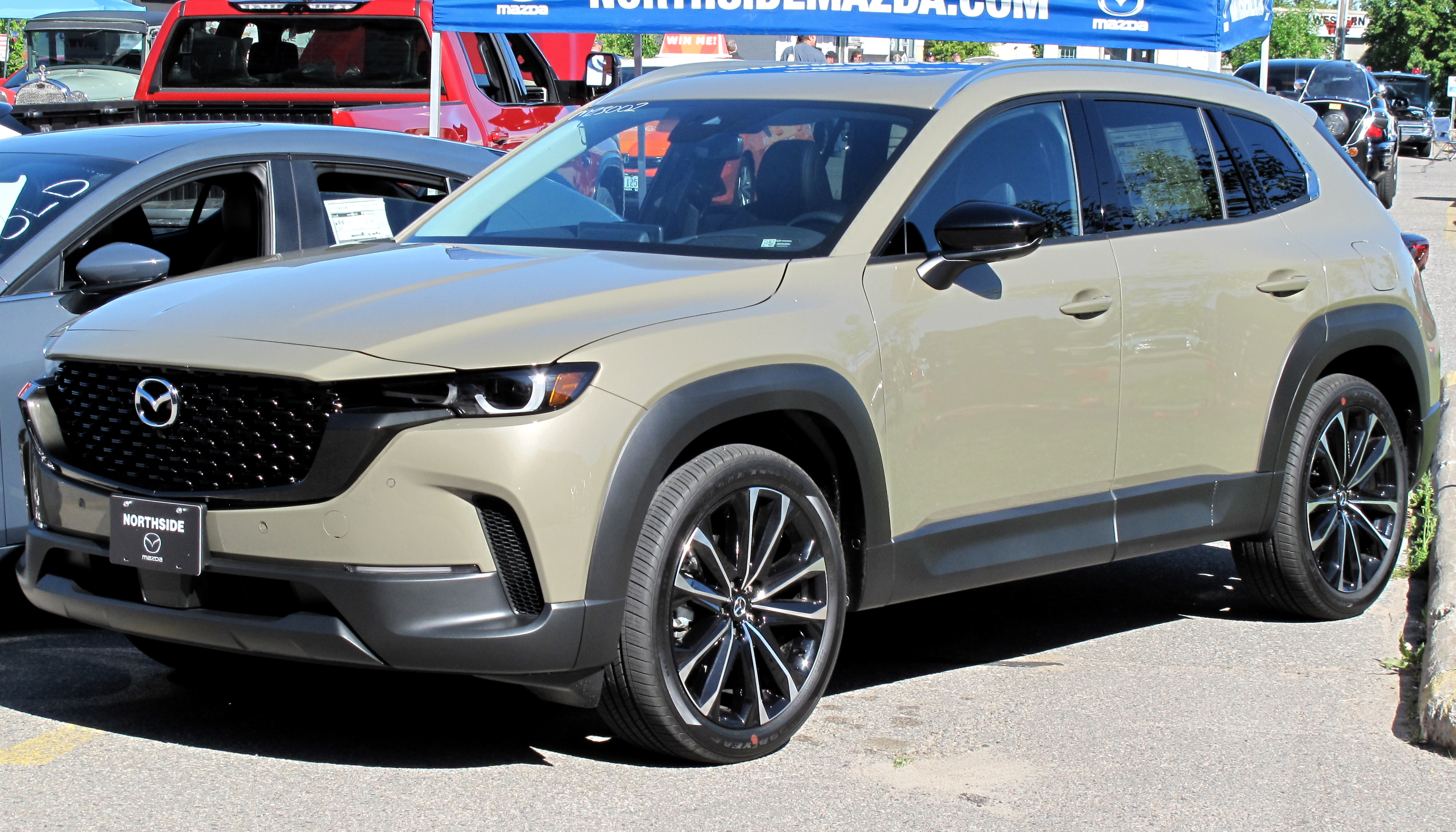
"[2033.6s] the escape used to have it. The only one really left that's not hybrid is the CX-50 turbo. So
[2040.2s] I see what they're going for."
This is Mazda’s compact SUV with a turbo engine. The host is saying it’s one of the few left that isn’t a hybrid, so it appeals to people who want a more straightforward turbo setup.
The Mazda CX-50 Turbo is called out as one of the remaining non-hybrid options in this segment. The host’s point is that many competitors have moved toward hybrid powertrains, making the CX-50 Turbo stand out for traditional turbo-only buyers.
"[2033.6s] the escape used to have it. The only one really left that's not hybrid is the CX-50 turbo. So
[2040.2s] I see what they're going for."
Hybrid refers to a powertrain that combines an internal combustion engine with an electric motor. The host notes that many competitors in this crossover class have moved to hybrid systems, leaving fewer non-hybrid turbo options.
"I do like the styling. I think they've done, it's interesting to look at how Audi and Volkswagen stylings have gone in maybe slightly different directions. I think Audi went kind of crazy with the lines and the creases and now they've sort of chilled out and their cars look a little cleaner."
They’re talking about Audi’s design style and how it has changed. The idea is that Audi used to look more sharp and busy, and now it looks a bit cleaner. It’s a way to compare brand personalities.
Audi is discussing as part of a styling comparison. The host contrasts Audi’s design language—more aggressive lines and creases—with a more “cleaned up” look in newer cars. This helps listeners understand how different brands evolve their exterior design over time.
"with the demise of the Sony Honda partnership for the Affilia EV, do you think tech companies are getting scared off from the auto industry? Kind of an interesting question."
They’re asking whether tech companies are backing away from making cars. The idea is that building vehicles is harder than it looks, especially with supply problems and big operational challenges. So some companies may decide it’s not worth the risk.
This is the episode’s central business concept in the mailbag: whether tech firms are pulling back from automaking. The host connects it to known industry hurdles like supply-chain disruptions, parts availability, and the complexity of building vehicles at scale. It’s useful context for listeners trying to understand why fewer “tech-to-auto” bets are succeeding.
"And I mean, COVID kind of disrupted things and part shortages and the super chip issues. And yeah, this was sort of arguably the last holdover of those tech companies getting into"
Part shortages mean car companies couldn’t get certain components they needed. That can slow down production and make new cars harder to find. It’s one of the big reasons the market felt chaotic for a while.
“Part shortages” refers to supply-chain disruptions that limit production because specific components aren’t available. In the auto industry, this can reduce inventory, delay deliveries, and sometimes force automakers to substitute parts. It’s a key reason why new-car availability and pricing have been volatile in recent years.
"I mean, when Sony puts their mind to a segment, they do really well. But they only go to ones I know they're going to succeed in as well."
Sony is known for electronics like TVs and audio gear. The point here is that making cars is harder than making gadgets because cars have to be built and certified to strict rules.
Sony is a major consumer electronics company, and the discussion is about how a tech brand would try to enter the automotive space. The key idea is that Sony’s strengths are in technology and consumer products, but cars require a different kind of manufacturing and compliance than electronics.
"I do think like a Sony Honda branding, you know, pitch could be very strong for consumers, sort of like if, because I think there's a lot of people that are very curious about the Rivians,"
Honda is a long-time car company. The idea is that if Sony teamed up with Honda (or used Honda branding), people might trust the car more.
Honda is a long-established automaker, and the segment suggests a “Sony Honda” branding concept. The underlying point is that pairing a tech company’s brand with an established car manufacturer could reduce consumer skepticism about new entrants.
"...probably highly touted suppliers, like CES and things like that, you know, when they do develop something super cool like Apple CarPlay."
Apple CarPlay lets you connect your iPhone to a car so you can use things like maps and music on the car screen. The speaker uses it as an example of tech working well in cars.
Apple CarPlay is a smartphone-to-car infotainment system that lets drivers use compatible apps through the vehicle’s display and controls. It’s mentioned as an example of a tech company successfully contributing to cars without being responsible for the entire vehicle manufacturing and compliance process.
"So I think the problem now is a lot of the OEMs have either found their partners
that names maybe we don't know, or they figured out how to do it internally."
OEMs are the actual car makers—like the companies that build the vehicles. They either team up with other companies for EV parts or develop those parts in-house.
OEMs (original equipment manufacturers) are the companies that build the vehicles themselves. The transcript contrasts OEMs finding battery/EV partners versus doing the work internally, which affects how quickly new EV tech gets developed and scaled.
Select text to request an explanation
Welcome back to the AutoGuide show presented by eBay Motors.
I'm Greg Migliore and we've got a great show for you.
This week we're talking Jeep with its global head of off-roading and EV's Abur Ahmed.
We discussed the off-roaders they brought to the 60th Easter Jeep Safari which just kicked
off on Saturday.
Jeep is on safari with a throwback XJ, a grand wagon here, and of course, some Wranglers.
We also talk about what's coming up for the Jeep brand this year.
In this week's gear test, Mike Schlay reviews an all-season touring tire,
the Salem Inspire.
In the AutoGuide garage, iTest drive the Volkswagen Tiguan R and Mike gets behind the
wheel of the Subaru Crosstrek and Toyota Corolla hybrids.
We close things out with the mailbag where we ponder what went wrong with the Sony Honda
Ophelia project.
Stick around, we'll be right back after this.
Joining us now is Amir Ahmed, head of off-roading and EV's for the Jeep brand.
Welcome to the show.
Our customers and our enthusiasts are going to see how they use our products.
The XJ has always been an important car to the Jeep brand.
Basically, the godfather of the modern SUV, and we had a campaign when we launched that vehicle
following it.
Don't call it a comeback.
It was a rallying cry for us because this is a segment that we created,
and the XJ is the godfather of that segment.
So for us to doff our cap a little bit to that as a new Cherokee is now hitting showrooms and
finding its stride in the marketplace in a really competitive and massive segment
in the US and the world, it's important to pay tribute to where we come from.
And that vehicle and that specific vehicle is so cool because it's a 70-odd,
1,000-mile survivor from 1986 that's in pristine condition that somebody cared for and
loved, and now we get to be the custodians of that vehicle moving forward.
And it's a great way for us to protect and cherish the Cherokee nameplate.
I know Automobile Magazine called the XJ the most beautiful SUV of all time or something like that.
It seems to be resonating right now with things from the 80s and 90s are sort of cool again.
They're also kind of old. So can you talk about that sort of, I guess, like trying to capture that
vibe, that zeitgeist as sort of like Gen X millennials get a little bit older?
Absolutely. I mean, I'll take you a step farther and we'll go back to last year when we introduced
the rewind concept for that very reason, right? You look at that and I kind of joke it's very
fresh Prince of Bel Air, if you will, very bright colors, very charismatic, very retro.
I think the team had like a disc man inside of that car, which is really cool.
So yeah, I mean, for all of us that are growing up, they grew up in an era.
It's fun for us to look back on vehicles that we grew up in.
Myself, my father was a 30 year Jeep engineering retiree.
So I spent a lot of time in an XJ and a ZJ and all these old Jeeps helping him do product
development. I was kind of a dummy for him, say what side of the car is quieter left to right
because he was a body and white engineer. So for me, there's personal value in that.
So I think combining all those stories and then taking this a design language that's so popular,
which is big and boxy and bring you back. And you look at what we're doing in the recon, it's
going to be our first trail rated EV that follows that exact same design language as big boxy and
bold. So we're really excited to bring all these things together. eBay has reinvented vehicle
buying from click to curb. Everything's covered. It's all thanks to their new secure purchase.
Ever try to buy a car and end up at a parking lot with a stranger and some blind trust or spend
half the day at a dealership talking to pushy salespeople and signing paperwork,
or maybe worst of all, wait for hours at the DMV just to transfer the title. That era is over.
For years, eBay has been the go to for gear heads, collectors and DIYers because whatever you're into
from classics to SUVs and trucks to imports, eBay's got it. And now with secure purchase, eBay isn't
just where you find your next ride. It's where you can buy it start to finish sellers and titles
are verified paperwork is handled by experts and payments are traceable and digital. So you know
exactly who you're dealing with and exactly what you're getting. Plus you can finance ensure and
register your vehicle all in one place. No more hours at the dealership. No more trips to the DMV.
Get your vehicle plates and paperwork shipped to your door ready to drive. And it's all part of one
seamless process designed to feel as easy as buying anything else online. And eligible vehicles
purchased on eBay are backed up by up to $100,000 in purchase protection. Thinking about selling
your ride secure purchase makes that simple too. Because you know your buyer and their funds are
verified. If you still owe on your car, the financing payoff is fully integrated. So you're not
chasing paperwork or waiting on checks to clear and with secure purchase, you get paid fast and
you're not going to be stuck chasing no shows or answering the fifth still available message.
This is what modern car buying looks like. Skip the DMV skip the sketchy meetups buy it at eBay.
eBay things people love secure purchase is powered by Carbal dealer services LLC at eBay subsidiary.
Let's kind of zoom out for a little bit. Talk about like the recon.
What that means to a new generation of off rotors. You guys are trying to be multi energy is sort of
the line right now. What does that mean? How do you think that'll resonate and how do you think
people will use the recon? I think the important thing is similar to what we do with all of our
cars. It's not just us wanting to be multi energy. The market's commanding and demanding that we are
multi energy. So this is demand lad, right? And with recon, what I love about it is, you know,
I'm a car enthusiast, you and I were just speaking, I own multiple sports cars and I joke that we do
EVs to offset my own carbon footprint. But in reality, from a pure technical standpoint,
having a battery really low to the ground is going to dynamically give you a better driving
experience. Giving you instant torque at zero RPM is going to give you a better off roading
experience. So a vehicle like a recon with 650 horsepower, 620 pound feet of torque can be
trail rated that all the glass except the windshield comes out of is a great expression of what the
next generation or future of the brand looks like as we evolve into multi energy. This would be a
good time for me to interject that Amar is a Viper owner and we are doing this interview at the old
Viper factory where way back when my first assignments for auto week back in the day,
they were still making Vipers here, not for very long, but I caught the very tail end of it.
Can you talk about like what the history of Jeep, but also some of the broader like just
Stellantis Chrysler, the history and you know, how that sort of the pressure that comes with
designing sort of modern interpretation of some of these famous vehicles. Yeah. So what's really
amazing about our company Stellantis is that we are a house of brands. There's 14 global brands
that we manage and we're celebrating our 85th with the Jeep brand, but we have brands as old as 125
years old in Europe, right? Yeah. So our job is to be stewards of these brands and protect them
for the next generation. And the way we do that is by staying in tune with the customer demand
is and how to deliver the best ethos and version of that brand for that moment in time to capture
the most sales and share. So it's a building like this is really important because as you and I can
go for a walk later, we've got a version of every Wrangler that we've ever made here and you walk
through this and you remember the heritage that we're steeped in, whether it's talking about World
War II and all the other products, you know, it's not just the Willys MB, but Dodge made
patrol vehicles as well. And you see all that and you understand how all that played into
how this country came to be and protected itself and then how we as a company continue to evolve
protect ourselves moving forward. All right. Sounds good. What haven't I asked you? Would
you like to tell me about Jeep, the Jeep Concepts? Jeep is a brand that belongs to the community.
And that's one of the most rewarding parts of this job that I've been entrusted to do is
we get to be the voice of our customers and put that enthusiasm and passion and DNA back into the
product, whether that's finding white space, like the Cherokee coming in as a turbo hybrid vehicle
into the midsize SUV space, or it's evolving and looking at ways we could do things differently
maybe on Wrangler with that vehicle you see behind you. That's an evolution of our Safari
cars that we've done in the past with a welded high top on it. Our job is to find what resonates
with our community and try to bring it to market as swiftly and responsibly as possible. So
that's the great thing about our brand is we've been here for 85 years and we've been America's
most patriotic for 25 years and we do that because we listen to our customers. And with
Bob Rotoroff as our CEO back in charge with Antonio's guidance, this is what the DNA of
this brand will continue to be. It's back to the basics of putting more Jeep back into Jeep.
You've probably covered it late last year when you did the Jeep Reset plan and we added a ton
of value back into the cars, right? No charged content like all-terrain tires, technology
groups, LED headlights, all that stuff is important because that's what people were asking for. And
the new leadership here that we have, Estalantis, understands that and they're infusing us and that
is our remit now to put back into our brand. So that's what we're really excited about moving
forward. That's the mandate we have. Last question, I guess everybody right now is really
off-roading. People, car brands, a lot of your competitors have done all sorts of things from
adding off-road trucks to like purpose-built vehicles to things like the Subaru like wilderness
trim. You're really seeing it in all shapes and sizes. So what does that mean for you guys?
It's sort of like the OG of off-roading, but also everybody's kind of trying to come for it. Maybe
eat your lunch a little bit. What does that mean? Does that make you better? Is it like just a larger
segment is better for everybody? What's your take on that? Yeah, well, I mean, there's a couple of
things. One, it's nice to always know that every one of our vehicles is going to be the peak of
what another brand can do, right? That's our baseline. Our baseline is to be the most capable
in any segment. So that's where it starts. But the important thing is we are a competitive brand
and competition does drive us forward. It makes us innovate. It forces us to do things. And at the
end of the day, the customer is going to be the one that wins. So we're in for a challenge. We're
in for the dog fight. We love that. We're forged in battle. We did that 85 years ago. We continue
to do that. All right. That's Amira Med, head of EVs and off-roading. What a cool job for Jeep.
Thanks for being with us. Thank you, Greg. Appreciate it.
eBay has reinvented vehicle buying from click to curb. Everything's covered with their new secure
purchase. eBay isn't just where you find your car. It's where you buy it start to finish title,
financing, registration, delivery. It's all built in and eligible vehicle purchases are backed up
by up to $100,000 in protection. This is what modern car buying looks like. Get your next
ride on eBay. eBay, things people love. Secure purchase is powered by Carmel Dealer Services LLC
and eBay subsidiary. Okay, Mike joins me now for his latest gear test. We're talking about another
set of Salen tires. Let's talk about these, Mike. So this is called the Inspire. It's sort of a
regular touring tire for regular vehicles, specifically like a family sedan, let's say,
or cars. And I'm sure it can be used on small SUVs as well. So as Salen likes to do, I didn't
actually have this on my car, which I've done with a lot of their tires. This was an event,
and we did a blind tire test. So we had two identical cars. This is going back a couple
years, so Ford Fusion. And one had the Salen Inspire and another had a top tier, so like tier one
competitor, and they scrubbed the rubber literally off the tire. So you couldn't see the name. I
mean, those of us that are in the know, we knew what it was, it was a good year. But we weren't
supposed to know. And we drove them back to back to see the difference. And we did a dry handling
course in summer in Florida. So it was very hot. And we also did a wet skid pad. And their goal was
our good tire is as good as these excellent tires. And I'd say it was more than nine tenths there.
It was probably like 95 out of 100. And the price is less than two thirds. So you know,
the value for the performance is there. I mean, is it the absolute best tire? No, but it's pretty
close and it's way cheaper. Again, I only got to do it at the test. So I can't talk about
treadwear and longevity that has a huge warranty. So there's that. I know some customers since have
said that there's war out a little fast, others have said they've gone on beyond the warranty. So
it really is like a, how are you using the tires case? And that's the same case with any tire,
it doesn't have to be a saline per se. But no, I was impressed with the limited time I had
driving it. And a saline always does, they like to discuss how all other tires are made in Asia.
It's made in a state of the art factory. Some of them are actually made in other countries like
Rwanda is one of their plants and there's one in South America. It's not
compromised in the materials or the technology over the process. So yeah, as a budget tire,
it's funny that we use them on at the time brand new fusion. I think it was the very last year
before it got discontinued. That's sort of the perfect place for these tires are 10 year old
sedans that are in good shape that families maybe rely on or secondary cars or say
a person's first car like someone going to college or whatnot. This is the kind of tire you
probably want because it's giving you most of the capabilities for a fraction of the price and it
should last as long as you'll have that car. So a good value. Sounds like it's actually looking
around. They're decent in the rain, okay in the snow. If you perhaps lived in a very wintry place
where we are, you'd maybe hope for a warm winter so to speak. You might not want it to be
these are not winter tires obviously. Yeah, they're not all weather either. They're not the
three season, right? You and I would consider these summer tires even though they're not summer
in the sense that we wouldn't drive them in the winter. But that's just a standard all season.
It's going to do what an all season is going to do. We didn't test any winter. It was August in
Florida. But I wouldn't expect these to do well in the snow. That's not really what they're meant
for. But I guess if you live in areas where maybe you get a dusting or two, like an Asheville let's
say, then they're probably going to be fine. Maybe not for spirited driving but just sort of like
average cornering grip. Sounds like it's again a budget tire. It looks like they're available for
all sorts of different sizes of vehicles, sedans, minivans, even crossovers. So I mean just again,
you're trying to look at the set of slap of tires on something this will get you through for a
little bit. So a value pick and a decent deal. It's funny. Yeah, you're right. I think the best
customer case study is that somebody just needs to get tires, slap tires on something. But there's
so many options out there. And how do you know the ones that aren't going to blow out in a month
or wear out in a year compared to others? And that's sort of where these stand out. And yeah,
we did hard cornering even though you're right. That's not what they're meant for. I wish we could
do these sort of tests was like, okay, get in a minivan and drive to Costco and back. But they're
trying to show sort of the tires performance in a short period of time. So yeah, it was a good
tire for the money for sure. All right, speaking of value, we will be right back after this where
we will go inside the Auto Guide Garage where we're going to talk about several value oriented cars.
We'll be right back after this. All right, let's open up the Auto Guide Garage where we have a
fair amount of sort of family commuter vehicles here. I'm going to talk about the Volkswagen
Tiguan R and Mike, you're going to talk about the Toyota Corolla and Subaru Crosstrek hybrids. So
maybe not ideal for going to Costco if you're getting a ton of things, but you'll certainly get
good fuel economy getting to Costco. Let's talk about the hybrids first.
I like how the Tiguan R you put as a family vehicle. I mean, it would be for me, but I'm
very curious to hear your thoughts on that because I haven't driven it yet. But to the Corolla Cross
and the Crosstrek. Yes, they're both the hybrids. And this is a comparison we've wanted to do for a
while. We've tried to set up a couple times, but outside forces didn't allow us to complete it. So
now we finally got to do it. So the Corolla Cross was the hybrid of the class at least here in North
America in that it's hard to say. We used to be subcompact, but they've grown and they're kind of
the size of the compact SUVs back in the day. But the Corolla Cross we liked, but we didn't love.
This got cool styling. It was like baby rap for the old old rap for its looks, but inside it was
very and the engine wasn't great. So the hybrid corrected a lot of this because the noisy higher
high revving at times engine gets muted a bit because the hybrid system takes care of it.
And the fuel economy is unbelievable. It's so much better than anything on the class.
And it's also quite powerful because you get that extra hybrid boost. So it was
it was easy to overlook the all plastic interior, like even the door sills are hard plastic and the
dash and tears aren't nice and you can get different trims, but it gets kind of up there in the price.
So if you're going with a mid trim to match the price of some non hybrid vehicles,
you're missing some features. But again, the drive experience and fuel economy was well worth it.
But now Subaru has finally come out with a hybrid and although the Crosstrek hybrid
can't match the curl across in terms of fuel economy, it's got more features and a far nicer
interior, which is crazy to say Subaru's got the nicer interior than Toyota, but it's completely
true. It drives nicer in the sense it feels quieter and more premium. Kyle and I did this
together. He didn't like the engine sound of the Subaru. He actually said he found it louder than
Toyota. I found the opposite. So I guess it's just sort of one of those what pitch of engine or
noise gets to you more when the Subaru refires from a stop or when the you're driving just on
electric power and the engine comes to life. Sometimes it is super harsh more so than even
the regular start stop to the point where I'm wondering if something maybe is loose in this
particular Crosstrek we have, like it feels like the engine shakes independently of the vehicle for
a second. But other than that, the power is probably more readily available and more robust in
the curl across. But once you're underway, there's not a big difference. But again, the smoothness
and just all of the driving inputs in this Subaru feel better. And the interior, just the seats,
the panels, the dash, the technology, the features at all just feels like you're in a slight class
higher than the curl across. So it's totally one of those efficiencies you're only concerned than
the Toyota's the best. If having a nicer experience in the cabins, your biggest concern then probably
the Subaru. It's funny because they use very similar if not the exact same hybrid technology
because Subaru is using Toyota's technology. So the electric motor and battery and everything
between the two are very similar, but their approaches are very different because Toyota is
a Toyota. So it has the motor engine combo powering the front wheels. And then it has a secondary
small motor that powers the rear wheels completely independent, no connection to the front at all.
There's no drivetrain or anything. And it works on demand part time. So when needed at whatever
speed, but it'll kick in here and there if it detects lip or if it predicts lip where Subaru
has their exact usual four cylinder symmetrical all wheel drive system, just without electric motor
shoved in between in the transmission. So that's why it's not as efficient because it's turning
more mechanical stuff all the time. But if you're going to go more regularly in shallow mud,
redded trails, dirt roads, I mean, there's no contest, the Subaru is going to be better because
it's got the fully connected real all wheel drive, the more ground clearance, just just a better
setup. So there's that factor as well. But that's also why it can't match Toyota in terms of fuel
economy. But end of the day, all the pros and cons had to had Kyle and I both agree that the
cross checks the better overall package here will sacrifice a little bit of fuel economy for all the
other things we think someone in this class is looking for. I mean, if economies, your number
one concern, the Corolla Cross isn't the most spacious either. So go get a Prius. And Prius
even comes all wheel drive or even a Corolla, like just a regular Corolla, they're both going to be
way more efficient. And they can both, they're both fairly capable. If you need more space and
capability, then you go to the round four hybrid, which isn't much more than the Corolla Cross and
it's such a better vehicle. So that was our sort of summary. So I'm interested to drive
both these vehicles. I think I have some loans coming up later this spring and summer.
What I think is kind of interesting here is to talk about the way under the skin, the hybrid
elements are the same because Subaru and Toyota have teamed up here. But to your point, Mike,
they used them a little bit differently. And I think that just to kind of take a step back here,
that's like a really good template for how OEMs can work well together. It's like, hey,
we're going to develop this, share some costs, do it as a team. And then what we'll do is we'll
each go our own way. We'll do it differently and our own products. I mean, as industry insiders,
we know this, I highly doubt too many consumers know or care or notice the difference. Maybe
like a well-read dealer might tell each of them, hey, this is in the Subaru or hey, this is in
the Corolla. And sometimes people like that, it gives them that sort of sense of affirmation.
But I think that's kind of a cool, again, template for how companies could work together and
maybe they can in the future. It's funny to say that because while we were doing this comparison,
my, it's not like a dream comparison, but what I really want to do and we're just not getting one
of the vehicles in Canada right now because of tariffs is I want to do RAV4 hybrid,
Forrester hybrid and CX50 hybrid because they're all using Toyota's electric motor,
but they're all using their native engines and drivetrains. So it's like the same electric bits,
but use three completely different ways. And I'd love to see how they all are head to head to head
and efficiency and drivability and whatnot. So one day, but yeah, I mean, Kudos to Toyota,
they've developed a system that basically anyone can plug and play as long as they can get it into
their transmission housing is pretty much how it is right now. That's, I mean, that's very,
that's very clever. It actually kind of goes back to things the the late Sergio Marchione used to say
is like powertrains for everything, but the real enthusiast like, you know, application,
they almost don't matter. Six speed, seven speed, eight speed, five speed, average driver doesn't
know doesn't care force, you know, four cylinders, six cylinder, they don't care. And frankly,
though, like the ratings of most of those things, the performance is so similar that I kind of agree
with him. You know, it's for most people, I think cars are like their phone. I have no idea what is
powering my old iPhone right here. And I don't really care, you know, so I think that's how a
lot of consumers look at these things. But but back to the cars, I think I know what you're
saying. Yeah, definitely the Subaru, I mean, it always does because it's got that boxer engine
in that growl for better or worse, although it makes a lot of noise. But that's sort of part
of why I think we are picking it between the two is it's still a cross track, just one that's like
20 to 40% more efficient depending on how you're driving it. Whereas the crawl across really just
feels like a jacked up, coral hybrid, or even Prius to a degree. It doesn't have sort of that
cool little SUV feel that's kind of defined the cross track. And I think why it's been so successful.
So again, it really depends on how someone's approaching the segment and the decision. Because
if you if you're dead set you want a cross track, well, why not get the hybrid, it's more efficient
and more powerful was like win win. And it's not that much more money. But if you're looking for
the best vehicle in that segment, well, there's drawbacks to it, maybe a non hybrids better if
you're willing to pay the fuel. But character for sure, it's got the cool little looks. And it's
just that, you know, even if you're never going to really take it somewhere off road, it's like,
well, I got X mode and 8.7 inches of ground clearance and this and that. And, you know,
it's it's part of no one buys a car rationally, there's always some irrational aspects to it. So
I just with the curl across is like I got the most efficient small
SUV out there, which in itself is a pretty cool characteristic and and bragging, right? But
yeah, it's
neither are perfect. But they're both very good. And I mean, when we did a full segment comparison,
I think two years ago now, the crawl across, I believe, came second on hybrid because of how
efficient it was and whatnot. And the cross track was still top four. So like they're already
two of the better ones in the segment. So that's why we wanted to do it. And they're
the only two hybrid options. And honestly, you can't go wrong with either just depends on what
your priority is. Alrighty, well, let's speak of priorities. Let's talk about the the new Volkswagen
Tiguan. I drove this actually drove this last fall late last fall out on some of the twisty roads
around Ann Arbor. I drove the this is the R line with the 268 horsepower turbocharged four so a
pretty spunky engine. It's this is sort of like the, you know, the top the tip of the spear.
For the the new Tiguan, which was refreshed, it rides on their new Evo platform with a great name.
Better infotainment, better interior, obviously, you know, powerful four cylinder here. The new
Tiguan does not have a third row, which makes sense. I don't I was I've never been a big fan of
cramming third rows into relatively small vehicles. Although if you haven't driven a Tiguan lately,
this is probably bigger than you might remember. You know, I did some of these prior generation
launches over my career. And it was definitely more of a smaller vibe, almost like commuter car
for like one parent. They're pitching this. And you and I might have similar thoughts on this,
they're pitching this hard. It's like a family car. I think it's a little too small if you have two
kids, or even in my case, one kid in a pretty large dog, like just everybody's not going to fit in
there, you know, mom, dad, blew the dog, you know, your son, it's just it's not a lot of space. But
I get it. It's sort of like maybe the secondary car for like, you know, you have the midi van or
the three row SUV, and then you have this, which can be used for rides to baseball practice if you
so need it. They make a big point, though, the same thing. It's got things like it has
massaging seats, seat heaters, things that maybe you don't necessarily get in everything in this
sort of class that looks wagon competes in sort of like saying, Hey, parents, like treat yourself
a little bit here. You know, you might be tired around eight 30 as the sun goes down and queue up a
massage. So I definitely noticed, you know, some of the creature comforts during my drive. It was
kind of a very brisk morning. So all that stuff had that kind of feel I had actually driven straight
out there after dropping my son off at school. So I was very much of that kind of tired dad mode of
I've been on the road for like an hour and a half. I've, you know, done the morning. And
so in that sense, I did appreciate the T ones, like sense of comfort and that
sporty enough, you know, if you've driven a Volkswagen lately, you know, you'll recognize
that steering and braking feel. It's a little bit loose, but it has a little more probably
feedback of things like Toyotas and Hondas, not quite as much as Mazda's though. But you kind of
feel a little feedback, you know, sort of around like the 10 and two range. It's a fairly tight
ish for the segment chassis. They're pitching this is sort of like the GTI owner, or maybe golf
owner that has kids. I sure, okay, I don't know if I buy that. But you know, they're, they're trying
to sell that price point and that idea. Yeah, it's a very nice vehicle as far as the inside,
they worked hard to get the materials to be, you know, I wouldn't say Volvo-esque, but they definitely
paid a lot of attention to making it a nice interior. The infotainment screen is another thing
they redid, it's larger, it's pretty colorful, fairly easy to use. I guess the spotlight though,
maybe I'm bearing the lead here is the E888 Evo 5. This is the turbocharged engine with very
geometry. Turbocharged, of course, they approved the packaging. With 268 horsepower, you are getting
67. Looks like more horsepower than just the base model, which is 201. 37 more pound feet of torque,
which gets you to 258. All-wheel drive available. So it's fun crossover to drive, you know, it's
for the class, it's not super heavy. So that much power delivered with that turbo sort of gusto
gives you some character. I like it. I like too how they're, they are pitching this is like an
enthusiast vibe. Not totally, but like other brands maybe just would put an engine like this in their
crossover, call it like, I don't know, like Volkswagen does, VR line or something to that
effect and move on with it. Volkswagen is again going for it. I'm trying to say, hey, this is
something like if you're an elder millennial or something, this could be your sort of second
family car. So in that sense, I agree with it. I would still put it in the middle of the pack in
the segment. I think it's sometimes it's tough for Volkswagen because I feel like they don't
necessarily leap to the front of the pack with some of their products like this because it's so
competitive. Doesn't mean it's bad. It just means it's pretty good. So I guess that's kind of my
mini review. I imagine you're going to drive one of these fairly soon yourself.
I hope to. It's with the powertrain they put in it. Yeah, they're trying to cash in on what used
to be a pretty popular part where these smallish SUVs had that upgraded engine, the Forrester XT,
the escape used to have it. The only one really left that's not hybrid is the CX-50 turbo. So
I see what they're going for. It's funny, though, it's totally, I guess, maybe an American versus
Canadian thing. How you're saying it's small, not a family car. To me, it's like this is big,
and it's a big family car. You're talking about someone who's our main family car as a cross-track
for two parents, a son and a dog. Like anything Forrester, CR-V, RAV4, T1 size to me, that's
more than enough space for a family that size. We looked at the Taos, the smaller one,
potentially as a vehicle for us. The original T1 was tiny, as you said. We all called it a
GTI in stills because it basically was whereas then it got real big with the 3-row and now
the new one isn't too, too much smaller overall length, but it's a little more rounded and you
lost that third row. But I drove the T1 on the first drive, the regular one, and I quite liked
it. But I did find with the transmission and engine, it wasn't like I'm crazy about performance
and whatnot. It just felt like regular, sort of like all the regular vehicles in that segment.
I thought if they had something, I was hoping more for a hybrid, but I'll take this. I mean,
I'll always take more power. So yeah, I really want to try the R. I just hope it doesn't ruin some of
the ride in it because it is a family vehicle more than a sport one, even if they're calling it
somewhat performance. So hopefully it still rides nice. But other than that, price wise,
I mean, it's getting into that no man's land between these regular versions and going into the
the X3s and the Q5s and whatnot. So yeah, it needs to feel a little special, but it sounds
like it's just sort of a more powerful version of the T1, which isn't a terrible vehicle. But
I look forward to trying one out. They definitely are trying to play sort of subtly that this is
like German premium without all of the, you know, cost of like an X3 or a GLC or GLE or whatnot.
So I think they get almost to go back to the the saline analogy. You get like some of it,
but not all of it. But you don't have to pay as much. That being said, the one I tested was the,
this is the, this would cost $44,000, which average cost of a new car, maybe that's not bad,
but at the same time, you know, again, so here we go, SEL R-Line Turbo, $44,560. That's not cheap
for a Volkswagen. And the base T1 is about $32,000. I think this one, somewhat to your point, Mike,
is where you get these top trims with some of the pretty good goodies, things you might want,
but maybe you just step up to a more prestigious brand at that point. Because to me, a T1 at $33,
that's a good deal. That's a quality vehicle that looks like a German SUV. This could be an Audi
from a distance. I don't know. But when you're paying $44,000, yeah, maybe head down to the BMW
dealer or the Audi dealer and see what they might have for you too. But last note on this,
I do like the styling. I think they've done, it's interesting to look at how Audi and Volkswagen
stylings have gone in maybe slightly different directions. I think Audi went kind of crazy with
the lines and the creases and now they've sort of chilled out and their cars look a little cleaner.
Volkswagen, I think, started to dress things up a little bit, which maybe is confusing at times.
But I think this is a pretty handsome crossover. Like from the curb, you would see these things
and you're like, yeah, that's got a vibe to it. I mean, I put it in the middle of the pack,
to be quite honest. I still think things like the Honda CR-V, the Mazda's, I still put them
probably ahead of them in this segment. But I think I put it in there with things like,
I'd probably put the RAV4 ahead of it, but it's in there with maybe like a Bronco Sport kind of
thing. So I mean, that's kind of where I'd rank it. Sort of the front of the class of that next
here. So yeah. Sounds good. All right. So that is the Volkswagen T-Gwan R. You can check out my review.
I'll have a mini review with some YouTube video this week on the site. Come back for that.
We'll be right back after this for the mailbag.
All right. We are going to dip into the mailbag where this week's question is,
with the demise of the Sony Honda partnership for the Affilia EV, do you think tech companies
are getting scared off from the auto industry? Kind of an interesting question. That was big news
in our world this week, the end of the Affilia project, which I thought had a bit of promise.
But also, I think we all started to see this coming. It's kind of an obvious thing. So what do
you think, Mike? You can lead off. Yeah. I think this question is a question that should have been
asked maybe like five, 10 years ago. Because I think we've known for a while that tech
companies have been scared off of the auto industry. Because back in the day, Sony was going
to get in and Apple was going to make the Apple car. Some automakers were going to go more into
the tech side. And I mean, COVID kind of disrupted things and part shortages and the super chip
issues. And yeah, this was sort of arguably the last holdover of those tech companies getting into
cars. And I just kept getting pushed back and changed. And then when Honda canceled the EVs,
you knew the writing was on the wall. Even if this ever came to light, what was going to happen?
Sony was going to sell a handful in California and maybe some other countries and then it would
disappear. It was never going to be a ground shaking vehicle. Some of the tech, I think, was
cool. And maybe the whole goal was to put that tech and Honda's down the line or Sony to sell
their tech to other manufacturers. But it'd be one thing if they were working on the new
reincarnation of a Civic. But this was always going to be something fighting
Model S Teslas and Lucids and whatnot. And I never really thought it was going to make it.
It's sort of like, I feel bad comparing it to this, but like Faraday Future.
I was just thinking of that. I was thinking Faraday Future sort of execution with two huge names,
Sony and Honda behind it. So the concepts or the test mules they showed and the press photos,
it did look kind of like a Lucid, maybe even some of the higher trim Hyundai's and it's
good looking thing. I'll be curious to see what becomes of this. This strikes me as almost like
a museum footnote in auto history that we'll see somewhere down the road. I think there is
still some daylight for tech companies to get in and basically be suppliers. If Sony wanted to
offer up some of their tech, sure. We've got some room to run there. Yeah. I think when Tesla
exploded on the scene and a lot of people probably knew Elon in the industry and in the tech world,
a lot of companies thought, oh, we could do this. We could build great electric motors and batteries.
We already do batteries and this and that. But I think a lot of chemicalization building cars
is hard. Tesla is a success story because they were able to do it. It's questionable if they've
ever really made a real profit just off their vehicles. If you take away tax credits and that,
I mean, I think the answer is no. But they figured out a business model to make it succeed
because that was their business. Sony and some of the other big companies,
they're not going to be able to bleed billions for years and hopefully make a profit one day.
So yeah, I think a while ago it was decided at Sony that this was sort of a technology
experiment piece that they were going to hopefully build some stuff off. But I don't think they're
ever serious about getting into cars. If they really were, they would have gone all in. And
who knows what they could have done. I mean, when Sony puts their mind to a segment,
they do really well. But they only go to ones I know they're going to succeed in as well.
And this is a tough thing to get into, especially with all the like, there's no
shortage of great Japanese car companies. So how Sony are you going to disrupt there?
I do think like a Sony Honda branding, you know, pitch could be very strong for consumers,
sort of like if, because I think there's a lot of people that are very curious about the Rivians,
Lucids, not so much Tesla anymore, because that's mainstream. But if you're buying something that
isn't from a car company that's been around for 50, 60, 100 years, there's a bit of a hang up.
But if it's like a Sony with Honda, that sounds pretty good to a lot of people. So I think there
was potential here. But I really think this was just the last vestiges of that just like tech boom
of like, Apple's going to do it. And like, there was a bit of arrogance of tech that, yeah, they
could probably do some of the tech things better than, you know, Detroit and California and Japan
and Germany. But they realized, oh, man, this thing where the cars are made and wait, you guys
have to comply with all these safety regulations. Well, nobody makes us do that for our iPhones.
Like all of a sudden in our TVs, it all of a sudden like, you know, it was the light bulb going off,
or in this case, shattering. And I think tech companies are, yeah, we'll see them as suppliers,
probably highly touted suppliers, like CES and things like that, you know, when they do develop
something super cool like Apple CarPlay. But until then, I don't think we'll see too many
tech car initiatives for a few years anyway. Yeah, I think, I mean, I think we're over
generalizing about the arrogance. They thought it was easy. Like I don't think,
honestly, it was quite to that point. But I think what it was was the EV boom was happening
with the government regulations around the world. And a lot of these tech companies are like, well,
we make electronics on batteries. We can already do it. We'll do it better than OEMs. And I think,
I don't know how many actually thought they're going to build the car themselves, but I think
a lot thought they could really get deep into partnerships with brands and build these. And
I mean, Panasonic never said they're going to make a car, but they got into the batteries right away
and worked for them. So I think the problem now is a lot of the OEMs have either found their partners
that names maybe we don't know, or they figured out how to do it internally. And they've, because
it's designed specifically for cars, they're way beyond what a company, no matter how big they are,
is going to start from scratch. Like it's not worth the investment now to suddenly
start building a battery unless they are the one that makes the solid state. That's sort of the
next thing. And maybe some of these companies in the back end are working on solid state that they
EV tech boom of the 2010s is kind of slowed down. Slow down. And I think that's a good
place to leave things. That's all the time we have this week on The Auto Guide Show. Thank you
for listening. If you enjoyed the show, please like, share, and subscribe. We're available on
eBay has reinvented vehicle buying from click to curb. Everything's covered. Ever try to buy a car
online and end up in a parking lot with a stranger and some blind trust? That era is over. Now with
secure purchase. eBay isn't just where you find your car. It's where you buy it. Start to finish
title financing registration delivery. It's all built in. This is the modern way to buy your next
ride on eBay. eBay things people love. Secure purchase is powered by Carmel dealer services,
LLC and eBay subsidiary.
Request an explanation for:
6 cars
6 cars featured
Request an Explanation
Heard something you'd like explained? We'll add it to this episode.
Sign in to request explanations for terms you heard.
Want to learn more?
Browse our glossary for plain-English explanations of automotive terms, jargon, and concepts.
See something that's not quite right? Our annotations are AI-generated and can sometimes miss the mark.
Click the flag icon on any annotation to suggest a correction.