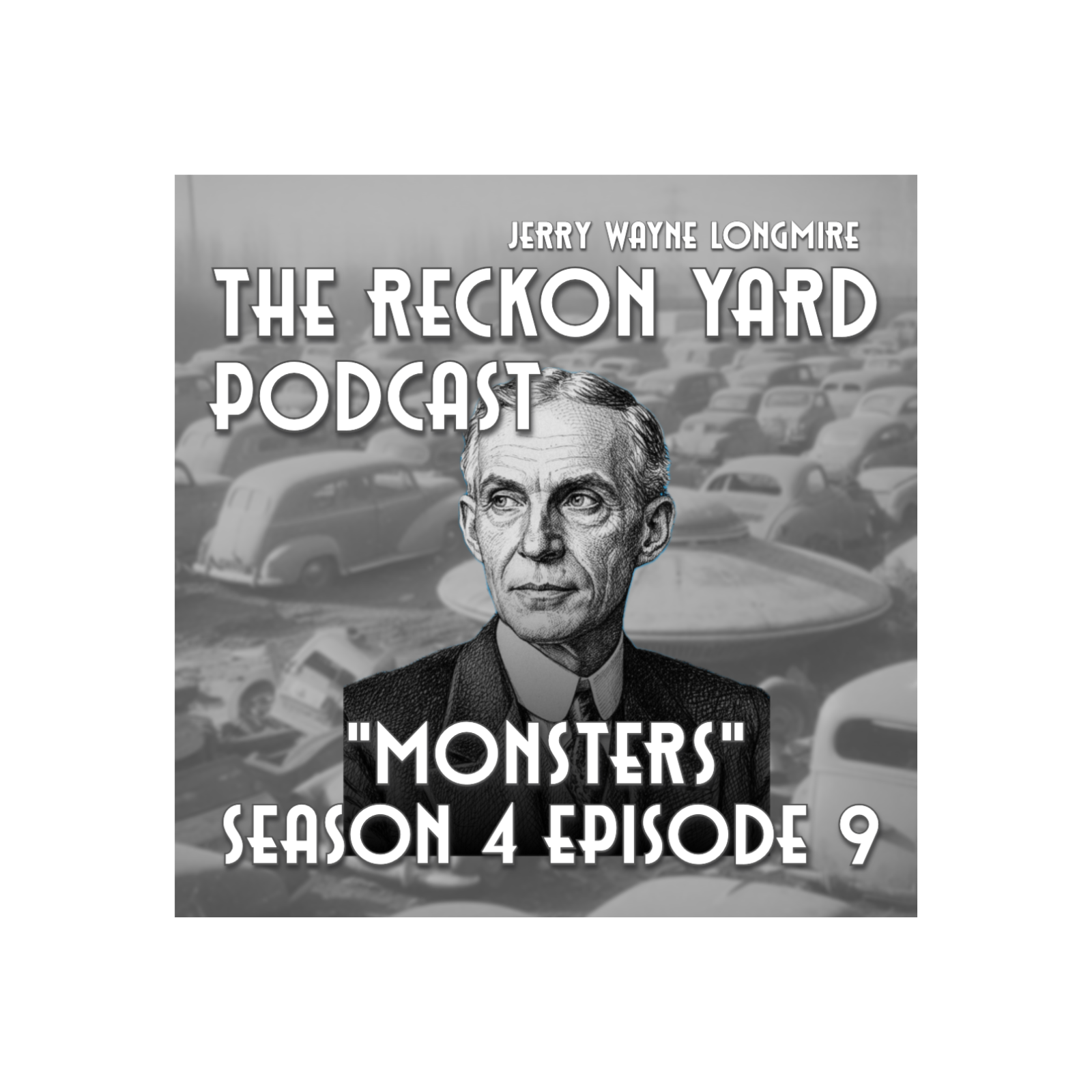
About this episode
“Monsters” blends moral debate with real-world stories and hands-on vehicle talk. The hosts open with the idea that money doesn’t automatically turn someone into a monster, then pivot to character-driven history via “Diamond Jim Brady.” Along the way, there’s practical HVAC troubleshooting on a GM Avalanche—cold at first, then vent airflow fades after 30–40 minutes—and front-end repair from leaking hydro-boost/power steering fluid. Racing and touring stories keep the episode moving between big ideas and everyday fixes.
History’s been lied about from both directions and I’m tired of it. Edison, Ford, and Diamond Jim Brady none of them are who you think. This week on Duwali Bottoms, Tony and Dusty get out of jail, Alana shows up, Dave Tilton pays the sheriff a visit, and somebody comes flying around a curve on the two lane who has no business being there.
resistor on the blower motor
"But the air conditioner blows cold on the avalanche And I thought I had a bad resistor on the blower motor It's real common with the GMT-800s So I changed the blower motor resistor out"
That resistor helps control how fast the AC fan blows air into the cabin. If it’s failing, the fan can start out working but then slow down or stop pushing air out of the vents.
A blower motor resistor controls the fan speed for the HVAC blower. If it fails, the AC may work initially but later lose airflow from the vents, which matches the host’s symptom: cold air early, then reduced vent output after 30–40 minutes.
GMT-800s
"And I thought I had a bad resistor on the blower motor It's real common with the GMT-800s Real common with general motor stuff"
GMT-800 is a GM “generation” of truck/SUV designs. The speaker is saying that this air-conditioning fan resistor problem is a known/common issue on that kind of GM vehicle.
GMT-800 refers to General Motors’ truck/SUV platform generation used for vehicles like the Chevrolet Avalanche. When the host says the resistor issue is “real common with the GMT-800s,” they mean this HVAC blower-resistor failure pattern is commonly seen on that platform.
blend door actuator
"So I'm thinking it's that blend door actuator in the middle The one that controls mode I think something's going screwy with it"
The blend door actuator is a small motor that moves a flap inside the heating/AC system. That flap decides how much hot vs. cold air you get and where it comes out—so if it’s broken, the vents can act weird even if the fan works.
A blend door actuator moves the blend door inside the HVAC box to control the mix of hot and cold air (and often which vents get airflow). When it fails or sticks, you can end up with airflow problems like the fan running but no air coming out the expected vents.
freon
"Because it's got good freon, like I said it blows cold and something Right, but it just, something's going on"
Freon is the chemical inside the AC system that makes the air conditioning cool. If the refrigerant level is good, the AC can cool, but you can still have problems with airflow or the controls.
Freon is a common (though often outdated) name for the refrigerant used in a car’s air conditioning system. Refrigerant charge affects how well the AC cools; having “good freon” suggests the cooling circuit may be okay even if airflow/controls are not.
head unit
"And I've already changed, it's got a brand new head unit in it Brand new AC Delco head, not some aftermarket bull crap"
A head unit is the main dashboard control for the car’s electronics—like the radio/screen. Here, they replaced it because they think the controls/electronics might be part of the problem.
In car audio/infotainment, a head unit is the main control module (screen/radio interface). In this segment, the speaker mentions replacing the head unit, implying the HVAC control interface or related electronics may be involved in the vent/mode behavior.
AC Delco
"And I've already changed, it's got a brand new head unit in it Brand new AC Delco head, not some aftermarket bull crap High dollar AC Delco head unit in it"
AC Delco is a well-known auto-parts brand. In this context, they’re saying they replaced the unit with a brand-name part instead of a cheaper aftermarket one.
AC Delco is a parts brand (GM’s original-equipment supplier) known for replacement components like HVAC and electrical parts. Using an AC Delco head unit suggests the speaker chose a higher-quality OEM-style replacement rather than an aftermarket unit.
front end
"Got to do the front end work [486.5s] I'm going to tackle that this week, I've got all my parts and my hubs [490.0s] I'm going to go through the front end on that pickup [493.6s] And that's not necessary, but it just, what happened is"
“Front end” means the parts at the front of the truck that control steering and ride quality. Here, they’re planning to repair the suspension/steering area.
“Front end” refers to the suspension and steering components at the front of the vehicle—things like control arms, bushings, and steering linkages. When the host says they need “front end work,” they mean fixing those components rather than engine or drivetrain issues.
hubs
"I'm going to tackle that this week, I've got all my parts and my hubs [490.0s] I'm going to go through the front end on that pickup [493.6s] And that's not necessary, but it just, what happened is"
“Hubs” are parts near the wheel that help the wheel spin smoothly. If they’re worn, the front end can feel loose or noisy.
In this context, “hubs” likely means wheel hubs—components that support the wheel and often include bearings. If the front end is being rebuilt, replacing hubs/bearings can restore smooth steering and reduce play.
hydro boost system
"So I've got it all part right now, I'm trying to straighten that out [484.7s] Got to do the front end work [486.5s] I'm going to tackle that this week, I've got all my parts and my hubs [490.0s] I'm going to go through the front end on that pickup [493.6s] And that's not necessary, but it just, what happened is [497.9s] The hydro boost system on it and the power steering on it [501.0s] Was leaking for a long time"
A hydro-boost system helps your brakes using pressurized fluid. If it’s leaking, fluid can get onto nearby parts and cause damage over time.
A hydro-boost system uses hydraulic pressure (from the power steering pump) to assist the brake pedal. If it leaks, it can lose hydraulic fluid and also contaminate nearby rubber components, which can accelerate wear.
bushings
"And it leaked all down on them bushings on the left side [506.0s] On the driver's side of the front end [507.9s] And that, you know, that brake fluid and power steering fluid [511.7s] Just eat anything up, just eat it to death [515.7s] And just ruining them bushings on the left side [518.1s] I hate that, every time you hit a bump, you know"
Bushings are rubber parts that help the suspension move smoothly and quietly. If fluids leak onto them, the rubber can get ruined, and the ride can feel rough over bumps.
Bushings are rubber (or rubber-like) mounts that isolate vibration and allow controlled movement between suspension parts. When brake fluid or power steering fluid leaks onto them, the chemicals can degrade the rubber, leading to harshness—like feeling every bump more strongly.
power steering fluid
"And that, you know, that brake fluid and power steering fluid [511.7s] Just eat anything up, just eat it to death [515.7s] And just ruining them bushings on the left side"
Power steering fluid is the fluid that makes steering easier. If it leaks, it can damage rubber parts and also make the steering feel worse.
Power steering fluid is the hydraulic fluid that helps the steering system apply assist. Leaks can reduce assist and can also spread onto suspension components, where the fluid can degrade rubber bushings.
bypass that amp
"I just need to order one more harness because I'm going to bypass that amp under the console [532.5s] Because I'm pretty sure that amp is shorted out [538.0s] And, yeah man"
“Bypassing the amp” means skipping the amplifier that’s not working. The goal is to get sound working without relying on the broken part.
“Bypassing an amp” means routing the audio signal around the factory amplifier so the new stereo can drive speakers without using the problematic amp. This is often done when the amp is failing or causing electrical faults.
harness
"Other than that, I've got to put a stereo in it [522.8s] And I've got a stereo, ready to go [524.8s] I just need to tackle it [526.9s] I just need to order one more harness because I'm going to bypass that amp under the console [532.5s] Because I'm pretty sure that amp is shorted out"
A harness is the wiring adapter that makes it easier to connect a new stereo. It helps you plug things in the right way instead of guessing or splicing wires.
An audio wiring harness is the connector-and-wiring adapter that lets you install a new stereo cleanly without cutting up the factory wiring. Using the right harness helps the head unit plug in correctly and reduces installation headaches.
shorted out
"Because I'm pretty sure that amp is shorted out [538.0s] And, yeah man [539.8s] I'm enjoying the avalanche, enjoying the piss out of it actually"
“Shorted out” means electricity is accidentally taking a shortcut in the wiring. That can make the amp fail and sometimes blow a fuse, so it needs fixing rather than just ignoring it.
A “short” in automotive electronics is an unintended electrical connection that can cause excessive current. When an amp is “shorted out,” it may stop working and can also trigger protection behavior or blow fuses, so diagnosing the wiring matters.
Tesla
"It's a little black Tesla But it just made me giggle because I don't have a problem with electric cars"
Tesla is a company that makes electric cars. The host is saying they don’t dislike electric cars, but they don’t associate them with the kind of “fury” sound or vibe they like.
Tesla is an electric-vehicle brand known for making battery-electric cars and for popularizing EVs with a performance-and-tech image. In this segment, the host is reacting to a “little black Tesla,” focusing on how electric cars sound/feel to them.

Plymouth Fury
"Unless it's an old Plymouth or old Yeah, unless it's an old Plymouth If it ain't an old Plymouth fury I'm not interested"
A Plymouth Fury is an older American car model. The host is basically saying they only want to hear that loud, aggressive “muscle car” energy if it’s an old Plymouth Fury.
The Plymouth Fury is a classic American full-size car from the Plymouth lineup, and it’s especially associated with the “old cop car” and big-engine muscle-era vibe. Here, the host uses it as a shorthand for the kind of loud, aggressive character they want to hear—contrasting it with modern electric-car sounds.

AMC Eagle
"About to do another one about the AMC Eagle"
The AMC Eagle is a car made by AMC that was known for having all-wheel drive. That means it could send power to more than just the front wheels, helping it handle rough or slippery roads better.
The AMC Eagle is an American compact car from American Motors Corporation (AMC) known for being one of the early mainstream vehicles to offer all-wheel drive. In enthusiast conversations, it often comes up as a practical “do-it-all” machine that blended passenger-car comfort with off-road capability.
Henry Ford
"It wasn't a video about Henry Ford But you have to talk about Henry Ford When you talk about The 9-In tractor because this was his idea"
Henry Ford was the person behind Ford, one of the biggest early car companies. Here, the host credits him with an idea for making a tractor that was cheaper and easier for farmers to repair.
Henry Ford is the founder of Ford Motor Company and a major figure in early automotive manufacturing. In this segment, he’s credited with pushing the idea of a low-cost tractor that could be built and maintained using parts from cars and trucks.
cheap old tractor made from car and truck parts
"Is he wanted this cheap old tractor Made from car and truck parts That every farmer could work on"
The host is describing a tractor design that uses common parts from cars and trucks. That makes it cheaper to build and easier to fix when something breaks.
This describes a “parts-bin” approach to vehicle design: building a tractor using components sourced from existing car and truck parts. The goal is to reduce cost and simplify repairs so ordinary owners can maintain the machine without specialized supply chains.

Ford Ranger of tractors
"And that was Just the right size for what people Needed at that time And he went out and he built the Ford Ranger Of tractors"
The host says Ford followed up with a tractor line called the “Ranger.” It’s presented as the next step after the earlier cheap, repairable tractor concept.
The segment claims that Henry Ford “built the Ford Ranger of tractors,” framing it as a follow-on to the earlier tractor idea. If taken literally, it’s referencing a Ford tractor lineup branded as “Ranger,” but the exact model/series name isn’t clearly confirmed from the transcript.
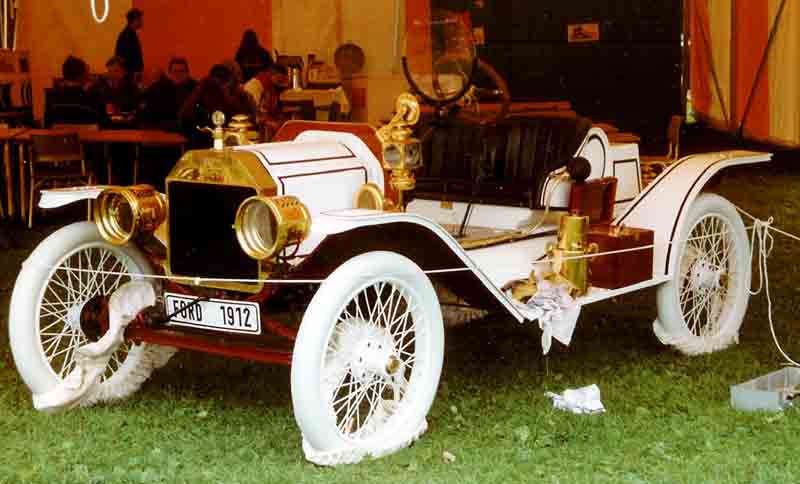
Ford Model T
"They were good accomplishments for this country Model T put America on wheels For Henry Ford"
The Ford Model T was one of the first cars made in large numbers so more regular people could afford one. Henry Ford helped improve how cars were built, which made it easier to get cars on the road. That’s why it’s remembered as an important early step in car history.
The Ford Model T is an early mass-produced automobile that helped make car ownership practical for many people in the United States. Henry Ford’s approach to production is often credited with putting “America on wheels,” which is why it comes up when discussing major industrial accomplishments. It’s a key historical car because it represents the shift toward affordable, widely available transportation.
Request an Explanation
Heard something you'd like explained? We'll add it to this episode.
Sign in to request explanations for terms you heard.
Want to learn more?
Browse our glossary for plain-English explanations of automotive terms, jargon, and concepts.
Help improve this episode
See something that's not quite right? Our annotations are AI-generated and can sometimes miss the mark. Click the flag icon on any annotation to suggest a correction.