NASCAR Rivalries Are Back: Hocevar vs. Zane | Stacking Pennies
About this episode
Rivalries and racecraft take center stage as the hosts break down dominant performances, dirty air, and how restarts and downforce shape pace. Corey LaJoie adds team context—why “you can't drive a slow car fast,” how big-team resources raise pressure, and what it’s like filling in on the 77. The conversation also swings to Atlanta and Lime Rock logistics, pit strategy tradeoffs, and a few off-track moments: merch promos, Topgolf charity fun, and Goodwood car spotting.
Carson Hocevar and Zane Smith are quickly becoming one of NASCAR's hottest rivalries. After Zane publicly called Hocevar a coward, Corey LaJoie and Skip Flores debate whether the feud is good for the sport, if Carson is becoming NASCAR's next great villain, and whether this rivalry has the potential to join NASCAR's all-time great battles.
The guys also break down Ryan Blaney's dominant win at Atlanta, why Team Penske's No. 12 is firing on all cylinders, and whether Atlanta Motor Speedway has become the best track on the NASCAR schedule.
Plus, Justin Allgaier's dramatic win, Grant Enfinger returning to Victory Lane at Lime Rock, the Goodwood Festival of Speed, superspeedway racing, rain-delay snacks, and the biggest stories from across the motorsports world.
Let us know in the comments: Is Hocevar vs. Zane Smith a real rivalry, and what's the greatest rivalry in NASCAR history?
See Privacy Policy at https://art19.com/privacy and California Privacy Notice at https://art19.com/privacy#do-not-sell-my-info.
fastest lap
"No, he didn't get the fastest lap. Oh, who got your question?... I heard somebody talk about how they got the fastest lap..."
The fastest lap is the quickest one full lap a driver completes during the race. It’s basically a way to show who had the speed at that moment.
In NASCAR, the fastest lap is the single quickest lap time recorded during the race. It’s a measurable performance indicator and can be tied to points or bragging rights depending on the event format.
restart
"You can kind of manipulate it at super speed. Especially after a restart when the track screen no rubber on it."
A restart is when the race starts again after a caution. Everyone is bunched up, so it’s a moment where drivers can make big moves and gain positions.
A restart in NASCAR is when the race is re-started after a caution period (like debris or an accident). Restarts are critical because the field is bunched up again and drivers can gain track position quickly.
dirty air
"A lot of times when a car like that that gets the pole loses the lead, you're like, okay, we're going to see how they do in dirty air..."
Dirty air means the air around your car is messed up because you’re following another car. That can make the car feel less stable and harder to drive fast.
Dirty air is the disturbed airflow a car experiences when it follows another car closely. In NASCAR, it can reduce downforce and make handling worse, so it’s harder to pass or stay fast when you’re not in clean air.
downforce
"because the Toyota's clearly had a lot of downforce built in their"
Downforce is the aerodynamic “push” that presses the tires onto the track. More downforce usually means better grip and more stable handling at speed.
Downforce is the aerodynamic force that pushes a car’s tires harder onto the track. More downforce generally improves grip and stability, which is especially important at high-speed drafting tracks where cars need confidence in corners and during close racing.
Toyota
"I don't think that they talked about that a whole lot on the broadcast because the Toyota's clearly had a lot of downforce built in their"
Toyota is the car brand mentioned here. The host is saying Toyota’s race cars seemed to have strong aerodynamic grip for this event.
Toyota is the manufacturer brand being referenced in the context of NASCAR aerodynamics. The speaker suggests Toyota teams had a downforce advantage built into their cars for this race.
straight line speed
"You get the Toyota's heads or bet towards downforce. You had the Ford's in the 22 and the 12 front row. Those guys heads or bets towards straight line speed."
Straight-line speed is how quickly the car can accelerate and keep going on the straight parts of the track. It’s a tradeoff with how well the car sticks in the turns.
Straight-line speed is how fast a car can go on the track’s straights, largely driven by engine power, gearing, and aerodynamic drag. In NASCAR, teams balance straight-line speed against cornering grip (often tied to downforce).
Ford
"You get the Toyota's heads or bet towards downforce. You had the Ford's in the 22 and the 12 front row. Those guys heads or bets towards straight line speed."
Ford is a car brand that competes in NASCAR. Here, the speaker is saying Ford teams were aiming more for speed on the straights than for extra corner grip.
Ford is another NASCAR manufacturer mentioned in the setup comparison. The speaker says Ford teams in the front row were leaning toward straight-line speed rather than maximizing downforce.
Chevrolets
"And clearly both of them found their way towards me. Chevrolet's were fast too. And host of ours leading that thing on the white flag."
Chevrolet is another NASCAR brand. The speaker is saying the Chevrolet cars were quick too, not just the Toyota or Ford cars.
Chevrolet is the third NASCAR manufacturer referenced, and the speaker notes that Chevrolet cars were also fast. This supports the idea that multiple manufacturers found competitive setups, not just one approach.
white flag
"Chevrolet's were fast too. And host of ours leading that thing on the white flag. He's got a really good knack for that place."
The white flag means there’s one lap left in the race. Everyone tightens up their strategy because the next lap decides the finish.
The white flag in NASCAR indicates the race is in its final lap. It changes strategy because drivers must manage position and risk while preparing for the last-corner and final-straight moves.
turbulent air
"He like that place rewards aggressiveness because the car never drives good because all the air is so turbulent. So that's what he is exceptional at is like manipulating the car and traffic, putting himself in a little bit of a better spot than other guys."
Turbulent air is messy airflow caused by other cars. It can make your car feel less stable and reduce grip, especially when you’re close to someone.
Turbulent air is disturbed airflow created by other cars, which can reduce aerodynamic efficiency and make handling less predictable. In stock-car racing, wake turbulence can hurt downforce and make the car feel “off” when following or passing.
traffic
"So that's what he is exceptional at is like manipulating the car and traffic, putting himself in a little bit of a better spot than other guys."
In NASCAR, “traffic” usually means slower cars you have to work around while you’re trying to race. How you pass them can make you gain or lose position.
In NASCAR, “traffic” refers to lapped cars (and other slower cars) that you must pass while still racing for position. Managing traffic well can be as important as outright speed because it affects braking points, line choice, and momentum.
wrapping the line
"He was wrapping the line like old school Atlanta. Do you see that? Yeah, especially the three and four."
“Wrapping the line” means driving the best path through the turns instead of drifting wide. It helps you keep speed and set up the next part of the lap.
“Wrapping the line” describes staying tight to the optimal racing line through turns while maintaining momentum and minimizing time lost. It’s a driving technique used to carry speed and set up the next corner, especially when the track is difficult due to airflow and traffic.
three and four
"He was wrapping the line like old school Atlanta. Do you see that? Yeah, especially the three and four."
“Three and four” are the last two turns on the lap. How you exit them affects how fast you can go on the straight right after.
“Three and four” refers to NASCAR track turns 3 and 4, typically the final corners before the main straight. Exiting these turns well is crucial because it sets up acceleration and positioning for the next straight and finish.
numb shove off the bottom
"It's easy to get that real like numb shove off the bottom if you don't lift the right spot."
This is about how the car feels when you drive low in the turn and then try to accelerate out. If you don’t time lifting correctly, the car can feel like it suddenly pushes or doesn’t respond smoothly.
“Shove off the bottom” describes the car’s push/acceleration when exiting the lower line (near the inside) of a turn. If you don’t lift at the right moment, the car can feel abrupt or unstable—often described as a “numb shove”—because grip and balance change suddenly.
Kevin Harvick
"And he was just wrapping like Kevin Harvick style around the bottom. Found a lot of juice there."
Kevin Harvick is a famous NASCAR driver. The host is comparing the way the car was being driven to Harvick’s style—aggressive and effective on corner exits.
Kevin Harvick is a well-known NASCAR driver whose driving style is being used as a comparison. The speaker says the car was “wrapping” the bottom in a way reminiscent of Harvick, implying aggressive, momentum-focused corner exits.
cup races
"inevitably probably about 65% of my workload got taken away because cup is just so much more like I love the O'Reilly series. I love practice and Saturdays, but there's just another level of like preparation for cup races that you have to put in"
“Cup races” means the top NASCAR series. Drivers usually have to prepare more because the races are tougher and the competition is higher.
“Cup” refers to NASCAR’s top national series (the Cup Series). Cup races generally demand more preparation and higher intensity because of the competition level, race length, and the level of detail teams and drivers manage.
O'Reilly series
"because cup is just so much more like I love the O'Reilly series. I love practice and Saturdays, but there's just another level of like preparation for cup races"
O’Reilly is a sponsor name used in NASCAR series branding. The host is saying the Cup level is a step up in how much preparation it takes.
O’Reilly is a sponsor name tied to NASCAR’s series branding in this context. The speaker contrasts the O’Reilly series with Cup, emphasizing that Cup requires more preparation and physical/mental workload.
Hendrick Motorsports
"when you when you have the resources like a Hendrick Motorsports or like a team Penske, you feel like you're letting everybody down if you're not winning."
Hendrick Motorsports is a major NASCAR racing team. Corey is saying that when a team has a lot of resources, the pressure to win can feel even heavier.
Hendrick Motorsports is a top-tier NASCAR team organization associated with the Hendrick racing operation. Corey uses it as an example of a team with massive resources where the expectation to win creates strong internal pressure.
Team Penske
"when you when you have the resources like a Hendrick Motorsports or like a team Penske, you feel like you're letting everybody down if you're not winning."
Team Penske is another big, high-level NASCAR team. Corey is comparing it to Hendrick to explain that top teams come with intense expectations to win.
Penske refers to Team Penske, another elite NASCAR organization. Corey groups it with Hendrick to explain how top teams’ resources and expectations can shape how drivers are perceived.
tier one and a half team
"not often is a call it a not a tier one and a half team like Spire is now in conjunction with with Hendrick and Chevy is as fast as they are."
In racing talk, people use “tiers” to mean how competitive teams are. Corey is saying Spire is now closer to the very top teams than it used to be.
“Tier one and a half” is NASCAR shorthand for a team that’s between the very top organizations and the rest of the field in terms of competitiveness. Corey uses it to describe how Spire’s partnership and Chevrolet support can elevate the team’s speed and results.
Spire
"not a tier one and a half team like Spire is now in conjunction with with Hendrick and Chevy is as fast as they are."
Spire is a NASCAR racing team. Corey is saying Spire is getting stronger because of partnerships that help it compete with the fastest teams.
Spire refers to Spire Motorsports, a NASCAR team. Corey mentions it in the context of being elevated by working “in conjunction with” Hendrick and Chevrolet, which he says helps it run at the front more often.
Chevy
"Spire is now in conjunction with with Hendrick and Chevy is as fast as they are. And that's what this cars opened up."
“Chevy” means Chevrolet. In NASCAR, manufacturer support can affect how competitive a team is, and Corey is saying that’s part of why Spire is running well.
“Chevy” is shorthand for Chevrolet, the manufacturer brand involved in NASCAR team programs. Corey is pointing out that Chevrolet support, combined with Hendrick-level resources, is part of why Spire can be as fast as it is.

Dodge Ram
"...ur fire suit. You know, we got it. We got to show Ram off because you know, Ram Rams who we is. So we d..."
A Dodge Ram is a large pickup truck. It’s made for carrying things and towing, and it can also be used like a normal truck for daily driving. The podcast may mention it because it’s a brand the team wants to highlight.
The Dodge Ram is a full-size pickup truck built for hauling, towing, and everyday driving. In a motorsports or racing context, it may come up as a brand spotlight or as part of a team’s sponsor/vehicle identity. That’s why it could be mentioned alongside gear or branding moments in the podcast.
tire advantage
"The way it all worked out, we'd have finished probably fourth because we were on a tire advantage. And then we had a mechanical oversight issue"
It means their tires were in better shape than the other cars'. When tires are newer, they usually grip the road better, so the car can go faster and handle better.
A tire advantage means one car has fresher or better-performing tires than the others, usually because of strategy (like pit timing) or how the race unfolded. Fresher tires typically provide more grip, which can translate into faster lap times and better track position.
mechanical oversight issue
"we'd have finished probably fourth because we were on a tire advantage. And then we had a mechanical oversight issue that didn't allow my truck to proceed forward anymore."
In racing, a mechanical issue is a problem with the car’s hardware (like drivetrain, cooling, or electronics) that prevents normal operation. The phrase “oversight” suggests the team may have missed or mismanaged something in setup, inspection, or procedure, leading to the failure.
Sim
"So that's the hard part. It's like, man, we've got no SIM. We have no notes on trucks."
SIM is short for a racing computer simulator. Teams use it to practice and plan how the car should be set up for a track, without having to test in real time.
“SIM” refers to a racing simulator used by teams to model car behavior and help drivers and engineers prepare. It’s used to study setups, practice lines, and anticipate how the car will respond at a specific track.
Lime Rock
"That place is, so Lime Rock, it's cool, man. I got to give a shout out to that group."
Lime Rock is a race track in Connecticut. It’s known for lots of tight turns, so getting the car set up right matters a lot for speed and control.
Lime Rock Park is a road course in Connecticut known for its tight, high-cornering-speed layout and frequent 80–90° turns. Because it’s so twisty, setup details like gear ratios and braking/turn-in behavior can strongly affect lap times.
Parker Kligerman
"I got to give a shout out to that group. I think Parker Kligerman has some sort of ownership stake there."
Parker Kligerman is a professional race car driver. Here, they mention he has some ownership involvement connected to the Lime Rock track.
Parker Kligerman is a NASCAR and road-racing driver who also has business involvement in racing venues. In this segment, he’s mentioned as having an ownership stake at Lime Rock Park.
third gear ratio
"And we didn't have the right third gear ratio. We didn't have the right second gear ratio."
Gear ratio is how the car’s gearing is set up to match the engine to the wheels. The “right” ratios help the engine stay in the best RPM range so the car accelerates better out of corners.
A gear ratio determines how the engine’s RPM relates to wheel speed, affecting acceleration and how quickly the car reaches its power band. Choosing the “right” gear ratios for a track helps keep the car in the optimal RPM range through corners and exits.
second gear ratio
"We didn't have the right third gear ratio. We didn't have the right second gear ratio."
Second gear ratio is the gearing setting that affects how the car pulls when you’re going slower and exiting tight turns. If it’s not right, the car can feel like it’s not accelerating where it should.
Second gear ratio is part of the transmission gearing that shapes acceleration for slower corners and tighter sections of a road course. If it’s wrong, the car may feel sluggish on corner exit or may not stay in the engine’s effective power range.
salvage day
"but we had a, we had a salvage day. That's like the sixth race in a row."
A salvage day means the race didn’t go the way they wanted, so they’re just trying to make the best of it. Instead of a great finish, they focus on limiting the damage and getting through.
A “salvage day” is an informal racing term for when a team can’t achieve its ideal result, so they focus on damage control—finishing as best they can after setbacks like crashes or mechanical problems. It’s often used when points or track position are already compromised.
Thomas Inuziato
"Shout out to who Thomas Inuziato won that. And then he caught me in finger. Yeah, finger got the, got the dub on in the truck race."
Thomas Inuziato is a race driver. They’re saying he won a race, and then there was an incident involving him afterward.
Thomas Inuziato is a racing driver referenced here as the winner of an “arc race.” The host also discusses an incident involving him afterward, indicating the context is a recent race event.
smoke inhalation
"Did Inuziato, did he go to hospital or something? I think it was smoke inhalation. He swallowed some fire."
Smoke inhalation means someone breathed in smoke, usually from a fire. It can be dangerous because it irritates the lungs and airways.
Smoke inhalation is a medical condition where a person breathes in smoke or combustion byproducts, which can irritate or damage the airways. In motorsports, it can occur after a fire or overheating event in or near the cockpit.
practice
"So NASCAR, go back to some practice for Atlanta. I think it would make, uh, I think it would make the, the racing product no different."
Practice is when NASCAR teams run the car before qualifying and the race. They use it to learn how the car feels and make adjustments so they’re not guessing on race day.
In NASCAR, practice sessions are scheduled runs where teams test setups and learn how the car behaves before qualifying and the race. It’s especially important when track conditions or rules change, because it helps drivers and crews dial in drivability.
fuel tax
"Uh, the fuel tax was weird to kind of see where people are coming out, who took two, who took four. If you took two or you did a quick pit stop early, it means you had to take a longer pit stop later, uh, to get all your fuel in the car."
“Fuel tax” is NASCAR slang for the tradeoff teams pay when they choose how much fuel to add and when to pit. If you don’t put enough fuel in early, you usually have to stop longer later to finish the race.
“Fuel tax” in NASCAR refers to the time/strategy penalty associated with how much fuel you take and when you take it. If you take less fuel early (or pit more quickly), you often have to make up the difference later with a longer stop, which can cost track position.
pit stop
"Uh, the fuel tax was weird to kind of see where people are coming out, who took two, who took four. If you took two or you did a quick pit stop early, it means you had to take a longer pit stop later, uh, to get all your fuel in the car."
A pit stop is when the race car comes into the pits during the race for service, usually fuel and sometimes tires. Teams time pit stops so they don’t run out of fuel and don’t fall too far behind.
A pit stop is when the car pulls into the pit lane for service—typically fuel and tires—during a race. NASCAR pit strategy often balances how long you stop and when you stop so you can meet fuel needs without losing too much track position.
Wilkesboro
"Going to Wilkesboro this weekend. What's pit road going to be like?"
Wilkesboro is a NASCAR track in North Carolina. The pit road layout is unusual, with a curve and big pit spots, which changes how cars enter and how easy it is to see what others are doing.
Wilkesboro refers to the NASCAR venue at North Wilkesboro Speedway in North Carolina. The host notes pit-road geometry there—curved pit road with large pit boxes—which affects how teams position cars and how visible other cars are during entry.
Martinsville
"Um, big pit boxes. It's just funky. It's a little bit like Martinsville. See, we haven't ever been there other than the All-Star race where half the field is in the race."
Martinsville is another NASCAR short track. The host is saying Wilkesboro feels a bit like it—busy and tricky when cars are moving around near the pits.
Martinsville refers to Martinsville Speedway, a short-track venue known for tight racing and frequent traffic on track. The host compares Wilkesboro’s pit-road feel to Martinsville, implying similar challenges when cars are coming and going near each other.
jump line penalty
"it's going to be easy to get a jump line penalty. That's what I foresee. The pitbox are big and"
On pit road there’s a line you’re supposed to wait at. If you cross it too early, you can get penalized because it helps you leave the pits faster than others.
In NASCAR-style racing, a “jump line” is a specific spot on pit road where you’re not supposed to cross before the allowed time. If you do, officials can penalize you because it gives you an unfair advantage in getting out of the pits.
pit box
"That's what I foresee. The pitbox are big and there's some room, but you're going to be on top of each other, especially if you don't get a lot of laps."
A pit box is the specific parking spot on pit road for a race team during stops. It’s like a designated lane/stall where the car pulls in to get serviced.
A pit box is the marked stall on pit road where a team parks its car during pit stops. Its size and layout affect how close cars and crew members are, which can influence timing and safety.
modified
"Oh, Riley's is off this week. So I was like, man, if I don't have to do the cup race, I don't want to do the truck race. I'm going to go race my modified at Bowman Gray."
A “modified” is a type of race car class used on short tracks. Corey is saying he races that kind of car at Bowman Gray.
A “modified” is a specific class of race car used in short-track racing, typically built for high performance on smaller circuits. Corey says he’ll race his modified at Bowman Gray, indicating the type of car category he competes in there.
Bowman Gray
"I'm going to go race my modified at Bowman Gray. Night of Destruction. If you're in the area, they got the Night of Destruction at Bowman Gray this weekend."
Bowman Gray is a famous short-track racing venue. It’s known for being intense and close-quarters, so events there tend to be loud and action-packed.
Bowman Gray Stadium is a short-track venue in NASCAR’s world, known for close racing and frequent on-track chaos. Corey is talking about going to a local event there—“Night of Destruction”—which highlights how event culture and track layout can drive the spectacle.
Night of Destruction
"I'm going to go race my modified at Bowman Gray. Night of Destruction. If you're in the area, they got the Night of Destruction at Bowman Gray this weekend. They've got monster trucks, Demo Derby, Twin 25."
“Night of Destruction” is a special event weekend at Bowman Gray. It’s not just one race—there are other car-and-truck events like monster trucks and a demolition derby.
“Night of Destruction” is an event at Bowman Gray Stadium featuring multiple motorsport-style attractions beyond a single race. In this segment, Corey lists monster trucks, a Demo Derby, and “Twin 25,” framing it as a weekend entertainment package.

Volkswagen Derby
"...ay this weekend. They've got monster trucks, Demo Derby, Twin 25. So the modified has got a new sponsor. ..."
A Volkswagen Derby is a Volkswagen car that’s been set up for a demolition derby event. In these events, cars are modified to survive impact as long as possible while competing. The podcast mentions it because it’s part of the racing weekend and sponsorship activity.
A “Volkswagen Derby” refers to a Volkswagen vehicle prepared for a demolition-derby style event, where cars are modified and driven for controlled destruction. The podcast context mentions demo derby and sponsors, which fits this kind of racing setup. It’s discussed because these events rely on specific builds and sponsorships to get cars ready for the weekend.
transponders
"They got transponders out there now too. No way. Transponders a little bit of drama this week. It's not just like people just like, Hey, I think Tim's going to be on the polls."
Transponders are small electronic tags on the race car that help the track measure timing. They’re used so everyone gets the same, official speed/lap data instead of guessing.
In racing, transponders are electronic devices on the car that send timing data to track systems. Corey is reacting to “transponders out there now,” arguing they make speed measurement more accurate and less subjective than people relying on informal timing.
poll
"Transponders a little bit of drama this week. It's not just like people just like, Hey, I think Tim's going to be on the polls. Yeah, I think, you know, old John Boyce is going to be on the polls."
“The polls” means the pole position, which is the best starting spot at the front of the race. Corey is saying people expect certain drivers to qualify first.
In NASCAR qualifying, “the polls” refers to the pole position—the starting spot at the front of the grid. Corey mentions drivers being expected to land on the pole, tying it to the week’s timing/measurement discussion.

Hyundai Accent
"...it. I didn't like it. You don't like his New York accent? No, I think Eric Brennan's phenomenal job. And I..."
The Hyundai Accent is a small, inexpensive car meant for everyday driving. It’s typically chosen for being practical and affordable to run. The podcast likely brings it up because the name “Accent” matches the conversation topic.
The Hyundai Accent is a small, budget-friendly car focused on practical transportation and low running costs. It’s the kind of vehicle that often comes up in conversations about everyday driving, affordability, and personal preferences. In the podcast excerpt, it sounds like it’s being discussed in relation to someone’s opinion of a particular person’s “accent,” but the car itself is the Accent model.
carbon shop
"Oh yeah. And I think too that you have, especially with this carbon shop, right? Because that's been where a lot of my focus and a lot of my money is being spent these days."
A “carbon shop” is a place where the team works on carbon-fiber parts. Carbon fiber is a lightweight material, so teams use it to try to make the race car faster and more responsive.
In NASCAR, a “carbon shop” typically refers to a shop or department focused on carbon-fiber components and related fabrication/repair. Carbon fiber is used because it can be strong and lightweight, which helps teams chase speed and handling improvements.

Kia Stinger
"...mily as in Crustple because it's round, but honey stingers. Oh yeah. I've been on the honey stingers or the ..."
The Kia Stinger is a sporty car with a sedan body style. It’s designed to feel quick and fun to drive, not just to get you from place to place. The podcast mentions it because of the car’s name and reputation as a performance-oriented model.
The Kia Stinger is a sporty sedan (and fastback-style car) known for its performance-focused driving feel. It’s often discussed because it offers a more “enthusiast” style than a typical family sedan, which makes it a common topic when people talk about cars they’ve driven or owned. The podcast’s wordplay likely points to the Stinger name rather than a specific racing role.
Goodwood Festival Speed
"This is my favorite part of the show because there's some cool stuff in the automobile world happening. Goodwood Festival. Just a lot of guys driving expensive cars up a long driveway to some guys castle here."
The Goodwood Festival of Speed is a big car event in the UK. People bring impressive cars and drivers, and they show them off by running them up a hill.
The Goodwood Festival of Speed is a major UK motorsport and car culture event where manufacturers and drivers bring notable cars to run up a hill climb. It’s especially known for seeing rare performance cars, concept vehicles, and racing legends in one place.
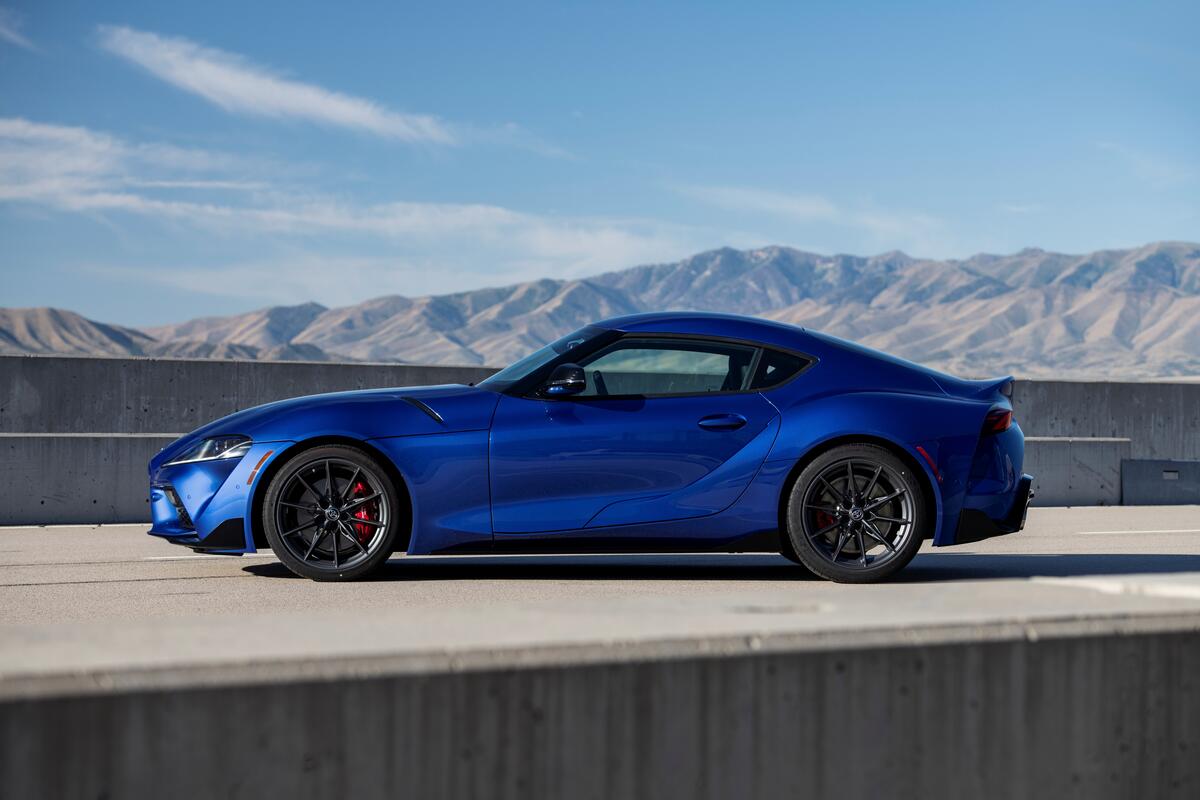
Toyota Supra
"This is my favorite part of the show because there's some cool stuff in the automobile world happening. Goodwood Festival... What do we got? What is this? Toyota Supra? Supra? Carbon? Buddy with a V10."
The Toyota Supra is a famous sports car from Toyota that’s known for being fast and fun to drive. Here, they’re talking about a Supra that shows up at a car event and looks especially wild because of its styling and aero.
The Toyota Supra is a performance sports car best known for its strong straight-line speed and, in recent generations, its modern turbocharged engine and track-ready tuning. In this segment, Corey is reacting to a Supra-like car shown at the Goodwood Festival of Speed, focusing on its aero and overall presence.
wing
"Okay, the wing on that thing, dude. Ryan Turk. Oh, it is Turk. Okay... You probably have to lift to not pull the front tires off the ground with that wing on the back."
A wing on a car is an aerodynamic spoiler. Its job is to push the car’s tires down onto the road so it grips better, especially at higher speeds.
A “wing” in performance cars typically refers to an aerodynamic spoiler that generates downforce. More downforce helps keep the tires planted at speed, which is why a big rear wing can dramatically change how a car behaves on track or during high-speed runs.
V10
"What do we got? What is this? Toyota Supra? Supra? Carbon? Buddy with a V10. Listen to this thing."
A V10 is an engine with 10 cylinders. The “V” shape helps it fit in a compact layout, and engines like this are often built to rev high and make a lot of power.
A V10 is an engine with 10 cylinders arranged in a “V” shape (two banks of cylinders). V10s are known for high-revving character and strong power potential, which is why they show up in some high-performance and racing-focused cars.
Ryan Turk
"Okay, the wing on that thing, dude. Ryan Turk. [2705.1s] Oh, it is Turk. Okay."
Ryan Turk is a race driver who’s known for drifting. In this clip, they’re saying he was the one driving the car they’re talking about.
Ryan Turk is a professional drift driver associated with Formula Drift. In this segment, Corey credits him with driving the featured car, framing it as a drift-focused setup rather than a typical street car.
Formula Drift
"So Ryan Turk, he's drift guy. He's a Formula Drift guy. Yeah, Ryan Turk is one of the best."
Formula Drift is a racing series focused on drifting—basically sliding the car around corners in a controlled way. Drivers are judged on how well they keep the slide going and how smoothly they do it.
Formula Drift is a professional drifting racing series where drivers score points based on how well they maintain controlled slides, angle, and speed through corners. It’s a specialized motorsport category with cars set up for traction management and steering control rather than just lap time.
lead lap finish
"I think he finished 28th, but lead lap finish, not torn up, finish all the laps."
In NASCAR, a “lead lap finish” means the car finished on the same lap as the race leader. It usually indicates the car ran well and didn’t fall too far behind.
A “lead lap finish” in NASCAR means the driver completed the race on the same lap as the leader, rather than being lapped. It’s a quick way to show the car stayed competitive and wasn’t forced into a major setback.
rain delay
"I saw him in a really bad spot on a restart after the rain delay. It was, he was like, whoa, whoa, whoa, whoa."
A “rain delay” is when the race stops because of rain. When it starts again, the track can be different, so drivers may have to adjust their driving and tire grip.
A “rain delay” is a pause in the race due to weather, which can change track conditions and restart strategy. In NASCAR, delays can also affect tire grip and how drivers manage gaps during the restart.
Port Royal Speedway
"So they come to the checkered right here. Port Royal Speedway. Right hooks them."
Port Royal Speedway is a NASCAR-related oval track in Pennsylvania where short-track racing can produce tight, high-contact racing. Restart timing and restart positioning matter a lot there, which is why incidents on restarts get discussed heavily.
right rear hook
"You can't right rear hook somebody after the race is over. Oh, yes."
A “right rear hook” is when one car clips another car’s back-right corner. That can upset the car’s handling and make it hard to drive straight.
A “right rear hook” describes a specific type of contact where one car’s front/right side catches another car’s right-rear area. In NASCAR, that kind of hit can be especially damaging because it can unsettle the car’s rear alignment and traction.

Buick Grand National
"Just something about seeing a Buick Grand National. Is that a 85 maybe? That thing's sick."
The Buick Grand National is a classic American car from the 1980s that’s known for having a turbocharged engine. It can make a lot of power, so people get excited when they see one—especially if it’s being driven hard.
The Buick Grand National is a famous American turbo V8 from the 1980s, best known for strong straight-line power and its “sleeper” look. In this segment, they’re reacting to seeing one in a racing context, which is notable because the Grand National’s turbo setup can make big boost and torque.
550 blade
"That's a big 550 blade on the back of that thing, but big power. So a lot of downforce."
A “550 blade” is a type/size of rear wing piece. The wing helps push the car down for better grip in corners, but it can also make the car less free on top speed.
“550 blade” refers to a specific rear-wing blade size/shape used on NASCAR-style cars, which affects aerodynamic load. Larger wing setups typically increase downforce, improving cornering grip but also adding drag.
McLaren hypercar
"One of the coolest things though, too, is I've been interested in this McLaren hypercar program since it since they dropped it last year. They've been working on it."
McLaren is building a very expensive, very high-performance race car for long-distance endurance events. They’re showing it off by letting a top driver drive it, and the point is to prove it can handle racing conditions for a long time.
McLaren’s hypercar program is a top-tier, limited-production effort aimed at building an ultra-high-performance car for endurance racing. In this segment, they’re talking about McLaren’s WEC (World Endurance Championship) development and the first public on-track reveal with Lando Norris driving it.
WEC car
"They've been developing this WEC car world endurance championship. And this was the essentially the unveil of McLaren's hypercar"
WEC is a long-distance racing series. The cars are designed to keep running strongly for a long time, not just for a few laps.
WEC stands for World Endurance Championship, a major global endurance racing series. A “WEC car” is built and developed around long stints, reliability, and consistent lap times rather than just short bursts of speed.
Lando Norris
"And this was the essentially the unveil of McLaren's hypercar and none other than Lando Norris letting the thing eat."
Lando Norris is a top Formula 1 race driver. In this clip, he’s the one driving the new McLaren hypercar to show what it can do.
Lando Norris is a Formula 1 driver for McLaren, and he’s known for being quick and consistent in high-pressure sessions. Here, he’s used to showcase McLaren’s hypercar by letting him drive it during the reveal.
Liam Lawson
"And then you got his fellow fellow competitor, Liam Lawson, also driving it good. Well, let's see what he's driving."
Liam Lawson is a professional race driver. The hosts are saying he’s also driving one of these high-end cars, not just the F1 guys.
Liam Lawson is a Formula 1 driver who can be placed in other top-level racing machinery beyond F1. In this segment, he’s mentioned as another driver associated with the hypercar program, implying he’s also driving it competitively.
Legend car
"So this is a car for these. Well, is this a legend car? I think it's in Australia. So he hits if you roll back a little bit, roll back."
“Legend car” sounds like a special, showy race car category. The host is saying it’s basically the same underlying car concept, but with a different body style.
“Legend car” here appears to mean a track-focused, modified or specialty car used for entertainment or racing events, often with a distinctive body style. The host describes it as having a different body on it, suggesting it’s a recognizable category rather than a specific production model.
curb
"So this is a car for these. Well, is this a legend car? I think it's in Australia. So he hits if you roll back a little bit, roll back. He hits the curb and the body like the body digs into the asphalt."
A curb is the raised edge at the side of the track. If a car hits it, it can bounce or lose grip, so it’s a big deal in racing.
A curb is the raised edge at the side of a racetrack or road that defines the boundary of the racing surface. Hitting a curb can upset a car’s suspension geometry and traction, which is why curb strikes are often used to judge how well a car manages bumps and contact.
Request an Explanation
Heard something you'd like explained? We'll add it to this episode.
Sign in to request explanations for terms you heard.
Want to learn more?
Browse our glossary for plain-English explanations of automotive terms, jargon, and concepts.
Help improve this episode
See something that's not quite right? Our annotations are AI-generated and can sometimes miss the mark. Click the flag icon on any annotation to suggest a correction.