The TR6 is a classic sports car made by Triumph in the UK. It’s known for being a fun, open-road style car from the late 1960s and early 1970s. People still talk about it because it’s a popular classic to drive and restore.
Car
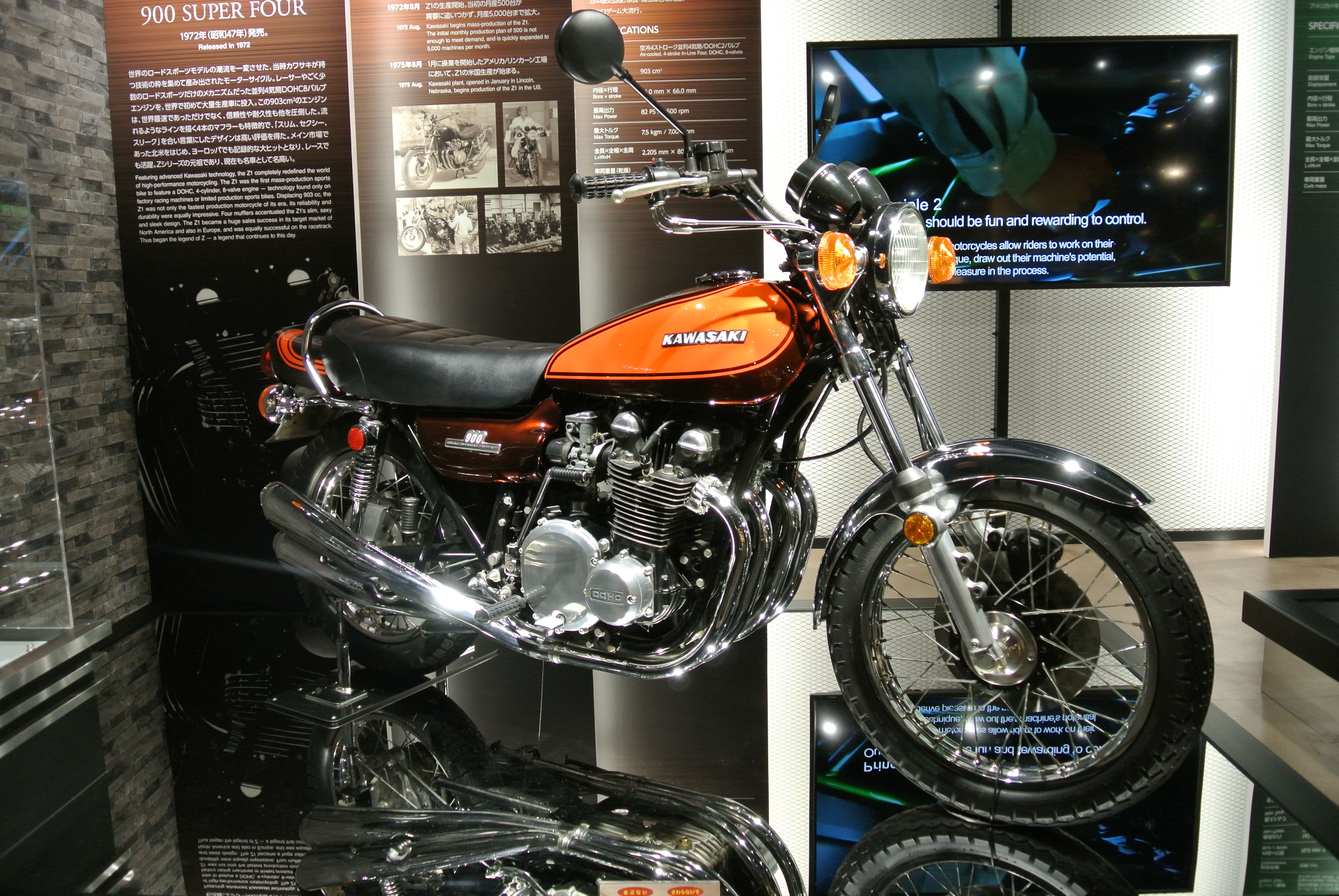
Kawasaki Z1
The Kawasaki Z1 is an early super-sport motorcycle that became famous for making a lot of power for its time. The hosts use it as the starting point to explain how later superbike engines got much stronger and more efficient.
Horsepower per pound is a way to compare how strong an engine is relative to the bike’s weight. Higher numbers usually mean the bike feels more eager and accelerates better.
This describes how the engine controls airflow. Two valves per cylinder and two camshafts in the head help the engine open and close the valves more effectively, especially when you rev it high.
SOHC means the engine uses one camshaft in the top of the engine to run the valves. It’s a different valve-control layout than DOHC, and it can affect how the engine performs at higher revs.
Term
roller crank
A roller crank is a crankshaft design that reduces friction inside the engine. Less friction can help the engine rev more easily and feel stronger.
Term
one piece rods
Connecting rods connect the piston to the crankshaft. “One piece rods” means the rod is made as one piece instead of using a separate cap held on with bolts.
Turbocharging adds a device that uses exhaust energy to push extra air into the engine. With more air (and fuel), the engine can make more power.
Term
emissions and economy
This is about making the engine cleaner and using less fuel. When regulations tighten, manufacturers often change how the engine is tuned so it burns fuel more efficiently and pollutes less.
Term
fuel efficient tire smoking
They’re basically saying you could get the fun, dramatic burnout look while also trying to be more fuel-efficient. It’s a humorous way to point out the tension between “clean/efficient” and “wild performance.”
It means each cylinder uses two valves total—one for letting air in and one for letting exhaust out. Fewer valves can limit how well the engine breathes, especially when you want big power at high revs.
This is the part of the engine where fuel and air get squeezed and burned. The shape matters because it affects how completely and efficiently the burn happens.
That number is describing how the valves are angled relative to each other inside the engine. The angle changes how the air-fuel mixture and exhaust flow, which affects power.
Here, “Superbike” isn’t just a type of motorcycle—it’s a specific racing class. It was created so the AMA could organize races for the new, larger-engine bikes that were suddenly showing up.
Weaving is when a motorcycle starts to oscillate—kind of like a fast wobble—while riding. It’s dangerous because it can make the bike feel unstable at speed.
Those are three ways a bike can rotate: tipping side-to-side (roll), nodding up and down (pitch), and twisting left and right (yaw). “Coupled” means these motions influence each other, which can create instability.
The swing arm is the rear arm that holds the back wheel and lets it move when the suspension works. Making it stiffer can help the bike feel more stable.
Pavement racing is racing on regular paved surfaces. The key idea is that having more engine power doesn’t matter as much as being able to put that power to the ground without losing control.
A “horsepower race” means people were mainly trying to make engines stronger and stronger. Later, the focus shifted more toward how well the bike handles, not just raw power.
The Jensen Interceptor is an older sports car made in the UK. It was designed to be fast and comfortable for long drives. It’s remembered today because it has a distinctive classic look and performance focus.
A connecting rod is a key engine part that helps move the piston’s motion to the crankshaft. The “small end” is the piston-side joint, and the host is saying those parts were breaking under the high stress of early powerful engines.
The crankcase is the bottom part of the engine that holds the crankshaft. In this story, when parts break, they can damage the crankcase badly.
Term
crankshafts who would don't slip at the joints
The crankshaft is the rotating shaft that the pistons’ motion turns. The host is saying engineers needed crankshafts that wouldn’t shift or move at their connections, because that can ruin the engine.
Valve float is when the engine revs so high that the valves start to lose contact with the timing that controls them. The fix is stronger valve hardware so the valves keep working correctly at high RPM.
Tappets are parts inside the engine that help open and close the valves. If they get too hot, they can discolor (like turning purple), which is a sign something isn’t being lubricated or controlled properly.
Oil feeds means sending extra oil to the engine parts that need lubrication most. The idea here is to keep those parts from overheating during short, hard runs.
AMA is a major motorcycle organization that helps set the rules for racing. In this story, they’re making sure the race format doesn’t push bikes into failure before the finish line.
Fuses are safety devices in the bike’s electrical system that stop current when something is overloaded. The speaker is saying early race bikes could run into electrical trouble if races lasted too long.
Steve McLaughlin is mentioned as a top superbike racer who helped write the rules used by the AMA. The story suggests the rules came from practical racing experience, not just theory.
John Ulrich is a well-known motorcycle racer mentioned as one of the people who helped create the racing rules. The idea is that racers themselves helped design the framework for how superbikes should be built and raced.
A twin-shock bike has two rear suspension shocks instead of one. The speaker is talking about how changing shock placement was part of improving how the bike handles.
A monoshock means the bike’s rear suspension uses one main shock instead of two. Putting it in a better location helps the suspension work more consistently and can improve handling.
A stiff chassis means the frame doesn’t twist or bend as much when you ride hard. That helps the suspension and handling feel more controlled, especially as bikes get faster and put more stress on the frame.
Chatter is a vibration or oscillation that shows up when a motorcycle’s tires and chassis/suspension can’t stay stable under load. In racing, it can be triggered or worsened by tire construction changes, and it often forces riders/teams to rethink setup rather than just “going back” to an older tire.
A “DOT race tire” is a racing tire that’s still tied to DOT rules/markings. Even though it’s meant for racing, its grip and stiffness can be different enough to make the bike start vibrating (“chattering”).
Dunlop is a tire company. In this segment, a new Dunlop tire is blamed for making the bike start vibrating (“chattering”) after it was installed on an older Honda 600.
The chassis is the bike’s frame, and the suspension is what uses springs and shock absorbers to keep the tires planted. The point is that if tires cause vibration, you often have to fix the bike’s setup, not just the engine.
Instead of sliding surfaces inside the engine, a rolling-element crankshaft uses rolling parts to reduce friction. Less friction can help the engine rev higher and make power more efficiently.
Overfilling is when the engine can’t pull in any more air/fuel than a certain limit. Even if you add more valves, there’s still a point where the engine’s intake can’t keep improving.
When the engine runs, pressure pulses move through the intake and exhaust pipes. Tuners try to use those pulses to help the engine breathe better, but there’s still a limit without forced induction.
The power-producing cycle is the engine’s repeating routine that makes energy—taking in the mixture, compressing it, burning it, and pushing exhaust out. If that routine happens more often per minute, the engine can make more power.
“Supersport” is a motorcycle racing category. It’s for sport bikes that are close to production models, and rules can affect things like how many valves the engine uses.
“Four valves per cylinder” means the engine uses more valve openings in each cylinder. More valve area and lighter valve parts can help the engine move air in and out more efficiently, especially at higher RPM.
The “squared cubed rule” is a math rule about how things scale. When you make a valve smaller, it gets lighter faster than the openings get smaller, which can help the engine rev higher.
A “flow coefficient” is a way engineers quantify how easily air can move through an engine’s valve and passages. Higher flow coefficient generally means the engine can breathe better.
A “hemi head” is an engine cylinder head design where the combustion chamber is shaped like half a sphere. That shape can help air flow more smoothly, which can improve engine efficiency and power.
Intake valves are the “inlet” valves that let the fuel/air mixture into the engine. At very high RPM, they have to move fast and accurately, or the engine won’t run right and can get damaged.
Valve float is when the valves start “losing control” at high engine speeds. Instead of opening and closing exactly as designed, they can bounce, which can hurt performance and potentially damage the engine.
Air cooling uses airflow to carry heat away from the engine, usually with fins. It can be harder to keep an engine cool when it’s making a lot of heat at high revs.
A “cast iron skull” is a tough cast-in insert around the combustion area. It helps keep the valve-seat area from moving around as the engine gets hot and vibrates.
Valve seat rings are the hardened surfaces in the head that the valves seal against. If they shift or loosen, the engine can start leaking and can even get badly damaged.
Car
GPZ 550
They’re using the GPZ 550 as an example of an older-style motorcycle engine. Even though it has two valves, the head can still be heavy because air-cooled engines need lots of metal to shed heat.
A heat sink is just a big chunk of metal that soaks up heat. On an air-cooled engine, the cylinder head is shaped and built to pull heat away so the engine doesn’t overheat.
Compression ratio is how much the fuel-air mixture gets squeezed inside the cylinder. More squeeze can make more power, but if the engine runs hotter (like air-cooled bikes in summer), it can become harder to run safely without problems.
Air-cooled engines use airflow and metal fins to get rid of heat. Since there’s no liquid coolant to control temperatures, the engine can run hotter in summer and cooler in fall, which changes how it should be tuned.
Knocking is a bad sound from the engine that usually means the fuel is burning at the wrong time or too violently. It’s a warning sign because it can lead to damage if you keep driving.
Lugging is operating the engine at a low RPM while demanding high load, which can lead to poor combustion conditions. For motorcycles, lugging can raise the chance of knock/detonation because cylinder pressures and temperatures don’t behave as they do at the engine’s intended operating range.
Detonation is when the fuel in the engine burns in a rough, explosive way instead of smoothly. That can create damaging shock waves inside the engine, which is why it’s something riders and tuners try to prevent.
Term
base gas
“Base gas” means the starting fuel they use before making changes to improve how safely it burns. The point is to prevent the engine from knocking when it gets hot and loaded.
The Honda Element is a small vehicle that looks boxy and is built for practical everyday use. It has a flexible interior so you can carry different kinds of stuff. People talk about it because it doesn’t look like a typical car.
Car
Honda Goldwing
The Honda Gold Wing is a big touring motorcycle. In this segment they’re explaining that its flat-four layout can make the rear cylinders run hotter if you rely on air cooling alone.
The “rear pair of cylinders” are the cylinders located toward the back of the engine. The point here is that they can run hotter if the cooling airflow isn’t as effective there, especially during long, steady cruising.
Peak torque is the engine’s strongest “pulling force,” measured at a certain engine speed. If you get that strong pull at lower RPM, the bike feels easier to ride and more responsive without revving as high.
The torque curve is how strong the engine’s pull is at different RPMs. A broad torque curve means it stays strong across many speeds, so the bike feels smoother and more flexible.
“Bottom center” is when the piston is at its lowest point in the engine. The host is using it to explain when the intake valve timing happens, which affects how much air the engine traps for combustion.
This is about valve timing: the intake valve stays open a bit longer than you might expect. That helps the engine capture more of the incoming air so it makes stronger torque without needing to spin as high.
A “light switch power band” means the bike feels like it’s not doing much for a while, and then power comes on suddenly. It’s the opposite of smooth, gradual pull across the rev range.
It means the engine feels strong not only when you rev it really high, but across a wide range of engine speeds. That makes the bike easier to ride and predict, especially during racing.
Two-stroke engines make power in a simpler, faster cycle, so they can feel very strong for their size. But they can be harder to manage smoothly, which matters when you’re racing.
Liquid cooling uses coolant flowing through the engine to carry heat away. It helps the engine stay at a more stable temperature, which is useful when you’re riding hard for a long time.
A flat four is an engine where the cylinders are laid out horizontally in two sides. That layout can help the engine run smoother and feel more balanced.
V-Force is Honda’s name for a V-shaped multi-cylinder engine design. Because the cylinders are arranged differently, cooling and airflow become a bigger engineering challenge.
Rear cylinders are the cylinders toward the back of the engine. In air-cooled bikes, they can get less cooling air, so they may run hotter than the front cylinders.
Ducts are channels that guide air exactly where you need it. On an air-cooled engine, that can help cool parts that otherwise don’t get enough airflow.
Compression ratio is how tightly the engine squeezes the fuel-air mixture before it ignites. A “14-to-1” number is very high, which can make more power but needs the engine and fuel to handle it safely.
Harley-Davidson is a famous motorcycle company, especially known for V-twin engines. Here it’s used as an example of how the back cylinder can run differently because of airflow.
A V-twin has two cylinders arranged in a V shape. Because of that layout, cooling and how heat builds up can be different between the front and back cylinder.
Liquid cooling means the engine has channels filled with coolant. That coolant carries heat to a radiator, which helps keep the engine from overheating.
“Stutter and stall” means the engine doesn’t run smoothly at low throttle and can even turn off. It usually points to the fuel-air mixture being wrong.
Fuel injection is how the bike puts fuel into the engine. Instead of using a carburetor, it uses sensors and a computer to deliver the right amount of fuel for the current conditions.
Mass air flow (MAF) is a sensor that estimates how much air the engine is pulling in. The computer uses that number to decide how much fuel to add so the engine runs right.
Speed density is how the computer figures out how much air the engine is getting. It uses RPM and intake pressure (plus air conditions) to calculate the right fuel amount.
This is a way for the computer to estimate engine load using intake pressure. Rather than measuring air directly, it looks at pressure in the intake and uses that to decide fueling.
The intake manifold is the part that carries air into the engine. The bike’s computer uses information from the intake area to help decide how much fuel to add.
The ECU has built-in maps that tell it how to run the engine. A tuning box can change parts of those maps to alter fueling.
LIVE
Welcome subscribers to the PsychoWorld podcast. We appreciate you being here. I'm Mark Hoyer, the editor, and I'm with Kevin Cameron, our tech editor.
We just had a vigorous off-camera blabbermouth about Ford pickup trucks and TR-6 restorations and pancake batter coming out of the oil tank.
It was all great. Maybe those would be some kind of podcast in the future, but on this one, we're going to talk about the evolution of the superbike engine.
We're going to use the Kawasaki Z1, the old Z1, a la Rob Muzzy.
So that was the superbike engine making 150 horse, pretty good, but horsepower per pound was kind of high. We'll talk about that.
And then into modern superbike engines. And what are the differences? Why is it that, you know, essentially a very similar displacement?
What are the changes that really have netted our spectacular increase in net horsepower, gross net, whatever, and then specific horsepower per pound?
Why is it so much better? There's a lot to it, as you might imagine. And I know someone who might have thought about this, Kevin.
Well, when the Z1 came out in 73, it was the best of current four-stroke motorcycle technology.
It was a two valve with double overhead cams, unlike Honda's CB750, which had single overhead cam SOHC plus rocker arms.
But it was a curious mixture. It had a roller crank. The Z1 had a roller crank that was all pressed together with one piece rods, no rod caps, no cap bolts.
But on the camshafts, it had plain bearings with replaceable inserts, just like it was two little miniature crankshafts up there in terms of concept plain bearings.
And the engine was air cooled and it had carburetors on it.
So the problem with Z1, seen in retrospect, is that it was 1960s technology, entire chassis and suspension, powered by two Triumph 650 engines.
And when, at least on one occasion, when a Japanese engineer was asked, why was this motorcycle not better in these respects, chassis and suspension,
he said, you have 60 mile per hour speed limit in your country, 65, whatever, and therefore no need for fancy stuff.
Did he think that we obey this laws? The laws are a suggestion, surely. That's what you see on the states.
I wonder, did they also consider that the Z1 would become like the durable foundation of drag racing for a period of time?
I think that's one of the things about Kawasaki's relationship with the US market is that it kind of evolved into a performance partnership.
We talked about the Z1 on a podcast, you can find that on YouTube or here on Patreon, but it was really the Z1 TC where they turbocharged it in the American market.
It was a very strong American enthusiast based working with Japanese engineering and evolving together as a partnership in the American market.
Surely, we were all obeying the speed limit, Kevin, with our big horsepower. What a bomb to drop on the US for a four stroke.
Well, one more thing, I know it's another aside, but that's what we live for. That in fact Kawasaki was thinking about emissions and economy when they dropped the Z1.
I read the press material from End of Cycle World Test and they were actually talking about reducing emissions and having a fuel efficient tire smoking.
I mean, the devil overhead Jim Monster.
All this in heaven too.
Yes.
So it was a two valve engine and it had basically, as I said, the best of existing technology, which meant that the combustion chamber and valve angles and so forth were very much like the Norton twins.
58 degrees more or less between the valve stems.
So it did not have a deep combustion chamber like a sportsor or a Triumph 650 early type.
A real birdbath for big drinkers with a lot of surface area to heat the thing and make it very hot.
Well, this was an atmospheric engine.
It was not supercharged.
So when Rob Muzzy and company got hold of it, they were able to fill the cylinders quite well up to a general limit.
And three years, three or four years after the Z1 hit the market, the AMA had to create a class for these new big inch motorcycles, Superbike.
And then everybody quickly found out that having doubling the power and not updating chassis tires and suspension was exciting to say the least.
In 1977, I stood at Riverside, the old Riverside track, Carousel.
Every Superbike that came through there was weaving.
And weave is a two to three cycle per second, complicated coupled roll pitch yaw motion.
I believe that's the same frequency as nausea in my book.
And people found out that they had to be able to make changes.
Well, somebody had talked the right talk to the AMA because the rulebook said front fork may be modified or replaced.
Swing arm may be modified or replaced.
Some people were bracing the swing arm so that the rear tire in between the swing arm beams was not able to do too much of this.
Because what you don't want on a high speed motorcycle is a direction of motion that is a result of two wheels, that of the operator and that of the motorcycles problems.
And this was a this was the theme of US sit up 1000 CC Superbike for its whole life.
They were constantly working to improve chassis performance and to be able to get more and more power on the ground.
Now, making power wasn't really a problem.
They were making 135 horsepower pretty soon.
But it wasn't doing them any good because they couldn't get it to the ground, which is why the first Superbike championship was won by a BMW flat twin.
What exactly right 50 years ago that the door was open because what Kevin said they couldn't get the power to the ground.
And so and they were pretty heavy like the Z ones and that Elk were pretty heavy motorcycle compared to the BMW, which was probably 100 plus pounds lighter than the equivalent Kawasaki and Udo Giedel and company with Butler and Smith,
particularly on the later 1000 CC, the R90S based versions.
Udo was clever and he was really getting a tremendous amount of power out of those things and they were moving the engines and the chassis and the 90s in the 90s for power.
Yeah.
Yeah.
So this underlined the great rule of pavement racing, which is it's not how much power you have.
It's how much you can use.
And if the moment you hit the gas, it starts to shake, rattle and roll.
Well, that was an era.
But the important thing about that era was that it created a horsepower race.
It created a performance race.
Because we have to remember that when interceptor 750 was brought to the market by Honda, people began to buy motorcycles based not only on quarter mile time and peak power, but handling.
That was yet to come during the sit up era.
But Rob Muzzy said his top engine is 152 or whatever horsepower version.
When it gets to 11, he said things start to go bad in a hurry.
Now they had already got through a spate of breaking connecting rods near the small end so that most of the length of the connecting rod was still on the crank pin with three strong running cylinders powering it as a jack hammer to poke holes in the crank case.
Oh, peekaboo.
And engines coming into the pit area, making that awful clattering noise and just broken to pieces.
Well, the Japanese began to plan how to fix this.
Oh, 65 mile per hour speed limit.
As it says in the song, well, that was just a lie.
So they began to figure out what to do in future.
And one of the things that they had to do right away was consider crankshafts who would don't slip at the joints.
And to consider valve systems that don't float the valves at the speed you'd like to be making reliable power.
Now, it's possible in drag racing, you just go up in with the spring.
And if the tapets start to turn purple, you run oil feeds in there.
It only has to run for a few seconds.
But if you're going to go 50 miles, which those early superbike races were,
another important consideration by the AMA, they were made to understand if you don't make these races that short,
somebody, there might come a day when nobody would finish because these things have got little bitty fuses on them.
I would like to give credit to John Ulrich and Steve McLaughlin who wrote the rules that the AMA adopted.
Because they sat around two racers, Steve McLaughlin, famous superbike racer John Ulrich,
a good racer in his own right who's run a race team for 60 years now or more, you know, out there still at it.
And they sat in John McLaughlin's empty apartment, his girlfriend or wife had left and taken the furniture.
And Ulrich took his wife Trudy on their first date to go ride superbike rules.
How romantic in an empty apartment on the floor with a typewriter.
But they were both practical people and they were racers and they said,
everyone wants to race these, we can buy these, we have to make them into race bikes as best as we can do so with the rules.
So that we have some kind of playing field to play on.
But it was, replace this, replace that, reposition the shocks and like BMW,
Udo Giedel, like that's a twin shock motorcycle that they're near vertical and Udo replaced,
he moved one of the shocks to the shelf and repositioned the other shock as a monoshock on some of the bikes.
And so there was a lot of creativity.
But as Kevin said, that was the evolution of handling that led to the bikes in the 80s that actually had a stiff chassis and had working suspension.
And it's all because we started making a lot of power.
We figured out how to make a lot of power and that just laid bare all the other problems.
Yep.
Just so plainly.
Because a motorcycle is like layers of problems.
You peel one off, oh, what?
And it goes on like that forever because there's no satisfied rider.
Nobody comes into the pits and says, that's great.
Don't touch anything.
Yeah.
You don't expect to hear that.
Well, we go faster.
We load it heavier and then we get more, which suddenly we have chatter, like the tires get better and it's chatter.
What's going on?
It's like the old Honda story that you always tell about.
The new Dunlop came out with some spectacular new DOT race tire and they put it on the existing Honda 600 of the 80s, 90s, whatever it was.
And it induced chatter.
And the first step was, oh no, I think we can solve this problem by going back to the old tire.
Like, no, we can't do that in fact.
We have to go faster for going to race.
That's the point.
Yes.
Mr. Yoshida, speaking in 1973 in Atlanta, he said, riders go slower, then no more trouble again.
Yeah.
Well, I like your Cal Corothers quote.
I think we're going to be spending as much time on chassis and suspension as we have on engines in the near future.
Maybe more.
Maybe more.
Yeah.
That was at breakfast after Pocono.
Great stuff.
Yeah.
Sometimes I get out my notebooks.
I've got stacks of them.
I have hundreds.
And I start reading this stuff and I think, oh, I forgot all this stuff.
This is great.
And the information that was available, you could just talk to people.
You know, it wasn't like you're in a high security building and everyone lips were sealed.
Well, it's so top secret in MotoGP now.
It's very hard to get actual information.
I think the engineers want to tell you, but they can't.
Yeah.
They would love to have a conversation about all of these interesting things that they're doing.
Because it's interesting.
This is so cool.
And they have no one to talk to about it.
Right.
One of these days, we'll get it out of them.
That's it.
A couple of jobs.
Drink, drugs, you name it.
You know, it's cool.
You were just talking about reading your notebooks and like, oh, I forgot that.
And we've had more than one comment, Kevin, on the YouTube channel about, well, I would
say Kevin Cameron's forgotten more than I'll ever know about motorcycles.
But I don't think he's forgotten anything.
Oh, dear.
Here's the proof.
Yeah.
Here's the truth.
We have to admit.
Okay.
Well, they had to get rid of the rolling element crankshaft.
Now, it is true that when Suzuki built the GS, it had a roller crank.
And it was an improvement in the chassis department and in certain other respects.
And it was worthy competition for the Z1.
And it was clear that this was not going to end.
No one was going to say, okay, you're the king.
We're serfs.
So they're all, they're all striving for, well, here's the, here's the thing.
If people set to work trying to fill a cylinder, it doesn't matter if you have a two valve
or a four valve or a five valve, eventually you hit a certain degree of cylinder overfilling.
And that's it.
The atmosphere doesn't push anymore into the cylinder, even when assisted with all sorts
of intake and exhaust waves bouncing around.
So as long as we're breathing this atmosphere, that's the upper limit for an unsupercharged engine.
That being the case, the quickest way to increase horsepower is to increase RPM because that
performs the power producing cycle more often.
Each little pellet of power, if you can stack up more of them, you have a remarkably strong force
acting on the rear wheel at a high speed.
So that meant two valves were going to be a problem.
And two valves persisted into the Supersport era, the Seca 550 or something.
It wasn't that a two valve.
They let the two valves run out before replacing them with an updated model.
But the thing was to switch from two valves to four.
And why would you do that?
Well, it looks like it's going to give you a lot more area because you've got two intakes,
even though they're smaller, the total intake valve head area is greater than the single valve.
But that's not it, really.
What is it is the fact that when you scale a valve down, it loses weight faster than it loses area.
And that's the so-called squared cubed rule.
The weight is proportional to the density, dimension cubed.
Like a cube is one side cubed.
And x times y times z is the volume of a cube.
So when you do this with valves, they become lighter faster than they lose flow area.
And that's why Honda adopted four valves per cylinder from 1960
through the classic Japanese invasion of Grand Prix motorcycle racing, which ended in 1967.
So at first people were criticizing this.
Don't they know that a single valve in a beautifully curved hemi head has a higher flow coefficient
than two nasty little valves in a folded piece of paper or something that looks like an army tent still in your head?
Gross. That can't work.
Everyone knew this since what, 1922.
This was to receive truth.
But it was more important to be able to perform the power producing cycle more frequently.
And two intake valves could be much more easily controlled at high RPM than one great big stocking valve.
And when BRM didn't get any satisfaction from their 12,000 RPM V16 Grand Prix engine,
they went to the other extreme and built a stand up for with two valves per cylinder.
Great big valves that broke when they were driven hard enough to keep them from floating.
They just broke.
So there are problems that you can run into if you say you're one of these people that's determined to prove that two valves are just as good.
And there have been a few of those.
Why not go the easy way with four valves per cylinder?
And that's the way they went with the second generation of superbikes.
And they tried to combine that with air cooling and had some trouble.
Everybody does.
For example, Honda, when they built their 250 inline four, which initially rev to like 13 and 13, 5,
they had to give each cylinder a cast iron skull around which the cylinder head was cast.
And that cast iron skull didn't have any valve seat rings to loosen or move in undesired directions.
It worked.
That's an old idea too.
The skull being cast into a combustion chamber dates way back.
I mean, that was a solution that was used by many, many makers in the old days for that same very problem of like, you know, valve seats raining down.
Yes.
Can't have that.
No, sir.
It makes an awful tinkling noise, bothers people and wrecks engines.
So they had to develop double overhead cam engines with four valves per cylinder.
And the problem with cooling, air cooling of four valves per cylinder was big.
And if you lift up a 750 cylinder head from, say, an early liquid cooled Yamaha, it weighs practically nothing.
It's just so light.
Pick up one from the last of the Suzuki four valve air cooled engines.
It just weighs a ton.
Even the GPZ 550, that was a two valve double overhead cam, like 82, a boat anchor of a cylinder head, even with two valves.
I mean, they're just, you got to put the metal in there.
That's for the, what do you call that?
That's the bank for the heat sink for the acceleration down the street to give the heat somewhere to go that doesn't melt everything down.
And then you roll off and it's like, thank goodness.
We stopped pouring it in so hard.
And when Dick O'Brien was sort of standing behind Pete Zilster as he drew the aluminum XR cylinder head, he said, I want a 750 flat tracker.
750.
Yeah.
He said, I want an inch of goddamn aluminum on that goddamn cylinder head.
Yeah.
And Zilster knew why he wanted it.
He wanted it so that instead of the cylinder head heating up like crazy as the bike accelerated down the straightaway, that there would be a massive aluminum there that could absorb the heat and not get as hot.
You know, if you're going to play a blow torch on a piece of metal for 10 seconds and then pick the metal up.
Oh, that hurts.
You want the biggest piece of metal.
That's the reason.
And that's why those air cooled four valve cylinder heads are so heavy.
That was the way that they could keep the valve seat rings in them and make a workable proposition.
Well, now another problem is air cooled engines and compression ratio can be a big problem.
Because the air cooled engines operating temperature goes up in the summer and goes down in the fall and if you still ride the winter.
And this, this is bad because the compression ratio has to be planned for the worst case.
You know, two rider and passenger on the bike climbing summer temperature, heavy hand on the throttle, even if the RPM is a bit low, maybe lugging, definitely knocking.
And you can't have that because when an engine detonates chronically, the sonic combustion waves of detonation nibble at the edges of the piston until the top ring is exposed.
Now, we hope that you'll hear that and say, damn thing's detonating.
I got to, I got to fix this.
He's up.
Throw some base gas.
Yeah, more base gas to blow out.
So you will notice that the great air cooled superbike engines have compression somewhere between 8.5 and 10.
And yes, you could run a higher compression than that in a drag racer, but you're only running for seconds.
Here they're building a product that has to go out from the dealer under warranty and they don't want to lose their shirt buying parts for engines that chronically detonate so they reduce the compression ratio.
Well, this is a terrible thing because the rule of thumb and it's a very rough one says peak combustion pressure is 100 times the compression ratio.
So which would you rather have 850 PSI or 1300 PSI pushing down on your pistons?
It's a question that answers itself.
So that was another push toward liquid cooling.
The first push came from the problem of keeping valve seat rings in the head in an air cooled engine.
And eventually something had to give.
Now, product planning people knew that riders love fins.
It makes engines look mysterious.
When my dad took me to New York from Boston on the Convair 240, I think, would be 1948.
Beautiful aircraft.
I looked in the nacelle and I saw these fins with these curving just beautiful masses of cooling fins.
And I've loved those giant engines ever since that time.
Well, those are those are pretty neat.
I want to add in my little Convair note here is that there's a Convair at the airport.
We go, my son and I go every Saturday and it's full war birds.
We go to Chino and we work on a tailor craft and some other stuff.
He flies and we do a few of these things, but they have a Convair on the ramp there as parked across from the business where we are sort of helping out as in this nonprofit.
And it's a Convair and the cowlings open and the cells open like the petals of a flower.
Yes. Oh, wonderful.
I mean, just, you know, in the old days, you're like taking off and then there's a crane and like, no, this thing's in service, man.
We got to get her in and get her out.
We got to make some money here, you know, and they open this way and this way.
It's like the four petals of a flower and then you have that beautiful radio sitting there waiting for you to caress its inner workings.
And so people love fins.
It makes engines look frankly mysterious and mystery is an important element in beauty.
Beauty keeps us mesmerized and that's one element of beauty.
But the pressure is in the direction of liquid cooling.
Now, Honda had a problem with two products.
The first one was the Goldwing, which was a flat four, which meant that if it were air cooled, the rear pair of cylinders would be in quotes cooled by hot air that had just cooled the front cylinders.
That will not work.
It cannot work.
Unless you're, you know, just putting around, of course, it'll run.
But if you want to get power from it, like steady cruising at 75 miles an hour.
Which was the goal.
The rear cylinders are going to be very unhappy.
Firstly, the cold Honda folks.
Yeah.
So.
And it was a sort of a puzzle.
That motorcycle went and arrived because people couldn't work out what it was.
What is a super bike?
Is it a touring?
Well, look at the Goldwing now.
What it settled.
It did.
It led to a great dynasty.
And what I never tire of repeating, and I'm sure you've heard me say it before, is that the current Goldwing engine gives.
80% of peak torque at 850 RPM.
Now, is that a broad torque curve?
I would say so.
It's so good.
And of course, it was converted to four valves.
The Harley is converted to four valves.
Everything converts to four valves because it allows you to broaden the torque curve.
Because with two valves, the way you can boost power is by keeping the intake open longer after bottom center.
So that the air, which the intake flow, which is whipping in there at hundreds of feet per second.
Are you going to put the stopper back in the hole at bottom center when it's just yearning to get in that cylinder?
No, you're going to keep it open.
But the problem comes when you're operating the engine at lower than peak torque RPM.
What happens then is that the air is moving much more slowly when the piston rises on compression.
It just pushes it back out of the cylinder, which is why you get the so-called light switch power band of a highly tuned engine.
You turn on the throttle, the thing accelerates in a sort of half-hearted, did you want something?
No.
Yes.
And then you get to a point where you are thrown back in your seat and your arms are stretched to full length as the power finally hits.
So that's not what you want in a tour bike.
And it turns out it's not what you want in a race bike either.
You want power available at all RPM and controllable predictable power.
All motorcyclists agree that even though it's exciting to ride a light switch bike, it isn't good.
Yeah, you want the tool.
That's the thing.
You want the tool.
You want something, especially if you're going to race for 50 miles or an hour, 45 minutes at full.
How bad do you want to wrestle with something that is moderately unpredictable or doubles its torque in 200 RPM?
Yes.
That's why two strokes were remarkably powerful for their weight.
But they were bad racing engines in the sense that the rider had to give more attention to the engine, which meant giving less attention to the racing.
It was a tough play because I love those things.
I worked with two strokes for 20 years.
Society has dictated otherwise.
So anyway, Honda made that thing liquid cooled the flat four.
And the next thing was interceptor and Sabre, which were V-Force.
And they too have the problem of how are we going if we make an air cooled, how are we going to cool the rear cylinders with hot air off the front cylinders?
Well, we could duct it.
We could bring in an air from the side.
Do you want ducts on your beautiful motor or do you want to see the motor?
Harley people at least like to see the motor.
I like to see motor.
A little quick aside about front cylinders and rear cylinders, Harley Davidson V-Twin, right?
You have a cylinder in the back, which is usually fine if you're just chuffing down and you don't have 14-to-1 compression and all the things that Kevin's talked about.
Chuffing down or putting out?
Yeah, but if you're liquid cooling, as Harley does with a lot of its touring bikes, they now run the water from the radiator to the rear cylinder first.
The cool water goes into the rear, normalizing the temperature through the whole engine because it's hotter.
And that was a strategy on the most recent twin that they've reduced, the one that's in the baggers now, the latest big twin, the one that gets the radiator,
is running in the rear cylinder first for the very same reasons that Kevin's talking about air cooling and liquid cooling savers, same deal.
But continuous evolution.
So now we've got a capable crankshaft, one-piece forging, in plain bearings, which, contrary to one's intuition, are entirely competitive with rolling bearings as to friction and are infinitely longer lasting.
So we've taken care of the crankshaft, we've taken care of the valve train.
Now we've water cooled the engine so the compression ratio can go up.
It helps at every RPM.
Compression ratio is just a geometric thing.
It is the ratio of the volume above the piston when it's at top center to the volume above the piston when it's at bottom center.
You're squeezing the mixture tighter so it goes up in pressure higher.
And it makes the exhaust gas cooler because you're taking more energy and putting it on the piston, which means there's less left over to make the exhaust hot.
Yeah, we've got production bikes running 14-1, 13-7 now.
And you know, in the old days of your time.
That is made possible by the next big difference, which was that product planning and design managers are saying emissions regulations are coming, what are we going to do about it?
Well, the first thing they had to do was to lean down the carburetors that were still in production.
And that was a catastrophe.
That was the era of stutter and stall.
You hit the start button, it fires and then it quits.
You hit the start button again.
Oh, blood and we always used to say.
It was on like that.
And this is also why at Daytona, the PA system was always barking out.
Well, Mark Dobak, please go to garage 28 because he had all the needles and those tiny little spacer washers and clips.
And he had experience so that he could get your engine to make the power it was designed to have without stuttering and stalling.
And that couldn't last.
That just wasn't satisfactory.
It was going to be a major reason not to buy a motorcycle, which is not in the spirit of this enterprise.
So.
Fuel injection had to come and ignition timing controlled by a computer.
There were a few efforts to make automotive type air meter fuel injection systems for bikes as the wind blows into the intake pipes.
It pushes a door and the angle of the door is in some way related to the volume of air that's passed.
Yeah, mass air flow.
They were also heated wires.
They would run a heated wire and then they would alter the voltage as the air blew over the wire and then they would calculate from that.
So an MAF mass air flow sensor type and then there's.
Well, this was all very well.
Motorcycling went a different way.
They went the map direction and or speed density in alpha in his RPM and alpha is throttle angle.
And what they did was they ran engines on the dyno and they found out what gave ideal power or planned power at all RPM and throttle angles and they stored that in a map.
And on top of that they added sensors which were like having a race team technician.
Smallified to fit into your ECU.
Smallified.
Constantly and ideally altering your mixture to go along with changes in atmospheric pressure and temperature or altitude.
Oh, we're crossing the Rocky Mountains.
Smallified technicians to embiggen your performance.
And it's absolute manifold absolute pressure is one of those that they're using.
So you don't even necessarily need to read atmospheric.
You're just reading what's happening in the intake manifold because that's the number that matters.
And then you have a position sensor and they just, you know, they can sit in there and your little computer box has little chips and memories and.
And that could be, for example, in.
Dobeck was the founder of dyno jet.
That's who Kevin just mentioned and he had the dyno and he had the jet kits.
And so, wow, this was a really big progression and we could tune in and we could find out what's making the power and do all this stuff.
And then dyno jet did what if I did and we made boxes that were adding or subtracting from the table that was stored in the motorcycle.
So I found out if it has a zero, the multiplication factor doesn't work.
If it says zero, you can't change it.
If there's a one, is that changeable?
I'm not sure.
But yeah, it's interesting.
It doesn't matter what you multiply zero times.
Right.
The answer is zero.
Right.
So I was trying to fix an MV Augusta.
And I was on the phone with the Rallo Faracci that MV Augusta F4.
It was a pretty good running bike, but it made, it just made awful.
And this was, this was like circa 2003 maybe or 2001.
So here's this F4 750 and in line for liquid cool, beautiful MV Brutale.
It was a Brutale.
And it was making, I think like 113 horsepower, but it was getting like 27 miles per gallon.
And I did, I put a box on it.
I put a dyno jet box on it and I tried lean crews and I tried all these different schemes and I called the Rallo and I'm like, oh, Rallo.
I said, a GSXR 750 makes 126 horsepower at the rear wheel on our dyno.
That's like 10, 12 more horsepower and it gets 43 miles per gallon if you just cruise around on it.
I'm like, this Brutale, I'm like, where does the fuel go?
He's like, ah, you know what he just started telling me about like, well, they did this with the primary ratio and you know, yada, yada, yada.
And you know, we tried to fix it.
We got close.
We got, we improved it, but it was never the same.
But you could, that's the beauty of having the box as you can, you can mess with your, I don't know.
I like having a laptop.
I love working with jets, but man, what a pain in the ass, right?
Getting into a carburetor when you can just plug in and you can just say, okay, let's change the table.
Like I worked with a guy who was a great technician at dyno jet.
He was actually leadership.
He was like one of the higher ups, incredible motorcycle rider and an incredible technician.
And I told him I had put one of these dyno jet boxes on my WR250R dual sport bike and I'd taken the top off the air box and it had a pipe.
And I was like, I thought it would make a little bit more power on the top.
I said, it's, you know, the fueling I think is quite good, but like, what about ignition timing?
And that guy goes to my motorcycle in a parking lot in the mountains and plugs in and he's holding his laptop and he won hands.
The spark table is like, oh yeah, these are Japanese are really, really, really conservative.
Watch this.
And he goes and he highlights all these different grids and he starts kicking it up.
He's like super safe still.
Like you could, you're going to be fine.
Difference like the throttle response and then the dyno numbers.
It was a couple horsepower just from timing and he did it all in the laptop.
It's none of, you know, it's not springs and weights in the bag in the battle days or fixed ignition timing like Kevin dealt with on all these two strokes where you're like, well, let's go with 22.
You know, and that's all you had was 22 degrees.
It's crazy.
Anyways, it was too much on top end and it was far too little down at 6000.
So it was a nasty, hurtful compromise.
You might have to go to counseling to deal with something like that.
Right.
So we have map sensors now and we can.
So yes, this is the wonderful thing is that the computer is sitting there master of all its surveys.
And the sensors tell it current conditions are this and it has so many microseconds before it needs to send instructions to the injector.
And having the conditions, it then sends this to the lookup table and sends back the injector must be open for this many milliseconds.
This is how fuel is doled out now.
It doesn't flow continuously.
There is a single regulated pressure in the fuel system, which is somewhere around 50 or 60 psi.
Typically, that is your reference pressure.
So the fuel is doled out by how long the injector valve is open.
Duty cycle.
Yep.
And so many microseconds is so many tiny, tiny, tiny volumes of fuel.
And it's all very precise.
And at the same time, the lookup table says, oh, by the way, the ignition timing for this cycle should be this.
And that's the timing that it fires at.
Yeah.
And a closed loop system is reading what's happening in the tailpipe.
So you're getting a message from an O2 sensor and it's saying like, oh, yeah, you're, you know, we're aiming for emissions.
We're aiming for stoichiometric.
So we're trying to theoretically burn every molecule of everything so that the least amount of smoke comes out the tailpipe that we were.
What are we?
We're searching for that theoretical perfection where we just get water and CO2.
CO2.
Carbon dioxide.
Yeah.
Which we don't achieve, but we get ever closer as we get smarter and smarter.
When you're rich enough to increase the number of molecules beating on the pistons.
Speak in my language, Kevin.
You will find.
4% CO, please.
You're getting 4% carbon monoxide.
Well, of course it's poisonous.
It's harmful.
But you have to remember that's what makes your steaks and roast so pink.
It's 150 miles an hour behind me, man.
Well, there's that too.
Yes.
I'm leaving it all behind.
That's why a friend of mine who grew up near a British air base as a small boy, he saw the English electric lightnings accelerate down the strip with their two engines, one above the other.
Glowing from the afterburner.
And then the pilot took off, tucked away the undercarriage and disappeared vertically.
It's reheat.
Yes, reheat.
The British call afterburners reheat.
I love that, reheat.
And that's exactly what it is.
There's a lot of unburned oxygen that passes through a gas turbine.
And if you spray more fuel into it, you can make a sort of crude rocket motor.
And that's what an afterburner or reheat system is.
So I think he paid 9,000 pounds to go to South Africa and have that ride in the privately owned English electric lightning.
And I think that that symbolizes one of the ambitions of motorcycles, which is to leave it all behind.
Agreed.
I used to wish when I was courtship age that I could have a reverse parachute, which would yank me upward from unpleasant situations.
You bought a BSA?
You bought a BSA Bantam instead.
Yes.
I could, I could drift away.
Serene in mind.
So what do we have for a bottom line here?
Well, Muzzy's 152 horsepower translated into World Superbikes, making what?
235 horsepower is a 50% increase in power.
And you look at the RPM.
Oh, it's a 50% increase in RPM because peak cylinder filling is the same for both.
One in one way, there are two intake valves in each cylinder.
And in the other way, there's one.
But you can do all the wonderful tricks of the tuning trade and fill the cylinders, just pack it in.
So we'd be dealing with a virtually identical BMEP.
Yes.
That's Muzzy.
That's exactly right.
Which is the combustion pressure averaged over the stroke with friction forces and so forth subtracted.
Break mean effective pressure.
It's a fun little game to play.
We use it to try to calculate horsepower of motorcycles that we don't know about, that we can't get numbers for.
Like Harley won't talk about their bagger horsepower.
Indian won't talk about their bagger horsepower.
MotoGP will not tell you the horsepower of an Aprilia.
Aprilia won't tell you.
So we have to stand back and say, well, a highly developed racing engine makes 200 psi.
And what does that translate to in a 1000cc?
And you can do the math and Kevin will show you how to do the math.
It's pretty fun.
And you can don your wizard hat and try to predict what Aprilia is making at the projected RPM.
Let's now compare Muzzy's 152 horsepower with MotoGP's claimed 300 horsepower.
Two to one, they've doubled the power in 44 years.
And they've doubled the RPM because 10,250 in Muzzy's engine.
And they're saying 20,000 RPM maximum in MotoGP.
So again, the role pretty much holds that horsepower is proportional to RPM in an engine that is well developed in terms of cylinder filling.
But there's also the question of weight.
Those sit up.
I've been sitting here waiting for you to say that.
I was like, when's he going to mention this?
Because we've, yeah.
Back in the sit up superbike days, 1000cc's engines weighed pretty much 200 pounds.
And why was that?
Well, it turns out this was something that was discovered in the late 90s by English researchers.
They're looking at oxygen content of castings, and they found that there was a significant oxygen content.
But at the same time, they knew that the solubility of oxygen gas in aluminum is such that if we added together all of the aluminum that's been created by humanity to date,
that the correct ratio would be one atom of oxygen to that enormous number, something like 10 to the 35th power, which is a lot.
Oh, it's a scientific notation.
I think we're using that for the gas price science right now too, by the way.
Yes.
Cubed.
Sorry, sorry.
Fourth power, eighth power.
Molecules.
Take it away.
So where's that oxygen?
How does it get into the casting?
When they looked at that in detail, they found that what was happening was anytime you make that you have molten aluminum exposed to the atmosphere,
a thin film of aluminum oxide instantly forms on the surface.
The problem occurs when you're pouring the casting.
If you have sufficient turbulence, those films of aluminum oxide are entrained in the flowing liquid and carried into the casting where they are trapped until the material has solidified.
This material doesn't stick to aluminum like aluminum.
So what you have is like little pieces of tape throughout the casting that are zones of weakness.
It's just like all those streaks of carbon in cast iron break on dotted line.
Cast iron that is not where the carbon is not spheroidized is brittle.
So when they investigated further, they realized that aluminum castings could be a lot stronger.
I mean a lot stronger approaching forged qualities if we could get rid of those aluminum oxide films.
So they devised methods.
There's a lot of different patent stuff that goes into this bottom fill, filling the casting from the bottom fairly slowly so that it isn't all the fountain of liquid aluminum isn't shooting up out of the surface.
I know Yamaha was an early adopter and they were doing that controlled fill, what you were describing, and a vacuum in the mold and really doing everything they can to keep that entrainment from happening.
The very expensive book now is that Castings book you were citing.
It is not cheap, but it's called Castings.
I forget the fellow who wrote it, but Kevin's got a copy on the shelf.
He's spying.
I gave mine to another person who I thought could use it more.
I'd read it and gotten the headaches and I'd read about entrainment.
I'd entrained every bit of casting detail and technology that I could foresee using in my remaining years and sent it to a friend who lives in the metal world and he was grateful.
A long time long-serving Honda crew chief, Al Ottington, around 2000.
Remember him saying, well this year Yamaha's making all their major castings using this new method and their bike is 35 pounds lighter than ours.
And what this means is that it's possible to make the engine lighter and stronger at the same time.
There's a good deal of gain in this process.
And there's all sorts of stuff in the book about how the material can become stratified so that when you heat it or you try to heat treat it, that it exfoliates.
Layers rise up and pop off.
It's disgusting.
It sounds like baklava.
Not that baklava is disgusting.
It's just that it's in lovely layers.
And so this casting problem of having to use a lot of metal has been ameliorated.
It has been made better.
It has been benefited.
And so the result is that Ducati's 1100cc V4 making what is it, 228 horsepower?
Well, if you throw the pipe and the special oil at it, it's close to 250.
It's a shockingly beautiful Akropovic exhaust system, which just...
I did want to sit in an art museum and stare at a painting for a course I was taking.
But I've not done that otherwise, but I would stare at Akropovic exhaust systems.
Yeah, my appreciation is deepened every time I try to make my own exhaust parts.
Oh, it's terrible.
Oh, you know, you try to cut on the radius so that you need the hole to stay around.
So if you cut it at an angle, you can't take your bend and connect it to your straight pipe.
This is all very artisanal.
I'm a guy with a bandsaw and a TIG torch and some tape measures.
Trying to do it perfectly.
And writing it down and calculating.
So this is a centerline 4-inch radius bend, meaning that if it's a 3-inch pipe, then it's a 4-inch radius.
So the outer radius is 4 plus 1.5 and then it's 4 minus 1.5 to the inside.
And then you take your seamstress tape and you go on the outside radius and then you do your pi r squared
and you convert your degrees into inches and you try to make perfection.
And then you look, what does the factory must look like at Kravavich?
I can't even imagine because it comes out so immaculate and so perfect.
And it's also tuned.
It's not just beautiful.
It's actually tuned for function.
And that, to me, that's like where the beauty is truly informed because there are plenty of incredible fabricators
who build beautiful exhaust systems that are not tuned for the engine.
They just look great and they function well, but they're not actually
filling in a mid-range hole, broadening power, increasing peak.
It just looks good and probably runs cooler.
Runs cooler than an iron manifold on a car or a stock.
Actually stock systems are pretty darn good now.
I have to finish my sentence.
Oh, sorry.
I just remembered it.
As usual.
The one about the 1,100cc V4.
Yes.
That engine, with its intake system on it, they say weighs 143 pounds.
That's less than the 200 something of the SIDUP Superbikes, which are also 1,000cc engines.
Now, of course, you could go into lots of detail.
Those early Superbikes had iron-linered cylinders.
Well, that was great because that way the older fellas who were accustomed to
boring their triumph from new pistons every 10 or 15,000 miles could bore and refit.
But it turns out that an engine that is well managed by an ECU that is correctly programmed
doesn't overheat.
It doesn't do all the things that caused unbearable cylinder wear.
Yeah.
Well, nickel-silicon carbide too, by the way.
Oils, yes.
It's hard to wear out silicon carbide.
Oils that don't allow as much of the terrible wear that mostly occurs at cold start.
And I must say that I am the grandson of a man who worked for the state of Indiana.
He was a highway engineer, and he didn't understand automobiles at all.
And I remember hearing him when I was a little boy.
He had a 49 Ford, I think, that they issued him.
I hear the engine crank, and then he would just floor it.
Well, he said, if I don't do that, it's just, it quits.
Yeah, but jeez, cruelty.
Needless cruelty.
Well, now we have additives in the oil that provide solid lubricant protection against cold starting, accelerated wear from cold starting.
So, you know, the closer you look, the more details you find.
Yeah, and I think one important distinction here is that we're talking about the Kawasaki, a highly developed race engine, making 150 horsepower for, I don't know, some period of time, but maybe not 50,000 miles.
Even Rob Muzzy would admit that it wouldn't go that far.
Yeah, that's a street engine for the street, but nickel, silicon, carbide, EFI, everything is precise and beautiful, and it would go a long time.
And that's a street engine. That's where we're getting, you know, MotoGP, 300 horsepower, et cetera.
Yeah, maybe. Wouldn't we just like to get one on the dyno here?
I just got a dyno in the garage, guys. Bring me a MotoGP bike. Let's go. We'll tie it down real good.
That's right.
Might have to have pump extra air. I didn't think about that.
Well, in the old days of GP racing, one of the boltako riders, of course, was Ginger Malloy, and Ginger Malloy knew everyone.
And if someone at boltako or wherever was curious about Suzuki's new 125, he might, under certain circumstances, be able to prevail upon whoever was in charge of the parts truck.
Because if nobody knows the thing is missing for a day and a half, it isn't missing for a day and a half.
And so information was disseminated in a way that almost seems to foretell the Internet, which brings us lots of information, not all of which is true.
Signal the noise.
To separate the wheat from the chaff.
Yeah.
Yes, sir. So, like I said, there's so many details of things that have changed between 1982 and the present day in the building of high performance motorcycle engines.
But these are the basics.
Double the RPM, improve manufacturing. We went through material improvements, design improvements, better crank shafts, incredible connecting rods, much lighter pistons, valve area for days,
camshafts and valve control mechanisms, because the valves are lighter, but also vacuum remelted steel, or in the case of Ducati, using ever improving desmodromic valve operation where we really don't have springs.
We have cams to close them very precisely and lay them gently upon the seat so they don't hammer.
Lay them gently.
And well, that's the thing is that, you know, you have to get it moving so it opens into the cylinder and then it's got to close.
So when it's opening into the cylinder, it's got to go, oh, you can't hit it with a hammer. It's got to be just rapid enough to not harm the parts.
And then once it's moving, yeah, let's get her open. But wait, we better slow down because we don't want to throw that valve all the way through the piston.
So just, ah, it's exquisite.
When I talked to the guys at Dell West some 20 years ago, they told me that valve accelerations of 3000G were common with pneumatic springs.
And of course, in MotoGP, I think Suzuki was the first to adopt pneumatic springs around 2006.
But they had passed through a period where they were changing valve springs every night.
And anyone who goes to drag racing knows that in some cases they're changing the springs after every run.
So it just depends on how hard you're working at steel.
And eventually you get to a point where you can no longer predict whether the valve spring will complete the necessary service.
Then you need something that does not fatigue crack.
Fortunately for us air-breathing creatures, air does not fatigue crack.
So there's nothing mysterious about pneumatic springs.
They're just gas pressure in place of spring pressure.
And there's a lot of, as there always are, niggly little details which must be attended to or the pressure cavity will fill up with oil or all kinds of bad stuff happens.
Yeah, they need to maintain the pressure in those chambers.
Yeah, they have this little unit on casters and they wheel it up to each bike in turn and they charge the pressure reservoir that supplies makeup pressure to compensate for leakage.
That may occur at 20,000 RPM.
Well, I hadn't thought about the heat factor.
I guess, is it cool?
You know, it gets the heats when you compress it.
Does it cool when it expands?
I guess it's a self-healing problem.
Idiomatic.
Yes, pretty neat.
And of course there's the liquid cooling system to take the heat away if it becomes a problem.
And here we are, the evolution of the Superbike engine.
So yeah, I mean, Z1 to what we have today, pretty remarkable evolution.
I guess we could talk about BMW Superbikes because that's a remarkably different evolution, right?
So we've talked about inline fours, which is, I mean, we are using B fours also, but BMW started with the flat twin when they were once again reinventing themselves.
BMWs had a series of brand reinventions.
We must remain relevant.
We must seek new market segments, just as many manufacturers do, but theirs have been very public.
So they had the flat twin 900 and they said, we're going Superbike racing.
They started with their 750s and early 72, you know, I'm like getting those bikes out.
That's how Udall cut his teeth.
Udall was working on those 750 twins and then they got the 900 and Butler Smith said, oh, the Superbike racing.
Yeah, let's do that.
And they use that flat twin and for a while it was a magic moment for them.
And then they didn't think about it for a long time.
But who would have thought in sort of 2008, 2009 that BMW would come out with an inline four Superbike and that they would subsequently win some World Superbike Championships with it?
Pretty neat.
But they just, they said we are a traditional company and that part of that equation is over here in this branding box.
And now we're going to start this new branding box.
And the inline fours are usually top three in the selling proposition for BMW in terms of volume.
So check the success box there, folks.
Yes, we'd like it.
The GS still rules the Roost, the 1300, the flat twin.
Well, thanks for listening subscribers.
We really appreciate it.
Love having you here.
Share with your friends.
I read every comment in Patreon.
You can message us, etc.
I have recorded a shop tour as promised.
Kevin promises he will record a shop tour.
And I will get that edited and I'll show you just a quick, you know, a few minutes in my shop.
You can see all the machine tools and it's not a lot of square footage, but it works.
It's motorcycle sized.
I just moved my bandsaw in there that I just picked up.
So I got to get rid of the valve machine, which I had high hopes for.
I got a beautiful, quick way valve grinder and all the associated valve seat grinding cones and the valve seat grinding drill bitty thing and the pilots.
I have all of that and I'm really not in cylinder head production.
So the square footage is more important than me someday doing another valve job.
So we're going to farm that out and I'm going to use my bandsaw.
Anyway, stay tuned.
Thanks for listening.
About this episode
Starting from “the Kawasaki Z1, the old Z1, a la Rob Muzzy,” the hosts trace how superbike engines evolved through valvetrain changes, breathing limits, and the push for higher RPM—while durability and stability problems forced smarter design. They connect early weaving and traction issues to rule changes, then dig into high-RPM valve float, cooling, and detonation that drove moves toward liquid cooling. The conversation broadens to modern ECU control, dyno mapping, and materials/coatings that make today’s power more raceable and reliable.