Paul checks out the Ferrari Luce in Rome, visits the Beijing motor show and Gordie falls in love with an Audi
About this episode
Paul checks out the Ferrari Luce launch in Rome and the hosts compare the reveal energy to the Tesla Cybertruck moment. They dig into why Ferrari’s electrification is as much about battery care and future swapping as it is about performance, plus the brand-perception and resale-value chatter. The conversation then swings to the Beijing Motor Show’s scale and China’s shifting brand landscape—where Gordie “falls in love with an Audi.” Along the way, there’s crash-testing detail, EV design debate, and plenty of listener banter.
Paul is fresh off the plane from Rome after witnessing what might be Ferrari’s most controversial launch ever — the debut of the all‑electric Ferrari Luce. He breaks down the strategy, the missteps, and what this bold move means for Ferrari’s future.
Back home, the boys dive into the Beijing Motor Show, where Paul takes us inside his unexpectedly adorable tour of the Chery factory, while Gordie goes full detective mode on Jaecoo and Omoda, uncovering some eyebrow‑raising surprises.
Then it’s time to grill the celebrity‑endorsed Mercedes‑AMG 4‑Door, before Gordie confesses his new automotive crush: the next‑gen Audi R8.
We also get to your questions. It’s loud, it’s opinionated, it’s occasionally inappropriate — in other words, it’s The Driver’s Show.
If you haven't done so - subscribe to the show on your favourite podcast platform and hit us up at [email protected] if you have any questions you want us to read out on the show!
See omnystudio.com/listener for privacy information.

cyber truck
"Then the car rolled out and I thought these guys serious, you know when they did the cyber truck reveal and I was like, Oh, he's going to walk off stage and then the real thing will come up."
The Cybertruck is a Tesla pickup that was revealed in a big, attention-grabbing way. The host is comparing the vibe of another reveal to that moment.
The Cybertruck is Tesla’s angular, stainless-steel pickup that became famous for its unusual design and high-profile reveal. Here, the host uses it as a reference point to describe the dramatic “reveal” feeling of the event they’re talking about.
Rome
"Where was it? It was in Rome? Yeah, it was in Rome?"
They say the Ferrari Luce launch happened in Rome. It’s just the location of the event they’re talking about.
Rome is the city where the Ferrari Luce launch took place, according to the hosts. For car fans, launch locations can hint at the brand’s target audience and the event’s global marketing focus.
city car
"If you stuck a Honda or a BYD badge on it, you'd go, oh, cool, it's a sixty thousand dollars city car. Yeah, this has a Ferrari badge on it."
A city car is a small, urban-focused vehicle designed for tight streets, easy parking, and short trips. In the transcript, it’s used as a price/category expectation: the host argues that a non-Ferrari badge would make people assume the car belongs in this cheaper, smaller segment.
BYD
"If you stuck a Honda or a BYD badge on it, you'd go, oh, cool, it's a sixty thousand dollars city car. Yeah, this has a Ferrari badge on it."
BYD is mentioned as a contrast brand. The host is saying that if the car had a BYD badge, people would likely think it’s a much cheaper city car than if it had a Ferrari badge.
BYD is referenced as another comparison badge to show how brand reputation changes expectations. The host suggests that with a BYD badge, the same-looking concept would be assumed to be a far cheaper city car than when it carries a Ferrari badge.
Honda
"If you stuck a Honda or a BYD badge on it, you'd go, oh, cool, it's a sixty thousand dollars city car. Yeah, this has a Ferrari badge on it."
Honda is mentioned as a contrast brand. The host is basically saying people would assume a much cheaper car if it had a Honda badge instead of a Ferrari badge.
Honda is used here as a comparison brand to illustrate how badge perception affects what people assume about a car’s price and category. The host’s point is that a Honda badge would lead listeners to expect a much lower-cost vehicle than a Ferrari badge.
resale value
"...Ferrari's existing plug in hybrids have horrendous resale value, so a fully electric Ferrari is not going to do much better."
Resale value is what you can sell the car for after you’ve used it. The host is saying Ferrari’s plug-in hybrid models don’t keep their value well.
Resale value is how much a vehicle is worth when you sell it later, after you’ve owned it. The host claims Ferrari’s plug-in hybrids have “horrendous resale value,” using it as an argument against the idea that a fully electric Ferrari would fare better.
plug in hybrids
"...Ferrari's existing plug in hybrids have horrendous resale value, so a fully electric Ferrari is not going to do much better."
A plug-in hybrid is a car that can run on electricity, but it also has a gas engine. You can charge it like an EV, and the host is saying these kinds of Ferraris haven’t sold for as much money later.
A plug-in hybrid is a hybrid car that can be charged from an external power source (like a wall outlet) and also uses an internal-combustion engine. The segment ties this to Ferrari’s “resale value” concerns, implying that electrified Ferraris haven’t held value well in the used market.
battery longevity
"With a standard electric car, you always want to try and get as much life out of the battery range and longevity, whereas these guys want to do the opposite."
Battery longevity means how long the battery stays healthy and useful. The host is saying this project is designed for batteries to last even when the car sits for a long time.
Battery longevity refers to how long a battery can keep acceptable performance before it degrades significantly. The host explains that most EVs aim to maximize both range and longevity, but Ferrari’s engineering targets longevity under storage conditions typical of Ferrari ownership.
battery range
"With a standard electric car, you always want to try and get as much life out of the battery range and longevity, whereas these guys want to do the opposite."
Battery range is how far an electric car can go before it needs charging. The host says most EVs try to maximize that, but this Ferrari strategy is more about keeping the battery healthy when the car isn’t driven often.
Battery range is the distance an EV can travel on a full charge under specified conditions. The segment contrasts typical EV priorities—maximizing range and battery longevity—with Ferrari’s approach, which prioritizes long-term battery health for cars that sit unused.
special mode
"So they've got like a special mode there to keep the battery at an optimum sort of percentage for you to just leave it sitting there."
The “special mode” is a setting that helps protect the battery when the car isn’t driven. Instead of letting the battery get too empty or too full, it holds it at a safer middle level.
In this context, “special mode” is a battery-management strategy that keeps the battery at a chosen state of charge for long-term storage. The host says leaving a battery empty or full is bad over time, so the system maintains an “optimum” percentage to help the battery survive while the car sits.
suspension
"[301.4s] Is quite hard to do. [302.1s] If you leave a battery empty or full, they're both not good for the battery longer term. So they've got [307.3s] like a special mode there to keep the battery at an optimum sort of percentage for you to just leave it sitting there. [314.7s] Stuff like the suspension."
Suspension is what helps the car stay stable and comfortable over bumps. It’s mentioned here as the next topic, but they don’t go into details in this excerpt.
Suspension is the system that connects the wheels to the body and controls ride and handling by managing how the car moves over bumps and road irregularities. The host is teeing up a discussion of suspension, but this segment doesn’t provide enough detail to explain a specific suspension type or issue.
battery cell
"The battery cell is entirely interchangeable, So what [332.6s] they're saying is that in the future, when battery densities improved, they can actually swap out the battery so that you don't have to have a battery that's ten or fifteen years old."
Think of the battery as made of smaller pieces. They’re saying this car’s battery pieces are designed so they can be replaced later, instead of replacing the entire battery pack.
A battery cell is the individual electrochemical unit inside a larger battery pack. In the Ferrari Luce discussion, they’re describing a design where the battery cell (or module) is made to be swapped out rather than requiring the whole car to be serviced for battery replacement.
swap out the battery
"they can actually swap out the battery so that you don't have to have a battery that's ten or fifteen years old. You can actually swap it out with a [343.1s] new one."
Instead of charging for a long time or replacing the whole battery the hard way, the idea is you can swap in a newer battery later. That way the car doesn’t feel “old” as battery tech improves.
Battery swapping is the idea that an EV’s battery can be removed and replaced with a fresh one, rather than waiting for a recharge or replacing the pack through normal service. The host frames it as a future-proofing strategy: as battery technology improves, owners could upgrade by swapping in newer cells.
free servicing
"No, So they are all sort of They have a program so when you buy a new Ferrari, you get seven years of free servicing, like it's included in the purchase price."
They’re saying Ferrari includes maintenance for a number of years as part of the deal. So for that time, you don’t pay for routine service.
“Free servicing” here refers to a bundled maintenance plan included with the purchase price for a set period. The host says that with a new Ferrari, buyers get seven years of free servicing, which reduces the total cost of ownership during that window.
warranty
"You then have the option of extending beyond [356.5s] that seven years for extra warranty, which a lot of owners will do. They also have a hybrid program, so [362.8s] any car with a battery and it once you extend that warranty for a certain period, you can actually just have the battery replaced as part of that package"
A warranty is coverage for repairs if something goes wrong. They’re saying you can extend it, and that extension can include battery replacement as part of the program.
In this context, warranty means a paid or extended coverage plan that can include repairs and—per the host’s description—battery replacement as part of a hybrid program. The key point is that extending coverage beyond the initial period can unlock the battery swap/replacement benefit.
hybrid program
"They also have a hybrid program, so [362.8s] any car with a battery and it once you extend that warranty for a certain period, you can actually just have the battery replaced as part of that package, so it is free in a sense."
They’re describing a special coverage deal for cars with batteries. If you extend the warranty, the program can cover replacing the battery.
A hybrid program (as described by the host) is a coverage package tied to cars that have a battery, where extending warranty coverage enables battery replacement. It’s not just about having a hybrid powertrain; it’s about the service/coverage structure around the battery.
Johnny Ive
"Clearly tell that Love from which is the company that's that's run by Johnny Ive."
Jony Ive is a famous designer associated with Apple. The host is saying his design influence is showing up in the car’s interior and screens.
Jony Ive is a design executive best known for his long-time leadership at Apple’s design team. The host connects his involvement to the Ferrari Luce’s interior look and user-interface style, implying Apple-like design influence.
Apple Car
"These guys were designing the Apple Car and that project died, and it is immediately obvious that this is just the Apple Car. Basically Ferrari had no involvement in the designs."
Apple tried to build its own car project, but it didn’t happen. The host thinks the Ferrari Luce’s design looks like it came from that same kind of Apple-style thinking.
The Apple Car refers to Apple’s long-rumored and then-canceled effort to build its own vehicle. The host argues that the Ferrari Luce’s design and approach feel like that project, suggesting the same design DNA or outsourced team influence.
screen
"The way that they've got the screen, the screen's. [415.5s] Functionality, you can kind of maneuver it."
They’re talking about the main digital display in the cabin—basically the car’s “tablet” for controls and information. The host thinks the way it works feels like modern Apple-style gadgets.
Here, “screen” refers to the car’s central digital display used for controlling functions and presenting information. The host compares the overall look and interaction style to consumer tech (like an Apple Watch), emphasizing how the interface is a major part of the experience.
power steering
"his graves since the invention of fucking power steering. [471.8s] He's exactly you know what I mean, exactly, Yeah, that's that's the thing."
Power steering is a system that makes the steering wheel easier to turn. The host is joking that Enzo Ferrari would have hated it because it changes the feel of driving.
Power steering is a steering-assist system that reduces the effort needed to turn the wheel. The host uses it as a symbolic “modern invention” that Enzo Ferrari supposedly would have disliked, contrasting it with the older, more mechanical feel of steering.
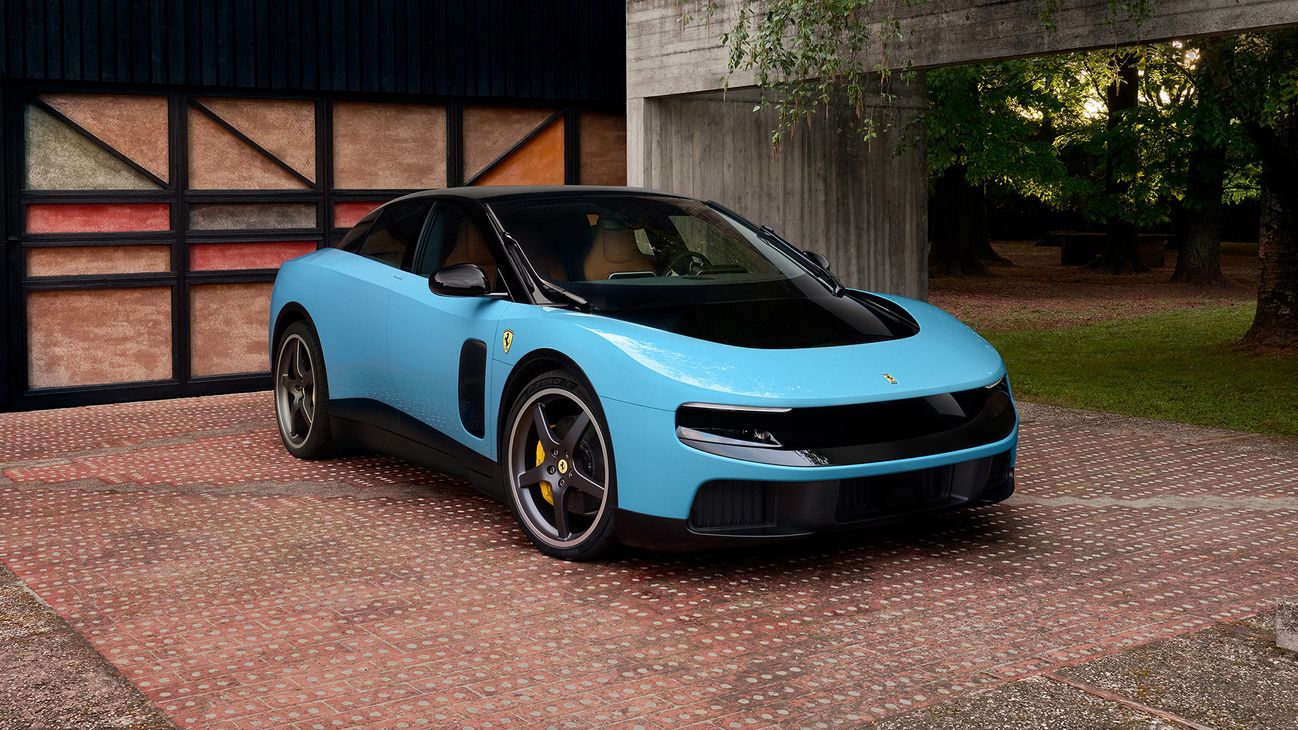
Ferrari Luce
"after he passed away, Ferrari really took a turn in terms of profitability. [484.2s] They are now worth a huge sum of money of eight percent less after the lu Che launch."
The Ferrari Luce is a new Ferrari model the host is talking about. They connect it to Ferrari changing how it makes cars—especially toward electrified powertrains—rather than sticking to the old “pure sports car” approach.
The Ferrari Luce is discussed as a new Ferrari model whose launch is tied to the brand’s recent financial and strategic shift. The host frames it as part of Ferrari’s move toward electrification/hybridization, which is a big departure from Enzo Ferrari’s traditional focus on driver-focused cars.

Porsche Cayenne
"this kind of reminds me of when Porsche released the Cayenne back in two thousand and one or whatever it was. [527.4s] People were up in arms, but it [528.3s] saved the company."
The Porsche Cayenne is Porsche’s SUV. The host brings it up because people criticized it at first, but it ended up helping Porsche financially.
The Porsche Cayenne is Porsche’s SUV that debuted in the early 2000s and is used here as an example of a controversial model that ultimately helped save the company. The host compares Ferrari’s current strategy to Porsche’s earlier pivot into SUVs.
euro admissions laws
"they've gone from this poster boy car company to now the euro admissions laws have kind of forced them to design a car for an EV focused group, which. [560.0s] I don't understand."
“Euro emissions laws” are rules in Europe that limit how much pollution cars can produce. The host thinks these rules are pushing Ferrari to add hybrid/electric tech to meet the limits.
“Euro admissions laws” appears to refer to European emissions regulations that limit pollutants from cars. The host argues these rules pressure Ferrari to electrify/hybridize models to comply, even if Ferrari’s low-volume supercar strategy would otherwise allow more flexibility.
EV focused group
"they've gone from this poster boy car company to now the euro admissions laws have kind of forced them to design a car for an EV focused group, which. [560.0s] I don't understand."
An “EV-focused group” here refers to the regulatory and market push toward electric-vehicle adoption. The host suggests Europe’s rules effectively force Ferrari to design cars for electrification rather than purely for traditional sports-car buyers.
hybridize
"Why do you have to hybridize a fee twelve Ferrari like, it just makes no sense to me at all. [578.6s] I just think that stuff is entirely stupid, and they really should be exempt from it"
Hybridize means the car uses both a gas engine and an electric system. The host thinks regulations are forcing Ferrari to do this, even when they’d rather keep cars more traditional.
To hybridize a car means adding a hybrid powertrain—typically combining an internal-combustion engine with an electric motor and battery. The host criticizes Ferrari for having to hybridize cars due to regulations, arguing it forces changes they don’t agree with.
electric car
"So maybe they will change the way that the driving experience is for an electric car, which which could be a good or bad thing. I don't know, but yeah, look."
An electric car runs on electricity from a battery and electric motors, not a gas engine. The host is asking whether the way it drives will feel different—and whether that difference will be good or bad.
“Electric car” refers to a vehicle powered primarily by one or more electric motors instead of a gasoline engine. The host is specifically wondering whether the driving experience will need to be changed for electric cars, for better or worse.

Rolls Royce spector
"And I don't think they are ever expecting it to be a mass consumer car, which none of these fully electric cars are. You look at the sales that Rolls Royce spector, I mean that, and the resale is horrific, like even worse than a normal Rolls Royce."
They bring up the Rolls-Royce Spectre to make a point about resale value. The idea is that some electric luxury cars don’t hold their value as well as people might hope.
The host mentions the Rolls-Royce Spectre to argue that fully electric luxury cars can struggle with resale value. They claim the Spectre’s resale is “horrific,” even compared with a typical Rolls-Royce, suggesting buyers may not expect strong long-term value.
Audi
"and they said, okay, we're going to have North Audi and South Audi. Really one of those is going to have the rings, the other will just have Audi written."
Audi is a German car brand with the four-ring logo. Here, they’re talking about how Audi is organized in China, with different regional companies using different branding.
Audi is a German automaker known for its quattro all-wheel-drive system and the four-ring logo. In this segment, the hosts discuss how Audi’s China operations are split into different entities (North vs South) for branding and distribution.
joint venture
"prior to a few years ago, every car company that wanted to sell a car in China had to have a JV with a joint venture with a local Chinese car company that would own majority percentage."
A joint venture is when two companies team up to run a business together. The host is saying that in China, car companies used to have to partner with local Chinese companies that controlled most of the decision-making.
A joint venture is a business arrangement where two companies partner to create and run a new operation. The host explains that, historically in China, automakers often had to form joint ventures with local Chinese companies that held majority ownership.

Ford Bronco
"...s are now launching their own cars. It's like the Bronco. For example, Broncho New Energy is produced by a..."
The Ford Bronco is an SUV designed to handle dirt roads and off-road driving. It’s built for people who want a tougher vehicle than a typical family car. It may be mentioned when people talk about new car launches or brand directions.
The Ford Bronco is a rugged, off-road-focused SUV built for driving on rough roads and trails. It often comes up in discussions because it’s a modern take on the classic “go anywhere” SUV formula, with versions aimed at different levels of off-road capability. In a podcast, it’s a natural reference point when talking about how major brands are expanding or launching new vehicles.
ZF transmission
"Even the Ranger that they sell in China has a ZF transmission, which we don't have available here. It's got"
ZF is a company that builds car gearboxes. They’re saying the version sold in China uses a ZF gearbox, while the one sold locally doesn’t.
ZF is a major automotive supplier that makes transmissions (gearboxes) used across many brands and models. Here, the host notes that the Chinese-market version of a Ford Ranger variant uses a ZF transmission that they say isn’t available in their local market.
Beijing motor show
"So yeah, Look, Beijing motors show unreal and I think a lot of people think in the back of their minds that China is like a third world country."
The Beijing Motor Show is a big car event in China where companies show off new cars and tech. The host says it’s proof that China’s car industry has progressed a lot.
The Beijing Motor Show is a major international auto event where automakers display new models and technologies. The host uses it to argue that China’s automotive industry is far more advanced than many people assume.
Beijing motors show
"So yeah, Look, Beijing motors show unreal and I think a lot of people think in the back of their minds that China is like a third world country."
They mention the Beijing car show as a way to make their point about how advanced China is. It’s more about the event than about a specific car part or system.
The host references the Beijing Motor Show as a benchmark for how quickly China’s auto industry is moving. This functions more as a storyline marker than a technical automotive detail.
head on crash test
"Yeah, the crash test was interesting. So they did a head on crash test with a Ti Go nine and a tick Go seven I think."
A head-on crash test evaluates how a car’s front structure manages impact when it hits another vehicle directly. It’s used to judge things like cabin integrity and whether safety systems (like airbags) deploy as intended.
sled
"But then what they did was, as the head on crash test happened, they had a sled, which represents another car, which is I think a fourteen hundred kilo vehicle, crash into the back of one of the cars."
A sled in crash testing is like a moving platform that can hit a car at controlled speeds. It helps engineers study what happens when there’s more than one impact.
In crash testing, a sled is a test platform that can be accelerated to simulate a vehicle impact. Here, the sled is used to strike the back of one car after the initial head-on event, creating a more complex, multi-impact scenario.
air bags
"So what they do this four is to understand whether you can still open doors and wheather air bags go off, what happens. So the door handles, all that sort of stuff."
Airbags are safety cushions that inflate during a crash to help reduce injury. They’re checked in tests to make sure they go off when they should.
Airbags are inflatable safety restraints designed to deploy rapidly during a crash. In this segment, the host is describing how engineers check whether airbags deploy correctly and whether occupants can access the car afterward (e.g., via door handles).
three hundred meter runway
"And yes, this crash facility is enormous. They've got like a three hundred meter runway where the crash happens, so the cars are pulled along on a on like a metal guide."
The runway is the track where the cars are driven so they hit the crash point at a controlled speed. A longer runway helps the test be more repeatable.
A runway in a crash facility is the controlled track length used to accelerate vehicles to a repeatable impact speed. The host highlights that the facility has a very long runway, which helps make crash results more consistent.
metal guide
"They've got like a three hundred meter runway where the crash happens, so the cars are pulled along on a on like a metal guide."
A metal guide is like a rail that keeps the car on the planned path during the test. That makes the crash results easier to compare.
A metal guide is a track or rail system used to keep the test vehicle’s path consistent during acceleration and impact. This reduces variation between runs so engineers can compare results reliably.
crumple zone
"so you can actually do crash tests where one car is going straight and then another car has come in from from the side and. Different different crumple zone of stuff."
A crumple zone is the part of the car that’s designed to crumple in an impact. It helps slow down the crash energy so passengers are less violently jolted.
A crumple zone is the engineered part of a car’s body designed to deform in a crash. That controlled deformation helps absorb energy and reduce the forces transmitted to the occupants.
one hundred and eighty degree
"So you've got not only your your sort of one hundred and eighty degree one, but then they spark off in like forty five degree thirty degree angles"
An “180-degree” crash test angle describes a direct, opposing impact direction (a head-on style geometry). The host contrasts it with smaller angles to show how side and offset impacts change the deformation and safety outcomes.

Prado / Meru
"...t they have. You've got much bigger problems. But Prado sales are down forty five percent, So I don't kno..."
Prado and Meru are Toyota SUV models. The podcast is saying that Prado sales have fallen a lot, which usually means fewer people are buying them. That can happen for reasons like pricing or changes in what buyers want.
“Prado” and “Meru” refer to Toyota SUVs that are commonly discussed in markets where they’re popular, with the podcast noting that Prado sales have dropped significantly. The mention of “much bigger problems” suggests the conversation is about broader market conditions affecting demand rather than a single mechanical issue. In a podcast, these models come up because sales trends can reflect how buyers view value, pricing, and availability.

land Cruiser
"Though we're down. My dad bought a land Cruiser about twelve months ago, decided he fucking is bored of it, put about a thousand kilometers on it, and just put it on the market."
The Toyota Land Cruiser is a tough, off-road SUV that’s built to last. Here, it’s just the car the speaker’s dad bought and then decided he didn’t want anymore.
The Toyota Land Cruiser is a body-on-frame, off-road-focused SUV known for durability and strong resale in many markets. In this segment, it’s the family SUV the speaker’s dad bought and then quickly sold.
phone call
"He's had it on there for one week, hasn't even had a fucking phone call. Oh really. Yeah, that's interesting."
They’re talking about how quickly a used-car listing gets interest. A “phone call” here just means someone contacting the seller to ask about the car.
In the context of selling a used car, a “phone call” is shorthand for a buyer contacting the seller after seeing the listing. It’s not a specialized automotive term, but it’s part of the sales-story context here.
Prado
"It's it was the Prato, so he bought that whenever the Prado came out. Yeah, it's just like, nah, it's too big or I don't know."
The Prado is a Toyota SUV related to the Land Cruiser, but usually aimed more at everyday driving. In the conversation, it’s the earlier Toyota SUV the dad had before moving to something bigger.
The Toyota Land Cruiser Prado is a more road-focused variant of the Land Cruiser line, often chosen for a balance of comfort and off-road ability. The speaker says their dad bought the Prado when it came out, and now he’s comparing it to the larger Land Cruiser.

Tesla Model Y
"Yeah, you're right, actually yeah, so May twenty six Tesla Model why was the best selling car behind in front of Ford Ranger, toy to high Lux and rap four's And that's crazy."
The Tesla Model Y is an electric SUV made by Tesla. The hosts are talking about how it’s been selling extremely well in Australia.
The Tesla Model Y is an all-electric compact SUV that’s been a major volume seller for Tesla. Here, the hosts discuss it being the best-selling car in Australia for a month, behind only specific conventional models.

Ford Ranger
"May twenty six Tesla Model why was the best selling car behind in front of Ford Ranger, toy to high Lux and rap four's And that's crazy."
The Ford Ranger is a pickup truck. The hosts mention it because it’s one of the top-selling vehicles in Australia alongside the Tesla Model Y.
The Ford Ranger is a best-selling pickup truck in many markets, especially popular in Australia. In this segment it’s used as a benchmark in the sales rankings the hosts are comparing against the Tesla Model Y.

Toyota HiLux
"May twenty six Tesla Model why was the best selling car behind in front of Ford Ranger, toy to high Lux and rap four's And that's crazy."
The Toyota HiLux is a popular pickup truck. It’s mentioned here because it’s also selling very well in Australia.
The Toyota HiLux is a long-running pickup truck known for being practical and widely used for work and towing. The hosts reference it in the same Australian sales ranking list as the Tesla Model Y and Ford Ranger.

RAV4
"May twenty six Tesla Model why was the best selling car behind in front of Ford Ranger, toy to high Lux and rap four's And that's crazy."
The Toyota RAV4 is a common, everyday SUV. The hosts mention it because it’s also among the top-selling cars in Australia.
The Toyota RAV4 is a compact SUV and one of Toyota’s biggest mainstream sellers. In this segment, it’s included in the Australia sales ranking comparison against the Tesla Model Y.

Honda Civic
"...ixty five boy boy, it's got the engine out of the civic hybrid. Why do they put a hybrid? Why'd you do th..."
The Honda Civic is a small, everyday car that many people use for commuting. The podcast is pointing out that some versions may use parts from the Civic Hybrid. That means the car can be related to the hybrid system, even if it’s not the same exact model.
The Honda Civic is a compact car that’s widely sold and known for being efficient and practical. The podcast mentions a hybrid connection—specifically that it uses the engine from the Civic Hybrid—highlighting how Honda can share components across different versions. That’s relevant because shared powertrain parts can influence performance, fuel economy, and maintenance planning.
fully electric
"This new one it just looks so [2342.4s] sedate and soft. It's fully electric, and it's more."
“Fully electric” means the car uses only electricity from a battery. It doesn’t have a gas engine, so the car’s layout and driving feel can be different.
“Fully electric” means the car runs only on electricity stored in a battery pack, with no gasoline engine. That changes how power is delivered and how the car is packaged, especially around the drivetrain and interior layout.
aerodynamics
"[2446.8s] I think I think the problem they face is aerodynamics, and they've got to put a cut, like for some reason, when you get an electric motor and something, everything has got to be aerodynamic. And so there there clearly trying [2460.9s] to shape lights and grills and all that sort of stuff around curves and it's a weird."
Aerodynamics is how the car’s shape affects the air flowing around it. If the air doesn’t flow smoothly, the car has to work harder, which can hurt efficiency.
Aerodynamics is how air flows around a car’s body. It matters because it affects drag (how hard the car has to push through air) and can influence efficiency—especially for electric cars where efficiency is a big part of range.
electric motor
"[2446.8s] I think I think the problem they face is aerodynamics, and they've got to put a cut, like for some reason, when you get an electric motor and something, everything has got to be aerodynamic."
An electric motor is what actually moves an electric car. It uses electricity instead of burning fuel, and that can affect how the car is designed to be efficient.
An electric motor is the power unit that converts electrical energy into motion. In an electric vehicle, it changes how engineers think about efficiency and packaging, which can drive design choices like smoother airflow and integrated lighting/grilles.
halo car
"[2490.7s] Audi have brought back the poster car poster a sports car. Actually, [2494.6s] I want to read something I saw on Magnus Walker's insta."
A “halo car” is a company’s dream car that’s meant to make people excited about the brand. It’s usually more about image and inspiration than about being the cheapest or most common car.
A halo car is a brand’s headline vehicle—often a high-profile, aspirational model or concept meant to generate excitement and attention. It’s typically not the highest-volume product, but it sets the tone for what the brand wants to be known for.

Porsche 918
"[2517.9s] It's been a long long time since the [2521.7s] nine to one eight came out in twenty thirteen, and it just can't be fifty seven varieties of a GT three."
The Porsche 918 is referenced as a prior “halo” sports car that came out in 2013. It’s being used as a benchmark for what enthusiasts want next—something more singular and inspiring than a long series of related variants.
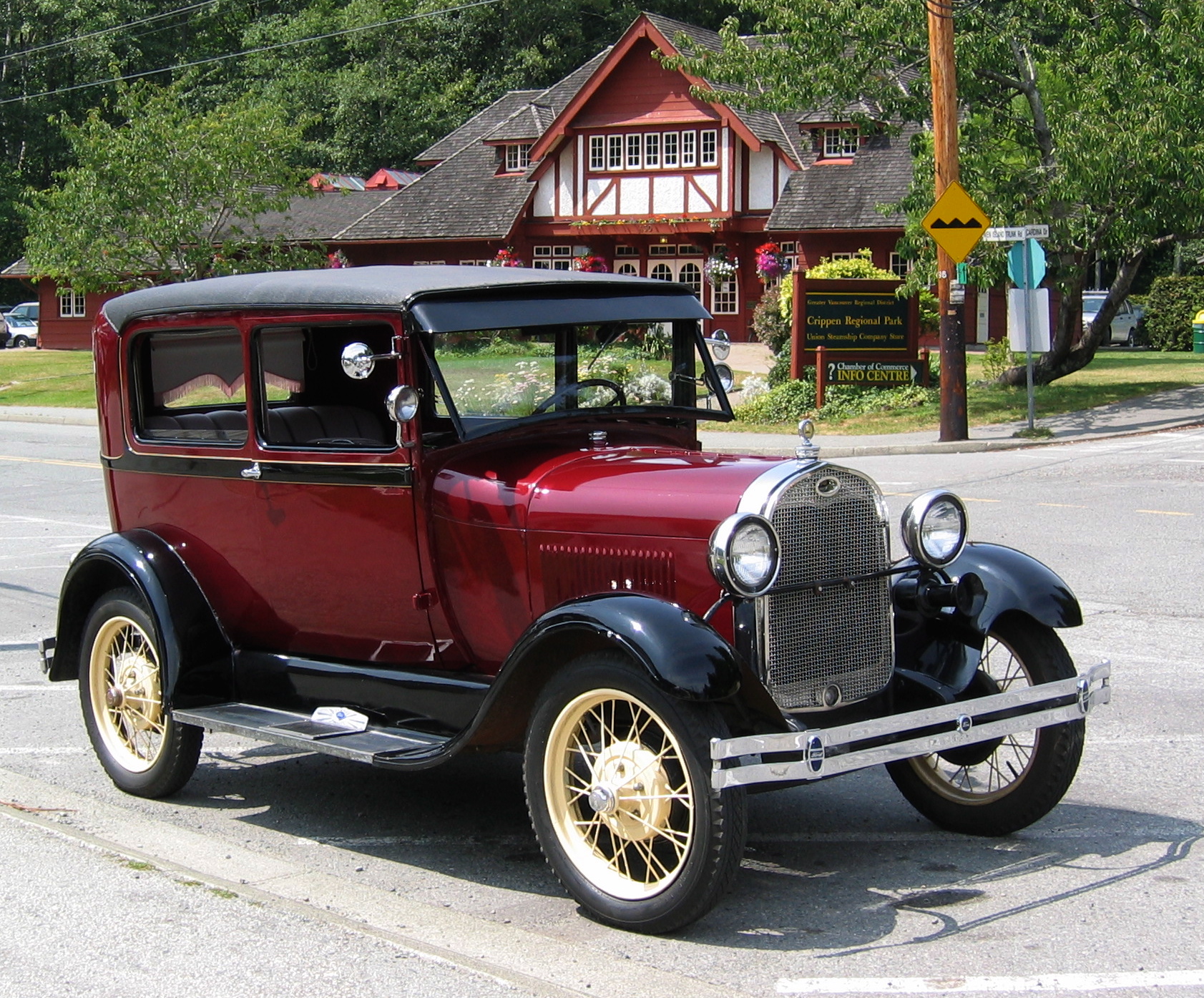
Super Duty
"I just took delivery of my Super Duty. [2586.0s] Oh yeah, I just says new little super geny."
The “Super Duty” is Ford’s big, heavy-duty truck line. People buy it when they need strong towing and hauling capability.
“Super Duty” refers to Ford’s heavy-duty pickup truck line, built for towing and work use. In this segment, the host says they just took delivery of one, implying a new purchase and planned use.

F-150 Raptor
"...is so slow and this is the thing I got out of the Raptor and all this other stuff have been driving recent..."
The Ford F-150 is a large pickup truck with a cargo bed. People often talk about how it drives and how it compares to other trucks they’ve driven. In the podcast, it’s mentioned because the host is describing driving impressions from recent vehicles.
The Ford F-150 is a full-size pickup truck that’s known for being widely used for work and everyday hauling. The podcast context mentions driving an F-150/Raptor-related setup and compares it to other recent driving experiences, which is typical of how people evaluate pickup behavior and performance. It’s discussed because the F-150 line is a major benchmark for how modern trucks drive and feel.
decontented
"As a model gets older, they slowly decontented without anyone knowing. [2756.2s] Yeah, it's crazy."
Decontented means the car gets fewer features over time. It’s like the same model name, but with some extras removed.
Decontented means a manufacturer quietly removes features or equipment from a model as it ages, often without a big announcement. In this segment, the host uses it to describe how later versions of a truck lose items like noise-canceling and convenience features.
active noise cancelation
"So at the end of the last generation of Ranger, they had remove moved stuff like the active noise cancelation. [2764.2s] The other stuff that's disappeared as like cup holders in front of their events."
Active noise cancelation is technology that helps quiet the noise inside the car. It works by creating a counter-sound so certain sounds are less noticeable to you.
Active noise cancelation is a system that uses microphones and speakers (or actuators) to reduce unwanted cabin noise by generating sound waves that cancel it out. When the host says it was removed on later versions of the Ranger, he’s pointing to how equipment can be deleted as models age or specs change.

Falcon XR6
"Well, for me, the Falcon stopped at the XR six. I like that car."
The Ford Falcon XR6 is an Australian Ford model that enthusiasts like for its punchy straight-six engine. People talk about it as a fun, practical performance car.
The Ford Falcon XR6 is a performance-focused variant of the Australian Ford Falcon, best known for its strong straight-six engine character. In enthusiast circles, the XR6 is often discussed as a sweet spot between everyday usability and serious power potential.

Holden SSV Redline
"The SSV Redline I thought was just a manual, perfect way to finish at the W one was I think the pinnacle of Australian cars."
The Holden SSV Redline is a sporty version of the Holden Commodore. The host likes it especially because it’s a manual, which makes it feel more engaging to drive.
The Holden SSV Redline is a performance trim of the Holden Commodore, typically associated with a more aggressive look and a driver-focused setup. The host specifically praises it as a “manual” swan song, which highlights how the car is remembered for its engagement rather than just raw speed.

BMW X3
"that new X three, the new design language coming out of BAH, coming out of BMW, looks pretty fascinating."
The BMW X3 is a luxury SUV that’s meant to feel more fun to drive than a typical family car. Here, the host is talking about the newer version and its fresh styling.
The BMW X3 is a compact luxury SUV known for its balance of everyday usability and sporty driving feel. In this segment, the host is referring to the next-generation X3 and its updated design language coming from BMW.
Request an Explanation
Heard something you'd like explained? We'll add it to this episode.
Sign in to request explanations for terms you heard.
Want to learn more?
Browse our glossary for plain-English explanations of automotive terms, jargon, and concepts.
Help improve this episode
See something that's not quite right? Our annotations are AI-generated and can sometimes miss the mark. Click the flag icon on any annotation to suggest a correction.