
About this episode
Running around with a rebuilt Chevrolet Colorado and waiting on an exhaust kit sets up the year’s build plans, including “that LS swap in the winter” and hopes for Power Tour 2026. Power Tour recap follows—“start in Chicago” down to Tulsa, with “numbers in the vicinity of 8,000 registered.” Then the show dives into conspiracies: moon landing “totally fake,” Area 51 as a spaceship crash vs “Mylar weather balloon,” and even “cash for clunkers” allegedly aimed to keep people from fixing old cars.
Power Tour
"Carmel. Welcome. So as you guys know, power tour sailed through St. Louis, Missouri... I heard numbers in the vicinity of 8,000 registered for power tour this year."
Power Tour is a big car road trip for modified cars. People drive their builds along a planned route and meet up at events along the way.
Power Tour is a long-running hot-rod and muscle-car road trip event where participants drive their cars along a set route, meeting up at stops along the way. The episode frames it as a huge, route-based gathering (with thousands of registered vehicles) rather than a single-day show.
Route 66
"you'll know where that route was following Route 66 from Joliet, Illinois, clear to Tucson... And, you know, get your kicks on Route 66 and 2026."
Route 66 is a legendary U.S. road known for classic road trips. The hosts mention it because the event’s route is tied to that same “drive and explore” spirit.
Route 66 is a famous U.S. highway stretching from Chicago to Los Angeles, and it’s become a cultural symbol of Americana and road trips. In the episode, Power Tour is described as following Route 66-style routing, which is why the hosts keep referencing the “get your kicks” vibe.

Jeep Cherokee
"So when you look at that and you want to go out and say, if I want to buy the equivalent to my 89 Jeep Cherokee today, A, there is no equivalent, but B, in the grand scheme of options and or size of vehicle, let's just use a new Jeep Cherokee today."
The Jeep Cherokee is an SUV model by Jeep. Here, the hosts use it as an example of what it costs to buy a similar vehicle today compared with owning an older one.
The Jeep Cherokee is a compact-to-midsize SUV from Jeep, known for being a mainstream option that also has a long-running enthusiast and off-road following. In this segment, it’s used as the baseline example to compare what “equivalent” new-car pricing looks like in Canada versus older ownership.
heated steering wheel
"Then you start getting the, well, it's nice to have that heated steering wheel. In order to get the heated steering wheel, you got to get this, this, this, and this. So there's 10 grand."
A heated steering wheel is a steering wheel that warms up so your hands feel less cold. In this discussion, it’s mentioned as an example of an add-on feature that can push you into a more expensive package.
A heated steering wheel is a comfort feature that uses an electric heating element inside the steering wheel to warm your hands. The host’s point is that features like this are often bundled behind higher trims or option packages, which can add significant cost.
subscription options
"You haven't even started about subscription options. Yep. Right to repair."
“Subscription options” means some car features may require a recurring payment to use. The idea is that you might pay extra after buying the car just to keep certain features working.
“Subscription options” refers to features that are enabled only after paying an ongoing fee, even if the hardware is already installed in the vehicle. The host frames this as another way manufacturers monetize features after the sale, increasing the total cost of ownership.
Right to repair
"Yep. Right to repair. Talked about this in previous episodes."
Right to repair is the principle that car owners should be able to get their cars fixed by independent mechanics, not only the dealership. It’s about having access to the parts and information needed for repairs.
Right to repair is the idea that vehicle owners and independent repair shops should be able to access the tools, parts, and information needed to fix modern cars. The host connects it to parts availability and to reducing dependence on dealer-only channels.
junkyards
"So again, you get rid of the junkyards for guys like you and me to get those parts that we may not be able to find new anymore. Right."
Here, “junkyards” means places that sell used parts from old cars. The point is that if it’s harder to get those parts, it becomes tougher to keep older vehicles on the road.
In this context, “junkyards” are salvage yards where used parts are recovered from older vehicles. The host argues that policies and parts restrictions can reduce access to these used parts, making it harder to keep older cars running.
older vehicles running
"Then what do we do? We can't keep our older vehicles running. We're forcing our hands to buy something maybe not necessarily brand new, but new ER or tech."
“Keep older vehicles running” means being able to maintain and repair older cars over time. The host is suggesting that it can become harder to do that, which pressures people to buy something newer.
The phrase “keep our older vehicles running” is about maintaining older cars despite parts availability, repair access, and modern restrictions. The host’s underlying claim is that these barriers effectively push owners toward replacing vehicles rather than repairing them.

Ford F150S
"And I'm seeing more and 90s, 80s and 90s, Ford F-150s. I'm seeing XJ Jeep Cherokees."
The Ford F-150 is a popular pickup truck. The host is mentioning it as one of the common older trucks they keep seeing.
The Ford F-150 is a full-size pickup truck that’s been one of the best-known vehicles in the U.S. for decades. The host lists it among the older vehicles they see frequently in major metro areas.

Toyota Land
"...at everyone has a 1990, 96 to 2003 Silver Limited Toyota Land, Toyota 4Runner. I can't tell you how many of the..."
The Toyota Land Cruiser is a large SUV built to handle tough roads and rough terrain. Older versions are popular because they’re known for lasting a long time. People talk about them when they’re discussing classic, dependable SUVs.
The Toyota Land Cruiser is a long-running, body-on-frame SUV known for durability and off-road capability. In older model years (like the 1990s through early 2000s mentioned), it’s often discussed because it can be a rugged, long-lived vehicle that people keep for decades. It comes up in conversations about classic SUV ownership and reliability.

Toyota 4Runner
"There is some sort of group that I'm not a part of that everyone has a 1990, 96 to 2003 Silver Limited Toyota Land, Toyota 4Runner. ... We see Silver 4Runners everywhere and they're the Limited's and they're just perfect."
The Toyota 4Runner is a tough SUV that’s built like a truck. The hosts are talking about how they keep seeing the same kind of 4Runner—especially silver ones—everywhere.
The Toyota 4Runner is a body-on-frame SUV known for rugged, truck-like durability and off-road capability. In this segment, the host focuses on a very common look: silver 4Runners, especially the Limited trim, which they see repeatedly around their area and at an event.

Jeep Grand Cherokee
"... show recently and there's going to be an 80s era grand Cherokee that someone has and that's their mountain cabin ..."
The Jeep Grand Cherokee is an SUV made for both regular driving and rougher conditions. Older ones can be kept running for years and used for trips and outdoor living. That’s why it comes up in stories about using a vehicle like a cabin or base.
The Jeep Grand Cherokee is a mid-size SUV that’s been offered in many trims and powertrains over the years. The podcast context suggests an older, 1980s-era example being used as a “mountain cabin” vehicle, which highlights how these SUVs can be kept and repurposed for lifestyle use. It’s often discussed because it blends everyday usability with off-road-friendly roots.

Dodge Intrepid
"When was the last time you saw an Intrepid? [1674.9s] Oh, it's been a bit. [1677.1s] I have seen one."
The Dodge Intrepid is a sedan that was around a lot in the 1990s. The speaker is basically saying they don’t see them anymore.
The Dodge Intrepid is a mid-size sedan from Chrysler’s brand lineup (under Dodge) that was popular in the 1990s. The host mentions not seeing one recently, using it as a cue to talk about how certain models disappeared from the road.

Chrysler Concorde
"In 1993, my parents bought a brand new Concorde. [1692.7s] It was top of the line. [1694.7s] LXI had."
The Chrysler Concorde is a family sedan made by Chrysler. The host is talking about a version from the early 1990s that had a very unusual layout, which made it feel futuristic.
The Chrysler Concorde is a full-size-ish family sedan from Chrysler’s lineup that became known for its late-80s/early-90s “cab forward” packaging. In this segment, the host ties it to Chrysler’s design shift that moved the engine placement and made the car feel unusually “space-age.”
cab forward design
"Yeah, well, look, that was when Chrysler was coming out with cab forward design. [1703.3s] Oh, sure, put the engine under the dashboard."
“Cab forward” means the car’s cabin is moved forward in the body, and the engine ends up placed differently than usual. It’s done to make the car feel roomier and more modern, but it can also make maintenance a little different.
“Cab forward design” is an automotive packaging approach where the cabin is pushed forward and the engine is moved rearward compared with older layouts. That can improve interior space and visibility, but it also changes how the engine bay is accessed and serviced.
transmission
"And the transmission fell out after 2000. Well, they were they were made of ceramic. I didn't know if you knew that or not. That was a transmission."
The transmission is the car’s gear box. It helps the engine turn the wheels in the right gear for slow driving, fast driving, and cruising.
A transmission is the gearbox that changes engine speed and torque so the car can accelerate smoothly and cruise efficiently. When someone says a transmission “fell out,” they mean the gearbox assembly came loose or was removed during a repair.
LX platform
"I think that was is it LX platform or something that's called or whatever? I think that's what it is. And we had to explain those."
A platform is the basic “skeleton” a car is built on. If multiple cars share the same platform, they can be similar underneath even if they look different.
“LX platform” refers to a shared vehicle architecture used across multiple Dodge models, including the Dodge Neon. A platform typically covers major hard points like the chassis layout and mounting locations, so cars built on the same platform can share engineering and production efficiencies.

Dodge Neon
"...had to explain those. We had to explain the Dodge Neons. We had to explain all of that stuff to customers..."
The Dodge Neon is a small, compact car. The podcast mentions it because the speaker had to explain it to customers, likely meaning people needed help understanding what it was. It’s brought up as a common model people ask about.
The Dodge Neon is a compact car that was widely sold and commonly encountered on the road. The podcast context suggests the speaker had to explain “Dodge Neons” to customers, which points to it being a recognizable model in their work or sales environment. It’s discussed as part of understanding what certain cars are and how they fit customer needs.
alignment
"Ask any alignment technician what the worst car ever to do an alignment was. [1843.1s] He's going to tell you those LX cars."
Alignment is when a shop adjusts the wheels so they’re pointed the right way. It helps tires wear evenly and keeps the car tracking straight.
An alignment is the process of adjusting a car’s suspension angles—like camber and toe—so the tires contact the road correctly. If it’s done wrong or the car’s geometry is problematic, you can get rapid tire wear and poor handling.
rack
"[1846.5s] Trepid Concorde LHS. [1848.2s] Why? [1848.6s] Because the rack opinion was on top of the transmission."
The “rack” is part of the steering system that helps turn the wheels when you turn the steering wheel. If it’s in a tough spot, it can make alignment jobs harder.
In steering systems, the “rack” usually refers to the steering rack, which converts the steering wheel’s rotation into left/right wheel movement. This segment says the rack was positioned in a way that made alignment work especially difficult.

Saturn
"First generation Saturn's in my humble opinion, as a used car salesman for the past 20 years, almost first generation Saturn's were some of the best cars domestically built in our generation."
Saturn was a car brand that used to be part of General Motors. The speaker is saying the early Saturn models were really good cars, and they wanted to buy one.
Saturn was a GM brand known for making cars with a reputation for being straightforward, practical, and (in the early years) relatively good value. In this segment, the host specifically calls out the first-generation Saturns as some of the best domestically built cars of their era.
planned obsolescence
"That's why there's that's why there's salvage yards and they don't keep any cars and they haven't since they were new. They don't keep any cars past 1995."
Planned obsolescence is the belief that companies intentionally make things stop working or feel “outdated” sooner than they should. The host is saying that’s why cars might not last or be kept for a long time.
Planned obsolescence is the idea that products are designed to wear out or become outdated on purpose so you have to replace them. The host compares it to how refrigerators are treated, arguing the same logic applies to cars—leading to fewer cars being kept long-term and more ending up in salvage yards.
salvage yards
"That's why there's that's why there's salvage yards and they don't keep any cars and they haven't since they were new."
A salvage yard is where old or damaged cars are taken apart so parts can be reused. The speaker is saying that many cars end up there instead of being kept for years.
A salvage yard is a place where wrecked or retired vehicles are stored and dismantled for parts. The host uses it as evidence in the planned-obsolescence argument, claiming cars aren’t kept long enough to avoid ending up there.
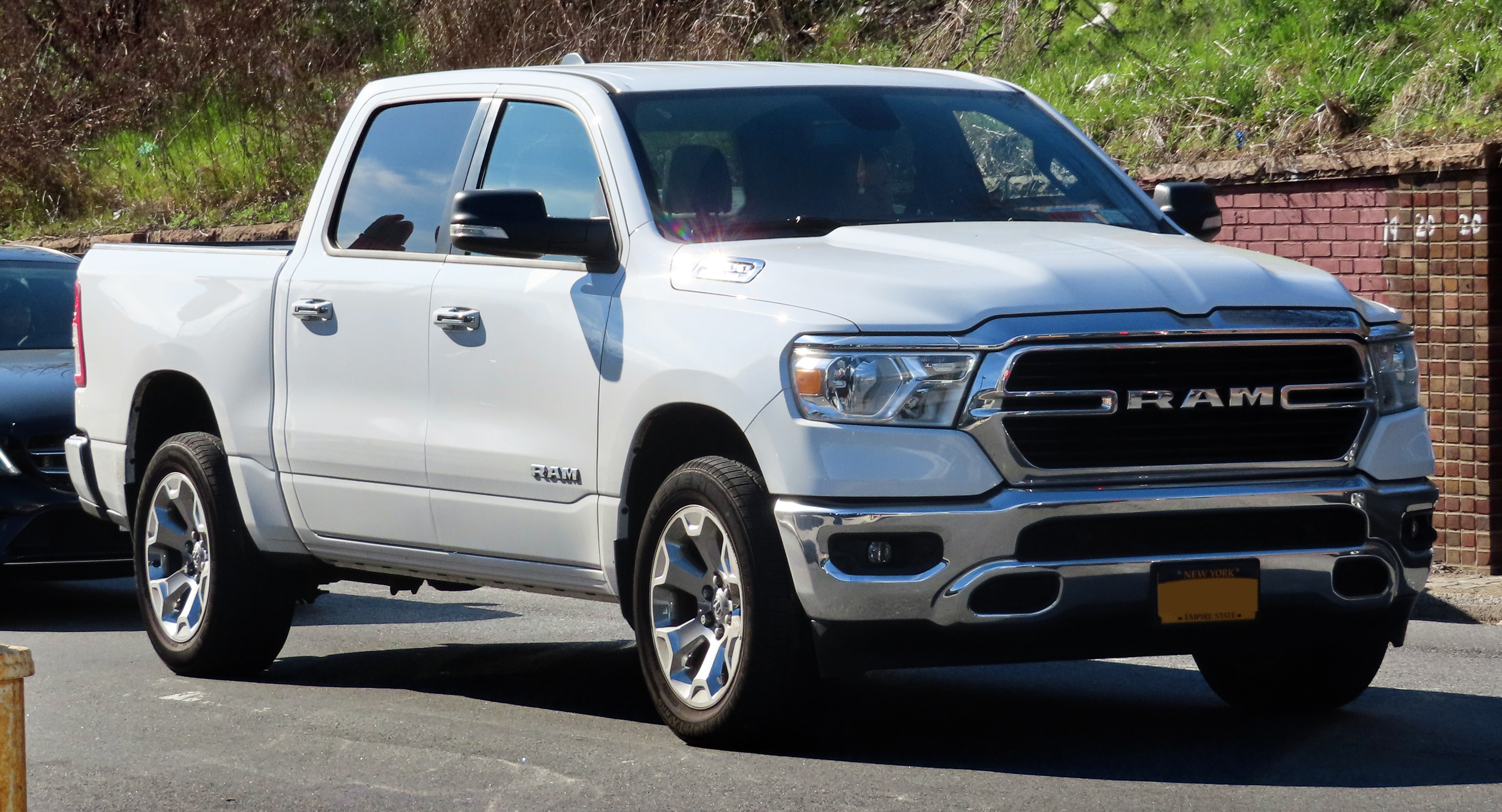
2015 Ram 1500
"Let's say you're driving a 2015 Ram 1500. Just a standard pickup truck."
A Ram 1500 is a full-size pickup truck. Here, the hosts use a 2015 example to talk about how an engine problem could get expensive over time.
The Ram 1500 is a full-size pickup truck, and the 2015 model is part of Ram’s modern half-ton lineup. In this segment, it’s used as the example vehicle for a hypothetical engine-cost scenario tied to “multi-cylinder displacement.”
multi-cylinder displacement
"And because of the multi-cylinder displacement debacle, again, conspiracy fuel savings, we're going to make your engine less reliable..."
Multi-cylinder displacement is when a car temporarily turns off some cylinders to save fuel. When you need power again, it turns them back on.
Multi-cylinder displacement is a system where an engine can shut down some cylinders under light load to improve fuel economy, then restart them when more power is needed. The hosts frame it as a “debacle” and connect it to reliability concerns in the example scenario.
gas guzzler tax
"Oh, shops nowadays are charging 80 to 100 bucks an hour. Want you to fix it in your trucks? Especially the gas guzzlers. Gas guzzler tax, conspiracy."
The “gas guzzler tax” is a U.S. federal tax applied to vehicles that don’t meet certain fuel-economy thresholds. It’s typically aimed at discouraging the least efficient cars, and the hosts mention it as part of their broader “conspiracy” framing.
OnStar
"whatever it was, I don't remember. Do you remember when OnStar came? They were pretty much standard on anything in 2000 when I was selling new cars, so I think it was within 53 to five years before that probably."
OnStar is a service built into many GM cars that can use GPS and a phone connection to find the car. It can help with things like locating a stolen vehicle, even though it usually can’t “take over” driving.
OnStar is GM’s connected-vehicle service that uses cellular/GPS to provide features like automatic crash response and remote vehicle tracking. In the episode, it’s discussed as a way authorities or the service can locate a stolen car, even if they can’t directly stop it.
buy here, pay here
"My right foot, they certainly had the ability maybe not to stop the car, but they knew where on our tiny planet that thing was at any given time. It's no different than the buy here, pay here, billy bob lot trackers that you can put on a car."
“Buy here, pay here” is when a car lot sells you the car and also handles the financing. Some lots add GPS tracking so they can find the car if the buyer stops paying.
“Buy here, pay here” (often shortened to BHPH) is a used-car financing model where the dealer both sells the car and finances the payments. Because many buyers have limited credit, these lots often use additional tools like GPS trackers to improve recovery if payments stop.
steering box
"People started talking to me about steering box is not connected to the steering wheel like an airplane. The stick is not connected directly through the wings. It's fly by wire and all that."
A steering box is the mechanical component that converts the steering wheel’s rotation into movement that turns the wheels (common in older steering systems). The host contrasts it with steer-by-wire ideas, arguing that the steering wheel may not be mechanically connected to the steering box.
fly by wire
"People started talking to me about steering box is not connected to the steering wheel like an airplane. The stick is not connected directly through the wings. It's fly by wire and all that."
“Fly by wire” means the controls talk to computers with signals instead of moving parts directly. In cars, the idea is similar: sensors and computers can influence steering rather than a purely mechanical connection.
“Fly by wire” is a control method where commands are sent electronically rather than through direct mechanical linkages. The host uses it as an analogy for modern steering systems where sensors and computers mediate control.

Tesla Cybertruck
"...ctions, one of the biggest conversations with the Cybertruck when it first came out because it is steer by wir..."
The Tesla Cybertruck is an electric pickup truck, meaning it runs on electricity instead of gasoline. It’s known for a very distinctive shape and for using electronic systems for steering rather than traditional mechanical parts. That’s why people often bring it up when discussing new vehicle technology.
The Tesla Cybertruck is an electric pickup truck known for its unusual angular design and all-electric powertrain. It was widely discussed when it first came out, including conversations about its steering-by-wire system. That makes it a frequent topic when people talk about how new technology changes vehicle feel and maintenance considerations.
steer by wire
"Well, and I think that was one of the biggest contradictions, not contradictions, one of the biggest conversations with the Cybertruck when it first came out because it is steer by wire. Right. It's not directly connected to the steering box."
Steer-by-wire means turning the steering wheel sends electronic signals instead of directly moving the steering parts mechanically. The computer then controls how the car steers.
Steer-by-wire replaces the mechanical connection between the steering wheel and the steering mechanism with electronic signals. The episode ties this to the Cybertruck’s design, arguing that modern cars can be controlled electronically rather than purely through a direct mechanical linkage.
kill switch
"if you've got somebody who's done a heinous act of maybe they murdered somebody or shot up a crowd of people or whatever they've taken off in a car that's modern enough to have a kill switch on it, do I think that the opportunity is there to stop that person from being more destructive?"
A “kill switch” here means a feature that can shut down or disable the car. The discussion is about whether modern cars could be stopped remotely if someone is driving dangerously.
A “kill switch” in a vehicle context refers to a system intended to disable or prevent operation of the car, typically for safety or security. The host connects it to the idea that connected/modern cars might be remotely disabled to stop a dangerous driver.
22-inch wheels
"“The baddest thing about that was the Black Lincoln Town Cars on, you know, 22-inch wheels.”"
“22-inch wheels” means the rims are 22 inches across. Bigger rims usually go with thinner tires, which can look cool but may feel a bit harsher over bumps.
“22-inch wheels” refers to the wheel diameter, which is a common upgrade for looks. Larger wheels can change ride comfort and tire sidewall height, and they’re often paired with lower-profile tires.

Black Lincoln Town Cars
"“The baddest thing about that was the Black Lincoln Town Cars on, you know, 22-inch wheels.”"
A Lincoln Town Car is a large, old-school luxury sedan. In this episode, the host is talking about the black Town Cars shown in the movie and saying they looked awesome.
The Lincoln Town Car is a full-size luxury sedan from Lincoln, known for its long-wheelbase comfort and classic American styling. Here, the host specifically calls out the “Black Lincoln Town Cars” from the movie “In Time,” emphasizing the look and vibe of those cars.
automotive industry
"“But if anything, I hope that we opened up some people's eyes to what's going on in the automotive industry.”"
They talk about the car industry and how they want to help keep the car hobby going. The idea is to make sure future generations still have a way to enjoy cars.
The hosts shift into a discussion about the automotive industry and how their platform is meant to advocate for enthusiasts. The segment frames their goal as keeping the hobby alive for future generations.

07 Crown Vic
"“The newest vehicle in my fleet right now is an 07 Crown Vic. That's my wife, my wife's daily driver. She absolutely loves it.”"
A “Crown Vic” is a big Ford sedan that’s known for being tough and comfortable, especially as a police car. Here, the host is saying their 2007 model is their wife’s daily driver and they think it’s the better choice versus a newer, smaller SUV.
The Ford Crown Victoria (often called the “Crown Vic”) is a full-size, body-on-frame sedan that became famous in North America for police and fleet use. In this episode, the host highlights it as a newer-in-the-fleet choice and argues it’s a better daily-driver option than a small crossover.

2018 Jeep Compass
"“I tried to get her into a 2018 Jeep Compass. Some people are going to laugh at me…”"
The Jeep Compass is a smaller SUV/crossover meant for daily driving. The host tried to convince their wife to switch to a 2018 Compass, but they ended up preferring the Crown Vic.
The Jeep Compass is a compact crossover SUV, and the 2018 model is part of the Compass lineup aimed at everyday commuting and easier parking than larger vehicles. In the segment, it’s mentioned as an alternative the host tried to get their wife into, but they ultimately prefer the Ford Crown Vic instead.

Toyota Crown
"...that's a good deal or that's not a good deal. The Crown Vic is a better vehicle. She drove it for three w..."
The Toyota Crown is a sedan, meaning it’s a car with a traditional trunk and passenger-focused comfort. In the podcast, it’s brought up while talking about whether a certain car is a good buy. The main point is comparing value and what you get for the money.
The Toyota Crown is a long-running sedan line known for comfort and a more upscale feel compared with many mainstream sedans. In the podcast, it’s mentioned in the context of comparing deals and vehicle choices, with the Crown being part of the discussion about what makes a “good deal” versus alternatives. That’s why it shows up—people are weighing practicality and value.

Chevrolet Suburban
"...wn Vic. I have a 95 Chev 3.25-ton truck, okay. 90 suburban, 79 Cordoba, 62 international. I love this older ..."
The Chevrolet Suburban is a large SUV that can carry lots of people and gear. Older models are popular because they’re roomy and can last a long time. That’s why someone might mention a 1990 Suburban as part of their older-vehicle collection.
The Chevrolet Suburban is a full-size SUV built for hauling people and cargo, with a long history of being used as a family and utility vehicle. The podcast mentions a “90 suburban,” which fits the Suburban’s reputation for being kept long-term and used as an everyday classic. It’s commonly discussed because it’s practical, spacious, and durable when maintained.

Seat Cordoba
"...e a 95 Chev 3.25-ton truck, okay. 90 suburban, 79 Cordoba, 62 international. I love this older stuff. Why? ..."
The Seat Cordoba is a small car meant for everyday driving. The podcast brings it up because the speaker likes older vehicles and is listing examples they own or admire. It’s included as part of that “older stuff” conversation.
The Seat Cordoba is a compact car from Seat, typically known for being a practical, everyday vehicle. In the podcast, it’s mentioned alongside other older vehicles the speaker likes, which suggests it’s part of a personal collection or interest in classic cars. It comes up as an example of older, simpler transportation choices.
Request an Explanation
Heard something you'd like explained? We'll add it to this episode.
Sign in to request explanations for terms you heard.
Want to learn more?
Browse our glossary for plain-English explanations of automotive terms, jargon, and concepts.
Help improve this episode
See something that's not quite right? Our annotations are AI-generated and can sometimes miss the mark. Click the flag icon on any annotation to suggest a correction.