A naturally aspirated engine doesn’t use a turbo or supercharger to force air in. It makes power by drawing air in normally, so the response can feel more immediate.
“GT” is Porsche’s label for their more performance-focused cars. They’re set up to feel more like a track car—tighter handling and more aggressive tuning than a regular model.
GT2 is a higher-performance GT racing class than GT3 in many rule sets, typically with fewer restrictions and more emphasis on outright speed. Porsche’s GT2 models are built around that idea of maximum performance for the class.
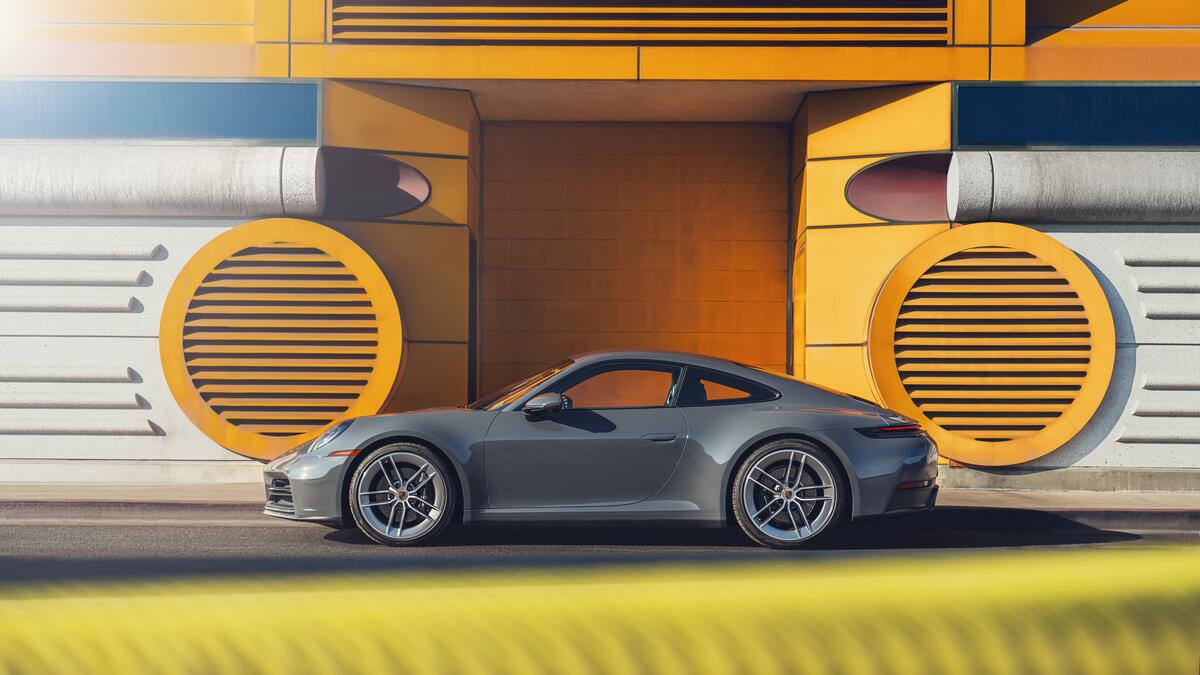
The Porsche 911 is Porsche’s famous sports car. In the podcast, it’s mentioned as a key part of Porsche’s future performance plans. It’s basically the model people think of when talking about Porsche’s track and driving excitement.
The Dodge Ram is a big pickup truck. It’s often chosen for towing and carrying stuff, and in this case the speaker says theirs is a 2017 with a long bed and a stronger engine.
“Hemi” is a nickname for a specific kind of engine design that Chrysler used. “Souped up” means it’s been upgraded or tuned to feel stronger than a standard version.
Headers are parts that route exhaust gases out of the engine. “Long tube” headers are a performance style that can help the engine breathe better and make more power.
The Porsche Cayenne is Porsche’s SUV. Here, they’re talking about a small sound system on the car that makes noise so it’s not completely silent at low speeds.
This is the Porsche 911 GT3 from the 991 generation’s updated version (“.2”). They mention it because they’ve driven multiple GT3 generations and are comparing how each one evolved.
PDK is Porsche’s dual-clutch automatic transmission. It shifts quickly by preparing the next gear in advance, so the car feels more responsive than a normal automatic.
This is a Porsche 911 GT3 RS from the 997 era. They’re saying it’s one of their favorite track-focused Porsches ever, which sets the bar for what they think the newer GT3 should match.
Anti-dive technology is a suspension design feature intended to reduce the car’s tendency to pitch forward under braking. It typically uses geometry and/or hydraulics to limit front-end compression so braking feels more stable and predictable.
Torque is the “pull” the engine has—how strongly it can twist the drivetrain. More torque usually means the car feels quicker when you start moving or accelerate out of corners.
Emission regulations are government rules that limit pollutants like NOx and hydrocarbons from the exhaust. They can force engine calibration changes (and sometimes hardware changes) that reduce output or change how power is delivered.
The final gear ratio is like the car’s “overall gearing.” It changes how hard the car pulls and how fast it reaches higher speeds for a given engine speed.
This is about making sure all the car’s systems “work together” smoothly. If the engine, gearing, and handling aren’t coordinated well, the car can feel no better—or even worse—than the previous version.
The Pareto principle (often phrased as the “80/20 rule”) is the idea that a small portion of causes can produce a large portion of results. In tuning, it suggests that a lot of effort may be required to chase the remaining small percentage of improvement after the big gains are already achieved.
Topic
Angelus Grouse
They’re talking about a particular place/route they drove to test the cars. It’s basically where they went to feel the difference between the two 911 generations.
This means shifting the car’s weight toward the front wheels, usually by braking. When the front wheels carry more weight, they grip the road better and the car turns more easily.
This is a rule of thumb that says most results come from a small amount of effort. After that, squeezing out the final improvements takes a lot more work than you’d expect.
Emission laws are rules about how much pollution a car is allowed to produce. If the rules get stricter, car makers often have to redesign engines to meet them.
Engine linearity describes how predictably engine output changes with throttle input—how smoothly and consistently the car responds as you press the pedal. The speaker is saying NA engines tend to deliver that kind of straightforward, controllable response.
Countermeasures here means “ways to deal with the problem.” If the car gets heavier and you can’t add more power, you have to find other engineering fixes to keep it fast.
Term
performance will be gone
He’s saying that if the car gets heavier, it can feel less quick and less responsive. Without enough power to compensate, the driving performance suffers.
Euro 7 refers to upcoming/tightened European vehicle emissions regulations that further limit exhaust pollutants. The speaker uses it as a constraint on how much power an NA engine can produce while still passing emissions requirements.
Concept
NA engines
NA means naturally aspirated—no turbo or supercharger. The speaker is discussing whether naturally aspirated engines can still make the power people want under modern rules.
Emission legislation is the set of rules that limits how much pollution cars are allowed to produce. Those rules can make it harder for engines to make as much power as before.
Engine displacement is basically the engine’s size, measured in liters. The speaker is saying that around four liters makes it easier to get strong power and torque.
EPA stands for the U.S. Environmental Protection Agency, which sets and enforces emissions standards. The host is joking that they “discovered” the EPA, implying U.S. emissions rules constrain what power levels are feasible.
When a car starts after sitting, it runs differently than when it’s warm. Emission rules for that moment are stricter because the engine can’t clean up exhaust as well until it heats up.
The bore is basically the inside diameter of the engine’s cylinder. If you change it, the engine’s shape changes, and that can affect how well fuel burns and what comes out of the exhaust.
Piston diameter is the size of the piston that fits in the cylinder. If you make it bigger, the engine’s shape changes and that can affect how cleanly it burns fuel.
Pre-chamber ignition is a spark system that starts combustion in a small “mini” chamber first. That makes it easier to get the main fuel-air mix burning correctly, especially when the engine is cold or operating under tough rules.
It’s a saying that means “the underdog can still win.” Here, it’s pointing out that you don’t always need the most power to be fast—how the whole car works matters.
Brand
American makers
This just means U.S. car companies. In the discussion, they’re described as trying to win by using bigger engines and more power.
It means the car’s different controls have to work together smoothly. If the engine, tires, and stability/traction systems don’t coordinate well, the car can feel slower or less predictable even if it has power.
Suspension is what connects the wheels to the car and helps the tires stay planted. A good suspension setup helps the car grip the road and turn more confidently.
Engine management is the car’s computer controlling how the engine runs. It adjusts things like fuel and timing so the engine makes power smoothly and doesn’t waste grip.
Steering feel is how “communicative” the steering is—how much feedback you get about what the tires are doing. When it feels right, it’s easier to drive precisely.
Concept
interfaces between man and machine
It means how the driver and the car “talk” to each other. If the car responds in a predictable, easy-to-understand way, the driver can push harder with more confidence.
They’re saying that more engine power usually helps you go faster on straightaways. But it only works if the car can actually use the power—tires need grip and the car has to fight air resistance.
Gearing is how the car’s transmission multiplies the engine’s effort to the wheels. The goal is to keep the engine in the sweet spot so the car accelerates efficiently.
Referring to “rev up to 9,000” means the engine can spin to high RPM. High-revving engines often use cam timing and intake/exhaust tuning to make power at those speeds, which matters for track acceleration and responsiveness.
The power band is the range of engine speeds where the car feels strong. A wide one means you don’t have to be perfectly in the right RPM to get good acceleration.
Wheelspin is when the tires spin but the car doesn’t accelerate as much as you’d expect. It usually happens when the road is slippery or the power is too much for the grip.
They’re comparing the Porsche GT3 to a very powerful Corvette. The message is that with enough grip and traction control, a big-power car can still put power down effectively.
Corner speed is your speed while going through the turn. Going faster usually makes you quicker on a lap, but only if the tires and the car’s balance can handle it.
The Nürburgring is a famous race track in Germany. A “lap time” is just how long it takes the car to go around the track once, and faster times usually mean the car is quicker on a track.
Ford’s Mustang GTD is a special, very fast Mustang built for track performance. They’re talking about how quickly it can lap the Nürburgring and roughly how much horsepower it makes.
The Corvette 01X is a special prototype Corvette used to test and prove performance. They’re using its Nürburgring lap results as a comparison point versus the Mustang GTD.
The Golf is a compact car model that comes in different versions. The podcast mentions GTD versions, which are performance-leaning trims. It also notes that there can be more than one GTD type, including a competition-focused version.
They’re talking about racing at the Nürburgring and why you can’t always compare lap times directly. Different types of cars race in different categories, so the rules and performance potential aren’t the same.
They mention the Ford GTD as another car that runs in a different category at the Nürburgring. The takeaway is that it’s not directly comparable to the Porsche GT3 RS because the rules and allowed equipment differ.
“Off-the-shelf” means the car or parts are basically standard, store-bought items—not one-off custom race gear. The speaker is saying the GT3 RS starts from what customers can get.
Tow-in is an alignment adjustment that changes how the tires point relative to each other. It can make the car feel more stable and change how the steering responds.
Pedestrian safety standards are laws meant to protect people outside the car during accidents. The speaker is saying those rules can restrict design choices, which affects whether a car can be legally driven on public roads.
Aero parts are the car’s aerodynamic pieces, like wings and spoilers. They help the car grip the road at speed, but they can also be restricted by rules.
They’re talking about a Ford Mustang. The point is that they’re judging the car by how fast it is on track first, before locking in the engine’s power number.
Lap time is how long it takes to do one full lap on the track. They’re saying they look at lap times first to understand what the car needs, rather than just chasing a power number.
Turbochargers are parts that help an engine make more power. They squeeze more air into the engine, so it can burn more fuel and feel stronger—especially when you accelerate.
Term
power drive
“Power drive” here just means the car’s ability to put power down and feel strong when you accelerate. The speaker is saying the next cars should keep that kind of driving character.
Carbon fiber is a very light, strong material used to make parts of a car. People use it on performance cars to help reduce weight and make the car feel more responsive.
A “locked” differential helps both drive wheels work together instead of letting one spin when traction is poor. That can improve grip when you’re accelerating out of a turn.
Term
deployed technologies
“Deployed technologies” here means technologies that are actually implemented and used in the car’s systems—not just theoretical or marketing claims. The speaker is saying the newer GT3 RS uses more advanced real-world tech than the previous one.
Emissions refers to the legal limits on what a vehicle can release from its exhaust and how manufacturers must design engines and systems to meet those rules. As emissions regulations tighten, it becomes harder to extract big performance gains from naturally aspirated engines without changing the powertrain approach.
The powertrain is the set of components that create and deliver power to the wheels—typically the engine, transmission, driveshafts, and related driveline parts. The speaker is saying they focused improvements on other areas of the car rather than changing the powertrain.
Aerodynamics is about how the car moves through air. The shape can create extra grip by pushing the car down, and it can also reduce air resistance so the car can go faster.
Active aerodynamics means the car can change its aerodynamic “shape” while driving. That helps it create grip when you need it and reduce resistance when you’re going fast in a straight line.
LIVE
Hi there and welcome to the inevitable.
This is Motor Trends podcast, our podcast about the future of the car, the future of
mobility and on a very, very special episode, the future of high strung naturally aspirated
Porsches because we've got such a special guest today.
I'm so geek for this one.
I'm going to let Ed pronounce his name.
I just call him Andy, but Ed, who do we got on the program today?
Well, if I tell you that, you got to know that this podcast, our podcast is not sponsored
by anybody.
So hurry up and get on it.
Come on, guys.
Come on, guys.
Edward.loh at Hearst.com.
Just slide into my DMs.
Slide into our DMs.
With your credit card.
With your credit card.
We need sponsorship.
We don't need it.
We still do it.
We like it.
We like it.
But yes, our guest today, very special, Andreas Poininger, he is the director of GT Model
Line for Porsche.
You can say he's basically the head of all the GT models, which are basically the motorsports
homologated versions of the 911 and occasionally a Cayman or a 718.
What this means is like GT3, GT3 RS, GT4, GT4 RS, GT2, Speedsters, STs, all the stuff
we drool over, all the really the best driving porches, which makes them some of the very
best driving cars on planet Earth.
He's had his hand in every single one except for the very first GT3.
He started after the 99.
He was actually at the company then, but he just wasn't in that division.
Or he wasn't the head of GT, but yeah, he wasn't working on it.
So the 996.1 GT3, he did not do, but he did do the .2 and then the first GT3 RS in every
subsequent car.
20-something years at Porsche, 26 cars, 26 vehicles to his name and as you'll hear him
say every single one, a raging success, he doesn't say it like that.
But yeah, we went along with this one.
It's all about the future of GT models, the specific, very special one they're announcing.
They've just announced and they're showing this weekend as well as what he's going to
do with that vehicle.
And of course we talk about the future of Porsche, future of Porsche GT cars and all
the fun stuff he's driven.
And most importantly about how I'm going to go driving with him tomorrow and this guy
isn't.
So without any further ado.
Here's Andy P.
All right, so I think the most important thing to know about you, Andy, is what do you daily
drive?
Daily.
Yeah.
That depends on which situation my projects are in because I have to take some development
cars home.
But by your personal car.
My personal car is my car that I'm lucky to have because the company is giving it to
me is a Cayenne, a Cayenne V6S and Cayenne S hybrid.
In silver and it's a great family mover and I love Cayenne's.
I'm searching for another car though.
Another car.
My private garage consists of a 993 convertible.
An American car.
An American car.
As a Dodge Ram.
That's the one.
The 2017 Ram with a long bed and it's souped up hemi.
I love it to bits and I towed my motorbikes around my dirt bikes and mountain bikes and
all kind of stuff that the that the garden brings out every August.
So I'd rather have a truck than a trailer.
How did you get that?
The Ram.
How did you get a Ram?
Can you buy it?
Yeah, I mean there are some that special model was imported from the states and I think
there are three of those in Germany only because it's the long bed in the three-seater
so it's not the crew cab or extended whatever cab so it's and it really looks looks very
rad because it's white but it has the silver stripes on top and got big 22 inch wheels
on it.
Original Dodge from the SRT and some TRX stuff on it so it's a great exhaust and a little
bit of long tube headers and all that stuff so I just always got to kick out of the father
of the GT3.
I mean my love for V8s goes back a long time and my boat is one of my most appreciated
material thing that I have on earth it has a V8 as well a nine-liter mercury racing engine
and a lot of two bits.
I love this.
What boat is it?
It's an offshore boat, a 29 foot offshore boat with a 600 horsepower normally aspirated
race engine and big tube headers and open exhaust.
Okay, you're a genius Johnny because this opening this is what keeps the normal motor
to an audience which is like stop talking about your EV cars or whatever.
I don't have an EV car so we can't talk about those trucks.
Yeah, well he's driven my truck, he's driven my rivies and in fact, oh my god, total blank
father of the GTR, the current guy, the Tamora son.
He drove it too so I've had the father of the GT3 and the father of the GTR.
I liked it, I remember that, we were driving after we came back from Renault and we took
a little tour in the Caribbean and I was really curious because their approach to EVs incorporating
this truck idea was for me very interesting and I was dying to drive and what I can remember
is that that thing didn't have car play and that pushed me off somehow because this is
one of the most important things in the car nowadays for me.
Yeah, I mean it's fine, I don't miss it at all but it still doesn't have car play.
But I remember what you said was interesting because it doesn't have any fake sounds, it
has four motors and you just hear that and you said like, oh I wish we'd do that.
Really?
I hope I don't get you in trouble.
Did I?
Well, I mean this is down to personal taste, I would say.
I personally, I don't dislike EVs but I dislike fake noises.
Yeah, same.
And even on my Cayenne, I mean I think it's necessary that there's a legislation that
says that you can't be completely without any noise so there's this little loudspeaker
even in the Cayenne and I have to confess I plucked it off.
So hopefully no one from the German government is listening.
Well, and if.
And then you know how to plug it back in.
So let's talk about the real reason you're here which is to drive Angelis Crest Highway
tomorrow in a very special car which we'll talk about.
But I'm surprised to learn you've never driven Angelis Crest Highways first time.
I've been several times in Los Angeles but I never had the time to start a road trip
from Pasadena.
I can remember a couple years ago I went from Los Angeles to San Francisco through the
back roads with Rob Dickinson and a singer and maybe we came along some of the part
of the routes that we'll do tomorrow, I don't know, but it was more like the canyons.
Where did you wind up?
We winded up in Laguna Seca.
Yeah, you wouldn't, you probably wouldn't have.
If anything, maybe you would have gone up like 33 or something but it's just totally
out of the way to do that.
So I'm a newbie.
Oh, cool.
And for some odd reason you're going to be showing them.
Johnny's going to be showing them.
Well, I've been invited to go driving with my friend Andy.
Well, look, I mean, during the pandemic I went up at least once a week for two years.
Every Friday there's nothing else to do.
And also I live just a few miles from the base of it, so I shoot a video up there every
week.
That's where I test cars.
Wasn't it great to drive cars through the pandemic?
The greatest.
But it saved my life.
There was nothing else to do.
I saw so many triple digits that started with a three on the Autobahn during the pandemic
because nobody was there and that was automotive freedom.
It was great, right?
Weirdly, it was kind of great.
But you guys are going up to drive this new GT car, the 911 GT3 SC.
Not the SC, just the new GT3.
SC.
Oh, that's right, that's right.
I think it's a bunch of second-generation Tourings and Winged cars.
That's the .2.
The 992.2.
The .2 is for the new generation.
You're here to help do the launch which is at an event this weekend but you're not actually
driving it.
That's right.
My bad.
So you're driving up in other GT cars that you have helped create.
Well, it's the newest GT3, the 992.2, which I drove at the Porsche Experience Center with
the 911 Cup.
I always go back to this because I don't really remember but we met on the launch, it was a
991.2 GT3.
But I had previously driven the 991.1 and that was the one that was PDK only.
And I love the 997 GT3 RS as one of my all-time favorite cars.
But I remember I was reading on the airplane, I think I brought the magazine and I was reading
what I'd written about the 991.1 and I had some paragraphs.
I was like, I don't even know how you could make a better version, like inevitably they'll
make a .2 but what could they do better?
There's an impossible to improve upon and then I drove the .2, it's like, oh man, everything's
better.
It's like way better.
And the manual is fantastic.
And that was kind of like when I got into the .2, like the press conference was like,
well, it's the same horsepower but emissions got tighter.
So we're really proud of it and I'm like, okay, it didn't sound very exciting.
And then it's got like anti-dive technology and all this crazy stuff and just ripping
around the track, falling Patrick long around and it's like, yep, they did it again.
It's not to flatter you too much but it's amazing how you can keep iterating the cars
and they get more fun to drive, not the right word, but just better.
They just become like better weapons, you know, like better tools.
It's necessary.
I mean, we never hold back with technology for the next model coming out so that puts
us under a lot of pressure for the next platform or the facelift of the car.
And yeah, you have to try really hard because it should be worth it to step up to the new
model.
This is kind of the business that we're in because most of the people, they all want
the best that there is at the moment.
And so it's kind of usual that people having the first gen step over to the second gen.
So the difference has to be big enough to justify that move.
And on the second gen 992, now it was the most hardest to explain maybe because you
couldn't put it out in sheer numbers, horsepower stayed the same and we lost even some a little
bit of torque due to the emission regulations that we have to fight.
Yeah, it was stuff like, oh, the final gear ratio is 8% different.
8% is a big deal.
It is, but it's also very hard to hear it.
You're like, okay, and then to write it.
It's on some coughs, you know, and it's more the synchronization of all the performance
relevant components in the car that is very important because if that is not perfect,
you can put as many horsepower or as good as a suspension as you want in the car without
having the effect that is better than the predecessor.
And so it's the fine tuning can take up a lot of time because it's a Pareto principle.
Right.
80% of the task is finished in 20% of the time.
And for the next 20% you need another 80% of the time.
Right.
This is a little bit like that.
So you have to like, concentrate a little bit more on the smaller stuff and the small
things.
And I think on the second gen now 992 that really shows, we had the same experience this
morning with a gentleman that drove the touring that we're in here with a manual gearbox
for the first time, having owned a first generation and said, oh, I don't need to step up because
it's almost the same.
And he was driving just one loop around the block and said, I'm in.
I want it.
It's so much different.
It's so much more as teach, you know, I had the same experience with my friend of mine
has a 991.2 touring and when the 992.1 touring came out, we took them up Angelus Grouse and
again, I liked the 991.2 just fine.
But it was like, it was like driving a couch in comparison.
You know what I mean?
It was floaty and moved and whereas like, you know, and like, you know, if you're approaching
a corner, you had to hit the brakes in the 991 to load the front end, whereas the new
one you sure didn't like, you had front grip suddenly and you know, first 911, I experienced
that like, you didn't have to like overload the front end to get it to turn.
And it was just, it was amazing the difference, you know, just in one generation.
And this is the magic that we have to do every time and knock on wood till now we succeeded
in doing so.
So is it because you're reaching the limit of the vehicle of the chassis of what you
can do?
And I want to ask this question now and come back to it later with some other questions,
but it sounds like this 80 20 rule you're talking about, it gets harder and harder to
outdo what you're doing with 911 GT cars, that it's what's the next thing going to
be, right?
I mean, it's legislation and horsepower is always a problem.
So because the emission laws get stricter and stricter and we have to find ways to keep
the normally aspirated engine because that's what our customer loves, despite of having
a little bit less torque down low.
It's just the linearity of the engine and the sound and everything.
And we have to find ways on technology, technological side for that.
And yeah, and all the rest, I mean, the cars get heavier and heavier, people want more
and more stuff in the car, even GT customers, or you have to fight for the weight, you have
to look for countermeasures to keep the weight as low as possible.
Mostly it's it's it's very hard to keep it at the same level even.
And when you can't up horsepower, you can't you can't make the car heavier because otherwise
performance will be gone.
So this is definitely something that that that we have to look into.
And as long as legislation allows us to have a normally aspirated engine anymore, not so
much a problem in America, but the European laws.
Could you do American spec GT3s?
Because like, in other words, like the 99 2.2, if you didn't have to worry about the
Euro seven, how much power could you get out of that engine naturally aspirated?
I mean, speculate.
Speculation.
We don't have to speculate because we know how many how much horsepower our race cars have.
When they have no restrictor or nothing, GT3R pumps out close to 600 horses.
So could you do America only GT3?
I mean, this is without any restraints or any
emission legislation.
550 horses or something.
I mean, it was it was it was a step back with the new emissions for Europe.
I think if we would still be in a position to have the same legislation and maybe 10 years ago,
with the technology available today in the engine, I think it would be no problem to make 550,
555 that around that without upping the displacement, staying at four liter,
saying a four liter displacement always helps for torque and for horsepower.
So I would I would say put all this very strict laws aside today.
A 560 horsepower GT3 would be would be would be feasible.
Definitely, but even under and even under the legislation in America right now,
that's not possible anymore.
So it's not that you guys are so far off the European limits at the moment.
Given a couple months with this administration.
Yeah, maybe I think we discovered the EPA last week.
So but but like the four liter thing is that still being driven by the Chinese market?
Or like, you know, because because you why not do a 4.2 in the Chinese market?
It drives nothing.
I mean, not our development.
So could you make a 4.2 liter?
Like is that the problem is in we have a 4.2 race engine.
Yes, that we have then and it's fantastic.
It is fantastic.
It's fantastic.
We had a four liter race engine when we had a 3.8 liter.
I drove that too.
That's fantastic.
So the problem that that is in the way is the cold start emission rules in you six rules already.
Because the wider the bore of the piston gets and we can't we can't up the stroke anymore.
So we have to go in and piston diameter.
And with that kind of burning, burning met methodology that we use at the moment,
the engine just doesn't burn as good and as clean with the additional diameter of the piston.
So we couldn't we would not be able to meet emissions.
Without that, we would have 4.2 now.
Wow.
We couldn't maybe cannot meet the
GT3 America with the with the with the with the current set of the engine.
GT3 America 4.2.
Do you pre-ignition or something?
Is there some fancy thing you could do to get the temperatures up?
Yeah, I mean, the burning procedure is key.
And in that case, Formula One uses the pre-chamber ignition.
Yeah.
I don't know if it's a light word in English.
No, it is.
But this definitely helps as well.
And this is something that we have to look at very closely technology-wise and for future models.
Definitely.
Yeah, I mean, because what's amazing, and Ed's going to bring this up in a second,
but like even with only 500 horsepower, which used to be a lot of horsepower back in,
I remember when that was a lot.
But like you guys are still like lap times and all the metrics we measure,
you're still competitive somehow, which is just crazy.
And this is a little bit of the David and Goliath principle.
And it was always like that.
And a Porsche, you needed less horsepower than all the rest.
And I mean, the American makers, they have one big advantage, they have big engines.
Huge, yeah.
So they're throwing as much power at us as possible and are similarly quick.
But that's what I meant a couple of minutes earlier.
You have to synchronize the systems better.
You have to know what you're doing on the suspension.
You have to know what you're doing on the gearing, on engine management, on traction.
On the loads on the car.
On steering feel.
It's even the interfaces between man and machine that you have to look into very closely
because somebody that feels confident in the car will be quicker.
Yeah, absolutely.
Well, I mean, we can talk about it now.
I was going to say we talk about it later.
Oh, okay.
Well, I was going to say like, for instance, like, you know, I haven't driven the Corvette ZR1X.
Yeah, but I've driven the ZR1, which is, you know, 1064 horsepower to the rear wheels.
And it's fantastic.
I mean, it's just what an accomplishment.
But I also drove your new car and it's the 1000 horsepower Corvette.
It's not twice as quick.
It's not twice as exciting.
It's probably, look, at like at 150 miles an hour, it probably does go faster, you know.
But up to that, it's not, there's not a noticeable difference.
Like, you know what I mean?
Yeah.
So it's, it's just, I, is that, like, how much of that is just like the engines in the back
so that drive wheels have a lot of traction versus you guys just out engineering everybody.
I mean, we're still everybody, everybody has to, has to live with the physics, you know.
So and more horsepower on the straight equals and better acceleration, higher top speed,
as a matter of fact.
I didn't drive the car you were, you were referring to.
I would love to.
It's very up your alley.
If you like G8s.
And I only drove the normal Corvette or the C06 from a friend in Miami.
And I always was impressed by GM's Chevrolet Corvettes.
The great Corvette.
I'm a Corvette fan, you know, to be, to be open.
And I think the GT3 has a certain combination of virtues that makes it a quick car.
And this is, this is the sum of all efforts.
It's the exact right gearing for the exact the torque curve that you have.
It's the capability to ref up to 9,000.
They have a really wide power band and traction helps as well, at least in the first gear.
But we're referring to as soon as the car is rolling.
I don't think that the Corvette with 1000 horsepower has wheelspin all the time in third gear
at 120 miles.
I think it brings its power down to the ground.
I don't know what the systems do of the system take away some of it.
They have very sophisticated traction management.
It really does a nice job of putting the power down.
I mean, you know, it's putting down over 500 pound-feet of torque per wheel.
I mean, it's crazy with that.
If you compare, I would dare say it didn't drive it, but I could, I have the impression
or I have to, I think our steering might be a lot more communicative.
So it's a driver factor.
10 times more.
And I think our front axle allows more corner entry corner speed.
And this is all about lap times now.
Yeah.
And the traction of the car allows a little bit being earlier in the gas on the apex.
So in a curve, I don't think a Corvette would beat us.
Even on super high sophisticated tires.
I mean, yeah, it's going to get in the way.
This is great.
I did want to get to this, but we'll just talk about it right now.
You know, you're coming to visit the U.S. about a week after Ford announced
that they have this Mustang GTD competition that just lapped the Nurburgring in six minutes
and 40 seconds.
Six minutes, 40.8.
We were talking about the Corvette 01X, which is, I have it here, 640, I think it's 43 or 645.
And so that Mustang is like what, 850 horsepower?
815, roughly 815 horsepower.
It depends on which Mustang we're talking about.
The GTD.
The one that drove there or the one that they can buy at the dealership.
They're saying they're going to sell the competition.
I can do my maths.
Very fair.
The Corvette 01X did 649 on the Nurburgring.
And I think more, more Ford than GM has been very vocal that GT3 RS in particular has been
the target all along.
Like the prior GTD, not this, there's two GTDs.
One is a competition, one is a regular GTD.
The GTD did 652.
The competition did 640, which is crazy.
They dropped 11 seconds.
But we should also mention that the GT3 RS, which is 520 horsepower.
Yeah, 518.
With Lars' care in the Mantae package.
But what you do sell, 643.5.
645, 645, 645.
No, the Bergmeister Yorg was 645.
I think Lars was like 643.
It's in the mid 40s.
Okay, yeah.
So, I mean, that's like...
Well, I have a lot of follow-up questions.
First of all, the fact that those cars are doing that was like all these cars you could buy.
You have two Americans.
Traditional front engine, V8, supercharged, 5.2 liter with around 815 horsepower.
They haven't specified what the competition makes.
What do you think it makes?
And it's rear drive.
And then the Corvette ZR1X is a 5.5 liter twin turbo VA plus hybrid at 1250 horsepower
and all-wheel drive.
And 40-some-on-100 pounds.
It's very heavy.
How do you...
And these guys are attempting to best the long-standing records that the GT3 RS has held
around the ring.
And they finally have.
I mean, how do you respond to that?
I mean, respond as a company or respond...
Oh, what do I think of it personally?
Oh, thank you.
Give us a corporate...
I mean, I think first it's a little bit of rat race on the ring.
Everybody wants to be the best there.
Maybe we started that because it's on our home turf.
That's where we test.
That's where we are.
That's where our workshops are.
And I welcome competition.
Like everybody at Porsche Motorsport, that's fine.
But we have to be careful not to comparing apples to pies here.
Because when you look at the official timetables of Nürburgring,
there's different classes.
And the GT3 RS is in a different class than the Ford GTD and the Corvette.
Why is that?
Because we take completely standard off-the-shelf with some adjusting of
Camber and tow-in and stuff that everything a customer can do as well.
Car that is legal to drive in Europe, nor the Corvette, nor the GTD.
Yeah, but that's because of...
Street legal in Europe.
That's because of pedestrian safety standard.
That's because they have flicks that'll cut your legs off.
No, no, no, no. Look at the aero parts on the cars.
I mean, there's a lot of laws in Germany that the wing can't...
No, that's what I'm saying.
...can't be that sort of thing.
...or you have to have radiuses that are pedestrian friendly.
That's what I'm saying.
I don't want to bash their product now.
But I mean, from what I learned, and we are looking very closely,
we have our Mantaigais at the ring all the time.
They know exactly what the competition is doing.
And I can only say we use cars that the customer can buy.
And we don't even know the horsepower of this Wonder Mustang now because
they first drive their lap times and then they think about how many horsepower can they make.
We do need the other way around.
We first bring the car and then look how fast it goes.
And how we will respond as a company, we will.
So that leads me then because we haven't seen it in a minute here.
I assume there's a GT2 RS, I should say.
I was talking to Jorg after the lap he did the other week,
Bergmeister.
And I said like, you know, it was an amazing lap.
I'm sure you watched the lap.
It was a full send, six minutes, 45 seconds, just every single lap.
All the guys doing this lap timing.
I mean, Ford had this Dirk Miller, I think.
They all know the Nürburgring by heart.
They're all professionals.
I was chatting with Jorg and I said, I was trying to always dig a story out.
I said, imagine if you had some turbo chargers on there already,
send back like a smiley face or something, you know.
So is there any, it's kind of about time for the next GT2 RS?
Rough time, why?
Not just when the last GT2 RS came out.
Like maybe like a year from now.
Oh, you mean high time for the next one.
Yeah, yeah, yeah, yeah.
Yeah, I mean, we're looking at all these things at the moment.
And I can't give you details about what is going on.
Understanding for that.
But if you look at the GT cars of the past,
what kind of models we brought out after a certain amount of time.
That's what I meant.
The probability is high.
Above zero, I would say.
That something like this might be one of our thoughts for the future
and the near future will bring maybe another car first, which is high time for.
And but with everything that we have cooking at the moment,
which is more like not the driver's car side, which we have as well,
like on the GT3 SC or touring or ST, but the racier stuff will make a very good figure
at the Nurburgring.
I can promise you that.
And this is great because you can keep your power drive.
He's jumping to GT2 RS.
I wanted to stay on GT3.
So you're saying there'll be a car, a high performance GT,
that will come to the Nurburgring before whatever GT2 RS that maybe will best the previous.
I don't say anything.
I just say we always had a GT3 and then we had a GT3 RS.
Why should it be different this time?
I mean, this is not giving away, spilling the beans.
I was like, oh, really?
I mean, everybody knows that there will be a successor.
Yeah, for sure.
Well, hang on.
I want to go back to and I just want to make sure that we're clear here because
I was doing the research for this and looking up.
I wanted to ask you about the Mustang and the ZR1X.
But the more you stare at both the times and the specs on the vehicles,
the more insane it is that the GT3 RS is that fast with so much less power
and naturally aspirated and rear wheel drive,
which was kind of where I was going at with the earlier question, which is,
have we reached peak GT3 RS?
Is there anything left that you can, without going to greater displacement or without adding
carbon fiber or something like that?
You could have asked me that question 10 years ago, 15 years ago,
and it would always be, he mentioned it a couple of minutes before,
it was always unsinkable that we could talk that up the ante and we always did.
Well, that would be my answer to that question.
My question was, because to me, the most impressive thing I've driven Porsche wise
in a long time was the 992.1 GT3 RS.
Like it was such a jump from the previous GT3 RSs.
Like the most sophisticated, not only suspension, but just sort of like driver
like I'm going to change my differential locking, which once you play with it,
you're like, oh, that's great.
I got like, yeah, it's really helpful.
It was just light years ahead of the last one in terms of,
I would say deployed technologies.
Quantum leap.
Quantum leap.
So what was the, I don't want to say like inspiration, but like when you say,
hey, instead of just doing the obvious thing, like yes, there's going to be a 992.1 GT3 RS
because there was one before it.
What was the jumping off point when we said, let's really go nuts.
Like let's really put those knobs and like give the driver control over every single thing
like that.
Yeah, it was the fact that we knew that on the engine side, we couldn't do much
because of the emissions that got stricter and stricter.
So the best we could calculate on was a little, a little bit
like in the five to 10 horsepower range upping the performance of the car.
That wouldn't do anything to get quicker lap times and to justify another model.
So we thought, okay, we have to go through all the other parts of the car,
but not the powertrain.
Right.
So you end up at aerodynamics and at chassis and at like giving the customer a little bit
something to adjust and to play with because I mean, come on, this is a toy.
A toy wants to be played with and you need possibilities to do that, but to do that in
a sensible way, not some beeping stuff or something you don't notice that's beneath
the threshold of noticing it.
Something you can really influence the car's behavior.
And this was, yeah, more the emergency situation.
We can't make more power, so we have to do it and all the other components of the car.
And that enslaved the car to aerodynamics because then we said, okay, we need an active
aerodynamic.
We can't put any more downfalls on the car because otherwise on the straights,
with not upping the power and a wider body, it will be slower than the predecessor.
So we had to find a way to take away the downfalls and the resistance, the driving resistance,
and that we ended up with this system that was a lot more sophisticated, I think, than
what McLaren did with the Senna.
Oh, much more, yeah.
They began with something similar, but it was only working the back of the car.
Yeah, it was an air brake.
And it was a solid state and it was not fluently.
And so that was the idea to overcome the problem, not being able to make more power.
And that we ended up with a brainstorming.
It's always a team.
It's not only me.
Everything brings to the table.
We should do this.
We should do that.
And then we made a daring approach to really present that car that was so much more extreme
from the optical side, from the aesthetical side.
And I can remember I had to show it to all the board members single, just on the four
eyes and to advertise for that project.
How'd that go?
We mostly build up a prototype and that you can see exactly what the car will look like
later on and explain the technology that is needed to be faster or more desirable than
the last one.
We always want to make our customers that have the last ones step up to the new one.
Right, sure.
That's the easiest way.
Right, yeah.
And that's the way the people want it to be.
And so, yeah, we're talking to the head of engineering and to the head of sales,
to the head of everything.
And trying to gain the trust that this is the right product for the market.
And it worked out.
And they said, okay, wow, this is a daring step because this is really,
I mean, the old one looks like Kindergeburtstag, we say.
And it compares to the new one.
But if you think it can sell in the markets, the market, the PC&PC&A and all the different
markets, look at it as well.
And if they give us a thumbs up, we have a project.
But is this because the board trusts you now?
And I'm bringing this up because I remember like with the 911R,
I believe you told me that you wanted every single one to have a lightweight flywheel.
And then you got pushed back within the company and said, no, no, no, make it an option.
And it turned out it was over 90% take rate.
Did I say that or that was daring?
I think you told me that.
But the 911R was a success.
It didn't have the problems of the 918 had.
It was actually the start, the beginning of the driver's car hype.
Yes.
Was the 911R.
Yeah.
And so do you think that when you come up with something as radical as the last GT3RS,
like now that you have this track record of the 911R and the Speedster and all these like
wonderful cars, you know, and the GT2RS with the 690 horsepower, like they just kind of say,
you know what, we trust Andy or Andy and his team, obviously.
Or like in other words, I'm asking you, if you hadn't done the 911R, could you have gotten away
with the GT3RS, something as daring as that?
I mean, nobody claps me on the shoulder and says, I trust you, like you can do whatever you want.
I mean, that would be optimum situations.
All the other parameters have to be on point as well.
So development cost and supplier base that you can get the parts for the car in the numbers that
you need them. The business case has to make a profit.
As a matter of fact, we're not there to exchange money.
So and all that relevant and very objective points have to be checked.
And at the end of the day, if something is looking very radical, we have our studio people as well,
like the all the designers, because they're involved in the process, form follows function,
but we want the function to look very attractive.
And they're mostly are behind the project as well in the final stages when we were
proposing to the board. And so we have another friend on our side, that's the studio guys in
the markets. And that's more the way it goes.
I hope sincerely, because I'm doing this for more than 20 years now, and I did 26 cars.
And I think every single one was a success without any exception.
That I gained some trust in my approach of how to like,
configure a next model for the markets. And I hope it is led way like that.
But I was just thinking about like, how did you get that one?
Because it's just such again, such a radical, radical step.
There were discussions, definitely, definitely.
But I think it helped that the people believed in us.
And we proved them home. I mean, we sold a lot of cars and it was a big success.
Yeah. And it wasn't an inexpensive vehicle. It was a big price.
But and I can't remember who said it. Somebody said it to me.
They said the GT3 RS is the first car they've ever driven that goes faster sideways than in a
straight line. And I hadn't driven it yet. I'm like, what are you talking about?
Then I drove it and I was just like, I don't know what I'm driving.
This is so crazy. So and forgive me for asking this question.
It seems like I'm asking like the third time, but in a different way.
The earlier you said when we were looking at the other the other two vehicles and
where they might be faster with their massive horsepower advantages in all-wheel drive,
you mentioned, well, the GT3 RS is likely faster in the corner, maybe a little bit
quicker on turn in. Perhaps it gives the driver makes it easier for them to drive
quickly, particularly around the Nurburgring. Where is left?
Where is there any more improvement to be gained in if you can't touch the power train?
If the power train is at the limit, where else in the formula do you think there can be
improved upon to gain more speed, to gain quickness?
I mean, it depends if we're talking about the Nurburgring.
Nurburgring is a track that welcomes power because you've got long straights.
And I think we made a quantum leap in the corners from the 991.2 to the 992.1.
The next step definitely would be having to look at horsepower again.
Because on the car side, you can make only so and so much downforce and we have
860 kilos of downforce on the GT3 RS, which is a lot. You can't just double that,
because you need tires that hold up. And you need the body in white.
You don't want to strengthen the body in white and put another 70 kilos in it
to endure the downforces. So we're in a field of diminishing returns when it comes to aerodynamics,
I would say. And tire technology is very good at the moment and we have future regulations
coming up with tire noise that are a little bit counterproductive to building up lateral forces.
So even on tires, we have to fight to stay where we are. So I don't think there's a lot of room
for improvement, at least not for a tire that should last a couple thousand kilometers or miles.
You can't put qualifiers on the car and have people every other weekend at the dealership of
tires. So definitely what we're looking into right now, and this is more I don't say, I know
what you're driving at, but it's a stop here then for me. We are looking at the powertrain.
Is there anything to get a little bit better on the streets? Because that's where the time lies
between us and the others. So nothing else you can do from a driver confidence perspective?
Because there's always something. There's always something you can play around with the balance
of the car, aerodynamics, for example. But this would be really something and you have to think
about the average, even track enthusiast. You don't want to overburden them with
things in the car that can adjust that only a race driver can really exploit. If it's only
for 1% of the people that's senseless, because 70% will be just not being able to grasp what they
have at hand here. So it has to be some intuitivity and simplicity in operation and the race car
is everything else than that. But you have professionals that know how to deal with that
and we can't expect that for a car that is street legal. Thank you for saying that because
we've gotten into many arguments over. I think many of the high performance vehicles, particularly
your German colleagues, that Ryan with Mercedes-Benz and BMW, they offer far too many modes
for the driver. There's like, hey, here's five different suspension modes. Here's four different
ways to weight the steering. It's like, what combination? I don't know. Give me Sport Plus,
just I know. What I don't get in many of the companies, I mean, even when you're changing from
sport to normal to sport, whatever, your steering changes. I don't get that. Steering should always
be completely the same, because this is the most crucial interface between man and machine.
And if you change the forces in the steering, when you've even changed the drive program,
I don't get what benefit you might have of that. You have to do it right once and keep it as it is.
If you play around with traction control and dampers, that's something different.
I have a different opinion on that. Steering, I'll give you steering. Yes, steering,
there's no need to change the, like, if you can change the ratio, I feel like BMW,
I think they used to be, they had a variable rate rack, which was sort of interesting.
But yeah, I don't know. I've had a good time in there sometimes. Like,
Rubin has this new thing called the RadTuner, where you can adjust everything.
Well, that's all fake. It's digital. Well, but you're still adjusting it. And like,
you can actually make the car handle terrible. You can put all, give me all the torque to the
front wheels with 100% wheel slip and soft suspension, you could. And it's like the engineering
toolbox, you know, but you can also make really cool modes. And that you sit there and play with
it. And for me, it was like, like the GT3 RS, I had fun, you know, I was like, I'm going to change
up what, what do I, oh, I like more differential lock. It has to make sense, definitely. Yeah.
And it has to be safe, no matter what, what, what, what strange combinations the driver
Right. Yeah, puts into the car. Yes. Because when you're overdoing it, then you might end up with
a vehicle that is not drivable anymore in certain conditions. And then this is not what you want
to have. Right, right. Okay. Let's change gears completely and talk about what we're really
supposed to be talking about, which is this 911 GT3 SC Sport Cabriolet.
Why this car and why, why now? There's a customer really asking for a convertible GT3.
Why not? I would, I would, I would answer. And yes, I mean, we had this spider RS coming out
a couple of years ago. And we had the speedster. So we had open GT cars, that's nothing new.
And if you look at the history of the brand, the first race cars, even the ones that were
driving here in America, were open, open top cars, like the speedsters with their road cages.
Before that, the America, the America Roadster, the best Porsche ever.
Fits, fits the brand. And so on a speedster and both on the speedster and on the, on the
spider RS, we had people complaining about the fumbling around with the top. Because when
you, it's finicky, it's, it's lightweight. And it was, it was deliberately lightweight.
And people said, welcome the idea of having this engine in a motorsport open scenario.
Enjoying, enjoying the noises that it makes and enjoying the driving in the open. Because it
just is for me as well. I'm a cabriolet guy to confess. It's added value when you drive for
the sake of driving when you just want to have fun in the car. And so yes, to come back to the
point, we had people saying, oh, can't you, can't you make a, make a top that is easier to close?
I want to press a button because I want to use the car more often. And I always have to go to
a lay-by and then fumble around when there's a, there's a cloud coming. You don't have clouds
here, but we have in Europe. So even in summertime, when you drive a convertible, you have to close
it every, every, every half hour, I would say for five minutes because there's some, some rain
inside it. The speedster was okay. The, the spider RS is, is a lot, you know. The speeds, the speed,
but the still in the speed, so you have to get out. You have to get out, you have to get out.
But it's not that, that's you, you're building a tent with the spider. And I'm, I'm, I'm, I'm,
I think it's great that the people are discussing so much about this car. It's a good conversation
please. And it's always great if you have a little bit of a controversy.
The reactions I get from the car, and I only can read what you can guys read. I don't go into forms
because that accrues me. But I read under the YouTube stuff from all the journalists that drove
the car or made some reports about it and, and, and all this Instagram stuff and look what the
people are writing. And I would say 90% is very positive. They thank you. I waited for a car like
this. And it's not diluting a GT3 brand. I can understand why people think it is because we
don't change the GT3. We don't change the touring. We don't change. We just have added another model.
And the only thing dilutive might be that it's an automated, fully automated top.
Everything else in the car is pure hardcore. It's, it features standard, the lightweight packages,
magnesium wheels, it had lightweight doors as defenders of the SE. It's a super puristic
cargo car. And it's this only manual. It's a two seater. And the only thing that we did
is use the normal drop top. And we found out because we tried it first, we build a car together
as a Skunk Works project after hours, just to feel it out. How does that feel? How does the car
handle with the little bit more weight on the back? And we found out and Chris Harris stated
that too. It's the most easiest car to drift on the GT line at the moment.
That's very important for three British guys. It's nice to have. And it's not dangerous.
And so I think it was a way, absolutely. And it's considered part spin exercise,
which in a way it is, but it's parts that we all know. But the combination is the novelty.
And it brings out so much such a big differentiation in what you feel in the car
that this model is totally justified and, and, and a true GT car, which I think we
should have done earlier because we only had the speedster in 991 second gen.
Before that, we had nothing on a 987. We already thought about something similar,
but didn't do it back then. So that's that gets to what I want to say about that because I look,
I think people love to just get angry on the internet. That's the thing humans like to do.
That's what the internet's for. But I consider myself, I don't know if I'm a Porsche expert,
but I'm a 991 expert. You guys made 29 variations of the 991 chassis. I drove
everyone except for the turbo exclusive and the 935. I drove, actually, and I did drive the 935.
I drove zwarts later on, but like, so I've driven everything. And the speedster, if it wasn't the
best 991, it was the second best. I mean, the speedster was absolutely incredible. I mean,
in terms of steering, in terms of just like the most, and it was also the only GT3 car where if
you get stuck in traffic, it's still fun to be in. I remember what you wrote about the speedster,
and I think this is one of the best pieces you ever wrote. Thank you. Because you, and, and I
even quoted on that in some interviews lately on the on the SC, but it goes for the SC as well.
You said, when you get holed up by a car and you're in a GT3, you get homicidal. Yes.
In a cabriolet, you shift one gear up, sniff the air and enjoy the scenery. And it's exactly
like that. It makes you a more calm driver. That doesn't mean that you don't need and enjoy the
GT3 technology. You enjoyed it. You enjoyed it. But it is just an add on to the driving experience.
Yeah. And that goes for the speedster as well as to the SC. Yeah. And so that was my thing with
everyone. Oh, they're mad about it. I mean, first of all, no one's driven it. You know,
it'll be Chris drove it. But like, yeah, I haven't, I like to reserve judgment until I actually drive
a car. But if any, if it's anything to go on, then the speedster was incredible. And then we
know the 992 is already an improvement. Sorry, the 992.2 is already an improvement over, you know,
a big improvement over what the 992 was. And the speedster was a 991. So it should be really good.
So, you know, I think people just want to be angry. I can explain the conceptual
anger, which is like the Porsche has always been about high performance and motorsport and GT3.
But they did the speedster. Hang on. They did the speedster.
GT3 is a homologation special for the race cars. And you made the point very early. Well, you know,
the earliest race cars were open top. But again, the speedster is a GT3. They just didn't put the
word GT3 on it. I'm just saying that people get angry because they believe that the race cars,
the modern day race cars are hard top. And what is this? What is this? Cabriolet? Because everyone
thinks that a cabriolet car convertible is inherently going to be a not, not a sporty.
It's compromised in the chassis. There's going to be some sort of.
How do these people know? I mean, it's true. They're so stiff, you won't notice a difference.
Absolutely not at all. And again, like just, I mean, it's not exactly a Barbie package that we
offer in pink and with some, some stuff. It's a GT3. It's a GT3 without, it's a touring without a
top with added on parts from the RS and ST, including lightweight package stuff. So now let me ask
you because I did watch, I watched the Chris Harris video that he did with you and the other,
the German influencer, KP or JP. Did you do anything particular to make it sound better?
It sounds like sound was a driving force. I top down, you're going to hear it.
Was there any special tuning to the exhaust between this car and a regular GT3?
We're exceptionally proud that we never did any sound engineering on any GT3 car.
The sound as it is, is because it's the natural sound this engine makes. And we don't have any
tricks in the exhaust to make it sound differently. We always fight the noise that we are not too
loud to fall through to get homologation, but we're quite honestly trying to stay at the very
brink of legality because it makes a good sound. It's perfectly fine, but it is as it is. And we
don't, we don't play around with the sound it is. And it's a great luck that we have. This engine
makes a great sound through this kind of exhaust that we use since the 997, which when all six
cylinders go in one damper, so it's six in one. That's different than you have when you have two
separate three-cylinder strings that don't meet in the middle. And it's the RPMs and it's the
rigid valve drain that we have or valve activation, which makes a very distinctive sound. And we
did nothing on the cabriolet. We took out some additional damping material that the normal
cabriolet has. So we threw it out and have the same situation than in a 911 touring. So we have
the same damping, but it sounds differently because you sit in the open. Your ear is virtually
nearer to the engine bay and that's what's the, and to the exhaust as a matter of fact, and that's
what the difference in perceived sound quality makes. But technology wise, you can exchange the
parts from any touring and they will sound a little bit different to the ear of the driver
sitting in the car. Okay. Regarding some of the other changes, why do the ST Fender indoors? Is
it primarily weight or also you wanted a visual difference? There's a simple reason for that
because we wanted to bring out the car as soon as possible because we only have another, let's
say two years left in the European Union to be able to have to use six emission regulations.
And that called for a very lightweight car that is in the same weight range than a GT3 touring,
for example, because there's a weight range depending on the options. And we couldn't
we couldn't surpass the maximum homologated weight of a touring with the convertible. But
the convertible has a 70 kilo penalty because of the fully automated roof. So we had to bring in
all the parts that make the car as light as possible to compensate that and still stay within
the same range than the touring has to be able to homologate the car alongside with the touring
we did it before and the normal GT3 because the driving resistance is exactly the same.
And when it's exactly the same, then you don't have to make a new emission homologation on the car.
If the car would have had, let's say, four seats and a PDK and normal doors and normal fenders,
it would have been too heavy. We would have needed a norm. We could have done that. Another
emission homologation which takes at least eight months time. So we couldn't have been on the
market that early. It would have been late fall or even next spring. And that would give us in
Europe about only one year to be able to sell the car. And that is, this is a catastrophe
because everybody will yell at us, we want a car and you don't produce enough. Because we had this
before. So there's a two year run on this car basically. But it is regular production. It's
like a GT3 RS. No limitation. So then, okay, so the fenders or doors help keep it lightweight. So
removing the rear seats, magnesium wheels, magnesium wheels and all this carbon fiber
rear sheet, stabilizers and carpentry and the door and the fender. And the manual only
transmission. So what is the weight? Is the SC the heaviest of all the GT3s or are they all
about the same? It is a little bit heavier. It is 1497 kilos. 3,300 pounds or something like
that. I'm not so good in converting. That's like 200 pounds lighter than a cabrio. Converting
two pounds. But that's about 200 pounds lighter than a cabrio. 100 kilograms lighter than a
cabrio. So the average SC is a little bit heavier than the average touring, I would say. But if
you opt for a touring, you have to steel planks and you have the normal seats. You have the aluminum
wheels and you have all this heavy stuff and a lot of equipment. You might end up with a touring
that's substantially heavier than the average or the normal 911 SC. But because in the NFC,
it has PCCB standard as well, which shapes up almost 20 kilos on the car. And so we could
bring the car down in weight for this homologation purposes and for the positioning purposes.
Because it's really a lightweight sport cabriolet if you compare it to a, let's say,
GTS cabriolet. It's 150 or 170 kilos more. A turbo cabriolet is 200 and something more. So this
is a huge difference, makes the car feel totally different and justifies its positioning. So we
don't want to snatch customers away from the GTS or turbos. This is a GT car. And that's what it's
only comes with manual transmission because it sharpens the character of the car and it's a
GT car. It's not even, this is how hardcore it is. You can't have it on with a PDK.
How about weight distribution? Weight distribution is a little bit more
prone to the rear. Because of the top mechanism. Because of the top.
One or two percent? Like something like that? I don't know. I don't know.
But is it substantially different from the 911, the turbo cab or GTS cab?
The weight distribution. Yeah. It's less on the back because a turbo engine is a lot heavier
with all the intercoolers and turbos and technology inside. My understanding is the
differential on a PDK car is even heavier because it's a hydraulic fluid.
We have the sport PDK, not on the SC but on the GT cars, which is in itself
more than 20 kilos lighter than the PDK that the turbo has, for example, which is
called a PDK 2. We have a really very special parts shop for the GT cars that are mostly
different in so much more ways than customers might think. We use different stuff and even
on the suspension, there's no part interchangeable to a GTS or to a turbo. It's totally bespoke.
And then the name SC. I noted in one of the videos you did that you ended by saying,
and the SC is not a limited production vehicle. If it had been limited production,
would you have called it a speedster? No. The speedster always needs this hump.
And then no rear seat at all. A speedster has to look like a speedster like the 997,
which I disliked personally from the aesthetics. I liked the 991. I spent a lot of time in the
studio with Mitya Borger, who now is running Lamborghini, and we did this car. And we did it
in the summertime when everybody was out on holidays and I was every day in the studio and
he was into it. And I said, no, I don't want this hump. I want a smooth line. And that's what
came out. And I wouldn't rule out a future speedster. So they're not interfering. This is a new model
in addition to the GT3 model line because a touring as well, you could say, oh, it's
diluting the race genes. It doesn't have a wing. But that doesn't make sense because 50% of the
GT3 customers are touring customers. So the driver's car bunch is getting bigger and bigger.
The guys that go to the track, they buy the RSS. How can you tell us how the touring happened?
Because I, again, I remember that press conference. Because of the 911 R.
It was because of the 911 R. Yeah. Okay. And because there was such demand for a GT3 with that
LR was a nightmare because, I mean, we made 991 of that things and there was a felt 9,911 people
wanting one. And it really caught us by surprise, absolutely. And we learned from that and said,
okay, we have to do something for the driver's car guys out there. And that's how the touring.
And not anyone part.2 touring came about. Then let me ask you, then why did you,
the decision to remove the wing to make the 911 R, where did that come from? Because I remember
like the press conference that you gave on the 991.2 GT3 about all the arrow and the wing and
how magical the wing is. And then you cut the wing off. It's like, wait, what are you doing?
Like, I thought you needed that. On the track here, it's worse than a wing car. I mean,
the difference on the track between the touring and the same spec wing GT3 is substantial. Yeah.
I mean, the faster the corner, the more you notice it. Right. So it is perfectly justified to
have a wing on the car when you do it, when you track the car. But we found out that more and
more people, they don't track the car. So they don't need the wing and they want the clean looks
of a 911, this typical 911 silhouette. Yeah. And that in combination with the GT3 technology,
we heard that a lot of times that there were people taking off their wings. Yes, I have a friend
on the GT3 RS. And they're completely out of balance then. Yes. Tell me that. I don't do it,
or at least stay away from the Autobahn or fast corners. I know the guy who did that on a GT3
RS, are you crazy? Because it looks better. And to be honest, we on a 911 R, we wanted,
I mean, 991.1, we were beaten to death because we didn't have a manual transmission anymore.
Right. Because we just couldn't afford to do two different transmissions for the whole new car that
featured a complete new engine, complete new gearbox, rear wheel steering, and the Metzger
motor engine was gone. It was such a leap from the 997 to the 991. And I always felt we have to do
something. We lost some of the drivers out there because the 997 GT3 was always good for track
rats and for the drivers because it was manual. And some people missed the manual. And so we needed
a project to get a manual, to invest in a manual and make a car out of it. So the 991 R was
a little bit also a project around the gearbox. I've never heard that until today because everyone
was just like, people just, when they don't know, they make stuff up. And I remember talking with
a lot of people. That's why I don't read the reader forums. Yeah, it's smart. Because everyone's like,
oh, no, Porsche is doing this because all they care about is lap times. They don't care about,
and I'm like, I don't think that's true. But I never knew the reason. We care about customers needs
because we have to feel out what the market wants because we're in the car business,
want to sell cars. I don't feel ashamed. I don't feel ashamed saying that.
Well, I was having, I won't mention names, but I was having a discussion about the SC.
I'm like, yeah, they're in the business of taking money off customers.
Yeah, the cash grab car. Oh, come on. When a restaurant offers a new dish, would you
accuse the guy that's running it or you just want to make money?
Again, people just want to be angry, I think. Yeah. And look, I'm not going to say Porsche
is above doing cash grabs. I'm just saying this particular car, I don't see it that way.
So I don't have to make stuff up. Where did the cargo box idea come from? What problem are you
solving there? This is in the SC. In the SC. Yeah. Where it comes from, I can tell you from the
Porsche 964 and 993, because exactly that we offered as an option back then.
And I think this is a great idea to come up with an option like that to stow away your jacket or
your stuff and to be able to lock it without having to close the car if you don't want.
And I think it's a nice idea to take advantage of the room behind the seats,
where no seats are because it's a two-seater. You can put your stuff without these boxes in there,
but we had, I mean, it's Porsche tradition to have something like that. This time we have a,
I would say a top loader, like a washing machine in the States. You always have this top loader.
Right, right, right. We in Europe, we always push it in from the side.
I'm going to throw a loader. Yeah, I know you mean it.
And back in the days on the 993 and 964, you had to move your seat forward to have access
to these boxes. And I said, why did they do that? It's complicated. So we did it on top.
And how do you lock it? How do you lock it? Is it actual?
There's one key between the two lids. It's like a Jeep center console. You can lock it,
yeah, on the top. And there's a key and you can lock it then.
Speaking of the 964, 993, when you're working on a new car, and maybe specifically something
like the SC, do you go back into the catalog and say, man, for instance, I recently drove
a 73 RS lightweight. And man, let me tell you, that's like,
as close as cars get to magic. Like, you hit the 5000 RPM and it's just like, oh my God,
this is what it's all about. Do you get to do that or are you just too busy with the new stuff?
You should never be too busy to push the internal reset button and drive the old car. So from all
the GT cars we did in the last 25 years, there's at least one example that is super fresh, low
mileage, that we drive from time to time to keep the car in good state because the cars need to
be driven, not standing around because they get damaged by doing this. I would rather buy a car
with 50,000 miles than one that is 20 years old than one with five miles on it. And yeah,
we do that, definitely, definitely, we do that. Otherwise, we wouldn't do like an ST or an R.
We always take the old cars, the old ideas, but we have to be careful not to look only
at the historical side. Of course, you have to have a good mix between new ideas and
traditional ideas. What were you driving for the SC, do you remember? Speedster, as a matter of fact,
Speedster, Spyder RS, and normal Turbo, Capriolet, GTS, Caprioleta, all the Capriolet,
the more sporty versions of the Capriolet. And some products from competitors, as a matter of
fact. That's what you should always do. Right. It's an exciting point. Yeah. I pay a lot of
attention to, I always like to ask people, well, what did you drive when, and sometimes it's funny,
like I remember, it was a BMW for the Z4, and they said, well, you know, we benchmark, I mean,
the Mercedes, the CLK, or whatever it was, and then this, and a Boxster, and we beat all these
cars with the Boxster, we beat it everywhere except for handling. And I go, yeah, you did.
But, you know, that's, you're really far away on the handling. It was just funny, but they were
very, they're like, we can't come close to that, you know. So it's very funny. Speaking of future
cars, and because we're running out of time. We are? Oh, well. Yes. You're the head of GT cars.
And it's, it's 911s and some Spiders and some Caymans. Why not a, will you ever do an SUV?
What? An SUV? A Cayman, a Macan? I mean, there are your competitors.
My team is small. And we're in motorsport. And our product is always a link to motorsport. We
have the motorsport DNA, the same people that I'm referring to this often, then doing the GT3Rs,
and, and cup cars are doing the street cars as well. And so there's always a direct brotherhood
between a cup car and a GT3. Because it's the same people because it's the same people and it's
the same components. I mean, a cup car uses the same engine. So we always have this, this,
this relationship not on the convertible, I know, but not on the touring as well.
That is our exceptions. We have the GT turbo, the turbo GT model line on Panamera and on,
on Cayenne. And these, the guys, we, we know them quite well and they consult us. Let's put it like
that. But there hasn't been an SUV project so far. If we would be entering the rally Perida car or
something like that and build a real race car out of a Cayenne, which we did with the Transuberia,
that was a Porsche Motorsport project. I drove that phenomenal. We would do it.
But we want this direct bloodline to the race, to the, to the racing scene and the racing
engineers and the development in motorsport because we are a company in the company a little
bit. We're working a lot together with the standard development or the Carrera development as well.
But everything that is the fingerprint of a GT car, the DNA is done in motorsport
with the motorsport team, development team. So there, there would have to be a series first
and then Porsche would have to decide, would have to decide to enter that series with a race car
based on an SUV or sedan. And then you might consider doing the homologated version of it,
so to speak. That would be the logical thing, how we do it on the 911s. And so I'm not boss of
Porsche. Somebody can decide completely different, but this is normally the way it goes. Yeah.
All right. But speaking of logic, let me see if I can, and I'm just, I'm just testing your poker
phase here. All right, 996, 997 was kind of the same chassis for, you know, 16 year production run.
991, 992 kind of the same chassis, but 16 year production run. You got two years left at the
very end of 997. You guys did the 4.0, which we talked about. You're coming up on the end of 992
there's a 4.2 liter in the GT3R. Just checking your poker phase here, like it seems real logical.
It would be. And I dare say, if there wouldn't be the legislational side, we talked about it a
couple of minutes before. Then I would be the first wanting to make something like this again
happen. Knowing from the technical side that we would have extreme problems in homologating that
thing from the emission side, I would say that's a tough one. Did you have problems with the 4.0?
Or things are just different? No, not as much, no. Because we up the displacement from the 3.8,
991.1 to the 991.2 by up in the stroke. You struggle with it too. And not the bore.
Not the bore. I got it. Now we have to look at the bore because we are out of stroke now.
As this is the inevitable podcast, which is about EVs, I do have to ask a couple of
EV questions. I put them at the end so that if you punch me in the face and walk out of here,
we got most of the interview. So will there ever be an electric GT3?
I don't know. I'm sitting here, I'm 60 years old. And I'm not planning on working till I'm 80.
So I would say in the next years to come, I don't think so. Because it's just
not the call from the market as we understand the GT customers.
The GT car is always about nimbleness, lightness, as light as possible. And the technology that
we have at hand at the moment won't allow that. Now, if we would have a battery that weighs nothing,
maybe there would be a way in the far future that you could make an entertaining and
credible GT3 out of it. At this point in time, including the next two, three, four years or
no, I don't see that happening. What about a hybrid like a GT2 RS that had some kind of hybrid
assist? And you're saying that like horsepower is sort of what you're missing on certain stretches
of the Nurburgring, the Turbo, the Carrera GTS, it's a very cool hybrid system. Pretty lightweight
for what it is. For what it is, because you don't need that big of a battery. I wouldn't rule that
out. I'm not too convinced that our customer base would welcome that, even though being lightweight.
I think if there's ways to make similar horsepower on the conventional side, I think it would be
better for the car. But as long as drivability doesn't suffer, because the bigger turbos get,
the more lag you have, and the worse the drivability gets.
But I was going to say, surely you've driven like the Ferrari 296 hybrid.
After I could bring it to life with all these systems.
But that's a hell of a driver's car. That's a wonderful driving car.
And it was like, my impression was it was like driving like a 991.2 GT2 RS with an extra 120
horsepower. It's a great car. That's true. I really don't understand why
it doesn't have that success on the market, obviously. I don't know. Everyone I know who's
driven it. I don't see these cars nowhere. Everyone I know who's driven it loves it.
For the last, since the pandemic, people say, what are the best cars you've driven?
I say normal cars and not that they're normal, but GT3 RS and 296. Those are the two best driving
production cars. I see the point you're driving at. We embrace all kind of technology that helps
makes the car feel better. Because it's always we want to have the grin on the face.
And the way to end up there to come to this point is relatively, I don't care. It has to be
credible. It has to be not too heavy. And if it's heavier, it has to out. The key laws have to
outweigh or the joy has to outweigh the weight penalty. So I would say what Ferrari did with
the 296 was definitely a way that you can do it. That's definitely something that I wouldn't rule
out for the future. My second and last DV question is, Porsche we know has had quite a time with
the Boxter and the Cayman Chassis first being all electric. And now who knows what's going on?
Surely you had, I would think you would have had made some plans for a GT version of
that vehicle when it was going to be electric. Or is there anything you can tell us about
what that would have been? I mean, there's, we're talking about a lot of things when we're doing
something like that. But like I said, I mean, that is directly the same answer that I gave you
a couple minutes ago. We don't see, I'll put it the other way around. We like to develop cars
that the customer needs and wants and communicates he wants. And I don't have the feeling that the
market is ready for any kind of GT car, be it a mid-engine platform or a rear-engine platform
at the moment because of the weight penalty and because of the simple fact that with track driving
you have a lot of, you use up a lot of energy. And if you can only do it in a
nerve-wracking notch life, one lap and then you have to stop again and refill your car,
I don't know, I don't know really for the track aficionados like the car with a wing
will eventually be on the track because it's one of the purposes the car is bought for.
And I don't know of any other track car that is electric at the moment.
I can appreciate a sport car, a driver car, whatever for some short blasts to the mountain,
some canyons and bag within let's say a range of 200 miles, good clean fun. But this is not
exactly a real GT4 for example. It has to be trackable. And I think as soon as we end up at
the point that we have a solution for that, I can definitely see customers starting to
have interest in a product like that. But at the moment I don't think, I think we have to start
first with the electrical versions of the two-door car as to begin with and then see what happens
and build up upon that. The same way happened on the Boxster and on the Cayman. And a years later
we came up with a GT4 and a Spider. Right, years later, 15 years. Well then just to
related because you were, you've been, we started talking about Nurburgring at the beginning and
how much time you spent there. Have you watched some of these Chinese EVs go set these go around
the ring, the Xiaomi, the Su7 Ultra? As a matter of fact, we talk about this. I'm spending a lot
of time up in the ring at Mantai and we're always interested, not only for professional reasons,
but for personal reasons, what's going on there. Sure. It's a fun thing. And this supercar, this
Chinese supercar, I mean, I only know I can tell you, I mean, our GT3 with a manual transmission
with 510 horses, makes 656 on the ring. And the 3000 horsepower, what Xiaomi, I don't know,
like every member of the Chinese brand had, I think, two or three seconds more.
Six times the horsepower. Not very efficient, yes. Have you driven any of them? Have you done any
benchmarking of any of the Chinese EVs? No. I drove the Xiaomi, this looks a little bit like
the Ferrari Pura Sangre. What's it called? The YU7. Yeah, exactly. And I kind of liked it. I mean,
for the money, it's incredible. The money is incredible. The money is incredible. And it's
one of the cars I like to look at. Lower that thing a bit, put on big wheels, it's a nice looking car.
I really have great respect for that thing. And the Ferrari guys have steam coming out of the
ears now because you said it looks like a Pura Sangre. Ah, the Pura Sangre is its own leak.
Yeah. I drove one over the over new years. Oh, you did? A friend of mine has one in Miami. I'm in
love with the thing. Really? In love. I love the Pura Sangre. I didn't drive one. I mean, look,
I hate to tell the Porsche. I shouldn't say that maybe, but I hate to tell the Porsche guy I like
really good. And I'm always mad at them because I say, like, let us do a comparison test. And
they go, no, we don't do it. Ferrari's don't compete. And I go, you'd win everything. You'd
win every single thing. I love your car. This last one has a big white bar in the nose. You like
that one? I mean, I just drove the F80. That's one. I mean, like, rocket ship. Wow. I've never
seen, you know, it's a three liter V6. I've never seen a car get to 9000 RPMs that quickly.
The hardest part about driving on a track is shifting it because it's just quick enough.
Well, it's 50. Well, it's almost four atmospheres of boost. 55.5 psi. So it's like 3.75 or 3.9 bar
of boost. That's a lot. It's insane. You know, because I looked it up. The next most boosted
thing is the Chiron, the Bugatti Chiron. And that's like, you know, it's like, not quite,
it's not even three bars. It's like 2.8 or something. So it's crazy. It's a crazy car.
All right. We're talking about Ferrari. My last question. Well, let's just talk about it.
My last question. Any thoughts on F1 this year and the whole powertrain?
Excuse me? Formula one. The whole what's going on with there. We talked a little bit about hybrids
and performance. Do you have any thoughts about how the season is going in Formula one?
I mean, I have to really make a confession here. I don't follow Formula one. I don't.
It's my personal opinion, but I'm honest. It's gotten so boring for me a couple years ago.
I watch rally, I watch Nürburgring and all that kind of thing, even NASCAR.
But Formula one has gotten for me a little bit. I mean, I can't. I mean, the drivers,
how old are most of the drivers? Like, 2018. Another young. It's very professional. I have
great respect for the technology involved. The only thing I know about the new regulation,
which I don't know, is that some of the drivers are disapproving and say, no, we don't want that
I got in and I always ask my son, who's 18, what's going on in Formula one?
So sorry. No, no, no, that's fine. Ask me about air races or boat races or whatever,
but not Formula one. This season, they're passing each other. It's kind of, it's a little exciting.
It is very easy to pass people finally. It's very exciting. But if you ask some people,
it's exciting for the wrong reasons because the guys are not allowed to to really drive.
They can't, certainly cannot drive the way they were driving last year. And it's so much is dependent
on how much power is in reserve or available. But I mean, this has to change the rules a little
bit. The cars are just smaller, I think is the big thing. So like in the Monaco, you could.
He doesn't like F1. That's great. No, I mean, I didn't say I didn't like it. I'm just not,
I'm not trying to pretend to experience Formula one. No, it all here. Sure. Which, which I'm not.
We can talk about Schumacher and Senna. It was my youth. And I was watching every Formula one.
I'm with you. I mean, I see these guys that are like 20 years old. It's really like, oh boy,
I just feel old. Yeah. Yeah. I like to watch rally or something like that. Sure.
Sure. Yeah. WRC. If you guys are like, if you love Formula one, I guarantee the racing is better
at WRC. And the justice doesn't have the soap opera drama with the drivers. The soap opera is very
good in Formula one. It's a very, very good soap opera. All right. So thank you so much for coming
on. So welcome. Good luck on your maiden voyage on Angeles Crest tomorrow. Oh yeah, we're gonna
fun. Can't wait. Please keep a shiny side up. Oh yeah. Good luck. And also we look forward to
driving the 911 GT3 SC whenever we get a chance to. But thank you so much for coming on. Thank you
for having me.
Yeah.
About this episode
Porsche GT boss Andreas Poininger walks through how the brand keeps GT cars moving forward even when horsepower is frozen by emissions rules. He explains why chassis, aero, gearing, and driver interface matter so much, why the GT3 RS has hit diminishing returns, and why a future GT2 RS-style successor still seems likely. The conversation also covers the new GT3 Cabriolet, its manual-only character, and Porsche’s cautious path toward electrified performance cars.
What does the future of Porsche GT cars really look like?
In this special episode of The Inevitable, we sit down with Andreas Preuninger, the man behind Porsche’s legendary GT lineup—GT3, GT3 RS, GT2 RS, and more. With over 20 years at Porsche and 26 GT cars to his name, he breaks down everything from naturally aspirated engines to Nürburgring rivalries and the controversial new 911 GT3 Cabriolet (SC).
We dive deep into:
Why Porsche is fighting to keep naturally aspirated engines alive
The real reason GT cars keep getting better without more horsepower
How the GT3 RS beats 1000+ hp rivals with just ~500 hp
Nürburgring lap time wars vs Mustang GTD & Corvette ZR1
The truth behind Porsche’s convertible GT3
Why EV GT cars aren’t happening (yet)
Whether a new GT2 RS is coming 👀
If you’re a Porsche fan, track enthusiast, or just love high-performance engineering, this is one of the most in-depth GT car conversations you’ll hear anywhere.