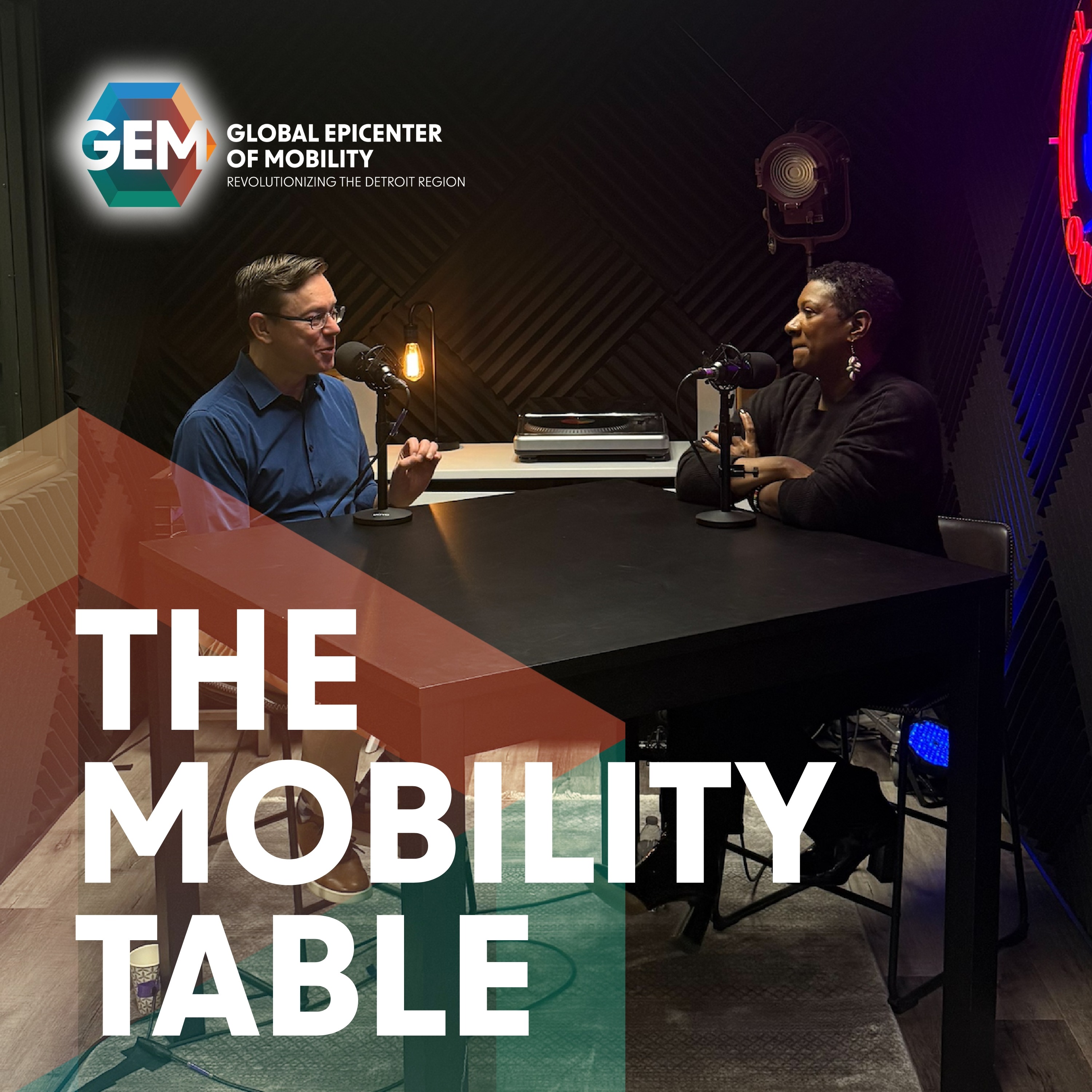
Retooling Mobility Businesses with Voltava Executive Director of Operations Craig Leek
About this episode
Detroit's historic automotive industry is undergoing a transformative shift toward advanced mobility sectors like electrification, automation, and new transportation modes including boating and aviation. The discussion highlights how Detroit leverages its manufacturing legacy, engineering talent, and community-focused companies like Detroit Manufacturing Systems to adapt and thrive in this evolving ecosystem. Emphasis is placed on workforce upskilling, supply chain evolution, and fostering innovation through collaboration among industry, education, and government. The episode captures the spirit of Detroit grit and the region's ambition to remain a global mobility hub amid increasing competition and technological change.
Craig Leek joined Jeannine and Bernard at The Mobility Table to discuss how companies are retooling and adapting to the growing shift towards electrification across the mobility industry, along with the limitations, challenges and successes that come with the transition.
Craig Leek is the Executive Director of Operations for Voltava (formerly Detroit Manufacturing Systems), where he oversees Ford operations. Craig has more than 40 years of experience in the automotive sector, including over three decades at Ford.
electrification
"And I feel like right now with this transformation that's happening with electrification, automation, you know, that is a once in a century, maybe opportunity to capitalize on,"
Electrification means cars are changing from using gas engines to using electric batteries and motors.
Electrification refers to the automotive industry's shift from internal combustion engines to electric powertrains, including hybrid and fully electric vehicles.
automation
"with this transformation that's happening with electrification, automation, you know, that is a once in a century, maybe opportunity to capitalize on,"
Automation means cars can drive themselves or help the driver by using computers and sensors.
Automation in automotive refers to the use of technology to enable vehicles to operate with reduced or no human input, such as advanced driver assistance systems and self-driving cars.
vertical integration
"we had the base laboratories doing ground research all the way up through manufacturing, that full vertical integration, you know, that's just not how the world works,"
Vertical integration means one company does many steps of making and selling a product instead of relying on others.
Vertical integration is a business model where a company controls multiple stages of production, from research and development through manufacturing and distribution.
mobility sectors
"And what does it look like when we then go out and start serving some of the other mobility sectors, you know, boating, you know, aviation,"
Mobility sectors are different ways people and goods move around, like cars, boats, and planes.
Mobility sectors refer to different modes of transportation including automotive, boating, aviation, and others.
General Motors
"we're still the home of Ford. We're still the home of General Motors. Stilantis still has a presence here,"
General Motors is a big car company from Detroit that makes popular car brands like Chevrolet and Cadillac.
General Motors (GM) is a leading American automotive company based in Detroit, producing brands like Chevrolet, GMC, Cadillac, and Buick.
Stellantis
"We're still the home of General Motors. Stilantis still has a presence here, as many of the other large automotive manufacturers as well."
Stellantis is a big car company that owns many brands like Jeep and Dodge.
Stellantis is a multinational automotive manufacturing corporation formed by the merger of Fiat Chrysler Automobiles and PSA Group, owning brands such as Jeep, Dodge, Chrysler, and Ram.
tier one suppliers
"And then your tier one, tier two suppliers are here as well."
Tier one suppliers are companies that make parts and sell them straight to car makers to put into new cars.
Tier one suppliers are companies that supply parts or systems directly to automotive manufacturers for assembly into vehicles.
tier two suppliers
"And then your tier one, tier two suppliers are here as well."
Tier two suppliers make parts or materials that they sell to other companies who then sell to car makers.
Tier two suppliers provide parts or materials to tier one suppliers rather than directly to car manufacturers.
advanced mobility ecosystem
"The work that we do through the Global Epicenter Mobility really touches on so many different parts of the advanced mobility ecosystem, right? So from supply to research and development through our testing and improving facilities that we're working with,"
Advanced mobility means new ways of moving around, like electric cars and self-driving vehicles, all working together with new technology and roads.
The advanced mobility ecosystem refers to the interconnected network of technologies, companies, and infrastructure focused on developing next-generation transportation solutions, including electric vehicles, autonomous driving, and smart infrastructure.
Detroit Manufacturing Systems
"Craig Leek, who was with Detroit Manufacturing Systems, is getting ready to join us. And, you know, he's a big manufacturer in Detroit, and how they're taking advantage of this emerging ecosystem."
Detroit Manufacturing Systems is a company in Detroit that helps make parts for car companies.
Detroit Manufacturing Systems (DMS) is a contract manufacturing company based in Detroit that serves automotive clients, specializing in producing components and assemblies.
Android Industries
"Well, we are in the midst of a transition and acquisition as we are acquiring Android Industries, and it's going to double the size of who we become."
Android Industries is a company that makes things, and it's joining with another company to become bigger.
Android Industries is a manufacturing company being acquired by Detroit Manufacturing Systems to expand their size and capabilities.
Big Three
"Okay. So it's still manufacturing, still contract manufacturing for Big Three, but we'll be taking on additional customers."
The Big Three are the three biggest car companies in America: Ford, General Motors, and Stellantis. They make a lot of cars and trucks.
The 'Big Three' refers to the three major American automotive manufacturers: Ford, General Motors, and Stellantis (formerly FCA). They dominate much of the US auto industry.
contract manufacturing
"Okay. So it's still manufacturing, still contract manufacturing for Big Three, but we'll be taking on additional customers."
Sometimes, one company makes parts or products for another company instead of making their own. This is called contract manufacturing.
Contract manufacturing is when a company produces goods on behalf of another company, often specializing in certain parts or assemblies rather than complete products.
Ford Motor Company
"We currently have a large footprint with Ford Motor Company as we do interior. And you're still going to be taking, you're taking a tremendous leadership role there with Ford."
Ford is a big company that makes many kinds of cars and trucks that you might see on the road every day.
Ford Motor Company is one of the largest and oldest American automotive manufacturers, known for producing a wide range of vehicles including trucks, SUVs, and passenger cars.
retooling
"When we think about electrification specifically in retooling, as that's the theme, I'll give you an example. Two years ago, we retooled from the Ford F-150..."
Retooling means changing the machines and tools in a factory so they can make new kinds of cars or parts.
Retooling refers to the process of modifying or updating manufacturing equipment and processes to produce different or new products, often necessary when shifting to new vehicle models or technologies.
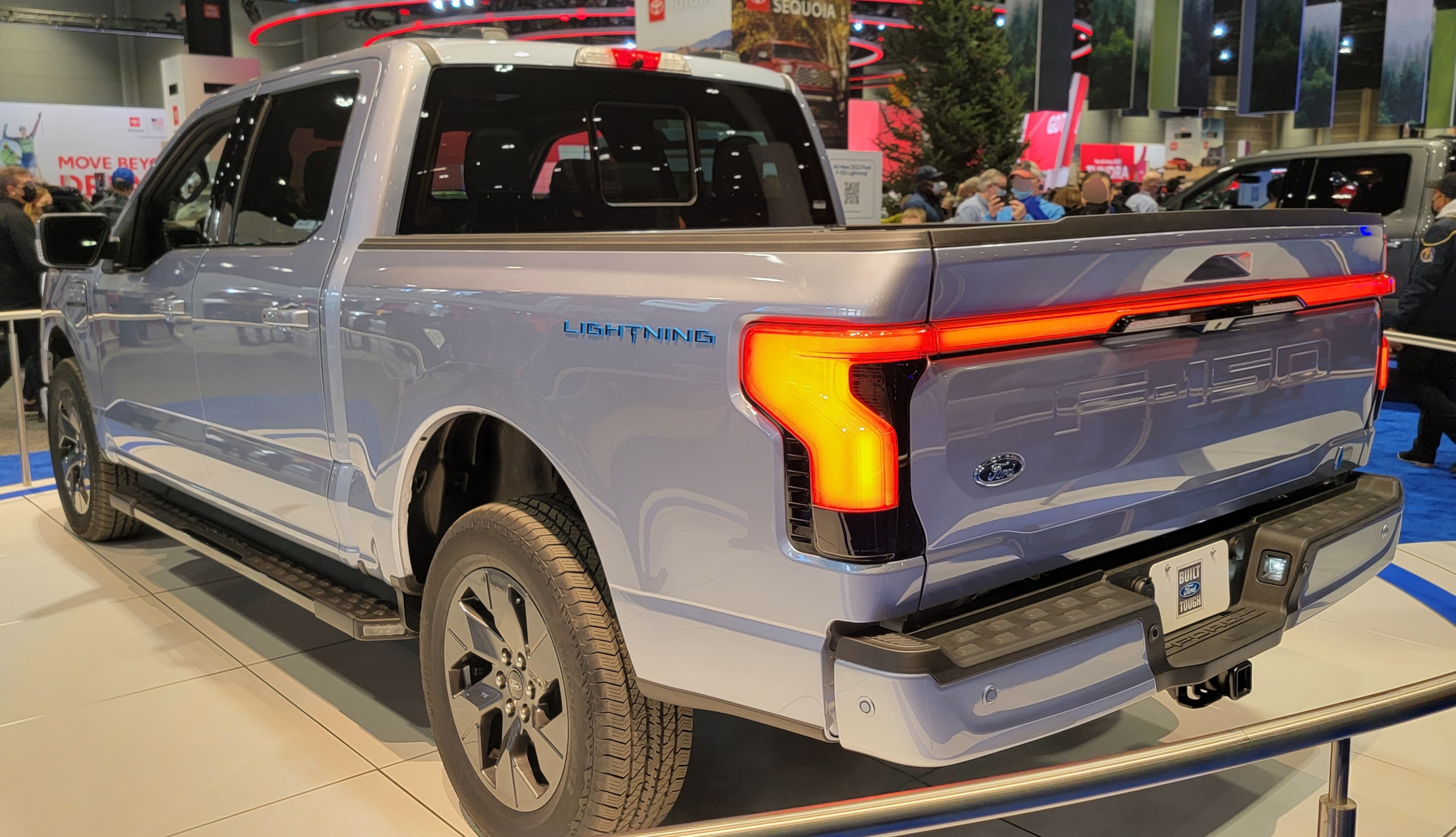
Ford F150
"...we retooled from the Ford F-150, which we make the instrument panels for as well as the center council."
The Ford F-150 is a big truck that many people use for work or driving around. It's very popular and can carry heavy loads or tow things.
The Ford F-150 is a full-size pickup truck known for its durability, versatility, and popularity in the North American market. It is often used for work, daily driving, and recreational purposes.
instrument panels
"...we retooled from the Ford F-150, which we make the instrument panels for as well as the center council."
Instrument panels are the part in front of the driver that shows things like speed, fuel, and other important info about the car.
Instrument panels refer to the dashboard area in a vehicle that houses gauges, controls, and displays providing the driver with important information about the vehicle's status and operation.
Ford F-150 Lightning
"We retooled a all-new hybrid line that is going to build the Ford Lightning, which is an all-electric Ford Lightning."
The Ford Lightning is a new electric truck made by Ford. It works like a regular truck but uses electricity instead of gas.
The Ford Lightning is an all-electric version of the F-150 pickup truck, representing Ford's move into electric vehicles with a focus on combining traditional truck capabilities with electric power.
AGVs
"...We expanded the line. We used AGVs, which are the next mode of how..."
AGVs are robots that move parts and materials around a factory by themselves, helping people work faster and easier.
AGVs, or Automated Guided Vehicles, are robotic systems used in manufacturing and logistics to transport materials autonomously within a facility, improving efficiency and reducing labor costs.
automated ground vehicles
"And these are automated ground vehicles. So we're talking about kind of a robotic way of delivering things to the supply line, which I love. And this is a great example of a legacy Detroit company evolving, doing things in the world class leading ways. And AGVs are not new, but how they are implemented for their flexibility, that's what we're moving towards."
Automated Ground Vehicles are robots that move things around in factories by themselves, helping workers get parts where they need to go faster and easier.
Automated Ground Vehicles (AGVs) are robotic vehicles used in manufacturing and logistics to transport materials without human intervention, increasing efficiency and flexibility in production lines.
range anxiety
"But it wasn't so much about the tariffs either. You know, there's range anxiety and things like that as people are trying to adopt electrification. So there were a lot of things working against that particular model."
Range anxiety is when people worry their electric car's battery will run out before they get where they want to go.
Range anxiety is the fear or concern that an electric vehicle will run out of battery before reaching its destination or a charging station.
ICE (internal combustion engine)
"I will be in a mixed world, right? Where we have, you know, one foot in the selectrified world and one in the sort of traditional ice world. But I'm curious, you know, all right, to make that work, we need flexibility and we need adaptability."
ICE means the regular car engine that uses gas or diesel to make the car go.
ICE stands for internal combustion engine, which is the traditional engine type that burns fuel like gasoline or diesel to power vehicles.
inductive charging system
"It does commercial vehicles. So there's a ground unit that we're building, and then there's the unit that actually goes on a vehicle. So as you ride over this particular charging port, it's charging your vehicle every time, every stop that you make..."
Inductive charging means your car or device can get power without plugging in a cable. It charges by sitting or driving over a special pad that sends electricity through the air.
An inductive charging system transfers electrical energy wirelessly through electromagnetic fields, allowing devices or vehicles to charge without physical connectors. In vehicles, this technology enables charging by simply parking or driving over a charging pad.
electrified vehicles
"most is what's next? What can we do next? Yeah. And Craig, would you say, is there more potential to open up a little bit now that things are electrified? You know, is there a greater chance to do, you know, a boat or a drone or another type of vehicle than there would have been when it was, you know, much more of a traditional engine transmission automotive world?"
Electrified vehicles are machines like cars or boats that use electricity to move instead of gas or diesel engines.
Electrified vehicles refer to cars, boats, drones, or other vehicles powered fully or partially by electric motors instead of traditional internal combustion engines.
logistics
"Well, what we bring, and I won't belong, logistics. It's not just enough to build it, but getting the parts in, shipping the parts out. We were born out of a logistics company."
Logistics means organizing how parts and materials get to the factory and how finished products get sent out, so everything runs smoothly.
Logistics in automotive manufacturing involves the planning and management of the flow of parts and materials into and out of production facilities to ensure efficient assembly and delivery.
design engineers
"We have engineers, as you mentioned, we have a lot of engineers, industrial engineers, manufacturing engineers, electrical engineers, design engineers."
Design engineers plan how cars and other products will look and work before they are made.
Design engineers focus on the conceptualization and detailed design of products, ensuring they meet functional and aesthetic requirements.
manufacturing engineers
"We have engineers, as you mentioned, we have a lot of engineers, industrial engineers, manufacturing engineers, electrical engineers, design engineers."
Manufacturing engineers figure out the best ways to build cars and parts so they come out right and fast.
Manufacturing engineers design and improve the processes and equipment used to produce vehicles and parts efficiently and with high quality.
electrical engineers
"We have engineers, as you mentioned, we have a lot of engineers, industrial engineers, manufacturing engineers, electrical engineers, design engineers."
Electrical engineers create and improve the electrical parts that make cars and other machines work.
Electrical engineers work on the design and development of electrical systems and components, which are especially important in electrified vehicles.
industrial engineers
"We have engineers, as you mentioned, we have a lot of engineers, industrial engineers, manufacturing engineers, electrical engineers, design engineers."
Industrial engineers help make factories and production lines work better and faster by organizing how things are done.
Industrial engineers focus on optimizing complex processes, systems, or organizations, often improving manufacturing efficiency and productivity.
Request an Explanation
Heard something you'd like explained? We'll add it to this episode.
Sign in to request explanations for terms you heard.
Want to learn more?
Browse our glossary for plain-English explanations of automotive terms, jargon, and concepts.
Help improve this episode
See something that's not quite right? Our annotations are AI-generated and can sometimes miss the mark. Click the flag icon on any annotation to suggest a correction.