A diesel particulate filter catches the smoky soot from a diesel exhaust. If it gets too full, the truck can lose performance or trigger warning lights, and it may need cleaning or replacement.
A diesel oxidation catalyst is an exhaust device that helps clean up diesel fumes. It can also help the system burn off soot so the DPF can stay working properly.
DPF X-Fit sells replacement emissions parts for diesel trucks. They’re advertising filters and catalysts that are meant to match the original equipment fitment.
The idea is that if an engine has more internal friction, it gets hotter and parts wear out faster. That extra wear and inefficiency can reduce how much power the engine makes.
Piston rings are the small metal bands on the piston that help seal the engine and manage oil. If they create too much friction against the cylinder walls, the engine runs hotter, wears faster, and can lose power.
Total Seal makes piston rings. The pitch here is that their ring design reduces friction inside the engine, which can help reduce wear and keep power from being wasted.
NAPA is a company that sells car parts and supplies. In racing, they often sponsor events and teams, so you’ll hear them mentioned a lot around motorsports.
Toyota is a major automaker that has a strong presence in motorsports and enthusiast culture. In drag racing contexts, Toyota name-drops often relate to sponsorship, fan communities, or specific vehicles/teams.
Bracket racing is drag racing where you’re trying to match a target time instead of just going as fast as possible. The goal is to be consistent and hit your number, which can make racing feel more fair and strategic.
Lucas Oil is a company that makes automotive lubricants and also sponsors racing teams. In racing talk, mentioning Lucas Oil usually means the team is part of that sponsored scene.
Concept
big show has kind of stagnated
They’re basically saying the top-level racing show doesn’t feel fresh anymore. That can happen when the same kinds of cars win and the sport doesn’t change much over time.
Nitro cars are drag racers that use nitromethane fuel. That fuel helps them make extremely strong power, which is why they’re famous for fast launches and a loud, dramatic sound.
To fabricate means to build or create parts by cutting, shaping, and assembling materials—often metal—rather than buying a finished component. In motorsports, fabrication skills are valuable for custom brackets, mounts, and race-specific hardware.
Ratchets are hand tools used to tighten or loosen fasteners with a reversible mechanism. In a racing context, knowing tool sizes and styles matters for quick repairs and accurate assembly.
Topic
Atlanta Braves game
They’re talking about a baseball game where the racer is doing the first pitch. It’s just a fun off-track moment mentioned in the show.
Topic
Detroit Tigers
They mention the Detroit Tigers as the team the Braves are playing. It’s just part of the story about the first pitch.
“1000th win” is a milestone win count for a driver in NHRA competition, marking a historic level of success. In drag racing, reaching a milestone like this is often celebrated because it reflects consistency across many rounds and seasons, not just a single standout performance.
Pomona is a well-known NHRA drag-racing event location in California. When people talk about “Pomona” in drag racing, they usually mean a big, important race.
NHRA is a drag-racing organization. A “funny car” is a type of race car built specifically for short, intense drag races where the goal is to accelerate as fast as possible.
Term
slid down the funny car
This sounds like what the driver did right after the run—moving or sliding along the funny car as part of the celebration or getting situated. Funny cars are very race-focused, so getting in and out can look a little unusual.
A time slip is the scorecard from your run. It shows how fast you went and how quickly you reacted to the start lights.
Term
wind lights
“Wind lights” is about the starting lights at the drag strip. If you time your launch well when those lights come on, you can react faster and improve your race result.
Term
Christmas tree
The Christmas tree is the set of lights at the drag strip that tells you when to go. If you launch at the right moment, your reaction time improves.
In NHRA racing, a “quad” is basically a group of four cars that race against each other in a round. If you win your matchups in that group, you move on and get a better shot at the next round.
In NHRA, qualifying runs decide the starting order for the elimination rounds. If you’re the “number one qualifier,” you were the fastest in qualifying and you start at the top seed.
Tracks often have a scheduled “pre-race” event before the cars actually start racing. They’re saying they didn’t get to do that because their race was already happening Sunday morning.
The “ladder” is the bracket that shows which cars will race each other and who advances. Teams look at it to see what matchups they could get.
Concept
part-time car
A “part-time car” is a race car that only shows up for some events instead of racing every weekend. Because they don’t run all the time, their performance can be hard to predict.
Concept
qualify number one
If you “qualify number one,” you’re the fastest in qualifying and you get the best starting position. But you still have to win your head-to-head races after that.
In 4-wide drag racing, four cars race at the same time on the same track. The hosts are saying this is a rare event, and it’s tough because each lane behaves a little differently.
Cloud cover can affect track temperature and air density, which in turn influences traction and engine performance. In drag racing, those changes can shift how easily a car hooks up and how consistent the car feels across runs.
In drag racing, a driver’s “comfort zone” is the range of conditions and setup where the car responds predictably—especially around launch and early acceleration. When conditions change (like cloud cover or track grip), drivers may need to adjust their approach to get back into that predictable window.
In 4-wide drag racing, each lane can have different traction and surface characteristics, so the same car can feel noticeably different depending on where it runs. That’s why drivers may prefer a particular lane and why lane choice is discussed as a performance factor.
Car
funny car
A “funny car” is a drag-racing race car built for maximum acceleration. It’s tough to drive because small changes in traction and launch timing can dramatically affect how it behaves.
Concept
murderous road
The phrase “murderous road” is a metaphor for a difficult, unforgiving stretch of racing where conditions and outcomes feel harsh. In context, it reflects how quickly a weekend can turn from promising to challenging based on track behavior and performance.
Grandstands are the big seating areas where fans watch from. The hosts are saying the same number of people can look smaller or bigger depending on the track and where the cameras are.
Concept
Gainesville grandstand capacity
They’re comparing how many people the stands can hold at Gainesville versus ZMAX. The goal is to show why it might look emptier on TV at one place than another.
They’re talking about famous NASCAR drivers showing up at the drag race. When big-name stars from another series attend, it can bring extra attention and fans.
IndyCar is a major U.S. racing series with open-wheel race cars. When the hosts mention IndyCar, they’re usually talking about the kind of racing crowd or attention the event drew. It helps set the scene for what else was going on in motorsports.
A burnout is when the car spins its tires to warm them up. A “nitro car” runs on nitromethane fuel, so it’s extremely powerful and can be tricky to control while doing that. Drivers sometimes debate whether it’s worth doing before a race run.
On a race track, there’s usually a best path where the tires grip the most—people call that the “groove.” Driving on the outside of it means going wider than the usual fast line, which can help you pass or avoid getting stuck in traffic. It can also change how the tires wear and how much grip you feel.
Concept
tunnel in the track for the fans and racers
Some motorsports venues build a “tunnel” or covered passage that separates or channels pedestrian and vehicle movement around the facility. In the context of racing, it can affect how fans view the action and how teams stage, enter, or move between areas. Track design like this is part of the overall event experience and logistics.
Tracks can change as they age. Over time, the surface can become slightly uneven or behave differently, and that can make one lane feel better than another.
Concept
tunnel is concrete and it's under
They’re talking about a section of the track that goes over/under something like a tunnel. The structure underneath can make that spot feel slightly different, like a small bump.
“Four Wides” is a drag-racing setup where four cars can run at the same time. Because the track isn’t perfectly identical in every lane, where you’re placed can affect how well your run goes.
Concept
Safety Safari
“Safety Safari” sounds like the crew that helps keep the event safe and the track conditions consistent. In this context, they’ve helped make the lanes behave more evenly over time.
Concept
low-qualifier Friday night
“Low-qualifier Friday night” describes a qualifying position earned on Friday that determines lane choice later. In drag racing, qualifying order often influences which lane you get, because organizers and drivers try to balance fairness with track-condition advantages.
The “groove” is the part of the track that has the best grip. If you’re in the groove at the wrong time or in the wrong spot, the car can feel unstable. So drivers try to get the tires to hook up smoothly for the launch.
As cars run on a drag strip, they leave rubber behind, and that rubber usually makes the track stickier. If your tires hit that sticky area at the wrong time, the car might not launch straight or smoothly. So the driver is told to aim for the best-grip spot.
That “400 feet” comment is basically telling the driver when to make the move into the best-grip part of the track. The car doesn’t hook up perfectly instantly—traction builds as it accelerates. So they’re telling you to time the move so it launches smoothly.
“Upsetting the car” means making it feel unstable—like it might wiggle or not go straight. On a drag strip, grip changes can happen fast, so you have to get the tires to hook up smoothly. Otherwise the car can react unpredictably.
Concept
0 to 100 in less than one second (drag acceleration)
Drag cars speed up extremely fast, so there’s almost no time to fix mistakes. If the tires don’t have the right grip at the right moment, the car can get unstable. That’s why the crew is so picky about where the car is on the track.
Concept
tunnel effect
The “tunnel” is the track area where airflow can change. That airflow can push the car slightly left or right, so drivers have to account for it to stay straight.
Concept
shallow
Here, “shallow” seems to mean keeping things as consistent as you can during race day. The goal is to avoid changing too much so the car acts the same each run.
On a drag car, the clutch discs help the car hook up when you launch. The “quandary” is basically the problem of picking the right kind so it performs well and doesn’t wear out or behave unpredictably.
“Learning discs” are basically test clutch parts. The team tries different ones to figure out which ones work best for how the car is being driven and what the track is like.
Concept
Austin's back to back championships
“Back to back championships” means winning the championship two years in a row. The hosts are saying that to beat a top team like that, you have to get the car’s launch/clutch setup right and keep it consistent.
They’re talking about NHRA’s 75th season, which is basically a big anniversary year. It’s why they’re discussing what the team is planning for the future.
Asking “Are you set on clutch discs for how long?” points to the practical race-team problem of disc life and replacement intervals. In drag racing, clutch discs can wear quickly or change behavior as they heat up and degrade, so teams must balance performance with how long a given setup will remain reliable through a season.
Bonifani Friction makes parts that create friction inside racing drivetrains. Those parts matter because they help the car transfer engine power reliably during hard launches.
Term
cluster
Here, “cluster” is basically the racing community around nitro cars. The point is that the people who race and work on these cars all know what’s going on.
Car
top fuel dragster
A Top Fuel dragster is a specialized nitro drag-racing car built to go as fast as possible off the line. Adding one to a team means more equipment and more focus on the parts that control launch and power transfer.
Multi-car teams run more than one race car. That can help them share resources and learn faster, but it also makes managing parts and setup more complicated.
They’re talking about how insanely powerful these race cars are. When power is that high, even tiny setup or parts changes can make the car launch differently.
The bell housing is the transmission/driveline housing that connects the engine to the gearbox and contains components like the clutch assembly. In drag racing, how power is routed through the bell housing and clutch area affects engagement timing, durability, and repeatability.
“Good year tires” refers to Goodyear, a major tire manufacturer heavily involved in motorsports. In Top Fuel/Funny Car, tire choice and compound are crucial because traction determines how effectively the car converts power into acceleration.
This emphasizes the sensitivity of nitro drag racing to tiny changes in setup and drivetrain behavior. Because the car is operating at extreme power and traction limits, small variations can change launch characteristics and consistency run-to-run.
Term
running 390 or running 415
“Running 390” vs “running 415” refers to different engine displacement or class-related setups in drag racing, where teams choose a configuration to match performance goals and rules. The speaker frames it as part of the broader “making it” vs not-making-it conversation, implying the choice affects competitiveness.
Term
DSR
DSR is a common NHRA shorthand for Don Schumacher Racing, a major drag racing organization. In the segment, it’s referenced as an example of a big team with enough budget to buy and stage performance parts early in the season.
A single-car team is a racing operation that focuses on just one car. With fewer cars, there’s usually less money and fewer spare parts to try different things, so it can be harder to stay competitive.
John Force Racing is a major NHRA racing team. When people move on or off a big team like that, it can affect what parts, support, and people they have access to.
Weather can change how the car runs. When it’s hotter or more humid, the engine and drivetrain can behave a little differently, so racers may need to adjust parts or setup to get the same launch every time.
Even the same clutch type can come in slightly different “grip” levels. Racers choose harder or softer versions to help the car launch the way they want for that day.
They’re talking about testing parts during qualifying. If they don’t have enough of one disc, they’ll put in the one they need, make a qualifying run, and see how it performs.
Concept
tune around that
It means the team changes the car’s settings to work around a problem. Instead of giving up, they adjust so the car still launches and runs well.
Term
another set of discs
They’re talking about a part that wears out after a while. The team replaces it so the car can keep running strong for the next few races.
Concept
battle
They mean the competition is tight and every race matters. Teams keep adjusting and trying to stay ahead.
They’re talking about a specific race track—South Georgia Motorsports Park—that the series is going to for the first time this year. Different tracks can change how the car hooks up and how teams set up their tune.
US 131 is a race venue they’re mentioning as part of their schedule. New or less-visited tracks can mean teams have to adjust how they launch and tune the car.
They’re naming more race tracks—Buds Creek and Maryland International Raceway—as part of the schedule. Each track can behave differently, so teams often need different setup approaches.
Topic
Epping
They mention Epping as a place that feels old-school and nostalgic. The point is that some tracks have a classic, smaller feel that racers and fans like.
They’re talking about the Southern Nationals, a historic race event in the South. The hosts want it back because it matters to the community and the fans.
They’re talking about Nitro Mall as a spot at the event where you can shop—like buying a shirt. It’s mentioned because it’s tied to a long-running, historic race weekend.
“Sportsmen” are racers who aren’t in the top pro ranks. They still race competitively, but the event focus is usually more on the pro teams.
Term
XM Satellite Radio
They’re mentioning a satellite radio service they worked with before starting their own show. It’s not a car part—just background on how the podcast/radio show got started.
They’re talking about a race-focused shop/website that sells performance parts. In this case, it sounds like they specialize in gaskets and can get them to you fast for racing.
A head gasket seals the space between the engine block and cylinder head. Copper head gaskets are a racing-style version that can hold up better when an engine runs very hot or makes a lot of pressure.
Composite gaskets are another type of head gasket made from layered materials. They’re used to seal the engine, and different engines may prefer different gasket styles.
This is a specialty shop that helps people buy or sell cars. They also offer consignment, which means they help you sell your car instead of you doing all the advertising yourself.
In drag racing, a delay box is a gadget that helps control exactly when certain launch actions happen. That can make launches more consistent and repeatable from run to run.
They’re talking about a company that sells insurance specifically for motorsports stuff. The point is that regular insurance often has exclusions, so you want a policy that actually covers your race car and tools.
They’re saying insurance might not pay if certain rules aren’t met—like if you had race fuel in the car or if you were driving on the wrong kind of road. That’s why it’s important to read the policy details.
LIVE
Looking to replace your OEM diesel particulate filter or diesel oxidation catalyst?
Look no further than DPF X-Fit, a complete line of aftermarket diesel particulate filters
and diesel oxidation catalyst designed as an exact fit OEM replacement with all makes
coverage for light, medium and heavy duty trucks.
With thousands of units in stock, we ship the same or next day and be sure to check out
our comprehensive reverse OEM lookup tool.
Always new, never remanufactured.
For more information, be sure to visit dpfxfit.com.
That's dpfxfit.com.
The number one source of friction in your engine is not what you think.
Piston rings rubbing against the cylinder walls generate more friction than any other part
of the engine.
More friction and temperature means more wear and less horsepower.
Fortunately, the team at Total Seal knows how to reduce friction and wear through innovative
piston ring design.
If it takes a piston, Total Seal could build a better ring.
This is WFO Radio.
Hey everybody, WFO Radio NHRA Nitro is on the air and this is a wild one.
We're coming from Zmax Dragway.
We're headed to South Georgia Motorsports Park.
I am in the auxiliary WFO studios.
I had to vacate the entire building this morning.
What could cause that?
Was it infestation?
Was it locust?
It was worse.
No internet access.
The router just blew up.
The whole everything was down.
What do we do?
Well, I had to come to my parents' house.
The backup studio.
This is it.
One of the rooms I grew up in.
Don't look, don't look.
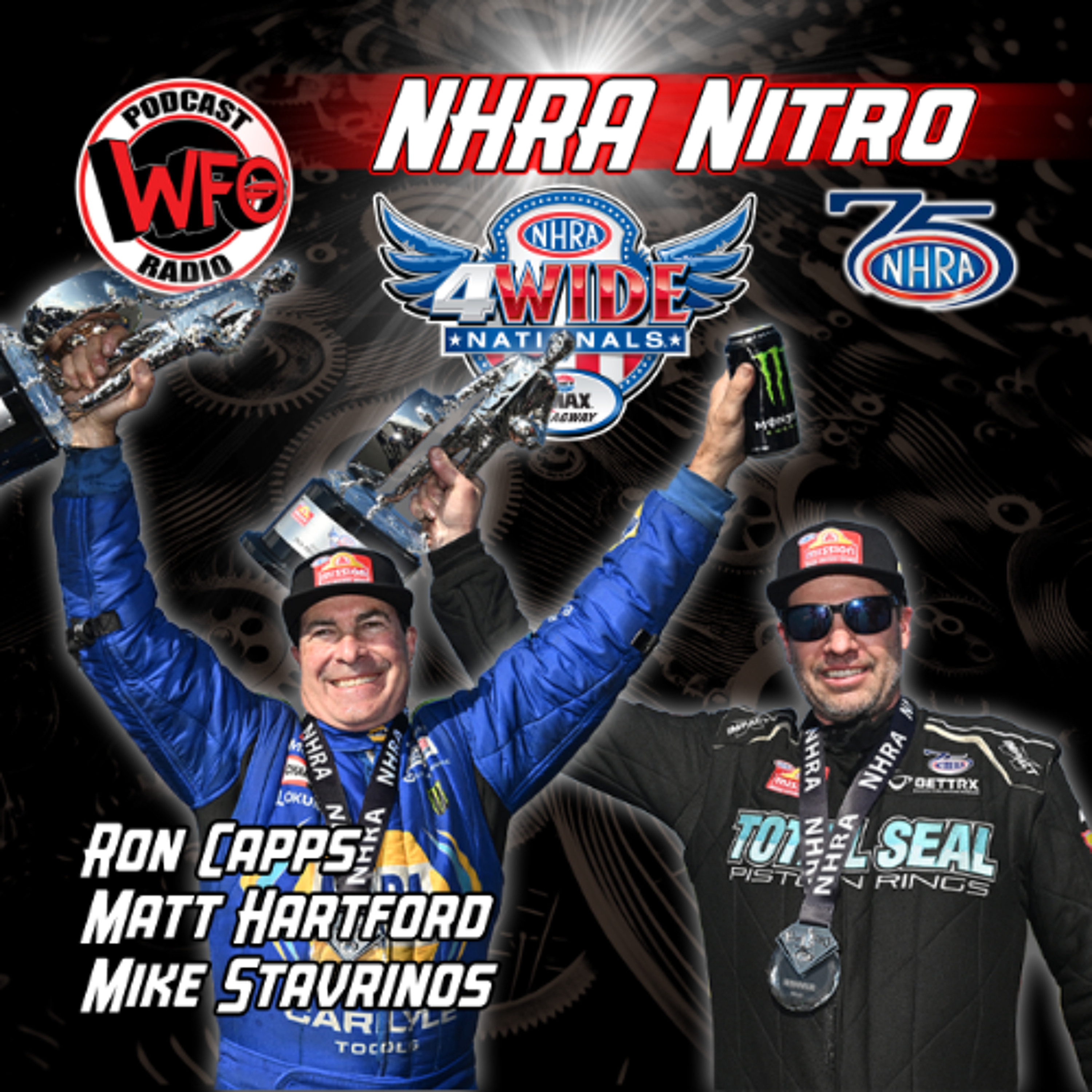
But anyway, yeah, at least we got it in and we got to speak with Ron Kapps.
We're going to speak with Mike Stabrinos.
We're going to speak with Matt Hartford, maybe Eddie Granacci and Michael Heiner.
They're all going to come on.
And so we had to figure out how to make this thing happen.
And it's happening as quick and as fast as is possible.
So thank you for supporting WFO radio and all of our sponsors.
We will tell you about all of them coming up right after Kapps.
Let's build those numbers.
Fans of Napa, fans of Toyota, fans of Ron Kapp, fans of Winners, fans of Maddie.
You want to share the show.
Apparently there's a photo shoot going on at Napa headquarters.
Let's bring them on right now.
Ron Kapps, what's up, Ron?
How are you?
How are you?
So you were, everybody needs to know, we're like,
this interview happened just moments ago for the live audience.
We're time-shifting because what are you going to record?
What do you do in a commercial?
Well, actually, we can do this, right?
Oh, here we are.
He's ruining everything.
I want to jab him.
I'm going to jab him.
Do it.
Well, we're going to sneak in.
And Maddie, of course, Maddie's great at everything.
Kind of pisses me off sometimes.
Yeah, me too.
Of course, she shows up and starts rallying off his commercials.
One takes.
Ron.
Hello.
Say hi to everybody in WFO.
Hi, everybody in WFO.
Here's all the equipment, all the shooting.
Here's Joe Sabo, our big boss.
Hey, Joe.
Did y'all know Carl, all tools are in Napa all the parts?
Oh, my God.
Anyway, I'll go back in.
That's great.
There you go.
Thank you for that.
So much more interesting than my home studio, the auxiliary studio.
It's been a whole day to this.
So the fans got some cool stuff to look forward to.
I'm going to go back in here, Joe.
Yeah, go back into the cave.
Go back into the cave.
No, it was good.
So listen, I have some friends that are bracket racers.
Not bracket racers.
They're Lucas Oil racers.
They're my friends from way back, right?
And I'll be very honest with you.
When I say that they will tell me they feel like the big show has kind of stagnated.
You know, like, I don't, I'm racing.
I'm worried about racing myself.
I don't need to go watch those nitro cars because really it's the same
that it's been 20 years ago.
They are both into Maddie.
And I was like, all right, well, why?
What's the deal about Maddie?
I was like, well, the girl can weld.
She can fabricate.
She's the real deal as real as it gets.
And like, that's what I like.
She's a real racer.
She's not putting on anything.
It's not really about her social media.
It's about who she is and they like it.
So I can tell you two middle-aged men who are racers like Maddie.
So it is a natural happening.
Yeah, shit.
They were just doing a guess this tool thing.
All these segments the fans are going to see.
And she's got her hand around a box and she's guessing these tools
and she's rattling off sizes of ratchets and what style
and just crazy stuff that it's fun.
It's fun to be around.
And for our fans, actually, Wednesday night,
and I'm not sure if it's nationally shown,
but she is throwing the first pitch out
at the Atlanta Braves game Wednesday night against Detroit Tigers.
So she is, we're going to practice throwing the ball.
She's been practicing with Ted Yerzik a little bit here and there.
But fans tune in.
Atlanta Braves game Wednesday night.
Maddie will throw out the first pitch.
So she's pretty fun.
That's exciting.
Well, maybe there's something she can't do,
but we haven't found it just yet.
Apparently she played softball.
She was a varsity softball player, which I didn't even know.
So I told her fired under him, but she's practicing.
You know her.
She's going to want to throw a strike.
Yes, she will.
Yes, she will.
But once again, we're not here to talk about Maddie.
We're here to talk about Ron Kapps, who got it done again
for wide big win.
The cars run great.
You're running great.
Final round at the 1000th.
And I want to ask you, Guido says,
he didn't know it was the final round for the 1000th.
I interviewed him right before and he goes,
why did you tell me that?
And I'm like, I didn't.
How could you possibly not know that?
He goes, I didn't know.
And so I, you know,
I hope we didn't like crank up the pressure on him
for the 1000th win and Pomona.
I don't know if that would have mattered.
I mean, it might have.
No, Guido, it might have,
especially if he would have saw the trophy.
I didn't even know what it looked like
until I came around and actually lost.
And it looked over and saw Matt Holden
and I was really more bummed.
That was big for me.
To be the 1000th funny car winner
would have been pretty cool.
I've led a blessed life being an NHA driver,
but that thing's pretty neat.
And forever, Matt will be the 1000th winner.
So proud of him, proud of their team.
But man, that was a tough one.
It was close, but, you know,
we got him back this last weekend.
What you did, and he came over to you
and he grabbed you and you guys embraced.
You slid down the funny car.
You're doing that again, Ron.
You are feeling it.
If you're sliding down the nose of the funny car again.
Yeah, I felt it yesterday.
That's the Eric Medlin slide.
And yeah, it hurts sometimes.
But anyhow, you know, we, I am feeling better.
I was questioning my reaction times last couple of years.
You know, I don't, I'm not wanting to get out of the car
and run over and look at the time slip
like some of these drivers do.
I never have, because wind lights are so much more important
and I'm just focused on doing the best thing
in the car that I can do.
But of course, the reaction time just seemed off
the last couple of years.
And I didn't think I was doing anything different.
Of course, you get a little older and you start to wonder.
But Guido and I, Guido went hard to work
and we found, mechanically, found a lot of little things
and one big thing that was kind of, it was real obvious.
And it was something, it was a habit that I had
going back to when I drove for Ed McCulloch, the ace.
And we showed up this year and all of a sudden
my lights are much better
and it wasn't anything that I was doing different.
So, and then you have a car running great.
So the confidence gets up, but you put those two together
and it's just, it's clicking right now.
That's good, it is clicking right now.
And you had a very difficult quad.
We don't normally make the number one qualifier.
Also, the quad of Doom, it turned out
we didn't get to have a pre-race show anyway
because we were racing on Sunday morning.
But the most challenging quad was definitely
the quad you were in as number one qualifier,
with Spencer and Chad and Austin.
And just looking at that, if you can get through that quad,
you're going to be off to the races, as they say.
And whatever, steel, hardened steel,
that sets you up to go up against Chad, J.R. and Alexis.
Not an easy day at the races, put it that way.
No, I always joke with my guys,
we have ladders that you look at sometimes
and there's cars that might be struggling in the weekend
or a part-time car might show up.
And you're like, okay, well, it's not a proc
or it's not J.R. or Hagen or whoever.
So, but we qualify number one
and we all know that Jimmy's going to figure out
what's going on with their car
and he's going to get a handle on that.
So to have that car is a big unknown
and we had cloud cover and great conditions Sunday morning.
So that also helps for somebody
that's trying to find their comfort zone like Jimmy proc is.
You know, Spencer, I'm a huge Spencer Hyde fan.
So it was not an easy one at all.
And Guido, you know, he wanted that right lane.
It's a tough lane to drive in a funny car.
But it was not an easy day.
And we have a lot of our wins when we look back.
It's like murderous road, you'd call it like in baseball, right?
You look at it and you go, my gosh,
we're not going to have it easy today,
but that's usually weekends.
It seems like we're standing with the trophy
at the end of the day.
And you got the job done in this case and four wide.
One race a year at the four wide now
and the only four wide of the year.
Good crowd.
Friday, good Saturday, great Sunday, good.
But I think people are going to learn
like this is your one shot now.
I was very happy with what I saw in the pit area
and see Max Dragway.
The pit area, first of all,
that track is deceiving for anybody watching at home.
I know you can get on the internet and type in
what's going on with the lack of fans.
That is one of the biggest grandstands we have.
Guido was, he was telling me that,
I mean, you walked in the pit area
and if you stood up by the staging lanes and looked down,
it was wall to wall people.
I mean, packed every day really,
but Saturday was insane and Sunday was a great crowd too.
But those grandstands and you could take Gainesville
grandstand capacity and put it up there at ZMAX
and it would look like it was a little bit empty.
So it's very deceiving.
But it was a great crowd.
Oh my gosh, all weekend long.
I mean, it was packed.
Of course, the fans there,
it just seems like there's with one race at ZMAX
and then also a four wide.
I think you throw that in and,
we had a lot of NASCAR stars come out and hang out
and a lot of IndyCar.
So it was a lot of excitement,
a lot of really good, juicy,
you know, excitement around this race.
So it was a good one to win for us.
Yeah, without a doubt.
Kyle Larson there is on the record
as having to agreeing to try to do a burnout in a nitro car.
He says, I don't want to make a run.
He's like, I would do a burnout though.
Yes, okay, sold.
And then we'll negotiate further from that point.
But yeah, NASCAR stars everywhere,
but you were the number one qualifier.
And let's walk, let's talk about that final
because you revealed that Guido told you
that he wanted you to drive around the outside of the groove.
All right, that's explain that
because it sounds very precise.
Well, at certain tracks,
I mean, they have the tunnel there, right?
It was one of those tracks that put a tunnel in
for the fans and racers
because there's a parking lot on one side.
But that's a benefit of a really cool track
being able to cross underneath much like Bristol
and have them to not go all the way around a track
for a fan to walk.
So it's a cool perk,
but it does create a little bit of adversity
when things start to settle over the years of the track
and the tunnel is concrete and it's under.
So it creates a little bit of a jump or a small,
when I say jump, it's not a real jump, of course.
But so these lanes,
having a choice of four lanes,
when we first started Four Wides, you would show up
and of course you wanted one of the two
that they run all the time
and not three and four.
And over the years, Safety Safari,
they do such a good job.
It pretty much was evening out.
We went low-qualifier Friday night in lane one.
But lane four, Guido is having me.
I didn't want to say anything to Bruno or any of you guys
because I didn't want to give it away
in case we didn't have choice
and somebody heard my interview
and then they got in that lane,
but he was going to line us outside the groove.
So in other words, when I'm backing up
and Elric that backs me up,
he's kept pointing over here and here and here
and moving me over and I'm like,
wow, we're way over here,
but Guido said I'm going to line you up
outside of the groove, lane four,
and do not bring in a lot of times
if we're lined up in better rubber on the starting line,
he'll get on the radio and say,
listen, I need you to be back in the middle of groove,
but do it about 400 feet.
So in other words,
don't just drive out and go over in the groove
and then because it'll upset the car.
So you try to get it in the groove at the right spot
without really upsetting things
because we're traveling zero to a hundred
right in less than one second.
You got to be very careful,
but he said, do not keep it over there
on the right hand side all the way down.
Do not get over even to the center of the groove
because the slight undulation,
I guess you'd call it where the tunnel is,
it will buck you to one side or the other.
So he said that first round
and we fired off down there
and I thought, what did we run?
86, I think, which was low AT the event.
And I was just amazed.
I was not able to keep it there driving it.
So the good thing about running good
and staying in a shallow as you can race day
is keeping lane choice.
And he was adamant about keeping that right lane.
So it worked out every time.
And in the final, same thing.
I was even over a little bit more
and somehow I kept it there and got the win.
75, 76, 54 were your reaction time.
So you had consistency.
I would imagine you would have rolled it in
a little bit in that final because why not?
Yeah, no, I did.
So the final round probably went 87 or 88.
And I told Guido that he knows too,
but I knew I put it in a couple in the final.
And there is no lane choice for Sunday night.
Hit the rest drop, right?
So no, you could take a little bit off there,
but it's always cool to know what it would have ran
and it would have run another mid to high 80, which is awesome.
So we don't want to give up Guido-isms,
especially during a race,
but last year you and I spoke and he and I spoke.
And I think you were very public about the clutch disc quandary.
Might have even gone back into 24,
the like learning discs, what they want,
how they react, get them in there.
And you said, in Austin's back to back championships,
you really couldn't, couldn't fight them the way you wanted
because you just weren't where you needed to be with the discs.
I'm feeling like in 2026 to 75th season of NHRA,
based on these diamond wallies you're collecting,
there's one over your right shoulder right now, guys,
if you haven't noticed it,
because Ron's background is way more interesting than mine.
Although I've got a cool Marine Corps lamp back there.
That was my dad's.
Are you set on clutch discs for how long?
Are you good for this season?
And can you reveal that?
Is that even something you'd want?
We're definitely better.
Thanks to Rob Bonifani and Bonifani Friction,
we are better.
And the reason I said that to you,
it's everybody within the sport knows it.
The nitro cars, top fuel or funny car,
the cluster,
and as probably what Jimmy Prock is going through right now,
you got to understand,
I'm still, we're a single car team,
but we now added a top fuel dragster.
So we're able to grow a little bit,
but we are not Colettas, we are not John Forrest racing.
You, you know,
scag, you go to these multi-car teams
and what DSR used to be.
So just for the people at home,
clutch discs are very expensive,
but they're very important.
They are the heart of the tune up.
Almost anybody could make that 12,000 horsepower.
It's putting it through the bell housing
and to the ground to those good year tires.
So it's slightest movement,
slightest little change means
the difference between making it or not making it
or running 390 or running 415.
So with that being said,
Jimmy, a lot of crew chiefs on big teams,
they're able to like DSR and Colett and all them,
they can buy a hundred thousand dollars
at the beginning of the season of a bunch of clutch discs.
They can get them all together
and figure out what they want out of that
and what they want for the year and what they like.
And then the other ones,
they can move and sell to somebody else or whatever.
So they have a pick of the litter sort of,
but when you're a single car team,
like when I branched off to form our ownership,
Guido, of course, came with me.
We didn't have that anymore.
So I'm not able to go spend the money
that some of these big teams have
to spend on these multi-cars.
So it was very important.
We got a lot of support from Bonifani,
but I would assume that Jimmy Proc
is probably going through
that he's not at John Force Racing anymore.
Not to say TASCA can't go spend that kind of money,
but they don't have that arsenal
already at their shop of all these clutch discs.
So we are very much more comfortable.
Guido has gotten a stack of what he likes,
but as the fans have always heard us talk about,
you get a certain amount, whatever thousands made,
on a certain day.
And then when they make them the next day,
it could be hotter out, more humid in Philadelphia
where Bonifani is.
The air quality could be different
and small changes like that.
When they make another thousand discs,
they're going to be slightly different, harder, softer,
believe it or not.
So things change like that,
and it actually makes a difference on these discs.
So you have to figure out what you like.
And for Guido, he's able to take,
when we know we're going to be short on one disc
of those six in the car,
he'll slide one in that we know we need to get to
and he'll put just that one in
and make a run during qualifying and see what it did.
If it's softer or harder,
and a lot of times it doesn't work,
but sometimes you can put it in and it affects it,
but barely.
Then he can say, all right, I'm still good.
I can tune around that.
And then you have another set of discs
to go four or five more races.
So it's a battle.
It really is.
And first teams like ours especially.
So we feel very comfortable.
Guido's got a handle on it.
The guys are doing a great job.
They give them a great car every time.
And I'm able to luckily just go up and cut those lights.
And we needed every bit of it.
Beckman was right there in the final.
So you put all that together and Guido will tell you,
these right here, especially this year,
this is the coolest thing with a diamond on it.
We know it won't continue forever.
We can't continue this pace.
You hope you can, but it will not happen.
We're going to get things thrown at us
and we're going to get into new discs and all that.
So you just enjoy it while you can,
rack up the points while you can.
And Rob Flynn is also starting to get a handle
on what Guido has been working on with the clutch discs.
So you're going to see Maddie's car
really start to pick up performance.
Very exciting.
Very exciting to see.
And I appreciate that to insight into clutch discs.
On a top field dragster in a nitro funny car,
I don't think people understand like,
what do they just do?
Forget how to do.
No, there's a lot of elements.
And really it is a miracle they go down the track one time.
All right, so we want to let you go
because I know you're busy and Maddie's next door.
But South Georgia Motorsports Park,
we're going to a new venue for the first time this year.
We're going to go to four new venues.
I'm sure you've been to Rockingham,
like way back in the day, I think you might have been.
But US 131, we haven't been.
Buds Creek, Maryland International Raceway,
the Potomac Nationals, we've never been.
So this is a great season of new venues kicking off this weekend
with South Georgia Motorsports Park,
going from one of the biggest, most grandiose venues
to a small grassroots racetrack.
It's going to be pretty cool.
Yeah, it's like first time I went to Epping, right?
I mean, it's still a small old school,
takes you back in time venue.
And we need to be at these places, those markets,
but also those fans, they deserve it.
So to bring back the Southern Nationals,
I want to go buy a shirt over at the Legends tent
at Nitro Mall because that is such a historic event
that used to be at commerce for years.
I watched the radio versus the world
and all those races on flow for a long time
at South Georgia Motorsports Park.
So Phil, who works at Tony Stewart,
I've known forever, he used to work on our car.
He's been telling me for years
how really nice that track is.
So I'm excited to go there as a racer.
I know a lot of racers are the fans.
We're going to get a lot of the Gainesville flow
from Northern Florida, of course, the Georgia fans.
I think we're going to a lot of people out
to see what it's all about.
Plus NHRA, this weekend,
I don't know how much I can say on this point,
but it's going to be more of a professional show,
not as many sportsmen,
so it's going to be more focused around the pro racing
for the fans.
So we're going to see,
it's kind of the first time they've done that,
and it'll be interesting to see how that's going to work,
but I think it'll be something kind of cool.
We don't know what the traffic is going to be like
getting in and out and things like that.
So very exciting for everybody.
First time going there, so I can't wait.
Historic firsts, right?
There's always some little skips in it,
but it'll be great.
Ron, thank you for making the time here on WFO Radio.
Appreciate it.
To the audience, guys,
we didn't put your comments on the screen
because we pre-recorded just a little while ago
because Ron's got to go beyond camera,
but thank you for making the time, Ron.
Congratulations on the win.
Great job out there at Four Wide,
and we get to do it again this weekend.
So I'll see you there.
Good luck.
You got it, man.
Thanks, Joe.
Thank you.
There goes Ron Caps with us here on WFO Radio.
How about the tour, guys?
If that's not worth a couple of shares, click Share.
Let's get it out there.
You see Maddie at work.
And the thing about Napa,
like Ron Caps is one of the most exposed NHRA drivers
because the folks at Napa have made television commercials,
whether it back to the Michael Waldtrip days
or the Martin Truex Junior days.
Now they've got Maddie Gordon.
I can only imagine they're going to want to get Maddie out there
as much as is possible.
So it's going to be very, very exciting.
All right, guys.
So when we come back, Mike Stavrinos is going to join us.
But I do want to run through the people who make it possible
for me to go WFO each week.
And guys, like I couldn't do the show, you think about MRN
and PRN and even NHRA and all of these big organizations,
ESPN and Fox Sports, I am WFO Radio.
After my XM Satellite Radio days, I started this business.
And now we've got Life's a Drag on there, our sister show.
Elin, we're going to have some guests on this week.
But it is about these sponsors.
People like HustyPerformance.net.
These are parts and pieces for race cars.
Copper head gaskets, copper gaskets of all kinds,
but composite gaskets as well.
Reach out to the folks at HustyPerformance.net.
Go to their website.
You'll see exactly what they've got to offer.
They can usually turn around gaskets for your race car
sometimes the same day.
But I don't want to over promise.
So let's say next day or the day after.
They can ship them directly to the track.
David Allen and the team, his dad,
have done great things over the years.
HustyPerformance.net, super excited
that they are on board with WFO Radio.
Our friends at Bernie's Speed Shop, B-U-R-N-Y-Z-Z.com.
This is Josh Hart's home base in Ocala, Florida.
If you've ever been to the fan fest,
you've seen this, I think at 100,000 square feet,
they've got all kinds of great cars.
It's amazing.
If you're buying, you might want to check their inventory.
If you're selling, this is what's up.
If you've got a car that's a cool car, car of consequence,
you know they're putting it on the corner in the median.
It's not the best way to do it, right?
Reach out to them.
They can sell it on Consignment, Bernie's Speed Shop,
B-U-R-N-Y-Z-Z.com, Bernie's.
They will get you hooked up and set you up.
Of course, Redline Synthetic Motor Oil
will hear about Redline a little bit later on in the show.
And our folks at Larisse Motorsports Insurance.
Holden Larisse invented something
that he felt like was needed for drag racers.
How many times has that happened
over the course of the years,
whether it be a piece of equipment or otherwise?
Think of the project.
Think of the delay boxes.
Think about Larisse Motorsports Insurance.
Your equipment, your trailer, your truck,
your golf carts, your tools, your race car,
all covered regardless of where it is
without all those exemptions that the big companies give you.
Did it have race fuel in it?
Were you on the return road?
Sorry, you're not covered.
Check out your policy.
You will be stunned.
You can also check out an interview
with Holden in our YouTube channel
where he details all of it.
But the bottom line is,
if you don't have insurance for your car,
you need to.
You need to.
You need to step up.
You need to get Motorsports Insurance
because I don't know about you,
but I could not afford to replace what I have at this point.
I just couldn't.
And so I've got my stuff insured as best as is possible.
So check them out.
LarisseMotorsportsInsurance.com.
Also, if you want to watch WFO Radio,
you can do it on PowerTube TV.
PowerTube TV is broadcasting WFO.
We're super excited.
The folks at PowerTube show in the show
and Ron Capps.
And if you're watching on PowerTube right now,
we thank you.
You can always reach out to us on our social media, WFO Radio.
All right, when we come back,
Mike Stavrinos is going to join us,
pro-mod winner,
and then later on in the show to bring home the show.
Matt Hartford will come on.
And Matt Hartford and friends, will it be?
Matt Hartford and friends will see when we come back
right after this WFO.
For more than a decade,
FTI has strived to become the leader in the aftermarket,
performance, transmission, and converter industry.
We've joined forces with McLeod driveline components
under the leadership of top fuel funny car pilot Paul Lee,
and now have a larger distribution network,
more resources, and more power.
Come see us in the pits and ask how you can join the FTI family.
It's not cheating, it is The Competitive Edge.
And pick your winners today.
Great.
How about now?
Drag Race Frack Bonanza.
I was doing great this past weekend at the Four Wides,
and then I wasn't.
You're doing great.
You had to pick all four.
Join the WFO Radio League.
How about Ron Kapps?
I'm back live now, guys,
live in the Auxiliary Studio Moms House.
For those who have been wondering about my mother,
a lot of people have been communicating to me
about my mother's health situation,
which has been kind of a major thing
over the start of the year, the last 60 days
she's still in the hospital,
might get out this week or next week.
It has been great.
I'm here organizing things.
Of course, the internet collapsed at my home,
so I ran over here where Ma's internet is still working.
Thank goodness, right?
I had someplace nearby.
Otherwise, we'd be doing the show from a Starbucks.
Either way, we got to talk to this guy.
He is a South Florida resident.
He's a local racer, speed and truck world,
over on Sunrise Boulevard.
But when he's out there at the Pro-Modified,
he gets the job done.
Mr. Mike Stabrinos joins us now.
Mike, welcome to WFO Radio.
How are you?
Thanks, Joe.
Pretty good, man.
Pretty good.
Can't complain.
We're here.
Coming off a good win here last weekend.
You were on.
Well, you were doing very well.
Forward's tough.
Like, I want your perspective.
We all remembered last year's final,
where everybody just left on nothing, right?
It takes a very intense concentration.
And you had it.
The lights were good all weekend long.
Walk us through your race.
No, I love the four wide.
Honestly, I prefer it,
because I feel like I kind of stepped up my game a little bit
on the four wide, just being focused on the tree.
Hey, Mike, you're on WFO.
I see you on there.
Hey, it always happens.
Someone will text somebody when they're on.
I mean, it could be anything, right?
But Mike got a text and now he is dealing with the text
and he will hopefully be back momentarily.
We'll see him down.
There he is.
He's back.
He's back.
He's back to the people.
Yeah, I got you.
Get back to you.
Step up your game when you're at four wide.
You there?
Yes.
I hear you.
Do you hear me?
I hear you.
Go.
Hold on.
I lost you there, Joe.
I can't hear you too well.
Oh, no.
Well, just keep going.
I hear you great.
Tell me about your race.
Give me one sec here.
Give me one sec.
One second.
All right.
All right.
All right.
Mike, he's resetting.
He's rising.
Maybe nobody can hear me right now.
But let's see what the, let me just kick him out.
That's what we do.
This is live something.
D-Rail says WFO.
Great seeing you this weekend.
Saw a lot of race fans out there.
Brian and Brian and Mark and Megan.
So friendly at BJ's Brewhouse.
I walked in there.
They made me feel like I was Gene Simmons.
Crazy stuff.
Good afternoon, Joe and Ron.
Congratulations on your win, Ron.
These guys, my man, Eddie,
was recovering from a health situation as well.
Guys, all you've got is your health.
This is what I have learned.
I'm going to start doing pushups like every day, man.
That's all you've got is your health.
Hey, if you want to support WFO Radio,
our merch is on sale.
It's discounted right now.
You can get a Project Pontiac t-shirt
at an extreme discount.
Just 16 bucks.
All right, here he is.
How about now, Mike?
Yeah, here you are, man.
Listen, this is all part of it.
I could actually hear you before,
but this is so much better when you can hear me.
So you step up your game at 4Y.
Why is that?
Because when you've got four,
when you've got three other racers there,
you really need to be on top of everything.
And the focus on that light
is really everything on a 4Y race.
When you feel the 16 cars battling it out,
that are within five or six numbers of each other.
And you really can't leave anything on the starting line.
If you do, you're going to get dragged on that track.
I think in my quads, I was always ahead when we left.
And that's just the focus, really.
And I was very, very, I came into that race
as a good race car.
And I was very confident with what we had.
And I just knew if I did my job,
we were going to end up in the winter circle.
I was hoping.
But yeah, no, overall, we had a competitive car.
It was doing what it needed to do as a driver.
I was pretty much doing my job.
The team really worked all week on that hot rod
as far as Tuesday and Wednesday.
We tested a week of, and we were in Rockingham.
And we made, I think, a consecutive lapse.
And we went into Charlotte with something
that we knew was going to work.
And if I did my job, and I thought
we'd have something that could really get us
to victory lane on Sunday.
And we did just that.
So yeah, I mean, the whole team, it really
takes a big effort there of everyone doing their job.
I really learned in the last year or two with the stuff
that it's more than just a driver and a crew chief.
You have to have the full package.
You have to have the guys that are maintaining that car,
that are turning it around between rounds.
It's just such a team effort to get to where that car was
on Sunday.
And yeah, the guys did a tremendous job.
And the results proved.
So pretty happy with how we ended up in Charlotte
and gives us some great momentum going into South Georgia
this weekend with a good competitive car.
And we'll have similar weather conditions.
So I think we'll have something to work with going in there
this week.
Unfortunately, they did make a rule change this week
on our combination, which is a little difficult
to go into another event without testing.
But it is what it is.
All right, lay it on me.
After the win, let's actually put that in a box for a moment
and save it for later.
Because I do want to continue talking about your driving.
You're 17 on the tree.
Your reaction times were incredible.
First round 17, second round 38, final round 16.
You went 68, 68, 66, like a dominant performance.
Stan Shelton, though, this guy was crazy on the tree.
He was driving like a madman out there.
But in the end, you got there first,
the combination of the two.
I just want to put an exclamation point on what you did
because that is a great day at the office.
Yeah, I mean, it was.
I mean, I want to keep my own horn there, but.
Do it.
It's okay.
I was focused, Joe.
I was really focused going into this race.
I told myself after we left Arizona,
we didn't have a good outing in Arizona.
Performance wasn't there.
I drove okay, but you know, I told myself in Arizona,
I said I'm not slipping up anymore this year.
As long as this car is there, I'm going to be there.
I'm going to do what I have to do to get this thing,
get our round wins.
Like I said, it's just an extra focus.
When you're up there, you know, you got to just take
a couple of deep breaths before you roll in there.
And when those four pre-stage bulbs are on,
you better be ready.
And you just got to mentally got to be there.
And yeah, Stan was tough.
I did see that.
He was crushing like, but really if you look in the final,
I mean, nobody, semifinals and finals,
there was nobody you can take lightly.
Most of those lights were 30 and below.
The average of the day was 30 and below.
But when you get a car going to 66, 67, 68,
in that whole range there, you can't afford to slip up.
You go out there with a 40 light, you're going to get left on.
So yeah, like I said, man, we had a good hot rod,
and I was just really, really extremely focused
that this weekend.
And then I plan on doing that the rest of the season.
I love it.
I'm excited about South Georgia.
I just want to thought because we did not speak
since you came so close in the championship last year.
They say, you know, they, the experts,
that you got to lose one like that before you can win one.
It's just like an experience that you got to go through.
Now, it doesn't always work out that way.
But what lessons were learned from last year?
Um, you know, we had parts failure.
I was confident that we were going to win the championship.
But you know, you can't take this, this sport is humbling
and it'll, it'll things like that happen.
Yeah.
I remember pushed off the starting line that in Vegas.
That was brutal.
Take away is any round slip up because there's so many rounds
when they get away from you like that.
Yeah.
Yeah.
When you, when you let a round like in between there
and that count, then if you let a round slip up,
I mean, it'll cost you a championship.
And there was, there was an opportunity for us there.
And it's been like, man, if we went that one extra round,
that would have made the difference.
You know, we had, we went to Charlotte last year
and we didn't qualify in the countdown.
And like that was like that, that could have changed
a whole outcome of what happened, you know, as far as the
champ, we could have went into Vegas with the more of a
points lead and that would have changed everything.
But you know, it is what it is.
And you just got to keep moving forward.
We got a championship for the team last year with JR Gray and,
you know, hey, we kept it in the team and we finished third.
I wasn't mad about it.
I really wasn't, you know, things like that happened.
It's unfortunate, but, you know, we'll try it again this year.
So, all right, let's talk about that rules change then.
So you win the race and NHRA, their tech department
is constantly tweaking and making moves.
And so what was the specifics that they did to your combination,
which is what you're like your roots charger, correct?
No, no, we're a screw blower now.
You're a screw.
Okay.
Go ahead.
Tell me.
Yeah.
And I'm not against the rule changes by any means.
So I'm about whatever keeps the parody,
whatever keeps everybody close.
That's, that's all fair.
It just kind of sucks that we get it now in between another race
because we're not testing.
We're going right into South Georgia.
So it's basically a 30 pound swing, which is
a 15 pound weight break for the weight penalty for the 68 and 69.
They took that away and the screw blowers got 15 added.
So it's a 30 pound swing for us, which it's going to,
that makes a difference.
That makes a difference, you know, it doesn't seem like much,
but in a hot rod like that, that's a lot of weight to tow it around.
And really without placement and stuff like that,
really know where you got to put that weight.
Makes sense and stuff, but it will be okay.
I don't think it'll be something that'll be a lot.
Yeah.
We all kind of got hit with it.
So I think it'll be okay.
We'll, we'll just see what happens.
It's not the end of the world.
We got to keep moving forward.
All right.
Headed to South Georgia.
You've got experience there.
I have very little experience there.
Raul has done a great job.
Everybody up there is like getting ready for their first.
You buy a house, you have a house party.
They bought a track.
We're having an NHRA national event.
What do you think it's going to be like?
One thing is I've done good at South Georgia with the small tire racing.
I've raced there many times.
I've always loved that facility.
I'm excited that they got the event that Raul got the event.
The hospitality there is always going to be on point because Raul is a racer
and he knows how to take care of the racers.
I am excited about that.
And it's like a, it's not a home race, but to me it's a home feeling race
because South Georgia is a race track I grew up going to.
And no, I'm excited about it.
I just, it's going to be, it's going to be a one off race.
And I want to see how they do this.
And for the future of the Georgia stuff, I'd like to see it, you know,
go many years and be another race and new Southern national race for us.
So, and it's a close to home race for us, I think still.
So no, I'm excited.
The track's awesome.
The people are awesome there.
Excited to get that track packed in and see what happens.
How are you getting there?
You going to Jacksonville or are you going to, you driving,
you find going to Tallahassee?
What was your route?
How'd you get there?
I'm driving, man.
I'm driving Thursday night.
I got to work.
I got to work till Thursday night and then I'm going to jump in the car
and I'm going to ride up.
It's, it was a six hours or so.
We'll be okay.
Yeah.
Yeah.
It's not terrible.
Seven at the max.
You're, you're, you're a little past Gainesville.
Our past Gainesville.
No big deal.
Right.
Right.
And then we got our own car and stuff there.
So I don't mind it.
Um, but yeah, I think we'll, uh, we'll be ready to come up the trailer
and qualify and, um, yeah, I'm excited about it.
I mean, I'm excited to see how that, that event turns out.
And you know, hopefully the weather holds off.
They said there might be some rain coming in, but I can't look at that stuff.
We'll be all right.
We'll be all right.
Well, hey, you're one of ours out South Florida,
local heroes that is doing so well in the national hot rod association.
I want to have you on the show.
Appreciate you and all you've done so far.
Congratulations.
Keep it going.
And I'll see you this weekend.
All right, Joe.
I appreciate it guys.
Thank you.
Appreciate it.
There goes Mike step, Reno's with us here on W F O radio.
And yes, very intense character behind the wheel.
Got the job done out there at the four wide.
All right.
When we come back, Matt Hartford and maybe a couple of friends will be joining us.
We'll talk pro stock, four wide wins stack in those trophies.
Just like he said, that is coming up after the number one source of friction
in your engine is not what you think.
Piston rings rubbing against the cylinder walls
generate more friction than any other part of the engine.
More friction and temperature means more wear and less horsepower.
Fortunately, the team at Total Seal knows how to reduce friction and wear
through innovative piston ring design.
If it takes a piston, Total Seal could build a better ring.
And we are back here from our auxiliary studios and W F O radio land.
Joining us now, pro stock winner.
He won the Golden Gator at the Gator Nationals.
I wasn't there for that one.
So I got to witness this one in person.
Four wide nationals winner Matt Hartford.
What's up, Matt?
How are you?
What are you doing, Joe?
I mean, yeah, you didn't you didn't come to Gainesville to see us.
But no, at least it is off in Charlotte.
Yes.
Yes.
I'll trust me.
I would have loved to have been there, but I did watch on NHRA.TV.
Thank goodness for NHRA.TV and its existence.
But this one was better and I was down at the stripe.
I was down at the top end and I got to watch you get out of the car and climb
up on the roof and delay Bruno's interview a little bit.
You didn't care.
Second diamond Wally big deal because this one, I don't know.
I want to hear what you have to say about it.
It felt like a dominating performance to me.
You outran Greg Anderson in the final round.
You know, the thing is, is that if you can beat Greg Anderson,
and you've had a probably a pretty good day, we actually beat Greg Anderson twice,
which is, you know, that's hard to do.
And unfortunately, you know, that all comes back around.
So we have to be very careful when we race and moving forward.
You know, it's Greg's as tough as it gets.
Dallas wasn't in the final, which is probably a good thing for us because
normally he's, you know, 00 and has a fast car.
But at the end of the day, we had a great car all day long.
Eddie and Amber and Adam did a fantastic job of keeping it ready to go.
And when we rolled up there, it was a quick turnaround.
We rolled up there and to say that we didn't feel rushed.
We definitely felt rushed, but I think everybody did.
And luckily the the windlight turned on in our lane.
And, you know, I was really, honestly, I was really shocked that we were in lane four.
We were expecting to pull up in there in the lane one.
And when they said we were going in the lane four, it kind of took me a little off guard.
So really, you just cleared your head and went up there and did your job.
Were you happy about being in lane four?
Was that like a gift being in lane four?
I know that lanes one and lane four are lanes that are, you know, drivers like them better
because it's natural to just look at the right side of the tree.
But what did you, how did you have the lanes?
You know, honestly, I would have stayed, I would have wanted to stay in lane one.
We've made two really nice runs out of lane one.
You know, our car was really happy there.
And, you know, to go into the finals thinking that you're going up and we assume Greg was
staying in lane four because he had been in lane four for both the mission races.
And then the first two rounds of eliminations, we just, I didn't personally think he was coming
out of lane four.
And Eddie told me on the radio, he said that Rob and Conley were over there looking at lane
one really hard.
I said, that doesn't matter.
They're going to lane four.
We'll roll up in lane one.
And then next thing I know, Greg's rolling up in lane one.
So Eddie said, you're going to four.
So it was, I was taken back by it.
I didn't expect it.
I would have rather stayed in lane one.
All right.
Very good.
Very good.
But hey, a four wide win.
This is your first four wide win.
Am I right about that?
It is.
We've had some runner ups and we've had, you know, some success in it.
But not nothing like this.
We've never, never taken home the trophy from a four wide.
And, you know, there used to be four of them.
Now there's only one of them.
And I'm happy about that.
I'm happy that we're done with the four wides.
Yeah.
But at the same time, now you know how to win.
You're part of the elite club who is able to do that.
Like everybody hates it until they win.
And then they're like, well, you know, and I was having a conversation with Amber prior
to the show.
And she's like, well, we beat nine people.
And I had never thought of it that way.
You only beat three, you know, four people on Sunday when you win.
No, you don't.
When you're four wide, it could be a larger number depending on who advances.
And I guess you guys counted them up.
That's crazy.
I hadn't thought of it that way.
We had three blinkers.
We won all three of our quads.
So we didn't just advance.
We actually won each of the quads.
So technically she's right.
We, we, we beat nine people.
And that is, uh, I've proven a couple of times this year, i.e.
Phoenix and Pomona, it's hard to beat one person.
So, um, to come out of there with a win, Joe, it, it's incredible.
It's, it's great for our team.
It's great for our sponsors.
It was, it's great for total seal.
The trophy is already back here at total seal.
And, um, we're really proud to have it here.
Yeah.
And it's well.
So Eddie told you, and where's that picture of Eddie right there, right there?
Eddie, I was kind of hoping that Eddie might make an appearance.
So we might get an appearance from and friends on this show.
Now would be the time for them to jump on if that was, it would be the case.
But, uh, he told you at the start of the year, like, Hey man, stack them up.
Like we got to stack them up because you've had two seasons of struggle,
two seasons of struggle, but a lot of learning and a fast car.
You just didn't punch it into the winter circle.
But last year, I think you had four runner ups.
And so you've, you've been there, but it just didn't all go right for you.
This is the year.
And now you're two out of four.
Yeah.
The, you gotta look at this.
I mean, we may have had four runner ups, but the caliber of the competitors that
we're racing against, you know, the winning, the winning and losing is,
is thousands of a second, you know, half inch, inch, inch and a half.
It is so tight out there in pro stock.
The parody in pro stock has never been better than it is today.
It's hard to, to look back.
Yes, there, there's definitely one race that I'll never forget in the last year.
But, you know, we, we lost some rounds last year that you could walk away and say,
hey, we, we ran really well.
We drove well.
We just lost.
And, and that happens.
You always want to be on the winning side, but you have to be a good loser and you have
to learn how to lose and you have to understand that you're going to lose.
And it's, it's, you know, sometimes you see that people are,
they're not very good winners and they're horrible losers.
That's not who we want to be.
You know, we understand when we lose, we want to make sure that, you know,
the person in the other lane, they did a better job than us.
Congratulate them and move on.
And, and last year we had to do that four times in the finals, which is hard to do.
Yeah.
Well, that, the way that Indy happened, which I don't know if it's been publicized,
what happened in Indy.
And, you know, like excuses, nobody wants to talk about excuses, you know, whatever.
But there are reasons and there are things.
And so what was the thing that happened at Indy?
Our shift light module decided it was going to work all day and all year and all decade
until the final round in Indy.
And when it was time to pull second gear, there was no shift light.
So I ran it in every limiter and every gear going down the track.
And it only takes touching the limiter a little bit to lose a hundredth here and there.
And, you know, we definitely scrubbed four or five hundredths off our ET, which cost us the,
the stripe.
And, you know, when you're not, if you're not expecting to not have a shift light,
it's one thing.
But when you're up there in a rhythm, you're expecting to see it and it doesn't come on,
then you're out of rhythm and it's game over.
And it's not an excuse.
It's the fact it was a electrical gremlin that cost us.
We had the same thing.
We had a similar issue happen this year already once.
We've made some wholesale changes into what we're doing inside the car.
And hopefully we've put some of these gremlins behind us.
Yeah, like the $50 part or, you know, the old adage, the 10 cent part or whatever
the cheapest part is on a car nowadays, it might be a hundred bucks, but still
to lose Indy that way.
But it, but it happened.
You got to be able to take the bad with the good.
Even when you have a brand new race trailer, you might, you might, you know,
something might happen to it.
What, and I didn't ask for the photograph.
I should have asked for the photo, but you were served something pretty negative
at the start of the race weekend.
You want to share that with us?
Yeah.
So we were loading the car.
I guess it would have been Saturday night and Adam, I think Adam and Eddie were on the door
and they took the car up to the top and they rolled the car in.
And as they were coming back down, one of the track workers and on one of their golf carts
with the garbage, the garbage golf cart decided that he would come down through, you know,
where all the spectators are at a very rapid pace.
As a matter of fact, one of the other teams at the other end, the pit area, so they almost
hit his car when he came through, but he came flying down through at a rapid pace,
not paying attention to anything.
And ran his A pillar of his golf cart directly into our lift gate, which ripped the,
the outer flap, the pull out in the outer flap right off our lift gate and threw it about 10
feet.
And that probably weighs, you know, 150 pounds, 200 pounds and shattered the windshield out of
his golf cart.
He's lucky he didn't get hurt.
He's lucky he didn't get decapitated.
And it was really, it was really frustrating that one, he hit our trailer to that.
He actually got out and thought it was funny.
And that was kind of like, come on, man.
You know, somebody could have got hurt.
A spectator, if a spectator would have been anywhere around the back of our gate,
that would have hit the spectator and probably caused some harm.
So luckily no one got hurt.
That's the main thing.
But two, he definitely did damage our trailer.
You see, you get a little jolt of adrenaline.
This is a brand new race trailer.
You guys were in the old trailer for a long time.
Now you're in like, you know, just something more modern.
And everybody's experienced the first chip on their brand new car.
And it's annoying.
It had to, that had to just get you a little bit.
Yeah, I wasn't happy.
Look, look, I have the photo.
I can't get it up because I'm in the auxiliary studio.
But there it is.
It is 150 pounds.
I could have fallen on someone.
Yeah, I definitely could have.
But hey, at the end of the day, we were able to get it back on the trailer,
get it so it was operational.
And luckily we were able to get the car out on Sunday morning.
All right.
So our comment people out there derail wants you to go on the record.
Can we get an official statement on the hood scoop debate from Matt?
I wasn't going to ask you about this, but I have to deliver for the audience.
An official statement.
Yeah.
It is the most cost insensitive thing that NHRA could have done.
They are asking every team to write large checks to put a hood scoop back on their car,
do all the R&D on the engines, go test, spend all the money.
At the end of the day, it's probably going to cost each team, if you were to look at it,
when this is all said and done somewhere between $100,000 and $200,000 per car.
Now, adding the hood scoop is not expensive.
It is.
It's probably $10,000 to get the hood scoop.
But all the research and development that will go into the engines,
all the research and development that will go into the hood scoops,
all of this costs the team's money.
NHRA refuses to do anything with the purses.
That's the number one issue.
If the purse was going to support spending money into the class, I would be all for it.
There is no reason to ask all of the teams to spend this kind of money for no reason.
There's simply no reason.
That's my standpoint.
Do I like hood scoops?
Yes, I love hood scoops.
Do I think pro stock cars look better with hood scoops?
Absolutely.
Do I mind driving with a hood scoop?
No, not at all.
I just think that their reasoning is that it will bring more people to the class is incorrect.
It's going to drive away the smaller budget teams.
It's not going to increase the smaller budget teams to this.
It's not going to be an increase in car count.
It's going to be a decrease in car count next year.
It costs everybody a lot of money and for absolutely no reason.
Do we want an increase in car count?
We got 16 spots.
We had 21 cars.
You know what we should do?
We should bring in our resident pro stock crew chief here on WFO radio,
someone who may have another opinion and certainly can ask you some questions.
Mr. His is his own show for our Patreon audience, the VIP Patreon audience.
Michael Heiner is joining the show.
Michael, do you have anything you want to ask Matt about?
Hi, boys.
If you already know what we left at, Mike, you're on my door for first round.
You already looked in there.
I couldn't.
Adam was way too fast for that.
I couldn't see it.
Well, first off, and I missed the beginning of the show.
I was into something else.
You really seem to like four wide.
It suits you.
It actually suits Derek pretty well as well.
But out of curiosity, what is it that you like about the four wides?
Is it the chaos?
Is it the you can roll in in the middle?
You don't have to be the first or last one in.
What I like about four wide is we're done with them for the year.
I'm not a fan of the four wide.
Now we've done okay.
Like I said, we've had some runner ups and we've ran okay and went rounds at all of them.
But to me, it's just there's a lot of confusion.
There's a lot of there's a lot of extra stress.
I think from a take myself out of the racing side of it,
put myself in more as the like the total seal, the sponsored side of a car.
It's a lot less bang for the buck for the sponsors.
There's too much going on.
People can't get focus on the cars.
The cameras can only see each car for a little bit.
It's hard to see who's where.
I think in as much as I'll say at times where I think Annie Charry has made bad decisions,
this is one where I think they've made a really good decision.
They've narrowed it down to one four wide a year from four.
So I think that's a very positive.
And I think most of the racers would agree with that.
Wait a big crowd.
Crowd was big.
I don't know about what you guys thought in the grandstand.
We could have heard someone said it holds 37,000 that man.
That's a big crowd.
We had a Saturday.
A great crowd.
It's only going to get better and better.
Now, Heiner is going to interview Eddie, right?
We got Eddie on the on the.
Is he locked?
Heiner.
Well, he said, okay.
So he said he could do it.
Whether he can click on the link and actually work his phone.
That's a whole different.
We'll help him.
We'll help him.
Tell you more about his electronic deficiencies that I can.
Oh, come on.
I mean, he is the most IT savvy guy you've ever met.
Yeah, I doubt it.
So the Heiner for Heiner show is going to feature Eddie.
WFO radio is featuring Matt.
Michael, any questions you have for this guy?
But Matt, he has been on your door.
Talk about the relationship between these two single car teams.
Derek Kramer to get biofuel team.
You both have KB power, but Michael is helping you guys a lot.
I know you help him a lot and there's a lot of like trade of parts and pieces.
Well, let's be clear.
When I looked over first round and he was on my door,
I said, if we lose this round, then the curse is real.
Because there is Michael.
What is this curse that I may speak of?
What's the curse, Michael?
KB guys are convinced anything I touch loses or breaks.
No way.
It's up till this weekend.
It's been proven pretty well, actually.
And yet you broke through those.
So this was a big victory, Hartford.
You got the curse off of Michael Heiner's back.
That's right.
And, you know, no, our teams are very close.
Obviously, I wouldn't say we share any information, but we share directional information.
Like Michael doesn't, you know, he'll come over to our trailer and bring us over the sheet.
And I know him and Eddie will talk and they'll talk in generalities of what direction they're
going with ratio or tire.
But neither one really discloses specifics between the team because obviously they're
a competitor.
They want to beat us.
We want to beat them.
But we definitely make sure.
I think the two teams make sure that neither one of us get off on some tangent that's going
to be not beneficial for each one.
And it's great to be able to have a team that you can bounce stuff off from.
Yeah, I'd agree with that.
I mean, you know, we're going against KB that has six cars.
We, I mean, we get a little bit of information as far as engine tune up, but there's not
run to run stuff.
And obviously we're going against Elite that's got whatever they got, eight cars.
And even McGay Hayes have two cars.
So yeah, it's not a direct, you know, hey, this is the gear I'm running.
But, you know, you go over to be like, Hey, I'm pulling a couple of points out because
I'm first car out.
What do you think the weather's going to be?
Hey, I've got, you know, I'm going to put on a 20 run older tire.
You know, what do you think?
Matt and I will talk about timing and general engine tune up.
But anybody that asks you directly what you're doing, like what's your gear,
they're asking the wrong question because every car, every driver is independent.
Matt drives a car different from Derek.
So what Eddie might change on a clutch between runs is not going to be the same amount I'm
going to change.
Now you can say, Oh, the weather's two grams different.
Absolutely.
But outside of that, you're not going to get.
I get, I mean, we'll get into it later, but I get frustrated when people ask me exactly
what I'm doing because you don't have the car, you don't have the engine.
And Matt can tell you from changing engines, engine to engine is different.
I mean, we saw that we ran three engines and three and three runs.
So, but it's really nice to have somebody else.
You can go over and say, Hey, did you see, did you see anything weird with your two's?
You know, the weather did this, we did this, did you see something different?
And he can say yes or no.
Yeah.
And in any given time, and I know this just from history, if I've had a specific question,
Michael's the first one to say here, look at this.
And if he comes over and wants to ask me a question here, look at this.
You know, if either one of us ever needs real help or needs something that is specific,
we will definitely answer for each other.
It's just, that's not a normal, that's not a normal weekend like that.
Good.
No, I was going to say Blake has a question guys.
And you can Matt, I want you to answer it.
And then Heiner, you can jump in, but we can elaborate.
And for those that don't know our Patreon VIP listener club,
there's all kinds of beneficial extras.
And it's really just the Heiner show, right?
But insight into ProStock.
Blake wants to know which of the new events, since we're going to one this weekend at
South Georgia Motorsports Park, is most intriguing to you?
Is it Georgia?
Is it Maryland?
Is it Rockingham?
Is it Michigan?
Is it all of them?
What do you think?
Hartford, go first.
Man, I've ran at all those tracks in different series.
I ran back in the sport compact days.
I ran at some of them.
At some of them, I ran with the mountain motor car when we ran mountain motor ProStock in 0809.
I've ran any cherry cars at some of those tracks.
I like them all.
They're all different venues.
I think what's going to be really, really good for the class, other than Rockingham,
because everybody, the KB guys go there and test all the time.
Everybody's showing up at these tracks with basically an empty notebook.
It's not like everybody's been to South Georgia testing with a 500-inch car,
and they have all this data.
And when we go to Rockingham, KB's got more data than anybody at Rockingham.
They've got how many hundreds and hundreds of runs do they have in the last year and a half there?
So that's definitely going to be an advantage for them.
Martin Michigan's always a great track.
It's kind of hard to get to.
They're all hard to get to.
Now, I wish we just have a lot more races on the West Coast,
because these flights are getting old back and forth to the East Coast.
The West Coast guy, us East Coast guys, we love it just fine.
I know Adam and Eddie are like, oh, this is great.
Yeah.
Yeah.
So let's take a second, because we've got someone in the comments section who is like
running whoever happens to run the Matt Hartford Racing Profile on the Facebook.
It says, maybe I can be a guest on the Heiner show, ha, ha, ha, trailing,
because this person, whoever it may be, was invited to come on,
but doesn't do this kind of thing.
Is it this guy?
No.
Is it this person?
It's definitely that troublemaker.
It's this troublemaker.
But talk about what the troublemaker adds to the program.
You have a four-person team that turned around.
You said it was, what, 27 minutes between semis and final?
What does this person bring to the table?
Man, I'm telling you, she a noise heiner, which is the best thing.
No, but seriously, between when we get there, setting up, she's fully engaged in everything
that happens, plans getting there, getting set up.
Once everything's set up, she makes lunch.
If Eddie is not treating her improperly, she'll make Eddie lunch.
Sometimes she has to cut his food off, not always, but sometimes she does.
But she handles basically the back half of the car.
She takes care of all the tires and rims on the car.
Her and Adam changed the rear end.
She helps Adam get the transmission in and out of the car.
Obviously, getting the car, helping getting the shoots out, getting the car up and down,
front end on, helping chill it.
Basically, just a full-service crew member.
She's one of the four of us.
And her job is just as hard as the rest of ours all day long, and we need all four.
And the good news is, and I can finally go public with this show, news alert.
Last night in a conversation, and I know her and Eddie and her and Adam have been talking,
and I think she renewed her contract with us to the end of 28.
I think that's what it is.
Really?
I could be wrong.
I was trying for 29, but I think she went to the end of 28.
Now, she may not remember this, but I'm pretty sure I heard it.
Okay, well, we're getting the response that says no with three exclamation points.
So, Amber, welcome aboard, Amber, through the conclusion of 2028 signed.
It's public knowledge now.
It's been really hard for her.
Reporting live.
And the text she sent me was, I quit, win or not.
I could show you Adam and Eddie's text with her.
Okay, you've managed to do it.
No, I didn't even hear what you said, but no.
But I touched her book.
Just we had to go to the airport before they were done.
And so I needed a piece of paper to write a congratulation note on,
and I had to tear a page out of her book.
And then I heard that that was going to end up being a bad thing.
Don't touch your tire book.
Oh my God.
Eddie won't even look at it.
You'll see the grocery list.
If I take our grocery list, honestly, and I write something on it,
she'll rewrite the whole thing and throw that one away that I wrote on.
Listen, this is very rare.
We have an Amber Hartford appearance.
Amber, would you care to respond to any of this?
Are you on for the remainder of this season?
2026 is my last season.
That is it.
We're done.
We're done.
But you're doing such a great job.
It doesn't matter.
We're done.
We're done.
We have things to do.
I have dogs, girls.
I have dogs to take care of.
We got stuff to do.
Hartford, he'll find someone.
He'll be all right.
He's shaking his head, no.
Whatever.
We don't want to go down that road.
But Amber, since you're on here, you were very excited with the win.
You busted your butt today.
And I happened to walk upon you and Adam changing your gear.
He said it was like the ninth gear change you guys did.
Well, Eddie is usually only allowed to have so many rear end changes a weekend,
so many things a day.
He typically exceeds those quite often.
We had run over our limit a few times over.
So it was a lot.
But oh well, keep going.
The satisfaction of winning, Amber.
You weren't a drag racer before you got into this, before you met Matt.
Now you're in pro stock and you won a couple of races this year.
It's been kind of last year was tough.
How is it this year so far?
I mean, for us, I don't honestly think anything's that different because
we win as a team, we lose as a team.
And it honestly doesn't change how it impacts us when we go home.
It's a lot nicer to go home with something in your hand.
But for the most part, I would say that we're still having the same amount of fun.
We still enjoy each other.
I still get to bust Heiner every weekend.
It doesn't change for me.
OK, now you go after Heiner pretty hard, though.
That's because I love him.
I'm Italian.
And that's how we show our love.
Isn't it true?
It is.
It's so true.
Apparently she won't give me a lot based off of that.
Didn't she get a martini this weekend?
And you get a martini.
I got my first martini from her.
Yes.
I've never had a martini before.
I was your first.
I love it.
I made it.
I made it 50 years out of martini.
But it wasn't that.
It was good.
Was it a vodka martini or was it a gin martini?
It was a vodka.
OK.
It was vodka.
But it was a pear, pear vodka.
It was pretty good.
Oh, that's pretty good.
Yeah.
I mean, I remember when Amber showed up with a glass and says, drink this.
I'm like, OK.
Could be anaphrasing.
I don't know.
You could end up in the trunk of a car.
I wouldn't be the first time.
All right, Heiner.
What do you want to do with this situation?
You got the Hartford's on with you.
You got any questions?
I want to go back to Charlotte, Matt.
How many finals do you have there?
Because I know I've raised you in the final there.
Charlotte's been a good track for you.
I mean, yeah, I think the number wins.
But you guys have run really well there.
Fourth final, I think, in Charlotte.
Fourth.
Yeah.
Yeah.
That's awesome.
Lost to Stanfield one year.
Lost to you one year.
We lost in the four wide one last year.
So fourth or fifth final.
Charlotte's always been a good track to us.
We just never were able to close the deal.
Against you guys, it was really close.
Against Stanfield's car.
And I think that was in 20 maybe?
21.
It was close.
How many customers did you have out there?
Because I noticed every time I was down there,
there was anywhere from five to 10 people loitering around.
So well, I mean, we had obviously the head of a bunch of the Cadillac F1 guys
were in our trailer.
All the guys from all the Roush, Roush Yates guys were there.
We had different Hendricks guys there, a lot.
But it was fun because there's just so many people that we know in that area.
Jamie McNaughton is an awesome guy.
He's the head of the engine development over at Roush Yates.
And he was with us the whole day on Saturday and helping on the car
and helping us analyze some issues that we had.
And it's just fun because they get out of their environment
and they get to come see a different environment.
And we really appreciate them coming over.
You can always learn something from somebody.
And every time someone's talking like that,
you take little bits and pieces that I think helps you.
Yeah, he's a smart guy.
I like it.
I was enjoying listening to him talk when we were looking at the other two stuff.
So yeah, that's pretty cool.
All right.
So we had a dog signing, though.
And that has to take precedent on the deal.
One of the Dalmatians has made it to the air on WFO.
So it gets better and better.
It gets better and better.
Look at this.
Hartford, friend of the animals.
There's brown cow.
Tee-tee.
Amber, I'd like your version of the 27-minute turnaround.
What are you doing during that period?
We've got a final coming up.
It's on TV.
Everyone is being rushed.
What was your perspective of all that?
I mean, you don't really have time to think about it,
to be honest with you.
I think that's part of the reason our team works so well
is because there's only so few of us.
We all have a job.
We all know it has to get done.
And we get out of each other's way.
We'll literally have our hands full of anything.
Parts, parachutes, tires, whatever.
And we can navigate in a very tight space
and are an efficient amount of time.
And then the next thing you know, it's like, all right,
they're rolling us up, click the chiller, put on the front.
Let's go.
You should tell you guys we've worked together for a while.
When you're down there, any of them can be doing something
and they're always moving around each other
without actually being in each other's way.
I mean, Adam and I can do that pretty well.
We've got a new guy on the back half,
so he's still trying to figure out where he needs to be
when we're doing stuff.
You can tell a team that's gelling together
and have worked together well.
I mean, even inside the trailer, they can get by each other
without really making anybody stop what they're doing.
I'd agree with that.
And it's easy if Matt wants to call out something different,
you'll just hear people yelling and you'll stop
and you'll move on to the next.
I mean, in our pit, if you're not yelling,
that's probably a problem.
There's yelling at all times, but it's good yelling.
I agree with that.
You gotta give instructions.
So Eddie'll yell something out or I'll yell something out.
And because typically, we make sure Eddie stays
right in front of the air conditioner,
so he stays nice and cool.
And to get someone that cleans his shoes for him
while he's in there and polishes him,
doesn't matter.
You don't want him passing out.
Weren't you in the trailer, Heiner,
when we heard the impact go and Eddie was outside?
Was it you?
Oh, yeah.
Yes, I was.
Oh, my God, yeah.
So Eddie's, Adam and Amber, the only two
that take the tires on and off the car, right?
That's, Amber does one side, Adam does the other,
or they alternate whatever happens.
The me, Heiner, Adam, and Amber in the trailer,
we hear the impact taking a lug nut off.
And Adam screams, who's in my department?
And goes running out the door.
Don't be expected to be Eddie.
No, no.
Especially me.
I'll be the first one to say that.
Why was he doing that?
Why was he in Adam's department?
What's going on?
He needed to make a change.
And look, there is nothing on that car from front to rear.
If you take any screw bolt, not washer wire anything
and drop it on the ground, Eddie can tell you where it goes,
why it goes there, what it's for,
what its cause and effect will be.
He understands a pro stock car as good as,
I'm not saying better than anybody,
but as good as anybody on the planet.
And to be able to work with him every day
and what I've learned from him over the years is incredible.
And as much as we give him grief about being in the trailer
and Amber and Eddie are out sweating there,
what's off when it's hot outside?
We finally got a trailer, it's got good AC,
so it is nice when we get to go inside.
But we always joke that he just stays inside
while all the work goes on outside.
There is a tremendous amount of work
that goes on inside that trailer.
He does all the clutch servicing in there,
he does all the transmission servicing in there,
he makes 90% of the calls.
It's a lot of work happens inside the trailer,
but it was just funny that when he was outside making noise,
Adam was like, what's up?
Adam was invited on the show,
he rejected us because he says
he wanted to leave it to the professionals,
so we wanted to have him on.
But this person has a question,
when Hollywood makes the Matt Hartford story,
Dax Shepard has to play the role of Matt.
What do you think about that, Amber?
I can't tell you how many times we've gone out
and the waitress or the bartender,
are you Dax Shepard?
Are you Dax Shepard?
I'm not mad about it,
but I see a lot of Billy Bob Thornton, I don't know.
Billy Bob Thornton.
Yes, you don't see it.
No.
Yes, like Prime Angelina.
Prime Angelina, yeah, it's there.
All right, so young Billy Bob Thornton.
So I will go back, middle-aged Billy Bob Thornton.
He's now playing Landman,
and so we'll go back and double-check.
Kind of overlapping.
It's funny.
I was thinking more about when Matt said
that Eddie knows what all the parts are
if they're laying on the ground,
because he's probably got a box of them
from 1980 in a storage unit.
You are not lying about that.
Oh my God, when we switched trailer.
Clutch, he's ever run in his entire life.
One day we were talking about clutches,
and I'm like, do you remember in 97 we ran?
And then next thing I know,
he's sending me a picture,
he went to a storage unit,
got the clutch out, took a picture,
he says, are you talking about this one?
That's an Italian thing, Hiner.
I mean, we run those as you call it.
What did you call it, a forklift clutch
or a tractor clutch?
What do you refer to our clutch as?
You won last race.
I can't say these things now.
You always call it something derogatory.
Well, I just always ask him
if he wants a real clutch.
Yeah, that too.
So you don't believe they have a real clutch?
That's interesting,
because we did a feature on your clutch,
actually, on the Total Seal Pro Stock Insider deal,
and that's available on YouTube and Facebook.
You can go find it.
But you had said during that,
some people don't think this is the clutch to use,
but we think it is.
I'll bona fide, this is my piece.
I mean, clearly Matt, it's fast.
They've been fast with it.
It's just Eddie and Bonifani family are friends,
and that's what he's always run,
just like me with East-West.
I knew Bob and Randy for years.
For 30-some years, I've run an East-West.
That's just clutch I prefer,
but there's nothing wrong with what they're running.
If I'd run it,
if I didn't have the relationship that I had with East-West,
I would absolutely run their clutch.
Yeah, they'll all work for sure.
I mean, obviously, you can make any of them work.
There's a lot of ways to skin the cat here.
You know, we prefer the bona fide clutch.
And like he said, Eddie and Robbie Bonifani go back so far
that it's just, there's a lot of history there.
I think Eddie had a lot of influence
in what the design of that clutch is.
It's a lot of his thought process
that went into building that clutch.
And to know that we just rolled up there with a clutch,
Eddie will probably kill me for saying this.
Don't say it.
With a clutch in the car that I am pretty sure
was in a pro stock car in 05 or 06.
The amount of people who have let their foot off that clutch,
and I don't care if it's Greg Standfield,
Richie Stevens, Kenny Koretzky, Dave Connelly, me.
You just start, Dave Howard.
You just start going through the list of the people
who have driven cars for Eddie.
And that's the same clutch.
Am I lying?
No, it's the same one.
He probably hasn't coded it.
The first time it went down the racetrack either.
No, no, no.
We had to.
No, no, no.
We had to.
Bradenton.
Connelly.
Oh, oh, Connelly.
Freaking Connelly.
I've never seen a grown man cry until that moment.
Yeah, really?
Well, I forgot that the floaters mounted in the trailer.
It's in the beauty box there.
The one piece of artwork that's up in the new trailer
is a destroyed clutch part.
Yeah, that's the only time he's been coded.
And it didn't need it until then,
but it needed it after that.
I forgot about that, yeah.
You could tell Dave didn't own anything
when he was driving in Bradenton.
It was going to cost him nothing the way he drove.
See, isn't it great we get everybody together like this?
All right, I want you, Amber,
tell us about Adam, though, a little bit more,
because he's like the silent partner in this whole deal.
I think Heiner's probably better suited for that.
He has more information on Clarence than I do.
No, you guys can.
You guys can.
Nope, Clarence.
Close the comments on it.
Well, listen, so, you know,
like I make sure that everybody knows about Adam
and that he's a big part of the team.
And he's been a Frank Holley's drag racing school.
And but he's not a big like public talker.
He does a lot.
And wants to, like anytime we have something going on
over there, I'll go over to get, you know,
whatever for the trailer.
And as I'm walking back,
I look over my shoulder and Adam's right behind me.
He can't help himself.
Like he just, he has to fix stuff.
And he, he can MacGyver anything together.
It's, it's phenomenal.
So yeah, he's pretty much for me anyway.
He's my go-to in the pit.
Hey, Adam, this is broke.
I don't know what to do.
And here he comes and he doesn't know he'll figure it out.
But more than likely he's already got a game plan.
I would say Adam is very much like Matt.
They can do anything.
I mean, you don't, you don't throw stuff away.
You fix it.
Adam's also extremely patient.
So when I came on had no clue what I was doing.
Matt just said, Hey, we're down a crew guy.
You're going to have to come on and learn.
And I'm thinking this isn't going to go well for our marriage
because him and I are too dominant to each other.
And Adam taught me absolutely everything in one race.
And he was patient and he's easy to deal with.
So when stuff happens, like there was a race that him and Eddie were late to.
And Matt had to come help me do the rear end.
I'll never do that again.
If Adam's not there, we're not doing the rear end.
When Eddie tries to volunteer to do the rear end.
Nope, we're not doing that.
We're waiting for Adam.
Just because the dynamic between me and the other two,
it's just not, not ideal.
Too much yelling and not the good cop.
Chemistry, Adam knows how to handle the situation.
That's great.
He's really good to have on the team.
So when Eddie's screaming things that nobody understands,
and Matt gets it because those two are just like this,
I kind of look over at Adam and I'm like, all right, well,
what do you want me to do?
Because I'm not really sure where we're at here.
I speak Eddie.
You do speak Eddie.
If you read his text sometime, he voice texts everything.
So if you read his text, you look at it and go, what?
And then and Amber's like, what does this mean?
And I tell her exactly what it means.
It's like, this is Eddie.
He's going to get a chance to retort
because he's going to be a guest on the hear it from Heiner
show pro stock crew chief with his own show on WFO Patreon.
All right.
Final thoughts, Hartford.
So first of all, I just want to say thank you to Amber
for this kind of breaking a long standing policy, Matt,
coming on to celebrate this victory.
This is not a normal thing.
Thank you, Amber.
Well, you're very welcome, Joe.
But maybe he'll get that.
That's how serious I am.
2026.
It's it. No more.
Well, I forgot all about that part already.
That's where we're already past it.
We're at 20.
Yes.
She wanted diamonds.
She said over the winter, I want diamonds.
So she's gotten to now.
Well, I got a text message here.
Yes. Oh, here we go.
Breaking news.
Okay.
So wait a minute.
Let me find it.
I want to make sure I am not paraphrasing.
I'm saying word for word, even still.
Well, I quit again this morning.
Win or lose.
I quit.
Yeah.
Everyone's like, oh, you won.
You won.
Aren't you so glad you're going to stay on the deal?
No.
Yeah.
I still quit.
You just had your 2026.
But why, though?
You already were making what you told me.
Let's dig into why would you want to step away from all of this?
You'd miss me.
I would miss you.
I would.
That's true.
I would.
But I can come visit.
That's okay.
Oh, no.
I'm coming to your house.
We're going visiting.
I'm coming to your house.
Okay.
We can do that, too.
We can do that, too.
I'm going in the wine cell.
You've been there before.
You visited before.
I know.
I was going back in a wine cellar.
I'll pick a different bottle this time.
The ones that are high up, but I can't reach.
That's one of them's I want.
I think Joe's been there, too.
Half.
I've witnessed the wine cellar.
Yeah.
I'll start calling the hurt.
You do that.
Pretty impressive.
So, Amber, before we let you go,
just a somewhat serious question.
You've guys got two wins already this year.
Long season to go.
A lot of great possible things happening.
What are your goals for the season?
You look at these guys.
You know how you're running.
What do you think is possible this year?
Well, I mean, every year, I honestly think we have
a championship possible.
That's just inevitable.
I think we've had a lot of really bad luck
that, unfortunately, we've had to kind of
go through the motions of just keep chucking along.
For us, I never want to say the goal is here,
because it's always a moving target.
I think if we continue to have fun,
and we can just keep racking up wins,
and round wins, and race wins,
it'll fall at the end where it's supposed to be.
I know Matt says he wants to keep going
until he wins a championship.
Whether that happens or not, I honestly don't know.
But I think we've had so much fun that,
regardless of where we all end up,
whether I step out next year or he steps out next year,
we won't have any regrets.
We've won really, really well.
We have the potential to win.
It's just a matter of making all the pieces come together,
and sometimes that's out of your hands,
so we just do what we can and have fun with it.
That's great attitude.
Ten wins, man. Ten wins.
Double-digit victories.
That's a real deal.
That's no accident to win ten things.
Hartford, a final...
Michael Heiner, final question for the Hartfords,
and then we'll let them get on out of here
so you and I can do here from Heiner.
I don't have a question.
I just want to say how proud I am of you guys.
I mean, I know the effort you've put in, the time,
obviously the money, because nothing that we do is cheap.
Matt was just talking about the hood scoops
and the stuff that's coming up.
So nothing we do is cheap of what we do,
but it's really great to see family like them come together
and win races.
Obviously, Matt, Adam, and Amber are related,
and Eddie's been adopted, so it's really cool.
From the outside, I know we're friends,
but from the outside, looking at the big picture of things,
it's really cool to see because it's that.
It's their program.
It's their family.
They haven't got outside people coming in to fix things.
It's their group doing it, and it's really phenomenal to see.
I'm really, I can't say how proud enough
of how proud I am of what they're doing.
Thanks, Hiner.
Wow, that was really emotional and nice.
That's the thing I'm saying to you this year.
Before we get to another final thought,
I just want to throw this back at Hiner.
He obviously is scared about taking that piece of paper
out of Amber's book.
Oh, I won't ever do that again.
I didn't realize that was such a thing to let.
He says I would have done that.
Oh, no, that's, listen, you were already gone,
so you kind of locked out.
But that's a thing.
Don't touch the book.
The book is, you don't touch it.
I wish I had a snuck around.
I would like to pour the Coors Light on you
like we did in Denver.
That's okay.
I'll take that.
I don't think I'd ran that fast before,
but it was about the fastest.
I think I get my fat little legs moving.
All right.
And on that note.
Congratulations.
Amber Hartford, Hiner, Matt Hartford.
Congratulations.
We're going racing this week,
so we'll see in a couple of days.
Let's see how well you can stack
because you got another shot to go back to back.
Absolutely.
Yeah, no, Joe, thanks.
Thanks for having us on here.
It's always great to be on your show.
Obviously, you typically need to do something
really well to get on your show.
It's hard to get on this show.
Now, you know, it could be like Hiner
and just, you know, I could come on his show
from time to time.
But to be invited to yours is an honor
for my favorite crew member and lovely wife
to actually show her face.
I knew I could gild her in somehow.
If I said enough things, you have to come on.
Is that what it was?
Is that what the whole...
It was.
Listen, I feel like a genius also
for sending her the link, you know,
like just so she had the ability
unless you also sent it to her.
I think it's cute that you guys think you got me.
I don't think I got you.
I definitely do not.
I'm just happy the world gets to see
the other half of the relationship.
That's all.
Like this guy's the front man all the time
and that's not how it works.
It's a symbiotic thing.
You got to understand.
Now people understand a little bit better, I think.
Yeah.
So no, the good news is we're going to see all you guys
in what, two days, three days, two days?
Hours.
Hours, less than 48 hours.
Amber, just think you get to get on a plane.
Have a nice day.
I got to go to Pilates.
Bye, guys.
There she goes.
Amber Hartford making a very rare media appearance.
Wow, that was great.
That was like...
At least she said goodbye
most of the time she just walks away.
Yeah, it is.
Good job, Hartford.
That's whatever you did.
You know, I know I was making some moves,
but that was stunning.
It's funny.
I look back at all of this and, you know,
a lot of people are on social media feeds,
whether it's our Total Seal one,
Matt Hartford one, my personal one, hers,
and everybody always wants to, you know,
get to know everybody.
If people really knew,
like Kyna was describing the relationship
that our team has, I think it would really click.
I mean, we are that close.
We are that, you know, unified.
We do everything together.
We stay together.
We eat together.
We ride together.
We're always together.
And we have a phenomenal time.
Win or lose.
We want to win, but even when we lose,
we might be down, but we still have a great time.
And that's hard to do in any sport,
let alone racing.
And we've been doing it now for a long time together.
So I'm really proud of my team.
I'm really proud that, you know, they support me.
And, you know, it's awesome when you get a win,
but that race is over.
That runs over.
We're heading to Georgia and start over.
Start over.
All right.
Hartford, thank you very much.
Great job.
Appreciate you seeing a few days.
Congratulations.
See you, Mikey.
There he goes.
There he goes.
Matt Hartford with us on WFL radio,
which leaves us to Michael Heiner.
All right.
You and I are going to reconnect here moments from now.
After I end this show,
we're going to record here from Heiner.
But listen, there's a lot of people watching right now
that are not WFO Patreons,
because, you know, it's a couple of bucks a month,
and it goes directly into the conference
to pay the internet, which didn't work today,
which is why I'm here in the auxiliary studio.
But we go pretty deep.
We go.
Thank you, mom.
Coming home this week or maybe next week, hopefully.
But we go pretty deep into this pro stock thing.
If you're a fan of pro stock
and we got to talk about the 11,000 RPM,
we're going to talk about hood scoops.
We're going to talk to Eddie on your show here from Heiner.
Pitch these folks for 10 seconds.
Yeah.
So we go into, as Joe said, a lot of depth.
Occasionally I'll pull some runs and stuff up
so we can look at that acquisition together.
Joe and I can share screens.
There's a lot of drag racing pro stock in particular,
but we also go down the path of some F1 stuff.
Joe and I both are big F1 fans,
and I have some friends that work over in that mess.
So it's kind of hard to say what we'll get into,
but it's definitely a good time.
And it's worth the listen, for sure.
There it is.
And watch and listen for Patreons.
Patreon.com slash WFO radio.
If you would like to join, you certainly may,
but you're not forced to.
It just is what it is.
We got Amber Hartford on WFO.
I just want to end the show
because it's like such a great victory.
Yes.
Take the win.
Me too.
Take the win.
All right.
See you later, Heiner.
There he goes.
Michael Heiner with us here on WFO radio.
And yeah, it's like, you know, you go into nature
and you see that creature
that doesn't normally get caught on camera.
It's pretty great.
Final comments in the comments section
as we get ready to get out of here.
Yeah, everybody, you know, Mark Stockseth.
Congratulations.
What's up, Mark?
Moving is healing, right?
Man, big moment for me.
I have all these little tiny victories along an event.
I had a great event in D-Max.
I really loved it.
I'm loving being back at the racetrack.
I am so appreciative of all the wonderful relationships
that I've made.
And it's so great.
Mark Stockseth pulls me over and he says,
man, I told my mom something that you said about your mom,
which in this case, it was that moving is healing.
No, man, you got to be moving.
That keeps the body alive.
The second you stop or slow down
or eliminate a function, it's going to die.
And it makes perfect sense.
So moving is healing.
And he told me that.
And I thought, my gosh, man, like, that's really great.
I want to remind everybody, get yourself a can of foggots.
Get yourself, look at it.
Here's me in the Hartford's after the win.
I was down on the top end.
Interviewing sportsman racers, eventually.
And had a great time.
We were down on the top end, though.
And what a great race it was.
It was just tremendous.
And we're going to do another one this weekend.
If you're anywhere near South Georgia Motorsports Park,
you should buy your tickets.
You should get your tickets as soon as is possible.
Is it going to sell out?
I don't know.
I don't know the answer to that question.
It might.
And you could actually be on the outside looking in.
We get the same crowd that we got at Z-Max at South Georgia.
Or if a half of the Gainesville crowd shows up at South Georgia,
we got a problem.
We don't have a good event.
We got a problem.
Like, because that's too many people.
So get your tickets and be ready to join us
at South Georgia Motorsports Park.
Thank you to Ron Caps for getting us started off right.
What a show, right?
Maybe I should stay in the auxiliary bunker studio, right?
With the AirPods.
And I'm just using my, right?
Like, what makes a show?
Laptop, AirPods.
Don't sound very good, by the way.
I'm wondering if I'm using them wrong.
It's just so echoey in here.
No soundproofing.
But what makes a show?
Ron Caps showing us Maddie doing a commercial.
Mike Stavrinos from Speed and Truck World.
And the Hartfords for the first time ever on media.
And Michael Heiner.
Great stuff.
I can't say anything else.
Other than, thank you to Fogget,
get your can at Summit Race Equipment.
Thank you to Bernie Speedshop.
Thank you to Redline Synthetic Oil and Jesse Converters.
Total Seal Piston Rings and FTI Performance Transmissions
and Tour Convers.
Our WFO swag is on sale.
It's discounted right now.
You can get yourself a Project Pontiac T-shirt.
Remember, the guys from Life's a Drag are on tomorrow.
I think Justin Ashley and Doudjeane Bland.
Are going to be the guests.
And if you want to watch the here from Heiner's show with Eddie,
patreon.com.wfo radio.
You get all kinds of benefits.
You get Monday motivation.
You get to watch the video of the Ignition Audio Only podcast.
Shout out to our friends at Frank Holly's Drag Racing School.
Thank you, Frank.
Frank and I had a great talk this weekend.
It was good stuff.
Really good.
And just everybody that supports the show,
we appreciate you greatly.
Jesse Converters.
How about that, Matt Latino?
Getting it done.
Big time.
Going all the way to the final.
All right, guys, that's going to do it.
We'll see you next time.
WFO, appreciate you.
And we'll see you in South Georgia.
About this episode
Ron Capps breaks down his Four-Wide NHRA Nationals win, including how tuning changes and lane strategy helped him get the job done after a tough final-round loss in Pomona. Mike Stavrinos talks about his Pro Mod victory, the focus required on the tree, and a rule change that added weight to his combination before the next race. Matt Hartford closes things out with a detailed look at Pro Stock parity, beating Greg Anderson twice, and how a shift-light failure cost him in Indy.
#NHRA #dragracing #nhraschedule
Ron Capps, Matt Hartford, and Mike Stavrinos join WFO Radio after 4-Wide NHRA Nationals. Race winners go WFO with host Joe Castello. The next race is this weekend at South Georgia Motorsports Park, the return of the NHRA Southern Nationals at a new venue on the Mission Foods Drag Racing Series tour.
🚨 Don’t miss out! Subscribe to WFO Radio for weekly NHRA updates, driver interviews, and exclusive motorsport content. Hit the bell 🔔 for notifications!