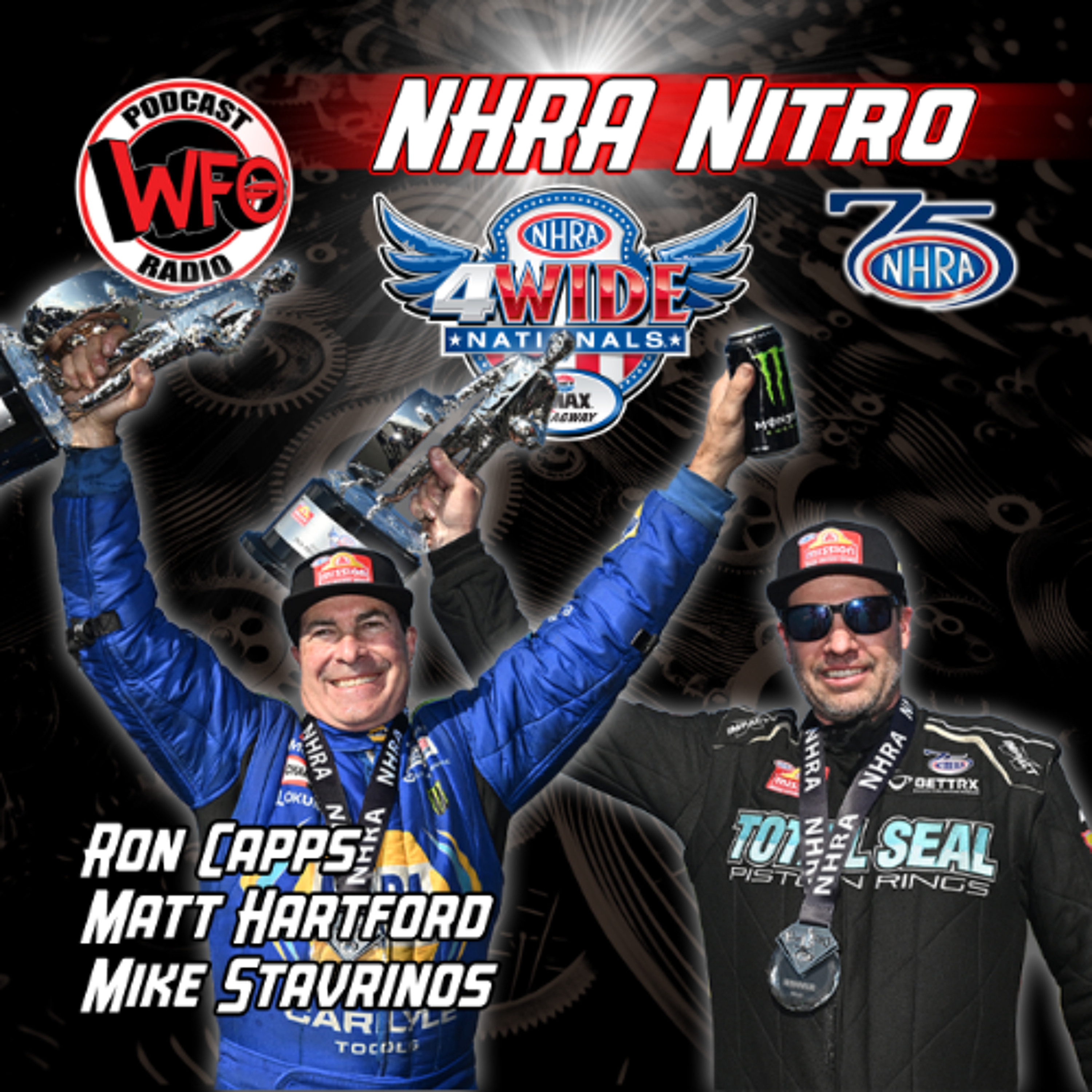
Ron Capps, Matt Hartford, and Mike Stavrinos join WFO Radio after 4-Wide NHRA Nationals
About this episode
Ron Capps breaks down his Four-Wide NHRA Nationals win, including how tuning changes and lane strategy helped him get the job done after a tough final-round loss in Pomona. Mike Stavrinos talks about his Pro Mod victory, the focus required on the tree, and a rule change that added weight to his combination before the next race. Matt Hartford closes things out with a detailed look at Pro Stock parity, beating Greg Anderson twice, and how a shift-light failure cost him in Indy.
diesel particulate filter
"Looking to replace your OEM diesel particulate filter or diesel oxidation catalyst? Look no further than DPF X-Fit, a complete line of aftermarket diesel particulate filters..."
A diesel particulate filter catches the smoky soot from a diesel exhaust. If it gets too full, the truck can lose performance or trigger warning lights, and it may need cleaning or replacement.
A diesel particulate filter (DPF) traps soot (particulate matter) from diesel exhaust. Over time it can become clogged and may require regeneration or replacement, depending on the vehicle and how it’s driven.
diesel oxidation catalyst
"Looking to replace your OEM diesel particulate filter or diesel oxidation catalyst? Look no further than DPF X-Fit, a complete line of aftermarket diesel particulate filters and diesel oxidation catalyst designed as an exact fit OEM replacement..."
A diesel oxidation catalyst is an exhaust device that helps clean up diesel fumes. It can also help the system burn off soot so the DPF can stay working properly.
A diesel oxidation catalyst (DOC) helps convert harmful exhaust gases into less harmful compounds, and it can also support DPF regeneration by improving exhaust chemistry. Many modern diesel systems use a DOC upstream of a DPF.
DPF X-Fit
"Look no further than DPF X-Fit, a complete line of aftermarket diesel particulate filters and diesel oxidation catalyst designed as an exact fit OEM replacement with all makes coverage for light, medium and heavy duty trucks."
DPF X-Fit sells replacement emissions parts for diesel trucks. They’re advertising filters and catalysts that are meant to match the original equipment fitment.
DPF X-Fit is an aftermarket supplier focused on emissions components for diesel engines. In this segment, they’re promoting diesel particulate filters (DPFs) and diesel oxidation catalysts (DOCs) designed to fit like OEM parts.
friction and wear reducing horsepower
"The number one source of friction in your engine is not what you think. Piston rings rubbing against the cylinder walls generate more friction than any other part of the engine. More friction and temperature means more wear and less horsepower."
The idea is that if an engine has more internal friction, it gets hotter and parts wear out faster. That extra wear and inefficiency can reduce how much power the engine makes.
The segment describes a cause-and-effect chain: more internal friction raises operating temperature, which accelerates wear. As wear increases and efficiency drops, the engine can make less horsepower.
piston rings
"Piston rings rubbing against the cylinder walls generate more friction than any other part of the engine. More friction and temperature means more wear and less horsepower..."
Piston rings are the small metal bands on the piston that help seal the engine and manage oil. If they create too much friction against the cylinder walls, the engine runs hotter, wears faster, and can lose power.
Piston rings seal the combustion chamber and control oil on the cylinder walls. This segment claims piston rings rubbing against cylinder walls create significant friction, which can increase temperature, wear, and reduce horsepower.
Total Seal
"Fortunately, the team at Total Seal knows how to reduce friction and wear through innovative piston ring design. If it takes a piston, Total Seal could build a better ring."
Total Seal makes piston rings. The pitch here is that their ring design reduces friction inside the engine, which can help reduce wear and keep power from being wasted.
Total Seal is an aftermarket piston ring company known for ring designs intended to reduce friction and wear. In this segment, they’re tying their ring design to improved efficiency and reduced loss of horsepower.
Zmax Dragway
"We're coming from Zmax Dragway. We're headed to South Georgia Motorsports Park."
Zmax Dragway is a drag strip where NHRA-style races happen. The hosts mention it to tell you where they were before heading to the next track.
Zmax Dragway is a drag racing facility referenced as the show’s starting location for the NHRA event travel. It’s relevant context for listeners following the NHRA schedule and where the hosts are coming from.
Napa
"Fans of Napa, fans of Toyota, fans of Ron Kapp, fans of Winners, fans of Maddie."
NAPA is a company that sells car parts and supplies. In racing, they often sponsor events and teams, so you’ll hear them mentioned a lot around motorsports.
NAPA is an automotive parts retailer and brand that sponsors motorsports and provides aftermarket parts and supplies. When a show mentions “fans of NAPA,” it’s usually pointing to sponsorship support and the brand’s presence in the racing community.
Toyota
"Fans of Napa, fans of Toyota, fans of Ron Kapp, fans of Winners, fans of Maddie."
Toyota is a major automaker that has a strong presence in motorsports and enthusiast culture. In drag racing contexts, Toyota name-drops often relate to sponsorship, fan communities, or specific vehicles/teams.
bracket racers
"So listen, I have some friends that are bracket racers. Not bracket racers. They're Lucas Oil racers."
Bracket racing is drag racing where you’re trying to match a target time instead of just going as fast as possible. The goal is to be consistent and hit your number, which can make racing feel more fair and strategic.
Bracket racing is a drag-racing format where competitors try to hit a specific elapsed-time “dial-in” rather than simply run the fastest pass. It rewards consistency and reaction-time accuracy, so cars can be very different but still compete on the same timing target.
Lucas Oil
"So listen, I have some friends that are bracket racers. Not bracket racers. They're Lucas Oil racers."
Lucas Oil is a company that makes automotive lubricants and also sponsors racing teams. In racing talk, mentioning Lucas Oil usually means the team is part of that sponsored scene.
Lucas Oil is a major motorsports sponsor and oil brand that has long supported drag racing and NHRA events. When someone says “Lucas Oil racers,” they’re typically referring to teams or drivers backed by that sponsorship ecosystem.
big show has kind of stagnated
"And I'll be very honest with you. When I say that they will tell me they feel like the big show has kind of stagnated. You know, like, I don't, I'm racing."
They’re basically saying the top-level racing show doesn’t feel fresh anymore. That can happen when the same kinds of cars win and the sport doesn’t change much over time.
“Big show” stagnation is a commentary on how the top-tier drag-racing spectacle can start to feel repetitive if technology, rules, or competitive dynamics don’t meaningfully change. In motorsports, stagnation often comes from limited innovation, predictable outcomes, or a lack of new contenders.
nitro cars
"I don't need to go watch those nitro cars because really it's the same that it's been 20 years ago."
Nitro cars are drag racers that use nitromethane fuel. That fuel helps them make extremely strong power, which is why they’re famous for fast launches and a loud, dramatic sound.
“Nitro cars” refers to drag-racing vehicles that run on nitromethane fuel, commonly used in NHRA Top Fuel and Funny Car classes. Nitro changes how the engine produces power—these cars make huge thrust-like power and are known for intense acceleration and distinctive sound.
weld
"[245.2s] I was like, well, the girl can weld. [247.9s] She can fabricate. [249.4s] She's the real deal as real as it gets."
Welding is how you permanently join metal parts together. It’s a key skill for building and repairing race car parts that need to be strong.
Welding is a metal-joining process that fuses parts together using heat (and sometimes filler material). In racing, welding is commonly used for roll cages, brackets, exhaust components, and other structural or custom fabrication work.
fabricate
"[247.9s] She can fabricate. [249.4s] She's the real deal as real as it gets. [252.0s] And like, that's what I like."
To fabricate means to build or create parts by cutting, shaping, and assembling materials—often metal—rather than buying a finished component. In motorsports, fabrication skills are valuable for custom brackets, mounts, and race-specific hardware.
ratchets
"[277.5s] And she's got her hand around a box and she's guessing these tools [281.6s] and she's rattling off sizes of ratchets and what style"
Ratchets are hand tools used to tighten or loosen fasteners with a reversible mechanism. In a racing context, knowing tool sizes and styles matters for quick repairs and accurate assembly.
Atlanta Braves game
"[289.7s] And for our fans, actually, Wednesday night, [291.0s] and I'm not sure if it's nationally shown, [294.4s] but she is throwing the first pitch out [297.1s] at the Atlanta Braves game Wednesday night against Detroit Tigers."
They’re talking about a baseball game where the racer is doing the first pitch. It’s just a fun off-track moment mentioned in the show.
The hosts mention the Atlanta Braves game as a crossover moment, with the racer throwing the ceremonial first pitch. While not automotive, it’s part of the episode’s narrative about the racer’s public presence.
Detroit Tigers
"[294.4s] but she is throwing the first pitch out [297.1s] at the Atlanta Braves game Wednesday night against Detroit Tigers. [302.8s] So she is, we're going to practice throwing the ball."
They mention the Detroit Tigers as the team the Braves are playing. It’s just part of the story about the first pitch.
The Detroit Tigers are mentioned as the opponent in the baseball game where the racer throws the first pitch. This is a sports reference rather than an automotive one.
1000th win
"I hope we didn't like crank up the pressure on him for the 1000th win and Pomona. I don't know if that would have mattered. No, Guido, it might have, especially if he would have saw the trophy. ... And forever, Matt will be the 1000th winner."
“1000th win” is a milestone win count for a driver in NHRA competition, marking a historic level of success. In drag racing, reaching a milestone like this is often celebrated because it reflects consistency across many rounds and seasons, not just a single standout performance.
Pomona
"I hope we didn't like crank up the pressure on him for the 1000th win and Pomona. I don't know if that would have mattered. No, Guido, it might have, especially if he would have saw the trophy."
Pomona is a well-known NHRA drag-racing event location in California. When people talk about “Pomona” in drag racing, they usually mean a big, important race.
Pomona refers to the NHRA event held at the Pomona drag strip in California. It’s a major stop on the NHRA calendar, so references to “Pomona” usually mean a high-profile race where teams and drivers are under extra pressure.
NHRA funny car
"I've led a blessed life being an NHA driver, but that thing's pretty neat. And forever, Matt will be the 1000th winner. So proud of him, proud of their team. But man, that was a tough one. It was close, but, you know, we got him back this last weekend."
NHRA is a drag-racing organization. A “funny car” is a type of race car built specifically for short, intense drag races where the goal is to accelerate as fast as possible.
NHRA is the National Hot Rod Association, and a “funny car” is a specific drag-racing class with short, wide bodies and a purpose-built drag powertrain. In funny cars, teams tune the car for maximum acceleration over a very short distance, and race outcomes can hinge on reaction time, traction, and how well the car stays composed under hard launches.
slid down the funny car
"What you did, and he came over to you and he grabbed you and you guys embraced. You slid down the funny car. You're doing that again, Ron."
This sounds like what the driver did right after the run—moving or sliding along the funny car as part of the celebration or getting situated. Funny cars are very race-focused, so getting in and out can look a little unusual.
“Slid down the funny car” is describing a driver’s movement after the run—typically sliding or moving along the car’s body/side as they exit or celebrate. In funny car culture, drivers often do quick, dramatic post-run gestures because the car is low, wide, and built for racing rather than comfort.
sliding down the nose
"If you're sliding down the nose of the funny car again... That's the Eric Medlin slide."
“Sliding down the nose” means the car isn’t hooking up and is slipping during the start. That can make the run slower and less consistent.
“Sliding down the nose” describes a loss of traction where the car’s front end (or nose area) is not gripping and the car skates during launch or early acceleration. In drag racing, this often points to traction/setup issues and can hurt performance and consistency.
reaction time
"I was questioning my reaction times last couple of years... But of course, the reaction time just seemed off the last couple of years."
Reaction time is how quickly you leave the line after the lights tell you to go. Even if the car is quick, a slow reaction can cost you the race.
In NHRA drag racing, reaction time is the delay between the start signal and when the driver launches. It’s measured in thousandths of a second and can make or break a pass even if the car is fast downtrack.
time slip
"...run over and look at the time slip like some of these drivers do."
A time slip is the scorecard from your run. It shows how fast you went and how quickly you reacted to the start lights.
A time slip is the printed (or electronic) record of a drag race run showing elapsed time (ET) and reaction time. Drivers use it to evaluate performance and compare passes, but some focus more on the starting lights and feel in the car.
wind lights
"I never have, because wind lights are so much more important... and I'm just focused on doing the best thing in the car that I can do."
“Wind lights” is about the starting lights at the drag strip. If you time your launch well when those lights come on, you can react faster and improve your race result.
“Wind lights” refers to the race’s starting light system (the Christmas tree) and the driver’s ability to time the launch. In drag racing, getting the timing right is crucial because it directly affects reaction time and can determine who wins at the line.
Christmas tree
"I never have, because wind lights are so much more important... and I'm just focused on doing the best thing in the car that I can do."
The Christmas tree is the set of lights at the drag strip that tells you when to go. If you launch at the right moment, your reaction time improves.
The Christmas tree is the starting light system used in drag racing to signal when the driver should launch. Timing it correctly is essential because it determines reaction time and can decide the outcome even when the car is otherwise fast.
quad
"And you had a very difficult quad. We don't normally make the number one qualifier. Also, the quad of Doom, it turned out we didn't get to have a pre-race show anyway... But the most challenging quad was definitely the quad you were in as number one qualifier..."
In NHRA racing, a “quad” is basically a group of four cars that race against each other in a round. If you win your matchups in that group, you move on and get a better shot at the next round.
In NHRA Top Fuel/Funny Car qualifying, a “quad” refers to a four-car bracket group within a round of eliminations. Getting through your quad means you advanced past that set of matchups, which is a big deal because it determines who you face next.
number one qualifier
"We don't normally make the number one qualifier. Also, the quad of Doom... But the most challenging quad was definitely the quad you were in as number one qualifier... So, but we qualify number one and we all know that Jimmy's going to figure out"
In NHRA, qualifying runs decide the starting order for the elimination rounds. If you’re the “number one qualifier,” you were the fastest in qualifying and you start at the top seed.
“Number one qualifier” means the car posted the fastest qualifying run in its class, earning the top seed for eliminations. That usually gives you favorable matchups early, but it doesn’t guarantee an easy day because eliminations are head-to-head.
pre-race show
"Also, the quad of Doom, it turned out we didn't get to have a pre-race show anyway because we were racing on Sunday morning."
Tracks often have a scheduled “pre-race” event before the cars actually start racing. They’re saying they didn’t get to do that because their race was already happening Sunday morning.
A “pre-race show” is an event segment scheduled before the actual racing begins, often involving media, interviews, and sponsor activities. In this context, it’s mentioned as something they missed because the schedule had them racing Sunday morning.
ladders
"No, I always joke with my guys, we have ladders that you look at sometimes and there's cars that might be struggling in the weekend or a part-time car might show up."
The “ladder” is the bracket that shows which cars will race each other and who advances. Teams look at it to see what matchups they could get.
“Ladders” refers to the elimination bracket charts used to map out matchups and potential paths through the rounds. Teams use these charts to anticipate who they might face next based on qualifying position.
part-time car
"we have ladders that you look at sometimes and there's cars that might be struggling in the weekend or a part-time car might show up."
A “part-time car” is a race car that only shows up for some events instead of racing every weekend. Because they don’t run all the time, their performance can be hard to predict.
A “part-time car” is a team/entry that doesn’t compete in every event of the season, often showing up only for select races. In eliminations, these cars can be unpredictable—sometimes they’re not at full rhythm, but other times they’re strong enough to upset higher-seeded teams.
qualify number one
"So, but we qualify number one and we all know that Jimmy's going to figure out"
If you “qualify number one,” you’re the fastest in qualifying and you get the best starting position. But you still have to win your head-to-head races after that.
Qualifying number one means the team earned the top seed based on the fastest qualifying performance. The hosts are emphasizing that once you’re the top seed, you still have to execute in eliminations—especially against tough opponents.
4-Wide NHRA Nationals
"...after 4-Wide NHRA Nationals [595.7s] One race a year at the four wide now [597.6s] and the only four wide of the year."
In 4-wide drag racing, four cars race at the same time on the same track. The hosts are saying this is a rare event, and it’s tough because each lane behaves a little differently.
“4-Wide” refers to a drag racing format where four cars race side-by-side on the same run. The hosts discuss how lane choice and track conditions affect performance, and they emphasize that this event is effectively the one major 4-wide race of the year.
cloud cover
"[545.2s] So to have that car is a big unknown [547.1s] and we had cloud cover and great conditions Sunday morning. [551.2s] So that also helps for somebody"
Cloud cover can affect track temperature and air density, which in turn influences traction and engine performance. In drag racing, those changes can shift how easily a car hooks up and how consistent the car feels across runs.
comfort zone
"[551.2s] So that also helps for somebody [554.1s] that's trying to find their comfort zone like Jimmy proc is. [557.9s] You know, Spencer, I'm a huge Spencer Hyde fan."
In drag racing, a driver’s “comfort zone” is the range of conditions and setup where the car responds predictably—especially around launch and early acceleration. When conditions change (like cloud cover or track grip), drivers may need to adjust their approach to get back into that predictable window.
lane
"[566.6s] And Guido, you know, he wanted that right lane. [570.1s] It's a tough lane to drive in a funny car. [574.2s] But it was not an easy day."
In 4-wide drag racing, each lane can have different traction and surface characteristics, so the same car can feel noticeably different depending on where it runs. That’s why drivers may prefer a particular lane and why lane choice is discussed as a performance factor.

funny car
"[566.6s] And Guido, you know, he wanted that right lane. [570.1s] It's a tough lane to drive in a funny car. [574.2s] But it was not an easy day."
A “funny car” is a drag-racing race car built for maximum acceleration. It’s tough to drive because small changes in traction and launch timing can dramatically affect how it behaves.
“Funny car” is a drag racing class with purpose-built, short-wheelbase cars that run high power and use a lightweight body over a specialized chassis. Because they’re so sensitive to traction and launch timing, lane differences can make them especially challenging to drive.
murderous road
"[575.8s] And we have a lot of our wins when we look back. [578.2s] It's like murderous road, you'd call it like in baseball, right? [582.8s] You look at it and you go, my gosh,"
The phrase “murderous road” is a metaphor for a difficult, unforgiving stretch of racing where conditions and outcomes feel harsh. In context, it reflects how quickly a weekend can turn from promising to challenging based on track behavior and performance.
pit area
"The pit area, first of all, that track is deceiving for anybody watching at home. I know you can get on the internet and type in what's going on with the lack of fans."
The pit area is the “team zone” at a race. That’s where mechanics and crew work on the cars between runs so they’re ready for the next pass.
In drag racing, the pit area is where teams park, service, and prepare the cars between runs. It’s also where crew members do quick adjustments, refuel/refresh as allowed, and handle logistics during the event.
grandstands
"That is one of the biggest grandstands we have. Guido was, he was telling me that, I mean, you walked in the pit area and if you stood up by the staging lanes and looked down, it was wall to wall people."
Grandstands are the big seating areas where fans watch from. The hosts are saying the same number of people can look smaller or bigger depending on the track and where the cameras are.
Grandstands are the main spectator seating areas at a motorsports venue. The hosts compare grandstand capacity and visibility between tracks to explain why the crowd can look different depending on camera angles and venue design.
Gainesville grandstand capacity
"But those grandstands and you could take Gainesville grandstand capacity and put it up there at ZMAX and it would look like it was a little bit empty."
They’re comparing how many people the stands can hold at Gainesville versus ZMAX. The goal is to show why it might look emptier on TV at one place than another.
This refers to comparing spectator seating capacity at Gainesville (a drag racing venue) to ZMAX. The hosts use the comparison to explain how crowd size can look different across tracks even if attendance is strong.
NASCAR stars
"Of course, the fans there, it just seems like there's with one race at ZMAX and then also a four wide. I think you throw that in and, we had a lot of NASCAR stars come out and hang out"
They’re talking about famous NASCAR drivers showing up at the drag race. When big-name stars from another series attend, it can bring extra attention and fans.
The hosts mention NASCAR stars showing up at the drag event. Cross-pollination like this can boost mainstream interest and attendance because fans of one motorsport series follow personalities to another.
IndyCar
"and a lot of IndyCar. So it was a lot of excitement, a lot of really good, juicy, you know, excitement around this race."
IndyCar is a major U.S. racing series with open-wheel race cars. When the hosts mention IndyCar, they’re usually talking about the kind of racing crowd or attention the event drew. It helps set the scene for what else was going on in motorsports.
IndyCar is the top open-wheel racing series in the United States, known for road courses, street circuits, and oval races. Mentioning “a lot of IndyCar” suggests the event had crossover attention or shared venue context with IndyCar fans/coverage. It’s a useful reference point for listeners to understand the broader motorsports audience.
burnout in a nitro car
"Kyle Larson there is on the record as having to agreeing to try to do a burnout in a nitro car. He says, I don't want to make a run. He's like, I would do a burnout though."
A burnout is when the car spins its tires to warm them up. A “nitro car” runs on nitromethane fuel, so it’s extremely powerful and can be tricky to control while doing that. Drivers sometimes debate whether it’s worth doing before a race run.
A burnout is when a driver heats the tires by spinning them under power before a run. In a nitro car (common in NHRA Top Fuel/Funny Car), the engine uses nitromethane, so the burnout is more about managing traction and heat than just “showing off.” It’s also a safety/strategy decision because nitro cars are loud, powerful, and can be harder to control at low speeds.
outside of the groove
"because you revealed that Guido told you that he wanted you to drive around the outside of the groove. All right, that's explain that because it sounds very precise."
On a race track, there’s usually a best path where the tires grip the most—people call that the “groove.” Driving on the outside of it means going wider than the usual fast line, which can help you pass or avoid getting stuck in traffic. It can also change how the tires wear and how much grip you feel.
The “groove” is the preferred racing line where the track surface provides the most grip. Driving “around the outside of the groove” means taking a wider path, often to avoid traffic, set up a pass, or exploit changing grip patterns across the track. At high-level oval racing, small line changes can significantly affect speed and tire behavior.
tunnel in the track for the fans and racers
"at certain tracks, I mean, they have the tunnel there, right? It was one of those tracks that put a tunnel in for the fans and racers because there's a parking lot on one side."
Some motorsports venues build a “tunnel” or covered passage that separates or channels pedestrian and vehicle movement around the facility. In the context of racing, it can affect how fans view the action and how teams stage, enter, or move between areas. Track design like this is part of the overall event experience and logistics.
track settling over the years
"...it does create a little bit of adversity when things start to settle over the years of the track and the tunnel is concrete and it's under."
Tracks can change as they age. Over time, the surface can become slightly uneven or behave differently, and that can make one lane feel better than another.
The hosts are describing how a drag strip’s surface and structure can change over time—especially near features like tunnels or underpasses. As the track settles, it can create subtle differences in how the surface behaves, which can translate into lane-to-lane performance variation.
tunnel is concrete and it's under
"...when things start to settle over the years of the track and the tunnel is concrete and it's under. So it creates a little bit of a jump or a small..."
They’re talking about a section of the track that goes over/under something like a tunnel. The structure underneath can make that spot feel slightly different, like a small bump.
This describes a track feature (an underpass/tunnel) with a concrete structure beneath it. Such construction can affect how the track surface transitions and can contribute to a “bump” or small step that drivers feel when crossing that area.
Four Wides
"So it's a cool perk, but it does create a little bit of adversity when things start to settle over the years of the track... So these lanes, having a choice of four lanes, when we first started Four Wides..."
“Four Wides” is a drag-racing setup where four cars can run at the same time. Because the track isn’t perfectly identical in every lane, where you’re placed can affect how well your run goes.
“Four Wides” refers to the NHRA-style four-lane drag racing format where multiple cars race side-by-side. The key idea is that lane assignment matters because track conditions and surface settling can make one lane slightly faster or more consistent than another.
Safety Safari
"And over the years, Safety Safari, they do such a good job. It pretty much was evening out."
“Safety Safari” sounds like the crew that helps keep the event safe and the track conditions consistent. In this context, they’ve helped make the lanes behave more evenly over time.
“Safety Safari” appears to be the event’s safety/track-prep crew responsible for managing conditions and ensuring consistent racing. The implication is that their work over time helped even out lane-to-lane differences.
low-qualifier Friday night
"We went low-qualifier Friday night in lane one. But lane four, Guido is having me."
“Low-qualifier Friday night” describes a qualifying position earned on Friday that determines lane choice later. In drag racing, qualifying order often influences which lane you get, because organizers and drivers try to balance fairness with track-condition advantages.
groove (NHRA drag racing)
"Guido said I'm going to line you up outside of the groove, lane four, ... listen, I need you to be back in the middle of groove, but do it about 400 feet. ... don't just drive out and go over in the groove and then because it'll upset the car."
The “groove” is the part of the track that has the best grip. If you’re in the groove at the wrong time or in the wrong spot, the car can feel unstable. So drivers try to get the tires to hook up smoothly for the launch.
In NHRA drag racing, the “groove” is the preferred lane area on the track where the surface has the best traction and consistency. Drivers are coached to position the car in that rubbered-in area at the right moment so the tires hook up without upsetting the car’s balance. The goal is repeatable launches and straight acceleration rather than just “driving into” the groove.
tire traction / "better rubber"
"...do not bring in a lot of times if we're lined up in better rubber on the starting line, he'll get on the radio and say, listen, I need you to be back in the middle of groove..."
As cars run on a drag strip, they leave rubber behind, and that rubber usually makes the track stickier. If your tires hit that sticky area at the wrong time, the car might not launch straight or smoothly. So the driver is told to aim for the best-grip spot.
“Better rubber” refers to the rubber laid down on the track by previous runs, which typically increases grip. In drag racing, small changes in where and when the tires contact that rubber can dramatically affect launch stability and acceleration. That’s why crew members may instruct a driver to adjust positioning rather than simply staying in one lane location.
400 feet positioning call
"...he'll get on the radio and say, listen, I need you to be back in the middle of groove, but do it about 400 feet."
That “400 feet” comment is basically telling the driver when to make the move into the best-grip part of the track. The car doesn’t hook up perfectly instantly—traction builds as it accelerates. So they’re telling you to time the move so it launches smoothly.
The “about 400 feet” instruction is a timing/positioning cue for when the driver should move into the best-grip area. In drag racing, the car’s weight transfer, tire loading, and traction build-up happen over the first portion of the run, so the optimal line isn’t necessarily where the car starts. Crew chiefs use distance markers to coordinate that transition for maximum consistency.
launch stability (avoiding upsetting the car)
"So in other words, don't just drive out and go over in the groove and then because it'll upset the car. So you try to get it in the groove at the right spot without really upsetting things..."
“Upsetting the car” means making it feel unstable—like it might wiggle or not go straight. On a drag strip, grip changes can happen fast, so you have to get the tires to hook up smoothly. Otherwise the car can react unpredictably.
The crew is emphasizing that entering the groove incorrectly can “upset the car,” meaning it can lose its intended balance and tracking. In a drag car, sudden traction changes or lateral movement can cause instability that affects both the launch and the straight-line run. That’s especially critical because the car is accelerating extremely quickly.
0 to 100 in less than one second (drag acceleration)
"...because we're traveling zero to a hundred right in less than one second. You got to be very careful..."
Drag cars speed up extremely fast, so there’s almost no time to fix mistakes. If the tires don’t have the right grip at the right moment, the car can get unstable. That’s why the crew is so picky about where the car is on the track.
The hosts highlight how quickly a drag car accelerates—so small steering or traction errors become huge problems. When acceleration is that rapid, the car can’t “correct” gently; it needs to be placed correctly from the start to maintain straight tracking. That’s why the conversation focuses so much on precise lane/groove positioning.
tunnel effect
"[830.3s] I guess you'd call it where the tunnel is, [832.4s] it will buck you to one side or the other."
The “tunnel” is the track area where airflow can change. That airflow can push the car slightly left or right, so drivers have to account for it to stay straight.
The “tunnel” refers to the drag strip’s enclosed/covered areas that can create airflow effects. Those airflow changes can push the car toward one side, affecting stability and where the car tracks down the track.
shallow
"[847.5s] So the good thing about running good [850.1s] and staying in a shallow as you can race day [853.1s] is keeping lane choice."
Here, “shallow” seems to mean keeping things as consistent as you can during race day. The goal is to avoid changing too much so the car acts the same each run.
In this context, “shallow” likely refers to keeping the car’s setup/approach as consistent as possible across race day rather than making big changes. Drag teams often aim for repeatable conditions so the car behaves the same from pass to pass.
clutch disc quandary
"And I think you were very public about the clutch disc quandary. Might have even gone back into 24, the like learning discs, what they want, how they react, get them in there."
On a drag car, the clutch discs help the car hook up when you launch. The “quandary” is basically the problem of picking the right kind so it performs well and doesn’t wear out or behave unpredictably.
In NHRA drag racing, the clutch disc is a critical wear-and-performance part for launching and managing drivetrain engagement. A “clutch disc quandary” refers to the challenge of choosing the right disc material/behavior and setup so the car can consistently hit the desired performance without slipping or wearing out too quickly.
learning discs
"Might have even gone back into 24, the like learning discs, what they want, how they react, get them in there. And you said, in Austin's back to back championships, you really couldn't, couldn't fight them the way you wanted because you just weren't where you needed to be with the discs."
“Learning discs” are basically test clutch parts. The team tries different ones to figure out which ones work best for how the car is being driven and what the track is like.
“Learning discs” implies a structured testing approach where teams try different clutch disc options to understand how they behave under specific conditions. The goal is to learn what the discs “want” (operating window) and how they react so future race setups are more consistent.
Austin's back to back championships
"And you said, in Austin's back to back championships, you really couldn't, couldn't fight them the way you wanted because you just weren't where you needed to be with the discs. I'm feeling like in 2026 to 75th season of NHRA, based on these diamond wallies you're collecting,"
“Back to back championships” means winning the championship two years in a row. The hosts are saying that to beat a top team like that, you have to get the car’s launch/clutch setup right and keep it consistent.
The phrase refers to a driver/team winning consecutive NHRA championships, which raises the bar for consistency and setup refinement. In this context, the hosts connect championship-level results to having the clutch disc setup “where you needed to be,” implying small drivetrain differences can decide who can repeat wins.
NHRA 75th season
"I'm feeling like in 2026 to 75th season of NHRA, based on these diamond wallies you're collecting, there's one over your right shoulder right now, guys, if you haven't noticed it,"
They’re talking about NHRA’s 75th season, which is basically a big anniversary year. It’s why they’re discussing what the team is planning for the future.
The hosts reference the NHRA’s 75th season, framing the discussion around what changes or improvements are expected going into that milestone year. This is more of a broadcast context marker than a technical detail, but it helps listeners understand why they’re talking about planning and setup for the upcoming season.
clutch discs for how long
"Are you set on clutch discs for how long? Are you good for this season? And can you reveal that? Is that even something you'd want?"
Asking “Are you set on clutch discs for how long?” points to the practical race-team problem of disc life and replacement intervals. In drag racing, clutch discs can wear quickly or change behavior as they heat up and degrade, so teams must balance performance with how long a given setup will remain reliable through a season.
Bonifani Friction
"Thanks to Rob Bonifani and Bonifani Friction, [960.2s] we are better."
Bonifani Friction makes parts that create friction inside racing drivetrains. Those parts matter because they help the car transfer engine power reliably during hard launches.
Bonifani Friction is a motorsports friction-material supplier. In drag racing, friction components are critical because they directly affect how reliably and consistently the car can put power to the track.
cluster
"The nitro cars, top fuel or funny car, [968.1s] the cluster, [968.9s] and as probably what Jimmy Prock is going through right now,"
Here, “cluster” is basically the racing community around nitro cars. The point is that the people who race and work on these cars all know what’s going on.
In this context, “cluster” likely refers to the group of teams/people and the competitive ecosystem within the nitro classes. It’s used to emphasize that everyone in the sport understands the same underlying performance factors.

top fuel dragster
"I'm still, we're a single car team, [974.6s] but we now added a top fuel dragster. [976.8s] So we're able to grow a little bit,"
A Top Fuel dragster is a specialized nitro drag-racing car built to go as fast as possible off the line. Adding one to a team means more equipment and more focus on the parts that control launch and power transfer.
A Top Fuel dragster is the NHRA’s nitro-fueled, purpose-built drag racing car designed for maximum acceleration over a short distance. Teams often run multiple cars/classes, and adding a Top Fuel dragster changes the program’s resources, parts strategy, and setup priorities.
multi-car teams
"scag, you go to these multi-car teams [988.9s] and what DSR used to be."
Multi-car teams run more than one race car. That can help them share resources and learn faster, but it also makes managing parts and setup more complicated.
Multi-car teams field more than one race car, often across the same or different classes. The advantage is shared infrastructure and data, but it also means more complex logistics for parts, personnel, and tuning decisions.
12,000 horsepower
"Almost anybody could make that 12,000 horsepower. [999.7s] It's putting it through the bell housing"
They’re talking about how insanely powerful these race cars are. When power is that high, even tiny setup or parts changes can make the car launch differently.
The “12,000 horsepower” line highlights how extreme the power levels are in nitro drag racing. At these outputs, small changes in drivetrain engagement and traction can have outsized effects on performance and consistency.
bell housing
"It's putting it through the bell housing [1001.5s] and to the ground to those good year tires."
The bell housing is the transmission/driveline housing that connects the engine to the gearbox and contains components like the clutch assembly. In drag racing, how power is routed through the bell housing and clutch area affects engagement timing, durability, and repeatability.
good year tires
"and to the ground to those good year tires. [1004.0s] So it's slightest movement,"
“Good year tires” refers to Goodyear, a major tire manufacturer heavily involved in motorsports. In Top Fuel/Funny Car, tire choice and compound are crucial because traction determines how effectively the car converts power into acceleration.
slightest movement / slightest little change
"So it's slightest movement, [1006.6s] slightest little change means"
This emphasizes the sensitivity of nitro drag racing to tiny changes in setup and drivetrain behavior. Because the car is operating at extreme power and traction limits, small variations can change launch characteristics and consistency run-to-run.
running 390 or running 415
"or running 390 or running 415. So with that being said,"
“Running 390” vs “running 415” refers to different engine displacement or class-related setups in drag racing, where teams choose a configuration to match performance goals and rules. The speaker frames it as part of the broader “making it” vs not-making-it conversation, implying the choice affects competitiveness.
DSR
"Jimmy, a lot of crew chiefs on big teams, they're able to like DSR and Colett and all them, they can buy a hundred thousand dollars at the beginning of the season of a bunch of clutch discs."
DSR is a common NHRA shorthand for Don Schumacher Racing, a major drag racing organization. In the segment, it’s referenced as an example of a big team with enough budget to buy and stage performance parts early in the season.
single car team
"but when you're a single car team, like when I branched off to form our ownership, Guido, of course, came with me. We didn't have that anymore."
A single-car team is a racing operation that focuses on just one car. With fewer cars, there’s usually less money and fewer spare parts to try different things, so it can be harder to stay competitive.
A single-car team in NHRA doesn’t have the same scale of resources as multi-car organizations. That affects budgeting for expensive consumables and the ability to test different setups, which can influence whether the team can “make it” consistently.
John Force Racing
"but I would assume that Jimmy Proc is probably going through that he's not at John Force Racing anymore."
John Force Racing is a major NHRA racing team. When people move on or off a big team like that, it can affect what parts, support, and people they have access to.
John Force Racing is one of the most prominent NHRA teams, historically associated with top-level Funny Car competition. Mentioning it in this context highlights how team resources and staffing can change when someone leaves or moves between organizations.
weather/air-condition changes affecting clutch performance
"And then when they make them the next day, it could be hotter out, more humid in Philadelphia where Bonifani is. The air quality could be different and small changes like that. When they make another thousand discs,"
Weather can change how the car runs. When it’s hotter or more humid, the engine and drivetrain can behave a little differently, so racers may need to adjust parts or setup to get the same launch every time.
The hosts are describing how day-to-day conditions—like temperature, humidity, and local air quality—can change engine output and drivetrain behavior. Even when you’re using the same parts, those small environmental differences can require tuning (like selecting different clutch disc characteristics) to keep performance consistent.
tuning with different clutch disc hardness (harder/softer)
"they're going to be slightly different, harder, softer, believe it or not. So things change like that, and it actually makes a difference on these discs. So you have to figure out what you like."
Even the same clutch type can come in slightly different “grip” levels. Racers choose harder or softer versions to help the car launch the way they want for that day.
They’re explaining that clutch discs can be produced with slightly different friction characteristics—described here as harder vs. softer. Racers use that variability to match the car’s launch needs to track and conditions, effectively treating disc selection as part of the performance tuning process.
qualifying-run testing by swapping one clutch disc
"when we know we're going to be short on one disc of those six in the car, he'll slide one in that we know we need to get to and he'll put just that one in and make a run during qualifying and see what it did."
They’re talking about testing parts during qualifying. If they don’t have enough of one disc, they’ll put in the one they need, make a qualifying run, and see how it performs.
The segment describes a practical race strategy: when they’re short on one clutch disc, they swap in the specific disc they need and then test it during qualifying. This lets them quickly evaluate which disc choice works best before the elimination rounds.
tune around that
"I can tune around that. And then you have another set of discs to go four or five more races."
It means the team changes the car’s settings to work around a problem. Instead of giving up, they adjust so the car still launches and runs well.
In NHRA drag racing, “tuning around” a problem means adjusting the car’s setup so it can still perform even if something isn’t perfect. Teams change things like engine calibration, traction strategy, and chassis settings to keep the car consistent run after run.
another set of discs
"And then you have another set of discs to go four or five more races. So it's a battle."
They’re talking about a part that wears out after a while. The team replaces it so the car can keep running strong for the next few races.
“Discs” here likely refers to a consumable racing component that has a limited number of passes or races before it needs replacement. In drag racing, teams often manage wear items to keep performance consistent across multiple events.
battle
"So it's a battle. It really is. And first teams like ours especially."
They mean the competition is tight and every race matters. Teams keep adjusting and trying to stay ahead.
The speaker frames the season as a “battle,” meaning teams are constantly trading advantages through qualifying, race strategy, and incremental tuning. In NHRA, consistency and managing resources (like parts and setup changes) often matter as much as raw speed.
cut those lights
"And I'm able to luckily just go up and cut those lights. And we needed every bit of it."
It means getting a great start. You want to leave the line at the right moment so you don’t lose time to the other car.
“Cut those lights” refers to reacting quickly at the start line and timing the launch so the car leaves right as the tree signals. In drag racing, reaction time and launch timing are critical because small timing differences can decide a race.
South Georgia Motorsports Park
"But South Georgia Motorsports Park, we're going to a new venue for the first time this year. We're going to go to four new venues."
They’re talking about a specific race track—South Georgia Motorsports Park—that the series is going to for the first time this year. Different tracks can change how the car hooks up and how teams set up their tune.
South Georgia Motorsports Park is being referenced as a venue the series is visiting for the first time that year. Track changes matter in drag racing because surface prep, layout, and weather can all affect traction and tuning decisions.
US 131
"But US 131, we haven't been. Buds Creek, Maryland International Raceway,"
US 131 is a race venue they’re mentioning as part of their schedule. New or less-visited tracks can mean teams have to adjust how they launch and tune the car.
US 131 is cited as one of the venues they haven’t been to yet in this context. Track selection is important in drag racing because it influences traction, staging consistency, and how teams dial in launch and driveline behavior.
Buds Creek, Maryland International Raceway
"US 131, we haven't been. Buds Creek, Maryland International Raceway,"
They’re naming more race tracks—Buds Creek and Maryland International Raceway—as part of the schedule. Each track can behave differently, so teams often need different setup approaches.
Buds Creek and Maryland International Raceway are listed as additional venues in the schedule discussion. Different tracks can change grip and weather sensitivity, which affects how teams prepare cars and manage performance.
Epping
"Yeah, it's like first time I went to Epping, right? I mean, it's still a small old school, takes you back in time venue."
They mention Epping as a place that feels old-school and nostalgic. The point is that some tracks have a classic, smaller feel that racers and fans like.
Epping is referenced as an example of a smaller, old-school racing venue that “takes you back in time.” In the context of NHRA-style racing talk, it’s used to illustrate how certain tracks feel more traditional and grassroots than large modern facilities.
Southern Nationals
"So to bring back the Southern Nationals, I want to go buy a shirt over at the Legends tent at Nitro Mall because that is such a historic event."
They’re talking about the Southern Nationals, a historic race event in the South. The hosts want it back because it matters to the community and the fans.
The Southern Nationals are referenced as a historic NHRA-related event that the hosts want to “bring back.” This is framed as a meaningful addition for both racers and fans, tied to tradition and regional motorsports culture.
Nitro Mall
"I want to go buy a shirt over at the Legends tent at Nitro Mall because that is such a historic event that used to be at commerce for years."
They’re talking about Nitro Mall as a spot at the event where you can shop—like buying a shirt. It’s mentioned because it’s tied to a long-running, historic race weekend.
Nitro Mall is brought up as a place to buy a shirt during a historic NHRA event. The hosts connect it to the “Legends tent” and to the event’s history, implying it’s part of the fan-facing race-weekend experience.
sportsmen
"but it's going to be more of a professional show, not as many sportsmen, so it's going to be more focused around the pro racing for the fans."
“Sportsmen” are racers who aren’t in the top pro ranks. They still race competitively, but the event focus is usually more on the pro teams.
In NHRA drag racing, “sportsman” refers to non-professional racers who compete in brackets and lower-tier classes. They’re typically contrasted with the NHRA Pro categories that draw the biggest TV/spotlight attention.
XM Satellite Radio
"ESPN and Fox Sports, I am WFO Radio. [1400.8s] After my XM Satellite Radio days, I started this business."
They’re mentioning a satellite radio service they worked with before starting their own show. It’s not a car part—just background on how the podcast/radio show got started.
XM Satellite Radio is referenced as part of the host’s career path before starting the WFO Radio business. It’s relevant here because it explains how the show transitioned from satellite radio to an ongoing motorsports media operation.
HustyPerformance.net
"People like HustyPerformance.net. [1413.9s] These are parts and pieces for race cars. [1416.4s] Copper head gaskets, copper gaskets of all kinds, [1419.6s] but composite gaskets as well."
They’re talking about a race-focused shop/website that sells performance parts. In this case, it sounds like they specialize in gaskets and can get them to you fast for racing.
HustyPerformance.net is mentioned as a sponsor that supplies race-car “parts and pieces,” specifically focusing on gaskets. The hosts describe it as a resource for getting gaskets quickly for track use, including shipping directly to the track.
copper head gaskets
"People like HustyPerformance.net. [1413.9s] These are parts and pieces for race cars. [1416.4s] Copper head gaskets, copper gaskets of all kinds, [1419.6s] but composite gaskets as well."
A head gasket seals the space between the engine block and cylinder head. Copper head gaskets are a racing-style version that can hold up better when an engine runs very hot or makes a lot of pressure.
Copper head gaskets are gasket materials made from copper, commonly used in high-heat, high-boost, or high-cylinder-pressure racing applications. Copper’s ability to conform and handle heat cycles can help maintain sealing when engines see extreme conditions.
composite gaskets
"Copper head gaskets, copper gaskets of all kinds, [1419.6s] but composite gaskets as well. [1421.8s] Reach out to the folks at HustyPerformance.net."
Composite gaskets are another type of head gasket made from layered materials. They’re used to seal the engine, and different engines may prefer different gasket styles.
Composite gaskets are made from layered gasket materials (often including fibers/resins and elastomer components) designed to seal effectively under normal-to-moderate performance conditions. In racing contexts, they’re often offered as an alternative to metal gaskets like copper depending on the engine and setup.
Bernie's Speed Shop
"Our friends at Bernie's Speed Shop, B-U-R-N-Y-Z-Z.com. This is Josh Hart's home base in Ocala, Florida. If you're buying, you might want to check their inventory... If you're selling, this is what's up."
This is a specialty shop that helps people buy or sell cars. They also offer consignment, which means they help you sell your car instead of you doing all the advertising yourself.
Bernie's Speed Shop is a drag-racing-focused shop in Ocala, Florida that the hosts recommend for buying and selling cars. They mention consignment, implying the shop helps market and sell a car on the owner’s behalf.
Consignment
"They can sell it on Consignment, Bernie's Speed Shop, B-U-R-N-Y-Z-Z.com, Bernie's."
Consignment means you let a shop try to sell your car for you. They usually take a cut, and you only get paid if the car actually sells.
Consignment is when a seller places a car with a dealer or shop to sell, and the shop handles marketing and transactions. The seller typically receives the sale proceeds minus a fee, and the car isn’t sold until the shop finds a buyer.
Redline Synthetic Motor Oil
"Of course, Redline Synthetic Motor Oil will hear about Redline a little bit later on in the show."
Redline is an oil brand. The hosts are saying it’s the kind of oil they’ll talk about later, likely because it’s used for performance driving.
Redline Synthetic Motor Oil is a performance-oriented lubricant brand the hosts say they’ll discuss later. In motorsports contexts, synthetic oils are often chosen for consistent lubrication under heat and high load.
delay boxes
"Think of the delay boxes. Think about Larisse Motorsports Insurance."
In drag racing, a delay box is a gadget that helps control exactly when certain launch actions happen. That can make launches more consistent and repeatable from run to run.
A delay box is an electronic device used in drag racing to control when the car’s launch systems activate. It helps manage timing for things like the transbrake/launch sequence and can improve consistency by reducing driver-to-driver variation.
Larisse Motorsports Insurance
"Think about Larisse Motorsports Insurance. Your equipment, your trailer, your truck, your golf carts, your tools, your race car, all covered regardless of where it is"
They’re talking about a company that sells insurance specifically for motorsports stuff. The point is that regular insurance often has exclusions, so you want a policy that actually covers your race car and tools.
Larisse Motorsports Insurance is referenced as a specialized insurance provider for racing equipment and vehicles. The hosts emphasize coverage for race-related gear and the importance of reading policy exclusions.
race fuel coverage / policy exclusions
"Did it have race fuel in it? Were you on the return road? Sorry, you're not covered."
They’re saying insurance might not pay if certain rules aren’t met—like if you had race fuel in the car or if you were driving on the wrong kind of road. That’s why it’s important to read the policy details.
The segment highlights that some insurance policies may exclude coverage depending on details like whether the vehicle had race fuel onboard or whether it was on a specific route (e.g., a return road). This is a reminder that motorsports insurance often hinges on strict conditions and exclusions.
Request an Explanation
Heard something you'd like explained? We'll add it to this episode.
Sign in to request explanations for terms you heard.
Want to learn more?
Browse our glossary for plain-English explanations of automotive terms, jargon, and concepts.
Help improve this episode
See something that's not quite right? Our annotations are AI-generated and can sometimes miss the mark. Click the flag icon on any annotation to suggest a correction.