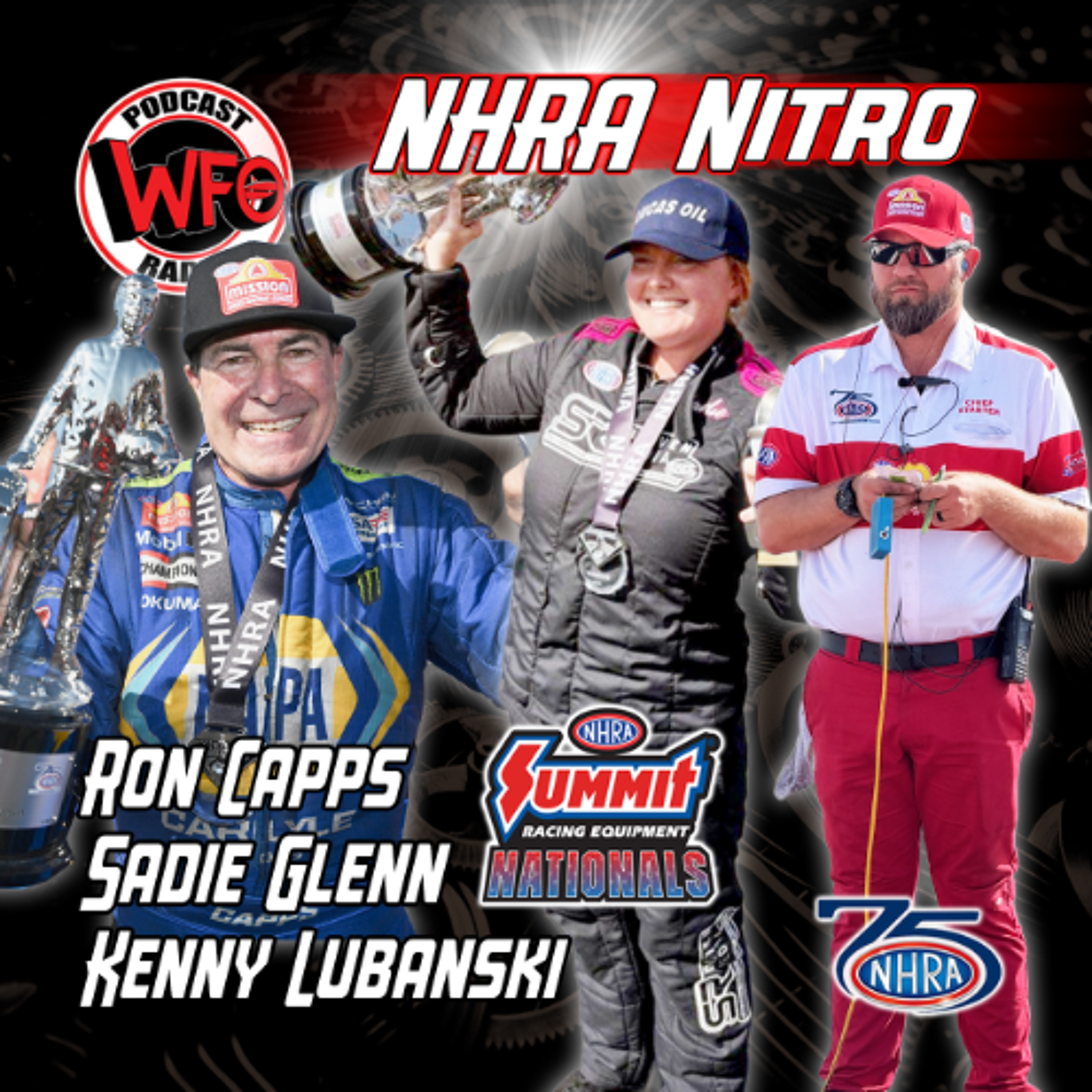
Ron Capps, Sadie Glenn and NHRA Chief Starter Kenny Lubanski join WFO Radio! Plus, Jason Logan!
About this episode
NHRA countdown energy fills WFO Radio as the show looks ahead to the Sonoma–Seattle swing and the pressure of the regular-season stretch. Ron Capps is teased after a strong Norwalk double, while Maddie Gordon and top-dragster standout Sadie Glenn are set for storytelling-focused interviews. The centerpiece is NHRA chief starter Kenny Lubanski, who explains what the job really involves beyond “flipping the switch”: leading a safety-first crew, track prep input, and constant observation for issues. Lubanski also shares his drag-racing roots from English Town and his rise through the NHRA ranks.
Redline Oil
"Redline Oil. Formulated to win. Proven by me."
Redline Oil is a brand of high-performance engine oil. They’re saying their oil is made for hard driving and is intended to reduce friction and wear.
Redline Oil is a lubricant brand that produces high-performance engine oils. The host is reading a promotional line claiming the oil is formulated to reduce friction and improve durability under demanding use.
friction
"The number one source of friction in your engine is not what you think."
Friction is the “drag” between moving engine parts. More friction means more heat and faster wear, and it can reduce the engine’s power output.
In an engine, friction is the resistance to motion between moving parts, which turns mechanical work into heat. Higher friction increases temperature and accelerates wear, reducing how much power the engine can deliver.
piston rings
"Piston rings rubbing against the cylinder walls generate more friction than any other part of the engine."
Piston rings are metal bands on the piston that help keep combustion pressure from leaking and help manage engine oil. If they scrape against the cylinder walls, they create extra friction and heat, which can wear the engine faster.
Piston rings are thin metal rings mounted on the piston that seal the combustion gases and help control oil use. When piston rings rub against the cylinder walls, that sliding friction creates heat and contributes to engine wear.
cylinder walls
"Piston rings rubbing against the cylinder walls generate more friction than any other part of the engine."
Cylinder walls are the inside surfaces of the engine cylinder where the piston slides. If the surfaces create too much friction with the piston rings, the engine can wear out faster.
Cylinder walls are the inner surfaces of the engine’s cylinder where the piston moves up and down. Their surface condition and friction against piston rings strongly affect wear and efficiency.
piston ring design
"Fortunately the team at Total Seal knows how to reduce friction and wear through innovative piston ring design."
Piston ring design is how the rings are built and shaped to seal properly and slide with less rubbing. The goal is less friction and less wear while still keeping the engine sealed and lubricated correctly.
Piston ring design refers to the shape, materials, coatings, and geometry of the rings that control sealing and friction. Better ring design can reduce rubbing losses and wear while maintaining compression and oil control.
Total Seal
"Fortunately the team at Total Seal knows how to reduce friction and wear through innovative piston ring design."
Total Seal is a company that makes piston rings for engines. They’re being discussed here as a brand that makes rings aimed at reducing friction and engine wear.
Total Seal is an aftermarket performance brand known for piston rings and related engine wear-reduction products. In this segment, they’re credited with ring designs intended to reduce friction and wear.
NHRA Nitro
"Hey everybody WFO Radio is back a little NHRA Nitro as we second off weekend so to speak for the Mission Foods drag racing series"
This is the show’s drag-racing segment tied to NHRA events. It’s basically the part of the podcast where they talk about what’s coming up in the drag racing calendar.
This refers to the NHRA drag racing coverage/segment the hosts are discussing. It frames the episode as being tied to the NHRA schedule and upcoming races.
Seattle
"western swing Sonoma, Seattle, back-to-back, little minor break, Brainerd, Minnesota, the big go."
Seattle is one of the race stops they’re listing in the run of NHRA events. They’re using it to explain how quickly the schedule moves.
Seattle is another stop in the NHRA “western swing” sequence mentioned by the hosts. It’s part of the run of back-to-back races that can decide championship momentum.
NHRA countdown
"Just like that the NHRA countdown is upon us. Regular season championships will be decided is crunch time now."
The “NHRA countdown” is the final stretch of the season where points matter most. It’s when teams have to perform well because the championship is getting decided.
The “NHRA countdown” is the postseason points battle that determines who advances toward the NHRA championship. The hosts frame it as crunch time where teams must be competitive.
Brainerd, Minnesota
"Sonoma and Seattle maybe in the future another comeback who knows but you still got to have your stuff right. So we got a big show for you today"
Brainerd, Minnesota is one of the drag racing stops on their schedule list. They’re highlighting it as a major upcoming event in the run of races.
Brainerd, Minnesota is named as a key NHRA race location in the schedule sequence. The hosts contrast it with the earlier swing races to emphasize the “big go” stretch.
Wally
"someday maybe if the thing goes in the right direction and she did it she won a Wally and it was amazing."
A “Wally” is the trophy drag racers win at NHRA events. If someone says they won a Wally, it means they won a race.
In NHRA drag racing, a “Wally” is the trophy awarded to event winners. It’s a named prize (not just a generic trophy), so hearing it signals a major accomplishment in the sport.
top dragster
"I'm gonna ask her also a little bit about all this top dragster stuff. Fast cars, slow cars."
“Top dragster” is a specific type of drag racing category. The cars are purpose-built to go as fast as possible in a straight line under NHRA rules.
“Top dragster” is a specific NHRA drag racing class for purpose-built dragsters. It’s different from other categories because of the rules around engine setup, weight, and how the cars are configured to run straight-line acceleration.
nitro cars
"responsibility of flipping the switch when nitro cars are in the final round."
“Nitro cars” are drag racers that use nitromethane fuel. It helps them make a lot of power, but it also means the car needs special setup and careful handling.
“Nitro cars” refers to drag racing vehicles that run on nitromethane fuel. Nitro engines produce very high power but require specialized fuel systems, tuning, and safety procedures.
catalytic converters
"But Jesse Converters, Global Emissions System Incorporated, the G-Sport brand, and the DPFX fit. Catalytic Converters guys for over the road trucks."
Catalytic converters are parts in the exhaust that help clean up engine fumes. They reduce pollution by changing harmful gases into less harmful ones.
Catalytic converters are emissions-control devices that use catalysts to reduce harmful exhaust gases. In racing sponsorship talk, they’re being referenced as a product category used for street/over-the-road trucks as well as broader vehicle emissions needs.
Performance Transmissions
"Fti Performance Transmissions and Tour Converters."
A performance transmission is a stronger, race-focused gearbox. It’s designed to survive hard acceleration and deliver the right gearing for fast launches.
Performance transmissions are upgraded gearboxes built to handle the torque and shock loads of racing launches and repeated hard runs. In drag racing, the transmission’s durability and shift behavior are critical to keeping the engine in its power band.
torque converters
"Fti Performance Transmissions and Tour Converters."
A torque converter is a part in an automatic transmission that helps the car get moving smoothly and strongly. For racing, it’s tuned so the engine hits the right power right at launch.
Torque converters are fluid couplings used in automatic transmissions to multiply torque at launch and allow the engine to keep spinning while the car accelerates. In drag racing, converter stall speed and lockup behavior are tuned to improve launch consistency and elapsed times.
English Town
"So your original track was English Town? Yep. So many time there. Wow. I raced juniors there."
English Town is a drag-racing track in New Jersey. It’s the kind of place racers and fans return to year after year, so losing it feels personal.
English Town refers to Englishtown Dragway in New Jersey, a well-known NHRA drag racing venue. It’s famous for hosting drag racing events and for being a longtime “home track” for many racers and fans.
junior dragster
"as the 10-year-old kid running in junior dragster out there with the NAPs and everybody."
A junior dragster is a smaller drag-racing car for kids and teens. It’s often how young racers get started before moving up to adult classes.
A junior dragster is a youth drag-racing car designed for children/teens, typically with smaller dimensions and power than adult dragsters. It’s a common entry point into drag racing for future racers.
NAPs
"running in junior dragster out there with the NAPs and everybody. So on that, David NAP was a friend"
“NAPs” sounds like a nickname or group name for people the speaker knew at the track. It’s probably not a general car term, more like a local racing-community reference.
“NAPs” appears to refer to a group of people associated with the track/scene the speaker grew up around, likely fellow racers or staff. In this context it’s not a widely standardized drag-racing term, so it’s best treated as a proper-name reference.
pro stock bikes
"So I came in just after Eddie started going to the pro stock bikes."
Pro Stock Bikes are a motorcycle category in drag racing. The bikes are based on real models you can buy, but they’re modified to race hard and launch consistently.
Pro Stock Bikes are a motorcycle drag-racing class where production-based bikes compete under NHRA rules. The bikes are heavily modified for acceleration and consistency while still tied to a production platform.
Miami Hollywood Speedway
"And how I lost my home track. I got the Miami Hollywood Speedway tree back there."
Miami Hollywood Speedway was a drag strip in Florida. The “tree” reference means it was where they first experienced the start/launch setup as part of racing and announcing.
Miami Hollywood Speedway was a drag racing facility in the Miami/Fort Lauderdale area of Florida. The speaker mentions getting the “tree” there, indicating it was a meaningful venue in their announcing and racing history.
tree
"I got the Miami Hollywood Speedway tree back there. That's where I got my first runs in as an announcer, as a racer."
In drag racing, the “tree” is the set of lights that tells drivers when to launch. It’s how the race start is timed and kept fair.
The “tree” in drag racing is the starting light system (the electronic signal) that controls the countdown and green light for the launch. It’s central to timing, staging, and fairness in every run.
Division III
"So I started in Division III, which is the mid-north central area."
Division III is a regional part of NHRA drag racing. It groups events and people by location, and it’s often where careers start before stepping up to national events.
Division III is one of NHRA’s regional competition divisions, used to organize racers by geography and event schedule. It’s where officials and competitors can build experience before moving to the national event structure.
Indianapolis
"Yep. Indianapolis, Norwalk, Will Tharp, Division Director."
Indianapolis is mentioned as one of the locations in the region for Division III. It helps show that NHRA organizes events by where they’re held.
Indianapolis is referenced as part of the geographic region covered by Division III. It indicates how NHRA divisions are organized by area rather than by car class or performance level.
national side
"And then 22, I got the opportunity to come over to the national side as the assistant starter"
The “national side” means the bigger, top-level NHRA events. It’s the step up from regional races, with bigger crowds and more serious officiating.
The “national side” refers to NHRA’s top-level event circuit where races are run at major national events rather than regional division events. Moving to the national side typically means higher visibility, more complex operations, and more responsibility for officials.
chief starter position
"And then in Gainesville this year is when they debuted the chief starter position again."
The chief starter is the lead official in charge of how races get started at NHRA events. They coordinate the starting crew and make sure the launch process is run correctly and safely.
The chief starter position is the top starting-line leadership role within NHRA event operations. The chief starter oversees the starter function for national events and coordinates the crew and procedures that manage the race start and related safety responsibilities.
safety safari
"You're leading a crew. There's the whole safety safari is part of it."
“Safety safari” is a colloquial term used in drag racing for the safety-focused crew activity around the track and starting area. It generally refers to personnel checking conditions and responding to safety needs before and during events.
first hundred foot
"Yeah. And some people think it's just switching, flipping the switch, but that's not all that goes into it. Probably the first hundred foot is technically my area"
The “first hundred foot” is the very beginning of a drag race, right after the launch. It’s where cars are accelerating the most, so officials pay close attention to how things are going.
The “first hundred foot” is a critical early section of a drag strip where cars are accelerating hard and the start sequence transitions into full launch. It’s often treated as a key zone for monitoring behavior, traction, and whether the run is proceeding safely and correctly.
track prep decisions
"of expertise, but, you know, I help in with all the track prep decisions and trying to make sure [798.4s] that we're going to have a safe and good racetrack."
Track prep is what drag-race officials do to make the track surface consistent. It’s meant to help cars get good traction safely, instead of slipping or behaving unpredictably.
In drag racing, “track prep” refers to the behind-the-scenes work that makes the racing surface consistent—things like cleaning, applying traction compounds, and managing temperature and moisture. “Track prep decisions” are the choices officials make to balance grip, safety, and predictable performance.
racetrack
"that we're going to have a safe and good racetrack. I'm always just watching the cars, you know, [807.4s] watching the racetrack itself is the best thing you can do to figure out if something's wrong,"
A racetrack is the specific place where cars race. In drag racing, it’s a straight strip, and officials watch it closely because car problems can spill onto the track.
A “racetrack” here isn’t just a generic road course—it’s the specific drag strip surface and layout where cars accelerate in a straight line. In this context, the speaker emphasizes that problems with a car will show up on the track surface and area.
Norwalk
"Um, you know, Dallas Glenn had an issue last weekend in Norwalk, and he's coming back and [825.1s] I could see a couple of specs of something."
Norwalk is a place where drag races happen. The host is saying a driver had a problem there last weekend.
Norwalk refers to a drag racing venue in the U.S. where NHRA events are held. The speaker uses it as the location of a recent incident involving Dallas Glenn.
fuel
"there was just a big puddle [830.5s] of fuel. So, you know, fuel, maybe not that big of an issue, but when it's pouring out of the car [836.0s] like that, you can't let him go down."
Fuel is the car’s gasoline or racing fuel. If it’s leaking badly, it can be a serious fire risk and also makes the track unsafe.
“Fuel” is mentioned as a safety hazard when it’s leaking or pouring out of a drag car. In drag racing, a fuel spill can quickly become dangerous because it can ignite and also affects traction and control.
safety is number one
"like that, you can't let him go down. So we're always looking out safety is number one. [843.9s] Performance of the track is number two. And you just go on from there."
In racing, safety comes first. If something looks dangerous—like a fuel leak—officials will stop the car from making the run.
This phrase summarizes the operational priority in drag racing: safety comes before performance. When there’s a leak or other hazard, officials may stop a run to protect drivers, crews, and spectators.
E-town
"Moody Drag Racing Chronicles says, [870.5s] what's up, Kenny? Friday night's under the tower. E-town for life. This guy, [875.1s] Fast Eddie, ran junior from 97 to 03 out there at E-town."
“E-town” is short for Englishtown, a famous drag racing track. People talk about it like a home base for the sport.
“E-town” is a common nickname for Englishtown Raceway Park, a well-known drag racing venue. The speaker and callers reference it as a major part of drag racing history and culture.

Chevrolet C5
"...E-town. Great hearing from Kenny, says Troy Hall. C5 Pete raced E-town up until 2008 and from 2008 unt..."
The Chevrolet Corvette is a sports car made by Chevrolet. People often choose it for racing because it’s built for speed and handling. The podcast mentions a specific older generation (C5) that was used at the track.
The Chevrolet Corvette is a long-running American sports car known for its performance and for being a popular choice in racing and enthusiast circles. In the podcast context, the C5-generation Corvette is specifically mentioned as a car that was raced at E-town up through 2008 and beyond, highlighting its track use and competitiveness. It’s discussed because it represents a well-known platform for drag/track performance during that era.
classes
"the faster your decisions have to be. So you got to be on point. You know, a lot of people give me credit for being able to hyper focus, I guess is the best term."
“Classes” are categories of race cars. Cars in the same class follow similar rules and race each other.
In NHRA drag racing, “classes” are groupings of cars based on rules and performance limits. The class determines who competes against whom and what procedures and expectations apply at the start line.
hyper focus
"a lot of people give me credit for being able to hyper focus, I guess is the best term. But I'm always trying to watch out for the drivers and my people and the crew and making sure nobody's"
“Hyper focus” just means concentrating extremely hard. In this job, it’s about staying fully locked in so nothing unsafe gets missed.
“Hyper focus” is used here as a description of intense, sustained attention under fast-changing race conditions. In a starter/crew role, it means tracking multiple cars and safety details at once.
flip the switch
"Like Buster, you know, being out there forever millions of pairs, right? Like that's not that's not right. Like there's got to be other people that can flip the switch."
“Flip the switch” is a motorsport slang phrase for initiating the race start sequence (the moment the starter system authorizes the launch). It’s not about an actual electrical switch being flipped by the driver.
alcohol
"Then we decide for who's going to get alcohol? Who's going to get showdown?"
“Alcohol” here means a specific type of racing fuel used in some drag-racing classes. It’s different from regular gasoline and changes how the car is tuned and run.
In NHRA drag racing, “alcohol” typically means alcohol-based fuel (commonly methanol or similar blends) used by certain classes. Fuel choice affects engine tuning, power characteristics, and safety procedures.
showdown
"Then we decide for who's going to get alcohol? Who's going to get showdown?"
“Showdown” sounds like a specific race category or segment the event uses. It’s the kind of label crews use to decide who runs what.
“Showdown” is a named NHRA event/class segment referenced by the crew’s scheduling. In this context it likely indicates a specific race category or round type with its own procedures.
starting line
"I get to stand on the starting line a little bit further back than you. And I'm happy about that. You are getting blasted by nitro cars every time down."
The starting line is where the race cars line up to launch. In nitro drag racing, it’s also where you’re closest to the intense blast and noise when the cars fire up.
The starting line is the drag strip’s launch area where the cars stage and then accelerate down the track. In nitro classes, being positioned differently on the starting line changes how you experience the blast and the immediate forces when the cars go.
flipping the switch
"And how is flipping the switch for nitro cars different just in terms of feeling and responsibility?"
“Flipping the switch” means the official starts the race and the cars are released to launch. With nitro cars, the moment they go is especially intense and requires instant control.
“Flipping the switch” is drag-racing shorthand for the moment the starting system is activated to release the cars. For nitro cars, that instant is a major sensory event—drivers and crew feel the violent launch and must manage timing and control immediately.
trackside
"So I like the thing that we're doing now. We're bringing fans out there to stand kind of trackside and giving more people that experience, which is great..."
“Trackside” means standing right next to the racing action on the track. It’s a closer, more intense way to experience the cars going down the strip.
“Trackside” means being positioned along the drag strip near the racing lanes, rather than in the stands. The hosts describe bringing fans trackside so they can experience the nitro runs directly, including the physical sensations and noise.
V in between the lanes
"Pomona is one where we can can get people out there to the V in between the lanes and they are changed forever."
The “V in between the lanes” refers to a specific spectator viewing area on a drag strip positioned between the two racing lanes. It’s described as a spot where fans can see and feel the cars’ passes closely, which the speaker claims changes how people understand the physics and forces involved.
Pomona
"Pomona is one where we can can get people out there to the V in between the lanes and they are changed forever."
Pomona refers to the NHRA drag racing venue in Pomona, California, known for hosting major national events. The hosts mention it as a place where fans can be brought trackside for a particularly immersive experience.
top fuel dragsters
"You know, so like top fuel dragsters, depending on which one's coming at me first and the burnout and trying to watch it go by..."
Top Fuel dragsters are the extreme drag-racing cars built to go as fast as possible over a short distance. The starter’s job includes watching for safety and readiness before the race begins.
Top Fuel dragsters are the fastest drag-racing cars in the NHRA world, built specifically for short, straight-line acceleration. They use a specialized starting and staging process, including watching the car’s systems and safety equipment before the run.
burnout
"...and the burnout and trying to watch it go by, see if anything's coming off on the burnout or if I could see something spraying out of one of the lines."
A burnout is when the driver spins the tires to heat them up before the run. It helps traction, and it can also show if something is going wrong with the car.
A burnout in drag racing is when the driver heats the tires by spinning them while the car is staged. Starters and crew watch the burnout closely because it can reveal issues like debris, fluid leaks, or parts coming loose.
parachutes
"Then I'm watching them come back. I'm trying to look at the parachutes, make sure there's no pins left in them."
Parachutes are used to slow the car down after the drag strip run. Officials watch that they deploy properly and that nothing is left stuck in the system.
In Top Fuel drag racing, parachutes are the primary high-speed braking system used after the run. The starter/officials watch them deploy correctly and check for issues like pins left in the parachute system.
canopy car
"If the car's a canopy car, making sure the canopy is closed, just trying to look out for them."
A canopy car has an enclosed cockpit area for the driver. The starter makes sure the canopy is shut because it’s a key safety feature.
A canopy car is a drag-racing configuration where the driver is enclosed behind a canopy for protection. The starter checks that the canopy is closed because it’s part of the car’s safety setup before the run.
pre-sage lights
"And after that, I kind of focus in on the lights. And then once I see two pre-sage lights, I'm hitting that switch."
The pre-sage lights are early signals in the drag strip countdown that tell the starter the cars are staged and ready. Once those lights come on, the starter is ready to trigger the final start.
Pre-sage lights are part of the drag strip starting-light sequence that indicates when cars are properly staged and ready. The starter watches for the correct lights before activating the final start signal.
Buster Couch
"But since you're coming on, I'm going to focus on this guy. Buster Couch, what do you say about Buster? I mean, he's a legendary figure."
Buster Couch was a famous person in drag racing. In this conversation, they’re saying he’s a legend in the sport and that Kenny knew of him.
Buster Couch is a well-known figure in drag racing history, often referenced as a legendary starter/official and competitor in the NHRA world. The host is noting that Kenny Lubanski was aware of him even if he never met him.
drivers won't stage
"But what's your decision process when drivers won't stage, i.e., a burn down? That's a good one, right?"
In drag racing, staging is when the car is lined up and ready to launch. If a driver doesn’t stage, the officials have to decide what to do next so the race can start properly.
In drag racing, “staging” is when the car is positioned and ready at the start line so the race can begin on the tree. If a driver won’t stage, the starter team has to manage timing and procedure so the event can still run safely and fairly.
burn down
"But what's your decision process when drivers won't stage, i.e., a burn down? That's a good one, right?"
A “burn down” is when the car keeps running while it’s waiting to be allowed to start properly. It wastes fuel/time and can create timing problems, so officials try to avoid it.
A “burn down” refers to a situation where a car’s engine is kept running (or repeatedly cycled) while waiting for staging to happen, effectively “burning” fuel/time rather than making a clean start. In nitro classes especially, this becomes a procedural and safety/timing issue for the starter team.
wait time
"The other classes, you know, it all depends on what class you're running. Everyone's got a different wait time that they could sit there"
“Wait time” is how long a car is allowed to sit there ready before it has to go. Different types of drag cars have different rules for that timing.
“Wait time” is the allowed period a car can remain staged/ready before the starter team expects it to commit to the run. Different classes have different timing windows, which affects how starters handle delays or repeated staging issues.
ProMod
"I think my favorite one was back in Gainesville a couple of years ago during ProMod. It was probably two, two and a half minutes long."
Pro Mod is a drag-racing class for cars that are heavily modified for maximum speed. It’s not a stock car category—teams build specialized machines to go as fast as possible.
Pro Mod (ProMod) is a class in drag racing for highly modified, purpose-built drag cars. The cars are typically altered far beyond stock and are designed to run very fast quarter-mile times.
Gainesville
"I think my favorite one was back in Gainesville a couple of years ago during ProMod."
Gainesville is a race location in Florida where drag racing events are held. It’s a common stop for big NHRA competitions.
Gainesville refers to the NHRA drag racing venue in Gainesville, Florida, which hosts major drag-racing events. It’s a recurring stop on the drag-racing calendar, so it often comes up when teams discuss recent races.
National Hot Rod Association
"There goes Kenny Labansky, chief starter for the National Hot Rod Association. Great job."
NHRA is the organization that runs and regulates drag racing events. They make the rules and oversee safety and how races are conducted.
The National Hot Rod Association (NHRA) is the major sanctioning body that organizes and regulates drag racing events in the United States. It sets rules for classes, safety procedures, and event operations.
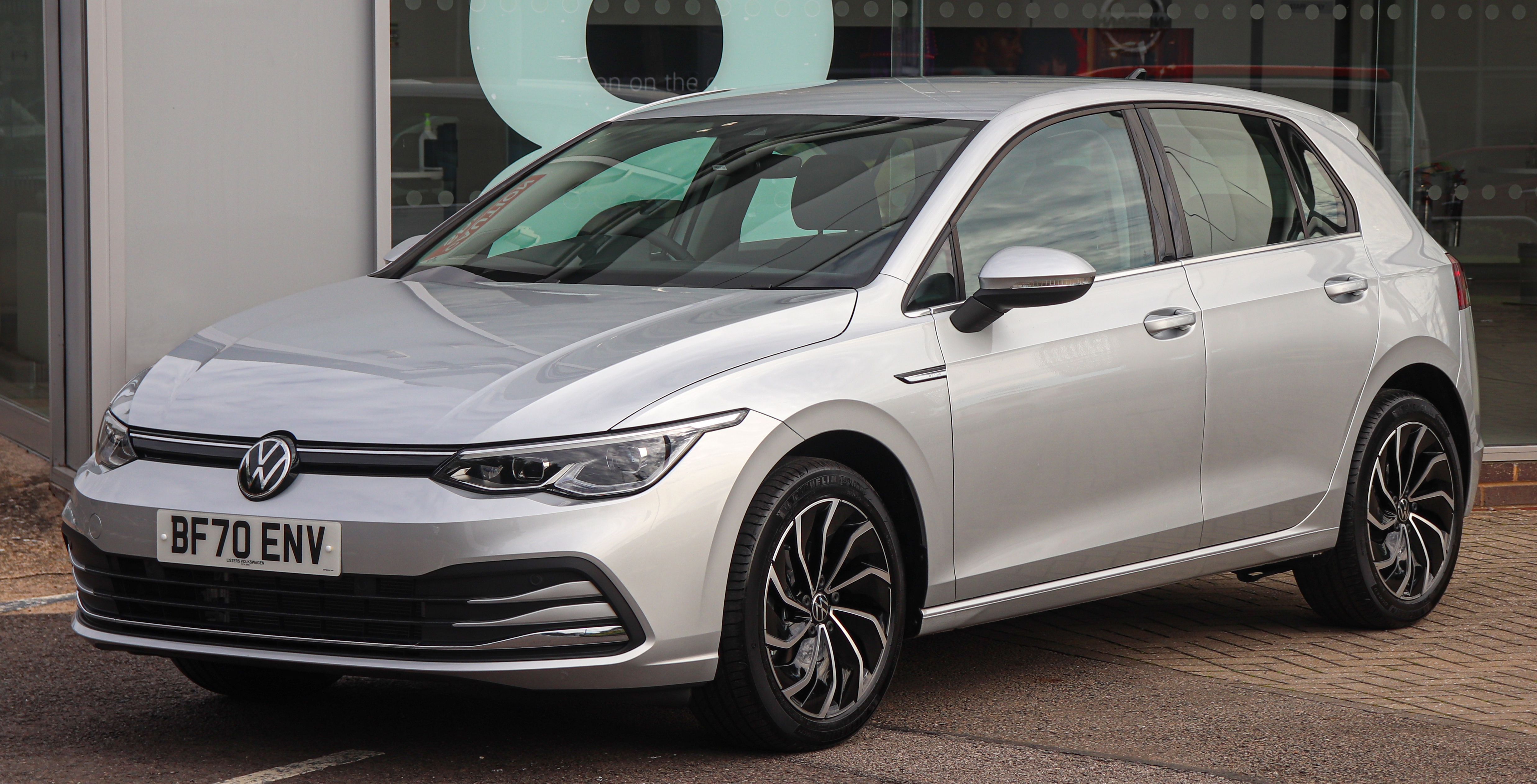
Volkswagen Golf
"...operation, the trailer, all the tools in it, your golf carts, your stuff, they can cover that and they c..."
The Volkswagen Golf is a small car that’s meant to be practical for daily use. It can be used to transport items, especially when you’re loading gear or using a trailer. The podcast brings it up in that “moving equipment” context.
The Volkswagen Golf is a compact car that’s widely used for everyday driving and practical hauling. In the podcast context, it’s mentioned in relation to covering equipment and items in a trailer or load, which points to its role as a vehicle people use to transport gear. It’s discussed because it’s a common, versatile platform for moving “stuff” rather than just commuting.
top end of the track
"Fans will understand when you sit near [2037.5s] the top end of the track, you actually see cars come at you before the noise."
On a drag strip, the “top end” is the part near the finish where cars are going their fastest. It’s the stretch where you can really feel how fast everything is happening.
In drag racing, the “top end” is the far end of the strip where cars are at their highest speeds. It’s also where the cars are closest to the finish line, so the timing and speed feel very different than near the start.
throttles being hit
"And way down there, [2042.6s] you hear the throttles being hit by Antron and Maddie."
In drag racing, “hitting the throttles” means the driver floors it at the start. That quick action helps the car accelerate hard and get up to speed fast.
“Hitting the throttles” means the driver quickly opens the throttle(s) at launch to maximize acceleration. In drag racing, that instant throttle input is critical because it affects how quickly the car builds speed and how well it hooks up.
monitor that's slightly delayed
"And we're watching a monitor that's slightly [2048.4s] delayed. And so you're looking and I, they were locked together."
The monitor is showing the action with a small time lag. So what you see on screen happens just a moment after it actually happens on the track.
A delayed monitor feed means the video you see from the track is not perfectly synchronized with what’s happening in real time. In drag racing, that matters because fans are trying to interpret launches and reaction timing visually.
six figure checks
"There were people, I'm sure they had, [2116.9s] they had six figure checks to drive your car to be part of Ron Cap's motor sports."
“Six figure checks” just means extremely large money payments—hundreds of thousands of dollars. The point here is that getting a top seat can cost a lot.
In motorsports, “six figure checks” refers to very large sponsorship or appearance/drive payments, often used to secure a seat or funding. It highlights how expensive and competitive top-level drag racing drives can be.
Ron Cap's motor sports
"There were people, I'm sure they had, [2116.9s] they had six figure checks to drive your car to be part of Ron Cap's motor sports. [2120.9s] And you went against all of that."
This is talking about Ron Capps’ racing team. He’s a famous drag racer, and his team is the group behind the cars and drivers.
This refers to Ron Capps’ motorsports operation/team. Ron Capps is a well-known NHRA Funny Car driver, and his team runs professional drag-racing programs.
Napa auto parts
"the people from Carlyle tool with Napa auto parts and just it just the way it fell together."
NAPA Auto Parts is a company that sells car parts you can replace after the factory parts. Here, they’re being used as part of a sponsorship/rebrand story.
NAPA Auto Parts is an aftermarket parts brand and retailer that supplies replacement components for many vehicle makes. In this segment, it’s mentioned as part of a rebrand effort tied to the Carlyle tool.
Carlyle tool
"the people from Carlyle tool with Napa auto parts and just it just the way it fell together."
Carlyle Tool sounds like a company that sponsors or supports the racing team. They’re talking about changing how that partnership is presented.
Carlyle Tool is referenced as a sponsor/partner entity that was being rebranded. The segment frames it as a business relationship that connects to racing team branding and support.
apprenticeship
"that want to work on cars, be it, you know, a hybrid or an electric car or old school cars, but rather than go into a four-year college and we preach to these kids that there's great options out there."
An apprenticeship is training where you learn a job by doing it with guidance from experienced people. They’re saying it can be a good path instead of a traditional college degree.
An apprenticeship is a structured training path where someone learns a trade through hands-on work under supervision. Here it’s presented as an alternative to a four-year college for people who want to work on cars.
electric car
"for two years and these options that kids have now that want to work on cars, be it, you know, a hybrid or an electric car or old school cars,"
An electric car runs mainly on electricity stored in a battery. It can require different repair skills than gas cars.
An electric car (EV) is powered primarily by one or more electric motors drawing energy from a battery. The segment highlights that modern technician pathways include EV-specific knowledge.
hybrid
"for two years and these options that kids have now that want to work on cars, be it, you know, a hybrid or an electric car or old school cars,"
A hybrid car uses two power sources, usually a gas engine and an electric motor. That means mechanics may need skills for both systems.
A hybrid vehicle uses more than one energy source—typically a gasoline engine plus an electric motor/battery. The segment uses it to describe the kinds of cars technicians might work on.
pit area
"but rather than go into a four-year college and we preach to these kids that there's great options out there. But you walk in our pit area and we've got a very young group"
The pit area is where racing teams work on the car during the event. They’re pointing out that their team has a lot of young people there.
The pit area is the working zone at a race track where teams service cars between runs. The speaker uses it to describe the team’s young roster and training pipeline.
UNOH
"my team personally, several on my team that went through UNOH and UTI and all these colleges."
UNOH is a school/training program the speaker says some of their team members went through. They’re using it to show there are practical routes into automotive careers.
UNOH (Universal Technical Institute of the North?) is mentioned as one of the training colleges technicians can attend. In context, it’s part of the speaker’s argument that there are real career pathways into automotive work.
UTI
"my team personally, several on my team that went through UNOH and UTI and all these colleges."
UTI is a training school the speaker mentions for people who want to work on cars. They’re pointing out it’s one of several paths into the industry.
UTI is referenced as a technical training college option for automotive careers. The segment uses it to emphasize that aspiring mechanics can get specialized training without a four-year degree.
junior drag race
"One kid I know for sure, junior drag race with Maddie and it never worked on a car."
Junior drag racing is racing for younger drivers. The speaker is saying someone’s racing experience doesn’t automatically mean they know how to work on cars.
Junior drag race refers to youth-focused drag racing competition. In this segment it’s used to describe a driver’s background and how that experience doesn’t always translate to working on a car.
drag race car
"when you're in a drag race car because no one knows what it's like, man. We can't feel that. You got to tell us."
A drag race car is built specifically for straight-line acceleration over a short distance, typically with specialized traction, gearing, and engine tuning. Because the driver’s experience is so different from everyday driving, communication and storytelling matter for fans who can’t “feel” what the driver feels.
first runs
"she's going to tell you we spent a lot of time talking about her first runs or how it's going to feel well before she got her license."
“First runs” are the early test passes where the driver and team learn how the car behaves. It’s when they figure out what feels right and what needs tweaking.
In motorsports, a driver’s “first runs” are early test passes where they learn how the car launches, how it responds, and what adjustments are needed. Teams often use these initial outings to refine setup and driver technique before competition.
sponsors
"Mark Martin was like, he'd get out of the car back in the day and ask, I love Mark Martin, by the way, and he would just rattle off the sponsors."
Sponsors are companies that pay for a team or driver. In racing, you’ll often hear them mentioned a lot because they’re supporting the team.
In drag racing, sponsors are companies that fund teams and drivers in exchange for branding and visibility. The hosts mention “rattling off the sponsors” as a common media habit, showing how sponsorship exposure is part of the sport’s culture.
short block
"...got to put together a short block that's going to go in the car that you're going to drive 330 and beat one of the biggest legends in the sport."
A short block is basically the engine’s bottom half. It’s the part racing teams build so they can swap engines quickly without rebuilding everything from scratch.
A short block is an engine assembly that includes the lower rotating and bottom-end components (like the crankshaft and pistons) but typically excludes the cylinder head(s) and often the intake/exhaust parts. In racing, teams build and swap short blocks to quickly refresh the engine while keeping the rest of the setup consistent.
behind the scenes
"So just little things like that that go on behind the scenes that fans don't even know about."
“Behind the scenes” means the work the team does that you don’t usually see on TV—preparing the car and getting it ready to run well.
In motorsports, “behind the scenes” refers to the off-camera work that determines race-day performance—engineering, assembly, and preparation by the team. The speaker is emphasizing that fans don’t see the build and coordination that lead to results on track.
round by round
"Let's talk about your round by round. But I do want to put a period on that in that the youth..."
Round by round means the race is decided in steps. You race another driver, and if you win you move to the next matchup.
Round-by-round refers to the elimination structure of drag racing, where competitors advance through successive matchups. Each round is a separate head-to-head race that determines who moves on.
final round
"405 had to catch it there, setting up the final round against Jack. Just kind of walk us through to the final."
The “final round” is the last race of the event. The two best remaining competitors race to decide who wins.
The “final round” is the last elimination race in a drag racing event, where the last two remaining cars/teams compete for the win. It’s the culmination of the bracket progression described earlier as “round by round.”
points lead
"JR fighting us for the points lead. They're right there and great run again by Guido."
A “points lead” means one team has the most points in the season standings. It matters because it can change how teams approach races and how much they need to gain or protect.
A “points lead” refers to leading the season standings based on accumulated results. In NHRA-style series, teams earn points per race, so being in the points lead affects strategy and pressure even before the final.
hot track
"They started putting a cylinder up, but it was a hot track. Obviously they lost traction, but we went down there pretty far"
A “hot track” is when the racing surface is warmer than usual. That can change how well the tires grip, so the car may need different setup to launch well.
A “hot track” means the track surface is unusually warm, which can change tire grip and how the car’s power is transferred to the ground. In drag racing, track temperature can make it easier or harder to hook up depending on tire and tune.
traction
"Obviously they lost traction, but we went down there pretty far and then they hit the button"
Traction is how much grip the tires have on the track. If there isn’t enough grip, the tires spin instead of accelerating hard.
In drag racing, traction is how well the tires can grip the track surface without spinning. If traction is poor, the car can’t put down the engine’s power effectively, which hurts acceleration and consistency.
funny car
"Very important, very hard to do in a funny car. And very, you had to be perfect, clutch-wise and motor-wise"
A funny car is a type of NHRA drag racing car with a short, wide body and a highly modified, purpose-built drivetrain. They’re known for extreme acceleration and for being difficult to drive precisely because traction and clutch/engine management are critical.
clutch-wise
"Very important, very hard to do in a funny car. And very, you had to be perfect, clutch-wise and motor-wise because it was tricky."
“Clutch-wise” means how the clutch is being used at launch. Getting it right helps the car get moving without slipping or losing grip.
“Clutch-wise” refers to how the clutch is being managed—timing, engagement, and slip—during launch and early acceleration. In drag racing, clutch behavior strongly affects whether the car hooks up cleanly or bogs/spins.
motor-wise
"And very, you had to be perfect, clutch-wise and motor-wise because it was tricky."
“Motor-wise” means how the engine is performing—how strong it is and how it responds when you put power down. If the engine isn’t right, the car won’t run its best.
“Motor-wise” points to the engine’s behavior—power delivery, tune, and how it responds under load. In a hot, traction-limited situation, the engine’s calibration and output can be the difference between a clean run and a mediocre one.
Nitro Mall
"I just got Nitro Mall is going to have a brand new shirt. They will have there at the tent for people going to that race and online of Maddie's first win."
“Nitro Mall” is basically a fan zone at NHRA races. It’s where you can pick up team gear like shirts and other event merchandise.
“Nitro Mall” is a branded fan/merchandise area associated with NHRA events. In this context, it’s where race-related shirts and team items are sold or displayed for fans attending the meet.
Sonoma
"So and just kind of gearing up for the race day. It's a big event for us. So obviously you want to carry that momentum and then it's back to back with Seattle. That Friday night at Sonoma is probably I would say possibly it's probably the coolest qualifying session of the whole season."
“Sonoma” is a well-known race track in California where major racing events happen. They’re saying the qualifying there is especially cool because it runs into the evening.
“Sonoma” refers to the Sonoma Raceway area used for motorsports events, including NHRA rounds. The hosts highlight it as a standout event because qualifying happens at sunset and the atmosphere is especially memorable.
qualifying session
"So that Friday night at Sonoma is probably I would say possibly it's probably the coolest qualifying session of the whole season. And it's the sun goes down and records fall and and it's a it's a cool place."
Qualifying is when teams run timed passes to earn their spot in the race bracket. The results determine who lines up against who later.
A qualifying session is the timed portion of an NHRA event where teams run to set their starting positions for eliminations. Better qualifying runs generally mean a more favorable lane/seed in the bracket.
Nicky Lauda
"Nicky Lauda. It's a great close up shot of them all burned up from his accident. And he sent that to Caden, my son."
Niki Lauda was a famous Formula 1 race car driver. He had a serious crash and later came back to race again. Here, they’re talking about a photo related to that accident.
Niki Lauda was a legendary Formula 1 driver from Austria, known for winning multiple World Championships and for his dramatic comeback after a severe fire in 1976. In this segment, the hosts reference a close-up photo connected to Lauda’s accident.
Formula 1
"So there you go. There it is. A little Formula 1 crossover there, which we all greatly appreciate."
Formula 1 is the highest level of open-wheel racing. The cars are specialized race machines, and the series is run around the world.
Formula 1 (F1) is the top tier of open-wheel racing run by the FIA, featuring purpose-built single-seat race cars. It’s known for high downforce aerodynamics, advanced engine technology, and global race calendars.
diesel oxidation catalyst
"filter or diesel oxidation catalyst. Look no further than DPFX fit, a complete line of [3232.3s] aftermarket diesel particular filters and diesel oxidation catalyst designed as an exact fit OEM"
A diesel oxidation catalyst is a part in a diesel truck’s exhaust that helps clean up the smoke and gases. It works by turning some of the harmful stuff into less harmful emissions before they leave the tailpipe.
A diesel oxidation catalyst (DOC) is an emissions-control device that helps convert certain exhaust pollutants into less harmful compounds. It’s commonly used on diesel trucks to reduce hydrocarbons and carbon monoxide, and it can also support later emissions systems.
diesel particular filters
"[3232.3s] aftermarket diesel particular filters and diesel oxidation catalyst designed as an exact fit OEM [3237.6s] replacement with all makes coverage for light, medium and heavy duty trucks"
A diesel particulate filter is a device that catches soot from a diesel engine’s exhaust. Over time it needs to clean itself out so it doesn’t get blocked.
Diesel particulate filters (DPFs) trap soot (particulate matter) from diesel exhaust. They periodically burn off the collected soot through a regeneration process to keep the filter from clogging.
OEM replacement
"[3237.6s] replacement with all makes coverage for light, medium and heavy duty trucks with thousands of [3242.1s] units in stock."
“OEM replacement” means the part is made to replace the original factory part. The goal is that it fits correctly and works the way the truck’s system expects.
An OEM replacement means the aftermarket part is intended to match the original equipment manufacturer’s fitment and function. Enthusiasts often care because correct fitment helps ensure the emissions system works as designed and avoids installation issues.
remanufactured
"Always new, never remanufactured. For more information, be sure to visit dpfxfit.com."
Remanufactured means the part was taken apart and rebuilt, often using some original pieces plus new ones. It’s usually cheaper than brand-new, but quality can vary by supplier.
Remanufactured parts are rebuilt components that are restored to a like-new or specified condition, usually using a mix of reused and replaced internal components. In emissions hardware, the quality of the rebuild can matter for durability and performance.
fogging oil
"[3264.2s] Fogget is a high performance fogging oil designed especially for internal combustion engines. [3270.7s] Fogget can be used by everyone."
Fogging oil is a special oil used before storing an engine. It leaves a protective coating inside so the engine parts don’t rust while it sits.
Fogging oil is a protective lubricant sprayed into an engine (often before storage) so it coats internal surfaces. For cylinder walls, it helps reduce corrosion by leaving a film that limits moisture and oxidation while the engine isn’t running.
Fogget
"[3264.2s] Fogget is a high performance fogging oil designed especially for internal combustion engines. [3270.7s] Fogget can be used by everyone."
Fogget is a product used to protect engines while they’re stored. It coats the inside surfaces so rust and corrosion are less likely to happen.
Fogget is a brand of high-performance fogging oil used to protect internal combustion engines during storage. Fogging oil coats cylinder walls to help prevent corrosion when an engine sits for long periods.
internal combustion engines
"[3264.2s] Fogget is a high performance fogging oil designed especially for internal combustion engines. [3270.7s] Fogget can be used by everyone."
An internal combustion engine is the kind of engine that burns fuel inside the engine to make power. Fogging oil is meant to protect those internal parts during storage.
Internal combustion engines (ICE) generate power by burning fuel inside the engine cylinders. The mention matters because fogging oil is specifically intended to protect the cylinder walls and other internal surfaces in ICE setups.
double divisional
"You went to the double divisional. You towed out there by yourself is my understanding."
A “double divisional” is an NHRA race weekend where more than one set of competitors/classes are running over the same event. It changes the rhythm of the weekend, so teams have to plan for long days and quick turnarounds.
“Double divisional” refers to a two-day NHRA event format where competitors run rounds across two divisions/classes during the same weekend. It’s a scheduling setup that can affect how teams plan travel, sleep, and car prep between sessions.
towed out there
"You went to the double divisional. You towed out there by yourself is my understanding."
They mean they transported the race setup by towing it, usually with a truck and trailer. That’s common for race teams because the car is set up for racing and you want it protected on the trip.
“Towed out there” describes transporting a race car using a tow vehicle and trailer rather than driving it normally. In NHRA-style logistics, towing is common because race cars are specialized, and teams often need to keep the car protected and ready for track use.
trailer
"How to stay comfortable sleeping in the trailer because I'm a hotel guy, man... We are literally not using any of those amenities."
In racing, a trailer is basically the team’s mobile home and storage. When you’re at the track for days, it’s where people sleep and keep their equipment ready.
In drag racing, a trailer is the mobile base where a team stays and stores gear between runs. It often includes sleeping space and sometimes power/comfort items, which matters when events run long and require early departures.
Request an Explanation
Heard something you'd like explained? We'll add it to this episode.
Sign in to request explanations for terms you heard.
Want to learn more?
Browse our glossary for plain-English explanations of automotive terms, jargon, and concepts.
Help improve this episode
See something that's not quite right? Our annotations are AI-generated and can sometimes miss the mark. Click the flag icon on any annotation to suggest a correction.