Rumors and Mid-Ohio Recap
About this episode
Scott Dixon, Felix Rosenqvist, and Marcus Armstrong/Quest?—the episode focuses on the IndyCar driver market shakeup: Dixon leaving CGR and McLaren announcing Dixon, Rosenqvist, and Quest, which effectively clears the way for Lundgaard and Siegel to be out. The hosts debate why motorsport can’t keep secrets, arguing the news leaked too slowly for any “big splash” moment. They also discuss how mid-season announcements affect drivers like Christian Lundgaard, emphasizing professionalism, compartmentalizing, and the difference between team relationships and day-to-day performance.
The guys go into rumors and leaked info in IndyCar silly season and how it effects reporting, then they break down the race at Mid-Ohio.
+++
Off Track is part of the SiriusXM Sports Podcast Network. If you enjoyed this episode and want to hear more, please give a 5-star rating and leave a review. Subscribe today wherever you stream your podcasts.
Want some Off Track swag? Check out our store!
Check out our website, www.askofftrack.com
Subscribe to our YouTube Channel.
Want some advice? Send your questions in for Ask Alex to [email protected]
Follow us on Twitter at @askofftrack. Or individually at @Hinchtown, @AlexanderRossi, and @TheTimDurham.
Hosted by Simplecast, an AdsWizz company. See pcm.adswizz.com for information about our collection and use of personal data for advertising.
Hamilton
"like this is Hamilton leaving Mercedes to go to Ferrari, right?"
Hamilton is a famous race car driver in Formula 1. The hosts are talking about him switching teams—from Mercedes to Ferrari—which is a big deal in F1.
Lewis Hamilton is a top Formula 1 driver known for winning multiple World Championships. In this segment, he’s discussed as leaving Mercedes for Ferrari, which is a major driver-team move that reshapes the competitive landscape.
Mercedes
"like this is Hamilton leaving Mercedes to go to Ferrari, right?"
Mercedes here means the Formula 1 racing team. The conversation is about a driver leaving that team for another one.
Mercedes is the Formula 1 team and constructor the hosts mention as Hamilton’s current employer in the context of a driver transfer. Team changes like this are significant because they affect car development direction, strategy, and driver performance.
Ferrari
"like this is Hamilton leaving Mercedes to go to Ferrari, right?"
Ferrari here means the Formula 1 racing team. The hosts are saying Hamilton is going there, which is a big headline in F1.
Ferrari is a historic Formula 1 team and constructor, and the hosts frame it as Hamilton’s destination. Driver moves to Ferrari are especially newsworthy because the team’s culture, expectations, and development priorities are tightly linked to results.
Scott Dixon
"And in the case of Scott Dixon, it's a really, really small pool of options, right?"
Scott Dixon is a top IndyCar driver. The hosts are saying that when he might move, there aren’t many teams he could realistically go to.
Scott Dixon is a well-known IndyCar driver, and the hosts discuss his situation as having a very limited set of potential options. In motorsport, that kind of “small pool” comment usually means his next move is constrained by team availability and contract realities.
Penske
"Cause like Penske's full and Dretty, we think is full and you're probably"
Penske is a well-known IndyCar racing team. The hosts are listing it as one of the possible places a driver like Scott Dixon could go.
Penske refers to Team Penske, a major IndyCar organization that fields cars and signs drivers. The hosts mention it as part of the limited set of options for Scott Dixon, implying Penske is one of the realistic destinations being considered.
Dretty
"Cause like Penske's full and Dretty, we think is full and you're probably"
This is likely “Andretti,” another IndyCar team. The hosts are saying that team probably already has enough drivers, so there aren’t many openings.
“Dretty” appears to be a transcription of “Andretti,” referring to Andretti Autosport, another major IndyCar team. The hosts are saying it’s likely full, which contributes to the idea that Dixon’s options are limited.
continuity
"MSR would be completely replacing their lineup and continuity is a big thing in racing. We talk about that all the time."
In racing, “continuity” means keeping things consistent—like the same people and the same approach—so the team doesn’t have to relearn everything. It can help results because the team stays in sync.
In motorsport, “continuity” refers to keeping the same team structure—drivers, car setup direction, and operational routines—so performance doesn’t reset every season. It’s often discussed alongside driver retention and lineup stability because racing is highly process-driven.
sticker numbers
"That Armstrong got extended, but they said that he's moving from the 66 to the 60, which to me means they're changing one of the sticker numbers on the car."
Racing cars have a big number on them so everyone knows which car is which. If they change the “sticker number,” they’re basically changing the number graphics on the car.
In racing, “sticker numbers” are the visible car number markings (often applied as decals) that identify the entry on track and in broadcasts. Changing the sticker number usually means updating the car’s livery/graphics so fans and officials can track the car correctly.
branding perspective
"And so maybe that car from a branding perspective is like locked into certain brands that they would want a, their lead driver or more established higher profile guy in that's the only thing that I can think of"
“Branding perspective” means thinking about how the team looks and who fans associate with it. Sometimes the car number and graphics are part of the team’s identity.
“Branding perspective” is how a team thinks about marketing value—who is associated with which car number and visual identity. In series with strong fan followings, the car number and livery can become part of the team’s recognizable “brand.”
ECR
"initially when I signed with ECR, you know, the 21 car was the, [917.1s] that was always the lead car, right?"
ECR is the name of the racing team the speaker joined. Teams like this handle the cars, drivers, and sponsorships for races.
ECR refers to a racing team organization that the speaker says they signed with. In motorsport context, a team like this manages car entries, driver lineups, and sponsorship relationships across the season.
lead car
"but you know, initially when I signed with ECR, you know, the 21 car was the, [917.1s] that was always the lead car, right?"
In racing, a “lead car” is the one a team considers the main car to focus on. It’s usually the car they expect to be the most important or most competitive.
In racing, a “lead car” is the car that a team treats as the primary entry—often the one with the most focus, resources, or sponsorship alignment. It can also mean the car expected to be the main contender in a given season or event.
full time car
"Because that was the full, that was Renus full time car. [922.8s] The 20 car was always the Ed was on the ovals"
A “full time car” is the main car that runs most of the races in the season. It’s not a one-off or occasional entry.
A “full time car” means a car that competes in most or all races of a season, rather than being a part-time or substitute entry. In series like IndyCar, the driver and car number are typically tied to that full-season schedule.
ovals
"The 20 car was always the Ed was on the ovals and they had someone else in [922.8s] the road and street courses, right?"
“Ovals” are race tracks shaped like an oval, where you mostly turn one direction. Cars often need different setup and driving than on twisty road courses.
“Ovals” are oval-shaped circuits where cars run mostly left turns at high speed. Setup and driving style often differ from road/street courses because aerodynamic balance and tire management are tuned for sustained cornering.
road and street courses
"The 20 car was always the Ed was on the ovals and they had someone else in [922.8s] the road and street courses, right?"
“Road and street courses” are tracks that aren’t ovals—either a normal race track or a course made from city streets. The car usually needs different setup and driving than on an oval.
“Road and street courses” refer to non-oval circuits: road courses are purpose-built tracks, while street courses use temporary or adapted city streets. These layouts typically demand different braking, traction, and aerodynamic balance than ovals.
sponsor
"because at the time there was a sponsor at the team that if Renus were to [945.4s] leave, they wanted Christian not knowing who the other guy was going to be."
A “sponsor” is a company that pays for a team or driver. In return, they get their name and branding shown during races.
A “sponsor” is a company that funds or supports a team/driver in exchange for branding and marketing exposure. In racing, sponsorship can strongly influence which car number a driver is tied to and how seats are allocated.
five years out
"So the only one that I know of that makes sense to me is, is Aero because [959.8s] their, their company like slogan is five years out, right?"
“Five years out” is a slogan that suggests thinking long-term. The speaker is saying that this kind of message matched what the sponsor wanted.
“Five years out” here is a brand slogan or positioning statement, implying a long-term outlook. In sponsorship discussions, the speaker is using it to explain why the sponsor’s messaging fit the situation.
Roger
"I want to say Roger owned the number five and the team had to go and kind [993.6s] of like acquire it off of Roger."
“Roger” is mentioned as the person who owned the number the team wanted. The team then had to get it from him to make the plan work.
“Roger” is referenced as the owner of a specific car number (“the number five”) in the team’s negotiations. The speaker implies that the team had to acquire that number from him.
Armstrong
"it kind of, for me, it goes back like going [1002.6s] back to Armstrong, like he's done two years now building a brand around"
“Armstrong” is a person the speaker brings up as an example of someone who has been working on their public image or brand for about two years. It’s used to explain why the current situation makes sense.
“Armstrong” is referenced as someone who has been “building a brand” for two years. The speaker is using Armstrong’s recent career/branding timeline as context for the current rumor discussion.
Indy car
"I still, I still think that Indy car needs to pivot to what formula one does"
“Indy car” means the race cars used in IndyCar, a major U.S. open-wheel racing series. They’re different from Formula 1 cars—different rules and design—so they don’t race the same way.
“Indy car” refers to the open-wheel race cars used in IndyCar, a top-level American road-and-oval racing series. They’re purpose-built for high-speed racing and are distinct from Formula One cars in rules, aerodynamics, and engine/technical regulations.
formula one
"I still, I still think that Indy car needs to pivot to what formula one does"
Formula One is the top international open-wheel racing series. In this discussion, it’s being used as a comparison for how racing identity is handled—more around the driver than the team/car number.
“Formula One” (F1) is the premier global open-wheel racing series with its own technical rulebook. The host is comparing IndyCar’s branding/numbering approach to how F1 ties identity more directly to the driver.
branding side
"in the, in modern, in modern Indy car, uh, there's a lot to, you know, the branding side of it, which didn't exist 40 years ago"
In racing, the “branding side” is how the sport markets itself—who the fans associate with the car, the number, and the driver. The point here is that modern racing uses branding much more than it used to.
The “branding side” in racing is how teams and series market identity—like car numbers, driver identity, merch, and social media. The host argues modern IndyCar has more branding leverage than it did decades ago, and that driver-focused branding could be more effective.
F one
"Perstappen and Red Bull, like it, it was really throwing shades of being an F one or shattering news announcement..."
“F one” means Formula 1, the biggest international open-wheel racing series. They’re talking about how news and rumors get attention in F1 compared to IndyCar.
“F one” is the hosts’ pronunciation of Formula 1 (F1), the top open-wheel racing series based in Europe with global coverage. They’re comparing how “breaking news” works in F1 versus IndyCar, and how fan attention shifts when major announcements happen.
Perstappen
"Perstappen and Red Bull, like it, it was really throwing shades of being an F one or shattering news announcement..."
This is Max Verstappen, a top Formula 1 driver. The hosts bring him up while discussing big F1 news that people pay attention to.
“Perstappen” is a transcription error for Max Verstappen, the Dutch Formula 1 driver. He’s mentioned alongside Red Bull in the context of recent F1 headlines and how those stories draw attention beyond F1 itself.
Red Bull
"Perstappen and Red Bull, like it, it was really throwing shades of being an F one or shattering news announcement..."
Red Bull is a major racing team in Formula 1. The hosts mention it while talking about big F1 news that grabs attention.
Red Bull is a Formula 1 team and brand, best known for its success with drivers like Max Verstappen. In this segment, it’s referenced in the context of recent high-profile F1 developments and how they affect attention across motorsport.
CGR
"we literally just said that Dixon leaving CGR for their team was akin to"
CGR is a racing team in IndyCar. It’s the team Scott Dixon is leaving in the discussion.
CGR is referenced as a team acronym in IndyCar context (“Dixon leaving CGR”). It stands for Chip Ganassi Racing, an IndyCar organization that fields cars and signs drivers.
Lewis
"but you also literally just said you found out about the Lewis to Ferrari announcement and how or before it happened."
“Lewis” here is referring to Lewis Hamilton, a top Formula 1 driver. They’re talking about his move to Ferrari and how that kind of announcement gets attention.
“Lewis” is almost certainly Lewis Hamilton, the prominent Formula 1 driver. The hosts mention “the Lewis to Ferrari announcement,” implying a major F1 driver-team move that was widely discussed as breaking news.
Mid-Ohio
"Mid Ohio is is done and dusted. Happy belated 4th of July. How was your weekend?"
Mid-Ohio is a famous race track in Ohio. The hosts are basically saying their race weekend there is over and moving on.
“Mid-Ohio” refers to the Mid-Ohio Sports Car Course, a road course in Ohio that hosts major IndyCar events. In this segment, the hosts are wrapping up their weekend there and shifting from rumor talk to race-weekend impressions.
softer compound
"It was a much softer compound than we have had at Mid-Ohio and quite some time."
Racing tires are made with different rubber “recipes,” called compounds. Softer tires usually grip the road better for quicker laps, but they wear out faster.
In racing, a tire “compound” is the rubber formulation. A softer compound usually grips more for faster lap times, but it wears out faster and can overheat sooner than a harder compound.
balance shift
"And so there was not only a massive pace difference between the two, but also a pretty big balance shift and because we were so lost and uncompetitive in P1..."
“Balance shift” means the car’s handling changes as the race goes on. It might start turning in better or worse depending on tire grip and track conditions.
“Balance shift” describes how a car’s handling characteristics change during a stint or across sessions. In practice it can mean the car becomes more understeery or oversteery as tires warm up, fuel burns off, or conditions change.
P1
"because we were so lost and uncompetitive in P1 and we were on such a different journey in P2..."
“P1” is the first practice session. It’s when teams try different setups and learn how the car behaves before qualifying.
“P1” is shorthand for the first practice session in a race weekend. Teams use it to test setups and tire behavior, then carry what they learn into later sessions like P2 and qualifying.
Alternates
"we felt that it was important to run instead of Alternates in practice, kind of get more of an understanding just of what we were doing."
“Alternates” means the team tries a different tire/strategy option in practice. The goal is to learn how the car will behave so they’re ready for qualifying or rain.
“Alternates” here refers to alternate tire sets/strategy options used in practice to gather data. Teams run different tire choices to understand how the car behaves and what pace is realistic under changing conditions.
P2
"because we were so lost and uncompetitive in P1 and we were on such a different journey in P2, we felt that it was important to run..."
“P2” is the second practice session. Teams use it to improve the car based on what they learned earlier and get ready for qualifying.
“P2” is shorthand for the second practice session. It’s typically used to refine setup and strategy based on what was learned in P1 and to prepare for qualifying.
rain
"because there was a pretty good chance it was going to rain. And so it was like, it's worth doing."
Rain changes how much grip the tires have. That can force teams to change their tire and strategy plans quickly.
“Rain” is a major variable in race weekends because it changes tire needs and grip levels. Teams plan around the possibility of rain by gathering data and deciding whether to run certain tire compounds early.
Red-Red
"Like we need to do it because if you go Red-Red and Qualifying, there's not enough time if you can only really do like a front wing change."
“Red-Red” means you use the same (red) tire for both qualifying runs. The idea is to keep things consistent so you can compare performance and not lose time changing tires.
“Red-Red” is a shorthand for using the red tire compound for both qualifying runs (i.e., the first and second attempts). It’s a strategy choice that avoids switching compounds between runs.
front wing change
"there's not enough time if you can only really do like a front wing change."
A “front wing change” is replacing the front aero part on the car. Changing it can change how the car grips and turns, and it’s one of the faster things teams can swap compared with bigger setup changes.
A “front wing change” is swapping the front aerodynamic wing assembly during a pit stop or between sessions. It’s relatively quick compared to deeper mechanical adjustments, but it can still significantly affect downforce and steering feel.
Qualifying
"Like we need to do it because if you go Red-Red and Qualifying, there's not enough time... So we got that, we gained the information that we needed going into Qualifying."
“Qualifying” is when drivers try to set the fastest lap to decide where they start the race. What tires and setup you use can make a big difference.
“Qualifying” is the session where drivers set their fastest lap to determine starting positions for the race. Tire choice and setup adjustments are crucial because track conditions and grip can change quickly.
geometry change
"If you need a massive spring change or geometry change or toe change or something like that, you can't do that between sets of tires."
“Geometry change” means adjusting the suspension alignment—how the wheels sit relative to each other. That can change how the car turns and how evenly the tires wear.
“Geometry change” refers to adjusting suspension alignment settings that determine wheel angles. In racing, changing geometry can alter steering response, tire wear, and how the car behaves as load transfers through corners.
spring change
"If you need a massive spring change or geometry change or toe change or something like that, you can't do that between sets of tires."
A “spring change” is changing the suspension springs. Stiffer or softer springs can make the car feel more stable or more responsive, especially over bumps.
A “spring change” means swapping the suspension springs to alter ride stiffness. That changes how the car responds to bumps and how it manages tire contact, which can strongly affect balance and grip.
toe change
"If you need a massive spring change or geometry change or toe change or something like that, you can't do that between sets of tires."
“Toe” is how much the wheels point inward or outward. Changing toe can make the car track straighter or turn in differently, and it also affects how fast the tires wear.
“Toe” is the angle of the wheels relative to the car’s centerline. A “toe change” adjusts that angle, which can affect straight-line stability, corner entry behavior, and tire wear rate.
group one
"Christian was group one, went Red-Red, was second, got out of his group."
“Group one” means qualifying is split into different groups so not everyone runs at once. Your job is to use your laps to get a good time in your group.
“Group one” refers to a qualifying practice grouping where cars are split into sets for track time. The driver’s goal is to use the available laps to set a competitive time relative to others in the same group.
group two
"I was group two and the plan was to put on a set of Reds, go out on a set of Reds and like try and execute..."
“Group two” is the second qualifying group. The team times the run so the driver can set a fast lap when the track is at its best.
“Group two” is the other qualifying grouping that determines who gets track time when. Teams manage tire usage and timing so the driver can set a strong lap when conditions are favorable.
set of Reds
"I was group two and the plan was to put on a set of Reds, go out on a set of Reds and like try and execute..."
“Set of Reds” means putting on a fresh batch of the red tires. Fresh tires usually give more grip, but teams decide when it’s worth using them.
A “set of Reds” means a fresh allocation of the red tire compound for a qualifying run. Teams choose whether to use new tires or reuse tires based on how much grip they’ve already lost and how much time remains.
fast six
"Like this is a gamble that's worth taking because I think this is a fast six kind of car. The great news was Christian made it to the fast six, his first ever fast six."
In some racing series, qualifying is split into stages. “Fast six” means only the six fastest cars get to move on to the next, more important round.
“Fast six” refers to a session format where only the six quickest cars advance to the next stage of qualifying. It’s a cut-down shootout, so track position and tire/strategy timing matter a lot.
Middle Ohio
"ended up missing by 500 as is typical around Middle Ohio, which when you miss by that amount, you're like, oh, I could definitely see in the lap where I could have found that."
“Middle Ohio” is the road course in Ohio where the race is held. They’re saying the timing is so tight that missing by a small amount can drop you several spots.
“Middle Ohio” is a reference to Mid-Ohio Sports Car Course, a road course in Ohio used for racing events. The hosts are talking about how close qualifying can be there—small time gaps can decide positions.
engine penalty
"But so we start, we qualified 16th, but then with an engine penalty, we started 15th. So still it was like, it was only a three position loss, which it wasn't the end of the world."
An “engine penalty” is a grid penalty applied when a team changes or exceeds allowed engine components under the series’ rules. The penalty typically costs starting positions, even if qualifying speed was strong.
test
"well, really a day and a half behind if you take the test into account, which really put us on the back foot in qualifying"
Here, “test” means extra practice time where teams try things to learn what works. They’re saying that including that practice, they were behind by even more than just qualifying pace.
In this context, “test” refers to an additional practice/testing session that the team uses to evaluate setup and performance. The hosts say that when you account for that extra session, they were even further behind than it looked.
Road America
"the really positive thing to take out of it was we, we had a really good Road America race car on Sunday."
Road America is a well-known racing track in Wisconsin. They’re using it as a comparison point for how well their car performed on Sunday versus Saturday at Mid-Ohio.
Road America is a famous road course in Wisconsin known for long straights, heavy braking zones, and high-speed cornering. The hosts compare their race performance there to what they struggled to replicate at Mid-Ohio.
diff
"And through the weekends where if I'm changing a diff, he's changing a diff. And if I'm changing a spring package, he's kind of changing a spring package."
“Diff” is short for the differential, which sends power to the left and right wheels. If you change it, the car can grip differently and turn in differently in corners.
In racing, “diff” is shorthand for the differential, the gearbox component that splits torque between the left and right drive wheels. Changing the differential settings can strongly affect traction and how the car rotates through corners.
spring package
"And if I'm changing a spring package, he's kind of changing a spring package. And it's like, we're not making the big enough steps forward."
A “spring package” is the suspension spring setup. Changing it changes how the car sits and how it responds when you turn or hit bumps.
A “spring package” is the specific set of suspension springs (often paired with related setup choices) used to tune ride height and suspension response. In racing, spring changes are a key lever for controlling grip, balance, and how the car behaves over bumps and during cornering.
two-car team
"And it's like, we're not operating as a two-car team. And so Road America and Mid-Ohio was really the first time as an organization, we've had two cars like collectively trying to gather more information for the greater good."
A “two-car team” means the team has two race cars working together. The idea is to test more things at once so you learn what works faster.
A “two-car team” approach means the organization runs two cars in parallel and coordinates their development work. Instead of both cars testing the same direction, the team can split tasks (different setup changes) to learn faster and cover more variables.
undercut
"We didn't make the reds last as long as we needed to, because we were trying to get, we were trying to like get an undercut and hope a yellow came."
An undercut is when a race car pits earlier than another car to try to come out ahead. The idea is that fresh tires let you run quicker laps, so you gain time before the other car makes their stop.
An undercut is a pit strategy where you pit earlier than a rival, aiming to get back on track in cleaner air and run faster laps on fresh tires. The goal is to build a time gap before the other car pits, so you end up ahead when both have finished their stops.
yellow
"We didn't make the reds last as long as we needed to... get an undercut and hope a yellow came."
A “yellow” means there’s a caution on track, so cars have to slow down. Drivers and teams like it because it can make pitting safer and sometimes cheaper in time compared to racing at full speed.
A yellow flag (often shortened to “yellow”) indicates a caution period where drivers must slow down and be prepared for hazards on track. Teams often hope for yellows because they can bunch the field and make pit stops less costly in terms of track position.
fuel save
"And then I was in a massive fuel save for the whole race. There was no yellows."
A fuel save means the driver is trying to use less fuel than normal during the race. They do it by driving a bit more gently so they can go longer without needing to pit again.
A fuel save is a deliberate reduction in fuel consumption during a race, usually by easing off throttle, managing engine modes, and adjusting driving style. Teams do it to stretch fuel enough to avoid an extra stop or to align with a planned pit window.
penalties for side-by-side rubbing contact
"And then all of a sudden we're now getting penalties for side-by-side rubbing contact. What was the penalty you got?"
When two cars are side-by-side, they sometimes bump or rub each other. If officials think the contact was too much, they can give a penalty even if the drivers were trying to race cleanly.
In open-wheel racing, “side-by-side rubbing contact” refers to cars touching while running next to each other. Race control can issue penalties when that contact is judged excessive or unsafe, even if it happens during normal racing lines.
two-stopper
"It seemed like there was a big deal made about people trying to go for the two-stopper instead of three-stopper. No one did that. Well, some people initially said we're going to try and then they had to abandon it."
A “two-stopper” means you plan to pit only twice during the race. That can be quicker, but you have to manage fuel and timing carefully, and it gets harder if there aren’t enough caution periods.
A “two-stopper” is a race strategy that aims to complete the event with two pit stops for fuel and tires. It’s usually faster on paper than a three-stop, but it requires careful fuel management and timing—especially if the race doesn’t produce enough caution periods.
three-stopper
"It seemed like there was a big deal made about people trying to go for the two-stopper instead of three-stopper. No one did that. Well, some people initially said we're going to try and then they had to abandon it."
A “three-stopper” means you plan to pit three times. It’s usually easier to execute because you don’t have to stretch fuel as far between stops.
A “three-stopper” is the opposite of a two-stopper: it’s a pit strategy that expects three pit stops to cover fuel and tire needs. It’s often more flexible when cautions are limited, because teams can run shorter stints without trying to stretch fuel too far.
fuel mileage
"In order to get the fuel mileage for the two-stopper, I mean, you have to drive so, so you can do it. You have to drive so slowly."
“Fuel mileage” is basically how far the car can drive on the fuel it has. In a race, it matters because it affects how many times you have to pit.
“Fuel mileage” here means how far the car can go on a given amount of fuel during a stint. In strategy talk, it determines whether a two-stopper is feasible—because teams need enough fuel to avoid extra stops.
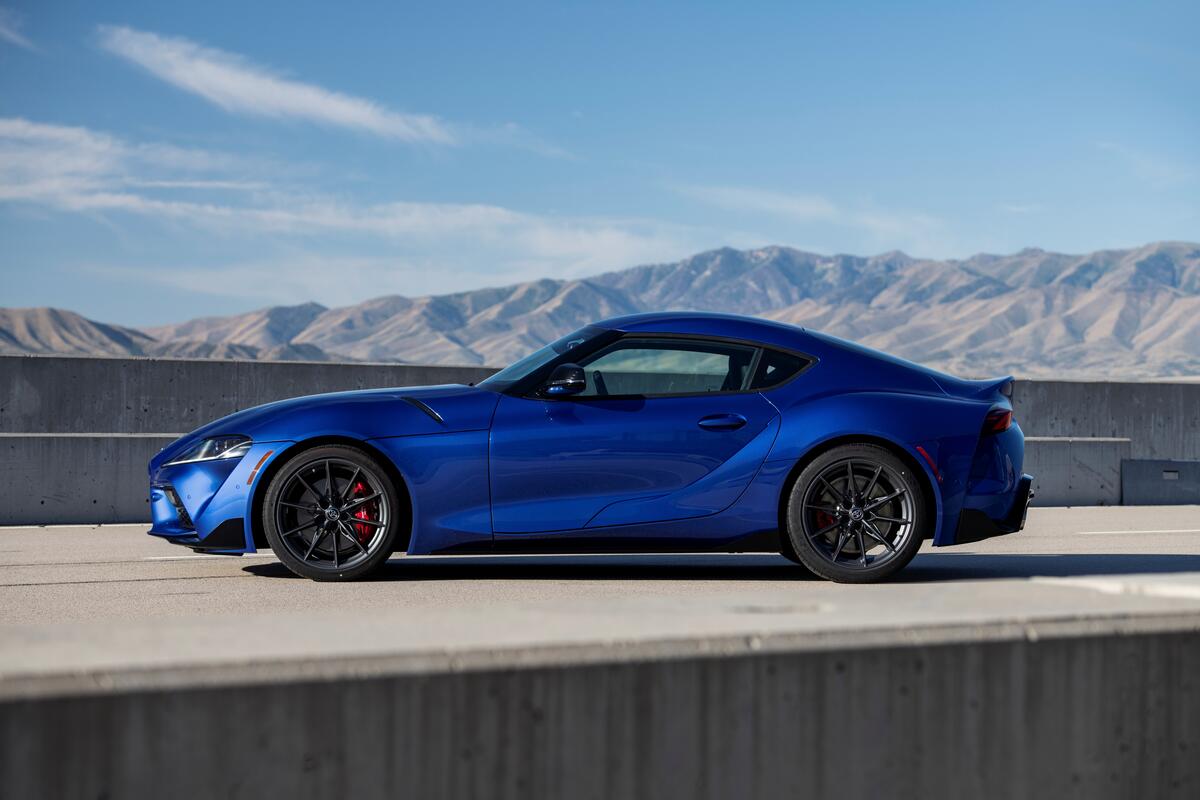
Toyota A90
"Last year, obviously, Dixon made it work. There were yellows, but a 90 lap all green race at Mid-Ohio. It's a tough, tough thing to do."
The Toyota Supra is a sports car built for fast driving, especially on roads and race tracks. In racing, it’s the kind of car teams try to keep running quickly for a long time, even when the race has interruptions. The mention here is about doing that for many laps with minimal slowdowns.
The Toyota Supra is a performance sports car known for its strong straight-line speed and track-ready tuning potential. In racing discussions like the one referenced, it’s highlighted for how difficult it is to maintain pace over long stints—especially when conditions include cautions and restarts. That’s why it comes up in the context of a long, mostly green run at Mid-Ohio.
all green race
"There were yellows, but a 90 lap all green race at Mid-Ohio. It's a tough, tough thing to do."
An “all green race” means there weren’t many (or any) caution periods. Without cautions, you can’t save fuel by slowing down, so pit strategy becomes tougher.
An “all green race” means the event runs without caution periods for the majority of laps. That removes the fuel-saving benefit of yellows, making two-stopper strategies much harder because cars must maintain pace while stretching fuel.
front row
"They locked out the front row. They kind of dominated the race."
The front row is the first two cars on the starting grid. Being there usually helps because you’re ahead of traffic and can get control of the race sooner.
The front row refers to the two cars starting side-by-side on the grid at the very front. Starting there usually improves track position, reduces traffic risk, and makes it easier to control the race early—especially on circuits where passing is difficult.
pole
"Christian was on pole. First McLaren 12 in history."
Pole position means the driver was fastest in qualifying and starts first. Starting first is a big advantage because you’re in the best spot for the race start.
Pole position is awarded to the driver who sets the fastest time in qualifying, earning the right to start first on the grid. It’s a major advantage because it gives clean air and track position at the start.

Mclaren 12
"Christian was on pole. First McLaren 12 in history. In the race."
The McLaren 12C GT Sprint is a race car based on the McLaren 12C, designed specifically for track events. In the podcast, it’s notable because it was the first time this McLaren 12C GT Sprint showed up in that kind of race. The driver being on pole means it was the fastest in qualifying before the race started.
The McLaren 12C GT Sprint is a track-focused racing version of the 12C, built for GT-style competition. It’s significant in the podcast context because it’s described as the first McLaren 12 to appear in that specific racing setting, with Christian taking pole and then competing in the race. That combination of “first time” and strong qualifying is why it stands out.
driver air ban
"But it was, was driver air ban. I mean, he had the race."
“Driver air ban” appears to be a transcription error for “driver airbag,” which is a safety system that inflates during a crash to help protect the driver’s head and chest. In racing, safety devices are critical because impacts can happen at high speed even when the car is performing well.
tough it is to pass
"That was the, you know, how tough it is to pass in mid Ohio, especially if both cars are good."
Some tracks make it hard to overtake. Even if you’re faster, you may not get a good chance to pass without risking a mistake.
Passing difficulty refers to how hard it is to overtake on a given circuit due to limited overtaking zones, aerodynamic effects (like dirty air), and the time needed to set up an attack. The hosts connect this to Mid-Ohio, implying that even strong cars can struggle to find clean moves.
power pass
"I'm trying to like be official. I did think that the Rasmussen power pass on lap 67 was worth mentioning."
A “power pass” is a special in-race advantage. Drivers can use it at the right time to get a boost—usually to help them move up or defend position.
A “power pass” is a race strategy tool used in some open-wheel series where a driver earns a temporary advantage during a specific window. It’s typically triggered by meeting a performance condition (like qualifying or leading) and then used to gain track position or pace for a short period.
Request an Explanation
Heard something you'd like explained? We'll add it to this episode.
Sign in to request explanations for terms you heard.
Want to learn more?
Browse our glossary for plain-English explanations of automotive terms, jargon, and concepts.
Help improve this episode
See something that's not quite right? Our annotations are AI-generated and can sometimes miss the mark. Click the flag icon on any annotation to suggest a correction.