In racing, “continuity” means keeping things consistent—like the same people and the same approach—so the team doesn’t have to relearn everything. It can help results because the team stays in sync.
Racing cars have a big number on them so everyone knows which car is which. If they change the “sticker number,” they’re basically changing the number graphics on the car.
Term
branding perspective
“Branding perspective” means thinking about how the team looks and who fans associate with it. Sometimes the car number and graphics are part of the team’s identity.
ECR is the name of the racing team the speaker joined. Teams like this handle the cars, drivers, and sponsorships for races.
Term
lead car
In racing, a “lead car” is the one a team considers the main car to focus on. It’s usually the car they expect to be the most important or most competitive.
Term
full time car
A “full time car” is the main car that runs most of the races in the season. It’s not a one-off or occasional entry.
“Ovals” are race tracks shaped like an oval, where you mostly turn one direction. Cars often need different setup and driving than on twisty road courses.
“Road and street courses” are tracks that aren’t ovals—either a normal race track or a course made from city streets. The car usually needs different setup and driving than on an oval.
A “sponsor” is a company that pays for a team or driver. In return, they get their name and branding shown during races.
Term
five years out
“Five years out” is a slogan that suggests thinking long-term. The speaker is saying that this kind of message matched what the sponsor wanted.
Person
Roger
“Roger” is mentioned as the person who owned the number the team wanted. The team then had to get it from him to make the plan work.
Person
Armstrong
“Armstrong” is a person the speaker brings up as an example of someone who has been working on their public image or brand for about two years. It’s used to explain why the current situation makes sense.
“Indy car” means the race cars used in IndyCar, a major U.S. open-wheel racing series. They’re different from Formula 1 cars—different rules and design—so they don’t race the same way.
Formula One is the top international open-wheel racing series. In this discussion, it’s being used as a comparison for how racing identity is handled—more around the driver than the team/car number.
In racing, the “branding side” is how the sport markets itself—who the fans associate with the car, the number, and the driver. The point here is that modern racing uses branding much more than it used to.
“F one” means Formula 1, the biggest international open-wheel racing series. They’re talking about how news and rumors get attention in F1 compared to IndyCar.
Person
Perstappen
This is Max Verstappen, a top Formula 1 driver. The hosts bring him up while discussing big F1 news that people pay attention to.
“Lewis” here is referring to Lewis Hamilton, a top Formula 1 driver. They’re talking about his move to Ferrari and how that kind of announcement gets attention.
Racing tires are made with different rubber “recipes,” called compounds. Softer tires usually grip the road better for quicker laps, but they wear out faster.
“Balance shift” means the car’s handling changes as the race goes on. It might start turning in better or worse depending on tire grip and track conditions.
Term
P1
“P1” is the first practice session. It’s when teams try different setups and learn how the car behaves before qualifying.
“Alternates” means the team tries a different tire/strategy option in practice. The goal is to learn how the car will behave so they’re ready for qualifying or rain.
Term
P2
“P2” is the second practice session. Teams use it to improve the car based on what they learned earlier and get ready for qualifying.
“Red-Red” means you use the same (red) tire for both qualifying runs. The idea is to keep things consistent so you can compare performance and not lose time changing tires.
A “front wing change” is replacing the front aero part on the car. Changing it can change how the car grips and turns, and it’s one of the faster things teams can swap compared with bigger setup changes.
“Geometry change” means adjusting the suspension alignment—how the wheels sit relative to each other. That can change how the car turns and how evenly the tires wear.
A “spring change” is changing the suspension springs. Stiffer or softer springs can make the car feel more stable or more responsive, especially over bumps.
“Toe” is how much the wheels point inward or outward. Changing toe can make the car track straighter or turn in differently, and it also affects how fast the tires wear.
“Group one” means qualifying is split into different groups so not everyone runs at once. Your job is to use your laps to get a good time in your group.
“Middle Ohio” is the road course in Ohio where the race is held. They’re saying the timing is so tight that missing by a small amount can drop you several spots.
An “engine penalty” is a grid penalty applied when a team changes or exceeds allowed engine components under the series’ rules. The penalty typically costs starting positions, even if qualifying speed was strong.
Here, “test” means extra practice time where teams try things to learn what works. They’re saying that including that practice, they were behind by even more than just qualifying pace.
Road America is a well-known racing track in Wisconsin. They’re using it as a comparison point for how well their car performed on Sunday versus Saturday at Mid-Ohio.
“Diff” is short for the differential, which sends power to the left and right wheels. If you change it, the car can grip differently and turn in differently in corners.
An undercut is when a race car pits earlier than another car to try to come out ahead. The idea is that fresh tires let you run quicker laps, so you gain time before the other car makes their stop.
A “yellow” means there’s a caution on track, so cars have to slow down. Drivers and teams like it because it can make pitting safer and sometimes cheaper in time compared to racing at full speed.
A fuel save means the driver is trying to use less fuel than normal during the race. They do it by driving a bit more gently so they can go longer without needing to pit again.
When two cars are side-by-side, they sometimes bump or rub each other. If officials think the contact was too much, they can give a penalty even if the drivers were trying to race cleanly.
A “two-stopper” means you plan to pit only twice during the race. That can be quicker, but you have to manage fuel and timing carefully, and it gets harder if there aren’t enough caution periods.
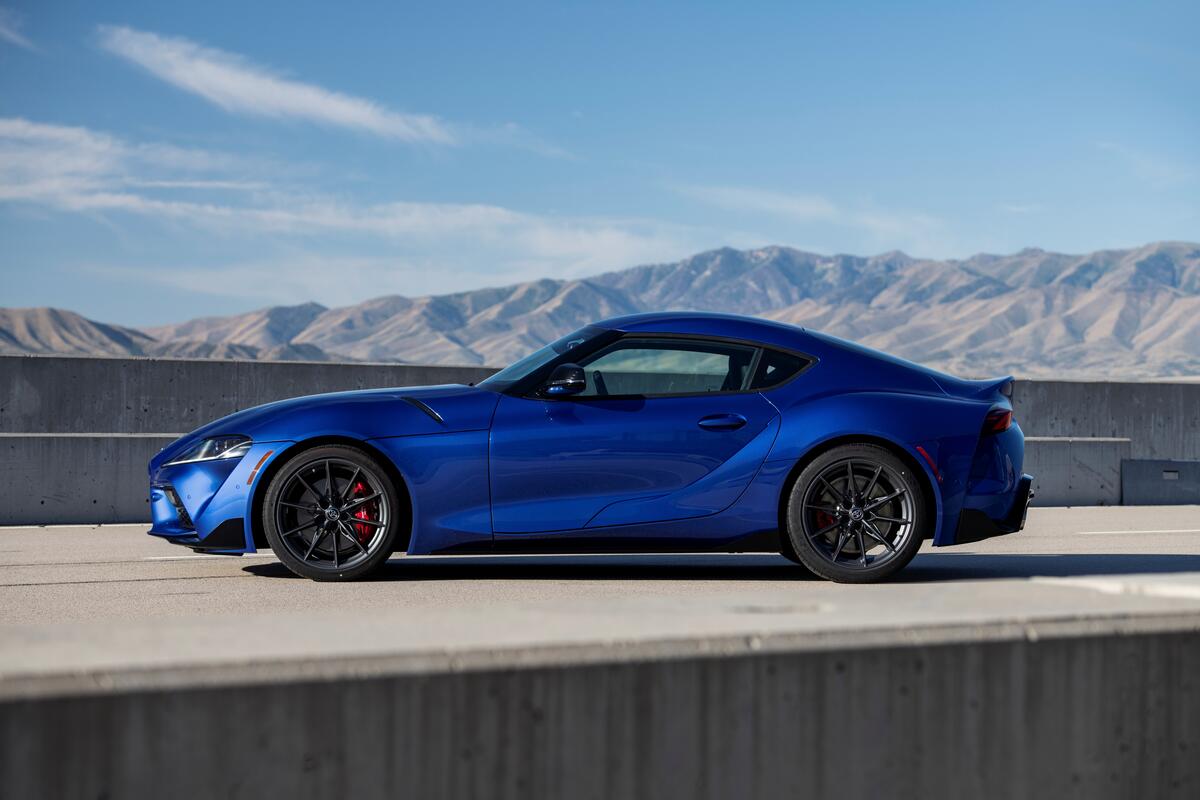
The Toyota Supra is a sports car built for fast driving, especially on roads and race tracks. In racing, it’s the kind of car teams try to keep running quickly for a long time, even when the race has interruptions. The mention here is about doing that for many laps with minimal slowdowns.
An “all green race” means there weren’t many (or any) caution periods. Without cautions, you can’t save fuel by slowing down, so pit strategy becomes tougher.
The front row is the first two cars on the starting grid. Being there usually helps because you’re ahead of traffic and can get control of the race sooner.
Pole position means the driver was fastest in qualifying and starts first. Starting first is a big advantage because you’re in the best spot for the race start.
The McLaren 12C GT Sprint is a race car based on the McLaren 12C, designed specifically for track events. In the podcast, it’s notable because it was the first time this McLaren 12C GT Sprint showed up in that kind of race. The driver being on pole means it was the fastest in qualifying before the race started.
Term
driver air ban
“Driver air ban” appears to be a transcription error for “driver airbag,” which is a safety system that inflates during a crash to help protect the driver’s head and chest. In racing, safety devices are critical because impacts can happen at high speed even when the car is performing well.
Concept
tough it is to pass
Some tracks make it hard to overtake. Even if you’re faster, you may not get a good chance to pass without risking a mistake.
Term
power pass
A “power pass” is a special in-race advantage. Drivers can use it at the right time to get a boost—usually to help them move up or defend position.
LIVE
This is Off-Track.
Hello and welcome to Off-Track with Hincha Rossi.
I'm not sure if Tim cut the opening part of that recording,
but I'm getting to know.
All right.
Yes, obviously I did.
Oh, okay, good.
It wasn't suitable for work.
I had a lot of people come up to me over the last couple of weeks
saying that they listened to the show and it still blows me away.
Yeah, I mean, they still get that.
Surprisingly, our numbers haven't dropped off.
You'd think they would.
I mean, it's insane.
I mean, I'm tired of us.
And then like, we don't bring that much newness to the table here.
We bring almost nothing to the table, right?
But I mean, the other thing that surprises me, and we've said it before,
but it's not just like, you know, fans and random people that come by.
It's like people in the industry, like people in the pack that admit to listening.
Like, oh, I heard on the show that you said, I was like.
Yeah, I get that.
I get that too much.
Actually, what did we say again?
Not good.
And here's the thing.
Um, as, as much as I'm reminded of it, I ain't going to change.
No, for better or worse.
Like you're listening, knowing full well who and what we are at this point.
And, uh, we haven't been, we haven't gotten in too much trouble yet.
No, I'm going to say we were talking about it actually on Thursday.
Unrelated, but like we're due for like, I think two talking Tuesday year,
which I feel like is acceptable.
Yeah.
We've already kind of loosely got one for this year.
I don't know.
Is that loose?
Yeah.
That seems pretty direct.
That's not like a, like a half.
No, no.
Yeah.
Okay.
Loosely because it was like a text message.
It wasn't like a real conversation, but that might be coming.
Yeah.
True.
I haven't seen said person in person.
Yeah.
Exactly.
Yeah.
Fair enough.
I mean, honestly, here's the thing guys.
The point of this is to give our mostly unfiltered opinion.
Um, because that is what is missing a lot of the time from interviews that are
given or conversations that are had, um, at the track for obvious reasons,
but to this audience and if you have stuck with us through this amount of time,
I hope you know that what you're getting is as close to the truth as we can while
steals, keeping our jobs give you.
So that's what we like to do.
Yeah.
Um, on the note of, I know the sideways going, I don't know if you do.
I think I know.
I think it's slightly even the way you think, but just on the note of like being
able to say what you feel and think what you do and all that sort of stuff.
I look.
So some big news has been announced.
That's been largely expected for, I would say a long time, like the last week
we kind of, did you and I have been in that group chat, one that Tim's not in
and we would like, like,
No, which, which one?
Which one?
The one, ooh, which one?
The one with our indie.
No, not which one or any friend.
The, the one, you know, the one where we were talking about who was going
where in the ending.
That was, that was three.
There were multiple.
No, they're multiple moves.
The big one, the one with like a lot of people that Tim's closest friends.
Yeah, got it.
Yes.
Yeah, all of them.
The whole, yeah, the whole ecosystem.
Yeah.
It's amazing how hard he's tried to block us out.
Yeah.
I have just, well, I do want to just like the one Marco sometimes contributes to.
Yeah.
Yeah.
The one he chimes.
You guys are in a town with Marco that I'm not in.
Yes.
I mean, a couple, but.
Yeah.
That's, that one hurts.
You're also in one with us and Marco.
So like whatever.
But so, so like I said, some big news came out that even as, as recently as a week
or so ago, we were all like, well, there's no way so and so is going to so and so.
There's just no way.
Well, evidently, some of the so and so have gone exactly where we thought
they wouldn't go.
So we're talking about Dixon and Rose and Quest getting announced at McLaren,
which obviously means that Lundgaard and Siegel have been said, have been told.
Thank you for your services.
They are no longer required.
Ejected.
There are two things that I want to talk about about that news.
Honestly, like it's not about what this is going.
I actually have something I want to chime into when you're done.
Yeah.
This is going to be a fun discussion because like it's not about like why
or the this really nothing to do with the on track stuff.
So number one, I think that IndyCar misses the boat in such a big way.
And I say that as like in the global sense that I don't mean IndyCar the
series.
I mean IndyCar like everybody involved misses the boat in a big way.
And this is motorsports a little bit in general, but like this news has been
kind of slowly leaked over the last two weeks.
And so when the announcement came out on Thursday or Friday, whatever it was
that Dixon was leaving CGR, it wasn't like new.
So it wasn't like that.
Like no one was shocked by it because we'd all been talking about it.
And then today, like we're recording on Monday.
It's announced by McLaren that Dixon and Rose and Quest are both going.
No one's like, no one's like shocked, right?
It's like a formality at this point to get that out.
I hate the fact that no one in this sport can keep a secret and like
actually break some news.
Like I would love I feel like we did the biggest actual news break in a while
with the whole Colton Will thing with Andretti.
But it's people just can't keep it quiet and make a real splash.
This was like a slow burn over two weeks rather than like a, oh my God, stop
the presses.
Here are some real news.
Yeah.
It is motor sports in general, I agree with you.
But I also think that IndyCar is again, not the series.
The collective group community is very bad at it with there's just a lot
of personal relationships that exist between people that have inside
information of the news and the people that type about the news.
And I'm not saying that that's bad because it's not specific to IndyCar,
but certainly in the world that we're in, you're absolutely right.
Because imagine that would have, I almost think that would have made like
normal sports news had it been something that was blown up.
Like if that caught IndyCar by surprise and the motor sport community
reacted in the way that it would have, it would have gotten to like an ESPN level
or a, right, you know, a whatever, a Yahoo sports level, but it's not going
to because it's, there's not this massive explosion today at two o'clock
when the send button was hit.
It would have been nonstop chatter between now and Nashville.
Yeah, that's nice.
And now it's just kind of like nonstop.
Everybody would have had an opinion.
Everybody would have had a say.
Everybody would have had a hot take.
Everybody would have been, you know, XYZ'ing about the whole thing.
And we just miss it.
Like I think so from a, a scale of, of what it is for
our little world here, like this is Hamilton leaving Mercedes to go to
Ferrari, right?
Like in this sense of tons of success, longest tenured, whatever,
leaving for a rival team, right?
That news was actually surprisingly kept under wraps.
Like the first time I heard about it was like hours before it was kind of
announced.
And I love the fact that both were announced at the same time, right?
Cause like as soon as you announced that someone's leaving a team,
well, then immediately all the chatter goes into it, well,
where are they possibly going?
And in the case of Scott Dixon, it's a really, really small pool of options,
right?
Cause like Penske's full and Dretty, we think is full and you're probably
like, there was really only one place for him to land.
Right.
So it just, it takes all the umph out of the announcement.
They should be done together.
They should be, everyone should actually keep their mouth shut and
let it be big news.
That part I find, I just feel like we miss it.
I feel like, I feel like we would get so much more out of the announcement.
It's sad.
Like there's just no wow factor anymore.
It just isn't.
There just isn't.
The other thing, oh, maybe there's a couple of things, but another thing I
wanted to talk about was, this is where I think I knew where you were going.
But the other thing that I want to talk about, you, you have some direct
experience with and I, um, I don't.
And I'm curious about it.
I'm trying to put myself into the mind of Christian Lindgard right now who
is, I mean, let's, again, we can't even ignore the fact that he's performing
at a high level, but like we still have seven races left or something like
that.
And you, and this is actually, this is kind of like, it's a motor sports thing
too.
Like somebody brought it up that maybe Kevin or somebody Lee was like,
in racing, they announced these things mid season, right?
Like no football player, no new place for the Colts knows in week eight that
they're going to be playing for the 49ers next year.
Right.
Like it's just not how it works.
It all happens in the off season, right?
And racing, especially Indy car, we've got a short enough season or we put it
this way, we have a long enough off season.
You could kind of keep all the announcements to the off season, which
also then creates a reason for Indy car to be in the news post race season,
right?
But not how it works.
And the driver now knows as the rest of the world knows, including everybody
on the team, that this guy's not coming back to the team for next year.
How hard is it in that scenario to just sort of show up and do the same job?
Is it hard or like can drivers, like drivers are so good at just compartmentalizing
and put it in the closet and never thinking about it.
So if you show up to the race track, you get in the race car, you prep the same
way you do the same job.
I think, I think it's there's such a distinction between the relationship
that you have with the decision makers of that.
So management and owners and whatever and your day to day people, your engineer,
your crew chief, your performance engineer and the guys that, you know,
you're kind of going to battle with each and every week and that you're spending
late nights talking to and that sort of thing.
That doesn't change at all because like you, they also don't really have a say.
And so you all might be disappointed to not be able to work together anymore.
You might be happy not to work together anymore.
Regardless, your job does not change whatsoever because as much as drivers
are evaluated on their performance over a weekend and throughout a season.
So are the engineers, right?
And so they all want to get the best results possible because it's their
livelihood as well.
So I would say 85% of it is exactly the same 15% of it can be a little awkward
with the owners or the marketing team or that sort of thing.
But also at the same time, like everyone's a professional and an adult and it's
not like a situation where Lungard or me or Nolan or whatever, like you're not
getting kill with eight races to go, right?
Like they, it's not, it's not a, there's no animosity that exists.
It's like we couldn't come to an agreement for these four reasons and
that's the way it is.
And we all have a job to do and you move on.
And so I think for Lungard in this case, maybe it's a little bit of a strange
situation because like he is the team leader, right?
And he is the guy that is kind of surprising everyone with the performances
that he's had over the past four to six weeks.
And so like in his mind, he's like, well, what more could I possibly do to not be
in this situation?
But at the same time, there's two very good seats that are vacating, which
were are obviously like have his name on it.
So I don't think he's that like, but this is what's so funny about it, right?
It's like, it's as weird as the situation is.
It almost couldn't have happened at a better time or in a better way because
like, but he would never be in this position if those seats were occupied.
So it's like, he's got the Felix and Scott don't go anywhere.
He's getting renewed for, right.
So he's not going anywhere, but because they are, they're going and like,
I'm just going to, I'll just say my opinion, that's an upgrade.
If he lands in the nine cars, that is, I'm sorry.
There was just at today, you cannot argue that that's an upgrade.
Now, maybe long term, McLaren's got some tricks up their sleeves and
a plan and they can execute it and become the new benchmark.
But like for tomorrow, that's an upgrade for 2027.
You have to think that's an upgrade.
So like on one hand, I'm sure he's kind of bitter like to your point.
What else can I do?
How are you?
How were we at this point?
But on the other hand, he's kind of like, peace.
I'll go ahead and take the nine car.
Thank you kindly.
It's interesting.
Interesting situation.
So do you guys consider it basically a done deal that he's going to be taking
the nine car?
No, no, not at all.
I was, was one of the ones that thought that maybe Armstrong had a
shot in it, but then MSR would be completely replacing their lineup and
continuity is a big thing in racing.
We talk about that all the time.
So I understand why they just like clawed him back and made sure that,
you know, he stayed on the team.
I do have, I do have one thing about that whole deal.
Cause that was announced, right?
That Armstrong got extended, but they said that he's moving from the 66 to the
60, which to me means they're changing one of the sticker numbers on the car.
And that's it.
Why do that?
What is the point of doing that when like respectfully MSR has not been around
long enough to have had like you're going into the, I mean, it's not like going
into the three and NASCAR, right?
It's not like going into the 24, the 48 when Gordon or Jimmy Johnson retired,
right?
The 60 is the team's been around for five years.
The only thing that I can think of is, and this is purely hypothesis, but the
60 is always the car that has the rotating Sirius XM stuff.
Yeah.
And so maybe that car from a branding perspective is like locked into certain
brands that they would want a, their lead driver or more established higher
profile guy in that's the only thing that I can think of because maybe they're
trying to make it an established thing.
No, no, like for example, like I'm not going to get into this a whole lot,
but you know, initially when I signed with ECR, you know, the 21 car was the,
that was always the lead car, right?
Because that was the full, that was Renus full time car.
The 20 car was always the Ed was on the ovals and they had someone else in
the road and street courses, right?
And so when all of these conversations were starting, it was around the 21 car
that I would be in, right?
Replacing Renus in air quotes and the reason that that wasn't the case is
because at the time there was a sponsor at the team that if Renus were to
leave, they wanted Christian not knowing who the other guy was going to be.
It's they wanted Christian and their sponsorship was tied to the 21 car.
So the only one that I know of that makes sense to me is, is Aero because
their, their company like slogan is five years out, right?
And when, when I was with that forever.
So they never get what, at what point is the five years like is the time
elapsed, you know, you would think five years just don't, don't go applying
logic to this, Tim.
But no, but so they, they actually were the ones because I think at the time
I want to say Roger owned the number five and the team had to go and kind
of like acquire it off of Roger.
However, that works.
I don't know how that works.
Um, so that one I kind of get, but it kind of, for me, it goes back like going
back to Armstrong, like he's done two years now building a brand around
his name in the 66, right?
I still, I still think that Indy car needs to pivot to what formula one does
and the number should be the drivers.
And that's your number for your career.
You can build your brain around that.
You can have your merch around that.
You can have social handles around that and it never changes and it should go
to the driver.
So that's something I think that we need to look at for this reason.
I get that there's some historic, you know, significance for certain number,
especially like some of the Penske numbers he's had forever and like the three
like Elio won everything in three.
And it went all goes all the way back to, you know, whatever.
Um, but I don't know.
I think that's something that in the, in modern, in modern racing, modern Indy
car, uh, there's a lot to, you know, the branding side of it, which didn't
exist 40 years ago that I think from the driver side would be advantageous.
So that one, that one was kind of weird, uh, the move from the 66 to the 60,
but say la vie.
So I just had two quick things I wanted to add in the discussion about this.
And I do want to say Tim real quick, I really like your shirt.
Oh, thank you.
Nice face capture.
Yeah.
Um, they're both about Will Buxton's tweet.
So I'm annoyed that Will Buxton hyped up an announcement that we all seem to
have known about to the point where like I sent it to Alex and I sent to you guys
like, Hey, what's this about?
Oh, it's just that.
So I was a little annoyed at that.
And it kind of goes to what you were saying where Indy car can't keep a secret,
but I'm now more annoyed.
I think at the people responding to it, like you baited and switched us and
thought made us think this was going to be a big F one announcement.
And it's like, dude, I'm not.
He's an Indy car commentator.
Like he's, but his following is still, I would say 80, 80% European.
He also still has a, uh, an F one podcast, right?
So a very prominent one.
So I love, I love what Will did for fully on board.
Well, I'm not.
I know we slightly disagree on this.
It's not that I'm not on board.
I love what Will did for the buzz around an Indy car announcement.
Amazing.
Incredible.
I said from the get go this morning at 745, I was like, that's really going to
piss off his followers because it's a little bit boy who cried wolf because
it's like the exact same thing that he said intentionally with the Ferrari
or the Lewis to Ferrari announcement.
So like with all of the stuff that has gone on very recently with
Perstappen and Red Bull, like it, it was really throwing shades of being
an F one or shattering news announcement and not the news that we all knew,
but we literally just said that Dixon leaving CGR for their team was akin to
but you also literally just said you found out about the Lewis to Ferrari
announcement and how or before it happened.
So I do think it is partly, it is partly tongue and cheek for the exact
topic we were just have a discussing right is that we can't keep a secret
in Indy car and there is no like breaking news anymore.
But I thought it was funny.
It got a lot of people's attention.
It created it created some conversation around a good bad or different.
No such thing as bad press.
And if anything, maybe there's some F one fans that haven't really paid
attention to any car that might pay attention to any car now or didn't
even know what it was.
Now they do know they just don't follow Will or watch Indy car because
they're angry anyways.
Well, that's on them.
Not our problem.
Mid Ohio is is done and dusted.
Happy belated 4th of July.
How was your weekend?
Well, it's not just let's not just like glaze over belated 4th of July.
It was America's 250th birthday, bro.
Like it's a pretty big deal.
Pretty big deal.
There's some very cool celebrations all over the country.
There was.
What was I just want to make sure you know, like, oh, no, no, it was huge.
I'm actually it's a little unfortunate in some ways that we had to work.
That weekend because they're like, there was some pretty cool things going on.
That would have been fun to.
Yeah, I miss a lot of things and be a part of now.
Yeah, Bob, but it's okay.
I had you celebrate the 4th of July burgers, brats and beers, the three beer
bees of the 4th of July.
That was about it.
I just had a bunch of people over.
I grilled out.
We watched the fireworks.
And that's about it.
You had everybody up to the hills.
Hey, I mean, I'm I don't actually live on a hill.
You're in the hills of Beverly.
You're in the view.
The view was not great.
We didn't see a lot of fireworks, but we just hung out.
It was fun.
Hazel had some friends over.
I grilled like the road.
The road is on an incline.
Is it?
Yeah, I want it.
I don't know.
Okay.
It is up there.
You have a balcony.
Which high up a bit of a balcony.
Yes.
Second floor.
Yeah, it's a balcony.
Yeah.
Did you use your your built in like bars that you have now?
I did.
I feel I definitely would have rather been at mid Ohio.
That looked like fun.
No, it looked hot.
It was not fun at all.
It was very warm.
It was not nice.
Just well, I did get to do something pretty American though.
I got to I saw your Humphie ride.
Yeah.
Yeah.
I had to drive a Humphie around the campsites and that was that was pretty cool.
So if you go to legion.org.
Slash sweepstakes.
They actually have the American Legion drive for freedom sweepstakes where you
can buy entries for a raffle to win the Humphie full on army issue.
Like how ridiculous.
So if you ever wanted one of those, go ahead and buy a couple tickets.
But yeah, so we went on the campsites and we were given away Austin and I
who's a service member.
We were given away flags and challenge coins and it was a pretty neat little
experience for a canuck on 4th of July, which I actually ran into a few Canadians
around the campsites in mid Ohio.
Anyway, Alex, how was your weekend?
It was a big weekend for us.
So we all know the test was bad.
That did not immediately mean that we were good in practice one actually quite
the opposite, both very unhappy still with the car despite going in two different
directions from the test.
And so it was a late night Friday night trying to get to the bottom of it and
and continued on a different path in P2, but kind of a path on the same ship, but
just a new and slightly, but we were both kind of on the same journey of the
Choose Your Own Adventure ECR weekend.
And we started P2 and it was a little bit better, I think for both of us.
But there was a really, the Alternate Tire was new for this event.
It was the Barber Alternate.
It was a much softer compound than we have had at Mid-Ohio and quite some time.
And so there was not only a massive pace difference between the two, but also a pretty big
balance shift and because we were so lost and uncompetitive in P1 and we were on
such a different journey in P2, we felt that it was important to run instead of
Alternates in practice, kind of get more of an understanding just of what we were doing.
So I liked to do that and put a set of Alternates on to kind of get the offset of
what the balance is going to do and this sort of thing because there was a pretty
good chance it was going to rain.
And so it was like, it's worth doing.
Like we need to do it because if you go Red-Red and Qualifying, there's not enough time
if you can only really do like a front wing change.
If you need a massive spring change or geometry change or toe change or something like that,
you can't do that between sets of tires.
So we got that, we gained the information that we needed going into Qualifying.
Christian was group one, went Red-Red, was second, got out of his group.
I was group two and the plan was to put on a set of Reds, go out on a set of Reds
and like try and execute to like the best of your ability and put up the big enough
time that you know, your confidence is going to get through.
So you didn't want to do, yeah, you didn't want to do use Reds and then throw in a new set?
No, because the use Reds on like the second run were like a second off.
So there wasn't really a benefit to doing that and we wanted to have the ability that
if it wasn't a good lap to put on another set of new Reds to get out of round one.
So the lap that I did on the first set was match Christians, which was second in his group.
And so I made the call to sit on it.
The team kind of was pushing to go out and I was like, guys, the car's good.
Like the car is in a really good window.
Like the pace is kind of unlocked and it would be really disappointing to go into round two
and just relegate ourselves to 12th because we're not going to have a new set of alternates.
And I was like, what's the worst case scenario that happens?
We miss it and we're seventh.
So we start 14th instead of 12th.
Like this is a gamble that's worth taking because I think this is a fast six kind of car.
And so we sat on it, ended up missing by 500 as is typical around Middle Ohio,
which when you miss by that amount, you're like, oh, I could definitely see in the lap where I could have found that.
For sure.
But so we start, we qualified 16th, but then with an engine penalty, we started 15th.
So still it was like, it was only a three position loss, which it wasn't the end of the world.
The great news was Christian made it to the fast six, his first ever fast six.
And the next bomb of disappointment hit us all because his time that he did in P2 or in round two,
if he had repeated that, it would have been pole.
And but he didn't have a set of new reds to run in the fast six because he went red red in round one.
So the moral of the story is we were really a session behind a session and a half behind,
well, really a day and a half behind if you take the test into account,
which really put us on the back foot in qualifying to not have, you know,
potentially a car on pole, but potentially two cars in the fast six as well.
And it's just a lesson in, you know, how, how good you have to be off the truck.
But yeah, the, the really positive thing to take out of it was we,
we had a really good Road America race car on Sunday.
We didn't really know what the recipe was to get that same sort of performance at any point in mid Ohio until qualifying on Saturday.
But then we did.
And so now it's like, all right, understanding the, the levers that need to be moved and the tools that move those levers,
like we finally, like we didn't solve it, but we took a really big step in understanding that.
Because again, in the race, like we were like, okay, well, if that's good,
like more of this has got to be better, right?
Right, some is good, more is better.
Right. And so I went down that avenue of like, well, for sure,
like we've been going in this direction every single time we've done this, better, better, better.
It wasn't.
But again, it's, it's, we're building these like the barriers of like knowledge is took a such a big step this weekend that even though I pretty much finished DFL.
It wasn't for nothing. Christian had a great race.
Obviously a career best start for him.
So there's like these glimmers of like really good positivity.
And you got to remember, and the big thing that I've really been pushing the organization on is when you think about what we're trying to do,
we're trying to play catch up to teams that have a decade plus of resource and development on us.
And one of our biggest weaknesses at ECR for the past year and a quarter is both cars are just doing the same thing.
Like, you know, Christian and I have very similar driving styles.
Our feedback is fairly aligned.
And through the weekends where if I'm changing a diff, he's changing a diff.
And if I'm changing a spring package, he's kind of changing a spring package.
And it's like, we're not making the big enough steps forward.
We're not operating as a two-car team.
And so Road America and Mid-Ohio was really the first time as an organization,
we've had two cars like collectively trying to gather more information for the greater good.
And so we're,
So in that sense, you mean that you guys were showing up actually with cars that were more like way different.
So that way you could, right.
But then you could trust the feedback that like, all right, he's doing better with this package.
I'm just going to control C, control V.
Well, it's not even that.
No, because what we're doing is we're like, we're really trying to get into the analysis of like, what in that package?
We're being very cognizant about.
So the package that didn't work at the test, we had a theory as to what was causing it not to work.
So he came back with that package plus the change.
I came back with a completely wholesale car, right?
And then we were like, okay, well, if this thing that we thought was the mover did nothing,
but Alex is experiencing, because our feedback in practice one was completely different, right?
So if we're achieving this with this thing on Alex's car that we're not getting on Christian's car,
and we know that this no longer is a factor, like it was, you're able to like pull things out of it.
So anyways, quite happy with how all of that went.
The race itself, for us, you know, we just, we weren't that fast.
We were starting, where do we start?
We started 15th.
We finished 20th.
We didn't make the reds last as long as we needed to, because we were trying to get,
we were trying to like get an undercut and hope a yellow came.
So we stopped like immediately on the early side.
And then I was in a massive fuel save for the whole race.
There was no yellows.
And also I got a very strange penalty that costs us about six seconds.
Was that the contact with Dixon, 37, 28 laps in?
So yeah, that was a weird one.
But then Marcus got the same penalty.
So at least they were consistent, but very, very weird because, well, in IndyCar, as we all know,
there's a lot of contact and there's a side by side contact has generally been ruled as
very much a part of the way we race.
And when there's side by side contact that doesn't even cause a car to a
miss a corner, lock a wheel, drop a wheel, lose any time,
just a little bit of rubbing and bumping.
Very surprised that there's now penalties for that.
And yeah.
Yeah.
I mean, consistency in the race, but not necessarily consistent with how it's been judged
with that kind of thing in the past.
I think about some of the stuff you guys were getting away with in Detroit,
that you and I was like, that one's a little rough.
And they're like, no action on the 45 and the three is like, really?
Okay.
All right.
That's what we're doing now.
But what's a little weird about it is, and there will be conversations that are had about it.
And I'm sure there's reasonings and justifications, but there was no conversation.
We all have a driver's meeting every Friday with the officials and the race director
and all of series leadership and everything going into the event with expectations and stuff.
And there was never a comment about any sort of changes to how they were going to view things
or look at things.
And then all of a sudden we're now getting penalties for side-by-side rubbing contact.
What was the penalty you got?
Well, I had to drop behind them, but they gave me the penalty after I had already had like a five
and a half second gap on them.
And another car was in between.
And so it was like, I don't know.
Ultimately, I don't care because it didn't cost me anything in the race.
I maybe would have finished 17th instead of 20th, but like, just strange, just a little bit of a surprise.
And that's it.
So I have a question about just some of the general things watching it.
It seemed like there was a big deal made about people trying to go for the two-stopper instead of three-stopper.
No one did that.
Well, some people initially said we're going to try and then they had to abandon it.
Was that because there were no yellows?
Yeah, basically.
Yes.
In order to get the fuel mileage for the two-stopper, I mean, you have to drive so, so you can do it.
You have to drive so slowly.
It's not worth it without yellows.
Last year, obviously, Dixon made it work.
There were yellows, but a 90 lap all green race at Mid-Ohio.
It's a tough, tough thing to do.
And like, actually, I just want to, I wanted to ask you about that, the physicality of it,
because, you know, physical track anyway, super, super hot, a lot of drivers looked beat at the end of it.
How did you find it out there?
Fine.
It was hot.
It was like, I was very sweaty, but like, I'm also sweaty.
The majority of the time.
You're sweaty right now.
I can see it glistening.
Yeah.
So I didn't find it, it that bad because again, James, like, even though this wasn't
a fuel save rate, well, it was for me.
So maybe that's why I didn't find it that bad.
But just in general, like even in qualifying, we're not doing the lap times we used to do.
So the steering load isn't that high.
Like you're not like pulling a caster out between qualifying the race.
Like it's not, it's not what you remember.
You know, I remember the days where like you were just the last stint when you put on new tires,
you're dreading it because like it was everything you could do just to turn the steering wheel.
All right.
And that the good old days.
Right.
That sort of load, it just never comes, right?
Because you're just not the corner speed isn't there.
So yeah, I mean, it was hot.
It's uncomfortable.
Yeah.
And you want it to be done.
But it's the heat more than anything.
Yeah.
It's the heat.
So the race itself, you know, it was, it was the McLaren show.
They locked out the front row.
They kind of dominated the race.
Christian was on pole.
First McLaren 12 in history.
In the race.
Yeah.
But it was, was driver air ban.
I mean, he had the race.
Paddock did a great job.
Like Christian was faster all weekend long and Paddock did a really good job in qualifying to get up on the front row.
And ultimately hound him in the race.
And when he made a small mistake, it wasn't a big one, but it was just enough for Paddock to get a run.
And then he did a great job to pull off the move.
And that was it.
Right.
That was the, you know, how tough it is to pass in mid Ohio, especially if both cars are good.
So, you know, credit where credit's due to Paddock.
First win for a while.
But again, great job for Christian.
Four road courses this year.
His finishing positions are second, first, first and second.
So he's doing all right.
Pretty, it's not terrible.
It's not awful.
Could be better.
It's not good enough to keep your job.
I would have to keep your job.
But weirdly, maybe better and good enough to get a better job.
It's a weird situation.
Kyle Kirkland was third, which was pretty impressive, man, from 10th on the grid.
He had a ton of pace.
Something happened in round two.
A qualifying just didn't get the time out of it the same way he did in the first round.
And, you know, that was a car that was, I think, definitely going to be in the fight for pole,
but from 10th with no cautions to get up into just on the podium.
That's super impressive from Kyle.
Greenest VK for J.H.R. in fourth.
Hey, hello.
Fast six up there with Christian, the fast six, which was awesome to see and just held onto it and did a great job.
Finish fourth, man, at Mid-Ohio, all green race.
No lucky anything.
Just got it done.
Polo up from eighth into fifth.
So another top five for him.
You know, he keeps Kyle being Kyle up to the podium.
He's like, yes, I beat Alex.
And then you look back.
He's like, damn it.
He's right there.
He's only two spots behind.
Like, gonna have a bad day today.
But yeah, so some really good drives, man.
I mean, honorable mention, obviously, to Christian for the day that he had.
No one got a top 10.
Kyle Collette was 11th.
Good effort from him.
But it was, you know, for an all green race at Mid-Ohio, there was a decent amount of action.
I thought there was some fun little battles and, you know, a lot of pressure up front the whole time.
It's not like anybody walked away with it.
So I thought it was, I mean, Polo and Kirkwood actually had a really good back and forth.
And again, Kirkwood did a great job executing a move there when they caught some traffic.
And yeah, man, for a hot, sweaty, stinky race, I thought it was all right.
That's good, man.
That's good to hear.
It was very boring from my side.
But Tim Boat, did you have any other questions about the race?
No, you guys actually addressed everything.
I took notes and everything.
I'm trying to like be official.
I did think that the Rasmussen power pass on lap 67 was worth mentioning.
I thought that was a really good one.
The Rasmussen power pass.
Did you use chat GPT for any of this?
No, this is handwritten notes I took while I was watching the race.
Alex, did you know that Tim is contributing a new YouTube video at the end of every race called Tim's fake?
You know.
I was going to tell you after we recorded this, I figured you didn't care.
It's like a full minute long.
Yeah, it's a little minute recap.
Some hot, thin fakes.
And we highly encourage anybody listening to go check those out.
Little recaps of the race.
And yeah, I mean, he was paying.
I listened to it.
He's paying attention, I think, or he'd chat GPT.
He was asking me a lot of questions during the race though.
So I feel like he was actually paying attention, despite.
I was watching for real.
So, yeah, let's talk about one more thing before we end.
Because in all of this news that came out, it was also announced that Ryan Hunter, right?
Is going to be back in the car at the 500 next year, which is great for our boy Ryan.
You know, he's got to fuel that ship somehow.
So yeah, I mean, boats have big gas tanks.
And yeah, and all of the, you know, staff he has, you know, to and all the toys.
Yeah, yeah.
No, for sure.
Kind of something I would just assumed was happening.
So again, not a huge shock in that announcement, but very happy for him.
Can we talk about the form that that team has had since Ryan kind of came on as the sporting director or whatever.
He is directed out of their sport.
Let me tell you, their sport is heading in a hell of a direction.
Yeah, it is.
It is very well sported.
Well, it makes sense.
He's been around since the invention of this sport.
So that is true.
That is true.
And the invention of direction.
I mean, I'm pretty sure he was around when they figured out that whole north, south, east and west thing.
I thought it was the light.
Let there be the compass, right?
Yeah, I believe I believe he was there for the first compass.
I did ask him if he had worked like win bonuses into his contract, which he said he did not.
Which after this, that was after Road America.
After this weekend, I bugged him about it again.
And I think he's had a little chat with old TK about his, about the bonus structure on his contract.
What is a team's ever first ever one to get you?
You know what I'm saying?
Probably the ability to maybe keep a job.
Hey, dude, I'll let you keep writing me any profile about that.
Okay, boss.
Sounds like a good deal.
I don't know.
It's cut through a team.
They got all top 10s and they're only keeping one of them.
But that means, you know, it's crazy as they're going to go to Indy next year, four cars, three of them are 500 winners.
And the one that isn't actually has the best finishing record at the Annapolis 500 on average.
Anyways, test in Milwaukee on Wednesday.
So that'll be fun going fast.
Turn left.
Love that place.
When are you going?
When are you going up tomorrow night?
Time for racquet sports tomorrow morning.
Question mark.
Oh, you're still on crutches.
Aren't you?
What are you?
Wait, are you walking yet?
When are you going to stop faking that?
Yeah.
Oh yeah.
You can't admit on the show that you're actually faking it.
So I'll ask you.
I love.
I love how.
I love how.
I'm not even going to say it.
It's fine.
I miss my racquet sports buddy.
Get better.
Are you off crutches yet?
I'm on a crutch still.
You're on a crutch still?
Okay.
So no racquet ball.
No James.
Got it.
Call me in August.
I have.
I think I have a Tuesday off in August.
All right.
I don't.
One of them.
See you in September.
Find us on YouTube and subscribe to our channel for exclusive video content.
Off track is produced by Tim Durham and by that we mean FIM.
About this episode
Scott Dixon, Felix Rosenqvist, and Marcus Armstrong/Quest?—the episode focuses on the IndyCar driver market shakeup: Dixon leaving CGR and McLaren announcing Dixon, Rosenqvist, and Quest, which effectively clears the way for Lundgaard and Siegel to be out. The hosts debate why motorsport can’t keep secrets, arguing the news leaked too slowly for any “big splash” moment. They also discuss how mid-season announcements affect drivers like Christian Lundgaard, emphasizing professionalism, compartmentalizing, and the difference between team relationships and day-to-day performance.
The guys go into rumors and leaked info in IndyCar silly season and how it effects reporting, then they break down the race at Mid-Ohio.
+++
Off Track is part of the SiriusXM Sports Podcast Network. If you enjoyed this episode and want to hear more, please give a 5-star rating and leave a review. Subscribe today wherever you stream your podcasts.