Tim Harris—Los Angeles Lakers president, former pro soccer player, and a returning rider after ~40 years off—shares how he first got into motorcycles at 15 for practical “freedom” (cheap transport, gas lines during the energy crisis), why he stopped around college, and what reignited the passion in his 60s. The conversation covers getting back on safely (MSF course, modern gear), handling spouse/family skepticism, finding community without forcing group rides, and adapting risk in today’s distracted, faster traffic. Kobe Bryant trivia and a Ducati engine-sound guessing game close it out.
President of the Los Angeles Lakers, Tim Harris, joins the show to discuss his life as a returning rider to answer the question: is it ever too late to start riding?
Tim rode from age 16 to 22, then spent the next four decades "frozen in motorcycle ice" while building a family and a career. Now back in the saddle in his 60s, Tim shares the hilarious and humble reality of relearning the "friction zone" and surviving the "intervention" of worried coworkers.
We also dive into new data from AIM Expo about Gen Z's interest in motorcycling and answer a listener's question about how to convince a reluctant spouse to let you start riding later in life.
"Well, maybe that's because your fueling system is a little dirty. Luckily for you, Motul has you covered with their Motul valve and injector cleaner additive."
Motul is a company that makes motorcycle oils and other fluids. Here they’re talking about a cleaner you add to your fuel to help your bike run better.
Motul is a major French lubricant and motorcycle fluids brand. In this segment, they’re sponsoring a fuel additive product aimed at cleaning the fuel system so the bike can run more efficiently.
"at AIM, which is the AIM Expo in Southern California, which is kind of like a motorcycle industry conference."
The AIM Expo is a major motorcycle-focused event held in Southern California. In the episode, it’s the venue where the colleague presented the study about attracting Gen Z to motorcycling.
"Was around Gen Z and how to create interest in motorcycling for Gen Z. And they went through some pretty interesting data."
Gen Z is a generation of younger adults. Here, they’re talking about how that group might want to try motorcycles without owning a bunch of them.
Gen Z is the demographic cohort born roughly in the late 1990s to early 2010s. In this episode, the speaker uses it to discuss how younger riders may approach motorcycling differently—like preferring lower-commitment ownership options.
"Cause it had that sort of high, that, you know, that, that high pipe. So the, the dad kind of taught us how to ride the Nile."
A “high pipe” means the exhaust sits higher up than normal. On older trail-style bikes, that can help it avoid getting hit by rocks or bumps.
“High pipe” refers to an exhaust system routed higher than usual, often to keep it away from obstacles when riding off-road. The speaker points to the high exhaust as a visual cue linking the Triumph 250 to scrambler/trail styling.
"So I can go down to the DMV and get my driver's license and freedom and drive a car."
The DMV is the government office where you get your driver’s license. It’s also involved with things like registering vehicles.
The DMV (Department of Motor Vehicles) is the government agency that handles driver licensing and vehicle registration. In the U.S., it’s where you typically apply for a driver’s license after meeting eligibility requirements.
"So I can go down to the DMV and get my driver's license and freedom and drive a car."
A driver’s license is what makes it legal for you to drive on public roads. You usually earn it after practice and passing tests.
A driver’s license is official permission from the government to drive a vehicle on public roads. It usually comes after passing tests and meeting requirements beyond a learners permit.
"like what is what is a Honda 250 gas
[1147.6s] take two gallons, like two and a half gallons?
[1150.3s] It was tiny."
Fuel tank capacity is the amount of fuel a bike can hold, often measured in gallons or liters. The speaker contrasts “two gallons” vs “two and a half gallons,” explaining why the bike needed frequent refueling.
"Absolutely did ride at night. Absolutely did ride in the rain, but I absolutely did not ride on the freeway. And I think in part because where we lived was sort of tucked away."
A freeway is a big, fast road where cars usually drive at higher speeds. For motorcycles, it can feel more intense because everything moves faster and there’s more traffic.
A freeway is a high-speed, limited-access road designed for sustained traffic flow. For riders, it usually means higher speeds, more lane changes, and more exposure to wind and debris than local roads.
"[1376.3s] Meaning I wasn't doing it because I thought, well, I'm carving up turns
[1379.9s] and I'm going to I'm going to drop a knee or anything."
It means riding through corners smoothly and confidently. Instead of just going straight, you set up the turn and lean the bike to follow the road’s curve.
“Carving up turns” is rider slang for smoothly leaning the motorcycle and following the curve with good line choice. It emphasizes cornering technique and control rather than just commuting or cruising.
"[1376.3s] Meaning I wasn't doing it because I thought, well, I'm carving up turns
[1379.9s] and I'm going to I'm going to drop a knee or anything.
[1382.5s] Or I'm doing wheelies or whatever."
“Drop a knee” is when a rider intentionally lets one knee touch the ground while leaning into a turn. It’s usually something you see on sport bikes or at the track, not normal commuting.
“Drop a knee” refers to dragging one knee on the pavement during a corner, usually as a sign of aggressive lean angle and commitment. It’s more common in sport riding and track contexts than everyday street riding.
"[1382.5s] Or I'm doing wheelies or whatever.
[1384.0s] Yeah, ever, ever, ever."
A wheelie is when you accelerate and the front wheel comes up off the ground. It takes skill and is risky, so it’s not something you’d do on regular streets.
A “wheelie” is when the motorcycle’s front wheel lifts off the ground under acceleration. It requires throttle control and proper balance, and it’s generally not appropriate for public roads.
"Yeah, exactly. So I, I mean, like after six years, the bike probably needed an oil change and you're like, the bike was screaming for some kind of attention."
An oil change is when you replace the motorcycle’s oil. Fresh oil helps the engine stay lubricated and prevents damage from dirt and wear.
An oil change replaces the engine oil and oil filter to keep the engine lubricated and clean. Over time, oil breaks down and collects contaminants, which can increase wear and reduce performance.
"Like, this is kind of crazy.
[1894.2s] And, and as I, as my kids got older and, and I'm obviously getting older, I'm like,
[1899.7s] I got to figure out a hobby.
[1902.3s] And at some point, Zach, a few years back, I thought, you know, you really enjoyed being on a bike."
This podcast is mainly about riding motorcycles. The speakers are talking about how they got back into it after a long time.
The episode is about returning to motorcycles after decades away. For listeners, it’s useful to treat “motorcycles” as the core activity being discussed—riding, training, and building confidence again.
"And he pulls up and I look at it and I can see that, you know, it says Ducati. I'm like, okay."
Ducati is a motorcycle brand from Italy. When someone says “Ducati,” they usually mean a bike that’s built to feel sporty and fun to ride.
Ducati is an Italian motorcycle manufacturer known for performance-focused engines and distinctive styling. In rider conversations, “Ducati” often signals a bike with a more spirited character than generic commuter models.
"You're like, where's the Kickstarter? Right. You know, hopefully you pre-warm it up for me."
A kickstarter is a lever you kick to start the motorcycle’s engine. Some bikes start with a button, but others can also be started by kicking.
A kickstarter is the manual lever you use to start an engine by physically kicking it. Many modern motorcycles use electric starters, so mentioning a kickstarter highlights whether the bike starts electrically or requires manual starting.
"What was that like the first time in 35 years, you pulled in a clutch and you put the biking gear, click, and you let the clutch out."
The clutch is a lever you pull to temporarily disconnect the engine from the gearbox. It helps you start smoothly and shift gears without jerking or damaging anything.
A clutch is the control that lets a motorcycle (or car) connect and disconnect the engine’s power to the transmission. Pulling the clutch lever disengages power so you can start moving smoothly or shift gears without grinding.
"...you put it in neutral and you put it on the kickstand and you shut it off..."
The kickstand is the little stand that holds the bike up when you park. You want it fully down so the bike doesn’t fall over.
The kickstand is the motorcycle’s support leg used to keep it upright when parked. Proper kickstand use matters because a motorcycle can tip if the surface is uneven or if the stand isn’t fully deployed.
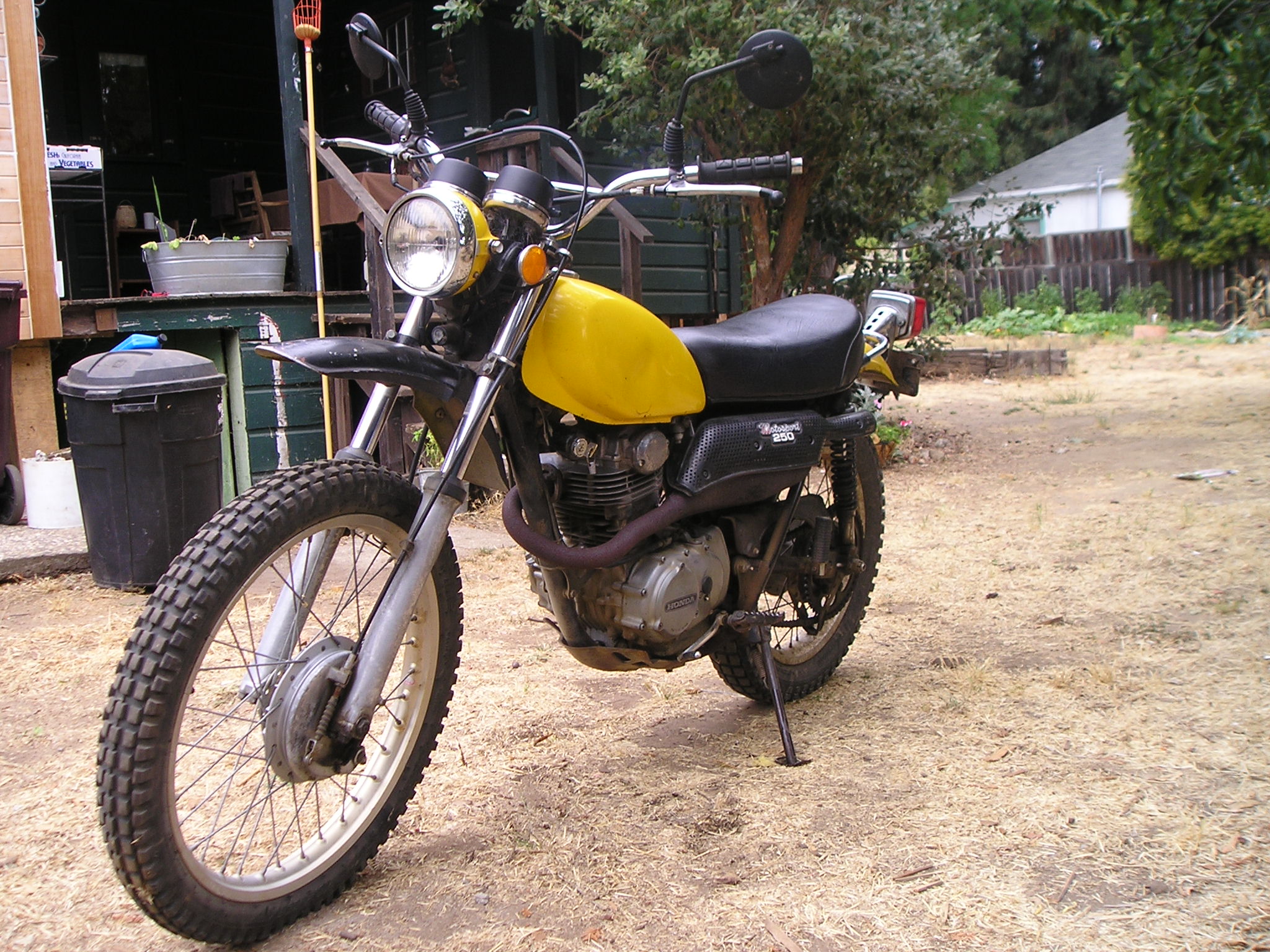
"And, and just sorry to interrupt Tim, but just in case people were confused at any point, any of you out there, a Honda XL 250 is like an Enduro.
[2551.5s] It's a, it's a, it's an early, early 70s or mid 70s, um, dual sport, basically."
A Honda XL 250 is a motorcycle that’s meant to do more than one kind of riding. It’s the kind of bike you can ride on dirt trails and also legally ride on regular roads.
The Honda XL 250 is a dual-sport motorcycle model from Honda’s lineup. In this context, the host describes it as an early/mid-1970s style bike that can be ridden on both dirt and street.
Car
Triumph Scrambler 1200 XC
"And I, and I, and I started, and the first bike was a, the first bike is the Triumph 1200 XC
Scrambler Triumph Scrambler 1200 XC."
The Triumph Scrambler 1200 XC is a motorcycle that looks like a classic scrambler, but it’s built for real-world riding. It’s meant to handle both pavement and dirt more comfortably than a basic street bike.
Triumph’s Scrambler 1200 XC is a modern “classic” style motorcycle built for mixed riding, with a more upright, adventure-leaning stance than a pure street bike. The XC trim typically emphasizes off-road capability and comfort for rougher surfaces.
"I'm going to sit on a, I'm going to sit on a T100, T120 and see what I think."
The Triumph T100 is one of Triumph’s classic-looking street motorcycles. People often sit on it to compare comfort and riding feel against other retro Triumph models.
Triumph’s T100 is a classic-style, air-cooled (or air-cooled-inspired) retro roadster in the company’s modern lineup. It’s often used as a “baseline” bike when comparing different Triumph retro models at a dealership.
"I'm going to sit on a, I'm going to sit on a T100, T120 and see what I think."
The Triumph T120 is a classic-style Triumph that’s generally the bigger, stronger-feeling option. It’s the kind of bike you sit on to see if it feels right for your body and how you want to ride.
The Triumph T120 is a larger, more powerful retro roadster in Triumph’s lineup, commonly positioned as the “bigger” counterpart to the T100. When shopping, riders compare the T120’s weight, power delivery, and comfort to decide what fits their riding style.
"So I signed up for an MSF course, um, in, in Long Beach here that Spurges and obviously you do that in, and I took, used one of their bikes."
MSF is a training program for motorcycle safety. They teach you the basics of riding safely, even if you think you already know how.
MSF stands for the Motorcycle Safety Foundation. It runs rider-training courses designed to teach safe motorcycle control skills, especially for newer riders or people returning after a long break.
"I was telling him a little bit about RevZilla and and it comes we come to find out that, you know, young young Scott Brooks lives right next to the the RevZilla showroom in Costa Mesa."
RevZilla is a store (and website) that sells motorcycle riding gear and accessories. The speaker is saying they’re close to one of RevZilla’s showrooms, which makes motorcycling feel more “real” and accessible.
RevZilla is a well-known online and showroom retailer focused on motorcycle gear and parts. In the episode, the speaker mentions the RevZilla showroom location, using it as a real-world connection point to motorcycling culture.
"[3596.2s] And then he said, like, you ride a motorcycle.
[3597.8s] I said, do it.
[3598.7s] And he made it like, I don't know if this is just a standard answer that you'd give
[3602.3s] somebody who's my age, but oh, he ran a Harley.
[3605.4s] Like he immediately just said, why is he a Harley?"
They’re talking about Harley-Davidson, a famous motorcycle company. If someone says “Harley,” they usually mean a cruiser-style bike from that brand.
“Harley” is shorthand for Harley-Davidson, the American motorcycle brand known for its cruiser styling and V-twin engines. In conversations like this, mentioning Harley often signals the rider’s preferred bike type and culture around the brand.
"[4125.9s] just knock on them. Like every car in LA now is going to be like aiming happy. No, I, I've talked
[4125.9s] about this in the podcast before because, you know, Zach and I have talked about lane splitting in
[4129.1s] the past."
Lane splitting means riding a motorcycle between lanes when cars are stuck in traffic. Some places allow it, and riders say it can help them get through traffic more safely. The discussion here is about how that changes the risk you feel over time.
Lane splitting is when a motorcycle rides between lanes of slower or stopped traffic. It’s common in places like California and is often discussed in terms of safety and risk management. The episode references how Los Angeles traffic culture and awareness affect how comfortable riders feel doing it.
"he wants to do something. He wants to ride a dirt bike and you know, he and I have kind of come, he seems excitable, that middle, that middle child."
A dirt bike is made for riding off the pavement. It has tires and suspension that help it grip and handle rough trails.
A dirt bike is a lightweight motorcycle designed for off-road riding on dirt trails, sand, and gravel. They typically have long-travel suspension and knobby tires for traction where street tires wouldn’t work well.
Concept
BDR
"how fun it would be to get a couple bikes and do like a BDR and trailer in and do a BDR trailer in and do some trail riding."
BDR is a kind of planned off-road riding route/event. People use it to ride dirt roads for multiple days, so you need the right bike, navigation, and preparation.
“BDR” in motorcycle context usually refers to a multi-day backcountry/off-road riding route or event (often associated with the “Backcountry Discovery Routes” concept). These rides are planned around dirt roads and trails, and they typically require careful prep, navigation, and appropriate bikes/gear.
"[4878.1s] one of the few things that I feel that way about, because I feel like when I see someone riding a [4882.9s] bowl or surfing a 60 foot wave or skiing down a rock face with ice and avalanches and stuff,"
They’re comparing motorcycling to skydiving. To some people it looks like you’re just hoping things work out, but to the people doing it, it feels more controlled and planned.
Skydiving is used here as an analogy for risk and control. The point is that some activities feel “hope-based” to outsiders, but riders/participants see them as more nuanced and skill-driven.
"I think in general, people in the motorcycle community get a bad rap from people outside of the motorcycle community. I think they're completely painted with the wrong color, but I think they're painted with a much darker color than they need to be."
A “motorcycle community” is the group of people who ride and share tips, meet up, and look out for each other. For new riders, it can make learning safer and less intimidating.
The speaker is talking about how riders form a social “community” around motorcycles—events, groups, and shared norms. This matters because it can influence safety habits, learning, and how new riders stay motivated.
"And I think one of the things that gets brought up a lot for new riders, whether they're Gen Z new riders or they're, you know, elder Gen Xers on the cusp of being a baby boomer, like the, how do you find a community of motorcyclists if you're just starting out regardless of how you're just starting out?"
The segment focuses on the challenges faced by new riders when they’re just starting out. A key theme is that finding the right social support and guidance can be as important as learning the mechanics of riding.
"Aprilia guy, he and I text all the time, but we don't ride together. Yeah. Right. It's just interesting reminder of, well, first of all, I think it's fair to point out that everyone's journey and experience within motorcycling is different."
Aprilia is a motorcycle brand. Saying “Aprilia guy” means they know someone connected to that brand—maybe a dealer contact or another rider—who they keep in touch with.
Aprilia is an Italian motorcycle manufacturer known for performance-oriented bikes. Mentioning an “Aprilia guy” suggests the speaker has an ongoing relationship with someone associated with that brand, likely for advice, parts, or community connections.
Select text to request an explanation
Welcome, welcome everybody to high side, low side, Zack and Spurge here with you as always.
On this episode, we are talking to our good buddy Tim who has, we think, a fascinating
story about getting into motorcycling, getting out of motorcycling and then getting back
into motorcycling.
He had a blast talking to him and we think you're going to love it.
Also a call out to Gen Z listeners and thoughts on getting into riding with a skeptical spouse.
All of that and more coming up after a word from our sponsor.
Gas prices are a bit and that's why you ride a motorcycle to save money on fuel.
But you've noticed that your fuel consumption, your beloved bike has gotten a little bit
lackluster lately.
Well, maybe that's because your fueling system is a little dirty.
Luckily for you, Motul has you covered with their Motul valve and injector cleaner additive.
One bottle will treat up to 60 liters of fuel.
You put it in there once every six months and it does its thing.
So keep your bike in its most efficient form possible to keep money in your wallet.
Check out Motul's full line of products, including the Motul valve and injector cleaner over
on RevZilla.com slash Motul.
That's RevZilla.com slash M-O-T-U-L.
And while you're over there on RevZilla.com, make sure you check out the RPM program.
That's the rider's preferred membership program now only $39.99 a year.
You get all kinds of discounts on motorcycle gear and apparel.
You get $15 for just signing up free two-day shipping concierge service.
And it works across all of RevZilla's sister brands.
That means J&P Cycles, Cycle Gear, RevZilla and RevR to learn more about all the benefits
of the RPM program.
Head over RevZilla.com slash RPM.
That's RevZilla.com slash RPM.
Now on with the show.
Okay, okay, everybody.
Welcome to high side, low side.
Zach and Spurge here on another journey.
We're going to bring our buddy Tim in here in a minute.
But for now, every now and then, you listeners, I want you to know, Spurge.
Spurge is a big, fancy businessman.
He's a business guy.
He's, he just had a conversation about this recently because somebody wrote into
you and complained like, oh, Spurge is presenting himself a little bit.
No, no, I'm not, I'm not, you're not being hoity hoity.
I'm just saying Spurge, Spurge is a businessman and he does business
things sometimes and he wants you to know about it.
And this is a perfect example of Spurge paying attention to the business and is
going to share some business with us.
And I think this is great.
That is, I prefer to think about this as we've oftentimes on high side, low side
challenged each other, challenged our listeners to think about how to get new
people into writing.
And I think it's oftentimes easy to think about new writers as, you know,
young writers, right?
And I think that's going to be a topic of what we're going to talk about today
is kind of branching out how we look at this.
But one of the studies that was done recently by a colleague that presented
at AIM, which is the AIM Expo in Southern California, which is kind of like a
motorcycle industry conference.
Exposition.
Exposition, if you will.
Was around Gen Z and how to create interest in motorcycling for Gen Z.
And they went through some pretty interesting data.
One of the points that I found interesting was if you look at the baby
boomer generation, there was a high priority placed on asset acquisition.
And for some of us that are about to inherit the possession of our baby
boomers down the road, you know, not all of us want the assets that are left behind,
right?
And so with Gen Z, because they they want a low liability of this burden
of possessions, well, they might not want four or five motorcycles in the garage,
right?
They might want an option to rent motorcycles.
And through this study, it kind of was interesting to look at, you know,
how the world perceives generation Z.
And that's one that's one data point.
But what we thought would be fun would be to actually talk to some people.
And Gen Z, does that sound about right, Zach?
Yeah.
Well, we actually are too old as millennials to know whether or not Gen
Z or even talk to each other.
Like do you use voice boxes?
They might just like text or Snapchat or some other tick tock.
I don't know.
The point is, if there are any Gen Z people out there that want to be on the radio,
just like the grandpappy done did.
It's sort of a it's sort of this is a call to action, right, Spurge?
That's that's the ultimate goal here.
It's like to talk to some Gen Z writers or want to be writers
to learn what it is about our pastime, our hobby that is either attractive,
scary, all those things.
And the business side of the business side aside, I think what Zach and Chase
and I were interested in as we started, you know, going through this is having
genuine conversations with people across demographic lines to take it beyond
the spreadsheets, right?
We talk about oftentimes when you're looking at a motorcycle, you can't look
at a spec sheet and really fully understand it.
You have to get on and tell the whole story.
And so for us, instead of looking at this presentation and saying, oh, well,
you know, Gen Z doesn't want things.
So I guess, you know, motorcycling is dead because they're never going to buy one.
We figured, you know, let's talk to some people that are riding a motorcycle
that are in their late teens and early to mid twenties.
And so if you are out there and you are a high side, low side listener,
and you are in Generation Z and you either ride a motorcycle or you're listening
to this podcast because you are interested in riding a motorcycle, any type of two wheels,
scooters, e-bikes, whatever you're riding that's bringing you into our fold,
we would like to hear from you.
So please, what's the give them a rundown?
What's what's age Gen Z again?
We're talking, this is, what is it?
17 to 27, something like that?
What is it?
I believe it's like 16, 16 to 27.
16 to 27, sure, something like that.
16 or 17 to 27.
If you're, if you're of driving age up to, or even before driving age,
if you're, if you're in that, that late teens, mid to late teens,
up to, you know, mid to early 20 or mid to late twenties, we want to hear from you.
And if people with gray hair often refer to you as quote unquote young,
you might be the person we're looking for.
So shoot us an email and, and just give us some, some thoughts over at
high side, low side at RevZool.com.
And if you're interested, we might have an opportunity for you to come on and
talk to Zach and I as we kind of spend some time over the next, you know,
seasons, you know, doing some of these human interest stories to hopefully
inspire other people your own age to get in the motorcycle, which is kind of what
we're doing here today, right Zach?
Lovely segue.
Spurgeo, um, to our guest today, um, who is not in Gen Z.
Um, but rather, uh, well, I actually don't know what to generate.
We'll have to, maybe you can tell us what generation he's in.
He's either a young baby or, or, or an elder, uh, Gen Xer.
Based on his spirit, I classified him as a, an elder Gen Xer.
Okay.
What was he, what he says?
Um, so, uh, our buddy Tim's on the pod today here, everybody.
Um, and we're going to, we're going to dive right into it, um, and get to know him
and his motorcycle experience because we think there's a lot to sort of learn
and unpack and, um, and, uh, and entertain everyone here today.
So our buddy, Tim Harris here, he is, uh, in his early sixties currently, um, he
works as the president of the Los Angeles Lakers organization in Los Angeles,
California, so a big fancy corporate job, in other words, uh, he lives in greater
LA with his wife.
He has three sons, uh, ranging age from 14 to 21.
Um, and Tim's motorcycling story is mostly what we're going to talk about.
Um, he rode motorcycles from about age 16 to age 22.
Um, so in, when he was a teenager, um, and how he got into motorcycle
and we think it's kind of cool.
Uh, then some decade, three, four decades went by and he decided to get back
into motorcycling, um, around the age of 60.
And when he did that, his whole experience there, we think is kind
of interesting and noteworthy and, uh, educational for you all, we hope.
And ultimately Tim, uh, sent an email to, uh, to Revzilla and, um, that turned
into somehow that turned into him texting with you and I all the time
Spurge, um, but that's none of that is really why Tim is on the podcast.
It's, it's funny, uh, Tim texts us so much that I was coming
into record today and my wife Nicole was like, tell Tim that I said hi.
I haven't heard from him in a while.
Um, no, the reason that we're having Tim on today is, is very much in
line with the conversation earlier around Gen Z.
Uh, we had done a survey recently, um, through Revzilla and we learned
that roughly 30% of new riders are between the ages of late 30s to early 60s.
So, you know, elder millennials to younger baby boomers.
And so for us, it was, it was interesting to look at this demographic
where we often think about, oh, a new rider is a young person, right?
And in this particular case, almost a third of new riders are coming
into motorcycling later in life.
And so we thought it would be fun to sit down with Tim, hear his story and,
you know, kind of get an idea of what brought him back into motorcycling in
an effort to hopefully inspire some of the people that are listening
right now that might be on the fringe.
We also know that in that same survey, 25% of people that don't yet ride
a motorcycle, but are interested in it are of the same age range.
So maybe of that small group or that, that quarter of the group, um, Tim's
story will help to push one or two of you over the edge into getting into two wheels.
So without any further ado, Tim Harris, welcome to the podcast.
Hello, guys.
How we do it?
All right.
It's great to see you.
Yes.
Um, well, so we just gave the whole spiel on you, your history, your love story.
Very briefly, we're going to dive into that.
Yep.
Um, when I was listening to Spurge talk there, he's talking about how, um, 50,
60 year old people are getting into motorcycling.
I think it's interesting that you were both a young person who got into
motorcycling and, uh, an older person who got into motorcycling.
You have both of those stories, which is one of the reasons we wanted to have you
on the pod and talk to you today.
I think if it's okay with you, Spurge, we'll start at the, we'll start at the
beginning, because I think the way that you got into bikes was kind of cool, Tim.
So you are, uh, uh, 15, 16 years old, living, uh, born and raised in greater Los
Angeles.
Why did you get a motorcycle to begin with?
So when I was 15, you know, I was living in suburbia, right?
And I had a buddy whose father had two motorcycles.
He had a little Honda 90, which was probably a late 60s Honda 90.
Um, and he had a bigger and it was much, it seemed a lot bigger then, but a bigger,
I think it was a Triumph 250 trail master or something like that.
Uh, you know, it was probably the, the Triumph was probably either the precursor
or the, the, the early scrambler, right?
Cause it had that sort of high, that, you know, that, that high pipe.
So the, the dad kind of taught us how to ride the Nile.
And I was like, I'm gonna go down the street and back and down the street and back.
And then, okay, you can go around the block and then, and we're 15.
We have no license.
We have no, this is the extent of our training.
Did you ask your parents for permission?
That was my question too.
I, you know what, I, I think I just sort of one day when later on, when I got better
and I was, I had sort of borrowed the, the little Honda and I, I think I just turned
up at the time.
Yeah.
Yeah.
Cause he just, he lived down the street.
He lived, not, not, you know, maybe a couple of blocks away and, and eventually,
and I don't, you guys would know better, like a late 60s Honda 90.
I don't, I don't recall a clutch.
I don't, I don't remember how it was.
Probably a, basically a trail 90, like the one the Aerie wrote across Alaska.
Yeah, it was, it was very simple.
Yeah.
Um, and, and so my, I remember, you know, my, my dad had volunteered me to do yard
work for one of his coworkers.
Um, and, and this, this man's wife was a tyrant.
And, and I remember I would, it was maybe, it was easy.
It was an easy bike right away, but I would ride the little 90 over to the tyrant's
house and clean tree leaves out of her IB.
Um, but then over time we learned how to ride the Triumph, which was, had a clutch,
a lot heavier, bigger bike.
Right.
Um, and, and then, and not what that allowed us to do.
Is ride together around the neighbor.
Okay.
As we were 15.
So now, like any 16 year old, I'm progressing or 15 year old, I'm progressing
towards 16 and I've got my learners permit for driving.
And I'm, I, I must have been around the house and I'm talking about how excited
I am for my 16th birthday.
So I can go down to the DMV and get my driver's license and freedom and drive a car.
And my dad stops me in my tracks and says, you know, like, I'm sorry,
do you see more than two cars parked at our house?
There's, you know, your, your mom has one and I have one.
Do you see a third?
No, dad, there's not a third.
Okay.
Can you take me out into the backyard and show me where the money tree is where
we're going to go and buy you a car when we didn't buy your older brother a car.
And my older brother was 18 months older than me or something.
And so that, that stopped me, right?
I'd have this, this thought that I was going to have all kinds of freedom.
I was getting my driver's license.
I was going to drive some sort of four wheel machine.
Right.
So I thought, okay, well, there's a work around here.
I'll, I'll get a motorcycle license.
Okay.
That'll be my fitting because at the time you could get a motorcycle license.
You just needed to go down and take the test.
So I, my buddy and I, I, I borrowed the 90 and I would no license.
I drove down in the pouring rain, took the driving test, passed it, took the
written while you're there, passed it.
So now I have a license.
Okay.
Now I'm good to go.
Now I actually need a motorcycle.
So I, I, I found out that there was a, a sandwich shop that was hiring three
miles away or so.
And I went down, applied to work in the sales shop, got hired.
And I came home that night and I said, Hey folks, I got to my parents.
I got hired at the, the giant grinder is to work in the sales shop.
And my dad, my dad again stops me on my tracks and says, well, that's tremendous.
How are you getting that?
And I said, well, dad, I've kind of thought this through because I had been
researching through the newspaper, right?
I'm looking through WAN ads and the little tiny WAN ads.
I saw that there was a little, there was a Honda 250 and Duro XL that was for sale
for 500 bucks.
And I, so you had, so you had a plan, like when you got, you got the job, you had a
plan.
100%.
So the, so the, and the, and the low financial barrier to be clear was kind of,
that was the driver here.
You're kind of like, I like, I like piddling around the neighborhood on the neighbors
moto and, and like, I know that if I want this quote, this, this, um, this quote,
unquote freedom by being 16, the way to do that is to get a bike because it'll be
cheaper.
So then you started like working toward this without necessarily looping your
parents all the way.
Correct, correct.
I thought this was going to be the work around because I'm never going to be able
to afford a car because I didn't have, I didn't have, you know, two nickels to rub
together.
I had nothing.
Um, and so I, I said, well, dad, I've got a solution.
If, if you will loan me $500, I can go and buy this motorcycle, which will allow
me to drive to the giant grinder to work and get paid on the motorcycle.
So I've got some freedom and I can pay you back the $500.
I need to buy borrow $500.
He says that sounds like a really good plan.
So on the day I had made arrangements to pick up the motorcycle.
I needed to check this is late seventies, right?
So I have to, an actual check and I went to my dad.
And I said, dad, I'm going to go pick up the motorcycle today.
I need a check to pay for the motorcycle.
It's $500 and it's made payable to John Q.
Public, whoever it was, he writes me the check and he's going to hand me the check
and he says, okay, now you owe me $550.
And I said, but wait a minute, dad, I'm borrowing $500.
What am I, why would I owe you $550?
And he says, well, that's the price of my money.
My money is my $500 costs you 50.
That's how the world works.
If you can get $500 for cheaper than my $50, you should go and do it.
Okay, well, I'm obviously, I can't get that.
So I took the money, bought the bike, brought the bike home.
And that night, my dad got home and said, you know, I said, dad, look at this bike.
He said, that's really beautiful bike, son.
Did you get a pink slip with that bike?
I said, I did.
He says, let me see that pink slip, right?
And my dad, he had just gotten home.
He worked in aerospace.
So he's got his tie in his pocket square and his dress shirt and he takes the pink
slip and he looks at it and he folds it up and puts it in his pocket.
And I said, what are you doing?
And he says, you don't own a motorcycle.
I own a motorcycle.
And if you miss one payment on my motorcycle, I am selling my motorcycle.
And at the time, I thought it was the meanest thing in the world.
Right.
But looking back, it was the greatest lesson in finance I could have ever got.
And it was with the way it with the way interest rates were in the late 70s,
you know, your dad gave you a bad deal.
Yeah, it was, it was 10%.
And then, you know, Spurge, I was thinking about it is, you know, this.
So now I've got this bike that I've got all kinds of freedom.
And like you guys know me, I can't wrench like I cannot wrench at all.
Like I am, I am literally if airy is at one end of the wrenching spectrum.
I I'm balancing him at the other end, right?
I can't reach it all.
So I have this bike.
I do no care for it.
I honestly can't remember if I ever, if I ever clean the chain, oil the chain.
I don't know if I ever changed the oil.
I own this thing for I own this thing for five years, years.
Yes, I rode the hell out of it.
And and so I had this bike, but I was thinking about this the other day, guys,
is I had it during the energy crisis.
And this is like when there were like lines at gas stations, when there were
lines at gas stations.
So yeah, so you had you had it.
Your license plate had a number on it.
And depending upon, you know, if you were off, if you're the last
number of your license plate determined when you would go get license,
when you would go get gas.
So odd numbers on this day, even numbers on that day.
And you would, you know, like what is what is a Honda 250 gas
take two gallons, like two and a half gallons?
It was tiny.
And so I'd have to I remember sitting in line and there's no phones.
There's not you have no phone.
You have nothing to occupy your time.
And I remember sort of sitting, standing in line where, you know,
you'd move up a car length at a time for an hour and a half to get 75
cents worth of gas.
Dang, right.
But but it was that was then you'd have to go back two days later
because like you're you're already going to be out.
It's like the thing had no had no range on it.
Well, what so I I freaking love that story because I think it's such an interesting
it's rare, I think that people get into motorcycling in this country.
That is in the United States for sort of like practical or like financial reasons.
Right. Like you had a plan here.
You're like, I'm going to work at the sandwich shop.
I'm going to get to the sandwich shop.
I'm going to get a cheap transportation.
It wasn't about sort of like, oh, I mean, I guess it started with your buddy's
friend who let you ride the trail 90 around and you thought it was fun.
And that's, you know, part of that we'll get into that more later.
But I think it's kind of rare that people make this like,
I don't know, this decision that theoretically makes sense on paper.
Like I'm going to do this thing and it makes sense financially.
But I and so I think that what I what I what I'm interested in now is kind of
what were what did that freedom look like?
So you had this this imagined freedom.
I'm turning 16. I'm going to get my license.
I'm going to get a vehicle.
I'm going to have a job.
I'm going to be able to go places.
What how did that manifest?
Like, is that what happened?
Did you did you use it only as transportation to get to the sandwich shop?
Or did it turn into did it turn into more than that?
Did you ride it with your friends?
Women are going to want you.
Men are going to want to be you.
Steve McQueen, yeah.
So that the cast is so much to that, Zach, is is it became obviously my way to school, right?
So school was however far school was a couple of miles away.
So it became a way not just the sandwich shop.
It became a way to school.
I grew up at a beach town.
So it was every single solitary day.
You took the long way home to ride by the beach every day without fail.
You took the long way so you could ride along and look at the waves, right?
I mean, that's just what you did.
And there was there was a I there was a loop that I created that on the weekends.
I might take it out and go up for a loop that was up in the hills.
And I would go on a loop and I but but I did not.
I did not ride.
I absolutely did ride at night.
Absolutely did ride in the rain, but I absolutely did not ride on the freeway.
And I think in part because where we lived was sort of tucked away.
And it was a little bit far from the freeway.
And I really had no reason to get on the freeway.
But that's the only reason is is and I rode the freeway one time.
I went to UCLA and one time I had to ride on the 405 for maybe an exit,
you know, one length of an exit.
And I just remember that the wheels were sort of narrow
and they're getting into the grooves of the freeway.
And I like the rain grooves.
And yeah, I just remember a thing.
Wow, this is kind of crazy.
But so I it was 100% freedom.
It was, you know, Zach, it was work at the giant grinder until you close at nine on a Friday
and then ride the bike to wherever the party is.
And then and it was it was everything I thought the car was going to be.
Which was freedom, right?
This was my utility of freedom.
And there was joy from a freedom standpoint.
And there was joy in that I got to do the loop, you know,
and I got to take rides on a Sunday when there was nothing going on.
I'm just going to go for a ride.
But it was more the freedom aspect of it as opposed to the bike aspect of it.
If that makes any sense at all.
Meaning I wasn't doing it because I thought, well, I'm carving up turns
and I'm going to I'm going to drop a knee or anything.
Or I'm doing wheelies or whatever.
Yeah, ever, ever, ever.
And and it was just more of it was it was a portal to me being able to gas some freedom.
Well, so before Spurge, before we there's there's so much to kind of like unpack,
but I want to try to save most of it if we can.
And I want to jump to a question that I don't think you and I have actually ever talked about
as friends, Tim, why, why'd you stop?
What was that you, you, you rode, you said till about age 22, I think.
So that would have been around the end of college, probably.
So you went to UCLA, played soccer at UCLA.
I remember you telling me stories about riding around in South Bay Los Angeles
to like pick up soccer games and you ride over and play soccer and then ride home or whatever.
But what was it?
Because it wasn't just like one or two years.
Like you were had, you were at like five or six years under your belt.
Yeah, six, seven years, just like that.
Guys, I'm like the poster child of what, like if, if, if, if one of our boys came home
and said, like, dad, I want to mirror your experience on a motorcycle.
There's not a chance in the world that they would be permitted to do that.
I mean, the, the amount of risk and that I took and rolling of the dice.
I mean, you know, like now, now I am like commander at GAT, right?
I am all in, but then whatever was the acronym for, I might wear a helmet.
Occasionally that was me, right?
And in, often days, it, you know, in the summer, it was shorts and flip flops and a,
and, you know, on a baseball hat, right?
So, right.
So I, I took it up to you.
I took it up to UCLA, which good God, if you, you're, you're, you're a college student at UCLA,
you're living in, Spurge, you'll know what this is.
You're living in Brentwood, which is close to Westwood,
but it's a motorcycle ride away.
You're going into Westwood on Friday after you turn 21.
You're going into Westwood on your bike, you're drinking beers, you're riding back home.
You're going front.
I mean, God, guys, I remember one time being on Sunset Boulevard, I mean, with my roommate
and a co-ed, like the three of us on the 250 going down Sunset Boulevard.
We did everything you should not do, right?
If you want that, I'm the textbook of what you don't do as a, as a young writer.
Interesting.
And so does that make it, does that make it harder to be a dad at times when your kids come home?
I'm a total hypocrite, right?
Because if my kid were, were, the boys would say, I want to get on a bike.
I'd like, no, you can't get on a bike, son.
You know how to need to be responsible.
I was the most irresponsible human being and I never considered, I never really considered
the risk.
Like I, I had a helmet.
I had like this yellow showy helmet.
But it might get worn.
It might not.
There was no law at the time.
But Zach, you asked me why I stopped is the bike had originally been an affordable utility
item for me to get it from point A to point B that I used, you know, at other times.
After UCLA, I was fortunate enough to be a, I became a professional soccer player.
And, and the commute to practice was a long way.
I was starting to make money and I thought, I can't, I can't ride 40 miles to practice.
You know, I can't date really on the bike.
I, I, I need to.
You can, but it's a very specific type of person you want to keep around.
Yeah, exactly.
So I, I mean, like after six years, the bike probably needed an oil change and you're like,
the bike was screaming for some kind of attention.
And, and so I, I decided to get a car, which should have been independent of getting rid
of the bike in hindsight.
I should have kept the bike and got a car, right?
But I was, I was living in an apartment.
Where would I keep the bike?
So it just seemed the natural evolution of my, of, of my maturing is how this is the thing I
will do now.
What's interesting is when I sold the bike, gosh, it was, because this is horrible.
And I'm an awful person.
I'm going to burn an hell.
This thing was so hard to start when it was cold.
Like you had to stand on it to get it to kick.
So you had to stand on it.
This is horrible.
And I get a call that there's a young woman who's interested in the bike, right?
She says, how's the bike?
And I, and look, I was really good about taking care of the bike.
I cleaned it.
I polished it.
I did that.
I just didn't do anything you actually should do.
Like I didn't change the oil.
I didn't check the chain.
I don't know if it ever got new tires, but I told her, this is the greatest bike you'll
ever have.
It's, you know, I've treated it like my own little princess.
It's awesome.
And she said, I'm going to come up.
Can I, can I take it for a ride?
I'm absolutely, you can.
When will you arrive?
And she says, well, I'm going to arrive at whatever o'clock.
And I'm like, oh, I, I got to make sure this thing is warm because it was warm.
It started really easy.
So I said, I got to make sure this thing's warm.
So I, she says, I'm going to arrive at like whatever, 1130.
I had that thing idling from like 11 until 1125.
So that when she showed up, she would think, oh my God, this thing's easy to start.
I can't imagine her first morning, like having to stand on that thing, trying to get it to start.
So I like to think that she was a good wrench.
And she was like, oh, he just had the pilot jet wrong.
He just needs to be moved fiddle with this and we'll fiddle with that.
And then he's like, oh, it was great.
You know, we're going to jump dude.
It was awful.
So we're going to transition here.
The problem is Tim, we're going to transition into like the bikes you own now and how you
got back into it.
And people are never going to want to buy a used bike from you.
You're going to take, you're going to go trade a bike in there.
They'd be like, whoa.
No, but I'm a totally different person now.
See, I'm a totally different person now.
That's, that's actually a great segue because within the context, and there's so much more
to talk about in your, your current motorcycling journey.
But in the context of you having this, um, the season of your life when you bought the
bike, because it was all you could afford and get to the sandwich shop and then, and
then you had fun with it.
It was cool transportation.
But then you, you aged out of it.
You, you know, you grew up, you got a car, move on with your life.
Um, I believe he said he matured out of it.
That becomes more important as he, it gets more immature later in life.
So I'm curious when, when you came back to motorcycling recently a few years ago there,
what, like, I guess to put it really simply, why, why did you come back to motorcycling?
If the reason you had one in the first place was never about going through curves or doing
wheelies or hitting jumps or it was just like to get around.
And like you enjoyed it.
Sure.
And you had some fun memories, but it wasn't, that wasn't the point.
So, so why, what was it?
What was the tickle that came back?
Presumably you still had a car, right?
Yes, exactly.
You're still gainfully important when you own a car.
You know, so my job, my career is a lot of nights and a lot of weekends.
Okay.
And then, and then, you know, I, I was focused on, you know, my car or my, my career.
And then my wife and I got married in 2002.
I met her in 2000.
So, and then we started having kids in 2004.
And so there it became, it was, I was really focused on my career.
And I, I, when I say I didn't think about, I didn't look back at the bike.
I didn't look back at the bike.
I didn't, I didn't yearn for them.
I had moved on to like next chapter or whatever's up.
Makes sense.
Then I, I meet my wife, we start having a family and building a family.
And now I'm focused on job.
And then, and then I was focused on like, I love, love, love coaching.
Like, and it was really important to me to coach our kids in, in whatever sports.
So whatever spare time I had, whatever spare time I had, it was, it was allocated to coaching,
you know, when I wasn't working or with the family.
And I never had a hobby.
I've never, I never, throughout, as I was through the 20, you know, the 2000, I never had a hobby.
I don't golf.
No, no, I cannot go golf.
You're not golfing the boats.
I cannot stand the sport.
Like, I, I, I just, I just do not, I don't have the patience for it.
I just want more people watching basketball.
That's all I get all day every day.
And so I love bowling, but I'm not in the bowling league.
I'm not in the poker.
I don't do poker night.
And I would talk to friends about, I don't have a hobby.
Like, this is kind of crazy.
And, and as I, as my kids got older and, and I'm obviously getting older, I'm like,
I got to figure out a hobby.
And at some point, Zach, a few years back, I thought, you know, you really enjoyed being on a bike.
You should like, look at that.
Like you really enjoyed that.
That was a really fun time.
You kind of intentionally dug up that memory.
You're sort of like, yeah, that was fun.
That was, I liked that.
Now that I think about it, I liked that.
Was it purposeful introspection, Tim?
Like you were like, you know what?
I'd need a hobby and I'm going to like reflect on things in my life, in my past.
Yeah.
It was, it's started with hobby.
Like, okay, you got to figure out where you have to do something.
Like you can't just go into lawn bowling, right?
You can't be that guy.
You've got to do something.
And I'm sure like, you know, Tim Harris, young 60s, getting into biking,
like a therapist would have a field day with this, right?
And so I thought, I want, I really enjoyed that.
And I'm sure a therapist would say, oh, look at him.
Like midlife crisis, trying to find his youth from years ago.
He's probably going to like still want to wear, you know, flip flops and shorts.
Like, look at him.
He's having an identity crisis.
That's how I arrived at Spurs.
I just thought, I enjoyed that.
That was the one thing because I knew coaching was coming to an end.
I knew my career would last forever.
I can't stay in golf.
And I thought, I like that.
Let me do that.
So then Tim, you know, I think, you know, so many people have maybe come
into motorcycling out of, you know, a necessity in their youth.
They're looking for some funds for some freedom.
And you gave us the story about how you got into it the first time.
As you approached it the second time, how did your approach differ?
Did you spend more than $500 on?
So, so I have, do they have newspaper classified from
motorcyclists still in your neck of the woods?
Good question.
So what I did is I thought, okay, so I had the idea, right?
And I thought, okay, and, and, and what I'm about to tell you is going to sound
as if I thought it through and you guys know, I don't think anything through
when it comes to this hobby.
And, and so I thought, well, let me see if this is like,
let me get, I should try and get on a bike to just see, I may hate it.
Like, don't spend any more time thinking about this thing you might want to do
that you used to do.
If you get back on a bike and you go, oh my god, that was horrible.
I hated it.
It was boring.
It was what have you.
Right.
The boyfriend of a colleague of mine rides, okay.
And he's, and he's like a super, super nice guy.
And, and I, I know him a bit.
And I said, look, hey, I know you ride.
I'm thinking about getting back into it.
Do you think I could ride your bike to just see if I'm, if I, if I like this,
well, this is the crazy thing.
So I don't, remember this is Tim Harris.
He's been frozen in motorcycle ice for 40 years.
Right.
They're just throwing him out in 40 degree.
He is just taking a while.
I knew nothing.
Spurs, I do not like, you think I know nothing now.
I knew less did.
And I said, I don't, I didn't know what he had.
Like I had no idea what he had.
I mean, he could have shown up on a track.
I don't know.
And, and so he says, I said, look, is there any way I could just ride your bike?
And he's the nicest man in the world.
He said, sure.
Um, do you have a license?
And I said, well, I used to, but somewhere along the way the M fell off of the license.
I don't, it fell off.
That's a question I had.
It was like, was you, were you still technically legal?
It sounds like at some point you lost it.
At some point it falls off, which was weird.
And probably at some point they said, it's going to fall off unless you retest.
I don't know.
So he says, yeah, let's meet.
And we met in a parking lot and he pulls up.
Okay.
If I'm sitting there that day, guys, he pulls up on a motorcycle.
That's what he pulls up on.
He pulls up on a motorcycle.
I know now that he pulled up on a motorcycle.
A Ducati, right?
Okay.
At the time he pulled up on a motorcycle.
All right.
And he pulls up and I look at it and I can see that, you know, it says Ducati.
I'm like, okay.
Now I don't know what model of Ducati it is.
And so he sort of gives me a primer on, this is how it works.
You know, and I knew, I knew how to run a motorcycle, right?
And like, here's, here's how you turn it on.
Here's this, here's that.
You're like, where's the Kickstarter?
Right.
You know, hopefully you pre-warm it up for me.
It was a big, you know, it's a big multi-strategy.
It's got the bags.
It's got the, it's got the, you know, the luggage.
It's just got everything and he longs me his helmet.
And, and I thought, okay, God, don't drop it.
Whatever you just don't drop this thing.
This, this is, this is, he likes this.
You don't know your, and I had no idea.
Am I going to like pop the clutch all over the place?
I'm not going to be able to get started.
Is it going to fall?
So just to interrupt you quickly.
For those of you who don't know Tim as we do, and are not looking at him on video,
perhaps only hearing his audio.
Tim, you are, um, six, four, six, three, six, four.
No, I'm not as big as Spurgeon.
I'm six, two.
I'm shrieking.
I'm shrieking by the day, which makes me, I don't know.
Jen, something old.
I'm shrieking by the day.
I used to be six, three.
I'm 16 now.
Okay.
But see my six point is all in like the volume.
So, so my, all my, my point is, um,
Tim, you do have this, you do have an advantage in the situation of being a,
a tall-ish, strong guy, um, and a, and a former pro athlete.
So you, you know, your hand-eye coordination is pretty good,
but I don't think this is another piece of your motorcycling history that I don't
think I've ever talked about with you as a friend and I'm, and you were about to get to it.
And so, uh, I just want to say that I'm super interested to hear you dissect this.
What was that like the first time in 35 years, you pulled in a clutch and you put
the biking gear, click, and you let the clutch out.
Like, what was that like?
It was, well, it was, it was more nerve-wracking than it needed to be.
Like it came back a lot faster and easier than I thought it might.
Okay.
Right.
Cool.
Um, I knew, I knew pulling the clutch, I didn't know, I didn't know what
the words frictions on were, were to be honest with you, but I knew pulling the clutch,
start letting the clutch out, give a little bit of gas, you know, it revs up,
throw it in the second, revs up, et cetera.
The concern that I had going in did not to be, did not need to be as high as it was,
because it was a lot easier and, and, you know, no pun identity.
It was like getting back on a bike and, and it was a lot easier.
And so I, I, I didn't, I didn't drop the bike.
It's not an old, you know, it's a big bike, right?
It's 500 something, whatever.
I didn't drop it.
It felt manageable.
I did.
We were over it in here at a, at a, it was like a week day at an aerospace, you know,
Forbes, so there's lots, a lot of parking lot space.
So I did some loops on the, in the parking lot and they felt pretty comfortable.
And so, and this online, I'm going to take it out of the street.
So I took it out of the street, went around the, sort of around the block and it felt,
it felt really comfortable.
And what it did, Zach, is it, it confirmed like, yeah, yeah, okay.
I can do this still.
Right.
Okay.
I'm still okay.
I'm, I'm, I'm able to do this.
I'm able to ride.
I haven't forgotten.
And B, it's pretty fun.
Like it's pretty fun.
So, so I'm wondering that, that was for my next question.
It's like, at what, did you have a moment either on the bike or when you brought the
bike back and you put it in neutral and you put it on the kickstand and you shut it off and you say,
you know, Jim Bob, whatever his name was, thanks so much.
Really appreciate that.
It was really nice of you.
And then you get back in your car and you're driving back to the office or your house or
something like that.
I'm, I'm imagining a moment that you had where you said like, yeah, I'm doing it.
I'm back.
I'm going to do it.
And so was that when you were still on the bike or was it after?
Was it the day after?
When did that happen?
No, I think it was, Zach, I think when I was on the bike on the street.
So I was driving it like an actually human being like would, you know, like,
not just, oh, I'm going to go around the park.
Not just in the parking lot.
Yeah.
When I was actually on the street.
And you sure it wasn't just breaking the law by riding as an unlicensed?
I was doing everything I shouldn't do.
Right.
So I was on the street and I thought, okay, A, I can do this and B, this is super fun.
Okay.
This is A, I can do this and B, I can do this super fun.
And I got back and I said, hey, Jim Bob, I just really appreciate it.
It was a blast.
And Jim Bob told me, like, if you ever want to borrow the bike, and he, I mean,
he's a really gracious guy.
If you ever want to borrow the bike, just let me know.
You could borrow it for a week.
You can, you know, take it out.
And, and, and as I've learned, people who ride motorcycles are incredibly kind.
And he's, he's just like everybody else in motorcycling that I've met.
And, and that's when I said, all right, I gotta, now I can explore this more.
And, and that's when it got interesting because I got it to sort of what I'm going to buy.
And so obviously when you, when you kick things off the first time around, you know,
you went to the newspaper, you looked up classifieds, you bought a used bike that you
had years down the road, what give us, you know, you don't have to go into,
into crazy detail, but like, what was your path into finding a motorcycle?
Like you, you walked in and you didn't know that it was a multi strata that Jim Bob
brought you and you're looking at these bikes and they all look different.
Like you leave, you're excited.
You don't want to give the keys back.
You're feeling that energy.
Then how did you translate that energy into jumping into this new world of
motorcycling and choosing a bike?
So you have to remember, I've been in ice for 40 years.
So I don't have a feel of what's good, what's bad, what you ride, what you do.
I knew what I didn't want.
I knew by looks, I suppose it would, I didn't want.
I knew I didn't want a, like a super naked, you know, I didn't want to, because I'm
150 years old.
I didn't want to be bent over, you know, where I can't get off the bike.
I knew kind of what I did not want, but I wasn't sure what I did want.
And like, like most things in this part of the journey, because I'm not a
wrencher, I'm not a machine person and I hadn't been on ice for 40 years.
I, everything was based on looks.
Everything was based on what, like I didn't really, I had a 250.
250 was fine for then, but I didn't know what that meant now.
And, and just sorry to interrupt Tim, but just in case people were confused at any
point, any of you out there, a Honda XL 250 is like an Enduro.
It's a, it's a, it's an early, early 70s or mid 70s, um, dual sport, basically.
It was a kind of, what it looks like is a dirt bike you can ride on the street.
And so that was, that was your history.
And so did you find yourself gravitating toward that?
Yes.
Yes.
I liked, I liked that look, but I also liked the look of the modern classics.
I really liked the Bonneville.
I liked that look.
So something that had a bit more timeless.
Like, I love World War II movies.
I love Steve McQueen.
He's jumping the feds, you know, that he gets caught up in the barbed wire.
You know, I love that look of that bike.
That's where I started was, I start, and then I think I may have gone to like the,
the triumph website.
I'm like, okay, yeah, that, the T 100, the T 100.
That's sort of what I'm, I'm looking for.
That was the first step in sort of a journey, you know, that, that led me to
where the first bike, the first bike on the return.
And how long did that journey, like to get, so for people listening that are like, oh, like,
I'm, I'm Tim Harris four or five years ago.
I'm, I'm feeling like maybe I want to try this out.
You start going down the spiral.
Maybe somebody out there is listening to this podcast that's at that point in their journey.
How long did it take you from, you know, riding the Ducati to doing your research
and looking at pictures on the internet to walking in a motorcycle dealership and saying,
I would like to buy that bike right there.
Like, what was your timeline?
No, not long at all.
I would say I bought the bike, the current, the first bike in July, I think.
And I think I started in earnest, I'm going to buy a bike in the spring.
Okay.
So it's a few months, three months, maybe.
Yeah.
Okay.
And I, and I, and I started, and the first bike was a, the first bike is the Triumph 1200 XC
Scrambler Triumph Scrambler 1200 XC.
So you ended up, you ended up, you ended up being drawn in.
You liked the Triumph, that, that sort of like, like you said, modern classic, that style,
the round headlight, vintage look, but modern motorcycle, which I think a lot of people do
for good reason.
And those are great bikes.
And then you ended up with the Scrambler in part because you, you like it was, it was tall
or because you like the dirt bike, you kind of look or what was the.
Yeah.
Yeah.
I, I, so I went to, um, I'm like, all right, I'm going to go and sit on a bonnet.
You went to a dealer, right?
I went to, I'm going to sit on a bonnet because I had no idea, right?
So there was a, there was a new, a new dealership that had just opened up.
Okay.
And I said, all right, and it's not too far from my house.
So I'm going to drive there.
I'm going to sit on a, I'm going to sit on a T100, T120 and see what I think.
And I, it's interesting guys, I showed up and they, they hadn't been home too long.
I made, I can, you know, I, I, you know, made sure that I confirmed that they were open the
hours that I showed up and the doors locked.
And then there was like a couple of guys standing outside like with, you know,
their arms crossed and they said, like, can we help you?
And I said, like, yeah, I'm trying to, I wanted to come in.
I'm, I should invite a bike.
I wanted to come in and sit on one of the, the Bonneville's and the doors locked.
They said, oh yeah, we, we didn't, we just opened recently where there, there's a staff meeting.
And I said, oh, okay.
Well, so I can't go in and sit on the bike.
And he says, no, no, because there's a staff meeting.
But he says, but I have a T100 parked right over there.
You could sit on that.
And so I sit on it, sat on it and it felt a little low for me.
I don't know to compare it to whatever.
It just felt a little low.
Immediately the guy's trying to, you know, he's trying to window sale me like,
hey, if you look in the window, there's a Thruxton, you know,
you should really buy this Thruxton if you look in the window.
And so, and it looked a little bent over for me.
And I said, okay, well, but I can't sit on it.
He says, no, no, no, no, no, because we're having the staff meeting.
But then you can look at it through the window, right?
So, so that's like, I think that frustrates me because I know that and we'll get into it.
Not right right now, but like, I think it's frustrating where it's like,
oh, you should buy the Thruxton.
It's like, you don't know me.
You didn't ask me any questions about what I'm looking for.
Like why, like you're just trying to push the one in the window because like it's,
you know, been sitting on the floor for six months.
Like that's, that's annoying.
We'll get into that later.
And you know what I did is, so I buy the scrambler and then I instantly
start Dr. Frankensteining it, not me.
I have someone Dr. Frankensteining it into a bike that starts looking like the 250.
The High Mudguard, you know, a more enduro looking.
So everything that had brought me in the door thinking I'm going to recreate Steve McQueen
goes completely out the window because I now I want to just recreate the 250.
So before, so outside of the mods or the recreation of 250,
you buy, you buy the scrambler, they pull it out to the parking lot for you.
They're like, Mr. Harris, here are your keys.
Godspeed, have fun.
The first ride on your own motorcycle in 35 years, just for anyone out there listening,
what was that moment like for you?
Well, first they didn't roll it out because I bought it from a dealer that's an hour away
and I had no license and I, other than that one little stretch of freeway,
I'd never been on the freeway.
Did you buy the bike before you got, you got your license?
Bingo.
I forgot about that.
Right.
So I'm like, you know, ready.
Doing it all in real time.
I'm just going to do it.
And so they were, but they, they said we can deliver it.
So they delivered the bike.
So Spurgeon, the first time I got on it after they delivered it with my no license,
with my permit, like I'd gone down and I'd taken the written.
Okay.
Or the written.
And I had my permit and I got on it because I was just dying to ride it.
And I, and I got on it and it was the most amazing feeling ever because it was,
it was a beautiful, it's July, it's a beautiful evening.
And I took it down along the beach.
And I'm like, this is just like your kid all over.
It's just like young Tim had gone right back to where I had gone to look at the way.
Interesting.
Right.
Again, the therapist is all over this.
The therapist is like taking notes right now, but it was the greatest feeling ever.
And to get you to actually get the little M, uh, back on your license.
Did you, did you do like an MSF course?
Or did you just get out of the state?
Okay.
Yes.
So I, I, I thought, okay, I, I could do the easier in terms of TikTok and just go to the DMV
and like do the lollipop thing.
Right.
And then by that, no, you've been off it so long.
Do the smart thing and sign up for a course.
So I signed up for an MSF course, um, in, in Long Beach here that Spurges and obviously you do that
in, and I took, used one of their bikes.
It was like a BMW 350, tinny thing.
And that's how I got the licenses.
I passed the course that day.
And I think that was, I think I remember that our, our communication and friendship was just
starting around that point, I think, right?
Cause didn't you reached out maybe just after you bought the bike or just before you bought,
I think just after you bought the bike.
And then you were sort of like talking to me about like, I have my, like, should I,
should I do the course?
And I think I told you that that's what I did.
Yeah.
I knew how to ride a motorcycle when I was 16, when I got my license, but I took the course
anyway, cause it seemed like the right thing to do.
And so that was a, I think I remember telling you.
Do you recommend, so Zach gave you that piece of advice for anyone out there listening that
might be, you know, later in life or a returning rider that's maybe thinking to themselves,
I don't know.
I know what I'm doing.
Should I take the course?
What would you say to that person listening?
1000% take the course.
Now, I know, I have a buddy who took the beginner course, like I've never been on a motorcycle
course and, and he loved it.
And he, he ultimately got his license.
Okay.
And he's, he's, uh, he's looking for a bike.
But I took the sort of, hey, you know, I'm gonna ride a motorcycle and come take this
course.
And I did that 1000% spurs, I would say take the course because, and this is a bigger
conversation, but everybody who's involved in that course wants you to have your license.
They just want to make sure that they're not turning knuckle heads loose on the road.
Right.
But they want you, they want you to succeed.
Yeah.
They, they, they truly, now they're not going to just gift it and just say, hey, anybody
who wrote us a check, we're going to pass just because, but because then you're throwing
knuckle heads out of the road.
Yeah.
1000%, I would do that over getting just getting the appointment at the DMV and going
to take it to lollipop and then you leave.
I would 1000% endorse.
So what you're saying is you're definitely not a knucklehead because even your money
couldn't buy there.
I am 1000% a knucklehead.
No, but you're, but you're not though.
And I think that's, that's a, we're going to, we're going to pause for an ad here soon,
but I think we could, we could potentially quickly cover the, let me sarcastically say
slightly different outlook that you had on gear this time around, which, which was, I
think you've said kind of an intimidating thing because there's so many options these
days, but like you ultimately, I don't know, I guess maybe, maybe to put a finer point on it
and, and drive right to the, to, to what I'm asking, why not just wear a helmet and flip
flop, like put on by the cheapest, crappiest helmet you can get and wear the flip flops in
the shorts and ride down to the beach like you just did.
And, and like call, call it good.
Like that's what you did before.
So why not?
Yeah.
What changed?
I mean, I can't, I can speak for me.
I can't speak for everybody else, but for me, I'm a, I'm an entirely different person
than I was then.
You have, you have sort of a better understanding of mortality.
You've got little ones and, and a wife who, who would like to walk, see you walk in the
door at the end of the day.
And that was it.
That's important to me is, and you know, my journey through gear, there was no notion of
gear back then, but there wasn't even, you know, back, back in the day, there wasn't
even a helmet law, you know, and helmet law was like loosely suggested.
And now, uh, my journey in gear, you know, and, and guys, you guys know this and that
is it's been an education by credit card.
And, um, you know, I started in the way I started with a bike.
Like I didn't know what CE rating was because I hadn't met Zach yet.
So I didn't know what CE rating was.
I just was everything was based on looks.
Yeah.
100%.
That's a cool jacket.
Oh, those are cool gloves.
You know, the helmet I just bought at the dealer.
Like, yeah, all right, sure.
Fine.
Yeah, I had, I had a show before I'll have a show now.
Yeah, I remember them.
Um, you know, the jeans, you know, I got jeans.
Like, wow, these are bulky and big and awful.
And why would anybody ever want to buy these, you know, boots?
I don't want to buy boots.
I just want to wear, you know, I want to wear, you know, sneaker.
But I, my education through it taught me like that just, it's just a better way to do this.
And you can, you can ride safely and look okay.
You don't, you know, you don't have to look like you're headed to the moon.
And, um, that was just all part of this journey.
And, and I think you guys talk about it from time to time.
So much of this industry is a solo endeavor.
Yeah.
Right.
Yet there's a world, there's an entire community out there willing to help you.
But we, for whatever reason, I think sometimes we make it a solo endeavor because of,
of the reaction non-riders give us.
That is a perfect segue, Timothy.
So we're going to come back and we're going to talk about, uh, community
and the perception of other riders.
But we're going to take a break for, uh, for an ad from our sponsor Motul.
Tim, the, the oil does need to be changed in your motorcycle.
So let's, uh, let's see what advice we can get for this ad for, uh, for Motul.
Splat.
Zing.
Bzzz.
Ding.
Some bugs are slow and some are spry.
Some bugs crawl and some, they fly.
Some bugs are small and some are fat.
Some go crunch and some go splat.
And when that sound you do here, reach for Motul.
Yes.
Keep it near.
Wind screens, leather and helmets too.
Motul has the cleaner for you.
From bugs, green guts to their purple goo.
Motul's clean is always true.
To maintain your bike's shining glow, to RevZilla.com you must go.
So clean your motorcycle.
Don't look like a fool and clean it right.
Use Motul.
To shop all of Motul's cleaning products, head over to RevZilla.com slash Motul.
That's RevZilla.com slash M-O-T-U-L.
All right, so we are back with our friend Tim Harris and we left off talking about community,
talking about the fact that you're a little wiser, you're a little bit more,
you know, maybe not risk adverse but cautious in your second time around.
And one of the things we wanted to talk to you about was just the perception
of the other people in your life.
And you know, you're bringing a motorcycle to the office, you're bringing a motorcycle home,
you know, and maybe the perception of risk from other people.
And I have a fun little anecdote that I haven't shared with you yet.
But a couple of months ago, I had the pleasure of going to my first professional basketball
game, a 76ers home game where the Lakers were in town, thanks to Tim who was like,
you have to go see a basketball game.
You've never been to a basketball game, you gotta go.
And I was sitting at the start of the game and there was a young man next to me
and I don't know anything about basketball, I'm just there for the ambiance.
And if I'm being honest, I had a little card that got me free beer.
But the young man sitting next to me, his name was Scott Brooks.
And I come to learn that Scott Brooks is an assistant coach of the Los Angeles Lakers.
I didn't know that at the time.
And he turns to me, he's like, what are you doing in these seats down here?
And I was like, oh, I'm watching the game.
My friend Tim, you know, got us, got me a ticket to the game.
And he goes, Tim, who?
And I said, Tim Harris, he goes, how do you know Tim Harris?
And I said, well, through motorcycling.
And he goes, what do you mean?
Motorcycling.
I said, well, Tim rides a motorcycle and I work in motorcycling and we've become friends
over the last year or so.
And and he got me a ticket to the game.
And he goes, well, what do you do in motorcycling?
And I was telling him a little bit about RevZilla and and it comes we come to find out that,
you know, young young Scott Brooks lives right next to the the store, the RevZilla showroom
in Costa Mesa.
Oh, wow.
And and I'm like, have you ever considered motorcycling yourself, Scott?
And he goes, hell no.
He goes, that's insane.
He goes, I've noticed I'm not going to ride a motorcycle.
And I was like, be able to get the RevZilla showroom right there.
Your buddy, your buddy Tim rides a motorcycle.
And he goes, no, absolutely.
I don't ride motorcycles.
And it was just it was really interesting to me that it wasn't even like a curiosity.
It was just like a absolutely not interested.
Don't even talk to me about motorcycles.
And, you know, Zach and I were joking before this episode about like, you know, you're
what kind of rules do you have as a as a Los Angeles Laker?
Or do you have something in your contract where you're not allowed to go jump out of
an airplane and go parachuting?
Like, are there certain rules associated?
And like, what has your, you know, reaction from people been when you come home and you
say, I bought a motorcycle, are you pulling into the office?
And you're like, carrying your motorcycle helmet in hand and people are, you know,
coworkers are watching get off a bike.
Like, give us a little bit of like what you faced.
Was it acceptance?
Was it rejection?
Like walk us through.
So there's a lot there.
And I'm cracking up that you sat with Scottie.
He's like a super nice guy.
And I, I actually ran into him one day.
I think some, he must have saw that I was carrying my helmet or something.
And then he said, like, you ride a motorcycle.
I said, do it.
And he made it like, I don't know if this is just a standard answer that you'd give
somebody who's my age, but oh, he ran a Harley.
Like he immediately just said, why is he a Harley?
Yeah, it was pretty interesting.
I think, you know, what's interesting is Jim Bob said to me once.
Who's Jim Bob?
Is Jim Bob the one that lets you borrow the Ducati?
He's forever Jim Bob.
Jim Bob once told me, he said, you know, motorcycle is like golf.
You either get it or you don't.
And people who ride get it and people who don't don't.
And, and I think what you find is what I find.
Okay.
So what I find is I'm, I'm, I'm very much like pretty much everybody else who rides a motorcycle.
You're really excited about it.
You want to talk about it.
You want to tell people about your bike.
You want to tell people where you went and people who don't ride are generally sort of
politely incredulous.
You know, you get a lot of, really, right?
Because they don't want to smash your hobby.
Yeah, yeah.
But they're clearly taking it aback.
Like, but they don't, they also don't want to accept it either, you know?
No.
And, and they don't, again, they're polite by it.
And, and, and Zach knows this because, you know, there's, there's a number of folks within,
within my work community who they support me and they support who I am.
And they support what I do, but they're also very worried.
You know, they get worried.
And, you know, I rode, I rode once.
I took a bike, I took the bike, one of my bikes to a game, you know, it's a game down at the
renits, you're riding down on twilight, you're leaving at night.
And that resulted in like a borderline intervention.
Like we, you know, like people coming into your office and people came into my office.
Like, we know you love this thing.
We don't necessarily understand this thing.
We know you love it.
We support you.
We support what you're doing.
But please don't ride the games anymore.
Like that makes us really uncomfortable.
And it was what it was.
It was the nighttime stuff.
It was, and like, look, from where I am to get to the arena, it's like freeway, freeway.
And, and they were, and, and like it was on the way there, it was twilight.
It was traffic-y-ish.
So it's, everything's moving slower.
So it's much easier.
Even though there's more cars, it's moving slower.
On the way home, it's a speedway.
Yeah.
Right.
It was, you know, like I'm going 80 and I'm staying at still, right?
Yeah.
And, and there, that's real.
That's real.
Like the concern is real that they have.
Their worry is real.
And, and this is, I think, a good thing to keep unpacking and to dig out a little bit,
if you're okay with it, Tim, because I think that you, this emotion that you bring out in your
colleagues is, I think, exacerbated, accentuated in your case because you are a leader in your
workplace and you've been around a long time and you, we don't need to go into much of the
details and I don't even know all the details, but I do know that you are well known in your
work community for taking care of the people around you and being generous and inclusive
and kind and, and in general, a good boss is what, the way that I understand it and from
the people that I've interacted with at your organization.
And that's what they don't like about this, right?
Is that, is, is they see your influence in your circle of coworkers, colleagues and,
and to some extent friends and family as being so positive and, and, you know, driving so many
people forward and carrying so many people along with you that the risk they see is not just for
you, but for, for their own emotional safety and for, and for others, right?
And I think that that's a, that's a, that's, most people are not, don't, don't hold the job that's
quite as highfalutin as yours, if we're being perfectly honest, but many people have
coworkers and friends and family who care about them and they have the same feeling.
So I'm curious how you, how you deal with that?
How do you navigate it?
Yeah, how do you navigate it?
How do you deal with the people that care about you?
It's, look, it's, I look at it from a number of different angles and lenses and it's, it's fair.
It's completely fair that they have concern and I, and I appreciate their concern, right?
Um, you know, you can, you can get Polly on it, Polly Anna about this and say, oh, but,
you know, you can, you could slip in the shower, you know, oh, you know, you can,
you could get hit crossing the street, oh, you could, you know, you could drown in a four foot
pool, right? And, and yet, and so you end up sort of pulling on this thread to where if you,
if you play that, you use that rationale, it's like, all right, I'm just going to stay in bed,
right? I'm just never going to get out of bed, which almost isn't a bad idea.
And, um, and yet, so you have to, you make these choices and they're, yes,
Jack, they're worried about me and I appreciate that, but they're also worried about like,
oh, what the loss of me would be to them. Okay. And I understand that and that's real.
But what I think is somewhat on not maybe not founded in the right place is
it is a dangerous sport. Okay. The dangerous hobby. But I think a lot of when you're looking at it
from the outside, it's seen as far more dangerous than it probably is in actuality.
Hmm. And so if nothing else for those listening, we're nodding in agreement. Okay. The statistics.
Thank you. Yeah. The statistics are, um, uh, more favorable to, to hear you tell it than
people think they are because basically, I mean, maybe to break this down and you can correct me
if I'm wrong, but I think this is where you're going with it. When people hear about motorcycles
or see about, see motorcycles or think about them, it's when they are
being ridden by a guy with a machine gun in an action movie, or it's when they see a motorcycle
tipped over on the side of the freeway, or it's when they hear some story at a party about my
uncle who broke his leg or whatever. It's not the millions and millions of people who use them
every day safely and appropriately and whatever. Is that what you're saying?
I wrote to the game. I wrote home and I went to bed. Like that's not, there's not a story there
that people hear. No, no. And your rights version. And, and, and I think, you know what,
there is this perception that is fueled by the things that they read, see or hear, because,
you know, it's like, you don't, you don't, you don't ever read, you know, to use an analogy with
what I do as a living, you don't, you don't, you don't read the next day that the NBA referee
did a really good job. Right. Like you only read that the NBA referee did a really bad job,
that they made a mistake, that he blew something. So you don't, you don't read about all the stories
of people who wrote to the game, watched the game, wrote home and went to bed. You only read about
the ones who were in an accident. And then when you did, when you, you know, you dig deeper
into that generally, not always, but generally, you know, you'll see, oh, there might have been
alcohol involved, though there might have been speeding involved. What I hear more than anything
in Los Angeles is you're not one of those guys who splits. You're not one of those guys who goes
down the freeway, you know, in between cars. Right. And, and the reality is, is yes, I am
one of those guys who goes down the freeway in between cars, but I don't go down the freeway
in between cars at the speed that the riders are going that they're referring to. Yeah. They're
referring to the ones that they remember. Yes. Yes. Because like when I'm in my car
and someone goes flying by me, okay, I remember it. Yeah. And I think, oh God,
slow down, be safe. Like that's, that's nervous. That's makes me nervous. Right. That's what
they're referring to. They, because they don't remember, they don't remember being in their car
and a guy going down the road 10 miles an hour faster than they're going. Right. They don't
remember that. Right. That's the NBA referee doing a good job. They only remember the guy going down
the road, going 30 miles an hour faster. Right. With his t-shirt flapping and a one-handed wheelie
or whatever. Exhaust, you know, fully wide open. Exactly. And I think that's, that's sort of where
the industry gets a bad rap is, is, you know, what I'm about to say, I'm, I'm going to probably do
myself after I say this guys, because I'll probably end up being like, all of a sudden I'm a target
for every car in Los Angeles, but I have not had a close call. I have not just find some wood and
just knock on them. Like every car in LA now is going to be like aiming happy. No, I, I've talked
about this in the podcast before because, you know, Zach and I have talked about lane splitting in
the past. And I think Los Angeles has done such a good job. When I first, I lived in Los Angeles
probably, I guess, almost 20 years ago now. And when I first moved to Los Angeles, there wasn't,
it didn't feel like there was the same level of awareness as when I ride in Los Angeles now.
And, you know, there is a very, I feel there is a lot of awareness in Los Angeles that makes it
easier to be a motorcycle in Los Angeles, despite all the traffic and despite the headaches,
because people are aware of motorcycling, because it is more prominent there as a city.
I think it's a good trade. And I want to, I want to talk, I want to transition risk into community
a little bit here as we pivot to the next part of this conversation. But for, for someone that
learned how to ride in a sleepy suburban portion of Los Angeles in the late 70s,
to someone that came back into motorcycling a couple of years ago, into what Los Angeles has
become. And you became a motorcycle. And ultimately riding to downtown LA, to LA Live in one of the
biggest metropolitan continues bridge. Yeah. What, what, what would you like, what was your story
about learning, you know, how motorcycling has changed on the street and how did that affect
your acceptable risk and, you know, the way that it just kind of all came back around for you,
because you weren't just riding, you know, around the beach town anymore.
Right. And then that's like, it's a super good questions first, because,
because what, what's happened in the last 40 years is, is enormous, right? What's happened
on the roads in the last 40 years is gigantic. And, and the, the, you know, look, the, the,
the paying attention thing is real. Yeah. I mean, the people on their phones is real.
I mean, that wasn't 40 years ago. There, there's just more of everything, right? And everything's
moving faster. Yeah. And, and, and, and everybody's on their phone, right? And that's, that's real.
Now, the, the little Timmy of 40 years ago, I had no sense of the danger. Okay. And I wasn't paying
as 10, as, as much attention, because I had no sense of mortality, right? So I'm, I'm just running
around on this little 250. It didn't matter. Fast forward, more things. It's a completely
different world. More things take care of more people to take care of more danger, right? More
people to be responsible to, and add to it, right? Add to it, people are paying attention less.
So what does that mean? Okay. What does that mean? It means for, surely for me, I'm very,
very, very attentive. I got, I, you know, I, I don't know how attentive I am on the, the scale
of attentiveness, but I like to think I'm very, very attentive. And, and, and that's, that's
part of what you have to accept. And I think the commitment that you have to make, if you're
going to do this thing. Yeah. Yeah. That's fair. I, I do want to, um, I do want to, we talked about
your colleagues and people being kind of like, Oh, Tim, we're worried about it. And, and you
seemed like you settled back on the, um, maybe not a rationale is not really fair, but, but you,
you settled back on the fact that you feel like you have a better understanding of
the past time and what it takes to be safe than they do. And so you have justified it that way.
But I think part of that, a piece of that is the emotional, um, benefit that you feel from it and
the, the, the, the, um, the upside, I guess, of riding a motorcycle, which, uh, for each of us
is a little different, but often part of the same river of emotion, which is, you know,
brings us joy, blah, blah, blah. How I'm curious how that has affected your family. And because
your family, um, your, your wife does not ride a motorcycle. She didn't ride a motorcycle when
you met her. She doesn't ride a motorcycle now. Um, and your kids don't ride, it's not a family
affair. It's a thing that you do. And so I guess I imagine they appreciate the upside, but also
they arguably have even firmer ground to stand on when they, if, and when they say we don't
like you doing this, or we worry about you or whatever. So have those conversations or
if those conversations literally haven't been different with your family, I assume the
conversation inside yourself has been a little different there.
Well, and look, I think, you know, they're sort of like the coworkers where they,
they want to support me and they want to support my, you know, my wanting to do what I want to do.
There is 100% concern. You know, it's sort of like, you know, if we don't talk about it,
it's not there. This thing that he does, right? That he goes out and does. If we don't talk about
it, it's not there. You know, I think my, my wife isn't, we don't talk about getting out on the bike
a lot, but we don't, she doesn't say like, don't get out on the bike. Okay. Um, she's sort of,
I think, I don't, she's not anti bike, but she's, she's, I guess she's kind of agnostic.
Like you're, you're, you're a grown man. You're a grown man. Like you're an intelligent guy.
And I know you used to ride before and I'm not a, she rode, she rode on a motorcycle one time
and she was on the back of a dirt bike and somebody popped the clutch and, and she fell
off the back and that road rash like crazy. And, and so she's had an accident. My oldest son,
he's completely disinterested, like whatever dad, the youngest one will ask questions.
Like your last questions, like, you know, he was asking me the other day, like
about size of the gas tank between back then and now the middle one, he's it. And Spurs,
you and I have talked about the middle one. He's it. He wants to do something. He wants to ride
a dirt bike and you know, he and I have kind of come, he seems excitable, that middle, that middle
child. Yeah. He's in and like, it's funny. You guys are, you guys have, you guys have, you know,
kids that are, that are behind me and, and he, he said to me once, he said, you know, like,
dad, can we go? And I said, yeah, like, I've been talking to Spurs and Zach about, maybe we get
some dirt bikes and we go, we throw on a trailer, we go ride somewhere. But I said, but you gotta,
you gotta talk to mom. And he said, I'm 18, I can do what I want. And I'm like, well, you gotta be,
like them's fine. You gotta be careful if you're gonna throw down the I'm 18, you know,
exactly. And, and somebody's going to talk to mom and it's not going to be me, son. So if you
want dad to put some dirt bikes on a trailer, you're going to talk to mom. So he's interested.
He's interested. I think he wants to put his toe in it. We've talked about like, yeah, how fun
it would be to get a couple bikes and do like a BDR and trailer in and do a BDR trailer in and do
some trail riding. He's into it. He's all into it. But the, like I, like I will say is the concern
is there and, and, and Zach, not to talk about you like you're not in the room, but like I was
shook up by your crash. Yeah, I was shook up by your crash. If people who are close to you were
shook up by your crash, right? It makes you pause for a moment and go wait. Right now, you know,
it is your job. Yeah. Right. This isn't my job. Like I can go and I can go and, you know, I could
pivot from this and go like pick up and do balloon animals. Yeah. Right. Instead of motorcycles,
right? And that's safer. Yeah. Yeah. And I mean, the, I don't want to derail the conversation
to talk about me too much, but I did have one friend tell me a buddy who's also a motorcyclist.
He has into bikes and rides. He's also a pilot. He's a helicopter pilot. He's,
he's done aerobatic airplane competition. He's a general aviation pilot. He flies,
you know, small airplanes pretty regularly. He, we often have conversations about the parallels
between flying an airplane and riding a motorcycle. And we often talk about the mistakes that you
can make. And obviously flying an airplane, pretty easy to make a bad mistake because you're in the
sky and you can fall out of the sky and that's bad. And almost all the time that we talk about
accidents that happen with general aviation, he always says like, yeah, they just like,
it was just such a dumb mistake. Like they just didn't flip that switch. They just didn't check
that thing. They just didn't do this. They just didn't do that. And he said, I never make those
mistakes. And that like the reason that I haven't fallen out of the sky is like, don't make those
mistakes. It's, that's part of being a pilot in that scenario is you have to not make those
mistakes. And then we recent, after my crash, he talked to me and he said, you know,
it seems like you don't really know why you crashed and it just sort of happened. And I said,
yeah, that's ultimately the upshot here. And he said, yeah, every now and then there's a,
there's a general aviation accident where it's like a really experienced pilot. It's a,
the conditions aren't bad. And there's an accident and everyone's sort of like,
it shakes you a little bit. And I don't, I don't mean to toot my own horn or blow too much smoke,
but like when there's, when it's not clear why the person who's supposed to be good at it made a
mistake that can rattle you a little bit. I mean, it rattled me. And so it makes sense. And it's
part of the conversation that you were having earlier about, um, you know, like, even if you
don't, even if you're not going to justify everything, you have an understanding and appreciation
for the risk because it's always there. You can't, you can't tell yourself that it's not.
Well, let me ask you this. And I'm going to, I want to make, make a point in the form of a
question because I'm curious. And, and I haven't, you guys will know when I ask this question,
I haven't posed this to you guys before, but as a, as a leaping off point, we all know
professional knowledgeable people, for instance, in the medical field,
like the medical field, they're the ones who see this stuff, they see, and I, I know you guys,
I'm sure no medical professionals who are doctors, nurses, radiologists, what have you,
who see motorcycle accidents, who ride motorcycles, right? And you talk to them and,
and it's like just a normal part of what they do. But yet, as I'd said, when I say, oh, I'm really
into motorcycle riding and, and they look at you and give you a like, really? Do you think that
how we, how the three of us, and I'm going to make an assumption here. And if I'm wrong,
then I'll, I'll raise my hand. Do you think if someone came up to me and said, I am so into
skydiving, I would say to them, oh, really? Because I'd say, like, that you're absolutely
out of your mind to jump out of a, you know, perfectly good airplane, right? Yeah. Is that
the equivalent guys? Is it, is it, is it just levels of risk? And if you're in it, you're in it?
It's, it's funny that you mentioned the skydiving thing. I, I'm currently in a second draft of
a common tread article that one Lance Oliver gave back to me was like, Zach, Zach knows,
because it's a common joke. In our common tread meetings, we're like, I'll tell Lance that I'm
going to give him like a 1200 word article, and I'll give him like a 3,800 word magnum opus,
and he's like, Spurgeon style, I can't publish this. But I was on a article creation
bend last weekend, and I talked about at this one trip that I was thinking, I came down this
dirt road and there was a airfield, and it was primarily an airfield for launching skydivers
into the air, and it was outside of Vegas. And in the article, I said, like,
that's not my flavor of risk. I prefer to be in control, jumping out of a plane, pulling a cord,
and waiting for that chute to open. I get it. I get the search for adrenaline in all different
forms. I don't judge that person, but that's not enough control for you. That is not my flavor
of risk. Right. Yeah. Yeah. It's actually funny. You asked that question to me, and I do, I think
the short answer is yes. I think that is what it is. That that is what we do some,
the outside perception is that that's what it is, right? Like people look at motorcycling,
and they think, what, what? Like, how, how could you ever jump out of that airplane
and hope the parachute opens? And to us who ride, we're like, it's not jumping out of a parachute
and hoping a parachute open. It's so much more nuanced than that. But it's interesting that
you pose the question that way, because skydiving, I do think that's a good analogy. Skydiving is
one of the few things that I feel that way about, because I feel like when I see someone riding a
bowl or surfing a 60 foot wave or skiing down a rock face with ice and avalanches and stuff,
I don't think, I don't, I don't have a piece of me that thinks, what are you doing? I look at it,
and I think I'm not going to do that. Cause I'm not, like Spurge says, it's not my flavor risk,
but I don't have any questions about why they do it. I don't, because I feel like maybe as
motorcyclists, we understand that, right? We see someone skiing down this rock face
or surfing the 60 foot wave and we don't, we don't go to you're crazy. Yeah. We, instead we think,
Oh, yep. I get it. I'm, I'm not interested. I can't, I won't, because I'm not gonna, but
I don't question why you do that. I get it. So yeah, I think, I think it's a,
I think you're absolutely right with that analogy. And I think it's, it's an important,
that's actually a really good way to put it, because I think for me, that gives me
perspective. Anytime someone says that to me, they say, you ride motorcycles, are you serious?
Then I can, in my mind, I can put myself into the skydiving question and I can put myself
into their mindset and think, okay, that's how you feel. And this is how we can have a conversation
rather than just being at the end of the road. Yeah. Well, and I did skydive once,
but I'm going to be on a one-time skydiver podcast, but I did do that once. Completely
different feeling. Like it's a, it's a spike high. But I, I think in general, people in the
motorcycle community get a bad rap from people outside of the motorcycle community. I think
they're completely painted with the wrong color, but I think they're painted with a much darker
color than they need to be. That's, I think, but I think that ties back into the analogy you made
early with the referees. There's so, there's 95% of motorcyclists out in the road. You don't know
they're even there because they're just pottling along in their, in their jacket and their neon
yellow helmet and they're just going about their business and you don't even see them because you're
not thinking about them. Right. But when you do see a motorcyclist, it's typically because they're
pissing you off and you remember them for, and I think that's the biggest problem that we have.
Yes. And, and it's why trucks have that bumper sticker saying 1-800 if I'm a horrible driver.
How's my driver? Right. You don't have like 1-800, you know, let us know he's driving good.
Okay. He's driving the speed limit and he's really making good light changes.
It's referee. We only notice the bad ones. Right. Yeah. But there are far better and far more good
referees. So then, so then this is, Tim, you're setting us up with great transition. So let's
talk about the great referees, right? So we talked about the risk. We talked about the friends and
the family that care about you, the coworkers that, you know, that are like, I'm not going to do that,
but, you know, Godspeed to you, Tim. Like, you know, we talked earlier when you were at the
motorcycle dealership about community, right? And I think one of the things that gets brought up a
lot for new riders, whether they're Gen Z new riders or they're, you know, elder Gen Xers on
the cusp of being a baby boomer, like the, how do you find a community of motorcyclists if you're
just starting out regardless of how you're just starting out? And I guess what was your journey
in that? And out of all the people that came to you and said, not me, Tim,
did you have any people that you started to find gravitated towards you and asked questions
about it or were interested in about it? Or, you know, we're excited to talk about motorcycling?
No, I mean, that's, that's, you know, you guys talk about it being kind of a solo endeavor.
And it's hard. It's hard. I listened to your podcast once about group rides.
Okay. And we scared you off from that.
I'm not, I'm not giggling because I'm not sure which direction this is going to go.
I'm with you guys on it. Like, I don't, I don't know if, you know, I'm sort of as an individual,
I'm sort of an introverted extrovert. And so I don't, you know, my, my job is very social,
but yet I'm not overly, I'm not out there all the time, right? And, and I think that
trying to find your community is difficult. A, there's a perception. There's just a smaller,
the, you know, the, the, the school of people who are riding motorcycles are small and how
you find them and how you connect and how you line up with schedules and how you line up with
where you're going to go and how you like, that's, that's like you're, you're threading a little bit
of a needle, right? It's, it's, this is the hardest thing, Spurgeon, is what is my community? But yet
when you meet people in, in this industry, they are the kindest, nicest people you'd want to meet.
Super, I mean, you two are, are prime examples. Super kind, super giving, super helpful, great
advice. To you, but not to each other. Yeah, yeah. But Tim, that's a great point, right? So like
you, you like your solo motorcycle rides, but yeah, you know, over the past year and a half or so,
we've, we've become friends and we're texting each other about motorcycles and you're sending
me pictures of the motorcycle outside of your doctor's office and you had a buddy that let
you borrow in a Prelia and like, and you like talking about that. And so, yes, you know,
how, if someone is listening to this and they're thinking, I might, I might want to get a motorcycle
or maybe they're in their first six months of the journey. Maybe they are a new rider that's
tuning in and they're listening to your story today. What would you recommend for them to find,
maybe not somebody else to ride with, but like, how does, how does someone come back into
motorcycling and find someone to talk to about motorcycles? You know, I think what you have
to do, Spurgeon, is you have to sort of, you have to be open. Yeah. I mean, like, I'm a firm believer
that like the, the, the stupid question is the one you leave in your pocket. And I, I've sort of
fashioned life out of being curious. And, and I think you have to be okay putting yourself out
there a little bit and being curious. Like you guys know, I asked the, I will ask any question on
the planet to learn more about this industry. And, and I think it's helped me. And if you don't know
what you'll find when you sort of step off that cliff of not knowing is there are, there's a world
of people who will help you understand. What I think it, because it's kind of a solo endeavor
in, in, in many ways is I think you can sort of, you know, bifurcate it and you could say, look,
it's okay to ask information and get advice and learn things, but that doesn't necessarily take
you down the road where, you know, you've asked questions, you've tried to get advice, you got
information and all of a sudden now it's Saturday morning and you're like in line of 20 going,
you know, going up Angeles Crest Highway, going, how did I end up with a bunch of these guys?
Like, how did I do this? This is not what I wanted to do. Right. They're separate.
Like, who are you ride with? Is it necessarily who you communicate with? Right. I think the
Aprilia guy, he and I text all the time, but we don't ride together. Yeah. Right. It's just
interesting reminder of, well, first of all, I think it's fair to point out that everyone's
journey and experience within motorcycling is different. And, and, and if you want different
things from it, that's totally fair. Maybe some people like only want to go to bike night so that
they can park their bike in a line of bikes and then talk about bikes and be with them and go on a
group ride. Maybe that's what they like. And, and there's, that's not wrong. Maybe a lot of people
just like, don't even want to talk to anybody. That's the whole point. That's why they're riding
a motorcycle is to not talk to somebody is to just go out and be alone and breathe the air
and hear the engine and hear the wind and eat a sandwich on the side of the road by themselves
and not talk to anybody or look at any screens or whatever. And so either, either one of those
things is totally, you know, I think, I think it's fair to remember is totally, totally fine.
But I do think there's an issue. You talked about the school of people in motorcycling
being smaller and I, I'm reminded of a story from my life where I played soccer with a guy in
San Francisco, played soccer with a guy, got to be friends. We're hanging out weekends. We're,
we're drinking beer after games, that kind of thing. And he eventually told me that his
motorcycling is not a big part of our relationship. We met playing soccer. That's, that's it.
He eventually told me his brother, I think died. And I don't remember if his brother died on a
motorcycle or not. But the point was his brother was into bikes and his brother had died and he
told me this. And I was sort of, you know, was sympathetic and, you know, thanks for sharing
that. And, and then a couple of weeks later, he had the, he brought it up again and he said
basically like, man, it bums me out to think that if my brother were still around, like,
you'd want to be friends with him and not me. And I thought, that's such an interesting thing
that happened in his, just because we were both into motorcycles, we would be friends
instead of me being friends with him. And my reaction was like, I don't like everyone who
rides a motorcycle. Just like, you know, that's not how this works. It's a, it's a, it's a world,
it's an ecosystem just like any other, right? Like, oh, I'm not necessarily friends with the
person because we go to the same gas station or the same coffee shop, or we play the same sport,
or we do the same thing. And I think it's, it's such a small, it's such a narrow silo
in society. Motorcycling is that people assume that if you like motorcycles, well, you'd love
my uncle Bob. He's got, he's got 15 motorcycles he made out of lawnmowers. You probably get along
great. And in your head, you're thinking like, that guy sounds like a nut job. I don't hang on him.
So I, I think that combining those things in my mind is where my head goes is like, it's,
it's not your journey is different. And also it's not necessarily, you know, just because
someone rides a bike doesn't mean you have to be friends with them. And that's something we
can all admit, I think. But, but, you know, I think what you would, I think advice for
someone who's either new or returning to motorcycle would be, and Spurge, you say this all the time
is ride your own ride, right? And, and it's, it's okay. Like, Spurge, you're great. You're great
about like giving people the grace to ride their own ride. And that's super important, because if
you're a new rider or a returning rider, and you're, you jump into some guys and you're, you
find yourself over your head, and you're like, I'm not comfortable here. The worst thing you
could do is just keep going. Yeah, because by the end of that, you might say, look, I'm going to
fire motorcycle, like, yeah, I'm firing them because I didn't enjoy that. But on the group ride
episode, I think you said, look, if it's not your thing, just get out. Yeah. Like ride your own
ride. And I love that. And that's, that's a really important thing for anyone who's going to get
into this. Well, you know, kind of like, it's interesting, Zach just told the story about like,
oh, you know, it's interesting that this friend assumed that you'd want to be friends with his
brother. I'm, I'm guilty. I'm to a, maybe a similar extent to you, Tim, like, I'm very
excitable. I like asking questions. I like walking up to people and talking and having
conversations. And I am guilty of like, there are times where if I see somebody with a motorcycle,
I'll just walk up and be like, Hey, how's it going? I see you have a motorcycle too.
And I remember I was, I was coming back from South Dakota and I stopped at like a rest stop or
something like that. And there was a, there was a gentleman who was riding a KTM 890 rally. And I'm
like, wow, we're going to have something to talk about. Right. And so I'm like, I'm wondering,
I'm wondering if he's coming back from get on adventure fest. He probably is. And we're on
the same bike. Like, we're going to want to talk. And so I found him because he was the only other
person in the restaurant with a helmet. And I was like, Hey, I have a KTM 890 rally too. And he's
like, yeah. And I'm like, could we, you want to talk about it? And he's like, no. And I couldn't
get him to engage with me. And I guess you met the Zac courts out there who was just like,
listen, buddy, just because we both have bikes is me. We're best friends. I like,
I like the point, Tim. And maybe, maybe this is the takeaway to kind of like round up the
community aspect of it. It is, it is tricky regardless of your age or your experience to
find other people, but you know, maybe not stop trying like, right. Don't be afraid to walk up
to somebody to rest up if you think that their bike looks cool. Or if you're at a dealership,
like talk to somebody, you know, and put yourself out there a little bit, but don't expect that
everybody's going to want to be your friend like Spurgeon Dunbar. There's a lot of Zac courts
in the world that are just like, Hey, man, if you're not going to talk about soccer and beer,
I don't want anything to do with it. Well, and if it's, I mean, look, the analogy would be if,
if, if you're single and you're dating, and you, you go on a couple of dates and it's not working,
you don't just stop. I mean, you wouldn't be advised to stop and become a monk.
Like keep trying to change your day and that's biking, right? Yeah. Yeah. That's a good way
to put it. So on the topic of group rides, Tim, I have to, I have to put a shameless plug in for
a company sanctioned event that's happening this summer. The Spurgeon's brought it up,
get on adventure fest in South Dakota and have been sort of like dabbling with this idea of
going because you have, you, so we never talked about this, but you now own a Honda Africa Twin
1100 as well as the Scrambler XC. So both arguably this sort of like, you know, dual sporty, dual
purposey, uh, adventurey, off-roading sort of bikes and, um, and, you know, so we're not talking
about community and that kind of thing. And you and I have had a couple fun conversations already
about like, do you, is that even like you, you, you don't mind meeting people. You don't mind
talking to people and you're into bikes and there'll be a bunch of people there who are into bikes.
And you're curious about like, you know, going camping on a bike or going on a road trip on a
bike and like, so maybe that would be a good thing. But you're also pretty apprehensive about it.
Can you talk about that a little bit? You seem intimidated by it almost. Is that accurate?
It's the unknown. Okay. It's the, okay. I've never, I've never ridden off-road.
Okay. It's, that's what, like, I can, I can bucket it. I can always bucket it. It may not make
sense, but I could bucket it. Okay. And it's, it's the off-road part. Like I, nobody wants to,
nobody wants to look stupid. Nobody wants to look like you don't know what you're doing. Nobody
wants to hold people up. It's, it's the off-road part. Now, I don't know exactly if you've
shared it with Spurge, but you know, Spurge, if you know me by now, you know, I'm very much like
fire aim ready or even fight, you know, fire, like I'll fire and then figure it out.
I was going to, I was going to use the word impulsive. Impulsive could be a way to describe
you. Yes. Okay. So, so I made the mistake once of letting Tim know that it was snowing out and
like eight hours later, I had like three boxes of cookies show up to the house and I'm like,
where the hell did all these cookies come from? Tim's like, I was afraid you didn't have enough
food for the snowstorms. And I'm like, we have an inch and a half of snow outside and I've got like
enough cookies to get me through the entire winter and like Tim's just impulsive and he's kind. So
like now I have a lot of cookies in my house. Okay. So what I'm about to say, what do I say?
Everybody's going to like dust off the keyboards and start going, this guy's the biggest like
whoosh. And what does he think it? And how could you ever book him as a guest?
So I started reading, I got the pop up about get on the adventure, what? The adventure?
Fest. Fest. And, and I'm like, okay, that sounds kind of interesting.
Interesting. Like all my friends are there. Wow. I've never ridden off road. I don't even know what
our family is doing. I don't even know what I'm doing. I don't know what's going on on vacation.
But, but, but, but let me just look at the housing. Okay. So I looked at the housing
and I'm like, okay, I'm not like, I'm not 10 camping because if a snake shows up,
I'm just going to like grab my keys and go home because I can't say it's snakes. So I'm like,
I don't know about the cabin thing. So sight unseen spurge. I don't know if you know this. I
booked a suite, whatever that is. I don't even know what that is. I booked a suite.
I've got a non refundable suite. So I've got a room for an event. I don't even know if I want to go
to and I don't have a bike and I don't, and I don't, and I don't, but I do have a suite. So I've already
told you that. Okay. So let's, there's a lot to unpack here. So let's, for the audience, let's,
let's kind of help explain some of this. So first and foremost, one of my favorite phone calls with
Tim was Tim read an article that I wrote a long time ago about taking a motorcycle trip to the
Grand Canyon. He's like, Oh, I'd like to do this too. Let's talk about the Grand Canyon. And the
first question that Tim asked me was, what kind of luxury accommodations do they have in the Grand
Canyon? Cause I read your article and you camped on the side of the road and I'm sure as hell not
doing that. So let's talk about what hotels are available along the way. And then Tim, less than
24 hours later from an impulse standpoint, sent me like a Google map where he found like different,
like acceptable hotels to stay at. And he's like, I planned my entire trip at 250 mile chunks to
where I could find the hotels. So it does not surprise me that you started with lodging. Secondly,
let's back up to nobody wants to look dumb. One of the biggest hurdles that I hear about,
whether it is young people coming into motorcycling or, you know, older people coming into
motorcycling is the fear of not wanting to look stupid. They don't want to ask the wrong question.
They don't want to fall down in front of people. That's what they're afraid of.
And what I will tell everybody that will listen is that you will miss out on so many amazing
opportunities to grow as a human being, to have fun adventures. If you let that fear stop you,
everybody looks dumb. I have crashed in front of people and I'm guilty of that fear too. There's
times where it's like, I don't know, man, like I don't want to go do that. Like I know that, you
do a track day is really hard for me because like I'm an intermediate trackwriter. I want to go,
I want to have fun. And then there's somebody in the A group that might come up to you and say,
oh, like, you know, you're not using the blah, blah, blah, blah enough. And like,
and it's hard. And it's like, you know, I'm the guy from Revzilla. I shouldn't, you know,
I shouldn't be that guy. And it is, it's hard to mentally overcome that. But I don't want to stop
going to track days. Like, and I'm not going to let that stand in my way. And also, I want to keep
getting better. So what I will say to anyone that will listen is whether it is get on Adventure
Fest or a track day or a school and maybe or just getting into motorcycling, the thing that is
standing in front of you is I don't want to look dumb. Yeah, just throw it out of your mind and
like just be okay with the fact that everybody has to start somewhere. Everybody makes mistakes.
And to that end, Timothy, here's my my 60 second pitch for Get on Adventure Fest. If you have ever
seen an ad for Get on Adventure Fest, which is a event that Revzilla hosts in conjunction with the
Buffalo Chip Campground in South Dakota, it is the middle of July, you can go you can Google
Get on Adventure Fest and you will find all the information. We have routes that are everything
from just street routes. Every day, we put new routes out. It's a four day event. When you show
up, you would give you Revver for free. We give you all the routes for the day and you can choose
I only want to ride street. I want to ride easy off road. I want to ride intermediate or I want
to ride advanced and the next day all new routes. So Tim, if you show up, and you're going to put
yourself out there, and you say, you know what, getting here was the hurdle I overcame this year.
I'm just going to go ride some street routes and experience what this has to offer for my first
year. You will still have a great time. And if you are anyone like Timothy, that that is your
that is your gateway into it. That's awesome. What I will also say is that there is rider training.
So you can show up and you can sign up for a beginner rider course and you can say, you know
what, for all day on Friday or for my first half day there, all I'm doing is getting a basic rider
training. And you've proven that you're open to rider training. Yes, Tim, yourself personally.
So we applaud that as well. There's a little grass track on the facility. So after you spend the
first couple hours doing your rider training, you could just go out and spin around in the
grass track and practice and go in circles. But you know what, guys, I'm staring at my two trainers.
Surprise. I'll ride the grass track with you, Tim. I'll ride the grass track.
And Zach and I get yelled at for riding the grass track too fast. So we've got a,
can I just say, to put a finer point on this, Tim, and you already know, I told you when you told
me that you booked this accommodation that you're like, I don't even think I'm going. I can't go.
I can't go. I don't know why I did that. And I said, I'm going to spend the next couple months
convincing you to go and try. And so I'm going to, this conversation is going to go well beyond
this podcast, but can I just say that there's no way someone who didn't ride a motorcycle for
multiple decades and then just got on a Ducati multi strata, pulled in the clutch,
dropped it into year and started riding around without having been on a motorcycle in 30 or 40
years. There's no way that person ends up being scared home by a gravel road in South Dakota.
There's no way. And just know that for anyone listening, when they get to the point where
all those suites were sold out, you're saying, and you know what, there's that MRF or
in LA who's going to whoosh out and there's going to be an empty room.
Well, we're going to do our best. I really hope not. And I think that, you know,
hopefully for anyone listening, whether it's get on a venture fest or something else,
you put yourself out there the way that Tim did, because there's a lot of great opportunities.
And if you end up hanging out with us again on a venture fest, there's a lot of community,
right? And the community is you will meet people just like yourself that are hitting
a gravel road for the first time, that are scared. And there's a lot of community there,
they're going to help you, whether it's picking up the bike or giving you pointers or getting
you down the road. That's one of my favorite thing about motorcycle events like get on a
venture fest is the community is there to embrace you. That's great. I think that this is a good
place to wind the conversation down because what I realized in the past 30 seconds of listening
to this conversation is that we had you on Tim to talk about all that you have done in
motorcycling and all that you have achieved, which is significant in my opinion. You had a
previous riding career, you took a break, you came back to motorcycling, we talked about all
that. And I think you've learned so much about the types of bikes and types of gear and places
to ride and things you can do. And you've like yearned to take a road trip and you've been like,
you know, can I ride to downtown LA at night? Can I even do that? You've made such great strides.
What this reminds me of is like a high school graduation. I remember when I graduated from
high school, everyone told me congratulations. Everyone said congratulations. Congratulations.
What a day. Congratulations. And I remember thinking, I haven't done anything. All I did was go to
school for 15 years. I hadn't done anything yet. And this feels like the Tim Harris commencement.
You have learned so much. You have achieved so much. And I would like to say congratulations
and welcome back to the world of motorcycling. But also, what I'm most excited about for you is
what the future holds and all the places you will go and things you can try, whether it's
get on a venture fest or the road trip to the Grand Canyon or whatever the heck it is,
I just feel like you've learned so much and yet you're at the beginning of this journey.
It's fair. And it is. It's beautiful. It's been amazing. It's been amazing. It's the best thing
I ever did is coming back. So Tim, let's we're gonna we're gonna play the engine sound guessing
game. But before we do that, and I know that you are anticipating that moment. Yep. Can't wait.
If you could leave, if you could have the final word with our audience for anyone out there that
hasn't started the journey that's thinking about maybe beginning their journey the same way you did
either as a returning rider that maybe someone they've dabbled younger in life or someone that's
just, you know, a little bit older in life that's always wanted to do it that's just been afraid.
What would you what would you like to leave our audience with?
Wow, it's a lot. And first, I would say, in no particular order, there is a wealth of information
out there is is you don't have to do this alone. There is a ton of bad, but also a ton of really
good sound information that can help you guide yourself in whatever direction you want to go.
That and that's how I met Zach. The second thing is is be okay walking.
Be okay crawling before you walk before you run, right? You don't have to just jump into
something because someone recommended that this is what you need to do.
You know, meet yourself where you are and and and be honest with yourself about where you are
and what it is you want to get out of this and be okay going your own pace and own your own pace.
And if you do that, if you do, if you do your homework, if you do some research and if you
go into it with an open mind that says, look, I can I can jump out at any point in time.
And if you go your own pace, right? And at the end of that, at the end of every day that you do
this journey, you say, I want to do it again tomorrow, then try again tomorrow. And then I
want to do it again tomorrow, then try again tomorrow. And all you have to do is commit to
today. And if you do that, then I think you're not you have so much freedom and grace to
to try this thing and and have your own opinion of it and have your own thought. And I think if
you do it that way, you end up winning. If that makes any sense at all. This this is like this
bigger than motorcycling at this point. This is just good life advice. I got chills. Yeah, I got
we didn't know you were talking about being a monk earlier. I didn't really have a monk on the
podcast. I need a career mentor. So we'll have a separate about that. Yeah. So that was the perfect
that was the perfect wrap up for the main portion of this conversation. Well said, Tim.
Thank you. We are now moving into the high side, low side, engine sound guessing game.
Now, Tim, I know that you and I had a conversation today that there's a company out there that,
you know, you might end up looking at for a sponsorship for, you know, something in your
role. So would you like, would you like to tell the audience, would you like to introduce the
high side, low side engine sound guessing game sponsor for our audience? It's a crop of it,
right? I mean, yeah, it is. Can I share the story? Please. The Lakers are on a regular
basis. We're out looking for partners with the team and our international agency came and they
said, Hey, here's sort of working on and these are some of the companies we're working with. And
there's this motorcycle parts company out of Slovenia. And I said, Oh, what's that company?
And they, they says a crop, a crop thick. And I said, you got to be kidding me.
And I said, look, I've got to be, I want to be on the first call, right? Not down the road when
it gets warm. I want to be on the first call. I need an exhaust for my Africa twin. So get me,
get me them on the horn. Yeah, super excited. I'm super excited. Well, it was funny. So Tim was
telling me this story and I was like, well, you're going to be able to go to that meeting and be like,
Hey, Krapavich, we are, I was on the high side, low side engine sound guessing game of which you
are also a sponsor. So yeah, if nothing else, you can take away that, you know, the LA Lakers
and high side, low side are almost on the same sponsor level. And I will tell you this. I,
the thing I would say to the Krapavich executives is figure out a way to make some hats.
And what I would say to our show sponsor, Motul, figure out a way to get hats sooner.
And I'll show them. Well, I would just like to say, if you work for the Miami Heat,
OKC Thunder, Denver Nuggets, New York Knicks, Golden State Warriors, eat your heart out because
you're not getting that a Krapavich money. They are going straight to Tim Harris is in like Flynn
here. So I think without any further ado, for those of you that are maybe new to the podcast,
we are about to play an engine sound. Tim has never played the game. Zach and I do not know
what the engine sound is. This engine sound is sponsored by a Krapavich. If you need a new exhaust
for your motorcycle, you should consider the high quality products that Krapavich makes.
Please play along at home. Shout out to the stereo speakers as you're listening. We will have some
hints along the way. But as long as there's no additional questions, we're ready to start the
engines. Let's do it, boys.
OK. It's a motorcycle. Do I win? So it was funny when we were trying to convince Tim to come on
and play with us. The only thing he was nervous about with this entire thing was the engines
on guessing game. And and rightfully so. It's not it's not an easy game to play. You know what I
tried to do? I tried to be able to and and they wouldn't let me do it. I tried to have the ability
to to phone a friend because I was going to I was going to try to course area your layouts to be my
friend. And then I would have like a motorcycle engine guessing game shirt. But well, usually
usually producer Chase asks either airy or Lance to help him with the engine sound. So you would
have been in the right wheelhouse as well. So Tim, we sometimes talk about end sound guessing
game over coffee. And and you I don't know if you'd be willing to do this for the audience,
but you have a couple of basic sounds that you know, right? Like, you know, you know KLR650,
right? KLR650. How many cylinders does it have? One. And what sound does it make?
Like it's the it's the sewing machine. It's a sewing machine. Right. And then maybe I won't
make you do any more noises if you don't want to. Thank you. There's a there's a there's a
was sort of like a blender noise for a four cylinder. Anyway, so lost me. But go ahead. First,
first question. We always ask here is how many cylinders do you hear? And I know you feel nervous
about guessing. And that's fair. But do you have a I do you have a guess here? There's one. Right.
Spurge, what do you got? I'm hearing two. But more but more importantly, I'm
having problems. Yeah, see, it's the Wi-Fi. Yeah, what I am hearing, Tim, and I'll give you a little
bit of a run through into my brain. I am not I am not listening to the clutch sound so much.
I'm sorry, the engine sounds so much in this particular motorcycle. I hear a dry clutch.
I hear I hear that like that like rattle. Yeah, like when it when it revs. Yes. Yes. That's the
that's a dry clutch in this particular case. So there's two sounds happening. Zach, do you
agree with me or am I wrong? I agree with you. I hear dry clutch as well. So there's two sounds.
There's an engine. That's what I thought. Tim Tim knew he was challenging. I thought dry clutch.
So for those of you not familiar with dry clutches that that that should be a little bit of a
giveaway. I do think it's two cylinders. We could be we are often wrong here, Tim, but I do think
it's two cylinders. I'm trying to think. Yeah, yeah. As you think about it, it's not a KLR.
Although, although there probably have been KLRs out there with no oil in the engine and therefore
a dry clutch in my car like this. Yeah, in your garage. Maybe yeah, exactly. Yeah, desperately
needing oil change. So I'm trying to think what other what other what other things we can dig
into here. Are you here? Are you here? Anything else, Tim? You hear like, I don't know, any other
like things that stand out to you like the the the the tone of it doesn't okay. It doesn't sound
throaty to me at all. Okay, okay. Okay. It sounds more tinny than throaty. Did you so you used to
own a motorcycle that you had to kick over before you sold it to an unsuspecting young woman.
Did you hear a Kickstarter or did you hear an electric? Oh, she's I didn't didn't even consider
at the start. Okay. Don't we get a don't we get a hint at something? Well, here's what we do.
Here's what we do. Jay's getting like coffee at this point. I'm gonna I'm gonna give us the first
hint. All right. And then we will then we will listen to the engine sound a second time so that
you get a second. Okay. Okay, so for the audience out there that's playing along with us, this is
actually this is actually like a good kind of like look inside how Zach and I analyze it as we're
is is an Italian 90 degree V twin. Okay, an Italian 90 degree twin. Was it was it produced on a lake?
You know, I don't I don't we don't you know as much as we do so we can't no not not a lake so much
as I think I think the okay you would be that yeah that helps the hint for you so it's not a lake
would be uh that's right. I'm married by the way so which late late late late late come on.
Oh wow. Okay. That's a whole new podcast as they said. The hint for you Tim would be this
the the dry clutch and the 90 degree V twin in the built in Italy. I guess you know it is made
by the same company as the bike that you rode Jim Bob's exactly right. Yeah. So let's let's listen
one more time for the audience. Let's let's so we're all going to play the engine sound one more
time and then we can come back around and there is always a second hint. Oh my god,
you guys are like training wheels me here. Let's let's go again here.
All right. All right. So are we supposed to guess the year?
I mean there are a couple hints in here for
yeah there are a couple hints in here with the size and I guess I'll just like cut to the chase
spur if you don't mind. I feel like the engine is large ish and I think that's why Tim might have
thought it was a single because you're hearing this like you're not giving a fish. I just want
to be clear to the audience. Zach is giving hints that he is hearing. He is not giving chase per
producer Chase's second hint. No, I'm not but we can we let's just get into that. Let's just do
second hint right now and because sometimes the second hint is so this second hint is aimed at
our guest. So producer Chase has a note that this second hint is aimed for Tim's knowledge base.
The bike that you're hearing is a first generation model of this motorcycle. However,
a second gen model of this bike was featured in a 2000 commercial as Lakers legend Kobe Bryant
raced it through the streets of Los Angeles to the Staples Center.
So I'll read that I'll read that one more time for the audience. The bike that you're hearing
is a first gen model. However, a second gen model of this bike was featured in a 2000 commercial
as Laker the year 2000 as Lakers legend Kobe Bryant and Kobe Bryant and Chase producer Chase
does have quote unquote the race race is is in quote right road it raced it through the streets
of Los Angeles to the Staples Center. See, okay, we talked about this that we talked about Kobe
Bryant in the games. We did talk about Kobe Bryant. Yeah, is that are they are players
allowed to ride motorcycles? No, but he was going to ride. Okay, right. Yeah. Yeah. It sounds like
he was well without we talked about this without tarnishing the reputation of of the Black Mamba
too much. It sounds like he might have been one of those motorcyclists at least some evenings
who was blown by cars. Yes. Based on what his security card said about keeping up with him.
Is that right, Tim? Yeah, they couldn't keep up. So I so I would just like to say I want to raise
my hand and say I don't know if there's ever been a trivia question in the history of the world
that was more geared towards that courts than a crossover between sports and motorcycling because
those are like the two things that I cared about for, you know, most of the first half of my life.
And I don't know the answer to this question. Do you do you know the model of the bike that he
that Kobe rode? And I can't picture the commercial. It was yeah, I remember seeing it.
I well, I remember the bike that he would ride. Okay. But that's not necessarily
because it was in the commercial. The bike he would ride was like a naked sport bike. Okay.
It wasn't what I was like. It was not like a multi-ster on a like a big touring bike. It was
like a naked sport that he would ride. Okay. Right. So I am for the audience listening,
I am not a sports fan in the way that Tim Harris and Zachary Quartz are sports fans.
But what I do know is that if if one Kobe Bryant was using this in a commercial produced in 2000,
and that was the second generation of the model, that there was a bike at some point in the 90s.
So we are thinking about a Ducati that is from the 90s that has a big V twin in it.
Mm hmm. That's got a dry clutch. Yep. So it's a monster 999, a 998.
Is that like a Panigale? It's the predecessor to the Panigale. Yeah. So like the sport bike,
the Ducati sport bike of the era, the Panigale's grandfather, the 999, or the 916,
which eventually turned into the 996 and 998. And then the 999. Yeah. And then the 999. So I guess
that does feel, I feel like it's the sport bike. When I first heard it, I thought monster,
but I think maybe I think it's not a monster and it's probably the sport bike. That's what
they would use in the commercial. Is that right, Spurge, do you think? That's based on the hint,
that's what I'm going with. I would assume, like again, the 999 was later. So this would have been,
so if it was a 90s version of it, 916, like you said, 996. The second generation of that would
have been the 996, which could have been around in 2000, theoretically. Yeah. I don't remember.
Okay. So let's call it. I think we're going to make that the guess. Okay.
I mean, Tim's shaking his head. Yes. Yeah. Yeah. Yeah. All right. So the answer,
the sound you are listening to, oh, it is, it's a little bit different, Zachary, Timothy.
It is a 1995 Ducati 900 SS. Interesting. So it is an air cooled. So it's basically the monster
engine, but in the super sport package, super sport chassis. That's one of your favorite
bikes of all time, Spurge. It is. This is kind of like it was, it was, I don't want to call it a
sport touring bike, but it was like, you know, it wasn't the aggressive gentleman sport, a gentleman
sport. Thank you. Just like myself, a gentleman. I'm a sporting gentleman. So I would say thank you
to Sean. Sean sent us in an audio clip of his 1995 Ducati 900 SS. He has made no mods. It is
the original pipes here that you're hearing there. And Sean, you just won yourself a t-shirt and you
played the engine sound guessing game. You didn't even know it, but you played the engine sound
guessing game with one Tim Harris. And you, you almost stumped him, but he figured it out in the
end. He knew. Okay. I'm going to, I'm going to say this and you guys are going to kick me to the
table. I'm just going to tell you, you're going to kick me to the table. Am I allowed to send Sean
anything? We can have you. Well, here's what we do. Sean, you send us your information and you
automatically win a high side, low side t-shirt of your choice. So we do need you to send us your
size, your t-shirt preference and, and where you would like it shipped to. And when you send us
that email, let us know if you would like one Tim Harris to send you a bonus prize right from
the Lakers. I just think it's, it's only fair that Sean gets something for participating in the
lowest rated high side, low side. I think that this has been a tremendous conversation. I appreciate
you sharing your experiences with everyone. Tim, I think it's, uh, you have, you have an interesting
motorcycling story and I think you did a good job describing it and talking through some of the
things that people might grapple with, struggle with, or, and, and dare I say enjoy about, um,
either getting into motorcycling or returning to motorcycling. Um, and I am, I, my, my pants are
thrilled almost all the way off with the fact that we were able to tie this into the Lakers. Um,
with the, in the end there with a motorcycle that Kobe rode in an Adidas commercial in 2000. That's
crazy. I didn't see that coming at all. Didn't see that producer chase always has something up as
always, always, always. Tim, I want to thank you for your time. I know that, I know that there's
a lot of ways you could have spent two hours on a Friday afternoon. Um, and I know that you are
nothing short if, uh, if, if not busy. And I just want to say, uh, it truly was a pleasure for me
and hopefully for the audience as well, for people that are sitting on the fringe of motorcycling
or thinking about dipping their toe in, hopefully your story, um, even if it only inspires one person
out there to get into it. That's really what we're trying to do. Um, with some of these episodes
where we're just talking to, you know, real people in motorcycling. Indeed. No, I love you. I love,
Spurs, I love your notion of get one person involved. I love that. Everybody, everybody,
everybody gets one person. I love that. We don't, we just boil our own bucket of water. We don't
have to boil the ocean. That's right. I love that. All right. Well, um, we're going to move on to the
housekeeping end of this podcast here, Tim, we'll let you go, but thank you for, for hanging out
with us and spending time and sharing your story. Thank you guys. Cheers. Appreciate it.
Okie dokie, spurjoe. Uh, our buddy Tim Harris, we had some questions and I think we were even
looking into ourselves thinking, is it right to just like have our friend on to the podcast,
but like, we think he's pretty good at telling stories and we think it'll be an interesting
podcast. I thought he did great. It's a great podcast. And then I, that's, that's super naval
gaze you to say out loud, especially to our audience. I hope that anyone listening felt
that this is a great podcast. And again, what I would say is even if you are not a returning
writer, even if you have been writing for 20 years, my hope is, is that you understand what
we're trying to do with an episode like this. Yeah. Yeah. And let me just say, uh, if it wasn't a
great podcast, it wasn't Tim's fault. Let's just put it that way. It was, it was, you can blame
Zach and I, as you always do. So moving on to the high side, low side comment, um, slash review
as a reminder, the way that you get your comment or review featured in this slot of the podcast is
to send us an email at highside, lowside at Revzilla.com or leave a comment or question, uh,
as an Apple review and Apple podcast platform, or leave a question or comment on YouTube or
Spotify. This one comes in from Andrew V email. Andrew says, I'm considering getting a motorcycle
and starting my journey later than most. I'm in my fifties. Any tips for convincing a reluctant
spouse to get on board with her husband starting to ride? Happy wife, happy life, all that.
Help a guy out here or this might just remain a pipe dream. Love the show. Um, best wishes Zach
for speed and smooth recovery. Thanks so much, Andrew. I feel much better. Thanks so much.
This, uh, we selected this question. This isn't an accident. We selected this because we figured
we would talk to Tim about, um, uh, you know, returning to motorcycling or getting to motorcycling,
um, later in your life and talking to family about it. And I think we learned a thing or two,
Spurge. Absolutely. And Andrew, our hope with this was that maybe you and perhaps even your wife
might be able to listen to the episode together. Um, you know, get a little bit of, of, um,
perspective from Tim's story. And, you know, uh, I think the takeaways that Tim left for you,
you know, as breadcrumbs, Andrew, are, you know, talk to your wife about the, the correct way in
which you would approach it. You would take an MSF course. You know, when we asked him, you know,
what would you say to people about, you know, getting an MSF program? Like there was no hesitation,
you know, go through a proper rider course, get the, the correct and appropriate safety gear,
um, to make sure that you can show your wife that you're doing it responsibly.
And have those open conversations with her. Exactly. You know, backbone of good relationships
communication. But when it comes to motorcycling, I think it's easy to have an internal,
you know, dialogue and think like, Oh, okay, well, I'll do this and I'll do that. But if you're not
articulating that and you're not saying it out loud, then it might seem, um, you know, impulsive
or, uh, not, you know, sort of half-baked from your spouse's perspective. So, um, I think, you
know, dotting all the I's and crossing all the T's as far as not just planning to take a safety
course or planning to wear the right gear, but saying out loud that you want to do those things,
it's like probably a good place to start. I don't, you know, Andrew says in the email, um,
tips for convincing a reluctant spouse to get on board with her husband starting to ride,
quote, unquote, get on board. I'm not sure if you're trying to get your wife to actually ride
with you, Andrew, or if you just mean figuratively get on board with the notion of doing this and
you doing it. And I think that, um, I would once again, I would, uh, I would sort of like, uh,
reference Tim's advice and musings on that where he sort of said, like, you know, take it a day at
a time. And like, you don't have to like, don't have to boil the ocean, right? You can like,
just boil your own bucket one day at a time, like try to, you know, for your own journey and for,
for your spouse's sake, take it step by step. And maybe in five, 10 years she'll be, you'll
be guys will be touring Europe on a motorcycle because she loves it so much, but you can't
start there, right? Obviously it's got to just be a, it's got to be a, a walk before you run
kind of situation. And I will leave you this Andrew and then we'll, we'll move on. Maybe that first
step is like, may I go take the rider safety course and you come and watch me in the parking
lot? And you can see what this is like as I'm going through it. Um, I know that that is an option
for a lot of safety courses. They have picnic tables and benches outside. And maybe your wife
would be willing to come and just, you know, watch you take, uh, the rider training course. And
that could be that first step that Zach was referring to. Right. And maybe, uh, you know,
not, not to torture all this advice too much, Spurge, but, um, but also don't be shy about how
it makes you feel, you know, um, both for your sake and your spouse's sake, you know, like if
it really is something that you get, you know, you take the course or you get on the bike and you
ride around a little bit and it just really just feels so vibrant and important and, um, and it
calls to you so much, then like that's something you need to say out loud. Um, and, uh, and I
suppose that the flip side of that coin is be honest with yourself about it. If it doesn't seem
like it's worth it, can considering, um, the, the challenges that may lay ahead for you.
Anyway, I hope, I hope it leads to, uh, uh, the, you know, the, the happier version of your relationship.
Andrew, regardless of whether or not there's a motorcycle in your future, there is a high
side, low side t-shirt in your future. And I don't want to overpromise and deliver,
but if I know my friend, Timothy, uh, he might be willing to send you a little something extra
as well. So let us know if you're okay with that. And, and, and, you know, knowing, uh, Tim's good,
uh, graciousness, you might get a little extra something from him as well.
Uh, but do send us an email to highside, lowside at Revzilla.com. We need your mailing address.
We need your preferred t-shirt size, as well as which of the high side, low side t-shirts
you would like to adorn, uh, as you're going down your own journey into potentially becoming
a motorcyclist. I think Spurge, anytime someone says, how do I get into motorcycling? My first
piece of advice is buy a t-shirt first, you know, start, start with a high side, low side t-shirt
preferably, but in any motorcycling t-shirt, that's really, that's how you, you, you, um,
you take the plunge initially. That's an important step. So I like, I like the Andrew, you know,
Andrew joking aside, um, an audience joking aside, we do get a lot of questions from riders
that are listening to the podcast or from non-riders that are listening to the podcast that
are thinking about riding. Um, that was our, that was our hope for this episode is that maybe,
you know, it is speaking to some of you out there that are curious and want to hear from someone's
perspective like Tim's. So anytime you have a comment or a question, please go ahead and drop
it in on YouTube. You can drop it in on Spotify. You can leave us an Apple podcast review. We do
really appreciate you taking the time to leave us review on Apple podcast, or as always,
you can send us an email to high side, low side at rivezilla.com.
Indeed. You can also, uh, leave a comment on YouTube, leave a comment in Spotify. You could
leave us a positive review on Apple podcast if you want, but you know, no pressure. Um, Spurjo,
with all the, um, little stuff out of the way here, not little stuff, with all the important,
uh, tail end of our show goings on behind us here. What's your big takeaway, huh?
We had a lot of big conversations. Yeah. Yeah. Reflection. What do you, um, what, what do you,
what's your, what, what are you going to go to sleep dreaming about as far as it pertains to
high side, low side? I have a lot of warm fuzzies from this episode. Um, and it really is
Tim taking the time to talk to us about his story and being open and honest with that. Um,
I, I, I know that I've said it in a, in a previous episode, we're like,
you know, if we can, if we can all just, you know, make some effort and to bringing more
people into motorcycling, like that's going to be the way that we can move this sport forward.
And, and we're trying to do our part here at high side, low side, because we genuinely love
motorcycles. And, um, I think that is probably what I hope everybody is taking away today.
But what I will say is that very specifically, one of the things that I heard Tim say in passing,
if you remember in the episode earlier, he was like, I don't play golf. Golf is not my hobby,
right? And you and I knew that. And he said, you know, motorcycling was something I had to
get into. Otherwise, I, you know, might as well be making balloon animals. And it got me thinking,
what if Tim is really into making balloon animals? And we never knew that about our
buddy. And we never asked him because we're not good friends. That's, I'm going to text him.
You should. Was this just a random passing comment in the episode? Or are you truly
a balloon animal artist that we haven't, we haven't asked you about? And shame on us.
Is it a call for help? Indeed. Shame on us is right. We should be asking him about his balloon
animals and asking him more questions about his life and what he cares about. God, that's a great
call. That's great. I didn't know he was afraid of snakes either until today. Maybe he's afraid
of snakes and in love with balloons. And we never knew it because we didn't take the time to listen.
One of the things that I like about this is that, you know, you and I have obviously had a lot of
conversations with Tim and, and, you know, yet we were still able to, you know, maybe throw some
questions at him that we hadn't had previously, you know, you specifically. So, you know, for
yourself as you're, as you're running down this episode, is there anything that you learned about
Tim today? Is there anything that you took from this episode that maybe you didn't know previously
or that, you know, surprised you? Well, you know, jokes aside about listening or asking questions
of your friends, you know, I did have a couple, I asked him a couple of things in the first part
of the discussion, I think was like about, you know, what was that moment like when you got on
a motorcycle for the first time in decades and you pulled in the clutch and you dropped into gear
and you, and you, and then you were riding again finally, you know, I've never asked him that question.
You know, we blew right by that in our, in our friendship. It was like, started with a message
here and email there and then it was like, ah, cool, let's get lunch and talk shop about this,
that and the other thing, whatever, you know, blossomed into this friendship. That's great.
He's such a good guy. But like, I never actually, like, how would I not ask that question? How would
I not be curious about that? Yeah. Or even, you know, we, you and I have heard the story before
about how he got into bikes and how he negotiated with his dad and his dad taught him about interest
and, you know, paying back something that you buy and the bank of dad and all that.
But I never asked him why he stopped either, you know, and I think that was, those, those are
really interesting things to ponder and to, and to get his take on and maybe realize that,
that some of the things that might be more obvious about riding motorcycles and being a part of
this community and, and past time that we are, um, they might seem obvious if you have a friend
that started riding and then you met them later and you're sort of like, well, I'm going to ask
them why they started riding. I know why they started riding the same reason I started riding.
Well, maybe it's not, you know, and, and maybe the reason that they, they do things or don't do
things are different. And so it was like to formalize our conversation with our friend was
actually kind of like a interesting exercise for that reason for me, because we actually dug
up some things that I never thought to ask. I thought it was interesting too, because a lot
of people were like, Oh, well, I had kids. So I stopped riding a motorcycle and he was like,
No, I just got a car because it was easier to commute 40 miles that highway and I could afford it.
And I, he's like, it never crossed my mind that I would just keep both. So I've got a car and then
that's what I did. I drove a car at that point, you know, and it was, it was like, I, that,
that's a great answer. And I never would have, everybody's got their own little path.
Hopefully you enjoyed listening about one Mr. Tim Harris's path today. And hopefully,
whether you are a seasoned rider or a rider that is just starting out, regardless of age,
hopefully you took something away from Tim's story. I know that I very much enjoyed
wrapping up my Friday afternoon, having this conversation.
Great as always for Joe. Thanks everybody for sticking around as you made it this long.
And you're still awake. You probably deserve a t-shirt too. So send us an email.
In the meantime, thanks for hanging out and we'll see you next time. Cheers.
Request an explanation for:
Request an Explanation
Heard something you'd like explained? We'll add it to this episode.
Sign in to request explanations for terms you heard.
Want to learn more?
Browse our glossary for plain-English explanations of automotive terms, jargon, and concepts.
See something that's not quite right? Our annotations are AI-generated and can sometimes miss the mark.
Click the flag icon on any annotation to suggest a correction.