The Japanese Grand Prix is a big auto race in Japan. It matters because it shows how serious Japan became about racing and building fast, high-quality cars.
Trial and error means you try something, see what goes wrong, and then improve it. Racing makes it easier to learn quickly because you’re pushing the car hard.
Term
peel surface materials off of European tracks
This describes a hands-on engineering approach: removing track surface layers to analyze construction and materials. For a circuit builder, track surface composition affects grip, wear, drainage, and how cars behave under braking and cornering.
Downshifting means moving to a lower gear. It helps the car slow down more effectively and also gives the engine more pull when you need to accelerate out of a corner.
Colin Chapman’s famous motto summarizes Lotus’s design approach: remove complexity and reduce mass to gain performance. It became influential because weight reduction often delivers broad benefits across the car—handling, braking, and acceleration.
The Nissan Fairlady Z is a sporty Nissan model line. In the podcast, it’s mentioned because a Fairlady 1500 was driven in a race. That’s why it’s part of the story—because it wasn’t just a road car.
“Setup” in racing refers to adjustable settings like suspension geometry, tire pressures, and aerodynamic balance. Testing different setups is how teams find the car’s best balance for a specific track and conditions.
The MG MGA is an older British sports car. It’s the kind of car people talk about because it was built for driving enjoyment and also showed up in racing. In the podcast, it’s mentioned as part of a group of cars competing at the time.
The Nissan Fairlady 1500 is Nissan’s early roadster built to compete with classic British sports cars. In this story, it’s the car that proved Nissan could match that style and performance.
Balanced weight distribution is the idea that the car’s mass is spread in a way that helps handling and stability. In racing roadsters, pairing an FR layout with good balance is often used to improve cornering confidence.
Front-engine, rear-wheel drive (FR layout) places the engine at the front and drives the rear wheels. The segment ties this layout to “balanced weight distribution,” which generally helps handling feel more predictable and sporty.
Leaf springs are a simple, tough suspension type made of layered metal strips. The episode mentions it because it’s durable and good for rough conditions.
“Designing from the inside out” is an approach where the engineering and mechanical layout drive the final product, rather than styling being the first priority. In this context, it contrasts with the idea of starting from the body or engine alone and instead treating the car as one integrated system.
They’re referencing General Motors because some American cars used very wide, wraparound glass. The Skyline copied that “premium” look so it would feel more upscale.
Car
Buick
Buick is an American car brand. In this story, they mention it to describe the Skyline’s shape and trim style—basically saying it looked like it belonged in that American design world.
Alfa Romeo is an Italian car brand. The episode brings it up because the designer they mention previously worked there, which helps explain why the Skyline started adopting more European design ideas.
R&D stands for research and development—the process of designing, testing, and iterating new technology. The transcript emphasizes that the rotary team had to do repetitive development work to solve sealing, vibration, and durability issues.
Term
apex seal made from horse and cow bone
The transcript mentions testing apex seal materials made from animal bone, showing how early rotary sealing development involved experimental, unconventional substances. This underscores how difficult it was to find a material that could handle combustion pressure and resist abrasive wear.
A rotary engine is a different kind of engine than the usual piston engine. Instead of pistons moving up and down, it uses a spinning rotor to make power.
Gran Turismo is a racing video game where you can drive and upgrade real cars. It can make certain cars feel legendary, even if the game’s numbers aren’t realistic.
Toyota is described as being methodical and reliability-focused in the early 1960s, selling practical cars. The narrative then pivots to 1964, when Toyota gains a new opportunity through Yamaha’s abandoned project.
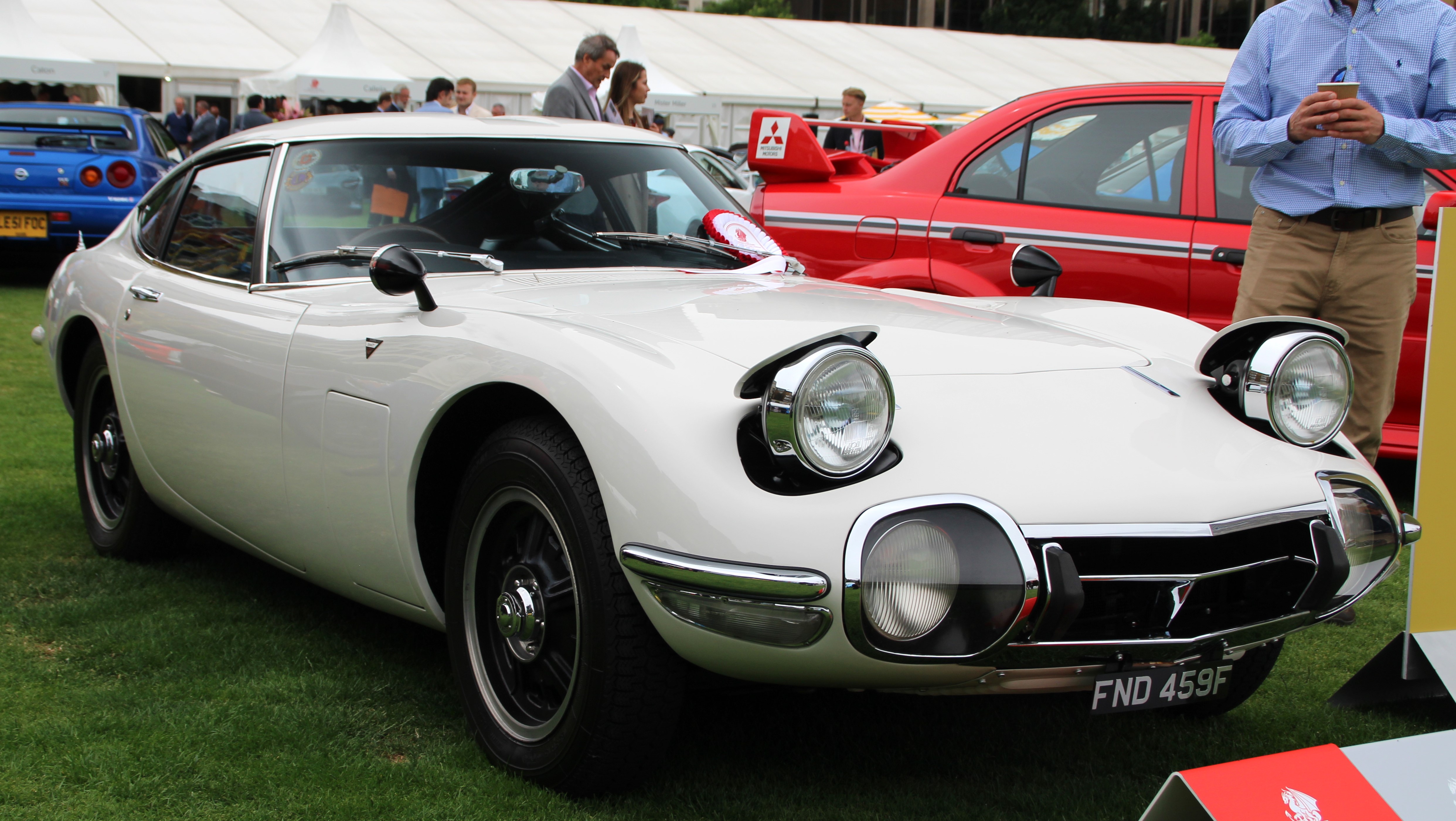
The Toyota 2000 GT is one of Japan’s most famous early “grand tourer” cars. It became well-known internationally, which helped set the bar for what a serious Japanese GT should look and feel like.
An oil crisis is when getting fuel becomes harder and more expensive. That kind of event can change what carmakers focus on—like making cars more efficient instead of just faster.
A “tōge” is basically a mountain pass road in Japan. It’s famous for twisty turns, so car people use it to show off how well a car handles.
LIVE
This episode is brought to you by Intuit QuickBooks Bill Pay.
Growth is the goal, but the paperwork is a trap.
If your accounts payable feels like a second job, you're doing it wrong.
Enter QuickBooks Bill Pay, reduce manual data entry,
automate your approvals, and track 1099s in one place.
No more chasing signatures, no more spreadsheet headaches,
just control over your cash flow and a back office that actually scales.
Automate your accounts payable today at quickbooks.com slash bill pay.
Terms apply.
Money movement services are provided by Intuit Payments Inc.
licensed as a money transmitter by the New York State Department of Financial Services.
There's nothing like the American Express Platinum card.
Find out your welcome offer after you apply, which could be as high as 175,000 points.
Learn more and find out your offer at americanexpress.com slash explore-platinum. Terms apply.
It was before dawn outside Suzuka, Japan, and traffic had already bottlenecked for miles in
every direction. Coaches had been charted from surrounding towns and teenagers pedaled in on
bicycles. Everyone weaved together into a crowd with the restless energy of a young generation
catching its first glimpse of a new country. What echoed over the fields was not the roar of engines,
not yet, but the soft rising hum of 200,000 voices converging on a single location for a
weekend like no other. And when the engines did fire up, they were something to behold.
Lotuses, Porsches, and Aston Martins, the finest sports cars Europe had to offer,
all lined up on a brand new circuit carved out of the mountainous countryside
of the Mai Prefecture. None of what was taking place, the crowds, the energy, the sheer numbers,
would have seemed possible just a decade earlier. Japan had undergone a radical transformation
in the years following World War II, and was during that transformation that a new industry
emerged, carrying with it enormous promise. The automotive industry, what had started as a means
of satisfying the demands of American occupation, had grown into a vessel for Japanese ingenuity,
and it was all culminating here at the first ever Japanese Grand Prix.
Those in attendance were proof that something significant was happening.
The national psyche was beginning to shift. A country once defined by devastation
was learning to feel pride again, and to believe in its own potential.
Welcome back to PASSGAS, everybody. I am your host, Nolan Sykes,
and this is season two, episode two of our deep dive into the golden age of the Japanese car industry.
Last week was the Amusebouche, okay, a little finger food with a weird little sauce on it,
like, did they use cucumber and jalapeno? How'd they do that? This right here, though, is the
first course, okay? This is where we're going to bring some real protein into the meal, okay?
We've got 12 courses in this menu, so, you know, watch your appetite. Put those chips away.
Last week, it was all about Japan's efforts to, like, find their people's car. This week,
we're going to go racing. So, get your helmet, and let's hit the track. It's episode two, everybody.
Although Japanese culture is often characterized by its discipline and structure, it has always
been equally defined by the power of community. Shrine visits at New Year, summer festivals,
sporting events, these are not just traditions, they're expressions of a deeply held cultural
belief that people are stronger together than apart. The inaugural Japanese Grand Prix was that
belief made real. To truly understand what this moment meant, you have to know that just 15 years
before, Japan was in ruins. Its infrastructure was gone, its industry was gutted, and its godlike
emperor had been forced to literally renounce his divinity. But through a combination of government
industrialization and the sheer determination of a people rebuilding from zero, the auto industry
started to take shape. In the last episode, we traced that journey from the ashes of post-war Japan,
and we left off with the 1950s drawing to a close and a guy named Soichi Rohanda ready to shake things
up. You remember Soichi Rohanda. He was the self-made man with a growing motorcycle company who
protested a proposed law that limited who could make cars. Well, back in 1959, before any of that,
Honda proposed the construction of a new facility at his Suzuka factory. He declared,
quote, I want a venue for motor racing. Automobiles cannot be improved if they are not put
through their paces on the racing circuit. That's my kind of guy right there. From there,
a project team began to take shape. Led by Honda's co-founder and Soichi Roh's partner in crime,
Takeo Fujisawa. Now, organized circuits in Japan hadn't been entirely absent up to this point.
The Asama Volcano motorcycle races were among the first to put domestic engines to the test,
and there was the often forgotten Kamagawa Speedway sitting just outside Tokyo. The very
place Soichi Rohanda got his start as a racing driver. That track opened in 1936 after auto
fanatic Gunji Fujimoto's persistent lobbying, and the Speedway flashed briefly into popularity
before shuttering in 1938. Honda never let go of what he experienced there. He had flipped his car
three times in the Speedway's inaugural race, so it's not much of a stretch to say he understood
the value of trial and error. Without a place to make mistakes, how could Japanese cars truly grow?
Growth was exactly what aligned Takeo Fujisawa with Honda's racetrack vision. Fujisawa saw the
circuit as a way to promote motorsport to a younger, excitable audience, the demographic they'd need
to succeed as a car company long term. Together, Honda and Fujisawa brought on Dutch designer
John Hugenholz, the man who helped create Zandvoort and other celebrated tracks to design a world-class
facility. That's super cool. Zandvoort, obviously home with the Dutch Grand Prix in the F1 season
there. They carved it through the dunes. And now that I'm thinking about it, Zand does sound like
sand in Dutch. If I was a betting man, which I'm not since that horrible accident, that's what my
bet would be. Very interesting. That's super cool. Okay, so that makes sense. That's awesome.
However, ballooning construction costs quickly forced Honda to rethink his original vision.
To study how more established circuits had done it, he sent his project team to Europe that winter.
There, they took the saying, great artists steal and made it literal.
Honda team members used their own shoe horns to peel surface materials off of European tracks
and bring them to Japan for reference. It was that DIY spirit that kept Honda's circuit dream alive.
The end result of this research was a figure eight layout consisting of high speed straights,
technical corners, and challenging elevation changes. It's not a literal figure eight,
but there is like a crossover section where the track, there's like an underpass,
overpass situation where the track goes over itself. Very cool. When the circuit near completion,
an eager Soichiro Honda took to the skies to view his brainchild from a helicopter.
Quote, they're doing a good job of creating a course that is close to what the drawing envisioned,
he remarked, looking down at what had once seemed unfathomable during his tumbling days
at Tamagawa. Everything was happening at once. Honda's famous protests came around the same
time that the track was being built and subsequently led to his team quickly designing the Honda S360,
S500, and the T360 mini truck. Those vehicles debuted less than a year before Suzuka circuit
opened and the track experienced its first defining moment, the 1963 Japanese Grand Prix.
Big thank you to our sponsor this week, Shopify. Starting something new isn't just hard. It's
terrifying. So much work goes into this thing that you're not entirely sure will work out
and it can be hard to make that leap of faith. Trust me. You know, when we started this podcast,
we were really not really even sure what we're doing. But now we know that we're right and
believing in ourselves and launching our shows, our podcasts, despite all the fears
and hesitations. It also helps when you have a partner like Shopify on your side to help.
Shopify is the e-commerce platform behind millions of businesses around the world
and 10% of all e-commerce in the US. That's insane. You can get started with your own design
studio with hundreds of easy to use templates. Shopify helps you build a beautiful online store
that matches your brand style. You can also get the word out like you have a marketing team behind
you and easily create email and social media campaigns wherever your customers are scrolling
or strolling. That's right, baby. And don't worry about getting stuck. Shopify is always around to
share advice with their award winning 24 seven customer support. So it's time to turn those
what ifs into with Shopify today. Sign up for your $1 per month trial today at
shopify.com slash gas. Go to shopify.com slash gas. That's shopify.com slash gas.
Thank you so much Shopify.
Love that jam. Up next, commercials.
Into a TurboTax free edition. See if you qualify at TurboTax.com slash free.
Don't miss the deadline. File by 415. No schedules except for earned income tax credit,
child tax credit, student loan interest and schedule 1A.
Picture the moments before the flag dropped at that very first Grand Prix race in Japan.
In that breath before the engines roared, an entire industry was poised to launch,
ready to help its country shed the label of a defeated nation.
And then silence shattered.
Engines erupted into a chorus of sound, rising in pitch and fury as the cars lunged forward and
disappeared into that first bend. When the leaders barreled towards the first sweeping right-hander,
the crowd let out a rolling noise, the kind that comes from seeing something new and thrilling for
the very first time. The field compressed, cars juked for gaps, they stormed up the hill towards
the essence, sliced through the curves like scalpels. Then came the chorus of downshifts.
The sharp metallic bark of each gearbox biting into lower gears,
echoing out across the hills of the Mai Prefecture.
Before the pack even reached the bridge, Japan had become a motorsport nation.
Racing in modern cars was mechanically loud and violent, yet elegant and unapologetically
forward-looking. The kind of spectacle Japan had never produced for itself before.
Many of the people stepping onto the circuit grounds that day
had never even seen a racetrack. They came because these machines felt like an invitation to the
future. And embedded in that invitation was something deeper. By cheering for Honda,
for Nissan, for Prince, you weren't just supporting a brand. You were championing the workers who
rode the same trains, attended the same schools, and lived in the same neighborhoods as you.
These were machines built by your own people. Now being tested against the rest of the world,
and in a country still finding its footing on the global stage, that meant everything.
When the big race was over, one thing was clear. Japan had come a long way,
but there was still a big gap between them and their Western competition.
Weight, or the lack of it, had proven to be king over the weekend. Peter Warr, Mike Knight,
and Arthur Owen, all driving Lotus 23s, had carved up Suzuka with precision.
Lotus chief Colin Chapman's motto of simplify, then add lightness, would come to dominate the
sport in the 1960s, and that included a podium sweep in Japan. For Japanese spectators and
engineers alike, watching Lotus leave heavier, more powerful machines behind was revelatory.
It was a glimpse of a different logic, one that would quietly influence Japanese performance
engineering for decades to come. I think we'll explore this notion a little later, but a country's
geography also dictates what kind of cars that country is going to make. Japan, obviously very
small, a lot of tight, twisting mountain roads, and you don't want a big, heavy car to drive those
with. One, it's going to be exhausting, and two, it's just not going to be as fun. You want something
light and nimble, whereas here in America, we have a lot of open spaces, a lot of straight roads.
It makes sense to want a big, just lumbering behemoth, big V8, big seats that basically
feel like couches, because you're just going to be going in a straight line, and then you're going
to go to the diner, order greasy food. It makes sense. There's not going to be any twisty roads
to like shake that burger up on your way home and make you drive faster, if you know what I mean.
The true emotional spark for Japan wouldn't come from behind the wheel of a Western elite.
It came from a small displacement class in a car that very few expected to matter.
In the B2 sports category, Genichiro Tawara rolled his privately owned Nissan Fairlady 1500
to the starting line. Tawara had spent the days before the race running laps at Suzuka,
testing different setups, building confidence. He would need it.
Mining up alongside a varied field of Triumph TR2s, TR3s, TR4s, two MGAs, and an NGB.
What followed became the stuff of legend.
Tawara seized the lead immediately, and lap after lap, his Nissan stretched its advantage.
Japan watched as its domestic roadster didn't just participate in a major race,
it dominated its class. For Nissan, the class win was less a crowning achievement than a
confirmation. Leading up to that weekend in May 1963, Nissan had built itself into a methodical,
industrial company whose identity rested on consistency and volume. They were the poster child
of Japan's post-war rebuild, trained to prioritize durability over experimentation.
While companies like Honda acted as rebellious disruptors, Nissan found its survival through
scale, building deep partnerships with international companies like the Austin Motor Company of Britain.
Through those partnerships, they learned how engines were cast, how suspensions were tuned,
how to design and assemble cars that could withstand export scrutiny.
It was no fluke then that the only car capable of holding its own that weekend was a Nissan.
The Fairlady 1500 didn't appear out of nowhere. It was essentially Japan's first attempt at a
true British-style roadster, drawing early inspiration from Austin's front engine,
rear-wheel drive design for its balanced weight distribution.
Like the MGs and Triumphs of the era, it used a leaf spring suspension for durability,
its G-Series Inline 4 was a direct evolution of the C-Series engines Nissan had learned to build
under Austin licensing. When Nissan tested its vehicles in the early 60s,
their drivers consistently pointed to international competition as the benchmark.
Sites were set well past the growing circle of Japanese manufacturers and trained firmly
on what was being developed globally. But that didn't mean Nissan wasn't thinking about the
if anything, they figured they already had it cornered.
What set Nissan apart beyond their reputation for British influence engineering
was their refusal to settle. Years of assembling British cars had given them a front-row seat
to those cars flaws. British vehicles were beloved but notoriously fragile. Nissan needed
something that could withstand Japan's varying terrain. Extreme climate swings,
dense urban stop and go traffic, preparing for those conditions turned out to be ideal
training for endurance racing. The Fairlady 1500 could run 20 plus laps at Suzuka without failure,
while small British roadsters struggled under the same conditions.
That reliability led directly to a US export version of the Fairlady called the Datsun SP310.
American buyers demanded speed above all, which meant higher compression ratios and more
aggressive cam profiles. One significant upgrade came in the form of brakes.
US spec cars ran front disc brakes, while many Japanese domestic cars were still using drums.
These changes, very subtle to the naked eye, were decisive in a game of inches,
and they helped propel Janichi Rotawara's Fairlady toward Japanese hero car status.
Nissan had tapped into what made them a standout, and they intended to build on it.
Part of their strategy going forward involved not just learning from foreign competitors,
but also from what was succeeding domestically, and in doing so, they wouldn't have to look very
far. Because while the Fairlady was celebrating its first big victory, Prince Motor Company was
watching from across the paddock with a very different attitude. What they assumed would be
their moment had been seized by someone else. To them, this was the beginning of a rivalry.
Prince Motor Company was the smallest of Japan's serious automakers. Unlike many, it had no
agricultural history, no sprawling corporate lineage, no industrial empire behind it. Founded
to build aircraft engines before the war, that DNA never left them. If Nissan understood the
business of cars, Prince understood the engineering of them. They had no interest in building the
Japanese equivalent of an MG, they wanted to create something that represented Japanese
ambition at its most technical and precise. When Prince first launched the Skyline back in 1957,
it was an unassuming sedan. The kind of modest family car a cautious company puts out to stay
afloat. But the engineers behind it weren't thinking like the executives. Their ambitions
were bigger. And unlike most companies, the engineering department at Prince held an
unusual amount of authority. In America, something like this would never happen. Usually, the execs
and more importantly, the accountants kind of dictate what you're going to do. The company
isn't going to take big risks if it means a lot of money is going to be left on the table.
As we'll see here, that's not the case at Prince.
At the center of it all was Shinichiro Sakurai, a dedicated engineer with the eye of an artist.
His early exposure to technology came not from cars, but from bicycles, radios, and the mechanical
odds and ends his generation had a knack for repurposing. He developed a philosophy of designing
from the inside out, seeing a car not as an engine or a body first, but as an integrated
mechanical organism. Sakurai thought what the people wanted was primarily visual,
but there were plenty of niche enthusiasts who cared about what was under the hood.
But the numbers Prince needed to hit were tied to mass appeal. And what appealed to the Japanese
masses in the late 1950s was the aesthetic of American culture. And think about this,
this makes sense. When they're rebuilding the country after the war, you have many US personnel
over in Japan, bases across the country, both observing and assisting in rebuilding of
the infrastructure. These men might be learning Japanese, but I think what's probably more likely
is the Japanese workers are learning English to work with these people. And it only makes sense
that when you get people together, they're going to learn and share with each other.
So it makes sense that the Japanese public is looking at America, seeing what the country's
doing, especially at this time post World War Two. We had the distinct advantage of
having our entire infrastructure remain intact throughout the war. That's something that gets
lost. I think sometimes Europe completely destroyed, Japan completely destroyed America had such a
huge advantage. The amount of personnel equipment infrastructure unharmed in America cannot be
understated in this context. So it makes sense that Japan wants to emulate that the shining city
on a hill. That's their compass. Let's make some little cars that look like big American cars.
Sakurai had his look. The challenge would be making it his own.
To build that American look, they fitted the skyline with scaled down Detroit style tail fins.
It had a wrap around rear window that mimicked General Motors panoramic glass design and a
side trim character line visually elongated the body in a Buick-esque fashion. Bumpers,
grille surrounds and window trim were all chromed out to project prosperity. This was a premium car.
To anyone who crossed its path, the skyline looked as American as a Vaughn's apple pie.
If you're in the Midwest, that's a Kroger apple pie. If you're on the east coast,
probably like a Rayleigh's. Thought you guys have out there? I'm pretty sure. That's the
skyline right there. It rode on a stiff, full-size ladder frame, more reminiscent of a European
executive sedan, though it was stable, confident and with room up front for a larger engine if
someone saw fit. In other words, it was a performance car waiting for the right motor.
After the skyline debuted to strong reception, Prince felt the only direction was up.
The original was discontinued in 1962 and replaced in spirit by the Skyline Sport,
designed by the legendary Giovanni Michalotti, who had made his name with Alfa Romeo in the 1950s.
Prince brought him in to inject the next generation skyline with a little bit of
European sophistication. The result was a genuine work of art, long proportions,
a hand-built feel, and launcher-like elegance. It's interesting to compare this to what
Nissan was doing at the same time, studying the assemblage of British cars.
Both companies were exploring different avenues of mimicry, but Nissan's methods would prove
more durable in the long run as Prince came to realize that a beautiful design doesn't always
make it a winner. The Skyline Sport looked good, but it was essentially an old skyline chassis
wearing a tailored suit. So when work began on their next model, the S50, their focus shifted
to a new chassis, versatile enough to accept both a four- and six-cylinder engine. From there,
driving performance became the new core mission. It was this car, the Skyline S50,
that became Prince's entry into the 1963 Japanese Grand Prix.
Prince didn't do as well as Nissan's Fairlady, but the company still had reason to be encouraged.
Despite not having the pace to run with the international machinery, the S50's skyline
had held itself together, staying composed through long corners, absorbing punishment,
and asking for more. Inside Prince, that mattered more than any trophy. The question shifted from
how do we build a race car to something bolder? How do we build something that can stand up to a Porsche?
To do that, they reached for the G7 Straight 6, an engine originally intended for the larger
Gloria sedan. Installing it became an exercise in rethinking the car from the firewall forward.
Cross members were cut and rebuilt. The engine bay was stretched in ways the original designers
never anticipated. Mechanics joked that a hard sneeze might dent the engine,
given how close it sat to the grille. Once the car ran, refinement became an around-the-clock task.
Every component was constantly being reevaluated and stress-test at race pace.
Tempers flared as Soccurized Team chased balance. Nobody asked whether the project made
financial sense. It didn't. What mattered was proving that the Skyline's 1963 durability was
no fluke. The big task would come in 1964. Back at Suzuka.
The new Skyline GT appeared basically the same to many onlookers. It still looked like an ordinary
sedan, especially standing next to a Porsche. But midway through the race, it was beginning to change
minds. Rather than fade into the race's background, Prince driver Tetsu Ikazawa began
hunting the Porsche 904. Lap after lap, his Japanese sedan stayed within striking distance
of one of Europe's most celebrated cars. Those watching at Suzuka were stunned,
struggling to make sense of what they were seeing. With each lap, the sedan drew closer.
With each pass, the crowd grew louder. Finally, Ikazawa sent the Skyline GT up the
inside in the first corner. Clean and assertive. The move of a driver who genuinely trusted his
chassis. For one brief electric moment, he passed Porsche. The crowd gasped. They'd done it. The
Skyline had taken the lead. Co-driver Yoshikazu Senako later recalled the moment. Quote,
It was a great feeling when Ikazawa passed the 904. I thought Prince had a real chance to win that
race. However, the Porsche retook him, and then I thought maybe it was my job to beat him.
After signaling to Ikazawa, I went absolutely flat out chasing the 904, and eventually came
second with Ikazawa coming third 20 seconds later. Porsche may have taken the top prize,
but Prince would settle for a Skyline sweep of positions two through six. That is stellar.
The psychological distance between the two companies had been erased in a matter of hours,
and in the charging Skyline GT, Japan saw its own reflection. A nation still learning,
still catching up, but absolutely refusing to fall away.
Thanks so much to our sponsor this week, Blue Chew. The future of erectile function is here.
Blue Chew Gold is changing the way millions of men are having sex in 2026.
The new arousal boosting formula combines passion and performance into one tablet that
dissolves under your tongue for super fast onset. No more waiting for a pill to kick in.
No more moments ruined by performance anxiety. Just the results you want when you want them.
Most EDMeds only focus on blood flow, but Blue Chew Gold goes further by combining
two ingredients from blood flow with two for mental arousal and connection,
so you're not just physically ready, you're actually in the mood.
This type of innovation is by Blue Chew Gold, the number one brand in erectile dysfunction.
The process is simple and all online. Get started today at bluechew.com and go for gold.
If you're in the 3% of a lady's listening to this show, send your man the link and make him
a trophy husband with Blue Chew Gold. Turbocharge your love life with Blue Chew.
Discover your options at bluechew.com. We've got a special deal for our listeners. Right now,
when you buy two months of Blue Chew Gold, you get the third for free with promo code past gas.
That's promo code past gas. One word. Visit bluechew.com for more details
and important safety information. And we thank Blue Chew for sponsoring the podcast. Blue Chew!
After the Grand Prix, Prince became impossible for Nissan to ignore.
The engineering performance on display was remarkable, but at the same time,
Prince's financial recklessness was unmistakable.
Nissan executives reviewed reports and quietly began imagining what the Skyline program could
become with proper resources. Their resources. The Japanese Ministry of International Trade
and Industry had also been watching closely. Where spectators saw a racing miracle,
the government regulators at MIDI saw a problem. To them, Prince's cars shouldn't have existed
in the first place. No company their size had any business building machine that sophisticated.
It was evidence that Prince was operating well outside the boundaries of economic reality.
Building cars for a stage it could never afford to stand on.
In the months after Suzuka, the pressure deepened. Despite Prince's success on the track,
the company faced enormous pressure from financiers and regulators. It became clear
Prince's days as an independent company were numbered.
The Japanese automotive landscape officially changed in 1966 when Prince was folded into Nissan.
On paper, it was a straightforward corporate consolidation. But inside the industry,
everyone understood what was really happening. Nissan hadn't just expanded,
they had absorbed one of Japan's most advanced engineering cultures.
Prince was proof that MIDI's pressure to consolidate
the very thing Sir Ichiro Honda had protested against was more than an empty threat.
Prince had built an iconic car, but prestige doesn't pay for stamping presses.
MIDI didn't care about innovation, only stability.
Prince didn't have the political insulation or regional necessity to survive long term.
While Prince's future as an independent company was up for debate, a company called Toyo Kogyo,
which would eventually become Mazda, found themselves in a similar boat.
They were under MIDI's thumb and at risk of consolidation.
Despite being a small company on paper, Toyo Kogyo had a few things going for it from the
perspective of MIDI overseers. For one thing, the city of Hiroshima needed the company.
Its economy depended on it. It was still rebuilding from unspeakable loss created by
the atomic bomb. And a regional necessity for jobs gave Toyo Kogyo a layer of governmental
protection that no amount of engineering prestige could buy. Toyo Kogyo was also profitable.
Their three-wheeler trucks and light commercial vehicles had been a reliable revenue engine for
years, and their focus on practical mass production slotted them neatly into MIDI's
people's car agenda. An advantage over a company like Prince, whose high-end sedans
smelled a little too much like luxury. As an added piece of cosmic luck, even rival
Toyota quietly wanted Toyo Kogyo to survive. Not formally and never with contracts,
but in the view that Toyo Kogyo's existence was a useful check against Nissan getting too large.
But even with regional protection and steady profits, no one inside Toyo Kogyo could truly
say they felt safe. From MIDI's perspective, managing 10-plus automakers was a logistical
nightmare Japan couldn't afford. Toyo Kogyo was still smaller than Toyota and Nissan,
and crucially, they lacked a defining flagship technology. That was the kind of thing that
made MIDI nervous, and a nervous MIDI was a dangerous MIDI. Worry over MIDI was just reaching
its peak when a small, unusual idea began circulating in Toyo Kogyo's backrooms and
engineering labs. At first, it seemed too experimental. Too unlike anything you'd expect
from a cautious regional player. But it kept coming up. The kind of idea that, if executed
correctly, could take a company from vulnerable to untouchable almost overnight.
It's often forgotten that the rotary engine did not originate from within the walls of Toyo
Kogyo, but from the mind of a restless tinkerer from large Germany named Felix Wenkel. His concept
was elegantly simple in theory. Replace the reciprocating pistons of a conventional engine
with a triangular rotor spinning inside of a housing. The goal was to convert combustion
directly into rotation, promising high power at low weight, with far fewer moving parts.
Wenkel had secured a patent for his rotary concept by 1929, and by the late 50s had produced a
working prototype and was actively licensing the idea abroad. Around 100 automakers jumped
at the opportunity to license the rotary engine like General Motors, Nissan, Daimler Benz,
Toyota, and Porsche among them. NSU Mötrenwerke, the company Wenkel had developed the prototype with,
had been vocal about what the engine could offer, and Toyo Kogyo President Suneji Matsuda was more
than listening. He flew to Neckarsum, Germany, rode in an NSU-powered car, and watched the engine
run on a test stand. He came home convinced and signed a licensing agreement in 1961 for the right
to develop and sell the rotary engine throughout Japan and Asia. The man that Matsuda tapped to
lead the effort was Kenichi Yamamoto, the Hiroshima-born engineer from our first episode.
By the time Matsuda gave him the call, Yamamoto had just finished overseeing development on a
compact passenger car. To tackle something this novel and this risky, Matsuda needed someone
as stubborn and persistent as himself, and Yamamoto would need a team to match. What was
assembled became known as the 47 Ronin. Named after the legendary samurai who dedicated their
lives to avenging the unjust death of their master, the group of engineers set out to do what R&D
teams everywhere call the boring work of miracles. They committed themselves entirely to the exercise
of repetition. Yamamoto constantly reminded them that, quote, the rotary engine must be on your
minds at all times, whether you are sleeping or awake. Their work paid off because the engine
ran beautifully for a few hours. The earliest prototypes, the single rotor 40A and the L8A
two rotor test engines, ran into roadblocks almost immediately. The biggest was known as the nail
marks of the devil, a vibration of the apex seals that scarred the interior of the rotor housing
with horizontal grooves called chatter marks. Oil consumption was also a constant problem.
Heat was public enemy number one. This whole thing was starting to look like a terrible bet.
German engineers were brilliant, but when it came to the rotary,
they had essentially handed off a fragile unsolved problem.
For two years, the 47 Ronin pushed through it. Some slept upright on their workstools,
faces pressed against drafting paper. Others worked until their hands shook.
Yamamoto walked among them, rarely raising his voice, but refusing to let anyone quit.
Night after night, test after test, they kept returning to the same spinning triangle.
By 1963, the team was running out of conventional ideas,
and at one point they even tested an apex seal made from horse and cow bone,
a last resort grass at any material that might survive the housing long enough to matter.
What we're talking about here, this apex seal at the very tip of the triangle,
the rotor inside the housing. Imagine the housing is like an oval, like a rectangular oval,
and the rotor is a triangle, but the sides of the triangle have a bit of a bend to them.
So it's a three point round triangle. Now you can't have the tip of that triangle scraping
directly against the walls of the housing. In traditional engines, we have piston rings
that complete the seal. This apex seal is that basically. It's the seal between the point of
the rotor and the walls of the housing, and they are having a tough time figuring out a material
that can both withstand the pressure of combustion, but also not scour the walls of the housing.
So they're testing all these materials, including the cow bone, but nothing held.
Yamamoto refused to accept this as the final word. When the breakthrough finally came,
it arrived without fanfare as a collective suggestion. What if the apex seal,
the fragile sliver of material responsible for keeping the rotor's chambers sealed,
wasn't a simple solid piece? What if it was hollow, shaped like a tiny cross,
able to flex and distribute pressure rather than crack under it?
By redistributing force across multiple internal surfaces,
the seal could maintain contact with the rotor housing without gouging into it.
When the engineers finally installed the new seals and fired the engine,
something happened that none of them had seen before. It kept running and running and running.
Minutes grew to hours, hours stretched through an entire night. The walls that had once echoed
with the sound of engineers tearing themselves apart were now filled with a smooth, sustained hum
that refused to quit. Yamamoto and his team stepped back and looked at what they had built.
Toyo Kogyo's future had finally snapped into focus.
Picture a split screen. On the left, May 1963, Suzuka Circuit. While the Fair Lady wins over a
nation in the skyline plots its revenge, Toyo Kogyo rolls out the Carol, a small,
unassuming car that couldn't stand out if it tried. The Carol was the last polite bow of the old
Toyo Kogyo, the company that always stayed in its lane and made its case through modesty and good
manners. Now, slide to the right. October 1963, the Tokyo Motor Show. Same year, same Japan,
but Toyo Kogyo has entered the building as a different animal entirely.
The show is part auto expo, part carnival, and the company unveils a prototype so bold
it feels smuggled in from the next century. Their whirring little experiment doesn't sound
like a piston engine, it doesn't breathe like one, it's something new. It's the rotary.
The media swarmed the booth, snapping photos, scribbling notes, demanding demonstrations.
As journalists circulated stories about this unusual little engine from Hiroshima,
Toyo Kogyo stepped onto the national stage with a confidence the company had never possessed before.
The following year, a production car built around the rotary was announced.
Eager to accelerate the process, Matsuda sent prototypes out to dealers, telling his team,
quote, with the cooperation of dealers, we will be able to obtain practical, useful data. If we
fail after coming this far, it will be said that the rotary engine is useless.
Dealers were instructed to drive the cars hard and report everything, every vibration, every
hiccup. Reports came back constantly, pages with more quirks and problems than a Doug Demiro
review. To a less committed team, that volume of bad news would have been enough to pull the plug.
The 47 Ronin treated every failure as information. On May 30, 1967, the world's first rotary-powered
production car, the Cosmos Sport, known abroad as the 110S, debuted to the public after six years of
development. Rather than house the engine in a family sedan, Matsuda greenlit a sports car body to
match. Its long, elegant nose led to its compact cabin with smooth curves that caught the light
like polished stone. It felt appropriate. This wasn't just the launch of a car, it was the official
unveiling of something they had fought relentlessly to make real. Toyo Kogo had decided not just to
build a rotary engine, but to wrap it in a sci-fi vision of what Japan can be. If you've played
Gran Turismo, you probably know the Cosmo as one of the cars you can upgrade to like a extremely
unrealistic degree and make like a thousand horsepower and have a car that can like beat the
whole game. It's a lot of fun, very cool. As the 1960s drew to a close, Matsuda, Yamamoto,
and the 47 Ronin could look back with real pride. They had not only made the rotary work,
they had used it to escape the looming threat of consolidation. Outlasting the likes of Prince
Motor Company wasn't just good positioning, it was the result of a relentless drive to
claim a seat at the midi table. Across from them sat Nissan, the juggernaut who essentially won the
decade. And beside them were Toyota and Mitsubishi, two automakers who hadn't spent much energy
worrying about consolidation because their time and energy were pointed somewhere else,
towards something more ambitious, towards the development of a grand touring car.
Zoom out of the 1960s and you can almost see it. Two companies on opposite sides of Japan
circling the same gravitational idea without knowing it. The public facing Toyota of the
early 60s had been practical to the point of dullness, obsessed with method and reliability.
Mitsubishi by contrast was still young, a prodigy of prize fighters still learning to box.
Both had room to grow, and both were looking for their next big thing.
Everything changed for Toyota in 1964 when Yamaha, yes that Yamaha, arrived at their door
with a quietly abandoned project. Yamaha had previously tried to build a sports car for Nissan,
the A550X, but when Nissan shifted its attention to the Prince acquisition,
that project fell apart. Yamaha didn't scrap the work though. They had what they needed,
a half built prototype skeleton, a small team of young craftsmen, and a dual overhead cam
two liter inline six engine. Now they just needed the right partner.
At Toyota the timing was right. Their mainstream range was selling well, reliable sedans and
practical compacts that ran forever. But inside the product planning rooms, a small team was
circling new ideas. The man who had lead the leap with Yamaha was Jiro Kono, a works team
supervisor who had spent years watching foreign made GTs dominate Japanese run races. Supporting
him on the styling front was the relaxed, Makisen wearing Satoru nozaki. For the engine, Toyota
brought its two liter inline six from the crown sedan and asked Yamaha to rework it into something
bold enough to compete with European GT bloodlines. This was exactly what Yamaha had hoped for.
Their development team was remarkably young, average age of around 30. An opportunity to
work with a company the size of Toyota was almost unheard of. And after the way things
that ended with Nissan, they weren't going to let it slip. While most Japanese cars of the era
leaned towards boxy presentation, Yamaha's young team pushed for a curvy exterior,
hand formed with steel and aluminum shaped entirely by human hands rather than pressing machines.
They borrowed techniques from Yamaha's boat building and instrument craft traditions,
wooden interior components, precisely painted bodies, magnesium disc wheels, and a finish
level that looked more like an Italian atelier than a suburban assembly line.
In under a year from when the concept began in earnest, the 280A was alive.
That pace shocked even veteran Toyota management.
At the 1965 Tokyo Motor Show, the prototype now named the 2000 GT rolled into the main hall
fresh, raw, and unproven. But under those burning show lights, the flowing fastback
roof and muscular arches stopped people cold. From a Japanese car standpoint, no one had
ever seen anything like it. I mean this car, the 2000 GT, is still astounding. I don't think I've
actually seen one in person. Maybe at the Peterson. I don't think so though because I don't remember
it. And this is a car you definitely remember. They actually, if you have a keen eye, there's
a Lexus commercial that's running these days where I think it's like the RX350 or their little
crossover is like doing parking by itself, parallel parking, and in between is it's got the LFA
in front of it and the 2000 GT behind it. I'm like, okay, look, they're standing behind the
product because that 2000 GT is probably worth like seven million dollars. They didn't build too
many of these. If you're keeping up on the development of the GR GT, they put a little teaser
of that. And again, they have the LFA and the 2000 GT driving along and then all of a sudden the GR
GT just blasts out of nowhere. You're like, what's that? You've just been advertised too.
But show floor glamour, of course, doesn't prove anything. The 2000 GT still had to race.
Without a mass production line ready, Toyota and Yamaha prepared a small team at Yamaha's Iwata
factory to hand assemble each car on a month to month basis. Each build was essentially curated
like a watch, but on a much larger scale. Before the cars officially hit the market,
they went to the Yatabe Proving Ground, opened in 1964 and designed for high speed testing.
There, under conditions far harsher than any Japanese commuter would ever encounter,
the car was pushed through extreme endurance trials. It set a world record, averaging high
speeds over a continuous 72 hour run. Toyota and Yamaha had earned the GT label.
Meanwhile, across Japan's factories and dogs, Mitsubishi had long been building ships, planes,
steel and heavy machinery. But motorsport had changed something inside them.
Watching their humble colt sedan run sharply in front of a crowd at the 1963 Japanese Grand Prix
had awakened a competitive instinct that couldn't be put back to sleep.
Suddenly, shop talk turned ambitious.
It was in this environment that Mitsubishi started imagining what a grand tour of their own might
look like. What if they had something fast? Truly fast. Feeding those fantasies was Hirahaki
Kamasago, one of the first Japanese automobile designers to train at the Art Center in Los Angeles.
He had returned to Japan with a head full of long-hood ambitions. To him, there was no reason
American muscle proportions couldn't exist with European GT restraint. His notebooks were filled
with sketches of cars appreciated as something more than transportation, something Japan,
still largely indifferent to cars as art, hadn't yet embraced. Under his pencil,
the GTX-1 began to take shape as a fastback coupe. Despite his vision, Kamasago would have to wait.
Mitsubishi was a heavyweight, but their priority was making sure they had the foundation to support
a high-end project before committing to one. The big break finally came in 1969 when Mitsubishi
executives walked into a room and saw the clay models that Kamasago had built. In careful detail,
they showed something never before seen on a mass-produced sports coupe.
A duct tail rear paired with a front featuring a chrome-centered grille and four round headlights.
A powerful face, a balanced tail, four chrome tail lamps. Kamasago's creation felt new,
Mitsubishi grown. The response was essentially, all right, let's build it, let's show the world.
And that was the green light we had been waiting for. The Colt GTX-1 had a pulse.
By the time Mitsubishi showcased the GTX-1 prototype at the 16th annual Tokyo Motor Show,
the Toyota 2000 GT was roughly in the middle of its production run.
A cameo in the James Bond film You Only Live Twice had given the car genuine international
clout, cementing it as Japan's definitive GT statement.
It had earned that status. The 2000 GT was well-documented as one of Japan's defining
automotive moments, proof that a Japanese manufacturer could build a real GT by any global
standard. By the time the GTX-1 debuted, the domestic auto market had expanded considerably,
and the Tokyo Motor Show floor was far more crowded than it had been four years earlier.
Mitsubishi's entry wasn't landing with the same shock treatment. The GTX-1 was a big deal,
but it entered a world where some of its novelty had already been spent.
That being said, the GTX-1 drew a strong domestic reaction. It wasn't just a pretty shell propped
on a turntable with vague promise, it was a functioning, stylized proof of concept.
When Mitsubishi's booth staff went home that night, one thing was certain, the people believed in it.
Maybe not with the same reverence given to the 2000 GT four years earlier,
but that wasn't entirely what was needed. That belief would go on to produce the Galant
GTO, a car so influential domestically that even Toyota found themselves drawing from it
in the 70s. By the end of the decade, Toyota and Mitsubishi had never once officially acknowledged
they were competing. Doing so would have given the other too much credit. Better to view them
as two pieces of the same puzzle. Toyota showing what Japanese craftsmanship could aspire to,
Mitsubishi showing what Japanese grit could achieve, and together they formed an unofficial
prologue to the era that was coming, one where Japan as a country and an industry would be thrust
squarely into the global spotlight. So we're leaving the 1960s behind, but before we do,
it's worth stopping back at Suzuka for a moment, not to relive any specific race,
not to recreate any specific crowd, but to acknowledge what that place quietly became once
the noise settled. In the years following that first Japanese Grand Prix, the circuit had turned
into a kind of pressure gauge for the entire industry. Companies came here to test, to compare
notes, to study, who was a natural environment for competing philosophies to collide. But while
the tracks sorted out engineers and executives, something else had been growing around the edges.
The people who kept showing up, especially the younger ones, weren't interested in consolidation
politics or who was winning the tug of war with midi that week. Their attention was fixed on what
was in front of them, Japanese machines built with intent representing the excellence that existed
within the country they loved. They would carry those experiences into the 70s and beyond, into
neighborhoods, night streets, back roads, and eventually into building an informal car culture
no one had officially sanctioned. A fuse was lit that day at the first Japanese Grand Prix,
but just as it was catching, the world was heading toward an era no one had a plan for.
An oil crisis brewing thousands of miles away was about to upend the global industry
responsible for putting wheels on that racetrack. The rules of performance were about to change.
So, while the next chapter would continue to be written by corporate strategies,
its heart beats in rhythm with the generation that sat in those Suzuka stands, the ones who
would take the cars their country was building and reshape them into a culture entirely their own.
We'll explore that culture on the next episode of Pass Gas.
Okay, wow. Great episode. Thank you guys so much for listening. We got a little peek at those
early, early days of Japanese motorsport. You know, we got a little sneak peek of the skyline there.
And you know what? I mean, we already said it. All those kids in the stands there,
they're going to take that foundation that has been built here and run with it.
We're going to start in the next episodes, really start to see the very first early chapters of the
golden age of Japanese car culture. Thank you so much for listening to this second season of Pass
Gas. I say that kind of tongue in cheek. Look, we've been doing this show for years, but I'm really
loving doing this new format. And I hope you guys are enjoying listening. I know these episodes are
a little longer than usual, but I mean, there's stuff in here that we've never even talked about
in all those episodes before. So I'm just so glad that we're doing this. And it's a lot of fun.
I hope you guys are enjoying it sincerely. And we look forward to seeing you here back next week
on Pass Gas. If you're listening to this podcast, you probably already know that it's available
on the podcast platform of your choice. And that includes YouTube, our YouTube channel.
Instead of having video of this show, we have a cool visualizer that you can go check out. We put
a lot of work into that. It's a lot of fun. It's a cool little visualizer of like a Z31 dashboard
going down a little Japanese toge road. Very cool stuff. Like and subscribe over on YouTube.
If you want more of this on your YouTubes and go check out our other podcasts as well. We got
Talk Talk Nation with Joe Weber. He interviews great guests from across the world of cars,
not just hardcore car guys. And of course, Jimmy eats cars. Car news told from the perspective
of one James Hilton. Go check out those shows if you haven't already. Look, it's a new era of
Donut podcast, baby. Let's keep having fun. All right. Thank you guys so much. And thanks to our
writer this week, Anthony Hardin. Anthony's put in a shit ton of work on this. Greg Nix,
Audrey Holden, Joe Weber behind the freaking cans over there recording me, Mark Schroeder
cutting it together. You know what it is. It's the Donut podcast team back again, bitch. Let's go.
About this episode
Suzuka’s dawn crowd becomes the backdrop for Japan’s postwar automotive “golden era” story, starting with the first Japanese Grand Prix and the tracks, cars, and rivalries that shaped it. Honda’s push for a proper racing circuit leads to Suzuka’s creation, while Nissan’s Fairlady 1500 dominates its class through reliability and British-inspired engineering. Prince’s Skyline program escalates from American-looking styling to the GT’s near-Porsche shock, then gets absorbed into Nissan amid government consolidation pressure. The episode also follows Toyo Kogyo’s rotary-engine breakthrough and Toyota/Yamaha’s 2000GT, setting up a grassroots car culture before the oil crisis changes everything.
In this episode of Past Gas, we're diving into the first ever Japanese Gran Prix, and how it shaped motorsport from that day on. How did Japan's cars do against Europe's elite and experienced Formula teams? Which companies competed? And what did they learn from the first Gran Prix that they took into development for road cars? All that and more in this episode!