S2 Ep2: The Golden Era of JDM: Japanese Grand Prix
About this episode
Suzuka’s dawn crowd becomes the backdrop for Japan’s postwar automotive “golden era” story, starting with the first Japanese Grand Prix and the tracks, cars, and rivalries that shaped it. Honda’s push for a proper racing circuit leads to Suzuka’s creation, while Nissan’s Fairlady 1500 dominates its class through reliability and British-inspired engineering. Prince’s Skyline program escalates from American-looking styling to the GT’s near-Porsche shock, then gets absorbed into Nissan amid government consolidation pressure. The episode also follows Toyo Kogyo’s rotary-engine breakthrough and Toyota/Yamaha’s 2000GT, setting up a grassroots car culture before the oil crisis changes everything.
Suzuka
"It was before dawn outside Suzuka, Japan, and traffic had already bottlenecked for miles in every direction. Coaches had been charted from surrounding towns and teenagers pedaled in on bicycles."
Suzuka is a well-known race track in Japan. People associate it with big racing events and a lot of racing history.
Suzuka is a famous motorsport circuit in Japan, best known for hosting major events in the Japanese racing calendar. In JDM/Grand Prix discussions, it’s often used as shorthand for the era when Japanese racing culture became a global spectacle.
Aston Martins
"And when the engines did fire up, they were something to behold. Lotuses, Porsches, and Aston Martins, the finest sports cars Europe had to offer, all lined up on a brand new circuit..."
Aston Martin is a famous British sports-car brand. Mentioning Aston Martins signals the event had very high-end cars.
“Aston Martins” refers to Aston Martin, the British luxury sports-car brand. Including them in the lineup emphasizes the prestige of the event and the mix of European supercar-level brands.
Porsches
"And when the engines did fire up, they were something to behold. Lotuses, Porsches, and Aston Martins, the finest sports cars Europe had to offer, all lined up on a brand new circuit..."
Porsche is a well-known German sports-car brand. Seeing Porsches mentioned means the event included top-tier performance cars.
“Porsches” points to Porsche, the German brand famous for performance sports cars and motorsport heritage. In this kind of historical Grand Prix setup, it highlights how European manufacturers were part of the spectacle.
Japanese Grand Prix
"...and it was all culminating here at the first ever Japanese Grand Prix. Those in attendance were proof that something significant was happening. ... The inaugural Japanese Grand Prix was that belief made real."
The Japanese Grand Prix is a big auto race in Japan. It matters because it shows how serious Japan became about racing and building fast, high-quality cars.
The Japanese Grand Prix is a major motorsport event that helped put Japan’s racing and automotive engineering on the global stage. In the context of this episode, it’s used as a milestone showing Japan’s post-war comeback and growing confidence in its car industry.
trial and error
"He had flipped his car three times in the Speedway's inaugural race, so it's not much of a stretch to say he understood the value of trial and error. Without a place to make mistakes, how could Japanese cars truly grow?"
Trial and error means you try something, see what goes wrong, and then improve it. Racing makes it easier to learn quickly because you’re pushing the car hard.
“Trial and error” describes the iterative process of testing, learning from failures, and refining designs. In motorsport, this is especially important because track feedback reveals weaknesses that might not show up during everyday driving.
peel surface materials off of European tracks
"Honda team members used their own shoe horns to peel surface materials off of European tracks"
This describes a hands-on engineering approach: removing track surface layers to analyze construction and materials. For a circuit builder, track surface composition affects grip, wear, drainage, and how cars behave under braking and cornering.
Shopify
"Big thank you to our sponsor this week, Shopify. Starting something new isn't just hard. It's terrifying."
Shopify is a website service that helps people sell products online. It’s mentioned here as the sponsor, not as a car-related company.
Shopify is an e-commerce platform used by businesses to build online stores and manage sales. The sponsor segment explains its tools for store setup, marketing, and customer support, but it’s not directly related to the car content beyond being the episode’s sponsor.
downshifts
"Then came the chorus of downshifts. The sharp metallic bark of each gearbox biting into lower gears, echoing out across the hills of the Mai Prefecture."
Downshifting means moving to a lower gear. It helps the car slow down more effectively and also gives the engine more pull when you need to accelerate out of a corner.
Downshifting is when a driver selects a lower gear to increase engine speed and provide stronger acceleration or engine braking. In racing, downshifts are especially common entering corners to keep the car in the right power band and stabilize speed for turn-in.
simplify, then add lightness
"Lotus chief Colin Chapman's motto of simplify, then add lightness, would come to dominate the sport in the 1960s, and that included a podium sweep in Japan."
Colin Chapman’s famous motto summarizes Lotus’s design approach: remove complexity and reduce mass to gain performance. It became influential because weight reduction often delivers broad benefits across the car—handling, braking, and acceleration.
Colin Chapman
"Lotus chief Colin Chapman's motto of simplify, then add lightness, would come to dominate the sport in the 1960s, and that included a podium sweep in Japan."
Colin Chapman was a major figure behind Lotus race cars. He helped popularize the idea that making a car lighter can make it much faster.
Colin Chapman was the founder of Lotus and one of the most influential motorsport engineers of the 20th century. His design philosophy emphasized weight reduction and efficiency, which shaped how many race cars were built afterward.

Nissan Fairlady
"...gory, Genichiro Tawara rolled his privately owned Nissan Fairlady 1500 to the starting line. Tawara had spent the ..."
The Nissan Fairlady Z is a sporty Nissan model line. In the podcast, it’s mentioned because a Fairlady 1500 was driven in a race. That’s why it’s part of the story—because it wasn’t just a road car.
The Nissan Fairlady Z is a Z-car model line from Nissan, known for its sporty character and long-running popularity. The podcast context references a specific Fairlady 1500 being driven in a race, highlighting how these cars were used competitively. That’s why it comes up: it links the Fairlady Z name to real racing history.
testing different setups
"Tawara had spent the days before the race running laps at Suzuka, testing different setups, building confidence. He would need it."
“Setup” in racing refers to adjustable settings like suspension geometry, tire pressures, and aerodynamic balance. Testing different setups is how teams find the car’s best balance for a specific track and conditions.

MG MGA
"...e a varied field of Triumph TR2s, TR3s, TR4s, two MGAs, and an NGB. What followed became the stuff of l..."
The MG MGA is an older British sports car. It’s the kind of car people talk about because it was built for driving enjoyment and also showed up in racing. In the podcast, it’s mentioned as part of a group of cars competing at the time.
The MG MGA is a classic British sports car known for its lightweight feel and popularity among enthusiasts. In the podcast context, it’s mentioned alongside other period cars in a racing field, emphasizing its role in historic competition. That makes it a good subject for stories about how these cars performed and competed in their era.
Nissan Fairlady 1500
"The Fairlady 1500 didn't appear out of nowhere. It was essentially Japan's first attempt at a true British-style roadster, drawing early inspiration from Austin's front engine, rear-wheel drive design for its balanced weight distribution."
The Nissan Fairlady 1500 is Nissan’s early roadster built to compete with classic British sports cars. In this story, it’s the car that proved Nissan could match that style and performance.
The Nissan Fairlady 1500 (often associated with the Datsun Fairlady name in export markets) is Nissan’s early 1960s roadster aimed at the British sports-car audience. The segment frames it as Nissan’s first serious attempt at a “true British-style roadster,” using a front-engine, rear-wheel-drive layout and durable suspension choices.
balanced weight distribution
"...drawing early inspiration from Austin's front engine, rear-wheel drive design for its balanced weight distribution."
Balanced weight distribution is the idea that the car’s mass is spread in a way that helps handling and stability. In racing roadsters, pairing an FR layout with good balance is often used to improve cornering confidence.
front engine, rear-wheel drive
"...drawing early inspiration from Austin's front engine, rear-wheel drive design for its balanced weight distribution."
Front-engine, rear-wheel drive (FR layout) places the engine at the front and drives the rear wheels. The segment ties this layout to “balanced weight distribution,” which generally helps handling feel more predictable and sporty.
leaf spring suspension
"Like the MGs and Triumphs of the era, it used a leaf spring suspension for durability..."
Leaf springs are a simple, tough suspension type made of layered metal strips. The episode mentions it because it’s durable and good for rough conditions.
Leaf spring suspension uses stacked metal leaves to provide springing and locate the axle/wheels. It’s often associated with durability and simplicity, which fits the segment’s theme of prioritizing durability over experimentation.
drums
"US spec cars ran front disc brakes, while many Japanese domestic cars were still using drums."
Drum brakes are an older type of braking system. They can work fine, but they often don’t handle repeated hard stops as well as disc brakes.
Drum brakes use brake shoes that press outward against a drum to create friction. They were common historically, but they can be less effective under repeated high-speed braking because they tend to shed heat less efficiently than discs.
designing from the inside out
"He developed a philosophy of designing dfrom the inside out, seeing a car not as an engine or a body first, but as an integrated mechanical organism."
“Designing from the inside out” is an approach where the engineering and mechanical layout drive the final product, rather than styling being the first priority. In this context, it contrasts with the idea of starting from the body or engine alone and instead treating the car as one integrated system.
General Motors panoramic glass design
"It had a wrap around rear window that mimicked General Motors panoramic glass design and a side trim character line visually elongated the body in a Buick-esque fashion."
They’re referencing General Motors because some American cars used very wide, wraparound glass. The Skyline copied that “premium” look so it would feel more upscale.
General Motors (GM) is referenced as the source of the “panoramic glass” look. This kind of styling was popular in certain American models, using wide, wraparound glass to make the cabin feel more open and upscale. The episode uses it to explain how the Skyline borrowed premium visual cues.

Buick
"It had a wrap around rear window that mimicked General Motors panoramic glass design and a side trim character line visually elongated the body in a Buick-esque fashion."
Buick is an American car brand. In this story, they mention it to describe the Skyline’s shape and trim style—basically saying it looked like it belonged in that American design world.
Buick is used here as a styling reference point—specifically for how the Skyline’s body lines were described as “Buick-esque.” That means the speaker is comparing the visual proportions and trim character to Buick’s American design language. It’s not a claim that the Skyline is a Buick, just a design comparison.
Alfa Romeo
"designed by the legendary Giovanni Michalotti, who had made his name with Alfa Romeo in the 1950s."
Alfa Romeo is an Italian car brand. The episode brings it up because the designer they mention previously worked there, which helps explain why the Skyline started adopting more European design ideas.
Alfa Romeo is mentioned as Michalotti’s earlier employer, tying the Skyline Sport’s design to European styling pedigree. This helps listeners understand why the episode frames the Skyline’s evolution as moving toward “European sophistication.” It’s a brand reference used for historical context rather than a direct technical comparison.
R&D
"...do what R&D teams everywhere call the boring work of miracles. They committed themselves entirely to the exercise of repetition."
R&D stands for research and development—the process of designing, testing, and iterating new technology. The transcript emphasizes that the rotary team had to do repetitive development work to solve sealing, vibration, and durability issues.
apex seal made from horse and cow bone
"...at one point they even tested an apex seal made from horse and cow bone, [2232.2s] a last resort grass at any material that might survive the housing long enough to matter."
The transcript mentions testing apex seal materials made from animal bone, showing how early rotary sealing development involved experimental, unconventional substances. This underscores how difficult it was to find a material that could handle combustion pressure and resist abrasive wear.
rotary
"...it feels smuggled in from the next century. Their whirring little experiment doesn't sound like a piston engine... It's the rotary."
A rotary engine is a different kind of engine than the usual piston engine. Instead of pistons moving up and down, it uses a spinning rotor to make power.
A rotary engine (most famously associated with Mazda) uses a spinning rotor instead of a piston-and-cylinder layout. The segment emphasizes that it “doesn’t sound like a piston engine” and “doesn’t breathe like one,” underscoring how different the technology was for the era.
Gran Turismo
"If you've played Gran Turismo, you probably know the Cosmo as one of the cars you can upgrade to like a extremely unrealistic degree and make like a thousand horsepower and have a car that can like beat the whole game."
Gran Turismo is a racing video game where you can drive and upgrade real cars. It can make certain cars feel legendary, even if the game’s numbers aren’t realistic.
Gran Turismo is a long-running racing video game series that includes real-world cars and lets players tune and upgrade them. It’s often used as a reference point for how enthusiasts first “learn” about JDM cars, even if the in-game performance is exaggerated.
Toyota
"The public facing Toyota of the early 60s had been practical to the point of dullness, obsessed with method and reliability."
Toyota is described as being methodical and reliability-focused in the early 1960s, selling practical cars. The narrative then pivots to 1964, when Toyota gains a new opportunity through Yamaha’s abandoned project.
Yamaha
"circling new ideas. The man who had lead the leap with Yamaha was Jiro Kono, a works team supervisor who had spent years watching foreign made GTs dominate Japanese run races."
Yamaha is a Japanese company that’s famous for motorcycles. In this story, they’re also helping design and develop a special Japanese sports car.
Yamaha is a Japanese engineering company best known for motorcycles, but it also has a long history of precision manufacturing and motorsports involvement. In this segment, Yamaha is portrayed as a key partner on a high-profile JDM development effort.
Tokyo Motor Show
"At the 1965 Tokyo Motor Show, the prototype now named the 2000 GT rolled into the main hall fresh, raw, and unproven."
The Tokyo Motor Show is a big car event where manufacturers show off new cars and prototypes. This is where Toyota unveiled the 2000 GT prototype.
The Tokyo Motor Show is a major international auto show where automakers debut prototypes and concept cars. In this segment, it’s the stage where the Toyota 2000 GT prototype made a dramatic first impression.
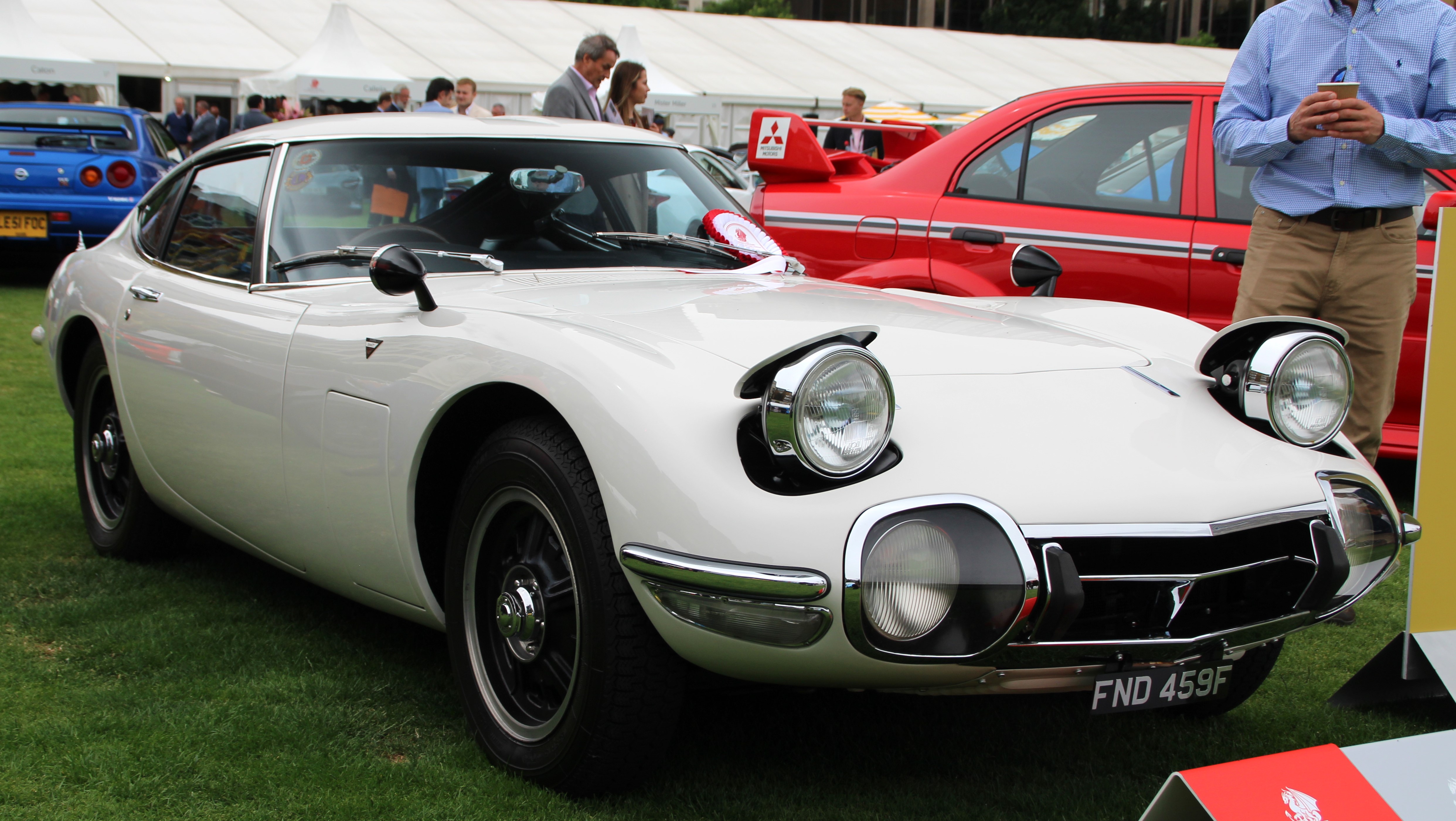
Toyota 2000 GT
"By the time Mitsubishi showcased the GTX-1 prototype at the 16th annual Tokyo Motor Show, the Toyota 2000 GT was roughly in the middle of its production run... A cameo in the James Bond film You Only Live Twice had given the car genuine international clout."
The Toyota 2000 GT is one of Japan’s most famous early “grand tourer” cars. It became well-known internationally, which helped set the bar for what a serious Japanese GT should look and feel like.
The Toyota 2000 GT is a landmark Japanese grand touring (GT) car from the late 1960s. The segment highlights its production timing and its cultural impact, including international recognition from appearing in a James Bond film.
oil crisis
"An oil crisis brewing thousands of miles away was about to upend the global industry responsible for putting wheels on that racetrack. The rules of performance were about to change."
An oil crisis is when getting fuel becomes harder and more expensive. That kind of event can change what carmakers focus on—like making cars more efficient instead of just faster.
An oil crisis is a period when oil supply tightens and fuel prices spike, forcing automakers to rethink vehicle design and priorities. The episode frames the upcoming oil crisis as a major external shock that would change the rules of performance worldwide.
Donut Media
"Thank you so much for listening to this second season of Pass Gas. I say that kind of tongue in cheek."
Donut Media is a car media channel that makes videos and podcasts about cars. This episode is part of their “Past Gas” show.
Donut Media is a major automotive media company known for car-focused video series and podcasts. Their “Past Gas” and related shows are part of how modern car culture storytelling reaches a broad audience.
tōge road
"It's a cool little visualizer of like a Z31 dashboard going down a little Japanese toge road. Very cool stuff."
A “tōge” is basically a mountain pass road in Japan. It’s famous for twisty turns, so car people use it to show off how well a car handles.
“Tōge” (峠) refers to mountain pass roads in Japan, often associated with spirited driving and car culture. These roads became a key part of JDM storytelling because they highlight handling, braking, and driver skill on twisty elevation changes.
Request an Explanation
Heard something you'd like explained? We'll add it to this episode.
Sign in to request explanations for terms you heard.
Want to learn more?
Browse our glossary for plain-English explanations of automotive terms, jargon, and concepts.
Help improve this episode
See something that's not quite right? Our annotations are AI-generated and can sometimes miss the mark. Click the flag icon on any annotation to suggest a correction.