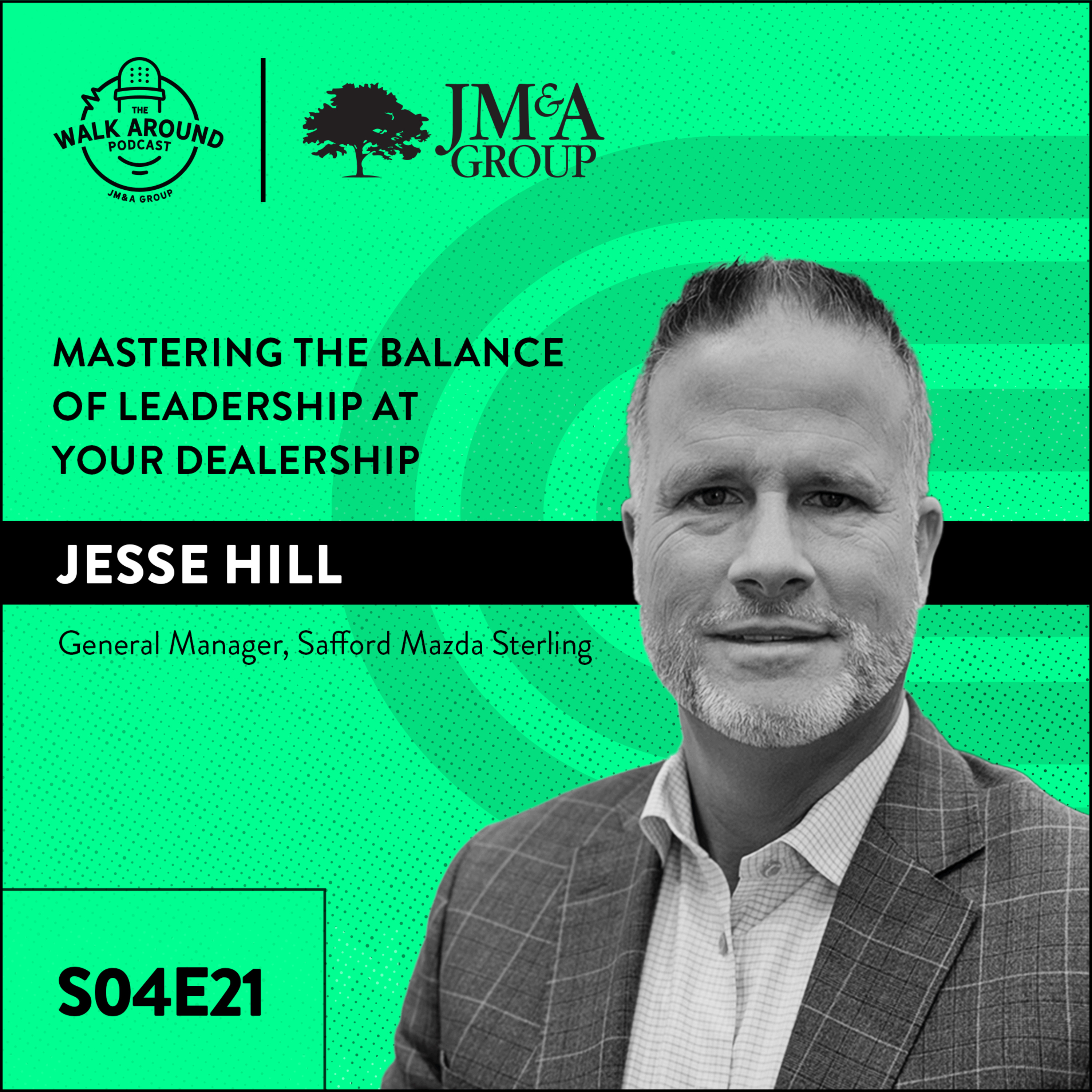
Jesse Hill, general manager at Stafford Mazda Sterling, shares his journey from salesperson to leadership in the automotive industry. He discusses the importance of hard work, personal development, and the balance between family and work. The conversation dives into the impact of technology, particularly AI and virtual finance, on customer interactions and dealership operations. Jesse emphasizes the need for genuine human connection despite technological advancements and offers insights on effective leadership and fostering a strong dealership culture.
From the finance office to General Manager, Jesse Hill of Safford Mazda Sterling shares how he balances family life with a busy career, how he led a virtual change in the finance office and advice for future dealership leaders.
For more information about our guest, visit their LinkedIn.
Episode Breakdown
0:00 - Jesse’s journey to the auto industry
7:29 - Balancing family with the demands of retail automotive careers
13:39 - Initial thoughts on virtual finance at the dealership
19:42 - How virtual F&I caused other processes to evolve
22:43 - The transition from the finance office to General Manager
28:29 - Key skills to develop for leadership roles
33:23 - The Process of converting a store from one OEM at another
36:50 - Dealership focus for 2026
43:41 - Bet it or Forget it: AI, front end gross profit, dealership culture
Liked this episode? Find our full episode library here.
"The first car I sold was a Chevy Malibu. It was a pre-owned Chevy Malibu gray."
The Chevy Malibu is a car made by Chevrolet. It's known for being comfortable and is often used by families and people who commute to work.
The Chevy Malibu is a mid-size car produced by Chevrolet, known for its comfortable ride and practicality. It has been a popular choice among families and commuters since its introduction in the 1960s.
"...Chevy Tahoe Sport Red gray cloth interior. It was Mr. and Mrs. Wilson. I remember the deal specifically..."
The Chevy Tahoe is a large SUV that can carry many passengers and has a lot of space for cargo. The 2005 version is known for being powerful and good for towing things like trailers.
The Chevy Tahoe is a full-size SUV known for its spacious interior and strong towing capabilities. The 2005 model features a robust V8 engine and is popular among families and those needing a versatile vehicle.
"...you went from Nissan to Mazda. And what was that like? And what did you learn from it?"
Nissan is a car company from Japan that makes many types of cars, including family cars and sports cars.
Nissan is a Japanese automotive manufacturer known for producing a wide range of vehicles, including sedans, SUVs, and sports cars. They are recognized for models like the Nissan Altima and Nissan GT-R.
"...you went from Nissan to Mazda. And what was that like? And what did you learn from it?"
Mazda is another car company from Japan that makes cars known for their stylish designs and fun driving experience.
Mazda is a Japanese automaker known for its innovative designs and technology, particularly the use of rotary engines in models like the Mazda RX-7. They produce a variety of vehicles, including the popular Mazda CX-5.
- Jesse’s journey to the auto industry
- Balancing family with the demands of retail automotive careers
- Initial thoughts on virtual finance at the dealership
- How virtual F&I caused other processes to evolve
- The transition from the finance office to General Manager
- Key skills to develop for leadership roles
- The Process of converting a store from one OEM at another
- Dealership focus for 2026
- Bet it or Forget it: AI, front end gross profit, dealership culture
Select text to request an explanation
The advice I would give is the obvious one,
which is work hard.
It's worth it.
It's worth it to work hard and to put yourself out there
to assume and act and operate within that role that you want.
Hello and welcome to the Walkaround podcast,
powered by JMNA Group.
I am one of your hosts, Mark Spoto, joined by Jonathan Jordan.
Jonathan, it's been a minute.
It's been a few minutes.
Since we've been in the chair together.
It has. I sit beside you every day, but it's been a while since we've done this.
It's unfortunate for you in that.
But we decided to wear the uniform today.
You went with the sleeves.
I went with the vest, but we're representing JMNA.
Trying our best.
So today we are talking with Jesse Hill.
And for those that don't know, Jesse is the general manager
at Stafford Mazda Sterling up in Northern Virginia.
And he brings such a wealth of information about the business.
He's served in basically every role in the store.
And it's good to get retail perspective from those that are in it day to day.
And I think you'd agree, Jonathan.
He had good advice, not just about the retail side of things,
but also just from a personal development standpoint,
and how to move into a more leadership capacity.
I totally agree.
I took notes, Mark.
We talked about leadership.
We talked about life.
We talked about family.
And then on the business side, a lot of tactical things too.
About what the future could look like as well.
Some really good conversation around AI, around virtual FNI.
It was a really great conversation.
Yeah, great advice.
And for those that are looking in particular to grow in automotive,
this is a really good one to pay attention to.
So let's go forward with Jesse Hill and take a walk around with Jesse.
Well, Jesse Hill, thank you so much for joining us on the Walk Around podcast.
We really appreciate you taking the time to be with us.
Thanks, Jesse.
Absolutely.
Happy to be here.
So we want to jump right in a little bit into your personal journey.
We like to talk and hear stories of people in the automotive business, such as yourself.
And generally, we find it to be either you're born into this business
or you fall into this business.
So which one is it for you?
And how did you get started?
Well, I certainly wasn't born into the car business.
My father was in retail all of my younger life and came home at 10,
11 o'clock at night.
He managed pharmacies and that sort of thing.
And so that part of it was in my blood, the retail part of it for sure.
But I had been laid off from a job and was a new father.
And I knew that from the time of that happening to walking in the door at home,
there needed to be a job, right?
Whether it was still with my old job or a new job.
So out of necessity, I actually went into a dealership here in the area in Leesburg,
Virginia with a suit and tie on saying I would like to be a salesperson.
Of course, all of us know that, well, let's get you signed up, right?
So it was a necessity thing.
So you could say that I fell into it or kind of didn't have another choice.
But what was interesting was that my first mentor in the car business, if you will,
told me in 90 days, Jesse, you're going to know whether this is for you or not.
And I fell in love with the business in just in a couple of weeks.
What was it in that first 90 days that had you all in?
For me, what it was and what it has remained is being able to interact with
so many different people, so many different personalities on a daily basis,
regardless of where you are in the dealership.
That's the beauty of it is whether you're the general manager of the store
or whether you're cleaning cars, we all get the opportunity to meet with the same customers
and get to know them.
There's no separation there.
There's no hierarchy.
And that's always what I've loved about the business.
Fell in love with it from the start.
Jonathan, we often talk about technology and how much this industry is evolving,
but at heart of it is still a people business.
Oh, gosh, for sure.
Jesse, what was the first car you sold?
The first car I sold was a Chevy Malibu.
It was a pre-owned Chevy Malibu gray.
I'm trying to remember more of the details, but that was the first car.
It was a Chevrolet dealership that I started at in Leesburg, Virginia, Northern Virginia.
Yeah, it's interesting.
I like to ask that question because anybody's been in the business a long time
and started there like you know.
Like I know it was a 2005 Chevy, also Chevy.
I started a Chevy store.
Chevy Tahoe Sport Red gray cloth interior.
It was Mr. and Mrs. Wilson.
I remember the deal specifically, but that people connection that you have in a dealership is,
I would say, just as important today as it's always been.
It is, and the challenging part with today's environment is, and at that time there weren't
Leeds, there was just answering the phone, and technology has helped in great ways.
There's no argument, but technology has separated us, has forced us to separate,
and so we've had to come to this realization that we just have to figure out how to use
technology better, and I'm sure we'll talk about this, but part of my career most recently has
been engaged and involved in virtual finance.
And as wonderful as that is, it tends to separate us from the customer, and that's fine,
but we just have to get really good at communication so that we can bring that separation back.
And that's an art form.
It's a talent.
I've always called finance being in the finance office a dance, if you will,
because you're having to shift with the customer's emotions, shift with the customer's expectations,
but you've got to be quick on your feet, and technology makes that a little more difficult,
but it doesn't have to be.
It doesn't have to be.
I'm glad you brought up technology and communication, Jesse, because we have a question
in our bedded or forgetted segment that we're going to do later in the program.
That's a teaser, Jonathan, just so you know.
All right, so I'm learning here.
We've been doing this a little while, but we're still getting our sea legs under us.
But Jesse, you brought up the importance of people, and also I'm assuming the importance of
family in your life.
You're a father of five children, I believe, which has got to be madness.
I mean, I have two, and I'm already out of my mind.
Jonathan is a new dad of two as well, and it's a lot.
Five is just exponential.
How do you balance that the demands of being a dad and the demands of being a general manager?
What is your approach there, and how do you manage it?
Well, the answer, and it's a little cliche, but the answer is giving 100% at both ends,
and that's hard.
It's hard to do that.
It's coming into the store.
I owe it to my team, my general sales manager, my managers, my service, and parts managers,
and so forth.
Again, down to my lot quarter.
I owe it to them to be 100% there and available for them and supportive of them.
I owe it to them.
And when I'm home, I owe it to my family to be the same.
And that's where it becomes tricky.
And that's where I think it gets complicated for lots of people, where you have to kind
of figure out how to find that balance, and that balance takes time.
I'll admit it gladly.
That has taken time because they also tend to intermingle with each other from time to time.
Right?
If I get that phone call from Natalie, my wife, and it's an emergency, well, I'm dad again.
I'm the husband again for a moment, right?
So I think it's being very clear about being present.
And that's not easy to do.
It's certainly a talent, but it's absolutely key.
You have to be 100% when you're at work.
You have to be 100% when you're at home.
You have to find that.
Yeah, and that's not always easy to do.
So I think that's good advice to kind of keep yourself grounded in being present based on
where you are, right?
And if it's with family, even though the demands are pulling you in different directions,
you have to try to keep that focus.
And I'd like to add something to that that just came to me.
I think the way, one of the more effective ways you can do that is by, it's kind of a
what do you stand for type of comment that I'm about to make, right?
It's who are you?
Who are you when you're home and who are you when you're at work?
If you're a different person, it's going to be really, really hard.
You know, what are your ethics?
Where's your level of integrity and honesty with those who you work with?
You know, we spend more time, as we all know, here at work than we do at home when we're
engaged in, really engaged in this business.
But how we speak to our employees and our management team, how we treat them,
what's our level again of honesty, integrity, and so forth and so on intent?
It's got to match.
It's got to match.
That I would say is probably the key.
It's got to match what we do at home versus what we do at work.
I love that.
We often see examples of people trying to be not who they are and not genuine or not authentic.
So I really like that concept, Jesse.
Yeah, I think that's great advice.
And there's so many in retail automotive who really struggle with how do I manage
a family and the demands of this job that requires sometimes long hours and weekends
and evenings and all these things.
I know there are people listening who are thinking like, how am I going to do this?
I think that's super good advice.
So that you'll be present and really ask yourself, who are you?
Am I showing up the same way in both places?
And share your successes, share, talk about them.
You know, one of the things, so really, really big plug for JM&A.
I will tell you, my early time, you know, so in 2000, the end of 2010, I started as a finance
manager, and it was the very end of 2010.
So in 2011, I just did well from the beginning.
In 2011, I went to Rome in June, and I was in Las Vegas in October.
And my wife came with me to Rome and came with me to Las Vegas, to the wind for Cash Bash.
And she was absolutely blown away by what it meant to be a part of that.
And that was really, really important.
And I'll tell you that JM&A has that in the back.
They have that piece really dialed in and figured out that you have to share those successes
and those excitements and those accomplishments and those wins with your family, with your spouse.
Look, those were our vacations for many years, every year.
And they were phenomenal vacations, right?
But that was really, that was a key piece to keeping that working, for her to see
those wins and those successes and be a part of that celebration.
Yeah, another great point, Jesse, around sharing success, sharing recognition.
We don't often find ourselves having that opportunity to do that with our families,
but it's just as important as much as we try to do it at work and with our teams as well.
Well, Jesse, we appreciate you giving us some recognition because you recently did that on
another podcast that we are friends with, the car dealership guy, and you talked a bit about
the virtual finance strategy that you implemented in your organization.
And we wanted to talk a little bit about that since it's so close to our heart.
Jonathan, you personally have been a big part of it.
Yeah, Jesse, and we listened to that podcast.
And maybe there were some differing opinions in the conversation about how things were going.
And I think you gave some really good perspective because not only have you seen
what JM&A has done around virtual FNI, you were a big part of it.
One of the early adopters back in 2021, I think, to virtual FNI.
So I want to talk a little bit about that journey.
And the first question I always have is, and I'm curious because I was a part of some of these
discussions, when you were in the first meeting, at this point, you've been a finance manager and
or director for a decade. And somebody suggested that, hey, we're going to do finance and we're
going to do it virtually over a screen. Like, what was your first kind of reaction?
My first reaction was kind of a mix of, well, I'm not all the way surprised.
I'm a little anxious at the idea of this.
You know, my mind kind of went in all the different directions of cost.
This is a cost savings venture, you know, but how is this going to work?
And I am great with people face to face.
I'll look into it. I'll see what it looks like and hear what it sounds like.
But I was skeptical for sure.
Yeah, so was I. I remember sitting here in our office at some point when the idea
started coming up and my initial response was very skeptical, very like, how are we going to
connect with customers? Can we really drive performance and do it well in that environment?
And I think as you spoke on the podcast, the Cardiola Ship Guy podcast, you know,
we did prove that out. Like we can have success in that environment.
But I want to talk a little bit about kind of the change management.
So obviously you were skeptical, but as we know, you kind of got on board.
How did you get your team on board with this idea of kind of doing things differently?
So that was the difficult part and it remains. It remains the difficult part is, you know,
those of us that have been in the business for a long time, we know what we're doing.
We got it, right? This process, that process, it's just so funny how we'll be in these
conversations, whether they'd be meetings with my team or even while working a deal.
And you see personalities say, well, no, no, I'm not going to do it that way or I've got it or
this there or the other, you know. And so it remains to be that challenge of how to get someone to
figure it out, right? To get a taste for it. And therein lies the answer, which is going through
the process. I learned early on that as we went and we launched our different stores, sat down,
got the equipment all set up, which is very important that the equipment is not only set up,
but that the equipment is comfortable and functional and easy to use. That's just,
look, what are we competing with? We're competing with sitting across the table from somebody.
It doesn't get any easier than that. It doesn't get, so iPads and so forth and so on and clear
video and good audio and so forth, you know, and sign-ons working and things happening,
that was a challenge. So sitting with these individuals that expressed an interest and
wanting to look into this process and going through it with them, doing that kind of,
you know, show me how to do it process, that was absolutely, it was key. There wasn't going to be
someone who was ever just going to just do it. This was something where they needed to see it
and kind of experience it and go through it. And in a second, I'll tell you what was so eye-opening
for me the first time I did it. But there also had to be a desire for them to be open to it.
That's just, you know, there needed to be some curiosity there. I found that, and we interviewed
lots of people and had lots of people kind of give it a go. And some were just never going to
do it. And that's okay, you know, because some would. I found out in my first experience,
like many on our team did as well, that as soon as that connection was made,
and as soon as you had five, you know, five, 10, 15 seconds to introduce yourself to talk
to the customer, the technology fades. With virtual finance, I have found, and many on my
team have found, that microphones and cameras and everything and screens, they all fade away.
After about a minute into the conversation, you're sitting across the desk from someone,
you just star. And so that's, and I think that's why we were successful with it was, in fact,
I know it is. Once you're having that rapport-based conversation with someone,
it doesn't matter that there's a screen or a camera in between you. It just doesn't make a
difference. And so as soon as someone was able to have that experience, that eye-opening, that
awakening, then the rest was history. Jesse, did this process going through virtual finance
cause you to think differently about any other aspect of the overall sales process in the store?
I'm curious if it kind of, you know, sparked other ideas or asked or, you know, compelled you to
evolve other areas of the process. It did. And in a lot of ways, the virtual finance works once
again, once you're connected, the game is you're good. You don't even really have to have a document
processor as we call them in the office with the customer holding their hand. Once you're on video,
you can direct the customer. Hey, do me a favor, pick up that iPad if you don't mind.
We don't prefer it to be that way, but it can be. The processes and things that have to happen
before the deal comes into virtual finance, all of a sudden become incredibly important. The deal
being loaded, so forth and so on paperwork being prepared because virtually you have what you have,
you've received what you've received and if it's not in the deal, if it hasn't been
scanned in and so forth and so on, you can only work with what you can work with. So that's an
obvious piece, right, that we learned became much, much more important and much more of a focus.
The other piece of it for me personally was I am a roamer in the dealership as a finance manager.
If I'm not active in settlement or taking care of previous settlements and funding and otherwise,
I am roaming. I'm at the sales tower. I'm roaming from desk to desk, interacting with salespeople,
interacting with the sales tower, listening to those conversations, learning about those,
not just the customer, but obviously learning about the salespeople, their style, sales managers
and so forth. So I learned about the importance of that prep, that rapport prep, if you will,
that you don't get with virtual finance. If you're going to do a virtual finance deal,
you depend on the store to create and generate that. So yes, it caused me to spend more time
with salespeople and with the sales managers on the importance of identifying who is this that's
coming into my office. It's not just Bob Smith, but who is it? And so providing me that insight
as we sit down and kind of get the boilers going before I bring the customer in,
tell me the story, talk to me about this customer, where do they like to go on vacation,
so forth and so on. So we learned about that before the finance office is just that piece,
that rapport building piece just became so much more important and it really caused us to focus
on it, which makes us better for in-person deals as well. So Jesse, I want to talk a little bit
more also on your leadership. You're relatively new in the general manager position and what has
that transition been like? You've been a very successful car sales person in the finance
office. You've held various different roles. What's that transition been like for you
stepping into GM? So the truth of it is that it's been very, very eye-opening. It's been tough.
It's been a challenge. About a month into it, I kind of came to this realization of what it means
to be the general manager of a dealership and therefore I was able to kind of come to more
of a realization of what I was doing for the past two years. So for two years, I served as the
corporate finance director for all of our stores and being that I'm a father and now a grandfather,
this is the way I equated it. I said, well, as the corporate director of finance, I was the grandfather.
Okay. I got to go into the store. I got to hold and kiss the baby. But guess what?
I got to walk out the door and I would go see the other grandchild and I would go see the other.
But I played the role of more of, you guys are doing great and let's see where we can improve
and so forth and so on. But coming into a dealership as a general manager, now I'm the dad.
That's, and I know that's a little goofy and cliche, but that is the biggest difference.
This is a family. This is a family here at this store and I have learned that very, very quickly
over these past several months. I started in August 1st as the general manager of the store
and I've learned very quickly how deep and connected those relationships have to be
with the people that you work with and come to and leave every single day
in your store as a general manager. That's the designation I've given those two roles.
It's a great analogy. I haven't heard that before, but it makes total sense.
Jesse, we've got several listeners out there, some people young in the business
who are thinking about their careers. A lot of people have aspirations to be a general manager.
If you could give advice to yourself a couple years into the business with aspirations of
moving up into leadership, what would you say? The one thing that I've always tried,
my hardest to do is to do more than my job. When I started off in the finance office,
I was a salesperson and a bigger part, I was a salesperson. Then I was in the internet sales
manager, if you will, at a store and the finance manager left. I packed up my stuff and moved
myself into the finance office and started operating out of that office because, well,
I wanted to be the finance manager. No one gave you that assignment, in other words. You took
that initiative on your own. Yes. I moved in there and the general manager walked by one day
and said, Jesse, you're out. He says, back up to the front desk, this is the finance manager's
office. You can do your job from up there. I kept pushing and I kept pushing for this opportunity
to be the finance manager. I dressed the part, acted the part, got involved with the finance
director at the time, helped with looking at deals and packaging deals and so forth and so on.
I just decided I'm going to operate within that role until that role becomes mine.
Similarly, with my role as corporate finance director, I was the director of virtual finance,
if you will. I played a role of launching stores to be able to do virtual finance. I was in and
out of all of our stores regularly. The meeting that I finally had with my executive team
kind of went like this. Well, Jesse, you're already in the stores. You're kind of already
doing the job. Let's just make that your job. That's how that happened. I think that's really
kind of funny because that's exactly what I was trying to do. That's what I wanted to do. It was
in my heart to work with all 24 stores on a much more intimate level. Then it's from a standpoint
of being a general manager, having those couple of years of interacting with so many different
personalities, learning what works, what doesn't, what to follow, what not to. Similarly, I kind of
worked myself into that role. The advice I would give is the obvious one, which is work hard.
It's worth it. It's worth it to work hard and to put yourself out there, to assume and act
and operate within that role that you want. The universe rewards those that really go after the
things that they want. That's what I would say. I would say work really, really hard, but
assume that role, act in that role, dress in that role, be that role until it becomes yours.
Now that you're in the role, and if you're talking to someone that is new in their career and has
already sort of established a high degree of performance, maybe they do really well on volume,
what are the key skills that you think someone should develop if they want to
move into a leadership role, such as the one that you have? Is it retail knowledge? Is it
rapport with people? Is it more on the leadership side of things? Where would you invest your time
talking to someone who's up and coming? This is a really, really good question,
and it's a really, really important question. We think about the people that we notice,
the people that we run into, the people that we run into at work, at home, at play,
and what separates those people? What is it about that person that if you had
two people that were equally capable, had the same amount of years, the same amount of time on
the job, had the same experience, but you looked at them and you said, I'm going to go with that
person over the other. Being able to connect, and again, I'm definitely the positive thinking
personality, if you haven't figured that out by now. I love all the old Tony Robbins stuff,
and the being able to connect with people is invaluable. It's invaluable. For someone who
is incredibly gifted, incredibly smart, but just walks in the door with that
kind of look on their face or just does not put other people first, and we've all experienced
those people. And listen, sometimes those people find their way into leadership roles,
and it usually is not the best scenario, right? That in my mind is probably the key element,
and kind of underneath that is something much, much more important. And what it's based upon
is service, is service to others. Having a mind that I'm going to do something today,
I'm going to work on something today, as I write up this pay plan, as I put this team together,
I am going to do it from the premise of serving my team. How do I do for them? How do I make them
better? What can I give them for myself? The learning that I've had, the good experience
that I've had, if they're having a tough day, how do I make them have a better day? How do I help
them to become better at their job, better at what they do? This is this inward versus outward
thinking that I think a lot of people mess. John Maxwell writes about the five levels of leadership,
level one title, title only. There are a lot of people in this industry and others that have the
title, but that's all they have. Level two is permission, meaning those individuals, they want
you to be their leader. That's a big jump from level one to level two. In fact, in my mind,
respectfully, I think it's the biggest jump. And so I think what separates those individuals is
their desire to make other people better, to put other people ahead of themselves. That's a big,
big difference between candidates for sure. That's a great message. And I think in our business,
that transition from salesperson to manager or even FNI manager to FNI director is so huge,
because we have these roles where we very much reward individual success, individual achievements.
That's how we pay. That's how we recognize. That's how in a lot of stores. And then we ask
said it very eloquently, it's not about you anymore. It's about everybody else and helping
them to be successful. And I think it's just a big jump for a lot of people. So great message.
And I think we've got to, as an industry, keep talking about it.
It is. It's probably the most important that it just gets forgotten. It gets forgotten on talent.
It gets forgotten on even work ethic. And someone that's in it six o'clock and leaves at six o'clock
at night. Okay, great. Those are all good things, right? But the difference you're right, finance,
being a finance manager, you're in control of one little world. But moving out of that role is,
yeah, there is a major, major, major change that a lot can't do. It doesn't work. And guess what?
That's okay too. That's okay too. Jesse, we want to get into a little bit on the retail
side of things. And speaking of transitions and making a big jump, you were in a unique
position of converting a store from one brand to another. You went from Nissan to Mazda. And
what was that like? And what did you learn from it? So being a brand new general manager,
obviously, it's drinking from a fire hose. There's a lot to learn about the store and
everything having to do with variable, everything having to do with fixed. And so it's already
a lot to take in. And then to make that adjustment from one manufacturer to another
has been, well, it's been a challenge. Two great brands, two great brands. And making
that change from one to another has been a learning experience. But I think, I really do try to
look at everything as a learning experience that it's going to help me. It's going to help my team
for what's to come in the future. A completely different style of vehicle.
I mean, yes and no, right? But a very different style in overall leadership and manufacture-based
structure and leadership going from the old brand to the new. That's been a major shift.
Now, the good news is, the brand that I'm the general manager of now, we're Safford, Mazda,
Sterling. So Mazda, I would probably have to say that Mazda was started many, many years ago
and I should know this by now, shouldn't I? Exactly when Mazda was established. But
they as a manufacturer were put together for Jesse Hill. Their style of leadership and
customer-based approach and customer-first approach is absolutely exciting to me.
So that part of it is great, right? But to answer your question, it is difficult.
Being a new general manager is difficult. Getting comfortable with a brand is difficult,
but changing brands is even more. And from Google pages and everything else that all has to shift,
it's been a challenge. But I will say this. In my life, I have learned that without question,
the greatest challenges and the greatest difficulties bring the greatest success,
bring the greatest learning. We do not learn when things are comfortable and easy and everybody's
making money and everybody's happy. It's a good thing. Don't get me wrong. We're not learning.
We're not learning, right? We're learning when it's tough. As difficult as it is to go through
these challenges, I welcome them because I'm learning something with every financial statement
I look at. With every tough conversation I have with others, it's a learning experience.
Jesse, you've given us such great motivation. I'm taking notes over here.
Yeah, I mean, you could follow in the Tony Robbins footsteps if this GM thing doesn't work out for
you. We did want to also talk about kind of the year ahead. We're moving into 2026.
And what are some things that are on your mind regarding the business? Are you putting your
focus areas more on evolving your technology in the store? Are you looking at more on the fixed
ops side, more on the front end sales process? What's got you thinking the most going into the
year? I think the continued growth and development of technology, more specifically AI, is on my mind.
I get with five children. I have a 24-year-old and I have a 10-year-old. So I have some insight
on what different age groups, what they're looking for, what their interests are,
how they think, what's going to be their driver. And so how to make adjustments so that we're able to
reach and connect with and build relationship and build rapport with those people is very heavy on
my mind. And I think that for my part, I believe that the AI and the other technologies that are
going to come because AI is very cool and there's lots of great things there. But we've got to
remember to keep it on the shelf where it belongs as a tool, not the answer as a tool. Because,
respectfully, I don't want to have a conversation or a settlement or a car deal with a customer
from start to finish with AI. And that could be down the road. That could be our future. I don't
mean to suggest that it isn't. But at some point, I still have the firm belief, and I've said this
before, I still have the firm belief that we still want connection ultimately. People still want
connection. They still want human interaction and it's an important piece that we have to find our
way back to. So how to use technology, how to use AI effectively to kind of get the ball rolling. And
I think in my mind, that's kind of the difference is how do we get the ball rolling? Because at the
end, at some point, I still feel like there needs to be a connection made, right? And look, I can't
see the future. I don't know really what the market, what it's going to look like 10 years from now,
20 years from now. Could it be where customers, where the human element has been taken out?
I hope not. I think that it's too essential. I've spoken at length with Don Hall from here in
Virginia, the ADA. And we talk about this a lot. We have the same passion, which is the customer
coming into the dealership, the customer coming in and experiencing that excitement,
the fun of that new car smell and that process, right? And that's where it becomes up to us,
doesn't it? It's the big issues of going to the dealership. What are they? It's the time
and it's the feeling of being handed off and handed off, right? Those are the two big challenges.
And so these tools, AI and otherwise, are going to help us, I believe, to fix some of that handoff
stuff. But I hope, I really do hope that we always have a dynamic where we're able to shake
someone's hand and smile at them face to face. I really do. That's my dream and my hope for this
business. Jonathan, I think we've heard that sentiment very similar to others. And I feel
like we're in a little bit of the same situation as we were when digital retail started to get off
the ground, right? And AI is now kind of taking that same conversation. I would agree. And we're
not only hearing that from people like us, we're hearing that from a lot of consumers as well.
And I think if you go back 10 years ago, when digital retail was starting to kind of come
out, and there were a lot of kind of people, a lot from outside of the industry who were saying
that like, in a few years, the majority of customers are going to buy their cars online and
have it delivered to their house and they were going to do everything digitally. And I think
the technology has certainly advanced to where a lot of that could be possible. But we're not
seeing the adoption go down that route from a lot of consumers. So it will be interesting
to see where we go with AI. But I love what you said about it being a tool. It's a fantastic tool
that I think we can do a lot of things with to improve our operations, improve experiences,
but it doesn't replace that human-to-human interaction.
The same thing is virtual finance, right? It's to turn a dealership completely into a
virtual finance setup. Well, there could be a necessity for that. So don't misunderstand.
That could be a necessity. I think that again, let's remember to use, let's not get lost
using what we view as the end all be all in these tools with AI and virtual finances. Let's not
get lost in those. It's very easy to go on AI and do all of your texting and your emails and
your letter writing and so forth and so on. Just using these tools, I won't get into specific
brands. But it's amazing what you can do with that. Let's not forget that people want people
at the end of the day. They do. They really do. And sometimes it's hard to know how to communicate
with someone and well, then we got to get better at it. We got to get better at it. And I believe
that customer service and how we take care of people and holding the door open and pulling
the chair out and grabbing a cup of coffee or grabbing a water, shaking a hand and doing it in
the right way with eye contacts over and so on. We must continue to teach these things. We must
continue to help our teams know that these are fundamental human interactions that we must
continue, regardless of how cool all the technology is out there. Well, Jesse, your commentary on AI
sets us up perfectly for our next segment. We like to play a little game on the walk around
podcast. Are you up for a game? Absolutely. Sure. All right, we call this bed it or forget it.
We're going to give you a couple of takes on the automotive industry and you're going to tell us
I'm going to bet that or nah, I'm going to forget it. Are you ready? Absolutely. All right, let's
start with AI since we just came off of that conversation. AI will handle 30% of your store's
customer communications within the next two years. Now, you mentioned you're already looking at that
in various channels that you interact with customers. Do you think that will grow to 30%
or more in the next two years? If you haven't figured out by now in our conversation,
my answers are never brief. Well, first you got to at least declare bed it or forget it.
I would bet it. I would bet it for sure. I would bet it for sure, but I would hope that we still
have associates that are that are a part of that communication, even though AI may be the kind of
the end all be all that they are, they are a part of that, you know, injecting their themselves
into those responses and so forth and so on. But I think I would bet it. Jonathan, you want to take
the next one? All right, I'll take the next one. In 2026, as an industry front end gross profit per
unit will continue to shrink, but back end profit can still grow. Bet it or forget it?
That's a good one. That's a good one, right? He's thinking about it. We may have stumped. Jesse,
I doubt it. You have it. There's considering all the different brands, I think that so I would say
bet it. You're going to bet it. All right. With the caveat that finance must get better.
They must get better because I, yes, I believe that it's going to continue to tighten
on the front end, but that means that we've got to get really, and hence all my conversation and
dialogue about customer service and communication and rapport, we've got to get really, really,
really good all the way through the process because we're going to need it. That is good advice.
Agreed. All right, our next one. So you talked about leadership. Jesse, you talked about
connection with people. So culture is a very big area of your approach. And what we're saying is
a strong culture will beat compensation when motivating and driving performance in your sales
and service teams. Culture over comp. Bet it or forget it. Another good one here. Got some tough
questions. Right? Tough ones. I'm going to bet it. Bet it. He's always a positive thinker, Jesse.
I'm going to bet it because I think culture, which in its expanded definition is it kind of
everything. It encapsulates the other piece in my mind, respectfully. So I would bet it.
Okay. Jonathan, take us home. All right. I'm not sure you're going to keep up your bets here.
OEMs will continue to push so hard on owning and redefining the customer experience when it comes
to data, connected car, digital retail, that the franchise model, as we know it today, will be
disrupted in the next five years. I hope not. Nope. Forget it. Forget it. Can I put you down
for a forget it? 100%. Say a little bit more about that. Tell us why you think the franchise model
will continue to be strong. It's going to be, look, we can't let it happen. We can't. We can't.
And the way that we don't is with kind of everything I've talked about is with this
absolute sheer power and motivation of being so good at what we do when it comes to the customer
experience that it becomes an impossibility to remove it from the process. We have to achieve
that. We have to. And I believe 150% that we have the capability of doing that. But it is up to us.
If we allow that, we allow it. Love it. What a great ending statement for our listeners
in the automotive business. Jesse, we can't thank you enough for spending some time with us.
And we hope to see you in future events. And we look forward to your continued success.
Well, thank you. I appreciate the opportunity. It's been great. I really do appreciate it,
both of you. We really appreciate you joining us today on The Walk Around. And we hope you
enjoyed the episode. Please be sure to like, share, subscribe, and follow us. We look forward to seeing
you next time on The Walk Around.
Request an explanation for:
2 cars
2 cars featured
Request an Explanation
Heard something you'd like explained? We'll add it to this episode.
Sign in to request explanations for terms you heard.
Want to learn more?
Browse our glossary for plain-English explanations of automotive terms, jargon, and concepts.
See something that's not quite right? Our annotations are AI-generated and can sometimes miss the mark.
Click the flag icon on any annotation to suggest a correction.