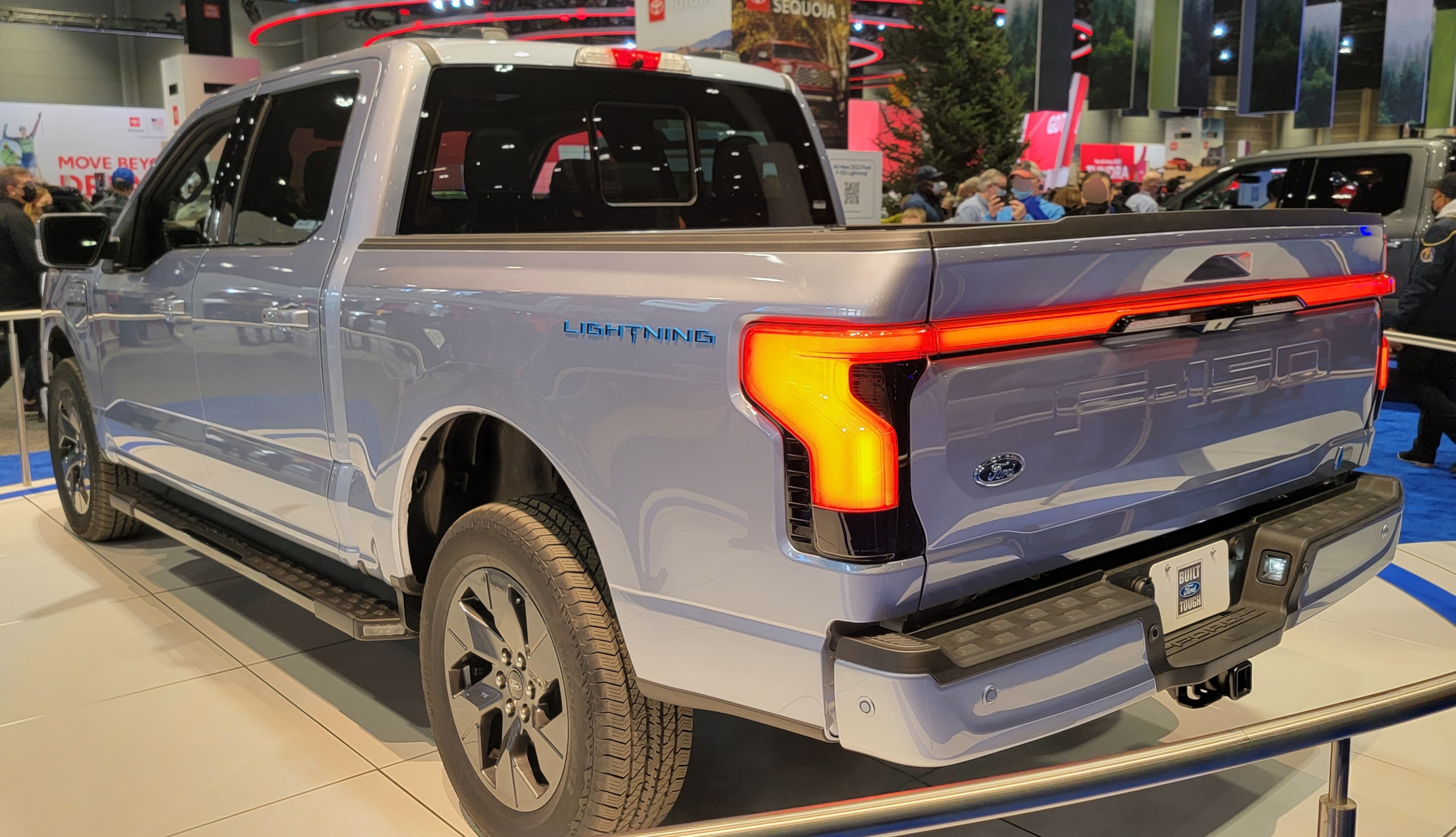
The episode discusses the expiration of the $7,500 federal tax credit for electric vehicles (EVs) and its implications for the EV market. Industry experts, including Mike Murphy from the EV Politics Project, analyze how this change may slow EV sales, particularly in states heavily reliant on subsidies. The conversation touches on automakers' strategies to maintain demand, such as new leasing programs, and explores the potential for state-level incentives. Additionally, Honda's innovative plans for fuel cells on the moon are highlighted, showcasing the ongoing evolution of EV technology.
"Come back tomorrow for a look back at Jim Farley's time at CEO of Ford as he celebrates his fifth anniversary on the job. He's streamlined the product portfolio. He's cut commodity vehicles like the edge and escape and focus more on Broncos and Mustangs and F-150s. And he's really done this because he's felt it's necessary."
"...t portfolio. He's cut commodity vehicles like the edge and escape and focus more on Broncos and Mustangs..."
Select text to request an explanation
This podcast is brought to you by Proton dealership IT experts in dealership cyber security and IT management. Interested in a free cyber security compliance or IT consultation? Visit ProtonTex.com. That's PRO-T-O-N-T-E-C-H-S.com. Welcome to Daily Drive for Tuesday, September 30th, 2025. I'm Kellan Walker in Las Vegas. Today on the show, it's the last day to buy an EV.
Let's see and get the $7,500 federal tax credit. GM and Ford work around that expiration with new EV lease programs and Honda sees potential for fuel sales on the moon. Plus, EV Politics Project Founder, Mike Murphy, talks about the state of electrification as federal support evaporates. In the short term, it's really important that the heavy EV sales states already,
to get into the subsidy business. Let's run through all the news you need to know to keep up in the auto industry. Federal Electric Vehicle Tax Credits expire at midnight. Consumers will lose the ability to claim up to $7,500 in federal incentives on any purchases finalized after today. Industry experts say it's a blow to an already fragile EV market. But many still believe demand will continue to increase, even if it's
a slower pace. Elaine Buckberg is senior fellow at Harvard University's Salada Institute for Climate and Sustainability.
Why don't the price gap in the near term for the consumer? It may slow charger rollout. It reduces pressure on auto makers on the timing of when they bring them to market. But they're still incentivized by the fact that virtually every auto maker believes that EVs are the future of the market, and they want to win in that future market.
Buckberg was speaking at Automotive News Congress in Detroit this month. She says EVs could account for 40% of the market by 2030 despite the loss of federal support.
Meanwhile, General Motors and Ford are using their financing arms to offer the federal incentive beyond its expiration on Tuesday. They're doing that by making down payments on the vehicles before finding customers to lease them.
The programs were confirmed in documents obtained by us at Automotive News and by people with knowledge of the automakers' plans.
The IRS said in August that consumers can still claim the credit if a vehicle is placed in service after September 30th.
That's as long as the vehicle has been acquired with payment made.
GM dealers need to sign up by today to participate while Ford gave dealers a September 26 deadline.
And fuel cells haven't yet taken off as a power source on Earth, but Honda thinks they could work well on the moon.
American Honda has signed a deal with astrobotic technology to jointly develop a continuous power source for lunar missions.
The companies will study how to integrate Honda's regenerative fuel cell system with astrobotics power infrastructure to supply electricity on the moon, where darkness lasts for two weeks at a time.
And those are today's headlines. You can find more details on all those stories at auto news dot com joining me now to talk more about the end of the federal EV tax credits is our own Hannah Lutz director of tech and innovation coverage at Automotive News.
She's also the co host of the automotive news shift podcast. Hannah, welcome back to daily drive.
Hi Kyle. Thanks for having me. I noticed that you're here a lot.
It's a big day for EV so I couldn't miss it today. Absolutely. And we're glad to have you.
So we heard from Elaine Buckberg earlier in the show. She says EVs might struggle a bit after the end of the tax credits, but they're still likely to grow to 40% of the light vehicle market by the end of the decade.
You moderated that panel at Automotive News Congress. How does that view line up with other experts you've been hearing from.
It lines up with some and it's more optimistic than than many I would say much of the consensus that EV sales will continue to grow, but at a slower pace than we've seen during this incentive period.
So we'll have a better sense of the natural EV demand without those big incentives, which, you know, they end the last day for them is September 30.
Our colleague Greg Grayson reported that in Canada, which is a much smaller market than the US EV registration spell almost 40% in the second quarter after the Canadian government ended their EV rebate.
And that's according to statistics Canada. So instead many Canadians are choosing hybrid hybrid sales rose 60% during that same period the second quarter.
So I don't know if we'll see the exact same thing in the US, but just an interesting thing to know that's what happened in Canada and now we'll find out what happens here.
And we're about to hear a piece of your conversation on shift with Mike Murphy of the EV politics project.
What are some of your big takeaways from that conversation about the role of politics and policy in EV adoption?
Yeah, that was a great conversation. I was really happy to get Mike Murphy on shift.
And the political influence around EVs is really amazing. It's very interesting to see.
I think there should be case studies on it and I guess that there there probably are some in the works or are some that are published.
But here are some of my biggest political EV takeaways.
One, automakers initially marketed EVs based on this green messaging, this is the climate benefits, climate friendly message.
You know, you can save money but also save the planet. And that works for a segment of US buyers, but definitely not the majority of US buyers.
They are more focused on vehicle performance, which automakers are really prioritizing now when they're marketing, but they weren't initially.
Also, the election cycle really didn't do EVs many favors. There was a lot of talk about an EV mandate when there actually wasn't an EV mandate.
There was no mandate for consumers to purchase an electric vehicle, but candidates used EVs as a talking point in their campaigns.
And they said that EVs could could mean job loss.
So Mike Murphy talks a lot more about that about the campaign strategy.
But overall, the EV conversation has largely become a political one and it will be interesting to see if and how states incentivize EVs as the federal government takes a big step back.
Good stuff. Hannah, thank you so much for joining me. Thanks, come.
Coming up, we're part of that conversation with Mike Murphy CEO of the EV Politics project. That's next on Daily Drive.
Automotive news shift podcast brings you the latest on automotive technology trends and transformation. I'm Hannah Lutz.
And I'm Molly Boygon. We're the new co-host of shift and we're excited to bring you new conversations with experts and industry insiders like this one with Larry Dominique, president of LD Management Consultant.
Do you believe the legacy OEMs are falling into a trap? They've got to find a way to, in some ways, build new airplane while they're still in flight.
Ketch shift available every Sunday wherever you get your podcast.
While you provide top notch support to your team and customers every day, is anyone taking the time to ensure your sensitive data remains secure?
Just one click on a malicious link can place your entire dealership in danger. In fact, the average cost of a data breach served past four million last year.
Stay one step ahead by understanding the threats and minimizing your risk. Proton dealership by T works around the clock to provide you with support 24-7-365, operating out of a cutting edge security operation center located in the USA.
Proton continuously monitors detects and responds to your potential network issues or cyber threats.
You've got a lot on your plate. Keep your focus on where it matters most.
Your customers will handle the cyber support. Learn more about our comprehensive services at protontax.com.
That's P-R-O-T-O-N-T-E-C-H-S.
Welcome back to Daily Drive. I'm Kellyn Walker.
To many, Mike Murphy might seem like an unlikely EV evangelist.
He spent decades as a political consultant.
Running statewide campaigns for Republicans including Arnold Schwarzenegger in California and John Angler in Michigan.
But he is now dedicated to demystifying the political fault lines that often separate EV adopters from EV skeptics.
Murphy is CEO of the EV Politics Project and the American EV Jobs Alliance.
He spoke with our own Hannah Lutz on the latest episode of Automotive News Shift Podcast.
Here's a piece of their conversation.
So in a few days, after September 30th, the $7,500 federal tax credit on eligible new EVs and the $4,000 one for used EVs will disappear.
And we know those incentives played a big part in getting EV prices closer to gas vehicle prices.
What do you think will happen to EV sales once those credits go away?
Well, that's the big question. The answer is we don't know, but it won't be good.
When the Germans killed their subsidies, they had about a 27% sales drop.
My view is that the forward march of increasing EV sales will slow, but I'm not so sure it'll be a disaster.
And I say that for two reasons, really.
One, I think next year some states are going to step up.
I mean, we're pushing a $3,500 new and used credit here in California.
I managed to trap the governor for 90 minutes, just me and him before the state cops rescued him.
And you know, he's an original EV driver. He had an EV one, I believe.
So in the next budget cycle next year, I think there's going to be some support and legislature for a credit.
The real fight will not be, is there a credit?
It's to get out of this lefty stuff where we limit the credit.
Because in the EV business, all you care about is volume.
When you get somebody to drive an EV, there's an 80% chance they're going to stick with EVs.
So I don't care if they're driving a lucid or the new bolt.
You know, you want to create more drivers, which is why leases are better.
Because through the cycle, you create two drivers most of the time in four years, first driver,
and then when it goes into the use market.
So I think there will still be some momentum in the big EV states like California.
You know, we're one third of all EV sales in America.
The other thing that I think is on the hopeful side is we're going to have a glut of use cars,
which they're going to be good deals on used EVs.
And as we all know in the auto business, the use markets twice as big as the new market.
So I think we're going to see in the new market, a little cooling in the used market,
a bit of a surge with low price points and volume.
Now, the pinch points we've got to get around.
One is all this attitude problem where, you know, Republicans make up 40% of car commerce.
Democrats make up 36%.
So it's hard to compete when 40% of the market is suspicious.
Now maybe a quarter of those Republicans are open to EVs, but it would be more like 70%,
which is the Democrat number.
The other pinch point, I think we have a dealer problem.
You know, in the average store, the ownership is thinking, I got to install all this new equipment.
My service drive revenue is going to go through the floor on these things,
because they don't need the same service.
The only big service they need is changing a battery, but that's an insurance nightmare for me,
unless I build a big concrete block.
You know, there are a lot of business incentives that are anti-EV at the dealer level.
And then you have the sales consultant thinking, I'm going to put a guy in an EV
and here she is going to drive off and a week later they won't have the charging in the garage figured out.
Other than maybe Ford, they've got a brilliant program, everybody on a copy.
And when the JD power, how do I do think comes out? I'm going to get dinged hard.
And, you know, that could reflect on me here, so I'm just going to put a regular car and avoid all that risk.
So we have a lot of dealer incentive things to fix in the front retail lines.
And then finally multifamily, you know, we got seven million people think about this.
Actually seven and a half million people in California, the best EV market,
live in a multifamily apartment building of 10 or more units, condo or apartment.
That's bigger than the population of 30 states.
And at the best EV state that we poll them, we just did a big poll.
They don't think they can get an EV because they can't get leveled to charging in the apartment building.
That's where some of this infrastructure money ought to go.
You can build 40 permanent EV level two overnight charging where the tenant pays the power for the cost of two fast charging dispensers in a six dispensuous station.
Yeah, there's been a lot of talk about level two versus fast chargers and like what the right balances.
The Navi program focused on fast charging along highways, which, you know, is important, but those chargers within cities and out of apartment complexes are important as well.
Oh, they're a huge pinch point and they're the easiest one to fix.
You got to get the state has to pay the four or five grand to install it.
The landlord has to collect a fee for putting up with all this because landlords won't invest even in this great EV market, only four percent of buildings.
And the tenants have to pay the power and part of maintenance contract across all the chargers and then it works.
Yeah. So going back to the tax credit for a second, your data shows 200,000 Americans are building EVs.
And the majority we know are doing so in these Republican led states that voted for Trump.
So what could the end of the tax credit, the consumer one mean for them and for business and the districts that they work in?
Well, that's a big question. And when we were fighting over the big happy bill, big beautiful bill, you know, we have an advocacy group in our umbrella called the American EV Jobs Alliance.
We actually aired TV ads in Michigan during the campaign making the argument.
Unfortunately, the Harris campaign never said a word.
We did a polar Michigan voters. You can see on the website two weeks for the election.
And they thought EVs were terrible for Michigan and Trump spent 10 million whacking them and it worked.
And the industry has fought but not hard on some of this stuff, even though they have so much at risk.
Because there were other things like getting rid of the fuel standards and not having to pay Elon a billion a quarter that they got that meant a lot to them.
So bottom line, if you're in Georgia, number one state for EV CapEx spending or Michigan, number two, if we do have a sales collapse in new EVs, which again, I'm not sure we will.
But if we do, those plants are going to be running at low capacity and we know in the auto business, if you got a plant running at low capacity, shut down the plant because you can't make any money.
Some of the incentives go away other than the threat that the Chinese are going to wipe out in a decade if they come here.
So it's tough. I mean, I feel for the auto manufacturers North America be they foreign or domestic.
Well, we got to lose a billion a quarter preparing for the future but in the meantime, hey shareholders, we lost another billion, you know, it's really a tough decision matrix.
The other thing is, even though I'm a Trump critic, you know, I went independent because I'm not a big Trump guy in the Republican party after, you know, spending a lifetime as a senior person there.
The Trump people are pretty good on batteries. They get the national security argument.
So they've been more supportive of building the battery stuff, but the problem is if you build a huge battery plant and you have no, the tech is good to have for defense reasons.
You want to shoot down a drone. There's going to be a battery-based weapon most of the time in the future.
But if the battery plants aren't feeding EV assembly, then they're going to have the same problem.
So you can't really fix part of it and, you know, I'm a right-winger. I don't like subsidies.
But Chad has got a hundred EV companies. They have a production capacity of 50 million vehicles across EV and I say, year, they're building 30 million.
They build 50. They could find markets to dump them into. It's a conquest strategy.
So we need subsidies in the short term to stay in the hunt. I mean, I'll quote Farley, who I think is very brave on these issues for the CEO of a public company.
He said, an Aspen not long ago, if we can't compete globally in EVs, I don't see a future for the Ford Motor Company. I mean, think about that.
So, you know, that's why we're in this. We love the climate stuff, but we're about American jobs and manufacturing might.
Yeah, everything feels very circular from EVs to batteries. They all connect like you can't do one without the other.
Do voters and policymakers understand the correlation between the consumer EV tax credit and these jobs?
Well, I've been in politics nearly 35 years, run dozens of Senate governor and a bunch of congressional campaigns.
I would say with a heavy heart that we are not in an era where you want to go door to door in Congress with an IQ test uncomplicated issues.
Sad, sad to say. There have been times when you would have done better with that test. Maybe we'll get there again.
But the ones who get it, at least on the, the Democrats generally vote for all this stuff on environmental reasons.
And to some extent, jobs, although you've got the UAW, which is dominated by long serving members who are often spitting distance of pension and great healthcare, worried about what we're going to get next year, whether or not the young guys are going to have a plant to work in, which is a tragedy right now.
Their leadership is not forward thinking and they're often very hostile to EVs. They don't really understand, in my view, the choices do we build them here in a plant like the new Ford production process they're going to try and Kentucky with fewer people.
Or do we build it all somewhere else? You know, that's the choice. So the dams basically are for this stuff with some bad caveos on the Republican side.
There are people who get it, but they're afraid of Trump. They're afraid of coming in the primary and they lose the free haircuts and all the other congressional perks. They worked hard to get there.
So we're in kind of a bad nodal zone now, which is why in the short term, it's really important that the heavy EV sales states already get into the subsidy business, which is Colorado, Hawaii, of course, California, Massachusetts.
There are about 10 states for all the, you know, Florida and Texas based on size. And then we've got to go to the conquest states. Michigan is an underperforming EV state for a lot of reasons, including 10 million hours of advertising.
They said that they kill auto jobs from the campaign. So you know, we have a lot of work to do, but it's going to move to the state level for a while.
You can hear the full conversation between EV politics project CEO Mike Murphy and our own Hannah Lutz on the latest episode of the Automotive News Shift Podcast.
That's available now wherever you get your podcast. That's daily drive for today. I'm Kellyn Walker.
Thanks to Automotive News executive producer Jake Nier, as well as our own Hannah Lutz, Lindsey Van Hully and Nick Bunkley for their reporting for today's podcast.
You can get the latest news on the loss of EV tax credits, fuel sales, and everything happening in the auto industry at autonews.com.
Come back tomorrow for a look back at Jim Farley's time at CEO of Ford as he celebrates his fifth anniversary on the job.
He's streamlined the product portfolio. He's cut commodity vehicles like the edge and escape and focus more on Broncos and Mustangs and F-150s.
And he's really done this because he's felt it's necessary.
We'd love to hear from you. Let us know what you think of the show when the topics we covered today.
Send us an email at dailydriveatautonews.com or leave us a voicemail at 313 or 444-2774.
And if you enjoy the podcast remember to like, leave a review, and subscribe so you never miss an episode.
Thanks for watching.
Request an explanation for:
5 cars
5 cars featured
Request an Explanation
Heard something you'd like explained? We'll add it to this episode.
Sign in to request explanations for terms you heard.
Want to learn more?
Browse our glossary for plain-English explanations of automotive terms, jargon, and concepts.
See something that's not quite right? Our annotations are AI-generated and can sometimes miss the mark.
Click the flag icon on any annotation to suggest a correction.