
So Close To 1st Place, Back To Leave It All Out There | Colt Carter - AMSOIL UCC 2026
About this episode
Colt Carter of AMSOIL UCC 2026 talks through the pressure of “crunch time” and what it takes to prep a diesel truck and business for a multi-day show with interviews before and after. He explains how EPA changes made shop life harder, and why customer expectations often come down to diagnostics and knowing when to “pull the motor” and rebuild. Between 2024 and 2025, close finishes hinge on setup tweaks, traction, and avoiding repeat engine failures—costly ones that can wipe out tens of thousands.
From wrenching on everything to starting his own diesel shop, Black Magic Performance, to competing in his third AMSOIL UCC event, Colt Carter joins the podcast to talk his about his Cummins and what he expects from this year's event. From putting down a 2nd place finish his first AMSOIL UCC and then improving the next year in the drag race and dyno portion of the challenge, this man has left it all out there. Fracturing his foot from his piston blasting apart on the dyno and spending all night trying to mke sure the truck could make the sled pull portion, this man embodies a no quit attitude. Colt has what it takes to win it and when you hear his story and what he's dealt with this past year, you can't help but root for him. Good luck Colt!
EPA stuff
"…and then EPA stuff came around and it just got real rocky and now I'm still still have my shop…"
“EPA stuff” means government rules about pollution and vehicle emissions. For diesel shops, those rules can make it harder to do certain upgrades or require extra steps so the truck still meets emissions laws.
“EPA stuff” refers to emissions regulations enforced by the U.S. Environmental Protection Agency (EPA). In diesel performance shops, new or changing EPA rules can affect what modifications are legal, what parts can be sold/installed, and how vehicles must be calibrated to meet emissions requirements.
telling the customer no / lead times
"…the biggest deal is is telling the customer no that I can't get it done in time…"
He’s talking about the hard part of running a shop: sometimes you can’t finish a job when the customer wants. So you have to be honest about timing and manage expectations.
The discussion centers on service-business lead times—how long it takes to complete customer work—and the challenge of communicating delays. This is a common operational issue in performance and repair shops, especially when workload and staffing are tight.
flash
"with myself and just my experiences with being in the industry just because someone wants to flash [310.9s] a couple bucks in your face doesn't mean that that's your customer you know"
“Flash” here means updating the truck’s computer software. People do it to change how the engine runs, but it’s not always the best choice for every situation.
In diesel performance, “flash” usually means reprogramming the engine’s electronic control unit (ECU) with new software. It’s commonly used to add power, change fueling/boost behavior, or improve drivability, but it’s not automatically the right move for every truck or customer.
dead cylinder
"I'd call and say you know you got two dead [392.5s] cylinder holes you know best thing to do we can't sit there and patch it"
A “dead cylinder” is a cylinder that isn’t firing or making power. If you have more than one, it usually means something bigger is wrong inside the engine.
A “dead cylinder” means one cylinder isn’t producing power—often due to issues like loss of compression, fuel/spark problems, or internal mechanical failure. When multiple cylinders are dead, it can point to a serious engine condition rather than a simple fix.
pull the motor
"best thing to do we can't sit there and patch it I'm not going to patch it [402.5s] best thing to do is hey we need to go ahead pull the motor let's rebuild it"
“Pull the motor” means taking the engine out so the shop can fix the real problem. It’s usually done when the issue is too serious to fix without removing the engine.
“Pull the motor” means removing the engine from the vehicle to access internal components for repair. It’s typically chosen when the problem is deep enough that in-place repairs (like patching) won’t be reliable or complete.
rebuild it
"best thing to do is hey we need to go ahead pull the motor let's rebuild it and I've had some customers"
“Rebuild it” means taking the engine apart and fixing the internal parts that are worn or broken. It’s done when the problem is inside the engine, not just something external.
“Rebuild it” means disassembling the engine and replacing worn or failed internal parts to restore proper operation. It’s often the next step when diagnostics show internal mechanical failure rather than a surface-level issue.
diagnostic
"hey let's patch it and I just usually I kind of tell that customer hey just pay for diagnostic [407.2s] and you can come get your vehicle"
“Diagnostic” means figuring out what’s really causing the problem before you start fixing it. It can save money by preventing the wrong repair.
“Diagnostic” refers to troubleshooting to find the root cause of a problem before doing repairs. In engine work, paying for diagnostic time helps avoid guessing—like patching something that actually needs a deeper repair.
EPA started coming involved
"the 2007 I had actually had eight takes at 2007 all the way up to 2011 and then the other stuff [447.5s] EPA started coming involved and then next thing you know"
The EPA is the government agency that regulates emissions. When they get involved, it can limit or change what people can do to modify diesel trucks.
When the speaker says the EPA “started coming involved,” they’re referring to U.S. Environmental Protection Agency regulations affecting diesel emissions. Those rules can change what modifications are allowed and how shops tune or certify vehicles.
overdrive
"...if I probably wouldn't have done the overdrive and left it in third I we could probably take first at that point..."
Overdrive is a higher gear that usually makes the engine run at lower RPM for a given speed. In a race, whether you’re in overdrive or not can affect how hard the truck feels when you’re trying to win.
In a truck’s drivetrain, overdrive is a gear ratio that lets the engine spin slower at a given speed. In racing contexts, choosing overdrive (or not) can change how the truck stays in its power band during acceleration and pulls.
sled pull
"...after we left we got in the parking lot and I still had to sled pull stuff on the truck and I you know got a little bit excited..."
A sled pull is a competition where your truck has to drag a heavy sled. The sled makes the truck work hard, so the truck’s setup matters a lot.
A sled pull is a motorsport event where a vehicle pulls a weighted sled over a track. The sled’s resistance loads the drivetrain hard, so setup choices (power delivery, traction, gearing) can make or break the run.
burnout
"...I did a damn burnout and parked a lot and I threw rocks on Kenny's uh truck..."
A burnout is when you spin the tires to heat them up. The goal is usually better grip for the next run, though it can also wear things out.
A burnout is when the driver spins the tires to heat them and improve traction before a run. In sled pull/drag-adjacent events, it can help the tires bite, but it can also waste time or stress drivetrain components.
quarter
"...so let me let me ask you this so 24 second place finish 2025 fifth place finish but you went faster in the quarter..."
“Quarter” means the quarter-mile distance used in drag racing. It’s a standard way to compare how fast a truck accelerates.
“Quarter” refers to the quarter-mile drag racing distance (a common benchmark for acceleration and elapsed time). Faster quarter-mile performance usually indicates the truck is making more usable power and/or launching more effectively.
four length bars
"...we didn't actually test the truck... we didn't know about the four length bars I've never adjusted four length bars so it was something totally new..."
“Four length bars” are adjustable suspension links that help control how the truck sits and moves. In a pull/drag-style setup, adjusting them can change traction and stability.
“Four length bars” refers to adjustable suspension/control links (often in the rear) used to set ride height, traction, and geometry under load. Changing them can dramatically affect how the truck launches and how stable it stays during hard pulls.
spray it
"...it's like I'm gonna go ahead and spray it and I'm gonna drive the living hell out of it and let's see what happens..."
“Spray it” usually means adding an extra power-boost system for the run. People do it to make more power when they’re trying something new or when conditions aren’t fully known.
“Spray it” in performance diesel talk typically means using an added fuel/boost system—most commonly nitrous oxide (NOS) or a similar injection system—to increase power for a run. It’s often used strategically when the driver is trying to compensate for unknown traction or setup.
dyno
"but uh I mean like I said we didn't need to test it we didn't do nothing we just kind of we was at that time crunched it's like hey let's just send this damn thing let's see what happens no so I mean and then uh you know we got on dyno we did the uh 27 28"
A dyno is a machine that tests the truck’s power in a controlled way. It helps you measure how much torque and horsepower the engine is making so you can tune it more safely.
A dyno is a dynamometer used to measure engine and drivetrain output under controlled load. Instead of guessing from track runs, teams can quantify things like horsepower and torque and then adjust tuning based on the results.
learning curve
"but you know that's a learning curve you don't never know until you actually get on a dyno and you start you know dialing in a truck"
A “learning curve” here means they had to adjust the tune step-by-step and see what happened. You only find the right settings by testing and refining.
A “learning curve” in tuning means the process of iteratively adjusting the setup (like fuel and ignition strategy) and observing results. Even experienced teams can’t fully predict behavior until the engine is tested under real load on a dyno or track.
timing
"but you know that's a learning curve you don't never know until you actually get on a dyno and you start you know dialing in a truck so I mean when number six piston it came through the cab"
“Timing” is when the engine lights the fuel during each cycle. If you change it too aggressively, the engine can run too hard internally and get damaged.
In engine tuning, “timing” refers to when the engine’s combustion event is triggered relative to piston position. Advancing timing can increase power, but too much can raise cylinder pressures and heat, increasing the risk of knock and mechanical damage.
number six piston
"so I mean and then uh when number six piston it came through the cab I mean oh at that point yeah it knocked a big old hole inside the cab"
Engines have multiple cylinders, and “number six” is one specific cylinder. If that piston fails badly, it can cause major engine damage and even send broken parts outward.
“Number six piston” means the piston in cylinder #6 of the engine. A catastrophic failure of that piston can indicate severe internal damage—often from extreme combustion conditions—leading to parts breaking through the engine block or even into the cabin.
knocked
"so I mean and then uh when number six piston it came through the cab I mean oh at that point yeah it knocked a big old hole inside the cab it actually when it came in it actually hit my foot"
“Knock” is when the engine starts burning fuel in a rough, uncontrolled way. It’s dangerous because it can break parts inside the engine.
“Knocked” here points to detonation/knock, where the fuel-air mixture ignites violently and out of the intended timing. Knock is a major warning sign because it can rapidly damage pistons, rods, and cylinder walls.
swapping motors out
"we're swapping the motor out we're you know swapping motors out swapping axles out I mean it sounded like a NASCAR pit crew inside the tent"
That’s when the team replaces the engine fast so the truck can make the next run. It’s a way to save time during competition.
In racing, “swapping motors out” means replacing the engine quickly between runs or after a failure. Teams do this to minimize downtime and keep the vehicle eligible for the next pull.
swapping axles out
"we're swapping the motor out we're you know swapping motors out swapping axles out I mean it sounded like a NASCAR pit crew inside the tent"
That means replacing the axle parts that send power to the wheels. In a hard competition, they can get damaged and need to be changed quickly.
“Swapping axles out” is replacing the axle assembly (the parts that transmit power to the wheels) as part of rapid repair. In high-load diesel pulls, axles can be damaged by torque, traction events, or drivetrain failures.
puking oil out of the head
"we finally got the truck running next thing you know it is puking oil out of the head water jackets oh so it's kind of like holy hell what the hell we do now"
That sounds like the engine started leaking oil badly from the top (the cylinder head area). It usually means something serious failed, like a seal or gasket not holding anymore.
“Puking oil out of the head” describes severe oil leakage from the cylinder head area, usually indicating a major sealing or internal failure. In diesel engines, this can point to issues like blown head gasket/seals or a cracked component that lets oil escape under pressure.
water jackets
"it is puking oil out of the head water jackets oh so it's kind of like holy hell what the hell we do now"
Water jackets are the internal channels where coolant flows to keep the engine from overheating. If oil and coolant are mixing or leaking near that area, it’s a sign of a serious problem.
“Water jackets” are the coolant passages built into the engine block and cylinder head. They circulate liquid coolant to control engine temperature; if oil is “puking” near the water jackets, it can suggest oil/coolant contamination or a sealing failure between oil and coolant passages.
radiator cap
"yeah and I'll take the radiator cap off just go all in because that's what it's pushing oil anyways so that motor was a liquid liquid uh oh"
The radiator cap controls pressure in the cooling system. Taking it off can help you add coolant, but it can also be dangerous if the system is still pressurized/hot.
The radiator cap regulates cooling-system pressure, which raises the boiling point of the coolant. Removing it during a hot or pressurized situation can be risky, but teams sometimes do it to quickly add coolant when the system is acting up.

Dodge Ram
"...uh our bolts would line up for a hitch so we just ram some uh socket extensions inside there we like to..."
The Dodge Ram is a pickup truck used for hauling and towing. The podcast context sounds like someone is working on a hitch setup and making parts fit properly. That’s the kind of practical truck modification people do to get the right towing setup.
The Dodge Ram is a pickup truck platform that’s widely used for work and towing, but it also has a large performance and modification community. In the podcast snippet, it sounds like the discussion is about practical fabrication/fitment—like using hardware to line up a hitch—showing how owners adapt the truck for specific needs. That kind of real-world modification talk is common when people discuss how to get a truck set up correctly for towing or hauling.
test fired
"so we finally pushed the truck out so when we pushed the truck out I actually put our bolts would line up for a hitch so we just ram some uh socket extensions inside there we like to hell with it... we got test fired"
They started the engine briefly to make sure it was working after the repairs. It’s like a quick check before the real run.
“Test fired” means starting the engine briefly to confirm it runs correctly after repairs or component swaps. In motorsport, it’s a quick verification step before the next competitive pull.

Dodge Charger
"...ow I get up time I start trying to come up on the charger just pulling me through and I forgot all about th..."
The Dodge Charger is a car built for strong acceleration and performance. People often modify them with upgrades to make them faster and better at pulling power. It may be mentioned in a podcast when someone is talking about how the car feels when it’s working hard.
The Dodge Charger is a full-size American muscle sedan/coupe that’s commonly discussed in performance circles for its strong aftermarket support and ability to handle power upgrades. In a diesel-performance context, it may come up when people talk about drivetrain “pull” and how the car responds under load. That makes it a frequent subject for tuning, traction, and real-world acceleration discussions.
nitrous
"start getting in it and I pull throttle all of the nitrous comes on and it's all screaming to hell"
Nitrous is a system that adds nitrous gas to the engine. It helps the engine make more power quickly, usually for short bursts during racing.
Nitrous (nitrous oxide) is an aftermarket power-boost system that injects gas into the engine to increase oxygen availability for combustion. In practice, it can dramatically raise power for short bursts, which is why it’s often used in drag racing and sled pulling.
dino
"you have a better pass than you did the year prior you have better dino than you did the year prior"
“Dino” means a dyno test. It’s a machine that measures how much power and torque the truck is producing.
“Dino” is shorthand for a dynamometer test, where a vehicle’s power and torque are measured under controlled conditions. It’s commonly used to compare tuning changes and to verify how much power a build is actually making.
firewall
"it took me about two weeks to go ahead and get the firewall all fabricated back up and I bet I probably had 30 or 40 holes all on the firewall"
The firewall is the wall between the engine area and the inside of the truck. He’s saying he had to rebuild and patch it after cutting holes for the build.
The firewall is the structural panel that separates the engine bay from the cabin. When it’s “fabricated back up” and patched with many holes, it usually indicates major engine or turbo/nitrous plumbing work that required cutting and reworking the engine-bay structure.
open diff
"I've noticed off of uh how much power I can put down that you know the open diff for the uh AEM axles just it doesn't take it anymore"
An open differential can struggle when one wheel loses grip. If one tire spins, it can take away power from the tire that still has traction.
An “open diff” (open differential) sends torque to both rear wheels, but if one wheel loses traction, most of the power can go to that slipping wheel. That makes it harder to put power down in high-traction launches, especially with big torque.
AEM axles
"the open diff for the uh AEM axles just it doesn't take it anymore"
AEM axles are the axle parts that send power to the wheels. With more power, the axles and the rear setup have to be strong enough to handle it.
“AEM axles” refers to axle components from AEM used in the rear driveline. Axles are critical for transferring torque to the wheels, and when power increases, axle strength and traction strategy (like moving away from an open diff) become limiting factors.
spool
"so now I'm doing a spool on the back with the bigger shafts from DHD"
A spool locks the rear wheels together so they spin together. That helps prevent one wheel from spinning away traction, which is useful for racing.
A “spool” replaces the differential’s action so the axle shafts are locked together, forcing both wheels to rotate at the same speed. It improves traction for straight-line launches because power can’t bleed to a slipping wheel, but it can make the truck harder to turn and increases drivetrain stress.
DHD
"so now I'm doing a spool on the back with the bigger shafts from DHD so they got me all set up with that stuff"
DHD is the company he says provided stronger axle parts. Those parts help the drivetrain survive higher power.
DHD is referenced as the supplier of the “bigger shafts” used with the rear axle setup. In drag and sled-pull builds, stronger axle shafts help handle higher torque and reduce the chance of driveline failures.
stepping trans
"by next week I should be stepping trans in"
He’s talking about changing the transmission gearing. The goal is to make the truck accelerate in the best RPM range for the engine.
“Stepping trans” is a transmission change aimed at better matching gear ratios to the powerband and launch conditions. In high-power diesel competition, transmission gearing is tuned to keep the engine in the right RPM range and improve acceleration consistency.
test firing truck
"I'm hoping by end of this weekend I should be test firing truck"
A “test firing” is an initial run/verification after major work to confirm the engine starts, systems function, and there are no immediate faults. In competition builds, it’s a checkpoint before more tuning or track-specific preparation.
new sleeves
"the sled pull I'm still using that same old factory motor for a backup uh they're putting new sleeves in it right now so that one should be good to go"
Cylinder sleeves are like replaceable inner walls for the engine’s cylinders. If the cylinders get worn out or damaged, new sleeves can bring the engine back to a good, round surface for proper sealing.
“Sleeves” are cylinder liners installed inside the engine block to restore or change the cylinder bore. In a high-power diesel, adding new sleeves is often part of rebuilding after wear or damage so the engine can run reliably again.
new CGI block
"the uh the uh new power plant that truck now is the new CGI block from Hamilton uh it's all solid"
A “CGI block” is the engine’s main metal housing where the cylinders are. CGI is a special type of iron that helps the engine handle a lot more stress, which matters for high-power diesel builds.
A “CGI block” refers to a cylinder block made from CGI (compacted graphite iron). It’s used in diesel engines because it can be strong and resist cracking under high cylinder pressures compared with some other cast-iron approaches.
D and J head solid stage three
"and then I'm running the d and j head solid uh stage three"
This is a performance upgrade to the top end of the engine (the valve train). A “solid” setup usually means the valves are controlled more directly for higher-speed use, which is common in racing builds.
“Solid” in this context refers to a solid-lifter/solid-valvetrain setup (as opposed to hydraulic lifters), which can help control valve motion more precisely at higher RPM. A “stage three” typically indicates a more aggressive performance cam/valvetrain package intended for racing use.
80 over a 122
"the air setup it's a 80 over a 122 on it and then it's got the flux 400 injectors in it"
That phrase is about turbo sizing—basically how big the turbo setup is. The turbo size changes how fast it builds boost and how much air the engine can move, which is crucial for pulling hard.
“80 over a 122” describes a turbocharger sizing or compressor/turbine arrangement used for diesel performance. In sled-pull builds, the exact “over” relationship affects spool-up, airflow, and how quickly the engine can make boost under load.
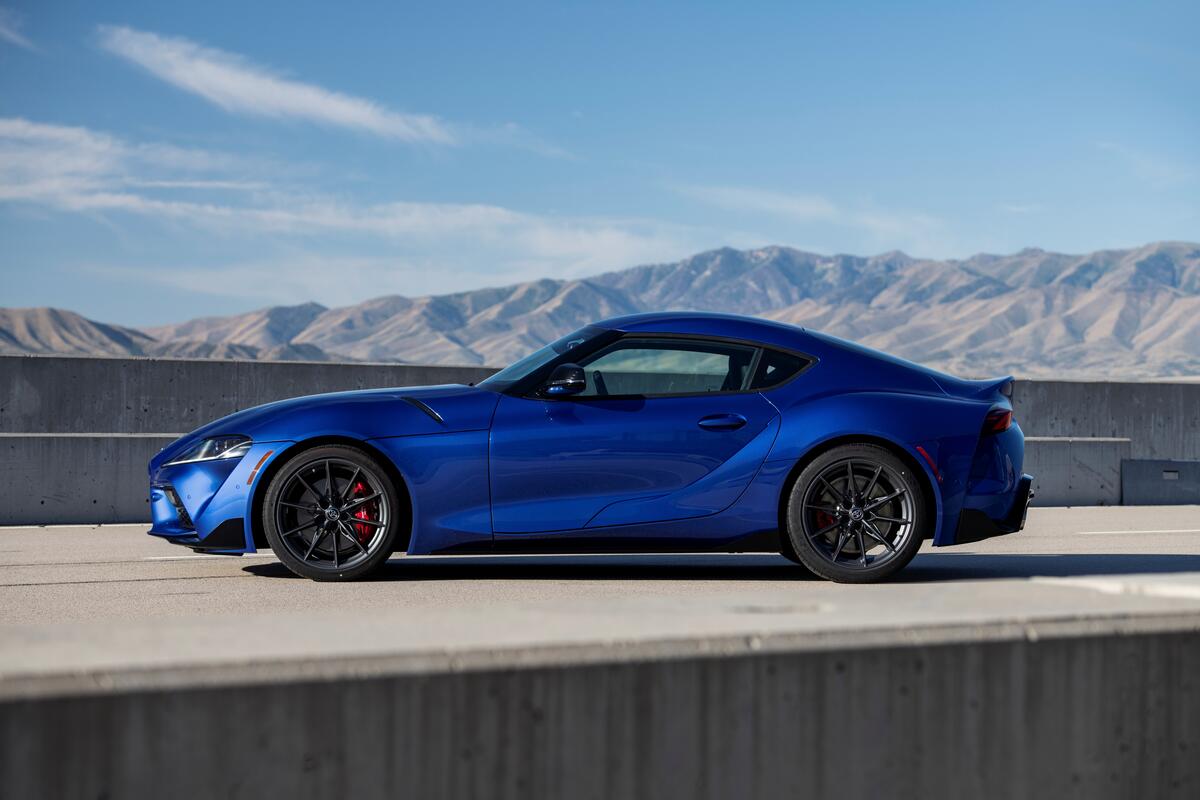
Toyota A80
"block from Hamilton uh it's all solid and then I'm running the d and j head solid uh stage three the air setup it's a 80 over a 122 on it and then it's got the flux 400 injectors in it okay transmission wise what do you have on that 48 or transmission yeah transmission"
The Toyota Supra is a sports car designed to be fast and fun to drive. In this podcast, it sounds like the engine has been heavily modified with upgrades for more airflow and fuel. Those changes are usually done to make the car produce much more power than stock.
The Toyota Supra is a performance sports car known for its strong tuning potential and track-focused hardware. In the podcast context, it’s being described with specific engine and fueling modifications (like a built/solid block setup, stage-three air setup, and upgraded injectors), which is why it’s relevant to diesel-performance audiences interested in how power is made and controlled. That kind of build detail is typically discussed to explain reliability, airflow, and fueling requirements at higher power levels.
flux 400 injectors
"and then it's got the flux 400 injectors in it"
Fuel injectors control how much diesel gets sprayed into the engine. Higher-output injectors help the engine get enough fuel to make power when the turbo and other parts are upgraded.
“Injectors” are the fuel nozzles that meter diesel into the cylinders. “Flux 400” indicates a specific injector model/rating, and higher-flow injectors are commonly used to support the extra fuel needed for high-boost, high-power diesel builds.
transmission is a 48
"okay transmission wise what do you have on that 48 or transmission yeah transmission is a 48"
That’s the transmission model he’s using. In a high-power diesel, the transmission has to survive big torque and keep power going to the wheels without slipping or breaking.
“48” is a shorthand for a specific transmission model used in diesel drag/sled-pull circles. Transmission choice matters because it has to handle high torque loads and keep the engine in the right RPM band under sustained pulling.
new 72 fast class
"I mean especially you know we got the new 72 fast class so I mean a lot of the guys that you know help me work on my truck from time to time"
They’re talking about a new competition class for this year. That changes who’s available to help and how the team focuses on the truck.
The speaker mentions a “new 72 fast class,” which appears to be a competition class/category that affects who can help and how the truck is prepared. It’s a rules/format detail for the event rather than a technical component.
tune in here a to b
"yeah and maybe hey if I gotta rob somebody hey throw me a tune in here a to b let's try it without you know messing with their stuff"
A “tune” is the calibration of engine control parameters (fueling, boost targets, timing, etc.) that determines how the diesel runs. “A to B” suggests making a controlled change and verifying behavior from one state to another without disturbing other work.
wheel set up
"“...send a new picture of the truck with you know the whole wheel set up...”"
This is the tire-and-wheel choice. The right setup helps the truck grip better so it can accelerate more consistently.
“Wheel set up” refers to the chosen wheel and tire configuration, which affects grip, rolling resistance, and how the truck’s traction changes under load. In competition, tire choice and fitment can be as important as engine tuning because they determine how effectively power is transferred to the ground.
suspension
"“...now trying to set the forward length and suspension up...”; “...if I could actually dial the truck in the suspension...”"
Suspension is the system that controls how the truck’s wheels move and how the chassis stays stable under acceleration, braking, and cornering. For drag or short-track competition, suspension setup directly affects launch behavior, weight transfer, and how consistently the truck can put power down.
forward length
"“...now trying to set the forward length and suspension up...”"
They’re talking about a measurement in the suspension setup that changes how the front of the truck sits and moves. Changing it can change how the truck launches and handles.
“Forward length” in a suspension context usually refers to geometry or setup dimensions that affect how the truck’s front end responds, such as link lengths or mounting positions. Small changes can alter ride height, weight transfer, and how the truck behaves during launch.
qualifiers
"“...we get to test up there... we’re only going to get probably maybe two qualifiers so I mean the first one is...”"
Qualifiers are the preliminary runs where you prove your setup. Your results can decide whether you move on and how you line up for the main competition.
Qualifiers are the runs that determine starting positions or advancement in a competition. Drivers often use limited qualifying attempts to test tune changes and suspension adjustments before the main event.
A to B tune
"“...I know we're only going to get probably maybe two qualifiers so I mean the first one is by going to be you know a good A to B tune and then see how it you know takes it...”"
It’s basically a “setup” for how the truck should run from one part of the course to another. Instead of trying to be perfect everywhere, you tune it to be predictable and fast for the actual run you’ll do in competition.
An “A to B tune” is a calibration strategy where the truck is set up to perform consistently between two points on the track (or course) rather than chasing peak numbers everywhere. In practice, it usually means dialing fueling/boost/shift behavior for the specific run so the car can repeat its performance during qualifying.
shift left to right
"“...a good A to B tune and then see how it you know takes it if it don't you know shift left to right after that...”"
They’re talking about how the truck changes gears during the run. “Left to right” means the gear changes happen at different engine speeds, which can make the truck feel faster or smoother.
“Shift left to right” is shorthand for changing where the transmission/shift events land in the RPM range during a run. If the truck “shifts left to right” after a tune change, it typically means the shift timing or shift points moved, affecting acceleration and how the engine stays in its power band.
launches
"“...if you could do some back road runs... just to see how the truck launches see how it handles...”"
A “launch” is the start—how the truck gets moving from a stop. Testing launches helps you see if it hooks up and accelerates the way you expect.
In performance driving, “launches” refers to the initial acceleration from a stop or low speed. How a truck launches depends heavily on traction, suspension compliance, and drivetrain calibration, so testing launches helps predict race-day behavior.
dead hooks
"if it dead hooks it should be no reason not to hit you know five ohs five 10s five 20s easy it's just trying to get the truck to dial it in"
“Dead hooks” means the truck grabs the ground hard at launch. The tires don’t spin much, so it can accelerate faster.
“Dead hooks” is drag-racing slang for a launch where the tires immediately bite and the truck hooks up without excessive wheelspin. It’s usually the goal because it helps convert engine power into forward acceleration right away.
five 10s
"hit you know five ohs five 10s five 20s easy"
“Five 10s” means the truck is aiming for a very fast drag-race time—around five seconds and a tenth. It’s basically a target elapsed time.
“Five 10s” is shorthand for running in the 5.10-second range in a drag-racing time category (typically a quarter-mile pass). It’s a performance target expressed as elapsed time.
sweet spot
"at the right sweet spot yeah well it's all about the progress at that point right"
The “sweet spot” is the best setup for getting the truck to launch and accelerate well. It’s basically the point where everything lines up for traction.
The “sweet spot” is the optimal setup point where the vehicle’s suspension, traction, and weight transfer work together for the best launch and acceleration. For drag trucks, it often means finding the right balance so the tires stay planted under hard throttle.
2400 horsepower
"if I slap down you know two grand 2400 horsepower that's fine"
Horsepower is how much power the engine can make. “2,400 horsepower” is an extremely high power target for a diesel drag truck.
Horsepower is a measure of engine power output; in diesel drag racing, higher horsepower generally increases acceleration potential. When someone says “2,400 horsepower,” they’re talking about the scale of power they expect from the tuned setup.
roller
"give me the hell off this roller you know I mean am I a point now from what I did last year"
A “roller” is part of a dyno setup where the truck’s wheels sit on rollers. The dyno measures power while the engine is under load.
In this context, a “roller” refers to a chassis dyno setup where the vehicle drives onto rollers that apply load while measuring output. It’s part of how dyno testing simulates resistance to quantify power.
breaking and the repairs
"because it's the stresses that really ruins it for them that you know because it's a go go go the breaking and the repairs"
They’re talking about how racing hard can cause parts to fail, which means you have to fix things often. That constant cycle of racing and repairing is stressful and expensive.
The speaker is describing the typical endurance/abuse cycle in diesel motorsports: repeated hard launches and passes lead to component wear or failures (“breaking”), which then forces repairs between runs. This “go go go” loop is a major cost and stress factor in competitive drag racing.
fire up
"like I say I mean the first fire up was last year was firing it up to drive it put it on trailer and let's go"
“Fire up” just means turning the engine on. In a race setup, the first start can show problems right away.
“Fire up” means starting the engine after it’s been shut down, often after service, tuning, or transport. In racing contexts, the first “fire up” can reveal issues quickly, especially on heavily modified diesel builds.
blow a motor
"I think if if I go out there and just have fun hey and I don't blow a motor hey I'm probably the happiest person that I can't be"
“Blow a motor” means the engine fails catastrophically—often from overheating, lubrication failure, or mechanical damage under high stress. In performance diesel racing, it’s commonly tied to pushing power beyond what the engine’s internal components can reliably handle.
out-the-door
"last year I went through two motors so you know after it's all said and done for two days it was 60 grand gone out the door"
“Out-the-door” means the total you actually end up paying. It includes the base cost plus taxes and fees, not just the sticker price.
“Out-the-door” (OTD) is the total amount paid to buy or fix something, including taxes, fees, and any required charges—not just the base price. When he says “60 grand gone out the door,” he’s emphasizing the full, real cost of the engine failures.
send it
"i think I was angry at more myself of trying to say hey let's send it let's see what happens and it was just the cars was there"
“Send it” basically means to go for it. It’s the mindset of pushing the car/truck as hard as you can instead of holding back.
“Send it” is racing slang for going all-in—full throttle or maximum effort—rather than driving conservatively. In the context of engine failures, it implies he was intentionally pushing the truck hard to see what would happen.
Request an Explanation
Heard something you'd like explained? We'll add it to this episode.
Sign in to request explanations for terms you heard.
Want to learn more?
Browse our glossary for plain-English explanations of automotive terms, jargon, and concepts.
Help improve this episode
See something that's not quite right? Our annotations are AI-generated and can sometimes miss the mark. Click the flag icon on any annotation to suggest a correction.