Ball joints are the little pivot connections that let your suspension move while still keeping the wheels pointed correctly. When they wear out, the steering can feel loose and you might hear knocking or feel extra movement.
Term
tire ends
This sounds like they mean tie rod ends—the parts that connect the steering to the wheel. If they’re worn, the steering can feel loose and your tires may wear unevenly.
The knuckle is the part that the wheel mounts to and that turns when you steer. If it or its bearings get worn, the steering can feel loose and you may hear grinding or clunking.
The steering rack is the part that turns the steering wheel’s motion into movement that actually steers the wheels. If it’s worn, steering can feel sloppy and you might hear clunks or feel vibration.
The steering gearbox is the mechanism that turns the steering wheel into the motion that steers the front wheels. If it wears out, you can get looseness or noise you feel through the steering wheel.
A rag joint is a flexible connector in the steering shaft area. If it wears out, the steering can feel loose and you may hear knocking when you turn the wheel.
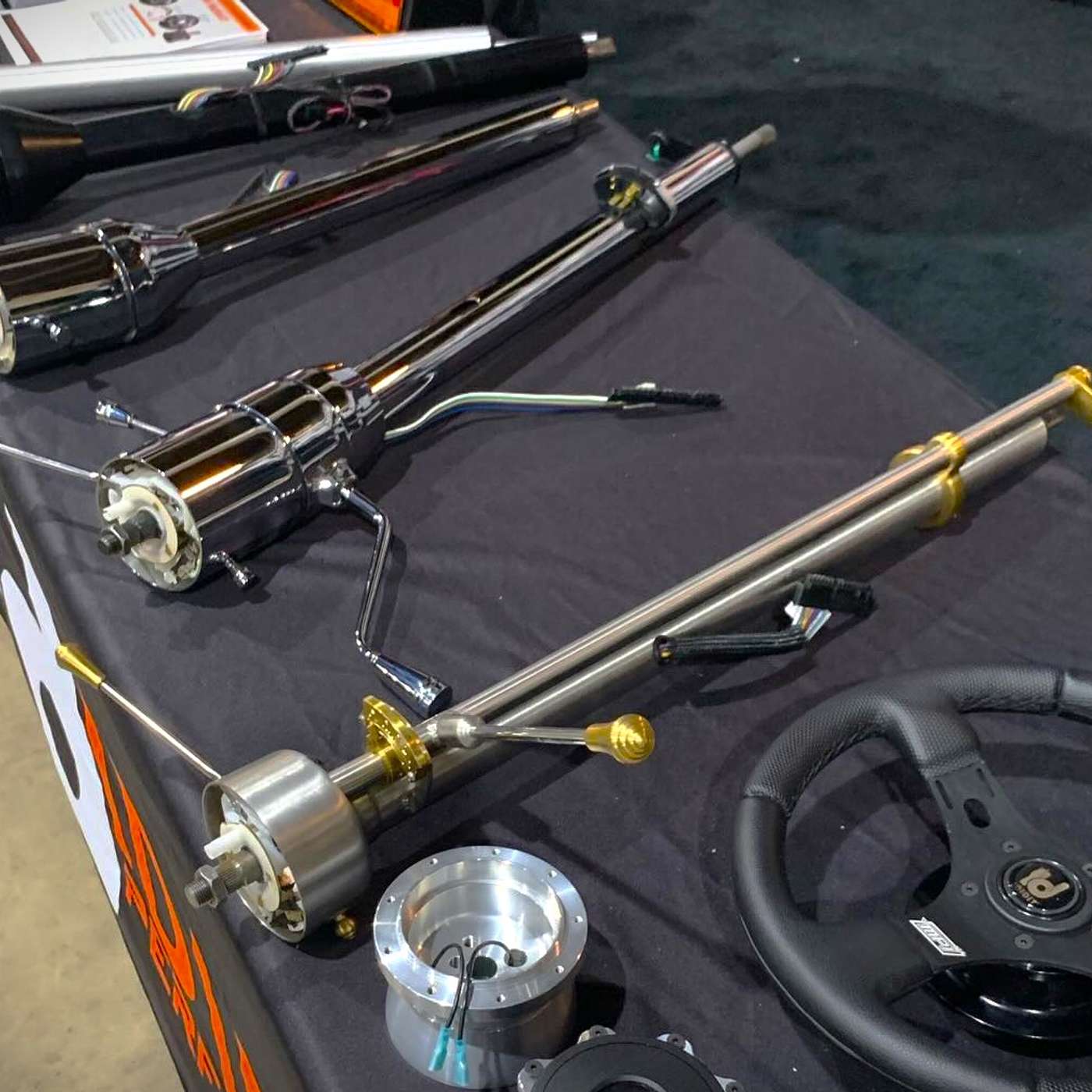
The steering column is the part that connects your steering wheel to the rest of the steering system. It’s also where some controls and adjustments (like tilt) are built in.
Junkyards are places that sell used parts from old cars. The point here is that older steering-column parts become harder to find as the cars get rarer.
Castings are metal parts made by pouring molten metal into a mold. If a steering column’s metal housing is cracked and you can’t find replacement parts, rebuilding may not be possible.
Turnstile switches are the electrical switches on the steering column that control things like your turn signals. If the old ones are hard to find, upgrading the column can be the practical fix.
Aftermarket columns are replacement or upgrade steering columns from companies besides the car’s maker. People use them to add modern features to older vehicles.
The output shaft is the “transfer” part that carries your steering input from the steering wheel toward the steering mechanism. When you change columns, you need the right size so it connects correctly.
U-joints are the “angle adapters” that let the steering shaft work even if the parts aren’t lined up perfectly. They help keep steering motion smooth when the column and rack aren’t in a straight line.
This means lining up the steering parts so the joints work at the right angles. If the angles are wrong, the steering can feel rough and the joints can wear out sooner.
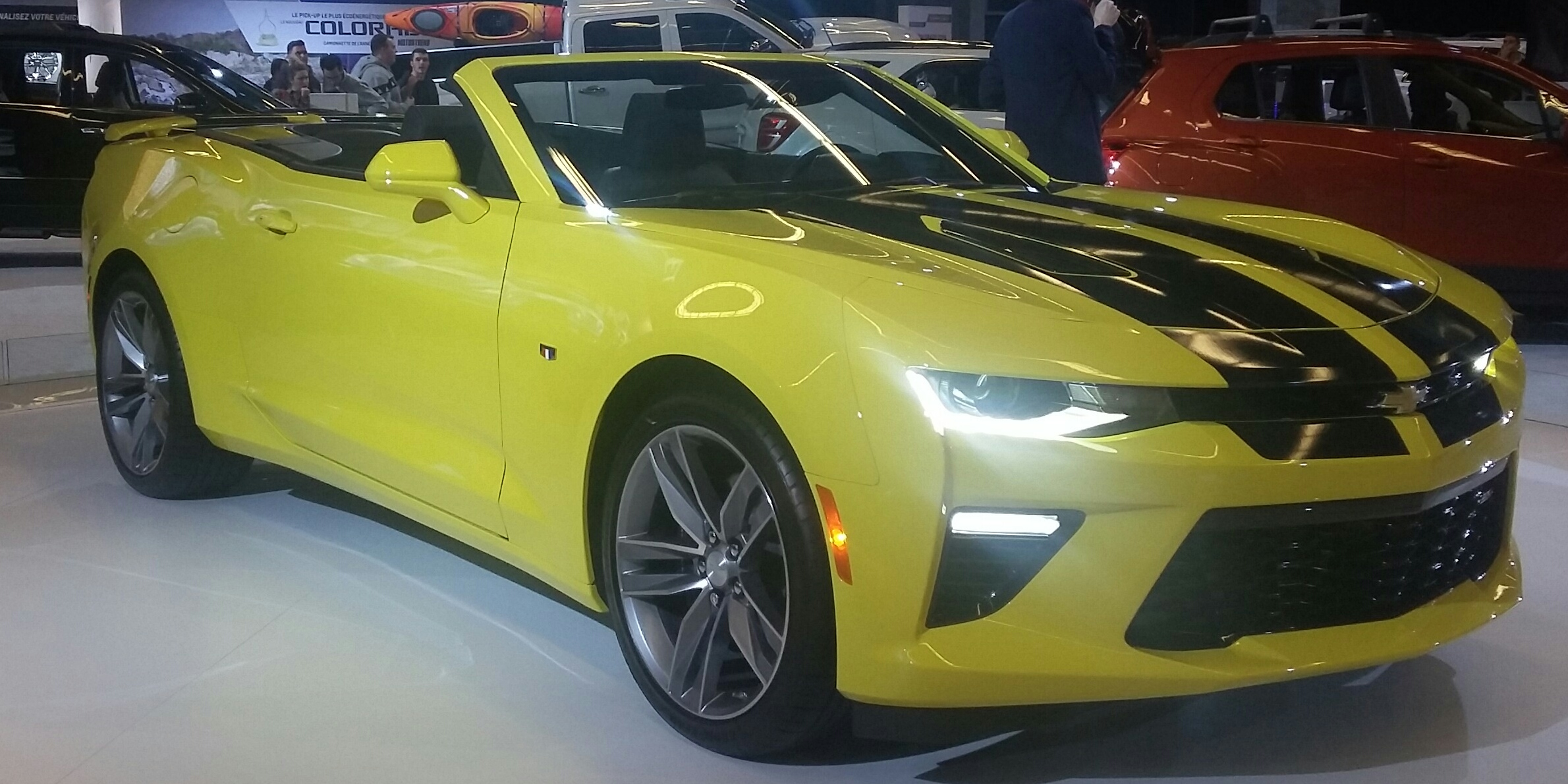
They’re using the Chevrolet Camaro as an example of a car where the steering column needs to fit the specific steering setup. That means measurements and parts may differ by year and configuration.
“Cone sizes” are the different tapered shapes/dimensions that help the steering column connect to other steering parts. Getting the right size helps everything fit tight and aligned.
“Wire spot location” is where the steering-column wiring comes out. Matching that location helps the wires reach the right places without getting pulled tight or damaged.
“Non-ignition” means the steering column isn’t built to include the ignition switch. That matters because you’ll need the ignition setup to work with whatever system you’re using in the car.
ididit.com is a company website for aftermarket steering columns. They sell steering column parts and accessories, and the episode is using their guidance for how to measure and choose the right column.
“Pro light” is an aftermarket steering-column line designed to reduce weight compared with a stock column. In this segment, the host ties it to motorsports use, citing cases where it can save around 25 pounds—an advantage when teams are trying to move weight around for handling and acceleration.
“Pro fab” is a second steering-column line from the same aftermarket supplier. It’s presented as an alternative to “pro light” for different build needs in race cars.
Weight management means paying attention to how much the car weighs and where that weight is located. In performance driving, where the weight sits can change how the car turns and feels.
A retrofit approach means the new part is designed to fit into an older setup. Here, it’s meant to make the steering column swap easier without major custom work.
These are the original mounting brackets your car already has. Using them can make the steering column install easier because you don’t have to relocate or fabricate new mounting points.
Term
mount at the floor or firewall
A “mount” is where the steering column is bolted to the car. Mounting it at strong structural areas like the floor/firewall (and also at the dash) helps keep it solid and safe.
“Push to start” lets you start the car with a button instead of turning a key. It’s usually wired into the ignition controls so it works like a modern car.
A steering wheel adapter is a bracket that lets you fit a different steering wheel onto your car. It can also move the wheel closer to or farther from you, so it matters for comfort and fit.
A restomod is an older car that’s been brought back to good condition and then updated with newer parts. It’s not just restoration—it’s restoration plus upgrades.
This is an older style of steering. Instead of a straight “rack” that moves side to side, it uses a ball-and-gear mechanism inside a box, which can feel a bit different than modern steering.
A delrin bushing is a plastic sleeve that helps support the steering shaft. It reduces friction and helps keep everything aligned so the steering feels smooth.
This is about how the steering parts “lock together.” The shaft has a specific pattern (spline) and the mating part has a specific number of teeth, and they have to match for the connection to be safe and tight.
A double D shaft is a steering shaft with two flat sides, creating a “D” shape on both sides (often described as a shaft with flat faces rather than a round profile). That shape helps prevent rotation slip at the coupling, but it still needs the correct length and interface details to work properly.
This is a steering shaft that can move in a crash instead of staying rigid. That movement can help keep the steering wheel from pushing too far toward the driver.
The Ford Bronco is an SUV made for off-road driving, like dirt roads and trails. Because it’s built for that kind of use, many owners add upgrades to improve how it steers and handles. That’s why it shows up in discussions about parts and modifications.
The Jeep Wrangler is an off-road SUV that’s designed to handle rough terrain. Many people customize Wranglers with extra parts to make them steer and drive better on trails. That’s why it’s often brought up when discussing what upgrades fit and work.
A lifetime warranty means the company promises to cover certain problems for as long as the product is in use. Here, they’re talking about coverage for parts inside the steering column.
Turn signal stocks are the lever/stalk you move to turn the left or right blinker on. If you upgrade the steering column, you may need the right stalks and wiring so the signals still work.
“Three on a tree” is an older style manual shifter where the stick comes out of the steering column and you shift three gears. It’s less common today, so replacement parts can be hard to find.
Steering wheel fitment means making sure a steering wheel will properly attach to your steering column and clear everything it needs to. If it doesn’t fit right, you can’t safely use it.
The “GM top shaft” is the part at the top of the steering column that the steering wheel connects to. If your wheel and adapter match this shaft style, the swap is much easier.
Term
GM universal
A GM universal retro-fit column is an aftermarket steering column meant to fit multiple cars. It still needs the right connection style to match the steering wheel and shaft so everything lines up correctly.
The GM taper is the specific angled shape where the steering wheel connects to the steering shaft. If your wheel doesn’t match that shape, it may not fit correctly or securely.
Pre-splined means the steering wheel already has the “teeth” (splines) built into it. That way it can connect to the steering shaft—if the patterns match.
Splines are the ridges on the steering shaft and wheel that lock them together. If the spline shape doesn’t match, the wheel won’t sit right or connect securely.
A keyway is a groove that uses a small key to lock parts together. Older steering setups sometimes used a keyway instead of splines, so modern wheels/columns may not match without the right adapter or rework.
LIVE
This is the On All Cylinders podcast powered by Summit Racing.
Your host for today is Summit Racing's Paul Sokolis with special guest, Eddie Moore from
I Did It.
Here we go.
You got another installment of the On All Cylinders podcast, Paul Sokolis handling your
hosting duties today.
And like we often try to do, we're shedding some light on an often overlooked topic.
You know, it's easy to get hung up on like big horsepower motors and tire squealing performance,
but as the saying goes, power is nothing without control.
And for most of us, that control starts at the steering wheel, right?
So to learn more about steering tech, we brought in Eddie Moore from I Did It.
And as you can imagine, he knows an awful lot on that subject.
So Eddie, thank you for joining us today.
Yeah, thanks for having me.
Hopefully we can get some good knowledge out there for everybody.
And we certainly will, I'm sure.
But before we do that, let's talk about you.
Give me a little bit of context.
What brought you into this culture of ours and what brought you to I Did It?
So I worked for an aftermarket parts company for about 10 years.
And while I found I did it, it's in a neighboring town and a friend of ours worked there.
And I just fell in love with it again.
I grew up around cars my entire life and so they brought me in and it's been a success
ever since.
I just the customers are great.
The people you see every day are great and just keep it going.
Now, refresh my memory.
I did it.
You're somewhat close to the Summit Racing headquarters out here in Akron, Ohio.
You're in Michigan, right?
Yes, we're in southeast Michigan, just south of the Ann Arbor.
Another fellow Midwestern.
Good to meet you.
Now, let's dive into the topic of steering.
And one of the biggest questions we get on a lot of our tech lines is that say
someone buys a project car, be it 50 years old or 15 years old.
What are some of the things they should look for, listen for, feel for to check
for potential issues or something they should maybe investigate further to make
sure that their steering system is up to snuff?
So just like anything, you get a new project and you dive in, you got to figure
out what's going on with it, what's wrong with it.
Steering is no different.
You're going to go through and check your ball joints, your tire
ends, your knuckles, your racks, your gearbox for looseness play in the gearbox.
Well, all that travels right back up to the column because there's you joints
that connect to it, rag joints that connect to the column.
When you get to the column, there's bearings inside there.
There's castings, there's electrical.
It could make noises.
It could be just just the tilt mechanism could be flopping all over.
That's a big thing from these early GM columns that we've seen.
It just there's a lot that goes into it and all these could look at
different reasons why you would want to replace or repair the columns.
So is there a tipping point, you know, be it parts availability
or system complexity where it no longer makes sense to repair a steering column?
And it's just better to yank it out and replace it with something new.
So a lot of the reasons why we got started, a was appearance.
You know, people wanted a nicer looking column to throw in their old hot rod.
But with that being said, you couldn't find things in junkyards anymore.
Like as the years go on, you're starting to lose track of columns
that you can restore or rebuild or repair or find parts for the ones you currently have.
So when you're looking at the columns that you have in your car,
like just major components for breaking castings, internal tilt mechanisms
or just wanting that function of tilt to have a more comfortable ride.
The big things like turnstile switches, you couldn't source any more
from older fifties and sixties cars.
So that's those are all really good indicators.
It's like, hey, you know, I can't rebuild this anymore.
I can't find the bearings.
I can't find the castings.
Let's look and try to get these upgraded.
So we'll talk more about some potential benefits
of upgrading your steering column here in a bit.
But say go back to that hypothetical project car.
Say the steering is good, everything's hunky dory.
Is there any regular maintenance that a vehicle owner should do
to ensure that their steering column lives a long, happy life?
Steering columns are basically a maintenance free item.
So really, which one just look over is if a car's been sitting a while
before you take it out, you want to make sure things are tight.
And that's just easy by grabbing the wheel, you know,
and you can see if anything feels feels out of the norm.
For me, it's also just taking care of it.
The wiping it down, make sure it's clean,
make sure it's not dust just like hanging out everywhere
because that could cause issues just in any kind of component on a car.
So pretty basic stuff there for maintenance.
All right.
So when you think of a steering column, it's more than just a tiller, right?
Like there's other components at play here, and that's what's really interesting.
So can you talk about maybe some unforeseen benefits
of potentially upgrading a steering column?
Oh, absolutely.
So when you're looking at a lot of these aftermarket columns out there
for I did it, we created an eight position tilt.
You know, a lot of people want that creature comfort that we see in modern cars
today where we can move the column where we want it so we can drive and be comfortable
and it's just not sitting there in your lap.
That's that's a huge benefit.
And then a lot of the older 50s, 60s and prior cars
didn't have turn signal cancellation.
So you'd be sitting there hanging out in the left lane with your left blinker
on for miles and miles and now that that's a feature that can just go away.
Yeah, when I was doing some some show prep for this interview, I was like,
oh, yeah, never really thought about like turn signals or cruise control
or tilt telly, right?
Some some interesting things outside of just being able to control your vehicle, for sure.
Now, when it comes to selecting a replacement steering column for a vehicle,
what other factors should someone consider?
I mean, I can only imagine how important it is to like measure and measure
and measure to ensure proper fitment and operation.
So so here's the idea that we have a lot of retrofit columns that are we have
taken those cars and brought them in house and designed to come for those lengths.
Every build can be different.
So you might want to change to have it a little closer to the dash.
You might want to have a quick release installed.
You might want to lose weight off the column.
These are all things we can talk about as you're buying the column process.
But the biggest thing is if it's not an offering that we have,
or you have a one off car, we haven't brought in the shop yet and kind of designed dimensions for
what you can do is we have some different pamphlets on our website
that you can look over to how to measure and forward a column.
But yes, the overall length is critical just to make sure because you don't want it stuck
in your chest when you're driving.
So you want it just right.
You want to be comfortable with your arms in the location that you generally like to drive in
and the output shaft, how you're going to hook up.
That's a critical dimension too.
So you can get the proper U-joints to go down to your rack and pinion or gearbox
or rag joint as well.
The tilt mechanism and racket tree that goes to that,
you want to make sure that's all aligned for angles.
So these are all components that you need to look at while measuring for a column that we haven't done.
So that's just for like an application specific fitment,
be it a Chevy Camaro, Ford Mustang, whatever.
But what about someone building like a true customer,
a vehicle that there really is no template for?
Are there universal parts that they can, you know, sort of make work for their custom project?
Yes.
Yes, that's where I did it started actually because I just wanted to have,
you know, universal columns and hot rods back in the day and make them look sharp.
So we have a variety of sizes there.
And if you don't see one that you on our website or dimension that you don't,
that doesn't coexist with the build you're doing today,
we can definitely make a custom column to your dimension.
So in those situations, you would encourage folks to pick up the phone and call you or send you an email?
So you can, those two options are always available.
We love to talk to everybody.
But we on our website, we'll, we have a form we'll have you fill out.
And it's a great form and tool actually to help figure out what dimensions you need to
actually measure for when installing a column in a car.
It's going to go over where your wire spot location is that comes out of the column,
the length, various cone sizes.
If you're doing tilt, non-tilt ignition, non-ignition,
and then we have several finishes to choose from as well.
And just to keep my note straight, that is I did it.com, right?
I did it.com.
All right, let's pivot away from like the restoration RestoMod crowd and talk about
motorsports.
We are Summit Racing after all.
And I know a lot of folks out there listening have a race car project in their garage or
pole barn or shed, what have you.
As someone who has personally wrestled a 1970s era GM steering column out of a vehicle,
I know for a fact that those suckers are not light.
So weight savings immediately springs to mind as a performance advantage.
Is that a fair assumption?
So like the last several years, we've actually came out with two different lines of steering
columns called the pro light and pro fab.
There's definitely some key advantages.
We've had cases where you lose upwards of 25 pounds from the stock column.
It's pretty insane when you're trying to move weight around in those race cars.
The pro light is a column that we've designed.
It goes great with a quick release.
It weighs five and a half pounds.
On average, they do vary a little bit, but it's only a couple ounces,
depending on the application you're going for.
It's got self canceling turn signals, and it's got five inches of clapted class ability for
safety.
And a lot of them are pretty universal.
You can put them in a lot of things and for autocrossing or street strip kind of functionality.
And then the pro fab, we've really designed most of those for a lot of the Mustang columns
that are designed to just bolt right in.
Recently, we've came out with some universal ones that are adjustable, so you can kind of
put them in a variety of cars, but those weigh anywhere from three to four pounds.
So it's a big game changer.
And most importantly, it's weight up near the front of the car, right?
Yes.
Yes.
Getting it off those front tires.
Yeah.
I mean, any veteran racer will tell you that weight management is critical to how your car performs.
Now, for folks who have never tackled a steering column replacement job before,
how difficult is the process?
I'm sure your tech line rings with some common questions or some things that are commonly overlooked
during the process.
What should folks know before they start?
So when installing a column, a lot of we try to keep it easy with our retrofit line.
So if you're just, you know, rest of money in car, a lot of the times it's you're using your
stock factory mounts, your stock floor mounts to hold the column to the floor.
Now, when you're getting to these kind of universal builds, a lot of times we're just
talking over with trying to see how you need to measure, what kind of angles you like.
And we have a variety of mounts that are pretty universal and just trying to figure out how those
fit into your build and application.
That's the best way I can put that.
But it's generally speaking, it's a pretty straightforward install.
You get a mount at the floor or firewall, and then you have a mount at the dash.
And as long as you have two fixed locations for that column, it's going to be structurally sound
and safe for you to drive.
Well, that's good news.
So what I'm hearing then is that you don't get a whole lot of phone calls about crazy complex
issues then, right?
Nothing really too crazy.
We have we have a variety of questions on a daily basis of, you know, how can they
achieve certain goals with their car?
And usually what it comes down to is like, what is the right column for me?
A lot of that is if it is a one-off build, we just kind of go through the paces and say,
hey, what, you know, what are you looking for?
Are you looking for tilt?
Are you looking for a straight column?
Are you looking for comfortability?
Are you looking to save weight?
Because there's definitely a variety of add-ons we can add to the column, such as dimmer,
wiper, ignition, push to start, ignition.
Those are some really nice creature comforts.
Oh, and I didn't mention cruise.
Their cruise is a great tool for those guys trying to get out and just cruise the streets.
Some of the other common issues that we do see with some of these replacement columns is
people need to account for their steering wheel adapters and steering wheel lengths,
because each wheels have different style dishes.
Some adapters are larger than others.
And that a length can put the steering wheel more or closer to the driver.
And most drivers are looking to get more room from them to the dashboard to be more comfortable.
So that's a big thing that we always talk to people about and like, hey,
how do we save room for the driver to have a really enjoyable experience as a driver in their cars?
Okay, so you've already mentioned some of these in some earlier responses,
but since it's really, really important, I want to drive the point home.
Say someone has decided that they want to purchase a replacement steering column
for their particular vehicle.
What specs?
What measurements do they need to have beforehand?
In other words, what do you need to know to recommend the best steering column for their
particular application?
Yes, so a lot of the stuff that you can do ahead of time to make sure when you get
on the phone, we don't ask you a million questions, then you got to go back home and start measuring.
So we need to know the type of build you're working on.
If it's just something that's a restroom mod, we just need to know the base of the car.
A lot of people are upgrading the rack and pinion steering these days and changed out front clips.
So a big thing that we always have people second ask again is we need you joints and shafting to
go down to that rack and pinion.
Something that's commonly forgot is that shaft size on the rack.
So if you can get that ahead of time, that's always a good chance to get ahead in the game.
Then we can get you all your shafting from the rack all the way up to the steering wheel.
Oh, good.
I'm glad you brought that up because I wanted to ask that question.
Anyway, does someone need to upgrade their steering column when they do make a switch
from like a recirculating ball steering setup to a rack and pinion?
So in a lot of cases, I'm going to recommend it because a lot of cases you have to somehow
put a bearing in the bottom of that column.
I've seen people do it.
I'm sure there's a safer way to do it.
To me, the safest way is to replace the column because you know it's got a fixed point
bearing at the bottom, the column or delrin bushing on ours.
You're not worried about an aftermarket bearing coming out when you're trying to use the stock column.
Ours are kind of set up for that length and accountability to hook up to the rack.
Now, it's fair to say that there's a lot of variation when it comes to hooking up the
actual column to the steering box or the rack.
What have you?
What should someone know about the various connection points before they undertake a job like this?
So there's several types of shafts and that brings up a good point that go in between the
column and rack and pinion or gearbox that come on the box themselves or shafting that goes in
between. So figuring out that spline and tooth count at the gearbox or racks is a key factor for
all of this. A lot of people will just use a couple of U joints and some double D shaft.
And if you're not familiar with that, that's basically a three quarter round or one inch
round shaft with two flat sides in it. And you can use that as a cut to fit and kind of just
make out your measurements and cut to fit. A lot of the things I typically suggest if you don't
want to do that is we have collapsible or telescoping shafts to where you can kind of
preset up and just kind of telescope the shafts out to the desired, you know, gearbox or rack
and pinion. Also, that adds another level of safety as well because that's another position
that can collapse for you in case of any accidents.
So we've talked about muscle cars. We've talked about restomans. race cars.
What about off-roading? Do you see a lot of advantages for the off-roader with a steering
column upgrade? So we're very big in the Bronco world, the Wrangler world.
We've been in some Baja stuff too in the past where people are just like,
we're using ididic columns. They feel sturdy and safe in my hands. We're really well known for that,
just being a column that I can trust and I feel tight and it's dedicated to steering and not
slap or looseness. The off-world market loves us because we're able to work with them and
they know they can go climb up a hill and the steering will not come off in their hands,
you know, whether it be our columns or the quick releases we provide.
Now, certainly with off-roading, you've got a lot of different environmental factors to consider
and even driving style. Do things like that come into play when you spec out a column for
an off-roader? The columns are pretty similar, to be honest. Their applications, they do like the
quick releases on a lot of the off-road markets or they might be a little shorter
because they got to run different tighter shafting down to their steering units that they're using
on those applications. As far as the guts of our columns, they're going to be pretty similar.
They're really, we've beefed them up from what the original designs were to not have castings
break or bolts slip out and cause looseness from what they were when out of the factory after 30
years. So there's a reason why we offer that lifetime warranty on these manufactured components
on the column. So you made a specific point to talk about some of the electrical accessories
that are commonly associated with your steering column. We're talking things like cruise control,
turn signal stocks. Are all those things built into a particular application spec or do we have
to add that when we order a la carte? Yeah, so either you can add it yourself as an individual,
it's perfectly doable. There's some video links that we've put out that kind of help with that
or you can consult with your salesperson and that you can request to have the cruise handle
installed at the time of your purchase. Now, when you say videos, I'm assuming you mean
your YouTube channel, is that correct? And do you post like walkthroughs and tutorials on there as
well? Yeah, so we're constantly making videos. We're actually more active recently than we
have been in years. So we're getting back after that, maybe we're going to release some new content
that we've had created. So that's kind of been a big push this year for us to get more information
out there for you guys. So you guys have answers on demand, even when we're not by the phones
on the weekend and can't see at the car shows, you're at that weekend. So.
And what about your website? ididit.com. Can folks go there to get questions answered and
maybe even find like a tech resource library? Yes, we have a lot of tech help. We have people
on the website that can answer questions on chat. It is a live person for us on our chats.
We like to get in touch with our customers that way. There's a frequently asked questions and
tech help as well. You can also send, we have email set up there so you can send and we can see
first thing in the morning or throughout the day if you want to send an email to help with your needs.
I love it that you actually mentioned that you have real live people answering those questions.
We like it too. I think it goes, we kind of pride ourselves with that customer service level
here at ididit. So we want to make sure everybody's helped the way we want to be helped when we call
somewhere. I mean, correct me if I'm wrong here, but the refrain I keep hearing is that
if you're out there and need to replace the steering column in your particular vehicle,
be that a muscle car, rest or mod off road or whatever it is. Eddie, you would recommend that
these folks call you contact you first and really walk through the process together to ensure they're
getting exactly what they need to fill their particular expectations. Is that sound right?
Yes, absolutely. If we don't have the measurements already, we can definitely help you
and guide you to getting those measurements on the vehicle that you're building,
whatever it may be. A lot of times we have this saying that we say around ididit is,
if you can dream it, we can build it. So that's the goal. If you have this one off custom need,
off road vehicle, rest or mod, hot rod, that's just very rare, give us a call. We generally don't
like to say, no, we want to help you get back on the road and enjoy what you've built. And it is
absolutely worth mentioning that we're not just talking about complete steering column swaps here.
Just looking at ididit stuff on summitracing.com, there are a ton of repair and replacement parts,
so you're able to fix your current steering column without necessarily the need to replace the entire
thing. So yeah, we do have replacing parts for ididit columns. If there's a rare piece that
you're trying to get help with and try to keep it stock and factory, we do have some connections
there if you want to reach out. We do know that there's a big column in the world today that you
can't source parts for and it's three on a tree. No one makes an aftermarket column for it, no one
has parts for this, but we've ran across some people in the industry. If you need help with that,
give us a call, we'll try to find somebody that potentially could help you or just maybe we
can help you guide you to another steering column of your needs. Three on a tree, that is a topic
I didn't expect to talk about today. Yeah, they're kind of going by the wayside because it's hard
to find parts for it. Once in a while, I get lucky and find a component or have a source
reckon send somebody. It's just because it's one of those dreams that we'd like to do here. It's just
not a thriving market. People are kind of going away from them and maybe they don't know how to
use them as much as they used to back in the day. I for one am all for preserving the manual
transmission in whatever form it may take. I appreciate that. One of the things we have not
talked about yet is steering wheel fitment and anything you should consider when selecting
a steering wheel for a particular steering column. Can you talk about that for a moment?
Majority of the time, our columns are going to be a 55 to 94 GM top shaft. It's a pretty
industry standard dimension. We do have some Ford based columns that come with a Ford top
shaft designed to use your factory wheel. But back to the GM universal or retro fit columns
that we have, there's an abundance of steering wheels in the market. To me, it's the thing
you're looking at, so what you want to enjoy seeing. We generally have an adapter for most wheels out
there, probably over 90%. If you're buying a wheel that's already pre-splined, just make sure it's
got that GM taper in there and you'll be good to go. Going back to your tech lines, is there a
common question or any common issues that you're often dealing with when it comes to steering wheel
fitment on a particular column? One of the bigger that pertains to that, the bigger issues we see
is it's not so much picking a new aftermarket wheel. They generally can get in love with the
wheel that they grew up with driving those cars 50, 60 years ago. Some of those splines in the early
40s, 50s, like DeSoto's or early GM's that were actually had a keyway versus spline.
Those are the ones we generally see problems with. Now, with that being said, there's a couple
companies out there that we can suggest that actually can rebuild those wheels to a GM spline,
so you're able to use those. We can suggest those if you want to reach out to us as well.
All right, so say someone out there listening really wants to learn more about this particular
topic. What resources do you have available to help educate customers when it comes to selecting
the right steering column or identifying general steering column tech issues?
Yeah, so if you want to check out more things I did it, you can reach us at www.ididit.com.
We have a library of videos there for tech help, frequently asked questions,
and all of our product is displayed and sourced on the website there.
We're also available by phone if you want to reach out, 517-424-0577.
Again, you kind of mentioned that you're building up a pretty robust library of
technical support videos, right? Yeah, you can also find us at YouTube,
but with a lot of our installed videos, you can type, I did it right in the search bar,
and possibly the vehicle you're looking up, you might find an install or frequently asked
questions on there as well. Well, as Sam Elliott said at the end of Big Lebowski,
that about wraps her up. We've been talking with Eddie Moore from I Did It,
all about steering column tech. Been a pretty interesting conversation, Eddie.
Thank you so much for sharing your time and talent with us,
and I do hope our paths cross again soon, my friend. Hey, thanks Paul, you have a great day.
About this episode
Steering-column upgrades aren’t just about swapping parts—they start with diagnosing where play and noise originate, often tracing issues back through couplings to the column itself. The experts explain when repair stops making sense due to missing components, and why modern aftermarket columns can add comfort features like multi-position tilt and self-canceling turn signals. Selection comes down to fitment measurements, correct shaft/U-joint compatibility, and safe mounting points, with options for custom builds and tech support.
Thinking about replacing the worn out steering column in our car or truck? Eddie Mohr with ididit explains the ins-and-outs of the process, and offers advice on how to upgrade to a modern steering column.