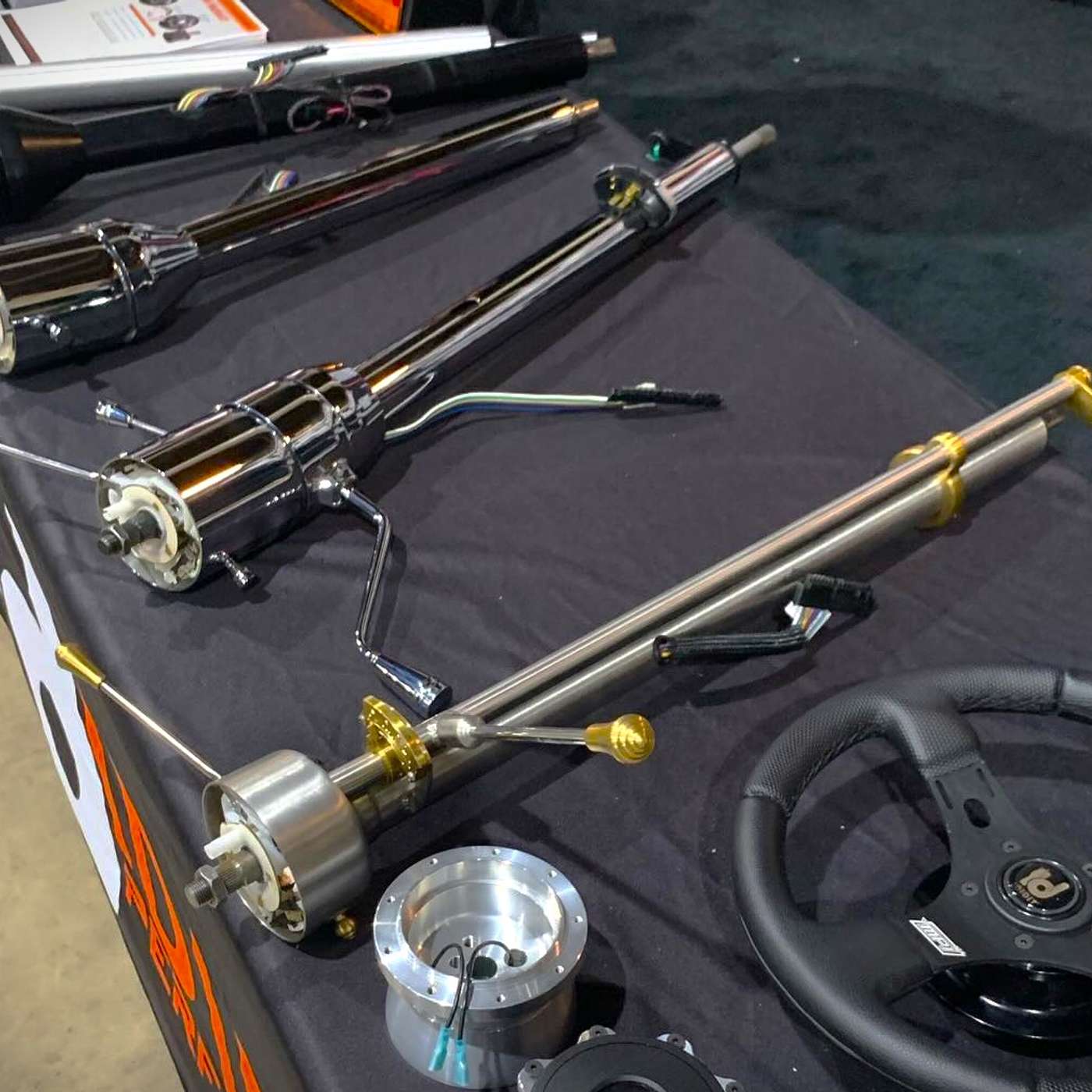
Steering Column Tech: Advice on Upgrading to Modern Steering with the Experts at ididit
About this episode
Steering-column upgrades aren’t just about swapping parts—they start with diagnosing where play and noise originate, often tracing issues back through couplings to the column itself. The experts explain when repair stops making sense due to missing components, and why modern aftermarket columns can add comfort features like multi-position tilt and self-canceling turn signals. Selection comes down to fitment measurements, correct shaft/U-joint compatibility, and safe mounting points, with options for custom builds and tech support.
Thinking about replacing the worn out steering column in our car or truck? Eddie Mohr with ididit explains the ins-and-outs of the process, and offers advice on how to upgrade to a modern steering column.
ball joints
"So just like anything, you get a new project and you dive in, you got to figure [123.2s] out what's going on with it, what's wrong with it. [125.8s] Steering is no different. [127.4s] You're going to go through and check your ball joints, your tire [129.9s] ends, your knuckles, your racks, your gearbox for looseness play in the gearbox."
Ball joints are the little pivot connections that let your suspension move while still keeping the wheels pointed correctly. When they wear out, the steering can feel loose and you might hear knocking or feel extra movement.
Ball joints are pivot joints that connect the steering knuckle to the suspension control arms. If they wear out, they can create steering looseness and wandering, and you may hear clunks or feel play when turning.
tire ends
"You're going to go through and check your ball joints, your tire [129.9s] ends, your knuckles, your racks, your gearbox for looseness play in the gearbox. [134.8s] Well, all that travels right back up to the column because there's you joints"
This sounds like they mean tie rod ends—the parts that connect the steering to the wheel. If they’re worn, the steering can feel loose and your tires may wear unevenly.
“Tire ends” here is almost certainly referring to tie rod ends, which connect the steering rack to the steering knuckles. Worn tie rod ends can cause steering play, uneven tire wear, and vague on-center feel.
knuckles
"You're going to go through and check your ball joints, your tire [129.9s] ends, your knuckles, your racks, your gearbox for looseness play in the gearbox. [134.8s] Well, all that travels right back up to the column because there's you joints"
The knuckle is the part that the wheel mounts to and that turns when you steer. If it or its bearings get worn, the steering can feel loose and you may hear grinding or clunking.
Steering knuckles are the components that the wheel hubs attach to and that pivot to steer the vehicle. Wear or looseness in the knuckle bearings or related joints can show up as steering play and noise.
rack
"You're going to go through and check your ball joints, your tire [129.9s] ends, your knuckles, your racks, your gearbox for looseness play in the gearbox. [134.8s] Well, all that travels right back up to the column because there's you joints"
The steering rack is the part that turns the steering wheel’s motion into movement that actually steers the wheels. If it’s worn, steering can feel sloppy and you might hear clunks or feel vibration.
A steering rack converts the rotation of the steering wheel into left/right movement for the tie rods. If the rack has internal wear or looseness, it can cause wandering, delayed response, and steering noise.
gearbox
"You're going to go through and check your ball joints, your tire [129.9s] ends, your knuckles, your racks, your gearbox for looseness play in the gearbox. [134.8s] Well, all that travels right back up to the column because there's you joints"
The steering gearbox is the mechanism that turns the steering wheel into the motion that steers the front wheels. If it wears out, you can get looseness or noise you feel through the steering wheel.
In steering systems, the gearbox refers to the steering gear (common on older designs) that translates steering wheel rotation into wheel movement. Excess play or wear inside the steering gear can create looseness that you feel at the wheel and column.
rag joints
"Well, all that travels right back up to the column because there's you joints [137.7s] that connect to it, rag joints that connect to the column. [140.8s] When you get to the column, there's bearings inside there."
A rag joint is a flexible connector in the steering shaft area. If it wears out, the steering can feel loose and you may hear knocking when you turn the wheel.
A rag joint is a flexible coupling (often with a fabric-reinforced element) between the steering shaft and the steering column. When it deteriorates, it can add steering play and clunks, and it can make the steering feel imprecise.
bearing
"When you get to the column, there's bearings inside there. [143.1s] There's castings, there's electrical. [146.8s] It could make noises. [148.4s] It could be just just the tilt mechanism could be flopping all over."
Bearings are the small moving parts that let the steering column rotate smoothly. If they wear out, the column can make noise and feel loose or jerky.
Bearings inside the steering column support rotating parts like the shaft and tilt mechanism. Worn column bearings can cause noise and “flopping” or rough movement when you adjust or turn the wheel.
tilt mechanism
"It could make noises. [148.4s] It could be just just the tilt mechanism could be flopping all over."
The tilt mechanism is what lets you move the steering wheel up or down. If it gets loose, it can rattle or shift, making steering feel less solid.
The tilt mechanism is the part of the steering column that allows the steering wheel angle to be adjusted. If it develops looseness, it can create movement or noise that feels like steering play even when the rest of the system is fine.
steering column
"That's a big thing from these early GM columns that we've seen... when you're looking at the columns that you have in your car, like just major components for breaking castings, internal tilt mechanisms"
The steering column is the part that connects your steering wheel to the rest of the steering system. It’s also where some controls and adjustments (like tilt) are built in.
The steering column is the shaft-and-housing assembly that connects the steering wheel to the steering gear/rack. It also packages key functions like steering shaft bearings, adjustment mechanisms (like tilt), and electrical controls mounted on the column.
junkyards
"But with that being said, you couldn't find things in junkyards anymore... you're starting to lose track of columns that you can restore or rebuild"
Junkyards are places that sell used parts from old cars. The point here is that older steering-column parts become harder to find as the cars get rarer.
Junkyards are salvage yards where you can sometimes find discontinued or rare parts from older vehicles. In the context of steering columns, the speaker is saying that as cars age out, it becomes harder to find usable columns or components in salvage yards.
castings
"like just major components for breaking castings... I can't find the castings."
Castings are metal parts made by pouring molten metal into a mold. If a steering column’s metal housing is cracked and you can’t find replacement parts, rebuilding may not be possible.
Castings are the metal housings or structural parts made by pouring molten metal into a mold. For steering columns, broken or damaged castings can be difficult to repair because replacement castings may be unavailable.
turnstile switches
"The big things like turnstile switches, you couldn't source any more from older fifties and sixties cars."
Turnstile switches are the electrical switches on the steering column that control things like your turn signals. If the old ones are hard to find, upgrading the column can be the practical fix.
Turnstile switches are the multi-function electrical switches mounted on the steering column for controls like turn signals and related stalk/column functions. Older “fifties and sixties” switch designs can be hard to source, which pushes people toward column upgrades.
eight position tilt
"we created an eight position tilt. You know, a lot of people want that creature comfort that we see in modern cars"
“Eight position tilt” means the steering wheel can be set to eight different angles. It helps you find a comfortable driving position more easily.
An eight position tilt steering column provides eight discrete steering-wheel angle settings. More positions usually means finer adjustment so the wheel can be set closer to the driver’s preferred reach and posture.
aftermarket columns
"So when you're looking at a lot of these aftermarket columns out there for I did it, we created an eight position tilt."
Aftermarket columns are replacement or upgrade steering columns from companies besides the car’s maker. People use them to add modern features to older vehicles.
Aftermarket columns are steering columns made by companies other than the original vehicle manufacturer, typically sold as upgrades or replacements. They can add features—like tilt/adjustment—that older cars didn’t have from the factory.
output shaft
"and the output shaft, how you're going to hook up. That's a critical dimension too."
The output shaft is the “transfer” part that carries your steering input from the steering wheel toward the steering mechanism. When you change columns, you need the right size so it connects correctly.
The output shaft is the part of the steering column that transfers motion from the steering wheel to the steering linkage. In an upgrade, its length and spline/connection type determine how the column interfaces with the rest of the steering system.
U joints
"So you can get the proper U-joints to go down to your rack and pinion or gearbox or rag joint as well."
U-joints are the “angle adapters” that let the steering shaft work even if the parts aren’t lined up perfectly. They help keep steering motion smooth when the column and rack aren’t in a straight line.
U-joints (universal joints) allow the steering shaft to transmit rotation even when the angles change between components. They’re important in steering-column swaps because the column-to-rack geometry often isn’t perfectly straight.
alignment for angles
"you want to make sure that's all aligned for angles. So these are all components that you need to look at while measuring for a column"
This means lining up the steering parts so the joints work at the right angles. If the angles are wrong, the steering can feel rough and the joints can wear out sooner.
“Alignment for angles” refers to setting the steering shaft and joints so their operating angles are correct. If the angles are off, U-joints can bind, wear faster, or cause steering feel issues.
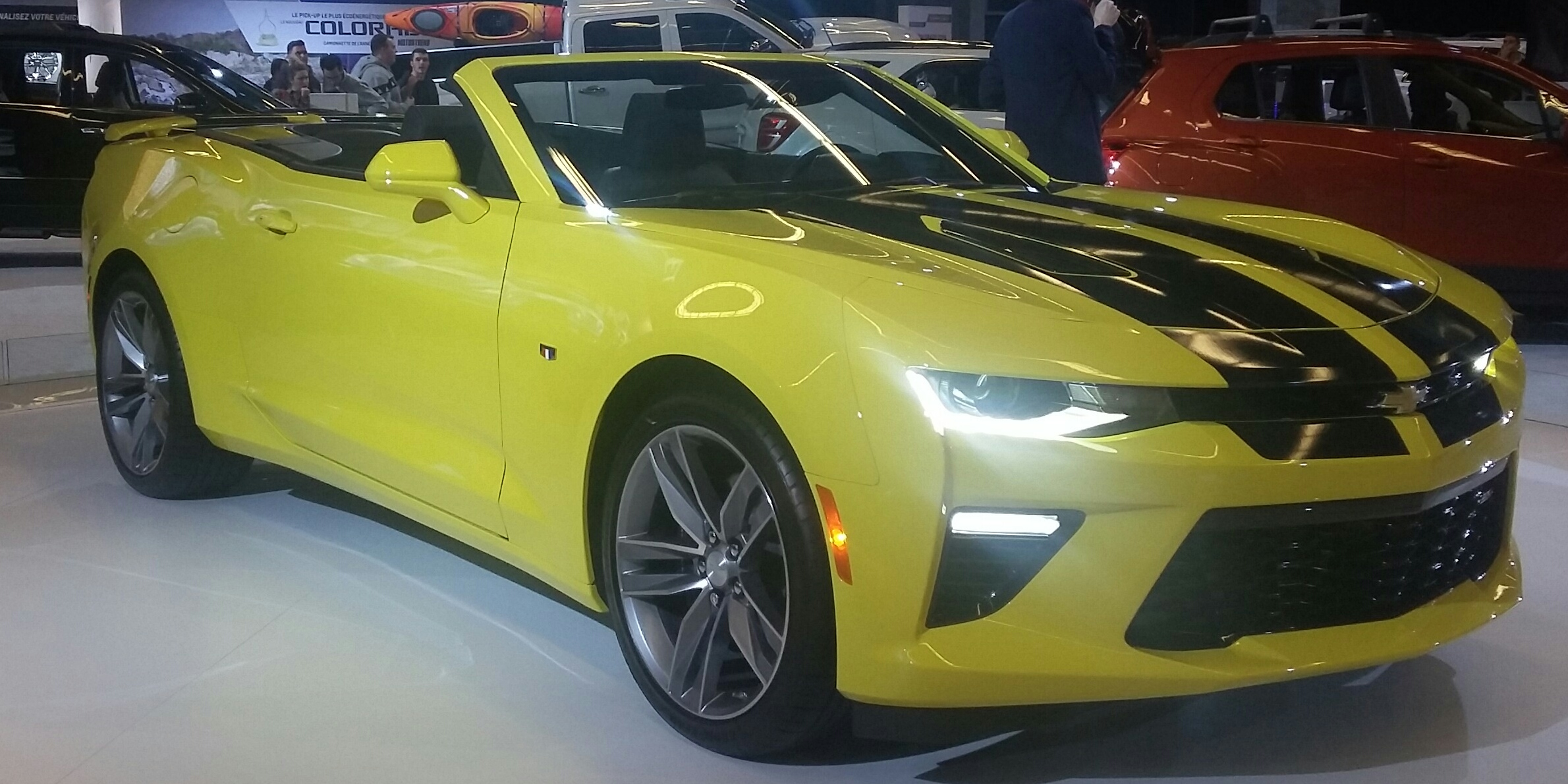
Chevrolet Camaro
"So that's just for like an application specific fitment, be it a Chevy Camaro, Ford Mustang, whatever."
They’re using the Chevrolet Camaro as an example of a car where the steering column needs to fit the specific steering setup. That means measurements and parts may differ by year and configuration.
The Chevrolet Camaro is mentioned as an example of an application-specific steering-column fitment. Different generations and steering gear setups can change the required column dimensions and shaft/joint angles.
custom column
"that doesn't coexist with the build you're doing today, we can definitely make a custom column to your dimension."
A custom column is a steering column made to fit your exact project. It’s for builds where standard columns don’t match the measurements you need.
A custom column means the steering column is built to specific dimensions for a particular swap or chassis. This is used when no off-the-shelf column matches the required shaft length, mounting position, and steering-gear interface.
cone sizes
"It's going to go over where your wire spot location is that comes out of the column, the length, various cone sizes."
“Cone sizes” are the different tapered shapes/dimensions that help the steering column connect to other steering parts. Getting the right size helps everything fit tight and aligned.
“Cone sizes” refers to the different tapered shaft/adapter dimensions used at the steering-column interface. Correct cone sizing is crucial so the column mates properly to the rest of the steering system and doesn’t introduce play or alignment issues.
wire spot location
"It's going to go over where your wire spot location is that comes out of the column, the length, various cone sizes."
“Wire spot location” is where the steering-column wiring comes out. Matching that location helps the wires reach the right places without getting pulled tight or damaged.
“Wire spot location” describes where the wiring exits or is routed relative to the steering column. When installing a modern column, matching the wire exit location helps ensure the harness reaches the correct components without stretching, pinching, or interfering with moving parts.
non-ignition
"If you're doing tilt, non-tilt ignition, non-ignition, and then we have several finishes to choose from as well."
“Non-ignition” means the steering column isn’t built to include the ignition switch. That matters because you’ll need the ignition setup to work with whatever system you’re using in the car.
“Non-ignition” refers to steering-column configurations that don’t include an ignition switch/ignition function. That choice affects wiring and compatibility with the vehicle’s existing ignition setup, especially in swaps where the ignition components are handled elsewhere.
ididit.com
"And just to keep my note straight, that is I did it.com, right? I did it.com."
ididit.com is a company website for aftermarket steering columns. They sell steering column parts and accessories, and the episode is using their guidance for how to measure and choose the right column.
ididit.com is the website for ididit, a company known for aftermarket steering columns used in hot rods, restorations, and race builds. In this segment, the host uses it as the source for the column-installation measurements and options.
pro light
"So like the last several years, we've actually came out with two different lines of steering columns called the pro light and pro fab."
“Pro light” is an aftermarket steering-column line designed to reduce weight compared with a stock column. In this segment, the host ties it to motorsports use, citing cases where it can save around 25 pounds—an advantage when teams are trying to move weight around for handling and acceleration.
pro fab
"So like the last several years, we've actually came out with two different lines of steering columns called the pro light and pro fab."
“Pro fab” is a second steering-column line from the same aftermarket supplier. It’s presented as an alternative to “pro light” for different build needs in race cars.
“Pro fab” is another aftermarket steering-column line offered alongside “pro light.” The segment frames these as two different product lines with key advantages for motorsports builds, implying different design goals (not just appearance) for installation and performance.
quick release
"The pro light is a column that we've designed. It goes great with a quick release."
A quick-release steering setup lets you take the steering wheel off quickly. Race teams like it because it makes getting in and out of the car faster.
A quick release steering setup allows the steering wheel to be removed or detached rapidly, typically using a latch mechanism. It’s commonly used in motorsports and track cars to speed up driver entry/exit and reduce steering wheel clutter during service.
self-canceling signals
"It's got self canceling turn signals, and it's got five inches of clapted class ability for [546.8s] safety."
These turn signals turn themselves off after you finish a turn. That way you don’t have to remember to cancel them manually.
Self-canceling turn signals automatically turn off after you complete a turn. They use a steering-angle or steering-wheel position input so the signal doesn’t stay on after you straighten the wheel.
autocrossing
"You can put them in a lot of things and for autocrossing or street strip kind of functionality."
Autocross is a timed driving event on a closed course with cones. You’re steering through lots of quick turns, so good steering setup helps a lot.
Autocrossing is a timed motorsport where cars navigate a course of cones on a closed surface. Steering feel and quick, predictable response matter a lot because you’re constantly changing direction.

Mustang
"And then the pro fab, we've really designed most of those for a lot of the Mustang columns [559.0s] that are designed to just bolt right in."
The Ford Mustang is a very common car to modify. Here, they’re saying their steering columns are made to fit Mustangs with minimal hassle.
The Ford Mustang is a popular American sports coupe/convertible platform that has a large aftermarket for steering and suspension upgrades. In this segment, ididit is described as designing steering columns that bolt into Mustang applications.
universal builds
"Recently, we've came out with some universal ones that are adjustable, so you can kind of [565.4s] put them in a variety of cars, but those weigh anywhere from three to four pounds."
Universal builds are parts meant to work across many different cars. They’re usually adjustable so you can fit them to different steering setups.
Universal builds are aftermarket setups designed to fit multiple vehicle applications rather than a single model. They’re often adjustable to accommodate different steering column geometries and mounting requirements.
weight management
"I mean, any veteran racer will tell you that weight management is critical to how your car performs. [583.5s] Now, for folks who have never tackled a steering column replacement job before,"
Weight management means paying attention to how much the car weighs and where that weight is located. In performance driving, where the weight sits can change how the car turns and feels.
Weight management is the practice of controlling where mass sits in the vehicle and how it affects handling. Moving weight toward the center of the car and away from the tires can improve balance and responsiveness, especially in performance driving.
retrofit line
"So when installing a column, a lot of we try to keep it easy with our retrofit line. [602.4s] So if you're just, you know, rest of money in car, a lot of the times it's you're using your"
A retrofit approach means the new part is designed to fit into an older setup. Here, it’s meant to make the steering column swap easier without major custom work.
A retrofit line refers to an installation approach designed to adapt an aftermarket part to an existing vehicle. In this context, it means the steering column can be installed using existing mounting points instead of requiring extensive fabrication.
stock factory mounts
"So if you're just, you know, rest of money in car, a lot of the times it's you're using your [606.6s] stock factory mounts, your stock floor mounts to hold the column to the floor."
These are the original mounting brackets your car already has. Using them can make the steering column install easier because you don’t have to relocate or fabricate new mounting points.
Stock factory mounts are the original brackets and attachment points the car came with from the manufacturer. Using them can simplify a steering column replacement because the aftermarket column is aligned to the existing locations.
mount at the floor or firewall
"“You get a mount at the floor or firewall, and then you have a mount at the dash.”"
A “mount” is where the steering column is bolted to the car. Mounting it at strong structural areas like the floor/firewall (and also at the dash) helps keep it solid and safe.
This describes the steering-column mounting points used to attach the column to the vehicle structure. Using a mount at the floor or firewall (and another at the dash) helps keep the column aligned and provides structural support for safe driving.
two fixed locations
"“And as long as you have two fixed locations for that column, it's going to be structurally sound and safe for you to drive.”"
They’re saying the steering column should be bolted down at two solid points. That helps prevent wobble and keeps the steering stable and safe.
“Two fixed locations” refers to anchoring the steering column at two rigid points in the chassis. This reduces movement and helps the column remain structurally sound and safe under driving loads.
straight column
"“Are you looking for tilt? Are you looking for a straight column?”"
A “straight column” means the steering wheel position is fixed. You don’t get the ability to tilt it up or down like on many newer setups.
A “straight column” refers to a steering column design with no built-in tilt adjustment. Builders choose it when they want a fixed steering-wheel position or when packaging constraints make tilt unnecessary.
push to start
"“such as dimmer, wiper, ignition, push to start, ignition.”"
“Push to start” lets you start the car with a button instead of turning a key. It’s usually wired into the ignition controls so it works like a modern car.
“Push to start” is an ignition system where the engine is started with a button rather than turning a traditional key. In steering-column upgrades, it’s typically integrated with the column’s ignition/controls so the rest of the dash and wiring can stay clean.
dimmer
"“such as dimmer, wiper, ignition, push to start, ignition.”"
A “dimmer” lets you make the dashboard lights brighter or dimmer. It’s a convenience feature that can be integrated into the column controls.
A “dimmer” is the control that adjusts dashboard or instrument lighting brightness. When upgrading a steering column, dimmer functionality may be added so the lighting controls match modern ergonomics.
wiper
"“such as dimmer, wiper, ignition, push to start, ignition.”"
“Wiper” means the controls for the windshield wipers. Upgrading the column can bring those switches into a more modern, driver-friendly position.
“Wiper” refers to windshield wiper controls, typically including intermittent or speed settings. Steering-column upgrades may relocate or add wiper switches so the driver can operate them from the modern control layout.
Cruise
"“Oh, and I didn't mention cruise.”"
“Cruise” means cruise control—set a speed and the car keeps it for you. It’s commonly controlled from the steering wheel or steering-column switches.
“Cruise” here refers to cruise control, which maintains a set speed without the driver holding the accelerator. Modern steering columns often include cruise switches on the wheel or column stalks, which is why it comes up during column selection.
steering wheel heaters
"Some of the other common issues that we do see with some of these replacement columns is [692.9s] people need to account for their steering wheel adapters and steering wheel lengths, [697.0s] because each wheels have different style dishes."
A steering wheel adapter is a bracket that lets you fit a different steering wheel onto your car. It can also move the wheel closer to or farther from you, so it matters for comfort and fit.
Steering wheel adapters are hardware that lets you mount a different steering wheel to your existing steering column. They also affect steering wheel position, because different adapters can change how far the wheel sits from the driver.
steering wheel leather
"people need to account for their steering wheel adapters and steering wheel lengths, [697.0s] because each wheels have different style dishes. [700.3s] Some adapters are larger than others."
Steering wheel length is basically how far the wheel is from you. If it’s too close or too far, your driving position won’t feel right.
Steering wheel length here refers to how far the steering wheel sits relative to the driver, which is influenced by the adapter and column setup. Getting the length right helps ensure comfortable reach and proper seating position.
restomod
"So we need to know the type of build you're working on. [758.0s] If it's just something that's a restroom mod, we just need to know the base of the car. [763.5s] A lot of people are upgrading the rack and pinion steering these days"
A restomod is an older car that’s been brought back to good condition and then updated with newer parts. It’s not just restoration—it’s restoration plus upgrades.
A restomod is a classic or older car that’s been restored and then modified with modern upgrades. In this context, the host is saying the steering column choice depends on the base car and the type of build, including restomod-style changes.
recirculating ball steering setup
"Anyway, does someone need to upgrade their steering column when they do make a switch from like a recirculating ball steering setup to a rack and pinion?"
This is an older style of steering. Instead of a straight “rack” that moves side to side, it uses a ball-and-gear mechanism inside a box, which can feel a bit different than modern steering.
Recirculating ball steering is a steering system where a gearbox uses a recirculating ball mechanism to convert steering wheel rotation into road-wheel movement. It’s common on older trucks and many classic cars, and it typically feels different from rack-and-pinion because of the gearbox design and internal clearances.
delrin bushing
"the safest way is to replace the column because you know it's got a fixed point bearing at the bottom, the column or delrin bushing on ours."
A delrin bushing is a plastic sleeve that helps support the steering shaft. It reduces friction and helps keep everything aligned so the steering feels smooth.
Delrin bushing refers to a steering-column support sleeve made from Delrin (an engineering plastic). Bushings like this reduce friction and help locate the shaft, but they must be the correct type and fit for the column design to maintain proper alignment and durability.
spline and tooth count
"So figuring out that spline and tooth count at the gearbox or racks is a key factor for all of this."
This is about how the steering parts “lock together.” The shaft has a specific pattern (spline) and the mating part has a specific number of teeth, and they have to match for the connection to be safe and tight.
Spline and tooth count describe how the steering shaft interfaces with the rack/gearbox. The spline is the patterned engagement on the shaft, while tooth count refers to the number of teeth on the mating gear/connection—both must match so the column can connect securely without play or binding.
double D shaft
"A lot of people will just use a couple of U joints and some double D shaft. And if you're not familiar with that, that's basically a three quarter round or one inch round shaft with two flat sides in it."
A double D shaft is a steering shaft with two flat sides, creating a “D” shape on both sides (often described as a shaft with flat faces rather than a round profile). That shape helps prevent rotation slip at the coupling, but it still needs the correct length and interface details to work properly.
collapsible or telescoping shafts
"want to do that is we have collapsible or telescoping shafts to where you can kind of preset up and just kind of telescope the shafts out to the desired, you know, gearbox or rack and pinion."
This is a steering shaft that can move in a crash instead of staying rigid. That movement can help keep the steering wheel from pushing too far toward the driver.
A collapsible or telescoping steering shaft is designed to move in a controlled way during a crash. Telescoping lets the shaft extend/retract to fit different setups, while collapsible behavior helps reduce the steering column’s intrusion into the driver.

Ford Bronco
"...steering column upgrade? So we're very big in the Bronco world, the Wrangler world. We've been in some Baj..."
The Ford Bronco is an SUV made for off-road driving, like dirt roads and trails. Because it’s built for that kind of use, many owners add upgrades to improve how it steers and handles. That’s why it shows up in discussions about parts and modifications.
The Ford Bronco is a modern off-road SUV designed for trail use, with a focus on durability and capability. It’s frequently discussed in the context of upgrades—like steering and other off-road-focused components—because owners often tailor it for rough terrain. In the podcast, it’s used as a key example of a vehicle community where specific fitment and performance improvements are common.

Jeep Wrangler
"...grade? So we're very big in the Bronco world, the Wrangler world. We've been in some Baja stuff too in the p..."
The Jeep Wrangler is an off-road SUV that’s designed to handle rough terrain. Many people customize Wranglers with extra parts to make them steer and drive better on trails. That’s why it’s often brought up when discussing what upgrades fit and work.
The Jeep Wrangler is a rugged off-road SUV known for its trail-ready design and strong aftermarket support. It’s commonly referenced in conversations about upgrades because many owners modify steering, suspension, and other components to better handle off-road conditions. In the podcast context, it’s mentioned alongside the Bronco as another major platform in the off-road community.
lifetime warranty
"So there's a reason why we offer that lifetime warranty on these manufactured components on the column."
A lifetime warranty means the company promises to cover certain problems for as long as the product is in use. Here, they’re talking about coverage for parts inside the steering column.
A lifetime warranty is a manufacturer-backed promise to cover defects for the product’s lifetime, rather than a short fixed term. In this context, it’s offered for the manufactured components of the steering column.
turn signal stock
"We're talking things like cruise control, turn signal stocks. Are all those things built into a particular application spec or do we have"
Turn signal stocks are the lever/stalk you move to turn the left or right blinker on. If you upgrade the steering column, you may need the right stalks and wiring so the signals still work.
Turn signal stocks are the stalks on the steering column that control left/right indicators and often other functions like high beams. Column upgrades may need to match wiring and switch functions for the stalks to work correctly.
off-road
"be that a muscle car, rest or mod off road or whatever it is. Eddie, you would recommend that these folks call you contact you first"
They’re talking about cars used on rough/unpaved roads. That kind of use can affect what steering parts you want and how you set them up.
“Off road” refers to vehicles used on unpaved or rough terrain, which often changes how steering and control components are selected and installed. The segment uses it as a category of use-case for steering-column replacement guidance.
rest oh mod
"[1150.8s] off road vehicle, rest or mod, hot rod, that's just very rare, give us a call."
“Rest or mod” means either bringing an older car back (restoration) or changing it with upgrades (modification). Many people do a mix of both.
“Rest or mod” refers to restoring a vehicle (restoration) or modifying it (modification), often with a mix of both. It’s a common enthusiast shorthand for projects where you want modern drivability/parts while keeping the vehicle’s character.
three on a tree
"[1194.7s] it's three on a tree. No one makes an aftermarket column for it, no one has parts for this, but we've ran across some people in the industry. [1206.5s] If you need help with that, give us a call..."
“Three on a tree” is an older style manual shifter where the stick comes out of the steering column and you shift three gears. It’s less common today, so replacement parts can be hard to find.
“Three on a tree” is a manual-transmission setup where the gear shifter is mounted on the steering column (“on the tree”) and typically uses three forward gears. It’s strongly associated with older American cars and is harder to support with modern aftermarket parts.
steering wheel menu
"[1241.2s] One of the things we have not talked about yet is steering wheel fitment and anything you should consider when selecting a steering wheel for a particular steering column. [1252.2s] Can you talk about that for a moment?"
Steering wheel fitment means making sure a steering wheel will properly attach to your steering column and clear everything it needs to. If it doesn’t fit right, you can’t safely use it.
Steering wheel fitment is whether a specific steering wheel will physically and functionally work with a given steering column. It includes factors like spline/adapter compatibility, clearance, and how the wheel mounts to the column.
GM top shaft
"[1257.6s] Majority of the time, our columns are going to be a 55 to 94 GM top shaft. It's a pretty industry standard dimension."
The “GM top shaft” is the part at the top of the steering column that the steering wheel connects to. If your wheel and adapter match this shaft style, the swap is much easier.
A “GM top shaft” refers to the upper steering-column shaft interface used on many General Motors columns, which determines how steering wheels and adapters attach. When builders say their columns use a “55 to 94 GM top shaft,” they’re pointing to a common dimension/fitment standard across model years.
GM universal
"But back to the GM universal or retro fit columns that we have, there's an abundance of steering wheels in the market."
A GM universal retro-fit column is an aftermarket steering column meant to fit multiple cars. It still needs the right connection style to match the steering wheel and shaft so everything lines up correctly.
A GM universal (retro-fit) steering column is an aftermarket column designed to adapt to many vehicles using GM-style interfaces. The speaker contrasts these with factory-style setups, implying that the GM universal approach relies on matching the correct wheel/shaft interface (like taper/splines) for proper fitment.
GM taper
"If you're buying a wheel that's already pre-splined, just make sure it's got that GM taper in there and you'll be good to go."
The GM taper is the specific angled shape where the steering wheel connects to the steering shaft. If your wheel doesn’t match that shape, it may not fit correctly or securely.
The GM taper refers to a specific steering-wheel/shaft interface shape used on many General Motors applications. When a wheel is “pre-splined,” matching the GM taper is critical so the wheel seats correctly on the column without wobble or improper fitment.
pre-splined
"If you're buying a wheel that's already pre-splined, just make sure it's got that GM taper in there and you'll be good to go."
Pre-splined means the steering wheel already has the “teeth” (splines) built into it. That way it can connect to the steering shaft—if the patterns match.
A pre-splined steering wheel has splines already machined into the wheel hub so it can mate to a compatible steering shaft. This matters for fitment because the spline pattern and taper/interface must match the column’s design.
splines
"Some of those splines in the early 40s, 50s, like DeSoto's or early GM's that were actually had a keyway versus spline."
Splines are the ridges on the steering shaft and wheel that lock them together. If the spline shape doesn’t match, the wheel won’t sit right or connect securely.
Splines are the ridged, toothed surfaces on a steering shaft (and matching hub) that transmit torque and keep the wheel aligned. Fitment problems often come from mismatched spline counts/shapes between older GM-style columns and aftermarket wheels.
keyway
"Some of those splines in the early 40s, 50s, like DeSoto's or early GM's that were actually had a keyway versus spline."
A keyway is a groove that uses a small key to lock parts together. Older steering setups sometimes used a keyway instead of splines, so modern wheels/columns may not match without the right adapter or rework.
A keyway is a slot in a shaft (or hub) that uses a key to transmit torque and prevent rotation. The segment notes that some early-40s/50s wheels used a keyway instead of splines, which can cause steering-wheel fitment issues when upgrading to GM-style spline columns.
Request an Explanation
Heard something you'd like explained? We'll add it to this episode.
Sign in to request explanations for terms you heard.
Want to learn more?
Browse our glossary for plain-English explanations of automotive terms, jargon, and concepts.
Help improve this episode
See something that's not quite right? Our annotations are AI-generated and can sometimes miss the mark. Click the flag icon on any annotation to suggest a correction.